Archive for December, 2025

“He sees you when you’re sleeping.
He knows when you’re awake.
He knows if you’ve been bad or good,
So be good for goodness’ sake.”
   — “Santa Claus Is Coming to Town

For generations, “Santa Claus Is Coming to Town” has been treated as a playful reminder to children to be good because someone, somewhere, is watching.

Today, it reads less like a joke and more like a warning.

The Surveillance State is making a naughty list, and we’re all on it.

Long before Santa’s elves start loading his sleigh with toys for good girls and boys, the government’s surveillance apparatus is already at work—logging your movements, monitoring your messages, tracking your purchases, scanning your face, recording your license plate, and feeding it all into algorithmic systems designed to determine whether you belong on a government watchlist.

Unlike Santa’s naughty list, however, the consequences of landing on the government’s “naughty list” are far more severe than a stocking full of coal. They can include heightened surveillance, loss of privacy, travel restrictions, financial scrutiny, police encounters, or being flagged as a potential threat—often without notice, explanation, or recourse.

This is not fiction. This is not paranoia.

This is the modern surveillance state operating exactly as designed.

Santa Claus has long been the benign symbol of omniscient surveillance, a figure who watches, judges, and rewards. His oversight is fleeting, imaginary, and ultimately harmless.

The government’s surveillance is none of those things—and never was.

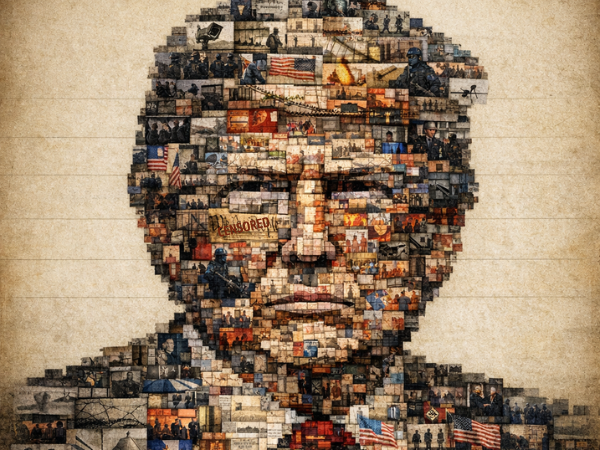
What was once dismissed as a joke—“Santa is watching”—has morphed into a chilling reality. Instead of elves, the watchers are data brokers, intelligence agencies, predictive algorithms, and fusion centers. Instead of a naughty-or-nice list, Americans are sorted into databases, risk profiles, and threat assessments—lists that never disappear.

The shift is subtle but profound.

Innocence is no longer presumed.

Everyone is watched. Everyone is scored. Everyone is a potential suspect.

This is the surveillance state in action.

Today’s surveillance state doesn’t require suspicion, a warrant, or probable cause. It is omnipresent, omniscient, and inescapable.

Your smartphone tracks your location. Your car records your movements. License plate readers log when and where you drive. Retail purchases create detailed consumer profiles. Smart speakers listen to everything you say. Home security cameras observe not just your property, but your neighbors, delivery drivers, and anyone who passes by.

The government’s appetite for data is insatiable.

In a dramatic expansion of surveillance reach, the Transportation Security Administration now shares airline passenger lists with Immigration and Customs Enforcement, enabling ICE to identify and arrest travelers at airports based on immigration status.

In one incident, ICE arrested and immediately deported a college student with no criminal record who was flying home to spend Thanksgiving with her family.

What was once routine aviation security data has been transformed into an enforcement tool—merging civilian travel records with the machinery of deportation and demonstrating how ordinary movements can be weaponized by the state.

Even the most personal acts—like Christmas shopping—are now tracked in real time. Every item you buy, where you buy it, how you pay, and who you buy it for becomes part of a permanent digital record. That data does not stay confined to retailers. It is shared, sold, aggregated, and folded into sprawling surveillance ecosystems that blur the line between corporate data collection and government intelligence.

Companies like Palantir specialize in fusing these data streams into comprehensive behavioral profiles, linking financial activity, social media behavior, geolocation data, and government records into a single, searchable identity map.

The result is not merely a government that watches what you’ve done but one that claims the power to predict what you will do next.

It is a short step from surveillance to pre-crime.

While predictive policing and AI-driven risk assessments are marketed as tools of efficiency and public safety, in reality, they represent a dangerous shift from punishing criminal acts to policing potential behavior.

Algorithms—trained on historical data already shaped by over-policing, bias, and inequality—are now used to predict who might commit a crime, who might protest, or who might pose a “risk.” Even the way you drive—where you came from, where you were going and which route you took—is being analyzed by predictive intelligence programs for suspicious patterns that could get you flagged and pulled over.

Once flagged by an algorithm, individuals often have no meaningful way to challenge the designation. The criteria are secret. The data sources opaque. The decisions automated.

Accountability disappears.

This isn’t law enforcement as envisioned by the Founders. This is pre-crime enforcement—punishing people not for what they’ve done, but for what an AI machine predicts they might do.

At the same time, President Trump has openly threatened states that attempt to regulate artificial intelligence in order to protect citizens from its discriminatory and intrusive uses—seeking to clear the way for unchecked, nationwide deployment of these systems.

No government initiative has done more to normalize, expand, and entrench mass surveillance than the Trump administration’s war on immigration.

The Trump administration’s war on immigration has become the laboratory for the modern surveillance state.

Under the guise of border security, vast stretches of the country have been transformed into Constitution-free zones—places where the Fourth Amendment is treated as optional and entire communities are subjected to constant monitoring.

The federal government has transformed immigration policy into a proving ground for authoritarian surveillance tactics—testing tools, technologies, and legal shortcuts could be deployed with minimal public resistance and quietly repurposed for use against the broader population. As journalist Todd Miller warned, these areas have been transformed into “a ripe place to experiment with tearing apart the Constitution, a place where not just undocumented border-crossers, but millions of borderland residents have become the targets of continual surveillance.”

Through ICE and DHS, the government fused immigration enforcement with corporate surveillance technologies—facial recognition, license-plate readers, cellphone tracking, and massive data-sharing agreements—creating a sprawling digital dragnet that now extends far beyond immigrants.

What began as a policy aimed at undocumented immigrants has now become a model for nationwide surveillance policing.

“What’s new,” reports the Brennan Center for Justice, “is that the federal government now openly says it will use its supercharged spy capabilities to target people who oppose ICE’s actions. Labeled as ‘domestic terrorists’ by the administration, these targets include anti-ICE protesters and anyone who allegedly funds them—all of them part of a supposed left-wing conspiracy to violently oppose the president’s agenda.”

The critical point is this: the surveillance infrastructure developed to track immigrants is now used to monitor everyone. Immigration enforcement served as the justification, the infrastructure, and the legal gray zone needed to create a permanent surveillance apparatus that treats all Americans as potential suspects.

All of this adds up to an algorithmic naughty list.

Government watchlists have exploded in size and scope.

Terrorist watchlists, no-fly lists, gang databases, protester tracking systems, and “suspicious activity” registries operate with little oversight and even less transparency.

People can be added to these lists without notification and can remain there indefinitely. Errors are common. Corrections are rare.

Social media posts are mined. Associations are mapped. Speech is scrutinized. Peaceful dissent is increasingly treated as a precursor to extremism.

The government’s watchlists aren’t just opaque databases hidden from public view. They are becoming public-facing instruments of political classification. Internal Justice Department memoranda now direct the FBI to compile lists of groups and networks it categorizes as possible domestic extremists, broadening counter-terror tools to sweep in ideological opponents and organizations without clear statutory definitions.

At the same time, the White House has launched an official “Offender Hall of Shame”—a public naughty list of journalists and media outlets it accuses of bias—even briefly circulating a video styled like Santa putting together a naughty list of offenders before deleting it amid backlash.

In this system, being “good” no longer means obeying the law. It means staying under the radar, avoiding attention, and never questioning authority.

The chilling effect is the point.

Once upon a time, privacy was recognized as a fundamental liberty—an essential buffer between the individual and the state. Today, it’s a conditional privilege, granted temporarily and revoked when it suits the police state’s purposes.

Under the banner of national security, public health, and law and order, surveillance powers continue to expand. Biometric identification—facial recognition, gait analysis, voice prints—are normalized.

What was once unthinkable has become routine.

Americans are being conditioned to accept constant monitoring as the price of safety. That resistance is suspicious. That anonymity is dangerous.

Yet history teaches us the opposite: societies that normalize surveillance do not become safer—they become more authoritarian.

A government that sees everything, everywhere, all the time, will eventually control everything.

The Founders understood this. That is why they enshrined protections against unreasonable searches and unchecked power. They knew liberty couldn’t survive under constant surveillance.

When the government knows where you go, what you buy, what you say, who you associate with, and what you believe, freedom becomes conditional.

This Christmas, we might joke about Santa watching from the North Pole, but we should be far more concerned about the watchers much closer to home.

The surveillance state doesn’t take a holiday. It doesn’t sleep. It doesn’t forget. And it doesn’t forgive easily.

So you see, the question is not whether we are being watched. We are.

The question, as I make clear in my book Battlefield America: The War on the American People and in its fictional counterpart The Erik Blair Diaries, is whether we will continue to accept a system that treats every citizen as a suspect—and whether we will reclaim the constitutional limits that once stood between liberty and the all-seeing state.

Source: https://tinyurl.com/yc6cmv9m

ABOUT JOHN W. WHITEHEAD

Constitutional attorney and author John W. Whitehead is founder and president of The Rutherford Institute. His most recent books are the best-selling Battlefield America: The War on the American People, the award-winning A Government of Wolves: The Emerging American Police State, and a debut dystopian fiction novel, The Erik Blair Diaries. Whitehead can be contacted at staff@rutherford.org. Nisha Whitehead is the Executive Director of The Rutherford Institute. Information about The Rutherford Institute is available at www.rutherford.org.

Publication Guidelines / Reprint Permission

John W. Whitehead’s weekly commentaries are available for publication to newspapers and web publications at no charge. 

“We the people are the rightful masters of both Congress and the courts, not to overthrow the Constitution but to overthrow the men who pervert the Constitution.”—Abraham Lincoln

We now live in a nation where constitutional rights exist in theory, not in practice.

Yet what good are rights on paper when every branch of government is allowed to ignore, circumvent, chip away at or hollow them out in practice?

Two hundred and thirty-four years after the ratification of the Bill of Rights on December 15, 1791, the safeguards meant to shield “We the people” from government abuse are barely recognizable.

In ways the Founders could scarcely have imagined—and would never have tolerated—the safeguards meant to restrain government overreach have become little more than empty platitudes.

America’s founders understood that power corrupts and absolute power—especially when it comes to power-hungry governments fixated on amassing institutional power at the expense of individual freedoms—corrupts absolutely. That’s why they insisted on binding down the government “with the chains of the Constitution.”

In 2025, those chains have been cut link by link.

These links were not severed in secret. They snapped under the weight of executive orders issued without congressional authority, judicial doctrines that shield misconduct from accountability, and a Congress that no longer defends its own constitutional prerogatives.

If Americans are finally learning the true significance of constitutional limits, it is because the government keeps violating them—and daring anyone to stop it. Time and again, the message is being drummed into our heads that constitutional limits no longer apply when they inconvenience those in power.

Any government that treats rights as privileges—contingent on economic status, citizenship, race, orientation, religious beliefs, or political alignment—has already abandoned the Bill of Rights.

And a government that does so with the courts’ blessing is not a constitutional republic.

When rights become privileges, what we are left with is a two-tier system of freedom: those afforded the privilege of enjoying their constitutional rights vs. those targeted for exercising those same rights.

The Bill of Rights was intended as a bulwark. Each amendment was drafted as a barrier against a specific form of tyranny.

In 2025, every one of those barriers buckled under the weight of government corruption, political expediency, partisan politics, and institutional neglect.

The following is what it looked like to live without the protections of the Bill of Rights in the American police state.

First Amendment—Speech Without Protection: In 2025, the right to speak freely was not guaranteed—it was conditional. Political activism—especially around immigration, foreign policy, or policing—was treated as a national security concern. Students questioning government actions found themselves on watchlists. ICE agents used ideology as cause for detention. Peaceful protest was conflated with domestic extremism.

This year also saw revelations—via leaked FBI planning documents—that the government is preparing an expanded “extremist” classification system that goes far beyond violence or criminal activity. The categories include broad ideological markers that include anyone expressing “opposition to law and immigration enforcement; extreme views in favor of mass migration and open borders; adherence to radical gender ideology,” as well as labels such as “anti-Americanism,” “anti-capitalism,” and “anti-Christianity.” In other words, Americans are being profiled not for what they have done, but for what the government predicts they might think, believe, or someday express. It is the architecture of a pre-crime state.

Second Amendment—The Right to Self-Defense in a Militarized Nation. While the political class fixated on culture-war debates over gun ownership, the government quietly expanded the militarization of policing, federalized National Guard units, and broadened executive authority to deploy armed agents domestically. During several high-profile ICE operations, heavily armed federal teams equipped with military-grade gear conducted raids in residential neighborhoods, making it clear that this administration intends to rule by martial law.

Third Amendment—Quartering Without Quarters: The Rise of Domestic Militarization. The Third Amendment is often dismissed as obsolete. Nothing could be further from the truth. Although Americans no longer face the literal quartering of soldiers in their homes, the spirit of the Third Amendment—prohibiting the use of the military against the civilian population—has been trampled. Its purpose was to prevent exactly what we are seeing now: a permanent, militarized presence in civilian life, illustrated vividly when armored vehicles and tactical teams patrol residential neighborhoods during ICE operations.

Fourth Amendment—Privacy Without Boundaries. The Framers wrote the Fourth Amendment in response to “general warrants”: broad, suspicionless searches by the British Crown. In 2025, the digital equivalents of general warrants have become routine, executed at the speed of an algorithm and justified by the flimsiest of standards. Americans now live under surveillance so pervasive that privacy survives mostly in legal theory. In several cities, entire apartment complexes were subjected to geofence dragnets after minor incidents, sweeping innocent residents into criminal databases simply because their phones were nearby. Geofence warrants became routine, sweeping up location data from entire neighborhoods. Predictive policing tools—fueled by Palantir-style data fusion—were treated as legitimate substitutes for suspicion or probable cause. And the Supreme Court keeps lowering the threshold for intrusion.

Fifth & Sixth Amendments—Due Process Without Process. What we have seen emerge this year is a justice system where the government is accountable only to itself. Immigration courts—already overcrowded and under-resourced—operated as Constitution-lite tribunals where counsel was scarce, evidence was opaque, and the presumption of innocence evaporated. Executive detention powers continued to expand under the radar, with little oversight. Due process now bends to government expediency. For example, asylum seekers placed into “expedited removal” proceedings were denied meaningful hearings, legal counsel, or the ability to present evidence—procedures that would never withstand constitutional scrutiny in any ordinary court of law. In some instances, hearings lasted less than ten minutes. In others, decisions were issued without the accused ever speaking to a lawyer. This is not due process. It is bureaucracy masquerading as justice.

Seventh Amendment—Civil Justice Denied by Design. The right to a civil jury trial—already inaccessible for many—continued to erode in 2025, keeping ordinary Americans from ever getting their day in court, while corporations and government agencies enjoy legal shields that no ordinary citizen can penetrate. A right that exists only in theory—and which you cannot afford to exercise—is a right that has already been lost.

Eighth Amendment—Justice Without Humanity. Cruelty, once hidden, has now been codified as policy. The federal government allocated $170 billion to expand incarceration, including the construction of Alligator Alcatraz, the first of several planned megaprison complexes. The Kilmar Garcia case exposed the brutality of a system where preventable death, medical neglect, and inhumane conditions are treated as regrettable but acceptable collateral. In one widely reported incident, a detainee held on a nonviolent immigration violation died after being denied medical care for hours—a tragedy officials dismissed as “procedurally compliant,” revealing just how low the bar has fallen. These incidents are not anomalies. They are symptoms of a system designed for maximum control and minimum accountability, a system where cruelty is not an accident but an administrative outcome.

Ninth Amendment—Unenumerated Rights Crushed by Government Power. The Ninth Amendment affirms that the people retain rights beyond those listed in the Constitution. In 2025, those inherent liberties—bodily autonomy, privacy, freedom of movement, freedom from government coercion—were repeatedly undermined. Biometric surveillance was expanded. Predictive analytics categorized individuals as pre-criminal. Mandatory data-sharing regimes blurred the boundary between state and citizen. Bodily autonomy came under attack through proposed health-tracking mandates.

The Ninth Amendment’s warning has never been more relevant: the rights of the people do not end where the government’s imagination begins.

Tenth Amendment—Powers Reserved to the People Swept Aside. Federal overreach dominated 2025. Executive orders, emergency declarations, and federalized law enforcement displaced state and local authority. The Tenth Amendment’s guarantee that powers not delegated to the federal government are reserved to the states—or to the people—has become meaningless under a system in which the executive branch claims inherent authority to:

  • deploy troops domestically,
  • commandeer local police,
  • surveil the populace, and
  • dictate immigration enforcement priorities.

When states attempted to challenge the federal deployment of troops or resist federalized policing mandates, the courts largely sided with the executive, leaving states with little more than symbolic sovereignty.

A government that disregards the Bill of Rights rarely stops there.

The collapse of the Bill of Rights would be alarming enough on its own, but it is only part of the story. Beyond these first ten amendments, the structural safeguards designed to limit government power—the separation of powers, checks and balances, transparency, and federalism—were also weakened dramatically.

Without an independent judiciary willing to restrain power, the founders recognized that the entire constitutional framework would collapse.

What we continue to witness is the U.S. Supreme Court’s abdication of its constitutional duties in favor of partisan politics. By refusing to review cases that cut to the heart of constitutional protections, the Court has effectively signaled to the executive branch that there is no constitutional line it cannot cross.

While the Supreme Court is not the only institution responsible for upholding the Constitution, when the Court refuses to act as a check on government power, every American suffers.

A constitutional crisis does not always erupt in dramatic fashion.

Sometimes it arrives quietly, in the form of a Court that declines to hear the very cases that would determine whether the Constitution still has meaning.

Here is what it means to live under the Constitution today.

For generations, Americans were taught that living under the Constitution meant:

  • The government cannot enter your home without a warrant.
  • The government cannot silence you for criticizing its actions.
  • The government cannot surveil you without probable cause.
  • The government cannot imprison you without due process.
  • The government cannot treat you as guilty until proven innocent.
  • The government cannot deploy troops against the public unless the Constitution expressly allows it.
  • The government cannot classify you as a threat solely for your beliefs.

Now consider what it means to live under the American Police State of 2025:

  • Your digital life is a government search zone.
  • Your speech can place you on a watchlist.
  • Your movements are tracked without a warrant.
  • Your property can be seized without meaningful judicial review.
  • Your community can be subjected to predictive policing algorithms with no oversight.
  • Your rights depend on which legal category you fall into.
  • And the courts increasingly refuse to intervene.

The gap between the promise of a constitutional republic and the practice of the American Police State has grown so vast that the rights Americans take for granted no longer resemble the realities they face in their daily lives.

America’s founders assumed the people—not the president, not the politicians, not the courts—would be the ones to keep the government in check.

What the police state wants is for us to meekly accept its constitutional violations as normal, inevitable, or justified. That complacency fuels and sustains tyranny.

We cannot afford to be complacent.

If Americans want a government bound by law, we must insist on it—daily, loudly, relentlessly and without apology or fear.

As I make clear in my book Battlefield America: The War on the American People and in its fictional counterpart The Erik Blair Diaries, the Constitution will not collapse all at once. It will erode one unchallenged abuse at a time—until future generations wonder how the people who inherited a framework for liberty allowed it to slip through their fingers.

If 2025 was the year the Constitution became optional, 2026 will determine whether it becomes obsolete.

Source: https://tinyurl.com/mvses7du

ABOUT JOHN W. WHITEHEAD

Constitutional attorney and author John W. Whitehead is founder and president of The Rutherford Institute. His most recent books are the best-selling Battlefield America: The War on the American People, the award-winning A Government of Wolves: The Emerging American Police State, and a debut dystopian fiction novel, The Erik Blair Diaries. Whitehead can be contacted at staff@rutherford.org. Nisha Whitehead is the Executive Director of The Rutherford Institute. Information about The Rutherford Institute is available at www.rutherford.org.

Publication Guidelines / Reprint Permission

John W. Whitehead’s weekly commentaries are available for publication to newspapers and web publications at no charge. 

WASHINGTON, DC — In a ruling that leaves thousands of military servicemembers and their families without meaningful recourse when the government’s negligence causes harm, the U.S. Supreme Court has declined to reconsider a 1950 judicial doctrine that prevents military personnel from suing the federal government for non-combat injuries deemed “incident to service,” even when a civilian in the same situation could bring a claim.

For decades, the Feres doctrine has drawn criticism across the ideological spectrum for its expansive and often devastating consequences. Courts have interpreted “incident to service” so broadly that it now bars claims arising from medical malpractice, car accidents, and even sexual assault by another servicemember—harms far removed from the battlefield. The Rutherford Institute and the Constitutional Accountability Center had filed an amicus brief in Beck v. United States, urging the Court to overturn Feres because it contradicts the text and purpose of the Federal Tort Claims Act (FTCA) and denies military families the same legal protections afforded to civilians.

“No American should be denied the right to hold the government accountable for negligence and harm merely because they wear a military uniform,” said constitutional attorney John W. Whitehead, president of The Rutherford Institute and author of Battlefield America: The War on the American People. “The Constitution does not permit a two-tiered system of justice—one for civilians and a lesser one for those who serve—and neither should we.”

Staff Sergeant Cameron Beck was living and working at Whiteman Air Force Base in Missouri, serving on active duty in the Wing Cybersecurity Office. One afternoon, he drove home for lunch with his wife and seven-year-old son. As he traveled along a Base road, a civilian federal employee—driving a government-owned van while distracted by her cell phone—struck and killed him. She later pleaded guilty to operating her vehicle in a careless and imprudent manner and admitted the crash was “100 percent” her fault.

Beck’s widow and son filed a wrongful-death lawsuit under the FTCA, the law that allows individuals to sue the federal government for negligence of its employees. But because Beck happened to be on Base, on active duty, and subject to recall—even though he was riding home during off-duty hours and was not engaged in a military activity—the lower courts dismissed the case under the Feres doctrine. Therefore, the government could not be held liable, and the family was left with no meaningful path to justice.

While the family received some limited benefits from the Department of Veterans Affairs and the Department of Defense, Justice Thomas (who dissented from the Court’s decision in this case) has pointed out that these benefits often amount to only a fraction of what a civilian family could obtain in court. Yet, Feres bars lawsuits by servicemembers when a civilian would be allowed to sue based on the same acts by the same federal employee. The amicus brief in Beck warned that the Feres doctrine has drifted so far from its original purpose that it now bars even the most straightforward negligence claims—such as the careless operation of a government vehicle by a civilian employee that results in the death of a servicemember not engaged in any military activity.

Miriam Becker-Cohen, Brianne J. Gorod, Elizabeth B. Wydra, and Nargis Aslami with the Constitutional Accountability Center advanced the arguments in the Beck amicus brief.

The Rutherford Institute, a nonprofit civil liberties organization, defends individuals whose constitutional rights have been threatened or violated and educates the public on a wide spectrum of issues affecting their freedoms.

Source: https://tinyurl.com/yc5ukebt

“The United States boldly broke with the ancient military custom of swearing loyalty to a leader. Article VI required that American Officers thereafter swear loyalty to our basic law, the Constitution… Our American Code of Military Obedience requires that, should orders and the law ever conflict, our officers must obey the law… This nation must have military leaders of principle and integrity so strong that their oaths to support and defend the Constitution will unfailingly govern their actions.”—“Loyalty to the Constitution” plaque located on the grounds of the United States Military Academy

Every military servicemember’s oath is a pledge to defend the Constitution against all enemies, foreign and domestic.

It is not an oath to a politician. It is not an oath to a party. And it is not an oath to the police state.

Yet what happens when those same men and women are being told—by their own government—that obedience to power and loyalty to a political leader come before allegiance to the Constitution they swore to uphold?

That question isn’t hypothetical.

It is the moral line now being tested in real time, and it goes to the heart of what kind of country we are: do we live in a constitutional republic governed by the rule of law, or in a militarized police state where “legality” is whatever the person with the most power and the biggest army say it is?

The answer becomes painfully clear when you look at what our troops are being ordered to do—and what “we the people” are tacitly allowing them to be ordered to do—in the so-called name of national security.

Members of the military are now being deployed domestically to police their fellow American citizens in ways that trample the spirit, if not the letter, of the Posse Comitatus Act.

It’s legally dubious enough that the military is being used to enforce immigration crackdowns and police protests in American cities. But now they’re being tasked with killing civilians far from any declared battlefield in the absence of an imminent threat—all while being told that questioning the legality of those missions is itself a form of disloyalty.

So, which is it: obedience to the Constitution or the Commander-in-Chief?

At the center of this latest maelstrom is a report that Defense Secretary Pete Hegseth issued a verbal order to “kill everybody” on a maritime vessel in the Caribbean that was suspected of transporting drugs.

According to multiple accounts, after an initial “lethal, kinetic” strike disabled the vessel and killed nine men on board, a second strike was carried out to kill two survivors clinging to the wreckage—an alleged “double tap strike” that legal experts warn could constitute murder or a war crime if the survivors no longer posed a threat.

In all, the boat was reportedly hit four times: twice to kill the eleven occupants on board and twice more to sink the boat.

Intentionally killing survivors clinging to the remains of a boat in the middle of the ocean, in the absence of an imminent threat, whether or not the U.S. is engaged in “armed conflict” with drug cartels, is unlawful.

Murder on the high seas is a crime.

Even the Pentagon’s manual on the law of war says combatants who are “wounded, sick, or shipwrecked” no longer pose a threat and should not be attacked.

Some Republicans who have, until now, turned a blind eye to the Trump administration’s most egregious offenses against the Constitution appear reluctant to let this one slide.

Not surprisingly, the Trump administration has done an about-face.

Hegseth—who bragged about watching the September 2 strike live—now claims he wasn’t in the room when the second strike happened.

Suddenly, the White House—which had been gleefully chest-thumping over its power to kill extrajudicially—is signaling its willingness to scapegoat subordinates in the chain of command.

The man with his head on the chopping block is Adm. Frank M. “Mitch” Bradley.

Clearly, it’s a lesson learned too late: when you’re dealing with power-hungry authoritarians, loyalty is no guarantee of protection. It’s always the men and women who carry out the unlawful orders—not the ones who give them—who end up paying the price.

Here’s the problem, though. While the media fixates on who will bear the blame for ordering the double-tap strike, the government war machine is moving forward, full steam ahead.

The Sept. 2 boat strike was part of a broader Trump administration campaign of maritime attacks that has already killed at least 80 people at sea, all without a formal declaration of war or due process—evidence of who they were or what they had done—to warrant an extrajudicial execution.

This is yet another of Trump’s everywhere, endless wars—this time at sea—sold as toughness on “narco-terrorists” at a moment when his poll numbers are slipping, economic promises have failed to manifest, and new Epstein-related revelations continue to surface.

When presidents manufacture new fronts in a forever war whenever they need a distraction, we should all beware.

The Trump administration has tried to frame this preemptive maritime war on suspected “narco-terrorists” as a “non-international armed conflict” with designated terrorist organizations.

Yet what it amounts to is an undeclared war, launched in international waters, without just cause and without congressional authorization.

The legal landscape is not murky—it is clear.

Most of the public debate has revolved around those technical legalities—what kind of conflict this is, which statutes apply, which court might have jurisdiction—yet what is really at stake is whether we are training a generation of American troops to believe that loyalty to a leader can excuse disobedience to, or even override, the Constitution.

Three bodies of law converge here: the Constitution’s allocation of war powers, the international law of armed conflict, and the Uniform Code of Military Justice.

First, there has been no declaration of war by Congress. Under the Constitution, only Congress can declare war. The president cannot start wars based solely on his own authority.

Second, the law of armed conflict and the law of the sea forbid killing shipwrecked survivors who pose no immediate threat.

Third, the Uniform Code of Military Justice requires every servicemember to refuse manifestly unlawful orders.

A command to “kill everybody” is precisely the kind of order these guardrails were written to forbid.

The rationale that “I was just following orders” is not a defense to war crimes. That is the core lesson of the Nuremberg Trials and the modern law of armed conflict.

Of course, the police state wants mindless automatons who obey unquestioningly.

Reporting on the trial of Nazi bureaucrat Adolf Eichmann for the New Yorker in 1963, Hannah Arendt explained, “The essence of totalitarian government, and perhaps the nature of every bureaucracy, is to make functionaries and mere cogs in the administrative machinery out of men, and thus to dehumanize them.”

Arendt, a Holocaust survivor, denounced Eichmann, a senior officer who organized Hitler’s death camps, for being a bureaucrat who unquestioningly carried out orders that were immoral, inhumane and evil. This, Arendt concluded, was the banality of evil, the ability to engage in wrongdoing or turn a blind eye to it, without taking any responsibility for your actions or inactions.

Coincidentally, the same year that Arendt’s book Eichmann in Jerusalem: A Report on the Banality of Evil was published, Martin Luther King Jr. penned his “Letter from a Birmingham Jail,” in which he points out “that everything Adolf Hitler did in Germany was ‘legal’ and everything the Hungarian freedom fighters did in Hungary was ‘illegal.’ It was ‘illegal’ to aid and comfort a Jew in Hitler’s Germany.”

In other words, there comes a time when law and order are in direct opposition to justice.

Every military recruit is supposed to learn in basic training that there is a duty to obey lawful orders, and an equal duty to disobey manifestly unlawful orders.

No president—Republican or Democrat—can override that principle.

The Commander-in-Chief may issue orders, but he does not get to erase the Constitution or rewrite the laws of war by fiat.

The White House rationale—that a preemptive “kill everybody” attack “was conducted in self-defense to protect U.S. interests”—should terrify every American.

If the government can redefine “self-defense” to justify killing incapacitated survivors on a sinking boat, then it can justify killing anyone—at home or abroad, in uniform or out of it.

No matter how the White House spins it, however, these are crimes and those involved—from Hegseth on down—could find themselves in legal jeopardy and should be held accountable.

The pressure on the military is mounting.

The Orders Project, a nonpartisan initiative that helps connect servicemembers with outside legal counsel, reports a spike in calls from military personnel concerned that they could be asked to carry out an illegal order or pressured to take part in missions that violate their training in the laws of war.

Given Hegseth’s much-publicized approach to waging war without constraints—he has openly derided the military’s Judge Advocate General corps and championed a more “unshackled” approach to lethal force—these concerns are reasonable.

Indeed, there has been enough cause for concern that six members of Congress, all with military or national security backgrounds, recorded a message reminding servicemembers what the law requires: “Our laws are clear. You can refuse illegal orders…you must refuse illegal orders. No one has to carry out orders that violate the law or our constitution.

For re-stating what every recruit is taught in basic training, these lawmakers have been accused by President Trump of “sedition” and branded as “traitors” who should be arrested and punished by death. The FBI has reportedly opened an investigation. Hegseth has even threatened to recall one of the lawmakers—Senator Mark Kelly, a retired Navy captain—to active duty in order to court-martial him for his remarks.

The message from the top could not be clearer: allegiance to the Constitution is a crime.

Every person like myself who has served in uniform has experienced the tension between following orders and honoring that oath. Discipline requires obedience, but a constitutional republic requires lawful obedience.

That is why the oath matters.

It is not an oath to a man, a party, or a policy agenda. It is an oath to a charter of law: the Constitution.

At West Point, a 1943 “Loyalty to the Constitution” plaque proclaims: “should orders and the law ever conflict, our officers must obey the law.”

That principle is not antiquated. It is the foundation of American civil-military relations. Remove it, and what remains is not a republic but a personality cult with weapons.

The danger becomes even clearer when you examine the rhetoric now shaping national policy.

For instance, Homeland Security Secretary Kristi Noem recently urged the president to impose “a full travel ban on every damn country that’s been flooding our nation with killers, leeches, and entitlement junkies.”

A harsher irony is hard to find.

A good case could be made that it is, in fact, the U.S. government that is flooding our nation with killers, leeches, and entitlement junkies. Just consider Trump’s steady spate of presidential pardons, the latest to Juan Orlando Hernández, the former president of Honduras, who had been sentenced to 45 years in prison for conspiring with drug traffickers to move cocaine into the U.S.

According to U.S. prosecutors, Hernández—quoted as saying he wanted to “shove the drugs right up the noses of the gringos by flooding the United States with cocaine”—took bribes from drug traffickers and had the country’s armed forces protect a cocaine laboratory and shipments to the U.S.

So the president is blowing up boats in the Caribbean he claims—without proof—are ferrying drugs all the while pardoning someone who was convicted of conspiring to transport hundreds of tons of cocaine into the U.S.

This corrupt double standard has become business as usual for the Trump administration.

Now Trump wants to launch land attacks on Venezuela, a country that is conveniently richer in oil reserves than Iraq—all in the so-called name of fighting the war on drugs.

The rapid buildup of U.S. military forces in the Caribbean—which according to news reports includes a range of aircraft carriers, guided-missile destroyers, and amphibious assault ships capable of landing thousands of troops, as well as a nuclear-powered submarine and spy planes—far exceeds what would be needed for a supposed counternarcotics operation and is worrisome enough on its own.

Yet conscripting the military to do the dirty work of the police state—and then throwing them under the bus for doing so—takes us into even darker territory.

The U.S. government’s weaponization of the armed forces for political power is a betrayal of the Constitution, but it is also a betrayal of the very men and women who swore to give their lives for it.

This has never been about public safety.

As I make clear in my book Battlefield America: The War on the American People and in its fictional counterpart The Erik Blair Diaries, this has always been about power—who wields it, who is protected by it, and who is crushed under it.

And once a government shows a willingness to break faith with its defenders, it will break faith with anyone.

A government that can discard its military service members can discard its whistleblowers and truth-tellers who expose corruption.

A government that can discard its military service members can discard its journalists, judges, and watchdogs in the press and the courts who insist on transparency and limits to power.

A government that can discard its military service members can discard its political opponents and dissidents, its religious and racial minorities, its immigrants and asylum seekers, its small business owners and workers who organize, its parents and community members who speak up locally, and any citizen who dares to say “no” when the state demands “yes.”

This betrayal of those who swore an oath to the Constitution is not an accident—it is a warning.

Be warned.

Source: https://tinyurl.com/5xaj9s93

ABOUT JOHN W. WHITEHEAD

Constitutional attorney and author John W. Whitehead is founder and president of The Rutherford Institute. His most recent books are the best-selling Battlefield America: The War on the American People, the award-winning A Government of Wolves: The Emerging American Police State, and a debut dystopian fiction novel, The Erik Blair Diaries. Whitehead can be contacted at staff@rutherford.org. Nisha Whitehead is the Executive Director of The Rutherford Institute. Information about The Rutherford Institute is available at www.rutherford.org.

Publication Guidelines / Reprint Permission

John W. Whitehead’s weekly commentaries are available for publication to newspapers and web publications at no charge. 

Today is Giving Tuesday—a day when people across the country choose to support the causes that matter most. And this year, the stakes for freedom could not be higher.

Everywhere we turn, the government is expanding its power:

·       Surveillance programs are monitoring ordinary Americans.

·       Executive orders are being used to bypass constitutional limits.

·       Police powers are growing more militarized and unchecked.

·       Dissenters are being censored, silenced, and punished.

·       The Bill of Rights is treated as optional—especially when inconvenient.

The Constitution cannot defend itself—and defending it has nothing to do with politics.

At a time where every issue is twisted into a partisan wedge, The Rutherford Institute remains committed to something far more enduring: the rule of law, the Bill of Rights, and the fundamental liberties that belong to all Americans—no matter who holds power.

 We don’t play politics. We don’t take sides. We stand on the side of the Constitution.

The Constitution needs people who are willing to stand up. People who refuse to surrender their freedoms quietly. People who say “no” to the steady erosion of their rights. 

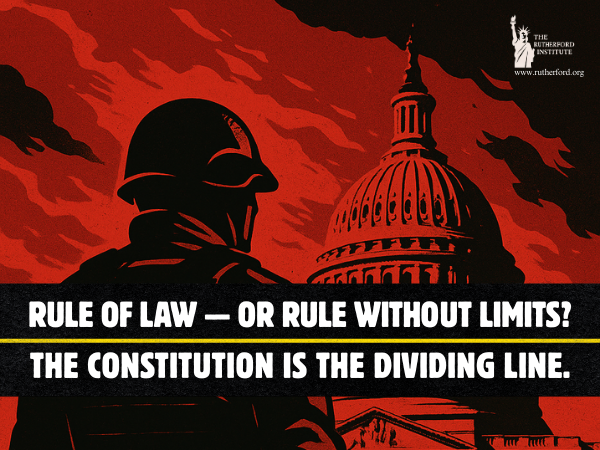
The Constitution draws a clear line between the rule of law and the rule of power. The Rutherford Institute is working to hold that line.

Giving Tuesday contributions—no matter the size—help ensure that The Rutherford Institute can:

·       Challenge government abuse in the courts

·       Defend victims of censorship and retaliation

·       Expose unconstitutional behavior

·       Hold officials accountable for violating the rule of law

·       Speak truth to power without fear or favor

Our work has never been more critical. In recent months, The Rutherford Institute has:

·       Fought warrantless digital surveillance in cases challenging geofence searches and mass data sweeps.

·       Defended students, journalists, and activists targeted for their protected speech.

·       Challenged the use of excessive police force and militarized tactics in situations where the Fourth Amendment was ignored.

·       Opposed executive actions that bypass constitutional safeguards and expand unchecked government power.

Every one of these battles depends on supporters who believe the Constitution still matters.

Thanks to a $250,000 Matching Gift Challenge Grant, Giving Tuesday contributions will go twice as far in helping The Rutherford Institute hold the constitutional line against government overreach.