Archive for June, 2025

“Experience should teach us to be most on our guard to protect liberty when the government’s purposes are beneficent. Men born to freedom are naturally alert to repel invasion of their liberty by evil-minded rulers. The greatest dangers to liberty lurk in insidious encroachment by men of zeal, well-meaning but without understanding.”—Justice Louis D. Brandeis

While the U.S. wages war abroad—bombing Iran, escalating conflict, and staging a spectacle of power for political gain—a different kind of war is being waged here at home.

This war at home is quieter but no less destructive. The casualties are not in distant deserts or foreign cities. They are our freedoms, our communities, and the Constitution itself.

And the agents of this domestic war? Masked thugs. Unmarked vans. Raids. Roundups.

Detentions without due process. Retaliation against those who dare to question or challenge government authority. People made to disappear into bureaucratic black holes. Fear campaigns targeting immigrant communities and political dissenters alike. Surveillance weaponized to monitor and suppress lawful activity.

Packaged under the guise of national security—as all power grabs tend to be—this government-sanctioned thuggery masquerading as law-and-order is the face of the Trump Administration’s so-called war on illegal immigration.

Don’t fall for the propaganda that claims we’re being overrun by criminals or driven into the poorhouse by undocumented immigrants living off welfare.

The real threat to our way of life comes not from outside invaders, but from within: an unelected, unaccountable enforcement agency operating above the law.

President Trump insists that ICE (Immigration and Customs Enforcement) is focused on violent criminals, but the facts tell a different story (non-criminal ICE arrests have surged 800% in six months)—and that myth is precisely what enables the erosion of rights for everyone.

By painting enforcement as narrowly targeted, the administration obscures a far broader dragnet that sweeps up legal residents, naturalized citizens, and native-born Americans alike.

What begins with immigrants rarely ends there.

According to the Cato Institute, 65 percent of people taken by ICE had no convictions, and 93 percent had no violent convictions at all.

This isn’t targeted enforcement—it’s indiscriminate purging.

What ICE—an agency that increasingly resembles a modern-day Gestapo—is doing to immigrants today, it can and will do to citizens tomorrow: these are the early warning signs of a system already in motion.

The machinery is in place. The abuses are ongoing. And the constitutional safeguards we rely on are being ignored, dismantled, or bypassed entirely.

When legal residents, naturalized citizens, and native-born Americans are swept up in ICE’s raids, detained without cause, and subjected to treatment that defies every constitutional protection against government overreach, this isn’t about immigration.

It’s not about danger. It’s about power—unchecked and absolute.

This is authoritarianism by design.

Here are just a few examples of how ICE’s reach now extends far beyond a criminal class of undocumented immigrants:

This pattern of abuse is not accidental.

It reflects a deliberate strategy of fear and domination by ICE agents acting like an occupying army, intent on intimidating the population into submission while the Trump Administration redraws the boundaries of the Constitution for all within America’s borders, citizen and immigrant alike.

This is how you dismantle a constitutional republic: not in one dramatic moment, but through the steady erosion of rights, accountability, and rule of law—first for the marginalized, then for everyone.

When constitutional guarantees become conditional and oversight is systematically evaded, all Americans—regardless of status—stand vulnerable to a regime that governs by fear rather than freedom.

We’ve seen this playbook before.

It’s the same strategy used by fascist regimes to consolidate power—using fear, force, and propaganda to turn public institutions into instruments of oppression.

ICE raids often occur without warrants. Agents frequently detain individuals not charged with any crime. Homes, schools, hospitals, workplaces, and courthouses have all become targets. Agents in plain clothes swarm unsuspecting individuals, arrest them without explanation, and separate families under the pretense of national security. In many cases, masked agents refuse to identify themselves at all—creating a climate of terror where the public cannot distinguish lawful enforcement from lawless abduction.

This is not justice. It is intimidation. And it has become business as usual.

ICE has even begun deputizing local police departments to carry out these raids.

Through an expanded network of partnerships, ICE has turned routine traffic stops into pipelines for deportation. According to The Washington Post, immigrants stopped on the way to volleyball practice, picking up baby formula, or heading to job sites have been detained and, in some cases, sent to a notorious mega-prison in El Salvador.

This is what politicizing and weaponizing local police looks like.

Even members of Congress attempting to exercise constitutional oversight have been turned away from ICE facilities. As The New York Times reported, ICE now claims the authority to “deny a request or otherwise cancel” congressional visits based on vague “operational concerns”—effectively placing its operations beyond democratic scrutiny.

Beyond the high-profile arrests, the abuse runs deeper.

Julio Noriega, a 54-year-old American citizen, was snatched up off the street and detained in Chicago for 10 hours without explanation. Leonardo Garcia Venegas, a U.S.-born citizen, was detained because ICE dismissed his REAL ID as fake. Cary López Alvarado, a pregnant U.S. citizen, was handcuffed and arrested for challenging ICE agents who had followed her fiancé to work. Children, veterans, and immunocompromised individuals have all suffered under ICE’s dragnet.

These are not outliers. They are the product of a system that operates without meaningful checks.

ICE agents are rarely held accountable. Internal investigations are ineffective. Congress has abdicated oversight. Directives from the Trump administration—including those authored by Stephen Miller—have turbocharged deportations and loosened any remaining restraints.

From boots on the ground to bytes in the cloud, ICE’s unchecked power reflects a broader shift toward authoritarianism, fueled by high-tech surveillance, public indifference and minimal judicial oversight. The agency operates a sprawling digital dragnet: facial recognition, license plate readers, cellphone tracking, and partnerships with tech giants like Amazon and Palantir feed massive databases—often without warrants or oversight.

These same tools—hallmarks of a growing surveillance state—are now being quietly repurposed across other federal agencies, setting the stage for an integrated surveillance-policing regime that threatens the constitutional rights of every American.

This isn’t about safety. It’s about control.

These tools aren’t just targeting undocumented immigrants—they’re laying the digital scaffolding for a future in which everyone is watched, scored, and subject to state suspicion.

Quotas over justice. Algorithms over rights.

ICE’s operations have little to do with individualized threat assessments. What drives these raids is not public safety but bureaucratic performance. Field offices are under pressure to meet arrest quotas, creating a system that incentivizes indiscriminate sweeps over focused investigations.

As Jennie Taer writes for the NY Post:

“The Trump administration’s mandate to arrest 3,000 illegal migrants per day is forcing ICE agents to deprioritize going after dangerous criminals and targets with deportation orders, insiders warn. Instead, federal immigration officers are spending more time rounding up people off the streets… Agents are desperate to meet the White House’s high expectations, leading them to leave some dangerous criminal illegal migrants on the streets, and instead look for anyone they can get their hands on at the local Home Depot or bus stop.”

Predictive algorithms and flawed databases replace constitutional suspicion with digital hunches, turning enforcement into a numbers game and transforming communities into statistical targets.

Constitutional safeguards are being replaced by digital suspicion.

We now live in a nation where lawful dissent—especially from immigrants or those perceived as outsiders—can place someone under state suspicion. The line between investigation and persecution has been erased.

Fear needs fuel.

And ICE finds it in propaganda: just as the Gestapo used propaganda to justify its cruelty, ICE relies on the language of fear and division. When the government labels people “invaders,” “animals,” or “thugs,” it strips them of humanity—and strips us of our conscience.

This rhetoric serves to distract and divide. It normalizes abuse. And it ensures that, once targeted, no one is safe.

The construction of a new ICE mega-prison in Florida—nicknamed “Alligator Alcatraz” for its proposed moat and remote location—serves as a grotesque symbol of the Trump Administration’s mass deportation agenda: out of sight, beyond accountability, and surrounded by literal and bureaucratic barriers to due process.

And Trump’s shifting stance on industries that rely on migrant labor—one moment threatening crackdowns, the next signaling exemptions for hotels, farms, and construction—reveals what this campaign is really about: not security, but political theater.

It’s not about danger; it’s about dominance.

But the crisis isn’t just rhetorical. It’s systemic. Agents are trained to obey, not to question. Immunity shields misconduct. Whistleblowers are punished. Watchdogs are ignored. Courts too often defer to executive power.

This is not law enforcement—it is authoritarian enforcement.

And it’s not limited to immigrants. It’s creeping into every corner of American life.

When a government can detain its own citizens without due process, punish political dissent, and target individuals for what they believe or how they look, it is no longer governed by law. It is governed by fear.

The Constitution was designed to prevent this. But rights are meaningless when no one is held accountable for violating them.

That is why the solution must go beyond the ballot box.

We must dismantle the machinery of oppression that enables ICE to act as judge, jury, and jailer.

Congress must ban warrantless raids, end predictive profiling, and prohibit mass surveillance. It must enforce real oversight and revoke the legal shields that insulate abusive agents from consequences.

We must reassert the rule of law, not just through legislation, but through a cultural recommitment to constitutional values. That includes transparency, demilitarization, and equal protection for all—citizens and non-citizens alike.

This is not just a fight over immigration policy. It’s a battle for the soul of our nation.

ICE is not the exception. It is the prototype.

As I make clear in my books Battlefield America: The War on the American People and A Government of Wolves: The Emerging American Police State, the same blueprint is being applied across the federal landscape: to protest monitoring, dissent suppression, and data-mined predictive policing.

If we fail to dismantle the ICE model, we normalize it—and risk reproducing it everywhere else.

ICE has become the beta test—perfecting the merger of technology, policing, and executive power that could soon define American governance as a whole.

Make no mistake: when fear becomes law, freedom is the casualty.

If we don’t act soon, we may find that the Constitution is the next to be detained.

James Madison warned that “the accumulation of all powers, legislative, executive, and judiciary, in the same hands… may justly be pronounced the very definition of tyranny.”

When ICE acts as enforcer, jailer, and judge for the president, those fears are no longer theoretical—they are the daily reality for countless people within U.S. borders.

Source: https://tinyurl.com/fc2ffn45

ABOUT JOHN W. WHITEHEAD

Constitutional attorney and author John W. Whitehead is founder and president of The Rutherford Institute. His most recent books are the best-selling Battlefield America: The War on the American People, the award-winning A Government of Wolves: The Emerging American Police State, and a debut dystopian fiction novel, The Erik Blair Diaries. Whitehead can be contacted at staff@rutherford.org. Nisha Whitehead is the Executive Director of The Rutherford Institute. Information about The Rutherford Institute is available at www.rutherford.org.

Publication Guidelines / Reprint Permission

John W. Whitehead’s weekly commentaries are available for publication to newspapers and web publications at no charge.

“Every gun that is made, every warship launched, every rocket fired signifies, in the final sense, a theft from those who hunger and are not fed, those who are cold and are not clothed.”—President Dwight D. Eisenhower (April 16, 1953)

Seventy years after President Dwight D. Eisenhower warned about the cost of a military-industrial complex, America is still stealing from its own people to fund a global empire.

In 2025 alone, the U.S. has launched airstrikes in Yemen (Operation Rough Rider), bombed Houthi-controlled ports and radar installations (killing scores of civilians), deployed greater numbers of troops and multiple aircraft carriers to the Middle East, and edged closer to direct war with Iran in support of Israel’s escalating conflict.

Each of these “new” fronts has been sold to the public as national defense. In truth, they are the latest outposts in a decades-long campaign of empire maintenance—one that lines the pockets of defense contractors while schools crumble, bridges collapse, and veterans sleep on the streets at home.

This isn’t about national defense. This is empire maintenance.

It’s about preserving a military-industrial complex that profits from endless war, global policing, and foreign occupations—while the nation’s infrastructure rots and its people are neglected.

The United States has spent much of the past half-century policing the globe, occupying other countries, and waging endless wars.

What most Americans fail to recognize is that these ongoing wars have little to do with keeping the country safe and everything to do with propping up a military-industrial complex that has its sights set on world domination.

War has become a huge money-making venture, and the U.S. government, with its vast military empire, is one of its best buyers and sellers.

America’s role in the Russia-Ukraine conflict has already cost taxpayers more than $112 billion.

And now, the price of empire is rising again.

Clearly, it’s time for the U.S. government to stop policing the globe.

The U.S. military reportedly has more than 1.3 million men and women on active duty, with more than 200,000 of them stationed overseas in nearly every country in the world.

American troops are stationed in Somalia, Iraq and Syria. In Germany, South Korea and Japan. In Saudi Arabia, Jordan and Oman. In Niger, Chad and Mali. In Turkey, the Philippines, and northern Australia.

Those numbers are likely significantly higher in keeping with the Pentagon’s policy of not fully disclosing where and how many troops are deployed for the sake of “operational security and denying the enemy any advantage.” As investigative journalist David Vine explains, “Although few Americans realize it, the United States likely has more bases in foreign lands than any other people, nation, or empire in history.”

Incredibly, America’s military forces aren’t being deployed abroad to protect our freedoms here at home. Rather, they’re being used to guard oil fields, build foreign infrastructure and protect the financial interests of the corporate elite. In fact, the United States military spends about $81 billion a year just to protect oil supplies around the world.

America’s military empire spans nearly 800 bases in 160 countries, operated at a cost of more than $156 billion annually. As Vine reports, “Even US military resorts and recreation areas in places like the Bavarian Alps and Seoul, South Korea, are bases of a kind. Worldwide, the military runs more than 170 golf courses.”

This is how a military empire occupies the globe.

For 20 years, the U.S. war machine propped up Afghanistan to the tune of trillions of dollars and thousands of lives lost. When troops left Afghanistan, the military-industrial complex simply shifted theaters—turning Yemen, Iran, and the Red Sea into new frontlines.

Each new conflict is marketed as national defense. In reality, it’s business as usual for the Pentagon’s global footprint, with American soldiers used as pawns in the government’s endless quest to control global markets, prop up foreign regimes, and secure oil, data, and strategic ports—all while being told it’s for liberty.

This is how the military-industrial complex, aided and abetted by the likes of Donald Trump, Joe Biden, Barack Obama, George W. Bush, Bill Clinton and others, continues to get rich at taxpayer expense.

Yet while the rationale may keep changing for why American military forces are policing the globe, these wars abroad aren’t making America—or the rest of the world—any safer, are certainly not making America great again, and are undeniably digging the U.S. deeper into debt.

War spending is bankrupting America.

Although the U.S. constitutes only 5% of the world’s population, America boasts almost 50% of the world’s total military expenditure, spending more on the military than the next 19 biggest spending nations combined.

In fact, the Pentagon spends more on war than all 50 states combined spend on health, education, welfare, and safety.

The American military-industrial complex has erected an empire unsurpassed in history in its breadth and scope, one dedicated to conducting perpetual warfare throughout the earth.

Since 2001, the U.S. government has spent more than $10 trillion waging its endless wars, much of it borrowed, much of it wasted, all of it paid for in blood and taxpayer dollars.

Add Yemen and the Middle East escalations of 2025, and the final bill for future wars and military exercises waged around the globe will total in the tens of trillions.

Co-opted by greedy defense contractors, corrupt politicians and incompetent government officials, America’s expanding military empire is bleeding the country dry at a rate of more than $32 million per hour.

In fact, the U.S. government spent more money every five seconds in Iraq than the average American earns in a year.

Talk about fiscally irresponsible: the U.S. government is spending money it doesn’t have on a military empire it can’t afford.

Even if we ended the government’s military meddling today and brought all of the troops home, it would take decades to pay down the price of these wars and get the government’s creditors off our backs.

As investigative journalist Uri Friedman puts it, for more than 15 years now, the United States has been fighting terrorism with a credit card, “essentially bankrolling the wars with debt, in the form of purchases of U.S. Treasury bonds by U.S.-based entities like pension funds and state and local governments, and by countries like China and Japan.”

War is not cheap, but it becomes outrageously costly when you factor in government incompetence, fraud, and greedy contractors. Indeed, a leading accounting firm concluded that one of the Pentagon’s largest agencies “can’t account for hundreds of millions of dollars’ worth of spending.”

Unfortunately, the outlook isn’t much better for the spending that can be tracked.

A government audit found that defense contractor Boeing has been massively overcharging taxpayers for mundane parts, resulting in tens of millions of dollars in overspending. As the report noted, the American taxpayer paid:

$71 for a metal pin that should cost just 4 cents; $644.75 for a small gear smaller than a dime that sells for $12.51: more than a 5,100 percent increase in price. $1,678.61 for another tiny part, also smaller than a dime, that could have been bought within DoD for $7.71: a 21,000 percent increase. $71.01 for a straight, thin metal pin that DoD had on hand, unused by the tens of thousands, for 4 cents: an increase of over 177,000 percent.

The fact that such price gouging has become an accepted form of corruption within the American military empire is a sad statement on how little control “we the people” have over our runaway government.

Mind you, this isn’t just corrupt behavior. It’s deadly, downright immoral behavior.

Americans have thus far allowed themselves to be spoon-fed a steady diet of pro-war propaganda that keeps them content to wave flags with patriotic fervor and less inclined to look too closely at the mounting body counts, the ruined lives, the ravaged countries, the blowback arising from ill-advised targeted-drone killings and bombing campaigns in foreign lands, or the transformation of our own homeland into a warzone.

The bombing of Yemen’s Ras Isa port by U.S. forces—killing more than 80 civilians—is just the latest example of war crimes justified as national interest.

That needs to change.

The U.S. government is not making the world any safer. It’s making the world more dangerous. It is estimated that the U.S. military drops a bomb somewhere in the world every 12 minutes. Since 9/11, the United States government has directly contributed to the deaths of around 500,000 human beings. Every one of those deaths was paid for with taxpayer funds.

With the 2025 escalation, those numbers will only rise.

The U.S. government is not making America any safer. It’s exposing American citizens to alarming levels of blowback, a CIA term referring to the unintended consequences of the U.S. government’s international activities. Chalmers Johnson, a former CIA consultant, repeatedly warned that America’s use of its military to gain power over the global economy would result in devastating blowback.

The 9/11 attacks were blowback. The Boston Marathon Bombing was blowback. The attempted Times Square bomber was blowback. The Fort Hood shooter, a major in the U.S. Army, was blowback.

The U.S. military’s ongoing drone strikes will, I fear, spur yet more blowback against the American people.

The war hawks’ militarization of America—bringing home the spoils of war (the military tanks, grenade launchers, Kevlar helmets, assault rifles, gas masks, ammunition, battering rams, night vision binoculars, etc.) and handing them over to local police, thereby turning America into a battlefield—is also blowback.

James Madison was right: “No nation could preserve its freedom in the midst of continual warfare.” As Madison explained, “Of all the enemies to public liberty war is, perhaps, the most to be dreaded because it comprises and develops the germ of every other. War is the parent of armies; from these proceed debts and taxes… known instruments for bringing the many under the domination of the few.”

We are seeing this play out before our eyes.

The government is destabilizing the economy, destroying the national infrastructure through neglect and a lack of resources, and turning taxpayer dollars into blood money with its endless wars, drone strikes and mounting death tolls.

The nation’s infrastructure is in shambles. Public schools are underfunded. Mental health care is collapsing. Basic needs like housing, transportation, and clean water go unmet. Meanwhile, government contractors drop bombs on third-world villages and call it strategy.

This isn’t just bad budgeting. It’s moral bankruptcy. A country that can’t care for its own people has no business policing the rest of the world.

Bridges collapse, water systems fail, students drown in debt, and veterans sleep on the streets—while the Pentagon builds runways in the desert and funds proxy wars no one can explain.

Clearly, our national priorities are in desperate need of overhauling.

We are funding our own collapse. The roads rot while military convoys roll. The power grid fails while the drones fly. Our national strength is being siphoned off to feed a war machine that produces nothing but death, debt, and dysfunction.

We don’t need another war. We need a resurrection of the republic.

It’s time to stop policing the world. Bring the troops home. Shut down the military bases. End the covert wars. Slash the Pentagon’s budget. The path to peace begins with a full retreat from empire.

At the height of its power, even the mighty Roman Empire could not stare down a collapsing economy and a burgeoning military. Prolonged periods of war and false economic prosperity largely led to its demise. As historian Chalmers Johnson predicts:

The fate of previous democratic empires suggests that such a conflict is unsustainable and will be resolved in one of two ways. Rome attempted to keep its empire and lost its democracy. Britain chose to remain democratic and in the process let go its empire. Intentionally or not, the people of the United States already are well embarked upon the course of non-democratic empire.

This is the “unwarranted influence, whether sought or unsought, by the military-industrial complex” that President Dwight Eisenhower warned us not to let endanger our liberties or democratic processes.

Eisenhower, who served as Supreme Commander of the Allied forces in Europe during World War II, was alarmed by the rise of the profit-driven war machine that emerged following the war—one that, in order to perpetuate itself, would have to keep waging war.

We failed to heed his warning.

As I make clear in my book Battlefield America: The War on the American People and in its fictional counterpart The Erik Blair Diaries, war is the enemy of freedom.

As long as America’s politicians continue to involve us in wars that bankrupt the nation, jeopardize our servicemen and women, increase the chances of terrorism and blowback domestically, and push the nation that much closer to eventual collapse, “we the people” will find ourselves in a perpetual state of tyranny.

In the end, it’s not just the empire that falls. It’s the republic it hollowed out along the way.

Source: https://tinyurl.com/3k2jfchj

ABOUT JOHN W. WHITEHEAD

Constitutional attorney and author John W. Whitehead is founder and president of The Rutherford Institute. His most recent books are the best-selling Battlefield America: The War on the American People, the award-winning A Government of Wolves: The Emerging American Police State, and a debut dystopian fiction novel, The Erik Blair Diaries. Whitehead can be contacted at staff@rutherford.org. Nisha Whitehead is the Executive Director of The Rutherford Institute. Information about The Rutherford Institute is available at www.rutherford.org.

Publication Guidelines / Reprint Permission

John W. Whitehead’s weekly commentaries are available for publication to newspapers and web publications at no charge.
NEWARK, NJ — Warning that the Trump administration’s actions likely pose a serious threat to constitutional rights, a federal judge has temporarily blocked the government from deporting a legal U.S. resident under a little-used statute that allows the Secretary of State to deport non-citizens for expressing views deemed contrary to U.S. foreign policy interests.

Although the Supreme Court affirmed in 1945 that freedom of speech applies to all persons within the United States, including non-citizens, the Trump Administration has systematically weaponized its immigration enforcement in order to punish political dissent, targeting university students engaged in peaceful political protests for arrests, detentions and deportations. Mahmoud Khalil, a Columbia University graduate married to a U.S. citizen and father to a newborn, was arrested on March 8, 2025, by agents with the Department of Homeland Security for his vocal yet nonviolent criticism of Israel’s military actions in Gaza. In coming to Mahmoud Khalil’s defense, a legal coalition that includes The Rutherford Institute and FIRE (the Foundation for Individual Rights and Expression) warned that allowing deportation based on a government official’s disapproval of someone’s speech threatens free expression for everyone.

“Political speech—even when unpopular or controversial—is protected under the Constitution,” said constitutional attorney John W. Whitehead, president of The Rutherford Institute and author of Battlefield America: The War on the American People. “If non-citizens can be jailed or deported simply for criticizing government policy, then we’re all at risk. The First Amendment protects everyone on American soil—citizen or not—but this case threatens to undermine that fundamental freedom.”

Although Mahmoud Khalil has not been accused of any vandalism or physical violence related to his protest activity at Columbia University, he was arrested and transported to an out-of-state detention center in Louisiana where he remains in ICE custody, far from his attorneys and family. In response to a Petition for Writ of Habeas Corpus, asking for Khalil’s release, the federal court granted a preliminary injunction prohibiting the government from detaining or deporting Khalil based on Secretary of State Marco Rubio’s determination that Khalil’s nonviolent protest activity would compromise a U.S. foreign policy interest—a determination which the court found likely violates due process rights when coupled with First Amendment protections. The judge warned that if such a law can be used against Khalil, “then other, similar statutes can also one day be made to apply. Not just in the removal context, as to foreign nationals. But also in the criminal context, as to everyone.” The court further invoked a chilling analogy: “Imagine…how quickly our constitutional [alarms] would rise if a local police chief were granted the power to arrest any person whose mere presence would cause potentially serious adverse consequences for the public peace.”

The court gave the Trump administration 40 hours to appeal or release Khalil from this charge. However, government lawyers did neither. Instead, the Trump administration pivoted, justifying Khalil’s ongoing detention on a second charge for allegedly failing to disclose that he was a member of certain humanitarian organizations—such as the U.N. Relief and Works Agency for Palestinian Refugees—on his 2024 application for lawful permanent residence.

Ronnie London, Conor Fitzpatrick, Will Creeley, and others at FIRE (the Foundation for Individual Rights and Expression) advanced the arguments in the Khalil v. Trump amicus brief.

The Rutherford Institute, a nonprofit civil liberties organization, defends individuals whose constitutional rights have been threatened or violated and educates the public on a wide spectrum of issues affecting their freedoms.


Case History

March 20, 2025 • Deporting Non-Citizen Protesters Sets a Dangerous Precedent of Punishment and Retaliation for All Americans

Litigation: Mahmoud Khalil v. Donald Trump

New Jersey District Court

Source: https://tinyurl.com/mr24wkyc

Reporter: “What’s the bar for sending in the Marines?”

Trump: “The bar is what I think it is.

In Trump’s America, the bar for martial law is no longer constitutional—it’s personal.

Indeed, if ever we needed proof that Donald Trump was an operative for the Deep State, this is it.

Despite what Trump would have us believe, the Deep State is not the vast numbers of federal employees who have been fired as part of his government purge.

Rather, the Deep State refers to the entrenched network of unelected bureaucrats, intelligence agencies, military contractors, surveillance firms, and corporate lobbyists that operate beyond the reach of democratic accountability. It is a government within a government—an intelligence-industrial complex that persists regardless of who sits in the Oval Office and whose true allegiance lies not with the Constitution but with power, profit, and control.

In other words, the Deep State doesn’t just survive presidential administrations—it recruits them. And in Trump, it has found a showman willing to turn its agenda into a public performance of raw power—militarized, theatrical, and loyal not to the Constitution, but to dominance.

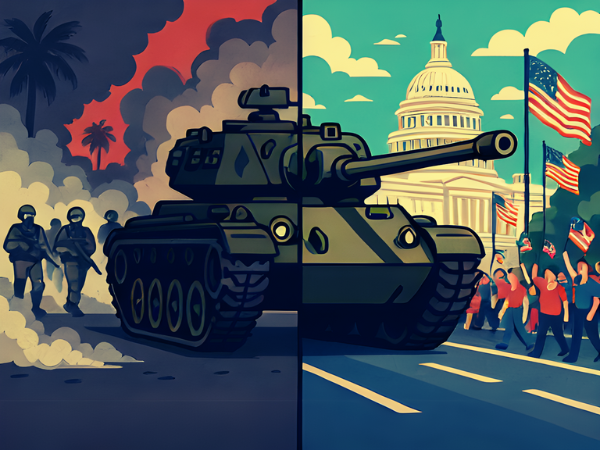
What is unfolding right now in California—with hundreds of Marines deployed domestically; thousands of National Guard troops federalized; and military weapons, tactics and equipment on full display—is the latest chapter in that performance.

Trump is flexing his presidential muscles with a costly, violent, taxpayer-funded military display intended to intimidate, distract and discourage us from pulling back the curtain on the reality of the self-serving corruption, grift, graft, overreach and abuse that have become synonymous with his Administration.

Don’t be distracted. Don’t be intimidated. Don’t be sidelined by the spectacle of a police state.

As columnist Thomas Friedman predicted years ago, “Some presidents, when they get into trouble before an election, try to ‘wag the dog’ by starting a war abroad. Donald Trump seems ready to wag the dog by starting a war at home.

This is yet another manufactured crisis fomented by the Deep State.

When Trump issues a call to “BRING IN THE TROOPS!!!” explaining to reporters that he wants to have them “everywhere,” we should all be alarmed.

This is martial law without a formal declaration of war.

This heavy-handed, chest-thumping, politicized, militarized response to what is clearly a matter for local government is yet another example of Trump’s disregard for the Constitution and the limits of his power.

Political protests are protected by the First Amendment until they cross the line from non-violent to violent. Even when protests turn violent, constitutional protocols remain for safeguarding communities: law and order must flow through local and state chains of command, not from federal muscle.

By breaking that chain of command, Trump is breaking the Constitution.

Deploying the military to deal with domestic matters that can—and should—be handled by civilian police, despite the objections of local and state leaders, crosses the line into authoritarianism.

When someone shows you who they are, believe them.

In the span of a single week, the Trump administration is providing the clearest glimpse yet of its unapologetic, uncompromising, corrupt allegiance to the authoritarian Deep State.

First came the federalization of the National Guard, deployed to California in response to protests sparked by violent and aggressive Immigration and Customs Enforcement (ICE) raids across the country. Then, just days later, the president is set to preside over a lavish, taxpayer-funded military parade in the nation’s capital.

These two events bookend the administration’s unmistakable message: dissent will be crushed, and power will be performed.

Trump governs by force (military deployment), fear (ICE raids, militarized policing), and spectacle (the parade).

This is the spectacle of a police state. One side of the coin is militarized suppression. The other is theatrical dominance. Together, they constitute the language of force and authoritarian control.

Wrapped in the rhetoric of “public safety” and “restoring order,” the federalization of California’s National Guard is not about security. It’s about signaling power.

This is the first time in over half a century that a president has forcibly deployed the National Guard against a state governor’s wishes. California Gov. Gavin Newsom’s public opposition to the deployment was met not with dialogue, but with the threat of arrest from Trump himself—a move that evokes the worst abuses of executive power.

This is more than political theater; it is a constitutional crisis in motion.

As we have warned before, this tactic is familiar.

In times of political unrest, authoritarian regimes invoke national emergencies as pretexts to impose military solutions. The result? The Constitution is suspended, civilian control is overrun, and the machinery of the state turns against its own people.

This is precisely what the Founders feared when they warned against standing armies on American soil: that one day, the military might be used not to defend the people, but to control them. Where the military marches at home, the Republic trembles.

And this is not unprecedented.

It is a textbook play from the authoritarian handbook, deployed with increasing frequency under Trump. The optics are meant to intimidate, to broadcast control, and to discourage resistance before it begins.

Fear is the Deep State’s favorite tool—it doesn’t just control the people, it conditions them to surrender voluntarily.

Thus, deploying the National Guard in this manner is not just a political maneuver—it is a strategic act of fear-based governance designed to instill terror, particularly among vulnerable communities, and ensure compliance.

As President Harry S. Truman observed, “Once a government is committed to the principle of silencing the voice of opposition, it has only one way to go, and that is down the path of increasingly repressive measures, until it becomes a source of terror to all its citizens and creates a country where everyone lives in fear.”

Under Trump, the lines between a civilian democracy and a military regime continue to blur. American streets increasingly resemble war zones, where peaceful protests are met with riot gear, armored vehicles, and surveillance drones.

America is being transformed into a battlefield before our eyes.

Militarized police. Riot squads. Black uniforms. Armored vehicles. Pepper spray. Tear gas. Stun grenades. Crowd control and intimidation tactics.

From federal law enforcement to local police, from border patrol to the intelligence agencies, the guiding doctrine is the same: treat Americans as suspects first, citizens second—if at all.

This is not the language of freedom. This is not even the language of law and order.

This is the language of force.

This is what happens when the rule of law gets replaced by the rules of force: war becomes the organizing principle of domestic governance, law becomes subordinate to command, and liberty is reclassified as a liability.

The war zone mentality—where citizens are treated like insurgents to be subdued—is a hallmark of authoritarian rule.

This transformation is not accidental—it’s strategic. The government now sees the public not as constituents to be served but as potential combatants to be surveilled, managed, and subdued. In this new paradigm, dissent is treated as insurrection, and constitutional rights are treated as threats to national security.

What we are witnessing today is also part of a broader setup: an excuse to use civil unrest as a pretext for militarized overreach.

You want to turn a peaceful protest into a riot? Bring in the militarized police with their guns and black uniforms and warzone tactics and “comply or die” mindset. Ratchet up the tension across the board. Take what should be a healthy exercise in constitutional principles (free speech, assembly and protest) and turn it into a lesson in authoritarianism.

We saw signs of this strategy in Charlottesville, Virginia, where police failed to de-escalate and at times exacerbated tensions during protests that should have remained peaceful. The resulting chaos gave authorities cover to crack down—not to protect the public, but to reframe protest as provocation and dissent as disorder.

Charlottesville was the trial run—California is the main event.

Then and now, the objective wasn’t to preserve peace and protect the public. It was to delegitimize dissent and cast protest as provocation.

Yet the right to criticize the government and speak out against government wrongdoing is the quintessential freedom.

The government has become increasingly intolerant of speech that challenges its power. While all kinds of labels are now applied to “unacceptable” speech, the message is clear: Americans have no right to express themselves if what they are saying is at odds with what the government determines to be acceptable.

Where the problem arises is when you put the power to determine who is a potential danger in the hands of government agencies, the courts and the police.

Which brings us to this present moment: there’s a pattern emerging if you pay close enough attention.

Civil discontent leads to civil unrest, which leads to protests and counterprotests. Tensions rise, violence escalates, and federal armies move in. Meanwhile, despite the protests and the outrage, the government’s abuses continue unabated.

It’s all part of an elaborate setup by the architects of the Deep State. The government wants a reason to crack down and lock down and bring in its biggest guns.

They want us divided. They want us to turn on one another. They want us powerless in the face of their artillery and armed forces. They want us silent, servile and compliant.

They certainly do not want us to remember that we have rights, much less attempt to exercise those rights peaceably and lawfully.

This is how it begins.

We are moving fast down that slippery slope to an authoritarian society in which the only opinions, ideas and speech expressed are the ones permitted by the government and its corporate cohorts.

This unilateral power to muzzle free speech represents a far greater danger than any so-called right- or left-wing extremist might pose. The ramifications are so far-reaching as to render almost every American an extremist in word, deed, thought or by association.

Watch and see: we are all about to become enemies of the state.

Today, California is being staged as the test site for the coming crackdown.

The Trump administration provokes unrest through inhumane policies—in this case, mass ICE raids—then paints the resulting protests as violent threats to national security. The answer? Deploy the military.

It’s a cynical and calculated loop: create the crisis, then respond with force. This strategy transforms protest into pretext, dissent into justification for domination.

There are disturbing echoes of history in these tactics, and they come with grave legal implications. We have seen this before.

It has been 55 years since President Nixon deployed the National Guard to put down anti-war student protests, culminating in the Kent State massacre. During the civil rights era, peaceful demonstrators were met with dogs, firehoses, and police batons. In more recent memory, federal agents cracked down on Occupy Wall Street encampments and Black Lives Matter protests with militarized force.

All of it under the guise of order.

Trump’s tactics fall squarely in that lineage.

His use of the military against civilians violates the spirit—if not the letter—of the Posse Comitatus Act, which is meant to bar federal military involvement in domestic affairs. It also raises severe constitutional questions about the infringement of First Amendment rights to protest and Fourth Amendment protections against warrantless search and seizure.

Modern tools of repression compound the threat. AI-driven surveillance, predictive policing software, biometric databases, and fusion centers have made mass control seamless and silent. The state doesn’t just respond to dissent anymore; it predicts and preempts it.

While boots are on the ground in California, preparations are underway for a military spectacle in Washington, D.C.

At first glance, a military procession might seem like a patriotic display. But in this context, it is something far darker. Trump’s parade is not a celebration of service; it is a declaration of supremacy. It is not about honoring troops; it is about reminding the populace who holds the power and who wields the guns.

This is how authoritarian regimes govern—through spectacle. North Korea, Russia, and China use grandiose military pageants to project strength and silence dissent. Mussolini marched troops as theater in carefully staged public displays to bolster fascist control. Augusto Pinochet filled Chile’s streets with tanks to intimidate critics and consolidate power. All of it designed not to honor the nation—but to dominate it.

By sandwiching a military crackdown between a domestic troop deployment and a showy parade, Trump is sending a unified message: dissent is weakness. Obedience is strength. You are being watched.

This is not about immigration. It is not about security. It is not even about protest.

This is about power. Raw, unchecked, theatrical power. And whether we, the people, will accept a government that rules not by consent, but by coercion.

The Constitution was not written to accommodate authoritarian pageantry. It was written to restrain it. It was never meant to sanctify conquest as governance.

We are at a crossroads.

Governments derive their just powers from the consent of the governed. Strip away that consent, and all that remains is conquest—through force, spectacle, and fear.

As I point out in my book Battlefield America: The War on the American People and in its fictional counterpart The Erik Blair Diaries, if we allow the language of fear, the spectacle of dominance, and the machinery of militarized governance to become normalized, then we are no longer citizens of a republic—we are subjects of a police state.

The only question now is: will we rise up as citizens of a constitutional republic—or bow down as subjects of an authoritarian regime?

Source: https://tinyurl.com/y3vvk783

ABOUT JOHN W. WHITEHEAD

Constitutional attorney and author John W. Whitehead is founder and president of The Rutherford Institute. His most recent books are the best-selling Battlefield America: The War on the American People, the award-winning A Government of Wolves: The Emerging American Police State, and a debut dystopian fiction novel, The Erik Blair Diaries. Whitehead can be contacted at staff@rutherford.org. Nisha Whitehead is the Executive Director of The Rutherford Institute. Information about The Rutherford Institute is available at www.rutherford.org.

Publication Guidelines / Reprint Permission

John W. Whitehead’s weekly commentaries are available for publication to newspapers and web publications at no charge.
We are fast approaching the stage of the ultimate inversion: the stage where the government is free to do anything it pleases, while the citizens may act only by permission.” — Ayn Rand

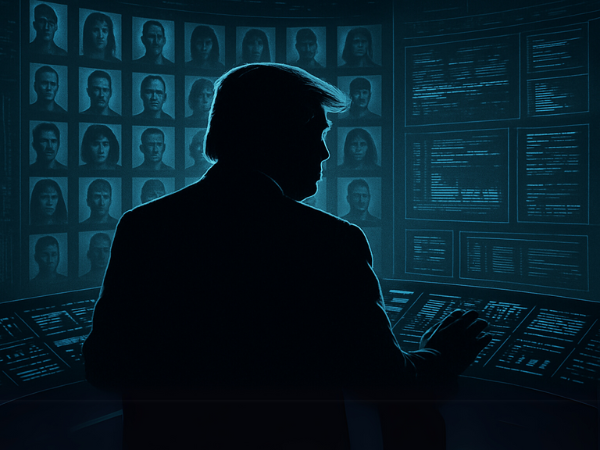
Call it what it is: a panopticon presidency.

President Trump’s plan to fuse government power with private surveillance tech to build a centralized, national citizen database is the final step in transforming America from a constitutional republic into a digital dictatorship armed with algorithms and powered by unaccountable, all-seeing artificial intelligence.

This isn’t about national security. It’s about control.

According to news reports, the Trump administration is quietly collaborating with Palantir Technologies—the data-mining behemoth co-founded by billionaire Peter Thiel—to construct a centralized, government-wide surveillance system that would consolidate biometric, behavioral, and geolocation data into a single, weaponized database of Americans’ private information.

This isn’t about protecting freedom. It’s about rendering freedom obsolete.

What we’re witnessing is the transformation of America into a digital prison—one where the inmates are told we’re free while every move, every word, every thought is monitored, recorded, and used to assign a “threat score” that determines our place in the new hierarchy of obedience.

This puts us one more step down the road to China’s dystopian system of social credit scores and Big Brother surveillance.

The tools enabling this all-seeing surveillance regime are not new, but under Trump’s direction, they are being fused together in unprecedented ways—with Palantir at the center of this digital dragnet.

Palantir, long criticized for its role in powering ICE (Immigration and Customs Enforcement) raids and predictive policing, is now poised to become the brain of Trump’s surveillance regime.

Under the guise of “data integration” and “public safety,” this public-private partnership would deploy AI-enhanced systems to comb through everything from facial recognition feeds and license plate readers to social media posts and cellphone metadata—cross-referencing it all to assess a person’s risk to the state.

Palantir’s software has already been used to assist ICE in locating, arresting, and deporting undocumented immigrants, often relying on vast surveillance data sets aggregated from multiple sources. In New Orleans, the company secretly partnered with local police to run a predictive policing program without public knowledge or oversight, targeting individuals flagged as likely to commit crimes based on social networks and past behaviors—not actual wrongdoing.

This isn’t speculative. It’s already happening.

Palantir’s Gotham platform, used by law enforcement and military agencies, has long been the backbone of real-time tracking and predictive analysis. Now, with Trump’s backing, it threatens to become the central nervous system of a digitally enforced authoritarianism.

As Palantir itself admits, its mission is to “augment human decision-making.” In practice, that means replacing probable cause with probability scores, courtrooms with code, and due process with data pipelines.

In this new regime, your innocence will be irrelevant. The algorithm will decide who you are.

To understand the full danger of this moment, we must trace the long arc of government surveillance—from secret intelligence programs like COINTELPRO to today’s AI-driven digital dragnet embodied by data fusion centers.

The threat posed by today’s surveillance state did not emerge overnight. The groundwork was laid decades ago through covert government programs such as COINTELPRO (Counter Intelligence Program), launched by the FBI in the 1950s and continuing through the 1970s. Its explicit mission was to “disrupt, misdirect, discredit, or otherwise neutralize” political dissidents, including civil rights leaders, Vietnam War protesters, and Black liberation groups.

Under COINTELPRO, federal agents infiltrated lawful organizations, spread misinformation, blackmailed targets, and conducted warrantless surveillance.

Though exposed and publicly condemned by Congress, the spirit of COINTELPRO never died—it merely went underground and digital.

Post-9/11 legislation like the USA PATRIOT Act provided legal cover for mass surveillance, allowing intelligence agencies to collect phone records, monitor internet activity, and build profiles on American citizens without meaningful oversight. Fusion centers, initially conceived to coordinate counterterrorism efforts, became clearinghouses for domestic spying, facilitating data-sharing between federal agencies and local police.

Today, this infrastructure has merged with the tools of Big Tech.

With Palantir and similar firms at the helm, the government can now watch more people, more closely, for more arbitrary reasons than ever before. Dissent is once again being criminalized. Free expression is being categorized as extremism. And citizens—without ever committing a crime—can be flagged, tracked, and punished by an invisible digital bureaucracy that operates with impunity.

Building on this foundation of historical abuse, the government has evolved its tactics, replacing human informants with algorithms and wiretaps with metadata, ushering in an age where pre-crime prediction is treated as prosecution.

In the age of AI, your digital footprint is enough to convict you—not in a court of law, but in the court of preemptive suspicion.

Every smartphone ping, GPS coordinate, facial scan, online purchase, and social media like becomes part of your “digital exhaust”—a breadcrumb trail of metadata that the government now uses to build behavioral profiles. The FBI calls it “open-source intelligence.” But make no mistake: this is dragnet surveillance, and it is fundamentally unconstitutional.

Already, government agencies are mining this data to generate “pattern of life” analyses, flag “radicalized” individuals, and preemptively investigate those who merely share anti-government views. Whistleblowers have revealed that the FBI has flagged individuals as potential threats based on their internet search history, social media posts, religious beliefs, or associations with activist groups.

In a growing number of cases, individuals have found themselves visited by agents simply for attending a protest, making a political post, or appearing on the “wrong” side of a digital algorithm.

This is not law enforcement. This is thought-policing by machine.

The FBI has developed detailed dossiers on individuals based not on criminal activity, but on constitutionally protected expression—flagging citizens for visiting alternative media websites, criticizing government policies, or supporting causes deemed “extreme.”

According to leaked memos and internal documents, terms like “liberty,” “sovereignty,” and even the Gadsden flag have been cited as potential indicators of domestic extremism. In one case, a peaceful protester was interrogated for merely using encrypted messaging apps. In another, churchgoers were surveilled because their religious leader spoke critically of the government.

These are the logical outcome of a system that criminalizes dissent and deputizes algorithms to do the targeting.

Nor is this entirely new.

For decades, the federal government has reportedly maintained a highly classified database known as Main Core, designed to collect and store information on Americans deemed potential threats to national security.

Investigative journalists have revealed that Main Core may contain data on millions of individuals—compiled without warrants or due process—for potential use during a national emergency. As Tim Shorrock reported for Salon, “One former intelligence official described Main Core as ‘an emergency internal security database system’ designed for use by the military in the event of a national catastrophe, a suspension of the Constitution or the imposition of martial law.”

Trump’s embrace of Palantir, and its unparalleled ability to fuse surveillance feeds, social media metadata, public records, and AI-driven predictions, marks a dangerous evolution: a modern-day resurrection of Main Core, digitized, centralized, and fully automated.

What was once covert contingency planning is now becoming active policy.

What has emerged is a surveillance model more vast than anything dreamed up by past regimes—a digital panopticon in which every citizen becomes both observed and self-regulating.

Imagine a society in which every citizen is watched constantly, and every move is logged in a government database.

Imagine a state where facial recognition cameras scan your face at protests and concerts, where your car’s location is tracked by automatic license plate readers, where your biometric data is captured by drones, and where AI programs assign you a “threat assessment” score based on your behavior, opinions, associations, and even your purchases.

This is not science fiction. This is America—now.

This is the panopticon brought to life: a circular prison designed so that inmates never know when they are being watched, and thus must behave as if they always are. Jeremy Bentham’s original vision has become the model of modern-day governance: total visibility, zero accountability.

Our every move is being monitored, our every word recorded, our every action judged and categorized—not by humans, but by machines without conscience, without compassion, and without constitutional limits.

And in this surveillance state, the people have become inventory. Lives reduced to data points. Choices reduced to algorithms. Freedom reduced to a permission slip. You are no longer the customer. You are the product.

In this new reality, we are not only watched—we are measured, categorized, and sold back to the very systems that enslave us.

We are no longer free citizens.

We are data points in a digital control grid—commodified, categorized, and exploited.

In this new digital economy, our lives have become profit centers for corporations that track, trade, and monetize our every move.

The surveillance state is powered not only by authoritarian government impulses but by a corporate ecosystem that sees no distinction between the marketplace and the public square.

We are being bought and sold, not as citizens with rights, but as consumers to be studied and shaped.

Our autonomy is being eroded by design, not by accident.

This modern surveillance state knows everything about you—where you go, what you buy, what you read, who you associate with—and it uses that information to predict your behavior, shape your preferences, and ultimately control your actions.

Your phone is tracking you.

Your car is tracking you.

Your smart TV, internet searches, and digital assistant—all of it is being harvested to feed a growing network of AI-powered surveillance.

Even your refrigerator and your doorbell are reporting on you.

Every electronic device you use, every online transaction you make, every move you make through a smart city grid, adds another data point to your profile.

This is the machinery of oppression, and it is being refined daily.

The difference between past regimes and the one being constructed now is its subtlety. Today’s totalitarianism doesn’t come with jackboots and secret police. It comes with convenience. With apps. With “national security” justifications. With the illusion of safety.

As in the dystopian world of Soylent Green, where the individual is reduced to a consumable product of the system, today’s surveillance state treats Americans not as citizens but as data points to be harvested, scored, and fed back into the machine of control.

We are no longer governed—we are managed.

It is no less dangerous—just more efficient.

The tragedy, however, is that most Americans don’t see the bars being built around them, because the architecture of tyranny is disguised as convenience and cloaked in comfort.

Most Americans are still asleep to the danger. They live in a prison masquerading as paradise, where surveillance is sold as safety, compliance is branded as patriotism, and convenience has become the currency of captivity.

We have been conditioned to love our servitude, to decorate our cells with apps and smart devices, and to mistake technological dependency for freedom.

The prison walls are invisible, the bars digital, the guards automated.

We are inmates in a high-tech prison, lulled by convenience and pacified by illusion. We carry our tracking devices in our pockets. We whisper our secrets into microphones embedded in our own devices. We voluntarily surrender our privacy to digital overlords.

Meanwhile, those who dare question this system—journalists, whistleblowers, dissidents—are silenced, surveilled, and punished. All under color of law.

Consider:

This is predictive policing turned preemptive prosecution. It is the very definition of a surveillance state.

As this technological tyranny expands, the foundational safeguards of the Constitution—those supposed bulwarks against arbitrary power—are quietly being nullified and its protections rendered meaningless.

What does the Fourth Amendment mean in a world where your entire life can be searched, sorted, and scored without a warrant? What does the First Amendment mean when expressing dissent gets you flagged as an extremist? What does the presumption of innocence mean when algorithms determine guilt?

The Constitution was written for humans—not for machine rule. It cannot compete with predictive analytics trained to bypass rights, sidestep accountability, and automate tyranny.

And that is the endgame: the automation of authoritarianism. An unblinking, AI-powered surveillance regime that renders due process obsolete and dissent fatal.

Still, it is not too late to resist—but doing so requires awareness, courage, and a willingness to confront the machinery of our own captivity.

Make no mistake: the government is not your friend in this. Neither are the corporations building this digital prison. They thrive on your data, your fear, and your silence.

To resist, we must first understand the weaponized AI tools being used against us.

We must demand transparency, enforce limits on data collection, ban predictive profiling, and dismantle the fusion centers feeding this machine.

We must treat AI surveillance with the same suspicion we once reserved for secret police. Because that is what AI-powered governance has become—secret police—only smarter, faster, and less accountable.

We must stop cooperating with our captors. Stop consenting to our own control. Stop feeding the surveillance machine with our data, our time, and our trust.

We don’t have much time.

Trump’s alliance with Palantir is a warning sign—not just of where we are, but of where we’re headed. A place where freedom is conditional, rights are revocable, and justice is decided by code.

The question is no longer whether we’re being watched—that is now a given—but whether we will meekly accept it. Will we dismantle this electronic concentration camp, or will we continue building the infrastructure of our own enslavement?

As I point out in my book Battlefield America: The War on the American People and in its fictional counterpart The Erik Blair Diaries, if we trade liberty for convenience and privacy for security, we will find ourselves locked in a prison we helped build, and the bars won’t be made of steel. They will be made of data.

Source: https://tinyurl.com/4mxvwpz3

ABOUT JOHN W. WHITEHEAD

Constitutional attorney and author John W. Whitehead is founder and president of The Rutherford Institute. His most recent books are the best-selling Battlefield America: The War on the American People, the award-winning A Government of Wolves: The Emerging American Police State, and a debut dystopian fiction novel, The Erik Blair Diaries. Whitehead can be contacted at staff@rutherford.org. Nisha Whitehead is the Executive Director of The Rutherford Institute. Information about The Rutherford Institute is available at www.rutherford.org.

Publication Guidelines / Reprint Permission

John W. Whitehead’s weekly commentaries are available for publication to newspapers and web publications at no charge.