Archive for May, 2025

“If one company or small group of people manages to develop godlike digital superintelligence, they could take over the world. At least when there’s an evil dictator, that human is going to die. But for an AI, there would be no death. It would live forever. And then you’d have an immortal dictator from which we can never escape.”—Elon Musk

The Deep State is not going away. It’s just being replaced.

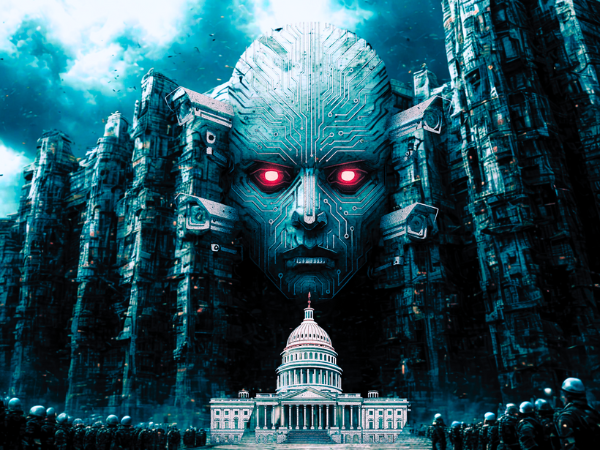
Replaced not by a charismatic autocrat or even a shadowy bureaucracy, but by artificial intelligence (AI)—unfeeling, unaccountable, and immortal.

As we stand on the brink of a new technological order, the machinery of power is quietly shifting into the hands of algorithms.

Under Donald Trump’s watch, that shift is being locked in for at least a generation.

Trump’s latest legislative initiative—a 10-year ban on AI regulation buried within the “One Big Beautiful Bill”—strips state and local governments of the ability to impose any guardrails on artificial intelligence until 2035.

Despite bipartisan warnings from 40 state attorneys general, the bill passed the House and awaits Senate approval. It is nothing less than a federal green light for AI to operate without oversight in every sphere of life, from law enforcement and employment to healthcare, education, and digital surveillance.

This is not innovation.

This is institutionalized automation of tyranny.

This is how, within a state of algorithmic governance, code quickly replaces constitutional law as the mechanism for control.

We are rapidly moving from a society ruled by laws and due process to one ruled by software.

Algorithmic governance refers to the use of machine learning and automated decision-making systems to carry out functions once reserved for human beings: policing, welfare eligibility, immigration vetting, job recruitment, credit scoring, and judicial risk assessments.

In this regime, the law is no longer interpreted. It is executed. Automatically. Mechanically. Without room for appeal, discretion, or human mercy.

These AI systems rely on historical data—data riddled with systemic bias and human error—to make predictions and trigger decisions. Predictive policing algorithms tell officers where to patrol and whom to stop. Facial recognition technology flags “suspects” based on photos scraped from social media. Risk assessment software assigns threat scores to citizens with no explanation, no oversight, and no redress.

These algorithms operate in black boxes, shielded by trade secrets and protected by national security exemptions. The public cannot inspect them. Courts cannot challenge them. Citizens cannot escape them.

The result? A population sorted, scored, and surveilled by machinery.

This is the practical result of the Trump administration’s deregulation agenda: AI systems given carte blanche to surveil, categorize, and criminalize the public without transparency or recourse.

And these aren’t theoretical dangers—they’re already happening.

Examples of unchecked AI and predictive policing show that precrime is already here.

Once you are scored and flagged by a machine, the outcome can be life-altering—as it was for Michael Williams, a 65-year-old man who spent nearly a year in jail for a crime he didn’t commit. Williams was behind the wheel when a passing car fired at his vehicle, killing his 25-year-old passenger, who had hitched a ride.

Despite no motive, no weapon, and no eyewitnesses, police charged Williams based on an AI-powered gunshot detection program called ShotSpotter. The system picked up a loud bang near the area and triangulated it to Williams’ vehicle. The charge was ultimately dropped for lack of evidence.

This is precrime in action. A prediction, not proof. An algorithm, not an eyewitness.

Programs like ShotSpotter are notorious for misclassifying noises like fireworks and construction as gunfire. Employees have even manually altered data to fit police narratives. And yet these systems are being combined with predictive policing software to generate risk maps, target individuals, and justify surveillance—all without transparency or accountability.

It doesn’t stop there.

AI is now flagging families for potential child neglect based on predictive models that pull data from Medicaid, mental health, jail, and housing records. These models disproportionately target poor and minority families. The algorithm assigns risk scores from 1 to 20. Families and their attorneys are never told what the scores are, or that they were used.

Imagine losing your child to the foster system because a secret algorithm said you might be a risk.

This is how AI redefines guilt.

The Trump administration’s approach to AI regulation reveals a deeper plan to deregulate democracy itself.

Rather than curbing these abuses, the Trump administration is accelerating them.

An executive order titled “Removing Barriers to American Leadership in Artificial Intelligence,” signed by President Trump in early 2025, revoked prior AI safeguards, eliminated bias audits, and instructed agencies to prioritize “innovation” over ethics. The order encourages every federal agency to adopt AI quickly, especially in areas like policing and surveillance.

Under the guise of “efficiency,” constitutional protections are being erased.

Trump’s 10-year moratorium on AI regulation is the logical next step. It dismantles the last line of defense—state-level resistance—and ensures a uniform national policy of algorithmic dominance.

The result is a system in which government no longer governs. It processes.

The federal government’s AI expansion is building a surveillance state that no human authority can restrain.

Welcome to Surveillance State 2.0, the Immortal Machine.

Over 1700 uses of AI have already been reported across federal agencies, with hundreds directly impacting safety and rights. Many agencies, including the Departments of Homeland Security, Veterans Affairs, and Health and Human Services, are deploying AI for decision-making without public input or oversight.

This is what the technocrats call an “algocracy”—rule by algorithm.

In an algocracy, unelected developers and corporate contractors hold more power over your life than elected officials.

Your health, freedom, mobility, and privacy are subject to automated scoring systems you can’t see and can’t appeal.

And unlike even the most entrenched human dictators, these systems do not die. They do not forget. They are not swayed by mercy or reason. They do not stand for re-election.

They persist.

When AI governs by prediction, due process disappears in a haze of machine logic.

The most chilling effect of this digital regime is the death of due process.

What court can you appeal to when an algorithm has labeled you a danger? What lawyer can cross-examine a predictive model? What jury can weigh the reasoning of a neural net trained on flawed data?

You are guilty because the machine says so. And the machine is never wrong.

When due process dissolves into data processing, the burden of proof flips. The presumption of innocence evaporates. Citizens are forced to prove they are not threats, not risks, not enemies.

And most of the time, they don’t even know they’ve been flagged.

This erosion of due process is not just a legal failure—it is a philosophical one, reducing individuals to data points in systems that no longer recognize their humanity.

Writer and visionary Rod Serling warned of this very outcome more than half a century ago: a world where technology, masquerading as progress under the guise of order and logic, becomes the instrument of tyranny.

That future is no longer fiction. What Serling imagined is now reality.

The time to resist is now, before freedom becomes obsolete.

To those who call the shots in the halls of government, “we the people” are merely the means to an end.

“We the people”—who think, who reason, who take a stand, who resist, who demand to be treated with dignity and care, who believe in freedom and justice for all—have become obsolete, undervalued citizens of a totalitarian state that, in the words of Serling, “has patterned itself after every dictator who has ever planted the ripping imprint of a boot on the pages of history since the beginning of time. It has refinements, technological advances, and a more sophisticated approach to the destruction of human freedom.”

In this sense, we are all Romney Wordsworth, the condemned man in Serling’s Twilight Zone episode “The Obsolete Man.”

The Obsolete Man,” a story arc about the erasure of individual worth by a mechanized state, underscores the danger of rendering humans irrelevant in a system of cold automation and speaks to the dangers of a government that views people as expendable once they have outgrown their usefulness to the State. Yet—and here’s the kicker—this is where the government through its monstrous inhumanity also becomes obsolete.

As Serling noted in his original script for “The Obsolete Man,” “Any state, any entity, any ideology which fails to recognize the worth, the dignity, the rights of Man…that state is obsolete.

Like Serling’s totalitarian state, our future will be defined by whether we conform to a dehumanizing machine order—or fight back before the immortal dictator becomes absolute.

We now face a fork in the road: resist the rise of the immortal dictator or submit to the reign of the machine.

This is not a battle against technology, but a battle against the unchecked, unregulated, and undemocratic use of technology to control people.

We must demand algorithmic transparency, data ownership rights, and legal recourse against automated decisions. We need a Digital Bill of Rights that guarantees:

  • The right to know how algorithms affect us.
  • The right to challenge and appeal automated decisions.
  • The right to privacy and data security.
  • The right to be free from automated surveillance and predictive policing.
  • The right to be forgotten.

Otherwise, AI becomes the ultimate enforcer of a surveillance state from which there is no escape.

As Eric Schmidt, former CEO of Google, warned: “We know where you are. We know where you’ve been. We can more or less know what you’re thinking about. Your digital identity will live forever… because there’s no delete button.

An immortal dictator, indeed.

Let us be clear: the threat is not just to our privacy, but to democracy itself.

As I point out in my book Battlefield America: The War on the American People and in its fictional counterpart The Erik Blair Diaries, the time to fight back is now—before the code becomes law, and freedom becomes a memory.

Source: https://tinyurl.com/pmj64bcb

ABOUT JOHN W. WHITEHEAD

Constitutional attorney and author John W. Whitehead is founder and president of The Rutherford Institute. His most recent books are the best-selling Battlefield America: The War on the American People, the award-winning A Government of Wolves: The Emerging American Police State, and a debut dystopian fiction novel, The Erik Blair Diaries. Whitehead can be contacted at staff@rutherford.org. Nisha Whitehead is the Executive Director of The Rutherford Institute. Information about The Rutherford Institute is available at www.rutherford.org.

Publication Guidelines / Reprint Permission

John W. Whitehead’s weekly commentaries are available for publication to newspapers and web publications at no charge. 
“Once a government is committed to the principle of silencing the voice of opposition, it has only one way to go, and that is down the path of increasingly repressive measures, until it becomes a source of terror to all its citizens and creates a country where everyone lives in fear… If the Bill of Rights were to be broken down, all groups, even the most conservative, would be in danger from the arbitrary power of government.”—President Harry S. Truman (August 8, 1950)

Let us be very clear.

The Constitution is not a suggestion or a negotiating tactic. It is not optional.

Government officials do not get to pick and choose which laws they will obey.

The Constitution is the supreme law of the land: a binding contract between “we the people” of the United States and those we hire to govern. It spells out our expectations for transparency and accountability, limits the government’s authority, affirms the purpose of government as protecter of liberty and property, and reinforces that we are the masters and government agents are the servants.

Thus, any decision by a government official to suspend the rights enshrined in the Constitution should not be undertaken lightly or for political gain or expedience, nor can it be done without following the strict parameters laid out by its creators and the courts.

Bottom line: any attempt to unilaterally override any aspect of the Constitution should alarm every American, regardless of party affiliation.

Which brings us to the Trump Administration’s ongoing attempts to weaponize concerns about national security in order to wage war on the rights enshrined in the Constitution.

We have been inundated with executive orders issued by President Trump purporting to protect national security interests by gutting free speech, eroding equal rights protections, sidestepping the separation of powers, and pushing us ever closer to martial law and outright dictatorship.

Behind the façade of national security lies a more insidious threat: a permanent shadow government—the Deep State—using every “emergency” to tighten its grip and expand unchecked executive authority.

Trump’s most effective ploy to seize power has been his use of illegal immigration to stoke fear and chill dissent. He has used it as a justification to do away with due processexpand the police statedeepen military involvement in domestic policing, and intimidate the nation into compliance.

Even his bid to unilaterally end birthright citizenship for children born in the United States to undocumented immigrants is just another Trojan horse masquerading as a concern for national security.

This is not about protecting America—it’s about redefining America from the top down.

That redefinition is already underway.

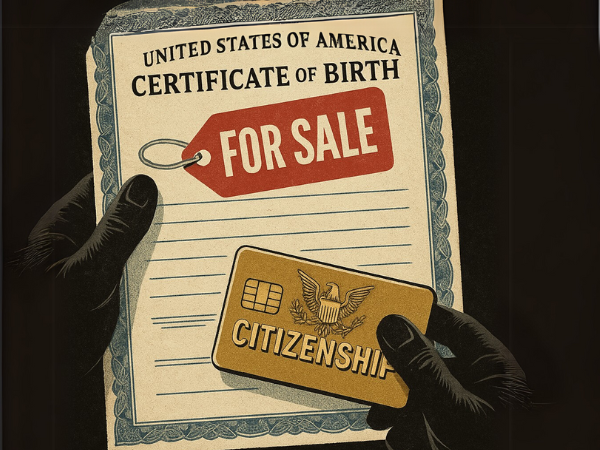
The Trump Administration has floated plans to sell $5 million “gold cards” to wealthy investors as a path to citizenship and is considering a pitch for a reality show that would “pit immigrants against each other for a chance at a fast-tracked path to citizenship.”

These proposals are not just absurd—they’re obscene. They reveal a government willing to reduce constitutional rights to commodities, auctioned off to the highest bidder or trivialized for ratings.

This governing by-way-of performance turns a constitutional guarantee into a privilege for sale or spectacle. And it’s part of a calculated effort to recast citizenship as conditional, transactional, and exclusionary. Whether by wealth, loyalty, or ideology, this emerging framework decides who is “deserving” of rights—and who is not.

It is fear-based nationalism that disguises a deeper threat: the normalization of government power to decide who is entitled to rights and who is not.

We see this in action with the Trump Administration’s stance on childbirth and citizenship.

It’s a contradiction: although the Trump Administration is so concerned about falling birth rates that it is prepared to offer financial incentives for childbirth (for example, a $5,000 “baby bonus” and expanded child tax credit), it continues to demonize birthright citizenship for the one population segment that is actually having babies.

Surely the fact that migrant communities, including undocumented immigrants, not only contribute significantly to the economy and pay into Medicare, Social Security and income taxes without any guarantee of anything in return, only adds to their appeal?

Not for Trump, who is spending tens of millions of taxpayer dollars to expel immigrants who are positively contributing to the U.S. economy, while selectively welcoming others under a vastly different standard—such as family members of a South American drug cartel leader or white Afrikaners—who will have the cost of their resettlement services, and assistance with housing, jobs, and schools paid for by the American taxpayer.

Yet this brazenly hypocritical double standard is just a distraction, part of the political theater designed to pit Americans against each other while the power brokers rewrite the rules behind closed doors.

The real power play rests in the Trump Administration’s efforts to gut the Fourteenth Amendment, sidestep the courts, and redefine who qualifies as American—all by executive fiat.

Redefining citizenship by executive order is not governance. It is a bloodless coup—one that overthrows a constitutional republic founded on the rule of law—to reconfigure the face of the nation in the image of the unelected Deep State and its machinery of control.

Enacted in the wake of the Civil War, the Fourteenth Amendment was designed to ensure that all persons born on U.S. soil would be recognized as full citizens—a direct rebuke to the Supreme Court’s infamous Dred Scott decision, which held that Black Americans could not be citizens. Its language is unambiguous: all persons born or naturalized in the U.S., and subject to its jurisdiction, are citizens.

This principle was upheld by the Supreme Court in United States v. Wong Kim Ark (1898), which affirmed that children born in the U.S. to foreign nationals are entitled to citizenship under the Fourteenth Amendment.

The ruling in Wong Kim Ark came during an era of rampant anti-Chinese sentiment, reinforcing that even in times of national xenophobia, the Constitution prevailed in affirming equality under the law.

The Court’s ruling was unequivocal: the Constitution guarantees birthright citizenship to all born on American soil, regardless of parentage.

That precedent still stands.

Yet that legacy—of constitutional protections prevailing over prejudice—is now at risk.

Some have recently argued—including the Trump Administration in legal filings—that the Fourteenth Amendment was intended solely to grant citizenship to the children of former slaves after the Civil War, and thus no longer applies to children born to undocumented immigrants. But if that logic is taken seriously, it undermines the citizenship of everyone born in America.

After all, if the government—not the Constitution—gets to decide who qualifies as a citizen, then no one’s status is secure.

If your citizenship depends on government approval, your rights aren’t inalienable—they’re transitory privileges.

Likewise, this is not a return to “originalism.” It’s a retreat from constitutional rule altogether. It suggests that citizenship is not a right guaranteed by the Constitution, but a privilege bestowed by those in power.

That’s not just bad law. It’s tyranny in the making.

The notion that a sitting president can erase a constitutional guarantee with the stroke of a pen is not only absurd—it is dangerous. Such an action would be flatly unconstitutional, lacking any legal authority and in direct contradiction to more than a century of settled law.

Despite Trump’s attempts to rule by fiat and executive order, presidents cannot pick and choose which parts of the Constitution they will honor.

Yet perhaps even more concerning than Trump’s war on birthright citizenship itself is the administration’s underlying legal strategy to test the limits of judicial authority—specifically, to restrict the power of federal district courts to issue nationwide injunctions against unconstitutional actions.

You see, this is not just an immigration battle, nor is it only a challenge to the Fourteenth Amendment.

It is a calculated attempt to strip the judiciary of its ability to check executive abuse and a full-frontal assault on the role of the judiciary as a co-equal branch of government entrusted with interpreting the law and defending individual rights against majoritarian overreach.

If successful, it would mark a seismic shift in the balance of powers, subordinating the courts to the whims of the executive branch.

As James Madison wrote, the accumulation of all powers in the same hands may justly be pronounced the very definition of tyranny.

Revoking birthright citizenship would create a stateless class of people born on U.S. soil who are denied recognition by their own country. These children would be cast into legal limbo, denied the rights and protections afforded to every other citizen.

Such a move would not only be cruel—it would be profoundly un-American.

Don’t be fooled: the same unchecked power used to deny citizenship to the children of immigrants today could just as easily be turned against you to strip you of your citizenship—based on your political beliefs, religious views, or failure to toe the party line.

This is the danger the Founders warned against: a government that grants rights only to the loyal, the favored, or the compliant.

And make no mistake: what we’re witnessing is another point along the slippery slope of the effort to recast birthright citizenship—not as a right—but as a privilege, subject to political approval and ideological purity tests.

Increasingly, the government is creating a hierarchy of so-called “deserving” citizens, where access to constitutional rights is predicated on compliance, productivity, and perceived loyalty to the state. This shift toward merit-based citizenship is in direct contradiction to the ideals laid out in the Declaration of Independence, which affirms that rights are inalienable, not contingent.

We see it in efforts to strip dissenters of their legal protections, deny free speech to the unpopular, surveil certain communities more than others, and criminalize poverty, protest, or association with disfavored political movements.

In this emerging framework, being born in America is no longer enough—you must also prove your worth, your allegiance, and your compliance.

Worse still, this would set a precedent that constitutional rights can be rewritten by executive whim, paving the way for even greater erosions of liberty.

We have seen this before.

History shows how easily rights can be suspended when fear rules and power goes unchecked.

Consider the use of emergency powers to suspend habeas corpus protections, the unilateral authorization of surveillance programs that violate the Fourth Amendment, and the declaration of national emergencies to justify military deployments or detentions without trial.

These are not hypothetical scenarios.

They have occurred under multiple administrations and show how executive power, once unrestrained, expands at the expense of individual rights.

Redefining who qualifies as an American citizen is not the end of the story—it is the beginning of a slippery slope.

If the government can deny citizenship to those born on U.S. soil, what is to stop it from stripping citizenship from naturalized citizens? Or from declaring certain classes of people—based on ideology, ethnicity, or ancestry—as unworthy of constitutional protection?

What’s at stake is not merely a policy dispute—it is the foundational principle that rights cannot be granted or revoked at the pleasure of a single ruler.

If we do not hold the line here, this erosion of liberty will only accelerate.

These power grabs rarely come without a manufactured crisis.

That’s how the Deep State operates: inflame the public, declare an emergency, and then consolidate control.

Every time the people are told to trade liberty for security, we lose both.

This is a line that must not be crossed.

Birthright citizenship is more than a legal technicality. It is a cornerstone of American democracy and equality. The attempt to destroy it through executive power is a direct threat to the rule of law, the independence of the judiciary, and the future of liberty in America.

As I make clear in my book Battlefield America: The War on the American People and in its fictional counterpart The Erik Blair Diaries, if the government can erase one constitutional right today, it can erase another tomorrow.

This is exactly why the Founders drafted a Constitution that limits power and protects individuals—not just the popular or the powerful.

Once we allow the government to decide who is “deserving” of rights, we’ve already surrendered the rule of law. What remains is not a constitutional republic—but an empire of arbitrary rule.

Source: https://tinyurl.com/bp7fh92v

ABOUT JOHN W. WHITEHEAD

Constitutional attorney and author John W. Whitehead is founder and president of The Rutherford Institute. His most recent books are the best-selling Battlefield America: The War on the American People, the award-winning A Government of Wolves: The Emerging American Police State, and a debut dystopian fiction novel, The Erik Blair Diaries. Whitehead can be contacted at staff@rutherford.org. Nisha Whitehead is the Executive Director of The Rutherford Institute. Information about The Rutherford Institute is available at www.rutherford.org.

Publication Guidelines / Reprint Permission

John W. Whitehead’s weekly commentaries are available for publication to newspapers and web publications at no charge. 
Donald Trump ran on a platform of relentless, thoroughgoing rejection of the Constitution itself, and its underlying principle of democratic self-government and individual rights. True, he never endorsed quartering of troops in private homes in time of peace, but aside from that there is hardly a provision of the Bill of Rights or later amendments he did not explicitly promise to override, from First Amendment freedom of the press and of religion to Fourth Amendment freedom from ‘unreasonable searches and seizures’ to Sixth Amendment right to counsel to Fourteenth Amendment birthright citizenship and Equal Protection and Fifteenth Amendment voting rights.”—Garrett Epps, law professor

If Donald Trump is remembered for anything, it may be his unintentional role in reviving public interest in the U.S. Constitution.

Indeed, few modern political figures have done more to prompt spontaneous national discussions about the Bill of Rights and constitutional limits on government power—if only because Trump tramples on them so frequently.

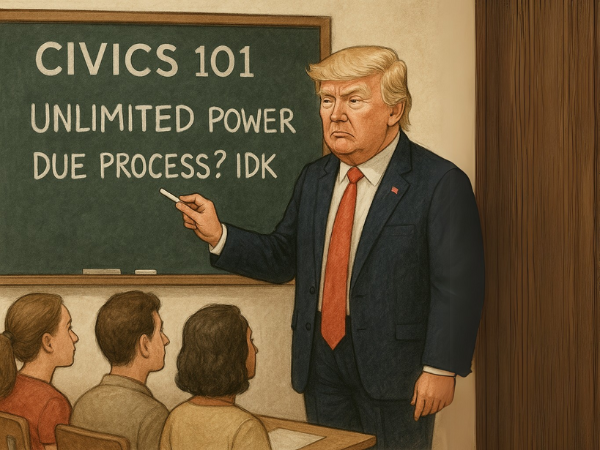
Through his routine disregard for due process, free speech, separation of powers, and the rule of law, President Trump has become a walking civics lesson.

From the First and Fourth Amendments to the Emoluments Clause, the Constitution has never had such regular airtime.

Ironically, this might be Trump’s greatest legacy: forcing Americans to learn what the Constitution actually says—by violating it.

Unfortunately, Trump himself remains constitutionally illiterate.

Days after issuing an executive order that openly hints at martial law, Trump made a mockery of his oath of office by confessing his complete ignorance about the Constitution on national television. When asked if he needs to uphold the Constitution of the United States as president, Trump replied, “I don’t know.

This is the same man who appointed himself Chair of America’s 250th anniversary celebration but seems entirely unaware of what that history represents. Asked what the Declaration of Independence means, Trump called it a “declaration of unity and love.”

In reality, it’s a fiery breakup letter—a revolutionary indictment of unchecked executive power.

If Trump had been king in 1776, Jefferson might have named him in the first paragraph.

To be clear, Donald Trump is not the first president to stretch, sidestep, or outright violate constitutional limits—Democrats and Republicans alike have done so. But Trump is singular in the sheer scope, frequency, and brazenness with which he has stress-tested every clause, amendment, and founding principle of the U.S. Constitution.

His presidency has become a full-frontal assault on the rule of law.

The good news is that Trump’s constitutional ignorance has turned millions of Americans into more alert and informed citizens. In fighting off Trump’s excesses, the nation has reawakened to the rights and principles that many had taken for granted.

Consider some of the constitutional principles that Trump can be credited with bringing into the spotlight unintentionally during his time in office.

First Amendment (free speech, press, religion, protest and assembly): Trump’s repeated confrontations with the First Amendment have transformed free expression into a battleground, making it impossible to ignore the protections it guarantees. From branding the press as “the enemy of the people” and threatening to revoke media licenses to blacklisting law firmsthreatening universities with funding cuts for not complying with the government’s ideological agenda, and detaining foreign students for their political views, Trump has treated constitutional protections not as guarantees, but as obstacles. Deportations and detentions based solely on political speech have shown the fragility of these freedoms when power goes unchecked. Even when Trump claims to be championing religious freedom for Christians, he skates close to violating the First Amendment’s Establishment Clause, which prohibits the government from favoring one religion over another.

Second Amendment (right to bear arms): Although often portrayed as a defender of the Second Amendment, Trump has shown an inconsistent and, at times, authoritarian approach to gun rights. He has publicly suggested confiscating firearms from individuals deemed dangerous—without prior due process—summed up in his infamous 2018 statement: “Take the guns first, go through due process second.” This disregard for constitutional procedure alarmed even staunch Second Amendment advocates. At the same time, Trump has encouraged the militarization of domestic police forces, blurring the line between civilian law enforcement and standing armies—a contradiction that cuts against the very spirit of the amendment, which was rooted in distrust of centralized power and standing militaries.

Fourth Amendment (protection against unreasonable searches and seizures): Under Trump, the Fourth Amendment’s shield against unreasonable searches and seizures has likewise become a focal point of concern. His expansion of no-knock raids, endorsement of sweeping surveillance tactics, sanctioning of police brutality and greater immunity for police misconduct, and the use of masked, plainclothes federal agents to seize demonstrators off the streets have revived conversations about privacy, unlawful searches, and the right to be secure in one’s person and property. Executive orders have embedded DHS agents in local policing. All of this under the guise of “law and order”—but without lawful justification.

Fifth & Fourteenth Amendments (due process and equal protection): Perhaps nowhere has Trump’s disregard been more dangerous than in his approach to due process and equal protection under the law. The Fifth and Fourteenth Amendments guarantee that neither citizens nor non-citizens can be deprived of liberty without fair procedures. Yet Trump’s Administration has repeatedly floated or enacted policies that sidestep due process, from the suggestion that he could suspend habeas corpus to the indefinite detention of individuals without trial, and openly questioned whether non-citizens deserve any constitutional protections at all. His immigration policies targeting lawful visa holders for dissent have pushed these rights to the edge of collapse. When asked if non-citizens deserve due process, Trump said, “I don’t know.” That chilling admission sums up his approach to the Fifth and Fourteenth Amendments: treat them as optional.

Sixth (right to a fair and speedy trial) and Eighth Amendments (protection against cruel and unusual punishment): Even the Sixth and Eighth Amendments have found new urgency. Trump has promoted indefinite pretrial detention for protesters and immigrants alike, while presiding over family separations, inhumane detention centers, and support for enhanced interrogation techniques. Trump has also doubled down on his administration’s commitment to carrying out more executions, including a push to impose the death penalty for crimes other than murder. What once seemed like settled moral and legal territory is now back up for debate.

Tenth Amendment (states’ rights): The Tenth Amendment, which preserves state sovereignty against federal overreach, has been tested by Trump’s threats to defund sanctuary cities, override state public health measures, and interfere in local policing and elections. His efforts to federalize domestic law enforcement have exposed the limits of decentralized power in the face of executive ambition.

Fourteenth Amendment (birthright citizenship): No clause has been more aggressively misunderstood by Trump than the Citizenship Clause of the Fourteenth Amendment. His push to strip citizenship from children born on U.S. soil to immigrant parents (birthright citizenship) ignores over a century of legal precedent affirming that citizenship cannot be denied by executive whim.

Article I, Section 8 (commerce and tariffs): Trump’s use of tariff authority provides another example of executive power run amok. Although the Constitution assigns Congress the power to regulate commerce with foreign nations, Trump has imposed sweeping tariffs on allies and used them as political leverage. These actions not only undermine the constitutional balance between the branches but also weaponize trade policy for political ends.

Article I, Section 9 (Emoluments Clause): Trump’s disregard for the Emoluments Clause—a safeguard against presidential profiteering—brought this obscure constitutional provision back into the public eye. By continuing to profit from his private businesses while in office, including his newly launched crypto companies, hosting foreign dignitaries at Trump-branded properties, and his reported willingness to accept extravagant gifts, such as a $400 million luxury plane from the Qatari government, he has raised urgent ethical and legal concerns about self-dealing, corruption and backdoor arrangements by which foreign and domestic governments can funnel money into Trump’s personal coffers.

Article I, Section 9 (power of the purse): Trump has also trampled on Congress’s exclusive power over federal spending, attempting to redirect funds by executive fiat rather than operating within Congress’ approved budgetary plan. Within the first months of his second term, Trump empowered Elon Musk’s Department of Government Efficiency (DOGE) to unilaterally slash government spending by reducing the federal workforce and dismantling whole programs. He has also threatened to withhold federal aid from states, cities, and universities deemed insufficiently loyal. These efforts to bypass congressional appropriations not only violate the Constitution’s clear separation of powers but set a dangerous precedent for future administrations to govern by fiscal coercion.

Article II (executive powers): At the heart of Trump’s governance is a dangerous misreading of Article II, which vests executive power in the president, to justify executive overreach and the concept of an all-powerful unitary executive. He has repeatedly claimed “total authority” over state matters, wielded executive orders like royal decrees in order to bypass Congress, and sought to bend the Department of Justice to his personal and political will. Trump’s use of executive orders—both in his first term and now again in 2025—reflects a belief in unchecked presidential power. He has declared “total authority,” fired independent watchdogspardoned political allies, and weaponized the DOJ. Such behavior undermines the balance of powers laid out by the framers.

Separation of Powers / Checks and Balances: This has also meant a sustained attack on the separation of powers. Trump has defied congressional subpoenas, pardoned loyalists implicated in wrongdoing, and threatened to jail political enemies. In doing so, he has tested—and often breached—the guardrails that prevent any one branch from overpowering the others.

Historical Emergency Powers and Legal Precedents: Beyond these standard constitutional provisions, Trump has also breathed new life into archaic emergency powers—tools that most Americans associate with authoritarian regimes, not a constitutional republic. His rhetoric and executive orders have invoked the Alien Enemies Act to justify rounding up, detaining and deporting undocumented immigrants without due process. He has also threatened to invoke the Insurrection Act to deploy troops domestically in order to deal with civil unrest, raising the specter of martial law cloaked in patriotic language.

In routinely violating the Constitution and crossing legal lines that were once unthinkable, Trump—who appears to have no real understanding of or regard for the Constitution—is forcing Americans to confront what the Constitution truly protects, and what it doesn’t.

So where does that leave us?

Thomas Jefferson recognized that a citizenry educated on “their rights, interests, and duties” is the only real assurance that freedom will survive. As Jefferson wrote in 1820: “I know no safe depository of the ultimate powers of our society but the people themselves; and if we think them not enlightened enough to exercise their control with a wholesome discretion, the remedy is not to take it from them, but to inform their discretion by education. This is the true corrective of abuses of constitutional power.

Still, what good is a knowledgeable citizenry if their elected officials are woefully ignorant about the Constitution or willfully disregard their sworn duty to uphold and protect it?

Jefferson again has the answer: “In questions of power then, let no more be heard of confidence in man, but bind him down from mischief by the chains of the Constitution.”

For starters, anyone taking public office, from the president on down, should have a working knowledge of the Constitution and the Bill of Rights and should be held accountable for upholding their precepts.

One way to ensure this? Require government leaders to take a course on the Constitution—and pass a thorough examination—before being allowed to take office. And if they violate their contractual obligations to uphold and defend the Constitution, vote them out—throw them out—or impeach them.

“We the people” have the power, but we must use it, or we’ll lose it.

Trump may have contributed to this revival in constitutional awareness, but as we warn in Battlefield America: The War on the American People and A Government of Wolves: The Emerging American Police State, the challenge isn’t just knowing our rights—it’s defending them, before they’re gone for good.

Source: https://tinyurl.com/454khw2x

ABOUT JOHN W. WHITEHEAD

Constitutional attorney and author John W. Whitehead is founder and president of The Rutherford Institute. His most recent books are the best-selling Battlefield America: The War on the American People, the award-winning A Government of Wolves: The Emerging American Police State, and a debut dystopian fiction novel, The Erik Blair Diaries. Whitehead can be contacted at staff@rutherford.org. Nisha Whitehead is the Executive Director of The Rutherford Institute. Information about The Rutherford Institute is available at www.rutherford.org.

Publication Guidelines / Reprint Permission

John W. Whitehead’s weekly commentaries are available for publication to newspapers and web publications at no charge. 
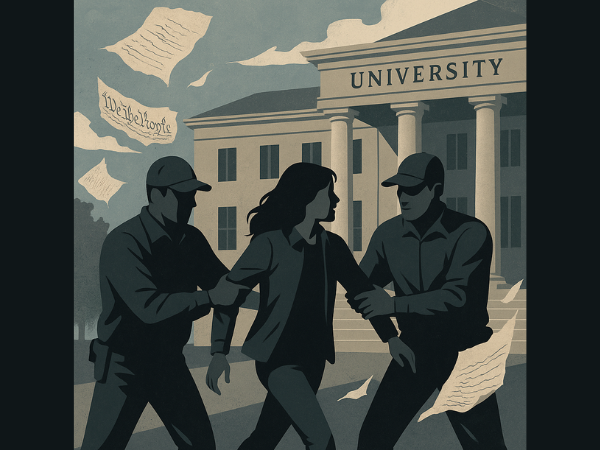
BURLINGTON, Vt. — In the wake of a string of court challenges over its arrests, detentions and deportations of university students engaged in political protests, the Trump Administration is threatening to suspend the writ of habeas corpus, a constitutional principle with roots in British law that assures everyone in the United States, including noncitizens, of the right to challenge a detention in court.

The White House’s admission that it is “actively looking at” suspending habeas corpus came on the same day that the U.S. District Court for Vermont ordered the immediate release of Rümeysa Öztürk, a Tufts University PhD student who was seized on the street near her apartment by masked, plainclothes ICE agents; shoved into an unmarked car; and transported out of state to a detention center pending deportation. Although never charged with a crime, Öztürk was targeted by government officials for co-authoring an op-ed in a student paper a year earlier expressing support for Palestinian civilians during a time of heightened international conflict. The Rutherford Institute joined a coalition of civil liberties organizations (including the Foundation for Individual Rights and Expression (FIRE), the National Coalition Against Censorship, PEN America, Cato Institute, and the First Amendment Lawyers Association) to file an amicus brief in Öztürk v. Trump challenging the legality of Öztürk’s arrest and detention through her petition for a writ of habeas corpus.

“This is not about public safety. This is about silencing dissent. The U.S. government is weaponizing immigration enforcement to punish political dissent,” said constitutional attorney John W. Whitehead, president of The Rutherford Institute and author of Battlefield America: The War on the American People. “If the government can silence, detain, and deport individuals simply for speaking out on political issues, then no one’s speech is truly safe and we’re no longer operating under the Constitution. We’re living under a system of political policing.”

Öztürk, a Turkish national lawfully present in the U.S. on a student visa, is pursuing a doctorate in the Child Study and Human Development program at Tufts University. Unbeknownst to Öztürk, Secretary of State Marco Rubio revoked her visa as part of a campaign by the Trump Administration to retaliate against those who publicly criticize Israel. Öztürk was detained without warning by masked, plainclothes agents on March 25, 2025, and transferred more than 1,500 miles away from her home in Massachusetts to the South Louisiana ICE Processing Center. In its amicus brief challenging Öztürk’s detention as unconstitutional, the legal coalition contends that the government’s actions set a dangerous precedent in which political speech can be treated as evidence of threat, opening the door for officials to selectively punish individuals based on the content and viewpoint of their expression.

The implications reach far beyond Öztürk’s case. Since returning to office, the Trump Administration has increasingly targeted immigrants and legal visa holders for arrest, deportation, or visa revocation based solely on their political expression. In one case, a legal aid attorney had her visa canceled after attending a peaceful protest. In another, a university lecturer was denied re-entry to the U.S. over critical social media posts. Such tactics, the coalition contends, create a sweeping chilling effect for anyone who dares to speak out against government policy.

Ronnie London, Conor Fitzpatrick, Colin McDonell, Will Creeley, and others at FIRE advanced the arguments in the Öztürk v. Trump amicus brief.

The Rutherford Institute, a nonprofit civil liberties organization, defends individuals whose constitutional rights have been threatened or violated and educates the public on a wide spectrum of issues affecting their freedoms.


Case History

May 01, 2025 • Civil Liberties Advocates Sound Alarm Over Arrest of PhD Student for Political Views

Source: https://tinyurl.com/22v9an5u

“A standing military force, with an overgrown Executive will not long be safe companions to liberty.”—James Madison

We are being frog-marched into tyranny at the end of a loaded gun. Or rather, hundreds of thousands of loaded guns.

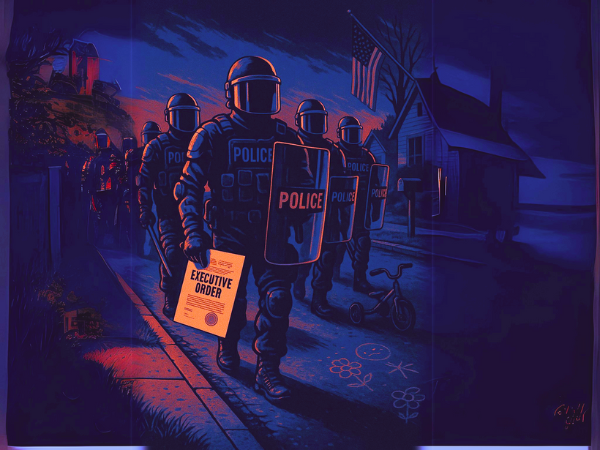
Let’s not mince words: President Trump’s April 28 executive order is the oldest trick in the authoritarian playbook: martial law masquerading as law and order.

Officially titled “Strengthening and Unleashing America’s Law Enforcement to Pursue Criminals and Protect Innocent Citizens,” this order is a “heil Hitler” wrapped in the goosestepping, despotic trappings of national security.

Don’t be fooled by Trump’s tough-on-crime rhetoric, cloaked in patriotic language and the promise of safety.

This is the language of every strongman who’s ever ruled by force.

The White House claims the order will “empower state and local law enforcement to relentlessly pursue criminals and protect American communities.” But under this administration, “criminal” increasingly includes anyone who dares to exercise their constitutional rights.

The order doesn’t merely expand policing—it institutionalizes repression.

It sets us squarely on the road to martial law.

If allowed to stand, Trump’s executive order completes our shift from a nation of laws—where even the least among us had the right to due process—to a nation of enforcers: vigilantes with badges who treat “we the people” as suspects and subordinates.

Without invoking the Insurrection Act or deploying active-duty military forces, Trump has accelerated the transformation of domestic police into his own paramilitary force.

With the stroke of his presidential pen, he has laid the groundwork for a stealth version of martial law by:

  • Expanding police powers and legal protections;
  • Authorizing the DOJ to defend officers accused of civil rights violations;
  • Increasing the transfer of military equipment to local police;
  • Shielding law enforcement from judicial oversight;
  • Prioritizing law enforcement protection over civil liberties;
  • Embedding DHS and federal agents more deeply into local policing.

Since taking office in January 2025, Trump has moved systematically to dismantle what little accountability remains:

  • Terminating the National Law Enforcement Accountability Database;
  • Halting DOJ investigations into abusive police departments;
  • Expanding immigration enforcement while eliminating oversight;
  • Dismissing internal watchdogs at DOJ and DHS;
  • Weakening civil rights tools and body camera requirements;
  • Suspending or eliminating consent decrees nationwide.

All of this has occurred without congressional debate, judicial review, or constitutional scrutiny.

Through it all, Trump has emboldened police forces to act with near impunity, reinforcing a trend long embraced by powerful police unions, bureaucratic cronyism, and laws providing for qualified immunity that shield misconduct from public consequence.

For years, we have watched as the government transformed local law enforcement into extensions of the military: outfitted with military hardware and trained in battlefield tactics.

However, this executive order goes one step further—creating not just a de facto standing army but Trump’s own army: loyal not to the Constitution or the people, but to the president.

This is the very danger the Founders feared: a militarized police force answerable to a powerful executive, operating outside the bounds of the law.

While the Posse Comitatus Act was intended to prevent the military from becoming a domestic police force, this administration has found a workaround: transforming civilian police into a paramilitary force armed and trained like the military, but without the legal constraints.

In doing so, the federal government has effectively sidestepped both constitutional checks and statutory prohibitions meant to guard against military rule on American soil.

This is martial law without a declaration.

The battlefield is here.

Law enforcement today is equipped like the military, trained in battlefield tactics, and given broad discretion over who to target and how to respond. But these are not soldiers bound by the laws of war. They are civilian enforcers, wielding unchecked power with minimal oversight.

And they are everywhere.

Armored vehicles on neighborhood streets. Flashbang raids on family homes. Riot police in small towns. SWAT-style teams deployed by federal agencies. Drones overhead. Mass surveillance below.

We are fast approaching a reality where constitutional rights exist in name only.

In practice, we are ruled by a quasi-military bureaucracy empowered to:

  • Detain without trial;
  • Punish political dissent;
  • Seize property under civil asset forfeiture;
  • Classify critics as extremists or terrorists;
  • Conduct mass surveillance on the populace;
  • Raid homes in the name of “public safety”;
  • Use deadly force at the slightest provocation.

In other words, we’ve got freedom in name only.

It’s the same scenario nationwide: in big cities and small towns alike, militarized “warrior” cops—hyped up on power—ride roughshod over individual rights by exercising almost absolute discretion over who is a threat, what constitutes resistance, and how harshly they can deal with the citizens they were appointed to “serve and protect.”

This nationwide epidemic of court-sanctioned police violence has already ensured that unarmed Americans—many of them mentally ill, elderly, disabled, or simply noncompliant—will continue to die at the hands of militarized police.

From individuals shot for holding garden hoses, to those killed after calling 911 for help, these tragedies underscore a chilling truth: in a police state, the only truly “safe” person is one who offers no resistance at all.

These killings are the inevitable result of a system that rewards vigilante aggression by warrior cops and punishes accountability.

These so-called warrior cops, trained to act as judge, jury and executioner, increasingly outnumber those who still honor their oath to uphold the Constitution and serve the public.

Now, under the cover of executive orders and nationalist rhetoric, that warrior mentality is being redirected toward a more dangerous mission: silencing political dissent.

Emboldened by Trump’s call to reopen Alcatraz and target so-called “homegrown” threats, these forces are no longer going to be tasked with enforcing the law—they will be deployed to enforce political obedience.

Backed by the full power of the state and unbound by meaningful accountability, these police state enforcers operate with the tactics of a military force but without its legal constraints. They are not soldiers governed by the rules of war. They are the foot soldiers of the police state.

And their numbers are growing.

This is not a theory. It is a reality unfolding before our eyes.

Battlefield tactics. Camouflage gear. Mass arrests. Tear gas. Strip searches. Drones. Water cannons. Rubber bullets. Concussion grenades. Intimidation. Laws abandoned at will.

We are living in a creeping state of undeclared martial law.

The militarization of police and federal agencies over recent decades has only accelerated the timeline toward authoritarianism.

The groundwork was laid long ago: the NDAA’s indefinite detention powers; court rulings that excuse shootings of unarmed citizens; the normalization of asset forfeiture, round-the-clock surveillance, and militarized drills in American cities.

This regime of lawless enforcement has been built over time—by legislators, courts, and a public too willing to look the other way.

Don’t be fooled: this is not law and order. This is constitutional demolition under the color of authority.

We are being trained to accept militarized policing, normalized surveillance, and injustice disguised as safety.

This is how freedom ends—not with a loud decree, but with the quiet, calculated erosion of every principle we once held sacred.

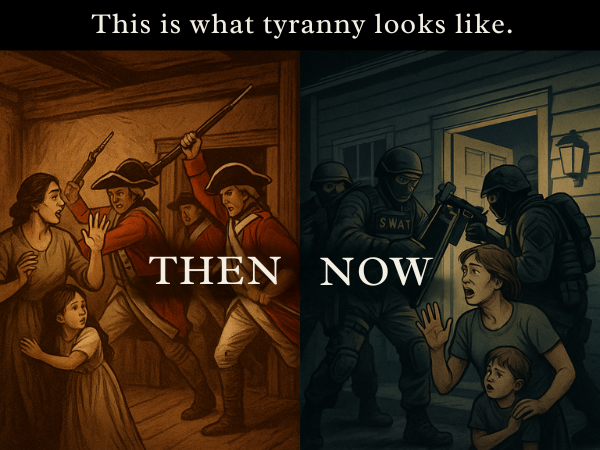
We’ve come full circle—from resisting British redcoats to submitting to American forces with the same disdain for liberty.

Our constitutional foundation is crumbling, and with it, any illusion that those in power still serve the public good.

Congress, for its part, has abdicated its role as a constitutional check on executive power—passing sweeping authorizations with little scrutiny and failing to rein in executive overreach. The courts, too, have in the past sanctioned many of these abuses in the name of national security, public order, or qualified immunity. Instead of acting as constitutional safeguards, these institutions have largely become rubber stamps.

Indeed, the president, Congress, the courts, and the police have come to embody the very abuse the Founders fought to resist. Only now are the courts beginning to show glimmers of allegiance to the Constitution.

This is not about partisanship. This is about power without restraint.

As tempting as it is to place full blame on Trump for this full-throttle shift into martial law, he is not the architect of this police state. He is its most shameless enabler—a useful frontman for the Deep State in its ongoing war on the American people.

As we warn in Battlefield America: The War on the American People and A Government of Wolves: The Emerging American Police State, we are sliding fast down a slippery slope to a Constitution-free America.

We ignore these signs at our peril.

Source: https://tinyurl.com/27hd6ywk

ABOUT JOHN W. WHITEHEAD

Constitutional attorney and author John W. Whitehead is founder and president of The Rutherford Institute. His most recent books are the best-selling Battlefield America: The War on the American People, the award-winning A Government of Wolves: The Emerging American Police State, and a debut dystopian fiction novel, The Erik Blair Diaries. Whitehead can be contacted at staff@rutherford.org. Nisha Whitehead is the Executive Director of The Rutherford Institute. Information about The Rutherford Institute is available at www.rutherford.org.

Publication Guidelines / Reprint Permission

John W. Whitehead’s weekly commentaries are available for publication to newspapers and web publications at no charge. 
BURLINGTON, Vt. — Warning that the U.S. government is weaponizing immigration enforcement to punish political dissent, The Rutherford Institute has joined a coalition of civil liberties organizations in challenging the arrest and detention of Rümeysa Öztürk, a Tufts University PhD student whose only alleged offense was expressing support for Palestinian civilians during a time of heightened international conflict.

In a joint amicus brief filed before the U.S. District Court for the District of Vermont in Öztürk v. Trump, the coalition—including the Foundation for Individual Rights and Expression (FIRE), the National Coalition Against Censorship, PEN America, Cato Institute, First Amendment Lawyers Association, and The Rutherford Institute—argues that Öztürk’s arrest by federal agents and the attempt to deport her represent a dangerous abuse of power rooted in viewpoint discrimination and retaliation against protected political speech.

“This is not about public safety. This is about silencing dissent,” said constitutional attorney John W. Whitehead, president of The Rutherford Institute and author of Battlefield America: The War on the American People. “If the government can silence, detain, and deport individuals simply for speaking out on political issues, then no one’s speech is truly safe and we’re no longer operating under a Constitution. We’re living under a system of political policing.”

Öztürk, a Turkish national lawfully present in the U.S. on a student visa, is pursuing a doctorate in the Child Study and Human Development program at Tufts University. She was seized on the street near her apartment on March 25, 2025, by masked, plainclothes agents who grabbed her as she screamed, handcuffed her, and took her away in an unmarked vehicle. Unbeknownst to Öztürk, Secretary of State Marco Rubio had revoked her visa, apparently in response to an op-ed she co-wrote a year earlier in which she criticized her university’s administration for dismissing student government resolutions which aimed to hold Israel accountable for alleged violations of international law in Palestine—views that diverge sharply from the Trump Administration’s. She was detained without warning and transferred more than 1,500 miles away from her home in Massachusetts to the South Louisiana ICE Processing Center.

According to the brief, there are no allegations that Öztürk engaged in violence or illegal activity. The coalition contends that the government’s effort to suppress disfavored political views is flatly prohibited by the Constitution. Moreover, the government’s actions set a dangerous precedent in which political speech can be treated as evidence of threat or disloyalty. This, the coalition warns, opens the door for officials to selectively punish individuals based on the content and viewpoint of their expression. The implications reach far beyond Öztürk’s case. Since returning to office in 2025, the Trump Administration has increasingly targeted immigrants and legal visa holders for arrest, deportation, or visa revocation based solely on their political expression. In one case, a legal aid attorney had her visa canceled after attending a peaceful protest. In another, a university lecturer was denied re-entry to the U.S. over critical social media posts. Such tactics, the coalition contends, create a sweeping chilling effect—not only for immigrants, but for anyone who dares to speak out against government policy.

Ronnie London, Conor Fitzpatrick, Colin McDonell, Will Creeley, and others at FIRE advanced the arguments in the Ozturk v. Trump amicus brief.

The Rutherford Institute, a nonprofit civil liberties organization, defends individuals whose constitutional rights have been threatened or violated and educates the public on a wide spectrum of issues affecting their freedoms.

Source: https://tinyurl.com/3ne6t5rw

“One of the most essential branches of English liberty is the freedom of one’s house. A man’s house is his castle.”—James Otis, Revolutionary War activist, on the Writs of Assistance, 1761

What the Founders rebelled against—armed government agents invading homes without cause—we are now being told to accept in the so-called name of law and order.

Imagine it: it’s the middle of the night. Your neighborhood is asleep. Suddenly, your front door is splintered by battering rams. Shadowy figures flood your home, screaming orders, pointing guns, threatening violence. You and your children are dragged out into the night—barefoot, in your underwear, in the rain.

Your home is torn apart. Your valuables seized. Your sense of safety, demolished.

But this isn’t a robbery by lawless criminals.

This is what terror policing looks like in Trump’s America: raids by night, flashbangs at dawn, mistaken identities, and shattered lives.

On April 24, 2025, in Oklahoma City, 20 heavily armed federal agents from ICE, the FBI, and DHS kicked in the door of a home where a woman and her three daughters—all American citizens—were sleeping. They were forced out of bed at gunpoint and made to wait in the rain while agents ransacked the house, confiscating their belongings.

It was the wrong house. The wrong family.

There were no apologies. No compensation. No accountability.

This is the new face of American policing, and it’s about to get so much worse thanks to the President Trump’s latest executive order, which aims to eliminate federal oversight and empower local law enforcement to act with impunity.

Titled “Strengthening and Unleashing America’s Law Enforcement to Pursue Criminals and Protect Innocent Citizens,” the executive order announced on April 28, 2025, removes restraints on police power, offers enhanced federal protections for officers accused of misconduct, expands access to military-grade equipment, and nullifies key oversight provisions from prior reform efforts.

Trump’s supporters have long praised his efforts to deregulate business and government under the slogan of “no handcuffs.” But when that logic is applied to law enforcement, the result isn’t freedom—it’s unchecked power.

What it really means is no restraints on police power—while the rest of us are left with fewer rights, less recourse, and a Constitution increasingly ignored behind the barrel of a gun.

This isn’t just a political shift. It’s a constitutional unraveling.

These aren’t abstract freedoms—they’re the bedrock of the Bill of Rights: the Fourth Amendment’s shield against warrantless searches, the Fifth Amendment’s promise of due process, and the First Amendment’s guarantee that we may speak, protest, and petition without fear of state retaliation.

Yet the build-up of the police state didn’t begin with Trump. What he has done is seize upon decades of bipartisan failure—and strip away the last remaining restraints.

For years, under both Republican and Democratic administrations, policing in America has grown more militarized, aggressive, and unaccountable. At times, there were modest attempts to rein in the worst excesses—like curbing the flow of military surplus equipment to local police—but these efforts were short-lived, inconsistent, and easily undone.

Trump’s executive order doesn’t just abandon those reforms. It bulldozes the guardrails. It hands law enforcement a blank check: more weapons, more power, and fewer consequences.

The result is not safety. It’s state-sanctioned violence.

It’s a future in which no home is safe, no knock is required, and no officer is ever held accountable.

That future is already here.

Just a few days before Trump signed the order, that reality played out in Oklahoma City when ICE, FBI, and DHS agents stormed the wrong home and terrorized a mother and her daughters.

Unfortunately, this is not an isolated incident.

In the 30 years since the first federal Crime Bill helped militarize local police forces, the use of SWAT teams has exploded. What was once a rare tactic for hostage situations is now used tens of thousands of times a year, often for nonviolent offenses or mere suspicion. These raids leave behind broken doors, traumatized children, and, too often, dead bodies. And yet, when families seek justice, they’re met with a legal wall called qualified immunity.

Under this doctrine, courts excuse even blatant misconduct by law enforcement unless an almost identical case has already been ruled unconstitutional. It’s legal sleight of hand—a get-out-of-jail-free card for government agents who trample on the Constitution.

We’ve entered an era in which federal agents can destroy your home, traumatize your family, and violate the Fourth Amendment with impunity. And the courts have said: that’s just how it works.

More than 80,000 SWAT raids now occur annually in the United States, most of them for nonviolent offenses like drug possession or administrative code violations.

Many are botched. Few are ever investigated.

In Martin v. United States, now before the Supreme Court, a heavily armed FBI SWAT team mistakenly stormed a Georgia home—armed with rifles, clad in tactical gear, and deploying a flashbang grenade—causing the family inside, with a 7-year-old son, to fear they were being burglarized.

The agents were supposed to raid a gang suspect’s house. Instead, they relied on faulty GPS and ended up at the wrong address, a block away from the intended target.

Only after detaining the family—forcing one family member onto the bedroom floor at gunpoint, and then pointing a gun in the mother’s face—did the officers realize their mistake.

The Rutherford Institute, alongside the National Police Accountability Project, filed an amicus brief urging the Court to deny qualified immunity for the agents. But if history is any guide, justice may prove elusive.

Just last year, the Court refused to hold a SWAT team leader accountable for raiding the wrong house, wrecking the wrong home, and terrorizing an innocent family.

In Jimerson v. Lewis, the SWAT team ignored clear differences between the actual target house and the Jimerson residence—missing house numbers, architectural mismatches, a wheelchair ramp where none should have been—and still received qualified immunity.

These rulings aren’t exceptions—they reflect a growing doctrine of unaccountability enshrined by the courts and now supercharged by the Trump administration.

Trump wants to give police even more immunity.

Brace yourselves for a new era of lawless policing.

President Trump’s call for a new crime bill that would further insulate police from liability, accountability and charges of official misconduct could usher in a new era of police brutality, lawlessness and the reckless deployment of lethal force on unarmed civilians.

This is how the rights of ordinary Americans get trampled under the boots of unchecked power.

Even when SWAT commanders disregard warrants, ignore addresses, and terrorize innocent families, the courts shield them from consequences.

These SWAT raids have become a thinly veiled, court-sanctioned excuse to let heavily armed police crash through doors in the dead of night. Too often, they’re marked by incompetence, devastation, and death—leaving a trail of broken homes and broken lives, while law enforcement escapes accountability.

There was a time in America when a person’s home was a sanctuary, protected by the Fourth Amendment from unlawful searches and seizures.

That promise is dead.

We have returned to the era of the King’s Writ—blanket search powers once used by British soldiers to invade colonial homes without cause. As James Otis warned in 1761, such writs “annihilate the privilege” of privacy and due process, allowing agents of the state to enter homes “when they please.”

Trump’s new executive order revives this tyranny in modern form: armored vehicles, night raids, no-knock warrants, federal immunity. It empowers police to act without restraint, and it rewards those who brutalize with impunity.

Even more alarming, the order sets the stage for future legislation that could effectively codify qualified immunity into federal law, making it nearly impossible for victims of police violence to sue.

This is how constitutional protections are dismantled—not in one dramatic blow, but in a thousand raids, a thousand broken doors, a thousand courts that look the other way.

Let’s not pretend we’re safe. Who will protect us from the police when the police have become the law unto themselves?

The war on the American people is no longer metaphorical.

Government agents can now kick in your door without warning, shoot your dog, point a gun at your children, and suffer no legal consequences—so long as they claim it was a “reasonable” mistake. They are judge, jury, and executioner.

With Trump’s new order, the architecture of a police state is no longer theoretical. It is being built in real time. It is being normalized.

It’s not just the poor, the marginalized, or the criminalized who should be afraid. It’s every homeowner, every parent, every citizen who still believes in the Bill of Rights.

Nowhere is this threat more visible than in the unholy alliance between ICE and militarized police forces.

This is where the danger deepens: when ICE and SWAT join forces, no one is safe.

This is more than just a problem of policing—it’s the convergence of two of the most dangerous arms of the modern security state: the merging of federal immigration enforcement with militarized domestic operations, creating a volatile blend of ICE lawlessness and militarized SWAT-style brute force.

Together, they’ve created a government apparatus that acts first and justifies itself later, if at all.

What used to be separate spheres—immigration enforcement and local policing—have now, under the pretense of national security, merged into a seamless operation of nighttime raids, heavy weaponry, blacked-out uniforms, and unmarked vehicles.

Armed federal agents, often operating in plainclothes and without clearly presented warrants, storm homes in the dead of night.

The distinction between a SWAT raid and an ICE operation has disappeared.

ICE agents—often masked, plainclothes, and operating without judicial oversight—are executing aggressive home invasions indistinguishable from SWAT team raids. These officers operate in secret, detaining individuals without clear warrants, sometimes without charges, and often without informing families of where their loved ones have been taken.

This alliance of ICE and SWAT has turned the American home into a battlefield, especially for those deemed politically inconvenient or “suspect” by the state.

These raids aren’t limited to those suspected of crimes.

Legal residents, asylum seekers, and even U.S. citizens have found themselves disappeared under vague claims of national security or immigration violations.

It is policing by fear and disappearance. And it runs counter to everything the Bill of Rights was designed to prevent: punishment without trial, surveillance without suspicion, and power without accountability.

When ICE agents armed with military-grade equipment conduct predawn raids alongside SWAT teams, with little to no accountability, the result is not public safety. It is state terror. And it’s exactly the kind of unchecked power the Constitution was written to prevent.

The Constitution is supposed to be a shield—especially the Fourth Amendment, which guards against unreasonable searches and seizures. But in this new reality, the government has nullified that shield.

All of America is fast becoming a Constitution-free zone.

What started as an exception—the so-called Constitution-free zone at the border—is fast becoming the norm across America, where due process is optional, and law enforcement acts more like a domestic army than a public servant.

The government no longer needs to prove its authority in court before violating your rights. It only needs to assert it on your doorstep—with flashbangs and rifles at the ready.

The only castle left may be the one you’re willing to defend.

The Founders knew the dangers of unchecked power. That’s why they gave us the Fourth Amendment. But rights are only as strong as the public’s willingness to defend them.

If we allow the government to turn our homes into war zones—if we continue to reward police for lawless raids, ignore the courts for rubber-stamping abuse, and cheer political leaders who promise “no more handcuffs”—we will lose the last refuge of freedom: the right to be left alone.

As I make clear in my book Battlefield America: The War on the American People and in its fictional counterpart The Erik Blair Diaries, the Constitution cannot protect you if the government no longer follows it—and if the courts no longer enforce it.

The knock may never come again. Just the crash of a door. The sound of boots. And the silence that follows.

Source: https://tinyurl.com/mvycd267

ABOUT JOHN W. WHITEHEAD

Constitutional attorney and author John W. Whitehead is founder and president of The Rutherford Institute. His most recent books are the best-selling Battlefield America: The War on the American People, the award-winning A Government of Wolves: The Emerging American Police State, and a debut dystopian fiction novel, The Erik Blair Diaries. Whitehead can be contacted at staff@rutherford.org. Nisha Whitehead is the Executive Director of The Rutherford Institute. Information about The Rutherford Institute is available at www.rutherford.org.

Publication Guidelines / Reprint Permission

John W. Whitehead’s weekly commentaries are available for publication to newspapers and web publications at no charge.