Posts Tagged ‘tyranny’

“When a long train of abuses and usurpations… evinces a design to reduce them under absolute Despotism, it is their right, it is their duty, to throw off such Government.”—Declaration of Independence (1776)

We are now struggling to emerge from the wreckage of a constitutional republic, transformed into a kleptocracy (government by thieves), collapsing into kakistocracy (government by the worst), and enforced by a police state algogracy (rule by algorithm).

This week alone, the Trump administration is reportedly erecting protest barricades around the White House, Congress is advancing legislation that favors the wealthy, and President Trump is grandstanding at the opening of a detention center dubbed “Alligator Alcatraz.”

Against such a backdrop of government-sponsored cruelty, corruption and shameless profiteering at taxpayer expense, what, to the average American, is freedom in an age when the government plays god—determining who is worthy of rights, who qualifies as a citizen, and who can be discarded without consequence?

What are inalienable rights worth if they can be redefined, delayed, or revoked by executive order?

Frederick Douglass posed a similar challenge more than 170 years ago when he asked, “What, to the American slave, is your Fourth of July?

His question was a searing indictment not just of slavery but of a government that proclaimed liberty while denying it to millions—a hypocrisy that persists in a system still governed by institutions more committed to power than principle.

Every branch of government—executive, legislative, and judicial—has, in one way or another, abandoned its duty to uphold the Constitution. And both parties have prioritized profit and political theater over justice and the rights of the governed.

The founders of this nation believed our rights come from God, not government. That we are born free, not made free by bureaucrats or judges. That among these rights—life, liberty, and the pursuit of happiness—none can be taken away without destroying the very idea of government by consent.

And yet that is precisely what’s happening.

We now live under a government that has become judge, jury, and executioner—writing its own laws, policing its own limits, and punishing those who object.

This is not what it means to be free.

When presidents rule by fiat, when agencies strip citizenship from naturalized Americans, when police act as both enforcers and executioners, and when courts rubber-stamp the erosion of basic protections, the distinction between a citizen and a subject begins to collapse.

What do inalienable rights mean in a country where:

  • Your citizenship can be revoked based solely on the government’s say-so?
  • Your freedom can be extinguished by surveillance, asset seizure, or indefinite detention?
  • Your property can be taken, your speech censored, and your life extinguished without due process?
  • Your life can be ended without a trial, a warning, or a second thought, because the government views you as expendable?

The answer is stark: they mean nothing—unless we defend them.

When the government—whether president, Congress, court, or local bureaucrat—claims the right to determine who does and doesn’t deserve rights, then no one is safe. Individuals become faceless numbers. Human beings become statistics. Lives become expendable. Dignity becomes disposable.

It is a slippery slope—justified in the name of national security, public safety, and the so-called greater good—that leads inevitably to totalitarianism.

Unfortunately, we have been dancing with this devil for far too long, and now, the mask has come off.

This is what authoritarianism looks like in America today.

Imagine living in a country where government agents crash through doors to arrest citizens merely for criticizing government officials. Where police stop and search you on a whim. Where carrying anything that resembles a firearm might get you arrested—or killed. Where surveillance is constant, dissent is criminalized, and loyalty is enforced through fear.

If you’re thinking this sounds like America today, you wouldn’t be far wrong.

But this scenario isn’t new. It’s the same kind of tyranny that drove American colonists to sever ties with Great Britain nearly 250 years ago.

Back then, American colonists lived under the shadow of an imperial power and an early police state that censored their speech, surveilled their movements, taxed their livelihoods, searched their homes without cause, quartered troops in their towns, and punished them for daring to demand liberty.

It was only when the colonists finally got fed up with being silenced, censored, searched, frisked, threatened, and arrested that they finally revolted against the tyrant’s fetters.

The Declaration of Independence—drafted by Thomas Jefferson and signed on July 4, 1776, by 56 men who risked everything—was their response. It was more than a list of grievances. It was a document seething with outrage over a government which had betrayed its citizens, a call to arms against a system that had ceased to represent the people and instead sought to dominate them.

Labeled traitors, these men were charged with treason, a crime punishable by death, because they believed in a radical idea: that all people are created to be free. For some, their acts of rebellion would cost them their homes and their fortunes. For others, it would be the ultimate price—their lives.

Yet even knowing the heavy price they might have to pay, these men dared to speak up. They understood that silence in the face of tyranny is complicity. So they stood together, pledging “our Lives, our Fortunes, and our sacred Honor” to the cause of freedom.

Even after they had won their independence from Great Britain, these new Americans worked to ensure that the rights they had risked their lives to secure would remain secure for future generations.

The result: our Bill of Rights, the first ten amendments to the Constitution.

The Constitution and Bill of Rights were meant to enshrine the liberties they fought for: due process, privacy, free speech, the right to bear arms, and limits on government power.

Now, nearly two and a half centuries later, those freedoms hang by a thread.

Imagine the shock and outrage these 56 men would feel were they to discover that almost 250 years later, the government they had risked their lives to create has been transformed into a militaristic police state in which exercising one’s freedoms—at a minimum, merely questioning a government agent—is often viewed as a flagrant act of defiance.

In fact, had Jefferson and his compatriots written the Declaration of Independence today, they would almost certainly be labeled extremists, placed on government watchlists, targeted by surveillance, and prosecuted as domestic threats.

Read the Declaration of Independence again, and you’ll see the grievances they laid at the feet of King George—unjust laws, militarized policing, surveillance, censorship, and the denial of due process—are the very abuses “we the people” suffer under today.

Had Jefferson written the Declaration about the American police state in 2025, it might have read like a criminal indictment of the crimes perpetrated by a government that:

Polices by fear and violence:

Surveils and represses dissent:

Strips away rights:

Concentrates unchecked power in the executive:

  • bypassing Congress with executive orders, sidelining the courts, and ruling by decree;
  • weaponizing federal agencies to suppress opposition and silence critics;
  • treating constitutional limits as optional and the presidency as a personal fiefdom.

These are not isolated abuses.

They are the logical outcomes of a government that has turned against its people.

They reveal a government that has claimed the god-like power to decide who gets rights—and who doesn’t. Who counts as a citizen—and who doesn’t. Who gets to live—and who becomes expendable.

All along the spectrum of life—from the unborn child to the elderly—the government continues to treat individuals endowed by their Creator with certain unalienable rights as if they are criminals, subhumans, or enemies of the state.

That is not freedom. It is tyranny.

And it must be called by its true name.

The truth is hard, but it must be said: the American police state has grown drunk on power, money, and its own authority.

The irony is almost too painful to articulate.

On the anniversary of the signing of the Declaration of Independence—a document that rebuked government corruption, tyranny, and injustice—we find ourselves surrounded by its modern-day equivalents.

This week’s spectacle—protest barricades, legislation to benefit the rich, and Trump’s appearance at Alligator Alcatraz, a.k.a. “Gator Gitmo”—shows how completely we have inverted the spirit of 1776.

That a president would celebrate the Fourth of July while inaugurating a modern-day internment camp—far from the reach of the courts or the Constitution—speaks volumes about the state of our nation and the extent to which those in power now glorify the very forms of tyranny the Founders once rose up against.

This is not law and order.

This is political theater, carceral cruelty, and authoritarianism in plain sight.

It is what happens when a nation that once prided itself on liberty now builds monuments to its own fear and domination.

The spectacle doesn’t end with detention camps and barricades. It extends into commerce, corruption, and self-enrichment at the highest levels of power.

President Trump is now marketing his own line of fragrances—a branding exercise so absurd it would be laughable if it weren’t a flagrant violation of the Constitution’s Emoluments Clause. His investments are booming. And all across his administration, top officials are shamelessly using public office to line their pockets, even as they push legislation to strip working-class Americans of the most basic benefits and protections, while claiming to be rooting out corruption and inefficiency.

This is not governance. This is kleptocracy—and it is happening in plain sight.

In the nearly 250 years since early Americans declared their independence from Great Britain, “we the people” have worked ourselves back under the tyrant’s thumb—only this time, the tyrant is one of our own making.

The abuses they once suffered under an imperial power haven’t disappeared. They’ve evolved.

We are being robbed blind by political grifters and corporate profiteers. We are being silenced by bureaucrats and blacklists. We are being watched by data miners and digital spies. We are being caged by militarized enforcers with no regard for the Constitution. And we are being ruled by presidents who govern not by law, but by executive decree.

Given the fact that we are a relatively young nation, it hasn’t taken very long for an authoritarian regime to creep into power.

Unfortunately, the bipartisan coup that laid siege to our nation did not happen overnight.

The architecture of oppression—surveillance, militarism, censorship, propaganda—was built slowly, brick by brick, law by law, war by war.

It snuck in under our radar, hiding behind the guise of national security, the war on drugs, the war on terror, the war on immigration, political correctness, hate crimes and a host of other official-sounding programs aimed at expanding the government’s power at the expense of individual freedoms.

The building blocks for the bleak future we’re just now getting a foretaste of—police shootings of unarmed citizens, profit-driven prisons, weapons of compliance, a wall-to-wall surveillance state, pre-crime programs, a suspect society, school-to-prison pipelines, militarized police, overcriminalization, SWAT team raids, endless wars, etc.—were put in place by government officials we trusted to look out for our best interests.

The result is an empire in decline and a citizenry under siege.

But if history teaches us anything, it’s that the power of the people—when awakened—is stronger than any empire.

For decades, the Constitution has been our shield against tyranny.

But today, it’s under siege. And now we must be the shield.

Surveillance is expanding. Peaceful dissent is being punished. Judges are being targeted. The presidency is issuing decrees and bypassing the rule of law.

Every institution meant to check power is being tested—and in some cases, broken.

This is the moment to stand in front of the Constitution and defend it.

As I make clear in my book Battlefield America: The War on the American People and in its fictional counterpart The Erik Blair Diaries, the fight for freedom is never over. But neither is it lost—so long as we refuse to surrender, refuse to remain silent, and refuse to accept tyranny as the price of safety.

It is time to remember who we are. To reclaim the Constitution. To resist the march toward authoritarianism. And to reassert—boldly and without apology—that our rights are not up for negotiation.

Source: https://tinyurl.com/yc8n9rsj

ABOUT JOHN W. WHITEHEAD

Constitutional attorney and author John W. Whitehead is founder and president of The Rutherford Institute. His most recent books are the best-selling Battlefield America: The War on the American People, the award-winning A Government of Wolves: The Emerging American Police State, and a debut dystopian fiction novel, The Erik Blair Diaries. Whitehead can be contacted at staff@rutherford.org. Nisha Whitehead is the Executive Director of The Rutherford Institute. Information about The Rutherford Institute is available at www.rutherford.org.

Publication Guidelines / Reprint Permission

John W. Whitehead’s weekly commentaries are available for publication to newspapers and web publications at no charge. 

“When the song of the angels is stilled, when the star in the sky is gone, when the kings and princes are home, when the shepherds are back with their flocks, the work of Christmas begins: to find the lost, to heal the broken, to feed the hungry, to release the prisoner, to rebuild the nations, to bring peace among the people, to make music in the heart.”—Howard Thurman, theologian and civil rights activist

The Christmas story of a baby born in a manger is a familiar one.

The Roman Empire, a police state in its own right, had ordered that a census be conducted. Joseph and his pregnant wife Mary traveled to the little town of Bethlehem so that they could be counted. There being no room for the couple at any of the inns, they stayed in a stable (a barn), where Mary gave birth to a baby boy, Jesus. Warned that the government planned to kill the baby, Jesus’ family fled with him to Egypt until it was safe to return to their native land.

Yet what if Jesus had been born 2,000 years later?

What if, instead of being born into the Roman police state, Jesus had been born at this moment in time? What kind of reception would Jesus and his family be given? Would we recognize the Christ child’s humanity, let alone his divinity? Would we treat him any differently than he was treated by the Roman Empire? If his family were forced to flee violence in their native country and sought refuge and asylum within our borders, what sanctuary would we offer them?

A singular number of churches across the country have asked those very questions in recent years, and their conclusions were depicted with unnerving accuracy by nativity scenes in which Jesus and his family are separated, segregated and caged in individual chain-link pens, topped by barbed wire fencing.

Those nativity scenes were a pointed attempt to remind the modern world that the narrative about the birth of Jesus is one that speaks on multiple fronts to a world that has allowed the life, teachings and crucifixion of Jesus to be drowned out by partisan politics, secularism, materialism and war, all driven by a manipulative shadow government called the Deep State.

The modern-day church has largely shied away from applying Jesus’ teachings to modern problems such as war, poverty, immigration, etc., but thankfully there have been individuals throughout history who ask themselves and the world: what would Jesus do?

What would Jesus—the baby born in Bethlehem who grew into an itinerant preacher and revolutionary activist, who not only died challenging the police state of his day (namely, the Roman Empire) but spent his adult life speaking truth to power, challenging the status quo of his day, and pushing back against the abuses of the Roman Empire—do about the injustices of our  modern age?

Dietrich Bonhoeffer asked himself what Jesus would have done about the horrors perpetrated by Hitler and his assassins. The answer: Bonhoeffer was executed by Hitler for attempting to undermine the tyranny at the heart of Nazi Germany.

Aleksandr Solzhenitsyn asked himself what Jesus would have done about the soul-destroying gulags and labor camps of the Soviet Union. The answer: Solzhenitsyn found his voice and used it to speak out about government oppression and brutality.

Martin Luther King Jr. asked himself what Jesus would have done about America’s warmongering. The answer: declaring “my conscience leaves me no other choice,” King risked widespread condemnation as well as his life when he publicly opposed the Vietnam War on moral and economic grounds.

Even now, despite the popularity of the phrase “What Would Jesus Do?” (WWJD) in Christian circles, there remains a disconnect in the modern church between the teachings of Christ and the suffering of what Jesus in Matthew 25 refers to as the “least of these.”

Yet this is not a theological gray area: Jesus was unequivocal about his views on many things, not the least of which was charity, compassion, war, tyranny and love.

After all, Jesus—the revered preacher, teacher, radical and prophet—was born into a police state not unlike the growing menace of the American police state. When he grew up, he had powerful, profound things to say, things that would change how we view people, alter government policies and change the world. “Blessed are the merciful,” “Blessed are the peacemakers,” and “Love your enemies” are just a few examples of his most profound and revolutionary teachings.

When confronted by those in authority, Jesus did not shy away from speaking truth to power. Indeed, his teachings undermined the political and religious establishment of his day. It cost him his life. He was eventually crucified as a warning to others not to challenge the powers-that-be.

Can you imagine what Jesus’ life would have been like if, instead of being born into the Roman police state, he had been born and raised in the American police state?

Consider the following if you will.

Had Jesus been born in the era of the America police state, rather than traveling to Bethlehem for a census, Jesus’ parents would have been mailed a 28-page American Community Survey, a mandatory government questionnaire documenting their habits, household inhabitants, work schedule, how many toilets are in your home, etc. The penalty for not responding to this invasive survey can go as high as $5,000.

Instead of being born in a manger, Jesus might have been born at home. Rather than wise men and shepherds bringing gifts, however, the baby’s parents might have been forced to ward off visits from state social workers intent on prosecuting them for the home birth. One couple in Washington had all three of their children removed after social services objected to the two youngest being birthed in an unassisted home delivery.

Had Jesus been born in a hospital, his blood and DNA would have been taken without his parents’ knowledge or consent and entered into a government biobank. While most states require newborn screening, a growing number are holding onto that genetic material long-term for research, analysis and purposes yet to be disclosed.

Then again, had Jesus’ parents been undocumented immigrants, they and the newborn baby might have been shuffled to a profit-driven, private prison for illegals where they first would have been separated from each other, the children detained in make-shift cages, and the parents eventually turned into cheap, forced laborers for corporations such as Starbucks, Microsoft, Walmart, and Victoria’s Secret. There’s quite a lot of money to be made from imprisoning immigrants, especially when taxpayers are footing the bill.

From the time he was old enough to attend school, Jesus would have been drilled in lessons of compliance and obedience to government authorities, while learning little about his own rights. Had he been daring enough to speak out against injustice while still in school, he might have found himself tasered or beaten by a school resource officer, or at the very least suspended under a school zero tolerance policy that punishes minor infractions as harshly as more serious offenses.

Had Jesus disappeared for a few hours let alone days as a 12-year-old, his parents would have been handcuffed, arrested and jailed for parental negligence. Parents across the country have been arrested for far less “offenses” such as allowing their children to walk to the park unaccompanied and play in their front yard alone.

Rather than disappearing from the history books from his early teenaged years to adulthood, Jesus’ movements and personal data—including his biometrics—would have been documented, tracked, monitored and filed by governmental agencies and corporations such as Google and Microsoft. Incredibly, 95 percent of school districts share their student records with outside companies that are contracted to manage data, which they then use to market products to us.

From the moment Jesus made contact with an “extremist” such as John the Baptist, he would have been flagged for surveillance because of his association with a prominent activist, peaceful or otherwise. Since 9/11, the FBI has actively carried out surveillance and intelligence-gathering operations on a broad range of activist groups, from animal rights groups to poverty relief, anti-war groups and other such “extremist” organizations.

Jesus’ anti-government views would certainly have resulted in him being labeled a domestic extremist. Law enforcement agencies are being trained to recognize signs of anti-government extremism during interactions with potential extremists who share a “belief in the approaching collapse of government and the economy.”

While traveling from community to community, Jesus might have been reported to government officials as “suspicious” under the Department of Homeland Security’s “See Something, Say Something” programs. Many states, including New York, are providing individuals with phone apps that allow them to take photos of suspicious activity and report them to their state Intelligence Center, where they are reviewed and forwarded to law-enforcement agencies.

Rather than being permitted to live as an itinerant preacher, Jesus might have found himself threatened with arrest for daring to live off the grid or sleeping outside. In fact, the number of cities that have resorted to criminalizing homelessness by enacting bans on camping, sleeping in vehicles, loitering and begging in public has doubled.

Viewed by the government as a dissident and a potential threat to its power, Jesus might have had government spies planted among his followers to monitor his activities, report on his movements, and entrap him into breaking the law. Such Judases today—called informants—often receive hefty paychecks from the government for their treachery.

Had Jesus used the internet to spread his radical message of peace and love, he might have found his blog posts infiltrated by government spies attempting to undermine his integrity, discredit him or plant incriminating information online about him. At the very least, he would have had his website hacked and his email monitored.

Had Jesus attempted to feed large crowds of people, he would have been threatened with arrest for violating various ordinances prohibiting the distribution of food without a permit. Florida officials arrested a 90-year-old man for feeding the homeless on a public beach.

Had Jesus spoken publicly about his 40 days in the desert and his conversations with the devil, he might have been labeled mentally ill and detained in a psych ward against his will for a mandatory involuntary psychiatric hold with no access to family or friends. One Virginia man was arrested, strip searched, handcuffed to a table, diagnosed as having “mental health issues,” and locked up for five days in a mental health facility against his will apparently because of his slurred speech and unsteady gait.

Without a doubt, had Jesus attempted to overturn tables in a Jewish temple and rage against the materialism of religious institutions, he would have been charged with a hate crime. More than 45 states and the federal government have hate crime laws on the books.

Had anyone reported Jesus to the police as being potentially dangerous, he might have found himself confronted—and killed—by police officers for whom any perceived act of non-compliance (a twitch, a question, a frown) can result in them shooting first and asking questions later.

Rather than having armed guards capture Jesus in a public place, government officials would have ordered that a SWAT team carry out a raid on Jesus and his followers, complete with flash-bang grenades and military equipment. There are upwards of 80,000 such SWAT team raids carried out every year, many on unsuspecting Americans who have no defense against such government invaders, even when such raids are done in error.

Instead of being detained by Roman guards, Jesus might have been made to “disappear” into a secret government detention center where he would have been interrogated, tortured and subjected to all manner of abuses. Chicago police have “disappeared” more than 7,000 people into a secret, off-the-books interrogation warehouse at Homan Square.

Charged with treason and labeled a domestic terrorist, Jesus might have been sentenced to a life-term in a private prison where he would have been forced to provide slave labor for corporations or put to death by way of the electric chair or a lethal mixture of drugs.

Indeed, as I make clear in my book Battlefield America: The War on the American People and in its fictional counterpart The Erik Blair Diaries, given the nature of government then and now, it is painfully evident that whether Jesus had been born in our modern age or his own, he still would have died at the hands of a police state.

Thus, as we draw near to Christmas with its celebration of miracles and promise of salvation, we would do well to remember that what happened in that manger on that starry night in Bethlehem is only the beginning of the story. That baby born in a police state grew up to be a man who did not turn away from the evils of his age but rather spoke out against it.

We must do no less.

Source: https://tinyurl.com/6fucv454

ABOUT JOHN W. WHITEHEAD

Constitutional attorney and author John W. Whitehead is founder and president of The Rutherford Institute. His most recent books are the best-selling Battlefield America: The War on the American People, the award-winning A Government of Wolves: The Emerging American Police State, and a debut dystopian fiction novel, The Erik Blair Diaries. Whitehead can be contacted at staff@rutherford.org. Nisha Whitehead is the Executive Director of The Rutherford Institute. Information about The Rutherford Institute is available at www.rutherford.org.

Publication Guidelines / Reprint Permission

John W. Whitehead’s weekly commentaries are available for publication to newspapers and web publications at no charge. 
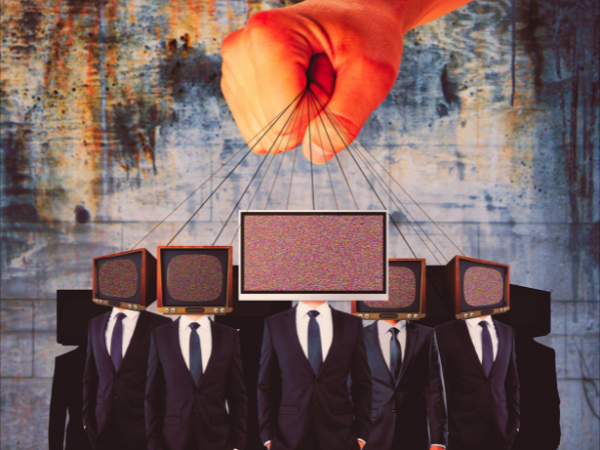
“It is the function of mass agitation to exploit all the grievances, hopes, aspirations, prejudices, fears, and ideals of all the special groups that make up our society, social, religious, economic, racial, political. Stir them up. Set one against the other. Divide and conquer. That’s the way to soften up a democracy.”― J. Edgar Hoover, Masters of Deceit

Nothing is real,” observed John Lennon, and that’s especially true of politics.

Much like the fabricated universe in Peter Weir’s 1998 film The Truman Show, in which a man’s life is the basis for an elaborately staged television show aimed at selling products and procuring ratings, the political scene in the United States has devolved over the years into a carefully calibrated exercise in how to manipulate, polarize, propagandize and control a population.

Take the media circus that is the Donald Trump hush money trial, which panders to the public’s voracious appetite for titillating, soap opera drama, keeping the citizenry distracted, diverted and divided.

This is the magic of the reality TV programming that passes for politics today.

Everything becomes entertainment fodder.

As long as we are distracted, entertained, occasionally outraged, always polarized but largely uninvolved and content to remain in the viewer’s seat, we’ll never manage to present a unified front against tyranny (or government corruption and ineptitude) in any form.

Studies suggest that the more reality TV people watch—and I would posit that it’s all reality TV, entertainment news included—the more difficult it becomes to distinguish between what is real and what is carefully crafted farce.

“We the people” are watching a lot of TV.

On average, Americans spend five hours a day watching television. By the time we reach age 65, we’re watching more than 50 hours of television a week, and that number increases as we get older. And reality TV programming consistently captures the largest percentage of TV watchers every season by an almost 2-1 ratio.

This doesn’t bode well for a citizenry able to sift through masterfully-produced propaganda in order to think critically about the issues of the day.

Yet look behind the spectacles, the reality TV theatrics, the sleight-of-hand distractions and diversions, and the stomach-churning, nail-biting drama that is politics today, and you will find there is a method to the madness.

We have become guinea pigs in a ruthlessly calculated, carefully orchestrated, chillingly cold-blooded experiment in how to control a population and advance a political agenda without much opposition from the citizenry.

This is how you persuade a populace to voluntarily march in lockstep with a police state and police themselves (and each other): by ratcheting up the fear-factor, meted out one carefully calibrated crisis at a time, and teaching them to distrust any who diverge from the norm through elaborate propaganda campaigns.

Unsurprisingly, one of the biggest propagandists today is the U.S. government.

Add the government’s inclination to monitor online activity and police so-called “disinformation,” and you have the makings of a restructuring of reality straight out of Orwell’s 1984, where the Ministry of Truth polices speech and ensures that facts conform to whatever version of reality the government propagandists embrace.

This “policing of the mind” is exactly the danger author Jim Keith warned about when he predicted that “information and communication sources are gradually being linked together into a single computerized network, providing an opportunity for unheralded control of what will be broadcast, what will be said, and ultimately what will be thought.”

You may not hear much about the government’s role in producing, planting and peddling propaganda-driven fake news—often with the help of the corporate news media—because the powers-that-be don’t want us skeptical of the government’s message or its corporate accomplices in the mainstream media.

However, when you have social media giants colluding with the government in order to censor so-called disinformation, all the while the mainstream news media, which is supposed to act as a bulwark against government propaganda, has instead become the mouthpiece of the world’s largest corporation (the U.S. government), the Deep State has grown dangerously out-of-control.

This has been in the works for a long time.

Veteran journalist Carl Bernstein, in his expansive 1977 Rolling Stone piece “The CIA and the Media,” reported on Operation Mockingbird, a CIA campaign started in the 1950s to plant intelligence reports among reporters at more than 25 major newspapers and wire agencies, who would then regurgitate them for a public oblivious to the fact that they were being fed government propaganda.

In some instances, as Bernstein showed, members of the media also served as extensions of the surveillance state, with reporters actually carrying out assignments for the CIA. Executives with CBS, the New York Times and Time magazine also worked closely with the CIA to vet the news.

If it was happening then, you can bet it’s still happening today, only this collusion has been reclassified, renamed and hidden behind layers of government secrecy, obfuscation and spin.

In its article, “How the American government is trying to control what you think,” the Washington Post points out “Government agencies historically have made a habit of crossing the blurry line between informing the public and propagandizing.”

This is mind-control in its most sinister form.

The end goal of these mind-control campaigns—packaged in the guise of the greater good—is to see how far the American people will allow the government to go in re-shaping the country in the image of a totalitarian police state.

The government’s fear-mongering is a key element in its mind-control programming.

It’s a simple enough formula. National crises, global pandemics, reported terrorist attacks, and sporadic shootings leave us in a constant state of fear. The emotional panic that accompanies fear actually shuts down the prefrontal cortex or the rational thinking part of our brains. In other words, when we are consumed by fear, we stop thinking.

A populace that stops thinking for themselves is a populace that is easily led, easily manipulated and easily controlled whether through propaganda, brainwashing, mind control, or just plain fear-mongering.

Fear not only increases the power of government, but it also divides the people into factions, persuades them to see each other as the enemy and keeps them screaming at each other so that they drown out all other sounds. In this way, they will never reach consensus about anything and will be too distracted to notice the police state closing in on them until the final crushing curtain falls.

This Machiavellian scheme has so ensnared the nation that few Americans even realize they are being brainwashed—manipulated—into adopting an “us” against “them” mindset. All the while, those in power—bought and paid for by lobbyists and corporations—move their costly agendas forward.

This unseen mechanism of society that manipulates us through fear into compliance is what American theorist Edward L. Bernays referred to as “an invisible government which is the true ruling power of our country.”

It was almost 100 years ago when Bernays wrote his seminal work Propaganda:

“We are governed, our minds are molded, our tastes formed, our ideas suggested, largely by men we have never heard of… In almost every act of our daily lives, whether in the sphere of politics or business, in our social conduct or our ethical thinking, we are dominated by the relatively small number of persons…who understand the mental processes and social patterns of the masses. It is they who pull the wires which control the public mind.”

To this invisible government of rulers who operate behind the scenes—the architects of the Deep State—we are mere puppets on a string, to be brainwashed, manipulated and controlled.

All of the distracting, disheartening, disorienting news you are bombarded with daily is being driven by propaganda churned out by one corporate machine (the corporate-controlled government) and fed to the American people by way of yet another corporate machine (the corporate-controlled media).

“For the first time in human history, there is a concerted strategy to manipulate global perception. And the mass media are operating as its compliant assistants, failing both to resist it and to expose it,” writes investigative journalist Nick Davies.

So where does that leave us?

Americans should beware of letting others—whether they be television news hosts, political commentators or media corporations—do their thinking for them.

A populace that cannot think for themselves is a populace with its backs to the walls: mute in the face of elected officials who refuse to represent us, helpless in the face of police brutality, powerless in the face of militarized tactics and technology that treat us like enemy combatants on a battlefield, and naked in the face of government surveillance that sees and hears all.

As I make clear in my book Battlefield America: The War on the American People and in its fictional counterpart The Erik Blair Diaries, it’s time to change the channel, tune out the reality TV show, and push back against the real menace of the police state.

If not, if we continue to sit back and lose ourselves in political programming, we will remain a captive audience to a farce that grows more absurd by the minute.

Source: https://tinyurl.com/2d72r9ap

ABOUT JOHN W. WHITEHEAD

Constitutional attorney and author John W. Whitehead is founder and president of The Rutherford Institute. His most recent books are the best-selling Battlefield America: The War on the American People, the award-winning A Government of Wolves: The Emerging American Police State, and a debut dystopian fiction novel, The Erik Blair Diaries. Whitehead can be contacted at staff@rutherford.org. Nisha Whitehead is the Executive Director of The Rutherford Institute. Information about The Rutherford Institute is available at www.rutherford.org.

Publication Guidelines / Reprint Permission

John W. Whitehead’s weekly commentaries are available for publication to newspapers and web publications at no charge. 

“When the song of the angels is stilled, when the star in the sky is gone, when the kings and princes are home, when the shepherds are back with their flocks, the work of Christmas begins: to find the lost, to heal the broken, to feed the hungry, to release the prisoner, to rebuild the nations, to bring peace among the people, to make music in the heart.”—Howard Thurman, theologian and civil rights activist

The Christmas story of a baby born in a manger is a familiar one.

The Roman Empire, a police state in its own right, had ordered that a census be conducted. Joseph and his pregnant wife Mary traveled to the little town of Bethlehem so that they could be counted. There being no room for the couple at any of the inns, they stayed in a stable (a barn), where Mary gave birth to a baby boy, Jesus. Warned that the government planned to kill the baby, Jesus’ family fled with him to Egypt until it was safe to return to their native land.

Yet what if Jesus had been born 2,000 years later?

What if, instead of being born into the Roman police state, Jesus had been born at this moment in time? What kind of reception would Jesus and his family be given? Would we recognize the Christ child’s humanity, let alone his divinity? Would we treat him any differently than he was treated by the Roman Empire? If his family were forced to flee violence in their native country and sought refuge and asylum within our borders, what sanctuary would we offer them?

A singular number of churches across the country have asked those very questions in recent years, and their conclusions were depicted with unnerving accuracy by nativity scenes in which Jesus and his family are separated, segregated and caged in individual chain-link pens, topped by barbed wire fencing.

Those nativity scenes were a pointed attempt to remind the modern world that the narrative about the birth of Jesus is one that speaks on multiple fronts to a world that has allowed the life, teachings and crucifixion of Jesus to be drowned out by partisan politics, secularism, materialism and war, all driven by a manipulative shadow government called the Deep State.

The modern-day church has largely shied away from applying Jesus’ teachings to modern problems such as war, poverty, immigration, etc., but thankfully there have been individuals throughout history who ask themselves and the world: what would Jesus do?

What would Jesus—the baby born in Bethlehem who grew into an itinerant preacher and revolutionary activist, who not only died challenging the police state of his day (namely, the Roman Empire) but spent his adult life speaking truth to power, challenging the status quo of his day, and pushing back against the abuses of the Roman Empire—do about the injustices of our  modern age?

Dietrich Bonhoeffer asked himself what Jesus would have done about the horrors perpetrated by Hitler and his assassins. The answer: Bonhoeffer was executed by Hitler for attempting to undermine the tyranny at the heart of Nazi Germany.

Aleksandr Solzhenitsyn asked himself what Jesus would have done about the soul-destroying gulags and labor camps of the Soviet Union. The answer: Solzhenitsyn found his voice and used it to speak out about government oppression and brutality.

Martin Luther King Jr. asked himself what Jesus would have done about America’s warmongering. The answer: declaring “my conscience leaves me no other choice,” King risked widespread condemnation as well as his life when he publicly opposed the Vietnam War on moral and economic grounds.

Even now, despite the popularity of the phrase “What Would Jesus Do?” (WWJD) in Christian circles, there remains a disconnect in the modern church between the teachings of Christ and the suffering of what Jesus in Matthew 25 refers to as the “least of these.”

Yet this is not a theological gray area: Jesus was unequivocal about his views on many things, not the least of which was charity, compassion, war, tyranny and love.

After all, Jesus—the revered preacher, teacher, radical and prophet—was born into a police state not unlike the growing menace of the American police state. When he grew up, he had powerful, profound things to say, things that would change how we view people, alter government policies and change the world. “Blessed are the merciful,” “Blessed are the peacemakers,” and “Love your enemies” are just a few examples of his most profound and revolutionary teachings.

When confronted by those in authority, Jesus did not shy away from speaking truth to power. Indeed, his teachings undermined the political and religious establishment of his day. It cost him his life. He was eventually crucified as a warning to others not to challenge the powers-that-be.

Can you imagine what Jesus’ life would have been like if, instead of being born into the Roman police state, he had been born and raised in the American police state?

Consider the following if you will.

Had Jesus been born in the era of the America police state, rather than traveling to Bethlehem for a census, Jesus’ parents would have been mailed a 28-page American Community Survey, a mandatory government questionnaire documenting their habits, household inhabitants, work schedule, how many toilets are in your home, etc. The penalty for not responding to this invasive survey can go as high as $5,000.

Instead of being born in a manger, Jesus might have been born at home. Rather than wise men and shepherds bringing gifts, however, the baby’s parents might have been forced to ward off visits from state social workers intent on prosecuting them for the home birth. One couple in Washington had all three of their children removed after social services objected to the two youngest being birthed in an unassisted home delivery.

Had Jesus been born in a hospital, his blood and DNA would have been taken without his parents’ knowledge or consent and entered into a government biobank. While most states require newborn screening, a growing number are holding onto that genetic material long-term for research, analysis and purposes yet to be disclosed.

Then again, had Jesus’ parents been undocumented immigrants, they and the newborn baby might have been shuffled to a profit-driven, private prison for illegals where they first would have been separated from each other, the children detained in make-shift cages, and the parents eventually turned into cheap, forced laborers for corporations such as Starbucks, Microsoft, Walmart, and Victoria’s Secret. There’s quite a lot of money to be made from imprisoning immigrants, especially when taxpayers are footing the bill.

From the time he was old enough to attend school, Jesus would have been drilled in lessons of compliance and obedience to government authorities, while learning little about his own rights. Had he been daring enough to speak out against injustice while still in school, he might have found himself tasered or beaten by a school resource officer, or at the very least suspended under a school zero tolerance policy that punishes minor infractions as harshly as more serious offenses.

Had Jesus disappeared for a few hours let alone days as a 12-year-old, his parents would have been handcuffed, arrested and jailed for parental negligence. Parents across the country have been arrested for far less “offenses” such as allowing their children to walk to the park unaccompanied and play in their front yard alone.

Rather than disappearing from the history books from his early teenaged years to adulthood, Jesus’ movements and personal data—including his biometrics—would have been documented, tracked, monitored and filed by governmental agencies and corporations such as Google and Microsoft. Incredibly, 95 percent of school districts share their student records with outside companies that are contracted to manage data, which they then use to market products to us.

From the moment Jesus made contact with an “extremist” such as John the Baptist, he would have been flagged for surveillance because of his association with a prominent activist, peaceful or otherwise. Since 9/11, the FBI has actively carried out surveillance and intelligence-gathering operations on a broad range of activist groups, from animal rights groups to poverty relief, anti-war groups and other such “extremist” organizations.

Jesus’ anti-government views would certainly have resulted in him being labeled a domestic extremist. Law enforcement agencies are being trained to recognize signs of anti-government extremism during interactions with potential extremists who share a “belief in the approaching collapse of government and the economy.”

While traveling from community to community, Jesus might have been reported to government officials as “suspicious” under the Department of Homeland Security’s “See Something, Say Something” programs. Many states, including New York, are providing individuals with phone apps that allow them to take photos of suspicious activity and report them to their state Intelligence Center, where they are reviewed and forwarded to law-enforcement agencies.

Rather than being permitted to live as an itinerant preacher, Jesus might have found himself threatened with arrest for daring to live off the grid or sleeping outside. In fact, the number of cities that have resorted to criminalizing homelessness by enacting bans on camping, sleeping in vehicles, loitering and begging in public has doubled.

Viewed by the government as a dissident and a potential threat to its power, Jesus might have had government spies planted among his followers to monitor his activities, report on his movements, and entrap him into breaking the law. Such Judases today—called informants—often receive hefty paychecks from the government for their treachery.

Had Jesus used the internet to spread his radical message of peace and love, he might have found his blog posts infiltrated by government spies attempting to undermine his integrity, discredit him or plant incriminating information online about him. At the very least, he would have had his website hacked and his email monitored.

Had Jesus attempted to feed large crowds of people, he would have been threatened with arrest for violating various ordinances prohibiting the distribution of food without a permit. Florida officials arrested a 90-year-old man for feeding the homeless on a public beach.

Had Jesus spoken publicly about his 40 days in the desert and his conversations with the devil, he might have been labeled mentally ill and detained in a psych ward against his will for a mandatory involuntary psychiatric hold with no access to family or friends. One Virginia man was arrested, strip searched, handcuffed to a table, diagnosed as having “mental health issues,” and locked up for five days in a mental health facility against his will apparently because of his slurred speech and unsteady gait.

Without a doubt, had Jesus attempted to overturn tables in a Jewish temple and rage against the materialism of religious institutions, he would have been charged with a hate crime. More than 45 states and the federal government have hate crime laws on the books.

Had anyone reported Jesus to the police as being potentially dangerous, he might have found himself confronted—and killed—by police officers for whom any perceived act of non-compliance (a twitch, a question, a frown) can result in them shooting first and asking questions later.

Rather than having armed guards capture Jesus in a public place, government officials would have ordered that a SWAT team carry out a raid on Jesus and his followers, complete with flash-bang grenades and military equipment. There are upwards of 80,000 such SWAT team raids carried out every year, many on unsuspecting Americans who have no defense against such government invaders, even when such raids are done in error.

Instead of being detained by Roman guards, Jesus might have been made to “disappear” into a secret government detention center where he would have been interrogated, tortured and subjected to all manner of abuses. Chicago police have “disappeared” more than 7,000 people into a secret, off-the-books interrogation warehouse at Homan Square.

Charged with treason and labeled a domestic terrorist, Jesus might have been sentenced to a life-term in a private prison where he would have been forced to provide slave labor for corporations or put to death by way of the electric chair or a lethal mixture of drugs.

Indeed, as I make clear in my book Battlefield America: The War on the American People and in its fictional counterpart The Erik Blair Diaries, given the nature of government then and now, it is painfully evident that whether Jesus had been born in our modern age or his own, he still would have died at the hands of a police state.

Thus, as we draw near to Christmas with its celebration of miracles and promise of salvation, we would do well to remember that what happened in that manger on that starry night in Bethlehem is only the beginning of the story. That baby born in a police state grew up to be a man who did not turn away from the evils of his age but rather spoke out against it.

We must do no less.

Source: https://tinyurl.com/2tfdtwxt

ABOUT JOHN W. WHITEHEAD

Constitutional attorney and author John W. Whitehead is founder and president of The Rutherford Institute. His most recent books are the best-selling Battlefield America: The War on the American People, the award-winning A Government of Wolves: The Emerging American Police State, and a debut dystopian fiction novel, The Erik Blair Diaries. Whitehead can be contacted at staff@rutherford.org. Nisha Whitehead is the Executive Director of The Rutherford Institute. Information about The Rutherford Institute is available at www.rutherford.org.

Publication Guidelines / Reprint Permission

John W. Whitehead’s weekly commentaries are available for publication to newspapers and web publications at no charge. Please contact staff@rutherford.org to obtain reprint permission.
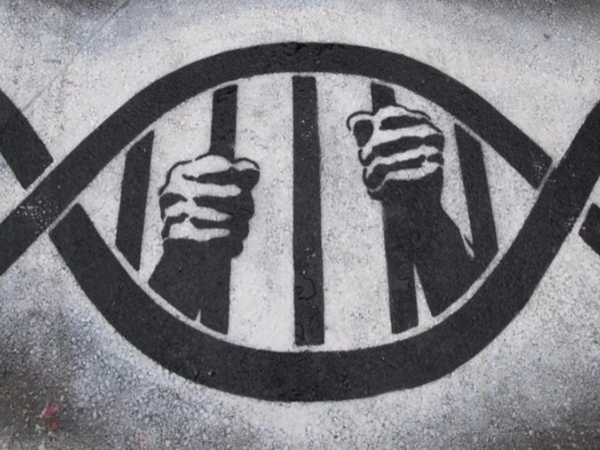
“Make no mistake about it…your DNA can be taken and entered into a national DNA database if you are ever arrested, rightly or wrongly, and for whatever reason… I doubt that the proud men who wrote the charter of our liberties would have been so eager to open their mouths for royal inspection.”—Justice Antonin Scalia dissenting in Maryland v. King

Be warned: the DNA detectives are on the prowl.

Whatever skeletons may be lurking on your family tree or in your closet, whatever crimes you may have committed, whatever associations you may have with those on the government’s most wanted lists: the police state is determined to ferret them out.

In an age of overcriminalization, round-the-clock surveillance, and a police state eager to flex its muscles in a show of power, we are all guilty of some transgression or other.

No longer can we consider ourselves innocent until proven guilty.

Now we are all suspects in a DNA lineup waiting to be matched up with a crime.

Suspect State, meet the Genetic Panopticon.

DNA technology in the hands of government officials will complete our transition to a Surveillance State in which prison walls are disguised within the seemingly benevolent trappings of technological and scientific progress, national security and the need to guard against terrorists, pandemics, civil unrest, etc.

By accessing your DNA, the government will soon know everything else about you that they don’t already know: your family chart, your ancestry, what you look like, your health history, your inclination to follow orders or chart your own course, etc.

It’s getting harder to hide, even if you think you’ve got nothing to hide.

Armed with unprecedented access to DNA databases amassed by the FBI and ancestry website, as well as hospital newborn screening programs, police are using forensic genealogy, which allows police to match up an unknown suspect’s crime scene DNA with that of any family members in a genealogy database, to solve cold cases that have remained unsolved for decades.

As reported by The Intercept, forensic genetic genealogists are “combing through the genetic information of hundreds of thousands of innocent people in search of a perpetrator.”

By submitting your DNA to a genealogical database such as Ancestry and 23andMe, you’re giving the police access to the genetic makeup, relationships and health profiles of every relative—past, present and future—in your family, whether or not you or they ever agreed to be part of such a database.

Indeed, relying on a loophole in a commercial database called GEDmatch, genetic genealogists are able to sidestep privacy rules that allow people to opt out of sharing their genetic information with police. The end result? Police are now able to identify and target those very individuals who explicitly asked to keep their DNA results private.

In this way, merely choosing to exercise your right to privacy makes you a suspect and puts you in the police state’s crosshairs.

It no longer even matters if you’re among the tens of millions of people who have added their DNA to ancestry databases. As Brian Resnick reports, public DNA databases have grown so massive that they can be used to find you even if you’ve never shared your own DNA.

That simple transaction—a spit sample or a cheek swab in exchange for getting to learn everything about one’s ancestral makeup, where one came from, and who is part of one’s extended family—is the price of entry into the Suspect State for all of us.

After all, a DNA print reveals everything about “who we are, where we come from, and who we will be.” It can also be used to predict the physical appearance of potential suspects.

It’s what police like to refer to a “modern fingerprint.”

Whereas fingerprint technology created a watershed moment for police in their ability to “crack” a case, DNA technology is now being hailed by law enforcement agencies as the magic bullet in crime solving, especially when it helps them crack cold cases of serial murders and rapists.

After all, who wouldn’t want to get psychopaths and serial rapists off the streets and safely behind bars, right?

At least, that’s the argument being used by law enforcement to support their unrestricted access to these genealogy databases, and they’ve got the success stories to prove it.

For instance, a 68-year-old Pennsylvania man was arrested and charged with the brutal rape and murder of a young woman almost 50 years earlier. Relying on genealogical research suggesting that the killer had ancestors who hailed from a small town in Italy, investigators narrowed their findings down to one man whose DNA, obtained from a discarded coffee cup, matched the killer’s.

In another cold case investigation, a 76-year-old man was arrested for two decades-old murders after his DNA was collected from a breathalyzer during an unrelated traffic stop.

Yet it’s not just psychopaths and serial rapists who are getting caught up in the investigative dragnet. In the police state’s pursuit of criminals, anyone who comes up as a possible DNA match—including distant family members—suddenly becomes part of a circle of suspects that must be tracked, investigated and ruled out.

In this way, “guilt by association” has taken on new connotations in a technological age in which one is just a DNA sample away from being considered a person of interest in a police investigation. As Jessica Cussins warns in Psychology Today, “The fundamental fight—that data from potentially innocent people should not be used to connect them to unrelated crimes—has been lost.”

Until recently, the government was required to at least observe some basic restrictions on when, where and how it could access someone’s DNA. That was turned on its head by various U.S. Supreme Court rulings that heralded the loss of privacy on a cellular level.

For instance, the U.S. Supreme Court ruled in Maryland v. King that taking DNA samples from a suspect doesn’t violate the Fourth Amendment. The Court’s subsequent decision to let stand the Maryland Court of Appeals’ ruling in Raynor v. Maryland, which essentially determined that individuals do not have a right to privacy when it comes to their DNA, made Americans even more vulnerable to the government accessing, analyzing and storing their DNA without their knowledge or permission.

It’s all been downhill since then.

Indeed, the government has been relentless in its efforts to get hold of our DNA, either through mandatory programs carried out in connection with law enforcement and corporate America, by warrantlessly accessing our familial DNA shared with genealogical services such as Ancestry and 23andMe, or through the collection of our “shed” or “touch” DNA.

Get ready, folks, because the government has embarked on a diabolical campaign to create a nation of suspects predicated on a massive national DNA database.

This has been helped along by Congress (which adopted legislation allowing police to collect and test DNA immediately following arrests), President Trump (who signed the Rapid DNA Act into law), the courts (which have ruled that police can routinely take DNA samples from people who are arrested but not yet convicted of a crime), and local police agencies (which are chomping at the bit to acquire this new crime-fighting gadget).

For example, Rapid DNA machines—portable, about the size of a desktop printer, highly unregulated, far from fool-proof, and so fast that they can produce DNA profiles in less than two hours—allow police to go on fishing expeditions for any hint of possible misconduct using DNA samples.

Journalist Heather Murphy explains: “As police agencies build out their local DNA databases, they are collecting DNA not only from people who have been charged with major crimes but also, increasingly, from people who are merely deemed suspicious, permanently linking their genetic identities to criminal databases.”

All 50 states now maintain their own DNA government databases, although the protocols for collection differ from state to state. Increasingly, many of the data from local databanks are being uploaded to CODIS, the FBI’s massive DNA database, which has become a de facto way to identify and track the American people from birth to death.

Even hospitals have gotten in on the game by taking and storing newborn babies’ DNA, often without their parents’ knowledge or consent. It’s part of the government’s mandatory genetic screening of newborns. In many states, the DNA is stored indefinitely. There’s already a move underway to carry out whole genome sequencing on newborns, ostensibly to help diagnose rare diseases earlier and improve health later in life, which constitutes an ethical minefield all by itself.

What this means for those being born today is inclusion in a government database that contains intimate information about who they are, their ancestry, and what awaits them in the future, including their inclinations to be followers, leaders or troublemakers.

For example, police in New Jersey accessed the DNA from a nine-year-old blood sample of a newborn baby in order to identify the child’s father as a suspect in a decades-old sexual assault.

The ramifications of this kind of DNA profiling are far-reaching.

At a minimum, these DNA databases do away with any semblance of privacy or anonymity.

These genetic databases and genomic technology also make us that much more vulnerable to creeps and cyberstalkersgenetic profiling, and those who would weaponize the technology against us.

Unfortunately, the debate over genetic privacy—and when one’s DNA becomes a public commodity outside the protection of the Fourth Amendment’s prohibition on warrantless searches and seizures—continues to lag far behind the government and Corporate America’s encroachments on our rights.

Moreover, while much of the public debate, legislative efforts and legal challenges in recent years have focused on the protocols surrounding when police can legally collect a suspect’s DNA (with or without a search warrant and whether upon arrest or conviction), the question of how to handle “shed” or “touch” DNA has largely slipped through without much debate or opposition.

As scientist Leslie A. Pray notes:

We all shed DNA, leaving traces of our identity practically everywhere we go… In fact, the garbage you leave for curbside pickup is a potential gold mine of this sort of material. All of this shed or so-called abandoned DNA is free for the taking by local police investigators hoping to crack unsolvable cases… shed DNA is also free for inclusion in a secret universal DNA databank.

What this means is that if you have the misfortune to leave your DNA traces anywhere a crime has been committed, you’ve already got a file somewhere in some state or federal database—albeit it may be a file without a name.

As the dissenting opinion to the Maryland Court of Appeals’ shed DNA ruling in Raynor rightly warned, “A person can no longer vote, participate in a jury, or obtain a driver’s license, without opening up his genetic material for state collection and codification.”

It’s just a matter of time before government agents will know everywhere we’ve been and how long we were at each place by following our shed DNA. After all, scientists can already track salmon across hundreds of square miles of streams and rivers using DNA.

Today, helped along by robotics and automation, DNA processing, analysis and reporting takes far less time and can bring forth all manner of information, right down to a person’s eye color and relatives. Incredibly, one company specializes in creating “mug shots” for police based on DNA samples from unknown “suspects” which are then compared to individuals with similar genetic profiles.

Of course, none of these technologies are infallible.

DNA evidence can be wrong, either through human error, tampering, or even outright fabrication, and it happens more often than we are told.

What this amounts to is a scenario in which we have little to no defense against charges of wrongdoing, especially when “convicted” by technology, and even less protection against the government sweeping up our DNA in much the same way it sweeps up our phone calls, emails and text messages.

As I make clear in my book Battlefield America: The War on the American People and in its fictional counterpart The Erik Blair Diaries, it’s only a matter of time before the police state’s pursuit of criminals from the past expands into genetic profiling and a preemptive hunt for criminals of the future.

Source: https://tinyurl.com/yss7tf97

ABOUT JOHN W. WHITEHEAD

Constitutional attorney and author John W. Whitehead is founder and president of The Rutherford Institute. His most recent books are the best-selling Battlefield America: The War on the American People, the award-winning A Government of Wolves: The Emerging American Police State, and a debut dystopian fiction novel, The Erik Blair Diaries. Whitehead can be contacted at staff@rutherford.org. Nisha Whitehead is the Executive Director of The Rutherford Institute. Information about The Rutherford Institute is available at www.rutherford.org.

Publication Guidelines / Reprint Permission

John W. Whitehead’s weekly commentaries are available for publication to newspapers and web publications at no charge. Please contact staff@rutherford.org to obtain reprint permission.

There is no more dangerous menace to civilization than a government of incompetent, corrupt, or vile men.”—Ludwig von Mises

Once again, the police state is up to its old tricks, stoking tensions over whether or not the government is forced to shut down, even partially, due to a default on the national debt.

Yet while these political games dominate news headlines, send the stock market into a nosedive, and put federal employees at risk of having to work without pay, nothing about these high-handed theatrics will diminish the immediate and very real dangers of the American Police State with its roadside strip searches, government surveillance, biometric databases, citizens being treated like terrorists, imprisonments for criticizing the government, national ID cards, SWAT team raids, censorship, forcible blood draws and DNA extractions, private prisons, weaponized drones, red light cameras, tasers, active shooter drills, police misconduct and government corruption.

Default or not, war will continue. Drone killings will continue. Surveillance will continue. Censorship and persecution of anyone who criticizes the government will continue. The government’s efforts to label dissidents as extremists and terrorists will continue.

Police shootings will continue. Highway robbery meted out by government officials will continue. Corrupt government will continue. Profit-driven prisons will continue. And the militarization of the police will continue.

Indeed, take a look at the programs and policies that will not be affected by a government default on its debt leading to a possible shutdown, and you’ll get a clearer sense of the government’s priorities, which have little to do with serving taxpayers and everything to do with amassing money, power and control.

Surveillance will continue unabated. On any given day, whether you’re walking through a store, driving your car, checking email, or talking to friends and family on the phone, you can be sure that some government agency, whether the NSA or some other entity, is listening in and tracking your behavior. Police have been outfitted with a litany of surveillance gear, from license plate readers and cell phone tracking devices to biometric data recorders. Technology now makes it possible for the police to scan passersby in order to detect the contents of their pockets, purses, briefcases, etc. Full-body scanners, which perform virtual strip-searches of Americans traveling by plane, have gone mobile, with roving police vans that peer into vehicles and buildings alike—including homes. Coupled with the nation’s growing network of real-time surveillance cameras and facial recognition software, soon there really will be nowhere to run and nowhere to hide.

Global spying will continue unabated. The NSA’s massive surveillance network, what the Washington Post refers to as a $500 billion “espionage empire,” will continue to span the globe and target every single person on the planet who uses a phone or a computer. The NSA’s Echelon program intercepts and analyzes virtually every phone call, fax and email message sent anywhere in the world. In addition to carrying out domestic surveillance on peaceful political groups such as Amnesty International, Greenpeace and several religious groups, Echelon has also been a keystone to the government’s attempts at political and corporate espionage.

Egregious searches will continue unabated. Under the pretext of protecting the nation’s infrastructure (roads, mass transit systems, water and power supplies, telecommunications systems and so on) against criminal or terrorist attacks, Transportation Security Administration (TSA) task forces (comprised of federal air marshals, surface transportation security inspectors, transportation security officers, behavior detection officers and explosive detection canine teams) will continue to do random security sweeps of nexuses of transportation, including ports, railway and bus stations, airports, ferries and subways. Sweep tactics include the use of x-ray technology, pat-downs and drug-sniffing dogs, among other things.

The undermining of the Constitution will continue unabated. America’s so-called war on terror, which it has relentlessly pursued since 9/11, has chipped away at our freedoms, unraveled our Constitution and transformed our nation into a battlefield, thanks in large part to such subversive legislation as the USA Patriot Act and National Defense Authorization Act. These laws—which completely circumvent the rule of law and the constitutional rights of American citizens, re-orienting our legal landscape in such a way as to ensure that martial law, rather than the rule of law, our U.S. Constitution, becomes the map by which we navigate life in the United States—will continue to be enforced.

Militarized policing will continue unabated. Thanks to federal grant programs allowing the Pentagon to transfer surplus military supplies and weapons to local law enforcement agencies without charge, police forces will continue to be transformed from peace officers into heavily armed extensions of the military, complete with jackboots, helmets, shields, batons, pepper-spray, stun guns, assault rifles, body armor, miniature tanks and weaponized drones. Having been given the green light to probe, poke, pinch, taser, search, seize, strip and generally manhandle anyone they see fit in almost any circumstance, all with the general blessing of the courts, America’s law enforcement officials, no longer mere servants of the people entrusted with keeping the peace, will continue to keep the masses corralled, under control, and treated like suspects and enemies rather than citizens.

SWAT team raids will continue unabated. With more than 80,000 SWAT team raids carried out every year on unsuspecting Americans for relatively routine police matters and federal agencies laying claim to their own law enforcement divisions, the incidence of botched raids and related casualties will continue to rise. Nationwide, SWAT teams will continue to be employed to address an astonishingly trivial array of criminal activity or mere community nuisances including angry dogs, domestic disputes, improper paperwork filed by an orchid farmer, and misdemeanor marijuana possession.

Overcriminalization will continue unabated. The government bureaucracy will continue to churn out laws, statutes, codes and regulations that reinforce its powers and value systems and those of the police state and its corporate allies, rendering the rest of us petty criminals. The average American now unknowingly commits three felonies a day, thanks to this overabundance of vague laws that render otherwise innocent activity illegal. Consequently, small farmers who dare to make unpasteurized goat cheese and share it with members of their community will continue to have their farms raided.

The shadow government— a.k.a. the Deep State, a.k.a. the police state, a.k.a. the military industrial complex, a.k.a. the surveillance state complex—will continue unabated. This corporatized, militarized, entrenched bureaucracy that is fully operational and staffed by unelected officials will continue to call the shots in Washington DC, no matter who sits in the White House or controls Congress. By “government,” I’m not referring to the highly partisan, two-party bureaucracy of the Republicans and Democrats. Rather, I’m referring to “government” with a capital “G,” the entrenched Deep State that is unaffected by elections, unaltered by populist movements, and has set itself beyond the reach of the law.

These issues are not going away.

As I make clear in my book Battlefield America: The War on the American People and in its fictional counterpart The Erik Blair Diaries, they are the backbone of an increasingly aggressive authoritarian government, formed by an unholy alliance between the mega-corporations with little concern for the Constitution and elected officials and bureaucrats incapable or unwilling to represent the best interests of their constituents.

Whether or not the government runs out of borrowed money, it will remain business as usual in terms of the police state’s unceasing pursuit of greater powers and control.

Source: https://bit.ly/42StLGW

ABOUT JOHN W. WHITEHEAD

Constitutional attorney and author John W. Whitehead is founder and president of The Rutherford Institute. His most recent books are the best-selling Battlefield America: The War on the American People, the award-winning A Government of Wolves: The Emerging American Police State, and a debut dystopian fiction novel, The Erik Blair Diaries. Whitehead can be contacted at staff@rutherford.org. Nisha Whitehead is the Executive Director of The Rutherford Institute. Information about The Rutherford Institute is available at www.rutherford.org.

Publication Guidelines / Reprint Permission

John W. Whitehead’s weekly commentaries are available for publication to newspapers and web publications at no charge. Please contact staff@rutherford.org to obtain reprint permission.
“Whether the mask is labeled fascism, democracy, or dictatorship of the proletariat, our great adversary remains the apparatus—the bureaucracy, the police, the military.”—Simone Weil, French philosopher

It’s hard to say whether we’re dealing with a kleptocracy (a government ruled by thieves), a kakistocracy (a government run by unprincipled career politicians, corporations and thieves that panders to the worst vices in our nature and has little regard for the rights of American citizens), or if we’ve gone straight to an idiocracy

For instance, an animal welfare bill introduced in the Florida state legislature would ban the sale of rabbits in March and April, prohibit cat owners from declawing their pets, make it illegal for dogs to stick their heads out of car windows, force owners to place dogs in a harness or in a pet seatbelt when traveling in a car, and require police to create a public list of convicted animal abusers.

A Massachusetts law prohibits drivers from letting their cars idle for more than five minutes on penalty of a $100 fine ($500 for repeat offenders), even in the winter. You can also be fined $20 or a month in jail for scaring pigeons.

This overbearing Nanny State despotism is what happens when government representatives (those elected and appointed to work for us) adopt the authoritarian notion that the government knows best and therefore must control, regulate and dictate almost everything about the citizenry’s public, private and professional lives.

The government’s bureaucratic attempts at muscle-flexing by way of overregulation and overcriminalization have reached such outrageous limits that federal and state governments now require on penalty of a fine that individuals apply for permission before they can grow exotic orchids, host elaborate dinner parties, gather friends in one’s home for Bible studies, give coffee to the homeless, let their kids manage a lemonade stand, keep chickens as pets, or braid someone’s hair, as ludicrous as that may seem.

Consider, for example, that businesses in California were ordered to designate an area of the children’s toy aisle “gender-neutral” or face a fine, whether or not the toys sold are traditionally marketed to girls or boys such as Barbies and Hot Wheels. California schools are prohibited from allowing students to access websites, novels or religious works that reflect negatively on gays. And while Californians are free to have sex with whomever they choose (because that’s none of the government’s business), removing a condom during sex without consent could make you liable for general, special and punitive damages.

It’s getting worse.

Almost every aspect of American life today—especially if it is work-related—is subject to this kind of heightened scrutiny and ham-fisted control, whether you’re talking about aspiring “bakers, braiders, casket makers, florists, veterinary masseuses, tour guides, taxi drivers, eyebrow threaders, teeth whiteners, and more.”

For instance, whereas 70 years ago, one out of every 20 U.S. jobs required a state license, today, almost 1 in 3 American occupations requires a license.

The problem of overregulation has become so bad that, as one analyst notes, “getting a license to style hair in Washington takes more instructional time than becoming an emergency medical technician or a firefighter.”

This is what happens when bureaucrats run the show, and the rule of law becomes little more than a cattle prod for forcing the citizenry to march in lockstep with the government.

Overregulation is just the other side of the coin to overcriminalization, that phenomenon in which everything is rendered illegal and everyone becomes a lawbreaker.

As policy analyst Michael Van Beek warns, the problem with overcriminalization is that there are so many laws at the federal, state and local levels—that we can’t possibly know them all.

“It’s also impossible to enforce all these laws. Instead, law enforcement officials must choose which ones are important and which are not. The result is that they pick the laws Americans really must follow, because they’re the ones deciding which laws really matter,” concludes Van Beek. “Federal, state and local regulations — rules created by unelected government bureaucrats — carry the same force of law and can turn you into a criminal if you violate any one of them… if we violate these rules, we could be prosecuted as criminals. No matter how antiquated or ridiculous, they still carry the full force of the law. By letting so many of these sit around, just waiting to be used against us, we increase the power of law enforcement, which has lots of options to charge people with legal and regulatory violations.”

This is the police state’s superpower: it has been vested with the authority to make our lives a bureaucratic hell.

That explains how a fisherman can be saddled with 20 years’ jail time for throwing fish that were too small back into the water. Or why police arrested a 90-year-old man for violating an ordinance that prohibits feeding the homeless in public unless portable toilets are also made available.

The laws can get downright silly. For instance, you could also find yourself passing time in a Florida slammer for such inane activities as singing in a public place while wearing a swimsuit, breaking more than three dishes per day, farting in a public place after 6 pm on a Thursday, and skateboarding without a license.

However, the consequences are all too serious for those whose lives become grist for the police state’s mill. A few years back, police raided barber shops in minority communities, resulting in barbers being handcuffed in front of customers, and their shops searched without warrants. All of this was purportedly done in an effort to make sure that the barbers’ licensing paperwork was up to snuff.

In this way, America has gone from being a beacon of freedom to a locked down nation. And “we the people,” sold on the idea that safety, security and material comforts are preferable to freedom, have allowed the government to pave over the Constitution in order to erect a concentration camp.

We labor today under the weight of countless tyrannies, large and small, carried out in the so-called name of the national good by an elite class of governmental and corporate officials who are largely insulated from the ill effects of their actions.

We increasingly find ourselves badgered, bullied and browbeaten into bearing the brunt of their arrogance, paying the price for their greed, suffering the backlash for their militarism, agonizing as a result of their inaction, feigning ignorance about their backroom dealings, overlooking their incompetence, turning a blind eye to their misdeeds, cowering from their heavy-handed tactics, and blindly hoping for change that never comes. 

The overt signs of the despotism exercised by the increasingly authoritarian regime that passes itself off as the United States government (and its corporate partners in crime) are all around us: censorship, criminalizing, shadow banning and de-platforming of individuals who express ideas that are politically incorrect or unpopular; warrantless surveillance of Americans’ movements and communications; SWAT team raids of Americans’ homes; shootings of unarmed citizens by police; harsh punishments meted out to schoolchildren in the name of zero tolerance; community-wide lockdowns and health mandates that strip Americans of their freedom of movement and bodily integrity; armed drones taking to the skies domestically; endless wars; out-of-control spending; militarized police; roadside strip searches; privatized prisons with a profit incentive for jailing Americans; fusion centers that spy on, collect and disseminate data on Americans’ private transactions; and militarized agencies with stockpiles of ammunition, to name some of the most appalling.

Yet as egregious as these incursions on our rights may be, it’s the endless, petty tyrannies—the heavy-handed, punitive-laden dictates inflicted by a self-righteous, Big-Brother-Knows-Best bureaucracy on an overtaxed, overregulated, and underrepresented populace—that illustrate so clearly the degree to which “we the people” are viewed as incapable of common sense, moral judgment, fairness, and intelligence, not to mention lacking a basic understanding of how to stay alive, raise a family, or be part of a functioning community.

In exchange for the promise of an end to global pandemics, lower taxes, lower crime rates, safe streets, safe schools, blight-free neighborhoods, and readily accessible technology, health care, water, food and power, we’ve opened the door to lockdowns, militarized police, government surveillance, asset forfeiture, school zero tolerance policies, license plate readers, red light cameras, SWAT team raids, health care mandates, overcriminalization, overregulation and government corruption.

In the end, such bargains always turn sour.

We relied on the government to help us safely navigate national emergencies (terrorism, natural disasters, global pandemics, etc.) only to find ourselves forced to relinquish our freedoms on the altar of national security, yet we’re no safer (or healthier) than before.

We asked our lawmakers to be tough on crime, and we’ve been saddled with an abundance of laws that criminalize almost every aspect of our lives. So far, we’re up to 4500 criminal laws and 300,000 criminal regulations that result in average Americans unknowingly engaging in criminal acts at least three times a day. For instance, the family of an 11-year-old girl was issued a $535 fine for violating the Federal Migratory Bird Act after the young girl rescued a baby woodpecker from predatory cats.

We wanted criminals taken off the streets, and we didn’t want to have to pay for their incarceration. What we’ve gotten is a nation that boasts the highest incarceration rate in the world, with more than 2.3 million people locked up, many of them doing time for relatively minor, nonviolent crimes, and a private prison industry fueling the drive for more inmates, who are forced to provide corporations with cheap labor.

A special report by CNBC breaks down the national numbers:

One out of 100 American adults is behind bars — while a stunning one out of 32 is on probation, parole or in prison. This reliance on mass incarceration has created a thriving prison economy. The states and the federal government spend about $74 billion a year on corrections, and nearly 800,000 people work in the industry.

We wanted law enforcement agencies to have the necessary resources to fight the nation’s wars on terror, crime and drugs. What we got instead were militarized police decked out with M-16 rifles, grenade launchers, silencers, battle tanks and hollow point bullets—gear designed for the battlefield, more than 80,000 SWAT team raids carried out every year (many for routine police tasks, resulting in losses of life and property), and profit-driven schemes that add to the government’s largesse such as asset forfeiture, where police seize property from “suspected criminals.”

According to the Washington Post, these funds have been used to buy guns, armored cars, electronic surveillance gear, “luxury vehicles, travel and a clown named Sparkles.” Police seminars advise officers to use their “department wish list when deciding which assets to seize” and, in particular, go after flat screen TVs, cash and nice cars.

In Florida, where police are no strangers to asset forfeiture, Florida police have been carrying out “reverse” sting operations, where they pose as drug dealers to lure buyers with promises of cheap cocaine, then bust them, and seize their cash and cars. Over the course of a year, police in one small Florida town seized close to $6 million using these entrapment schemes.

We fell for the government’s promise of safer roads, only to find ourselves caught in a tangle of profit-driven red light cameras, which ticket unsuspecting drivers in the so-called name of road safety while ostensibly fattening the coffers of local and state governments. Despite widespread public opposition, corruption and systemic malfunctions, these cameras—used in 24 states and Washington, DC—are particularly popular with municipalities, which look to them as an easy means of extra cash.

One small Florida town, population 8,000, generates a million dollars a year in fines from these cameras. Building on the profit-incentive schemes, the cameras’ manufacturers are also pushing speed cameras and school bus cameras, both of which result in heft fines for violators who speed or try to go around school buses.

As I make clear in my book Battlefield America: The War on the American People and in its fictional counterpart The Erik Blair Diaries, this is what happens when the American people get duped, deceived, double-crossed, cheated, lied to, swindled and conned into believing that the government and its army of bureaucrats—the people we appointed to safeguard our freedoms—actually have our best interests at heart.

The problem with these devil’s bargains is that there is always a catch, always a price to pay for whatever it is we valued so highly as to barter away our most precious possessions.

We’ve bartered away our right to self-governance, self-defense, privacy, autonomy and that most important right of all: the right to tell the government to “leave me the hell alone.”

Source: https://bit.ly/3kuytdi

ABOUT JOHN W. WHITEHEAD

Constitutional attorney and author John W. Whitehead is founder and president of The Rutherford Institute. His most recent books are the best-selling Battlefield America: The War on the American People, the award-winning A Government of Wolves: The Emerging American Police State, and a debut dystopian fiction novel, The Erik Blair Diaries. Whitehead can be contacted at staff@rutherford.org. Nisha Whitehead is the Executive Director of The Rutherford Institute. Information about The Rutherford Institute is available at www.rutherford.org.

Publication Guidelines / Reprint Permission

John W. Whitehead’s weekly commentaries are available for publication to newspapers and web publications at no charge. Please contact staff@rutherford.org to obtain reprint permission.
“Never has our future been more unpredictable, never have we depended so much on political forces that cannot be trusted to follow the rules of common sense and self-interest—forces that look like sheer insanity, if judged by the standards of other centuries.”—Hannah Arendt, The Origins of Totalitarianism

Let me tell you about the state of our nation: things are getting worse, not better.

Easily distracted by wall-to-wall news coverage of the latest crisis and conveniently diverted by news cycles that change every few days, Americans remain oblivious to the many governmental abuses that are still wreaking havoc on our freedoms: police shootings of unarmed individuals, invasive surveillance, roadside blood draws, roadside strip searches, SWAT team raids gone awry, the military industrial complex’s costly wars, pork barrel spending, pre-crime laws, civil asset forfeiture, fusion centers, militarization, armed drones, smart policing carried out by AI robots, courts that march in lockstep with the police state, schools that function as indoctrination centers, and bureaucrats that keep the Deep State in power.

These are dangerous times for America and the world.

Yet while you may hear plenty about the dangers posed by Russia and COVID-19 in President Biden’s State of the Union address, it’s still the U.S. government that poses the gravest threat to our freedoms and way of life.

Consider for yourself.

Americans have little protection against police abuse. The police and other government agents have been generally empowered to probe, poke, pinch, taser, search, seize, strip and generally manhandle anyone they see fit in almost any circumstance, all with the general blessing of the courts. It is no longer unusual to hear about incidents in which police shoot unarmed individuals first and ask questions later. What is increasingly common, however, is the news that the officers involved in these incidents get off with little more than a slap on the hands.

Americans are little more than pocketbooks to fund the police state. If there is any absolute maxim by which the federal government seems to operate, it is that the American taxpayer always gets ripped off. This is true, whether you’re talking about taxpayers being forced to fund high-priced weaponry that will be used against us, endless wars that do little for our safety or our freedoms, or bloated government agencies with their secret budgets, covert agendas and clandestine activities.

Americans are no longer innocent until proven guilty. We once operated under the assumption that you were innocent until proven guilty. Due in large part to rapid advances in technology and a heightened surveillance culture, the burden of proof has been shifted so that the right to be considered innocent until proven guilty has been usurped by a new norm in which all citizens are suspects. Indeed, the government—in cahoots with the corporate state—has erected the ultimate suspect society. In such an environment, we are all potentially guilty of some wrongdoing or other.

Americans no longer have a right to self-defense. While the courts continue to disagree over the exact nature of the rights protected by the Second Amendment, the government itself has made its position extremely clear. When it comes to gun rights in particular, and the rights of the citizenry overall, the U.S. government has adopted a “do what I say, not what I do” mindset. Nowhere is this double standard more evident than in the government’s attempts to arm itself to the teeth, all the while viewing as suspect anyone who dares to legally own a gun, let alone use one in self-defense. Indeed, while it still technically remains legal to own a firearm in America, possessing one can now get you pulled over, searched, arrested, subjected to all manner of surveillance, treated as a suspect without ever having committed a crime, shot at, and killed.

Americans no longer have a right to private property. If government agents can invade your home, break down your doors, kill your dog, damage your furnishings and terrorize your family, your property is no longer private and secure—it belongs to the government. Likewise, if government officials can fine and arrest you for growing vegetables in your front yard, praying with friends in your living room, installing solar panels on your roof, and raising chickens in your backyard, you’re no longer the owner of your property.

Americans no longer have a say about what their children are exposed to in school. Incredibly, the government continues to insist that parents essentially forfeit their rights when they send their children to a public school. This growing tension over whether young people, especially those in the public schools, are essentially wards of the state, to do with as government officials deem appropriate, in defiance of the children’s constitutional rights and those of their parents, is at the heart of almost every debate over educational programming, school discipline, and the extent to which parents have any say over their children’s wellbeing in and out of school.

Americans are powerless in the face of militarized police forces. With local police agencies acquiring military-grade weaponry, training and equipment better suited for the battlefield, Americans are finding their once-peaceful communities transformed into military outposts patrolled by a standing military army.

Americans no longer have a right to bodily integrity. The debate over bodily integrity covers broad territory, ranging from abortion and euthanasia to forced blood draws, biometric surveillance and basic healthcare. Forced vaccinations, forced cavity searches, forced colonoscopies, forced blood draws, forced breath-alcohol tests, forced DNA extractions, forced eye scans, forced inclusion in biometric databases: these are just a few ways in which Americans continue to be reminded that we have no control over what happens to our bodies during an encounter with government officials.

Americans no longer have a right to the expectation of privacy. Despite the staggering number of revelations about government spying on Americans’ phone calls, Facebook posts, Twitter tweets, Google searches, emails, bookstore and grocery purchases, bank statements, commuter toll records, etc., Congress, the president and the courts have done little to nothing to counteract these abuses. Instead, they seem determined to accustom us to life in this electronic concentration camp.

Americans no longer have a representative government. We have moved beyond the era of representative government and entered the age of authoritarianism, where all citizens are suspects, security trumps freedom, and so-called elected officials represent the interests of the corporate power elite. This topsy-turvy travesty of law and government has become America’s new normal.

Americans can no longer rely on the courts to mete out justice. The U.S. Supreme Court was intended to be an institution established to intervene and protect the people against the government and its agents when they overstep their bounds. Yet through their deference to police power, preference for security over freedom, and evisceration of our most basic rights for the sake of order and expediency, the justices of the Supreme Court have become the architects of the American police state in which we now live, while the lower courts have appointed themselves courts of order, concerned primarily with advancing the government’s agenda, no matter how unjust or illegal.

I haven’t even touched on the corporate state, the military industrial complex, SWAT team raids, invasive surveillance technology, zero tolerance policies in the schools, overcriminalization, or privatized prisons, to name just a few, but what I have touched on should be enough to show that the landscape of our freedoms has already changed dramatically from what it once was and will no doubt continue to deteriorate unless Americans can find a way to wrest back control of their government and reclaim their freedoms.

This steady slide towards tyranny, meted out by militarized local and federal police and legalistic bureaucrats, has been carried forward by each successive president over the past seventy-plus years regardless of their political affiliation.

The more things change, the more they stay the same.

Big government has grown bigger, and the rights of the citizenry have grown smaller.

We are walking a dangerous path right now.

Having allowed the government to expand and exceed our reach, we find ourselves on the losing end of a tug-of-war over control of our country and our lives. And for as long as we let them, government officials will continue to trample on our rights, always justifying their actions as being for the good of the people.

Yet the government can only go as far as “we the people” allow. Therein lies the problem.

The pickle we find ourselves in speaks volumes about the nature of the government beast we have been saddled with and how it views the rights and sovereignty of “we the people.”

Now you don’t hear a lot about sovereignty anymore. Sovereignty is a dusty, antiquated term that harkens back to an age when kings and emperors ruled with absolute power over a populace that had no rights. Americans turned the idea of sovereignty on its head when they declared their independence from Great Britain and rejected the absolute authority of King George III. In doing so, Americans claimed for themselves the right to self-government and established themselves as the ultimate authority and power.

In other words, in America, “we the people”— sovereign citizens—call the shots.

So when the government acts, it is supposed to do so at our bidding and on our behalf, because we are the rulers.

That’s not exactly how it turned out, though, is it?

In the 200-plus years since we boldly embarked on this experiment in self-government, we have been steadily losing ground to the government’s brazen power grabs, foisted upon us in the so-called name of national security.

We have relinquished control over the most intimate aspects of our lives to government officials who, while they may occupy seats of authority, are neither wiser, smarter, more in tune with our needs, more knowledgeable about our problems, nor more aware of what is really in our best interests.

The government has knocked us off our rightful throne. It has usurped our rightful authority. It has staged the ultimate coup. Its agents no longer even pretend that they answer to “we the people.”

Worst of all, “we the people” have become desensitized to this constant undermining of our freedoms.

How do we reconcile the Founders’ vision of the government as an entity whose only purpose is to serve the people with the police state’s insistence that the government is the supreme authority, that its power trumps that of the people themselves, and that it may exercise that power in any way it sees fit (that includes government agents crashing through doors, mass arrests, ethnic cleansing, racial profiling, indefinite detentions without due process, and internment camps)?

They cannot be reconciled. They are polar opposites.

We are fast approaching a moment of reckoning where we will be forced to choose between the vision of what America was intended to be (a model for self-governance where power is vested in the people) and the reality of what it has become (a police state where power is vested in the government).

We are repeating the mistakes of history—namely, allowing a totalitarian state to reign over us.

Former concentration camp inmate Hannah Arendt warned against this when she wrote:

“No matter what the specifically national tradition or the particular spiritual source of its ideology, totalitarian government always transformed classes into masses, supplanted the party system, not by one-party dictatorships, but by mass movement, shifted the center of power from the army to the police, and established a foreign policy openly directed toward world domination.”

So where does that leave us?

Aldous Huxley predicted that eventually the government would find a way of:

“making people love their servitude, and producing dictatorship without tears, so to speak, producing a kind of painless concentration camp for entire societies, so that people will in fact have their liberties taken away from them, but will rather enjoy it, because they will be distracted from any desire to rebel by propaganda or brainwashing, or brainwashing enhanced by pharmacological methods. And this seems to be the final revolution.”

The answer? Get un-brainwashed. Stop allowing yourself to be distracted and diverted.

Learn your rights. Stand up for the founding principles.

Make your voice and your vote count for more than just political posturing.

Never cease to vociferously protest the erosion of your freedoms at the local and national level.

Most of all, do these things today.

Ultimately, I make clear in my book Battlefield America: The War on the American People and in its fictional counterpart The Erik Blair Diaries, we need to shift the center of power back to “we the people.”

WC: 2101

ABOUT JOHN W. WHITEHEAD

Constitutional attorney and author John W. Whitehead is founder and president The Rutherford Institute. His books Battlefield America: The War on the American People and A Government of Wolves: The Emerging American Police State are available at www.amazon.com. He can be contacted at johnw@rutherford.org. Nisha Whitehead is the Executive Director of The Rutherford Institute. Information about The Rutherford Institute is available at www.rutherford.org.

Publication Guidelines / Reprint Permission

John W. Whitehead’s weekly commentaries are available for publication to newspapers and web publications at no charge. Please contact staff@rutherford.org to obtain reprint permission.
“The illusion of freedom will continue as long as it’s profitable to continue the illusion. At the point where the illusion becomes too expensive to maintain, they will just take down the scenery, they will pull back the curtains, they will move the tables and chairs out of the way and you will see the brick wall at the back of the theater.”—Frank Zappa

We are no longer free.

We are living in a world carefully crafted to resemble a representative democracy, but it’s an illusion.

We think we have the freedom to elect our leaders, but we’re only allowed to participate in the reassurance ritual of voting. There can be no true electoral choice or real representation when we’re limited in our options to one of two candidates culled from two parties that both march in lockstep with the Deep State and answer to an oligarchic elite.

We think we have freedom of speech, but we’re only as free to speak as the government and its corporate partners allow.

We think we have the right to freely exercise our religious beliefs, but those rights are quickly overruled if and when they conflict with the government’s priorities, whether it’s COVID-19 mandates or societal values about gender equality, sex and marriage.

We think we have the freedom to go where we want and move about freely, but at every turn, we’re hemmed in by laws, fines and penalties that regulate and restrict our autonomy, and surveillance cameras that monitor our movements. Punitive programs strip citizens of their passports and right to travel over unpaid taxes.

We think we have property interests in our homes and our bodies, but there can be no such freedom when the government can seize your property, raid your home, and dictate what you do with your bodies.

We think we have the freedom to defend ourselves against outside threats, but there is no right to self-defense against militarized police who are authorized to probe, poke, pinch, taser, search, seize, strip and generally manhandle anyone they see fit in almost any circumstance, and granted immunity from accountability with the general blessing of the courts. Certainly, there can be no right to gun ownership in the face of red flag gun laws which allow the police to remove guns from people merely suspected of being threats.

We think we have the right to an assumption of innocence until we are proven guilty, but that burden of proof has been turned on its head by a surveillance state that renders us all suspects and overcriminalization which renders us all lawbreakers. Police-run facial recognition software that mistakenly labels law-abiding citizens as criminals. A social credit system (similar to China’s) that rewards behavior deemed “acceptable” and punishes behavior the government and its corporate allies find offensive, illegal or inappropriate.

We think we have the right to due process, but that assurance of justice has been stripped of its power by a judicial system hardwired to act as judge, jury and jailer, leaving us with little recourse for appeal. A perfect example of this rush to judgment can be found in the proliferation of profit-driven speed and red light cameras that do little for safety while padding the pockets of government agencies.

We have been saddled with a government that pays lip service to the nation’s freedom principles while working overtime to shred the Constitution.

By gradually whittling away at our freedoms—free speech, assembly, due process, privacy, etc.—the government has, in effect, liberated itself from its contractual agreement to respect the constitutional rights of the citizenry while resetting the calendar back to a time when we had no Bill of Rights to protect us from the long arm of the government.

Aided and abetted by the legislatures, the courts and Corporate America, the government has been busily rewriting the contract (a.k.a. the Constitution) that establishes the citizenry as the masters and agents of the government as the servants.

We are now only as good as we are useful, and our usefulness is calculated on an economic scale by how much we are worth—in terms of profit and resale value—to our “owners.”

Under the new terms of this revised, one-sided agreement, the government and its many operatives have all the privileges and rights and “we the people” have none.

Only in our case, sold on the idea that safety, security and material comforts are preferable to freedom, we’ve allowed the government to pave over the Constitution in order to erect a concentration camp.

The problem with these devil’s bargains, however, is that there is always a catch, always a price to pay for whatever it is we valued so highly as to barter away our most precious possessions.

We’ve bartered away our right to self-governance, self-defense, privacy, autonomy and that most important right of all: the right to tell the government to “leave me the hell alone.” In exchange for the promise of safe streets, safe schools, blight-free neighborhoods, lower taxes, lower crime rates, and readily accessible technology, health care, water, food and power, we’ve opened the door to militarized police, government surveillance, asset forfeiture, school zero tolerance policies, license plate readers, red light cameras, SWAT team raids, health care mandates, overcriminalization and government corruption.

In the end, such bargains always turn sour.

We asked our lawmakers to be tough on crime, and we’ve been saddled with an abundance of laws that criminalize almost every aspect of our lives. So far, we’re up to 4500 criminal laws and 300,000 criminal regulations that result in average Americans unknowingly engaging in criminal acts at least three times a day. For instance, the family of an 11-year-old girl was issued a $535 fine for violating the Federal Migratory Bird Act after the young girl rescued a baby woodpecker from predatory cats.

We wanted criminals taken off the streets, and we didn’t want to have to pay for their incarceration. What we’ve gotten is a nation that boasts the highest incarceration rate in the world, with more than 2.3 million people locked up, many of them doing time for relatively minor, nonviolent crimes, and a private prison industry fueling the drive for more inmates, who are forced to provide corporations with cheap labor.

We wanted law enforcement agencies to have the necessary resources to fight the nation’s wars on terror, crime and drugs. What we got instead were militarized police decked out with M-16 rifles, grenade launchers, silencers, battle tanks and hollow point bullets—gear designed for the battlefield, more than 80,000 SWAT team raids carried out every year (many for routine police tasks, resulting in losses of life and property), and profit-driven schemes that add to the government’s largesse such as asset forfeiture, where police seize property from “suspected criminals.”

We fell for the government’s promise of safer roads, only to find ourselves caught in a tangle of profit-driven red-light cameras, which ticket unsuspecting drivers in the so-called name of road safety while ostensibly fattening the coffers of local and state governments. Despite widespread public opposition, corruption and systemic malfunctions, these cameras are particularly popular with municipalities, which look to them as an easy means of extra cash. Building on the profit-incentive schemes, the cameras’ manufacturers are also pushing speed cameras and school bus cameras, both of which result in hefty fines for violators who speed or try to go around school buses.

We’re being subjected to the oldest con game in the books, the magician’s sleight of hand that keeps you focused on the shell game in front of you while your wallet is being picked clean by ruffians in your midst.

This is how tyranny rises and freedom falls.

With every new law enacted by federal and state legislatures, every new ruling handed down by government courts, and every new military weapon, invasive tactic and egregious protocol employed by government agents, “we the people” are being reminded that we possess no rights except for that which the government grants on an as-needed basis.

Indeed, there are chilling parallels between the authoritarian prison that is life in the American police state and The Prisoner, a dystopian television series that first broadcast in Great Britain more than 50 years ago.

The series centers around a British secret agent (played by Patrick McGoohan) who finds himself imprisoned, monitored by militarized drones, and interrogated in a mysterious, self-contained, cosmopolitan, seemingly idyllic retirement community known only as The Village. While luxurious and resort-like, the Village is a virtual prison disguised as a seaside paradise: its inhabitants have no true freedom, they cannot leave the Village, they are under constant surveillance, their movements are tracked by surveillance drones, and they are stripped of their individuality and identified only by numbers.

Much like the American Police State, The Prisoner’s Village gives the illusion of freedom while functioning all the while like a prison: controlled, watchful, inflexible, punitive, deadly and inescapable.

Described as “an allegory of the individual, aiming to find peace and freedom in a dystopia masquerading as a utopia,” The Prisoner is a chilling lesson about how difficult it is to gain one’s freedom in a society in which prison walls are disguised within the trappings of technological and scientific progress, national security and so-called democracy.

Perhaps the best visual debate ever on individuality and freedom, The Prisoner confronted societal themes that are still relevant today: the rise of a police state, the freedom of the individual, round-the-clock surveillance, the corruption of government, totalitarianism, weaponization, group think, mass marketing, and the tendency of mankind to meekly accept his lot in life as a prisoner in a prison of his own making.

The Prisoner is an operations manual for how you condition a populace to life as prisoners in a police state: by brainwashing them into believing they are free so that they will march in lockstep with the state and be incapable of recognizing the prison walls that surround them.

We can no longer maintain the illusion of freedom.

As I make clear in my book Battlefield America: The War on the American People and in its fictional counterpart The Erik Blair Diaries, “we the people” have become “we the prisoners.”

Source: https://bit.ly/3LcKAUS

“All the Dachaus must remain standing. The Dachaus, the Belsens, the Buchenwald, the Auschwitzes—all of them. They must remain standing because they are a monument to a moment in time when some men decided to turn the Earth into a graveyard. Into it they shoveled all of their reason, their logic, their knowledge, but worst of all, their conscience. And the moment we forget this, the moment we cease to be haunted by its remembrance, then we become the gravediggers.”— Rod Serling, Deaths-Head Revisited

In the politically charged, polarizing tug-of-war that is the debate over COVID-19, we find ourselves buffeted by fear over a viral pandemic that continues to wreak havoc with lives and the economy, threats of vaccine mandates and financial penalties for noncompliance, and discord over how to legislate the public good without sacrificing individual liberty.

The discord is getting more discordant by the day.

Just recently, for instance, the Salt Lake Tribune Editorial Board suggested that government officials should mandate mass vaccinations and deploy the National Guard “to ensure that people without proof of vaccination would not be allowed, well, anywhere.”

In other words, lock up the unvaccinated and use the military to determine who gets to be “free.”

These tactics have been used before.

This is why significant numbers of people are worried: because this is the slippery slope that starts with well-meaning intentions for the greater good and ends with tyrannical abuses no one should tolerate.

For a glimpse at what the future might look like if such a policy were to be enforced, look beyond America’s borders.

In Italy, the unvaccinated are banned from restaurants, bars and public transportation, and could face suspensions from work and monthly fines. Similarly, France will ban the unvaccinated from most public venues.

In Austria, anyone who has not complied with the vaccine mandate could face fines up to $4100. Police will be authorized to carry out routine checks and demand proof of vaccination, with penalties of as much as $685 for failure to do so.

In China, which has adopted a zero tolerance, “zero COVID” strategy, whole cities—some with populations in the tens of millions—are being forced into home lockdowns for weeks on end, resulting in mass shortages of food and household supplies. Reports have surfaced of residents “trading cigarettes for cabbage, dishwashing liquid for apples and sanitary pads for a small pile of vegetables. One resident traded a Nintendo Switch console for a packet of instant noodles and two steamed buns.”

For those unfortunate enough to contract COVID-19, China has constructed “quarantine camps” throughout the country: massive complexes boasting thousands of small, metal boxes containing little more than a bed and a toilet. Detainees—including children, pregnant women and the elderly— were reportedly ordered to leave their homes in the middle of the night, transported to the quarantine camps in buses and held in isolation.

If this last scenario sounds chillingly familiar, it should.

Eighty years ago, another authoritarian regime established more than 44,000 quarantine camps for those perceived as “enemies of the state”: racially inferior, politically unacceptable or simply noncompliant.

While the majority of those imprisoned in the Nazi concentration camps, forced labor camps, incarceration sites and ghettos were Jews, there were also Polish nationals, gypsies, Russians, political dissidents, resistance fighters, Jehovah’s Witnesses, and homosexuals.

Culturally, we have become so fixated on the mass murders of Jewish prisoners by the Nazis that we overlook the fact that the purpose of these concentration camps were initially intended to “incarcerate and intimidate the leaders of political, social, and cultural movements that the Nazis perceived to be a threat to the survival of the regime.”

As the U.S. Holocaust Memorial Museum explains:

“Most prisoners in the early concentration camps were political prisoners—German Communists, Socialists, Social Democrats—as well as Roma (Gypsies), Jehovah’s Witnesses, homosexuals, and persons accused of ‘asocial’ or socially deviant behavior. Many of these sites were called concentration camps. The term concentration camp refers to a camp in which people are detained or confined, usually under harsh conditions and without regard to legal norms of arrest and imprisonment that are acceptable in a constitutional democracy.”

How do you get from there to here, from Auschwitz concentration camps to COVID quarantine centers?

Connect the dots.

You don’t have to be unvaccinated or a conspiracy theorist or even anti-government to be worried about what lies ahead. You just have to recognize the truth in the warning: power corrupts, and absolute power corrupts absolutely.

This is not about COVID-19. Nor is it about politics, populist movements, or any particular country.

This is about what happens when good, generally decent people—distracted by manufactured crises, polarizing politics, and fighting that divides the populace into warring “us vs. them” camps—fail to take note of the looming danger that threatens to wipe freedom from the map and place us all in chains.

It’s about what happens when any government is empowered to adopt a comply-or-suffer-the-consequences mindset that is enforced through mandates, lockdowns, penalties, detention centers, martial law, and a disregard for the rights of the individual.

The slippery slope begins in just this way, with propaganda campaigns about the public good being more important than individual liberty, and it ends with lockdowns and concentration camps.

The danger signs are everywhere.

Claudio Ronco, a 66-year-old Orthodox Jew and a specialist in 18th-century music, recognizes the signs. Because of his decision to remain unvaccinated, Ronco is trapped inside his house, unable to move about in public without a digital vaccination card. He can no longer board a plane, check into a hotel, eat at a restaurant or get a coffee at a bar. He has been ostracized by friends, shut out of public life, and will soon face monthly fines for insisting on his right to bodily integrity and individual freedom.

For all intents and purposes, Ronco has become an undesirable in the eyes of the government, forced into isolation so he doesn’t risk contaminating the rest of the populace.

This is the slippery slope: a government empowered to restrict movements, limit individual liberty, and isolate “undesirables” to prevent the spread of a disease is a government that has the power to lockdown a country, label whole segments of the population a danger to national security, and force those undesirables—a.k.a. extremists, dissidents, troublemakers, etc.—into isolation so they don’t contaminate the rest of the populace.

The world has been down this road before, too.

Others have ignored the warning signs. We cannot afford to do so.

As historian Milton Mayer recounts in his seminal book on Hitler’s rise to power, They Thought They Were Free:

“Most of us did not want to think about fundamental things and never had. There was no need to. Nazism gave us some dreadful, fundamental things to think about—we were decent people‑—and kept us so busy with continuous changes and ‘crises’ and so fascinated, yes, fascinated, by the machinations of the ‘national enemies’, without and within, that we had no time to think about these dreadful things that were growing, little by little, all around us.”

The German people chose to ignore the truth and believe the lie.

They were not oblivious to the horrors taking place around them. As historian Robert Gellately points out, “[A]nyone in Nazi Germany who wanted to find out about the Gestapo, the concentration camps, and the campaigns of discrimination and persecutions need only read the newspapers.”

The warning signs were there, blinking incessantly like large neon signs.

“Still,” Gellately writes, “the vast majority voted in favor of Nazism, and in spite of what they could read in the press and hear by word of mouth about the secret police, the concentration camps, official anti-Semitism, and so on. . . . [T]here is no getting away from the fact that at that moment, ‘the vast majority of the German people backed him.’”

Half a century later, the wife of a prominent German historian, neither of whom were members of the Nazi party, opined: “[O]n the whole, everyone felt well. . . . And there were certainly eighty percent who lived productively and positively throughout the time. . . . We also had good years. We had wonderful years.”

In other words, as long as their creature comforts remained undiminished, as long as their bank accounts remained flush, as long as they weren’t being locked up, locked down, discriminated against, persecuted, starved, beaten, shot, stripped, jailed or killed, life was good.

Life is good in America, too, as long as you’re able to keep cocooning yourself in political fantasies that depict a world in which your party is always right and everyone else is wrong, while distracting yourself with bread-and-circus entertainment that bears no resemblance to reality.

Indeed, life in America may be good for the privileged few who aren’t being locked up, locked down, discriminated against, persecuted, starved, beaten, shot, stripped, jailed or killed, but it’s getting worse by the day for the rest of us.

Which brings me back to the present crisis: COVID-19 is not the Holocaust, and those who advocate vaccine mandates, lockdowns and quarantine camps are not Hitler, but this still has the makings of a slippery slope.

The means do not justify the ends: we must find other ways of fighting a pandemic without resorting to mandates and lockdowns and concentration camps. To do otherwise is to lay the groundwork for another authoritarian monster to rise up and wreak havoc.

If we do not want to repeat the past, then we must learn from past mistakes.

January 27 marks Remembrance Day, the anniversary of the liberation of Auschwitz-Birkenau, a day for remembering those who died at the hands of Hitler’s henchmen and those who survived the horrors of the Nazi concentration camps.

Yet remembering is not enough. We can do better. We must do better.

As I make clear in my book Battlefield America: The War on the American People and in its fictional counterpart The Erik Blair Diaries, the world is teetering on the edge of authoritarian madness.

All it will take is one solid push for tyranny to prevail.

Source: https://bit.ly/3u16B2Q

ABOUT JOHN W. WHITEHEAD

Constitutional attorney and author John W. Whitehead is founder and president The Rutherford Institute. His books Battlefield America: The War on the American People and A Government of Wolves: The Emerging American Police State are available at www.amazon.com. He can be contacted at johnw@rutherford.org. Nisha Whitehead is the Executive Director of The Rutherford Institute. Information about The Rutherford Institute is available at www.rutherford.org.

Publication Guidelines / Reprint Permission

John W. Whitehead’s weekly commentaries are available for publication to newspapers and web publications at no charge. Please contact staff@rutherford.org to obtain reprint permission.