Posts Tagged ‘surveillance’

One of the creeping hands of totalitarianism running through the democracy is the Federal Bureau of Investigation… Because why does the FBI do all this? To scare the hell out of people… They work for the establishment and the corporations and the politicos to keep things as they are. And they want to frighten and chill the people who are trying to change things.”—Howard Zinn, historian

Power corrupts. We know this.

In fact, we know this from experience learned the hard way at the hands of our own government.

So why is anyone surprised to learn that the FBI, one of the most power-hungry and corrupt agencies within the police state’s vast complex of power-hungry and corrupt agencies, misused a massive government surveillance database more than 300,000 times in order to target American citizens?

This is how the government operates, after all.

First, they seek out extraordinary powers acquired in the wake of some national crisis—in this case, warrantless surveillance powers intended to help the government spy on foreign targets suspected of engaging in terrorism—and then they use those powers against the American people.

According to the Foreign Intelligence Surveillance Court, the FBI repeatedly misused Section 702 of the Foreign Intelligence Surveillance Act in order to spy on the communications of two vastly disparate groups of Americans: those involved in the George Floyd protests and those who may have taken part in the Jan. 6, 2021, protests at the Capitol.

This is par for the course for the FBI, whose modus operandi has historically been to “expose, disrupt, misdirect, discredit, or otherwise neutralize” perceived threats to the government’s power.

Indeed, the FBI has a long history of persecuting, prosecuting and generally harassing activists, politicians, and cultural figures.

Back in the 1950s and ‘60s, the FBI’s targets were civil rights activists, those suspected of having Communist ties, and anti-war activists. In more recent decades, the FBI has expanded its reach to target so-called domestic extremists, environmental activists, and those who oppose the police state.

In 2019, President Trump promised to give the FBI “whatever they need” to investigate and disrupt hate crimes and domestic terrorism, without any apparent thought for the Constitution’s prohibitions on such overreach.

That misguided pledge sheds a curious light on the FBI’s ongoing spree of SWAT team raids, surveillance, disinformation campaigns, fear-mongering, paranoia, and strong-arm tactics meted out to dissidents on both the right and the left.

Yet while these overreaching, heavy-handed lessons in how to rule by force have become standard operating procedure for a government that communicates with its citizenry primarily through the language of brutality, intimidation and fear, none of this is new.

Indeed, the FBI’s love affair with totalitarianism can be traced back to the Nazi police state.

As historian Robert Gellately recounts, the Nazi police state was so admired for its efficiency and order by the world powers of the day that in the decades after World War II, the FBI, along with other government agencies, aggressively recruited at least a thousand Nazis, including some of Hitler’s highest henchmen.

Since then, U.S. government agencies—the FBI, CIA and the military—have fully embraced many of the Nazi’s well-honed policing tactics, and used them repeatedly against American citizens.

With every passing day, the United States government borrows yet another leaf from Nazi Germany’s playbook: Secret police. Secret courts. Secret government agencies. Surveillance. Censorship. Intimidation. Harassment. Torture. Brutality. Widespread corruption. Entrapment. Indoctrination. Indefinite detention.

These are not tactics used by constitutional republics, where the rule of law and the rights of the citizenry reign supreme. Rather, they are the hallmarks of authoritarian regimes, where secret police control the populace through intimidation, fear and official lawlessness on the part of government agents.

Consider the extent to which the FBI’s far-reaching powers to surveil, detain, interrogate, investigate, prosecute, punish, police and generally act as a law unto themselves resemble those of their Nazi cousins, the Gestapo.

Just like the Gestapo, the FBI has vast resources, vast investigatory powers, and vast discretion to determine who is an enemy of the state.

Much like the Gestapo spied on mail and phone calls, FBI agents have carte blanche access to the citizenry’s most personal information.

Much like the Gestapo’s sophisticated surveillance programs, the FBI’s spying capabilities can delve into Americans’ most intimate details (and allow local police to do so, as well).

Much like the Gestapo’s ability to profile based on race and religion, and its assumption of guilt by association, the FBI’s approach to pre-crime allows it to profile Americans based on a broad range of characteristics including race and religion.

Much like the Gestapo’s power to render anyone an enemy of the state, the FBI has the power to label anyone a domestic terrorist.

Much like the Gestapo infiltrated communities in order to spy on the German citizenry, the FBI routinely infiltrates political and religious groups, as well as businesses.

Just as the Gestapo united and militarized Germany’s police forces into a national police force, America’s police forces have largely been federalized and turned into a national police force.

Just as the Gestapo carried out entrapment operations, the FBI has become a master in the art of entrapment.

Just as the Gestapo’s secret files on political leaders were used to intimidate and coerce, the FBI’s attempts to target and spy on anyone suspected of “anti-government” sentiment have been similarly abused.

The Gestapo became the terror of the Third Reich by creating a sophisticated surveillance and law enforcement system that relied for its success on the cooperation of the military, the police, the intelligence community, neighborhood watchdogs, government workers for the post office and railroads, ordinary civil servants, and a nation of snitches inclined to report “rumors, deviant behavior, or even just loose talk.”

Likewise, as countless documents make clear, the FBI has had no qualms about using its extensive powers in order to blackmail politicians, spy on celebrities and high-ranking government officials, and intimidate and attempt to discredit dissidents of all stripes.

In fact, borrowing heavily from the Gestapo, between 1956 and 1971, the FBI conducted an intensive domestic intelligence program, termed COINTELPRO, intended to neutralize domestic political dissidents. As Congressman Steve Cohen explains, “COINTELPRO was set up to surveil and disrupt groups and movements that the FBI found threatening… many groups, including anti-war, student, and environmental activists, and the New Left were harassed, infiltrated, falsely accused of criminal activity          .”

Sound familiar? The more things change, the more they stay the same.

Those targeted by the FBI under COINTELPRO for its intimidation, surveillance and smear campaigns included: Martin Luther King Jr., Malcom X, the Black Panther Party, Billie Holiday, Emma Goldman, Aretha Franklin, Charlie Chaplin, Ernest Hemingway, Felix Frankfurter, John Lennon, and hundreds more.

The Church Committee, the Senate task force charged with investigating COINTELPRO abuses in 1975, denounced the government’s abuses:

“Too many people have been spied upon by too many Government agencies and too much information has been collected. The Government has often undertaken the secret surveillance of citizens on the basis of their political beliefs, even when those beliefs posed no threat of violence or illegal acts on behalf of a hostile foreign power.”

The report continued:

“Groups and individuals have been harassed and disrupted because of their political views and their lifestyles. Investigations have been based upon vague standards whose breadth made excessive collection inevitable. Unsavory and vicious tactics have been employed—including anonymous attempts to break up marriages, disrupt meetings, ostracize persons from their professions, and provoke target groups into rivalries that might result in deaths. Intelligence agencies have served the political and personal objectives of presidents and other high officials.”

Whether 50 years ago or in the present day, the treatment being doled out by the government’s lethal enforcers has remained consistent, no matter the threat.

The FBI’s laundry list of crimes against the American people includes surveillance, disinformation, blackmail, entrapment, intimidation tactics, harassment and indoctrination, governmental overreach, abuse, misconduct, trespassing, enabling criminal activity, and damaging private property, and that’s just based on what we know.

Whether the FBI is planting undercover agents in churches, synagogues and mosques; issuing fake emergency letters to gain access to Americans’ phone records; using intimidation tactics to silence Americans who are critical of the government; recruiting high school students to spy on and report fellow students who show signs of being future terrorists; or persuading impressionable individuals to plot acts of terror and then entrapping them, the overall impression of the nation’s secret police force is that of a well-dressed thug, flexing its muscles and doing the boss’ dirty work of ensuring compliance, keeping tabs on potential dissidents, and punishing those who dare to challenge the status quo.

As I make clear in my book Battlefield America: The War on the American People and in its fictional counterpart The Erik Blair Diaries, it’s time to rein in the Federal Bureau of Intimidation’s war on political freedom.

Source: https://tinyurl.com/bdcu3ypw

ABOUT JOHN W. WHITEHEAD

Constitutional attorney and author John W. Whitehead is founder and president of The Rutherford Institute. His most recent books are the best-selling Battlefield America: The War on the American People, the award-winning A Government of Wolves: The Emerging American Police State, and a debut dystopian fiction novel, The Erik Blair Diaries. Whitehead can be contacted at staff@rutherford.org. Nisha Whitehead is the Executive Director of The Rutherford Institute. Information about The Rutherford Institute is available at www.rutherford.org.

Publication Guidelines / Reprint Permission

John W. Whitehead’s weekly commentaries are available for publication to newspapers and web publications at no charge. Please contact staff@rutherford.org to obtain reprint permission.

“There are more instances of the abridgment of the freedom of the people by gradual and silent encroachments of those in power than by violent and sudden usurpations.”—James Madison

How far would you really go to secure the nation’s borders in the so-called name of national security?

Would you give the government limitless amounts of money? Surround the entire country with concrete walls and barbed wire? Erect a high-tech, virtual wall of AI-powered surveillance cameras and drones that does a better job of imprisoning those within its boundaries than keeping intruders out? Empower border police to trample on the rights of anyone who crosses their path, including legal citizens?

Relinquish some of your freedoms in exchange for the elusive promise of non-porous borders? Submit to a national ID card that allows the government to target individuals and groups as it chooses in order to identify those who do not “belong”? Turn a blind eye to private prisons and detainment camps that profit off the forced labor of its detainees?

Would you turn your backs on every constitutional principle for which our founders fought and died in exchange for empty campaign promises of elusive safety by fast-talking politicians?

This is the devil’s bargain that the U.S. government demands of its people.

These devilish deals have been foisted upon “we the people” before.

Every decade or so, the government makes the case for expanding its wartime powers and curtailing the citizenry’s freedom—in the war on terrorism, war on drugs, war on communism, war on foreigners, war on extremism, war on dissidents, war on peace activists, war on anti-government speech, etc.—all for the sake of national security, of course, and as expected, the American people fall in line.

Increasingly, the government wants us to buy into the fiction that its war on illegal immigrants is so necessary for national security that we should be grateful when roving bands of border patrol agents, flexing their muscles far beyond the nation’s borders, exercise their right to disregard the Constitution at every turn.

Except these border patrol cops aren’t just disregarding the Constitution.

They’re trampling all over the Constitution, especially the Fourth Amendment, which prohibits the government from carrying out egregious warrantless searches and seizures without probable cause.

As part of the government’s so-called crackdown on illegal immigration, drugs and trafficking, border patrol cops are expanding their reach, roaming further afield and subjecting greater numbers of Americans to warrantless searches, ID checkpoints, transportation checks, and even surveillance on private property far beyond the boundaries of the borderlands.

That so-called border, once a thin borderline, is now an ever-thickening band spreading deeper and deeper inside the country.

Consequently, nearly 66% of Americans (2/3 of the U.S. population, or 197.4 million people) now live within a 100-mile-deep, Constitution-free zone.

As journalist Todd Miller explains, that expanding border region now extends “100 miles inland around the United States—along the 2,000-mile southern border, the 4,000-mile northern border and both coasts… This ‘border’ region now covers places where two-thirds of the US population (197.4 million people) live… The ‘border’ has by now devoured the full states of Maine and Florida and much of Michigan.”

So much for walking that golden ribbon of highway.

In this authoritarian reshaping of America, you’d better watch where you roam and ramble, because you could find yourself wandering into the government’s ever-expanding, Constitution-free zone where freedom is off-limits and government agents have all the power and “we the people” have none.

Miller continues:

“In these vast domains, Homeland Security authorities can institute roving patrols with broad, extra-constitutional powers backed by national security, immigration enforcement and drug interdiction mandates. There, the Border Patrol can set up traffic checkpoints and fly surveillance drones overhead with high-powered cameras and radar that can track your movements. Within twenty-five miles of the international boundary, CBP [Customs and Border Protection] agents can enter a person’s private property without a warrant.”

These are definitely not Mayberry cops.

The CBP, with its more than 60,000 Customs and Border Protection employees, supplemented by the National Guard and the U.S. military, is an arm of the Department of Homeland Security (DHS), a national police force imbued with all the brutality, ineptitude and corruption such a role implies.

Just about every nefarious deed, tactic or thuggish policy advanced by the government today can be traced back to the DHS, its police state mindset, and the billions of dollars it distributes to local police agencies in the form of grants to transform them into extensions of the military.

As Miller points out, the government has turned the nation’s expanding border regions into “a ripe place to experiment with tearing apart the Constitution, a place where not just undocumented border-crossers, but millions of borderland residents have become the targets of continual surveillance.”

In much the same way that police across the country have been schooled in the art of sidestepping the Constitution, border cops have also been drilled in the art of “anything goes” in the name of national security.

In fact, according to FOIA documents shared with The Interceptborder cops even have a checklist of “possible behaviors” that warrant overriding the Constitution and subjecting individuals—including American citizens—to stops, searches, seizures, interrogations and even arrests.

For instance, if you’re driving a vehicle that to a border cop looks unusual in some way, you can be stopped.

If your passengers look dirty or unusual, you can be stopped.

If you or your passengers avoid looking at a cop, you can be stopped.

If you or your passengers look too long at a cop, you can be stopped.

If you’re anywhere near a border (near being within 100 miles of a border, or in a city, or on a bus, or at an airport), you can be stopped and asked to prove you’re legally allowed to be in the country.

If you’re traveling on a public road that smugglers and other criminals may have traveled, you can be stopped.

If you’re not driving in the same direction as other cars, you can be stopped.

If you appear to be avoiding a police checkpoint, you can be stopped.

If your car appears to be weighed down, you can be stopped.

If your vehicle is from out of town, wherever that might be, you can be stopped.

If you’re driving a make of car that criminal-types have also driven, you can be stopped.

If your car appears to have been altered or modified, you can be stopped.

If the cargo area in your vehicle is covered, you can be stopped.

If you’re driving during a time of day or night that border cops find suspicious, you can be stopped.

If you’re driving when border cops are changing shifts, you can be stopped.

If you’re driving in a motorcade or with another vehicle, you can be stopped.

If your car appears dusty, you can be stopped.

If people with you are trying to avoid being seen, or exhibiting “unusual” behavior, you can be stopped.

If you slow down after seeing a cop, you can be stopped.

Are you starting to get the picture yet?

This isn’t about illegal immigrants and border crossings at all.

It’s a test to see how hard “we the people” will fight to hold onto what remains of our freedoms.

If this is a test, we’re failing abysmally.

Then again, we’ve been failing this particular test for a long time now.

Indeed, as journalist Hayes Brown concludes, the United States has a long, dubious history of putting national security before people’s freedoms.

Certainly, it took no time at all for us to forget Benjamin Franklin’s warning that “Those who would give up essential Liberty, to purchase a little temporary Safety, deserve neither Liberty nor Safety.”

It was 1798 when Americans, their fears stoked by rumblings of a Quasi-War with France, chose safety over liberty when they failed to protest the Alien and Sedition Acts, which criminalized anti-government speech, empowered the government to deport “dangerous” non-citizens and made it harder for immigrants to vote.

During the Civil War, Americans went along when Abraham Lincoln suspended the writ of habeas corpus (the right to a speedy trial) and authorized government officials to spy on Americans’ mail.

During World War I, Americans took it in stride when  President Woodrow Wilson and Congress adopted the Espionage and Sedition Acts, which made it a crime to interfere with the war effort and criminalized any speech critical of war.

By World War II, Americans were marching in lockstep with the government’s expanding war powers to imprison Japanese-American citizens in detainment camps, censor mail, and lay the groundwork for the future surveillance state.

Fast-forward to the Cold War’s Red Scares, the McCarthy era’s hearings on un-American activities, and the government’s surveillance of Civil Rights activists such as Martin Luther King Jr.—all done in the name of national security.

By the time 9/11 rolled around, all George W. Bush had to do was claim the country was being invaded by terrorists, and the government was given greater powers to spy, search, detain and arrest American citizens in order to keep America safe.

The terrorist invasion never really happened, but the government kept its newly acquired police powers made possible by the nefarious USA Patriot Act.

Barack Obama continued Bush’s trend of undermining the Constitution, going so far as to give the military the power to strip Americans of their constitutional rights, label them extremists, and detain them indefinitely without trialall in the name of keeping America safe.

Despite the fact that the breadth of the military’s power to detain American citizens violates not only U.S. law and the Constitution but also international laws, the government has refused to relinquish its detention powers made possible by the National Defense Authorization Act (NDAA).

Then Donald Trump claimed the only way to keep America safe from dangerous immigrants was to build an expensive border wall, expand the reach of border patrol, and empower the military to “assist” with border control.

Now you have Joe Biden sending thousands of active-duty troops to the southern border in order to deal with what they anticipate could be more than 10,000 illegal crossings per day.

It’s a state of affairs perfectly timed to stir up, divide and distract the populace, while expanding the reach of the police state under our noses.

Once the government acquires—and uses—additional powers (to spy on its citizens, to carry out surveillance, to transform its police forces into extensions of the police, to seize taxpayer funds, to wage endless wars, to censor and silence dissidents, to identify potential troublemakers, to detain citizens without due process), it does not voluntarily relinquish them.

It’s time “we the people” put our house in order.

Just look at the mess we’re in right now: political theatrics that keep the populace distracted while the police state clamps down, an economy that is disintegrating before our eyes, a surveillance state that is gearing up for total control, an aging national infrastructure that is falling apart, an appalling lack of leaders with moral backbones and civic knowledge, and a government that grows more authoritarian with every passing day.

The looming problem is not so much that the U.S. is being invaded by hostile forces at the border, but rather that the U.S. Constitution is under assault from within by a power-hungry cabal at the highest levels of power.

As I make clear in my book Battlefield America: The War on the American People and in its fictional counterpart The Erik Blair Diaries, the government is now the greatest threat to our safety, and there’s no border wall big enough to protect us from these ruffians in our midst.

Source: https://bit.ly/3Mfx45k

ABOUT JOHN W. WHITEHEAD

Constitutional attorney and author John W. Whitehead is founder and president of The Rutherford Institute. His most recent books are the best-selling Battlefield America: The War on the American People, the award-winning A Government of Wolves: The Emerging American Police State, and a debut dystopian fiction novel, The Erik Blair Diaries. Whitehead can be contacted at staff@rutherford.org. Nisha Whitehead is the Executive Director of The Rutherford Institute. Information about The Rutherford Institute is available at www.rutherford.org.

Publication Guidelines / Reprint Permission

John W. Whitehead’s weekly commentaries are available for publication to newspapers and web publications at no charge. Please contact staff@rutherford.org to obtain reprint permission.
“I know the capability that is there to make tyranny total in America, and we must see to it that this agency and all agencies that possess this technology operate within the law and under proper supervision, so that we never cross over that abyss. That is the abyss from which there is no return.”—Senator Frank Church on Meet The Press, 1975

If you give the government an inch, it will always take a mile.

This is how the slippery slope to all-out persecution starts.

Martin Niemöller’s warning about the widening net that ensnares us all, a warning issued in response to the threat posed by Nazi Germany’s fascist regime, still applies.

“First they came for the socialists, and I did not speak out—because I was not a socialist. Then they came for the trade unionists, and I did not speak out— because I was not a trade unionist. Then they came for the Jews, and I did not speak out—because I was not a Jew. Then they came for me—and there was no one left to speak for me.

This particular slippery slope has to do with the government’s use of geofence technology, which uses cell phone location data to identify people who are in a particular area at any given time.

First, police began using geofence warrants to carry out dragnet sweeps of individuals near a crime scene.

Then the FBI used geofence warrants to identify individuals who were in the vicinity of the Capitol on Jan. 6, 2021.

It wasn’t long before government officials in California used cell phone and geofence data to track the number and movements of churchgoers on church grounds during the COVID-19 lockdowns.

If we’ve already reached the point where people praying and gathering on church grounds merits this level of government scrutiny and sanctions, we’re not too far from free-falling into a total surveillance state.

Dragnet geofence surveillance sweeps can and eventually will be used to target as a suspect every person in any given place at any given time and sweep them up into a never-ending virtual line-up in the hopes of matching a criminal to every crime.

There really can be no overstating the danger.

The government’s efforts to round up those who took part in the Jan. 6 Capitol protests provided a glimpse of exactly how vulnerable we all are to the menace of a surveillance state that aspires to a God-like awareness of our lives.

Relying on selfies, social media posts, location data, geotagged photos, facial recognition, surveillance cameras and crowdsourcing, government agents compiled a massive data trove on anyone and everyone who may have been anywhere in the vicinity of the Capitol on January 6, 2021.

Included in that data roundup were individuals who may have had nothing to do with the protests but whose cell phone location data identified them as being in the wrong place at the wrong time.

You didn’t even have to be involved in the Capitol protests to qualify for a visit from the FBI: investigators reportedly tracked—and questioned—anyone whose cell phones connected to wi-fi or pinged cell phone towers near the Capitol.

One man, who had gone out for a walk with his daughters only to end up stranded near the Capitol crowds, actually had FBI agents show up at his door days later. Using Google Maps, agents were able to pinpoint exactly where they were standing and for how long.

The massive amount of surveillance data available to the government is staggering.

As investigative journalists Charlie Warzel and Stuart A. Thompson explain, “This [surveillance] data…provide[s] an intimate record of people whether they were visiting drug treatment centers, strip clubs, casinos, abortion clinics or places of worship.

In such a surveillance ecosystem, we’re all suspects and databits to be tracked, catalogued and targeted.

Forget about being innocent until proven guilty.

Although the Constitution requires the government to provide solid proof of criminal activity before it can deprive a citizen of life or liberty, the government has turned that fundamental assurance of due process on its head.

Now, thanks to the digital trails and digital footprints we all leave behind, you start off guilty and have to prove your innocence.

In an age of overcriminalization, when the average American unknowingly commits at least three crimes a day, there is no one who would be spared.

The ramifications of empowering the government to sidestep fundamental due process safeguards are so chilling and so far-reaching as to put a target on the back of anyone who happens to be in the same place where a crime takes place.

As Warzel and Thompson warn:

“To think that the information will be used against individuals only if they’ve broken the law is naïve; such data is collected and remains vulnerable to use and abuse whether people gather in support of an insurrection or they justly protest police violence… This collection will only grow more sophisticated… It gets easier by the day… it does not discriminate. It harvests from the phones of MAGA rioters, police officers, lawmakers and passers-by. There is no evidence, from the past or current day, that the power this data collection offers will be used only to good ends. There is no evidence that if we allow it to continue to happen, the country will be safer or fairer.”

Saint or sinner, it doesn’t matter because we’re all being swept up into a massive digital data dragnet that does not distinguish between those who are innocent of wrongdoing, suspects, or criminals.

Case in point: consider what happened to Calvary Chapel during COVID-19.

Government officials in Santa Clara County, Calif., issued a shelter-in-place order in March 2020, dictating whom residents could see, where they could go, what they could do, and under what circumstances.

County officials imposed even harsher restrictions on churches, accompanied by the threat of crippling fines for those that did not comply with the lockdown orders.

Then Santa Clara officials reportedly used geofence surveillance technology to monitor the concentrations of congregants at Calvary Chapel during the COVID-19 lockdowns in 2020 and 2021, using their findings to justify levying nearly $3 million in public health fines against the church for violating the county’s strict pandemic restrictions.

Despite the U.S. Supreme Court’s ruling that similar restrictions unconstitutionally singled out houses of worship for especially harsh treatment and “struck “at the very heart of the First Amendment’s guarantee of religious liberty,” county officials have sought to collect millions of dollars in fines levied against churches, including Calvary Chapel, for violating the county’s mandates.

At a minimum, the use of geofence surveillance to monitor church attendees constitutes an egregious violation of the churchgoers’ Fourth Amendment rights and an attempt to undermine protected First Amendment activities relating to the freedom of speech, the free exercise of religion, and the right of the people peaceably to assemble.

Still, the government’s use of geofence surveillance goes way beyond its impact on church members and anyone in the vicinity of the Jan. 6 protests.

The ramifications for all of us are far-reaching.

Mass surveillance has been shown to chill lawful First Amendment activities, and historically has been used to stifle dissent, persecute activists, and harass marginalized communities.

A study conducted by Roger Clarke, the famed Australian specialist in data surveillance and privacy, indicates that the costs resulting from the erosion of personal privacy are so significant that they essentially threaten the very foundation of a democratic society.

Some of the most serious harms include:

  • A prevailing climate of suspicion and adversarial relationships
  • Inequitable application of the law
  • Stultification of originality
  • Weakening of society’s moral fiber and cohesion
  • Repressive potential for a totalitarian government
  • Blacklisting
  • Ex-ante discrimination and guilt prediction
  • Inversion of the onus of proof.

In other words, the chilling effects of pervasive surveillance give rise to a constant, justifiable fear in even the most compliant, law-abiding citizen.

Of course, that’s the point.

The government wants us muzzled, complacent and compliant.

So far, it’s working.

Americans are increasingly self-censoring and marching in lockstep with the government’s (and corporate America’s) dictates, whether out of fear or indoctrination, or a combination.

In the meantime, the use of geofence warrants continues to be debated in the legislatures and challenged in the courts. For instance, while a California court found that a broad geofence search warrant violated the Fourth Amendment, a federal district judge for the District of Columbia upheld the use of geofence warrants by police in connection with the events of Jan. 6.

No matter how the courts rule, however, one thing is clear: these dragnet geofence searches are well on their way to becoming the eyes and ears of a police state that views each and every one of us as a potential suspect, terrorist and lawbreaker.

As I make clear in my book Battlefield America: The War on the American People and in its fictional counterpart The Erik Blair Diaries, this is how technologies purportedly adopted to rout out dangerous criminals in our midst are used to conquer a free people.

Source: https://bit.ly/3LqQHro

ABOUT JOHN W. WHITEHEAD

Constitutional attorney and author John W. Whitehead is founder and president of The Rutherford Institute. His most recent books are the best-selling Battlefield America: The War on the American People, the award-winning A Government of Wolves: The Emerging American Police State, and a debut dystopian fiction novel, The Erik Blair Diaries. Whitehead can be contacted at staff@rutherford.org. Nisha Whitehead is the Executive Director of The Rutherford Institute. Information about The Rutherford Institute is available at www.rutherford.org.

Publication Guidelines / Reprint Permission

John W. Whitehead’s weekly commentaries are available for publication to newspapers and web publications at no charge. Please contact staff@rutherford.org to obtain reprint permission.
“Experience teaches us to be most on our guard to protect liberty when the government’s purposes are beneficent.”—Supreme Court Justice Louis D. Brandeis

There was a time when the census was just a head count.

That is no longer the case.

The American Community Survey (ACS), sent to about 3.5 million homes every year, is the byproduct of a government that believes it has the right to know all of your personal business.

If you haven’t already received an ACS, it’s just a matter of time.

A far cry from the traditional census, which is limited to ascertaining the number of persons living in each dwelling, their ages and ethnicities, the ownership of the dwelling and telephone numbers, the ACS contains some of the most detailed and intrusive questions ever put forth in a census questionnaire.

At 28 pages (with an additional 16-page instruction packet), these questions concern matters that the government simply has no business knowing, including questions relating to respondents’ bathing habits, home utility costs, fertility, marital history, work commute, mortgage, and health insurance, among other highly personal and private matters.

For instance, the ACS asks how many persons live in your home, along with their names and detailed information about them such as their relationship to you, marital status, race and their physical, mental and emotional problems, etc. The survey also asks how many bedrooms and bathrooms you have in your house, along with the fuel used to heat your home, the cost of electricity, what type of mortgage you have and monthly mortgage payments, property taxes and so on.

And then the survey drills down even deeper.

The survey demands to know how many days you were sick last year, how many automobiles you own and the number of miles driven, whether you have trouble getting up the stairs, and what time you leave for work every morning, along with highly detailed inquiries about your financial affairs. And the survey demands that you violate the privacy of others by supplying the names and addresses of your friends, relatives and employer.

The questionnaire also demands that you give other information on the people in your home, such as their educational levels, how many years of school were completed, what languages they speak and when they last worked at a job, among other things.

Individuals who receive the ACS must complete it or be subject to monetary penalties.

Although no reports have surfaced of individuals actually being penalized for refusing to answer the survey, the potential fines that can be levied for refusing to participate in the ACS are staggering. For every question not answered, there is a $100 fine. And for every intentionally false response to a question, the fine is $500. Therefore, if a person representing a two-person household refused to fill out any questions or simply answered nonsensically, the total fines could range from upwards of $10,000 and $50,000 for noncompliance.

While some of the ACS’ questions may seem fairly routine, the real danger is in not knowing why the information is needed, how it will be used by the government or with whom it will be shared.

In an age when the government has significant technological resources at its disposal to not only carry out warrantless surveillance on American citizens but also to harvest and mine that data for its own dubious purposes, whether it be crime-mapping or profiling based on whatever criteria the government wants to use to target and segregate the populace, the potential for abuse is grave.

As such, the ACS qualifies as a government program whose purpose, while sold to the public as routine and benign, raises significant constitutional concerns.

The Rutherford Institute has received hundreds of inquiries from individuals who have received the ACS and are not comfortable sharing such private, intimate details with the government or are unsettled by the aggressive tactics utilized by Census Bureau agents seeking to compel responses to ACS questions.

The following Q&A is provided as a resource to those who want to better understand their rights in respect to the ACS.

Q:  What kind of questions are contained in the ACS?

A:  The ACS contains questions that go far beyond typical census questions about the number of individuals within the household and their age, race, and sex. The survey combines intrusive questions with highly detailed inquiries about your financial affairs. Furthermore, the questionnaire also demands that recipients provide information about their family and other  people in their home, such as their educational levels, how many years of school were completed, what languages they speak, when they last worked at a job, and when occupants of your home are away from the house.

Q:  How will this information be used?

A:  The Census Bureau states that information from this survey is used to assist a wide variety of entities, from federal, state and local governments to private corporations, nonprofit organizations, researchers and public advocacy groups. The Bureau lists 35 different categories of questions on its website and offers an explanation on how the information is to be used.  For 12 of those categories, the information is used to assist private corporations.  For another 22, the information is used to aid advocacy groups, and in nine of those cases, the Census Bureau states that the responses will be used by advocacy groups to “advocate for policies that benefit their groups,” including advocacy based on age, race, sex, and marital status. Thus, information obtained through the ACS is not simply used to inform government policy in a neutral manner, but is also being provided to private actors for the purpose of promoting corporate and/or political agendas.

One concern raised by the Brookings Institute is the use of ACS information by law enforcement for  “crime mapping,” a surveillance tool used to predict crime and preemptively target certain neighborhoods for policing. It is “most effective” when “analysts can see the relationship between various types of criminal incidents (e.g., homicides, drug dealing) and neighborhood characteristics (risk factors such as poverty, population density, and vacant housing), pinpoint where crimes are most likely to occur (hot spots), and focus police resources accordingly.” The Brookings Institute notes that because the ACS provides data every year, rather than every ten years, crime mapping is more effective and cheaper.

Q:  Are my responses kept confidential?

A:  While the Census Bureau claims that an individual’s information will be kept strictly confidential, it does require a recipient to put their name on the survey, ostensibly for the purpose of asking follow-up questions in the event of missing or incomplete answers. This means your answers could be linked to you even if it is forbidden by law to share your individual responses.

Q:  Am I required by law to fully complete the American Community Survey?

A:  Federal law makes it mandatory to answer all questions on the ACS. A refusal to answer any question on the ACS or giving an intentionally false answer is a federal offense. The Census Bureau also maintains that responding to the ACS is mandatory and that recipients are legally obligated to answer all questions.

Q:  Is there a penalty for refusing to answer American Community Survey questions?

A:  The law requiring answers to the ACS also provides that a person who fails to answer “shall be fined not more than $100.” The actual fine for a refusal to complete the ACS could be much greater because a failure to respond to certain ACS questions could be considered a separate offense subject to the $100 fine.

Q:  Has the government prosecuted persons for refusing to answer the American Community Survey?

A:  While The Rutherford Institute has been made aware of Census Bureau agents engaging in harassing tactics and threatening behavior, to date, we are unaware of the Census Bureau having levied any financial penalties for non-compliance with the ACS. However, a refusal to answer the survey violates the letter of the law and a prosecution might be brought if the government decides to adopt a policy to do so.

Q:  How does the Census Bureau typically ensure that people complete the survey?

A:  Those who do not answer the ACS risk repeated overtures—by mail, by phone and in person—from Census Bureau employees seeking to compel a response. Typically, the Census Bureau will telephone those who do not respond to the survey and may visit their homes to coerce the targets to respond.

The Census Bureau boasts a 97% response rate to the survey via these methods, but critics argue this constitutes harassment. One recipient who did complete the survey but whose answers were misplaced by the Census Bureau wrote about his experience. First, a Census Bureau employee left a note at his apartment asking him to contact her. When he did, the employee asked him to allow her into his home. When he refused, the employee “turned up twice unannounced at my apartment, demanding entry, and warning me of the fines I would face if I didn’t cooperate.” Only after he filed a complaint with the Census Bureau did the agency realize he had actually completed the survey, thus ending its attempts to enter his home.

Q:  Is this an unconstitutional invasion of privacy?

A:  There are significant and legitimate questions concerning the authority of the government to require, under threat of prosecution and penalty, that persons answer questions posed by the ACS. The ACS is not part of the enumeration required by Article I of the Constitution, and that constitutional provision only applies to a census for purposes of counting the number of people in each state. As noted, the ACS seeks much more information than the number of persons in a household.

In other contexts, the U.S. Supreme Court has ruled that citizens have no obligation to answer questions posed by the government and are free to refuse to do so. This same principle could apply to questions posed by ACS agents.  However, because the government has not brought a prosecution for a refusal to respond to the ACS, the question of a person’s right to refuse has not yet been decided by a court.

Q:  What are my options for objecting to the ACS survey as an intrusion on my Fourth Amendment rights?

A:  If you receive notice that you have been targeted to respond to the ACS and you desire to assert your right of privacy, you can voice those objections and your intent not to respond to the ACS by writing a letter to the Census Bureau. The Rutherford Institute has developed a form letter that you may use in standing up against the government’s attempt to force you to disclose personal information.

If you are contacted by Census Bureau employees, either by telephone or in person, demanding your response, you can assert your rights by politely, but firmly, informing the employee that you believe the ACS is an improper invasion of your privacy, that you do not intend to respond and that they should not attempt to contact you again. Be sure to document any interactions you have with Bureau representatives for your own files.

If you believe you are being unduly harassed by a Census Bureau employee, either by telephone or in person, it is in your best interest to carefully document the time, place and manner of the incidents and file a complaint with the U.S. Census Bureau.

Remember, nothing is ever as simple or as straightforward as the government claims.

As I make clear in my book Battlefield America: The War on the American People and in its fictional counterpart The Erik Blair Diaries, any attempt by the government to encroach upon the citizenry’s privacy rights or establish a system by which the populace can be targeted, tracked and singled out must be met with extreme caution.

While government agents can approach, speak to and even question citizens without violating the Fourth Amendment, Americans should jealously guard what Supreme Court Justice Louis Brandeis referred to as the constitutional “right to be let alone.”

Source: https://bit.ly/3Zs1Psd

ABOUT JOHN W. WHITEHEAD

Constitutional attorney and author John W. Whitehead is founder and president of The Rutherford Institute. His most recent books are the best-selling Battlefield America: The War on the American People, the award-winning A Government of Wolves: The Emerging American Police State, and a debut dystopian fiction novel, The Erik Blair Diaries. Whitehead can be contacted at staff@rutherford.org. Nisha Whitehead is the Executive Director of The Rutherford Institute. Information about The Rutherford Institute is available at www.rutherford.org.

Publication Guidelines / Reprint Permission

John W. Whitehead’s weekly commentaries are available for publication to newspapers and web publications at no charge. Please contact staff@rutherford.org to obtain reprint permission.
“If all that Americans want is security, they can go to prison. They’ll have enough to eat, a bed and a roof over their heads. But if an American wants to preserve his dignity and his equality as a human being, he must not bow his neck to any dictatorial government.”— President Dwight D. Eisenhower

The government wants us to bow down to its dictates.

It wants us to buy into the fantasy that we are living the dream, when in fact, we are trapped in an endless nightmare of servitude and oppression.

Indeed, with every passing day, life in the American Police State increasingly resembles life in the dystopian television series The Prisoner.

First broadcast 55 years ago in the U.S., The Prisonerdescribed as “James Bond meets George Orwell filtered through Franz Kafka”—confronted societal themes that are still relevant today: the rise of a police state, the loss of freedom, round-the-clock surveillance, the corruption of government, totalitarianism, weaponization, group think, mass marketing, and the tendency of human beings to meekly accept their lot in life as prisoners in a prison of their own making.

Perhaps the best visual debate ever on individuality and freedom, The Prisoner centers around a British secret agent who abruptly resigns only to find himself imprisoned in a virtual prison disguised as a seaside paradise with parks and green fields, recreational activities and even a butler.

While luxurious, the Village’s inhabitants have no true freedom, they cannot leave the Village, they are under constant surveillance, all of their movements tracked by militarized drones, and stripped of their individuality so that they are identified only by numbers.

“I am not a number. I am a free man,” is the mantra chanted in each episode of The Prisoner, which was largely written and directed by Patrick McGoohan, who also played the title role of Number Six, the imprisoned government agent.

Throughout the series, Number Six is subjected to interrogation tactics, torture, hallucinogenic drugs, identity theft, mind control, dream manipulation, and various forms of social indoctrination and physical coercion in order to “persuade” him to comply, give up, give in and subjugate himself to the will of the powers-that-be.

Number Six refuses to comply.

In every episode, Number Six resists the Village’s indoctrination methods, struggles to maintain his own identity, and attempts to escape his captors. “I will not make any deals with you,” he pointedly remarks to Number Two, the Village administrator a.k.a. prison warden. “I’ve resigned. I will not be pushed, filed, stamped, indexed, debriefed or numbered. My life is my own.”

Yet no matter how far Number Six manages to get in his efforts to escape, it’s never far enough.

Watched by surveillance cameras and other devices, Number Six’s attempts to escape are continuously thwarted by ominous white balloon-like spheres known as “rovers.”

Still, he refuses to give up.

“Unlike me,” he says to his fellow prisoners, “many of you have accepted the situation of your imprisonment, and will die here like rotten cabbages.”

Number Six’s escapes become a surreal exercise in futility, each episode an unfunny, unsettling Groundhog’s Day that builds to the same frustrating denouement: there is no escape.

As journalist Scott Thill concludes for Wired, “Rebellion always comes at a price. During the acclaimed run of The Prisoner, Number Six is tortured, battered and even body-snatched: In the episode ‘Do Not Forsake Me Oh My Darling,’ his mind is transplanted to another man’s body. Number Six repeatedly escapes The Village only to be returned to it in the end, trapped like an animal, overcome by a restless energy he cannot expend, and betrayed by nearly everyone around him.”

The series is a chilling lesson about how difficult it is to gain one’s freedom in a society in which prison walls are disguised within the seemingly benevolent trappings of technological and scientific progress, national security and the need to guard against terrorists, pandemics, civil unrest, etc.

As Thill noted, “The Prisoner was an allegory of the individual, aiming to find peace and freedom in a dystopia masquerading as a utopia.”

The Prisoner’s Village is also an apt allegory for the American Police State, which is rapidly transitioning into a full-fledged Surveillance State: it gives the illusion of freedom while functioning all the while like a prison: controlled, watchful, inflexible, punitive, deadly and inescapable.

The American Surveillance State, much like The Prisoner’s Village, is a metaphorical panopticon, a circular prison in which the inmates are monitored by a single watchman situated in a central tower. Because the inmates cannot see the watchman, they are unable to tell whether or not they are being watched at any given time and must proceed under the assumption that they are always being watched.

Eighteenth century social theorist Jeremy Bentham envisioned the panopticon prison to be a cheaper and more effective means of “obtaining power of mind over mind, in a quantity hitherto without example.”

Bentham’s panopticon, in which the prisoners are used as a source of cheap, menial labor, has become a model for the modern surveillance state in which the populace is constantly being watched, controlled and managed by the powers-that-be while funding its existence.

Nowhere to run and nowhere to hide: this is the mantra of the architects of the Surveillance State and their corporate collaborators.

Government eyes are watching you.

They see your every move: what you read, how much you spend, where you go, with whom you interact, when you wake up in the morning, what you’re watching on television and reading on the internet.

Every move you make is being monitored, mined for data, crunched, and tabulated in order to amass a profile of who you are, what makes you tick, and how best to control you when and if it becomes necessary to bring you in line.

When the government sees all and knows all and has an abundance of laws to render even the most seemingly upstanding citizen a criminal and lawbreaker, then the old adage that you’ve got nothing to worry about if you’ve got nothing to hide no longer applies.

Apart from the obvious dangers posed by a government that feels justified and empowered to spy on its people and use its ever-expanding arsenal of weapons and technology to monitor and control them, we’re approaching a time in which we will be forced to choose between bowing down in obedience to the dictates of the government—i.e., the law, or whatever a government official deems the law to be—and maintaining our individuality, integrity and independence.

When people talk about privacy, they mistakenly assume it protects only that which is hidden behind a wall or under one’s clothing. The courts have fostered this misunderstanding with their constantly shifting delineation of what constitutes an “expectation of privacy.” And technology has furthered muddied the waters.

However, privacy is so much more than what you do or say behind locked doors. It is a way of living one’s life firm in the belief that you are the master of your life, and barring any immediate danger to another person (which is far different from the carefully crafted threats to national security the government uses to justify its actions), it’s no one’s business what you read, what you say, where you go, whom you spend your time with, and how you spend your money.

Unfortunately, George Orwell’s 1984—where “you had to live—did live, from habit that became instinct—in the assumption that every sound you made was overheard, and, except in darkness, every movement scrutinized”—has now become our reality.

We now find ourselves in the unenviable position of being monitored, managed, corralled and controlled by technologies that answer to government and corporate rulers.

Consider that on any given day, the average American going about his daily business will be monitored, surveilled, spied on and tracked in more than 20 different ways, by both government and corporate eyes and ears.

A byproduct of this new age in which we live, whether you’re walking through a store, driving your car, checking email, or talking to friends and family on the phone, you can be sure that some government agency is listening in and tracking your behavior.

This doesn’t even begin to touch on the corporate trackers that monitor your purchases, web browsing, Facebook posts and other activities taking place in the cyber sphere.

Stingray devices mounted on police cars to warrantlessly track cell phones, Doppler radar devices that can detect human breathing and movement within in a home, license plate readers that can record up to 1800 license plates per minutesidewalk and “public space” cameras coupled with facial recognition and behavior-sensing technology that lay the groundwork for police “pre-crime” programspolice body cameras that turn police officers into roving surveillance cameras, the internet of things: all of these technologies (and more) add up to a society in which there’s little room for indiscretions, imperfections, or acts of independence—especially not when the government can listen in on your phone calls, read your emails, monitor your driving habits, track your movements, scrutinize your purchases and peer through the walls of your home.

As French philosopher Michel Foucault concluded in his 1975 book Discipline and Punish, “Visibility is a trap.”

This is the electronic concentration camp—the panopticon prison—the Village—in which we are now caged.

It is a prison from which there will be no escape. Certainly not if the government and its corporate allies have anything to say about it.

As Glenn Greenwald notes:

“The way things are supposed to work is that we’re supposed to know virtually everything about what [government officials] do: that’s why they’re called public servants. They’re supposed to know virtually nothing about what we do: that’s why we’re called private individuals. This dynamic – the hallmark of a healthy and free society – has been radically reversed. Now, they know everything about what we do, and are constantly building systems to know more. Meanwhile, we know less and less about what they do, as they build walls of secrecy behind which they function. That’s the imbalance that needs to come to an end. No democracy can be healthy and functional if the most consequential acts of those who wield political power are completely unknown to those to whom they are supposed to be accountable.”

None of this will change, no matter which party controls Congress or the White House, because despite all of the work being done to help us buy into the fantasy that things will change if we just elect the right candidate, we’ll still be prisoners of the Village.

So how do you escape? For starters, resist the urge to conform to a group mind and the tyranny of mob-think as controlled by the Deep State.

Think for yourself. Be an individual.

As McGoohan commented in 1968, “At this moment individuals are being drained of their personalities and being brainwashed into slaves… As long as people feel something, that’s the great thing. It’s when they are walking around not thinking and not feeling, that’s tough. When you get a mob like that, you can turn them into the sort of gang that Hitler had.”

You want to be free? Remove the blindfold that blinds you to the Deep State’s con game, stop doping yourself with government propaganda, and break free of the political chokehold that has got you marching in lockstep with tyrants and dictators.

As I make clear in my book Battlefield America: The War on the American People and in its fictional counterpart The Erik Blair Diaries, until you come to terms with the fact that the government is the problem (no matter which party dominates), you’ll never stop being prisoners.

Source: https://bit.ly/3XB5MZz

ABOUT JOHN W. WHITEHEAD

Constitutional attorney and author John W. Whitehead is founder and president of The Rutherford Institute. His most recent books are the best-selling Battlefield America: The War on the American People, the award-winning A Government of Wolves: The Emerging American Police State, and a debut dystopian fiction novel, The Erik Blair Diaries. Whitehead can be contacted at staff@rutherford.org. Nisha Whitehead is the Executive Director of The Rutherford Institute. Information about The Rutherford Institute is available at www.rutherford.org.

Publication Guidelines / Reprint Permission

John W. Whitehead’s weekly commentaries are available for publication to newspapers and web publications at no charge. Please contact staff@rutherford.org to obtain reprint permission.

We live in a surveillance state founded on a partnership between government and the technology industry.”— Law Professor Avidan Y. Cover

In this age of ubiquitous surveillance, there are no private lives: everything is public.

Surveillance cameras mounted on utility poles, traffic lights, businesses, and homes. License plate readers. Ring doorbells. GPS devices. Dash cameras. Drones. Store security cameras. Geofencing and geotracking. FitBits. Alexa. Internet-connected devices.  

There are roughly one billion surveillance cameras worldwide and that number continues to grow, thanks to their wholehearted adoption by governments (especially law enforcement and military agencies), businesses, and individual consumers.

With every new surveillance device we welcome into our lives, the government gains yet another toehold into our private worlds.

Indeed, empowered by advances in surveillance technology and emboldened by rapidly expanding public-private partnerships between law enforcement, the Intelligence Community, and the private sector, police have become particularly adept at sidestepping the Fourth Amendment.

As law professor Avidan Y. Cover explains:

A key feature of the surveillance state is the cooperative relationship between the private sector and the government. The private sector’s role is vital to the surveillance both practically and legally. The private sector, of course, provides the infrastructure and tools for the surveillance… The private sector is also critical to the surveillance state’s legality. Under the third-party doctrine, the Fourth Amendment is not implicated when the government acquires information that people provide to corporations, because they voluntarily provide their information to another entity and assume the risk that the entity will disclose the information to the government. Therefore, people do not have a reasonable expectation of privacy in their calling data, or potentially even their emails. As a result, the government does not normally need a warrant to obtain information transmitted electronically. But the Fourth Amendment is not only a source of protection for individual privacy; it also limits government excess and abuse through challenges by the people. The third-party doctrine removes this vital and populist check on government overreach.

Critical to this end run around the Fourth Amendment’s prohibitions against unreasonable searches and seizures by government agents is a pass play that allows police to avoid public transparency requirements (open bids, public meetings, installation protocols) by having private companies and individuals do the upfront heavy lifting, leaving police to harvest the intel on the back end.

Stingray devices, facial recognition technology, body cameras, automated license plate readers, gunshot detection, predictive policing software, AI-enhanced video analytics, real-time crime centers, fusion centers: all of these technologies and surveillance programs rely on public-private partnerships that together create a sticky spiderweb from which there is no escape.

As the cost of these technologies becomes more affordable for the average consumer, an effort underwritten by the tech industry and encouraged by law enforcement agencies and local governing boards, which in turn benefit from access to surveillance they don’t need to include in their budgets, big cities, small towns, urban, suburban and rural communities alike are adding themselves to the surveillance state’s interconnected grid.

What this adds up to for government agencies (that is, FBI, NSA, DHS agents, etc., as well as local police) is a surveillance map that allows them to track someone’s movements over time and space, hopscotching from doorbell camera feeds and business security cameras to public cameras on utility poles, license plate readers, traffic cameras, drones, etc.

It has all but eliminated the notion of privacy and radically re-drawn the line of demarcation between our public and private selves.

Over the past 50 years, surveillance has brought about a series of revolutions in how governments govern and populations are policed to the detriment of us all. Cybersecurity expert Adam Scott Wandt has identified three such revolutions.

The first surveillance revolution came about as a result of government video cameras being installed in public areas. There were a reported 51 million surveillance cameras blanketing the United States in 2022. It’s estimated that Americans are caught on camera an average of 238 times every week (160 times per week while driving; 40 times per week at work; 24 times per week while out running errands and shopping; and 14 times per week through various other channels and activities). That doesn’t even touch on the coverage by surveillance drones, which remain a relatively covert part of police spying operations.

The second revolution occurred when law enforcement agencies started forging public-private partnerships with commercial establishments like banks and drug stores and parking lots in order to gain access to their live surveillance feeds. The use of automatic license plate readers (manufactured and distributed by the likes of Flock Safety), once deployed exclusively by police and now spreading to home owners associations and gated communities, extends the reach of the surveillance state that much further afield. It’s a win-win for police budgets and local legislatures when they can persuade businesses and residential communities to shoulder the costs of the equipment and share the footage, and they can conscript the citizenry to spy on each other through crowdsourced surveillance.

The third revolution was ushered in with the growing popularity of doorbell cameras such as Ring, Amazon’s video surveillance doorbell, and Google’s Nest Cam.

Amazon has been particularly aggressive in its pursuit of a relationship with police, enlisting them in its marketing efforts, and going so far as to hosting parties for police, providing free Ring doorbells and deep discounts, sharing “active camera” maps of Ring owners, allowing access to the Law Enforcement Neighborhood Portal, which enables police to directly contact owners for access to their footage, and coaching police on how to obtain footage without a warrant.

Ring currently partners with upwards of 2,161 law enforcement agencies and 455 fire departments, and that number grows exponentially every year. As Vice reports, “Ring has also heavily pursued city discount programs and private alliances with neighborhood watch groups. When cities provide free or discounted Ring cameras, they sometimes create camera registries, and police sometimes order people to aim Ring cameras at their neighbors, or only give cameras to people surveilled by neighborhood watches.”

In November 2022, San Francisco police gained access to the live footage of privately owned internet cameras as opposed to merely being able to access recorded footage. No longer do police even have to request permission of homeowners for such access: increasingly, corporations have given police access to footage as part of their so-called criminal investigations with or without court orders.

We would suggest a fourth revolutionary shift to be the use of facial recognition software and artificial intelligence-powered programs that can track people by their biometrics, clothing, behavior and car, thereby synthesizing the many strands of surveillance video footage into one cohesive narrative, which privacy advocates refer to as 360 degree surveillance.

Finally, Wandt sees autonomous cars equipped with cameras that record everything around them as yet another revolutionary expansion of surveillance to be tapped by police.

Yet in the present moment, it’s those public-private partnerships that signify a watershed moment in the transition from a police state to a surveillance state and sound a death knoll for our privacy rights. This fusion of government power and private power is also at the heart of the surveillance state’s growing stranglehold on the populace.

As always, these intrusions into our personal lives are justified in the name of national security and fighting crime. Yet while the price to be paid for having the government’s so-called protection is nothing less than our right to privacy, the guarantee of safety remains dubious, at best.

As a study on camera surveillance by researchers at City University of New York concluded, the presence of cameras were somewhat effective as a deterrent for crimes such as car burglaries and property theft, but they had no significant effect on violent crimes.

On the other hand, when you combine overcriminalization with wall-to-wall surveillance monitored by police in pursuit of crimes, the resulting suspect society inevitably gives way to a nation of criminals. In such a society, we are all guilty of some crime or other.

The predatory effect of these surveillance cameras has also yet to be fully addressed, but they are vulnerable to being hacked by third parties and abused by corporate and government employees.

After all, power corrupts. We’ve seen this abuse of power recur time and time again throughout history. For instance, as an in-depth investigative report by the Associated Press concludes, the very same mass surveillance technologies that were supposedly so necessary to fight the spread of COVID-19 are now being used to stifle dissent, persecute activists, harass marginalized communities, and link people’s health information to other surveillance and law enforcement tools. As the AP reports, federal officials have also been looking into how to add “‘identifiable patient data,’ such as mental health, substance use and behavioral health information from group homes, shelters, jails, detox facilities and schools,” to its surveillance toolkit.

These cameras—and the public-private eyes peering at us through them—are re-engineering a society structured around the aesthetic of fear and, in the process, empowering “people to not just watch their neighborhood, but to organize as watchers,” creating not just digital neighborhood watches but digital gated communities.

Finally, there is a repressive, suppressive effect to surveillance that not only acts as a potentially small deterrent on crime but serves to monitor and chill lawful First Amendment activity. As Matthew Feeney warns in the New York Times, “In the past, Communists, civil rights leaders, feminists, Quakers, folk singers, war protesters and others have been on the receiving end of law enforcement surveillance. No one knows who the next target will be.

No one knows, but it’s a pretty good bet that the surveillance state will be keeping a close watch on anyone seen as a threat to the government’s chokehold on power.

It’s George Orwell’s 1984 on a global scale.

As I make clear in my book Battlefield America: The War on the American People and in its fictional counterpart The Erik Blair Diaries, Orwell’s dystopian nightmare has become our looming reality.

Source: https://bit.ly/3HeSmgW

ABOUT JOHN W. WHITEHEAD

Constitutional attorney and author John W. Whitehead is founder and president of The Rutherford Institute. His most recent books are the best-selling Battlefield America: The War on the American People, the award-winning A Government of Wolves: The Emerging American Police State, and a debut dystopian fiction novel, The Erik Blair Diaries. Whitehead can be contacted at staff@rutherford.org. Nisha Whitehead is the Executive Director of The Rutherford Institute. Information about The Rutherford Institute is available at www.rutherford.org.

Publication Guidelines / Reprint Permission

John W. Whitehead’s weekly commentaries are available for publication to newspapers and web publications at no charge. Please contact staff@rutherford.org to obtain reprint permission.

“He sees you when you’re sleeping
He knows when you’re awake
He knows when you’ve been bad or good
So be good for goodness’ sake!”
—“Santa Claus Is Coming to Town”

You’d better watch out—you’d better not pout—you’d better not cry—‘cos I’m telling you why: this Christmas, it’s the Surveillance State that’s making a list and checking it twice, and it won’t matter whether you’ve been bad or good.

You’ll be on this list whether you like it or not.

Mass surveillance is the Deep State’s version of a “gift” that keeps on giving…back to the Deep State.

Geofencing dragnets. Fusion centers. Smart devices. Behavioral threat assessments. Terror watch lists. Facial recognition. Snitch tip lines. Biometric scanners. Pre-crime. DNA databases. Data mining. Precognitive technology. Contact tracing apps.

What these add up to is a world in which, on any given day, the average person is now monitored, surveilled, spied on and tracked in more than 20 different ways by both government and corporate eyes and ears.

Big Tech wedded to Big Government has become Big Brother.

Every second of every day, the American people are being spied on by a vast network of digital Peeping Toms, electronic eavesdroppers and robotic snoops.

This creepy new era of government/corporate spying—in which we’re being listened to, watched, tracked, followed, mapped, bought, sold and targeted—has been made possible by a global army of techno-tyrants, fusion centers and Peeping Toms.

Consider just a small sampling of the tools being used to track our movements, monitor our spending, and sniff out all the ways in which our thoughts, actions and social circles might land us on the government’s naughty list, whether or not you’ve done anything wrong.

Tracking you based on your phone and movements: Cell phones have become de facto snitches, offering up a steady stream of digital location data on users’ movements and travels. For instance, the FBI was able to use geofence data to identify more than 5,000 mobile devices (and their owners) in a 4-acre area around the Capitol on January 6. This latest surveillance tactic could land you in jail for being in the “wrong place and time.” Police are also using cell-site simulators to carry out mass surveillance of protests without the need for a warrant. Moreover, federal agents can now employ a number of hacking methods in order to gain access to your computer activities and “see” whatever you’re seeing on your monitor. Malicious hacking software can also be used to remotely activate cameras and microphones, offering another means of glimpsing into the personal business of a target.

Tracking you based on your DNA. DNA technology in the hands of government officials completes our transition to a Surveillance State. If you have the misfortune to leave your DNA traces anywhere a crime has been committed, you’ve already got a file somewhere in some state or federal database—albeit it may be a file without a name. By accessing your DNA, the government will soon know everything else about you that they don’t already know: your family chart, your ancestry, what you look like, your health history, your inclination to follow orders or chart your own course, etc. After all, a DNA print reveals everything about “who we are, where we come from, and who we will be.” It can also be used to predict the physical appearance of potential suspects. It’s only a matter of time before the police state’s pursuit of criminals expands into genetic profiling and a preemptive hunt for criminals of the future.

Tracking you based on your face: Facial recognition software aims to create a society in which every individual who steps out into public is tracked and recorded as they go about their daily business. Coupled with surveillance cameras that blanket the country, facial recognition technology allows the government and its corporate partners to identify and track someone’s movements in real-time. One particularly controversial software program created by Clearview AI has been used by police, the FBI and the Department of Homeland Security to collect photos on social media sites for inclusion in a massive facial recognition database. Similarly, biometric software, which relies on one’s unique identifiers (fingerprints, irises, voice prints), is becoming the standard for navigating security lines, as well as bypassing digital locks and gaining access to phones, computers, office buildings, etc. In fact, greater numbers of travelers are opting into programs that rely on their biometrics in order to avoid long waits at airport security. Scientists are also developing lasers that can identify and surveil individuals based on their heartbeats, scent and microbiome.

Tracking you based on your behavior: Rapid advances in behavioral surveillance are not only making it possible for individuals to be monitored and tracked based on their patterns of movement or behavior, including gait recognition (the way one walks), but have given rise to whole industries that revolve around predicting one’s behavior based on data and surveillance patterns and are also shaping the behaviors of whole populations. One smart “anti-riot” surveillance system purports to predict mass riots and unauthorized public events by using artificial intelligence to analyze social media, news sources, surveillance video feeds and public transportation data.

Tracking you based on your spending and consumer activities: With every smartphone we buy, every GPS device we install, every Twitter, Facebook, and Google account we open, every frequent buyer card we use for purchases—whether at the grocer’s, the yogurt shop, the airlines or the department store—and every credit and debit card we use to pay for our transactions, we’re helping Corporate America build a dossier for its government counterparts on who we know, what we think, how we spend our money, and how we spend our time. Consumer surveillance, by which your activities and data in the physical and online realms are tracked and shared with advertisers, has become big business, a $300 billion industry that routinely harvests your data for profit. Corporations such as Target have not only been tracking and assessing the behavior of their customers, particularly their purchasing patterns, for years, but the retailer has also funded major surveillance in cities across the country and developed behavioral surveillance algorithms that can determine whether someone’s mannerisms might fit the profile of a thief.

Tracking you based on your public activities: Private corporations in conjunction with police agencies throughout the country have created a web of surveillance that encompasses all major cities in order to monitor large groups of people seamlessly, as in the case of protests and rallies. They are also engaging in extensive online surveillance, looking for any hints of “large public events, social unrest, gang communications, and criminally predicated individuals.” Defense contractors have been at the forefront of this lucrative market. Fusion centers, $330 million-a-year, information-sharing hubs for federal, state and law enforcement agencies, monitor and report such “suspicious” behavior as people buying pallets of bottled water, photographing government buildings, and applying for a pilot’s license as “suspicious activity.”

Tracking you based on your social media activities: Every move you make, especially on social media, is monitored, mined for data, crunched, and tabulated in order to form a picture of who you are, what makes you tick, and how best to control you when and if it becomes necessary to bring you in line. As The Intercept reported, the FBI, CIA, NSA and other government agencies are increasingly investing in and relying on corporate surveillance technologies that can mine constitutionally protected speech on social media platforms such as Facebook, Twitter and Instagram in order to identify potential extremists and predict who might engage in future acts of anti-government behavior. This obsession with social media as a form of surveillance will have some frightening consequences in coming years. As Helen A.S. Popkin, writing for NBC News, observed, “We may very well face a future where algorithms bust people en masse for referencing illegal ‘Game of Thrones’ downloads… the new software has the potential to roll, Terminator-style, targeting every social media user with a shameful confession or questionable sense of humor.”

Tracking you based on your social network: Not content to merely spy on individuals through their online activity, government agencies are now using surveillance technology to track one’s social network, the people you might connect with by phone, text message, email or through social message, in order to ferret out possible criminals. An FBI document obtained by Rolling Stone speaks to the ease with which agents are able to access address book data from Facebook’s WhatsApp and Apple’s iMessage services from the accounts of targeted individuals and individuals not under investigation who might have a targeted individual within their network. What this creates is a “guilt by association” society in which we are all as guilty as the most culpable person in our address book.

Tracking you based on your car: License plate readers are mass surveillance tools that can photograph over 1,800 license tag numbers per minute, take a picture of every passing license tag number and store the tag number and the date, time, and location of the picture in a searchable database, then share the data with law enforcement, fusion centers and private companies to track the movements of persons in their cars. With tens of thousands of these license plate readers now in operation throughout the country, affixed to overpasses, cop cars and throughout business sectors and residential neighborhoods, it allows police to track vehicles and run the plates through law enforcement databases for abducted children, stolen cars, missing people and wanted fugitives. Of course, the technology is not infallible: there have been numerous incidents in which police have mistakenly relied on license plate data to capture out suspects only to end up detaining innocent people at gunpoint.

Tracking you based on your mail: Just about every branch of the government—from the Postal Service to the Treasury Department and every agency in between—now has its own surveillance sector, authorized to spy on the American people. For instance, the U.S. Postal Service, which has been photographing the exterior of every piece of paper mail for the past 20 years, is also spying on Americans’ texts, emails and social media posts. Headed up by the Postal Service’s law enforcement division, the Internet Covert Operations Program (iCOP) is reportedly using facial recognition technology, combined with fake online identities, to ferret out potential troublemakers with “inflammatory” posts. The agency claims the online surveillance, which falls outside its conventional job scope of processing and delivering paper mail, is necessary to help postal workers avoid “potentially volatile situations.”

Now the government wants us to believe that we have nothing to fear from these mass spying programs as long as we’ve done nothing wrong.

Don’t believe it.

The government’s definition of a “bad” guy is extraordinarily broad, and it results in the warrantless surveillance of innocent, law-abiding Americans on a staggering scale.

As I make clear in my book Battlefield America: The War on the American People and in its fictional counterpart The Erik Blair Diaries, surveillance, digital stalking and the data mining of the American people—weapons of compliance and control in the government’s hands—haven’t made America any safer. And they certainly aren’t helping to preserve our freedoms.

Indeed, America will never be safe as long as the U.S. government is allowed to shred the Constitution.

Source: https://bit.ly/3VX6IYf

ABOUT JOHN W. WHITEHEAD

Constitutional attorney and author John W. Whitehead is founder and president of The Rutherford Institute. His most recent books are the best-selling Battlefield America: The War on the American People, the award-winning A Government of Wolves: The Emerging American Police State, and a debut dystopian fiction novel, The Erik Blair Diaries. Whitehead can be contacted at staff@rutherford.org. Nisha Whitehead is the Executive Director of The Rutherford Institute. Information about The Rutherford Institute is available at www.rutherford.org.

Publication Guidelines / Reprint Permission

John W. Whitehead’s weekly commentaries are available for publication to newspapers and web publications at no charge. Please contact staff@rutherford.org to obtain reprint permission.
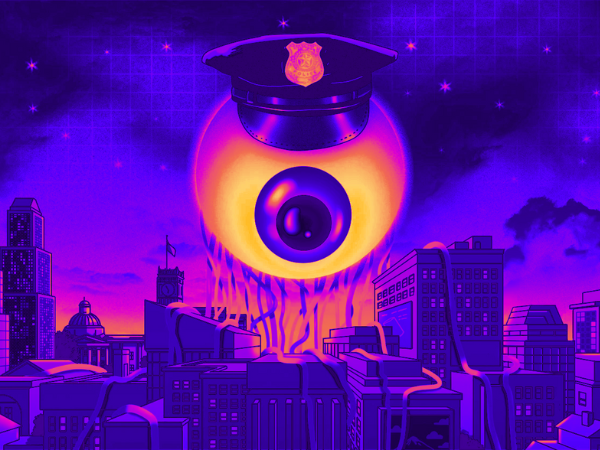
“If this government ever became a tyranny, if a dictator ever took charge in this country, the technological capacity that the intelligence community has given the government could enable it to impose total tyranny, and there would be no way to fight back.”—Senator Frank Church

The votes are in.

No matter who runs for office, no matter who controls the White House, Senate or the House of Representatives now or in the future, “we the people” have already lost.

We have lost because the future of this nation is being forged beyond the reach of our laws, elections and borders by techno-authoritarian powers with no regard for individuality, privacy or freedom.

The fate of America is being made in China, our role model for all things dystopian.

An economic and political powerhouse that owns more of America’s debt than any other country and is buying up American businesses across the spectrum, China is a vicious totalitarian regime that routinely employs censorship, surveillance, and brutal police state tactics to intimidate its populace, maintain its power, and expand the largesse of its corporate elite.

Where China goes, the United States eventually follows. This way lies outright tyranny.

Censorship. China’s censorship machine is straight out of Orwell’s 1984 with government agencies and corporations working together to limit the populace’s freedom of expression. Just a few years ago, in fact, China banned the use of the word “disagree,” as well as references to George Orwell’s novels Animal Farm and 1984. Government agencies routinely harass and intimidate anyone seen as non-compliant. Activists are frequently penalized for gathering in public places and charged criminally with “picking quarrels and provoking trouble.” China has also gone to great lengths to muzzle journalists reporting on corruption or human rights abuses.

Surveillance. COVID-19 brought China’s Orwellian surveillance out of the shadows and gave China the perfect excuse for unleashing the full force of its expansive and sophisticated surveillance and data collection powers on its citizenry and the rest of the world. Thermal scanners using artificial intelligence (AI) were installed at train stations in major cities to assess body temperatures and identify anyone with a fever. Facial recognition cameras and cell phone carriers tracked people’s movements constantly, reporting in real time to data centers that could be accessed by government agents and employers alike. And coded color alerts (red, yellow and green) sorted people into health categories that corresponded to the amount of freedom of movement they’re allowed: “Green code, travel freely. Red or yellow, report immediately.”

Social media credit scores. Prior to the coronavirus outbreak, the Chinese surveillance state had already been hard at work tracking its citizens through the use of some 200 million security cameras installed nationwide. Equipped with facial recognition technology, the cameras allow authorities to track so-called criminal acts, such as jaywalking, which factor into a person’s social credit score. Social media credit scores assigned to Chinese individuals and businesses categorize them on whether or not they are “good” citizens. A “citizen score” determines one’s place in society based on one’s loyalty to the government. A real-name system—which requires people to use government-issued ID cards to buy mobile sims, obtain social media accounts, take a train, board a plane, or even buy groceries—coupled with social media credit scores ensures that those blacklisted as “unworthy” are banned from accessing financial markets, buying real estate or travelling by air or train. Among the activities that can get you labeled unworthy are taking reserved seats on trains or allegedly causing trouble in hospitals.

Safe, smart cities. Having pioneered the development of so-called “safe” smart cities, China is exporting worldwide the high-tech communities in which residents are monitored round the clock, their every action under constant surveillance, and every device is connected to a central brain operated by artificial intelligence. As privacy expert Vincent Mosco concludes, “The benefit from smart cities clearly goes to the authorities who are able to use the promise of the modern, high-tech city to extend and deepen surveillance. It also goes to the big tech companies who profit first from building the smart city infrastructure and secondly by commodifying the entire smart city space. Citizens gain some operational efficiency but at great cost to their liberty.”

Digital currency. China has already adopted a government-issued digital currency, which not only allows it to surveil and seize people’s financial transactions, but can also work in tandem with its social credit score system to punish individuals for moral lapses and social transgressions (and reward them for adhering to government-sanctioned behavior). As China expert Akram Keram wrote for The Washington Post, “With digital yuan, the CCP [Chinese Communist Party] will have direct control over and access to the financial lives of individuals, without the need to strong-arm intermediary financial entities. In a digital-yuan-consumed society, the government easily could suspend the digital wallets of dissidents and human rights activists.”

Digital authoritarianism will redefine what it means to be free in almost every aspect of our lives. Again, we must look to China to understand what awaits us. As Human Rights Watch analyst Maya Wang explains: “Chinese authorities use technology to control the population all over the country in subtler but still powerful ways. The central bank is adopting digital currency, which will allow Beijing to surveil—and control—people’s financial transactions. China is building so-called safe cities, which integrate data from intrusive surveillance systems to predict and prevent everything from fires to natural disasters and political dissent. The government believes that these intrusions, together with administrative actions, such as denying blacklisted people access to services, will nudge people toward ‘positive behaviors,’ including greater compliance with government policies and healthy habits such as exercising.”

AI surveillance. In much the same way that Chinese products have infiltrated almost every market worldwide and altered consumer dynamics, China is now exporting its “authoritarian tech” to governments worldwide ostensibly in an effort to spread its brand of totalitarianism worldwide. In fact, both China and the United States have led the way in supplying the rest of the world with AI surveillance, sometimes at a subsidized rate. In the hands of tyrants and benevolent dictators alike, AI surveillance is the ultimate means of repression and control, especially through the use of smart city/safe city platforms, facial recognition systems, and predictive policing. These technologies are also being used by violent extremist groups, as well as sex, child, drug, and arms traffickers for their own nefarious purposes.

While countries with authoritarian regimes have been eager to adopt AI surveillance, as the Carnegie Endowment’s research makes clear, liberal democracies are also “aggressively using AI tools to police borders, apprehend potential criminals, monitor citizens for bad behavior, and pull out suspected terrorists from crowds.” Moreover, it’s easy to see how the China model for internet control has been integrated into the American police state’s efforts to flush out so-called anti-government, domestic extremists. This is how totalitarianism conquers the world.

Secret police. According to recent reports, China has planted more than 54 secret police forces in 25 cities around the world, including the United States, as part of their efforts to track and threaten dissidents and deport them back to China for prosecution. The campaign to surveil, intimidate and punish ex-patriates living abroad engaging in dissent has been dubbed Operation Fox Hunt. As one human rights agency noted, “The message from the [Chinese] ministry of foreign affairs – that you are not safe anywhere, that we can find you and that we can get to you – is very effective.”

Police brutality. Not much has changed about China’s brutal crackdown on protesters in the wake of the Tiananmen Square massacre. Chinese policing remains brutal, excessive and inflexible, now with the added power of the surveillance state behind it.

Intimidation tactics. China has mastered the art of intimidation tactics, threatening activists, their families and their livelihood should they fail to comply with the government’s dictates. As one activist explained, “There have been telephone calls in the middle of the night that family members won’t find work if you don’t cooperate with the government, or that your parents’ phone number will be posted online and they’ll be harassed. Or with Uyghurs, that the rest of your family will be put in camps.”

Disappearance, brainwashing and torture. Those who fail to fall in line with China’s dictates are often made to disappear, arrested in the dead of night and imprisoned in Orwellian re-education camps. China has built more than 400 of these internment camps in recent years to detain people for offenses that run the gamut from challenging the government to so-called religious crimes such as owning a Qur’an or abstaining from eating pork. As the Guardian reports, “abuses include detailed arbitrary detentions, torture and medical neglect in the detention camps and coercive birth control.”

China’s global influence, its technological reach, its quest for world domination, and its rigid demand for compliance are pushing us towards a world in chains.

Through its growing stranglehold on surveillance technology, China has erected the world’s first digital totalitarian state, and in the process, has made itself a model for aspiring dictators everywhere.

What too many fail to recognize, however, is that China and the American Deep State have joined forces.

As I make clear in Battlefield America: The War on the American People and in its fictional counterpart The Erik Blair Diaries, this is fascism hiding behind a thin veneer of open government and populist elections.

For all intents and purposes, we have become the embodiment of what Philip K. Dick feared when he wrote The Man in the High Castle, a vision of an alternate universe in which the Axis powers defeat the Allies in World War II, and “fascism has not simply conquered America. It has insinuated itself, with disturbing ease, into America’s DNA.”

Yet while Dick’s vision of a world in which totalitarianism has been normalized is chilling, our growing reality of a world in which the Deep State is not merely entrenched but has gone global is downright terrifying.

Our national flag may not boast the red and white stripes with a swastika on a field of blue as depicted in The Man in the High Castle, but be warned: we are no less occupied.

Source: https://bit.ly/3hIw8K6

ABOUT JOHN W. WHITEHEAD

Constitutional attorney and author John W. Whitehead is founder and president of The Rutherford Institute. His most recent books are the best-selling Battlefield America: The War on the American People, the award-winning A Government of Wolves: The Emerging American Police State, and a debut dystopian fiction novel, The Erik Blair Diaries. Whitehead can be contacted at staff@rutherford.org. Nisha Whitehead is the Executive Director of The Rutherford Institute. Information about The Rutherford Institute is available at www.rutherford.org.

Publication Guidelines / Reprint Permission

John W. Whitehead’s weekly commentaries are available for publication to newspapers and web publications at no charge. Please contact staff@rutherford.org to obtain reprint permission.

For soldiers … coming home is more lethal than being in combat.” ― Brené Brown, research professor at the University of Houston

The U.S. government is still waging war on America’s military veterans.

Especially veterans who exercise their First Amendment right to speak out against government wrongdoing.

Consider: we raise our young people on a steady diet of militarism and war, sell them on the idea that defending freedom abroad by serving in the military is their patriotic duty, then when they return home, bruised and battle-scarred and committed to defending their freedoms at home, we often treat them like criminals merely for exercising those rights they risked their lives to defend.

As first reported by the Wall Street Journal, the government even has a name for its war on America’s veterans: Operation Vigilant Eagle.

This Department of Homeland Security (DHS) program tracks military veterans returning from Iraq and Afghanistan and characterizes them as extremists and potential domestic terrorist threats because they may be “disgruntled, disillusioned or suffering from the psychological effects of war.”

Coupled with the DHS’ dual reports on Rightwing and Leftwing “Extremism,” which broadly define extremists as individuals, military veterans and groups “that are mainly antigovernment, rejecting federal authority in favor of state or local authority, or rejecting government authority entirely,” these tactics bode ill for anyone seen as opposing the government.

Yet the government is not merely targeting individuals who are voicing their discontent so much as it is taking aim at individuals trained in military warfare.

Don’t be fooled by the fact that the DHS has gone extremely quiet about Operation Vigilant Eagle.

Where there’s smoke, there’s bound to be fire.

And the government’s efforts to target military veterans whose views may be perceived as “anti-government” make clear that something is afoot.

In recent years, military servicemen and women have found themselves increasingly targeted for surveillance, censorship, threatened with incarceration or involuntary commitment, labeled as extremists and/or mentally ill, and stripped of their Second Amendment rights.

In light of the government’s efforts to lay the groundwork to weaponize the public’s biomedical data and predict who might pose a threat to public safety based on mental health sensor data (a convenient means by which to penalize certain “unacceptable” social behaviors), encounters with the police could get even more deadly, especially if those involved have a mental illness or disability coupled with a military background.

Incredibly, as part of a proposal introduced under the Trump Administration, a new government agency HARPA (a healthcare counterpart to the Pentagon’s research and development arm DARPA) will take the lead in identifying and targeting “signs” of mental illness or violent inclinations among the populace by using artificial intelligence to collect data from Apple Watches, Fitbits, Amazon Echo and Google Home.

These tactics are not really new.

Many times throughout history in totalitarian regimes, such governments have declared dissidents mentally ill and unfit for society as a means of rendering them disempowering them.

For example, government officials in the Cold War-era Soviet Union often used psychiatric hospitals as prisons in order to isolate political prisoners from the rest of society, discredit their ideas, and break them physically and mentally through the use of electric shocks, drugs and various medical procedures.

This age-old practice by which despotic regimes eliminate their critics or potential adversaries by declaring them mentally ill and locking them up in psychiatric wards for extended periods of time is a common practice in present-day China.

What is particularly unnerving, however, is how this practice of eliminating or undermining potential critics, including military veterans, is happening with increasing frequency in the United States.

Remember, the National Defense Authorization Act (NDAA) opened the door for the government to detain as a threat to national security anyone viewed as a troublemaker. According to government guidelines for identifying domestic extremists—a word used interchangeably with terrorists—technically, anyone exercising their First Amendment rights in order to criticize the government qualifies.

It doesn’t take much anymore to be flagged as potentially anti-government in a government database somewhere—Main Core, for example—that identifies and tracks individuals who aren’t inclined to march in lockstep to the government’s dictates.

In fact, as the Washington Post reports, communities are being mapped and residents assigned a color-coded threat score—green, yellow or red—so police are forewarned about a person’s potential inclination to be a troublemaker depending on whether they’ve had a career in the military, posted a comment perceived as threatening on Facebook, suffer from a particular medical condition, or know someone who knows someone who might have committed a crime.

The case of Brandon Raub is a prime example of Operation Vigilant Eagle in action.

Raub, a 26-year-old decorated Marine, actually found himself interrogated by government agents about his views on government corruption, arrested with no warning, labeled mentally ill for subscribing to so-called “conspiratorial” views about the government, detained against his will in a psych ward for standing by his views, and isolated from his family, friends and attorneys. Within days of Raub being seized and forcibly held in a VA psych ward, news reports started surfacing of other veterans having similar experiences.

“Oppositional defiance disorder” (ODD) is another diagnosis being used against veterans who challenge the status quo. As journalist Anthony Martin explains, an ODD diagnosis

“denotes that the person exhibits ‘symptoms’ such as the questioning of authority, the refusal to follow directions, stubbornness, the unwillingness to go along with the crowd, and the practice of disobeying or ignoring orders. Persons may also receive such a label if they are considered free thinkers, nonconformists, or individuals who are suspicious of large, centralized government… At one time the accepted protocol among mental health professionals was to reserve the diagnosis of oppositional defiance disorder for children or adolescents who exhibited uncontrollable defiance toward their parents and teachers.”

That the government is using the charge of mental illness as the means by which to immobilize (and disarm) these veterans is diabolical. With one stroke of a magistrate’s pen, these veterans are being declared mentally ill, locked away against their will, and stripped of their constitutional rights.

If it were just being classified as “anti-government,” that would be one thing.

Unfortunately, anyone with a military background and training is also now being viewed as a heightened security threat by police who are trained to shoot first and ask questions later.

Feeding this perception of veterans as ticking time bombs in need of intervention, the Justice Department launched a pilot program in 2012 aimed at training SWAT teams to deal with confrontations involving highly trained and often heavily armed combat veterans.

The result?

Police encounters with military veterans often escalate very quickly into an explosive and deadly situation, especially when SWAT teams are involved.

For example, Jose Guerena, a Marine who served in two tours in Iraq, was killed after an Arizona SWAT team kicked open the door of his home during a mistaken drug raid and opened fire. Thinking his home was being invaded by criminals, Guerena told his wife and child to hide in a closet, grabbed a gun and waited in the hallway to confront the intruders. He never fired his weapon. In fact, the safety was still on his gun when he was killed. The SWAT officers, however, not as restrained, fired 70 rounds of ammunition at Guerena—23 of those bullets made contact. Apart from his military background, Guerena had had no prior criminal record, and the police found nothing illegal in his home.

John Edward Chesney, a 62-year-old Vietnam veteran, was killed by a SWAT team allegedly responding to a call that the Army veteran was standing in his San Diego apartment window waving what looked like a semi-automatic rifle. SWAT officers locked down Chesney’s street, took up positions around his home, and fired 12 rounds into Chesney’s apartment window. It turned out that the gun Chesney reportedly pointed at police from three stories up was a “realistic-looking mock assault rifle.”

Ramon Hooks’ encounter with a Houston SWAT team did not end as tragically, but it very easily could have. Hooks, a 25-year-old Iraq war veteran, was using an air rifle gun for target practice outside when a Homeland Security Agent, allegedly house shopping in the area, reported him as an active shooter. It wasn’t long before the quiet neighborhood was transformed into a war zone, with dozens of cop cars, an armored vehicle and heavily armed police. Hooks was arrested, his air rifle pellets and toy gun confiscated, and charges filed against him for “criminal mischief.”

Given the government’s increasing view of veterans as potential domestic terrorists, it makes one think twice about government programs encouraging veterans to include a veterans designation on their drivers’ licenses and ID cards.

Hailed by politicians as a way to “make it easier for military veterans to access discounts from retailers, restaurants, hotels and vendors across the state,” it will also make it that much easier for the government to identify and target veterans who dare to challenge the status quo.

Remember: no one is spared in a police state.

Eventually, as I make clear in Battlefield America: The War on the American People and in its fictional counterpart The Erik Blair Diaries, we all suffer the same fate.

It stands to reason that if the government can’t be bothered to abide by its constitutional mandate to respect the citizenry’s rights—whether it’s the right to be free from government surveillance and censorship, the right to due process and fair hearings, the right to be free from roadside strip searches and militarized police, or the right to peacefully assemble and protest and exercise our right to free speech—then why should anyone expect the government to treat our nation’s veterans with respect and dignity?

Certainly, veterans have enough physical and psychological war wounds to overcome without adding the government to the mix. Although the U.S. boasts more than 20 million veterans who have served in World War II through the present day, large numbers of veterans are impoverished, unemployed, traumatized mentally and physically, struggling with depression, suicide, and marital stress, homeless, subjected to sub-par treatment at clinics and hospitals, and left to molder while their paperwork piles up within Veterans Administration offices.

At least 60,000 veterans died by suicide between 2008 and 2017.

On average, 6,000 veterans kill themselves every year. However, a recent study suggests that the rate of suicide among veterans may be more than double what federal officials report annually.

The plight of veterans today—and their treatment at the hands of the U.S. government—remains America’s badge of shame.

Source: https://bit.ly/3hjqgH3

ABOUT JOHN W. WHITEHEAD

Constitutional attorney and author John W. Whitehead is founder and president of The Rutherford Institute. His most recent books are the best-selling Battlefield America: The War on the American People, the award-winning A Government of Wolves: The Emerging American Police State, and a debut dystopian fiction novel, The Erik Blair Diaries. Whitehead can be contacted at staff@rutherford.org. Nisha Whitehead is the Executive Director of The Rutherford Institute. Information about The Rutherford Institute is available at www.rutherford.org.

Publication Guidelines / Reprint Permission

John W. Whitehead’s weekly commentaries are available for publication to newspapers and web publications at no charge. Please contact staff@rutherford.org to obtain reprint permission.

“We want no Gestapo or Secret Police. FBI is tending in that direction.”—Harry Truman

With every passing day, the United States government borrows yet another leaf from Nazi Germany’s playbook: Secret police. Secret courts. Secret government agencies. Surveillance. Censorship. Intimidation. Harassment. Torture. Brutality. Widespread corruption. Entrapment. Indoctrination. Indefinite detention.

These are not tactics used by constitutional republics, where the rule of law and the rights of the citizenry reign supreme. Rather, they are the hallmarks of authoritarian regimes, where secret police control the populace through intimidation, fear and official lawlessness on the part of government agents.

That authoritarian danger is now posed by the FBI, whose love affair with totalitarianism began long ago. Indeed, according to the New York Times, the U.S. government so admired the Nazi regime that following the second World War, it secretly and aggressively recruited at least a thousand Nazis, including some of Hitler’s highest henchmen as part of Operation Paperclip. American taxpayers have been paying to keep these ex-Nazis on the U.S. government’s payroll ever since.

If the government’s covert, taxpayer-funded employment of Nazis after World War II weren’t bad enough, U.S. government agencies—the FBI, CIA and the military—adopted many of the Third Reich’s well-honed policing tactics, and have used them against American citizens.

Indeed, the FBI’s laundry list of crimes against the American people includes surveillance, disinformation, blackmail, entrapment, intimidation tactics, harassment and indoctrination, governmental overreach, abuse, misconduct, trespassing, enabling criminal activity, and damaging private property, and that’s just based on what we know.

Compare the FBI’s far-reaching powers to surveil, detain, interrogate, investigate, prosecute, punish, police and generally act as a law unto themselves—powers that have grown since 9/11, transforming the FBI into a mammoth federal policing and surveillance agency that largely operates as a power unto itself, beyond the reach of established laws, court rulings and legislative mandates—to its Nazi counterparts, the Gestapo—and then try to convince yourself that the United States is not a totalitarian police state.

Just like the Gestapo, the FBI has vast resources, vast investigatory powers, and vast discretion to determine who is an enemy of the state.

Today, the FBI employs more than 35,000 individuals and operates more than 56 field offices in major cities across the U.S., as well as 400 resident agencies in smaller towns, and more than 50 international offices. In addition to their “data campus,” which houses more than 96 million sets of fingerprints from across the United States and elsewhere, the FBI has also built a vast repository of “profiles of tens of thousands of Americans and legal residents who are not accused of any crime. What they have done is appear to be acting suspiciously to a town sheriff, a traffic cop or even a neighbor.” The FBI’s burgeoning databases on Americans are not only being added to and used by local police agencies, but are also being made available to employers for real-time background checks.

All of this is made possible by the agency’s nearly unlimited resources (President Biden’s budget projections allocate $10.8 billion for the FBI), the government’s vast arsenal of technology, the interconnectedness of government intelligence agencies, and information sharing through fusion centers—data collecting intelligence agencies spread throughout the country that constantly monitor communications (including those of American citizens), everything from internet activity and web searches to text messages, phone calls and emails.

Much like the Gestapo spied on mail and phone calls, FBI agents have carte blanche access to the citizenry’s most personal information.

Working through the U.S. Post Office, the FBI has access to every piece of mail that passes through the postal system: more than 160 billion pieces are scanned and recorded annually. Moreover, the agency’s National Security Letters, one of the many illicit powers authorized by the USA Patriot Act, allows the FBI to secretly demand that banks, phone companies, and other businesses provide them with customer information and not disclose those demands to the customer. An internal audit of the agency found that the FBI practice of issuing tens of thousands of NSLs every year for sensitive information such as phone and financial records, often in non-emergency cases, is riddled with widespread constitutional violations.

Much like the Gestapo’s sophisticated surveillance programs, the FBI’s spying capabilities can delve into Americans’ most intimate details (and allow local police to do so, as well).

In addition to technology (which is shared with police agencies) that allows them to listen in on phone calls, read emails and text messages, and monitor web activities, the FBI’s surveillance boasts an invasive collection of spy tools ranging from Stingray devices that can track the location of cell phones to Triggerfish devices which allow agents to eavesdrop on phone calls.  In one case, the FBI actually managed to remotely reprogram a “suspect’s” wireless internet card so that it would send “real-time cell-site location data to Verizon, which forwarded the data to the FBI.” Law enforcement agencies are also using social media tracking software to monitor Facebook, Twitter and Instagram posts. Moreover, secret FBI rules also allow agents to spy on journalists without significant judicial oversight.

Much like the Gestapo’s ability to profile based on race and religion, and its assumption of guilt by association, the FBI’s approach to pre-crime allows it to profile Americans based on a broad range of characteristics including race and religion.

The agency’s biometric database has grown to massive proportions, the largest in the world, encompassing everything from fingerprints, palm, face and iris scans to DNA, and is being increasingly shared between federal, state and local law enforcement agencies in an effort to target potential criminals long before they ever commit a crime. This is what’s known as pre-crime. Yet it’s not just your actions that will get you in trouble. In many cases, it’s also who you know—even minimally—and where your sympathies lie that could land you on a government watch list. Moreover, as the Intercept reports, despite anti-profiling prohibitions, the bureau “claims considerable latitude to use race, ethnicity, nationality, and religion in deciding which people and communities to investigate.”

Much like the Gestapo’s power to render anyone an enemy of the state, the FBI has the power to label anyone a domestic terrorist.

As part of the government’s so-called ongoing war on terror, the nation’s de facto secret police force has begun using the terms “anti-government,” “extremist” and “terrorist” interchangeably. Moreover, the government continues to add to its growing list of characteristics that can be used to identify an individual (especially anyone who disagrees with the government) as a potential domestic terrorist. For instance, you might be a domestic terrorist in the eyes of the FBI (and its network of snitches) if you:

  • express libertarian philosophies (statements, bumper stickers)
  • exhibit Second Amendment-oriented views (NRA or gun club membership)
  • read survivalist literature, including apocalyptic fictional books
  • show signs of self-sufficiency (stockpiling food, ammo, hand tools, medical supplies)
  • fear an economic collapse
  • buy gold and barter items
  • subscribe to religious views concerning the book of Revelation
  • voice fears about Big Brother or big government
  • expound about constitutional rights and civil liberties
  • believe in a New World Order conspiracy

Much like the Gestapo infiltrated communities in order to spy on the German citizenry, the FBI routinely infiltrates political and religious groups, as well as businesses.

As Cora Currier writes for the Intercept: “Using loopholes it has kept secret for years, the FBI can in certain circumstances bypass its own rules in order to send undercover agents or informants into political and religious organizations, as well as schools, clubs, and businesses…” The FBI has even been paying Geek Squad technicians at Best Buy to spy on customers’ computers without a warrant.

Just as the Gestapo united and militarized Germany’s police forces into a national police force, America’s police forces have largely been federalized and turned into a national police force.

In addition to government programs that provide the nation’s police forces with military equipment and training, the FBI also operates a National Academy that trains thousands of police chiefs every year and indoctrinates them into an agency mindset that advocates the use of surveillance technology and information sharing between local, state, federal, and international agencies.

Just as the Gestapo’s secret files on political leaders were used to intimidate and coerce, the FBI’s files on anyone suspected of “anti-government” sentiment have been similarly abused.

As countless documents make clear, the FBI has no qualms about using its extensive powers in order to blackmail politicians, spy on celebrities and high-ranking government officials, and intimidate and attempt to discredit dissidents of all stripes. For example, not only did the FBI follow Martin Luther King Jr. and bug his phones and hotel rooms, but agents also sent him anonymous letters urging him to commit suicide and pressured a Massachusetts college into dropping King as its commencement speaker.

Just as the Gestapo carried out entrapment operations, the FBI has become a master in the art of entrapment.

In the wake of the 9/11 terrorist attacks the FBI has not only targeted vulnerable individuals but has also lured or blackmailed them into fake terror plots while actually equipping them with the organization, money, weapons and motivation to carry out the plots—entrapment—and then jailing or deporting them for their so-called terrorist plotting.

This is what the FBI characterizes as “forward leaning—preventative—prosecutions.” In addition to creating certain crimes in order to then “solve” them, the FBI also gives certain informants permission to break the law, “including everything from buying and selling illegal drugs to bribing government officials and plotting robberies,” in exchange for their cooperation on other fronts.

USA Today estimates that FBI agents have authorized criminals to engage in as many as 15 crimes a day. Some of these informants are getting paid astronomical sums: one particularly unsavory fellow, later arrested for attempting to run over a police officer, was actually paid $85,000 for his help laying the trap for an entrapment scheme.

When and if a true history of the FBI is ever written, it will not only track the rise of the American police state but it will also chart the decline of freedom in America, in much the same way that the empowerment of Germany’s secret police tracked with the rise of the Nazi regime.

How did the Gestapo become the terror of the Third Reich?

It did so by creating a sophisticated surveillance and law enforcement system that relied for its success on the cooperation of the military, the police, the intelligence community, neighborhood watchdogs, government workers for the post office and railroads, ordinary civil servants, and a nation of snitches inclined to report “rumors, deviant behavior, or even just loose talk.”

In other words, ordinary citizens working with government agents helped create the monster that became Nazi Germany. Writing for the New York Times, Barry Ewen paints a particularly chilling portrait of how an entire nation becomes complicit in its own downfall by looking the other way:

In what may be his most provocative statement, [author Eric A.] Johnson says that ‘‘most Germans may not even have realized until very late in the war, if ever, that they were living in a vile dictatorship.’’ This is not to say that they were unaware of the Holocaust; Johnson demonstrates that millions of Germans must have known at least some of the truth. But, he concludes, ‘‘a tacit Faustian bargain was struck between the regime and the citizenry.’’ The government looked the other way when petty crimes were being committed. Ordinary Germans looked the other way when Jews were being rounded up and murdered; they abetted one of the greatest crimes of the 20th century not through active collaboration but through passivity, denial and indifference.

Much like the German people, “we the people” have become passive, polarized, gullible, easily manipulated, and lacking in critical thinking skills.  Distracted by entertainment spectacles, politics and screen devices, we too are complicit, silent partners in creating a police state similar to the terror practiced by former regimes.

Had the government tried to ram such a state of affairs down our throats suddenly, it might have had a rebellion on its hands. Instead, the American people have been given the boiling frog treatment, immersed in water that slowly is heated up—degree by degree—so that they’ve fail to notice that they’re being trapped and cooked and killed.

“We the people” are in hot water now.

The Constitution doesn’t stand a chance against a federalized, globalized standing army of government henchmen protected by legislative, judicial and executive branches that are all on the same side, no matter what political views they subscribe to: suffice it to say, they are not on our side or the side of freedom.

From Presidents Clinton to Bush, then Obama to Trump and now Biden, it’s as if we’ve been caught in a time loop, forced to re-live the same thing over and over again: the same assaults on our freedoms, the same disregard for the rule of law, the same subservience to the Deep State, and the same corrupt, self-serving government that exists only to amass power, enrich its shareholders and ensure its continued domination.

Can the Fourth Reich happen here?

As I point out in my book Battlefield America: The War on the American People and in its fictional counterpart The Erik Blair Diaries, it’s already happening right under our noses.

Source: https://bit.ly/3pCCfjK

ABOUT JOHN & NISHA WHITEHEAD

Constitutional attorney and author John W. Whitehead is founder and president of The Rutherford Institute. His most recent books are the best-selling Battlefield America: The War on the American People, the award-winning A Government of Wolves: The Emerging American Police State, and a debut dystopian fiction novel, The Erik Blair Diaries. Whitehead can be contacted at staff@rutherford.org. Nisha Whitehead is the Executive Director of The Rutherford Institute. Information about The Rutherford Institute is available at www.rutherford.org.

Publication Guidelines / Reprint Permission

John W. Whitehead’s weekly commentaries are available for publication to newspapers and web publications at no charge. Please contact staff@rutherford.org to obtain reprint permission.