Posts Tagged ‘surveillance’

“There were relatively few secret police, and most were just processing the information coming in. I had found a shocking fact. It wasn’t the secret police who were doing this wide-scale surveillance and hiding on every street corner. It was the ordinary German people who were informing on their neighbors.”—Professor Robert Gellately, author of Backing Hitler

Are you among the 41% of Americans who regularly attend church or some other religious service?

Do you believe the economy is about to collapse and the government will soon declare martial law?

Do you display an unusual number of political and/or ideological bumper stickers on your car?

Are you among the 44% of Americans who live in a household with a gun? If so, are you concerned that the government may be plotting to confiscate your firearms?

If you answered yes to any of the above questions, you may be an anti-government extremist (a.k.a. domestic terrorist) in the eyes of the government and flagged for heightened surveillance and preemptive intervention.

Let that sink in a moment.

If you believe in and exercise your rights under the Constitution (namely, your right to speak freely, worship freely, associate with like-minded individuals who share your political views, criticize the government, own a weapon, demand a warrant before being questioned or searched, or any other activity viewed as potentially anti-government, racist, bigoted, anarchic or sovereign), you have just been promoted to the top of the government’s terrorism watch list.

I assure you I’m not making this stuff up.

So what is the government doing about these so-called American “extremists”?

The government is grooming the American people to spy on each other as part of its Center for Prevention Programs and Partnerships, or CP3 program.

According to journalist Leo Hohmann, the government is handing out $20 million in grants to police, mental health networks, universities, churches and school districts to enlist their help in identifying Americans who might be political dissidents or potential “extremists.”

As Hohmann explains, “Whether it’s COVID and vaccines, the war in Ukraine, immigration, the Second Amendment, LGBTQ ideology and child-gender confusion, the integrity of our elections, or the issue of protecting life in the womb, you are no longer allowed to hold dissenting opinions and voice them publicly in America. If you do, your own government will take note and consider you a potential ‘violent extremist’ and terrorist.”

Cue the dawning of the Snitch State.

This new era of snitch surveillance is the lovechild of the government’s post-9/11 “See Something, Say Something” programs combined with the self-righteousness of a politically correct, hyper-vigilant, technologically-wired age.

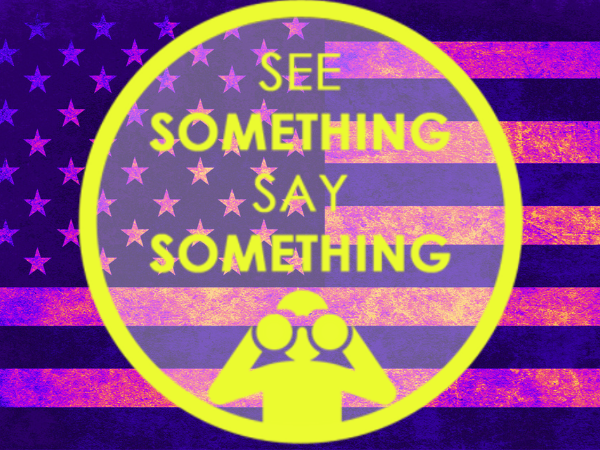
For more than two decades, the Department of Homeland Security has plastered its “See Something, Say Something” campaign on the walls of metro stations, on billboards, on coffee cup sleeves, at the Super Bowl, even on television monitors in the Statue of Liberty. Colleges, universities and even football teams and sporting arenas have lined up for grants to participate in the program.

The government has even designated September 25 as National “If You See Something, Say Something” Awareness Day.

If you see something suspicious, says the DHS, say something about it to the police, call it in to a government hotline, or report it using a convenient app on your smart phone.

This DHS slogan is nothing more than the government’s way of indoctrinating “we the people” into the mindset that we’re an extension of the government and, as such, have a patriotic duty to be suspicious of, spy on, and turn in our fellow citizens.

This is what is commonly referred to as community policing.

Yet while community policing and federal programs such as “See Something, Say Something” are sold to the public as patriotic attempts to be on guard against those who would harm us, they are little more than totalitarian tactics dressed up and repackaged for a more modern audience as well-intentioned appeals to law and order and security.

The police state could not ask for a better citizenry than one that carries out its own policing.

After all, the police can’t be everywhere. So how do you police a nation when your population outnumbers your army of soldiers? How do you carry out surveillance on a nation when there aren’t enough cameras, let alone viewers, to monitor every square inch of the country 24/7? How do you not only track but analyze the transactions, interactions and movements of every person within the United States?

The answer is simpler than it seems: You persuade the citizenry to be your eyes and ears. You hype them up on color-coded “Terror alerts,” keep them in the dark about the distinctions between actual threats and staged “training” drills so that all crises seem real, desensitize them to the sight of militarized police walking their streets, acclimatize them to being surveilled “for their own good,” and then indoctrinate them into thinking that they are the only ones who can save the nation from another 9/11.

Consequently, we now live in a society in which a person can be accused of any number of crimes without knowing what exactly he has done. He might be apprehended in the middle of the night by a roving band of SWAT police. He might find himself on a no-fly list, unable to travel for reasons undisclosed. He might have his phones or internet tapped based upon a secret order handed down by a secret court, with no recourse to discover why he was targeted.

This Kafkaesque nightmare has become America’s reality.

This is how you turn a people into extensions of the omniscient, omnipotent, omnipresent police state, and in the process turn a citizenry against each other.

It’s a brilliant ploy, with the added bonus that while the citizenry remains focused on and distrustful of each other and shadowy forces from outside the country, they’re incapable of focusing on more definable threats that fall closer to home—namely, the government and its cabal of Constitution-destroying agencies and corporate partners.

Community policing did not come about as a feel-good, empowering response to individuals trying to “take back” their communities from crime syndicates and drug lords.

Rather, “Community-Oriented Policing” or COPS (short for Community Partnerships, Organizational Transformation, and Problem Solving) is a Department of Justice program designed to foster partnerships between police agencies and members of the community.

To this end, the Justice Department identifies five distinct “partners” in the community policing scheme: law enforcement and other government agencies, community members and groups, nonprofits, churches and service providers, private businesses and the media.

Together, these groups are supposed to “identify” community concerns, “engage” the community in achieving specific goals, serve as “powerful” partners with the government, and add their “considerable resources” to the government’s already massive arsenal of technology and intelligence. The mainstream media’s role, long recognized as being a mouthpiece for the government, is formally recognized as “publicizing” services from government or community agencies or new laws or codes that will be enforced, as well as shaping public perceptions of the police, crime problems, and fear of crime.

Inevitably, this begs the question: if there’s nothing wrong with community engagement, if the police can’t be everywhere at once, if surveillance cameras do little to actually prevent crime, and if we need to “take back our communities” from the crime syndicates and drug lords, then what’s wrong with community policing and “See Something, Say Something”?

What’s wrong is that these programs are not, in fact, making America any safer while turning us into a legalistic, intolerant, squealing, bystander nation.

We are now the unwitting victims of an interconnected, tightly woven, technologically evolving web of real-time, warrantless, wall-to-wall, widening mass surveillance dragnet comprised of fusion centers, red flag laws, behavioral threat assessments, terror watch lists, facial recognition, snitch tip lines, biometric scanners, pre-crime programs, DNA databases, data mining, precognitive technology and contact tracing apps, to name just a few.

This is how the government keeps us under control and in its crosshairs.

By the time you combine the DHS’ “See Something, Say Something” with CP3 and community policing, which has gone global in the guise of the Strong Cities Network program, you’ve got a formula for enabling the government to not only flag distinct “anti-government” segments of the population but locking down the entire nation.

Under the guise of fighting violent extremism “in all of its forms and manifestations” in cities and communities across the world, the Strong Cities Network program works with the UN and the federal government to train local police agencies across America in how to identify, fight and prevent extremism, as well as address intolerance within their communities, using all of the resources at their disposal.

What this program is really all about, however, is community policing on a global scale with the objective being to prevent violent extremism by targeting its source: racism, bigotry, hatred, intolerance, etc. In other words, police will identify, monitor and deter individuals who could be construed as potential extremist “threats,” violent or otherwise, before they can become actual threats.

The government’s war on extremists has been sold to Americans in much the same way that the USA Patriot Act was sold to Americans: as a means of combatting terrorists who seek to destroy America.

However, as we now know, the USA Patriot Act was used as a front to advance the surveillance state, allowing the government to establish a far-reaching domestic spying program that has turned every American citizen into a criminal suspect.

Similarly, the concern with the government’s ongoing anti-extremism program is that it will, in many cases, be utilized to render otherwise lawful, nonviolent activities as potentially extremist.

Keep in mind that the government agencies involved in ferreting out American “extremists” will carry out their objectives—to identify and deter potential extremists—in concert with fusion centers, data collection agencies, behavioral scientists, corporations, social media, and community organizers and by relying on cutting-edge technology for surveillance, facial recognition, predictive policing, biometrics, and behavioral epigenetics (in which life experiences alter one’s genetic makeup).

This is pre-crime on an ideological scale and it’s been a long time coming.

For example, in 2009, the Department of Homeland Security (DHS) released two reports, one on “Rightwing Extremism,” which broadly defines rightwing extremists as individuals and groups “that are mainly antigovernment, rejecting federal authority in favor of state or local authority, or rejecting government authority entirely,” and one on “Leftwing Extremism,” which labeled environmental and animal rights activist groups as extremists.

These reports, which use the words terrorist and extremist interchangeably, indicate that for the government, anyone seen as opposing the government—whether they’re Left, Right or somewhere in between—can be labeled an extremist.

Fast forward a few years, and you have the National Defense Authorization Act (NDAA), which each successive presidential administration has continually re-upped, that allows the military to take you out of your home, lock you up with no access to friends, family or the courts if you’re seen as an extremist.

Now connect the dots, from the 2009 Extremism reports to the NDAA and the far-reaching data crime fusion centers that collect and share surveillance data between local, state and federal police agencies.

Add in tens of thousands of armed, surveillance drones that will soon blanket American skies, facial recognition technology that identifies and tracks you wherever you go and whatever you do. And then to complete the circle, toss in the real-time crime centers which are attempting to “predict” crimes and identify criminals before they happen based on widespread surveillance, complex mathematical algorithms and prognostication programs.

If you can’t read the writing on the wall, you need to pay better attention.

As I point out in my book Battlefield America: The War on the American People and in its fictional counterpart The Erik Blair Diaries, unless we can put the brakes on this dramatic expansion and globalization of the government’s powers, we’re not going to recognize this country five, ten—even twenty—years from now.

As long as “we the people” continue to allow the government to trample our rights in the so-called name of national security, things will get worse, not better.

It’s already worse.

Source: https://tinyurl.com/4af3m2tt

ABOUT JOHN W. WHITEHEAD

Constitutional attorney and author John W. Whitehead is founder and president of The Rutherford Institute. His most recent books are the best-selling Battlefield America: The War on the American People, the award-winning A Government of Wolves: The Emerging American Police State, and a debut dystopian fiction novel, The Erik Blair Diaries. Whitehead can be contacted at staff@rutherford.org. Nisha Whitehead is the Executive Director of The Rutherford Institute. Information about The Rutherford Institute is available at www.rutherford.org.

Publication Guidelines / Reprint Permission

John W. Whitehead’s weekly commentaries are available for publication to newspapers and web publications at no charge. Please contact staff@rutherford.org to obtain reprint permission.

LANSING, Mich. — The Rutherford Institute is pushing back against efforts by government officials to use warrantless aerial drone surveillance to snoop on citizens at home and spy on their private property.

In filing a joint amicus brief with Cato Institute in Long Lake Township v. Maxon, Institute attorneys are calling on the Michigan Supreme Court to hold government officials accountable for violating the Fourth Amendment by not obtaining a search warrant before using a drone to take aerial photographs of private property, which was not observable from the ground, in order to gather evidence of a civil zoning violation.

“Americans are being swept up into a massive digital data dragnet that does not distinguish between those who are innocent of wrongdoing, suspects, or criminals. Aerial drone surveillance has become a de facto snitch for the police state,” said constitutional attorney John W. Whitehead, president of The Rutherford Institute and author of Battlefield America: The War on the American People. “By subjecting Americans to surveillance without their knowledge or compliance, the government has erected the ultimate suspect society. In such an environment, there is no such thing as ‘innocent until proven guilty.’”

In 2008, Long Lake Township brought a zoning action against Todd Maxon, alleging that he was using his five-acre property where he lives as an illegal salvage or junkyard due to having automobiles which he worked on fixing up as a hobby. The case settled that year in Maxon’s favor with a dismissal and the Township agreeing to reimburse a portion of his attorneys’ fees. However, the government did not stop in its pursuit to penalize Maxon and his wife. In 2010, 2016, 2017, and 2018—without obtaining any search warrant—Township officials used a drone to take aerial photographs of the Maxons’ property, which was not visible from the ground because it is blocked by buildings and trees. The Township then filed another zoning action in 2018, alleging that the Maxons had increased the scope of the junk cars and material on their property. The Maxons argued that the aerial surveillance and photographs by the drones of their property was an unlawful search in violation of the Fourth Amendment and should therefore be excluded from evidence because people do not reasonably expect drones with high powered cameras to surveil their private property at relatively low altitudes. The trial court denied the Maxons’ motion to suppress the images.

Noting the maneuverability, speed, and stealth of drones which could fly directly up to an open bathroom window, the Michigan Court of Appeals ruled that persons do have a reasonable expectation of privacy in their property against drone surveillance and that government officials must therefore obtain a warrant for such surveillance. However, although the Court of Appeals held that government officials had violated the Fourth Amendment, the court further held that the exclusionary rule does not apply in civil cases to suppress unconstitutionally obtained evidence. The Maxons appealed to the Michigan Supreme Court. In weighing in before the Court on behalf of the Maxons’ right to be free from warrantless aerial drone surveillance, The Rutherford Institute and Cato Institute warned that failure to apply the exclusionary rule will create a roadmap for the government to circumvent Fourth Amendment protections by simply classifying its fines as “civil” to punish people for violating its laws and ordinances.

Clark M. Neily, III and Laura A. Bondank of the Cato Institute helped advance the arguments in the Long Lake Township v. Maxon amicus brief.

The Rutherford Institute, a nonprofit civil liberties organization, provides legal assistance at no charge to individuals whose constitutional rights have been threatened or violated and educates the public on a wide spectrum of issues affecting their freedoms.

“The whole aim of practical politics is to keep the populace alarmed (and hence clamorous to be led to safety) by an endless series of hobgoblins, most of them imaginary.”—H.L. Mencken

First came 9/11, which the government used to transform itself into a police state.

Then the COVID-19 pandemic hit, which the police state used to test out its lockdown powers.

In light of the government’s tendency to exploit crises (legitimate or manufactured) and capitalize on the nation’s heightened emotions, confusion and fear as a means of extending the reach of the police state, one has to wonder what so-called crisis it will declare next.

It’s a simple enough formula: first, you create fear, then you capitalize on it by seizing power.

Frankly, it doesn’t even matter what the nature of the next national emergency might be (terrorism, civil unrest, economic collapse, a health scare, or the environment) as long as it allows the government to lockdown the nation and justify all manner of tyranny in the so-called name of national security.

Cue the Emergency State.

Terrorist attacks, mass shootings, “unforeseen economic collapse, loss of functioning political and legal order, purposeful domestic resistance or insurgency, pervasive public health emergencies, and catastrophic natural and human disasters”: the government has been anticipating and preparing for such crises for years now.

As David C. Unger writes for the New York Times: “Life, liberty, and the pursuit of happiness have given way to permanent crisis management: to policing the planet and fighting preventative wars of ideological containment, usually on terrain chosen by, and favorable to, our enemies. Limited government and constitutional accountability have been shouldered aside by the kind of imperial presidency our constitutional system was explicitly designed to prevent.”

Here’s what we know: given the rate at which the government keeps devising new ways to establish itself as the “solution” to all of our worldly problems at taxpayer expense, each subsequent crisis ushers in ever larger expansions of government power and less individual liberty.

This is the slippery slope to outright tyranny.

You see, once the government acquires (and uses) authoritarian powers—to spy on its citizens, to carry out surveillance, to transform its police forces into extensions of the military, to seize taxpayer funds, to wage endless wars, to censor and silence dissidents, to identify potential troublemakers, to detain citizens without due process—it does not voluntarily relinquish them.

The lesson for the ages is this: once any government is allowed to overreach and expand its powers, it’s almost impossible to put the genie back in the bottle. As Harvard constitutional law professor Laurence Tribe recognizes, “The dictatorial hunger for power is insatiable.

Indeed, the history of the United States is a testament to the old adage that liberty decreases as government (and government bureaucracy) grows. To put it another way, as government expands, liberty contracts.

In this way, every crisis since the nation’s early beginnings has become a make-work opportunity for the government.

Each crisis has also been a test to see how far “we the people” would allow the government to sidestep the Constitution in the so-called name of national security; a test to see how well we have assimilated the government’s lessons in compliance, fear and police state tactics; a test to see how quickly we’ll march in lockstep with the government’s dictates, no questions asked; and a test to see how little resistance we offer up to the government’s power grabs when made in the name of national security.

Most critically of all, it has been a test to see whether the Constitution—and our commitment to the principles enshrined in the Bill of Rights—could survive a national crisis and true state of emergency.

Unfortunately, we’ve been failing this particular test for a long time now.

Indeed, the powers-that-be have been pushing our buttons and herding us along like so much cattle since World War II, at least, starting with the Japanese attacks on Pearl Harbor, which not only propelled the U.S. into World War II but also unified the American people in their opposition to a common enemy.

That fear of attack by foreign threats, conveniently torqued by the growing military industrial complex, in turn gave rise to the Cold War era’s “Red Scare.” Promulgated through government propaganda, paranoia and manipulation, anti-Communist sentiments boiled over into a mass hysteria that viewed anyone and everyone as suspect: your friends, the next-door neighbor, even your family members could be a Communist subversive.

This hysteria, which culminated in hearings before the House Un-American Activities Committee, where hundreds of Americans were called before Congress to testify about their so-called Communist affiliations and intimidated into making false confessions, also paved the way for the rise of an all-knowing, all-seeing governmental surveillance state.

By the time 9/11 rolled around, all George W. Bush had to do was claim the country was being invaded by terrorists, and the government used the USA Patriot Act to claim greater powers to spy, search, detain and arrest American citizens in order to keep America safe.

By way of the National Defense Authorization Act, Barack Obama continued Bush’s trend of undermining the Constitution, going so far as to give the military the power to strip Americans of their constitutional rights, label them extremists, and detain them indefinitely without trialall in the name of keeping America safe.

Despite the fact that the breadth of the military’s power to detain American citizens violates not only U.S. law and the Constitution but also international laws, the government has refused to relinquish its detention powers made possible by the NDAA.

Then Donald Trump took office, claiming the country was being invaded by dangerous immigrants and insisting that the only way to keep America safe was to expand the reach of the border police, empower the military to “assist” with border control, and essentially turn the country into a Constitution-free zone.

That so-called immigration crisis then morphed into multiple crises (domestic extremism, the COVID-19 pandemic, race wars, civil unrest, etc.) that the government has been eager to use in order to expand its powers.

Joe Biden, in turn, has made every effort to expand the reach of the militarized police state, pledging to hire 87,000 more IRS agents and 100,000 police officers, and allowing the FBI to operate as standing army.

What the next crisis will be is anyone’s guess, but you can be sure that there will be a next crisis.

So, what should you expect if the government decides to declare another state of emergency and institutes a nationwide lockdown?

You should expect more of the same, only worse.

More compliance, less resistance.

More fear-mongering, mind-control tactics and less tolerance for those who question the government’s propaganda-driven narratives.

Most of all, you should expect more tyranny and less freedom.

Given the government’s past track record and its long-anticipated plans for using armed forces to solve domestic political and social problems in response to a future crisis, there’s every reason to worry about what comes next.

Mark my words: as I make clear in my book Battlefield America: The War on the American People and in its fictional counterpart The Erik Blair Diaries, if and when another crisis arises—if and when a nationwide lockdown finally hits—if and when martial law is enacted with little real outcry or resistance from the public— then we will truly understand the extent to which the powers-that-be have fully succeeded in acclimating us to a state of affairs in which the government has all the power and “we the people” have none. 

In the meantime, if all we do to reclaim our freedoms and regain control over our runaway government is vote for yet another puppet of the Deep State, by the time the next crisis arises, it may well be too late.

Source: http://tinyurl.com/3sn4waec

ABOUT JOHN W. WHITEHEAD

Constitutional attorney and author John W. Whitehead is founder and president of The Rutherford Institute. His most recent books are the best-selling Battlefield America: The War on the American People, the award-winning A Government of Wolves: The Emerging American Police State, and a debut dystopian fiction novel, The Erik Blair Diaries. Whitehead can be contacted at staff@rutherford.org. Nisha Whitehead is the Executive Director of The Rutherford Institute. Information about The Rutherford Institute is available at www.rutherford.org.

Publication Guidelines / Reprint Permission

John W. Whitehead’s weekly commentaries are available for publication to newspapers and web publications at no charge. Please contact staff@rutherford.org to obtain reprint permission.

“Once a government is committed to the principle of silencing the voice of opposition, it has only one way to go, and that is down the path of increasingly repressive measures, until it becomes a source of terror to all its citizens and creates a country where everyone lives in fear.” — President Harry S. Truman

Ever since Martin Luther King Jr. delivered his groundbreaking “I Have a Dream” speech during the March on Washington for Jobs and Freedom on Aug. 28, 1963, the Deep State has been hard at work turning King’s dream into a living nightmare.

The end result of the government’s efforts over the past 60 years is a country where nothing ever really changes, and everyone lives in fear.

Race wars are still being stoked by both the Right and the Left; the military-industrial complex is still waging profit-driven wars at taxpayer expense; the oligarchy is still calling the shots in the seats of government power; and the government is still weaponizing surveillance in order to muzzle anti-government sentiment, harass activists, and terrorize Americans into compliance.

This last point is particularly disturbing.

Starting in the 1950s, the government relied on COINTELPRO, its domestic intelligence program, to neutralize domestic political dissidents. Those targeted by the FBI under COINTELPRO for its intimidation, surveillance and smear campaigns included: Martin Luther King Jr., Malcom X, the Black Panther Party, John Lennon, Billie Holiday, Emma Goldman, Aretha Franklin, Charlie Chaplin, Ernest Hemingway, Felix Frankfurter, and hundreds more.

In more recent decades, the powers-that-be have expanded their reach to target anyone who opposes the police state, regardless of their political leanings.

Advances in technology have enabled the government to deploy a veritable arsenal of surveillance weapons in order to “expose, disrupt, misdirect, discredit, or otherwise neutralize” perceived threats to the government’s power.

Surveillance cameras mounted on utility poles, traffic lights, businesses, and homes. License plate readers. Ring doorbells. GPS devices. Dash cameras. Drones. Store security cameras. Geofencing and geotracking. FitBits. Alexa. Internet-connected devices. Geofencing dragnets. Fusion centers. Smart devices. Behavioral threat assessments. Terror watch lists. Facial recognition. Snitch tip lines. Biometric scanners. Pre-crime. DNA databases. Data mining. Precognitive technology. Contact tracing apps.

What these add up to is a world in which, on any given day, the average person is now monitored, surveilled, spied on and tracked in more than 20 different ways by both government and corporate eyes and ears.

Consider just a small sampling of the ways in which the government is weaponizing its 360 degree surveillance technologies to flag you as a threat to national security, whether or not you’ve done anything wrong.

Flagging you as a danger based on your feelings. Customs and Border Protection is reportedly using an artificial intelligence surveillance program that can detect “sentiment and emotion” in social media posts in order to identify travelers who may be “a threat to public safety, national security, or lawful trade and travel.”

Flagging you as a danger based on your phone and movements. Cell phones have become de facto snitches, offering up a steady stream of digital location data on users’ movements and travels. For instance, the FBI was able to use geofence data to identify more than 5,000 mobile devices (and their owners) in a 4-acre area around the Capitol on January 6. This latest surveillance tactic could land you in jail for being in the “wrong place and time.” Police are also using cell-site simulators to carry out mass surveillance of protests without the need for a warrant. Moreover, federal agents can now employ a number of hacking methods in order to gain access to your computer activities and “see” whatever you’re seeing on your monitor. Malicious hacking software can also be used to remotely activate cameras and microphones, offering another means of glimpsing into the personal business of a target.

Flagging you as a danger based on your DNA. DNA technology in the hands of government officials completes our transition to a Surveillance State. If you have the misfortune to leave your DNA traces anywhere a crime has been committed, you’ve already got a file somewhere in some state or federal database—albeit it may be a file without a name. By accessing your DNA, the government will soon know everything else about you that they don’t already know: your family chart, your ancestry, what you look like, your health history, your inclination to follow orders or chart your own course, etc. After all, a DNA print reveals everything about “who we are, where we come from, and who we will be.” It can also be used to predict the physical appearance of potential suspects. It’s only a matter of time before the police state’s pursuit of criminals expands into genetic profiling and a preemptive hunt for criminals of the future.

Flagging you as a danger based on your face. Facial recognition software aims to create a society in which every individual who steps out into public is tracked and recorded as they go about their daily business. Coupled with surveillance cameras that blanket the country, facial recognition technology allows the government and its corporate partners to identify and track someone’s movements in real-time. One particularly controversial software program created by Clearview AI has been used by police, the FBI and the Department of Homeland Security to collect photos on social media sites for inclusion in a massive facial recognition database. Similarly, biometric software, which relies on one’s unique identifiers (fingerprints, irises, voice prints), is becoming the standard for navigating security lines, as well as bypassing digital locks and gaining access to phones, computers, office buildings, etc. In fact, greater numbers of travelers are opting into programs that rely on their biometrics in order to avoid long waits at airport security. Scientists are also developing lasers that can identify and surveil individuals based on their heartbeats, scent and microbiome.

Flagging you as a danger based on your behavior. Rapid advances in behavioral surveillance are not only making it possible for individuals to be monitored and tracked based on their patterns of movement or behavior, including gait recognition (the way one walks), but have given rise to whole industries that revolve around predicting one’s behavior based on data and surveillance patterns and are also shaping the behaviors of whole populations. One smart “anti-riot” surveillance system purports to predict mass riots and unauthorized public events by using artificial intelligence to analyze social media, news sources, surveillance video feeds and public transportation data.

Flagging you as a danger based on your spending and consumer activities. With every smartphone we buy, every GPS device we install, every Twitter, Facebook, and Google account we open, every frequent buyer card we use for purchases—whether at the grocer’s, the yogurt shop, the airlines or the department store—and every credit and debit card we use to pay for our transactions, we’re helping Corporate America build a dossier for its government counterparts on who we know, what we think, how we spend our money, and how we spend our time. Consumer surveillance, by which your activities and data in the physical and online realms are tracked and shared with advertisers, has become a $300 billion industry that routinely harvests your data for profit. Corporations such as Target have not only been tracking and assessing the behavior of their customers, particularly their purchasing patterns, for years, but the retailer has also funded major surveillance in cities across the country and developed behavioral surveillance algorithms that can determine whether someone’s mannerisms might fit the profile of a thief.

Flagging you as a danger based on your public activities. Private corporations in conjunction with police agencies throughout the country have created a web of surveillance that encompasses all major cities in order to monitor large groups of people seamlessly, as in the case of protests and rallies. They are also engaging in extensive online surveillance, looking for any hints of “large public events, social unrest, gang communications, and criminally predicated individuals.” Defense contractors have been at the forefront of this lucrative market. Fusion centers, $330 million-a-year, information-sharing hubs for federal, state and law enforcement agencies, monitor and report such “suspicious” behavior as people buying pallets of bottled water, photographing government buildings, and applying for a pilot’s license as “suspicious activity.”

Flagging you as a danger based on your social media activities. Every move you make, especially on social media, is monitored, mined for data, crunched, and tabulated in order to form a picture of who you are, what makes you tick, and how best to control you when and if it becomes necessary to bring you in line. As The Intercept reported, the FBI, CIA, NSA and other government agencies are increasingly investing in and relying on corporate surveillance technologies that can mine constitutionally protected speech on social media platforms such as Facebook, Twitter and Instagram in order to identify potential extremists and predict who might engage in future acts of anti-government behavior. This obsession with social media as a form of surveillance will have some frightening consequences in coming years. As Helen A.S. Popkin, writing for NBC News, observed, “We may very well face a future where algorithms bust people en masse for referencing illegal ‘Game of Thrones’ downloads… the new software has the potential to roll, Terminator-style, targeting every social media user with a shameful confession or questionable sense of humor.”

Flagging you as a danger based on your social network. Not content to merely spy on individuals through their online activity, government agencies are now using surveillance technology to track one’s social network, the people you might connect with by phone, text message, email or through social message, in order to ferret out possible criminals. An FBI document obtained by Rolling Stone speaks to the ease with which agents are able to access address book data from Facebook’s WhatsApp and Apple’s iMessage services from the accounts of targeted individuals and individuals not under investigation who might have a targeted individual within their network. What this creates is a “guilt by association” society in which we are all as guilty as the most culpable person in our address book.

Flagging you as a danger based on your car. License plate readers are mass surveillance tools that can photograph over 1,800 license tag numbers per minute, take a picture of every passing license tag number and store the tag number and the date, time, and location of the picture in a searchable database, then share the data with law enforcement, fusion centers and private companies to track the movements of persons in their cars. With tens of thousands of these license plate readers now in operation throughout the country, affixed to overpasses, cop cars and throughout business sectors and residential neighborhoods, it allows police to track vehicles and run the plates through law enforcement databases for abducted children, stolen cars, missing people and wanted fugitives. Of course, the technology is not infallible: there have been numerous incidents in which police have mistakenly relied on license plate data to capture out suspects only to end up detaining innocent people at gunpoint.

Flagging you as a danger based on your political views. The Church Committee, the Senate task force charged with investigating COINTELPRO abuses in 1975, concluded that the government had carried out “secret surveillance of citizens on the basis of their political beliefs, even when those beliefs posed no threat of violence or illegal acts on behalf of a hostile foreign power.” The report continued: “Groups and individuals have been harassed and disrupted because of their political views and their lifestyles… Intelligence agencies have served the political and personal objectives of presidents and other high officials.” Nothing has changed since then.

Flagging you as a danger based on your correspondence. Just about every branch of the government—from the Postal Service to the Treasury Department and every agency in between—now has its own surveillance sector, authorized to spy on the American people. For instance, the U.S. Postal Service, which has been photographing the exterior of every piece of paper mail for the past 20 years, is also spying on Americans’ texts, emails and social media posts. Headed up by the Postal Service’s law enforcement division, the Internet Covert Operations Program (iCOP) is reportedly using facial recognition technology, combined with fake online identities, to ferret out potential troublemakers with “inflammatory” posts. The agency claims the online surveillance, which falls outside its conventional job scope of processing and delivering paper mail, is necessary to help postal workers avoid “potentially volatile situations.”

Now the government wants us to believe that we have nothing to fear from these mass spying programs as long as we’ve done nothing wrong.

Don’t believe it.

As Matthew Feeney warns in the New York Times, “In the past, Communists, civil rights leaders, feminists, Quakers, folk singers, war protesters and others have been on the receiving end of law enforcement surveillance. No one knows who the next target will be.

The government’s definition of a “bad” guy is extraordinarily broad, and it results in the warrantless surveillance of innocent, law-abiding Americans on a staggering scale.

Moreover, there is a repressive, suppressive effect to surveillance that not only acts as a potentially small deterrent on crime but serves to monitor and chill lawful First Amendment activity, and that is the whole point.

Weaponized surveillance is re-engineering a society structured around the aesthetic of fear.

As I make clear in my book Battlefield America: The War on the American People and in its fictional counterpart The Erik Blair Diaries, the police state wants us silent, servile and compliant.

They definitely do not want us to engage in First Amendment activities that challenge the government’s power, reveal the government’s corruption, expose the government’s lies, and encourage the citizenry to push back against the government’s many injustices.

And they certainly do not want us to remember that we have rights, let alone attempting to exercise those rights peaceably and lawfully, whether it’s protesting police brutality and racism, challenging COVID-19 mandates, questioning election outcomes, or listening to alternate viewpoints—even conspiratorial ones—in order to form our own opinions about the true nature of government. 

Source: https://tinyurl.com/5n8839tw

ABOUT JOHN W. WHITEHEAD

Constitutional attorney and author John W. Whitehead is founder and president of The Rutherford Institute. His most recent books are the best-selling Battlefield America: The War on the American People, the award-winning A Government of Wolves: The Emerging American Police State, and a debut dystopian fiction novel, The Erik Blair Diaries. Whitehead can be contacted at staff@rutherford.org. Nisha Whitehead is the Executive Director of The Rutherford Institute. Information about The Rutherford Institute is available at www.rutherford.org.

Publication Guidelines / Reprint Permission

John W. Whitehead’s weekly commentaries are available for publication to newspapers and web publications at no charge. Please contact staff@rutherford.org to obtain reprint permission.

“Make no mistake about it…your DNA can be taken and entered into a national DNA database if you are ever arrested, rightly or wrongly, and for whatever reason… I doubt that the proud men who wrote the charter of our liberties would have been so eager to open their mouths for royal inspection.”—Justice Antonin Scalia dissenting in Maryland v. King

Be warned: the DNA detectives are on the prowl.

Whatever skeletons may be lurking on your family tree or in your closet, whatever crimes you may have committed, whatever associations you may have with those on the government’s most wanted lists: the police state is determined to ferret them out.

In an age of overcriminalization, round-the-clock surveillance, and a police state eager to flex its muscles in a show of power, we are all guilty of some transgression or other.

No longer can we consider ourselves innocent until proven guilty.

Now we are all suspects in a DNA lineup waiting to be matched up with a crime.

Suspect State, meet the Genetic Panopticon.

DNA technology in the hands of government officials will complete our transition to a Surveillance State in which prison walls are disguised within the seemingly benevolent trappings of technological and scientific progress, national security and the need to guard against terrorists, pandemics, civil unrest, etc.

By accessing your DNA, the government will soon know everything else about you that they don’t already know: your family chart, your ancestry, what you look like, your health history, your inclination to follow orders or chart your own course, etc.

It’s getting harder to hide, even if you think you’ve got nothing to hide.

Armed with unprecedented access to DNA databases amassed by the FBI and ancestry website, as well as hospital newborn screening programs, police are using forensic genealogy, which allows police to match up an unknown suspect’s crime scene DNA with that of any family members in a genealogy database, to solve cold cases that have remained unsolved for decades.

As reported by The Intercept, forensic genetic genealogists are “combing through the genetic information of hundreds of thousands of innocent people in search of a perpetrator.”

By submitting your DNA to a genealogical database such as Ancestry and 23andMe, you’re giving the police access to the genetic makeup, relationships and health profiles of every relative—past, present and future—in your family, whether or not you or they ever agreed to be part of such a database.

Indeed, relying on a loophole in a commercial database called GEDmatch, genetic genealogists are able to sidestep privacy rules that allow people to opt out of sharing their genetic information with police. The end result? Police are now able to identify and target those very individuals who explicitly asked to keep their DNA results private.

In this way, merely choosing to exercise your right to privacy makes you a suspect and puts you in the police state’s crosshairs.

It no longer even matters if you’re among the tens of millions of people who have added their DNA to ancestry databases. As Brian Resnick reports, public DNA databases have grown so massive that they can be used to find you even if you’ve never shared your own DNA.

That simple transaction—a spit sample or a cheek swab in exchange for getting to learn everything about one’s ancestral makeup, where one came from, and who is part of one’s extended family—is the price of entry into the Suspect State for all of us.

After all, a DNA print reveals everything about “who we are, where we come from, and who we will be.” It can also be used to predict the physical appearance of potential suspects.

It’s what police like to refer to a “modern fingerprint.”

Whereas fingerprint technology created a watershed moment for police in their ability to “crack” a case, DNA technology is now being hailed by law enforcement agencies as the magic bullet in crime solving, especially when it helps them crack cold cases of serial murders and rapists.

After all, who wouldn’t want to get psychopaths and serial rapists off the streets and safely behind bars, right?

At least, that’s the argument being used by law enforcement to support their unrestricted access to these genealogy databases, and they’ve got the success stories to prove it.

For instance, a 68-year-old Pennsylvania man was arrested and charged with the brutal rape and murder of a young woman almost 50 years earlier. Relying on genealogical research suggesting that the killer had ancestors who hailed from a small town in Italy, investigators narrowed their findings down to one man whose DNA, obtained from a discarded coffee cup, matched the killer’s.

In another cold case investigation, a 76-year-old man was arrested for two decades-old murders after his DNA was collected from a breathalyzer during an unrelated traffic stop.

Yet it’s not just psychopaths and serial rapists who are getting caught up in the investigative dragnet. In the police state’s pursuit of criminals, anyone who comes up as a possible DNA match—including distant family members—suddenly becomes part of a circle of suspects that must be tracked, investigated and ruled out.

In this way, “guilt by association” has taken on new connotations in a technological age in which one is just a DNA sample away from being considered a person of interest in a police investigation. As Jessica Cussins warns in Psychology Today, “The fundamental fight—that data from potentially innocent people should not be used to connect them to unrelated crimes—has been lost.”

Until recently, the government was required to at least observe some basic restrictions on when, where and how it could access someone’s DNA. That was turned on its head by various U.S. Supreme Court rulings that heralded the loss of privacy on a cellular level.

For instance, the U.S. Supreme Court ruled in Maryland v. King that taking DNA samples from a suspect doesn’t violate the Fourth Amendment. The Court’s subsequent decision to let stand the Maryland Court of Appeals’ ruling in Raynor v. Maryland, which essentially determined that individuals do not have a right to privacy when it comes to their DNA, made Americans even more vulnerable to the government accessing, analyzing and storing their DNA without their knowledge or permission.

It’s all been downhill since then.

Indeed, the government has been relentless in its efforts to get hold of our DNA, either through mandatory programs carried out in connection with law enforcement and corporate America, by warrantlessly accessing our familial DNA shared with genealogical services such as Ancestry and 23andMe, or through the collection of our “shed” or “touch” DNA.

Get ready, folks, because the government has embarked on a diabolical campaign to create a nation of suspects predicated on a massive national DNA database.

This has been helped along by Congress (which adopted legislation allowing police to collect and test DNA immediately following arrests), President Trump (who signed the Rapid DNA Act into law), the courts (which have ruled that police can routinely take DNA samples from people who are arrested but not yet convicted of a crime), and local police agencies (which are chomping at the bit to acquire this new crime-fighting gadget).

For example, Rapid DNA machines—portable, about the size of a desktop printer, highly unregulated, far from fool-proof, and so fast that they can produce DNA profiles in less than two hours—allow police to go on fishing expeditions for any hint of possible misconduct using DNA samples.

Journalist Heather Murphy explains: “As police agencies build out their local DNA databases, they are collecting DNA not only from people who have been charged with major crimes but also, increasingly, from people who are merely deemed suspicious, permanently linking their genetic identities to criminal databases.”

All 50 states now maintain their own DNA government databases, although the protocols for collection differ from state to state. Increasingly, many of the data from local databanks are being uploaded to CODIS, the FBI’s massive DNA database, which has become a de facto way to identify and track the American people from birth to death.

Even hospitals have gotten in on the game by taking and storing newborn babies’ DNA, often without their parents’ knowledge or consent. It’s part of the government’s mandatory genetic screening of newborns. In many states, the DNA is stored indefinitely. There’s already a move underway to carry out whole genome sequencing on newborns, ostensibly to help diagnose rare diseases earlier and improve health later in life, which constitutes an ethical minefield all by itself.

What this means for those being born today is inclusion in a government database that contains intimate information about who they are, their ancestry, and what awaits them in the future, including their inclinations to be followers, leaders or troublemakers.

For example, police in New Jersey accessed the DNA from a nine-year-old blood sample of a newborn baby in order to identify the child’s father as a suspect in a decades-old sexual assault.

The ramifications of this kind of DNA profiling are far-reaching.

At a minimum, these DNA databases do away with any semblance of privacy or anonymity.

These genetic databases and genomic technology also make us that much more vulnerable to creeps and cyberstalkersgenetic profiling, and those who would weaponize the technology against us.

Unfortunately, the debate over genetic privacy—and when one’s DNA becomes a public commodity outside the protection of the Fourth Amendment’s prohibition on warrantless searches and seizures—continues to lag far behind the government and Corporate America’s encroachments on our rights.

Moreover, while much of the public debate, legislative efforts and legal challenges in recent years have focused on the protocols surrounding when police can legally collect a suspect’s DNA (with or without a search warrant and whether upon arrest or conviction), the question of how to handle “shed” or “touch” DNA has largely slipped through without much debate or opposition.

As scientist Leslie A. Pray notes:

We all shed DNA, leaving traces of our identity practically everywhere we go… In fact, the garbage you leave for curbside pickup is a potential gold mine of this sort of material. All of this shed or so-called abandoned DNA is free for the taking by local police investigators hoping to crack unsolvable cases… shed DNA is also free for inclusion in a secret universal DNA databank.

What this means is that if you have the misfortune to leave your DNA traces anywhere a crime has been committed, you’ve already got a file somewhere in some state or federal database—albeit it may be a file without a name.

As the dissenting opinion to the Maryland Court of Appeals’ shed DNA ruling in Raynor rightly warned, “A person can no longer vote, participate in a jury, or obtain a driver’s license, without opening up his genetic material for state collection and codification.”

It’s just a matter of time before government agents will know everywhere we’ve been and how long we were at each place by following our shed DNA. After all, scientists can already track salmon across hundreds of square miles of streams and rivers using DNA.

Today, helped along by robotics and automation, DNA processing, analysis and reporting takes far less time and can bring forth all manner of information, right down to a person’s eye color and relatives. Incredibly, one company specializes in creating “mug shots” for police based on DNA samples from unknown “suspects” which are then compared to individuals with similar genetic profiles.

Of course, none of these technologies are infallible.

DNA evidence can be wrong, either through human error, tampering, or even outright fabrication, and it happens more often than we are told.

What this amounts to is a scenario in which we have little to no defense against charges of wrongdoing, especially when “convicted” by technology, and even less protection against the government sweeping up our DNA in much the same way it sweeps up our phone calls, emails and text messages.

As I make clear in my book Battlefield America: The War on the American People and in its fictional counterpart The Erik Blair Diaries, it’s only a matter of time before the police state’s pursuit of criminals from the past expands into genetic profiling and a preemptive hunt for criminals of the future.

Source: https://tinyurl.com/yss7tf97

ABOUT JOHN W. WHITEHEAD

Constitutional attorney and author John W. Whitehead is founder and president of The Rutherford Institute. His most recent books are the best-selling Battlefield America: The War on the American People, the award-winning A Government of Wolves: The Emerging American Police State, and a debut dystopian fiction novel, The Erik Blair Diaries. Whitehead can be contacted at staff@rutherford.org. Nisha Whitehead is the Executive Director of The Rutherford Institute. Information about The Rutherford Institute is available at www.rutherford.org.

Publication Guidelines / Reprint Permission

John W. Whitehead’s weekly commentaries are available for publication to newspapers and web publications at no charge. Please contact staff@rutherford.org to obtain reprint permission.
“There are no dangerous thoughts; thinking itself is a dangerous activity.”—Hannah Arendt

Get ready for the next phase of the government’s war on thought crimes: mental health round-ups and involuntary detentions.

Under the guise of public health and safety, the government could use mental health care as a pretext for targeting and locking up dissidents, activists and anyone unfortunate enough to be placed on a government watch list.

If we don’t nip this in the bud, and soon, this will become yet another pretext by which government officials can violate the First and Fourth Amendments at will.

This is how it begins.

In communities across the nation, police are being empowered to forcibly detain individuals they believe might be mentally ill, based solely on their own judgment, even if those individuals pose no danger to others.

In New York City, for example, you could find yourself forcibly hospitalized for suspected mental illness if you carry “firmly held beliefs not congruent with cultural ideas,” exhibit a “willingness to engage in meaningful discussion,” have “excessive fears of specific stimuli,” or refuse “voluntary treatment recommendations.”

While these programs are ostensibly aimed at getting the homeless off the streets, when combined with advances in mass surveillance technologies, artificial intelligence-powered programs that can track people by their biometrics and behavior, mental health sensor data (tracked by wearable data and monitored by government agencies such as HARPA), threat assessments, behavioral sensing warnings, precrime initiatives, red flag gun laws, and mental health first-aid programs aimed at training gatekeepers to identify who might pose a threat to public safety, they could well signal a tipping point in the government’s efforts to penalize those engaging in so-called “thought crimes.”

As the AP reports, federal officials are already looking into how to add “‘identifiable patient data,’ such as mental health, substance use and behavioral health information from group homes, shelters, jails, detox facilities and schools,” to its surveillance toolkit.

Make no mistake: these are the building blocks for an American gulag no less sinister than that of the gulags of the Cold War-era Soviet Union.

The word “gulag” refers to a labor or concentration camp where prisoners (oftentimes political prisoners or so-called “enemies of the state,” real or imagined) were imprisoned as punishment for their crimes against the state.

The gulag, according to historian Anne Applebaum, used as a form of “administrative exile—which required no trial and no sentencing procedure—was an ideal punishment not only for troublemakers as such, but also for political opponents of the regime.”

Totalitarian regimes such as the Soviet Union also declared dissidents mentally ill and consigned political prisoners to prisons disguised as psychiatric hospitals, where they could be isolated from the rest of society, their ideas discredited, and subjected to electric shocks, drugs and various medical procedures to break them physically and mentally.

In addition to declaring political dissidents mentally unsound, government officials in the Cold War-era Soviet Union also made use of an administrative process for dealing with individuals who were considered a bad influence on others or troublemakers. Author George Kennan describes a process in which:

The obnoxious person may not be guilty of any crime . . . but if, in the opinion of the local authorities, his presence in a particular place is “prejudicial to public order” or “incompatible with public tranquility,” he may be arrested without warrant, may be held from two weeks to two years in prison, and may then be removed by force to any other place within the limits of the empire and there be put under police surveillance for a period of from one to ten years.

Warrantless seizures, surveillance, indefinite detention, isolation, exile… sound familiar?

It should.

The age-old practice by which despotic regimes eliminate their critics or potential adversaries by making them disappear—or forcing them to flee—or exiling them literally or figuratively or virtually from their fellow citizens—is happening with increasing frequency in America.

Now, through the use of red flag lawsbehavioral threat assessments, and pre-crime policing prevention programs, the groundwork is being laid that would allow the government to weaponize the label of mental illness as a means of exiling those whistleblowers, dissidents and freedom fighters who refuse to march in lockstep with its dictates.

That the government is using the charge of mental illness as the means by which to immobilize (and disarm) its critics is diabolical. With one stroke of a magistrate’s pen, these individuals are declared mentally ill, locked away against their will, and stripped of their constitutional rights.

These developments are merely the realization of various U.S. government initiatives dating back to 2009, including one dubbed Operation Vigilant Eagle which calls for surveillance of military veterans returning from Iraq and Afghanistan, characterizing them as extremists and potential domestic terrorist threats because they may be “disgruntled, disillusioned or suffering from the psychological effects of war.”

Coupled with the report on “Rightwing Extremism: Current Economic and Political Climate Fueling Resurgence in Radicalization and Recruitment” issued by the Department of Homeland Security (curiously enough, a Soviet term), which broadly defines rightwing extremists as individuals and groups “that are mainly antigovernment, rejecting federal authority in favor of state or local authority, or rejecting government authority entirely,” these tactics bode ill for anyone seen as opposing the government.

Thus, what began as a blueprint under the Bush administration has since become an operation manual for exiling those who challenge the government’s authority.

An important point to consider, however, is that the government is not merely targeting individuals who are voicing their discontent so much as it is locking up individuals trained in military warfare who are voicing feelings of discontent.

Under the guise of mental health treatment and with the complicity of government psychiatrists and law enforcement officials, these veterans are increasingly being portrayed as ticking time bombs in need of intervention.

For instance, the Justice Department launched a pilot program aimed at training SWAT teams to deal with confrontations involving highly trained and often heavily armed combat veterans.

One tactic being used to deal with so-called “mentally ill suspects who also happen to be trained in modern warfare” is through the use of civil commitment laws, found in all states and employed throughout American history to not only silence but cause dissidents to disappear.

For example, NSA officials attempted to label former employee Russ Tice, who was willing to testify in Congress about the NSA’s warrantless wiretapping program, as “mentally unbalanced” based upon two psychiatric evaluations ordered by his superiors.

NYPD Officer Adrian Schoolcraft had his home raided, and he was handcuffed to a gurney and taken into emergency custody for an alleged psychiatric episode. It was later discovered by way of an internal investigation that his superiors were retaliating against him for reporting police misconduct. Schoolcraft spent six days in the mental facility, and as a further indignity, was presented with a bill for $7,185 upon his release.

Marine Brandon Raub—a 9/11 truther—was arrested and detained in a psychiatric ward under Virginia’s civil commitment law based on posts he had made on his Facebook page that were critical of the government.

Each state has its own set of civil, or involuntary, commitment laws. These laws are extensions of two legal principlesparens patriae Parens patriae (Latin for “parent of the country”), which allows the government to intervene on behalf of citizens who cannot act in their own best interest, and police power, which requires a state to protect the interests of its citizens.

The fusion of these two principles, coupled with a shift towards a dangerousness standard, has resulted in a Nanny State mindset carried out with the militant force of the Police State.

The problem, of course, is that the diagnosis of mental illness, while a legitimate concern for some Americans, has over time become a convenient means by which the government and its corporate partners can penalize certain “unacceptable” social behaviors.

In fact, in recent years, we have witnessed the pathologizing of individuals who resist authority as suffering from oppositional defiant disorder (ODD), defined as “a pattern of disobedient, hostile, and defiant behavior toward authority figures.” Under such a definition, every activist of note throughout our history—from Mahatma Gandhi to Martin Luther King Jr.—could be classified as suffering from an ODD mental disorder.

Of course, this is all part of a larger trend in American governance whereby dissent is criminalized and pathologized, and dissenters are censored, silenced, declared unfit for society, labelled dangerous or extremist, or turned into outcasts and exiled.

Red flag gun laws (which authorize government officials to seize guns from individuals viewed as a danger to themselves or others), are a perfect example of this mindset at work and the ramifications of where this could lead.

As The Washington Post reports, these red flag gun laws “allow a family member, roommate, beau, law enforcement officer or any type of medical professional to file a petition [with a court] asking that a person’s home be temporarily cleared of firearms. It doesn’t require a mental-health diagnosis or an arrest.

With these red flag gun laws, the stated intention is to disarm individuals who are potential threats.

While in theory it appears perfectly reasonable to want to disarm individuals who are clearly suicidal and/or pose an “immediate danger” to themselves or others, where the problem arises is when you put the power to determine who is a potential danger in the hands of government agencies, the courts and the police.

Remember, this is the same government that uses the words “anti-government,” “extremist” and “terrorist” interchangeably.

This is the same government whose agents are spinning a sticky spider-web of threat assessments, behavioral sensing warnings, flagged “words,” and “suspicious” activity reports using automated eyes and ears, social media, behavior sensing software, and citizen spies to identify potential threats.

This is the same government that keeps re-upping the National Defense Authorization Act (NDAA), which allows the military to detain American citizens with no access to friends, family or the courts if the government believes them to be a threat.

This is the same government that has a growing list—shared with fusion centers and law enforcement agencies—of ideologies, behaviors, affiliations and other characteristics that could flag someone as suspicious and result in their being labeled potential enemies of the state.

For instance, if you believe in and exercise your rights under the Constitution (namely, your right to speak freely, worship freely, associate with like-minded individuals who share your political views, criticize the government, own a weapon, demand a warrant before being questioned or searched, or any other activity viewed as potentially anti-government, racist, bigoted, anarchic or sovereign), you could be at the top of the government’s terrorism watch list.

Moreover, as a New York Times editorial warns, you may be an anti-government extremist (a.k.a. domestic terrorist) in the eyes of the police if you are afraid that the government is plotting to confiscate your firearms, if you believe the economy is about to collapse and the government will soon declare martial law, or if you display an unusual number of political and/or ideological bumper stickers on your car.

Let that sink in a moment.

Now consider the ramifications of giving police that kind of authority in order to preemptively neutralize a potential threat, and you’ll understand why some might view these mental health round-ups with trepidation.

No matter how well-meaning the politicians make these encroachments on our rights appear, in the right (or wrong) hands, benevolent plans can easily be put to malevolent purposes.

Even the most well-intentioned government law or program can be—and has been—perverted, corrupted and used to advance illegitimate purposes once profit and power are added to the equation.

The war on terror, the war on drugs, the war on illegal immigration, the war on COVID-19: all of these programs started out as legitimate responses to pressing concerns and have since become weapons of compliance and control in the government’s hands. For instance, the very same mass surveillance technologies that were supposedly so necessary to fight the spread of COVID-19 are now being used to stifle dissent, persecute activists, harass marginalized communities, and link people’s health information to other surveillance and law enforcement tools.

As I make clear in my book Battlefield America: The War on the American People and in its fictional counterpart The Erik Blair Diaries, we are moving fast down that slippery slope to an authoritarian society in which the only opinions, ideas and speech expressed are the ones permitted by the government and its corporate cohorts.

We stand at a crossroads.

As author Erich Fromm warned, “At this point in history, the capacity to doubt, to criticize and to disobey may be all that stands between a future for mankind and the end of civilization.”

Source: https://tinyurl.com/2pkjkn5r

ABOUT JOHN W. WHITEHEAD

Constitutional attorney and author John W. Whitehead is founder and president of The Rutherford Institute. His most recent books are the best-selling Battlefield America: The War on the American People, the award-winning A Government of Wolves: The Emerging American Police State, and a debut dystopian fiction novel, The Erik Blair Diaries. Whitehead can be contacted at staff@rutherford.org. Nisha Whitehead is the Executive Director of The Rutherford Institute. Information about The Rutherford Institute is available at www.rutherford.org.

Publication Guidelines / Reprint Permission

John W. Whitehead’s weekly commentaries are available for publication to newspapers and web publications at no charge. Please contact staff@rutherford.org to obtain reprint permission.
“There is now the capacity to make tyranny total in America.”― James Bamford, journalist

We’re all being targeted now.

We’re all guilty until proven innocent now.

And thanks to the 24/7 surveillance being carried out by the government’s spy network of fusion centers, we are all now sitting ducks, just waiting to be tagged, flagged, targeted, monitored, manipulated, investigated, interrogated, heckled and generally harassed by agents of the American police state.

Although these precrime programs are popping up all across the country, in small towns and big cities, they are not making us any safer but they are endangering individual freedoms.

Nationwide, there are upwards of 123 real-time crime centers (a.k.a. fusion centers), which allow local police agencies to upload and share massive amounts of surveillance data and intelligence with state and federal agencies culled from surveillance cameras, facial recognition technology, gunshot sensors, social media monitoring, drones and body cameras, and artificial intelligence-driven predictive policing algorithms.

These data fusion centers, which effectively create an electronic prison—a digital police state—from which there is no escape, are being built in partnership with big tech companies such as Microsoft, Google and Amazon, which helped to fuel the rise of police militarization and domestic surveillance.

While these latest expansions of the surveillance state are part of the Biden Administration’s efforts to combat domestic extremism through the creation of a “precrime” crime prevention agency, they have long been a pivotal part of the government’s plans for total control and dominion.

Yet this crime prevention campaign is not so much about making America safer as it is about ensuring that the government has the wherewithal to muzzle anti-government discontent, penalize anyone expressing anti-government sentiments, and preemptively nip in the bud any attempts by the populace to challenge the government’s authority or question its propaganda.

As J.D. Tuccille writes for Reason, “[A]t a time when government officials rage against ‘misinformation’ and ‘disinformation’ that is often just disagreement with whatever opinions are currently popular among the political class, fusion centers frequently scrutinize peaceful dissenting speech.”

Indeed, while the Biden Administration was recently dealt a legal blow over its attempts to urge social media companies to do more to combat so-called dis- and mis-information, these fusion centers are the unacknowledged powerhouses behind the government’s campaign to censors and retaliate against those who vocalize their disagreement and discontent with government policies.

Already, the powers-that-be are mobilizing to ensure that fusion centers have the ability to monitor and lockdown sectors of a community at a moment’s notice.

For instance, a 42,000-square-foot behemoth of a fusion center in downtown Washington is reportedly designed to “better prepare law enforcement for the next public health emergency or Jan. 6-style attack.” According to an agency spokeswoman, “Screens covering the walls of the new facility will show surveillance cameras around the city as well as social media accounts that may be monitored for threatening speech.”

It’s like a scene straight out of Steven Spielberg’s dystopian film Minority Report, set in 2054, where police agencies harvest intelligence from widespread surveillance, behavior prediction technologies, data mining, precognitive technology, and neighborhood and family snitch programs in order to capture would-be criminals before they can do any damage.

Incredibly, as the various nascent technologies employed and shared by the government and corporations alike—facial recognition, iris scanners, massive databases, behavior prediction software, and so on—are incorporated into a complex, interwoven cyber network aimed at tracking our movements, predicting our thoughts and controlling our behavior, the dystopian visions of past writers is fast becoming our reality.

Our world is now characterized by widespread surveillance, behavior prediction technologies, data mining, fusion centers, driverless cars, voice-controlled homes, facial recognition systems, cybugs and drones, and predictive policing (pre-crime) aimed at capturing would-be criminals before they can do any damage.

What once seemed futuristic no longer occupies the realm of science fiction.

The American police state’s take on the dystopian terrors foreshadowed by George Orwell, Aldous Huxley and Phillip K. Dick have all been rolled up into one oppressive pre-crime and pre-thought crime package.

In this way, the novel 1984 has become an operation manual for an omnipresent, modern-day surveillance state in which ordinary Americans find themselves labeled domestic extremists for engaging in lawful behavior that triggers the government’s precrime sensors.

The technocrats who run the surveillance state don’t even have to break a sweat while monitoring what you say, what you read, what you write, where you go, how much you spend, whom you support, and with whom you communicate and then classifying you as a danger.

Computers now do the tedious work of trolling social media, the internet, text messages and phone calls for potentially anti-government remarks, all of which is carefully recorded, documented, and stored to be used against you someday at a time and place of the government’s choosing.

In this way, with the help of automated eyes and ears, a growing arsenal of high-tech software, hardware and techniques, government propaganda urging Americans to turn into spies and snitches, as well as social media and behavior sensing software, government agents are spinning a sticky spider-web of threat assessments, behavioral sensing warnings, flagged “words,” and “suspicious” activity reports aimed at snaring potential enemies of the state.

It’s also a setup ripe for abuse.

For instance, an investigative report by the Brennan Center found that “Over the last two decades, leaked materials have shown fusion centers tracking protestors and casting peaceful activities as potential threats. Their targets have included racial justice and environmental advocates, right-wing activists, and third-party political candidates.”

One fusion center in Maine was found to have been “illegally collecting and sharing information about Maine residents who weren’t suspected of criminal activity. They included gun purchasers, people protesting the construction of a new power transmission line, the employees of a peacebuilding summer camp for teenagers, and even people who travelled to New York City frequently.”

In one Florida county, police have been using their precrime program to generate “lists of people it considers likely to break the law, based on arrest histories, unspecified intelligence and arbitrary decisions by police analysts.” Then, according to the Tampa Bay Times, deputies are deployed “to find and interrogate anyone whose name appears, often without probable cause, a search warrant or evidence of a specific crime. They swarm homes in the middle of the night, waking families and embarrassing people in front of their neighbors. They write tickets for missing mailbox numbers and overgrown grass, saddling residents with court dates and fines. They come again and again, making arrests for any reason they can.”

The goal? “Make their lives miserable until they move or sue.”

This is how the government is turning a nation of citizens into suspects and would-be criminals.

This transformation is being driven by the Department of Homeland Security (DHS), the agency notorious for militarizing the police and SWAT teams; spying on activists, dissidents and veterans; stockpiling ammunition; distributing license plate readers; contracting to build detention camps; tracking cell-phones with Stingray devices; carrying out military drills and lockdowns in American cities; using the TSA as an advance guard; conducting virtual strip searches with full-body scanners; carrying out soft target checkpoints; directing government workers to spy on Americans; conducting widespread spying networks using fusion centers; carrying out Constitution-free border control searches; funding city-wide surveillance cameras; and utilizing drones and other spybots.

Twenty years after being formed in the wake of 9/11, the DHS is a massive, costly, power-hungry bureaucracy working hard to ensure that the government is all-seeing, all-knowing and all-powerful.

Yet here’s the thing: you don’t have to do anything illegal or challenge the government’s authority in order to be flagged as a suspicious character, labeled an enemy of the state and locked up like a dangerous criminal.

In fact, all you need to do is use certain trigger words, surf the internet, communicate using a cell phone, drive a car, stay at a hotel, purchase materials at a hardware store, take flying or boating lessons, appear suspicious to a neighbor, question government authority, or generally live in the United States.

The following activities are guaranteed to get you censored, surveilled, eventually placed on a government watch list, possibly detained and potentially killed.

Use harmless trigger words like cloud, pork and pirates. Use a cell phone. Drive a car. Attend a political rally. Express yourself on social media. Serve in the military. Disagree with a law enforcement official. Call in sick to work. Limp or stutter. Appear confused or nervous, fidget, whistle or smell bad. Allow yourself to be seen in public waving a toy gun or anything remotely resembling a gun, such as a water nozzle or a remote control or a walking cane, for instance. Stare at a police officer. Appear to be pro-gun, pro-freedom or anti-government. Attend a public school. Speak truth to power.

It’s just a matter of time before you find yourself wrongly accused, investigated and confronted by police based on a data-driven algorithm or risk assessment culled together by a computer program run by artificial intelligence.

Before long, every household in America will be flagged as a threat and assigned a threat score.

Without having ever knowingly committed a crime or been convicted of one, you and your fellow citizens have likely been assessed for behaviors the government might consider devious, dangerous or concerning; assigned a threat score based on your associations, activities and viewpoints; and catalogued in a government database according to how you should be approached by police and other government agencies based on your particular threat level.

Combine predictive policing with surveillance, overcriminalization and precrime programs, then add in militarized police trained to shoot first and ask questions later, and as I make clear in my book Battlefield America: The War on the American People and in its fictional counterpart The Erik Blair Diaries, you’ll be lucky to escape with your life.

If you’re not scared yet, you should be.

Source: https://tinyurl.com/226j6cyc

ABOUT JOHN W. WHITEHEAD

Constitutional attorney and author John W. Whitehead is founder and president of The Rutherford Institute. His most recent books are the best-selling Battlefield America: The War on the American People, the award-winning A Government of Wolves: The Emerging American Police State, and a debut dystopian fiction novel, The Erik Blair Diaries. Whitehead can be contacted at staff@rutherford.org. Nisha Whitehead is the Executive Director of The Rutherford Institute. Information about The Rutherford Institute is available at www.rutherford.org.

Publication Guidelines / Reprint Permission

John W. Whitehead’s weekly commentaries are available for publication to newspapers and web publications at no charge. Please contact staff@rutherford.org to obtain reprint permission.
“What country can preserve its liberties if their rulers are not warned from time to time that their people preserve the spirit of resistance?”—Thomas Jefferson

The government is goosestepping all over our freedoms.

Case in point: America’s founders did not want a military government ruled by force. Rather, they opted for a republic bound by the rule of law: the U.S. Constitution.

Yet sometime over the course of the past 240-plus years that constitutional republic has been transformed into a military dictatorship disguised as a democracy.

Most Americans seem relatively untroubled by this state of martial law.

Incredibly, when President Biden bragged about how the average citizen doesn’t stand a chance against the government’s massive arsenal of militarized firepower, it barely caused a ripple.

As Biden remarked at a fundraising event in California, “I love these guys who say the Second Amendment is—you know, the tree of liberty is water with the blood of patriots. Well, if [you] want to do that, you want to work against the government, you need an F-16.  You need something else than just an AR-15.”

The message being sent to the citizenry is clear: there is no place in our nation today for the kind of revolution our forefathers mounted against a tyrannical government.

For that matter, the government has declared an all-out war on any resistance whatsoever by the citizenry to its mandates, power grabs and abuses.

By this standard, had the Declaration of Independence been written today, it would have rendered its signers extremists or terrorists, resulting in them being placed on a government watch list, targeted for surveillance of their activities and correspondence, and potentially arrested, held indefinitely, stripped of their rights and labeled enemy combatants.

This is no longer the stuff of speculation and warning.

For years, the government has been warning against the dangers of domestic terrorism, erecting surveillance systems to monitor its own citizens, creating classification systems to label any viewpoints that challenge the status quo as extremist, and training law enforcement agencies to equate anyone possessing anti-government views as a domestic terrorist.

2008 Army War College report revealed that “widespread civil violence inside the United States would force the defense establishment to reorient priorities in extremis to defend basic domestic order and human security.” The 44-page report goes on to warn that potential causes for such civil unrest could include another terrorist attack, “unforeseen economic collapse, loss of functioning political and legal order, purposeful domestic resistance or insurgency, pervasive public health emergencies, and catastrophic natural and human disasters.”

Subsequent reports by the Department of Homeland Security to identify, monitor and label right-wing and left-wing activists and military veterans as extremists (a.k.a. terrorists) have manifested into full-fledged pre-crime surveillance programs. Almost a decade later, after locking down the nation and spending billions to fight terrorism, the DHS concluded that the greater threat is not ISIS but domestic right-wing extremism.

Rounding out this profit-driven campaign to turn American citizens into enemy combatants (and America into a battlefield) is a technology sector that is colluding with the government to create a Big Brother that is all-knowing, all-seeing and inescapable. It’s not just the drones, fusion centers, license plate readers, stingray devices and the NSA that you have to worry about. You’re also being tracked by the black boxes in your cars, your cell phone, smart devices in your home, grocery loyalty cards, social media accounts, credit cards, streaming services such as Netflix, Amazon, and e-book reader accounts.

The events of recent years have all been part of a master plan to shut us up and preemptively shut us down: by making peaceful revolution impossible and violent revolution inevitable.

The powers-that-be want an excuse to lockdown the nation and throw the switch to all-out martial law.

This is how it begins.

As John Lennon warned, “When it gets down to having to use violence, then you are playing the system’s game. The establishment will irritate you—pull your beard, flick your face—to make you fight. Because once they’ve got you violent, then they know how to handle you.”

Already, discontent is growing.

According to a USA TODAY/Suffolk University poll, 7 out of 10 Americans believe that American democracy is “imperiled.”

Americans are worried about the state of their country, afraid of an increasingly violent and oppressive federal government, and tired of being treated like suspects and criminals.

What we’ll see more of before long is a growing dissatisfaction with the government and its heavy-handed tactics by people who are tired of being used and abused and are ready to say “enough is enough.”

This is what happens when a parasitical government muzzles the citizenry, fences them in, herds them, brands them, whips them into submission, forces them to ante up the sweat of their brows while giving them little in return, and then provides them with little to no outlet for voicing their discontent.

Our backs are against the proverbial wall.

We’ve been losing our freedoms so incrementally for so long—sold to us in the name of national security and global peace, maintained by way of martial law disguised as law and order, and enforced by a standing army of militarized police and a political elite determined to maintain their powers at all costs—that it’s hard to pinpoint exactly when it all started going downhill, but we’ve been on that fast-moving, downward trajectory for some time now.

When the government views itself as superior to the citizenry, when it no longer operates for the benefit of the people, when the people are no longer able to peacefully reform their government, when government officials cease to act like public servants, when elected officials no longer represent the will of the people, when the government routinely violates the rights of the people and perpetrates more violence against the citizenry than the criminal class, when government spending is unaccountable and unaccounted for, when the judiciary act as courts of order rather than justice, and when the government is no longer bound by the laws of the Constitution, then you no longer have a government “of the people, by the people and for the people.”

Brace yourselves.

There is something being concocted in the dens of power, far beyond the public eye, and it doesn’t bode well for the future of this country.

Anytime you have an entire nation so mesmerized by political theater and public spectacle that they are oblivious to all else, you’d better beware.

Anytime you have a government that operates in the shadows, speaks in a language of force, and rules by fiat, you’d better beware.

And anytime you have a government so far removed from its people as to ensure that they are never seen, heard or heeded by those elected to represent them, you’d better beware.

The architects of the police state have us exactly where they want us: under their stamping boot, gasping for breath, desperate for freedom, grappling for some semblance of a future that does not resemble the totalitarian prison being erected around us.

The government and its cohorts have conspired to ensure that the only real recourse the American people have to express their displeasure with the government is through voting, yet that is no real recourse at all.

Yet as I make clear in my book Battlefield America: The War on the American People and in its fictional counterpart The Erik Blair Diaries, what is unfolding before us is not a revolution. This is an anti-revolution.

We are at our most vulnerable right now.

Source: https://tinyurl.com/te6y8nak

ABOUT JOHN W. WHITEHEAD

Constitutional attorney and author John W. Whitehead is founder and president of The Rutherford Institute. His most recent books are the best-selling Battlefield America: The War on the American People, the award-winning A Government of Wolves: The Emerging American Police State, and a debut dystopian fiction novel, The Erik Blair Diaries. Whitehead can be contacted at staff@rutherford.org. Nisha Whitehead is the Executive Director of The Rutherford Institute. Information about The Rutherford Institute is available at www.rutherford.org.

Publication Guidelines / Reprint Permission

John W. Whitehead’s weekly commentaries are available for publication to newspapers and web publications at no charge. Please contact staff@rutherford.org to obtain reprint permission.
One of the creeping hands of totalitarianism running through the democracy is the Federal Bureau of Investigation… Because why does the FBI do all this? To scare the hell out of people… They work for the establishment and the corporations and the politicos to keep things as they are. And they want to frighten and chill the people who are trying to change things.”—Howard Zinn, historian

Power corrupts. We know this.

In fact, we know this from experience learned the hard way at the hands of our own government.

So why is anyone surprised to learn that the FBI, one of the most power-hungry and corrupt agencies within the police state’s vast complex of power-hungry and corrupt agencies, misused a massive government surveillance database more than 300,000 times in order to target American citizens?

This is how the government operates, after all.

First, they seek out extraordinary powers acquired in the wake of some national crisis—in this case, warrantless surveillance powers intended to help the government spy on foreign targets suspected of engaging in terrorism—and then they use those powers against the American people.

According to the Foreign Intelligence Surveillance Court, the FBI repeatedly misused Section 702 of the Foreign Intelligence Surveillance Act in order to spy on the communications of two vastly disparate groups of Americans: those involved in the George Floyd protests and those who may have taken part in the Jan. 6, 2021, protests at the Capitol.

This is par for the course for the FBI, whose modus operandi has historically been to “expose, disrupt, misdirect, discredit, or otherwise neutralize” perceived threats to the government’s power.

Indeed, the FBI has a long history of persecuting, prosecuting and generally harassing activists, politicians, and cultural figures.

Back in the 1950s and ‘60s, the FBI’s targets were civil rights activists, those suspected of having Communist ties, and anti-war activists. In more recent decades, the FBI has expanded its reach to target so-called domestic extremists, environmental activists, and those who oppose the police state.

In 2019, President Trump promised to give the FBI “whatever they need” to investigate and disrupt hate crimes and domestic terrorism, without any apparent thought for the Constitution’s prohibitions on such overreach.

That misguided pledge sheds a curious light on the FBI’s ongoing spree of SWAT team raids, surveillance, disinformation campaigns, fear-mongering, paranoia, and strong-arm tactics meted out to dissidents on both the right and the left.

Yet while these overreaching, heavy-handed lessons in how to rule by force have become standard operating procedure for a government that communicates with its citizenry primarily through the language of brutality, intimidation and fear, none of this is new.

Indeed, the FBI’s love affair with totalitarianism can be traced back to the Nazi police state.

As historian Robert Gellately recounts, the Nazi police state was so admired for its efficiency and order by the world powers of the day that in the decades after World War II, the FBI, along with other government agencies, aggressively recruited at least a thousand Nazis, including some of Hitler’s highest henchmen.

Since then, U.S. government agencies—the FBI, CIA and the military—have fully embraced many of the Nazi’s well-honed policing tactics, and used them repeatedly against American citizens.

With every passing day, the United States government borrows yet another leaf from Nazi Germany’s playbook: Secret police. Secret courts. Secret government agencies. Surveillance. Censorship. Intimidation. Harassment. Torture. Brutality. Widespread corruption. Entrapment. Indoctrination. Indefinite detention.

These are not tactics used by constitutional republics, where the rule of law and the rights of the citizenry reign supreme. Rather, they are the hallmarks of authoritarian regimes, where secret police control the populace through intimidation, fear and official lawlessness on the part of government agents.

Consider the extent to which the FBI’s far-reaching powers to surveil, detain, interrogate, investigate, prosecute, punish, police and generally act as a law unto themselves resemble those of their Nazi cousins, the Gestapo.

Just like the Gestapo, the FBI has vast resources, vast investigatory powers, and vast discretion to determine who is an enemy of the state.

Much like the Gestapo spied on mail and phone calls, FBI agents have carte blanche access to the citizenry’s most personal information.

Much like the Gestapo’s sophisticated surveillance programs, the FBI’s spying capabilities can delve into Americans’ most intimate details (and allow local police to do so, as well).

Much like the Gestapo’s ability to profile based on race and religion, and its assumption of guilt by association, the FBI’s approach to pre-crime allows it to profile Americans based on a broad range of characteristics including race and religion.

Much like the Gestapo’s power to render anyone an enemy of the state, the FBI has the power to label anyone a domestic terrorist.

Much like the Gestapo infiltrated communities in order to spy on the German citizenry, the FBI routinely infiltrates political and religious groups, as well as businesses.

Just as the Gestapo united and militarized Germany’s police forces into a national police force, America’s police forces have largely been federalized and turned into a national police force.

Just as the Gestapo carried out entrapment operations, the FBI has become a master in the art of entrapment.

Just as the Gestapo’s secret files on political leaders were used to intimidate and coerce, the FBI’s attempts to target and spy on anyone suspected of “anti-government” sentiment have been similarly abused.

The Gestapo became the terror of the Third Reich by creating a sophisticated surveillance and law enforcement system that relied for its success on the cooperation of the military, the police, the intelligence community, neighborhood watchdogs, government workers for the post office and railroads, ordinary civil servants, and a nation of snitches inclined to report “rumors, deviant behavior, or even just loose talk.”

Likewise, as countless documents make clear, the FBI has had no qualms about using its extensive powers in order to blackmail politicians, spy on celebrities and high-ranking government officials, and intimidate and attempt to discredit dissidents of all stripes.

In fact, borrowing heavily from the Gestapo, between 1956 and 1971, the FBI conducted an intensive domestic intelligence program, termed COINTELPRO, intended to neutralize domestic political dissidents. As Congressman Steve Cohen explains, “COINTELPRO was set up to surveil and disrupt groups and movements that the FBI found threatening… many groups, including anti-war, student, and environmental activists, and the New Left were harassed, infiltrated, falsely accused of criminal activity          .”

Sound familiar? The more things change, the more they stay the same.

Those targeted by the FBI under COINTELPRO for its intimidation, surveillance and smear campaigns included: Martin Luther King Jr., Malcom X, the Black Panther Party, Billie Holiday, Emma Goldman, Aretha Franklin, Charlie Chaplin, Ernest Hemingway, Felix Frankfurter, John Lennon, and hundreds more.

The Church Committee, the Senate task force charged with investigating COINTELPRO abuses in 1975, denounced the government’s abuses:

“Too many people have been spied upon by too many Government agencies and too much information has been collected. The Government has often undertaken the secret surveillance of citizens on the basis of their political beliefs, even when those beliefs posed no threat of violence or illegal acts on behalf of a hostile foreign power.”

The report continued:

“Groups and individuals have been harassed and disrupted because of their political views and their lifestyles. Investigations have been based upon vague standards whose breadth made excessive collection inevitable. Unsavory and vicious tactics have been employed—including anonymous attempts to break up marriages, disrupt meetings, ostracize persons from their professions, and provoke target groups into rivalries that might result in deaths. Intelligence agencies have served the political and personal objectives of presidents and other high officials.”

Whether 50 years ago or in the present day, the treatment being doled out by the government’s lethal enforcers has remained consistent, no matter the threat.

The FBI’s laundry list of crimes against the American people includes surveillance, disinformation, blackmail, entrapment, intimidation tactics, harassment and indoctrination, governmental overreach, abuse, misconduct, trespassing, enabling criminal activity, and damaging private property, and that’s just based on what we know.

Whether the FBI is planting undercover agents in churches, synagogues and mosques; issuing fake emergency letters to gain access to Americans’ phone records; using intimidation tactics to silence Americans who are critical of the government; recruiting high school students to spy on and report fellow students who show signs of being future terrorists; or persuading impressionable individuals to plot acts of terror and then entrapping them, the overall impression of the nation’s secret police force is that of a well-dressed thug, flexing its muscles and doing the boss’ dirty work of ensuring compliance, keeping tabs on potential dissidents, and punishing those who dare to challenge the status quo.

As I make clear in my book Battlefield America: The War on the American People and in its fictional counterpart The Erik Blair Diaries, it’s time to rein in the Federal Bureau of Intimidation’s war on political freedom.

Source: https://tinyurl.com/bdcu3ypw

ABOUT JOHN W. WHITEHEAD

Constitutional attorney and author John W. Whitehead is founder and president of The Rutherford Institute. His most recent books are the best-selling Battlefield America: The War on the American People, the award-winning A Government of Wolves: The Emerging American Police State, and a debut dystopian fiction novel, The Erik Blair Diaries. Whitehead can be contacted at staff@rutherford.org. Nisha Whitehead is the Executive Director of The Rutherford Institute. Information about The Rutherford Institute is available at www.rutherford.org.

Publication Guidelines / Reprint Permission

John W. Whitehead’s weekly commentaries are available for publication to newspapers and web publications at no charge. Please contact staff@rutherford.org to obtain reprint permission.
“There are more instances of the abridgment of the freedom of the people by gradual and silent encroachments of those in power than by violent and sudden usurpations.”—James Madison

How far would you really go to secure the nation’s borders in the so-called name of national security?

Would you give the government limitless amounts of money? Surround the entire country with concrete walls and barbed wire? Erect a high-tech, virtual wall of AI-powered surveillance cameras and drones that does a better job of imprisoning those within its boundaries than keeping intruders out? Empower border police to trample on the rights of anyone who crosses their path, including legal citizens?

Relinquish some of your freedoms in exchange for the elusive promise of non-porous borders? Submit to a national ID card that allows the government to target individuals and groups as it chooses in order to identify those who do not “belong”? Turn a blind eye to private prisons and detainment camps that profit off the forced labor of its detainees?

Would you turn your backs on every constitutional principle for which our founders fought and died in exchange for empty campaign promises of elusive safety by fast-talking politicians?

This is the devil’s bargain that the U.S. government demands of its people.

These devilish deals have been foisted upon “we the people” before.

Every decade or so, the government makes the case for expanding its wartime powers and curtailing the citizenry’s freedom—in the war on terrorism, war on drugs, war on communism, war on foreigners, war on extremism, war on dissidents, war on peace activists, war on anti-government speech, etc.—all for the sake of national security, of course, and as expected, the American people fall in line.

Increasingly, the government wants us to buy into the fiction that its war on illegal immigrants is so necessary for national security that we should be grateful when roving bands of border patrol agents, flexing their muscles far beyond the nation’s borders, exercise their right to disregard the Constitution at every turn.

Except these border patrol cops aren’t just disregarding the Constitution.

They’re trampling all over the Constitution, especially the Fourth Amendment, which prohibits the government from carrying out egregious warrantless searches and seizures without probable cause.

As part of the government’s so-called crackdown on illegal immigration, drugs and trafficking, border patrol cops are expanding their reach, roaming further afield and subjecting greater numbers of Americans to warrantless searches, ID checkpoints, transportation checks, and even surveillance on private property far beyond the boundaries of the borderlands.

That so-called border, once a thin borderline, is now an ever-thickening band spreading deeper and deeper inside the country.

Consequently, nearly 66% of Americans (2/3 of the U.S. population, or 197.4 million people) now live within a 100-mile-deep, Constitution-free zone.

As journalist Todd Miller explains, that expanding border region now extends “100 miles inland around the United States—along the 2,000-mile southern border, the 4,000-mile northern border and both coasts… This ‘border’ region now covers places where two-thirds of the US population (197.4 million people) live… The ‘border’ has by now devoured the full states of Maine and Florida and much of Michigan.”

So much for walking that golden ribbon of highway.

In this authoritarian reshaping of America, you’d better watch where you roam and ramble, because you could find yourself wandering into the government’s ever-expanding, Constitution-free zone where freedom is off-limits and government agents have all the power and “we the people” have none.

Miller continues:

“In these vast domains, Homeland Security authorities can institute roving patrols with broad, extra-constitutional powers backed by national security, immigration enforcement and drug interdiction mandates. There, the Border Patrol can set up traffic checkpoints and fly surveillance drones overhead with high-powered cameras and radar that can track your movements. Within twenty-five miles of the international boundary, CBP [Customs and Border Protection] agents can enter a person’s private property without a warrant.”

These are definitely not Mayberry cops.

The CBP, with its more than 60,000 Customs and Border Protection employees, supplemented by the National Guard and the U.S. military, is an arm of the Department of Homeland Security (DHS), a national police force imbued with all the brutality, ineptitude and corruption such a role implies.

Just about every nefarious deed, tactic or thuggish policy advanced by the government today can be traced back to the DHS, its police state mindset, and the billions of dollars it distributes to local police agencies in the form of grants to transform them into extensions of the military.

As Miller points out, the government has turned the nation’s expanding border regions into “a ripe place to experiment with tearing apart the Constitution, a place where not just undocumented border-crossers, but millions of borderland residents have become the targets of continual surveillance.”

In much the same way that police across the country have been schooled in the art of sidestepping the Constitution, border cops have also been drilled in the art of “anything goes” in the name of national security.

In fact, according to FOIA documents shared with The Interceptborder cops even have a checklist of “possible behaviors” that warrant overriding the Constitution and subjecting individuals—including American citizens—to stops, searches, seizures, interrogations and even arrests.

For instance, if you’re driving a vehicle that to a border cop looks unusual in some way, you can be stopped.

If your passengers look dirty or unusual, you can be stopped.

If you or your passengers avoid looking at a cop, you can be stopped.

If you or your passengers look too long at a cop, you can be stopped.

If you’re anywhere near a border (near being within 100 miles of a border, or in a city, or on a bus, or at an airport), you can be stopped and asked to prove you’re legally allowed to be in the country.

If you’re traveling on a public road that smugglers and other criminals may have traveled, you can be stopped.

If you’re not driving in the same direction as other cars, you can be stopped.

If you appear to be avoiding a police checkpoint, you can be stopped.

If your car appears to be weighed down, you can be stopped.

If your vehicle is from out of town, wherever that might be, you can be stopped.

If you’re driving a make of car that criminal-types have also driven, you can be stopped.

If your car appears to have been altered or modified, you can be stopped.

If the cargo area in your vehicle is covered, you can be stopped.

If you’re driving during a time of day or night that border cops find suspicious, you can be stopped.

If you’re driving when border cops are changing shifts, you can be stopped.

If you’re driving in a motorcade or with another vehicle, you can be stopped.

If your car appears dusty, you can be stopped.

If people with you are trying to avoid being seen, or exhibiting “unusual” behavior, you can be stopped.

If you slow down after seeing a cop, you can be stopped.

Are you starting to get the picture yet?

This isn’t about illegal immigrants and border crossings at all.

It’s a test to see how hard “we the people” will fight to hold onto what remains of our freedoms.

If this is a test, we’re failing abysmally.

Then again, we’ve been failing this particular test for a long time now.

Indeed, as journalist Hayes Brown concludes, the United States has a long, dubious history of putting national security before people’s freedoms.

Certainly, it took no time at all for us to forget Benjamin Franklin’s warning that “Those who would give up essential Liberty, to purchase a little temporary Safety, deserve neither Liberty nor Safety.”

It was 1798 when Americans, their fears stoked by rumblings of a Quasi-War with France, chose safety over liberty when they failed to protest the Alien and Sedition Acts, which criminalized anti-government speech, empowered the government to deport “dangerous” non-citizens and made it harder for immigrants to vote.

During the Civil War, Americans went along when Abraham Lincoln suspended the writ of habeas corpus (the right to a speedy trial) and authorized government officials to spy on Americans’ mail.

During World War I, Americans took it in stride when  President Woodrow Wilson and Congress adopted the Espionage and Sedition Acts, which made it a crime to interfere with the war effort and criminalized any speech critical of war.

By World War II, Americans were marching in lockstep with the government’s expanding war powers to imprison Japanese-American citizens in detainment camps, censor mail, and lay the groundwork for the future surveillance state.

Fast-forward to the Cold War’s Red Scares, the McCarthy era’s hearings on un-American activities, and the government’s surveillance of Civil Rights activists such as Martin Luther King Jr.—all done in the name of national security.

By the time 9/11 rolled around, all George W. Bush had to do was claim the country was being invaded by terrorists, and the government was given greater powers to spy, search, detain and arrest American citizens in order to keep America safe.

The terrorist invasion never really happened, but the government kept its newly acquired police powers made possible by the nefarious USA Patriot Act.

Barack Obama continued Bush’s trend of undermining the Constitution, going so far as to give the military the power to strip Americans of their constitutional rights, label them extremists, and detain them indefinitely without trialall in the name of keeping America safe.

Despite the fact that the breadth of the military’s power to detain American citizens violates not only U.S. law and the Constitution but also international laws, the government has refused to relinquish its detention powers made possible by the National Defense Authorization Act (NDAA).

Then Donald Trump claimed the only way to keep America safe from dangerous immigrants was to build an expensive border wall, expand the reach of border patrol, and empower the military to “assist” with border control.

Now you have Joe Biden sending thousands of active-duty troops to the southern border in order to deal with what they anticipate could be more than 10,000 illegal crossings per day.

It’s a state of affairs perfectly timed to stir up, divide and distract the populace, while expanding the reach of the police state under our noses.

Once the government acquires—and uses—additional powers (to spy on its citizens, to carry out surveillance, to transform its police forces into extensions of the police, to seize taxpayer funds, to wage endless wars, to censor and silence dissidents, to identify potential troublemakers, to detain citizens without due process), it does not voluntarily relinquish them.

It’s time “we the people” put our house in order.

Just look at the mess we’re in right now: political theatrics that keep the populace distracted while the police state clamps down, an economy that is disintegrating before our eyes, a surveillance state that is gearing up for total control, an aging national infrastructure that is falling apart, an appalling lack of leaders with moral backbones and civic knowledge, and a government that grows more authoritarian with every passing day.

The looming problem is not so much that the U.S. is being invaded by hostile forces at the border, but rather that the U.S. Constitution is under assault from within by a power-hungry cabal at the highest levels of power.

As I make clear in my book Battlefield America: The War on the American People and in its fictional counterpart The Erik Blair Diaries, the government is now the greatest threat to our safety, and there’s no border wall big enough to protect us from these ruffians in our midst.

Source: https://bit.ly/3Mfx45k

ABOUT JOHN W. WHITEHEAD

Constitutional attorney and author John W. Whitehead is founder and president of The Rutherford Institute. His most recent books are the best-selling Battlefield America: The War on the American People, the award-winning A Government of Wolves: The Emerging American Police State, and a debut dystopian fiction novel, The Erik Blair Diaries. Whitehead can be contacted at staff@rutherford.org. Nisha Whitehead is the Executive Director of The Rutherford Institute. Information about The Rutherford Institute is available at www.rutherford.org.

Publication Guidelines / Reprint Permission

John W. Whitehead’s weekly commentaries are available for publication to newspapers and web publications at no charge. Please contact staff@rutherford.org to obtain reprint permission.