WASHINGTON, D.C. — The U.S. Supreme Court has refused to hear the case of decorated Marine Brandon Raub, who was seized by a swarm of Secret Service, FBI and local police officials and involuntarily committed to a mental institution for a week after posting controversial song lyrics and political views critical of the government on his Facebook page. In asking the Supreme Court to hear the case, Rutherford Institute attorneys were seeking to overturn lower court rulings dismissing the case, which characterized concerns over government suppression of dissident speech as “far-fetched.” In rejecting the appeal, the Supreme Court also refused to establish standards to guide and constrain mental health professionals when they seek to commit individuals and to prevent commitment on the basis of a person’s exercise of his right to free speech.
“This case was about more than one Marine’s right to not be targeted for speaking out against the government. It was about whether Americans have the freedom to criticize the government without being labeled ‘domestic extremists’ and stripped of their rights,” said constitutional attorney John W. Whitehead, president of The Rutherford Institute and author of Battlefield America: The War on the American People. “Unfortunately, in refusing to hear this case, the Supreme Court has left us all vulnerable to the possibility that we can be declared mentally unfit, handcuffed, arrested and locked up against our will simply for exercising our right to speak truth to power.”
Brandon Raub, a decorated Marine who has served tours in Iraq and Afghanistan, uses his Facebook page to post song lyrics and air his political opinions. On Aug.16, 2012, Chesterfield police, Secret Service and FBI agents arrived at Raub’s home, asked to speak with him about his Facebook posts, and without providing any explanation, levying any charges against Raub or reading him his rights, handcuffed Raub and transported him to police headquarters, then to a medical facility, where he was held against his will for psychological evaluation and treatment.
In coming to Raub’s aid, Rutherford Institute attorneys challenged the government’s actions as a violation of Raub’s First and Fourth Amendment rights. On Aug. 23, Circuit Court Judge Allan Sharrett ordered Raub’s immediate release, stating that the government’s case was “so devoid of any factual allegations that it could not be reasonably expected to give rise to a case or controversy.” Rutherford Institute attorneys filed a lawsuit in May 2013, challenging the government’s actions as procedurally improper and legally unjustified. In February 2014, a U.S. District Court judge dismissed the lawsuit, rejecting concerns over government suppression of dissident speech as “far-fetched.” On appeal to the Court of Appeals for the Fourth Circuit, Institute attorneys claimed that the Chesterfield County mental health screener who recommended Raub’s seizure and commitment failed to exercise reasonable professional judgment in wrongly determining that Raub was mentally ill and dangerous, and that Raub’s seizure and detention were the result of a mental health screener’s dislike of Raub’s “unpatriotic” views on federal government misconduct, thereby violating the ex-Marine’s First Amendment right to freedom of speech. The appeals court subsequently affirmed the lower court judgment.
Attorneys William H. Hurd and Stephen C. Piepgrass of Troutman Sanders and Anthony Troy and Charles A. Zdebski of Eckert Seamens Cherin & Mellott assisted The Rutherford Institute in its defense of Brandon Raub.
WASHINGTON, DC — A federal appeals court has summarily rejected a request that it reconsider its ruling that a 60-year old federal statute criminalizing expressive First Amendment activity on the Supreme Court plaza is “reasonable” and does not violate the First Amendment, setting up an appeal to the U.S. Supreme Court.
The U.S. Court of Appeals for the District of Columbia denied without explanation a petition for rehearing filed by The Rutherford Institute in Hodge v. Talkin, in which Institute attorneys pointed out that the ruling by a three-judge panel of the Court upholding the ban on speech on the plaza conflicts with earlier decisions construing a nearly-identical statute. The panel decision reversed a lower court decision finding the ban to be “repugnant” to the Constitution and “unreasonable, substantially overbroad, and irreconcilable with the First Amendment.” Rutherford Institute attorneys filed the lawsuit on behalf of activist Harold Hodge, who was arrested while standing silently in front of the U.S. Supreme Court on a snowy day wearing a sign voicing his concerns about the government’s disparate treatment of African-Americans and Hispanics.
“Through a series of carefully crafted legislative steps and politically expedient court rulings, government officials have managed to disembowel this fundamental freedom, rendering the First Amendment with little more meaning than the right to file a lawsuit against government officials,” said constitutional attorney John W. Whitehead, president of The Rutherford Institute and author of Battlefield America: The War on the American People. “Ironically, when we appeal this case, it will be the justices of the U.S. Supreme Court who will eventually be asked to decide the constitutionality of their own statute, yet they have already made their views on the subject quite clear.”
On January 28, 2011, Harold Hodge quietly and peacefully stood in the plaza area near the steps leading to the United States Supreme Court Building, wearing a 3’ X 2’ sign around his neck that proclaimed: “The U.S. Gov. Allows Police To Illegally Murder And Brutalize African Americans And Hispanic People.” The plaza is a place where the public is allowed to gather and converse, and is in all relevant respects like a public square or park where citizens have traditionally met to express their views on matters of public interest. However, Hodge was handcuffed, placed under arrest, and then transported to U.S. Capitol Police Headquarters for violating 40 U.S.C. § 6135, which broadly makes it unlawful to display any flag, banner, or device designed to bring into public notice a party, organization, or movement while on the grounds of the U.S. Supreme Court, thereby banning expressive activity on the Supreme Court plaza. Rutherford Institute attorneys subsequently filed a lawsuit challenging § 6135, and in June 2013 a district court judge struck down the law finding it “plainly unconstitutional on its face.” In response, the government not only appealed that ruling, but the marshal for the Supreme Court—with the approval of Chief Justice John Roberts—issued even more strident regulations outlawing expressive activity on the grounds of the high court, including the plaza. Rutherford Institute attorneys have since filed a related lawsuit challenging the Supreme Court’s more strident regulations.
Affiliate attorney Jeffrey Light is assisting The Rutherford Institute with Hodge.
“Since mankind’s dawn, a handful of oppressors have accepted the responsibility over our lives that we should have accepted for ourselves. By doing so, they took our power. By doing nothing, we gave it away. We’ve seen where their way leads, through camps and wars, towards the slaughterhouse.” ― Alan Moore, V for Vendetta
What began with the passage of the USA Patriot Act in October 2001 has snowballed into the eradication of every vital safeguard against government overreach, corruption and abuse. Since then, we have been terrorized, traumatized, and acclimated to life in the American Surveillance State.
The bogeyman’s names and faces change over time, but the end result remains the same: our unquestioning acquiescence to anything the government wants to do in exchange for the phantom promise of safety and security has transitioned us to life in a society where government agents routinely practice violence on the citizens while, in conjunction with the Corporate State, spying on the most intimate details of our personal lives.
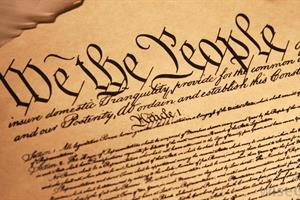
Ironically, the 14th anniversary of the 9/11 attacks occurs just days before the 228th anniversary of the ratification of our Constitution. Yet while there is much to mourn about the loss of our freedoms in the years since 9/11, there is virtually nothing to celebrate.
The Constitution has been steadily chipped away at, undermined, eroded, whittled down, and generally discarded to such an extent that what we are left with today is but a shadow of the robust document adopted more than two centuries ago. Most of the damage has been inflicted upon the Bill of Rights—the first ten amendments to the Constitution—which has historically served as the bulwark from government abuse.
Set against a backdrop of government surveillance, militarized police, SWAT team raids, asset forfeiture, eminent domain, overcriminalization, armed surveillance drones, whole body scanners, stop and frisk searches, roving VIPR raids and the like—all sanctioned by a corrupt government run by Congress, the White House and the courts—a recitation of the Bill of Rights now sounds more like a eulogy to freedoms lost than an affirmation of rights we should possess.
We can pretend that the Constitution, which was written to hold the government accountable, is still our governing document. However, the reality we must come to terms with is that in the America we live in today, the government does whatever it wants, freedom be damned, and “we the people” are seen as little more than cattle to be branded and eventually led to the slaughterhouse.
Consider the state of our freedoms, and judge for yourself whether Osama Bin Laden was right when he warned that “freedom and human rights in America are doomed,” and that the “U.S. government will lead the American people in — and the West in general — into an unbearable hell and a choking life.”
Here is what it means to live under the Constitution today.
The First Amendment is supposed to protect the freedom to speak your mind, assemble and protest nonviolently without being bridled by the government. It also protects the freedom of the media, as well as the right to worship and pray without interference. In other words, Americans should not be silenced by the government. To the founders, all of America was a free speech zone.
Yet despite the clear protections found in the First Amendment, the freedoms described therein are under constant assault. Increasingly, Americans are being arrested and charged with bogus “contempt of cop” charges such as “disrupting the peace” or “resisting arrest” for daring to film police officers engaged in harassment or abusive practices. Journalists are being prosecuted for reporting on whistleblowers. States are passing legislation to muzzle reporting on cruel and abusive corporate practices. Religious ministries are being fined for attempting to feed and house the homeless. Protesters are being tear-gassed, beaten, arrested and forced into “free speech zones.” And under the guise of “government speech,” the courts have reasoned that the government can discriminate freely against any First Amendment activity that takes place within a government forum.
The Second Amendment was intended to guarantee “the right of the people to keep and bear arms.” Yet while gun ownership has been recognized by the U.S. Supreme Court as an individual citizen right, Americans remain powerless to defend themselves against SWAT team raids and government agents armed to the teeth with military weapons better suited for the battlefield than for a country founded on freedom. Police shootings of unarmed citizens continue to outrage communities, while little is really being done to demilitarize law enforcement agencies. Indeed, just recently, North Dakota became the first state to legalize law enforcement use of drones armed with weapons such as tear gas, rubber bullets, beanbags, pepper spray and Tasers.
The Third Amendment reinforces the principle that civilian-elected officials are superior to the military by prohibiting the military from entering any citizen’s home without “the consent of the owner.” With the police increasingly training like the military, acting like the military, and posing as military forces—complete with military weapons, assault vehicles, etc.—it is clear that we now have what the founders feared most—a standing army on American soil. Moreover, as a result of SWAT team raids (more than 80,000 a year) where police invade homes, often without warrants, and injure and even kill unarmed citizens, the barrier between public and private property has been done away with, leaving us with armed government agents who act as if they own our property.
The Fourth Amendment prohibits the government from conducting surveillance on you or touching you or invading you, unless they have some evidence that you’re up to something criminal. In other words, the Fourth Amendment ensures privacy and bodily integrity. Unfortunately, the Fourth Amendment has suffered the greatest damage in recent years and been all but eviscerated by an unwarranted expansion of police powers that include strip searches and even anal and vaginal searches of citizens, surveillance and intrusions justified in the name of fighting terrorism, as well as the outsourcing of otherwise illegal activities to private contractors. Case in point: Texas police forced a 21-year-old woman to undergo a warrantless vaginal search by the side of the road after she allegedly “rolled” through a stop sign.
The use of civil asset forfeiture schemes to swell the coffers of police forces has also continued to grow in popularity among cash-strapped states. The federal government continues to strong-arm corporations into providing it with access to Americans’ private affairs, from emails and online transactions to banking and web surfing. Coming in the wake of massive leaks about the inner workings of the NSA and the massive secretive surveillance state, it was revealed that the government threatened to fine Yahoo $250,000 every day for failing to comply with the NSA’s mass data collection program known as PRISM. Meanwhile, AT&T has enjoyed a profitable and “extraordinary, decades-long” relationship with the NSA.
The technological future appears to pose even greater threats to what’s left of our Fourth Amendment rights, with advances in biometric identification and microchip implants on the horizon making it that much easier for the government to track not only our movements and cyber activities but our very cellular beings. Barclays has already begun using a finger-scanner as a form of two-step authentication to give select customers access to their accounts. Similarly, Motorola has been developing thin “digital tattoos” that will ensure that a phone’s owner is the only person who may unlock it. Not to be overlooked are the aerial spies—surveillance drones—about to take to the skies in coming years, as well as the Drive Smart programs that will spy on you (your speed, movements, passengers, etc.) while you travel the nation’s highways and byways.
The Fifth Amendment and the Sixth Amendment work in tandem. These amendments supposedly ensure that you are innocent until proven guilty, and government authorities cannot deprive you of your life, your liberty or your property without the right to an attorney and a fair trial before a civilian judge. However, in the new suspect society in which we live, where surveillance is the norm, these fundamental principles have been upended. Certainly, if the government can arbitrarily freeze, seize or lay claim to your property (money, land or possessions) under government asset forfeiture schemes, you have no true rights. That’s the crux of a case before the U.S. Supreme Court challenging the government’s use of asset forfeiture to strip American citizens of the funds needed to hire a defense attorney of their choosing.
The Seventh Amendment guarantees citizens the right to a jury trial. However, when the populace has no idea of what’s in the Constitution—civic education has virtually disappeared from most school curriculums—that inevitably translates to an ignorant jury incapable of distinguishing justice and the law from their own preconceived notions and fears. However, as a growing number of citizens are coming to realize, the power of the jury to nullify the government’s actions—and thereby help balance the scales of justice—is not to be underestimated. Jury nullification reminds the government that it’s “we the people” who can and should be determining what laws are just, what activities are criminal and who can be jailed for what crimes.
The Eighth Amendment is similar to the Sixth in that it is supposed to protect the rights of the accused and forbid the use of cruel and unusual punishment. However, the Supreme Court’s determination that what constitutes “cruel and unusual” should be dependent on the “evolving standards of decency that mark the progress of a maturing society” leaves us with little protection in the face of a society lacking in morals altogether. For example, a California appeals court is being asked to consider “whether years of unpredictable delays from conviction to execution” constitute cruel and unusual punishment. For instance, although 900 individuals have been sentenced to death in California since 1978, only 13 have been executed. As CBS News reports, “More prisoners have died of natural causes on death row than have perished in the death chamber.”
The Ninth Amendment provides that other rights not enumerated in the Constitution are nonetheless retained by the people. Popular sovereignty—the belief that the power to govern flows upward from the people rather than downward from the rulers—is clearly evident in this amendment. However, it has since been turned on its head by a centralized federal government that sees itself as supreme and which continues to pass more and more laws that restrict our freedoms under the pretext that it has an “important government interest” in doing so. Thus, once the government began violating the non-enumerated rights granted in the Ninth Amendment, it was only a matter of time before it began to trample the enumerated rights of the people, as explicitly spelled out in the rest of the Bill of Rights.
As for the Tenth Amendment’s reminder that the people and the states retain every authority that is not otherwise mentioned in the Constitution, that assurance of a system of government in which power is divided among local, state and national entities has long since been rendered moot by the centralized Washington, DC, power elite—the president, Congress and the courts. Indeed, the federal governmental bureaucracy has grown so large that it has made local and state legislatures relatively irrelevant. Through its many agencies and regulations, the federal government has stripped states of the right to regulate countless issues that were originally governed at the local level.
If there is any sense to be made from this recitation of freedoms lost, it is simply this: our individual freedoms have been eviscerated so that the government’s powers could be expanded, while reducing us to a system of slavery disguised as a democracy.
The film V for Vendetta is a powerful commentary on how totalitarian governments such as our own exploit fear and use mass surveillance, censorship, terrorism, and militarized tactics to control, oppress and enslave.
As the lead character V observes:
Where once you had the freedom to object, to think and speak as you saw fit, you now have censors and systems of surveillance coercing your conformity and soliciting your submission. How did this happen? Who’s to blame? Well certainly there are those more responsible than others, and they will be held accountable, but again truth be told, if you’re looking for the guilty, you need only look into a mirror. I know why you did it. I know you were afraid. Who wouldn’t be? War, terror, disease. There were a myriad of problems which conspired to corrupt your reason and rob you of your common sense. Fear got the best of you, and in your panic you turned to the now high chancellor, Adam Sutler. He promised you order, he promised you peace, and all he demanded in return was your silent, obedient consent.
How will you have it? Will you simply comply while the train heads down the track to a modern-day Auschwitz? Or will you become a free person and resist? To quote Patrick Henry, “Is life so dear, or peace so sweet, as to be purchased at the price of chains and slavery? Forbid it, Almighty God! — I know not what course others may take; but as for me, give me liberty or give me death!”
The architects of the American police state must think we’re idiots.
With every passing day, we’re being moved further down the road towards a totalitarian society characterized by government censorship, violence, corruption, hypocrisy and intolerance, all packaged for our supposed benefit in the Orwellian doublespeak of national security, tolerance and so-called “government speech.”
Were Tinker to make its way through the courts today, it would have to overcome the many hurdles being placed in the path of those attempting to voice sentiments that may be construed as unpopular, offensive, conspiratorial, violent, threatening or anti-government.
Consider, if you will, that the U.S. Supreme Court, historically a champion of the First Amendment, has declared that citizens can exercise their right to free speech everywhere it’s lawful—online, in social media, on a public sidewalk, etc.—as long as they don’t do so in front of the Court itself.
“Allowing demonstrations directed at the Court, on the Court’s own front terrace, would tend to yield the…impression…of a Court engaged with — and potentially vulnerable to — outside entreaties by the public.”
Translation: The appellate court that issued that particular ruling in Hodge v. Talkin actually wants us to believe that the Court is so impressionable that the justices could be swayed by the sight of a single man, civil rights activist Harold Hodge, standing alone and silent in the snow in a 20,000 square-foot space in front of the Supreme Court building wearing a small sign protesting the toll the police state is taking on the lives of black and Hispanic Americans. [You can watch the video here: https://www.youtube.com/watch?v=xy1HQm67b2c]
My friends, we’re being played for fools.
The Supreme Court is not going to be swayed by you or me or Harold Hodge.
To suggest that Harold Hodge, standing in front of the Supreme Court building on a day when the Court was not in session hearing arguments or issuing rulings, is a threat to the Court’s neutrality, while their dalliances with Corporate America is not, is utter hypocrisy.
Making matters worse, the Supreme Court has the effrontery to suggest that the government can discriminate freely against First Amendment activity that takes place within a government forum. Justifying such discrimination as “government speech,” the Court ruled that the Texas Dept. of Motor Vehicles could refuse to issue specialty license plate designs featuring a Confederate battle flag because it was offensive.
If it were just the courts suppressing free speech, that would be one thing to worry about, but First Amendment activities are being pummeled, punched, kicked, choked, chained and generally gagged all across the country.
The reasons for such censorship vary widely from political correctness, safety concerns and bullying to national security and hate crimes but the end result remains the same: the complete eradication of what Benjamin Franklin referred to as the “principal pillar of a free government.”
Officials at the University of Tennessee, for instance, recently introduced an Orwellian policy that would prohibit students from using gender specific pronouns and be more inclusive by using gender “neutral” pronouns such as ze, hir, zir, xe, xem and xyr, rather than he, she, him or her.
On many college campuses, declaring that “America is the land of opportunity” or asking someone “Where were you born?” are now considered microaggressions, “small actions or word choices that seem on their face to have no malicious intent but that are thought of as a kind of violence nonetheless.” Trigger warnings are also being used to alert students to any material or ideas they might read, see or hear that might upset them.
More than 50 percent of the nation’s colleges, including Boston University, Harvard University, Columbia University and Georgetown University, subscribe to “red light” speech policies that restrict or ban so-called offensive speech, or limit speakers to designated areas on campus. The campus climate has become so hypersensitive that comedians such as Chris Rock and Jerry Seinfeld refuse to perform stand-up routines to college crowds anymore.
What we are witnessing is an environment in which political correctness has given rise to “vindictive protectiveness,” a term coined by social psychologist Jonathan Haidt and educational First Amendment activist Greg Lukianoff. It refers to a society in which “everyone must think twice before speaking up, lest they face charges of insensitivity, aggression or worse.”
This is particularly evident in the public schools where students are insulated from anything—words, ideas and images—that might create unease or offense. For instance, the thought police at schools in Charleston, South Carolina, have instituted a ban on displaying the Confederate flag on clothing, jewelry and even cars on campus.
Added to this is a growing list of programs, policies, laws and cultural taboos that defy the First Amendment’s safeguards for expressive speech and activity. Yet as First Amendment scholar Robert Richards points out, “The categories of speech that fall outside of [the First Amendment’s] protection are obscenity, child pornography, defamation, incitement to violence and true threats of violence. Even in those categories, there are tests that have to be met in order for the speech to be illegal. Beyond that, we are free to speak.”
Technically, Richards is correct. On paper, we are free to speak.
In reality, however, we are only as free to speak as a government official may allow.
Free speech zones, bubble zones, trespass zones, anti-bullying legislation, zero tolerance policies, hate crime laws and a host of other legalistic maladies dreamed up by politicians and prosecutors have conspired to corrode our core freedoms.
As a result, we are no longer a nation of constitutional purists for whom the Bill of Rights serves as the ultimate authority. As I make clear in my book Battlefield America: The War on the American People, we have litigated and legislated our way into a new governmental framework where the dictates of petty bureaucrats carry greater weight than the inalienable rights of the citizenry.
It may seem trivial to be debating the merits of free speech at a time when unarmed citizens are being shot, stripped, searched, choked, beaten and tasered by police for little more than daring to frown, smile, question, challenge an order, or just breathe.
However, while the First Amendment provides no tangible protection against a gun wielded by a government agent, nor will it save you from being wrongly arrested or illegally searched, or having your property seized in order to fatten the wallets of government agencies, without the First Amendment, we are utterly helpless.
It’s not just about the right to speak freely, or pray freely, or assemble freely, or petition the government for a redress of grievances, or have a free press. The unspoken freedom enshrined in the First Amendment is the right to think freely and openly debate issues without being muzzled or treated like a criminal.
In the end, censorship and political correctness not only produce people that cannot speak for themselves but also people who cannot think for themselves. And a citizenry that can’t think for itself is a citizenry that will neither rebel against the government’s dictates nor revolt against the government’s tyranny.
The end result: a nation of sheep who willingly line up for the slaughterhouse.
The cluttered cultural American landscape today is one in which people are so distracted by the military-surveillance-entertainment complex that critical thinkers are in the minority and frank, unfiltered, uncensored speech is considered uncivil, uncouth and unacceptable.
That’s the point, of course.
The architects, engineers and lever-pullers who run the American police state want us to remain deaf, dumb and silent. They want our children raised on a vapid diet of utter nonsense, where common sense is in short supply and the only viewpoint that matters is the government’s.
We are becoming a nation of idiots, encouraged to spout political drivel and little else.
In so doing, we have adopted the lexicon of Newspeak, the official language of George Orwell’s fictional Oceania, which was “designed not to extend but to diminish the range of thought.” As Orwell explained in 1984, “The purpose of Newspeak was not only to provide a medium of expression for the world-view and mental habits proper to the devotees of IngSoc [the state ideology of Oceania], but to make all other modes of thought impossible.”
If Orwell envisioned the future as a boot stamping on a human face, a fair representation of our present day might well be a muzzle on that same human face.
If we’re to have any hope for the future, it will rest with those ill-mannered, bad-tempered, uncivil, discourteous few who are disenchanted enough with the status quo to tell the government to go to hell using every nonviolent means available.
“No man in the wrong can stand up against a fellow that’s in the right and keeps on a-comin’.”—Texas Rangers
In one swoop, on June 22, 2015, a divided U.S. Supreme Court handed down three consecutive rulings affirming the right of raisin farmers, hotel owners and prison inmates. However, this push back against government abuse, government snooping and government theft only came about because some determined citizens stood up and took a stand against tyranny.
The three cases respectively deal with the government’s confiscation of agricultural crops without any guarantee or promise of payment (Horne v. U.S. Department of Agriculture); the practice of police gaining unfettered access to motel and hotel guest registries (City of Los Angeles v. Patel); and the use of tasers and excessive force by prison officials (Kingsley v. Hendrickson).
Whether these three rulings will amount to much in the long run remains to be seen. In the meantime, they sound a cautiously optimistic note at a time when police state forces continue to use advancing technologies, surveillance and militarization to weaken, sidestep and flout the Constitution at almost every turn.
In the first case, Horne v. U.S. Department of Agriculture, a 5-4 Supreme Court declared that raisin farmer Marvin Horne deserves to be compensated for the official seizure of one-third of his personal property by the government.
The case arose after independent raisin farmers in California were fined almost $700,000 for refusing to surrender about 40% of the raisins they produced to the government as part of a program purportedly aimed at maintaining a stable market for commodities.
Marvin and Laura Horne are independent farmers in California and have been growing raisins for almost half a century. During that time, the Hornes were subject to a Depression-era law promulgated by the U.S. Department of Agriculture that aims to create “orderly” market conditions for raisins by regulating their supply. Supply is regulated by requiring that raisin producers surrender a certain percentage of their raisins (a so-called “reserve tonnage”) each year to an administrative committee.
In 2002-2003, the reserve tonnage was set at 47% of the crop. The reserve tonnage may be sold by the government with the government paying itself first for administrative costs, and then providing pro rata payments to participating farmers. However, in 2002-2003, raisin farmers received payments that did not cover the expenses of production and in 2003-2004, no payments whatsoever were made for reserve tonnage raisins.
Although the Hornes attempted to arrange their operation to avoid having to give up part of their crop, the USDA assessed a monetary penalty of $695,226 against the Hornes for having failed to surrender raisins they produced between 2002 and 2004. The Hornes appealed this order, arguing that the requirement that they surrender, on pain of monetary penalty, a percentage of their property without any guarantee of compensation violated the command of the Fifth Amendment to the U.S. Constitution that private property shall not be taken for public use without just compensation. However, the U.S. Court of Appeals for the Ninth Circuit determined that the Fifth Amendment affords less protection to personal property than real property (land), and upheld the penalties. The Hornes subsequently appealed that ruling to the U.S. Supreme Court, arguing that the Fifth Amendment’s prohibition on government confiscation of property applies not only to the appropriation of land but with full and equal force to personal property such as agricultural crops.
The bigger picture: Whether you’re talking about raisins confiscated by the USDA, homes expropriated by government agencies under the rubric of eminent domain, or cars and cash seized by asset forfeiture-driven highway police, these various takings all add up to the same thing: government theft sanctioned by an endless assortment of arcane laws. Unfortunately, as I point out in my book Battlefield America: The War on the American People, the lines between private and public property have been so blurred that private property is reduced to little more than something the government can use to control, manipulate and harass the citizenry to suit its own purposes, while ‘we the people’ have been reduced to little more than tenants or serfs in bondage to an overbearing landlord. This is feudalism revisited.
Section 41.49 of the City of Los Angeles Municipal Code requires all hotel owners to maintain a registry that collects information about persons staying at the hotel, including their names, addresses, vehicle information, arrival and departure dates, room prices, and payment methods.
Under this law, it is a crime for a guest to provide false or misleading information in registering at the hotel. The law also requires that hotels make these records available to any officer of the Los Angeles Police Department for inspection on demand, thereby allowing law enforcement officers to inspect this information at any time regardless of whether there is consent to the inspection or a warrant allowing it. Additionally, police need not have any measure of suspicion in order to review hotel registries under the ordinance and there need not be any history of criminal activity at the hotel. A hotel operator is guilty of a crime if he or she refuses to allow inspection.
In 2005, the Los Angeles Lodging Association and various owners and operators of hotels and motels in the city filed a lawsuit challenging the requirement of the ordinance that they grant unfettered access to their guest registries, arguing that the ordinance is a patent violation of the Fourth Amendment’s protection of persons’ houses, papers and effects against “unreasonable searches and seizures.”
In December 2013, the U.S. Court of Appeals for the Ninth Circuit upheld the hotel owners’ claims, ruling that the inspection of hotel registries by police is clearly a search for purposes of the Fourth Amendment. The Ninth Circuit also rejected the claim that hotels are a “closely regulated” industry that should expect government inspections, thereby holding that police are not excused from the general search warrant requirement.
Citing a fundamental right to privacy, travel and association, civil liberties advocates argued that the ordinance, which is similar to laws on the books in cities across the nation, flies in the face of historical protections affording hotel guests privacy in regards to their identities and comings-and-goings and burdens the fundamental rights of travel and association. Moreover, police should not be given carte blanche to rummage through records containing highly personal information because this could chill the exercise of other constitutional rights, such as the right to travel and the right of association.
The bigger picture: The practice of giving police officers unfettered, warrantless access to Americans’ hotel records is no different from the government’s use of National Security Letters to force banks, phone companies, casinos and other businesses to secretly provide the FBI with customer information such as telephone records, subscriber information, credit reports, employment information, and email records and not disclose the demands. Both ploys are merely different facets of the government’s campaign to circumvent, by hook or by crook, the clear procedural safeguards of the Fourth Amendment and force business owners to act as extensions of the police state.
The case involves a Wisconsin man who alleged that he was subjected to unreasonable and excessive force in reckless disregard for his safety when prison guards forcibly removed him from his jail cell and subdued him with a stun gun.
In 2010, Michael Kingsley was arrested and booked into the jail in Sparta, Wisconsin, and detained there pending his court appearances on the charges against him. About a month into his detention, guards noticed that a sheet of yellow paper was covering the light above Kingsley’s bed, which was a common practice among detainees in order to dim the brightness of the facilities lights. The guards ordered Kingsley to remove the paper, but he refused, pointing out that he had not put the paper over the light.
The next morning, Kingsley was again ordered to remove the paper and again he refused. The jail administrator was then called, who told Kingsley he would be transferred to another cell. Five officers then came to the cell and ordered Kingsley to stand up. Kingsley protested that he had done nothing wrong, but was told to follow the order or he would be tasered.
Kingsley continued to lie face down on his bunk but put his hands behind his back and was handcuffed. The officers pulled Kingsley off the bunk, which allegedly caused injuries to his knees and feet and inflicted pain so severe Kingsley could not stand or walk. The officers then carried him to a receiving cell, placed him face down on a bunk and attempted to remove the handcuffs.
Although Kingsley denied that he resisted, the officers allegedly smashed his head into the concrete bunk and placed a knee into his back. When Kingsley told the officer to get off him, one of the officers tasered Kingsley for five seconds. As a result of this incident, Kingsley sued several officers involved, alleging that they used excessive force against him and that this violated his constitutional right to due process. A jury ruled against Kingsley, who subsequently lost his appeal to the U.S. Court of Appeals for the Seventh Circuit. Weighing in on the case, civil liberties advocates asked the Supreme Court to remove restrictions some courts have imposed on civil rights lawsuits for excessive force by inmates against jail personnel, thereby discouraging the use of excessive force by prison officials.
The bigger picture: In a police state, there is no need for judges, juries or courts of law, because the police act as judge, jury and law, and their version of justice is one-sided, delivered at the end of a gun, taser or riot stick. Unless the courts and legislatures act soon to change this climate of government-sanctioned police brutality, we may find that there is no real difference between those who are innocent, those accused of committing crimes and those found guilty, because we will all suffer the same at the hands of government agents.
Taken individually, these three cases may appear to be little more than small, procedural slaps on the wrist to government agencies that are so bloated, out-of-control and unaccountable as to scarcely register the slaps. However, taken together they serve as a potent reminder of what happens when a determined citizenry takes a collective stand against government abuse. That said, if “we the people” don’t keep pushing back, standing up, and holding government officials accountable to the rule of law, these victories will do little to keep government bureaucrats off the backs of the American citizenry.
“The year is 2025. The population is 325 million, and the FBI has the DNA profiles of all of them. Unlike fingerprints, these profiles reveal vital medical information. The universal database arrived surreptitiously. First, the Department of Defense’s repository of DNA samples from all military personnel, established to identify remains of soldiers missing from action, was given to the FBI. Then local police across the country shadowed individuals, collecting shed DNA for the databank. On the way, thousands of innocent people were imprisoned because they had the misfortune to have race-based crime genes in their DNA samples. Sadly, it did not have to be this way. If only we had passed laws against collecting and using shed DNA….”—Professor David H. Kaye
Every dystopian sci-fi film we’ve ever seen is suddenly converging into this present moment in a dangerous trifecta between science, technology and a government that wants to be all-seeing, all-knowing and all-powerful.
Of course, none of these technologies are foolproof. Nor are they immune from tampering, hacking or user bias. Nevertheless, they have become a convenient tool in the hands of government agents to render null and void the Constitution’s requirements of privacy and its prohibitions against unreasonable searches and seizures.
The government’s questionable acquisition and use of DNA to identify individuals and “solve” crimes has come under particular scrutiny in recent years. Until recently, the government was required to at least observe some basic restrictions on when, where and how it could access someone’s DNA. That has all been turned on its head by various U.S. Supreme Court rulings, including the recent decision to let stand the Maryland Court of Appeals’ ruling in Raynor v. Maryland, which essentially determined that individuals do not have a right to privacy when it comes to their DNA.
Although Glenn Raynor, a suspected rapist, willingly agreed to be questioned by police, he refused to provide them with a DNA sample. No problem. Police simply swabbed the chair in which Raynor had been sitting and took what he refused to voluntarily provide. Raynor’s DNA was a match, and the suspect became a convict. In refusing to hear the case, the U.S. Supreme Court gave its tacit approval for government agents to collect shed DNA, likening it to a person’s fingerprints or the color of their hair, eyes or skin.
Whereas fingerprint technology created a watershed moment for police in their ability to “crack” a case, DNA technology is now being hailed by law enforcement agencies as the magic bullet in crime solving. It’s what police like to refer to a “modern fingerprint.” However, unlike a fingerprint, a DNA print reveals everything about “who we are, where we come from, and who we will be.”
Now, in the wake of this Raynor ruling, Americans are vulnerable to the government accessing, analyzing and storing their DNA without their knowledge or permission. As the dissenting opinion in Raynor for the Maryland Court of Appeals rightly warned, “a person desiring to keep her DNA profile private, must conduct her public affairs in a hermetically sealed hazmat suit…. The Majority’s holding means that a person can no longer vote, participate in a jury, or obtain a driver’s license, without opening up his genetic material for state collection and codification.”
All 50 states now maintain their own DNA databases, although the protocols for collection differ from state to state. That DNA is also being collected in the FBI’s massive national DNA database, code-named CODIS (Combined DNA Index System), which was established as a way to identify and track convicted felons and has since become a de facto way to identify and track the American people from birth to death.
Indeed, hospitals have gotten in on the game by taking and storing newborn babies’ DNA, often without their parents’ knowledge or consent. It’s part of the government’s mandatory genetic screening of newborns. However, in many states, the DNA is stored indefinitely. What this means for those being born today is inclusion in a government database that contains intimate information about who they are, their ancestry, and what awaits them in the future, including their inclinations to be followers, leaders or troublemakers.
For the rest of us, it’s just a matter of time before the government gets hold of our DNA, either through mandatory programs carried out in connection with law enforcement and corporate America, or through the collection of our “shed” or “touch” DNA.
While much of the public debate, legislative efforts and legal challenges in recent years have focused on the protocols surrounding when police can legally collect a suspect’s DNA (with or without a search warrant and whether upon arrest or conviction), the question of how to handle “shed” or “touch” DNA has largely slipped through without much debate or opposition.
We all shed DNA, leaving traces of our identity practically everywhere we go. Forensic scientists use DNA left behind on cigarette butts, phones, handles, keyboards, cups, and numerous other objects, not to mention the genetic content found in drops of bodily fluid, like blood and semen. In fact, the garbage you leave for curbside pickup is a potential gold mine of this sort of material. All of this shed or so-called abandoned DNA is free for the taking by local police investigators hoping to crack unsolvable cases. Or, if the future scenario depicted at the beginning of this article is any indication, shed DNA is also free for inclusion in a secret universal DNA databank.
What this means is that if you have the misfortune to leave your DNA traces anywhere a crime has been committed, you’ve already got a file somewhere in some state or federal database—albeit it may be a file without a name. As Forensic magazine reports, “As officers have become more aware of touch DNA’s potential, they are using it more and more. Unfortunately, some [police] have not been selective enough when they process crime scenes. Instead, they have processed anything and everything at the scene, submitting 150 or more samples for analysis.” Even old samples taken from crime scenes and “cold” cases are being unearthed and mined for their DNA profiles.
Today, helped along by robotics and automation, DNA processing, analysis and reporting takes far less time and can bring forth all manner of information, right down to a person’s eye color and relatives. Incredibly, one company specializes in creating “mug shots” for police based on DNA samples from unknown “suspects” which are then compared to individuals with similar genetic profiles.
If you haven’t yet connected the dots, let me point the way: Having already used surveillance technology to render the entire American populace potential suspects, DNA technology in the hands of government will complete our transition to a suspect society in which we are all merely waiting to be matched up with a crime.
No longer can we consider ourselves innocent until proven guilty. As I make clear in my book A Government of Wolves: The Emerging American Police State, now we are all suspects in a DNA lineup until circumstances and science say otherwise.
Of course, there will be those who point to DNA’s positive uses in criminal justice, such as in those instances where it is used to absolve someone on death row of a crime he didn’t commit, and there is no denying its beneficial purposes at times. However, as is the case with body camera footage and every other so-called technology that is hailed as a “check” on government abuses, in order for the average person—especially one convicted of a crime—to request and get access to DNA testing, they first have to embark on a costly, uphill legal battle through red tape and, even then, they are opposed at every turn by a government bureaucracy run by prosecutors, legislatures and law enforcement.
What this amounts to is a scenario in which we have little to no defense of against charges of wrongdoing, especially when “convicted” by technology, and even less protection against the government sweeping up our DNA in much the same way it sweeps up our phone calls, emails and text messages.
Yet if there are no limits to government officials being able to access your DNA and all that it says about you, then where do you draw the line? As technology makes it ever easier for the government to tap into our thoughts, our memories, our dreams, suddenly the landscape becomes that much more dystopian.
With the entire governmental system shifting into a pre-crime mode aimed at detecting and pursuing those who “might” commit a crime before they have an inkling, let alone an opportunity, to do so, it’s not so far-fetched to imagine a scenario in which government agents (FBI, local police, etc.) target potential criminals based on their genetic disposition to be a “troublemaker” or their relationship to past dissenters. Equally disconcerting: if scientists can, using DNA, track salmon across hundreds of square miles of streams and rivers, how easy will it be for government agents to not only know everywhere we’ve been and how long we were at each place but collect our easily shed DNA and add it to the government’s already burgeoning database?
As always there will be those voices—well-meaning, certainly—insisting that if you want to save the next girl from being raped, abducted or killed, then we need to give the government all the tools necessary to catch these criminals before they can commit their heinous crimes.
It’s hard to argue against such a stance. If you care for someone, you’re particularly vulnerable to this line of reasoning. Of course we don’t want our wives butchered, our girlfriends raped, our daughters abducted and subjected to all manner of atrocities. But what about those cases in which the technology proved to be wrong, either through human error or tampering? It happens more often than we are told.
For example, David Butler spent eight months in prison for a murder he didn’t commit after his DNA was allegedly found on the murder victim and surveillance camera footage placed him in the general area the murder took place. Conveniently, Butler’s DNA was on file after he had voluntarily submitted it during an investigation years earlier into a robbery at his mother’s home. The case seemed cut and dried to everyone but Butler who proclaimed his innocence. Except that the DNA evidence and surveillance footage was wrong: Butler was innocent.
Moreover, despite the insistence by government agents that DNA is infallible, New York Times reporter Andrew Pollack makes a clear and convincing case that DNA evidence can, in fact, be fabricated. Israeli scientists “fabricated blood and saliva samples containing DNA from a person other than the donor of the blood and saliva,” stated Pollack. “They also showed that if they had access to a DNA profile in a database, they could construct a sample of DNA to match that profile without obtaining any tissue from that person.” The danger, warns scientist Dan Frumkin, is that crime scenes can be engineered with fabricated DNA.
Now if you happen to be the kind of person who trusts the government implicitly and refuses to believe it would ever do anything illegal or immoral, then the prospect of government officials—police, especially—using fake DNA samples to influence the outcome of a case might seem outlandish. But for those who know their history, the probability of our government acting in a way that is not only illegal but immoral becomes less a question of “if” and more a question of “when.”
WASHINGTON, D.C. — Citing a fundamental right to privacy, travel and association, The Rutherford Institute has asked the U.S. Supreme Court to prohibit police from gaining unfettered access to motel and hotel guest registries.
In an amicus curiae brief filed in City of Los Angeles v. Patel, et al., Rutherford Institute attorneys are asking the Court to declare unconstitutional a Los Angeles ordinance that allows police to inspect private hotel and motel records containing information about the persons who are staying there without a warrant or other judicial review. The Institute’s brief argues that the ordinance, which is similar to laws on the books in cities across the nation, flies in the face of historical protections affording hotel guests privacy in regards to their identities and comings-and-goings and burdens the fundamental rights of travel and association, which the Court has long safeguarded from arbitrary government scrutiny.
“This practice of giving police officers unfettered, warrantless access to Americans’ hotel records is no different from the government’s use of National Security Letters to force banks, phone companies, casinos and other businesses to secretly provide the FBI with customer information such as telephone records, subscriber information, credit reports, employment information, and email records and not disclose the demands,” said John W. Whitehead, president of The Rutherford Institute and author of the award-winning A Government of Wolves: The Emerging American Police State. “Both ploys are merely different facets of the government’s campaign to circumvent, by hook or by crook, the clear procedural safeguards of the Fourth Amendment and force business owners to act as extensions of the police state.”
Section 41.49 of the City of Los Angeles Municipal Code requires all hotel owners to maintain a registry that collects information about persons staying at the hotel, including their names, addresses, vehicle information, arrival and departure dates, room prices, and payment methods. Under this law, it is a crime for a guest to provide false or misleading information in registering at the hotel.
The law also requires that hotels make these records available to any officer of the Los Angeles Police Department for inspection on demand, thereby allowing law enforcement officers to inspect this information at any time regardless of whether there is consent to the inspection or a warrant allowing it. Additionally, police need not have any measure of suspicion in order to review hotel registries under the ordinance and there need not be any history of criminal activity at the hotel. A hotel operator is guilty of a crime if he or she refuses to allow inspection.
In 2005, the Los Angeles Lodging Association and various owners and operators of hotels and motels in the city filed a lawsuit challenging the requirement of the ordinance that they grant unfettered access to their guest registries, arguing that the ordinance is a patent violation of the Fourth Amendment’s protection of persons’ houses, papers and effects against “unreasonable searches and seizures.”
In December 2013, the U.S. Court of Appeals for the Ninth Circuit upheld the hotel owners’ claims, ruling that the inspection of hotel registries by police is clearly a search for purposes of the Fourth Amendment. The Ninth Circuit also rejected the claim that hotels are a “closely regulated” industry that should expect government inspections, thereby holding that police are not excused from the general search warrant requirement.
In weighing in on the case before the U.S. Supreme Court, Rutherford Institute attorneys argue that police should not be given carte blanche to rummage through records containing highly personal information because this could chill the exercise of other constitutional rights, such as the right to travel and the right of association.
Affiliate attorneys Anand Agneshwar and Grace K. Chang of Arnold & Porter, LLP, assisted The Rutherford Institute in advancing the arguments in the amicus brief before the U.S. Supreme Court.
WASHINGTON, DC — In a strong endorsement of religious liberty, the United States Supreme Court has unanimously held that the Arkansas Department of Corrections violated the rights of a Muslim prisoner by refusing to allow him to grow a short beard in accordance with his religious beliefs. The Court’s decision in Holt v. Hobbs held that the prison policy forbidding beards for religious reasons violates the Religious Land Use and Institutionalized Persons Act (RLUIPA), a federal law requiring that prison policies that substantially burden a prisoner’s exercise of religion be supported by a compelling interest.
The Rutherford Institute, which was instrumental in the drafting and enactment of RLUIPA in 2000, filed an amicus brief in support of the prisoner’s First Amendment rights, noting that prison authorities failed to consider other ways to maintain prison safety that would accommodate the religious exercise of prisoners.
“At one time, prisoners were considered ‘slaves of the state,’ having forfeited their basic constitutional rights by engaging in criminal activity. Thankfully, a growing concern for how we treat ‘the least of these’ has ensured that prisoners are afforded some basic constitutional protections, even while the debate over prisoners’ rights—whether it pertains to religious freedom, the right to vote, or the right to bodily integrity—rages on,” said John W. Whitehead, president of The Rutherford Institute and author of A Government of Wolves: The Emerging American Police State. “At a time when America’s prison population is growing, laws criminalizing the most mundane activities are on the rise, states have a financial incentive to keep private prisons at capacity, and the courts are inclined to side with law enforcement in matters of security—no matter how questionable the claim or minimal the accommodation, it is in all of our best interests to ensure that those incarcerated are treated as we ourselves would want to be treated if the tables were turned: with dignity, decency and compassion.”
Gregory Holt is a prisoner assigned to a prison within the Arkansas Department of Correction (“ADC”). One essential tenet of Holt’s Salafi Muslim faith is to follow the sayings of the Prophet Muhammad as collected in the hadith. This includes the requirement to “keep the mustaches short [but] leave the beard as it is.” The ADC grooming policy, however, prohibits prisoners from growing beards, although it does allow beards to be maintained by prisoners with diagnosed dermatological conditions. After Holt’s request for an exemption from the no-beards rule was denied by prison officials, he brought a lawsuit alleging that application of the rule to him violated RLUIPA and seeking an order that he be allowed to grow and maintain a one-half inch beard.
At a court hearing, prison officials asserted their belief that the no-beard rule was needed to protect prison security because inmates could hide contraband in a one-half inch beard, although they were unable to provide any specific examples. Accepting this testimony and deferring to the judgment of these prison officials, the lower courts ruled that officials had demonstrated a “compelling” interest for the no-beard rule and that the rule was the least restrictive means of furthering that interest, thereby satisfying the strict scrutiny test required by RLUIPA. The Supreme Court granted Holt’s request to review the case and resolve a conflict in the decisions of federal courts, most of which have ruled that prison no-beard policies violate the rights of Muslim prisoners under RLUIPA.
In its amicus brief supporting Holt, Rutherford Institute attorneys argued that the security concerns of ADC are largely illusory, as shown by the experience of more than forty prison systems that have grooming policies without express restrictions on beards, or have provisions for religious exceptions. Affiliate attorneys Anand Agneshwar, Carl S. Nadler and Anna K. Thompson of Arnold & Porter, LLP, assisted The Rutherford Institute in advancing the arguments in theamicus brief before the Supreme Court.
WASHINGTON, DC — Ruling in two separate cases in Plumhoff v. Rickard and Wood v. Moss, the U.S. Supreme Court has once again refused to hold law enforcement officials accountable for allegedly violating citizens’ constitutional rights. In the first case, the Court dismissed complaints against police officers who were involved in a fatal shooting, despite Fourth Amendment concerns that the officers needlessly resorted to a deadly use of force, and in the second, the Court granted “qualified immunity” to Secret Service officials who relocated anti-Bush protesters, despite concerns raised that the protesters’ First Amendment right to freely speak, assemble, and petition their government leaders had been violated. Noting that these decisions are part of a recent trend toward granting government officials “qualified immunity” in lawsuits over alleged constitutional violations, John W. Whitehead, president of The Rutherford Institute, warned that such rulings incentivize government officials to violate constitutional rights without fear of repercussion.
“Not a day goes by without reports of police officers overstepping the bounds of the Constitution and brutalizing, terrorizing and killing the citizenry. Indeed, the list of incidents in which unaccountable police abuse their power, betray their oath of office and leave taxpayers bruised, broken and/or killed grows longer and more tragic by the day to such an extent that Americans are now eight times more likely to die in a police confrontation than they are to be killed by a terrorist,” said constitutional attorney John W. Whitehead, author of A Government of Wolves: The Emerging American Police State. “This lawlessness on the part of government officials, an unmistakable characteristic of a police state, is made possible in large part by the courts, which increasingly defer to law enforcement and prioritize security over civil liberties. In so doing, the government gives itself free rein to abuse the law, immune from reproach, and we are all the worse off for it.”
In Wood v. Moss, the Ninth Circuit Court of Appeals found that Secret Service agents who removed only anti-Bush protesters (while allowing pro-Bush supporters standing on an adjacent street to remain) were not immune from lawsuit on First Amendment grounds, and had to make a showing that their actions were not unlawfully motivated by the viewpoint of the protesters. In reversing the Ninth Circuit, the U.S. Supreme Court held that the protesters’ rights to “equal access to the President” were not clearly established under the law, and that the agents’ actions were not motivated by the viewpoint of the protesters.
In Plumhoff v. Rickard, the Sixth Circuit Court of Appeals ruled that police officers who used lethal force against a man fleeing police in a high speed car chase were not immune from a wrongful death suit, and that the case should continue to trial. In Plumhoff, the deceased plaintiff led police officers on a high-speed car chase, which came to a halt after his car was spun out in a parking lot. Officers proceeded to fire three shots at the stopped vehicle, then fired an additional 12 shots as the vehicle backed away, eventually killing both the driver and passenger of the vehicle. The Sixth Circuit held that it could not conclude that the officers’ conduct was reasonable as a matter of law, and instead should proceed to a fact finder. In reversing the Sixth Circuit’s decision, the Supreme Court held that the officers’ use of deadly force to terminate the car chase did not violate the Fourth Amendment and the officers were immune from suit.
This latter point should really stick in your craw. Consider the irony: the government insists it can carry out all manner of surveillance on us—listen in on our phone calls, read our emails and text messages, track our movements, photograph our license plates, even enter our biometric information into DNA databases—but if we dare to return the favor, even a little, we get roughed up by the police, arrested, charged with violating various and sundry crimes (often trumped up), and forced to make restitution.
Leon Rosby was filming a police standoff in June 2013, his cellphone in one hand and his dog’s leash in the other, when three officers approached him. Anticipating a problem, Rosby placed his 2-year-old Rottweiler, Max, in his car. The LA Times reports: “As officers cuffed Rosby, the dog escaped through an open window and began to bark and lunge at officers. One officer tried to grab the dog’s leash, then drew his gun and fired four shots, killing Max. Video of the incident went viral on YouTube, prompting a public outcry and drawing protesters to the Police Department headquarters.” Rosby has now filed a civil rights lawsuit against the city and the three police officers.
“I’m allowed to do this,” the man told the officer.
“Get it out of my face,” the officer replied.
“I have my rights,” the man said.
“You have no rights,” the officer said.
But the man didn’t stop rolling and was once again aggressively approached.
“Do you see the police presence here? Do you see us all? We’re not [expletive] around. Do you understand? Do not disrespect us and do not not listen to us,” the officer said. “Now walk away and shut your [expletive] mouth or you’re going to jail, do you understand?”
After backing away, the officer came at the man a third time, appearing to grab him.
“I thought I had freedom of speech here,” the man said.
“You don’t. You just lost it,” the officer replied.
And that, in a nutshell, is what happens when law enforcement officials—not just the police, but every agent of the government entrusted with enforcing laws, from the president on down—are allowed to discard the law when convenient. At the point where there’s a double standard at play, where the only ones having to obey the law are the citizenry and not the enforcers, then that vital “social contract” that John Locke envisioned as the basis for society breaks down. The more we allow government officials to operate outside the law, the more we ensure that the law becomes only a tool to punish us, rather than binding and controlling the government, as it was intended.
This brings me back to the problem of Americans getting arrested for filming the police. Until recently, this has primarily been a problem experienced by journalists and photographers attempting to document political protests and other disturbances involving the police. However, with the preponderance of smart phones capable of recording audio and video, individuals who dare to record police engaged in questionable or abusive activities in public are increasingly finding themselves on the receiving end of the harsh treatment they intended to document. These videos, if widely distributed, can be a powerful method of subjecting police to closer scrutiny and holding them accountable to respecting the rights of those they are supposed to serve.
Naturally, police agencies and unions have sought out legal prohibitions on such videos from being created. Massachusetts police, for instance, have invoked a state surveillance law to charge citizen video-makers criminally for their actions. Because the state surveillance law requires “two-party” consent, most kinds of public filming can be construed as illegal. Similar laws exist in California, Florida, Illinois, Michigan, and Pennsylvania. The law was enacted to protect private citizens from invasive surveillance, but the police have exploited it to curtail free speech that tarnishes their public image. Police claim that this regulation gives them legal justification to prohibit filming by citizens such as Jeffrey Manzelli, a journalist who recorded the police intimidating protesters at a rally and was arrested and charged under the law.
As part of a $200,000 legal settlement, Indianapolis police will soon be required to remind its officers that citizens have a legal right to videotape on-duty police officers. The case arose after a 66-year-old Indianapolis resident was tackled to the ground, arrested and charged with resisting arrest, disorderly conduct and public intoxication (he was found not guilty of the charges) after he used his cellphone to record police arresting a young man in his neighbor’s driveway. There is also a movement afoot to equip police with on-officer cameras that would provide footage of what an officer sees.
The Garcia case involves a journalist who was arrested and charged with disorderly conduct for filming police as they detained two men. According to the lawsuit, police “dragged Garcia to the police car, put him in handcuffs, threw him to the ground by kicking his feet out from under him, taunted him, threatened to arrest his wife if she came too close and took his camera, and seized the memory card, which was never returned.”
The difficulty we face is that police officers are becoming increasingly thin skinned, less restrained in dealing with the public, and more inclined to conceive every word, gesture, or motion as a threat. In an ideal world, police would recognize that, as public servants, they are rightfully subject to recording and surveillance when carrying out their public duties. Unfortunately, this is far from an ideal world.
So what are we to do?
We must continue to stand up for our rights, record police when the opportunity presents itself, and politely remind any offended officers that they are, in fact, our public servants and, as such, their behavior is subject to public scrutiny. If they disagree and attempt to stop us from recording, we can refer them to the U.S. Constitution, which they have sworn to uphold, which protects our right to record matters of public interest. And if they continue to insist on hauling people to jail because they don’t like the idea of transparency and accountability, they can take it up with the courts. The goal is to eventually arrive at a point where we can keep a watchful eye on our government officials, instead of the other way around. As Justice Louis D. Brandeis once observed, “Sunlight is said to be the best of disinfectants; electric light the most efficient policeman.” — John W. Whitehead


 WASHINGTON, D.C. — The U.S. Supreme Court has refused to hear the case of decorated Marine Brandon Raub, who was seized by a swarm of Secret Service, FBI and local police officials and involuntarily committed to a mental institution for a week after posting controversial song lyrics and political views critical of the government on his Facebook page. In asking the Supreme Court to hear the case, Rutherford Institute attorneys were seeking to overturn lower court rulings dismissing the case, which characterized concerns over government suppression of dissident speech as “far-fetched.” In rejecting the appeal, the Supreme Court also refused to establish standards to guide and constrain mental health professionals when they seek to commit individuals and to prevent commitment on the basis of a person’s exercise of his right to free speech.
 In coming to Raub’s aid, Rutherford Institute attorneys challenged the government’s actions as a violation of Raub’s First and Fourth Amendment rights. On Aug. 23, Circuit Court Judge Allan Sharrett ordered Raub’s immediate release, stating that the government’s case was “so devoid of any factual allegations that it could not be reasonably expected to give rise to a case or controversy.” Rutherford Institute attorneys filed a lawsuit in May 2013, challenging the government’s actions as procedurally improper and legally unjustified. In February 2014, a U.S. District Court judge dismissed the lawsuit, rejecting concerns over government suppression of dissident speech as “far-fetched.” On appeal to the Court of Appeals for the Fourth Circuit, Institute attorneys claimed that the Chesterfield County mental health screener who recommended Raub’s seizure and commitment failed to exercise reasonable professional judgment in wrongly determining that Raub was mentally ill and dangerous, and that Raub’s seizure and detention were the result of a mental health screener’s dislike of Raub’s “unpatriotic” views on federal government misconduct, thereby violating the ex-Marine’s First Amendment right to freedom of speech. The appeals court subsequently affirmed the lower court judgment.
 WASHINGTON, DC — A federal appeals court has summarily rejected a request that it reconsider its ruling that a 60-year old federal statute criminalizing expressive First Amendment activity on the Supreme Court plaza is “reasonable” and does not violate the First Amendment, setting up an appeal to the U.S. Supreme Court.
 Ironically, the 14th anniversary of the 9/11 attacks occurs just days before the
 Yet despite the clear protections found in the First Amendment, the freedoms described therein are under constant assault. Increasingly, Americans are being arrested and charged with bogus “
 The Second Amendment was intended to guarantee “the right of the people to keep and bear arms.” Yet while gun ownership has been recognized by the U.S. Supreme Court as an individual citizen right, Americans remain
  The Fourth Amendment prohibits the government from conducting surveillance on you or touching you or invading you, unless they have some evidence that you’re up to something criminal. In other words, the Fourth Amendment ensures privacy and bodily integrity. Unfortunately, the Fourth Amendment has suffered the greatest damage in recent years and been all but eviscerated by an unwarranted expansion of police powers that include strip searches and even anal and vaginal searches of citizens, surveillance and intrusions justified in the name of fighting terrorism, as well as the outsourcing of otherwise illegal activities to
  The technological future appears to pose even greater threats to what’s left of our Fourth Amendment rights, with advances in biometric identification and microchip implants on the horizon making it that much easier for the government to track not only our movements and cyber activities but our very cellular beings. Barclays has already begun using a
  The Eighth Amendment is similar to the Sixth in that it is supposed to protect the rights of the accused and forbid the use of cruel and unusual punishment. However, the Supreme Court’s determination that what constitutes “cruel and unusual” should be dependent on the “evolving standards of decency that mark the progress of a maturing society” leaves us with little protection in the face of a society lacking in morals altogether. For example, a California appeals court is being asked to consider “whether
  The film V for Vendetta is a powerful commentary on how totalitarian governments such as our own exploit fear and use mass surveillance, censorship, terrorism, and militarized tactics to control, oppress and enslave.
 Long gone are the days when advocates of free speech could prevail in a case such as Tinker v. Des Moines. Indeed, it’s been 50 years since
 Officials at the University of Tennessee, for instance, recently introduced an Orwellian policy that would prohibit students from using gender specific pronouns and be more inclusive by using

 In the end, censorship and political correctness not only produce people that cannot speak for themselves but also people who cannot think for themselves. And a citizenry that can’t think for itself is a citizenry that will neither rebel against the government’s dictates nor revolt against the government’s tyranny.
 If Orwell envisioned the future as a boot stamping on a human face, a fair representation of our present day might well be a muzzle on that same human face.
 In the first case, Horne v. U.S. Department of Agriculture, a 5-4 Supreme Court declared that

 The case involves a Wisconsin man who alleged that he was subjected to unreasonable and excessive force in reckless disregard for his safety when prison guards forcibly removed him from his jail cell and subdued him with a stun gun.
 Taken individually, these three cases may appear to be little more than small, procedural slaps on the wrist to government agencies that are so bloated, out-of-control and unaccountable as to scarcely register the slaps. However, taken together they serve as a potent reminder of what happens when a determined citizenry takes a collective stand against government abuse. That said, if “we the people” don’t keep pushing back, standing up, and holding government officials accountable to the rule of law, these victories will do little to keep government bureaucrats off the backs of the American citizenry.

 Consequently, no longer are we “innocent until proven guilty” in the face of
  Whereas fingerprint technology created a watershed moment for police in their ability to “crack” a case, DNA technology is now being hailed by law enforcement agencies as the magic bullet in crime solving. It’s what police like to refer to a “
 All 50 states now maintain their own DNA databases, although the protocols for collection differ from state to state. That DNA is also being collected in the FBI’s massive national DNA database, code-named CODIS (Combined DNA Index System), which was established as a way to identify and track convicted felons and has since become a de facto way to identify and track the American people from birth to death.




 For example,
  John W. Whitehead, Constitutional Attorney