Posts Tagged ‘police’

We’re all potential victims.”—Peter Christ, retired police officer

It’s the middle of the night.

Your neighborhood is in darkness. Your household is asleep.

Suddenly, you’re awakened by a loud noise.

Someone or an army of someones has crashed through your front door.

The intruders are in your home.

Your heart begins racing. Your stomach is tied in knots. The adrenaline is pumping through you.

You’re not just afraid. You’re terrified.

Desperate to protect yourself and your loved ones from whatever threat has invaded your home, you scramble to lay hold of something—anything—that you might use in self-defense. It might be a flashlight, a baseball bat, or that licensed and registered gun you thought you’d never need.

You brace for the confrontation.

Shadowy figures appear at the doorway, screaming orders, threatening violence.

Chaos reigns.

You stand frozen, your hands gripping whatever means of self-defense you could find.

Just that simple act—of standing frozen in fear and self-defense—is enough to spell your doom.

The assailants open fire, sending a hail of bullets in your direction.

You die without ever raising a weapon or firing a gun in self-defense.

In your final moments, you get a good look at your assassins: it’s the police.

Brace yourself, because this hair-raising, heart-pounding, jarring account of a no-knock, no-announce SWAT team raid is what passes for court-sanctioned policing in America today, and it could happen to any one of us.

Nationwide, SWAT teams routinely invade homes, break down doors, kill family pets (they always shoot the dogs first), damage furnishings, terrorize families, and wound or kill those unlucky enough to be present during a raid.

No longer reserved exclusively for deadly situations, SWAT teams are now increasingly being deployed for relatively routine police matters such as serving a search warrant, with some SWAT teams being sent out as much as five times a day.

SWAT teams have been employed to address an astonishingly trivial array of so-called criminal activity or mere community nuisances: angry dogs, domestic disputesimproper paperwork filed by an orchid farmer, and misdemeanor marijuana possession, to give a brief sampling. In some instances, SWAT teams are even employed, in full armament, to perform routine patrols.

These raids, which might be more aptly referred to as “knock-and-shoot” policing, have become a thinly veiled, court-sanctioned means of giving heavily armed police the green light to crash through doors in the middle of the night.

No-knock raids, a subset of the violent, terror-inducing raids carried out by police SWAT teams on unsuspecting households, differ in one significant respect: they are carried out without police having to announce and identify themselves as police.

It’s a chilling difference: to the homeowner targeted for one of these no-knock raids, it appears as if they are being set upon by villains mounting a home invasion.

Never mind that the unsuspecting homeowner, woken from sleep by the sounds of a violent entry, has no way of distinguishing between a home invasion by criminals as opposed to a police mob. In many instances, there is little real difference.

According to an in-depth investigative report by The Washington Post, “police carry out tens of thousands of no-knock raids every year nationwide.”

While the Fourth Amendment requires that police obtain a warrant based on probable cause before they can enter one’s home, search and seize one’s property, or violate one’s privacy, SWAT teams are granted “no-knock” warrants at high rates such that the warrants themselves are rendered practically meaningless.

If these aggressive, excessive police tactics have also become troublingly commonplace, it is in large part due to judges who largely rubberstamp the warrant requests based only on the word of police; police who have been known to lie or fabricate the facts in order to justify their claims of “reasonable suspicion” (as opposed to the higher standard of probable cause, which is required by the Constitution before any government official can search an individual or his property); and software that allows judges to remotely approve requests using computers, cellphones or tablets.

This sorry state of affairs is made even worse by U.S. Supreme Court rulings that have essentially done away with the need for a “no-knock” warrant altogether, giving the police authority to disregard the protections afforded American citizens by the Fourth Amendment.

In addition to the terror brought on by these raids, general incompetence, collateral damage (fatalities, property damage, etc.) and botched raids are also characteristic of these SWAT team raids. In some cases, officers misread the address on the warrant. In others, they simply barge into the wrong house or even the wrong building. In another subset of cases, police conduct a search of a building where the suspect no longer resides.

SWAT teams have even on occasion conducted multiple, sequential raids on wrong addresses or executed search warrants despite the fact that the suspect is already in police custody. Police have also raided homes on the basis of mistaking the presence or scent of legal substances for drugs. Incredibly, these substances have included tomatoes, sunflowers, fish, elderberry bushes, kenaf plants, hibiscus, and ragweed.

All too often, botched SWAT team raids have resulted in one tragedy after another for the residents with little consequences for law enforcement.

The horror stories have become legion in which homeowners are injured or killed simply because they mistook a SWAT team raid by police for a home invasion by criminals. Too often, the destruction of life and property wrought by the police is no less horrifying than that carried out by criminal invaders.

As one might expect, judges tend to afford extreme levels of deference to police officers who have mistakenly killed innocent civilians but do not afford similar leniency to civilians who have injured police officers in acts of self-defense. Indeed, homeowners who mistake officers for robbers can be sentenced for assault or murder if they take defensive actions resulting in harm to police.

Yet the shock-and-awe tactics utilized by many SWAT teams only increases the likelihood that someone will get hurt.

That’s exactly what happened to Jose Guerena, the young ex-Marine who was killed after a SWAT team kicked open the door of his Arizona home during a drug raid and opened fire. According to news reports, Guerena, 26 years old and the father of two young children, grabbed a gun in response to the forced invasion but never fired. In fact, the safety was still on his gun when he was killed. Police officers were not as restrained. The young Iraqi war veteran was allegedly fired upon 71 times. Guerena had no prior criminal record, and the police found nothing illegal in his home.

Aiyana Jones is dead because of a SWAT raid gone awry. The 7-year-old was killed after a Detroit SWAT team—searching for a suspect—launched a flash-bang grenade into her family’s apartment, broke through the door and opened fire, hitting the little girl who was asleep on the living room couch. The cops weren’t even in the right apartment.

Exhibiting a similar lack of basic concern for public safety, a Georgia SWAT team launched a flash-bang grenade into the house in which Baby Bou Bou, his three sisters and his parents were staying. The grenade landed in the 2-year-old’s crib, burning a hole in his chest and leaving him with scarring that a lifetime of surgeries will not be able to easily undo.

Payton, a 7-year-old black Labrador retriever, and 4-year-old Chase, also a black Lab, were shot and killed after a SWAT team mistakenly raided the mayor’s home while searching for drugs. Police shot Payton four times. Chase was shot twice, once from behind as he ran away. “My government blew through my doors and killed my dogs. They thought we were drug dealers, and we were treated as such. I don’t think they really ever considered that we weren’t,” recalls Mayor Cheye Calvo, who described being handcuffed and interrogated for hours—wearing only underwear and socks—surrounded by the dogs’ carcasses and pools of the dogs’ blood.

If these violent SWAT team raids have become tragically widespread, you can chalk it up to the “make-work” principle that has been used to justify the transfer of sophisticated military equipment, weaponry and training to local police departments, which in turn has helped to transform police into extensions of the military—a standing army on American soil.

The problem, as one reporter rightly concluded, is “not that life has gotten that much more dangerous, it’s that authorities have chosen to respond to even innocent situations as if they were in a warzone.”

A study by a political scientist at Princeton University concludes that militarizing police and SWAT teams “provide no detectable benefits in terms of officer safety or violent crime reduction.” The study, the first systematic analysis on the use and consequences of militarized force, reveals that “police militarization neither reduces rates of violent crime nor changes the number of officers assaulted or killed.”

SWAT teams, designed to defuse dangerous situations such as those involving hostages, were never meant to be used for routine police work targeting nonviolent suspects, yet they have become intrinsic parts of federal and local law enforcement operations.

There are few communities without a SWAT team today.

In 1980, there were roughly 3,000 SWAT team-style raids in the US.

Incredibly, that number has since grown to more than 80,000 SWAT team raids per year.

Where this becomes a problem of life and death for Americans is when these militarized SWAT teams are assigned to carry out routine law enforcement tasks.

In the state of Maryland alone, 92 percent of 8200 SWAT missions were used to execute search or arrest warrants.

Police in both Baltimore and Dallas have used SWAT teams to bust up poker games.

A Connecticut SWAT team swarmed a bar suspected of serving alcohol to underage individuals.

In Arizona, a SWAT team was used to break up an alleged cockfighting ring.

An Atlanta SWAT team raided a music studio, allegedly out of a concern that it might have been involved in illegal music piracy.

A Minnesota SWAT team raided the wrong house in the middle of the night, handcuffed the three young children, held the mother on the floor at gunpoint, shot the family dog, and then “forced the handcuffed children to sit next to the carcass of their dead pet and bloody pet for more than an hour” while they searched the home.

A California SWAT team drove an armored Lenco Bearcat into Roger Serrato’s yard, surrounded his home with paramilitary troops wearing face masks, threw a fire-starting flashbang grenade into the house in order, then when Serrato appeared at a window, unarmed and wearing only his shorts, held him at bay with rifles. Serrato died of asphyxiation from being trapped in the flame-filled house. Incredibly, the father of four had done nothing wrong. The SWAT team had misidentified him as someone involved in a shooting.

And then there was the police officer who tripped and “accidentally” shot and killed Eurie Stamps, an unarmed grandfather of 12, who had been forced to lie facedown on the floor of his home at gunpoint while a SWAT team attempted to execute a search warrant against his stepson.

Equally outrageous was the four-hour SWAT team raid on a California high school, where students were locked down in classrooms, forced to urinate in overturned desks and generally terrorized by heavily armed, masked gunmen searching for possible weapons that were never found.

These incidents underscore a dangerous mindset in which the citizenry (often unarmed and defenseless) not only have less rights than militarized police, but also one in which the safety of the citizenry is treated as a lower priority than the safety of their police counterparts (who are armed to the hilt with an array of lethal and nonlethal weapons).

Likewise, our privacy, property and security are no longer safe from government intrusion.

Yet it wasn’t always this way.

There was a time in America when a person’s home was a sanctuary, safe and secure from the threat of invasion by government agents, who were held at bay by the dictates of the Fourth Amendment, which protects American citizens from unreasonable searches and seizures.

The Fourth Amendment, in turn, was added to the U.S. Constitution by colonists still smarting from the abuses they had been forced to endure while under British rule, among these home invasions by the military under the guise of “writs of assistance.” These writs gave British soldiers blanket authority to raid homes, damage property and wreak havoc for any reason whatsoever, without any expectation of probable cause.

To our detriment, we have come full circle to a time before the American Revolution when government agents—with the blessing of the courts—could force their way into a citizen’s home, with seemingly little concern for lives lost and property damaged in the process.

Rubber-stamped, court-issued warrants for no-knock SWAT team raids have become the modern-day equivalent of colonial-era writs of assistance.

Then again, we may be worse off today when one considers the extent to which courts have sanctioned the use of no-knock raids by police SWAT teams (occurring at a rate of more than 80,000 a year and growing); the arsenal of lethal weapons available to local police agencies; the ease with which courts now dispense search warrants based often on little more than a suspicion of wrongdoing; and the inability of police to distinguish between reasonable suspicion and the higher standard of probable cause.

This is exactly what we can expect more of as a result of President Biden’s commitment to expand law enforcement and so-called crime prevention at taxpayer expense.

Yet as I make clear in my book Battlefield America: The War on the American People and in its fictional counterpart The Erik Blair Diaries, no matter what the politicians insist to the contrary, militarized police armed with weapons of war who are empowered to carry out pre-dawn raids on our homes, shoot our pets, and terrorize our families are not making America any safer or freer.

Source: https://bit.ly/3JUMg3B

ABOUT JOHN W. WHITEHEAD

Constitutional attorney and author John W. Whitehead is founder and president The Rutherford Institute. His books Battlefield America: The War on the American People and A Government of Wolves: The Emerging American Police State are available at www.amazon.com. He can be contacted at johnw@rutherford.org. Nisha Whitehead is the Executive Director of The Rutherford Institute. Information about The Rutherford Institute is available at www.rutherford.org.

Publication Guidelines / Reprint Permission

John W. Whitehead’s weekly commentaries are available for publication to newspapers and web publications at no charge. Please contact staff@rutherford.org to obtain reprint permission.

If you don’t want to get shot, tased, pepper-sprayed, struck with a baton or thrown to the ground, just do what I tell you.”—Officer with the Los Angeles Police Department

Police violence has not lessened.

Police shootings have not abated.

Police reforms have largely failed.

In fact, according to the latest research, police violence kills three people a day.

Despite all of this, President Biden wants to throw more money at America’s police forces.

Biden’s $30 billion “Fund the Police” program, a signature part of his administration’s $5.8 trillion budget proposalaims to expand law enforcement and so-called crime prevention at taxpayer expense.

Essentially, Biden wants to fight gun violence with more gun violence.

What Biden is really looking to do is score points with voters and police unions. Hence, Biden’s political push-back against a call by activists to “defund the police,” would pay for state and local governments to hire more cops, double the funding for community policing, bring on 300 new deputy marshals, staff gun-trafficking strike forces and investigations into gun-dealer complianceprosecute hate crimes, and purchase more police body cameras.

The problem, as far as I can tell, is not that police agencies lack money or cops on the beat. Indeed, as Jamelle Bouie writes in the New York Times, “there is no pressing, national need for greater police funding. If anything, police departments and their allies have skillfully used anxiety over ‘defund’ to successfully lobby for even larger budgets, despite the striking inability of many police departments to solve crimes and clear murders.”

As much as Biden and the police unions want us to believe that more police funding will translate to a decrease in violent crime, research shows there is no real correlation between crime rates and police budgets.

While the “Defund the Police” movement was misguided in their messaging (it was never about stripping police of their funding; rather, it was a call for greater accountability, better training, and overall reform), Biden’s push to expand funding for the police without any assurance of significant reforms in place could well encourage further police brutality.

The unfortunate reality we must come to terms with is that America is overrun with militarized cops—vigilantes with a badge—who have almost absolute discretion to decide who is a threat, what constitutes resistance, and how harshly they can deal with the citizens they were appointed to “serve and protect.”

It doesn’t matter where you live—big city or small town—it’s the same scenario being played out over and over again in which government agents, hyped up on their own authority and the power of their uniform, ride roughshod over the rights of the citizenry.

These warrior cops, who have been trained to act as judge, jury and executioner in their interactions with the public and believe the lives (and rights) of police should be valued more than citizens, are increasingly outnumbering the good cops, who take seriously their oath of office to serve and protect their fellow citizens, uphold the Constitution, and maintain the peace.

Indeed, if you ask police and their enablers what Americans should do to stay alive during encounters with law enforcement, they will tell you to comply, cooperate, obey, not resist, not argue, not make threatening gestures or statements, avoid sudden movements, and submit to a search of their person and belongings during encounters with the police.

In other words, it doesn’t matter if you’re in the right, it doesn’t matter if a cop is in the wrong, it doesn’t matter if you’re being treated with less than the respect you deserve: if you want to emerge from a police encounter with your life and body intact, then you’d better comply, submit, obey orders, respect authority and generally do whatever a cop tells you to do.

In this way, the old police motto to “protect and serve” has become “comply or die.”

This is the unfortunate, misguided, perverse message that has been beaten, shot, tasered and slammed into our collective consciousness over the past few decades, and it has taken root.

This is how we have gone from a nation of laws—where the least among us had just as much right to be treated with dignity and respect as the next person (in principle, at least)—to a nation of law enforcers (revenue collectors with weapons) who treat “we the people” like suspects and criminals.

As a result, Americans as young as 4 years old are being leg shackledhandcuffedtasered and held at gun point for not being quiet, not being orderly and just being childlike—i.e., not being compliant enough.

Americans as old as 95 are being beaten, shot and killed for questioning an order, hesitating in the face of a directive, and mistaking a policeman crashing through their door for a criminal breaking into their home—i.e., not being submissive enough.

And Americans of every age and skin color are continuing to die at the hands of a government that sees itself as judge, jury and executioner over a populace that have been pre-judged and found guilty, stripped of their rights, and left to suffer at the hands of government agents trained to respond with the utmost degree of violence.

At a time when growing numbers of unarmed people have been shot and killed for just standing a certain way, or moving a certain way, or holding something—anything—that police could misinterpret to be a gun, or igniting some trigger-centric fear in a police officer’s mind that has nothing to do with an actual threat to their safety, even the most benign encounters with police can have fatal consequences.

The problem, as one reporter rightly concluded, is “not that life has gotten that much more dangerous, it’s that authorities have chosen to respond to even innocent situations as if they were in a warzone.”

Warrior cops—trained in the worst-case scenario and thus ready to shoot first and ask questions later—are definitely not making us or themselves any safer.

Worse, militarized police increasingly pose a risk to anyone undergoing a mental health crisis or with special needs whose disabilities may not be immediately apparent or require more finesse than the typical freeze-or-I’ll-shoot tactics employed by America’s police forces. Indeed, disabled individuals make up a third to half of all people killed by law enforcement officers. (People of color are three times more likely to be killed by police than their white counterparts.)

If you’re black and disabled, you’re even more vulnerable.

Specifically, what we’re dealing with today is a skewed shoot-to-kill mindset in which police, trained to view themselves as warriors or soldiers in a war, whether against drugs, or terror, or crime, must “get” the bad guys—i.e., anyone who is a potential target—before the bad guys get them.

This nationwide epidemic of court-sanctioned police violence carried out with impunity against individuals posing little or no real threat has all but guaranteed that unarmed Americans will keep dying at the hands of militarized police.

Making matters worse, when these officers, who have long since ceased to be peace officers, violate their oaths by bullying, beating, tasering, shooting and killing their employers—the taxpayers to whom they owe their allegiance—they are rarely given more than a slap on the hands before resuming their patrols.

This lawlessness on the part of law enforcement, an unmistakable characteristic of a police state, is made possible in large part by police unions which routinely oppose civilian review boards and resist the placement of names and badge numbers on officer uniforms; police agencies that abide by the Blue Code of Silence, the quiet understanding among police that they should not implicate their colleagues for their crimes and misconduct; prosecutors who treat police offenses with greater leniency than civilian offenses; courts that sanction police wrongdoing in the name of security; and legislatures that enhance the power, reach and arsenal of the police, and a citizenry that fails to hold its government accountable to the rule of law.

Indeed, not only are cops protected from most charges of wrongdoing—whether it’s shooting unarmed citizens (including children and old people), raping and abusing young women, falsifying police reports, trafficking drugs, or soliciting sex with minors—but even on the rare occasions when they are fired for misconduct, it’s only a matter of time before they get re-hired again.

Much of the “credit” for shielding these rogue cops goes to influential police unions and laws providing for qualified immunity, police contracts that “provide a shield of protection to officers accused of misdeeds and erect barriers to residents complaining of abuse,” state and federal laws that allow police to walk away without paying a dime for their wrongdoing, and rampant cronyism among government bureaucrats.

It’s happening all across the country.

This is no longer a debate over good cops and bad cops.

It’s a power struggle between police officers who rank their personal safety above everyone else’s and police officers who understand that their jobs are to serve and protect; between police trained to shoot to kill and police trained to resolve situations peacefully; most of all, it’s between police who believe the law is on their side and police who know that they will be held to account for their actions under the same law as everyone else.

Unfortunately, more and more police are being trained to view themselves as distinct from the citizenry, to view their authority as superior to the citizenry, and to view their lives as more precious than those of their citizen counterparts. Instead of being taught to see themselves as mediators and peacemakers whose lethal weapons are to be used as a last resort, they are being drilled into acting like gunmen with killer instincts who shoot to kill rather than merely incapacitate.

Even so, the answer is not to de-fund the police.

What we really need to do is de-fang the police: de-militarize, de-weaponize, and focus on de-escalation tactics, better training and accountability.

We’ve allowed the government to create an alternate reality in which freedom is secondary to security, and the rights of the citizenry are less important than the authority of the government.

The longer we wait to burst the bubble on this false chimera, the harder it will be to return to a time when police were public servants and freedom actually meant something, and the greater the risks to both police officers and the rest of the citizenry.

The police state wants the us vs. them dichotomy. It wants us to turn each other in, distrust each other and be at each other’s throats, while it continues amassing power. It wants police officers who act like the military, and citizens who cower in fear. It wants a suspect society. It wants us to play by its rules instead of holding it accountable to the rule of law.

As I make clear in my book Battlefield America: The War on the American People and in its fictional counterpart The Erik Blair Diaries, something must be done and soon.

Source: https://bit.ly/3u8E76P

“The Internet is watching us now. If they want to. They can see what sites you visit. In the future, television will be watching us, and customizing itself to what it knows about us. The thrilling thing is, that will make us feel we’re part of the medium. The scary thing is, we’ll lose our right to privacy. An ad will appear in the air around us, talking directly to us.”—Director Steven Spielberg, Minority Report

We have arrived, way ahead of schedule, into the dystopian future dreamed up by such science fiction writers as George Orwell, Aldous Huxley, Margaret Atwood and Philip K. Dick.

Much like Orwell’s Big Brother in 1984, the government and its corporate spies now watch our every move.

Much like Huxley’s A Brave New World, we are churning out a society of watchers who “have their liberties taken away from them, but … rather enjoy it, because they [are] distracted from any desire to rebel by propaganda or brainwashing.”

Much like Atwood’s The Handmaid’s Tale, the populace is now taught to “know their place and their duties, to understand that they have no real rights but will be protected up to a point if they conform, and to think so poorly of themselves that they will accept their assigned fate and not rebel or run away.”

And in keeping with Philip K. Dick’s darkly prophetic vision of a dystopian police state—which became the basis for Steven Spielberg’s futuristic thriller Minority Report which was released 20 years ago—we are now trapped into a world in which the government is all-seeing, all-knowing and all-powerful, and if you dare to step out of line, dark-clad police SWAT teams and pre-crime units will crack a few skulls to bring the populace under control.

Minority Report is set in the year 2054, but it could just as well have taken place in 2022.

Seemingly taking its cue from science fiction, technology has moved so fast in the short time since Minority Report premiered in 2002 that what once seemed futuristic no longer occupies the realm of science fiction.

Incredibly, as the various nascent technologies employed and shared by the government and corporations alike—facial recognition, iris scanners, massive databases, behavior prediction software, and so on—are incorporated into a complex, interwoven cyber network aimed at tracking our movements, predicting our thoughts and controlling our behavior, Spielberg’s unnerving vision of the future is fast becoming our reality.

Both worlds—our present-day reality and Spielberg’s celluloid vision of the future—are characterized by widespread surveillance, behavior prediction technologies, data mining, fusion centers, driverless cars, voice-controlled homes, facial recognition systems, cybugs and drones, and predictive policing (pre-crime) aimed at capturing would-be criminals before they can do any damage.

Surveillance cameras are everywhere. Government agents listen in on our telephone calls and read our emails. Political correctness—a philosophy that discourages diversity—has become a guiding principle of modern society.

The courts have shredded the Fourth Amendment’s protections against unreasonable searches and seizures. In fact, SWAT teams battering down doors without search warrants and FBI agents acting as a secret police that investigate dissenting citizens are common occurrences in contemporary America.

We are increasingly ruled by multi-corporations wedded to the police state. Much of the population is either hooked on illegal drugs or ones prescribed by doctors. And bodily privacy and integrity has been utterly eviscerated by a prevailing view that Americans have no rights over what happens to their bodies during an encounter with government officials, who are allowed to search, seize, strip, scan, spy on, probe, pat down, taser, and arrest any individual at any time and for the slightest provocation.

All of this has come about with little more than a whimper from an oblivious American populace largely comprised of nonreaders and television and internet zombies, but we have been warned about such an ominous future in novels and movies for years.

The following 15 films may be the best representation of what we now face as a society.

Fahrenheit 451 (1966). Adapted from Ray Bradbury’s novel and directed by Francois Truffaut, this film depicts a futuristic society in which books are banned, and firemen ironically are called on to burn contraband books—451 Fahrenheit being the temperature at which books burn. Montag is a fireman who develops a conscience and begins to question his book burning. This film is an adept metaphor for our obsessively politically correct society where virtually everyone now pre-censors speech. Here, a brainwashed people addicted to television and drugs do little to resist governmental oppressors.

2001: A Space Odyssey (1968). The plot of Stanley Kubrick’s masterpiece, as based on an Arthur C. Clarke short story, revolves around a space voyage to Jupiter. The astronauts soon learn, however, that the fully automated ship is orchestrated by a computer system—known as HAL 9000—which has become an autonomous thinking being that will even murder to retain control. The idea is that at some point in human evolution, technology in the form of artificial intelligence will become autonomous and human beings will become mere appendages of technology. In fact, at present, we are seeing this development with massive databases generated and controlled by the government that are administered by such secretive agencies as the National Security Agency and sweep all websites and other information devices collecting information on average citizens. We are being watched from cradle to grave.

Planet of the Apes (1968). Based on Pierre Boulle’s novel, astronauts crash on a planet where apes are the masters and humans are treated as brutes and slaves. While fleeing from gorillas on horseback, astronaut Taylor is shot in the throat, captured and housed in a cage. From there, Taylor begins a journey wherein the truth revealed is that the planet was once controlled by technologically advanced humans who destroyed civilization. Taylor’s trek to the ominous Forbidden Zone reveals the startling fact that he was on planet earth all along. Descending into a fit of rage at what he sees in the final scene, Taylor screams: “We finally really did it. You maniacs! You blew it up! Damn you.” The lesson is obvious, but will we listen? The script, although rewritten, was initially drafted by Rod Serling and retains Serling’s Twilight Zone-ish ending.

THX 1138 (1970). George Lucas’ directorial debut, this is a somber view of a dehumanized society totally controlled by a police state. The people are force-fed drugs to keep them passive, and they no longer have names but only letter/number combinations such as THX 1138. Any citizen who steps out of line is quickly brought into compliance by robotic police equipped with “pain prods”—electro-shock batons. Sound like tasers?

A Clockwork Orange (1971). Director Stanley Kubrick presents a future ruled by sadistic punk gangs and a chaotic government that cracks down on its citizens sporadically. Alex is a violent punk who finds himself in the grinding, crushing wheels of injustice. This film may accurately portray the future of western society that grinds to a halt as oil supplies diminish, environmental crises increase, chaos rules, and the only thing left is brute force.

Soylent Green (1973). Set in a futuristic overpopulated New York City, the people depend on synthetic foods manufactured by the Soylent Corporation. A policeman investigating a murder discovers the grisly truth about what soylent green is really made of. The theme is chaos where the world is ruled by ruthless corporations whose only goal is greed and profit. Sound familiar?

Blade Runner (1982). In a 21st century Los Angeles, a world-weary cop tracks down a handful of renegade “replicants” (synthetically produced human slaves). Life is now dominated by mega-corporations, and people sleepwalk along rain-drenched streets. This is a world where human life is cheap, and where anyone can be exterminated at will by the police (or blade runners). Based upon a Philip K. Dick novel, this exquisite Ridley Scott film questions what it means to be human in an inhuman world.

Nineteen Eighty-Four (1984). The best adaptation of Orwell’s dark tale, this film visualizes the total loss of freedom in a world dominated by technology and its misuse, and the crushing inhumanity of an omniscient state. The government controls the masses by controlling their thoughts, altering history and changing the meaning of words. Winston Smith is a doubter who turns to self-expression through his diary and then begins questioning the ways and methods of Big Brother before being re-educated in a most brutal fashion.

Brazil (1985). Sharing a similar vision of the near future as 1984 and Franz Kafka’s novel The Trial, this is arguably director Terry Gilliam’s best work, one replete with a merging of the fantastic and stark reality. Here, a mother-dominated, hapless clerk takes refuge in flights of fantasy to escape the ordinary drabness of life. Caught within the chaotic tentacles of a police state, the longing for more innocent, free times lies behind the vicious surface of this film.

They Live (1988). John Carpenter’s bizarre sci-fi social satire action film assumes the future has already arrived. John Nada is a homeless person who stumbles across a resistance movement and finds a pair of sunglasses that enables him to see the real world around him. What he discovers is a world controlled by ominous beings who bombard the citizens with subliminal messages such as “obey” and “conform.” Carpenter manages to make an effective political point about the underclass—that is, everyone except those in power. The point: we, the prisoners of our devices, are too busy sucking up the entertainment trivia beamed into our brains and attacking each other up to start an effective resistance movement.

The Matrix (1999). The story centers on a computer programmer Thomas A. Anderson, secretly a hacker known by the alias “Neo,” who begins a relentless quest to learn the meaning of “The Matrix”—cryptic references that appear on his computer. Neo’s search leads him to Morpheus who reveals the truth that the present reality is not what it seems and that Anderson is actually living in the future—2199. Humanity is at war against technology which has taken the form of intelligent beings, and Neo is actually living in The Matrix, an illusionary world that appears to be set in the present in order to keep the humans docile and under control. Neo soon joins Morpheus and his cohorts in a rebellion against the machines that use SWAT team tactics to keep things under control.

Minority Report (2002). Based on a short story by Philip K. Dick and directed by Steven Spielberg, the film offers a special effect-laden, techno-vision of a futuristic world in which the government is all-seeing, all-knowing and all-powerful. And if you dare to step out of line, dark-clad police SWAT teams will bring you under control. The setting is 2054 where PreCrime, a specialized police unit, apprehends criminals before they can commit the crime. Captain Anderton is the chief of the Washington, DC, PreCrime force which uses future visions generated by “pre-cogs” (mutated humans with precognitive abilities) to stop murders. Soon Anderton becomes the focus of an investigation when the precogs predict he will commit a murder. But the system can be manipulated. This film raises the issue of the danger of technology operating autonomously—which will happen eventually if it has not already occurred. To a hammer, all the world looks like a nail. In the same way, to a police state computer, we all look like suspects. In fact, before long, we all may be mere extensions or appendages of the police state—all suspects in a world commandeered by machines.

V for Vendetta (2006). This film depicts a society ruled by a corrupt and totalitarian government where everything is run by an abusive secret police. A vigilante named V dons a mask and leads a rebellion against the state. The subtext here is that authoritarian regimes through repression create their own enemies—that is, terrorists—forcing government agents and terrorists into a recurring cycle of violence. And who is caught in the middle? The citizens, of course. This film has a cult following among various underground political groups such as Anonymous, whose members wear the same Guy Fawkes mask as that worn by V.

Children of Men (2006). This film portrays a futuristic world without hope since humankind has lost its ability to procreate. Civilization has descended into chaos and is held together by a military state and a government that attempts to keep its totalitarian stronghold on the population. Most governments have collapsed, leaving Great Britain as one of the few remaining intact societies. As a result, millions of refugees seek asylum only to be rounded up and detained by the police. Suicide is a viable option as a suicide kit called Quietus is promoted on billboards and on television and newspapers. But hope for a new day comes when a woman becomes inexplicably pregnant.

Land of the Blind (2006). In this dark political satire, tyrannical rulers are overthrown by new leaders who prove to be just as evil as their predecessors. Maximilian II is a demented fascist ruler of a troubled land named Everycountry who has two main interests: tormenting his underlings and running his country’s movie industry. Citizens who are perceived as questioning the state are sent to “re-education camps” where the state’s concept of reality is drummed into their heads. Joe, a prison guard, is emotionally moved by the prisoner and renowned author Thorne and eventually joins a coup to remove the sadistic Maximilian, replacing him with Thorne. But soon Joe finds himself the target of the new government.

All of these films—and the writers who inspired them—understood what many Americans, caught up in their partisan, flag-waving, zombified states, are still struggling to come to terms with: that there is no such thing as a government organized for the good of the people. Even the best intentions among those in government inevitably give way to the desire to maintain power and control at all costs.

Eventually, as I make clear in my book Battlefield America: The War on the American People and in its fictional counterpart The Erik Blair Diaries, even the sleepwalking masses (who remain convinced that all of the bad things happening in the police state—the police shootings, the police beatings, the raids, the roadside strip searches—are happening to other people) will have to wake up.

Sooner or later, the things happening to other people will start happening to us.

When that painful reality sinks in, it will hit with the force of a SWAT team crashing through your door, a taser being aimed at your stomach, and a gun pointed at your head. And there will be no channel to change, no reality to alter, and no manufactured farce to hide behind.

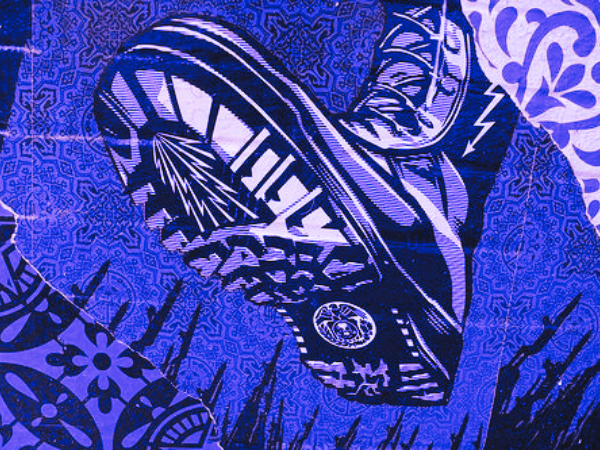
As George Orwell warned, “If you want a picture of the future, imagine a boot stamping on a human face forever.”

Source: https://bit.ly/36yARIK

ABOUT JOHN W. WHITEHEAD

Constitutional attorney and author John W. Whitehead is founder and president The Rutherford Institute. His books Battlefield America: The War on the American People and A Government of Wolves: The Emerging American Police State are available at www.amazon.com. He can be contacted at johnw@rutherford.org. Nisha Whitehead is the Executive Director of The Rutherford Institute. Information about The Rutherford Institute is available at www.rutherford.org.

Publication Guidelines / Reprint Permission

John W. Whitehead’s weekly commentaries are available for publication to newspapers and web publications at no charge. Please contact staff@rutherford.org to obtain reprint permission.
“In a time of deceit telling the truth is a revolutionary act.”— George Orwell  

The U.S. government, which speaks in a language of force, is afraid of its citizenry.

What we are dealing with is a government so power-hungry, paranoid and afraid of losing its stranglehold on power that it is conspiring to wage war on anyone who dares to challenge its authority.

All of us are in danger.

In recent years, the government has used the phrase “domestic terrorist” interchangeably with “anti-government,” “extremist” and “terrorist” to describe anyone who might fall somewhere on a very broad spectrum of viewpoints that could be considered “dangerous.” The ramifications are so far-reaching as to render almost every American an extremist in word, deed, thought or by association.

In the government’s latest assault on those who criticize the government—whether that criticism manifests itself in word, deed or thought—the Biden Administration has likened those who share “false or misleading narratives and conspiracy theories, and other forms of mis- dis- and mal-information” to terrorists.

The next part is the kicker.

According to the Department of Homeland Security’s latest terrorism bulletin, “These threat actors seek to exacerbate societal friction to sow discord and undermine public trust in government institutions to encourage unrest, which could potentially inspire acts of violence.”

You see, the government doesn’t care if what you’re sharing is fact or fiction or something in between. What it cares about is whether what you’re sharing has the potential to make people think for themselves and, in the process, question the government’s propaganda.

Get ready for the next phase of the government’s war on thought crimes and truth-tellers.

For years now, the government has used all of the weapons in its vast arsenal—surveillance, threat assessments, fusion centers, pre-crime programs, hate crime laws, militarized police, lockdowns, martial law, etc.—to target potential enemies of the state based on their ideologies, behaviors, affiliations and other characteristics that might be deemed suspicious or dangerous.

For instance, if you believe in and exercise your rights under the Constitution (namely, your right to speak freely, worship freely, associate with like-minded individuals who share your political views, criticize the government, own a weapon, demand a warrant before being questioned or searched, or any other activity viewed as potentially anti-government, racist, bigoted, anarchic or sovereign), you could be at the top of the government’s terrorism watch list.

Moreover, as a New York Times editorial warns, you may be an anti-government extremist (a.k.a. domestic terrorist) in the eyes of the police if you are afraid that the government is plotting to confiscate your firearms, if you believe the economy is about to collapse and the government will soon declare martial law, or if you display an unusual number of political and/or ideological bumper stickers on your car.

According to one FBI latest report, you might also be classified as a domestic terrorism threat if you espouse conspiracy theories, especially if you “attempt to explain events or circumstances as the result of a group of actors working in secret to benefit themselves at the expense of others” and are “usually at odds with official or prevailing explanations of events.”

In other words, if you dare to subscribe to any views that are contrary to the government’s, you may well be suspected of being a domestic terrorist and treated accordingly.

This latest government salvo against consumers and spreaders of “mis- dis- and mal-information” widens the net to potentially include anyone who is exposed to ideas that run counter to the official government narrative.

You don’t have to be a Joe Rogan questioning COVID-19 to get called out, cancelled and classified as an extremist.

There’s a whole spectrum of behaviors ranging from thought crimes and hate speech to whistleblowing that qualifies for persecution (and prosecution) by the Deep State.

Simply liking or sharing this article on Facebook, retweeting it on Twitter, or merely reading it or any other articles related to government wrongdoing, surveillance, police misconduct or civil liberties might be enough to get you categorized as a particular kind of person with particular kinds of interests that reflect a particular kind of mindset that might just lead you to engage in a particular kinds of activities and, therefore, puts you in the crosshairs of a government investigation as a potential troublemaker a.k.a. domestic extremist.

Chances are, as the Washington Post reports, you have already been assigned a color-coded threat score—green, yellow or red—so police are forewarned about your potential inclination to be a troublemaker depending on whether you’ve had a career in the military, posted a comment perceived as threatening on Facebook, suffer from a particular medical condition, or know someone who knows someone who might have committed a crime.

In other words, you might already be flagged as potentially anti-government in a government database somewhere—Main Core, for example—that identifies and tracks individuals who aren’t inclined to march in lockstep to the police state’s dictates.

As The Intercept reported, the FBI, CIA, NSA and other government agencies have increasingly invested in corporate surveillance technologies that can mine constitutionally protected speech on social media platforms such as Facebook, Twitter and Instagram in order to identify potential extremists and predict who might engage in future acts of anti-government behavior.

Where many Americans go wrong is in naively assuming that you have to be doing something illegal or harmful in order to be flagged and targeted for some form of intervention or detention.

In fact, all you need to do these days to end up on a government watch list or be subjected to heightened scrutiny is use certain trigger words (like cloud, pork and pirates), surf the internet, communicate using a cell phone, limp or stutterdrive a car, stay at a hotel, attend a political rally, express yourself on social mediaappear mentally ill, serve in the militarydisagree with a law enforcement officialcall in sick to work, purchase materials at a hardware store, take flying or boating lessons, appear suspicious, appear confused or nervous, fidget or whistle or smell bad, be seen in public waving a toy gun or anything remotely resembling a gun (such as a water nozzle or a remote control or a walking cane), stare at a police officer, question government authority, or appear to be pro-gun or pro-freedom.

And then at the other end of the spectrum there are those such as Julian Assange, for example, who blow the whistle on government misconduct that is within the public’s right to know.

Assange, the founder of WikiLeaks—a website that published secret information, news leaks, and classified media from anonymous sources—was arrested on April 11, 2019, on charges of helping U.S. Army intelligence analyst Chelsea Manning access and leak more than 700,000 classified military documents that portray the U.S. government and its military as reckless, irresponsible and responsible for thousands of civilian deaths.

Included among the leaked Manning material were the Collateral Murder video (April 2010), the Afghanistan war logs (July 2010), the Iraq war logs (October 2010), a quarter of a million diplomatic cables (November 2010), and the Guantánamo files (April 2011).

The Collateral Murder leak included gunsight video footage from two U.S. AH-64 Apache helicopters engaged in a series of air-to-ground attacks while air crew laughed at some of the casualties. Among the casualties were two Reuters correspondents who were gunned down after their cameras were mistaken for weapons and a driver who stopped to help one of the journalists. The driver’s two children, who happened to be in the van at the time it was fired upon by U.S. forces, suffered serious injuries.

In true Orwellian fashion, the government would have us believe that it is Assange and Manning who are the real criminals for daring to expose the war machine’s seedy underbelly.

Since his April 2019 arrest, Assange has been locked up in a maximum-security British prison—in solitary confinement for up to 23 hours a day—pending extradition to the U.S., where if convicted, he could be sentenced to 175 years in prison.

This is how the police state deals with those who challenge its chokehold on power.

This is why the government fears a citizenry that thinks for itself. Because a citizenry that thinks for itself is a citizenry that is informed, engaged and prepared to hold the government accountable to abiding by the rule of law, which translates to government transparency and accountability.

After all, we’re citizens, not subjects. For those who don’t fully understand the distinction between the two and why transparency is so vital to a healthy constitutional government, Manning explains it well:

When freedom of information and transparency are stifled, then bad decisions are often made and heartbreaking tragedies occur – too often on a breathtaking scale that can leave societies wondering: how did this happen? … I believe that when the public lacks even the most fundamental access to what its governments and militaries are doing in their names, then they cease to be involved in the act of citizenship. There is a bright distinction between citizens, who have rights and privileges protected by the state, and subjects, who are under the complete control and authority of the state.

This is why the First Amendment is so critical. It gives the citizenry the right to speak freely, protest peacefully, expose government wrongdoing, and criticize the government without fear of arrest, isolation or any of the other punishments that have been meted out to whistleblowers such as Edwards Snowden, Assange and Manning.

The challenge is holding the government accountable to obeying the law.

A little over 50 years ago, the U.S. Supreme Court ruled 6-3 in United States v. Washington Post Co. to block the Nixon Administration’s attempts to use claims of national security to prevent The Washington Post and The New York Times from publishing secret Pentagon papers on how America went to war in Vietnam.

As Justice William O. Douglas remarked on the ruling, “The press was protected so that it could bare the secrets of government and inform the people. Only a free and unrestrained press can effectively expose deception in government. And paramount among the responsibilities of a free press is the duty to prevent any part of the government from deceiving the people and sending them off to distant lands to die of foreign fevers and foreign shot and shell.”

Fast forward to the present day, and we’re witnessing yet another showdown, this time between Assange and the Deep State, which pits the people’s right to know about government misconduct against the might of the military industrial complex.

Yet this isn’t merely about whether whistleblowers and journalists are part of a protected class under the Constitution. It’s a debate over how long “we the people” will remain a protected class under the Constitution.

Following the current trajectory, it won’t be long before anyone who believes in holding the government accountable is labeled an “extremist,” relegated to an underclass that doesn’t fit in, watched all the time, and rounded up when the government deems it necessary.

We’re almost at that point now.

Eventually, we will all be potential suspects, terrorists and lawbreakers in the eyes of the government.

Partisan politics have no place in this debate: Americans of all stripes would do well to remember that those who question the motives of government provide a necessary counterpoint to those who would blindly follow where politicians choose to lead.

We don’t have to agree with every criticism of the government, but we must defend the rights of all individuals to speak freely without fear of punishment or threat of banishment.

Never forget: what the architects of the police state want are submissive, compliant, cooperative, obedient, meek citizens who don’t talk back, don’t challenge government authority, don’t speak out against government misconduct, and don’t step out of line.

What the First Amendment protects—and a healthy constitutional republic requires—are citizens who routinely exercise their right to speak truth to power.

The right to speak out against government wrongdoing is the quintessential freedom.

As I make clear in my book Battlefield America: The War on the American People and in its fictional counterpart The Erik Blair Diaries, once again, we find ourselves reliving George Orwell’s 1984, which portrayed in chilling detail how totalitarian governments employ the power of language to manipulate the masses.

In Orwell’s dystopian vision of the future, Big Brother does away with all undesirable and unnecessary words and meanings, even going so far as to routinely rewrite history and punish “thoughtcrimes.”

Much like today’s social media censors and pre-crime police departments, Orwell’s Thought Police serve as the eyes and ears of Big Brother, while the other government agencies peddle in economic affairs (rationing and starvation), law and order (torture and brainwashing), and news, entertainment, education and art (propaganda).

Orwell’s Big Brother relies on Newspeak to eliminate undesirable words, strip such words as remained of unorthodox meanings and make independent, non-government-approved thought altogether unnecessary.

Where we stand now is at the juncture of OldSpeak (where words have meanings, and ideas can be dangerous) and Newspeak (where only that which is “safe” and “accepted” by the majority is permitted). The power elite has made their intentions clear: they will pursue and prosecute any and all words, thoughts and expressions that challenge their authority.

Source: https://bit.ly/3uVOJa3

ABOUT JOHN W. WHITEHEAD

Constitutional attorney and author John W. Whitehead is founder and president The Rutherford Institute. His books Battlefield America: The War on the American People and A Government of Wolves: The Emerging American Police State are available at www.amazon.com. He can be contacted at johnw@rutherford.org. Nisha Whitehead is the Executive Director of The Rutherford Institute. Information about The Rutherford Institute is available at www.rutherford.org.

Publication Guidelines / Reprint Permission

John W. Whitehead’s weekly commentaries are available for publication to newspapers and web publications at no charge. Please contact staff@rutherford.org to obtain reprint permission.

Sexual predation by police officers happens far more often than people in the business are willing to admit.”—Former Seattle police chief Norm Stamper

We are a nation on the brink of a nervous breakdown.

Undeniably, the blowback from COVID-19 lockdowns and mandates continues to reverberate around the country, impacting the nation’s struggling workplaces, choking the economy and justifying all manner of authoritarian tyrannies being inflicted on the populace by state and federal governments.

Yet while it is easy to be distracted by political theater, distressed by the COVID-19 pandemic, and divided over authoritarian lockdowns and mandates, there are still darker forces afoot that cannot—should not—must not be ignored.

Here’s a news flash for you: there are sexual predators on America’s police forces.

Indeed, when it comes to sex trafficking—the buying and selling of young girls, boys and women for sex—police have become both predators and pimps. As the Philadelphia Inquirer reports, “Hundreds of police officers across the country have turned from protectors to predators, using the power of their badge to extort sex.”

Victims of sex trafficking report that police are among those “buying” young girls and women for sex. Incredibly, this COVID-19 pandemic has resulted in even greater numbers of children being preyed upon by sex traffickers.

Unfortunately, rather than being part of the solution, America’s police forces—riddled with corruption, brutality, sexual misconduct and drug abuse—have largely become part of the problem.

In New York, for instance, seven NYPD cops—three sergeants, two detectives and two officers—were accused of running brothels that sold 15-minute sexual encounters, raking in more than $2 million over the course of 13 months.

In California, a police sergeant—a 16-year veteran of the police force—was arrested for raping a 16-year-old girl who was being held captive and sold for sex in a home in an upscale neighborhood.

A week-long sting in Florida ended with 277 arrests of individuals accused of sex trafficking, including doctors, pharmacists and police officers.

Sex trafficking victims in Hawaii described “cops asking for sexual favors to more coercive situations like I’ll let you go if you do X, Y, or Z for me.”

One study found that “over 14 percent of sex workers said that they had been threatened with arrest unless they had sex with a police officer.” In many states, it’s actually legal for police to have sex with prostitutes during the course of sting operations.

While the problem of cops engaged in sex trafficking is part of the American police state’s seedy underbelly that doesn’t get addressed enough, equally alarming is the number of cops who commit sex crimes against those they encounter as part of their job duties, a largely underreported number given the “blue wall of silence” that shields police misconduct.

Former Seattle police chief Norm Stamper describes cases in which cops fondled prisoners, made false traffic stops of attractive women, traded sexual favors for freedom, had sex with teenagers and raped children.

Young girls are particularly vulnerable to these predators in blue.

Former police officer Phil Stinson estimates that half of the victims of police sex crimes are minors under the age of eighteen.

According to The Washington Post, a national study found that 40 percent of reported cases of police sexual misconduct involved teens. One young woman was assaulted during a “ride along” with an officer, who said in a taped confession: “The badge gets you the p—y and the p—y gets your badge, you know?

For example, a Pennsylvania police chief and his friend were arrested for allegedly raping a young girl hundreds of times—orally, vaginally, and anally several times a week—over the course of seven years, starting when she was 4 years old.

In 2017, two NYPD cops were accused of arresting a teenager, handcuffing her, and driving her in an unmarked van to a nearby parking lot, where they raped her and forced her to perform oral sex on them, then dropped her off on a nearby street corner.

The New York Times reports that “a sheriff’s deputy in San Antonio was charged with sexually assaulting the 4-year-old daughter of an undocumented Guatemalan woman and threatening to have her deported if she reported the abuse.”

One young girl, J.E., was kidnapped by a Border Patrol agent when she was 14 years old, taken to his apartment and raped. “In the apartment, there were two beds on top of the other, children’s bunk beds, and ropes there, too. They were shoelaces. For my wrists and my feet. My mind was blank,” recalls J.E. “I was trying to understand everything. I didn’t know what to do. My feet were tied up. I would look at him and he had a gun. And that frightened me. I asked him why, and he answered me that he was doing this to me because I was the prettiest one of the three.”

Two teenage girls accused a Customs and Border Protection officer of forcing them to strip, fondling them, then trying to get them to stop crying by offering chocolates, potato chips and a blanket. The government settled the case for $125,000. (Mind you, this is the same government that separated immigrant children from their parents and locked them up in detention centers, where they were easy prey for sexual predators. At one point, the government had received more than 4500 complaints about sexual abuse at those child detention facilities.)

The police state’s sexual assaults of children are sickening enough, but when you add sex crimes against grown women into the mix, the picture becomes even more sordid.

According to The Washington Post, “research on ‘police sexual misconduct’—a term used to describe actions from sexual harassment and extortion to forcible rape by officers—overwhelmingly concludes that it is a systemic problem.”

Investigative journalist Andrea Ritchie has tracked national patterns of sexual violence by police officers during traffic stops, in addition to heightened risk from minor offenses, drug arrests and police interactions with teenagers.

Victims of domestic abuse, women of color, transgender women, women who use drugs or alcohol, and women involved in the sex trade are particularly vulnerable to sexual assault by police.

One Oklahoma City police officer allegedly sexually assaulted at least seven women while on duty over the course of four months, including a 57-year-old grandmother who says she was forced to give the cop oral sex after he pulled her over.

A Philadelphia state trooper, eventually convicted of assaulting six women and teenagers, once visited the hospital bedside of a pregnant woman who had attempted suicide, and groped her breasts and masturbated.

These aren’t isolated incidents.

According to research from Bowling Green State University, police officers in the U.S. were charged with more than 400 rapes over a 9-year period. During that same time period, 600 police officers were arrested for forcible fondling; 219 were charged with forcible sodomy; 186 were arrested for statutory rape; 58 for sexual assault with an object; and 98 with indecent exposure.

Sexual assault is believed to be the second-most reported form of misconduct against police officers after the use of excessive force, making up more than 9% of all complaints.

Even so, these crimes are believed to be largely underreported so much so that sex crimes may in fact be the number one form of misconduct among police officers.

So why are the numbers underreported?

“The women are terrified. Who are they going to call? It’s the police who are abusing them,” said Penny Harrington, the former police chief of Portland, Ore.

One Philadelphia cop threatened to arrest a teenager for carjacking unless she had sex with him. “He had all the power. I had no choice,” testified the girl. “Who was I? He had his badge.”

This is the danger of a police state that invests its henchmen with so much power that they don’t even need to use handcuffs or a gun to get what they want.

Making matters worse, most police departments do little to identify the offenders, and even less to stop them. “Unlike other types of police misconduct, the abuse of police power to coerce sex is little addressed in training, and rarely tracked by police disciplinary systems,” conclude Nancy Phillips and Craig R. McCoy writing for the Philadelphia Inquirer. “This official neglect makes it easier for predators to escape punishment and find new victims.”

Unfortunately, this is a problem that is hiding in plain sight, covered up by government agencies that are failing in their constitutional duties to serve and protect “we the people.”

That thin blue line of knee-jerk adulation and absolute loyalty to police above and beyond what the law requires is creating a menace to society that cannot be ignored.

As researcher Jonathan Blanks notes, “The system is rigged to protect police officers from outside accountability. The worst cops are going to get the most protection.

Hyped up on the power of the badge and their weaponry, protected from charges of wrongdoing by police unions and government agencies, and empowered by rapidly advancing tools—technological and otherwise—that make it all too easy to identify, track and take advantage of vulnerable members of society, predators on the nation’s police forces are growing in number.

“It can start with a police officer punching a woman’s license plate into a police computer – not to see whether a car is stolen, but to check out her picture,” warns investigative journalists Nancy Phillips and Craig R. McCoy. “If they are not caught, or left unpunished, the abusers tend to keep going, and get worse, experts say.”

So where does this leave us?

The courts, by allowing the government’s desire for unregulated, unaccountable, expansive power to trump justice and the rule of law, have turned away from this menace. Politicians, eager for the support of the powerful police unions, have turned away from this menace. Police unions, which have been at the forefront of the effort to shield sexual misconduct by cops, have exacerbated this menace.

Yet for the sake of the most vulnerable among us, we as a nation must stop turning away from this menace in our midst.

For starters, police should not be expected—or allowed—to police themselves.

Misconduct by local police has become a national problem. Therefore, the response to this national problem must start at the local level.

This is no longer a matter of a few bad apples. As I make clear in my book Battlefield America: The War on the American People and in its fictional counterpart The Erik Blair Diaries, the entire system has become corrupted and must be reformed.

Greater oversight is needed, yes, but also greater accountability and more significant consequences for assaults.

Andrea Ritchie’s piece in The Washington Post provides some practical suggestions for reform ranging from small steps to structural changes (greater surveillance of police movements, heightened scrutiny of police interactions and traffic stops, and more civilian oversight boards), but as she acknowledges, these efforts still don’t strike at the root of the problem: a criminal justice system that protects abusers and encourages abuse.

It’s difficult to say whether modern-day policing with its deep-seated corruption, immunity from accountability, and authoritarian approach to law enforcement attracts this kind of deviant behavior or cultivates it, but empowering police to view themselves as the best, or even the only, solution to the public’s problems, while failing to hold them accountable for misconduct, will only deepen the policing crisis that grows deadlier and more menacing by the day.

Source: https://bit.ly/3CU9DYx

ABOUT JOHN W. WHITEHEAD

Constitutional attorney and author John W. Whitehead is founder and president The Rutherford Institute. His books Battlefield America: The War on the American People and A Government of Wolves: The Emerging American Police State are available at www.amazon.com. He can be contacted at johnw@rutherford.org. Nisha Whitehead is the Executive Director of The Rutherford Institute. Information about The Rutherford Institute is available at www.rutherford.org.

Publication Guidelines / Reprint Permission

John W. Whitehead’s weekly commentaries are available for publication to newspapers and web publications at no charge. Please contact staff@rutherford.org to obtain reprint permission.

“Whether the mask is labeled fascism, democracy, or dictatorship of the proletariat, our great adversary remains the apparatus—the bureaucracy, the police, the military. Not the one facing us across the frontier of the battle lines, which is not so much our enemy as our brothers’ enemy, but the one that calls itself our protector and makes us its slaves. No matter what the circumstances, the worst betrayal will always be to subordinate ourselves to this apparatus and to trample underfoot, in its service, all human values in ourselves and in others.”—Simone Weil, French philosopher and political activist

We labor today under the weight of countless tyrannies, large and small, carried out in the so-called name of the national good by an elite class of governmental and corporate officials who are largely insulated from the ill effects of their actions.

We, the middling classes, are not so fortunate.

We find ourselves badgered, bullied and browbeaten into bearing the brunt of their arrogance, paying the price for their greed, suffering the backlash for their militarism, agonizing as a result of their inaction, feigning ignorance about their backroom dealings, overlooking their incompetence, turning a blind eye to their misdeeds, cowering from their heavy-handed tactics, and blindly hoping for change that never comes. 

The overt signs of the despotism exercised by the increasingly authoritarian regime that passes itself off as the United States government (and its corporate partners in crime) are all around us: COVID-19 lockdowns and vaccine mandates that strip Americans of their freedom of movement and bodily integrity; censorship, criminalizing, shadow banning and de-platforming of individuals who express ideas that are politically incorrect or unpopular; warrantless surveillance of Americans’ movements and communications; SWAT team raids of Americans’ homes; shootings of unarmed citizens by police; harsh punishments meted out to schoolchildren in the name of zero tolerance; armed drones taking to the skies domestically; endless wars; out-of-control spending; militarized police; roadside strip searches; roving TSA sweeps; privatized prisons with a profit incentive for jailing Americans; fusion centers that spy on, collect and disseminate data on Americans’ private transactions; and militarized agencies with stockpiles of ammunition, to name some of the most appalling.

Yet as egregious as these incursions on our rights may be, it’s the endless, petty tyrannies—the heavy-handed, punitive-laden dictates inflicted by a self-righteous, Big-Brother-Knows-Best bureaucracy on an overtaxed, overregulated, and underrepresented populace—that illustrate so clearly the degree to which “we the people” are viewed as incapable of common sense, moral judgment, fairness, and intelligence, not to mention lacking a basic understanding of how to stay alive, raise a family, or be part of a functioning community.

It’s hard to say whether we’re dealing with a kleptocracy (a government ruled by thieves), a kakistocracy (a government run by unprincipled career politicians, corporations and thieves that panders to the worst vices in our nature and has little regard for the rights of American citizens), or if we’ve gone straight to an idiocracy

This certainly isn’t a constitutional democracy, however.

This overbearing Nanny State despotism is what happens when government representatives (those elected and appointed to work for us) adopt the authoritarian notion that the government knows best and therefore must control, regulate and dictate almost everything about the citizenry’s public, private and professional lives.

The government’s bureaucratic attempts at muscle-flexing by way of overregulation and overcriminalization have reached such outrageous limits that federal and state governments now require on penalty of a fine that individuals apply for permission before they can grow exotic orchids, host elaborate dinner parties, gather friends in one’s home for Bible studies, give coffee to the homeless, let their kids manage a lemonade stand, keep chickens as pets, or braid someone’s hair, as ludicrous as that may seem.

Consider, for example, that businesses in California must now designate an area of the children’s toy aisle “gender-neutral” or face a fine, whether or not the toys sold are traditionally marketed to girls or boys such as Barbies and Hot Wheels. California schools are prohibited from allowing students to access websites, novels or religious works that reflect negatively on gays. And while Californians are free to have sex with whomever they choose (because that’s none of the government’s business), removing a condom during sex without consent could make you liable for general, special and punitive damages.

Up until a few years ago, Missouri required that anyone wanting to braid African-style hair and charge for it must first acquire a government license, which at a minimum requires the applicant to undertake at least 1500 hours of cosmetology classes costing tens of thousands of dollars. Tennessee was prepared to fine residents nearly $100,000 just for violating its laws against braiding hair without a government license. In Oregon, the law was so broad that you needed a license even if you were planning to braid hair for free. The mere act of touching someone’s hair could render you a cosmetologist operating without a license and in violation of the law.

It’s getting worse.

Almost every aspect of American life today—especially if it is work-related—is subject to this kind of heightened scrutiny and ham-fisted control, whether you’re talking about aspiring “bakers, braiders, casket makers, florists, veterinary masseuses, tour guides, taxi drivers, eyebrow threaders, teeth whiteners, and more.”

For instance, whereas 70 years ago, one out of every 20 U.S. jobs required a state license, today, almost 1 in 3 American occupations requires a license.

The problem of overregulation has become so bad that, as one analyst notes, “getting a license to style hair in Washington takes more instructional time than becoming an emergency medical technician or a firefighter.”

This is what happens when bureaucrats run the show, and the rule of law becomes little more than a cattle prod for forcing the citizenry to march in lockstep with the government.

Overregulation is just the other side of the coin to overcriminalization, that phenomenon in which everything is rendered illegal and everyone becomes a lawbreaker.

This is the mindset that tried to penalize a fisherman with 20 years’ jail time for throwing fish that were too small back into the water.

That same overcriminalization mindset reared its ugly head again when police arrested a 90-year-old man for violating an ordinance that prohibits feeding the homeless in public unless portable toilets are also made available.

It’s no coincidence that both of these incidents—the fishing debacle and the homeless feeding arrest—happened in Florida.

Despite its pristine beaches and balmy temperatures, Florida is no less immune to the problems plaguing the rest of the nation in terms of overcriminalization, incarceration rates, bureaucracy, corruption, and police misconduct.

A few years back, in fact, Florida officials authorized police raids on barber shops in minority communities, resulting in barbers being handcuffed in front of customers, and their shops searched without warrants. All of this was purportedly done in an effort to make sure that the barbers’ licensing paperwork was up to snuff.

As if criminalizing fishing, charity, and haircuts wasn’t bad enough, you could also find yourself passing time in a Florida slammer for such inane activities as singing in a public place while wearing a swimsuit, breaking more than three dishes per day, farting in a public place after 6 pm on a Thursday, and skateboarding without a license.

In this way, the Sunshine State is representative of the transformation happening across the nation, where a steady diet of bread and circuses has given rise to an oblivious, inactive citizenry content to be ruled over by an inflexible and highly bureaucratic regime.

America has gone from being a beacon of freedom to a locked down nation. And “we the people,” sold on the idea that safety, security and material comforts are preferable to freedom, have allowed the government to pave over the Constitution in order to erect a concentration camp.

The problem with these devil’s bargains, however, is that there is always a catch, always a price to pay for whatever it is we valued so highly as to barter away our most precious possessions.

We’ve bartered away our right to self-governance, self-defense, privacy, autonomy and that most important right of all—the right to tell the government to “leave me the hell alone.”

In exchange for the promise of an end to global pandemics, lower taxes, lower crime rates, safe streets, safe schools, blight-free neighborhoods, and readily accessible technology, health care, water, food and power, we’ve opened the door to lockdowns, militarized police, government surveillance, asset forfeiture, school zero tolerance policies, license plate readers, red light cameras, SWAT team raids, health care mandates, overcriminalization, overregulation and government corruption.

In the end, such bargains always turn sour.

We relied on the government to help us safely navigate national emergencies (terrorism, natural disasters, global pandemics, etc.) only to find ourselves forced to relinquish our freedoms on the altar of national security, yet we’re no safer (or healthier) than before.

We asked our lawmakers to be tough on crime, and we’ve been saddled with an abundance of laws that criminalize almost every aspect of our lives. So far, we’re up to 4500 criminal laws and 300,000 criminal regulations that result in average Americans unknowingly engaging in criminal acts at least three times a day. For instance, the family of an 11-year-old girl was issued a $535 fine for violating the Federal Migratory Bird Act after the young girl rescued a baby woodpecker from predatory cats.

We wanted criminals taken off the streets, and we didn’t want to have to pay for their incarceration. What we’ve gotten is a nation that boasts the highest incarceration rate in the world, with more than 2.3 million people locked up, many of them doing time for relatively minor, nonviolent crimes, and a private prison industry fueling the drive for more inmates, who are forced to provide corporations with cheap labor.

A special report by CNBC breaks down the national numbers:

One out of 100 American adults is behind bars — while a stunning one out of 32 is on probation, parole or in prison. This reliance on mass incarceration has created a thriving prison economy. The states and the federal government spend about $74 billion a year on corrections, and nearly 800,000 people work in the industry.

We wanted law enforcement agencies to have the necessary resources to fight the nation’s wars on terror, crime and drugs. What we got instead were militarized police decked out with M-16 rifles, grenade launchers, silencers, battle tanks and hollow point bullets—gear designed for the battlefield, more than 80,000 SWAT team raids carried out every year (many for routine police tasks, resulting in losses of life and property), and profit-driven schemes that add to the government’s largesse such as asset forfeiture, where police seize property from “suspected criminals.”

According to the Washington Post, these funds have been used to buy guns, armored cars, electronic surveillance gear, “luxury vehicles, travel and a clown named Sparkles.” Police seminars advise officers to use their “department wish list when deciding which assets to seize” and, in particular, go after flat screen TVs, cash and nice cars.

In Florida, where police are no strangers to asset forfeiture, Florida police have been carrying out “reverse” sting operations, where they pose as drug dealers to lure buyers with promises of cheap cocaine, then bust them, and seize their cash and cars. Over the course of a year, police in one small Florida town seized close to $6 million using these entrapment schemes.

We fell for the government’s promise of safer roads, only to find ourselves caught in a tangle of profit-driven red light cameras, which ticket unsuspecting drivers in the so-called name of road safety while ostensibly fattening the coffers of local and state governments. Despite widespread public opposition, corruption and systemic malfunctions, these cameras—used in 24 states and Washington, DC—are particularly popular with municipalities, which look to them as an easy means of extra cash.

One small Florida town, population 8,000, generates a million dollars a year in fines from these cameras. Building on the profit-incentive schemes, the cameras’ manufacturers are also pushing speed cameras and school bus cameras, both of which result in heft fines for violators who speed or try to go around school buses.

As I make clear in my book Battlefield America: The War on the American People and in its fictional counterpart The Erik Blair Diaries, this is what happens when the American people get duped, deceived, double-crossed, cheated, lied to, swindled and conned into believing that the government and its army of bureaucrats—the people we appointed to safeguard our freedoms—actually have our best interests at heart.

Yet when all is said and done, who is really to blame when the wool gets pulled over your eyes: you, for believing the con man, or the con man for being true to his nature?

It’s time for a bracing dose of reality, America.

Wake up and take a good, hard look around you, and ask yourself if the gussied-up version of America being sold to you—crime free, worry free, disease free and devoid of responsibility—is really worth the ticket price: nothing less than your freedoms.

Source: https://bit.ly/3BAhgT2

ABOUT JOHN W. WHITEHEAD

Constitutional attorney and author John W. Whitehead is founder and president The Rutherford Institute. His books Battlefield America: The War on the American People and A Government of Wolves: The Emerging American Police State are available at www.amazon.com. He can be contacted at johnw@rutherford.org. Nisha Whitehead is the Executive Director of The Rutherford Institute. Information about The Rutherford Institute is available at www.rutherford.org.

Publication Guidelines / Reprint Permission

John W. Whitehead’s weekly commentaries are available for publication to newspapers and web publications at no charge. Please contact staff@rutherford.org to obtain reprint permission.
A house divided against itself cannot stand. I believe this government cannot endure, permanently, half slave and half free. I do not expect the Union to be dissolved—I do not expect the house to fall—but I do expect it will cease to be divided. It will become all one thing or all the other.”—Abraham Lincoln

History has a funny way of circling back on itself.

The facts, figures, faces and technology may change from era to era, but the dangers remain the same.

This year is no different, whatever the politicians and talking heads may say to the contrary.

Sure, there’s a new guy in charge, but for the most part, we’re still recycling the same news stories that have kept us with one eye warily glued to the news for the past 100-odd years: War. Corruption. Brutality. Economic instability. Partisan politics. Militarism. Disease. Hunger. Greed. Violence. Poverty. Ignorance. Hatred.

The more things change, the more they stay the same.

Brush up on your history, and you’ll find that we’ve been stuck on repeat for some time now.

Take the United States of America in the year 2021, which is not so far different from the United States of America during the Civil Rights era, or the Cold War era, or even the Depression era.

Go far enough afield, and you’ll find aspects of our troubled history mirrored in the totalitarianism of Nazi Germany, in the fascism of Mussolini’s Italy, and further back in the militarism of the Roman Empire.

We’re like TV weatherman Phil Connors in Harold Ramis’ classic 1993 comedy Groundhog Day, forced to live the same day over and over again.

Here in the American police state, however, we continue to wake up, hoping each new day, new president and new year will somehow be different from what has come before.

Unfortunately, no matter how we change the narrative, change the characters, change the plot lines, we seem to keep ending up in the same place that we started: enslaved, divided and repeating the mistakes of the past.

You want to know about the true State of our Nation? Listen up.

The State of the Union: The state of our nation is politically polarized, controlled by forces beyond the purview of the average American, and rapidly moving the nation away from its freedom foundation. Over the past year, due in part to the COVID-19 pandemic, Americans have found themselves repeatedly subjected to egregious civil liberties violations, invasive surveillance, martial law, lockdowns, political correctness, erosions of free speech, strip searches, police shootings of unarmed citizens, government spying, the criminalization of lawful activities, warmongering, etc.

The predators of the police state have wreaked havoc on our freedoms, our communities, and our lives. The government does not listen to the citizenry, refuses to abide by the Constitution, and treats taxpayers as a source of funding and little else. Police officers shoot unarmed citizens and their household pets. Government agents—including local police—remain armed to the teeth and act like soldiers on a battlefield. Bloated government agencies continue to fleece taxpayers. Government technicians spy on our emails and phone calls. And government contractors make a killing by waging endless wars abroad.

Consequently, the state of our nation remains bureaucratic, debt-ridden, violent, militarized, fascist, lawless, invasive, corrupt, untrustworthy, mired in war, and unresponsive to the wishes and needs of the electorate.

The policies of the American police state continue unabated.

The Executive Branch: All of the imperial powers amassed by Donald Trump, Barack Obama and George W. Bush—to kill American citizens without due process, to detain suspects indefinitely, to strip Americans of their citizenship rights, to carry out mass surveillance on Americans without probable cause, to suspend laws during wartime, to disregard laws with which he might disagree, to conduct secret wars and convene secret courts, to sanction torture, to sidestep the legislatures and courts with executive orders and signing statements, to direct the military to operate beyond the reach of the law, to act as a dictator and a tyrant, above the law and beyond any real accountability—were inherited by Joe Biden.

Biden has these powers because every successive occupant of the Oval Office has been allowed to expand the reach and power of the presidency through the use of executive orders, decrees, memorandums, proclamations, national security directives and legislative signing statements that can be activated by any sitting president. Those of us who saw this eventuality coming have been warning for years about the growing danger of the Executive Branch with its presidential toolbox of terror that could be used—and abused—by future presidents. The groundwork, we warned, was being laid for a new kind of government where it won’t matter if you’re innocent or guilty, whether you’re a threat to the nation or even if you’re a citizen. What will matter is what the president—or whoever happens to be occupying the Oval Office at the time—thinks. And if he or she thinks you’re a threat to the nation and should be locked up, then you’ll be locked up with no access to the protections our Constitution provides. In effect, you will disappear.

Our warnings continue to go unheeded.

The Legislative Branch:  Congress may well be the most self-serving, semi-corrupt institution in America. Abuses of office runs the gamut from elected representatives neglecting their constituencies to engaging in self-serving practices, including the misuse of eminent domain, earmarking hundreds of millions of dollars in federal contracting in return for personal gain and campaign contributions, having inappropriate ties to lobbyist groups and incorrectly or incompletely disclosing financial information. Pork barrel spending, hastily passed legislation, partisan bickering, a skewed work ethic, graft and moral turpitude have all contributed to the public’s increasing dissatisfaction with congressional leadership. No wonder only 31 percent of Americans approve of the job Congress is doing.

The Judicial Branch: The Supreme Court was intended to be an institution established to intervene and protect the people against the government and its agents when they overstep their bounds. Yet through their deference to police power, preference for security over freedom, and evisceration of our most basic rights for the sake of order and expediency, the justices of the United States Supreme Court have become the guardians of the American police state in which we now live. As a result, sound judgment and justice have largely taken a back seat to legalism, statism and elitism, while preserving the rights of the people has been deprioritized and made to play second fiddle to both governmental and corporate interests. The courts have empowered the government to wreak havoc on our liberties. Protections for private property continue to be undermined. And Americans can no longer rely on the courts to mete out justice.

Shadow Government: Joe Biden inherited more than a bitterly divided nation teetering on the brink of financial catastrophe when he assumed office. He also inherited a shadow government, one that is fully operational and staffed by unelected officials who are, in essence, running the country. Referred to as the Deep State, this shadow government is comprised of unelected government bureaucrats, corporations, contractors, paper-pushers, and button-pushers who are actually calling the shots behind the scenes right now.

Law Enforcement: By and large the term “law enforcement” encompasses all agents within a militarized police state, including the military, local police, and the various agencies such as the Secret Service, FBI, CIA, NSA, etc. Having been given the green light to probe, poke, pinch, taser, search, seize, strip and generally manhandle anyone they see fit in almost any circumstance, all with the general blessing of the courts, America’s law enforcement officials, no longer mere servants of the people entrusted with keeping the peace but now extensions of the military, are part of an elite ruling class dependent on keeping the masses corralled, under control, and treated like suspects and enemies rather than citizens. As a result, police are becoming even more militarized and weaponized, and police shootings of unarmed individuals continue to increase.

A Suspect Surveillance Society: Every dystopian sci-fi film we’ve ever seen is suddenly converging into this present moment in a dangerous trifecta between science, technology and a government that wants to be all-seeing, all-knowing and all-powerful. By tapping into your phone lines and cell phone communications, the government knows what you say. By uploading all of your emails, opening your mail, and reading your Facebook posts and text messages, the government knows what you write. By monitoring your movements with the use of license plate readers, surveillance cameras and other tracking devices, the government knows where you go. By churning through all of the detritus of your life—what you read, where you go, what you say—the government can predict what you will do. By mapping the synapses in your brain, scientists—and in turn, the government—will soon know what you remember. And by accessing your DNA, the government will soon know everything else about you that they don’t already know: your family chart, your ancestry, what you look like, your health history, your inclination to follow orders or chart your own course, etc. Consequently, in the face of DNA evidence that places us at the scene of a crimebehavior sensing technology that interprets our body temperature and facial tics as suspicious, and government surveillance devices that cross-check our biometricslicense plates and DNA against a growing database of unsolved crimes and potential criminals, we are no longer “innocent until proven guilty.”

Military Empire: America’s endless global wars and burgeoning military empire—funded by taxpayer dollars—have depleted our resources, over-extended our military and increased our similarities to the Roman Empire and its eventual demise. Black budget spending has completely undermined any hope of fiscal transparency, with government contractors padding their pockets at the expense of taxpayers and the nation’s infrastructure—railroads, water pipelines, ports, dams, bridges, airports and roads—taking the hit. The U.S. now operates approximately 800 military bases in foreign countries around the globe at an annual cost of at least $156 billion. The consequences of financing a global military presence are dire. In fact, David Walker, former comptroller general of the U.S., believes there are “striking similarities” between America’s current situation and the factors that contributed to the fall of Rome, including “declining moral values and political civility at home, an over-confident and over-extended military in foreign lands and fiscal irresponsibility by the central government.”

I haven’t even touched on the corporate state, the military industrial complex, SWAT team raids, invasive surveillance technology, zero tolerance policies in the schools, overcriminalization, or privatized prisons, to name just a few. However, what I have touched on should be enough to show that the landscape of our freedoms has already changed dramatically from what it once was and will no doubt continue to deteriorate unless Americans can find a way to wrest back control of their government and reclaim their freedoms.

So how do we go about reclaiming our freedoms and reining in our runaway government?

Essentially, there are four camps of thought among the citizenry when it comes to holding the government accountable. Which camp you fall into says a lot about your view of government—or, at least, your view of whichever administration happens to be in power at the time.

In the first camp are those who trust the government to do the right thing, despite the government’s repeated failures in this department.

In the second camp are those who not only don’t trust the government but think the government is out to get them.

In the third camp are those who see government neither as an angel nor a devil, but merely as an entity that needs to be controlled, or as Thomas Jefferson phrased it, bound “down from mischief with the chains of the Constitution.”

Then there’s the fourth camp, comprised of individuals who pay little to no attention to the workings of government. Easily entertained, easily distracted, easily led, these are the ones who make the government’s job far easier than it should be.

It is easy to be diverted, distracted and amused by the antics of politicians, the pomp and circumstance of awards shows, athletic events, and entertainment news, and the feel-good evangelism that passes for religion today.

What is far more difficult to face up to is the reality of life in America, where unemployment, poverty, inequality, injustice and violence by government agents are increasingly norms.

The powers-that-be want us to remain divided, alienated from each other based on our politics, our bank accounts, our religion, our race and our value systems. Yet as George Orwell observed, “The real division is not between conservatives and revolutionaries but between authoritarians and libertarians.”

The only distinction that matters anymore is where you stand in the American police state.

In other words, you’re either part of the problem or part of the solution.

America is at a crossroads.

History may show that from this point forward, we will have left behind any semblance of constitutional government and entered into a militaristic state where all citizens are suspects and security trumps freedom.

Certainly, we have moved beyond the era of representative government and entered a new age: the age of authoritarianism. Even with its constantly shifting terrain, this topsy-turvy travesty of law and government has become America’s new normal.

As long as we continue to put our politics ahead of our principles—moral, legal and constitutional—“we the people” will lose.

And you know who will keep winning by playing on our prejudices, capitalizing on our fears, deepening our distrust of our fellow citizens, and dividing us into polarized, warring camps incapable of finding consensus on the one true menace that is an immediate threat to all of our freedoms? The government.

As I make clear in my book Battlefield America: The War on the American People and its fictional counterpart The Erik Blair Diaries, when we lose sight of the true purpose of government—to protect our rights—and fail to keep the government in its place as our servant, we allow the government to overstep its bounds and become a tyrant that rules by brute force.

Source: https://bit.ly/3hPwhJo

ABOUT JOHN W. WHITEHEAD

Constitutional attorney and author John W. Whitehead is founder and president The Rutherford Institute. His books Battlefield America: The War on the American People and A Government of Wolves: The Emerging American Police State are available at www.amazon.com. He can be contacted at johnw@rutherford.org. Nisha Whitehead is the Executive Director of The Rutherford Institute. Information about The Rutherford Institute is available at www.rutherford.org.

Publication Guidelines / Reprint Permission

John W. Whitehead’s weekly commentaries are available for publication to newspapers and web publications at no charge. Please contact staff@rutherford.org to obtain reprint permission.
“Experience teaches us to be most on our guard to protect liberty when the government’s purposes are beneficent.”—Supreme Court Justice Louis D. Brandeis

A federal COVID-19 vaccination strike force may soon be knocking on your door, especially if you live in a community with low vaccination rates. Will you let them in?

More to the point, are you required to open the door?

The Biden Administration has announced that it plans to send federal “surge response teams” on a “targeted community door-to-door outreach“ to communities with low vaccination rates in order to promote the safety and accessibility of the COVID-19 vaccines.

That’s all fine and good as far as government propaganda goes, but nothing is ever as simple or as straightforward as the government claims, especially not when armed, roving bands of militarized agents deployed by the Nanny State show up at your door with an agenda that is at odds with what Supreme Court Justice Louis Brandeis referred to as the constitutional “right to be let alone.”

Any attempt by the government to encroach upon the citizenry’s privacy rights or establish a system by which the populace can be targeted, tracked and singled out must be met with extreme caution. These door-to-door “visits” by COVID-19 surge response teams certainly qualify as a government program whose purpose, while seemingly benign, raises significant constitutional concerns.

First, there is the visit itself.

While government agents can approach, speak to and even question citizens without violating the Fourth Amendment, Americans have a right not to answer questions or even speak with a government agent.

Courts have upheld these “knock and talk” visits as lawful, reasoning that even though the curtilage of the home is protected by the Fourth Amendment, there is an implied license to approach a residence, knock on the door/ring the bell, and seek to contact occupants. However, the encounter is wholly voluntary and a person is under no obligation to speak with a government agent in this situation. 

Indeed, you don’t even need to answer or open the door in response to knocking/ringing by a government agent, and if you do answer the knock, you can stop speaking at any time. You also have the right to demand that government agents leave the property once the purpose of the visit is established. Government officials would not be enforcing any law or warrant in this context, and so they don’t have the authority of law to remain on the property after a homeowner or resident specifically revokes the implied license to come onto the property.

When the government’s actions go beyond merely approaching the door and knocking, it risks violating the Fourth Amendment, which requires a warrant and probable cause of possible wrongdoing in order to search one’s property. A government agent would violate the Fourth Amendment if he snooped around the premises, peering into window and going to other areas in search of residents. 

It should be pointed out that some judges (including Supreme Court Justice Gorsuch) believe that placing “No Trespassing” signs or taking other steps to impede access to the door is sufficient to negate any implied permission for government agents or others to approach your home, but this view does not have general acceptance.

While in theory one can refuse to speak with police or other government officials during a “knock and talk” encounter, as the courts have asserted as a justification for dismissing complaints about this police investigative tactic, the reality is far different. Indeed, it is unreasonable to suggest that individuals caught unaware by these tactics will not feel pressured in the heat of the moment to comply with a request to speak with government agents who display official credentials and are often heavily armed, let alone allow them to search one’s property. Even when such consent is denied, police have been known to simply handcuff the homeowner and conduct a search over his objections.

Second, there is the danger inherent in these knock-and-talk encounters.

Although courts have embraced the fiction that “knock and talks” are “voluntary” encounters that are no different from other door-to-door canvassing, these constitutionally dubious tactics are highly intimidating confrontations meant to pressure individuals into allowing police access to one’s home, which then paves the way for a warrantless search of one’s home and property.

The act of going to homes and taking steps to speak with occupants is akin to the “knock and talk” tactic used by police, which can be fraught with danger for homeowners and government agents alike. Indeed, “knock-and-talk” policing has become a thinly veiled, warrantless exercise by which citizens are coerced and intimidated into “talking” with heavily armed police who “knock” on their doors in the middle of the night.

“Knock-and-shoot” policing might be more accurate, however.

“Knock and talks” not only constitute severe violations of the privacy and security of homeowners, but the combination of aggression and surprise employed by police is also a recipe for a violent confrontation that rarely ends well for those on the receiving end of these tactics.

For example, although 26-year-old Andrew Scott had committed no crime and never fired a single bullet or threatened police, he was gunned down by police who knocked aggressively on the wrong door at 1:30 am, failed to identify themselves as police, and then repeatedly shot and killed Scott when he answered the door while holding a gun in self-defense. The police were investigating a speeding incident by engaging in a middle-of-the-night “knock and talk” in Scott’s apartment complex.

Carl Dykes was shot in the face by a county deputy who pounded on Dykes’ door in the middle of the night without identifying himself. Because of reports that inmates had escaped from a local jail, Dykes brought a shotgun with him when he answered the door.

As these and other incidents make clear, while Americans have a constitutional right to question the legality of a police action or resist an unlawful police order, doing so can often get one arrested, shot or killed.

Third, there is the question of how the government plans to use the information it obtains during these knock-and-talk visits.

Because the stated purpose of the program is to promote vaccination, homeowners and others who reside at the residence will certainly be asked if they are vaccinated. Again, you have a right not to answer this or any other question. Indeed, an argument could be made that even asking this question is improper if the purpose of the program is merely to ensure that Americans “have the information they need on how both safe and accessible the vaccine is.”

Under the Privacy Act, 5 U.S.C. 552a, an agency should only collect and maintain information about an individual as is “relevant and necessary to accomplish a purpose of the agency.” In this situation, the government agent could accomplish the purpose of assuring persons have information about the vaccine simply by providing that information (either in writing or orally) and would not need to know the vaccination status of the residents. To the extent the agents do request, collect and store information about residents’ vaccination status, this could be a Privacy Act violation.

Of course, there is always the danger that this program could be used for other, more nefarious, purposes not related to vaccination encouragement. As with knock-and-talk policing, government agents might misuse their appearance of authority to gain entrance to a residence and obtain other information about it and those who live there. Once the door is opened by a resident, anything the agents can see from their vantage point can be reported to law enforcement authorities.

Moreover, while presumably the targeting will be of areas with demonstrated low vaccination rates, there is no guarantee that this program would not be used as cover for conducting surveillance on areas deemed to be “high crime” areas as a way of obtaining intelligence for law enforcement purposes.

We’ve been down this road before, with the government sending its spies to gather intel on American citizens by questioning them directly, or by asking their neighbors to snitch on them.

Remember the egregiously invasive and intrusive American Community Survey?

Unlike the traditional census, which collects data every ten years, the American Community Survey (ACS) is sent to about 3 million homes per year at a reported cost of hundreds of millions of dollars. Moreover, while the traditional census is limited to ascertaining the number of persons living in each dwelling, their ages and ethnicities, the ownership of the dwelling and telephone numbers, the ACS is much more intrusive, asking questions relating to respondents’ bathing habits, home utility costs, fertility, marital history, work commute, mortgage, and health insurance, among other highly personal and private matters.

Individuals who receive the ACS must complete it or be subject to monetary penalties. Although no reports have surfaced of individuals actually being penalized for refusing to answer the survey, the potential fines that can be levied for refusing to participate in the ACS are staggering. For every question not answered, there is a $100 fine. And for every intentionally false response to a question, the fine is $500. Therefore, if a person representing a two-person household refused to fill out any questions or simply answered nonsensically, the total fines could range from upwards of $10,000 and $50,000 for noncompliance.

At 28 pages (with an additional 16-page instruction packet), the ACS contains some of the most detailed and intrusive questions ever put forth in a census questionnaire. These concern matters that the government simply has no business knowing, including questions relating to respondents’ bathing habits, home utility costs, fertility, marital history, work commute, mortgage, and health insurance, among others. For instance, the ACS asks how many persons live in your home, along with their names and detailed information about them such as their relationship to you, marital status, race and their physical, mental and emotional problems, etc. The survey also asks how many bedrooms and bathrooms you have in your house, along with the fuel used to heat your home, the cost of electricity, what type of mortgage you have and monthly mortgage payments, property taxes and so on.

However, that’s not all.

The survey also demands to know how many days you were sick last year, how many automobiles you own and the number of miles driven, whether you have trouble getting up the stairs, and what time you leave for work every morning, along with highly detailed inquiries about your financial affairs. And the survey demands that you violate the privacy of others by supplying the names and addresses of your friends, relatives and employer. The questionnaire also demands that you give other information on the people in your home, such as their educational levels, how many years of school were completed, what languages they speak and when they last worked at a job, among other things.

While some of the ACS’ questions may seem fairly routine, the real danger is in not knowing why the information is needed, how it will be used by the government or with whom it will be shared.

Finally, you have the right to say “no.”

Whether police are knocking on your door at 2 am or 2:30 pm, as long as you’re being “asked” to talk to a police officer who is armed to the teeth and inclined to kill at the least provocation, you don’t really have much room to resist, not if you value your life.

Mind you, these knock-and-talk searches are little more than police fishing expeditions carried out without a warrant.

The goal is intimidation and coercion.

Unfortunately, with police departments increasingly shifting towards pre-crime policing and relying on dubious threat assessments, behavioral sensing warnings, flagged “words,” and “suspicious” activity reports aimed at snaring potential enemies of the state, we’re going to see more of these warrantless knock-and-talk police tactics by which police attempt to circumvent the Fourth Amendment’s warrant requirement and prohibition on unreasonable searches and seizures.

Here’s the bottom line.

These agents are coming to your home with one purpose in mind: to collect information on you.

It’s a form of intimidation, of course. You shouldn’t answer any questions you’re uncomfortable answering about your vaccine history or anything else. The more information you give them, the more it can be used against you. Just ask them politely but firmly to leave.

In this case, as in so many interactions with government agents, the First, Fourth and Fifth Amendments (and your cell phone recording the encounter) are your best protection.

Under the First Amendment, you don’t have to speak (to government officials or anyone else). The Fourth Amendment protects you against unreasonable searches and seizures by the government. And under the Fifth Amendment, you have a right to remain silent and not say anything which might be used against you.

You can also post a “No Trespassing” sign on your property to firmly announce that you are exercising your right to be left alone. If you see government officials wandering around your property and peering through windows, in my opinion, you have a violation of the Fourth Amendment. Government officials can ring the doorbell, but once you put them on notice that it’s time for them to leave, they can’t stay on your property.

It’s important to be as clear as possible and inform them that you will call the police if they don’t leave. You may also wish to record your encounter with the government agent. If they still don’t leave, immediately call the local police and report a trespasser on your property.

Remember, you have rights.

The government didn’t want us to know about—let alone assert—those rights during this whole COVID-19 business.

After all, for years now, the powers-that-be—those politicians and bureaucrats who think like tyrants and act like petty dictators regardless of what party they belong to—have attempted to brainwash us into believing that we have no right to think for ourselves, make decisions about our health, protect our homes and families and businesses, act in our best interests, demand accountability and transparency from government, or generally operate as if we are in control of our own lives.

But we have every right, and you know why?

Because as the Declaration of Independence states, we are endowed by our Creator with certain inalienable rights—to life, liberty, property and the pursuit of happiness—that no government can take away from us.

Unfortunately, that hasn’t stopped the government from constantly trying to usurp our freedoms at every turn. Indeed, the nature of government is such that it invariably oversteps its limits, abuses its authority, and flexes its totalitarian muscles.

Take this COVID-19 crisis, for example.

What started out as an apparent effort to prevent a novel coronavirus from sickening the nation (and the world) has become yet another means by which world governments (including our own) can expand their powers, abuse their authority, and further oppress their constituents.

The government has made no secret of its plans.

Just follow the money trail, and you’ll get a sense of what’s in store: more militarized police, more SWAT team raids, more surveillance, more lockdowns, more strong-armed tactics aimed at suppressing dissent and forcing us to comply with the government’s dictates.

It’s chilling to think about, but it’s not surprising.

In many ways, this COVID-19 state of emergency has invested government officials (and those who view their lives as more valuable than ours) with a sanctimonious, self-righteous, arrogant, Big Brother Knows Best approach to top-down governing, and the fall-out can be seen far and wide.

It’s an ugly, self-serving mindset that views the needs, lives and rights of “we the people” as insignificant when compared to those in power.

That’s how someone who should know better such as Alan Dershowitz, a former Harvard law professor, can suggest that a free people—born in freedom, endowed by their Creator with inalienable rights, and living in a country birthed out of a revolutionary struggle for individual liberty—have no rights to economic freedom, to bodily integrity, or to refuse to comply with a government order with which they disagree.

According to Dershowitz, who has become little more than a legal apologist for the power elite, “You have no right not to be vaccinated, you have no right not to wear a mask, you have no right to open up your business… And if you refuse to be vaccinated, the state has the power to literally take you to a doctor’s office and plunge a needle into your arm.”

Dershowitz is wrong: as I make clear in my book Battlefield America: The War on the American People, while the courts may increasingly defer to the government’s brand of Nanny State authoritarianism, we still have rights.

The government may try to abridge those rights, it may refuse to recognize them, it may even attempt to declare martial law and nullify them, but it cannot litigate, legislate or forcefully eradicate them out of existence.

Source: https://bit.ly/2U4yszD

ABOUT JOHN W. WHITEHEAD

Constitutional attorney and author John W. Whitehead is founder and president The Rutherford Institute. His books Battlefield America: The War on the American People and A Government of Wolves: The Emerging American Police State are available at www.amazon.com. He can be contacted at johnw@rutherford.org. Nisha Whitehead is the Executive Director of The Rutherford Institute. Information about The Rutherford Institute is available at www.rutherford.org.

Publication Guidelines / Reprint Permission

John W. Whitehead’s weekly commentaries are available for publication to newspapers and web publications at no charge. Please contact staff@rutherford.org to obtain reprint permission.
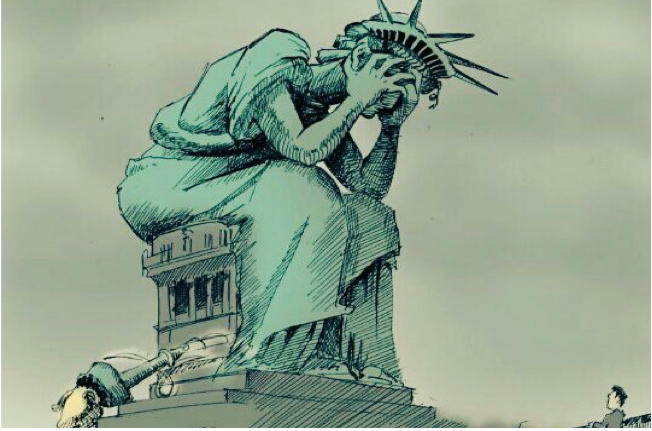
“A well regulated militia, being necessary to the security of a free state, the right of the people to keep and bear arms, shall not be infringed.”—The Second Amendment to the US Constitution

You can largely determine where a person will fall in the debate over gun control and the Second Amendment based on their view of government and the role it should play in our lives.

In the first group are those who see the government as a Nanny State, empowered to look out for the best interests of the populace, even when that means overriding our rights as individuals and free will.

These individuals tend to interpret the Second Amendment to mean that only members of law enforcement and the military are entitled to own a gun. Case in point: President Biden recently (and wrongly) asserted that “the Second Amendment, from the day it was passed, limited the type of people who could own a gun and what type of weapon you could own. You couldn’t buy a cannon.”

In the second group are those who see the government as inherently corrupt.

These individuals tend to view the Second Amendment as a means of self-defense, whether that involves defending themselves against threats to their freedoms or threats from individuals looking to harm them. For instance, eleven men were recently arrested for traveling on the interstate with unlicensed guns that were not secured in a case. The group, reportedly associated with a sovereign citizens group, claimed to be traveling from Rhode Island to Maine for militia training.

And then there is a third group, made up of those who view the government as neither good nor evil, but merely a powerful entity that, as Thomas Jefferson recognized, must be bound “down from mischief by the chains of the Constitution.” To this group, the Second Amendment’s assurance of the people’s right to bear arms is no different from any other right enshrined in the Constitution: to be safeguarded, exercised prudently and maintained.

How to exercise this right is the question that keeps jockeying for supremacy before the U.S. Supreme Court. After declaring more than a decade ago that citizens have a Second Amendment right to own a gun in one’s home for self-defense, the Court has now been tasked with deciding whether the Constitution also protects the right to carry a gun outside the home. The case, NY State Rifle & Pistol Assoc. v. Corlett, takes issue with a state law that requires a license in order to carry a concealed gun outside the home.

On the heels of Corlett is another legal challenge to the state’s authority to regulate—or ban outright—gun ownership outside the home. The attorneys general of 21 states—including Louisiana, Arizona, Montana, Alabama, Arkansas, Georgia, Idaho, Kansas, Kentucky, Mississippi, Missouri, Nebraska, North Dakota, Ohio, Oklahoma, South Carolina, South Dakota, Texas, Utah, West Virginia and Wyoming—have filed an amicus brief in Young v. Hawaii asking the Supreme Court to uphold Hawaiians’ Second Amendment rights to bear arms outside their homes.

Unfortunately, while the various federal circuit courts of appeal continue to disagree over the exact nature of the rights protected by the Second Amendment, the government itself has made its position extremely clear.

When it comes to gun rights in particular, and the rights of the citizenry overall, the U.S. government has adopted a “do what I say, not what I do” mindset. Nowhere is this double standard more evident than in the government’s attempts to arm itself to the teeth, all the while viewing as suspect anyone who dares to legally own a gun, let alone use one in self-defense.

Indeed, while it still technically remains legal to own a firearm in America, possessing one can now get you pulled over, searched, arrested, subjected to all manner of surveillance, treated as a suspect without ever having committed a crime, shot at, and killed. (This same rule does not apply to law enforcement officials, however, who are armed to the hilt and rarely given more than a slap on the wrists for using their weapons against unarmed individuals.)

Now the Biden Administration is setting its sights on gun control.

Mark my words: gun control legislation, especially in the form of red flag gun laws, which allow the police to remove guns from people “suspected” of being threats, will become yet another means by which to subvert the Constitution and sabotage the rights of the people.

Giving police the power to preemptively raid homes in order to neutralize a potential threat is a powder keg waiting for a lit match.

Under these red flag laws, what happened to Duncan Lemp—who was gunned down in his bedroom during an early morning, no-knock SWAT team raid on his family’s home—could very well happen to more people.

At 4:30 a.m. on March 12, 2020, in the midst of a COVID-19 pandemic that had most of the country under a partial lockdown and sheltering at home, a masked SWAT team—deployed to execute a “high risk” search warrant for unauthorized firearms—stormed the suburban house where 21-year-old Duncan, a software engineer and Second Amendment advocate, lived with his parents and 19-year-old brother.

The entire household, including Lemp and his girlfriend, was reportedly asleep when the SWAT team directed flash bang grenades and gunfire through Lemp’s bedroom window.

Lemp was killed and his girlfriend injured.

No one in the house that morning, including Lemp, had a criminal record.

No one in the house that morning, including Lemp, was considered an “imminent threat” to law enforcement or the public, at least not according to the search warrant.

So what was so urgent that militarized police felt compelled to employ battlefield tactics in the pre-dawn hours of a day when most people are asleep in bed, not to mention stuck at home as part of a nationwide lockdown?

According to police, they were tipped off that Lemp was in possession of “firearms.”

Thus, rather than approaching the house by the front door at a reasonable hour in order to investigate this complaint—which is what the Fourth Amendment requires—police instead strapped on their guns, loaded up their flash bang grenades and acted like battle-crazed warriors.

This is what happens when you adopt red flag gun laws, which Maryland did in 2018, painting anyone who might be in possession of a gun—legal or otherwise—as a threat that must be neutralized.

Meanwhile, the government’s efforts to militarize and weaponize its agencies and employees is reaching epic proportions, with federal agencies as varied as the Department of Homeland Security and the Social Security Administration placing orders for hundreds of millions of rounds of hollow point bullets. Moreover, under the auspices of a military “recycling” program, which allows local police agencies to acquire military-grade weaponry and equipment, $4.2 billion worth of equipment has been transferred from the Defense Department to domestic police agencies since 1990. Included among these “gifts” are tank-like 20-ton Mine Resistant Ambush Protected (MRAP) vehicles, tactical gear, and assault rifles.

Ironically, while the Biden administration’s gun control efforts have helped to spike gun sales nationally, the government has made no effort to curtail its own addiction to weapons of war, a significant number of which have conveniently been “lost” and used in violent crimes in communities across the U.S.

We’re talking about rifles, pistols, machine guns, shot guns, and grenades. Some of these weapons were lost through gross negligence. Others, however, were trafficked by military police.

The U.S. military boasts weapons the rest of the world doesn’t have, and it continues to develop even more weaponry, each deadlier than the last.

Make no mistake: every last one of these weapons will eventually make its way back to domestic police forces to be used against the American people.

Included in the government’s military arsenal are armed, surveillance Reaper drones capable of reading a license plate from over two miles away; an AA12 Atchisson Assault Shotgun that can shoot five 12-gauge shells per second and “can fire up to 9,000 rounds without being cleaned or jamming”; an ADAPTIV invisibility cloak that can make a tank disappear or seemingly reshape it to look like a car; a PHASR rifle capable of blinding and disorienting anyone caught in its sights; a Taser shockwave that can electrocute a crowd of people at the touch of a button; an XM2010 enhanced sniper rifle with built-in sound and flash suppressors that can hit a man-sized target nine out of ten times from over a third of a mile away; and an XM25 “Punisher” grenade launcher that can be programmed to accurately shoot grenades at a target up to 500 meters away.

What the government has yet to acknowledge, however, is that its own gun violence—inflicted on unarmed individuals by battlefield-trained SWAT teams, militarized police, and bureaucratic government agents trained to shoot first and ask questions later—is not making America any safer.

Indeed, the U.S. government may be the most egregious perpetrator of gun violence in America, bar none.

All the while gun critics continue to clamor for bans on military-style assault weapons, high-capacity magazines and armor-piercing bullets, the U.S. military is passing them out to domestic police forces.

Under the auspices of a military “recycling” program, which allows local police agencies to acquire military-grade weaponry and equipment, more than $4.2 billion worth of equipment has been transferred from the Defense Department to domestic police agencies since 1990. Included among these “gifts” are tank-like, 20-ton Mine Resistant Ambush Protected (MRAP) vehicles, tactical gear, and assault rifles.

There are now reportedly more bureaucratic (non-military) government agents armed with high-tech, deadly weapons than U.S. Marines.

While Americans have to jump through an increasing number of hoops in order to own a gun, the government is arming its own civilian employees to the hilt with guns, ammunition and military-style equipment, authorizing them to make arrests, and training them in military tactics.

Among the agencies being supplied with night-vision equipment, body armor, hollow-point bullets, shotguns, drones, assault rifles and LP gas cannons are the Smithsonian, U.S. Mint, Health and Human Services, IRS, FDA, Small Business Administration, Social Security Administration, National Oceanic and Atmospheric Administration, Education Department, Energy Department, Bureau of Engraving and Printing and an assortment of public universities.

This is the double standard at play here.

How is it that while violence has become our government’s calling card, from the more than 80,000 SWAT team raids carried out every year on unsuspecting Americans by heavily armed, black-garbed commandos and the increasingly rapid militarization of local police forces across the country to the drone killings used to target insurgents, “we the people” are the ones who must be regulated, restricted and banned from owning a weapon?

If we’re truly going to get serious about gun violence, why not start by scaling back the American police state’s weapons of war?

I’ll tell you why: because the government has no intention of scaling back on its weapons.

We’ve allowed ourselves to get so focused on debating who or what is responsible for gun violence—the guns, the gun owners, or our violent culture—and whether the Second Amendment “allows” us to own guns that we’ve overlooked the most important and most consistent theme throughout the Constitution: the fact that it is not merely an enumeration of our rights but was intended to be a clear shackle on the government’s powers.

When considered in the context of prohibitions against the government, the Second Amendment reads as a clear rebuke against any attempt to restrict the citizenry’s gun ownership.

As such, it is as necessary an ingredient for maintaining that tenuous balance between the citizenry and their republic as any of the other amendments in the Bill of Rights, especially the right to freedom of speech, assembly, press, petition, security, and due process.

Supreme Court Justice William O. Douglas understood this tension well. “The Constitution is not neutral,” he remarked, “It was designed to take the government off the backs of people.”

In this way, the freedoms enshrined in the Bill of Rights in their entirety stand as a bulwark against a police state.

To our detriment, these rights have been steadily weakened, eroded and undermined in recent years. Yet without any one of them, including the Second Amendment right to own and bear arms, we are that much more vulnerable to the vagaries of out-of-control policemen, benevolent dictators, genuflecting politicians, and overly ambitious bureaucrats.

When all is said and done, the debate over gun ownership really has little to do with gun violence in America. It’s also not even a question of whether Americans need weapons to defend themselves against any overt threats to our safety or wellbeing.

Truly, the debate over gun ownership in America is really a debate over who gets to call the shots and control the game.

In other words, it’s that same tug-of-war that keeps getting played out in every confrontation between the government and the citizenry over who gets to be the master and who is relegated to the part of the servant.

The Constitution, with its multitude of prohibitions on government overreach, is clear on this particular point. As 20th century libertarian Edmund A. Opitz observed in 1964, “No one can read our Constitution without concluding that the people who wrote it wanted their government severely limited; the words ‘no’ and ‘not’ employed in restraint of government power occur 24 times in the first seven articles of the Constitution and 22 more times in the Bill of Rights.”

In a nutshell, as I make clear in Battlefield America: The War on the American People, the Second Amendment’s right to bear arms reflects not only a concern for one’s personal defense, but serves as a check on the political power of the ruling authorities.

It represents an implicit warning against governmental encroachments on one’s freedoms, the warning shot over the bow to discourage any unlawful violations of our persons or property.

As such, it reinforces that necessary balance in the citizen-state relationship. As George Orwell, who plays a starring role in my new novel The Erik Blair Diaries, noted, “That rifle hanging on the wall of the working-class flat or labourer’s cottage is the symbol of democracy. It is our job to see that it stays there.”

Source: https://bit.ly/2VfoOdK

ABOUT JOHN W. WHITEHEAD

Constitutional attorney and author John W. Whitehead is founder and president The Rutherford Institute. His books Battlefield America: The War on the American People and A Government of Wolves: The Emerging American Police State are available at www.amazon.com. He can be contacted at johnw@rutherford.org. Nisha Whitehead is the Executive Director of The Rutherford Institute. Information about The Rutherford Institute is available at www.rutherford.org.

Publication Guidelines / Reprint Permission

John W. Whitehead’s weekly commentaries are available for publication to newspapers and web publications at no charge. Please contact staff@rutherford.org to obtain reprint permission.
“There is now the capacity to make tyranny total in America.”― James Bamford

It never fails.

Just as we get a glimmer of hope that maybe, just maybe, there might be a chance of crawling out of this totalitarian cesspool in which we’ve been mired, we get kicked down again.

In the same week that the U.S. Supreme Court unanimously declared that police cannot carry out warrantless home invasions in order to seize guns under the pretext of their “community caretaking” duties, the Biden Administration announced its plans for a “precrime” crime prevention agency.

Talk about taking one step forward and two steps back.

Precrime, straight out of the realm of dystopian science fiction movies such as Minority Report, aims to prevent crimes before they happen by combining widespread surveillance, behavior prediction technologies, data mining, precognitive technology, and neighborhood and family snitch programs to enable police to capture would-be criminals before they can do any damage.

This particular precrime division will fall under the Department of Homeland Security, the agency notorious for militarizing the police and SWAT teams; spying on activists, dissidents and veterans; stockpiling ammunition; distributing license plate readers; contracting to build detention camps; tracking cell-phones with Stingray devices; carrying out military drills and lockdowns in American cities; using the TSA as an advance guard; conducting virtual strip searches with full-body scanners; carrying out soft target checkpoints; directing government workers to spy on Americans; conducting widespread spying networks using fusion centers; carrying out Constitution-free border control searches; funding city-wide surveillance cameras; and utilizing drones and other spybots.

The intent, of course, is for the government to be all-seeing, all-knowing and all-powerful in its preemptive efforts to combat domestic extremism.

Where we run into trouble is when the government gets overzealous and over-ambitious and overreaches.

This is how you turn a nation of citizens into snitches and suspects.

In the blink of an eye, ordinary Americans will find themselves labeled domestic extremists for engaging in lawful behavior that triggers the government’s precrime sensors.

Of course, it’s an elaborate setup: we’ll all be targets.

In such a suspect society, the burden of proof is reversed so that guilt is assumed and innocence must be proven.

It’s the American police state’s take on the dystopian terrors foreshadowed by George Orwell, Aldous Huxley and Phillip K. Dick all rolled up into one oppressive pre-crime and pre-thought crime package.

What’s more, the technocrats who run the surveillance state don’t even have to break a sweat while monitoring what you say, what you read, what you write, where you go, how much you spend, whom you support, and with whom you communicate.

Computers now do the tedious work of trolling social media, the internet, text messages and phone calls for potentially anti-government remarks, all of which is carefully recorded, documented, and stored to be used against you someday at a time and place of the government’s choosing.

In this way, with the help of automated eyes and ears, a growing arsenal of high-tech software, hardware and techniques, government propaganda urging Americans to turn into spies and snitches, as well as social media and behavior sensing software, government agents are spinning a sticky spider-web of threat assessments, behavioral sensing warnings, flagged “words,” and “suspicious” activity reports aimed at snaring potential enemies of the state.

It works the same in any regime.

As Professor Robert Gellately notes in his book Backing Hitler about the police state tactics used in Nazi Germany: “There were relatively few secret police, and most were just processing the information coming in. I had found a shocking fact. It wasn’t the secret police who were doing this wide-scale surveillance and hiding on every street corner. It was the ordinary German people who were informing on their neighbors.”

Here’s the thing as the Germans themselves quickly discovered: you won’t have to do anything illegal or challenge the government’s authority in order to be flagged as a suspicious character, labeled an enemy of the state and locked up like a dangerous criminal.

In fact, all you will need to do is use certain trigger words, surf the internet, communicate using a cell phone, drive a car, stay at a hotel, purchase materials at a hardware store, take flying or boating lessons, appear suspicious to a neighbor, question government authority, or generally live in the United States.

The following activities are guaranteed to get you censored, surveilled, eventually placed on a government watch list, possibly detained and potentially killed.

Use harmless trigger words like cloud, pork and pirates: The Department of Homeland Security has an expansive list of keywords and phrases it uses to monitor social networking sites and online media for signs of terrorist or other threats. While you’ll definitely send up an alert for using phrases such as dirty bomb, Jihad and Agro terror, you’re just as likely to get flagged for surveillance if you reference the terms SWAT, lockdown, police, cloud, food poisoning, pork, flu, Subway, smart, delays, cancelled, la familia, pirates, hurricane, forest fire, storm, flood, help, ice, snow, worm, warning or social media.

Use a cell phone: Simply by using a cell phone, you make yourself an easy target for government agents—working closely with corporations—who can listen in on your phone calls, read your text messages and emails, and track your movements based on the data transferred from, received by, and stored in your cell phone. Mention any of the so-called “trigger” words in a conversation or text message, and you’ll get flagged for sure.

Drive a car: Unless you’ve got an old junkyard heap without any of the gadgets and gizmos that are so attractive to today’s car buyers (GPS, satellite radio, electrical everything, smart systems, etc.), driving a car today is like wearing a homing device: you’ll be tracked from the moment you open that car door thanks to black box recorders and vehicle-to-vehicle communications systems that can monitor your speed, direction, location, the number of miles traveled, and even your seatbelt use. Once you add satellites, GPS devices, license plate readers, and real-time traffic cameras to the mix, there’s nowhere you can go on our nation’s highways and byways that you can’t be followed. By the time you add self-driving cars into the futuristic mix, equipped with computers that know where you want to go before you do, privacy and autonomy will be little more than distant mirages in your rearview mirror.

Attend a political rally: Enacted in the wake of 9/11, the Patriot Act redefined terrorism so broadly that many non-terrorist political activities such as protest marches, demonstrations and civil disobedience were considered potential terrorist acts, thereby rendering anyone desiring to engage in protected First Amendment expressive activities as suspects of the surveillance state.

Express yourself on social media: The FBI, CIA, NSA and other government agencies are investing in and relying on corporate surveillance technologies that can mine constitutionally protected speech on social media platforms such as Facebook, Twitter and Instagram in order to identify potential extremists and predict who might engage in future acts of anti-government behavior. A decorated Marine, 26-year-old Brandon Raub was targeted by the Secret Service because of his Facebook posts, interrogated by government agents about his views on government corruption, arrested with no warning, labeled mentally ill for subscribing to so-called “conspiratorial” views about the government, detained against his will in a psych ward for having “dangerous” opinions, and isolated from his family, friends and attorneys.

Serve in the militaryOperation Vigilant Eagle, the brainchild of the Dept. of Homeland Security, calls for surveillance of military veterans returning from Iraq and Afghanistan, characterizing them as extremists and potential domestic terrorist threats because they may be “disgruntled, disillusioned or suffering from the psychological effects of war.” Police agencies are also using Beware, an “early warning” computer system that tips them off to a potential suspect’s inclination to be a troublemaker and assigns individuals a color-coded threat score—green, yellow or red—based on a variety of factors including one’s criminal records, military background, medical history and social media surveillance.

Disagree with a law enforcement official: A growing number of government programs are aimed at identifying, monitoring and locking up anyone considered potentially “dangerous” or mentally ill (according to government standards, of course). For instance, a homeless man in New York City who reportedly had a history of violence but no signs of mental illness was forcibly detained in a psych ward for a week after arguing with shelter police. Despite the fact that doctors cited no medical reason to commit him, the man was locked up in accordance with a $22 million program that monitors mentally ill people considered “potentially” violent. According to the Associated Press, “A judge finally ordered his release, ruling that the man’s commitment violated his civil rights and that bureaucrats had meddled in his medical treatment.”

Call in sick to work: In Virginia, a so-called police “welfare check” instigated by a 58-year-old man’s employer after he called in sick resulted in a two-hour, SWAT team-style raid on the man’s truck and a 72-hour mental health hold. During the standoff, a heavily armed police tactical team confronted Benjamin Burruss as he was leaving an area motel, surrounded his truck, deployed a “stinger” device behind the rear tires, launched a flash grenade, smashed the side window in order to drag him from the truck, handcuffed and searched him, and transported him to a local hospital for a psychiatric evaluation and mental health hold. All of this was done despite the fact that police acknowledged they had no legal basis nor probable cause for detaining Burruss, given that he had not threatened to harm anyone and was not mentally ill.

Limp or stutter: As a result of a nationwide push to certify a broad spectrum of government officials in mental health first-aid training (a 12-hour course comprised of PowerPoint presentations, videos, discussions, role playing and other interactive activities), more Americans are going to run the risk of being reported for having mental health issues by non-medical personnel. Mind you, once you get on such a government watch list—whether it’s a terrorist watch list, a mental health watch list, or a dissident watch list—there’s no clear-cut way to get off, whether or not you should actually be on there. For instance, one 37-year-old disabled man was arrested, diagnosed by police and an unlicensed mental health screener as having “mental health issues,” apparently because of his slurred speech and unsteady gait, and subsequently locked up for five days in a mental health facility against his will and with no access to family and friends. A subsequent hearing found that Gordon Goines, who suffers from a neurological condition similar to multiple sclerosis, has no mental illness and should not have been confined.

Appear confused or nervous, fidget, whistle or smell bad: According to the Transportation Security Administration’s 92-point secret behavior watch list for spotting terrorists, these are among some of the telling signs of suspicious behavior: fidgeting, whistling, bad body odor, yawning, clearing your throat, having a pale face from recently shaving your beard, covering your mouth with your hand when speaking and blinking your eyes fast. You can also be pulled aside for interrogation if you “have ‘unusual items,’ like almanacs and ‘numerous prepaid calling cards or cell phones.’” One critic of the program accurately referred to the program as a “license to harass.”

Allow yourself to be seen in public waving a toy gun or anything remotely resembling a gun, such as a water nozzle or a remote control or a walking cane, for instance: No longer is it unusual to hear about incidents in which police shoot unarmed individuals first and ask questions later. John Crawford was shot by police in an Ohio Wal-Mart for holding an air rifle sold in the store that he may have intended to buy. Thirteen-year-old Andy Lopez Cruz was shot 7 times in 10 seconds by a California police officer who mistook the boy’s toy gun for an assault rifle. Christopher Roupe, 17, was shot and killed after opening the door to a police officer. The officer, mistaking the Wii remote control in Roupe’s hand for a gun, shot him in the chest. Another police officer repeatedly shot 70-year-old Bobby Canipe during a traffic stop. The cop saw the man reaching for his cane and, believing the cane to be a rifle, opened fire.

Stare at a police officer: Miami-Dade police slammed the 14-year-old Tremaine McMillian to the ground, putting him in a chokehold and handcuffing him after he allegedly gave them “dehumanizing stares” and walked away from them, which the officers found unacceptable.

Appear to be pro-gun, pro-freedom or anti-government: You might be a domestic terrorist in the eyes of the FBI (and its network of snitches) if you: express libertarian philosophies (statements, bumper stickers); exhibit Second Amendment-oriented views (NRA or gun club membership); read survivalist literature, including apocalyptic fictional books; show signs of self-sufficiency (stockpiling food, ammo, hand tools, medical supplies); fear an economic collapse; buy gold and barter items; subscribe to religious views concerning the book of Revelation; voice fears about Big Brother or big government; expound about constitutional rights and civil liberties; or believe in a New World Order conspiracy. This is all part of a larger trend in American governance whereby dissent is criminalized and pathologized, and dissenters are censored, silenced or declared unfit for society. 

Attend a public school: Microcosms of the police state, America’s public schools contain almost every aspect of the militarized, intolerant, senseless, overcriminalized, legalistic, surveillance-riddled, totalitarian landscape that plagues those of us on the “outside.” From the moment a child enters one of the nation’s 98,000 public schools to the moment she graduates, she will be exposed to a steady diet of draconian zero tolerance policies that criminalize childish behavior, overreaching anti-bullying statutes that criminalize speech, school resource officers (police) tasked with disciplining and/or arresting so-called “disorderly” students, standardized testing that emphasizes rote answers over critical thinking, politically correct mindsets that teach young people to censor themselves and those around them, and extensive biometric and surveillance systems that, coupled with the rest, acclimate young people to a world in which they have no freedom of thought, speech or movement. Additionally, as part of the government’s so-called ongoing war on terror, the FBI—the nation’s de facto secret police force—has been recruiting students and teachers to spy on each other and report anyone who appears to have the potential to be “anti-government” or “extremist” as part of its “Don’t Be a Puppet” campaign.

Speak truth to power: Long before Chelsea Manning and Edward Snowden were being castigated for blowing the whistle on the government’s war crimes and the National Security Agency’s abuse of its surveillance powers, it was activists such as Martin Luther King Jr. and John Lennon who were being singled out for daring to speak truth to power. These men and others like them had their phone calls monitored and data files collected on their activities and associations. For a little while, at least, they became enemy number one in the eyes of the U.S. government.

Yet as I point out in my book Battlefield America: The War on the American People, you don’t even have to be a dissident to get flagged by the government for surveillance, censorship and detention.

All you really need to be is a citizen of the American police state.

Source: https://bit.ly/3hDJB3D

ABOUT JOHN W. WHITEHEAD

Constitutional attorney and author John W. Whitehead is founder and president The Rutherford Institute. His books Battlefield America: The War on the American People and A Government of Wolves: The Emerging American Police State are available at www.amazon.com. He can be contacted at johnw@rutherford.org. Nisha Whitehead is the Executive Director of The Rutherford Institute. Information about The Rutherford Institute is available at www.rutherford.org.

Publication Guidelines / Reprint Permission

John W. Whitehead’s weekly commentaries are available for publication to newspapers and web publications at no charge. Please contact staff@rutherford.org to obtain reprint permission.