Posts Tagged ‘police’

“You know, when police start becoming their own executioners, where’s it gonna end? Pretty soon, you’ll start executing people for jaywalking, and executing people for traffic violations. Then you end up executing your neighbor ‘cause his dog pisses on your lawn.”—“Dirty Harry” Callahan, Magnum Force

When I say that warrior cops—hyped up on their own authority and the power of the badge—have not made America any safer or freer, I am not disrespecting any of the fine, decent, lawful police officers who take seriously their oath of office to serve and protect their fellow citizens, uphold the Constitution, and maintain the peace.

My concern rests with the cops who feel empowered to act as judge, jury and executioner.

These death squads believe they can kill, shoot, taser, abuse and steal from American citizens in the so-called name of law and order.

Just recently, in fact, a rookie cop opened fire on the occupants of a parked car in a McDonald’s parking lot on a Sunday night in San Antonio, Texas.

The driver, 17-year-old Erik Cantu and his girlfriend, were eating burgers inside the car when the police officer—suspecting the car might have been one that fled an attempted traffic stop the night before—abruptly opened the driver side door, ordered the teenager to get out, and when he did not comply, shot ten times at the car, hitting Cantu multiple times.

Mind you, this wasn’t a life-or-death situation.

It was two teenagers eating burgers in a parking lot, and a cop fresh out of the police academy taking justice into his own hands.

This wasn’t an isolated incident, either.

In Hugo, Oklahoma, plain clothes police officers opened fire on a pickup truck parked in front of a food bank, heedless of the damage such a hail of bullets—26 shots were fired—could have on those in the vicinity. Three of the four children inside the parked vehicle were shot: a 4-year-old girl was shot in the head and ended up with a bullet in the brain; a 5-year-old boy received a skull fracture; and a 1-year-old girl had deep cuts on her face from gunfire or shattered window glass. The reason for the use of such excessive force? Police were searching for a suspect in a weeks-old robbery of a pizza parlor that netted $400.

In Minnesota, a 4-year-old girl watched from the backseat of a car as cops shot and killed her mother’s boyfriend, Philando Castile, a school cafeteria supervisor, during a routine traffic stop merely because Castile disclosed that he had a gun in his possession, for which he had a lawful conceal-and-carry permit. That’s all it took for police to shoot Castile four times as he was reaching for his license and registration. 

In Arizona, a 7-year-old girl watched panic-stricken as a state trooper pointed his gun at her and her father during a traffic stop and reportedly threated to shoot her father in the back (twice) based on the mistaken belief that they were driving a stolen rental car.

This is how we have gone from a nation of laws—where the least among us had just as much right to be treated with dignity and respect as the next person (in principle, at least)—to a nation of law enforcers (revenue collectors with weapons) who treat the citizenry like suspects and criminals.

The lesson for all of us: at a time when police have almost absolute discretion to decide who is a threat, what constitutes resistance, and how harshly they can deal with the citizens they were appointed to “serve and protect”—and a “fear” for officer safety is used to justify all manner of police misconduct—“we the people” are at a severe disadvantage.

Add a traffic stop to the mix, and that disadvantage increases dramatically.

According to the Justice Department, the most common reason for a citizen to come into contact with the police is being a driver in a traffic stop.

On average, one in 10 Americans gets pulled over by police.

Of the roughly 1,100 people killed by police each year, 10% of those involve traffic stops.

Historically, police officers have been given free range to pull anyone over for a variety of reasons.

This free-handed approach to traffic stops has resulted in drivers being stopped for windows that are too heavily tinted, for driving too fast, driving too slow, failing to maintain speed, following too closely, improper lane changes, distracted driving, screeching a car’s tires, and leaving a parked car door open for too long.

Motorists can also be stopped by police for driving near a bar or on a road that has large amounts of drunk driving, driving a certain make of car (Mercedes, Grand Prix and Hummers are among the most ticketed vehicles), having anything dangling from the rearview mirror (air fresheners, handicap parking permits, toll transponders or rosaries), and displaying pro-police bumper stickers.

Incredibly, a federal appeals court actually ruled unanimously in 2014 that acne scars and driving with a stiff upright posture are reasonable grounds for being pulled over. The Fifth Circuit Court of Appeals ruled that driving a vehicle that has a couple air fresheners, rosaries and pro-police bumper stickers at 2 MPH over the speed limit is suspicious, meriting a traffic stop.

Equally appalling, in Heien v. North Carolina, the U.S. Supreme Court—which has largely paved the way for the police and other government agents to probe, poke, pinch, taser, search, seize, strip and generally manhandle anyone they see fit in almost any circumstance—allowed police officers to stop drivers who appear nervous, provided they provide a palatable pretext for doing so.

Black drivers are almost two times more likely than white drivers to be pulled over by police and three times more likely to have their vehicles searched. As the Washington Post concludes, “‘Driving while black’ is, indeed, a measurable phenomenon.”

In other words, drivers beware.

Traffic stops aren’t just dangerous. They can be downright deadly.

Patrick Lyoya was pulled over for having a mismatched license plate. The unarmed man was shot in the back of the head while on the ground during a subsequent struggle with a Michigan police officer.

Reportedly pulled over for a broken taillight, Walter Scott—unarmed—ran away from the police officer, who pursued and shot him from behind, first with a Taser, then with a gun. Scott was struck five times, “three times in the back, once in the upper buttocks and once in the ear — with at least one bullet entering his heart.”

Samuel Dubose, also unarmed, was pulled over for a missing front license plate. He was reportedly shot in the head after a brief struggle in which his car began rolling forward.

Levar Jones was stopped for a seatbelt offense, just as he was getting out of his car to enter a convenience store. Directed to show his license, Jones leaned into his car to get his wallet, only to be shot four times by the “fearful” officer. Jones was also unarmed.

Bobby Canipe was pulled over for having an expired registration. When the 70-year-old reached into the back of his truck for his walking cane, the officer fired several shots at him, hitting him once in the abdomen.

Dontrell Stevens was stopped “for not bicycling properly.” The officer pursuing him “thought the way Stephens rode his bike was suspicious. He thought the way Stephens got off his bike was suspicious.” Four seconds later, sheriff’s deputy Adams Lin shot Stephens four times as he pulled out a black object from his waistband. The object was his cell phone. Stephens was unarmed.

That police are choosing to fatally resolve these encounters by using their guns on fellow citizens speaks volumes about what is wrong with policing in America today, where police officers are being dressed in the trappings of war, drilled in the deadly art of combat, and trained to look upon “every individual they interact with as an armed threat and every situation as a deadly force encounter in the making.”

Keep in mind, from the moment those lights start flashing and that siren goes off, we’re all in the same boat. Yet it’s what happens after you’ve been pulled over that’s critical.

Trying to predict the outcome of any encounter with the police is a bit like playing Russian roulette: most of the time you will emerge relatively unscathed, although decidedly poorer and less secure about your rights, but there’s always the chance that an encounter will turn deadly.

Survival is key.

Technically, you have the right to remain silent (beyond the basic requirement to identify yourself and show your registration). You have the right to refuse to have your vehicle searched. You have the right to film your interaction with police. You have the right to ask to leave. You also have the right to resist an unlawful order such as a police officer directing you to extinguish your cigarette, put away your phone or stop recording them.

However, there is a price for asserting one’s rights. That price grows more costly with every passing day.

If you ask cops and their enablers what Americans should do to stay alive during encounters with police, they will tell you to comply, cooperate, obey, not resist, not argue, not make threatening gestures or statements, avoid sudden movements, and submit to a search of their person and belongings. 

Unfortunately, in the American police state, compliance is no guarantee that you will survive an encounter with the police with your life and liberties intact.

Every day we hear about situations in which unarmed Americans complied and still died during an encounter with police simply because they appeared to be standing in a “shooting stance” or held a cell phone or a garden hose or carried around a baseball bat or answered the front door or held a spoon in a threatening manner or ran in an aggressive manner holding a tree branch or wandered around naked or hunched over in a defensive posture or made the mistake of wearing the same clothes as a carjacking suspect (dark pants and a basketball jersey) or dared to leave an area at the same time that a police officer showed up or had a car break down by the side of the road or were deaf or homeless or old.

More often than not, it seems as if all you have to do to be shot and killed by police is stand a certain way, or move a certain way, or hold something—anything—that police could misinterpret to be a gun, or ignite some trigger-centric fear in a police officer’s mind that has nothing to do with an actual threat to their safety.

Now politicians, police unions, law enforcement officials and individuals who are more than happy to march in lockstep with the police state make all kinds of excuses to justify these shootings.  However, to suggest that a good citizen is a compliant citizen and that obedience will save us from the police state is not only recklessly irresponsible, but it is also deluded.

To begin with, and most importantly, Americans need to know their rights when it comes to interactions with the police, bearing in mind that many law enforcement officials are largely ignorant of the law themselves.

A good resource is The Rutherford Institute’s “Constitutional Q&A: Rules of Engagement for Interacting with Police.”

In a nutshell, the following are your basic rights when it comes to interactions with the police as outlined in the Bill of Rights:

You have the right under the First Amendment to ask questions and express yourself. You have the right under the Fourth Amendment to not have your person or your property searched by police or any government agent unless they have a search warrant authorizing them to do so.  You have the right under the Fifth Amendment to remain silent, to not incriminate yourself and to request an attorney. Depending on which state you live in and whether your encounter with police is consensual as opposed to your being temporarily detained or arrested, you may have the right to refuse to identify yourself. Not all states require citizens to show their ID to an officer (although drivers in all states must do so).

As a rule of thumb, you should always be sure to clarify in any police encounter whether or not you are being detained, i.e., whether you have the right to walk away. That holds true whether it’s a casual “show your ID” request on a boardwalk, a stop-and-frisk search on a city street, or a traffic stop for speeding or just to check your insurance. If you feel like you can’t walk away from a police encounter of your own volition—and more often than not you can’t, especially when you’re being confronted by someone armed to the hilt with all manner of militarized weaponry and gear—then for all intents and purposes, you’re essentially under arrest from the moment a cop stops you. Still, it doesn’t hurt to clarify that distinction.

While technology is always going to be a double-edged sword, with the gadgets that are the most useful to us in our daily lives—GPS devices, cell phones, the internet—being the very tools used by the government to track us, monitor our activities, and generally spy on us, cell phones are particularly useful for recording encounters with the police and have proven to be increasingly powerful reminders to police that they are not all powerful.

Knowing your rights is only part of the battle, unfortunately.

As I point out in my book Battlefield America: The War on the American People and in its fictional counterpart The Erik Blair Diaries, the danger arises when the burden of proof is reversed, “we the people” are assumed guilty, and we have to exercise our rights while simultaneously attempting to prove our innocence to trigger-happy cops with no understanding of the Bill of Rights.

Source: https://bit.ly/3ThwQeZ

ABOUT JOHN W. WHITEHEAD

Constitutional attorney and author John W. Whitehead is founder and president of The Rutherford Institute. His most recent books are the best-selling Battlefield America: The War on the American People, the award-winning A Government of Wolves: The Emerging American Police State, and a debut dystopian fiction novel, The Erik Blair Diaries. Whitehead can be contacted at staff@rutherford.org. Nisha Whitehead is the Executive Director of The Rutherford Institute. Information about The Rutherford Institute is available at www.rutherford.org.

Publication Guidelines / Reprint Permission

John W. Whitehead’s weekly commentaries are available for publication to newspapers and web publications at no charge. Please contact staff@rutherford.org to obtain reprint permission.

“Once a government is committed to the principle of silencing the voice of opposition, it has only one way to go, and that is down the path of increasingly repressive measures, until it becomes a source of terror to all its citizens and creates a country where everyone lives in fear.” — President Harry S. Truman

Militarized police. Riot squads. Camouflage gear. Black uniforms. Armored vehicles. Mass arrests. Pepper spray. Tear gas. Batons. Strip searches. Surveillance cameras. Kevlar vests. Drones. Lethal weapons. Less-than-lethal weapons unleashed with deadly force. Rubber bullets. Water cannons. Stun grenades. Arrests of journalists. Crowd control tactics. Intimidation tactics. Brutality. Lockdowns.

This is not the language of freedom. This is not even the language of law and order.

This is the language of force.

This is how the government at all levels—federal, state and local—now responds to those who speak out against government corruption, misconduct and abuse.

These overreaching, heavy-handed lessons in how to rule by force have become standard operating procedure for a government that communicates with its citizenry primarily through the language of brutality, intimidation and fear.

We didn’t know it then, but what happened five years ago in Charlottesville, Va., was a foretaste of what was to come.

At the time, Charlottesville was at the center of a growing struggle over how to reconcile the right to think and speak freely, especially about controversial ideas, with the push to sanitize the environment of anything—words and images—that might cause offense. That fear of offense prompted the Charlottesville City Council to get rid of a statue of Confederate General Robert E. Lee that had graced one of its public parks for 82 years.

In attempting to err on the side of political correctness by placating one group while muzzling critics of the city’s actions, Charlottesville attracted the unwanted attention of the Ku Klux Klan, neo-Nazis and the alt-Right, all of whom descended on the little college town with the intention of exercising their First Amendment right to be disagreeable, to assemble, and to protest.

That’s when everything went haywire.

When put to the test, Charlottesville did not handle things well at all.

On August 12, 2017, government officials took what should have been a legitimate exercise in constitutional principles (free speech, assembly and protest) and turned it into a lesson in authoritarianism by manipulating warring factions and engineering events in such a way as to foment unrest, lockdown the city, and justify further power grabs.

On the day of scheduled protests, police deliberately engineered a situation in which two opposing camps of protesters would confront each other, tensions would bubble over, and things would turn just violent enough to justify allowing the government to shut everything down.

Despite the fact that 1,000 first responders (including 300 state police troopers and members of the National Guard)—many of whom had been preparing for the downtown rally for months—had been called on to work the event, and police in riot gear surrounded Emancipation Park on three sides, police failed to do their jobs.

In fact, as the Washington Post reports, police “seemed to watch as groups beat each other with sticks and bludgeoned one another with shields… At one point, police appeared to retreat and then watch the beatings before eventually moving in to end the free-for-all, make arrests and tend to the injured.”

Police Stood By As Mayhem Mounted in Charlottesville,” reported ProPublica.

Incredibly, when the first signs of open violence broke out, the police chief allegedly instructed his staff to “let them fight, it will make it easier to declare an unlawful assembly.”

In this way, police who were supposed to uphold the law and prevent violence failed to do either.

Indeed, a 220-page post-mortem of the protests and the Charlottesville government’s response by former U.S. attorney Timothy J. Heaphy concluded that “the City of Charlottesville protected neither free expression nor public safety.”

In other words, the government failed to uphold its constitutional mandates.

The police failed to carry out their duties as peace officers.

And the citizens found themselves unable to trust either the police or the government to do its job in respecting their rights and ensuring their safety.

This is not much different from what is happening on the present-day national scene.

Indeed, there’s a pattern emerging if you pay close enough attention.

Civil discontent leads to civil unrest, which leads to protests and counterprotests. Tensions rise, violence escalates, police stand down, and federal armies move in. Meanwhile, despite the protests and the outrage, the government’s abuses continue unabated.

It’s all part of an elaborate setup by the architects of the police state. The government wants a reason to crack down and lock down and bring in its biggest guns.

They want us divided. They want us to turn on one another.

They want us powerless in the face of their artillery and armed forces.

They want us silent, servile and compliant.

They certainly do not want us to remember that we have rights, let alone attempting to exercise those rights peaceably and lawfully, whether it’s protesting politically correct efforts to whitewash the past, challenging COVID-19 mandates, questioning election outcomes, or listening to alternate viewpoints—even conspiratorial ones—in order to form our own opinions about the true nature of government.  

And they definitely do not want us to engage in First Amendment activities that challenge the government’s power, reveal the government’s corruption, expose the government’s lies, and encourage the citizenry to push back against the government’s many injustices.

Why else do you think Wikileaks founder Julian Assange continues to molder in jail for daring to blow the whistle about the U.S. government’s war crimes, while government officials who rape, plunder and kill walk away with little more than a slap on the wrist?

This is how it begins.

We are moving fast down that slippery slope to an authoritarian society in which the only opinions, ideas and speech expressed are the ones permitted by the government and its corporate cohorts.

In the wake of the Jan. 6 riots at the Capitol, “domestic terrorism” has become the new poster child for expanding the government’s powers at the expense of civil liberties.

Of course, “domestic terrorist” is just the latest bull’s eye phrase, to be used interchangeably with “anti-government,” “extremist” and “terrorist,” to describe anyone who might fall somewhere on a very broad spectrum of viewpoints that could be considered “dangerous.”

This unilateral power to muzzle free speech represents a far greater danger than any so-called right- or left-wing extremist might pose. The ramifications are so far-reaching as to render almost every American an extremist in word, deed, thought or by association.

Watch and see: we are all about to become enemies of the state.

As I make clear in my book Battlefield America: The War on the American People and in its fictional counterpart The Erik Blair Diaries, anytime you have a government that operates in the shadows, speaks in a language of force, and rules by fiat, you’d better beware.

So what’s the answer?

For starters, we need to remember that we’ve all got rights, and we need to exercise them.

Most of all, we need to protect the rights of the people to speak truth to power, whatever that truth might be. Either “we the people” believe in free speech or we don’t.

Fifty years ago, Supreme Court Justice William O. Douglas asked:

“Since when have we Americans been expected to bow submissively to authority and speak with awe and reverence to those who represent us? The constitutional theory is that we the people are the sovereigns, the state and federal officials only our agents. We who have the final word can speak softly or angrily. We can seek to challenge and annoy, as we need not stay docile and quiet… [A]t the constitutional level, speech need not be a sedative; it can be disruptive… [A] function of free speech under our system of government is to invite dispute. It may indeed best serve its high purpose when it induces a condition of unrest, creates dissatisfaction with conditions as they are, or even stirs people to anger.”

In other words, the Constitution does not require Americans to be servile or even civil to government officials. Neither does the Constitution require obedience (although it does insist on nonviolence).

Somehow, the government keeps overlooking this important element in the equation.

Source: https://bit.ly/3QvFmp1

ABOUT JOHN W. WHITEHEAD

Constitutional attorney and author John W. Whitehead is founder and president of The Rutherford Institute. His most recent books are the best-selling Battlefield America: The War on the American People, the award-winning A Government of Wolves: The Emerging American Police State, and a debut dystopian fiction novel, The Erik Blair Diaries. Whitehead can be contacted at staff@rutherford.org. Nisha Whitehead is the Executive Director of The Rutherford Institute. Information about The Rutherford Institute is available at www.rutherford.org.

Publication Guidelines / Reprint Permission

John W. Whitehead’s weekly commentaries are available for publication to newspapers and web publications at no charge. Please contact staff@rutherford.org to obtain reprint permission.

“Solving unsolved crimes is a noble objective, but it occupies a lower place in the American pantheon of noble objectives than the protection of our people from suspicionless law-enforcement searches… Make no mistake about it…your DNA can be taken and entered into a national DNA database if you are ever arrested, rightly or wrongly, and for whatever reason… Perhaps the construction of such a genetic panopticon is wise. But I doubt that the proud men who wrote the charter of our liberties would have been so eager to open their mouths for royal inspection.”—Justice Antonin Scalia dissenting in Maryland v. King

Be warned: the DNA detectives are on the prowl.

Whatever skeletons may be lurking on your family tree or in your closet, whatever crimes you may have committed, whatever associations you may have with those on the government’s most wanted lists: the police state is determined to ferret them out.

In an age of overcriminalization, round-the-clock surveillance, and a police state eager to flex its muscles in a show of power, we are all guilty of some transgression or other.

No longer can we consider ourselves innocent until proven guilty.

Now we are all suspects in a DNA lineup waiting to be matched up with a crime.

Suspect State, meet the Genetic Panopticon.

DNA technology in the hands of government officials will complete our transition to a Surveillance State in which prison walls are disguised within the seemingly benevolent trappings of technological and scientific progress, national security and the need to guard against terrorists, pandemics, civil unrest, etc.

By accessing your DNA, the government will soon know everything else about you that they don’t already know: your family chart, your ancestry, what you look like, your health history, your inclination to follow orders or chart your own course, etc.

It’s getting harder to hide, even if you think you’ve got nothing to hide.

Armed with unprecedented access to DNA databases amassed by the FBI and ancestry website, as well as hospital newborn screening programs, police are using forensic genealogy, which allows police to match up an unknown suspect’s crime scene DNA with that of any family members in a genealogy database, to solve cold cases that have remained unsolved for decades.

By submitting your DNA to a genealogical database such as Ancestry and 23andMe, you’re giving the police access to the genetic makeup, relationships and health profiles of every relative—past, present and future—in your family, whether or not they ever agreed to be part of such a database.

It no longer even matters if you’re among the tens of millions of people who have added their DNA to ancestry databases. As Brian Resnick reports, public DNA databases have grown so massive that they can be used to find you even if you’ve never shared your own DNA.

That simple transaction—a spit sample or a cheek swab in exchange for getting to learn everything about one’s ancestral makeup, where one came from, and who is part of one’s extended family—is the price of entry into the Suspect State for all of us.

After all, a DNA print reveals everything about “who we are, where we come from, and who we will be.” It can also be used to predict the physical appearance of potential suspects.

It’s what police like to refer to a “modern fingerprint.”

Whereas fingerprint technology created a watershed moment for police in their ability to “crack” a case, DNA technology is now being hailed by law enforcement agencies as the magic bullet in crime solving, especially when it helps them crack cold cases of serial murders and rapists.

After all, who wouldn’t want to get psychopaths and serial rapists off the streets and safely behind bars, right?

At least, that’s the argument being used by law enforcement to support their unrestricted access to these genealogy databases, and they’ve got the success stories to prove it.

For instance, a 68-year-old Pennsylvania man was arrested and charged with the brutal rape and murder of a young woman almost 50 years earlier. Relying on genealogical research suggesting that the killer had ancestors who hailed from a small town in Italy, investigators narrowed their findings down to one man whose DNA, obtained from a discarded coffee cup, matched the killer’s.

In another cold case investigation, a 76-year-old man was arrested for two decades-old murders after his DNA was collected from a breathalyzer during an unrelated traffic stop.

Yet it’s not just psychopaths and serial rapists who are getting caught up in the investigative dragnet. In the police state’s pursuit of criminals, anyone who comes up as a possible DNA match—including distant family members—suddenly becomes part of a circle of suspects that must be tracked, investigated and ruled out.

Victims of past crimes are also getting added to the government’s growing DNA database of potential suspects. For instance, San Francisco police used a rape victim’s DNA, which was on file from a 2016 sexual assault, to arrest the woman for allegedly being involved in a property crime that took place in 2021.

In this way, “guilt by association” has taken on new connotations in a technological age in which one is just a DNA sample away from being considered a person of interest in a police investigation. As Jessica Cussins warns in Psychology Today, “The fundamental fight—that data from potentially innocent people should not be used to connect them to unrelated crimes—has been lost.”

Until recently, the government was required to at least observe some basic restrictions on when, where and how it could access someone’s DNA. That was turned on its head by various U.S. Supreme Court rulings that heralded the loss of privacy on a cellular level.

For instance, the U.S. Supreme Court ruled in Maryland v. King that taking DNA samples from a suspect doesn’t violate the Fourth Amendment. The Court’s subsequent decision to let stand the Maryland Court of Appeals’ ruling in Raynor v. Maryland, which essentially determined that individuals do not have a right to privacy when it comes to their DNA, made Americans even more vulnerable to the government accessing, analyzing and storing their DNA without their knowledge or permission.

It’s all been downhill since then.

Indeed, the government has been relentless in its efforts to get hold of our DNA, either through mandatory programs carried out in connection with law enforcement and corporate America, by warrantlessly accessing our familial DNA shared with genealogical services such as Ancestry and 23andMe, or through the collection of our “shed” or “touch” DNA.

Get ready, folks, because the government has embarked on a diabolical campaign to create a nation of suspects predicated on a massive national DNA database.

This has been helped along by Congress (which adopted legislation allowing police to collect and test DNA immediately following arrests), President Trump (who signed the Rapid DNA Act into law), the courts (which have ruled that police can routinely take DNA samples from people who are arrested but not yet convicted of a crime), and local police agencies (which are chomping at the bit to acquire this new crime-fighting gadget).

For example, Rapid DNA machines—portable, about the size of a desktop printer, highly unregulated, far from fool-proof, and so fast that they can produce DNA profiles in less than two hours—allow police to go on fishing expeditions for any hint of possible misconduct using DNA samples.

Journalist Heather Murphy explains: “As police agencies build out their local DNA databases, they are collecting DNA not only from people who have been charged with major crimes but also, increasingly, from people who are merely deemed suspicious, permanently linking their genetic identities to criminal databases.”

All 50 states now maintain their own DNA government databases, although the protocols for collection differ from state to state. Increasingly, many of the data from local databanks are being uploaded to CODIS, the FBI’s massive DNA database, which has become a de facto way to identify and track the American people from birth to death.

Even hospitals have gotten in on the game by taking and storing newborn babies’ DNA, often without their parents’ knowledge or consent. It’s part of the government’s mandatory genetic screening of newborns. In many states, the DNA is stored indefinitely. There’s already a move underway to carry out whole genome sequencing on newborns, ostensibly to help diagnose rare diseases earlier and improve health later in life, which constitutes an ethical minefield all by itself.

What this means for those being born today is inclusion in a government database that contains intimate information about who they are, their ancestry, and what awaits them in the future, including their inclinations to be followers, leaders or troublemakers.

Just recently, in fact, police in New Jersey accessed the DNA from a nine-year-old blood sample of a newborn baby in order to identify the child’s father as a suspect in a decades-old sexual assault.

The ramifications of this kind of DNA profiling are far-reaching.

At a minimum, these DNA databases do away with any semblance of privacy or anonymity.

The lucrative possibilities for hackers and commercial entities looking to profit off one’s biological record are endless. It’s estimated that the global human identification market is projected to reach $6.5 billion by 2032.

These genetic databases and genomic technology also make us that much more vulnerable to creeps and cyberstalkersgenetic profiling, and those who would weaponize the technology against us.

Unfortunately, the debate over genetic privacy—and when one’s DNA becomes a public commodity outside the protection of the Fourth Amendment’s prohibition on warrantless searches and seizures—continues to lag far behind the government and Corporate America’s encroachments on our rights.

Moreover, while much of the public debate, legislative efforts and legal challenges in recent years have focused on the protocols surrounding when police can legally collect a suspect’s DNA (with or without a search warrant and whether upon arrest or conviction), the question of how to handle “shed” or “touch” DNA has largely slipped through without much debate or opposition.

As scientist Leslie A. Pray notes:

We all shed DNA, leaving traces of our identity practically everywhere we go… In fact, the garbage you leave for curbside pickup is a potential gold mine of this sort of material. All of this shed or so-called abandoned DNA is free for the taking by local police investigators hoping to crack unsolvable cases… shed DNA is also free for inclusion in a secret universal DNA databank.

What this means is that if you have the misfortune to leave your DNA traces anywhere a crime has been committed, you’ve already got a file somewhere in some state or federal database—albeit it may be a file without a name. As Heather Murphy warns in the New York Times: “The science-fiction future, in which police can swiftly identify robbers and murderers from discarded soda cans and cigarette butts, has arrived…  Genetic fingerprinting is set to become as routine as the old-fashioned kind.

As the dissenting opinion to the Maryland Court of Appeals’ shed DNA ruling in Raynor rightly warned, “A person can no longer vote, participate in a jury, or obtain a driver’s license, without opening up his genetic material for state collection and codification.” Indeed, by refusing to hear the Raynor case, the U.S. Supreme Court gave its tacit approval for government agents to collect shed DNA, likening it to a person’s fingerprints or the color of their hair, eyes or skin.

It’s just a matter of time before government agents will know everywhere we’ve been and how long we were at each place by following our shed DNA. After all, scientists can already track salmon across hundreds of square miles of streams and rivers using DNA.

Today, helped along by robotics and automation, DNA processing, analysis and reporting takes far less time and can bring forth all manner of information, right down to a person’s eye color and relatives. Incredibly, one company specializes in creating “mug shots” for police based on DNA samples from unknown “suspects” which are then compared to individuals with similar genetic profiles.

Of course, none of these technologies are infallible.

DNA evidence can be wrong, either through human error, tampering, or even outright fabrication, and it happens more often than we are told.

What this amounts to is a scenario in which we have little to no defense against charges of wrongdoing, especially when “convicted” by technology, and even less protection against the government sweeping up our DNA in much the same way it sweeps up our phone calls, emails and text messages.

As I make clear in my book Battlefield America: The War on the American People and in its fictional counterpart The Erik Blair Diaries, it’s only a matter of time before the police state’s pursuit of criminals from the past expands into genetic profiling and a preemptive hunt for criminals of the future.

Source: https://bit.ly/3z4WZF2

ABOUT JOHN W. WHITEHEAD

Constitutional attorney and author John W. Whitehead is founder and president of The Rutherford Institute. His most recent books are the best-selling Battlefield America: The War on the American People, the award-winning A Government of Wolves: The Emerging American Police State, and a debut dystopian fiction novel, The Erik Blair Diaries. Whitehead can be contacted at staff@rutherford.org. Nisha Whitehead is the Executive Director of The Rutherford Institute. Information about The Rutherford Institute is available at www.rutherford.org.

Publication Guidelines / Reprint Permission

John W. Whitehead’s weekly commentaries are available for publication to newspapers and web publications at no charge. Please contact staff@rutherford.org to obtain reprint permission.
“That was when they suspended the Constitution. They said it would be temporary. There wasn’t even any rioting in the streets. People stayed home at night, watching television, looking for some direction. There wasn’t even an enemy you could put your finger on.”—Margaret Atwood, The Handmaid’s Tale

We are witnessing the gradual dismantling of every constitutional principle that serves as a bulwark against government tyranny, overreach and abuse.

As usual, the latest assault comes from the U.S. Supreme Court.

In a 6-3 ruling in Vega v. Tekoh, the Supreme Court took aim at the Miranda warnings, which require that police inform suspects that they have a right against self-incrimination when in police custody: namely, that they have a right to remain silent, to have an attorney present, and that anything they say and do can and will be used against them in a court of law.

Although the Supreme Court stopped short of overturning its 1966 ruling in Miranda v. Arizona, the conservative majority declared that individuals cannot hold police accountable for violating their Fifth Amendment right to remain silent.

By shielding police from lawsuits arising from their failure to Mirandize suspects, the Supreme Court has sent a message to police that they no longer have to respect a suspect’s right to remain silent.

In other words, concludes legal analyst Nick Sibilla, “the Supreme Court has effectively created a new legal immunity for cops accused of infringing on the Fifth Amendment’s protection against self-incrimination.”

Why is this important?

In totality, the rights enshrined in the Fifth Amendment speak to the Founders’ determination to protect the rights of the individual against a government with a natural inclination towards corruption, tyranny and thuggery.

The Founders were especially concerned with balancing the scales of justice in such a way that the innocent and the accused were not railroaded and browbeaten by government agents into coerced confessions, false convictions, or sham trials.  

Indeed, so determined were the Founders to safeguard the rights of the innocent, even if it meant allowing a guilty person to go free, that Benjamin Franklin insisted, “It is better a hundred guilty persons should escape than one innocent person should suffer.”

Two hundred-plus years later, the Supreme Court (aided and abetted by the police state, Congress and Corporate America) has flipped that longstanding presumption of innocence on its head.

In our present suspect society, “we the people” are all presumed guilty until proven innocent.

With the Vega ruling, we have even fewer defenses for warding off government chicanery, abuse, threats and entrapment.

To be clear, the Supreme Court is not saying that we don’t have the right to remain silent when in police custody. It’s merely saying that we can’t sue the police for violating that right.

It’s a subtle difference but a significant one that could well encourage police to engage in the very sort of egregious misconduct at the heart of the Vega case: in which a police officer investigating a sexual assault isolated a suspect in a small, windowless room; refused him access to a lawyer or work colleagues; accused him of molesting a female patient; threatened him with violence; implied that he and his family would be deported; and terrorized him into signing a false confession dictated by the cop.

Although Terence Tekoh was eventually tried and acquitted, the Supreme Court refused to hold police accountable for browbeating an innocent man into making a false confession.

The Vega ruling threatens to turn the clocks back to a time when police resorted to physical brutality (beating, hanging, whipping) and mental torture in order to obtain confessions from suspects without ever informing them of their Fifth Amendment rights.

This was exactly the kind of misconduct that the Warren Court sought to discourage with its 5-4 ruling in Miranda v. Arizona.

As the Court concluded in Miranda almost 60 years ago:

The prosecution may not use statements, whether exculpatory or inculpatory, stemming from custodial interrogation of the defendant unless it demonstrates the use of procedural safeguards effective to secure the privilege against self-incrimination. By custodial interrogation, we mean questioning initiated by law enforcement officers after a person has been taken into custody or otherwise deprived of his freedom of action in any significant way. As for the procedural safeguards to be employed, unless other fully effective means are devised to inform accused persons of their right of silence and to assure a continuous opportunity to exercise it, the following measures are required. Prior to any questioning, the person must be warned that he has a right to remain silent, that any statement he does make may be used as evidence against him, and that he has a right to the presence of an attorney, either retained or appointed. The defendant may waive effectuation of these rights, provided the waiver is made voluntarily, knowingly and intelligently. If, however, he indicates in any manner and at any stage of the process that he wishes to consult with an attorney before speaking, there can be no questioning. Likewise, if the individual is alone and indicates in any manner that he does not wish to be interrogated, the police may not question him. The mere fact that he may have answered some questions or volunteered some statements on his own does not deprive him of the right to refrain from answering any further inquiries until he has consulted with an attorney and thereafter consents to be questioned.

The end result as one analyst notes: “Miranda v. Arizona, in creating the ‘Miranda Rights’ we take for granted today, reconciled the increasing police powers of the state with the basic rights of individuals.”

By largely doing away with Miranda, the Supreme Court has made its present position clear: anything goes if you’re a cop in the American police state.

Indeed, pay close to attention to the Court’s rulings lately, and the broader picture that emerges is of a judiciary that is playing fast and loose with the rule of law, picking and choose which rights to uphold and which can be discarded, in order to expand the power of the police state at the expense of the people’s rights.

If left unchecked, this constitutionally illiterate ruling will open the door to a new era of police abuses.

By shielding police from charges of grave misconduct while throwing the book at Americans for violating any of a rapidly expanding assortment of so-called crimes, the government has created a world in which there are two sets of laws: one set for the government and its gun-toting agents, and another set for you and me.

If you’re a cop in the American police state, you can already break the law in a myriad of ways without suffering any major, long-term consequences.

Indeed, not only are cops protected from most charges of wrongdoing—whether it’s shooting unarmed citizens (including children and old people), raping and abusing young women, falsifying police reports, trafficking drugs, or soliciting sex with minors—but even on the rare occasions when they are fired for misconduct, it’s only a matter of time before they get re-hired again.

For instance, police officer Jackie Neal was accused of putting his hands inside a woman’s panties, lifting up her shirt and feeling her breasts during a routine traffic stop. He remained on the police force. A year later, Neal was accused of digitally penetrating another woman. Still, he wasn’t fired or disciplined.

A few years after that, Neal—then serving as supervisor of the department’s youth program—was suspended for three days for having sex with a teenage girl participating in the program. As Reuters reports, “Neal never lost a dime in pay or a day off patrol: The union contract allowed him to serve the suspension using vacation days.”

Later that same year, Neal was arrested on charges that he handcuffed a woman in the rear seat of his police vehicle and then raped her. He was eventually fined $5,000 and sentenced to 14 months in prison, with five months off for “work and education.” The taxpayers of San Antonio got saddled with $500,000 to settle the case.

Now here’s the kicker: when the local city council attempted to amend the police union contract to create greater accountability for police misconduct, the police unions flexed their muscles and engaged in such a heated propaganda campaign that the city backed down.

This is how perverse justice in America has become, and it’s happening all across the country.

Incredibly, while our own constitutional protections against government abuses continue to be dismantled, a growing number of states are adopting Law Enforcement Officers’ Bill of Rights (LEOBoR)—written by police unions—which provides police officers accused of a crime with special due process rights and privileges not afforded to the average citizen.

In other words, the LEOBoR protects police officers from being treated as we are treated during criminal investigations: questioned unmercifully for hours on end, harassed, harangued, browbeaten, denied food, water and bathroom breaks, subjected to hostile interrogations, and left in the dark about our accusers and any charges and evidence against us.

These LEOBoRs epitomize everything that is wrong with America today.

Now every so often, police officers engaged in wrongdoing are actually charged for abusing their authority and using excessive force against American citizens. Occasionally, those officers are even sentenced for their crimes against the citizenry.

Yet in just about every case, it’s still the American taxpayer who foots the bill.

The ones who rarely ever feel the pinch are the officers accused or convicted of wrongdoing, “even if they are disciplined or terminated by their department, criminally prosecuted, or even imprisoned.”  

In fact, police officers are more likely to be struck by lightning than be held financially accountable for their actions.

No matter which way you spin it, “we the people” are always on the losing end of the deal.

With the Supreme Court’s ruling in Vega v. Tekoh, the scales of justice have shifted out of balance even more.

Brace yourselves: as I make clear in my book Battlefield America: The War on the American People and in its fictional counterpart The Erik Blair Diaries, things are about to get downright ugly.

Source: https://bit.ly/3yzh0TZ

ABOUT JOHN W. WHITEHEAD

Constitutional attorney and author John W. Whitehead is founder and president of The Rutherford Institute. His most recent books are the best-selling Battlefield America: The War on the American People, the award-winning A Government of Wolves: The Emerging American Police State, and a debut dystopian fiction novel, The Erik Blair Diaries. Whitehead can be contacted at staff@rutherford.org. Nisha Whitehead is the Executive Director of The Rutherford Institute. Information about The Rutherford Institute is available at www.rutherford.org.

Publication Guidelines / Reprint Permission

John W. Whitehead’s weekly commentaries are available for publication to newspapers and web publications at no charge. Please contact staff@rutherford.org to obtain reprint permission.
No one should get used to their rights. Predicting with certainty which ones, if any, will go, or when, is impossible.”—Mary R. Ziegler, legal historian

The Supreme Court has spoken: there will be no consequences for cops who brutalize the citizenry and no justice for the victims of police brutality.

Although the Court’s 2021-22 rulings on qualified immunity for police who engage in official misconduct were largely overshadowed by its politically polarizing rulings on abortion, gun ownership and religion, they were no less devastating.

The doctrine of qualified immunity was intended to insulate government officials from frivolous lawsuits, but the real purpose of qualified immunity is to ensure that government officials are not held accountable for official misconduct.

In Egbert v. Boule, the Court gave total immunity to Border Patrol agents who beat up a bed-and-breakfast owner, in the process carving out a massive exception to the Fourth Amendment for border police (and by extension, other federal police) who unconstitutionally use excessive force. As journalist Ian Millhiser concludes, “Egbert v. Boule is a severe blow to the proposition that law enforcement must obey the Constitution.”

In Cope v. Cogdill, the Court let stand a Fifth Circuit ruling that granted qualified immunity to jail officials who watched a suicidal inmate strangle himself without intervening or calling for help. Likewise, in Ramirez v. Guadarrama, the Court let stand a lower court ruling granting qualified immunity to police officers who fired their tasers at a suicidal man who had doused himself in gasoline, causing the man to burst into flames.

Both Cope and Ramirez move the goal posts for the kind of misconduct that merits qualified immunity, suggesting that even sheer incompetence is excusable when it involves a cop.

It’s a chilling reminder that in the American police state, ‘we the people’ are at the mercy of law enforcement officers who have almost absolute discretion to decide who is a threat, what constitutes resistance, and how harshly they can deal with the citizens they were appointed to ‘serve and protect.”

This is how unarmed Americans keep dying at the hands of militarized police.

Under the guise of qualified immunity, there have been no consequences for police who destroyed a private home by bombarding it with tear gas grenades during a SWAT team raid gone awry, or for the cop who mistakenly shot a 10-year-old boy after aiming for and missing the non-threatening family dog, or for the arresting officer who sicced a police dog on a suspect who had already surrendered.

Qualified immunity is how the police state stays in power.

Although the U.S. Supreme Court recognized in Harlow v. Fitzgerald (1982) that suing government officials for monetary damages is “the only realistic avenue” of holding them accountable for abusing their offices and violating the Constitution, it has ostensibly given the police and other government agents a green light to shoot first and ask questions later, as well as to probe, poke, pinch, taser, search, seize, strip and generally manhandle anyone they see fit in almost any circumstance, all with the general blessing of the courts.

Whether it’s police officers breaking through people’s front doors and shooting them dead in their homes or strip searching motorists on the side of the road, these instances of abuse are continually validated by a judicial system that kowtows to virtually every police demand, no matter how unjust, no matter how in opposition to the Constitution.

Make no mistake about it: this is what constitutes “law and order” in the American police state.

These are the hallmarks of a police state: where police officers, no longer mere servants of the people entrusted with keeping the peace, are part of an elite ruling class dependent on keeping the masses corralled, under control, and treated like suspects and enemies rather than citizens.

Unfortunately, we’ve been traveling this dangerous road for a long time now.

A review of critical court rulings over the past several decades, including rulings affirming qualified immunity protections for government agents by the U.S. Supreme Court, reveals a startling and steady trend towards pro-police state rulings by an institution concerned more with establishing order, protecting the ruling class, and insulating government agents from charges of wrongdoing than with upholding the rights enshrined in the Constitution.

Indeed, as Reuters reports, qualified immunity “has become a nearly failsafe tool to let police brutality go unpunished and deny victims their constitutional rights.” Worse, as Reuters concluded, “the Supreme Court has built qualified immunity into an often insurmountable police defense by intervening in cases mostly to favor the police.”

For instance, police can claim qualified immunity for warrantless searches. In Anderson v. Creighton, the Supreme Court ruled that FBI and state law enforcement agents were entitled to qualified immunity protections after they were sued for raiding a private home without a warrant and holding family members at gunpoint, all in a search for a suspected bank robber who was not in the house.

Police can claim qualified immunity for using excessive force against protesters. In Saucier v. Katz, the Court ruled in favor of federal law enforcement agents who forcefully tackled a protester as he attempted to unfurl a banner at Vice President Gore’s political rally. The Court reasoned that the officers acted reasonably given the urgency of protecting the vice president.

Police can claim qualified immunity for shooting a fleeing suspect in the back. In Brosseau v. Haugen, the Court dismissed a lawsuit against a police officer who shot Kenneth Haugen in the back as he entered his car in order to flee from police. The Court ruled that in light of existing case law, the cop’s conduct fell in the “hazy border between excessive and acceptable force” and so she did not violate clearly established law.

Police can claim qualified immunity for shooting a mentally impaired person. In City of San Francisco v. Sheehan, the Court ruled in favor of police who repeatedly shot Teresa Sheehan during the course of a mental health welfare check. The Court ruled that it was not unreasonable for police to pepper spray and shoot Sheehan multiple times after entering her room without a warrant and encountering her holding a knife.

Police officers can use lethal force in car chases without fear of lawsuits. In Plumhoff v. Rickard, the U.S. Supreme Court declared that police officers who used deadly force to terminate a car chase were immune from a lawsuit. The officers were accused of needlessly resorting to deadly force by shooting multiple times at a man and his passenger in a stopped car, killing both individuals.

Police can stop, arrest and search citizens without reasonable suspicion or probable cause. In a 5-3 ruling in Utah v. Strieff, the U.S. Supreme Court effectively gave police the go-ahead to embark on a fishing expedition of one’s person and property, rendering Americans completely vulnerable to the whims of any cop on the beat.

Police officers can stop cars based on “anonymous” tips or for “suspicious” behavior such as having a reclined car seat or driving too carefully. In a 5-4 ruling in Navarette v. California, the U.S. Supreme Court declared that police officers, under the guise of “reasonable suspicion,” can stop cars and question drivers based solely on anonymous tips, no matter how dubious, and whether or not they themselves witnessed any troubling behavior. Then in State v. Howard, the Kansas Supreme Court declared that motorists who recline their car seats are guilty of suspicious behavior and can be subject to warrantless searches by police. That ruling, coupled with other court rulings upholding warrantless searches and seizures by police renders one’s car a Constitution-free zone.

Americans have no protection against mandatory breathalyzer tests at a police checkpoint, although mandatory blood draws violate the Fourth Amendment (Birchfield v. North Dakota). Police can also conduct sobriety and “information-seeking” checkpoints (Illinois v. Lidster and Mich. Dep’t of State Police v. Sitz).

Police can forcibly take your DNA, whether or not you’ve been convicted of a crime. In Maryland v. King, a divided U.S. Supreme Court determined that a person arrested for a crime who is supposed to be presumed innocent until proven guilty must submit to forcible extraction of their DNA. Once again the Court sided with the guardians of the police state over the defenders of individual liberty in determining that DNA samples may be extracted from people arrested for “serious” offenses. The end result of the ruling paves the way for a nationwide dragnet of suspects targeted via DNA sampling.

Police can use the “fear for my life” rationale as an excuse for shooting unarmed individuals. Upon arriving on the scene of a nighttime traffic accident, an Alabama police officer shot a driver exiting his car, mistakenly believing the wallet in his hand to be a gun. A report by the Justice Department found that half of the unarmed people shot by one police department over a seven-year span were “shot because the officer saw something (like a cellphone) or some action (like a person pulling at the waist of their pants) and misidentified it as a threat.”

Police have free reign to use drug-sniffing dogs as “search warrants on leashes.” In Florida v. Harris, a unanimous U.S. Supreme Court determined that police officers may use highly unreliable drug-sniffing dogs to conduct warrantless searches of cars during routine traffic stops. The ruling turns man’s best friend into an extension of the police state, provided the use of a K-9 unit takes place within a reasonable amount of time (Rodriguez v. United States).

Not only are police largely protected by qualified immunity, but police dogs are also off the hook for wrongdoing. The Fourth Circuit Court of Appeals ruled in favor of a police officer who allowed a police dog to maul a homeless man innocent of any wrongdoing.

Police can subject Americans to strip searches, no matter the “offense.” A divided U.S. Supreme Court actually prioritized making life easier for overworked jail officials over the basic right of Americans to be free from debasing strip searches. In its 5-4 ruling in Florence v. Burlington, the Court declared that any person who is arrested and processed at a jail house, regardless of the severity of his or her offense (i.e., they can be guilty of nothing more than a minor traffic offense), can be subjected to a strip search by police or jail officials, which involves exposing the genitals and the buttocks. This “license to probe” is now being extended to roadside stops, as police officers throughout the country have begun performing roadside strip searches—some involving anal and vaginal probes—without any evidence of wrongdoing and without a warrant.

Police can break into homes without a warrant, even if it’s the wrong home. In an 8-1 ruling in Kentucky v. King, the U.S. Supreme Court placed their trust in the discretion of police officers, rather than in the dictates of the Constitution, when they gave police greater leeway to break into homes or apartments without a warrant. Despite the fact that the police in question ended up pursuing the wrong suspect, invaded the wrong apartment and violated just about every tenet that stands between us and a police state, the Court sanctioned the warrantless raid, leaving Americans with little real protection in the face of all manner of abuses by police.

Police can use knock-and-talk tactics as a means of sidestepping the Fourth Amendment. Aggressive “knock and talk” practices have become thinly veiled, warrantless exercises by which citizens are coerced and intimidated into “talking” with heavily armed police who “knock” on their doors in the middle of the night. Andrew Scott didn’t even get a chance to say no to such a heavy-handed request before he was gunned down by police who pounded aggressively on the wrong door at 1:30 a.m., failed to identify themselves as police, and then repeatedly shot and killed the man when he answered the door while holding a gun in self-defense.

Police can carry out no-knock raids if they believe announcing themselves would be dangerous. Police can perform a “no-knock” raid as long as they have a reasonable suspicion that knocking and announcing their presence, under the particular circumstances, would be dangerous or futile or give occupants a chance to destroy evidence of a crime (Richards v. Wisconsin). Legal ownership of a firearm is also enough to justify a no-knock raid by police (Quinn v. Texas). For instance, a Texas man had his home subject to a no-knock, SWAT-team style forceful entry and raid based solely on the suspicion that there were legally-owned firearms in his household. The homeowner was actually shot by police through his closed bedroom door.

Police can recklessly open fire on anyone that might be “armed.” Philando Castile was shot and killed during a routine traffic stop allegedly over a broken taillight merely for telling police he had a conceal-and-carry permit. That’s all it took for police to shoot Castile four times in the presence of his girlfriend and her 4-year-old daughter. A unanimous Supreme Court declared in County of Los Angeles vs. Mendez that police should not be held liable for recklessly firing 15 times into a shack where a homeless couple had been sleeping because the grabbed his BB gun in defense, fearing they were being attacked.

Police can destroy a home during a SWAT raid, even if the owner gives their consent to enter and search it. In West v. Winfield, the Supreme Court provided cover to police after they smashed the windows of Shaniz West’s home, punched holes in her walls and ceilings, and bombed the house with so much tear gas that it was uninhabitable for two months. All of this despite the fact that the suspect they were pursuing was not in the house and West, the homeowner, agreed to allow police to search the home to confirm that.

Police can suffocate someone, deliberately or inadvertently, in the process of subduing them. “I can’t breathe” has become a rallying cry following the deaths of Eric Garner and George Floyd, both of whom died after being placed in a chokehold by police. Dozens more have died in similar circumstances at the hands of police who have faced little repercussions for these deaths.

Clearly, as I make clear in my book Battlefield America: The War on the American People and in its fictional counterpart The Erik Blair Diaries, the system is rigged.

Because the system is rigged, because the government is corrupt, and because the U.S. Supreme Court has consistently chosen to protect the police at the expense of the people, we are dealing with a nationwide epidemic of court-sanctioned police violence carried out with impunity against individuals posing little or no real threat.

This is how “we the people” keep losing.

Source: https://bit.ly/3NMzEgX

ABOUT JOHN W. WHITEHEAD

Constitutional attorney and author John W. Whitehead is founder and president of The Rutherford Institute. His most recent books are the best-selling Battlefield America: The War on the American People, the award-winning A Government of Wolves: The Emerging American Police State, and a debut dystopian fiction novel, The Erik Blair Diaries. Whitehead can be contacted at staff@rutherford.org. Nisha Whitehead is the Executive Director of The Rutherford Institute. Information about The Rutherford Institute is available at www.rutherford.org.

Publication Guidelines / Reprint Permission

John W. Whitehead’s weekly commentaries are available for publication to newspapers and web publications at no charge. Please contact staff@rutherford.org to obtain reprint permission.
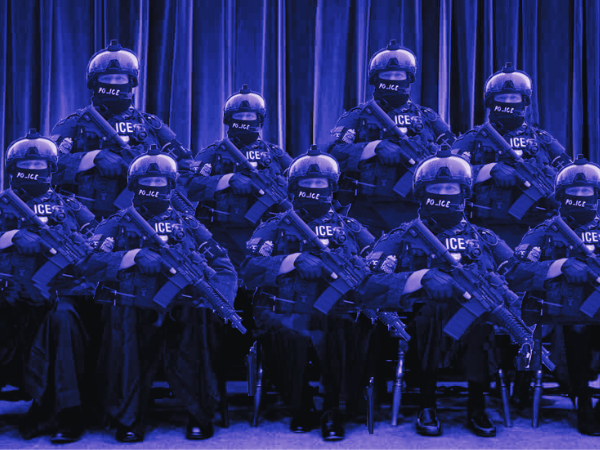
“In a closed society where everybody’s guilty, the only crime is getting caught.”—Hunter S. Thompson

The burden of proof has been reversed.

No longer are we presumed innocent. Now we’re presumed guilty unless we can prove our innocence beyond a reasonable doubt in a court of law. Rarely, are we even given the opportunity to do so.

Although the Constitution requires the government to provide solid proof of criminal activity before it can deprive a citizen of life or liberty, the government has turned that fundamental assurance of due process on its head.

Each and every one of us is now seen as a potential suspect, terrorist and lawbreaker in the eyes of the government.

Consider all the ways in which “we the people” are now treated as criminals, found guilty of violating the police state’s abundance of laws, and preemptively stripped of basic due process rights.

Red flag gun confiscation laws: Gun control legislation, especially in the form of red flag gun laws, allow the police to remove guns from people “suspected” of being threats. These laws, growing in popularity as a legislative means by which to seize guns from individuals viewed as a danger to themselves or others, will put a target on the back of every American whether or not they own a weapon.

Disinformation eradication campaigns. In recent years, the government has used the phrase “domestic terrorist” interchangeably with “anti-government,” “extremist” and “terrorist” to describe anyone who might fall somewhere on a very broad spectrum of viewpoints that could be considered “dangerous.” The ramifications are so far-reaching as to render almost every American an extremist in word, deed, thought or by association. In the government’s latest assault on those who criticize the government—whether that criticism manifests itself in word, deed or thought—the Biden Administration has likened those who share “false or misleading narratives and conspiracy theories, and other forms of mis- dis- and mal-information” to terrorists. This latest government salvo against consumers and spreaders of “mis- dis- and mal-information” widens the net to potentially include anyone who is exposed to ideas that run counter to the official government narrative. In other words, if you dare to subscribe to any views that are contrary to the government’s, you may well be suspected of being a domestic terrorist and treated accordingly. In this way, government and corporate censors claiming to protect us from dangerous, disinformation campaigns are, in fact, laying the groundwork now to preempt any “dangerous” ideas that might challenge the power elite’s stranglehold over our lives.

Government watch lists. The FBI, CIA, NSA and other government agencies have increasingly invested in corporate surveillance technologies that can mine constitutionally protected speech on social media platforms such as Facebook, Twitter and Instagram in order to identify potential extremists and predict who might engage in future acts of anti-government behavior. Where many Americans go wrong is in naively assuming that you have to be doing something illegal or harmful in order to be flagged and targeted for some form of intervention or detention. In fact, all you need to do these days to end up on a government watch list or be subjected to heightened scrutiny is use certain trigger words (like cloud, pork and pirates), surf the internet, communicate using a cell phone, limp or stutter, drive a car, stay at a hotel, attend a political rally, express yourself on social media, appear mentally ill, serve in the military, disagree with a law enforcement official, call in sick to work, purchase materials at a hardware store, take flying or boating lessons, appear suspicious, appear confused or nervous, fidget or whistle or smell bad, be seen in public waving a toy gun or anything remotely resembling a gun (such as a water nozzle or a remote control or a walking cane), stare at a police officer, question government authority, or appear to be pro-gun or pro-freedom.

Thought crimes. For years now, the government has used all of the weapons in its vast arsenal—surveillance, threat assessments, fusion centers, pre-crime programs, hate crime laws, militarized police, lockdowns, martial law, etc.—to target potential enemies of the state based on their ideologies, behaviors, affiliations and other characteristics that might be deemed suspicious or dangerous. It’s not just what you say or do that is being monitored, but how you think that is being tracked and targeted. There’s a whole spectrum of behaviors ranging from thought crimes and hate speech to whistleblowing that qualifies for persecution (and prosecution) by the Deep State. It’s a slippery slope from censoring so-called illegitimate ideas to silencing truth.

Security checkpoints and fusion centers. By treating an entire populace as suspect, the government has justified wide-ranging security checkpoints that subject travelers to scans, searches, pat downs and other indignities by the TSA and VIPR raids on so-called “soft” targets like shopping malls and bus depots by black-clad, Darth Vader look-alikes. Fusion centers, which represent the combined surveillance efforts of federal, state and local law enforcement, track the citizenry’s movements, record their conversations, and catalogue their transactions.

Surveillance, precrime programs. Facial recognition software aims to create a society in which every individual who steps out into public is tracked and recorded as they go about their daily business. Coupled with surveillance cameras that blanket the country, facial recognition technology allows the government and its corporate partners to warrantlessly identify and track someone’s movements in real-time, whether or not they have committed a crime. Rapid advances in behavioral surveillance are not only making it possible for individuals to be monitored and tracked based on their patterns of movement or behavior, including gait recognition (the way one walks), but have given rise to whole industries that revolve around predicting one’s behavior based on data and surveillance patterns and are also shaping the behaviors of whole populations. With the increase in precrime programs, threat assessments, AI algorithms and surveillance programs such as SpotShotter, which attempt to calculate where illegal activity might occur by triangulating sounds and images, the burden of proof has been turned on its head by a surveillance state that renders us all suspects and overcriminalization which renders us all lawbreakers.

Mail surveillance. Just about every branch of the government—from the Postal Service to the Treasury Department and every agency in between—now has its own surveillance sector, authorized to spy on the American people. For instance, the U.S. Postal Service, which has been photographing the exterior of every piece of paper mail for the past 20 years, is also spying on Americans’ texts, emails and social media posts. Headed up by the Postal Service’s law enforcement division, the Internet Covert Operations Program (iCOP) is reportedly using facial recognition technology, combined with fake online identities, to ferret out potential troublemakers with “inflammatory” posts. The agency claims the online surveillance, which falls outside its conventional job scope of processing and delivering paper mail, is necessary to help postal workers avoid “potentially volatile situations.”

Threat assessments and AI algorithms. The government has a growing list—shared with fusion centers and law enforcement agencies—of ideologies, behaviors, affiliations and other characteristics that could flag someone as suspicious and result in their being labeled potential enemies of the state. Before long, every household in America will be flagged as a threat and assigned a threat score. It’s just a matter of time before you find yourself wrongly accused, investigated and confronted by police based on a data-driven algorithm or risk assessment culled together by a computer program run by artificial intelligence.

No-knock raids. No-knock, no-announce SWAT team raids are what passes for court-sanctioned policing in America today, and it could happen to any one of us. Nationwide, SWAT teams routinely invade homes, break down doors, kill family pets (they always shoot the dogs first), damage furnishings, terrorize families, and wound or kill those unlucky enough to be present during a raid. No longer reserved exclusively for deadly situations, SWAT teams are now increasingly being deployed for relatively routine police matters such as serving a search warrant, with some SWAT teams being sent out as much as five times a day. Police carry out tens of thousands of no-knock raids every year nationwide.

Militarized police. America is overrun with militarized cops—vigilantes with a badge—who have almost absolute discretion to decide who is a threat, what constitutes resistance, and how harshly they can deal with the citizens they were appointed to “serve and protect.” It doesn’t matter where you live—big city or small town—it’s the same scenario being played out over and over again in which government agents, trained to act as judge, jury and executioner in their interactions with the public, ride roughshod over the rights of the citizenry. This is how we have gone from a nation of laws—where the least among us had just as much right to be treated with dignity and respect as the next person (in principle, at least)—to a nation of law enforcers (revenue collectors with weapons) who treat “we the people” like suspects and criminals.

Constitution-free zones. Merely living within 100 miles inland of the border around the United States is now enough to make you a suspect, paving the way for Border Patrol agents to search people’s homes, intimately probe their bodies, and rifle through their belongings, all without a warrant. Nearly 66% of Americans (2/3 of the U.S. population, 197.4 million people) now live within that 100-mile-deep, Constitution-free zone.

Asset forfeiture schemes. Americans no longer have a right to private property. If government agents can invade your home, break down your doors, kill your dog, damage your furnishings and terrorize your family, your property is no longer private and secure—it belongs to the government. Hard-working Americans are having their bank accounts, homes, cars electronics and cash seized by police under the assumption that they have been associated with some criminal scheme. As libertarian Harry Browne observed, “Asset forfeiture is a mockery of the Bill of Rights. There is no presumption of innocence, no need to prove you guilty (or even charge you with a crime), no right to a jury trial, no right to confront your accuser, no right to a court-appointed attorney (even if the government has just stolen all your money), and no right to compensation for the property that’s been taken.”

Vehicle kill switches. Sold to the public as a safety measure aimed at keeping drunk drivers off the roads, “vehicle kill switches” could quickly become a convenient tool in the hands of government agents to put the government in the driver’s seat while rendering null and void the Constitution’s requirements of privacy and its prohibitions against unreasonable searches and seizures. As such, it presumes every driver potentially guilty of breaking some law that would require the government to intervene and take over operation of the vehicle or shut it off altogether. The message: we cannot be trusted to obey the law or navigate the world on our end.

Bodily integrity. The government’s presumptions about our so-called guilt or innocence have extended down to our very cellular level. The debate over bodily integrity covers broad territory, ranging from forced vaccinations, forced cavity searches, forced colonoscopies, forced blood draws and forced breath-alcohol tests to forced DNA extractions, forced eye scans, and forced inclusion in biometric databases: these are just a few ways in which Americans continue to be reminded that we have no real privacy, no real presumption of innocence, and no real control over what happens to our bodies during an encounter with government officials. The groundwork being laid with these mandates is a prologue to what will become the police state’s conquest of a new, relatively uncharted, frontier: inner space, specifically, the inner workings (genetic, biological, biometric, mental, emotional) of the human race. “Guilt by association” has taken on new connotations in the technological age. Yet the debate over genetic privacy—and when one’s DNA becomes a public commodity outside the protection of the Fourth Amendment’s prohibition on warrantless searches and seizures—is really only beginning. Get ready, folks, because the government has embarked on a diabolical campaign to create a nation of suspects predicated on a massive national DNA database.

Limitations on our right to move about freely. We think we have the freedom to go where we want and move about freely, but at every turn, we’re hemmed in by laws, fines and penalties that regulate and restrict our autonomy, and surveillance cameras that monitor our movements. For instance, license plate readers are mass surveillance tools that can photograph over 1,800 license tag numbers per minute, take a picture of every passing license tag number and store the tag number and the date, time, and location of the picture in a searchable database, then share the data with law enforcement, fusion centers and private companies to track the movements of persons in their cars. With tens of thousands of these license plate readers now in operation throughout the country, police can track vehicles and run the plates through law enforcement databases for abducted children, stolen cars, missing people and wanted fugitives. Of course, the technology is not infallible: there have been numerous incidents in which police have mistakenly relied on license plate data to capture suspects only to end up detaining innocent people at gunpoint.

The war on cash and the introduction of digital currency. Digital currency provides the government and its corporate partners with a mode of commerce that can easily be monitored, tracked, tabulated, mined for data, hacked, hijacked and confiscated when convenient. This push for a digital currency dovetails with the government’s war on cash, which it has been subtly waging for some time now. In recent years, just the mere possession of significant amounts of cash could implicate you in suspicious activity and label you a criminal. The rationale (by police) is that cash is the currency for illegal transactions given that it’s harder to track, can be used to pay illegal immigrants, and denies the government its share of the “take,” so doing away with paper money will help law enforcement fight crime and help the government realize more revenue. A cashless society—easily monitored, controlled, manipulated, weaponized and locked down—plays right into the hands of the government (and its corporate partners).

The Security-Industrial Complex. Every crisis—manufactured or otherwise—since the nation’s early beginnings has become a make-work opportunity for the government to expand its reach and its power at taxpayer expense while limiting our freedoms at every turn. What this has amounted to is a war on the American people, fought on American soil, funded with taxpayer dollars, and waged with a single-minded determination to use national crises, manufactured or otherwise, in order to transform the American homeland into a battlefield. As a result, the American people have been treated like enemy combatants, to be spied on, tracked, scanned, frisked, searched, subjected to all manner of intrusions, intimidated, invaded, raided, manhandled, censored, silenced, shot at, locked up, denied due process, and killed.

These programs push us that much closer towards a suspect society where everyone is potentially guilty of some crime or another and must be preemptively rendered harmless.

The ramifications of empowering the government to sidestep fundamental due process safeguards are so chilling and so far-reaching as to put a target on the back of anyone who happens to be in the same place where a crime takes place.

The groundwork has been laid for a new kind of government where it won’t matter if you’re innocent or guilty, whether you’re a threat to the nation, or even if you’re a citizen. What will matter is what the government—or whoever happens to be calling the shots at the time—thinks. And if the powers-that-be think you’re a threat to the nation and should be locked up, then you’ll be locked up with no access to the protections our Constitution provides.

In effect, you will disappear.

As I make clear in my book Battlefield America: The War on the American People and in its fictional counterpart The Erik Blair Diaries, our freedoms are already being made to disappear.

Source: https://bit.ly/3OGn0Rv

ABOUT JOHN W. WHITEHEAD

Constitutional attorney and author John W. Whitehead is founder and president of The Rutherford Institute. His most recent books are the best-selling Battlefield America: The War on the American People, the award-winning A Government of Wolves: The Emerging American Police State, and a debut dystopian fiction novel, The Erik Blair Diaries. Whitehead can be contacted at staff@rutherford.org. Nisha Whitehead is the Executive Director of The Rutherford Institute. Information about The Rutherford Institute is available at www.rutherford.org.

Publication Guidelines / Reprint Permission

John W. Whitehead’s weekly commentaries are available for publication to newspapers and web publications at no charge. Please contact staff@rutherford.org to obtain reprint permission.
“We are fast approaching the stage of the ultimate inversion: the stage where the government is free to do anything it pleases, while the citizens may act only by permission; which is the stage of the darkest periods of human history, the stage of rule by brute force.” — Ayn Rand

What we do not need is yet another pretext by which government officials can violate the Fourth Amendment at will under the guise of public health and safety.

Indeed, at a time when red flag gun laws (which authorize government officials to seize guns from individuals viewed as a danger to themselves or others) are gaining traction as a legislative means by which to allow police to remove guns from people suspected of being threats, it wouldn’t take much for police to be given the green light to enter a home without a warrant in order to seize lawfully-possessed firearms based on concerns that the guns might pose a danger.

Frankly, a person wouldn’t even need to own a gun to be subjected to such a home invasion.

SWAT teams have crashed through doors on lesser pretexts based on false information, mistaken identities and wrong addresses.

Nineteen states and the District of Columbia have adopted laws allowing the police to remove guns from people suspected of being threats. If Congress succeeds in passing the Federal Extreme Risk Protection Order, which would nationalize red flag laws, that number will grow.

As The Washington Post reports, these red flag gun laws “allow a family member, roommate, beau, law enforcement officer or any type of medical professional to file a petition [with a court] asking that a person’s home be temporarily cleared of firearms. It doesn’t require a mental-health diagnosis or an arrest.

In the wake of yet another round of mass shootings, these gun confiscation laws—extreme risk protection order (ERPO) laws—may appease the fears of those who believe that fewer guns in the hands of the general populace will make our society safer.

Of course, it doesn’t always work that way.

Anything—knives, vehicles, planes, pressure cookers—can become a weapon when wielded with deadly intentions.

With these red flag gun laws, the stated intention is to disarm individuals who are potential threats… to “stop dangerous people before they act.”

While in theory it appears perfectly reasonable to want to disarm individuals who are clearly suicidal and/or pose an “immediate danger” to themselves or others, where the problem arises is when you put the power to determine who is a potential danger in the hands of government agencies, the courts and the police.

We’ve been down this road before.

Remember, this is the same government that uses the words “anti-government,” “extremist” and “terrorist” interchangeably.

This is the same government whose agents are spinning a sticky spider-web of threat assessments, behavioral sensing warnings, flagged “words,” and “suspicious” activity reports using automated eyes and ears, social media, behavior sensing software, and citizen spies to identify potential threats.

This is the same government that has a growing list—shared with fusion centers and law enforcement agencies—of ideologies, behaviors, affiliations and other characteristics that could flag someone as suspicious and result in their being labeled potential enemies of the state.

For instance, if you believe in and exercise your rights under the Constitution (namely, your right to speak freely, worship freely, associate with like-minded individuals who share your political views, criticize the government, own a weapon, demand a warrant before being questioned or searched, or any other activity viewed as potentially anti-government, racist, bigoted, anarchic or sovereign), you could be at the top of the government’s terrorism watch list.

Moreover, as a New York Times editorial warns, you may be an anti-government extremist (a.k.a. domestic terrorist) in the eyes of the police if you are afraid that the government is plotting to confiscate your firearms, if you believe the economy is about to collapse and the government will soon declare martial law, or if you display an unusual number of political and/or ideological bumper stickers on your car.

Let that sink in a moment.

Now consider the ramifications of giving police that kind of authority: to preemptively raid homes in order to neutralize a potential threat.

It’s a powder keg waiting for a lit match.

Under these red flag laws, what happened to Duncan Lemp—who was gunned down in his bedroom during an early morning, no-knock SWAT team raid on his family’s home—could very well happen to more people.

At 4:30 a.m. on March 12, 2020, in the midst of a COVID-19 pandemic that had most of the country under a partial lockdown and sheltering at home, a masked SWAT team—deployed to execute a “high risk” search warrant for unauthorized firearms—stormed the suburban house where 21-year-old Duncan, a software engineer and Second Amendment advocate, lived with his parents and 19-year-old brother.

The entire household, including Lemp and his girlfriend, was reportedly asleep when the SWAT team directed flash bang grenades and gunfire through Lemp’s bedroom window.

Lemp was killed and his girlfriend injured.

No one in the house that morning, including Lemp, had a criminal record.

No one in the house that morning, including Lemp, was considered an “imminent threat” to law enforcement or the public, at least not according to the search warrant.

So what was so urgent that militarized police felt compelled to employ battlefield tactics in the pre-dawn hours of a day when most people are asleep in bed, not to mention stuck at home as part of a nationwide lockdown?

According to police, they were tipped off that Lemp was in possession of “firearms.”

Thus, rather than approaching the house by the front door at a reasonable hour in order to investigate this complaint—which is what the Fourth Amendment requires—police instead strapped on their guns, loaded up their flash bang grenades and carried out a no-knock raid on the household.

According to the county report, the no-knock raid was justified “due to Lemp being ‘anti-government,’ ‘anti-police,’ currently in possession of body armor, and an active member of the Three Percenters,” a far-right paramilitary group that discussed government resistance.

This is what happens when you adopt red flag gun laws, painting anyone who might be in possession of a gun—legal or otherwise—as a threat that must be neutralized.

Therein lies the danger of these red flag laws, specifically, and pre-crime laws such as these generally where the burden of proof is reversed and you are guilty before you are given any chance to prove you are innocent.

Red flag gun laws merely push us that much closer towards a suspect society where everyone is potentially guilty of some crime or another and must be preemptively rendered harmless.

Where many Americans go wrong is in naively assuming that you have to be doing something illegal or harmful in order to be flagged and targeted for some form of intervention or detention.

In fact, all you need to do these days to end up on a government watch list or be subjected to heightened scrutiny is use certain trigger words (like cloud, pork and pirates), surf the internet, communicate using a cell phone, limp or stutterdrive a car, stay at a hotel, attend a political rally, express yourself on social mediaappear mentally ill, serve in the militarydisagree with a law enforcement officialcall in sick to work, purchase materials at a hardware store, take flying or boating lessons, appear suspicious, appear confused or nervous, fidget or whistle or smell bad, be seen in public waving a toy gun or anything remotely resembling a gun (such as a water nozzle or a remote control or a walking cane), stare at a police officer, question government authority, appear to be pro-gun or pro-freedom, or generally live in the United States.

Be warned: once you get on such a government watch list—whether it’s a terrorist watch list, a mental health watch list, a dissident watch list, or a red flag gun watch list—there’s no clear-cut way to get off, whether or not you should actually be on there.

You will be flagged as a potential threat and dealt with accordingly.

You will be tracked by the government’s pre-crime, surveillance network wherever you go.

Hopefully you’re starting to understand how easy we’ve made it for the government to identify, label, target, defuse and detain anyone it views as a potential threat for a variety of reasons that run the gamut from mental illness to having a military background to challenging its authority to just being on the government’s list of persona non grata.

The government has been building its pre-crime, surveillance network in concert with fusion centers (of which there are 78 nationwide, with partners in the private sector and globally), data collection agencies, behavioral scientists, corporations, social media, and community organizers and by relying on cutting-edge technology for surveillance, facial recognition, predictive policing, biometrics, and behavioral epigenetics (in which life experiences alter one’s genetic makeup).

Combine red flag laws with the government’s surveillance networks and its plan to establish an agency that will take the lead in identifying and targeting “signs” of mental illness or violent inclinations among the populace by using artificial intelligence to collect data from Apple Watches, Fitbits, Amazon Echo and Google Home, and you’ll understand why some might view gun control legislation with trepidation.

No matter how well-meaning the politicians make these encroachments on our rights appear, in the right (or wrong) hands, benevolent plans can easily be put to malevolent purposes.

As I make clear in my book Battlefield America: The War on the American People and in its fictional counterpart The Erik Blair Diaries, even the most well-intentioned government law or program can be—and has been—perverted, corrupted and used to advance illegitimate purposes once profit and power are added to the equation.

The war on terror, the war on drugs, the war on illegal immigration, the war on COVID-19: all of these programs started out as legitimate responses to pressing concerns and have since become weapons of compliance and control in the government’s hands.

No matter how well-intentioned, red flag gun laws will put a target on the back of every American whether or not they own a weapon.

Source: https://bit.ly/3tAmVGU

ABOUT JOHN W. WHITEHEAD

Constitutional attorney and author John W. Whitehead is founder and president of The Rutherford Institute. His most recent books are the best-selling Battlefield America: The War on the American People, the award-winning A Government of Wolves: The Emerging American Police State, and a debut dystopian fiction novel, The Erik Blair Diaries. Whitehead can be contacted at staff@rutherford.org. Nisha Whitehead is the Executive Director of The Rutherford Institute. Information about The Rutherford Institute is available at www.rutherford.org.

Publication Guidelines / Reprint Permission

John W. Whitehead’s weekly commentaries are available for publication to newspapers and web publications at no charge. Please contact staff@rutherford.org to obtain reprint permission.
“Mass shootings have become routine in the United States and speak to a society that relies on violence to feed the coffers of the merchants of death. Given the profits made by arms manufacturers, the defense industry, gun dealers and the lobbyists who represent them in Congress, it comes as no surprise that the culture of violence cannot be abstracted from either the culture of business or the corruption of politics.”—Professor Henry A. Giroux

We are caught in a vicious cycle.

With alarming regularity, the nation is being subjected to a heartbreaking spate of violence that terrorizes the populace, fractures communities, and gives the government greater justifications to crack down, lock down, and institute even more authoritarian policies for the so-called sake of national security without many objections from the citizenry.

Mass shootings have taken place in schools, on college campuses, movie theaters, nightclubs, grocery stores, concert venues, bars, workplaces, churches, on military bases, and in government offices. In almost every instance, the shooters were dressed in military-style gear and armed with military-style weapons.

Take the latest shooting that took place in Uvalde, Texas, when 18-year-old Salvador Ramos, wearing body armor and carrying a rifle, walked into Robb Elementary School and opened fire, leaving at least 19 children and two teachers dead.

This Uvalde shooting took place ten days after another 18-year-old man, heavily armed and wearing tactical gear (including a tactical helmet and plated armor), opened fire in a grocery store in Buffalo, N.Y, killing 10 people.

In 2018, a 19-year-old former student armed with a gas mask, smoke grenades, magazines of ammunition, and an AR-15-style semiautomatic rifle opened fire on students and teachers at Marjory Stoneman Douglas High School in Parkland, Fla., leaving 17 people dead.

Ten years ago, 20-year-old Adam Lanza—wearing body armor and black clothing, and armed with military-style weapons—opened fire on students and teachers at Sandy Hook Elementary School in Newtown, Conn., leaving 26 dead. Prior to the shooting, Lanza reportedly spent his days “playing violent video games amid posters showcasing military equipment.”

According to an FBI report issued the day before the Uvalde shooting, these kinds of “active shooter attacks” have doubled in recent years.

As expected in the wake of such tragedies, there has been a vocal outcry for enacting more strident gun control measures, more mental health checks, and heightened security measures.

Yet surely there’s more to these shootings than just easy access to weapons and mental illness.

Ask yourself: Why do these mass shootings keep happening? Who are these shooters modelling themselves after? Where are they finding the inspiration for their weaponry and tactics? Whose stance and techniques are they mirroring?

When you start to connect the dots, they lead right back to the American police state and the war-drenched, violence-imbued, profit-driven military industrial complex, both of which continue to dominate, dictate and shape almost every aspect of our lives.

The United States is the number one consumer, exporter and perpetrator of violence and violent weapons in the world.

Violence has become America’s calling card.

We are a military culture engaged in continuous warfare.

We have been a nation at war for most of our existence.

We are a nation that makes a living from killing through defense contracts, weapons manufacturing and endless wars.

We are being fed a steady diet of violence through our entertainment, news, sports and politics.

All of the military equipment featured in blockbuster movies is provided—at taxpayer expense—in exchange for carefully placed promotional spots aimed at boosting civic pride in the military, recruiting for the military, and churning out profit-driven propaganda for the military industrial complex. Even reality TV shows have gotten in on the gig.

It’s estimated that U.S. military intelligence agencies (including the NSA) have influenced over 1,800 movies and TV shows.

Then there are the growing number of violent video games, a number of which are engineered by or created for the military as recruitment tools, which have accustomed players to interactive war play through military simulations and first-person shooter scenarios. As Esther J. Cepeda writes for The Washington Post, “Violent video games alone do not cause people to go off the rails, arm themselves and open fire on innocent people in public places. But there’s also no question that there is something wrong with a multibillion-dollar video game industry that sells to young men the ability to virtually assassinate a foe as an escape from real life.”

The media, eager to score higher ratings, has been equally complicit in making (real) war more palatable to the public by packaging it as TV friendly. The military has also been firmly entrenched in the nation’s sports spectacles, having co-opted football, basketball, even NASCAR, “tying the symbols of sports with the symbols of war.”

This is how you acclimate a population to war.

This is how you cultivate loyalty to a war machine.

This is how, to borrow from the subtitle to the 1964 film Dr. Strangelove, you teach a nation to “stop worrying and love the bomb.”

This is how you sustain the nation’s appetite for war.

As journalist David Sirota writes for Salon, to those who profit from war, it is “a ‘product’ to be sold via pop culture products that sanitize war and, in the process, boost recruitment numbers.”

No wonder entertainment violence is the hottest selling ticket at the box office. As professor Henry Giroux points out, “Popular culture not only trades in violence as entertainment, but also it delivers violence to a society addicted to a pleasure principle steeped in graphic and extreme images of human suffering, mayhem and torture.”

No wonder the government continues to whet the nation’s appetite for violence and war through paid propaganda programs (seeded throughout sports entertainment, Hollywood blockbusters and video games)—what professor Roger Stahl refers to as “militainment“—that glorify the military and serve as recruiting tools for America’s expanding military empire.

No wonder Americans from a very young age are being groomed to enlist as foot soldiers—even virtual ones—in America’s Army (coincidentally, that’s also the name of a first-person shooter video game that was produced by the military and used as a pivotal recruiting tool for 20 years).

Explorer scouts, for example, have been one of the most popular recruiting tools for the military and its civilian counterparts (law enforcement, Border Patrol, and the FBI). Writing for The Atlantic, a former Explorer scout described the highlight of the program: monthly weekend maneuvers with the National Guard where scouts “got to fire live rounds from M16s, M60 machine guns, and M203 grenade launchers… we would have urban firefights (shooting blanks, of course) in Combat Town, a warren of concrete buildings designed for just that purpose. The exercise always devolved into a free-for-all, with all of us weekend warriors emptying clip after clip of blanks until we couldn’t see past the end of our rifles for all the smoke in the air.”

No wonder America spends more money on war than the combined military budgets of China, Russia, the United Kingdom, Japan, France, Saudi Arabia, India, Germany, Italy and Brazil. America polices the globe, with 800 military bases and troops stationed in 160 countries. Moreover, the war hawks have turned the American homeland into a quasi-battlefield with military gear, weapons and tactics. In turn, domestic police forces have become roving extensions of the military—a standing army.

You want to stop the gun violence?

Stop the worship of violence that permeates our culture.

Stop treating guns and war as entertainment fodder in movies, music, video games, toys, amusement parks, reality TV, sports and more.

Stop distributing weapons of war (weapons that have no business being anywhere but on a battlefield) to the local police and transforming police into extensions of the military.

Stop exposing young people to the military industrial complex’s pervasive propaganda.

Stop falling for the military industrial complex’s psychological war games.

Salvador Ramos may have pulled the trigger that resulted in the mayhem in Uvalde, Tex., but something else is driving the madness.

We’ve got to do more than react in a knee-jerk fashion.

Those who want safety at all costs will clamor for more gun control measures, widespread mental health screening of the general population and greater scrutiny of military veterans, more threat assessments and behavioral sensing warnings, more CCTV cameras with facial recognition capabilities, more “See Something, Say Something” programs aimed at turning Americans into snitches and spies, more metal detectors and whole-body imaging devices at soft targets, more roaming squads of militarized police empowered to do random bag searches, more fusion centers to centralize and disseminate information to law enforcement agencies, and more surveillance of what Americans say and do, where they go, what they buy and how they spend their time.

Yet as I point out in my book Battlefield America: The War on the American People and in its fictional counterpart The Erik Blair Diaries, all of these measures play into the government’s hands by locking down the nation without doing anything to address the underlying causes of this madness.

What we need is a thoughtful, measured, apolitical response to these shootings that takes aim at the violence plaguing our nation by lowering the levels of violence here and abroad, whether it’s violence we export to other countries, violence we glorify in entertainment, or violence we revel in when it’s leveled at our so-called enemies, politically or otherwise.

Our prolonged exposure to the toxic culture of the American police state is deadly.

Source: https://bit.ly/3wSigB3

ABOUT JOHN W. WHITEHEAD

Constitutional attorney and author John W. Whitehead is founder and president of The Rutherford Institute. His most recent books are the best-selling Battlefield America: The War on the American People, the award-winning A Government of Wolves: The Emerging American Police State, and a debut dystopian fiction novel, The Erik Blair Diaries. Whitehead can be contacted at staff@rutherford.org. Nisha Whitehead is the Executive Director of The Rutherford Institute. Information about The Rutherford Institute is available at www.rutherford.org.

Publication Guidelines / Reprint Permission

John W. Whitehead’s weekly commentaries are available for publication to newspapers and web publications at no charge. Please contact staff@rutherford.org to obtain reprint permission.

“The government solution to a problem is usually as bad as the problem and very often makes the problem worse.”—Milton Friedman

You’ve been flagged as a threat.

Before long, every household in America will be similarly flagged and assigned a threat score.

Without having ever knowingly committed a crime or been convicted of one, you and your fellow citizens have likely been assessed for behaviors the government might consider devious, dangerous or concerning; assigned a threat score based on your associations, activities and viewpoints; and catalogued in a government database according to how you should be approached by police and other government agencies based on your particular threat level.

If you’re not unnerved over the ramifications of how such a program could be used and abused, keep reading.

It’s just a matter of time before you find yourself wrongly accused, investigated and confronted by police based on a data-driven algorithm or risk assessment culled together by a computer program run by artificial intelligence.

Consider the case of Michael Williams, who spent almost a year in jail for a crime he didn’t commit. Williams was behind the wheel when a passing car fired at his vehicle, killing his 25-year-old passenger Safarian Herring, who had hitched a ride.

Despite the fact that Williams had no motive, there were no eyewitnesses to the shooting, no gun was found in the car, and Williams himself drove Herring to the hospital, police charged the 65-year-old man with first-degree murder based on ShotSpotter, a gunshot detection program that had picked up a loud bang on its network of surveillance microphones and triangulated the noise to correspond with a noiseless security video showing Williams’ car driving through an intersection. The case was eventually dismissed for lack of evidence.

Although gunshot detection program like ShotSpotter are gaining popularity with law enforcement agencies, prosecutors and courts alike, they are riddled with flaws, mistaking “dumpsters, trucks, motorcycles, helicopters, fireworks, construction, trash pickup and church bells…for gunshots.”

As an Associated Press investigation found, “the system can miss live gunfire right under its microphones, or misclassify the sounds of fireworks or cars backfiring as gunshots.”

In one community, ShotSpotter worked less than 50% of the time.

Then there’s the human element of corruption which invariably gets added to the mix. In some cases, “employees have changed sounds detected by the system to say that they are gunshots.” Forensic reports prepared by ShotSpotter’s employees have also “been used in court to improperly claim that a defendant shot at police, or provide questionable counts of the number of shots allegedly fired by defendants.”

The same company that owns ShotSpotter also owns a predictive policing program that aims to use gunshot detection data to “predict” crime before it happens. Both Presidents Biden and Trump have pushed for greater use of these predictive programs to combat gun violence in communities, despite the fact that found they have not been found to reduce gun violence or increase community safety.

The rationale behind this fusion of widespread surveillance, behavior prediction technologies, data mining, precognitive technology, and neighborhood and family snitch programs is purportedly to enable the government takes preemptive steps to combat crime (or whatever the government has chosen to outlaw at any given time).

This is precrime, straight out of the realm of dystopian science fiction movies such as Minority Report, which aims to prevent crimes before they happen, but in fact, it’s just another means of getting the citizenry in the government’s crosshairs in order to lock down the nation.

Even Social Services is getting in on the action, with computer algorithms attempting to predict which households might be guilty of child abuse and neglect.

All it takes is an AI bot flagging a household for potential neglect for a family to be investigated, found guilty and the children placed in foster care.

Mind you, potential neglect can include everything from inadequate housing to poor hygiene, but is different from physical or sexual abuse.

According to an investigative report by the Associated Press, once incidents of potential neglect are reported to a child protection hotline, the reports are run through a screening process that pulls together “personal data collected from birth, Medicaid, substance abuse, mental health, jail and probation records, among other government data sets.” The algorithm then calculates the child’s potential risk and assigns a score of 1 to 20 to predict the risk that a child will be placed in foster care in the two years after they are investigated. “The higher the number, the greater the risk. Social workers then use their discretion to decide whether to investigate.”

Other predictive models being used across the country strive to “assess a child’s risk for death and severe injury, whether children should be placed in foster care and if so, where.”

Incredibly, there’s no way for a family to know if AI predictive technology was responsible for their being targeted, investigated and separated from their children. As the AP notes, “Families and their attorneys can never be sure of the algorithm’s role in their lives either because they aren’t allowed to know the scores.”

One thing we do know, however, is that the system disproportionately targets poor, black families for intervention, disruption and possibly displacement, because much of the data being used is gleaned from lower income and minority communities.

The technology is also far from infallible. In one county alone, a technical glitch presented social workers with the wrong scores, either underestimating or overestimating a child’s risk.

Yet fallible or not, AI predictive screening program is being used widely across the country by government agencies to surveil and target families for investigation. The fallout of this over surveillance, according to Aysha Schomburg, the associate commissioner of the U.S. Children’s Bureau, is “mass family separation.”

The impact of these kinds of AI predictive tools is being felt in almost every area of life.

Under the pretext of helping overwhelmed government agencies work more efficiently, AI predictive and surveillance technologies are being used to classify, segregate and flag the populace with little concern for privacy rights or due process.

All of this sorting, sifting and calculating is being done swiftly, secretly and incessantly with the help of AI technology and a surveillance state that monitors your every move.

Where this becomes particularly dangerous is when the government takes preemptive steps to combat crime or abuse, or whatever the government has chosen to outlaw at any given time.

In this way, government agents—with the help of automated eyes and ears, a growing arsenal of high-tech software, hardware and techniques, government propaganda urging Americans to turn into spies and snitches, as well as social media and behavior sensing software—are spinning a sticky spider-web of threat assessments, behavioral sensing warnings, flagged “words,” and “suspicious” activity reports aimed at snaring potential enemies of the state.

Are you a military veteran suffering from post-traumatic stress disorder? Have you expressed controversial, despondent or angry views on social media? Do you associate with people who have criminal records or subscribe to conspiracy theories? Were you seen looking angry at the grocery store? Is your appearance unkempt in public? Has your driving been erratic? Did the previous occupants of your home have any run-ins with police?

All of these details and more are being used by AI technology to create a profile of you that will impact your dealings with government.

It’s the American police state rolled up into one oppressive pre-crime and pre-thought crime package, and the end result is the death of due process.

In a nutshell, due process was intended as a bulwark against government abuses. Due process prohibits the government of depriving anyone of “Life, Liberty, and Property” without first ensuring that an individual’s rights have been recognized and respected and that they have been given the opportunity to know the charges against them and defend against those charges.

With the advent of government-funded AI predictive policing programs that surveil and flag someone as a potential threat to be investigated and treated as dangerous, there can be no assurance of due process: you have already been turned into a suspect.

To disentangle yourself from the fallout of such a threat assessment, the burden of proof rests on you to prove your innocence.

You see the problem?

It used to be that every person had the right to be assumed innocent until proven guilty, and the burden of proof rested with one’s accusers. That assumption of innocence has since been turned on its head by a surveillance state that renders us all suspects and overcriminalization which renders us all potentially guilty of some wrongdoing or other.

Combine predictive AI technology with surveillance and overcriminalization, then add militarized police crashing through doors in the middle of the night to serve a routine warrant, and you’ll be lucky to escape with your life.

Yet be warned: once you get snagged by a surveillance camera, flagged by an AI predictive screening program, and placed on a government watch list—whether it’s a watch list for child neglect, a mental health watch list, a dissident watch list, a terrorist watch list, or a red flag gun watch list—there’s no clear-cut way to get off, whether or not you should actually be on there.

You will be tracked wherever you go, flagged as a potential threat and dealt with accordingly.

If you’re not scared yet, you should be.

We’ve made it too easy for the government to identify, label, target, defuse and detain anyone it views as a potential threat for a variety of reasons that run the gamut from mental illness to having a military background to challenging its authority to just being on the government’s list of persona non grata.

As I make clear in my book Battlefield America: The War on the American People and in its fictional counterpart The Erik Blair Diaries, you don’t even have to be a dissident to get flagged by the government for surveillance, censorship and detention.

All you really need to be is a citizen of the American police state.

Source: https://bit.ly/3N6L27u

“Rights aren’t rights if someone can take them away. They’re privileges. That’s all we’ve ever had in this country, is a bill of temporary privileges. And if you read the news even badly, you know that every year the list gets shorter and shorter. Sooner or later, the people in this country are gonna realize the government … doesn’t care about you, or your children, or your rights, or your welfare or your safety… It’s interested in its own power. That’s the only thing. Keeping it and expanding it wherever possible.”— George Carlin

We’re in a national state of denial.

For years now, the government has been playing a cat-and-mouse game with the American people, letting us enjoy just enough freedom to think we are free but not enough to actually allow us to live as a free people.

Case in point: on the same day that the U.S. Supreme Court appeared inclined to favor a high school football coach’s right to pray on the field after a game, the high court let stand a lower court ruling that allows police to warrantlessly track people’s location and movements through their personal cell phones, sweeping Americans up into a massive digital data dragnet that does not distinguish between those who are innocent of wrongdoing, suspects, or criminals.

Likewise, although the Supreme Court gave the go-ahead for a death row inmate to have his pastor audibly pray and lay hands on him in the execution chamber, it refused to stop police from using hidden cameras to secretly and warrantlessly record and monitor a person’s activities outside their home over an extended period of time.  

For those who have been paying attention, there’s a curious pattern emerging: the government appears reasonably tolerant of those who want to exercise their First Amendment rights in a manner that doesn’t challenge the police state’s hold on power, for example, by praying on a football field or in an execution chamber.

On the other hand, dare to disagree with the government about its war crimes, COVID-19, election outcomes or police brutality, and you’ll find yourself silenced, cited, shut down and/or branded an extremist.

The U.S. government is particularly intolerant of speech that reveals the government’s corruption, exposes the government’s lies, and encourages the citizenry to push back against the government’s many injustices. For instance, Wikileaks founder Julian Assange, the latest victim of the government’s war on dissidents and whistleblowers, is in the process of being extradited to the U.S. to be tried under the Espionage Act for daring to access and disclose military documents that portray the U.S. government and its endless wars abroad as reckless, irresponsible, immoral and responsible for thousands of civilian deaths.

Even political protests are fair game for prosecution. In Florida, two protesters are being fined $3000 for political signs proclaiming stating “F—k Biden,” “F—k Trump,” and “F—k Policing 4 Profit” that violate a city ban on “indecent” speech on signs, clothing and other graphic displays.

The trade-off is clear: pray all you want, but don’t mess with the U.S. government.

In this way, the government, having appointed itself a Supreme and Sovereign Ruler, allows us to bask in the illusion of religious freedom while stripping us of every other freedom afforded by the Constitution.

We’re in trouble, folks.

Freedom no longer means what it once did.

This holds true whether you’re talking about the right to criticize the government in word or deed, the right to be free from government surveillance, the right to not have your person or your property subjected to warrantless searches by government agents, the right to due process, the right to be safe from militarized police invading your home, the right to be innocent until proven guilty and every other right that once reinforced the founders’ belief that this would be “a government of the people, by the people and for the people.”

Not only do we no longer have dominion over our bodies, our families, our property and our lives, but the government continues to chip away at what few rights we still have to speak freely and think for ourselves.

My friends, we’re being played for fools.

On paper, we may be technically free.

In reality, however, we are only as free as a government official may allow.

We only think we live in a constitutional republic, governed by just laws created for our benefit.

Truth be told, we live in a dictatorship disguised as a democracy where all that we own, all that we earn, all that we say and do—our very lives—depends on the benevolence of government agents and corporate shareholders for whom profit and power will always trump principle. And now the government is litigating and legislating its way into a new framework where the dictates of petty bureaucrats carry greater weight than the inalienable rights of the citizenry.

With every court ruling that allows the government to operate above the rule of law, every piece of legislation that limits our freedoms, and every act of government wrongdoing that goes unpunished, we’re slowly being conditioned to a society in which we have little real control over our lives.

As Rod Serling, creator of the Twilight Zone and an insightful commentator on human nature, once observed, “We’re developing a new citizenry. One that will be very selective about cereals and automobiles, but won’t be able to think.”

Indeed, not only are we developing a new citizenry incapable of thinking for themselves, we’re also instilling in them a complete and utter reliance on the government and its corporate partners to do everything for them—tell them what to eat, what to wear, how to think, what to believe, how long to sleep, who to vote for, whom to associate with, and on and on.

In this way, we have created a welfare state, a nanny state, a police state, a surveillance state, an electronic concentration camp—call it what you will, the meaning is the same: in our quest for less personal responsibility, a greater sense of security, and no burdensome obligations to each other or to future generations, we have created a society in which we have no true freedom.

Government surveillance, police abuse, SWAT team raids, economic instability, asset forfeiture schemes, pork barrel legislation, militarized police, drones, endless wars, private prisons, involuntary detentions, biometrics databases, free speech zones, etc.: these are mile markers on the road to a fascist state where citizens are treated like cattle, to be branded and eventually led to the slaughterhouse.

Freedom, or what’s left of it, is being threatened from every direction. The threats are of many kinds: political, cultural, educational, media, and psychological. However, as history shows us, freedom is not, on the whole, wrested from a citizenry. It is all too often given over voluntarily and for such a cheap price: safety, security, bread, and circuses.

This is part and parcel of the propaganda churned out by the government machine.

That said, what we face today—mind manipulation and systemic violence—is not new. What is different are the techniques used and the large-scale control of mass humanity, coercive police tactics and pervasive surveillance.

We are overdue for a systemic check on the government’s overreaches and power grabs.

By “government,” I’m not referring to the highly partisan, two-party bureaucracy of the Republicans and Democrats. Rather, I’m referring to “government” with a capital “G,” the entrenched Deep State that is unaffected by elections, unaltered by populist movements, and has set itself beyond the reach of the law.

For years now, we have suffered the injustices, cruelties, corruption and abuse of an entrenched government bureaucracy that has no regard for the Constitution or the rights of the citizenry.

We have lingered too long in this strange twilight zone where ego trumps justice, propaganda perverts truth, and imperial presidents—empowered to indulge their authoritarian tendencies by legalistic courts, corrupt legislatures and a disinterested, distracted populace—rule by fiat rather than by the rule of law.

Where we find ourselves now is in the unenviable position of needing to rein in all three branches of government—the Executive, the Judicial, and the Legislative—that have exceeded their authority and grown drunk on power.

We are the unwitting victims of a system so corrupt that those who stand up for the rule of law and aspire to transparency in government are in the minority. This corruption is so vast it spans all branches of government: from the power-hungry agencies under the executive branch and the corporate puppets within the legislative branch to a judiciary that is, more often than not, elitist and biased towards government entities and corporations.

The predators of the police state are wreaking havoc on our freedoms, our communities, and our lives. The government doesn’t listen to the citizenry, it refuses to abide by the Constitution, which is our rule of law, and it treats the citizenry as a source of funding and little else.

The American kleptocracy (a government ruled by thieves) has sucked the American people down a rabbit hole into a parallel universe in which the Constitution is meaningless, the government is all-powerful, and the citizenry is powerless to defend itself against government agents who steal, spy, lie, plunder, kill, abuse and generally inflict mayhem and sow madness on everyone and everything in their sphere.

This dissolution of that sacred covenant between the citizenry and the government—establishing “we the people” as the masters and the government as the servant—didn’t happen overnight. It didn’t happen because of one particular incident or one particular president. It is a process, one that began long ago and continues in the present day, aided and abetted by politicians who have mastered the polarizing art of how to “divide and conquer.”

Unfortunately, there is no magic spell to transport us back to a place and time where “we the people” weren’t merely fodder for a corporate gristmill, operated by government hired hands, whose priorities are money and power.

As I make clear in my book Battlefield America: The War on the American People and in its fictional counterpart The Erik Blair Diaries, our freedoms have become casualties in an all-out war on the American people.

If we continue down this road, there can be no surprise about what awaits us at the end.

Source: https://bit.ly/3Mtx4fq

ABOUT JOHN W. WHITEHEAD

Constitutional attorney and author John W. Whitehead is founder and president The Rutherford Institute. His books Battlefield America: The War on the American People and A Government of Wolves: The Emerging American Police State are available at www.amazon.com. He can be contacted at johnw@rutherford.org. Nisha Whitehead is the Executive Director of The Rutherford Institute. Information about The Rutherford Institute is available at www.rutherford.org.

Publication Guidelines / Reprint Permission

John W. Whitehead’s weekly commentaries are available for publication to newspapers and web publications at no charge. Please contact staff@rutherford.org to obtain reprint permission.