Posts Tagged ‘Obama’

“The greatest tyrannies are always perpetuated in the name of the noblest causes.”—Thomas Paine

They said it was for safety.
They said it was for order.
They said it was for the good of the nation.

They always say it’s for something good… until it isn’t.

Nearly a quarter-century after 9/11, we are still living with the consequences of fear-driven government power grabs. What began as “temporary” measures for our security have hardened into a permanent architecture of control.

The bipartisan police-state architecture that began with 9/11 has been passed from president to president and party to party, each recycling the same justifications—safety, security, patriotism—to expand its powers at the expense of the citizenry.

So they locked down the country “for our safety.”
They expanded surveillance “for our security.”
They rounded up anyone who challenged the narrative “for the common good.”
They erased names, ideas, and histories “to prevent offense.”
They forced schools to teach only what was politically correct “for the children.”
They censored speech “for our protection.”
They targeted dissenters “to preserve peace.”
They militarized the streets and called it “law and order.”

These very abuses—once denounced when carried out by the Left—are now cheered, defended, and excused when carried out by the Right.

People who once spoke passionately about truth, freedom, and faith have now fallen silent in the face of injustice, or worse, convinced themselves that nothing is wrong. The very voices that should be warning against tyranny are instead excusing it or looking away.

This is the danger of double standards in politics: every tyranny is rationalized in the moment by its chorus of defenders.

But history teaches that what goes around comes around. If you justify it now, you’ll have no defense when the tables turn.

And yet, time and again, the lies we tell ourselves make it possible. The cult of personality. The blind loyalty to party. The belief that “our side” can’t be the villain.

It never ceases to amaze how far people will go to excuse the actions of their favorite tyrant, even when those actions are the very things they once swore to oppose.

The pattern of justifying tyranny is as old as power itself. Every abuse comes wrapped in the same excuse: we had to do it.

After 9/11, Americans were told the Patriot Act and mass surveillance were “necessary to prevent terrorism.” The result was a sprawling security state that tracks every phone call, every online search, every purchase. The justification was security. The cost was freedom.

Under Obama, drone warfare and the prosecution of whistleblowers were defended as “keeping America safe.” The president even claimed the power to assassinate U.S. citizens abroad without trial. The result was an unaccountable government acting as judge, jury and executioner. The justification was safety. The cost was due process.

During the COVID-19 pandemic, lockdowns and mandates were imposed in the name of “public health,” laying the groundwork for a Nanny State empowered to micromanage every aspect of our lives—where we go, what we buy, who we see. The result was government claiming control over every aspect of daily life. The justification was saving lives. The cost was the right to govern our bodies.

Under Trump, the script is familiar.

National Guard deployments in American cities are justified as “restoring order.” Sweeping surveillance is framed as “protecting communities.” Crackdowns on dissent are defended as “stopping criminals.” Mental health round-ups of the homeless are justified as “helping the vulnerable.” Militarized patrols on city streets are justified as “cleaning up the streets.” Turning ICE into a roving army of lawless thugs is justified as “protecting citizenship.” Censorship and efforts to sanitize American history are now being lauded by the same voices that railed against “cancel culture.”

That same logic has taken a deadly turn abroad. At Trump’s direction, the U.S. carried out a series of preemptive military strikes this year—against Iran’s nuclear sites, against the Houthis in Yemen, and most recently against what the administration claimed was a drug-trafficking boat off the coast of Venezuela. The White House has justified these deadly attacks—carried out without congressional approval or constitutional authorization—as part of the president’s unilateral war-making authority.

This, too, is part of the bipartisan police-state architecture built after 9/11, when presidents claimed open-ended authority to wage preemptive war without meaningful congressional oversight.

What began with Afghanistan and Iraq has metastasized into a global battlefield where any president can launch attacks—on Iran, on Yemen, on Venezuela—without accountability.

As always, the justification is order, safety, and patriotism. The cost is truth, justice and freedom.

Every time Trump expands his powers, the chorus is the same: It wouldn’t be necessary if Democrats had done their job. If you don’t break the law, you have nothing to fear. If you’re not doing anything wrong, why worry?

These are the oldest excuses for tyranny—and they never change. Only the partisanship does.

What makes Trump and those who came before him especially dangerous is not merely their willingness to wield power but the eagerness of their enablers to excuse and defend it at every turn.

History shows that bullies and strongmen can only rise when mobs rally to their side. A tyrant’s greatest weapon is not his fist, but the crowd that cheers him on, intimidates his critics, and convinces itself that might makes right.

The machinery of authoritarianism always needs a chorus of defenders, and today that chorus is louder, more organized, and more dismissive of constitutional limits than ever before.

We have been building to this moment for a long time. Even so, why do people accept tyranny so easily?

First, the cult of personality. When people invest blind faith in a leader, they will excuse anything he does. If he says surveillance is necessary, they believe it. If he says dissenters are enemies, they cheer their punishment. It is the psychology of the mob, cloaked in the loyalty of the true believer.

Second, fear as a political weapon. Every despot knows that frightened people will tolerate almost anything. Fear of terrorism. Fear of crime. Fear of disease. Fear of immigrants. Fear of collapse. Fear makes people beg for the chains that bind them.

Third, the “our side” fallacy. People imagine tyranny is only tyranny when the other side does it. When their side does it, they call it leadership. They call it patriotism. They call it protection. But the abuse doesn’t change when the party label does. Wrong is wrong.

Every new regime that seizes power promises it will use extraordinary authority only for good. And every regime—without exception—uses it to entrench itself at the expense of liberty.

Every generation tells itself the same lies to excuse the same abuses.

Consider the whiplash of partisan double standards:

  • Conservatives who blasted the Obama administration for NSA spying now cheer Trump’s Palantir partnership and AI-driven surveillance that tracks Americans’ digital footprints.
  • Democrats who embraced Biden’s use of emergency orders to advance their agenda have been quick to denounce Trump for ruling by executive order.
  • Those who bristled at COVID mandates under Democrats now applaud Trump’s use of government force to impose his own version of “public safety.”
  • Both sides flip-flop on free speech. Conservatives denounced censorship on college campuses but defend banning “dangerous” books and surveilling dissidents, while liberals oppose Trump’s attempt to whitewash history yet defend platforms censoring speech they deem “harmful” or “hateful.”

The double standard is breathtaking.

Tyranny doesn’t change depending on who carries it out. Yet partisans convince themselves it does. They say: It’s different this time. It’s necessary. It’s for us.

In truth, the only difference is who holds the whip.

The Constitution was designed to restrain exactly this impulse. It does not say: “These rights apply only when the other party is in power.” It does not say: “The executive may rule by decree if he is popular.”

James Madison warned that “if men were angels, no government would be necessary.” But men are not angels. That is why the Constitution separates powers, guarantees due process, and protects speech and assembly—especially in times of crisis.

Every time one party tramples these limits, the other eventually inherits those same powers and uses them in turn. The Patriot Act, passed under Bush, was wielded aggressively under Obama, Trump, and Biden. The executive orders one president signs become the precedents for the next.

“What you excuse today,” history warns us, “will be used against you tomorrow.”

The descent into tyranny always begins with justifications.

The Roman Republic collapsed into empire because senators claimed Caesar needed extraordinary powers to restore order. The republic never recovered.

In 1930s Germany, emergency decrees were defended as temporary measures to stabilize society. They became the permanent architecture of dictatorship.

In post-9/11 America, warrantless surveillance and secret courts were sold as temporary protections. Nearly a quarter-century later, they remain fixtures of government power.

Tyranny is never announced as tyranny. It is always justified as safety, morality, and order. It is always explained away as temporary. And it is always defended by people who believe they are on the winning side.

And so here we are.

A president issues executive orders that erode the Bill of Rights. His supporters applaud. Another president expands surveillance or censorship. His supporters applaud.

Both sides denounce the abuses of their opponents yet sanction the same abuses when carried out by their own.

This is how liberty dies—not with a sudden coup, but with partisan politics valued more than principled freedom.

The police state thrives on this selective outrage. It does not matter which party is in power. The machinery of control grows. The Constitution withers. And the people are left squabbling over whose tyrant is better.

There is only one antidote: principle.

You cannot defend freedom by defending tyranny when your side is in power. You cannot preserve liberty by cheering for its destruction. You cannot expect constitutional limits to shield you tomorrow if you discard them today.

The warnings span centuries. The Founders foresaw the danger: James Madison cautioned against the “gradual and silent encroachments” of government. Thomas Jefferson warned that the natural tendency of power is to grow.

Justice Louis Brandeis later confirmed it from the vantage point of the modern state: “the greatest dangers to liberty lurk in insidious encroachments by men of zeal, well-meaning but without understanding.”

Those warnings went unheeded after 9/11, and we have been paying the price ever since. The bipartisan police-state architecture built in those years has only grown stronger, repurposed by each new administration.

Unless we find the courage to dismantle it, today’s justifications will become tomorrow’s permanent chains.

The lesson is clear: if you want liberty, you must defend it consistently—even when it restrains your own party, your own leader, your own side. Especially then.

What you excuse today will be used against you tomorrow.

As I make clear in my book Battlefield America: The War on the American People and in its fictional counterpart The Erik Blair Diaries, it does not matter whether the abuse comes draped in red or blue. It does not matter whether it is cheered by the Right or justified by the Left.

Tyranny, once excused, becomes entrenched.

Source: https://tinyurl.com/3htehha7

ABOUT JOHN W. WHITEHEAD

Constitutional attorney and author John W. Whitehead is founder and president of The Rutherford Institute. His most recent books are the best-selling Battlefield America: The War on the American People, the award-winning A Government of Wolves: The Emerging American Police State, and a debut dystopian fiction novel, The Erik Blair Diaries. Whitehead can be contacted at staff@rutherford.org. Nisha Whitehead is the Executive Director of The Rutherford Institute. Information about The Rutherford Institute is available at www.rutherford.org.

Publication Guidelines / Reprint Permission

John W. Whitehead’s weekly commentaries are available for publication to newspapers and web publications at no charge.

How can the life of such a man

Be in the palm of some fool’s hand?

To see him obviously framed

Couldn’t help but make me feel ashamed to live in a land

Where justice is a game.—Bob Dylan, “Hurricane


Justice in America is not all it’s cracked up to be.

Just ask Jeffrey Deskovic, who spent 16 years in prison for a rape and murder he did not commit. Despite the fact that Deskovic’s DNA did not match what was found at the murder scene, he was singled out by police as a suspect because he wept at the victim’s funeral (he was 16 years old at the time), then badgered over the course of two months into confessing his guilt. He was eventually paid $6.5 million in reparation.

James Bain spent 35 years in prison for the kidnapping and rape of a 9-year-old boy, but he too was innocent of the crime. Despite the fact that the prosecutor’s case was flimsy—it hinged on the similarity of Bain’s first name to the rapist’s, Bain’s ownership of a red motorcycle, and a misidentification of Bain in a lineup by a hysterical 9-year-old boy—Bain was sentenced to life in prison. He was finally freed after DNA testing proved his innocence, and was paid $1.7 million.

Mark Weiner got off relatively easy when you compare his experience to the thousands of individuals who are spending lifetimes behind bars for crimes they did not commit.

Weiner was wrongfully arrested, convicted, and jailed for more than two years for a crime he too did not commit. In his case, a young woman claimed Weiner had abducted her, knocked her out and then sent taunting text messages to her boyfriend about his plans to rape her. Despite the fact that cell phone signals, eyewitness accounts and expert testimony indicated the young woman had fabricated the entire incident, the prosecutor and judge repeatedly rejected any evidence contradicting the woman’s far-fetched account, sentencing Weiner to eight more years in jail. Weiner was only released after his accuser was caught selling cocaine to undercover cops.

In the meantime, Weiner lost his job, his home, and his savings, and time with his wife and young son. As Slate journalist Dahlia Lithwick warned, “If anyone suggests that the fact that Mark Weiner was released this week means ‘the system works,’ I fear that I will have to punch him in the neck. Because at every single turn, the system that should have worked to consider proof of Weiner’s innocence failed him.”

The system that should have worked didn’t, because the system is broken, almost beyond repair.

In courtroom thrillers like 12 Angry Men and To Kill a Mockingbird, justice is served in the end because someone—whether it’s Juror #8 or Atticus Finch—chooses to stand on principle and challenge wrongdoing, and truth wins.
Unfortunately, in the real world, justice is harder to come by, fairness is almost unheard of, and truth rarely wins.

On paper, you may be innocent until proven guilty, but in actuality, you’ve already been tried, found guilty and convicted by police officers, prosecutors and judges long before you ever appear in a courtroom.

Chronic injustice has turned the American dream into a nightmare.

At every step along the way, whether it’s encounters with the police, dealings with prosecutors, hearings in court before judges and juries, or jail terms in one of the nation’s many prisons, the system is riddled with corruption, abuse and an appalling disregard for the rights of the citizenry.

Due process rights afforded to a person accused of a crime—the right to remain silent, the right to be informed of the charges against you, the right to representation by counsel, the right to a fair trial, the right to a speedy trial, the right to prove your innocence with witnesses and evidence, the right to a reasonable bail, the right to not languish in jail before being tried, the right to confront your accusers, etc.—mean nothing when the government is allowed to sidestep those safeguards against abuse whenever convenient.

It’s telling that while President Obama said all the right things about the broken state of our criminal justice system—that we jail too many Americans for nonviolent crimes (we make up 5 percent of the world’s population, but our prison population constitutes nearly 25% of the world’s prisoners), that we spend more money on incarceration than any other nation ($80 billion a year), that we sentence people for longer jail terms than their crimes merit, that our criminal justice system is far from color-blind, that the nation’s school-to-prison pipeline is contributing to overcrowded jails, and that we need to focus on rehabilitation of criminals rather than retribution—he failed to own up to the government’s major role in contributing to this injustice in America.

Indeed, while Obama placed the responsibility for reform squarely in the hands of prosecutors, judges and police, he failed to acknowledge that they bear the burden of our failed justice system, along with the legislatures and corporations who have worked with them to create an environment that is hostile to the rights of the accused.

In such a climate, we are all the accused, the guilty and the suspect.

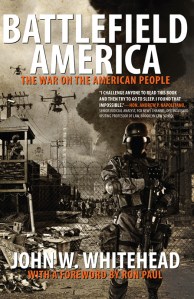
Battlefield_Cover_300As I document in my book Battlefield America: The War on the American People, we’re operating in a new paradigm where the citizenry are presumed guilty and treated as suspects, our movements tracked, our communications monitored, our property seized and searched, our bodily integrity disregarded, and our inalienable rights to “life, liberty and the pursuit of happiness” rendered insignificant when measured against the government’s priorities.

Every American is now in jeopardy of being targeted and punished for a crime he did not commit thanks to an overabundance of arcane laws. Making matters worse, by allowing government agents to operate above the law, immune from wrongdoing, we have created a situation in which the law is one-sided and top-down, used as a hammer to oppress the populace, while useless in protecting us against government abuse.

Add to the mix a profit-driven system of incarceration in which state and federal governments agree to keep the jails full in exchange for having private corporations run the prisons, and you will find the only word to describe such a state of abject corruption is “evil.”

How else do you explain a system that allows police officers to shoot first and ask questions later, without any real consequences for their misdeeds? Despite the initial outcry over the shootings of unarmed individuals in Ferguson and Baltimore, the pace of police shootings has yet to slow. In fact, close to 400 people were shot and killed by police nationwide in the first half of 2015, almost two shootings a day. Those are just the shootings that were tracked. Of those killed, almost 1 in 6 were either unarmed or carried a toy gun.

For those who survive an encounter with the police only to end up on the inside of a jail cell, waiting for a “fair and speedy trial,” it’s often a long wait. Consider that 60 percent of the people in the nation’s jails have yet to be convicted of a crime. There are 2.3 million people in jails or prisons in America. Those who can’t afford bail, “some of them innocent, most of them nonviolent and a vast majority of them impoverished,” will spend about four months in jail before they even get a trial.

Not even that promised “day in court” is a guarantee that justice will be served.

As Judge Alex Kozinski of the Ninth Circuit Court of Appeals points out, there are an endless number of factors that can render an innocent man or woman a criminal and caged for life: unreliable eyewitnesses, fallible forensic evidence, flawed memories, coerced confessions, harsh interrogation tactics, uninformed jurors, prosecutorial misconduct, falsified evidence, and overly harsh sentences, to name just a few.
In early 2015, the Justice Department and FBI “formally acknowledged that nearly every examiner in an elite FBI forensic unit gave flawed testimony in almost all trials in which they offered evidence against criminal defendants over more than a two-decade period…. The admissions mark a watershed in one of the country’s largest forensic scandals, highlighting the failure of the nation’s courts for decades to keep bogus scientific information from juries, legal analysts said.”

“How do rogue forensic scientists and other bad cops thrive in our criminal justice system?” asks Judge Kozinski. “The simple answer is that some prosecutors turn a blind eye to such misconduct because they’re more interested in gaining a conviction than achieving a just result.”

The power of prosecutors is not to be underestimated.

Increasingly, when we talk about innocent people being jailed for crimes they did not commit, the prosecutor plays a critical role in bringing about that injustice. As The Washington Post reports, “Prosecutors win 95 percent of their cases, 90 percent of them without ever having to go to trial…. Are American prosecutors that much better? No… it is because of the plea bargain, a system of bullying and intimidation by government lawyers for which they ‘would be disbarred in most other serious countries….’”

This phenomenon of innocent people pleading guilty makes a mockery of everything the criminal justice system is supposed to stand for: fairness, equality and justice. As Judge Jed S. Rakoff concludes, “our criminal justice system is almost exclusively a system of plea bargaining, negotiated behind closed doors and with no judicial oversight. The outcome is very largely determined by the prosecutor alone.”

It’s estimated that between 2 and 8 percent of convicted felons who have agreed to a prosecutor’s plea bargain (remember, there are 2.3 million prisoners in America) are in prison for crimes they did not commit.

Clearly, the Coalition for Public Safety was right when it concluded, “You don’t need to be a criminal to have your life destroyed by the U.S. criminal justice system.”

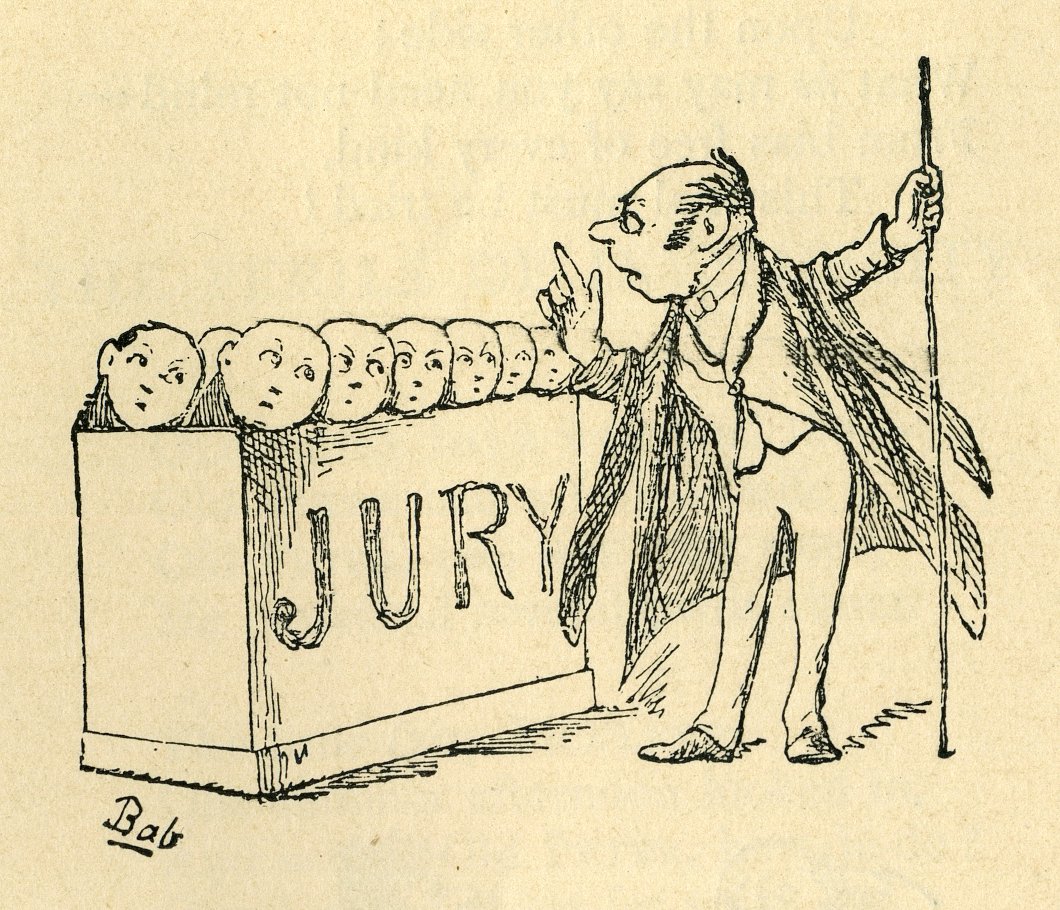
It wasn’t always this way. As Judge Rakoff recounts, the Founding Fathers envisioned a criminal justice system in which the critical element “was the jury trial, which served not only as a truth-seeking mechanism and a means of achieving fairness, but also as a shield against tyranny.”
That shield against tyranny has long since been shattered, leaving Americans vulnerable to the cruelties, vanities, errors, ambitions and greed of the government and its partners in crime.

There is not enough money in the world to make reparation to those whose lives have been disrupted by wrongful convictions.

Over the past quarter century, more than 1500 Americans have been released from prison after being cleared of crimes they did not commit. These are the fortunate ones. For every exonerated convict who is able to prove his innocence after 10, 20 or 30 years behind bars, Judge Kozinski estimates there may be dozens who are innocent but cannot prove it, lacking access to lawyers, evidence, money and avenues of appeal.

For those who have yet to fully experience the injustice of the American system of justice, it’s only a matter of time.

America no longer operates under a system of justice characterized by due process, an assumption of innocence, probable cause, and clear prohibitions on government overreach and police abuse. Instead, our courts of justice have been transformed into courts of order, advocating for the government’s interests, rather than championing the rights of the citizenry, as enshrined in the Constitution.

Without courts willing to uphold the Constitution’s provisions when government officials disregard them, and a citizenry knowledgeable enough to be outraged when those provisions are undermined, the Constitution provides little protection against the police state.

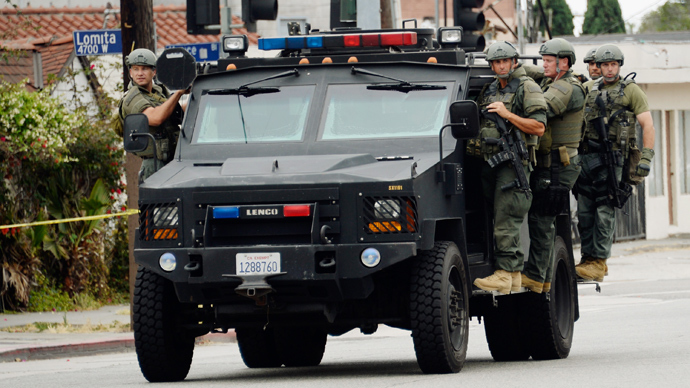
In other words, in this age of hollow justice, courts of order, and government-sanctioned tyranny, the Constitution is no safeguard against government wrongdoing such as SWAT team raids, domestic surveillance, police shootings of unarmed citizens, indefinite detentions, asset forfeitures, prosecutorial misconduct and the like.

“The war against Bradley Manning is a war against us all.”—Chris Hedges, author and journalist

“I wanted the American public to know that not everyone in Iraq and Afghanistan are targets that needed to be neutralized, but rather people who were struggling to live in the pressure cooker environment of what we call asymmetric warfare.”—Bradley Manning

Time and again, throughout America’s history, individuals with a passion for truth and a commitment to justice have opted to defy the unjust laws and practices of the American government in order to speak up against slavery, segregation, discrimination, and war. Even when their personal safety and freedom were on the line, these individuals spoke up, knowing they would be chastised, ridiculed, arrested, branded traitors and even killed.

Indeed, while brave men and women such as Martin Luther King, Jr., Henry David Thoreau, Susan B. Anthony and Harriet Tubman are lauded as American heroes today, they were once considered enemies of the state.

Thanks to the U.S. government’s growing intolerance for dissidents who insist on transparency and accountability, oppose its endless wars and targeted killings of innocent civilians and terrorists alike, and demand that government officials abide by the rule of law, that list of so-called “enemies of the state” is growing.

One such “enemy of the state” is Bradley Manning, an intelligence analyst who has been targeted by the Obama administration for holding up a mirror to the bloated face of American empire. Manning is being prosecuted for leaking classified government documents which, like the Pentagon Papers a generation ago, expose systemic corruption within America’s military and diplomatic apparatus. The embarrassment caused by showing that the emperor has no clothes, as it were, has made Bradley Manning public enemy number one in the eyes of the federal government. 

As Chris Hedges explains:

“Manning provided to the public the most important window into the inner workings of imperial power since the release of the Pentagon Papers. The routine use of torture, the detention of Iraqis who were innocent, the inhuman conditions within our secret detention facilities, the use of State Department officials as spies in the United Nations, the collusion with corporations to keep wages low in developing countries such as Haiti, and specific war crimes such as the missile strike on a house that killed seven children in Afghanistan would have remained hidden without Manning.”

Despite not being convicted of any crime, Manning has been put through a horror trip since the first day of his incarceration in the military brig at Quantico. He has spent 1,000 days in jail without trial, a large portion of which was passed in solitary confinement, imprisoned in a windowless 6 x 12 foot cell containing a bed, a drinking fountain and a toilet. Manning was kept under Suicide and/or Prevention of Injury (POI) watch during his incarceration, largely against the advice of two forensic psychiatrists. Under suicide watch, Manning was confined to his tiny cell for 24 hours a day and stripped of all clothing with the exception of his underwear. His prescription eyeglasses were taken away, leaving him in essential blindness except for those limited times when he was permitted to read or watch television. In a thinly veiled attempt to harass him, guards would check on Manning every five minutes, asking if he was ok.

Once he was finally brought before a military court, Manning pled guilty to ten of the twenty-two charges brought against him, admitting that he leaked the documents because he believed that the public has a right to know about the government’s misdeeds. Manning’s admission guarantees that he will be put into prison for up to twenty years. However, instead of proceeding to sentencing, government prosecutors are insisting on pressing the most serious charges against him, including “aiding the enemy,” in an attempt to imprison him for life.

The government’s aim is clear: to make an example of Manning (what Yale professor Eugene Fidell describes as an attempt to “scare the daylights out of other people”), thereby discouraging anyone else from defying the regime or daring to lay bare the inner workings of a corrupt government.

Indeed, despite promising unprecedented levels of transparency when he ascended to the presidency in 2009, Obama has invoked the WWI-era Espionage Act more times than all his predecessors combined as a means of silencing all internal dissent and criticism. Obama’s administration has also launched an all-out campaign to roust out, prosecute, and imprison government whistleblowers for exposing government corruption, incompetence, and greed. Obama’s other targets include John Kiriakou, a CIA agent who was prosecuted and imprisoned for blowing the whistle on government-sponsored torture, and Peter Van Buren, who exposed the government’s incompetence and failures during the occupation of Iraq.

Thus, Bradley Manning is merely the latest whistleblower to be singled out for punishment. So determined is the government to crucify Manning that government prosecutors plan to make the case that Manning essentially aided and abetted Osama bin Laden. Manning’s trial, which promises to be a government spectacle of manufactured “shock and awe,” will feature testimony from an anonymous Navy Seal who took part in the raid on Osama bin Laden’s Abbottabad compound. This Seal will reportedly testify that he recovered computer discs in Osama bin Laden’s personal effects containing government material that originated from Manning’s leak.

What the government is attempting to suggest is that if an individual or news organization publishes information that is accessed by terrorists over the internet, for example, then those individuals or news organizations are essentially guilty of collusion.

Stacking the odds in their favor, government prosecutors have refused to allow Manning’s defense team to interview government witnesses or to introduce evidence showing that Manning’s leak of government information did little, if any, harm to U.S. interests other than showing that the Obama administration is no different from its predecessors. In fact, Defense Secretary Robert Gates said that the publication of the Iraq War Logs and the Afghan War Diary had “not revealed any sensitive intelligence sources or methods.” As for the leak of some 250,000 State Department documents, a report by Reuters indicates that the damage caused was “limited,” and was for the most part simply an embarrassment to the Obama administration.

Manning reacted as one would hope any honorable American would react when they witness their government acting in a manner that is corrupt, incompetent, inhumane, immoral and, it must be said, downright evil. Manning was particularly affected by the so-called “Collateral Murder” video in which American Apache helicopter pilots can be see firing on civilians in Iraq, including children and a Reuters journalist. “The people in the van were not a threat but merely ‘good Samaritans,’” observed Manning. “The most alarming aspect of the video to me, however, was the seemly delightful bloodlust [the American troops] appeared to have.”

To his credit, Manning refused to remain silent. He spoke out, first to his superiors, who turned a deaf ear to his concerns, then to the New York Times and Washington Post. When he still could find no one willing to alert the American people to what their government was really doing in Iraq, Afghanistan, and elsewhere, he turned to Wikileaks.

The rest, as they say, is history. — John W. Whitehead