


“There is more than one way to burn a book. And the world is full of people running about with lit matches.”—Ray Bradbury
What we are witnessing is the modern-day equivalent of book burning which involves doing away with dangerous ideas—legitimate or not—and the people who espouse them.Seventy years after Ray Bradbury’s novel Fahrenheit 451 depicted a fictional world in which books are burned in order to suppress dissenting ideas, while televised entertainment is used to anesthetize the populace and render them easily pacified, distracted and controlled, we find ourselves navigating an eerily similar reality.
Welcome to the age of technocensorship.
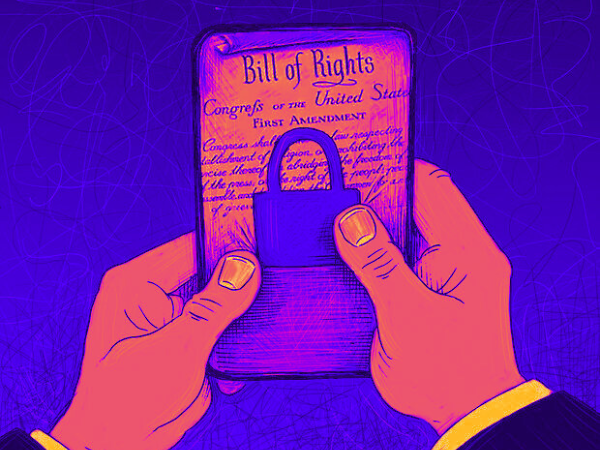
On paper—under the First Amendment, at least—we are technically free to speak.
In reality, however, we are now only as free to speak as a government official—or corporate entities such as Facebook, Google or YouTube—may allow.
Case in point: internal documents released by the House Judiciary Select Subcommittee on Weaponization of the Federal Government confirmed what we have long suspected: that the government has been working in tandem with social media companies to censor speech.
By “censor,” we’re referring to concerted efforts by the government to muzzle, silence and altogether eradicate any speech that runs afoul of the government’s own approved narrative.
This is political correctness taken to its most chilling and oppressive extreme.
The revelations that Facebook worked in concert with the Biden administration to censor content related to COVID-19, including humorous jokes, credible information and so-called disinformation, followed on the heels of a ruling by a federal court in Louisiana that prohibits executive branch officials from communicating with social media companies about controversial content in their online forums.
Likening the government’s heavy-handed attempts to pressure social media companies to suppress content critical of COVID vaccines or the election to “an almost dystopian scenario,” Judge Terry Doughty warned that “the United States Government seems to have assumed a role similar to an Orwellian ‘Ministry of Truth.’”
This is the very definition of technofascism.
Clothed in tyrannical self-righteousness, technofascism is powered by technological behemoths (both corporate and governmental) working in tandem to achieve a common goal.
The government is not protecting us from “dangerous” disinformation campaigns. It is laying the groundwork to insulate us from “dangerous” ideas that might cause us to think for ourselves and, in so doing, challenge the power elite’s stranglehold over our lives.
Thus far, the tech giants have been able to sidestep the First Amendment by virtue of their non-governmental status, but it’s a dubious distinction at best when they are marching in lockstep with the government’s dictates.
As Philip Hamburger and Jenin Younes write for The Wall Street Journal: “The First Amendment prohibits the government from ‘abridging the freedom of speech.’ Supreme Court doctrine makes clear that government can’t constitutionally evade the amendment by working through private companies.”
Nothing good can come from allowing the government to sidestep the Constitution.
The steady, pervasive censorship creep that is being inflicted on us by corporate tech giants with the blessing of the powers-that-be threatens to bring about a restructuring of reality straight out of Orwell’s 1984, where the Ministry of Truth polices speech and ensures that facts conform to whatever version of reality the government propagandists embrace.
Orwell intended 1984 as a warning. Instead, it is being used as a dystopian instruction manual for socially engineering a populace that is compliant, conformist and obedient to Big Brother.
This is the slippery slope that leads to the end of free speech as we once knew it.
In a world increasingly automated and filtered through the lens of artificial intelligence, we are finding ourselves at the mercy of inflexible algorithms that dictate the boundaries of our liberties.
Once artificial intelligence becomes a fully integrated part of the government bureaucracy, there will be little recourse: we will all be subject to the intransigent judgments of techno-rulers.
This is how it starts.
First, the censors went after so-called extremists spouting so-called “hate speech.”
Then they went after so-called extremists spouting so-called “disinformation” about stolen elections, the Holocaust, and Hunter Biden.
By the time so-called extremists found themselves in the crosshairs for spouting so-called “misinformation” about the COVID-19 pandemic and vaccines, the censors had developed a system and strategy for silencing the nonconformists.
Eventually, depending on how the government and its corporate allies define what constitutes “extremism, “we the people” might all be considered guilty of some thought crime or other.
Whatever we tolerate now—whatever we turn a blind eye to—whatever we rationalize when it is inflicted on others, whether in the name of securing racial justice or defending democracy or combatting fascism, will eventually come back to imprison us, one and all.
Watch and learn.
We should all be alarmed when any individual or group—prominent or not—is censored, silenced and made to disappear from Facebook, Twitter, YouTube and Instagram for voicing ideas that are deemed politically incorrect, hateful, dangerous or conspiratorial.
Given what we know about the government’s tendency to define its own reality and attach its own labels to behavior and speech that challenges its authority, this should be cause for alarm across the entire political spectrum.
Here’s the point: you don’t have to like or agree with anyone who has been muzzled or made to disappear online because of their views, but to ignore the long-term ramifications of such censorship is dangerously naïve, because whatever powers you allow the government and its corporate operatives to claim now will eventually be used against you by tyrants of your own making.
As Glenn Greenwald writes for The Intercept:
The glaring fallacy that always lies at the heart of pro-censorship sentiments is the gullible, delusional belief that censorship powers will be deployed only to suppress views one dislikes, but never one’s own views… Facebook is not some benevolent, kind, compassionate parent or a subversive, radical actor who is going to police our discourse in order to protect the weak and marginalized or serve as a noble check on mischief by the powerful. They are almost always going to do exactly the opposite: protect the powerful from those who seek to undermine elite institutions and reject their orthodoxies. Tech giants, like all corporations, are required by law to have one overriding objective: maximizing shareholder value. They are always going to use their power to appease those they perceive wield the greatest political and economic power.
Be warned: it’s a slippery slope from censoring so-called illegitimate ideas to silencing truth.
Eventually, as George Orwell predicted, telling the truth will become a revolutionary act.
If the government can control speech, it can control thought and, in turn, it can control the minds of the citizenry.
It’s happening already.
With every passing day, we’re being moved further down the road towards a totalitarian society characterized by government censorship, violence, corruption, hypocrisy and intolerance, all packaged for our supposed benefit in the Orwellian doublespeak of national security, tolerance and so-called “government speech.”
Little by little, Americans are being conditioned to accept routine incursions on their freedoms.
This is how oppression becomes systemic, what is referred to as creeping normality, or a death by a thousand cuts.
It’s a concept invoked by Pulitzer Prize-winning scientist Jared Diamond to describe how major changes, if implemented slowly in small stages over time, can be accepted as normal without the shock and resistance that might greet a sudden upheaval.
Diamond’s concerns related to Easter Island’s now-vanished civilization and the societal decline and environmental degradation that contributed to it, but it’s a powerful analogy for the steady erosion of our freedoms and decline of our country right under our noses.
As Diamond explains, “In just a few centuries, the people of Easter Island wiped out their forest, drove their plants and animals to extinction, and saw their complex society spiral into chaos and cannibalism… Why didn’t they look around, realize what they were doing, and stop before it was too late? What were they thinking when they cut down the last palm tree?”
His answer: “I suspect that the disaster happened not with a bang but with a whimper.”
Much like America’s own colonists, Easter Island’s early colonists discovered a new world—“a pristine paradise”—teeming with life. Yet almost 2000 years after its first settlers arrived, Easter Island was reduced to a barren graveyard by a populace so focused on their immediate needs that they failed to preserve paradise for future generations.
The same could be said of the America today: it, too, is being reduced to a barren graveyard by a populace so focused on their immediate needs that they are failing to preserve freedom for future generations.
In Easter Island’s case, as Diamond speculates:
The forest…vanished slowly, over decades. Perhaps war interrupted the moving teams; perhaps by the time the carvers had finished their work, the last rope snapped. In the meantime, any islander who tried to warn about the dangers of progressive deforestation would have been overridden by vested interests of carvers, bureaucrats, and chiefs, whose jobs depended on continued deforestation… The changes in forest cover from year to year would have been hard to detect… Only older people, recollecting their childhoods decades earlier, could have recognized a difference. Gradually trees became fewer, smaller, and less important. By the time the last fruit-bearing adult palm tree was cut, palms had long since ceased to be of economic significance. That left only smaller and smaller palm saplings to clear each year, along with other bushes and treelets. No one would have noticed the felling of the last small palm.”
Sound painfully familiar yet?
We’ve already torn down the rich forest of liberties established by our founders. It has vanished slowly, over the decades. The erosion of our freedoms has happened so incrementally, no one seems to have noticed. Only the older generations, remembering what true freedom was like, recognize the difference. Gradually, the freedoms enjoyed by the citizenry have become fewer, smaller and less important. By the time the last freedom falls, no one will know the difference.
This is how tyranny rises and freedom falls: with a thousand cuts, each one justified or ignored or shrugged over as inconsequential enough by itself to bother, but they add up.
Each cut, each attempt to undermine our freedoms, each loss of some critical right—to think freely, to assemble, to speak without fear of being shamed or censored, to raise our children as we see fit, to worship or not worship as our conscience dictates, to eat what we want and love who we want, to live as we want—they add up to an immeasurable failure on the part of each and every one of us to stop the descent down that slippery slope.
As I make clear in my book Battlefield America: The War on the American People and in its fictional counterpart The Erik Blair Diaries, we are on that downward slope now.
Source: https://tinyurl.com/3hvbehax
ABOUT JOHN W. WHITEHEAD
Constitutional attorney and author John W. Whitehead is founder and president of The Rutherford Institute. His most recent books are the best-selling Battlefield America: The War on the American People, the award-winning A Government of Wolves: The Emerging American Police State, and a debut dystopian fiction novel, The Erik Blair Diaries. Whitehead can be contacted at staff@rutherford.org. Nisha Whitehead is the Executive Director of The Rutherford Institute. Information about The Rutherford Institute is available at www.rutherford.org.
Publication Guidelines / Reprint Permission
John W. Whitehead’s weekly commentaries are available for publication to newspapers and web publications at no charge. Please contact staff@rutherford.org to obtain reprint permission.



The New Abnormal: Authoritarian Control Freaks Want to Micromanage Our Lives
Posted: September 26, 2023 in CommentaryTags: civil liberties, Constitution, COVID-19, government, individuality, Nanny State, police state, surveillance
Authoritarian control freaks out to micromanage our lives have become the new normal or, to be more accurate, the new abnormal when it comes to how the government relates to the citizenry.
This overbearing despotism, which pre-dates the COVID-19 hysteria, is the very definition of a Nanny State, where government representatives (those elected and appointed to work for us) adopt the authoritarian notion that the government knows best and therefore must control, regulate and dictate almost everything about the citizenry’s public, private and professional lives.
Indeed, it’s a dangerous time for anyone who still clings to the idea that freedom means the right to think for yourself and act responsibly according to your best judgment.
This tug-of-war for control and sovereignty over our selves impacts almost every aspect of our lives, whether you’re talking about decisions relating to our health, our homes, how we raise our children, what we consume, what we drive, what we wear, how we spend our money, how we protect ourselves and our loved ones, and even who we associate with and what we think.
As Liz Wolfe writes for Reason, “Little things that make people’s lives better, tastier, and less tedious are being cracked down on by big government types in federal and state governments.”
You can’t even buy a stove, a dishwasher, a showerhead, a leaf blower, or a lightbulb anymore without running afoul of the Nanny State.
In this way, under the guise of pseudo-benevolence, the government has meted out this bureaucratic tyranny in such a way as to nullify the inalienable rights of the individual and limit our choices to those few that the government deems safe enough.
Yet limited choice is no choice at all. Likewise, regulated freedom is no freedom at all.
Indeed, as a study by the Cato Institute concludes, for the average American, freedom has declined generally over the past 20 years. As researchers William Ruger and Jason Sorens explain, “We ground our conception of freedom on an individual rights framework. In our view, individuals should be allowed to dispose of their lives, liberties, and property as they see fit, so long as they do not infringe on the rights of others.”
The overt signs of the despotism exercised by the increasingly authoritarian regime that passes itself off as the United States government (and its corporate partners in crime) are all around us: censorship, criminalizing, shadow banning and de-platforming of individuals who express ideas that are politically incorrect or unpopular; warrantless surveillance of Americans’ movements and communications; SWAT team raids of Americans’ homes; shootings of unarmed citizens by police; harsh punishments meted out to schoolchildren in the name of zero tolerance; community-wide lockdowns and health mandates that strip Americans of their freedom of movement and bodily integrity; armed drones taking to the skies domestically; endless wars; out-of-control spending; militarized police; roadside strip searches; privatized prisons with a profit incentive for jailing Americans; fusion centers that spy on, collect and disseminate data on Americans’ private transactions; and militarized agencies with stockpiles of ammunition, to name some of the most appalling.
Yet as egregious as these incursions on our rights may be, it’s the endless, petty tyrannies—the heavy-handed, punitive-laden dictates inflicted by a self-righteous, Big-Brother-Knows-Best bureaucracy on an overtaxed, overregulated, and underrepresented populace—that illustrate so clearly the degree to which “we the people” are viewed as incapable of common sense, moral judgment, fairness, and intelligence, not to mention lacking a basic understanding of how to stay alive, raise a family, or be part of a functioning community.
When the dictates of petty bureaucrats carry greater weight than the individual rights of the citizenry, we’re in trouble, folks.
Federal and state governments have used the law as a bludgeon to litigate, legislate and micromanage our lives through overregulation and overcriminalization.
This is what happens when bureaucrats run the show, and the rule of law becomes little more than a cattle prod for forcing the citizenry to march in lockstep with the government.
Overregulation is just the other side of the coin to overcriminalization, that phenomenon in which everything is rendered illegal, and everyone becomes a lawbreaker.
You don’t have to look far to find abundant examples of Nanny State laws that infantilize individuals and strip them of their ability to decide things for themselves. Back in 2012, then-New York Mayor Michael Bloomberg infamously proposed a ban on the sale of sodas and large sugary drinks in order to guard against obesity. Other localities enacted bans on texting while jaywalking, wearing saggy pants, having too much mud on your car, smoking outdoors, storing trash in your car, improperly sorting your trash, cursing within earshot of others, or screeching your tires.
Yet while there are endless ways for the Nanny State to micromanage our lives, things become truly ominous when the government adopts mechanisms enabling it to monitor us for violations in order to enforce its many laws.
Nanny State, meet the all-seeing, all-knowing Surveillance State and its sidekick, the muscle-flexing Police State.
You see, in an age of overcriminalization—when the law is wielded like a hammer to force compliance to the government’s dictates whatever they might be—you don’t have to do anything “wrong” to be fined, arrested or subjected to raids and seizures and surveillance.
You just have to refuse to march in lockstep with the government.
As policy analyst Michael Van Beek warns, the problem with overcriminalization is that there are so many laws at the federal, state and local levels—that we can’t possibly know them all.
“It’s also impossible to enforce all these laws. Instead, law enforcement officials must choose which ones are important and which are not. The result is that they pick the laws Americans really must follow, because they’re the ones deciding which laws really matter,” concludes Van Beek. “Federal, state and local regulations — rules created by unelected government bureaucrats — carry the same force of law and can turn you into a criminal if you violate any one of them… if we violate these rules, we could be prosecuted as criminals. No matter how antiquated or ridiculous, they still carry the full force of the law. By letting so many of these sit around, just waiting to be used against us, we increase the power of law enforcement, which has lots of options to charge people with legal and regulatory violations.”
This is the police state’s superpower: empowered by the Nanny State, it has been vested with the authority to make our lives a bureaucratic hell.
Indeed, if you were unnerved by the rapid deterioration of privacy under the Surveillance State, prepare to be terrified by the surveillance matrix that will be ushered in by the Nanny State working in tandem with the Police State.
The government’s response to COVID-19 saddled us with a Nanny State inclined to use its draconian pandemic powers to protect us from ourselves.
The groundwork laid with COVID-19 is a prologue to what will become the police state’s conquest of a new, relatively uncharted, frontier: inner space, specifically, the inner workings (genetic, biological, biometric, mental, emotional) of the human race.
Consider how many more ways the government could “protect us” from ourselves under the guise of public health and safety.
For instance, under the guise of public health and safety, the government could use mental health care as a pretext for targeting and locking up dissidents, activists and anyone unfortunate enough to be placed on a government watch list.
When combined with advances in mass surveillance technologies, artificial intelligence-powered programs that can track people by their biometrics and behavior, mental health sensor data (tracked by wearable data and monitored by government agencies such as HARPA), threat assessments, behavioral sensing warnings, precrime initiatives, red flag gun laws, and mental health first-aid programs aimed at training gatekeepers to identify who might pose a threat to public safety, these preemptive mental health programs could well signal a tipping point in the government’s efforts to penalize those engaging in so-called “thought crimes.”
This is how it begins.
On a daily basis, Americans are already relinquishing (in many cases, voluntarily) the most intimate details of who we are—their biological makeup, our genetic blueprints, and our biometrics (facial characteristics and structure, fingerprints, iris scans, etc.)—in order to navigate an increasingly technologically-enabled world.
Having conditioned the population to the idea that being part of society is a privilege and not a right, such access could easily be predicated on social credit scores, the worthiness of one’s political views, or the extent to which one is willing to comply with the government’s dictates, no matter what they might be.
COVID-19 with its talk of mass testing, screening checkpoints, contact tracing, immunity passports, and snitch tip lines for reporting “rule breakers” to the authorities was a preview of what’s to come.
We should all be leery and afraid.
At a time when the government has a growing list—shared with fusion centers and law enforcement agencies—of ideologies, behaviors, affiliations and other characteristics that could flag someone as suspicious and result in their being labeled potential enemies of the state, it won’t take much for any of us to be considered outlaws or terrorists.
After all, the government likes to use the words “anti-government,” “extremist” and “terrorist” interchangeably. The Department of Homeland Security broadly defines extremists as individuals “that are mainly antigovernment, rejecting federal authority in favor of state or local authority, or rejecting government authority entirely.”
At some point, being an individualist will be considered as dangerous as being a terrorist.
When anything goes when it’s done in the name of national security, crime fighting and terrorism, “we the people” have little to no protection against SWAT team raids, domestic surveillance, police shootings of unarmed citizens, indefinite detentions, and the like, whether or not you’ve done anything wrong.
In an age of overcriminalization, you’re already a criminal.
All the government needs is proof of your law-breaking. They’ll get it, too.
Whether it’s through the use of surveillance software such as ShadowDragon that allows police to watch people’s social media activity, or technology that uses a home’s WiFi router and smart appliances to allow those on the outside to “see” throughout your home, it’s just a matter of time.
As I make clear in my book Battlefield America: The War on the American People and in its fictional counterpart The Erik Blair Diaries, it’s no longer a question of whether the government will lock up Americans for defying one of its numerous mandates but when.
Source: https://tinyurl.com/2jcu7y7v
ABOUT JOHN W. WHITEHEAD
Constitutional attorney and author John W. Whitehead is founder and president of The Rutherford Institute. His most recent books are the best-selling Battlefield America: The War on the American People, the award-winning A Government of Wolves: The Emerging American Police State, and a debut dystopian fiction novel, The Erik Blair Diaries. Whitehead can be contacted at staff@rutherford.org. Nisha Whitehead is the Executive Director of The Rutherford Institute. Information about The Rutherford Institute is available at www.rutherford.org.
Publication Guidelines / Reprint Permission
John W. Whitehead’s weekly commentaries are available for publication to newspapers and web publications at no charge. Please contact staff@rutherford.org to obtain reprint permission.