Posts Tagged ‘freedom’

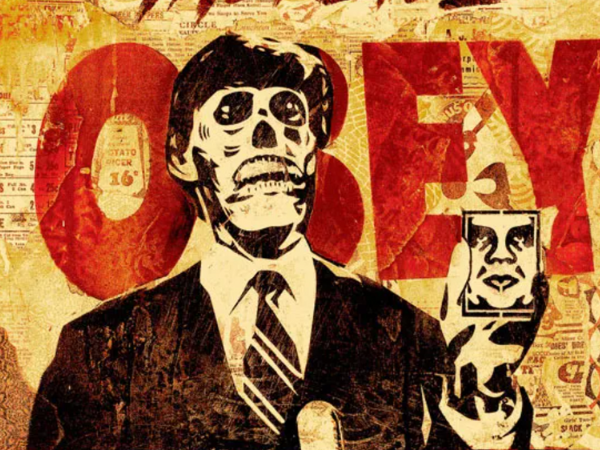
“You see them on the street. You watch them on TV. You might even vote for one this fall. You think they’re people just like you. You’re wrong. Dead wrong.” — They Live 

We’re living in two worlds.

There’s the world we see (or are made to see) and then there’s the one we sense (and occasionally catch a glimpse of), the latter of which is a far cry from the propaganda-driven reality manufactured by the government and its corporate sponsors, including the media.

Indeed, what most Americans perceive as life in America—privileged, progressive and free—is a far cry from reality, where economic inequality is growing, real agendas and real power are buried beneath layers of Orwellian doublespeak and corporate obfuscation, and “freedom,” such that it is, is meted out in small, legalistic doses by militarized police and federal agents armed to the teeth.

All is not as it seems.

Monsters with human faces walk among us. Many of them work for the U.S. government.

This is the premise of John Carpenter’s film They Live, which was released in November 1988 and remains unnervingly, chillingly appropriate for our modern age.

Best known for his horror film Halloween, which assumes that there is a form of evil so dark that it can’t be killed, Carpenter’s larger body of work is infused with a strong anti-authoritarian, anti-establishment, laconic bent that speaks to the filmmaker’s concerns about the unraveling of our society, particularly our government.

Time and again, Carpenter portrays the government working against its own citizens, a populace out of touch with reality, technology run amok, and a future more horrific than any horror film.

In Escape from New York, Carpenter presents fascism as the future of America.

In The Thing, a remake of the 1951 sci-fi classic of the same name, Carpenter presupposes that increasingly we are all becoming dehumanized.

In Christine, the film adaptation of Stephen King’s novel about a demon-possessed car, technology exhibits a will and consciousness of its own and goes on a murderous rampage.

In In the Mouth of Madness, Carpenter notes that evil grows when people lose “the ability to know the difference between reality and fantasy.”

And then there is Carpenter’s They Live, in which two migrant workers discover that the world is not as it seems. In fact, the population is actually being controlled and exploited by aliens working in partnership with an oligarchic elite. All the while, the populace—blissfully unaware of the real agenda at work in their lives—has been lulled into complacency, indoctrinated into compliance, bombarded with media distractions, and hypnotized by subliminal messages beamed out of television and various electronic devices, billboards and the like.

It is only when homeless drifter John Nada (played to the hilt by the late Roddy Piper) discovers a pair of doctored sunglasses—Hoffman lenses—that Nada sees what lies beneath the elite’s fabricated reality: control and bondage.

When viewed through the lens of truth, the elite, who appear human until stripped of their disguises, are shown to be monsters who have enslaved the citizenry in order to prey on them.

Likewise, billboards blare out hidden, authoritative messages: a bikini-clad woman in one ad is actually ordering viewers to “MARRY AND REPRODUCE.” Magazine racks scream “CONSUME” and “OBEY.” A wad of dollar bills in a vendor’s hand proclaims, “THIS IS YOUR GOD.”

When viewed through Nada’s Hoffman lenses, some of the other hidden messages being drummed into the people’s subconscious include: NO INDEPENDENT THOUGHT, CONFORM, SUBMIT, STAY ASLEEP, BUY, WATCH TV, NO IMAGINATION, and DO NOT QUESTION AUTHORITY.

This indoctrination campaign engineered by the elite in They Live is painfully familiar to anyone who has studied the decline of American culture.

A citizenry that does not think for themselves, obeys without question, is submissive, does not challenge authority, does not think outside the box, and is content to sit back and be entertained is a citizenry that can be easily controlled.

In this way, the subtle message of They Live provides an apt analogy of our own distorted vision of life in the American police state, what philosopher Slavoj Žižek refers to as dictatorship in democracy, “the invisible order which sustains your apparent freedom.”

We’re being fed a series of carefully contrived fictions that bear no resemblance to reality.

Tune out the government’s attempts to distract, divert and befuddle us and tune into what’s really going on in this country, and you’ll run headlong into an unmistakable, unpalatable truth: what we are dealing with today is an authoritarian beast that has outgrown its chains and will not be restrained.

Through its acts of power grabs, brutality, meanness, inhumanity, immorality, greed, corruption, debauchery and tyranny, the government has become almost indistinguishable from the evil it claims to be fighting, whether that evil takes the form of terrorism, torture, disease, drug traffickingsex trafficking, murder, violence, theft, pornography, scientific experimentations or some other diabolical means of inflicting pain, suffering and servitude on humanity.

We have let the government’s evil-doing and abuses go on for too long.

We’re being fed a series of carefully contrived fictions that bear no resemblance to reality.

Despite the fact that we are 17,600 times more likely to die from heart disease than from a terrorist attack; 11,000 times more likely to die from an airplane accident than from a terrorist plot involving an airplane; 1,048 times more likely to die from a car accident than a terrorist attack, and 8 times more likely to be killed by a police officer than by a terrorist , we have handed over control of our lives to government officials who treat us as a means to an end—the source of money and power.

As the Bearded Man in They Live warns, “They are dismantling the sleeping middle class. More and more people are becoming poor. We are their cattle. We are being bred for slavery.”

We have bought into the illusion and refused to grasp the truth.

From the moment we are born until we die, we are indoctrinated into believing that those who rule us do it for our own good. The truth is far different.

The powers-that-be want us to feel threatened by forces beyond our control (terrorists, pandemics, mass shootings, etc.).

They want us afraid and dependent on the government and its militarized armies for our safety and well-being.

They want us distrustful of each other, divided by our prejudices, and at each other’s throats.

Most of all, they want us to continue to march in lockstep with their dictates as fearful, controlled, pacified zombies.

This brings me back to They Live, in which the real zombies are not the aliens calling the shots but the populace who are content to remain controlled.

When all is said and done, the world of They Live is not so different from our own. As one of the characters points out, “The poor and the underclass are growing. Racial justice and human rights are nonexistent. They have created a repressive society and we are their unwitting accomplices. Their intention to rule rests with the annihilation of consciousness. We have been lulled into a trance. They have made us indifferent to ourselves, to others. We are focused only on our own gain.”

We, too, are focused only on our own pleasures, prejudices and gains. Our poor and underclasses are also growing. Injustice is growing. Inequality is growing. A concern for human rights is nearly nonexistent. We too have been lulled into a trance, indifferent to others.

Oblivious to what lies ahead, we’ve been manipulated into believing that if we continue to consume, obey, and have faith, things will work out. But that’s never been true of emerging regimes. And by the time we feel the hammer coming down upon us, it will be too late.

So where does that leave us?

The characters who populate Carpenter’s films provide some insight.

Underneath their machismo, they still believe in the ideals of liberty and equal opportunity. Their beliefs place them in constant opposition with the law and the establishment, but they are nonetheless freedom fighters.

When, for example, John Nada destroys the alien hypno-transmitter in They Live, he delivers a wake-up call for freedom. As Nada memorably declares, “I have come here to chew bubblegum and kick ass. And I’m all out of bubblegum.”

In other words: we need to get active and take a stand for what’s really important.

Stop allowing yourselves to be easily distracted by pointless political spectacles and pay attention to what’s really going on in the country.

As I make clear in my book Battlefield America: The War on the American People and in its fictional counterpart The Erik Blair Diaries, the real battle for control of this nation is taking place on roadsides, in police cars, on witness stands, over phone lines, in government offices, in corporate offices, in public school hallways and classrooms, in parks and city council meetings, and in towns and cities across this country.

All the trappings of the American police state are now in plain sight.

Wake up, America.

If they live (the tyrants, the oppressors, the invaders, the overlords), it is only because “we the people” sleep.

Source: https://bit.ly/3F9UYw4

ABOUT JOHN W. WHITEHEAD

Constitutional attorney and author John W. Whitehead is founder and president of The Rutherford Institute. His most recent books are the best-selling Battlefield America: The War on the American People, the award-winning A Government of Wolves: The Emerging American Police State, and a debut dystopian fiction novel, The Erik Blair Diaries. Whitehead can be contacted at staff@rutherford.org. Nisha Whitehead is the Executive Director of The Rutherford Institute. Information about The Rutherford Institute is available at www.rutherford.org.

Publication Guidelines / Reprint Permission

John W. Whitehead’s weekly commentaries are available for publication to newspapers and web publications at no charge. Please contact staff@rutherford.org to obtain reprint permission.

“You know, when police start becoming their own executioners, where’s it gonna end? Pretty soon, you’ll start executing people for jaywalking, and executing people for traffic violations. Then you end up executing your neighbor ‘cause his dog pisses on your lawn.”—“Dirty Harry” Callahan, Magnum Force

When I say that warrior cops—hyped up on their own authority and the power of the badge—have not made America any safer or freer, I am not disrespecting any of the fine, decent, lawful police officers who take seriously their oath of office to serve and protect their fellow citizens, uphold the Constitution, and maintain the peace.

My concern rests with the cops who feel empowered to act as judge, jury and executioner.

These death squads believe they can kill, shoot, taser, abuse and steal from American citizens in the so-called name of law and order.

Just recently, in fact, a rookie cop opened fire on the occupants of a parked car in a McDonald’s parking lot on a Sunday night in San Antonio, Texas.

The driver, 17-year-old Erik Cantu and his girlfriend, were eating burgers inside the car when the police officer—suspecting the car might have been one that fled an attempted traffic stop the night before—abruptly opened the driver side door, ordered the teenager to get out, and when he did not comply, shot ten times at the car, hitting Cantu multiple times.

Mind you, this wasn’t a life-or-death situation.

It was two teenagers eating burgers in a parking lot, and a cop fresh out of the police academy taking justice into his own hands.

This wasn’t an isolated incident, either.

In Hugo, Oklahoma, plain clothes police officers opened fire on a pickup truck parked in front of a food bank, heedless of the damage such a hail of bullets—26 shots were fired—could have on those in the vicinity. Three of the four children inside the parked vehicle were shot: a 4-year-old girl was shot in the head and ended up with a bullet in the brain; a 5-year-old boy received a skull fracture; and a 1-year-old girl had deep cuts on her face from gunfire or shattered window glass. The reason for the use of such excessive force? Police were searching for a suspect in a weeks-old robbery of a pizza parlor that netted $400.

In Minnesota, a 4-year-old girl watched from the backseat of a car as cops shot and killed her mother’s boyfriend, Philando Castile, a school cafeteria supervisor, during a routine traffic stop merely because Castile disclosed that he had a gun in his possession, for which he had a lawful conceal-and-carry permit. That’s all it took for police to shoot Castile four times as he was reaching for his license and registration. 

In Arizona, a 7-year-old girl watched panic-stricken as a state trooper pointed his gun at her and her father during a traffic stop and reportedly threated to shoot her father in the back (twice) based on the mistaken belief that they were driving a stolen rental car.

This is how we have gone from a nation of laws—where the least among us had just as much right to be treated with dignity and respect as the next person (in principle, at least)—to a nation of law enforcers (revenue collectors with weapons) who treat the citizenry like suspects and criminals.

The lesson for all of us: at a time when police have almost absolute discretion to decide who is a threat, what constitutes resistance, and how harshly they can deal with the citizens they were appointed to “serve and protect”—and a “fear” for officer safety is used to justify all manner of police misconduct—“we the people” are at a severe disadvantage.

Add a traffic stop to the mix, and that disadvantage increases dramatically.

According to the Justice Department, the most common reason for a citizen to come into contact with the police is being a driver in a traffic stop.

On average, one in 10 Americans gets pulled over by police.

Of the roughly 1,100 people killed by police each year, 10% of those involve traffic stops.

Historically, police officers have been given free range to pull anyone over for a variety of reasons.

This free-handed approach to traffic stops has resulted in drivers being stopped for windows that are too heavily tinted, for driving too fast, driving too slow, failing to maintain speed, following too closely, improper lane changes, distracted driving, screeching a car’s tires, and leaving a parked car door open for too long.

Motorists can also be stopped by police for driving near a bar or on a road that has large amounts of drunk driving, driving a certain make of car (Mercedes, Grand Prix and Hummers are among the most ticketed vehicles), having anything dangling from the rearview mirror (air fresheners, handicap parking permits, toll transponders or rosaries), and displaying pro-police bumper stickers.

Incredibly, a federal appeals court actually ruled unanimously in 2014 that acne scars and driving with a stiff upright posture are reasonable grounds for being pulled over. The Fifth Circuit Court of Appeals ruled that driving a vehicle that has a couple air fresheners, rosaries and pro-police bumper stickers at 2 MPH over the speed limit is suspicious, meriting a traffic stop.

Equally appalling, in Heien v. North Carolina, the U.S. Supreme Court—which has largely paved the way for the police and other government agents to probe, poke, pinch, taser, search, seize, strip and generally manhandle anyone they see fit in almost any circumstance—allowed police officers to stop drivers who appear nervous, provided they provide a palatable pretext for doing so.

Black drivers are almost two times more likely than white drivers to be pulled over by police and three times more likely to have their vehicles searched. As the Washington Post concludes, “‘Driving while black’ is, indeed, a measurable phenomenon.”

In other words, drivers beware.

Traffic stops aren’t just dangerous. They can be downright deadly.

Patrick Lyoya was pulled over for having a mismatched license plate. The unarmed man was shot in the back of the head while on the ground during a subsequent struggle with a Michigan police officer.

Reportedly pulled over for a broken taillight, Walter Scott—unarmed—ran away from the police officer, who pursued and shot him from behind, first with a Taser, then with a gun. Scott was struck five times, “three times in the back, once in the upper buttocks and once in the ear — with at least one bullet entering his heart.”

Samuel Dubose, also unarmed, was pulled over for a missing front license plate. He was reportedly shot in the head after a brief struggle in which his car began rolling forward.

Levar Jones was stopped for a seatbelt offense, just as he was getting out of his car to enter a convenience store. Directed to show his license, Jones leaned into his car to get his wallet, only to be shot four times by the “fearful” officer. Jones was also unarmed.

Bobby Canipe was pulled over for having an expired registration. When the 70-year-old reached into the back of his truck for his walking cane, the officer fired several shots at him, hitting him once in the abdomen.

Dontrell Stevens was stopped “for not bicycling properly.” The officer pursuing him “thought the way Stephens rode his bike was suspicious. He thought the way Stephens got off his bike was suspicious.” Four seconds later, sheriff’s deputy Adams Lin shot Stephens four times as he pulled out a black object from his waistband. The object was his cell phone. Stephens was unarmed.

That police are choosing to fatally resolve these encounters by using their guns on fellow citizens speaks volumes about what is wrong with policing in America today, where police officers are being dressed in the trappings of war, drilled in the deadly art of combat, and trained to look upon “every individual they interact with as an armed threat and every situation as a deadly force encounter in the making.”

Keep in mind, from the moment those lights start flashing and that siren goes off, we’re all in the same boat. Yet it’s what happens after you’ve been pulled over that’s critical.

Trying to predict the outcome of any encounter with the police is a bit like playing Russian roulette: most of the time you will emerge relatively unscathed, although decidedly poorer and less secure about your rights, but there’s always the chance that an encounter will turn deadly.

Survival is key.

Technically, you have the right to remain silent (beyond the basic requirement to identify yourself and show your registration). You have the right to refuse to have your vehicle searched. You have the right to film your interaction with police. You have the right to ask to leave. You also have the right to resist an unlawful order such as a police officer directing you to extinguish your cigarette, put away your phone or stop recording them.

However, there is a price for asserting one’s rights. That price grows more costly with every passing day.

If you ask cops and their enablers what Americans should do to stay alive during encounters with police, they will tell you to comply, cooperate, obey, not resist, not argue, not make threatening gestures or statements, avoid sudden movements, and submit to a search of their person and belongings. 

Unfortunately, in the American police state, compliance is no guarantee that you will survive an encounter with the police with your life and liberties intact.

Every day we hear about situations in which unarmed Americans complied and still died during an encounter with police simply because they appeared to be standing in a “shooting stance” or held a cell phone or a garden hose or carried around a baseball bat or answered the front door or held a spoon in a threatening manner or ran in an aggressive manner holding a tree branch or wandered around naked or hunched over in a defensive posture or made the mistake of wearing the same clothes as a carjacking suspect (dark pants and a basketball jersey) or dared to leave an area at the same time that a police officer showed up or had a car break down by the side of the road or were deaf or homeless or old.

More often than not, it seems as if all you have to do to be shot and killed by police is stand a certain way, or move a certain way, or hold something—anything—that police could misinterpret to be a gun, or ignite some trigger-centric fear in a police officer’s mind that has nothing to do with an actual threat to their safety.

Now politicians, police unions, law enforcement officials and individuals who are more than happy to march in lockstep with the police state make all kinds of excuses to justify these shootings.  However, to suggest that a good citizen is a compliant citizen and that obedience will save us from the police state is not only recklessly irresponsible, but it is also deluded.

To begin with, and most importantly, Americans need to know their rights when it comes to interactions with the police, bearing in mind that many law enforcement officials are largely ignorant of the law themselves.

A good resource is The Rutherford Institute’s “Constitutional Q&A: Rules of Engagement for Interacting with Police.”

In a nutshell, the following are your basic rights when it comes to interactions with the police as outlined in the Bill of Rights:

You have the right under the First Amendment to ask questions and express yourself. You have the right under the Fourth Amendment to not have your person or your property searched by police or any government agent unless they have a search warrant authorizing them to do so.  You have the right under the Fifth Amendment to remain silent, to not incriminate yourself and to request an attorney. Depending on which state you live in and whether your encounter with police is consensual as opposed to your being temporarily detained or arrested, you may have the right to refuse to identify yourself. Not all states require citizens to show their ID to an officer (although drivers in all states must do so).

As a rule of thumb, you should always be sure to clarify in any police encounter whether or not you are being detained, i.e., whether you have the right to walk away. That holds true whether it’s a casual “show your ID” request on a boardwalk, a stop-and-frisk search on a city street, or a traffic stop for speeding or just to check your insurance. If you feel like you can’t walk away from a police encounter of your own volition—and more often than not you can’t, especially when you’re being confronted by someone armed to the hilt with all manner of militarized weaponry and gear—then for all intents and purposes, you’re essentially under arrest from the moment a cop stops you. Still, it doesn’t hurt to clarify that distinction.

While technology is always going to be a double-edged sword, with the gadgets that are the most useful to us in our daily lives—GPS devices, cell phones, the internet—being the very tools used by the government to track us, monitor our activities, and generally spy on us, cell phones are particularly useful for recording encounters with the police and have proven to be increasingly powerful reminders to police that they are not all powerful.

Knowing your rights is only part of the battle, unfortunately.

As I point out in my book Battlefield America: The War on the American People and in its fictional counterpart The Erik Blair Diaries, the danger arises when the burden of proof is reversed, “we the people” are assumed guilty, and we have to exercise our rights while simultaneously attempting to prove our innocence to trigger-happy cops with no understanding of the Bill of Rights.

Source: https://bit.ly/3ThwQeZ

ABOUT JOHN W. WHITEHEAD

Constitutional attorney and author John W. Whitehead is founder and president of The Rutherford Institute. His most recent books are the best-selling Battlefield America: The War on the American People, the award-winning A Government of Wolves: The Emerging American Police State, and a debut dystopian fiction novel, The Erik Blair Diaries. Whitehead can be contacted at staff@rutherford.org. Nisha Whitehead is the Executive Director of The Rutherford Institute. Information about The Rutherford Institute is available at www.rutherford.org.

Publication Guidelines / Reprint Permission

John W. Whitehead’s weekly commentaries are available for publication to newspapers and web publications at no charge. Please contact staff@rutherford.org to obtain reprint permission.
“We the people are the rightful masters of both Congress and the courts, not to overthrow the Constitution but to overthrow the men who pervert the Constitution.” — Abraham Lincoln

It’s easy to become discouraged about the state of our nation.

We’re drowning under the weight of too much debt, too many wars, too much power in the hands of a centralized government, too many militarized police, too many laws, too many lobbyists, and generally too much bad news.

It’s harder to believe that change is possible, that the system can be reformed, that politicians can be principled, that courts can be just, that good can overcome evil, and that freedom will prevail.

So where does that leave us?

Benjamin Franklin provided the answer. As the delegates to the Constitutional Convention trudged out of Independence Hall on September 17, 1787, an anxious woman in the crowd waiting at the entrance inquired of Franklin, “Well, Doctor, what have we got, a republic or a monarchy?” “A republic,” Franklin replied, “if you can keep it.”

What Franklin meant, of course, is that when all is said and done, we get the government we deserve.

Those who gave us the Constitution and the Bill of Rights believed that the government exists at the behest of its citizens. It is there to protect, defend and even enhance our freedoms, not violate them.

Unfortunately, although the Bill of Rights was adopted as a means of protecting the people against government tyranny, in America today, the government does whatever it wants, freedom be damned.

“We the people” have been terrorized, traumatized, and tricked into a semi-permanent state of compliance by a government that cares nothing for our lives or our liberties.

The bogeyman’s names and faces have changed over time (terrorism, the war on drugs, illegal immigration, a viral pandemic, and more to come), but the end result remains the same: in the so-called name of national security, the Constitution has been steadily chipped away at, undermined, eroded, whittled down, and generally discarded with the support of Congress, the White House, and the courts.

A recitation of the Bill of Rights—set against a backdrop of government surveillance, militarized police, SWAT team raids, asset forfeiture, eminent domain, overcriminalization, armed surveillance drones, whole body scanners, stop and frisk searches, vaccine mandates, lockdowns, and the like (all sanctioned by Congress, the White House, and the courts)—would understandably sound more like a eulogy to freedoms lost than an affirmation of rights we truly possess.

What we are left with today is but a shadow of the robust document adopted more than two centuries ago. Sadly, most of the damage has been inflicted upon the Bill of Rights.

Here is what it means to live under the Constitution, twenty-plus years after 9/11 and with the nation just emerging from two years of COVID-19 lockdowns and mandates.

The First Amendment is supposed to protect the freedom to speak your mind, assemble and protest nonviolently without being bridled by the government. It also protects the freedom of the media, as well as the right to worship and pray without interference. In other words, Americans should not be silenced by the government. To the founders, all of America was a free speech zone.

Despite the clear protections found in the First Amendment, the freedoms described therein are under constant assault. Increasingly, Americans are being persecuted for exercising their First Amendment rights and speaking out against government corruption. Activists are being arrested and charged for daring to film police officers engaged in harassment or abusive practices. Journalists are being prosecuted for reporting on whistleblowers. States are passing legislation to muzzle reporting on cruel and abusive corporate practices. Religious ministries are being fined for attempting to feed and house the homeless. Protesters are being tear-gassed, beaten, arrested and forced into “free speech zones.” And under the guise of “government speech,” the courts have reasoned that the government can discriminate freely against any First Amendment activity that takes place within a so-called government forum.

The Second Amendment was intended to guarantee “the right of the people to keep and bear arms.” Essentially, this amendment was intended to give the citizenry the means to resist tyrannical government. Yet while gun ownership has been recognized by the U.S. Supreme Court as an individual citizen right, Americans remain powerless to defend themselves against red flag gun laws, militarized police, SWAT team raids, and government agencies armed to the teeth with military weapons better suited to the battlefield.

The Third Amendment reinforces the principle that civilian-elected officials are superior to the military by prohibiting the military from entering any citizen’s home without “the consent of the owner.” With the police increasingly training like the military, acting like the military, and posing as military forces—complete with heavily armed SWAT teams, military weapons, assault vehicles, etc.—it is clear that we now have what the founders feared most—a standing army on American soil.

The Fourth Amendment prohibits government agents from conducting surveillance on you or touching you or encroaching on your private property unless they have evidence that you’re up to something criminal. In other words, the Fourth Amendment ensures privacy and bodily integrity. Unfortunately, the Fourth Amendment has suffered the greatest damage in recent years and has been all but eviscerated by an unwarranted expansion of governmental police powers that include strip searches and even anal and vaginal searches of citizens, surveillance (corporate and otherwise), and intrusions justified in the name of fighting terrorism, as well as the outsourcing of otherwise illegal activities to private contractors.

The Fifth Amendment and the Sixth Amendment work in tandem. These amendments supposedly ensure that you are innocent until proven guilty, and government authorities cannot deprive you of your life, your liberty or your property without the right to an attorney and a fair trial before a civilian judge. However, in the new suspect society in which we live, where surveillance is the norm, these fundamental principles have been upended. Certainly, if the government can arbitrarily freeze, seize or lay claim to your property (money, land or possessions) under government asset forfeiture schemes, you have no true rights.

The Seventh Amendment guarantees citizens the right to a jury trial. Yet when the populace has no idea of what’s in the Constitution—civic education has virtually disappeared from most school curriculums—that inevitably translates to an ignorant jury incapable of distinguishing justice and the law from their own preconceived notions and fears. However, as a growing number of citizens are coming to realize, the power of the jury to nullify the government’s actions—and thereby help balance the scales of justice—is not to be underestimated. Jury nullification reminds the government that “we the people” retain the power to ultimately determine what laws are just.

The Eighth Amendment is similar to the Sixth in that it is supposed to protect the rights of the accused and forbid the use of cruel and unusual punishment. However, the Supreme Court’s determination that what constitutes “cruel and unusual” should be dependent on the “evolving standards of decency that mark the progress of a maturing society” leaves us with little protection in the face of a society lacking in morals altogether.

The Ninth Amendment provides that other rights not enumerated in the Constitution are nonetheless retained by the people. Popular sovereignty—the belief that the power to govern flows upward from the people rather than downward from the rulers—is clearly evident in this amendment. However, it has since been turned on its head by a centralized federal government that sees itself as supreme and which continues to pass more and more laws that restrict our freedoms under the pretext that it has an “important government interest” in doing so.

As for the Tenth Amendment’s reminder that the people and the states retain every authority that is not otherwise mentioned in the Constitution, that assurance of a system of government in which power is divided among local, state and national entities has long since been rendered moot by the centralized Washington, DC, power elite—the president, Congress and the courts.

Thus, if there is any sense to be made from this recitation of freedoms lost, it is simply this: our individual freedoms have been eviscerated so that the government’s powers could be expanded.

It was no idle happenstance that the Constitution opens with these three powerful words: “We the people.” As the Preamble proclaims:

We, the people of the United States, in order to form a more perfect Union, establish justice, insure domestic tranquility, provide for the common defense, promote the general welfare, and secure the blessings of liberty to ourselves and our posterity, do ordain and establish this CONSTITUTION for the United States of America.

In other words, it’s our job to make the government play by the rules of the Constitution.

We are supposed to be the masters and they—the government and its agents—are the servants.

We the American people—the citizenry—are supposed to be the arbiters and ultimate guardians of America’s welfare, defense, liberty, laws and prosperity.

Still, it’s hard to be a good citizen if you don’t know anything about your rights or how the government is supposed to operate.

As the National Review rightly asks, “How can Americans possibly make intelligent and informed political choices if they don’t understand the fundamental structure of their government? American citizens have the right to self-government, but it seems that we increasingly lack the capacity for it.”

Americans are constitutionally illiterate.

Most citizens have little, if any, knowledge about their basic rights. And our educational system does a poor job of teaching the basic freedoms guaranteed in the Constitution and the Bill of Rights. For instance, a survey by the Annenberg Public Policy Center found that a little more than one-third of respondents (36 percent) could name all three branches of the U.S. government, while another one-third (35 percent) could not name a single one.

A survey by the McCormick Tribune Freedom Museum found that only one out of a thousand adults could identify the five rights protected by the First Amendment. On the other hand, more than half (52%) of the respondents could name at least two of the characters in the animated Simpsons television family, and 20% could name all five. And although half could name none of the freedoms in the First Amendment, a majority (54%) could name at least one of the three judges on the TV program American Idol, 41% could name two and one-fourth could name all three.

It gets worse.

Many who responded to the survey had a strange conception of what was in the First Amendment. For example, a startling number of respondents believed that the “right to own a pet” and the “right to drive a car” were part of the First Amendment. Another 38% believed that “taking the Fifth” was part of the First Amendment.

Teachers and school administrators do not fare much better. A study conducted by the Center for Survey Research and Analysis found that one educator in five was unable to name any of the freedoms in the First Amendment.

Government leaders and politicians are also ill-informed. Although they take an oath to uphold, support and defend the Constitution against “enemies foreign and domestic,” their lack of education about our fundamental rights often causes them to be enemies of the Bill of Rights.

So what’s the solution?

Thomas Jefferson recognized that a citizenry educated on “their rights, interests, and duties”  is the only real assurance that freedom will survive.

As Jefferson wrote in 1820: “I know no safe depository of the ultimate powers of our society but the people themselves; and if we think them not enlightened enough to exercise their control with a wholesome discretion, the remedy is not to take it from them, but to inform their discretion by education. This is the true corrective of abuses of constitutional power.”

From the President on down, anyone taking public office should have a working knowledge of the Constitution and the Bill of Rights and should be held accountable for upholding their precepts. One way to ensure this would be to require government leaders to take a course on the Constitution and pass a thorough examination thereof before being allowed to take office.

Some critics are advocating that students pass the United States citizenship exam in order to graduate from high school. Others recommend that it must be a prerequisite for attending college. I’d go so far as to argue that students should have to pass the citizenship exam before graduating from grade school.

Here’s an idea to get educated and take a stand for freedom: anyone who signs up to become a member of The Rutherford Institute gets a wallet-sized Bill of Rights card and a Know Your Rights card. Use this card to teach your children the freedoms found in the Bill of Rights.

A healthy, representative government is hard work. It takes a citizenry that is informed about the issues, educated about how the government operates, and willing to do more than grouse and complain.

As I point out in my book Battlefield America: The War on the American People and in its fictional counterpart The Erik Blair Diaries, “we the people” have the power to make and break the government.

The powers-that-be want us to remain divided over politics, hostile to those with whom we disagree politically, and intolerant of anyone or anything whose solutions to what ails this country differ from our own. They also want us to believe that our job as citizens begins and ends on Election Day.

Yet there are 330 million of us in this country. Imagine what we could accomplish if we actually worked together, presented a united front, and spoke with one voice.

Tyranny wouldn’t stand a chance.

Source: https://bit.ly/3Dqg3kT

ABOUT JOHN W. WHITEHEAD

Constitutional attorney and author John W. Whitehead is founder and president of The Rutherford Institute. His most recent books are the best-selling Battlefield America: The War on the American People, the award-winning A Government of Wolves: The Emerging American Police State, and a debut dystopian fiction novel, The Erik Blair Diaries. Whitehead can be contacted at staff@rutherford.org. Nisha Whitehead is the Executive Director of The Rutherford Institute. Information about The Rutherford Institute is available at www.rutherford.org.

Publication Guidelines / Reprint Permission

John W. Whitehead’s weekly commentaries are available for publication to newspapers and web publications at no charge. Please contact staff@rutherford.org to obtain reprint permission.
“The whole aim of practical politics is to keep the populace alarmed (and hence clamorous to be led to safety) by an endless series of hobgoblins, most of them imaginary.”—H.L. Mencken

First came 9/11, which the government used to transform itself into a police state.

Then the COVID-19 pandemic hit, which the police state used to test out its lockdown powers.

In light of the government’s tendency to exploit crises (legitimate or manufactured) and capitalize on the nation’s heightened emotions, confusion and fear as a means of extending the reach of the police state, one has to wonder what so-called crisis it will declare next.

It’s a simple enough formula: first, you create fear, then you capitalize on it by seizing power.

Frankly, it doesn’t even matter what the nature of the next national emergency might be (terrorism, civil unrest, economic collapse, a health scare, or the environment) as long as it allows the government to lockdown the nation and justify all manner of tyranny in the so-called name of national security.

Cue the Emergency State.

Terrorist attacks, mass shootings, “unforeseen economic collapse, loss of functioning political and legal order, purposeful domestic resistance or insurgency, pervasive public health emergencies, and catastrophic natural and human disasters”: the government has been anticipating and preparing for such crises for years now.

As David C. Unger writes for the New York Times: “Life, liberty, and the pursuit of happiness have given way to permanent crisis management: to policing the planet and fighting preventative wars of ideological containment, usually on terrain chosen by, and favorable to, our enemies. Limited government and constitutional accountability have been shouldered aside by the kind of imperial presidency our constitutional system was explicitly designed to prevent.”

Here’s what we know: given the rate at which the government keeps devising new ways to establish itself as the “solution” to all of our worldly problems at taxpayer expense, each subsequent crisis ushers in ever larger expansions of government power and less individual liberty.

This is the slippery slope to outright tyranny.

You see, once the government acquires (and uses) authoritarian powers—to spy on its citizens, to carry out surveillance, to transform its police forces into extensions of the military, to seize taxpayer funds, to wage endless wars, to censor and silence dissidents, to identify potential troublemakers, to detain citizens without due process—it does not voluntarily relinquish them.

The lesson for the ages is this: once any government is allowed to overreach and expand its powers, it’s almost impossible to put the genie back in the bottle. As Harvard constitutional law professor Laurence Tribe recognizes, “The dictatorial hunger for power is insatiable.

Indeed, the history of the United States is a testament to the old adage that liberty decreases as government (and government bureaucracy) grows. To put it another way, as government expands, liberty contracts.

In this way, every crisis since the nation’s early beginnings has become a make-work opportunity for the government.

Each crisis has also been a test to see how far “we the people” would allow the government to sidestep the Constitution in the so-called name of national security; a test to see how well we have assimilated the government’s lessons in compliance, fear and police state tactics; a test to see how quickly we’ll march in lockstep with the government’s dictates, no questions asked; and a test to see how little resistance we offer up to the government’s power grabs when made in the name of national security.

Most critically of all, it has been a test to see whether the Constitution—and our commitment to the principles enshrined in the Bill of Rights—could survive a national crisis and true state of emergency.

Unfortunately, we’ve been failing this particular test for a long time now.

Indeed, the powers-that-be have been pushing our buttons and herding us along like so much cattle since World War II, at least, starting with the Japanese attacks on Pearl Harbor, which not only propelled the U.S. into World War II but also unified the American people in their opposition to a common enemy.

That fear of attack by foreign threats, conveniently torqued by the growing military industrial complex, in turn gave rise to the Cold War era’s “Red Scare.” Promulgated through government propaganda, paranoia and manipulation, anti-Communist sentiments boiled over into a mass hysteria that viewed anyone and everyone as suspect: your friends, the next-door neighbor, even your family members could be a Communist subversive.

This hysteria, which culminated in hearings before the House Un-American Activities Committee, where hundreds of Americans were called before Congress to testify about their so-called Communist affiliations and intimidated into making false confessions, also paved the way for the rise of an all-knowing, all-seeing governmental surveillance state.

By the time 9/11 rolled around, all George W. Bush had to do was claim the country was being invaded by terrorists, and the government used the USA Patriot Act to claim greater powers to spy, search, detain and arrest American citizens in order to keep America safe.

By way of the National Defense Authorization Act, Barack Obama continued Bush’s trend of undermining the Constitution, going so far as to give the military the power to strip Americans of their constitutional rights, label them extremists, and detain them indefinitely without trialall in the name of keeping America safe.

Despite the fact that the breadth of the military’s power to detain American citizens violates not only U.S. law and the Constitution but also international laws, the government has refused to relinquish its detention powers made possible by the NDAA.

Then Donald Trump took office, claiming the country was being invaded by dangerous immigrants and insisting that the only way to keep America safe was to expand the reach of the border police, empower the military to “assist” with border control, and essentially turn the country into a Constitution-free zone.

That so-called immigration crisis then morphed into multiple crises (domestic extremism, the COVID-19 pandemic, race wars, civil unrest, etc.) that the government has been eager to use in order to expand its powers.

Joe Biden, in turn, has made every effort to expand the reach of the militarized police state, pledging to hire 87,000 more IRS agents and 100,000 police officers. Read between the lines and you’ll find that Biden has all but declared war on the American people.

What the next crisis will be is anyone’s guess, but you can be sure that there will be a next crisis.

So, what should you expect if the government decides to declare another state of emergency and institutes a nationwide lockdown?

You should expect more of the same, only worse.

More compliance, less resistance.

More fear-mongering, mind-control tactics and less tolerance for those who question the government’s propaganda-driven narratives.

Most of all, as I point out in my book Battlefield America: The War on the American People and in its fictional counterpart The Erik Blair Diaries, you should expect more tyranny and less freedom.

There’s every reason to worry about what comes next.

Certainly, the government’s past track record and its long-anticipated plans for instituting martial law (using armed forces to solve domestic political and social problems) in response to a future crisis are cause enough to worry about the government’s handling of the next “crisis.”

Mark my words: if and when another nationwide lockdown finally hits—if and when we are forced to shelter in place— if and when militarized police are patrolling the streets— if and when security checkpoints have been established— if and when the media’s ability to broadcast the news has been curtailed by government censors—if and when public systems of communication (phone lines, internet, text messaging, etc.) have been restricted—if and when those FEMA camps the government has been surreptitiously building finally get used as detention centers for American citizens—if and when military “snatch and grab” teams are deployed on local, state, and federal levels as part of the activated Continuity of Government plans to isolate anyone suspected of being a threat to national security—and if and when martial law is enacted with little real outcry or resistance from the public—then we will truly understand the extent to which the government has fully succeeded in acclimating us to a state of affairs in which the government has all the power and “we the people” have none. 

Source: https://bit.ly/3x3ViHU

ABOUT JOHN W. WHITEHEAD

Constitutional attorney and author John W. Whitehead is founder and president of The Rutherford Institute. His most recent books are the best-selling Battlefield America: The War on the American People, the award-winning A Government of Wolves: The Emerging American Police State, and a debut dystopian fiction novel, The Erik Blair Diaries. Whitehead can be contacted at staff@rutherford.org. Nisha Whitehead is the Executive Director of The Rutherford Institute. Information about The Rutherford Institute is available at www.rutherford.org.

Publication Guidelines / Reprint Permission

John W. Whitehead’s weekly commentaries are available for publication to newspapers and web publications at no charge. Please contact staff@rutherford.org to obtain reprint permission.
“Every day in communities across the United States, children and adolescents spend the majority of their waking hours in schools that have increasingly come to resemble places of detention more than places of learning.”—Investigative journalist Annette Fuentes

This is what it means to go back-to-school in America today.

Instead of making the schools safer, government officials are making them more authoritarian.

Instead of raising up a generation of civic-minded citizens with critical thinking skills, government officials are churning out compliant drones who know little to nothing about their history or their freedoms.

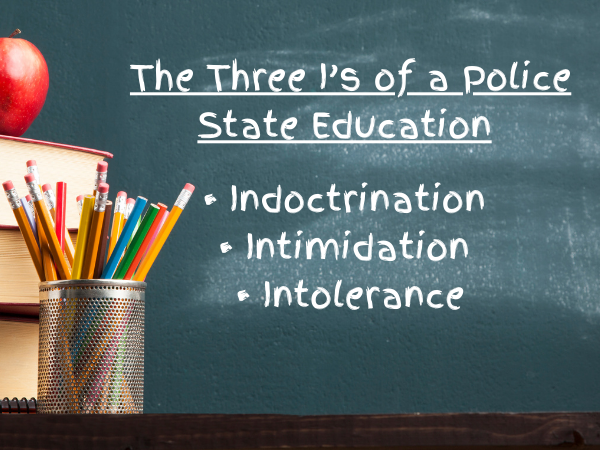
And instead of being taught the three R’s of education (reading, writing and arithmetic), young people are being drilled in the three I’s of life in the American police state: indoctrination, intimidation and intolerance.

From the moment a child enters one of the nation’s 98,000 public schools to the moment he or she graduates, they will be exposed to a steady diet of:

  • draconian zero tolerance policies that criminalize childish behavior,
  • overreaching anti-bullying statutes that criminalize speech,
  • school resource officers (police) tasked with disciplining and/or arresting so-called “disorderly” students,
  • standardized testing that emphasizes rote answers over critical thinking,
  • politically correct mindsets that teach young people to censor themselves and those around them,
  • and extensive biometric and surveillance systems that, coupled with the rest, acclimate young people to a world in which they have no freedom of thought, speech or movement.

Roped into the government’s profit-driven campaign to keep the nation “safe” from drugs, disease, and weapons, the schools have transformed themselves into quasi-prisons, complete with surveillance cameras, metal detectors, police patrols, zero tolerance policies, lock downs, drug sniffing dogs, strip searches and active shooter drills.

Young people in America are now first in line to be searched, surveilled, spied on, threatened, tied up, locked down, treated like criminals for non-criminal behavior, tasered and in some cases shot.

Students are not only punished for minor transgressions such as playing cops and robbers on the playground, bringing LEGOs to school, or having a food fight, but the punishments have become far more severe, shifting from detention and visits to the principal’s office into misdemeanor tickets, juvenile court, handcuffs, tasers and even prison terms.

Students have been suspended under school zero tolerance policies for bringing to school “look alike substances” such as oreganobreath mints, birth control pills and powdered sugar.

Look-alike weapons (toy guns—even Lego-sized ones, hand-drawn pictures of guns, pencils twirled in a “threatening” manner, imaginary bows and arrows, fingers positioned like guns) can also land a student in hot water, in some cases getting them expelled from school or charged with a crime.

Not even good deeds go unpunished.

One 13-year-old was given detention for exposing the school to “liability” by sharing his lunch with a hungry friend. A third grader was suspended for shaving her head in sympathy for a friend who had lost her hair to chemotherapy. And then there was the high school senior who was suspended for saying “bless you” after a fellow classmate sneezed.

Having police in the schools only adds to the danger.

Thanks to a combination of media hype, political pandering and financial incentives, the use of armed police officers (a.k.a. school resource officers) to patrol school hallways has risen dramatically in the years since the Columbine school shooting.

Indeed, the growing presence of police in the nation’s schools is resulting in greater police “involvement in routine discipline matters that principals and parents used to address without involvement from law enforcement officers.”

Funded by the U.S. Department of Justice, these school resource officers have become de facto wardens in elementary, middle and high schools, doling out their own brand of justice to the so-called “criminals” in their midst with the help of tasers, pepper spray, batons and brute force.

In the absence of school-appropriate guidelines, police are more and more “stepping in to deal with minor rulebreaking: sagging pants, disrespectful comments, brief physical skirmishes. What previously might have resulted in a detention or a visit to the principal’s office was replaced with excruciating pain and temporary blindness, often followed by a trip to the courthouse.”

Not even the younger, elementary school-aged kids are being spared these “hardening” tactics.

On any given day when school is in session, kids who “act up” in class are pinned facedown on the floor, locked in dark closets, tied up with straps, bungee cords and duct tape, handcuffed, leg shackled, tasered or otherwise restrained, immobilized or placed in solitary confinement in order to bring them under “control.”

In almost every case, these undeniably harsh methods are used to punish kids—some as young as 4 and 5 years old—for simply failing to follow directions or throwing tantrums.

Very rarely do the kids pose any credible danger to themselves or others.

Unbelievably, these tactics are all legal, at least when employed by school officials or school resource officers in the nation’s public schools.

This is what happens when you introduce police and police tactics into the schools.

Paradoxically, by the time you add in the lockdowns and active shooter drills, instead of making the schools safer, school officials have succeeded in creating an environment in which children are so traumatized that they suffer from post-traumatic stress disorder, nightmares, anxiety, mistrust of adults in authority, as well as feelings of anger, depression, humiliation, despair and delusion.

For example, a middle school in Washington State went on lockdown after a student brought a toy gun to class. A Boston high school went into lockdown for four hours after a bullet was discovered in a classroom. A North Carolina elementary school locked down and called in police after a fifth grader reported seeing an unfamiliar man in the school (it turned out to be a parent).

Police officers at a Florida middle school carried out an active shooter drill in an effort to educate students about how to respond in the event of an actual shooting crisis. Two armed officers, guns loaded and drawn, burst into classrooms, terrorizing the students and placing the school into lockdown mode.

These police state tactics have not made the schools any safer.

The fallout has been what you’d expect, with the nation’s young people treated like hardened criminals: handcuffed, arrested, tasered, tackled and taught the painful lesson that the Constitution (especially the Fourth Amendment) doesn’t mean much in the American police state.

So what’s the answer, not only for the here-and-now—the children growing up in these quasi-prisons—but for the future of this country?

How do you convince a child who has been routinely handcuffed, shackled, tied down, locked up, and immobilized by government officials—all before he reaches the age of adulthood—that he has any rights at all, let alone the right to challenge wrongdoing, resist oppression and defend himself against injustice?

Most of all, how do you persuade a fellow American that the government works for him when, for most of his young life, he has been incarcerated in an institution that teaches young people to be obedient and compliant citizens who don’t talk back, don’t question and don’t challenge authority?

As we’ve seen with other issues, any significant reforms will have to start locally and trickle upwards.

For starters, parents need to be vocal, visible and organized and demand that school officials 1) adopt a policy of positive reinforcement in dealing with behavior issues; 2) minimize the presence in the schools of police officers and cease involving them in student discipline; and 3) insist that all behavioral issues be addressed first and foremost with a child’s parents, before any other disciplinary tactics are attempted.

As I make clear in my book Battlefield America: The War on the American People and in its fictional counterpart The Erik Blair Diaries, if we want to raise up a generation of freedom fighters who will actually operate with justice, fairness, accountability and equality towards each other and their government, we must start by running the schools like freedom forums.

Source: https://bit.ly/3BBCCSQ

ABOUT JOHN W. WHITEHEAD

Constitutional attorney and author John W. Whitehead is founder and president of The Rutherford Institute. His most recent books are the best-selling Battlefield America: The War on the American People, the award-winning A Government of Wolves: The Emerging American Police State, and a debut dystopian fiction novel, The Erik Blair Diaries. Whitehead can be contacted at staff@rutherford.org. Nisha Whitehead is the Executive Director of The Rutherford Institute. Information about The Rutherford Institute is available at www.rutherford.org.

Publication Guidelines / Reprint Permission

John W. Whitehead’s weekly commentaries are available for publication to newspapers and web publications at no charge. Please contact staff@rutherford.org to obtain reprint permission.
Imagine living in a country where armed soldiers crash through doors to arrest and imprison citizens merely for criticizing government officials.

Imagine that in this very same country, you’re watched all the time, and if you look even a little bit suspicious, the police stop and frisk you or pull you over to search you on the off chance you’re doing something illegal.

Keep in mind that if you have a firearm of any kind (or anything that resembled a firearm) while in this country, it may get you arrested and, in some circumstances, shot by police.

If you’re thinking this sounds like America today, you wouldn’t be far wrong.

However, the scenario described above took place more than 200 years ago, when American colonists suffered under Great Britain’s version of an early police state. It was only when the colonists finally got fed up with being silenced, censored, searched, frisked, threatened, and arrested that they finally revolted against the tyrant’s fetters.

No document better states their grievances than the Declaration of Independence, drafted by Thomas Jefferson.

A document seething with outrage over a government which had betrayed its citizens, the Declaration of Independence was signed on July 4, 1776, by 56 men who laid everything on the line, pledged it all—“our Lives, our Fortunes, and our sacred Honor”—because they believed in a radical idea: that all people are created to be free.

Labeled traitors, these men were charged with treason, a crime punishable by death. For some, their acts of rebellion would cost them their homes and their fortunes. For others, it would be the ultimate price—their lives.

Yet even knowing the heavy price they might have to pay, these men dared to speak up when silence could not be tolerated. Even after they had won their independence from Great Britain, these new Americans worked to ensure that the rights they had risked their lives to secure would remain secure for future generations.

The result: our Bill of Rights, the first ten amendments to the Constitution.

Imagine the shock and outrage these 56 men would feel were they to discover that 246 years later, the government they had risked their lives to create has been transformed into a militaristic police state in which exercising one’s freedoms—at a minimum, merely questioning a government agent—is often viewed as a flagrant act of defiance.

In fact, had the Declaration of Independence been written today, it would have rendered its signers extremists or terrorists, resulting in them being placed on a government watch list, targeted for surveillance of their activities and correspondence, and potentially arrested, held indefinitely, stripped of their rights and labeled enemy combatants.

Read the Declaration of Independence again, and ask yourself if the list of complaints tallied by Jefferson don’t bear a startling resemblance to the abuses “we the people” are suffering at the hands of the American police state.

Here’s what the Declaration of Independence might look and sound like if it were written in the modern vernacular:

There comes a time when a populace must stand united and say “enough is enough” to the government’s abuses, even if it means getting rid of the political parties in power.

Believing that “we the people” have a natural and divine right to direct our own lives, here are truths about the power of the people and how we arrived at the decision to sever our ties to the government:

All people are created equal.

All people possess certain innate rights that no government or agency or individual can take away from them. Among these are the right to Life, Liberty and the pursuit of Happiness.

The government’s job is to protect the people’s innate rights to Life, Liberty and the pursuit of Happiness. The government’s power comes from the will of the people.

Whenever any government abuses its power, it is the right of the people to alter or abolish that government and replace it with a new government that will respect and protect the rights of the people.

It is not wise to get rid of a government for minor transgressions. In fact, as history has shown, people resist change and are inclined to suffer all manner of abuses to which they have become accustomed.

However, when the people have been subjected to repeated abuses and power grabs, carried out with the purpose of establishing a tyrannical government, people have a right and duty to do away with that tyrannical government and to replace it with a new government that will protect and preserve their innate rights for their future wellbeing.

This is exactly the state of affairs we are under suffering under right now, which is why it is necessary that we change this imperial system of government.

The history of the present Imperial Government is a history of repeated abuses and power grabs, carried out with the intention of establishing absolute tyranny over the country.

To prove this, consider the following:

The government has, through its own negligence and arrogance, refused to adopt urgent and necessary laws for the good of the people.

The government has threatened to hold up critical laws unless the people agree to relinquish their right to be fully represented in the Legislature.

In order to expand its power and bring about compliance with its dictates, the government has made it nearly impossible for the people to make their views and needs heard by their representatives.

The government has repeatedly suppressed protests arising in response to its actions.

The government has obstructed justice by refusing to appoint judges who respect the Constitution and has instead made the courts march in lockstep with the government’s dictates.

The government has allowed its agents to harass the people, steal from them, jail them and even execute them.

The government has directed militarized government agents—a.k.a., a standing army—to police domestic affairs in peacetime.

The government has turned the country into a militarized police state.

The government has conspired to undermine the rule of law and the constitution in order to expand its own powers.

The government has allowed its militarized police to invade our homes and inflict violence on homeowners.

The government has failed to hold its agents accountable for wrongdoing and murder under the guise of “qualified immunity.”

The government has jeopardized our international trade agreements.

The government has overtaxed us without our permission.

The government has denied us due process and the right to a fair trial.

The government has engaged in extraordinary rendition.

The government has continued to expand its military empire in collusion with its corporate partners-in-crime and occupy foreign nations.

The government has eroded fundamental legal protections and destabilized the structure of government.

The government has not only declared its federal powers superior to those of the states but has also asserted its sovereign power over the rights of “we the people.”

The government has ceased to protect the people and instead waged domestic war against the people.

The government has plundered our seas, ravaged our coasts, and destroyed the lives of the people.

The government has employed private contractors and mercenaries to carry out acts of death, desolation and tyranny, totally unworthy of a civilized nation.

The government through its political propaganda has pitted its citizens against each other.

The government has stirred up civil unrest and laid the groundwork for martial law.

Repeatedly, we have asked the government to cease its abuses. Each time, the government has responded with more abuse.

An Imperial Ruler who acts like a tyrant is not fit to govern a free people.

We have repeatedly sounded the alarm to our fellow citizens about the government’s abuses. We have warned them about the government’s power grabs. We have appealed to their sense of justice. We have reminded them of our common bonds.

They have rejected our plea for justice and brotherhood. They are equally at fault for the injustices being carried out by the government.

Thus, for the reasons mentioned above, we the people of the united States of America declare ourselves free from the chains of an abusive government. Relying on God’s protection, we pledge to stand by this Declaration of Independence with our lives, our fortunes and our honor.

In the 246 years since early Americans first declared and eventually won their independence from Great Britain, “we the people” have managed to work ourselves right back under the tyrant’s thumb.

Only this time, the tyrant is one of our own making: the American Police State.

The abuses meted out by an imperial government and endured by the American people have not ended. They have merely evolved.

“We the people” are still being robbed blind by a government of thieves.

We are still being taken advantage of by a government of scoundrels, idiots and monsters.

We are still being locked up by a government of greedy jailers.

We are still being spied on by a government of Peeping Toms.

We are still being ravaged by a government of ruffians, rapists and killers.

We are still being forced to surrender our freedoms—and those of our children—to a government of extortionists, money launderers and corporate pirates.

And we are still being held at gunpoint by a government of soldiers: a standing army in the form of a militarized police.

Given the fact that we are a relatively young nation, it hasn’t taken very long for an authoritarian regime to creep into power.

Unfortunately, the bipartisan coup that laid siege to our nation did not happen overnight.

It snuck in under our radar, hiding behind the guise of national security, the war on drugs, the war on terror, the war on immigration, political correctness, hate crimes and a host of other official-sounding programs aimed at expanding the government’s power at the expense of individual freedoms.

The building blocks for the bleak future we’re just now getting a foretaste of—police shootings of unarmed citizens, profit-driven prisons, weapons of compliance, a wall-to-wall surveillance state, pre-crime programs, a suspect society, school-to-prison pipelines, militarized police, overcriminalization, SWAT team raids, endless wars, etc.—were put in place by government officials we trusted to look out for our best interests.

As I make clear in my book Battlefield America: The War on the American People and in its fictional counterpart The Erik Blair Diaries, the problems we are facing will not be fixed overnight: that is the grim reality with which we must contend.

Yet that does not mean we should give up or give in or tune out. What we need to do is declare our independence from the tyranny of the American police state.

Source: https://bit.ly/3bBuabp

ABOUT JOHN W. WHITEHEAD

Constitutional attorney and author John W. Whitehead is founder and president of The Rutherford Institute. His most recent books are the best-selling Battlefield America: The War on the American People, the award-winning A Government of Wolves: The Emerging American Police State, and a debut dystopian fiction novel, The Erik Blair Diaries. Whitehead can be contacted at staff@rutherford.org. Nisha Whitehead is the Executive Director of The Rutherford Institute. Information about The Rutherford Institute is available at www.rutherford.org.

Publication Guidelines / Reprint Permission

John W. Whitehead’s weekly commentaries are available for publication to newspapers and web publications at no charge. Please contact staff@rutherford.org to obtain reprint permission.
Big Brother does not watch us, by his choice. We watch him, by ours…. When a population becomes distracted by trivia, when cultural life is redefined as a perpetual round of entertainments, when serious public conversation becomes a form of baby-talk, when, in short, a people become an audience, and their public business a vaudeville act, then a nation finds itself at risk; culture-death is a clear possibility.”—Professor Neil Postman

Once again, the programming has changed.

Like clockwork, the wall-to-wall news coverage of the latest crisis has shifted gears.

We have gone from COVID-19 lockdowns to Trump-Biden election drama to the Russia-Ukraine crisis to the Ketanji Brown Jackson confirmation hearings to Will Smith’s on-camera assault of comedian Chris Rock at the Academy Awards Ceremony.

The distractions, distortions, and political theater just keep coming.

The ongoing reality show that is life in the American police state feeds the citizenry’s voracious appetite for titillating, soap opera drama.

Much like the fabricated universe in Peter Weir’s 1998 film The Truman Show, in which a man’s life is the basis for an elaborately staged television show aimed at selling products and procuring ratings, the political scene in the United States has devolved over the years into a carefully calibrated exercise in how to manipulate, polarize, propagandize and control a population.

This is the magic of the reality TV programming that passes for politics today: as long as we are distracted, entertained, occasionally outraged, always polarized but largely uninvolved and content to remain in the viewer’s seat, we’ll never manage to present a unified front against tyranny (or government corruption and ineptitude) in any form.

The more that is beamed at us, the more inclined we are to settle back in our comfy recliners and become passive viewers rather than active participants as unsettling, frightening events unfold.

We don’t even have to change the channel when the subject matter becomes too monotonous. That’s taken care of for us by the programmers (the corporate media).

“Living is easy with eyes closed,” observed John Lennon, and that’s exactly what reality TV that masquerades as American politics programs the citizenry to do: navigate the world with their eyes shut.

As long as we’re viewers, we’ll never be doers.

Studies suggest that the more reality TV people watch—and I would posit that it’s all reality TV, entertainment news included—the more difficult it becomes to distinguish between what is real and what is carefully crafted farce.

“We the people” are watching a lot of TV.

On average, Americans spend five hours a day watching television. By the time we reach age 65, we’re watching more than 50 hours of television a week, and that number increases as we get older. And reality TV programming consistently captures the largest percentage of TV watchers every season by an almost 2-1 ratio.

This doesn’t bode well for a citizenry able to sift through masterfully-produced propaganda in order to think critically about the issues of the day, whether it’s fake news peddled by government agencies or foreign entities.

Those who watch reality shows tend to view what they see as the “norm.” Thus, those who watch shows characterized by lying, aggression and meanness not only come to see such behavior as acceptable and entertaining but also mimic the medium.

This holds true whether the reality programming is about the antics of celebrities in the White House, in the board room, or in the bedroom.

It’s a phenomenon called “humilitainment.”

A term coined by media scholars Brad Waite and Sara Booker, “humilitainment” refers to the tendency for viewers to take pleasure in someone else’s humiliation, suffering and pain.

Humilitainment” largely explains not only why American TV watchers are so fixated on reality TV programming but how American citizens, largely insulated from what is really happening in the world around them by layers of technology, entertainment, and other distractions, are being programmed to accept the government’s brutality, surveillance and dehumanizing treatment as things happening to other people.

The ramifications for the future of civic engagement, political discourse and self-government are incredibly depressing and demoralizing.

This explains how we keep getting saddled with leaders in government who are clueless about the Constitution and out-of-touch with the needs of the people they were appointed to represent.

This is also what happens when an entire nation—bombarded by reality TV programming, government propaganda and entertainment news—becomes systematically desensitized and acclimated to the trappings of a government that operates by fiat and speaks in a language of force.

Ultimately, the reality shows, the entertainment news, the surveillance society, the militarized police, and the political spectacles have one common objective: to keep us divided, distracted, imprisoned, and incapable of taking an active role in the business of self-government.

Look behind the political spectacles, the reality TV theatrics, the sleight-of-hand distractions and diversions, and the stomach-churning, nail-biting drama, and you will find there is a method to the madness.

We have become guinea pigs in a ruthlessly calculated, carefully orchestrated, chillingly cold-blooded experiment in how to control a population and advance a political agenda without much opposition from the citizenry.

This is mind-control in its most sinister form.

How do you change the way people think? You start by changing the words they use.

In totalitarian regimes where conformity and compliance are enforced at the end of a loaded gun, the government dictates what words can and cannot be used.

In countries where tyranny hides behind a benevolent mask and disguises itself as tolerance, the citizens censor themselves, policing their words and thoughts to conform to the dictates of the mass mind.

Even when the motives behind this rigidly calibrated reorientation of societal language appear well-intentioned—discouraging racism, condemning violence, denouncing discrimination and hatred—inevitably, the end result is the same: intolerance, indoctrination, infantilism, the chilling of free speech and the demonizing of viewpoints that run counter to the cultural elite.

As George Orwell recognized, “In times of universal deceit, telling the truth is a revolutionary act.”

Orwell understood only too well the power of language to manipulate the masses.

In Orwell’s 1984, Big Brother does away with all undesirable and unnecessary words and meanings, even going so far as to routinely rewrite history and punish “thoughtcrimes.” In this dystopian vision of the future, the Thought Police serve as the eyes and ears of Big Brother, while the Ministry of Peace deals with war and defense, the Ministry of Plenty deals with economic affairs (rationing and starvation), the Ministry of Love deals with law and order (torture and brainwashing), and the Ministry of Truth deals with news, entertainment, education and art (propaganda). The mottos of Oceania: WAR IS PEACE, FREEDOM IS SLAVERY, and IGNORANCE IS STRENGTH.

Orwell’s Big Brother relied on Newspeak to eliminate undesirable words, strip such words as remained of unorthodox meanings and make independent, non-government-approved thought altogether unnecessary.

Where we stand now is at the juncture of Oldspeak (where words have meanings, and ideas can be dangerous) and Newspeak (where only that which is “safe” and “accepted” by the majority is permitted).

Truth is often lost when we fail to distinguish between opinion and fact, and that is the danger we now face as a society. Anyone who relies exclusively on television/cable news hosts and political commentators for actual knowledge of the world is making a serious mistake.

Unfortunately, since Americans have by and large become non-readers, television has become their prime source of so-called “news.” This reliance on TV news has given rise to such popular news personalities who draw in vast audiences that virtually hang on their every word.

In our media age, these are the new powers-that-be.

Yet while these personalities often dispense the news like preachers used to dispense religion, with power and certainty, they are little more than conduits for propaganda and advertisements delivered in the guise of entertainment and news.

Given the preponderance of news-as-entertainment programming, it’s no wonder that viewers have largely lost the ability to think critically and analytically and differentiate between truth and propaganda, especially when delivered by way of fake news criers and politicians.

While television news cannot—and should not—be completely avoided, the following suggestions will help you better understand the nature of TV news.

1. TV news is not what happened. Rather, it is what someone thinks is worth reporting. Although there are still some good TV journalists, the old art of investigative reporting has largely been lost. While viewers are often inclined to take what is reported by television “news” hosts at face value, it is your responsibility to judge and analyze what is reported.

2. TV news is entertainment. There is a reason why the programs you watch are called news “shows.” It’s a signal that the so-called news is being delivered as a form of entertainment. “In the case of most news shows,” write Neil Postman and Steve Powers in their insightful book, How to Watch TV News (1992), “the package includes attractive anchors, an exciting musical theme, comic relief, stories placed to hold the audience, the creation of the illusion of intimacy, and so on.”

Of course, the point of all this glitz and glamour is to keep you glued to the set so that a product can be sold to you. (Even the TV news hosts get in on the action by peddling their own products, everything from their latest books to mugs and bathrobes.) Although the news items spoon-fed to you may have some value, they are primarily a commodity to gather an audience, which will in turn be sold to advertisers.

3. Never underestimate the power of commercials, especially to news audiences. In an average household, the television set is on over seven hours a day. Most people, believing themselves to be in control of their media consumption, are not really bothered by this. But TV is a two-way attack: it not only delivers programming to your home, it also delivers you (the consumer) to a sponsor.

People who watch the news tend to be more attentive, educated and have more money to spend. They are, thus, a prime market for advertisers. And sponsors spend millions on well-produced commercials. Such commercials are often longer in length than most news stories and cost more to produce than the news stories themselves. Moreover, the content of many commercials, which often contradicts the messages of the news stories, cannot be ignored. Most commercials are aimed at prurient interests in advocating sex, overindulgence, drugs, etc., which has a demoralizing effect on viewers, especially children.

4. It is vitally important to learn about the economic and political interests of those who own the “corporate” media. There are few independent news sources anymore. The major news outlets are owned by corporate empires.

5. Pay special attention to the language of newscasts. Because film footage and other visual imagery are so engaging on TV news shows, viewers are apt to allow language—what the reporter is saying about the images—to go unexamined. A TV news host’s language frames the pictures, and, therefore, the meaning we derive from the picture is often determined by the host’s commentary. TV by its very nature manipulates viewers. One must never forget that every television minute has been edited. The viewer does not see the actual event but the edited form of the event. For example, presenting a one- to two-minute segment from a two-hour political speech and having a TV talk show host critique may be disingenuous, but such edited footage is a regular staple on news shows. Add to that the fact that the reporters editing the film have a subjective view—sometimes determined by their corporate bosses—that enters in.

6. Reduce by at least one-half the amount of TV news you watch. TV news generally consists of “bad” news—wars, torture, murders, scandals and so forth. It cannot possibly do you any harm to excuse yourself each week from much of the mayhem projected at you on the news. Do not form your concept of reality based on television. TV news, it must be remembered, does not reflect normal everyday life. Studies indicate that a heavy viewing of TV news makes people think the world is much more dangerous than it actually is.

7. One of the reasons many people are addicted to watching TV news is that they feel they must have an opinion on almost everything, which gives the illusion of participation in American life. But an “opinion” is all that we can gain from TV news because it only presents the most rudimentary and fragmented information on anything. Thus, on most issues we don’t really know much about what is actually going on. And, of course, we are expected to take what the TV news host says on an issue as gospel truth. But isn’t it better to think for yourself? Add to this that we need to realize that we often don’t have enough information from the “news” source to form a true opinion. How can that be done? Study a broad variety of sources, carefully analyze issues in order to be better informed, and question everything.

The bottom line is simply this: Americans should beware of letting others—whether they be television news hosts, political commentators or media corporations—do their thinking for them.

As I make clear in my book Battlefield America: The War on the American People and in its fictional counterpart The Erik Blair Diaries, a populace that cannot think for themselves is a populace with its backs to the walls: mute in the face of elected officials who refuse to represent us, helpless in the face of police brutality, powerless in the face of militarized tactics and technology that treat us like enemy combatants on a battlefield, and naked in the face of government surveillance that sees and hears all.

It’s time to change the channel, tune out the reality TV show, and push back against the real menace of the police state.

If not, if we continue to sit back and lose ourselves in political programming, we will remain a captive audience to a farce that grows more absurd by the minute.

Source: https://bit.ly/3iL7LbQ

“The Internet is watching us now. If they want to. They can see what sites you visit. In the future, television will be watching us, and customizing itself to what it knows about us. The thrilling thing is, that will make us feel we’re part of the medium. The scary thing is, we’ll lose our right to privacy. An ad will appear in the air around us, talking directly to us.”—Director Steven Spielberg, Minority Report

We have arrived, way ahead of schedule, into the dystopian future dreamed up by such science fiction writers as George Orwell, Aldous Huxley, Margaret Atwood and Philip K. Dick.

Much like Orwell’s Big Brother in 1984, the government and its corporate spies now watch our every move.

Much like Huxley’s A Brave New World, we are churning out a society of watchers who “have their liberties taken away from them, but … rather enjoy it, because they [are] distracted from any desire to rebel by propaganda or brainwashing.”

Much like Atwood’s The Handmaid’s Tale, the populace is now taught to “know their place and their duties, to understand that they have no real rights but will be protected up to a point if they conform, and to think so poorly of themselves that they will accept their assigned fate and not rebel or run away.”

And in keeping with Philip K. Dick’s darkly prophetic vision of a dystopian police state—which became the basis for Steven Spielberg’s futuristic thriller Minority Report which was released 20 years ago—we are now trapped into a world in which the government is all-seeing, all-knowing and all-powerful, and if you dare to step out of line, dark-clad police SWAT teams and pre-crime units will crack a few skulls to bring the populace under control.

Minority Report is set in the year 2054, but it could just as well have taken place in 2022.

Seemingly taking its cue from science fiction, technology has moved so fast in the short time since Minority Report premiered in 2002 that what once seemed futuristic no longer occupies the realm of science fiction.

Incredibly, as the various nascent technologies employed and shared by the government and corporations alike—facial recognition, iris scanners, massive databases, behavior prediction software, and so on—are incorporated into a complex, interwoven cyber network aimed at tracking our movements, predicting our thoughts and controlling our behavior, Spielberg’s unnerving vision of the future is fast becoming our reality.

Both worlds—our present-day reality and Spielberg’s celluloid vision of the future—are characterized by widespread surveillance, behavior prediction technologies, data mining, fusion centers, driverless cars, voice-controlled homes, facial recognition systems, cybugs and drones, and predictive policing (pre-crime) aimed at capturing would-be criminals before they can do any damage.

Surveillance cameras are everywhere. Government agents listen in on our telephone calls and read our emails. Political correctness—a philosophy that discourages diversity—has become a guiding principle of modern society.

The courts have shredded the Fourth Amendment’s protections against unreasonable searches and seizures. In fact, SWAT teams battering down doors without search warrants and FBI agents acting as a secret police that investigate dissenting citizens are common occurrences in contemporary America.

We are increasingly ruled by multi-corporations wedded to the police state. Much of the population is either hooked on illegal drugs or ones prescribed by doctors. And bodily privacy and integrity has been utterly eviscerated by a prevailing view that Americans have no rights over what happens to their bodies during an encounter with government officials, who are allowed to search, seize, strip, scan, spy on, probe, pat down, taser, and arrest any individual at any time and for the slightest provocation.

All of this has come about with little more than a whimper from an oblivious American populace largely comprised of nonreaders and television and internet zombies, but we have been warned about such an ominous future in novels and movies for years.

The following 15 films may be the best representation of what we now face as a society.

Fahrenheit 451 (1966). Adapted from Ray Bradbury’s novel and directed by Francois Truffaut, this film depicts a futuristic society in which books are banned, and firemen ironically are called on to burn contraband books—451 Fahrenheit being the temperature at which books burn. Montag is a fireman who develops a conscience and begins to question his book burning. This film is an adept metaphor for our obsessively politically correct society where virtually everyone now pre-censors speech. Here, a brainwashed people addicted to television and drugs do little to resist governmental oppressors.

2001: A Space Odyssey (1968). The plot of Stanley Kubrick’s masterpiece, as based on an Arthur C. Clarke short story, revolves around a space voyage to Jupiter. The astronauts soon learn, however, that the fully automated ship is orchestrated by a computer system—known as HAL 9000—which has become an autonomous thinking being that will even murder to retain control. The idea is that at some point in human evolution, technology in the form of artificial intelligence will become autonomous and human beings will become mere appendages of technology. In fact, at present, we are seeing this development with massive databases generated and controlled by the government that are administered by such secretive agencies as the National Security Agency and sweep all websites and other information devices collecting information on average citizens. We are being watched from cradle to grave.

Planet of the Apes (1968). Based on Pierre Boulle’s novel, astronauts crash on a planet where apes are the masters and humans are treated as brutes and slaves. While fleeing from gorillas on horseback, astronaut Taylor is shot in the throat, captured and housed in a cage. From there, Taylor begins a journey wherein the truth revealed is that the planet was once controlled by technologically advanced humans who destroyed civilization. Taylor’s trek to the ominous Forbidden Zone reveals the startling fact that he was on planet earth all along. Descending into a fit of rage at what he sees in the final scene, Taylor screams: “We finally really did it. You maniacs! You blew it up! Damn you.” The lesson is obvious, but will we listen? The script, although rewritten, was initially drafted by Rod Serling and retains Serling’s Twilight Zone-ish ending.

THX 1138 (1970). George Lucas’ directorial debut, this is a somber view of a dehumanized society totally controlled by a police state. The people are force-fed drugs to keep them passive, and they no longer have names but only letter/number combinations such as THX 1138. Any citizen who steps out of line is quickly brought into compliance by robotic police equipped with “pain prods”—electro-shock batons. Sound like tasers?

A Clockwork Orange (1971). Director Stanley Kubrick presents a future ruled by sadistic punk gangs and a chaotic government that cracks down on its citizens sporadically. Alex is a violent punk who finds himself in the grinding, crushing wheels of injustice. This film may accurately portray the future of western society that grinds to a halt as oil supplies diminish, environmental crises increase, chaos rules, and the only thing left is brute force.

Soylent Green (1973). Set in a futuristic overpopulated New York City, the people depend on synthetic foods manufactured by the Soylent Corporation. A policeman investigating a murder discovers the grisly truth about what soylent green is really made of. The theme is chaos where the world is ruled by ruthless corporations whose only goal is greed and profit. Sound familiar?

Blade Runner (1982). In a 21st century Los Angeles, a world-weary cop tracks down a handful of renegade “replicants” (synthetically produced human slaves). Life is now dominated by mega-corporations, and people sleepwalk along rain-drenched streets. This is a world where human life is cheap, and where anyone can be exterminated at will by the police (or blade runners). Based upon a Philip K. Dick novel, this exquisite Ridley Scott film questions what it means to be human in an inhuman world.

Nineteen Eighty-Four (1984). The best adaptation of Orwell’s dark tale, this film visualizes the total loss of freedom in a world dominated by technology and its misuse, and the crushing inhumanity of an omniscient state. The government controls the masses by controlling their thoughts, altering history and changing the meaning of words. Winston Smith is a doubter who turns to self-expression through his diary and then begins questioning the ways and methods of Big Brother before being re-educated in a most brutal fashion.

Brazil (1985). Sharing a similar vision of the near future as 1984 and Franz Kafka’s novel The Trial, this is arguably director Terry Gilliam’s best work, one replete with a merging of the fantastic and stark reality. Here, a mother-dominated, hapless clerk takes refuge in flights of fantasy to escape the ordinary drabness of life. Caught within the chaotic tentacles of a police state, the longing for more innocent, free times lies behind the vicious surface of this film.

They Live (1988). John Carpenter’s bizarre sci-fi social satire action film assumes the future has already arrived. John Nada is a homeless person who stumbles across a resistance movement and finds a pair of sunglasses that enables him to see the real world around him. What he discovers is a world controlled by ominous beings who bombard the citizens with subliminal messages such as “obey” and “conform.” Carpenter manages to make an effective political point about the underclass—that is, everyone except those in power. The point: we, the prisoners of our devices, are too busy sucking up the entertainment trivia beamed into our brains and attacking each other up to start an effective resistance movement.

The Matrix (1999). The story centers on a computer programmer Thomas A. Anderson, secretly a hacker known by the alias “Neo,” who begins a relentless quest to learn the meaning of “The Matrix”—cryptic references that appear on his computer. Neo’s search leads him to Morpheus who reveals the truth that the present reality is not what it seems and that Anderson is actually living in the future—2199. Humanity is at war against technology which has taken the form of intelligent beings, and Neo is actually living in The Matrix, an illusionary world that appears to be set in the present in order to keep the humans docile and under control. Neo soon joins Morpheus and his cohorts in a rebellion against the machines that use SWAT team tactics to keep things under control.

Minority Report (2002). Based on a short story by Philip K. Dick and directed by Steven Spielberg, the film offers a special effect-laden, techno-vision of a futuristic world in which the government is all-seeing, all-knowing and all-powerful. And if you dare to step out of line, dark-clad police SWAT teams will bring you under control. The setting is 2054 where PreCrime, a specialized police unit, apprehends criminals before they can commit the crime. Captain Anderton is the chief of the Washington, DC, PreCrime force which uses future visions generated by “pre-cogs” (mutated humans with precognitive abilities) to stop murders. Soon Anderton becomes the focus of an investigation when the precogs predict he will commit a murder. But the system can be manipulated. This film raises the issue of the danger of technology operating autonomously—which will happen eventually if it has not already occurred. To a hammer, all the world looks like a nail. In the same way, to a police state computer, we all look like suspects. In fact, before long, we all may be mere extensions or appendages of the police state—all suspects in a world commandeered by machines.

V for Vendetta (2006). This film depicts a society ruled by a corrupt and totalitarian government where everything is run by an abusive secret police. A vigilante named V dons a mask and leads a rebellion against the state. The subtext here is that authoritarian regimes through repression create their own enemies—that is, terrorists—forcing government agents and terrorists into a recurring cycle of violence. And who is caught in the middle? The citizens, of course. This film has a cult following among various underground political groups such as Anonymous, whose members wear the same Guy Fawkes mask as that worn by V.

Children of Men (2006). This film portrays a futuristic world without hope since humankind has lost its ability to procreate. Civilization has descended into chaos and is held together by a military state and a government that attempts to keep its totalitarian stronghold on the population. Most governments have collapsed, leaving Great Britain as one of the few remaining intact societies. As a result, millions of refugees seek asylum only to be rounded up and detained by the police. Suicide is a viable option as a suicide kit called Quietus is promoted on billboards and on television and newspapers. But hope for a new day comes when a woman becomes inexplicably pregnant.

Land of the Blind (2006). In this dark political satire, tyrannical rulers are overthrown by new leaders who prove to be just as evil as their predecessors. Maximilian II is a demented fascist ruler of a troubled land named Everycountry who has two main interests: tormenting his underlings and running his country’s movie industry. Citizens who are perceived as questioning the state are sent to “re-education camps” where the state’s concept of reality is drummed into their heads. Joe, a prison guard, is emotionally moved by the prisoner and renowned author Thorne and eventually joins a coup to remove the sadistic Maximilian, replacing him with Thorne. But soon Joe finds himself the target of the new government.

All of these films—and the writers who inspired them—understood what many Americans, caught up in their partisan, flag-waving, zombified states, are still struggling to come to terms with: that there is no such thing as a government organized for the good of the people. Even the best intentions among those in government inevitably give way to the desire to maintain power and control at all costs.

Eventually, as I make clear in my book Battlefield America: The War on the American People and in its fictional counterpart The Erik Blair Diaries, even the sleepwalking masses (who remain convinced that all of the bad things happening in the police state—the police shootings, the police beatings, the raids, the roadside strip searches—are happening to other people) will have to wake up.

Sooner or later, the things happening to other people will start happening to us.

When that painful reality sinks in, it will hit with the force of a SWAT team crashing through your door, a taser being aimed at your stomach, and a gun pointed at your head. And there will be no channel to change, no reality to alter, and no manufactured farce to hide behind.

As George Orwell warned, “If you want a picture of the future, imagine a boot stamping on a human face forever.”

Source: https://bit.ly/36yARIK

ABOUT JOHN W. WHITEHEAD

Constitutional attorney and author John W. Whitehead is founder and president The Rutherford Institute. His books Battlefield America: The War on the American People and A Government of Wolves: The Emerging American Police State are available at www.amazon.com. He can be contacted at johnw@rutherford.org. Nisha Whitehead is the Executive Director of The Rutherford Institute. Information about The Rutherford Institute is available at www.rutherford.org.

Publication Guidelines / Reprint Permission

John W. Whitehead’s weekly commentaries are available for publication to newspapers and web publications at no charge. Please contact staff@rutherford.org to obtain reprint permission.
“This is the way the world ends

Not with a bang but a whimper.”

— “The Hollow Men,” T.S. Eliot

Barely three years into the 2020s, and we seem to be living out the prophesies of the Book of Revelation with its dire warnings about plague, poverty, hatred and war.

Just as the government hysteria over the COVID-19 pandemic appears to be dying down, new threats have arisen to occupy our attention and fuel our fears: food shortages, spiking inflation, rocketing gas prices, and a Ukraine-Russia conflict that threatens to bring about a world war.

Is this the end of the world as we know it? Or is this the beginning of the end of the world?

Will the world end with a bang or will it end, as T.S. Eliot concludes, with a whimper?

Robert Frost, torn between a vision of the world ending in fire (the hot flame of violence, anger and greed) or ice (the cold burn of hatred), suggests that either would suffice to do the job.

And then there’s the Polish-American poet Czeslaw Milosz, who envisioned the day the world ends as a day like any other: “Those who expected lightning and thunder are disappointed. And those who expected signs and archangels’ trumps do not believe it is happening now. As long as the sun and the moon are above, as long as the bumblebee visits a rose, as long as rosy infants are born, no one believes it is happening now… There will be no other end of the world.”

In Milosz’ words can be found a distant echo of a warning issued by Bertram Gross in his book Friendly Fascism: The New Face of Power in America:

“Anyone looking for black shirts, mass parties, or men on horseback will miss the telltale clues of creeping fascism. In any First World country of advanced capitalism, the new fascism will be colored by national and cultural heritage, ethnic and religious composition, formal political structure, and geopolitical environment… In America, it would be supermodern and multi-ethnic-as American as Madison Avenue, executive luncheons, credit cards, and apple pie. It would be fascism with a smile. As a warning against its cosmetic facade, subtle manipulation, and velvet gloves, I call it friendly fascism. What scares me most is its subtle appeal. I am worried by those who fail to remember-or have never learned -that Big Business-Big Government partnerships, backed up by other elements, were the central facts behind the power structures of old fascism in the days of Mussolini, Hitler, and the Japanese empire builders.”

Look beyond the drum-pounding distractions of war and the fear-inducing tactics of the Deep State, and consider the long-term ramifications of the so-called sanctions being levied against Russia right now: not just the governmental sanctions, but the corporate lockdowns.

As CBS News reports, “Car shipments were paused. Beer stopped flowing. McDonald’s shut down sales of Big Macs. Cargo ships dropped port calls and oil companies cut their pipelines. Russia’s invasion of Ukraine is leading some of the world’s best known brands—from Apple to Disney and Ikea—to abruptly exit a country that’s become a global outcast.”

This is shunning on a global scale.

Some companies, as Fortune reports, have gone above and beyond what was required by government sanctions. For instance, “major oil companies, including Exxon, BP, and Shell, ended joint investment projects with Russian oil companies. Major retailers, including H&M, Nike, Ikea, and TJX, have shut down Russian sales and closed stores. Visa, Mastercard, and American Express shut down global services in Russia… Boeing cut off support for Russian airlines and closed its offices in Moscow, while Delta ended its Russian code-sharing arrangement… FedEx and UPS shut services to Russia. Apple, Alphabet, Meta, and Microsoft all have taken significant action to combat Russian aggression and disinformation.”

You basically have Russia becoming a commercial pariah,” confirmed economist Mary Lovely. “Pretty much no company, no multinational, wants to be caught on the wrong side of U.S. and Western sanctions.”

Russia’s military aggression has paved the way for a show of force by a punitive Big Business-Big Government power alliance that, until recently, had been exerting itself on a smaller scale to sanction individuals whose behavior was deemed to be hateful, discriminatory, conspiratorial or anti-government.

There’s no going back from here.

This may well be the end of the world as we know it.

This particular apocalypse is the fallout from a silent coup that has given the Corporate State a taste for punitive power and an understanding of the ease with which it can use that power to manipulate, control and direct the world governments.

For good or bad, it will change the way we navigate the world, redrawing the boundaries of our world (and our freedoms) and altering the playing field faster than we can keep up.

This new world order—a global world order—made up of international government agencies and corporations owes its existence in large part to the U.S. government’s deep-seated and, in many cases, top-secret alliances with foreign nations and global corporations.

This powerful international cabal, let’s call it the Global Deep State, is just as real as the corporatized, militarized, industrialized American Deep State, and it poses just as great a threat to our rights as individuals under the U.S. Constitution, if not greater.

We’ve been inching closer to this global world order for the past several decades, but COVID-19, which saw governmental and corporate interests become even more closely intertwined, shifted this transformation into high gear.

Now, in the face of Russia’s aggression, fascism is about to become a global menace.

Given all that we know about the U.S. government—that it treats its citizens like faceless statistics and economic units to be bought, sold, bartered, traded, and tracked; that it repeatedly lies, cheats, steals, spies, kills, maims, enslaves, breaks the laws, overreaches its authority, and abuses its power at almost every turn; and that it wages wars for profit, jails its own people for profit, and has no qualms about spreading its reign of terror abroad—it is not a stretch to suggest that the government has been overtaken by a power elite that do not have our best interests at heart.

Indeed, to anyone who’s been paying attention to the goings-on in the world, it is increasingly obvious that we’re already under a new world order, and it is being brought to you by the Global-Industrial Deep State.

It remains unclear whether the American Deep State (“a national-security apparatus that holds sway even over the elected leaders notionally in charge of it”) answers to the Global Deep State, or whether the Global Deep State merely empowers the American Deep State. However, there is no denying the extent to which they are intricately and symbiotically enmeshed and interlocked.

Consider the extent to which our lives and liberties are impacted by this international convergence of governmental and profit-driven corporate interests in the surveillance state, the military industrial complex, the private prison industry, the intelligence sector, the security sector, the technology sector, the telecommunications sector, the transportation sector, the pharmaceutical industry and, most recently, by the pharmaceutical-health sector.

All of these sectors are dominated by mega-corporations operating on a global scale and working through government channels to increase their profit margins. The profit-driven policies of these global corporate giants influence everything from legislative policies to economics to environmental issues to medical care.

On almost every front, whether it’s the war on drugs, or the sale of weapons, or regulating immigration, or establishing prisons, or advancing technology, or fighting a pandemic, if there is a profit to be made and power to be amassed, you can bet that the government and its global partners have already struck a deal that puts the American people on the losing end of the bargain.

We’ve been losing our freedoms so incrementally for so long—sold to us in the name of national security and global peace, maintained by way of martial law disguised as law and order, and enforced by a standing army of militarized police and a political elite determined to maintain their powers at all costs—that it’s hard to pinpoint exactly when it all started going downhill, but we’re certainly on that downward trajectory now, and things are moving fast.

The “government of the people, by the people, for the people” has perished.

In its place is a shadow government—a corporatized, militarized, entrenched global bureaucracy—that is fully operational and is not only running the country but is about to take over the world.

Given the trajectory and dramatic expansion, globalization and merger of governmental and corporate powers, we’re not going to recognize this country (or the rest of the world) 20 years from now.

It’s taken less than a generation for our freedoms to be eroded and the Global Deep State’s structure to be erected, expanded and entrenched.

Yet mark my words: the U.S. government will not save us from the chains of the Global Deep State.

The current or future occupant of the White House will not save us.

For that matter, anarchy, violence and incivility will not save us.

Unfortunately, the government’s divide and conquer tactics are working like a charm.

Despite the laundry list of grievances that should unite “we the people” in common cause against the government, the nation is more divided than ever by politics, by socio-economics, by race, by religion, and by every other distinction that serves to highlight our differences.

The real and manufactured events of recent years—the pandemic, invasive surveillance, the extremism reports, the civil unrest, the protests, the shootings, the bombings, the military exercises and active shooter drills, the color-coded alerts and threat assessments, the fusion centers, the transformation of local police into extensions of the military, the distribution of military equipment and weapons to local police forces, the government databases containing the names of dissidents and potential troublemakers—have all conjoined to create an environment in which “we the people” are more divided, more distrustful, and fearful of each other.

What we have failed to realize is that in the eyes of the government, we’re all the same.

When the government and its Global-Industrial Deep State partners in the New World Order crack down, we’ll all suffer.

If there is to be any hope of freeing ourselves, it rests—as it always has—at the local level, with you and your fellow citizens taking part in grassroots activism, which takes a trickle-up approach to governmental reform by implementing change at the local level.

One of the most important contributions an individual citizen can make is to become actively involved in local community affairs, politics and legal battles. As the adage goes, “Think globally, act locally.”

America was meant to be primarily a system of local governments, which is a far cry from the colossal federal bureaucracy we have today. Yet if our freedoms are to be restored, understanding what is transpiring practically in your own backyard—in one’s home, neighborhood, school district, town council—and taking action at that local level must be the starting point.

Responding to unmet local needs and reacting to injustices is what grassroots activism is all about. Attend local city council meetings, speak up at town hall meetings, organize protests and letter-writing campaigns, employ “militant nonviolent resistance” and civil disobedience, which Martin Luther King Jr. used to great effect through the use of sit-ins, boycotts and marches.

And then, as I make clear in my book Battlefield America: The War on the American People and in its fictional counterpart The Erik Blair Diaries, if there is any means left to us for thwarting the government in its relentless march towards outright dictatorship, it may rest with the power of communities and local governments to invalidate governmental and corporate laws, tactics and policies that are illegitimate, egregious or blatantly unconstitutional.

Source: https://bit.ly/3tBmfjE

ABOUT JOHN W. WHITEHEAD

Constitutional attorney and author John W. Whitehead is founder and president The Rutherford Institute. His books Battlefield America: The War on the American People and A Government of Wolves: The Emerging American Police State are available at www.amazon.com. He can be contacted at johnw@rutherford.org. Nisha Whitehead is the Executive Director of The Rutherford Institute. Information about The Rutherford Institute is available at www.rutherford.org.

Publication Guidelines / Reprint Permission

John W. Whitehead’s weekly commentaries are available for publication to newspapers and web publications at no charge. Please contact staff@rutherford.org to obtain reprint permission.
“Never has our future been more unpredictable, never have we depended so much on political forces that cannot be trusted to follow the rules of common sense and self-interest—forces that look like sheer insanity, if judged by the standards of other centuries.”—Hannah Arendt, The Origins of Totalitarianism

Let me tell you about the state of our nation: things are getting worse, not better.

Easily distracted by wall-to-wall news coverage of the latest crisis and conveniently diverted by news cycles that change every few days, Americans remain oblivious to the many governmental abuses that are still wreaking havoc on our freedoms: police shootings of unarmed individuals, invasive surveillance, roadside blood draws, roadside strip searches, SWAT team raids gone awry, the military industrial complex’s costly wars, pork barrel spending, pre-crime laws, civil asset forfeiture, fusion centers, militarization, armed drones, smart policing carried out by AI robots, courts that march in lockstep with the police state, schools that function as indoctrination centers, and bureaucrats that keep the Deep State in power.

These are dangerous times for America and the world.

Yet while you may hear plenty about the dangers posed by Russia and COVID-19 in President Biden’s State of the Union address, it’s still the U.S. government that poses the gravest threat to our freedoms and way of life.

Consider for yourself.

Americans have little protection against police abuse. The police and other government agents have been generally empowered to probe, poke, pinch, taser, search, seize, strip and generally manhandle anyone they see fit in almost any circumstance, all with the general blessing of the courts. It is no longer unusual to hear about incidents in which police shoot unarmed individuals first and ask questions later. What is increasingly common, however, is the news that the officers involved in these incidents get off with little more than a slap on the hands.

Americans are little more than pocketbooks to fund the police state. If there is any absolute maxim by which the federal government seems to operate, it is that the American taxpayer always gets ripped off. This is true, whether you’re talking about taxpayers being forced to fund high-priced weaponry that will be used against us, endless wars that do little for our safety or our freedoms, or bloated government agencies with their secret budgets, covert agendas and clandestine activities.

Americans are no longer innocent until proven guilty. We once operated under the assumption that you were innocent until proven guilty. Due in large part to rapid advances in technology and a heightened surveillance culture, the burden of proof has been shifted so that the right to be considered innocent until proven guilty has been usurped by a new norm in which all citizens are suspects. Indeed, the government—in cahoots with the corporate state—has erected the ultimate suspect society. In such an environment, we are all potentially guilty of some wrongdoing or other.

Americans no longer have a right to self-defense. While the courts continue to disagree over the exact nature of the rights protected by the Second Amendment, the government itself has made its position extremely clear. When it comes to gun rights in particular, and the rights of the citizenry overall, the U.S. government has adopted a “do what I say, not what I do” mindset. Nowhere is this double standard more evident than in the government’s attempts to arm itself to the teeth, all the while viewing as suspect anyone who dares to legally own a gun, let alone use one in self-defense. Indeed, while it still technically remains legal to own a firearm in America, possessing one can now get you pulled over, searched, arrested, subjected to all manner of surveillance, treated as a suspect without ever having committed a crime, shot at, and killed.

Americans no longer have a right to private property. If government agents can invade your home, break down your doors, kill your dog, damage your furnishings and terrorize your family, your property is no longer private and secure—it belongs to the government. Likewise, if government officials can fine and arrest you for growing vegetables in your front yard, praying with friends in your living room, installing solar panels on your roof, and raising chickens in your backyard, you’re no longer the owner of your property.

Americans no longer have a say about what their children are exposed to in school. Incredibly, the government continues to insist that parents essentially forfeit their rights when they send their children to a public school. This growing tension over whether young people, especially those in the public schools, are essentially wards of the state, to do with as government officials deem appropriate, in defiance of the children’s constitutional rights and those of their parents, is at the heart of almost every debate over educational programming, school discipline, and the extent to which parents have any say over their children’s wellbeing in and out of school.

Americans are powerless in the face of militarized police forces. With local police agencies acquiring military-grade weaponry, training and equipment better suited for the battlefield, Americans are finding their once-peaceful communities transformed into military outposts patrolled by a standing military army.

Americans no longer have a right to bodily integrity. The debate over bodily integrity covers broad territory, ranging from abortion and euthanasia to forced blood draws, biometric surveillance and basic healthcare. Forced vaccinations, forced cavity searches, forced colonoscopies, forced blood draws, forced breath-alcohol tests, forced DNA extractions, forced eye scans, forced inclusion in biometric databases: these are just a few ways in which Americans continue to be reminded that we have no control over what happens to our bodies during an encounter with government officials.

Americans no longer have a right to the expectation of privacy. Despite the staggering number of revelations about government spying on Americans’ phone calls, Facebook posts, Twitter tweets, Google searches, emails, bookstore and grocery purchases, bank statements, commuter toll records, etc., Congress, the president and the courts have done little to nothing to counteract these abuses. Instead, they seem determined to accustom us to life in this electronic concentration camp.

Americans no longer have a representative government. We have moved beyond the era of representative government and entered the age of authoritarianism, where all citizens are suspects, security trumps freedom, and so-called elected officials represent the interests of the corporate power elite. This topsy-turvy travesty of law and government has become America’s new normal.

Americans can no longer rely on the courts to mete out justice. The U.S. Supreme Court was intended to be an institution established to intervene and protect the people against the government and its agents when they overstep their bounds. Yet through their deference to police power, preference for security over freedom, and evisceration of our most basic rights for the sake of order and expediency, the justices of the Supreme Court have become the architects of the American police state in which we now live, while the lower courts have appointed themselves courts of order, concerned primarily with advancing the government’s agenda, no matter how unjust or illegal.

I haven’t even touched on the corporate state, the military industrial complex, SWAT team raids, invasive surveillance technology, zero tolerance policies in the schools, overcriminalization, or privatized prisons, to name just a few, but what I have touched on should be enough to show that the landscape of our freedoms has already changed dramatically from what it once was and will no doubt continue to deteriorate unless Americans can find a way to wrest back control of their government and reclaim their freedoms.

This steady slide towards tyranny, meted out by militarized local and federal police and legalistic bureaucrats, has been carried forward by each successive president over the past seventy-plus years regardless of their political affiliation.

The more things change, the more they stay the same.

Big government has grown bigger, and the rights of the citizenry have grown smaller.

We are walking a dangerous path right now.

Having allowed the government to expand and exceed our reach, we find ourselves on the losing end of a tug-of-war over control of our country and our lives. And for as long as we let them, government officials will continue to trample on our rights, always justifying their actions as being for the good of the people.

Yet the government can only go as far as “we the people” allow. Therein lies the problem.

The pickle we find ourselves in speaks volumes about the nature of the government beast we have been saddled with and how it views the rights and sovereignty of “we the people.”

Now you don’t hear a lot about sovereignty anymore. Sovereignty is a dusty, antiquated term that harkens back to an age when kings and emperors ruled with absolute power over a populace that had no rights. Americans turned the idea of sovereignty on its head when they declared their independence from Great Britain and rejected the absolute authority of King George III. In doing so, Americans claimed for themselves the right to self-government and established themselves as the ultimate authority and power.

In other words, in America, “we the people”— sovereign citizens—call the shots.

So when the government acts, it is supposed to do so at our bidding and on our behalf, because we are the rulers.

That’s not exactly how it turned out, though, is it?

In the 200-plus years since we boldly embarked on this experiment in self-government, we have been steadily losing ground to the government’s brazen power grabs, foisted upon us in the so-called name of national security.

We have relinquished control over the most intimate aspects of our lives to government officials who, while they may occupy seats of authority, are neither wiser, smarter, more in tune with our needs, more knowledgeable about our problems, nor more aware of what is really in our best interests.

The government has knocked us off our rightful throne. It has usurped our rightful authority. It has staged the ultimate coup. Its agents no longer even pretend that they answer to “we the people.”

Worst of all, “we the people” have become desensitized to this constant undermining of our freedoms.

How do we reconcile the Founders’ vision of the government as an entity whose only purpose is to serve the people with the police state’s insistence that the government is the supreme authority, that its power trumps that of the people themselves, and that it may exercise that power in any way it sees fit (that includes government agents crashing through doors, mass arrests, ethnic cleansing, racial profiling, indefinite detentions without due process, and internment camps)?

They cannot be reconciled. They are polar opposites.

We are fast approaching a moment of reckoning where we will be forced to choose between the vision of what America was intended to be (a model for self-governance where power is vested in the people) and the reality of what it has become (a police state where power is vested in the government).

We are repeating the mistakes of history—namely, allowing a totalitarian state to reign over us.

Former concentration camp inmate Hannah Arendt warned against this when she wrote:

“No matter what the specifically national tradition or the particular spiritual source of its ideology, totalitarian government always transformed classes into masses, supplanted the party system, not by one-party dictatorships, but by mass movement, shifted the center of power from the army to the police, and established a foreign policy openly directed toward world domination.”

So where does that leave us?

Aldous Huxley predicted that eventually the government would find a way of:

“making people love their servitude, and producing dictatorship without tears, so to speak, producing a kind of painless concentration camp for entire societies, so that people will in fact have their liberties taken away from them, but will rather enjoy it, because they will be distracted from any desire to rebel by propaganda or brainwashing, or brainwashing enhanced by pharmacological methods. And this seems to be the final revolution.”

The answer? Get un-brainwashed. Stop allowing yourself to be distracted and diverted.

Learn your rights. Stand up for the founding principles.

Make your voice and your vote count for more than just political posturing.

Never cease to vociferously protest the erosion of your freedoms at the local and national level.

Most of all, do these things today.

Ultimately, I make clear in my book Battlefield America: The War on the American People and in its fictional counterpart The Erik Blair Diaries, we need to shift the center of power back to “we the people.”

WC: 2101

ABOUT JOHN W. WHITEHEAD

Constitutional attorney and author John W. Whitehead is founder and president The Rutherford Institute. His books Battlefield America: The War on the American People and A Government of Wolves: The Emerging American Police State are available at www.amazon.com. He can be contacted at johnw@rutherford.org. Nisha Whitehead is the Executive Director of The Rutherford Institute. Information about The Rutherford Institute is available at www.rutherford.org.

Publication Guidelines / Reprint Permission

John W. Whitehead’s weekly commentaries are available for publication to newspapers and web publications at no charge. Please contact staff@rutherford.org to obtain reprint permission.