Posts Tagged ‘free speech’

“Politicians of both parties want to use the power of government to silence their foes. Some in the university community seek to drive it from their campuses. And an entire generation of Americans is being taught that free speech should be curtailed as soon as it makes someone else feel uncomfortable.”—William Ruger, “Free Speech Is Central to Our Dignity as Humans

The police state does not want citizens who know their rights.

Nor does the police state want citizens prepared to exercise those rights.

This year’s graduates are a prime example of this master class in compliance. Their time in college has been set against a backdrop of crackdowns, lockdowns and permacrises ranging from the government’s authoritarian COVID-19 tactics to its more recent militant response to campus protests.

Born in the wake of the 9/11 attacks, these young people have been raised without any expectation of privacy in a technologically-driven, mass surveillance state; educated in schools that teach conformity and compliance; saddled with a debt-ridden economy on the brink of implosion; made vulnerable by the blowback from a military empire constantly waging war against shadowy enemies; policed by government agents armed to the teeth ready and able to lock down the country at a moment’s notice; and forced to march in lockstep with a government that no longer exists to serve the people but which demands they be obedient slaves or suffer the consequences.

And now, when they should be empowered to take their rightful place in society as citizens who fully understand and exercise their right to speak truth to power, they are being censored, silenced and shut down.

Consider what happened recently in Charlottesville, Va., when riot police were called in to shut down campus protests at the University of Virginia staged by students and members of the community to express their opposition to the ongoing humanitarian crisis in Palestine.

As the local newspaper reported, “State police sporting tactical gear and riot shields moved in on the demonstrators, using pepper spray and sheer force to disperse the group and arrest the roughly 15 or so at the camp, where for days students, faculty and community members had sang songs, read poetry and painted signs in protest of Israel’s ongoing war in the Palestinian territory of Gaza.”

What a sad turn-about for an institution which was founded as an experiment in cultivating an informed citizenry by Thomas Jefferson, the author of the Declaration of Independence, champion of the Bill of Rights, and the nation’s third president.

Unfortunately, the University of Virginia is not unique in its heavy-handed response to what have been largely peaceful anti-war protests. According to the Washington Postmore than 2300 people have been arrested for taking part in similar campus protests across the country.

These lessons in compliance, while expected, are what comes of challenging the police state.

What was unexpected were the campus protests themselves.

For those of us who came of age in the 1960s, college campuses were once the bastion of free speech, awash with student protests, sit-ins, marches, pamphleteering, and other expressive acts showing our displeasure with war, the Establishment and the status quo.

Contrast that with college campuses today, which have become breeding grounds for compliant citizens and bastions of censorship, trigger warningsmicroaggressions, and “red light” speech policies targeting anything that might cause someone to feel uncomfortable, unsafe or offended.

Free speech can certainly not be considered “free” when expressive activities across the nation are being increasingly limited, restricted to so-called free speech zones, or altogether blocked.

Remember, the First Amendment gives every American the right to “petition his government for a redress of grievances.”

There was a time in this country, back when the British were running things, that if you spoke your mind and it ticked off the wrong people, you’d soon find yourself in jail for offending the king.

Reacting to this injustice, when it was time to write the Constitution, America’s founders argued for a Bill of Rights, of which the First Amendment protects the right to free speech. James Madison, the father of the Constitution, was very clear about the fact that he wrote the First Amendment to protect the minority against the majority.

What Madison meant by minority is “offensive speech.”

Unfortunately, we don’t honor that principle as much as we should today. In fact, we seem to be witnessing a politically correct philosophy at play, one shared by both the extreme left and the extreme right, which aims to stifle all expression that doesn’t fit within their parameters of what they consider to be “acceptable” speech.

There are all kinds of labels put on such speech—it’s been called politically incorrect speech, hate speech, offensive speech, and so on—but really, the message being conveyed is that you don’t have a right to express yourself if certain people or groups don’t like or agree with what you are saying.

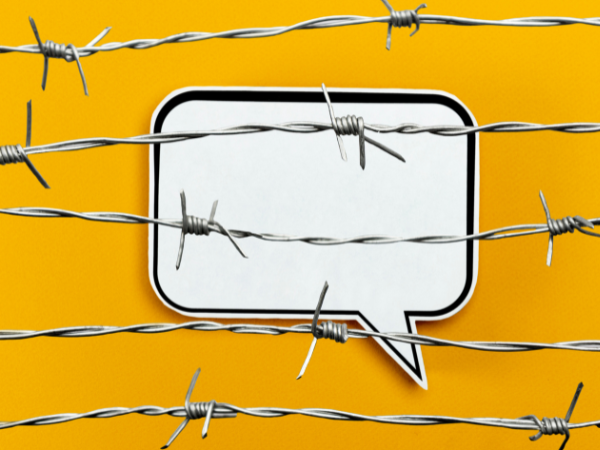
Hence, we have seen the caging of free speech in recent years, through the use of so-called “free speech zones” on college campuses and at political events, the requirement of speech permits in parks and community gatherings, and the policing of online forums.

Clearly, this elitist, monolithic mindset is at odds with everything America is supposed to stand for.

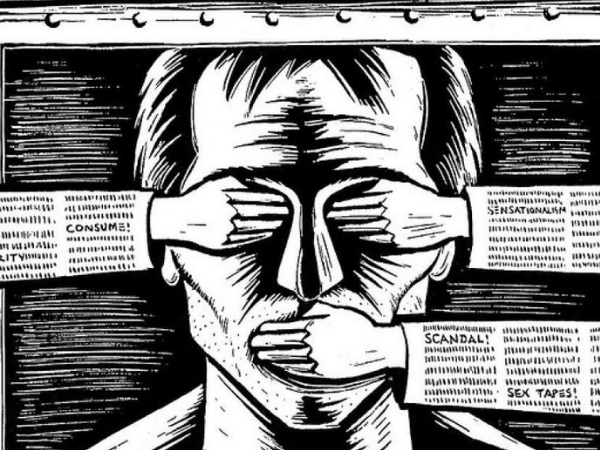
Indeed, we should be encouraging people to debate issues and air their views. Instead, by muzzling free speech, we are contributing to a growing underclass of Americans—many of whom have been labeled racists, rednecks and religious bigots—who are being told that they can’t take part in American public life unless they “fit in.”

Remember, the First Amendment acts as a steam valve. It allows people to speak their minds, air their grievances and contribute to a larger dialogue that hopefully results in a more just world. When there is no steam valve to release the pressure, frustration builds, anger grows and people become more volatile and desperate to force a conversation.

The attempt to stifle certain forms of speech is where we go wrong.

In fact, the U.S. Supreme Court has held that it is “a bedrock principle underlying the First Amendment…that the government may not prohibit the expression of an idea simply because society finds the idea offensive or disagreeable.” For example, it is not a question of whether the Confederate flag represents racism but whether banning it leads to even greater problems, namely, the loss of freedom in general.

Along with the constitutional right to peacefully (and that means non-violently) assemble, the right to free speech allows us to challenge the government through protests and demonstrations and to attempt to change the world around us—for the better or the worse—through protests and counterprotests.

If citizens cannot stand out in the open and voice their disapproval of their government, its representatives and its policies without fearing prosecution, then the First Amendment with all its robust protections for free speech, assembly and the right to petition one’s government for a redress of grievances is little more than window-dressing on a store window—pretty to look at but serving little real purpose.

After all, living in a representative republic means that each person has the right to take a stand for what they think is right, whether that means marching outside the halls of government, wearing clothing with provocative statements, or simply holding up a sign.

That’s what the First Amendment is supposed to be about: it assures the citizenry of the right to express their concerns about their government to their government, in a time, place and manner best suited to ensuring that those concerns are heard.

Unfortunately, through a series of carefully crafted legislative steps and politically expedient court rulings, government officials have managed to disembowel this fundamental freedom, rendering it with little more meaning than the right to file a lawsuit against government officials.

In more and more cases, the government is declaring war on what should be protected political speech whenever it challenges the government’s power, reveals the government’s corruption, exposes the government’s lies, and encourages the citizenry to push back against the government’s many injustices.

Indeed, there is a long and growing list of the kinds of speech that the government considers dangerous enough to red flag and subject to censorship, surveillance, investigation and prosecution: hate speech, conspiratorial speech, treasonous speech, threatening speech, inflammatory speech, radical speech, anti-government speech, extremist speech, etc.

Clearly, the government has no interest in hearing what “we the people” have to say.

Yet if Americans are not able to peacefully assemble for expressive activity outside of the halls of government or on public roads on which government officials must pass, or on college campuses, the First Amendment has lost all meaning.

If we cannot stand peacefully outside of the Supreme Court or the Capitol or the White House, our ability to hold the government accountable for its actions is threatened, and so are the rights and liberties that we cherish as Americans.

And if we cannot proclaim our feelings about the government, no matter how controversial, on our clothing, or to passersby, or to the users of the world wide web, then the First Amendment really has become an exercise in futility.

The source of the protest shouldn’t matter. The politics of the protesters are immaterial.

To play politics with the First Amendment encourages a double standard that will see us all muzzled in the end.

You don’t have to agree with someone to defend their freedoms.

Responsible citizenship means being outraged at the loss of others’ freedoms, even when our own are not directly threatened. It means remembering that the prime function of any free government is to protect the weak against the strong. And it means speaking up for those with whom you might disagree.

The Framers of the Constitution knew very well that whenever and wherever democratic governments had failed, it was because the people had abdicated their responsibility as guardians of freedom. They also knew that whenever in history the people rejected this responsibility, an authoritarian regime arose which eventually denied the people the right to govern themselves.

The demons of our age—some of whom disguise themselves as politicians—delight in fomenting violence, sowing distrust and prejudice, and persuading the public to support tyranny disguised as patriotism.

Overcoming the evils of our age will require us to stop marching in lockstep with the police state and start thinking—and speaking—for ourselves.

It doesn’t matter how old you are or what your political ideology is: it’s our civic duty to make the government hear us—and heed us—using every nonviolent means available to us: picket, protest, march, boycott, speak up, sound off and reclaim control over the narrative about what is really going on in this country.

The power elite has made their intentions clear: they will pursue and prosecute any and all words, thoughts and expressions that challenge their authority.

As I make clear in my book Battlefield America: The War on the American People and in its fictional counterpart The Erik Blair Diaries, this is the final link in the police state chain.

If ever there were a time for us to stand up for the right to speak freely, even if it’s freedom for speech we hate, the time is now.

Source: https://tinyurl.com/bddvzsnf

ABOUT JOHN W. WHITEHEAD

Constitutional attorney and author John W. Whitehead is founder and president of The Rutherford Institute. His most recent books are the best-selling Battlefield America: The War on the American People, the award-winning A Government of Wolves: The Emerging American Police State, and a debut dystopian fiction novel, The Erik Blair Diaries. Whitehead can be contacted at staff@rutherford.org. Nisha Whitehead is the Executive Director of The Rutherford Institute. Information about The Rutherford Institute is available at www.rutherford.org.

Publication Guidelines / Reprint Permission

John W. Whitehead’s weekly commentaries are available for publication to newspapers and web publications at no charge. 

In these days of worldwide confusion, there is a dire need for men and women who will courageously do battle for truth.”— Martin Luther King Jr.

When exposing a crime is treated as committing a crime, you are being ruled by criminals.

In the current governmental climate, obeying one’s conscience and speaking truth to the power of the police state can easily render you an “enemy of the state.”

The government’s list of so-called “enemies of the state” is growing by the day.

Wikileaks founder Julian Assange is merely one of the most visible victims of the police state’s war on dissidents and whistleblowers.

Five years ago, on April 11, 2019, police arrested Assange for daring to access and disclose military documents that portray the U.S. government and its endless wars abroad as reckless, irresponsible, immoral and responsible for thousands of civilian deaths.

Included among the leaked materials was gunsight video footage from two U.S. AH-64 Apache helicopters engaged in a series of air-to-ground attacks while American air crew laughed at some of the casualties. Among the casualties were two Reuters correspondents who were gunned down after their cameras were mistaken for weapons and a driver who stopped to help one of the journalists. The driver’s two children, who happened to be in the van at the time it was fired upon by U.S. forces, suffered serious injuries.

There is nothing defensible about crimes such as these perpetrated by the government.

When any government becomes almost indistinguishable from the evil it claims to be fighting—whether that evil takes the form of war, terrorism, torture, drug trafficking, sex trafficking, murder, violence, theft, pornography, scientific experimentations or some other diabolical means of inflicting pain, suffering and servitude on humanity—that government has lost its claim to legitimacy.

These are hard words, but hard times require straight-talking.

It is easy to remain silent in the face of evil.

What is harder—what we lack today and so desperately need—are those with moral courage who will risk their freedoms and lives in order to speak out against evil in its many forms.

Throughout history, individuals or groups of individuals have risen up to challenge the injustices of their age. Nazi Germany had its Dietrich Bonhoeffer. The gulags of the Soviet Union were challenged by Aleksandr Solzhenitsyn. America had its color-coded system of racial segregation and warmongering called out for what it was, blatant discrimination and profiteering, by Martin Luther King Jr.

And then there was Jesus Christ, an itinerant preacher and revolutionary activist, who not only died challenging the police state of his day—namely, the Roman Empire—but provided a blueprint for civil disobedience that would be followed by those, religious and otherwise, who came after him.

Indeed, it is fitting that we remember that Jesus Christ—the religious figure worshipped by Christians for his death on the cross and subsequent resurrection—paid the ultimate price for speaking out against the police state of his day.

A radical nonconformist who challenged authority at every turn, Jesus was a far cry from the watered-down, corporatized, simplified, gentrified, sissified vision of a meek creature holding a lamb that most modern churches peddle. In fact, he spent his adult life speaking truth to power, challenging the status quo of his day, and pushing back against the abuses of the Roman Empire.

Much like the American Empire today, the Roman Empire of Jesus’ day had all of the characteristics of a police state: secrecy, surveillance, a widespread police presence, a citizenry treated like suspects with little recourse against the police state, perpetual wars, a military empire, martial law, and political retribution against those who dared to challenge the power of the state.

For all the accolades poured out upon Jesus, little is said about the harsh realities of the police state in which he lived and its similarities to modern-day America, and yet they are striking.

Secrecy, surveillance and rule by the elite. As the chasm between the wealthy and poor grew wider in the Roman Empire, the ruling class and the wealthy class became synonymous, while the lower classes, increasingly deprived of their political freedoms, grew disinterested in the government and easily distracted by “bread and circuses.” Much like America today, with its lack of government transparency, overt domestic surveillance, and rule by the rich, the inner workings of the Roman Empire were shrouded in secrecy, while its leaders were constantly on the watch for any potential threats to its power. The resulting state-wide surveillance was primarily carried out by the military, which acted as investigators, enforcers, torturers, policemen, executioners and jailers. Today that role is fulfilled by the NSA, the FBI, the Department of Homeland Security and the increasingly militarized police forces across the country.

Widespread police presence. The Roman Empire used its military forces to maintain the “peace,” thereby establishing a police state that reached into all aspects of a citizen’s life. In this way, these military officers, used to address a broad range of routine problems and conflicts, enforced the will of the state. Today SWAT teams, comprised of local police and federal agents, are employed to carry out routine search warrants for minor crimes such as marijuana possession and credit card fraud.

Citizenry with little recourse against the police state. As the Roman Empire expanded, personal freedom and independence nearly vanished, as did any real sense of local governance and national consciousness. Similarly, in America today, citizens largely feel powerless, voiceless and unrepresented in the face of a power-hungry federal government. As states and localities are brought under direct control by federal agencies and regulations, a sense of learned helplessness grips the nation.

Perpetual wars and a military empire. Much like America today with its practice of policing the world, war and an over-arching militarist ethos provided the framework for the Roman Empire, which extended from the Italian peninsula to all over Southern, Western, and Eastern Europe, extending into North Africa and Western Asia as well. In addition to significant foreign threats, wars were waged against inchoate, unstructured and socially inferior foes.

Martial law. Eventually, Rome established a permanent military dictatorship that left the citizens at the mercy of an unreachable and oppressive totalitarian regime. In the absence of resources to establish civic police forces, the Romans relied increasingly on the military to intervene in all matters of conflict or upheaval in provinces, from small-scale scuffles to large-scale revolts. Not unlike police forces today, with their martial law training drills on American soil, militarized weapons and “shoot first, ask questions later” mindset, the Roman soldier had “the exercise of lethal force at his fingertips” with the potential of wreaking havoc on normal citizens’ lives.

A nation of suspects. Just as the American Empire looks upon its citizens as suspects to be tracked, surveilled and controlled, the Roman Empire looked upon all potential insubordinates, from the common thief to a full-fledged insurrectionist, as threats to its power. The insurrectionist was seen as directly challenging the Emperor.  A “bandit,” or revolutionist, was seen as capable of overturning the empire, was always considered guilty and deserving of the most savage penalties, including capital punishment. Bandits were usually punished publicly and cruelly as a means of deterring others from challenging the power of the state.  Jesus’ execution was one such public punishment.

Acts of civil disobedience by insurrectionists. Much like the Roman Empire, the American Empire has exhibited zero tolerance for dissidents such as Julian Assange, Edward Snowden and Chelsea Manning who exposed the police state’s seedy underbelly. Jesus was also branded a political revolutionary starting with his attack on the money chargers and traders at the Jewish temple, an act of civil disobedience at the site of the administrative headquarters of the Sanhedrin, the supreme Jewish council.

Military-style arrests in the dead of night. Jesus’ arrest account testifies to the fact that the Romans perceived Him as a revolutionary. Eerily similar to today’s SWAT team raids, Jesus was arrested in the middle of the night, in secret, by a large, heavily armed fleet of soldiers.  Rather than merely asking for Jesus when they came to arrest him, his pursuers collaborated beforehand with Judas. Acting as a government informant, Judas concocted a kiss as a secret identification marker, hinting that a level of deception and trickery must be used to obtain this seemingly “dangerous revolutionist’s” cooperation. 

Torture and capital punishment. In Jesus’ day, religious preachers, self-proclaimed prophets and nonviolent protesters were not summarily arrested and executed. Indeed, the high priests and Roman governors normally allowed a protest, particularly a small-scale one, to run its course. However, government authorities were quick to dispose of leaders and movements that appeared to threaten the Roman Empire. The charges leveled against Jesus—that he was a threat to the stability of the nation, opposed paying Roman taxes and claimed to be the rightful King—were purely political, not religious. To the Romans, any one of these charges was enough to merit death by crucifixion, which was usually reserved for slaves, non-Romans, radicals, revolutionaries and the worst criminals.

Jesus was presented to Pontius Pilate “as a disturber of the political peace,” a leader of a rebellion, a political threat, and most gravely—a claimant to kingship, a “king of the revolutionary type.” After Jesus is formally condemned by Pilate, he is sentenced to death by crucifixion, “the Roman means of executing criminals convicted of high treason.”  The purpose of crucifixion was not so much to kill the criminal, as it was an immensely public statement intended to visually warn all those who would challenge the power of the Roman Empire. Hence, it was reserved solely for the most extreme political crimes: treason, rebellion, sedition, and banditry. After being ruthlessly whipped and mocked, Jesus was nailed to a cross.

Jesus—the revolutionary, the political dissident, and the nonviolent activist—lived and died in a police state. Any reflection on Jesus’ life and death within a police state must take into account several factors: Jesus spoke out strongly against such things as empires, controlling people, state violence and power politics. Jesus challenged the political and religious belief systems of his day. And worldly powers feared Jesus, not because he challenged them for control of thrones or government but because he undercut their claims of supremacy, and he dared to speak truth to power in a time when doing so could—and often did—cost a person his life.

Unfortunately, the radical Jesus, the political dissident who took aim at injustice and oppression, has been largely forgotten today, replaced by a congenial, smiling Jesus trotted out for religious holidays but otherwise rendered mute when it comes to matters of war, power and politics.

Yet for those who truly study the life and teachings of Jesus, the resounding theme is one of outright resistance to war, materialism and empire.

What a marked contrast to the advice being given to Americans by church leaders to “submit to your leaders and those in authority,” which in the American police state translates to complying, conforming, submitting, obeying orders, deferring to authority and generally doing whatever a government official tells you to do.

Telling Americans to blindly obey the government or put their faith in politics and vote for a political savior flies in the face of everything for which Jesus lived and died.

Will we follow the path of least resistance—turning a blind eye to the evils of our age and marching in lockstep with the police state—or will we be transformed nonconformists “dedicated to justice, peace, and brotherhood”?

As Martin Luther King Jr. reminds us in a powerful sermon delivered 70 years ago, “This command not to conform comes … [from] Jesus Christ, the world’s most dedicated nonconformist, whose ethical nonconformity still challenges the conscience of mankind.”

Ultimately, as I make clear in my book Battlefield America: The War on the American People and in its fictional counterpart The Erik Blair Diaries, this is the contradiction that must be resolved if the radical Jesus—the one who stood up to the Roman Empire and was crucified as a warning to others not to challenge the powers-that-be—is to be an example for our modern age.

Source: https://tinyurl.com/yc5pkdkm

ABOUT JOHN W. WHITEHEAD

Constitutional attorney and author John W. Whitehead is founder and president of The Rutherford Institute. His most recent books are the best-selling Battlefield America: The War on the American People, the award-winning A Government of Wolves: The Emerging American Police State, and a debut dystopian fiction novel, The Erik Blair Diaries. Whitehead can be contacted at staff@rutherford.org. Nisha Whitehead is the Executive Director of The Rutherford Institute. Information about The Rutherford Institute is available at www.rutherford.org.

Publication Guidelines / Reprint Permission

John W. Whitehead’s weekly commentaries are available for publication to newspapers and web publications at no charge. 

“If the state could use [criminal] laws not for their intended purposes but to silence those who voice unpopular ideas, little would be left of our First Amendment liberties, and little would separate us from the tyrannies of the past or the malignant fiefdoms of our own age. The freedom to speak without risking arrest is ‘one of the principal characteristics by which we distinguish a free nation.’”—Justice Neil Gorsuch, dissenting, Nieves v. Bartlett (2019)

Tyrants don’t like people who speak truth to power.

Cue the rise of protest laws, which take the government’s intolerance for free speech to a whole new level and send the resounding message that resistance is futile.

In fact, ever since the Capitol protests on Jan. 6, 2021, state legislatures have introduced a broad array of these laws aimed at criminalizing protest activities.

There have been at least 205 proposed laws in 45 states aimed at curtailing the right to peacefully assemble and protest by expanding the definition of rioting, heightening penalties for existing offenses, or creating new crimes associated with assembly.

Weaponized by police, prosecutors, courts and legislatures, these protest laws, along with free speech zones, bubble zones, trespass zones, anti-bullying legislation, zero tolerance policies, hate crime laws, and a host of other legalistic maladies have become a convenient means by which to punish individuals who refuse to be muzzled.

In Florida, for instance, legislators passed a “no-go” zone law making it punishable by up to 60 days in jail to remain within 25 feet of working police and other first responders after a warning.

Yet while the growing numbers of protest laws cropping up across the country are sold to the public as necessary to protect private property, public roads or national security, they are a wolf in sheep’s clothing, a thinly disguised plot to discourage anyone from challenging government authority at the expense of our First Amendment rights.

It doesn’t matter what the source of that discontent might be (police brutality, election outcomes, COVID-19 mandates, the environment, etc.): protest laws, free speech zones, no-go zones, bubble zones, trespass zones, anti-bullying legislation, zero tolerance policies, hate crime laws, etc., aim to muzzle every last one of us.

To be very clear, these legislative attempts to redefine and criminalize speech are a backdoor attempt to rewrite the Constitution and render the First Amendment’s robust safeguards null and void.

No matter how you package these laws, no matter how well-meaning they may sound, no matter how much you may disagree with the protesters or sympathize with the objects of the protest, these proposed laws are aimed at one thing only: discouraging dissent.

This is the painful lesson being imparted with every incident in which someone gets arrested and charged with any of the growing number of contempt charges (ranging from resisting arrest and interference to disorderly conduct, obstruction, and failure to obey a police order) that get trotted out anytime a citizen voices discontent with the government or challenges or even questions the authority of the powers-that-be.

These assaults on free speech are nothing new.

As Human Rights Watch points out, “Various states have long-tried to curtail the right to protest. They do so by legislating wide definitions of what constitutes an ‘unlawful assembly’ or a ‘riot’ as well as increasing punishments. They also allow police to use catch-all public offenses, such as trespassing, obstructing traffic, or disrupting the peace, as a pretext for ordering dispersals, using force, and making arrests. Finally, they make it easier for corporations and others to bring lawsuits against protest organizers.

Journalists have come under particular fire for exercising their right to freedom of the press.

According to U.S. Press Freedom Tracker, the criminalization of routine journalism has become a means by which the government chills lawful First Amendment activity.

Journalists have been arrested or faced dubious charges for “publishing,” asking too many questions of public officials, being “rude” for reporting during a press conference, and being in the vicinity of public protests and demonstrations.

For instance, Steve Baker, a reporter for Blaze News, was charged with four misdemeanors, including trespassing and disorderly conduct charges, related to his sympathetic coverage of the Jan. 6 riots. Dan Heyman, a reporter for the Public News Service, was arrested for “aggressively” questioning Tom Price, then secretary of the Department of Health and Human Services during an encounter in the West Virginia State Capitol.

It’s gotten so bad that merely daring to question, challenge or hesitate when a cop issues an order can get you charged with resisting arrest or disorderly conduct.

For example, Deyshia Hargrave, a language arts teacher in Louisiana, was thrown to the ground, handcuffed and arrested for speaking out during a public comment period at a school board meeting.

Fane Lozman was arrested for alluding to government corruption during open comment time at a City Council meeting in Palm Beach County, Fla.

College professor Ersula Ore was slammed to the ground and arrested after she objected to the “disrespectful manner” shown by a campus cop who stopped her in the middle of the street and demanded that she show her ID.

Philadelphia lawyer Rebecca Musarra was arrested for exercising her right to remain silent and refusing to answer questions posed by a police officer during a routine traffic stop. (Note: she cooperated in every other way by providing license and registration, etc.)

Making matters worse, the U.S. Supreme Court issued a ruling in Nieves v. Bartlett that protects police from lawsuits by persons arrested on bogus “contempt of cop” charges (ranging from resisting arrest and interference to disorderly conduct, obstruction, and failure to obey a police order) that result from lawful First Amendment activities (filming police, asking a question of police, refusing to speak with police).

These incidents reflect a growing awareness about the state of free speech in America: you may have distinct, protected rights on paper, but dare to exercise those rights, and you risk fines, arrests, injuries and even death.

Unfortunately, we have been circling this particular drain hole for some time now.

More than 50 years ago, U.S. Supreme Court Justice William O. Douglas took issue with the idea that merely speaking to a government representative (a right enshrined in the First Amendment) could be perceived as unlawfully inconveniencing and annoying the police.

In a passionate defense of free speech, Douglas declared: 

Since when have we Americans been expected to bow submissively to authority and speak with awe and reverence to those who represent us? The constitutional theory is that we the people are the sovereigns, the state and federal officials only our agents. We who have the final word can speak softly or angrily. We can seek to challenge and annoy, as we need not stay docile and quiet. The situation might have indicated that Colten’s techniques were ill-suited to the mission he was on, that diplomacy would have been more effective. But at the constitutional level speech need not be a sedative; it can be disruptive.

It’s a power-packed paragraph full of important truths that the powers-that-be would prefer we quickly forget: We the people are the sovereigns. We have the final word. We can speak softly or angrily. We can seek to challenge and annoy. We need not stay docile and quiet. Our speech can be disruptive. It can invite dispute. It can be provocative and challenging. We do not have to bow submissively to authority or speak with reverence to government officials.

In theory, Douglas was right: “we the people” do have a constitutional right to talk back to the government.

In practice, however, we live in an age in which “we the people” are at the mercy of militarized, weaponized, immunized cops who have almost absolute discretion to decide who is a threat, what constitutes resistance, and how harshly they can deal with the citizens they were appointed to “serve and protect.”

As such, those who seek to exercise their First Amendment rights during encounters with the police are increasingly finding that there is no such thing as freedom of speech.

Case in point: Tony Rupp, a lawyer in Buffalo, NY, found himself arrested and charged with violating the city’s noise ordinance after cursing at an SUV bearing down on pedestrians on a busy street at night with its lights off. Because that unmarked car was driven by a police officer, that’s all it took for Rupp to find himself subjected to malicious prosecution, First Amendment retaliation and wrongful arrest.

The case, as Jesse McKinley writes in The New York Times, is part of a growing debate over “how citizens can criticize public officials at a time of widespread reevaluation of the lengths and limits of free speech. That debate has raged everywhere from online forums and college campuses to protests over racial bias in law enforcement and the Israel-Hamas war. Book bans and other acts of government censorship have troubled some First Amendment experts. Last week, the Supreme Court heard arguments about a pair of laws — in Florida and Texas — limiting the ability of social media companies such as Facebook to ban certain content from their platforms.”

Bottom line: what the architects of the police state want are submissive, compliant, cooperative, obedient, meek citizens who don’t talk back, don’t challenge government authority, don’t speak out against government misconduct, and don’t resist.

What the First Amendment protects—and a healthy constitutional republic requires—are citizens who routinely exercise their right to speak truth to power.

Yet there can be no free speech for the citizenry when the government speaks in a language of force.

What is this language of force?

Militarized police. Riot squads. Camouflage gear. Black uniforms. Armored vehicles. Mass arrests. Pepper spray. Tear gas. Batons. Strip searches. Surveillance cameras. Kevlar vests. Drones. Lethal weapons. Less-than-lethal weapons unleashed with deadly force. Rubber bullets. Water cannons. Stun grenades. Arrests of journalists. Crowd control tactics. Intimidation tactics. Brutality. Contempt of cop charges.

This is not the language of freedom. This is not even the language of law and order.

Unfortunately, this is how the government at all levels—federal, state and local—now responds to those who choose to exercise their First Amendment right to speak freely.

If we no longer have the right to tell a Census Worker to get off our property, if we no longer have the right to tell a police officer to get a search warrant before they dare to walk through our door, if we no longer have the right to stand in front of the Supreme Court wearing a protest sign or approach an elected representative to share our views, if we no longer have the right to protest unjust laws by voicing our opinions in public or on our clothing or before a legislative body, then we do not have free speech.

What we have instead is regulated, controlled, censored speech, and that’s a whole other ballgame.

Remember, the unspoken freedom enshrined in the First Amendment is the right to challenge government agents, think freely and openly debate issues without being muzzled or treated like a criminal.

Americans are being brainwashed into believing that anyone who wears a government uniform—soldier, police officer, prison guard—must be obeyed without question.

Of course, the Constitution takes a far different position, but does anyone in the government even read, let alone abide by, the Constitution anymore?

The government does not want us to remember that we have rights, let alone attempting to exercise those rights peaceably and lawfully. And it definitely does not want us to engage in First Amendment activities that challenge the government’s power, reveal the government’s corruption, expose the government’s lies, and encourage the citizenry to push back against the government’s many injustices.

Yet by muzzling the citizenry, by removing the constitutional steam valves that allow people to speak their minds, air their grievances and contribute to a larger dialogue that hopefully results in a more just world, the government is creating a climate in which violence becomes inevitable.

When there is no First Amendment steam valve, then frustration builds, anger grows and people become more volatile and desperate to force a conversation.

As John F. Kennedy warned, “Those who make peaceful revolution impossible will make violent revolution inevitable.”

As I point out in my book Battlefield America: The War on the American People and in its fictional counterpart The Erik Blair Diaries, the government is making violent revolution inevitable.

Source: https://tinyurl.com/c6n7tnep

ABOUT JOHN W. WHITEHEAD

Constitutional attorney and author John W. Whitehead is founder and president of The Rutherford Institute. His most recent books are the best-selling Battlefield America: The War on the American People, the award-winning A Government of Wolves: The Emerging American Police State, and a debut dystopian fiction novel, The Erik Blair Diaries. Whitehead can be contacted at staff@rutherford.org. Nisha Whitehead is the Executive Director of The Rutherford Institute. Information about The Rutherford Institute is available at www.rutherford.org.

Publication Guidelines / Reprint Permission

John W. Whitehead’s weekly commentaries are available for publication to newspapers and web publications at no charge. 

“Once a government is committed to the principle of silencing the voice of opposition, it has only one way to go, and that is down the path of increasingly repressive measures, until it becomes a source of terror to all its citizens and creates a country where everyone lives in fear. We must, therefore, be on our guard against extremists who urge us to adopt police state measures. Such persons advocate breaking down the guarantees of the Bill of Rights in order to get at the communists. They forget that if the Bill of Rights were to be broken down, all groups, even the most conservative, would be in danger from the arbitrary power of government.”—Harry S. Truman, Special Message to the Congress on the Internal Security of the United States (August 8, 1950)

Nothing good can come from allowing the government to sidestep the Constitution.

Unfortunately, the government has become an expert at disregarding constitutional roadblocks intended to protect the rights of the citizenry.

When these end-runs don’t suffice, the government hides behind the covert, clandestine, classified language of national security; or obfuscates, complicates, stymies, and bamboozles; or creates manufactured diversions to keep the citizenry in the dark; or works through private third parties not traditionally bound by the Constitution.

This last tactic is increasingly how the government gets away with butchering our freedoms, by having its corporate partners serve as a front for its nefarious deeds.

This is how the police state has managed to carry out an illegal secret dragnet surveillance program on the American people over the course of multiple presidential administrations.

Relying on a set of privacy loopholes, the White House (under Presidents Obama, Trump and now Biden) has been sidestepping the Fourth Amendment by paying AT&T to allow federal, state, and local law enforcement to access—without a warrant—the phone records of Americans who are not suspected of a crime.

The government used a similar playbook to get around the First Amendment, packaged as an effort to control the spread of speculative or false information in the name of national security.

As the House Judiciary Select Subcommittee on Weaponization of the Federal Government revealed, the Biden administration worked in tandem with social media companies to censor content related to COVID-19, including humorous jokes, credible information and so-called disinformation.

Likening the government’s heavy-handed attempts to pressure social media companies to suppress content critical of COVID vaccines or the election to “an almost dystopian scenario,” Judge Terry Doughty warned that “the United States Government seems to have assumed a role similar to an Orwellian ‘Ministry of Truth.’

Restricting access to social media has become a popular means of internet censorship.

Dare to voice politically incorrect views in anything louder than a whisper on social media and you might find yourself suspended on Twitter, shut out of Facebook, and banned across various social media platforms. This authoritarian intolerance masquerading as tolerance, civility and love is what comedian George Carlin referred to as “fascism pretending to be manners.”

Social media censorship runs the gamut from content blocking, throttling, and filtering to lockouts, shutdowns, shadow banning and de-platforming.

In fact, these tactics are at the heart of several critical cases before the U.S. Supreme Court over who gets to control, regulate or remove what content is shared on the internet: the individual, corporate censors or the government.

Yet what those who typically champion the right of corporations to be free from government meddling get wrong about these cases is that there can be no free speech when corporations such as Facebook, Google or YouTube become a front for—or extensions of—government censors.

This is the very definition of technocensorship.

On paper—under the First Amendment, at least—we are technically free to speak.

In reality, however, we are now only as free to speak as a government official—or corporate entities such as Facebook, Google or YouTube—may allow.

Clothed in tyrannical self-righteousness, technocensorship is powered by technological behemoths (both corporate and governmental) working in tandem to achieve a common goal: to muzzle, silence and altogether eradicate any speech that runs afoul of the government’s own approved narrative.

This is political correctness taken to its most chilling and oppressive extreme.

This authoritarian impulse to censor and silence “dangerous” speech masquerading as tolerance, civility and a concern for safety (what comedian George Carlin referred to as “fascism pretending to be manners”) is the end result of a politically correct culture that has become radicalized, institutionalized and tyrannical.

You see, the government is not protecting us from “dangerous” disinformation campaigns. It is laying the groundwork to insulate us from “dangerous” ideas that might cause us to think for ourselves and, in so doing, challenge the power elite’s stranglehold over our lives.

Thus far, the tech giants have been able to sidestep the First Amendment by virtue of their non-governmental status, but it’s a dubious distinction at best when they are marching in lockstep with the government’s dictates.

As Philip Hamburger and Jenin Younes write for The Wall Street Journal: “The First Amendment prohibits the government from ‘abridging the freedom of speech.’ Supreme Court doctrine makes clear that government can’t constitutionally evade the amendment by working through private companies.”

It remains to be seen whether the Supreme Court can see itself clear to recognizing that censorship by social media companies acting at the behest of the government runs afoul of the First Amendment.

Bottom line: either we believe in free speech or we don’t.

The answer to the political, legal and moral challenges of our day should always be more speech, not less.

Any individual or group—prominent or not—who is censored, silenced and made to disappear from Facebook, Twitter, YouTube and Instagram for voicing ideas that are deemed politically incorrect, hateful, dangerous or conspiratorial should be cause for alarm across the entire political spectrum.

To ignore the long-term ramifications of such censorship is dangerously naïve, because whatever powers the government and its corporate operatives are allowed to claim now will eventually be used against the populace at large.

These social shunning tactics borrow heavily from the mind control tactics used by authoritarian cults as a means of controlling its members. As Dr. Steven Hassan writes in Psychology Today: “By ordering members to be cut off, they can no longer participate. Information and sharing of thoughts, feelings, and experiences are stifled. Thought-stopping and use of loaded terms keep a person constrained into a black-and-white, all-or-nothing world. This controls members through fear and guilt.”

This mind control can take many forms, but the end result is an enslaved, compliant populace incapable of challenging tyranny.

As Rod Serling, creator of The Twilight Zone, once observed, “We’re developing a new citizenry, one that will be very selective about cereals and automobiles, but won’t be able to think.”

The problem is that we’ve allowed ourselves to be persuaded that we need someone else to think and speak for us, and we’ve bought into the idea that we need the government and its corporate partners to shield us from that which is ugly or upsetting or mean. The result is a society in which we’ve stopped debating among ourselves, stopped thinking for ourselves, and stopped believing that we can fix our own problems and resolve our own differences.

In short, we have reduced ourselves to a largely silent, passive, polarized populace incapable of working through our own problems and reliant on the government to protect us from our fears.

As Nat Hentoff, that inveterate champion of the First Amendment, once observed, “The quintessential difference between a free nation, as we profess to be, and a totalitarian state, is that here everyone, including a foe of democracy, has the right to speak his mind.”

What this means is championing the free speech rights of those with whom we might disagree.

That’s why James Madison, the author of the Bill of Rights, fought for a First Amendment that protected the “minority” against the majority, ensuring that even in the face of overwhelming pressure, a minority of one—even one who espouses distasteful viewpoints—would still have the right to speak freely, pray freely, assemble freely, challenge the government freely, and broadcast his views in the press freely. He understood that freedom for those in the unpopular minority constitutes the ultimate tolerance in a free society.

The government has no tolerance for freedom or free speech of any kind that challenges its chokehold on power.

At some point or another, depending on how the government and its corporate allies define what constitutes “disinformation,” “hate” or “extremism, “we the people” might all be considered guilty of some thought crime or speech transgression or other.

Yet as I make clear in my book Battlefield America: The War on the American People and in its fictional counterpart The Erik Blair Diaries, it’s a slippery slope from censoring so-called illegitimate ideas to silencing truth.

Eventually, as George Orwell predicted, telling the truth will become a revolutionary act.

Ultimately, the government’s war on free speech—and that’s exactly what it is—is a war that is driven by a government fearful of its people.

As President John F. Kennedy observed, “[A] nation that is afraid to let its people judge the truth and falsehood in an open market is a nation that is afraid of its people.”

Source: http://tinyurl.com/24ejau2y

ABOUT JOHN W. WHITEHEAD

Constitutional attorney and author John W. Whitehead is founder and president of The Rutherford Institute. His most recent books are the best-selling Battlefield America: The War on the American People, the award-winning A Government of Wolves: The Emerging American Police State, and a debut dystopian fiction novel, The Erik Blair Diaries. Whitehead can be contacted at staff@rutherford.org. Nisha Whitehead is the Executive Director of The Rutherford Institute. Information about The Rutherford Institute is available at www.rutherford.org.

Publication Guidelines / Reprint Permission

John W. Whitehead’s weekly commentaries are available for publication to newspapers and web publications at no charge.
WASHINGTON, D.C. — The U.S. Supreme Court has given government officials the green light to obstruct citizens from voting at polling places based on the content of speech displayed on their clothing.

By refusing to hear an appeal in Ostrewich v. Hudspeth, the U.S. Supreme Court has laid the groundwork for citizens to be prevented from voting merely by wearing something expressive on their clothing that might relate to an item on a ballot. In a joint amicus brief with Justice and Freedom Fund and World Faith Foundation, The Rutherford Institute warned against electioneering laws that give government officials too much discretion to engage in viewpoint discrimination of voters. Conceivably, just the act of wearing a MAGA hat, a Taylor Swift t-shirt, or other apparel that could be perceived by a poll worker as sending a political message could get one criminally prosecuted or prevented from voting in some states.

“These polling place laws can be so vague as to prohibit citizens from voting merely for wearing clothing with images of Martin Luther King Jr. or John Lennon that could be considered ‘relating to’ an item on the ballot” said constitutional attorney John W. Whitehead, president of The Rutherford Institute and author of Battlefield America: The War on the American People. “Yet political speech, especially speech critical of the government, is a constitutional virtue, not a harm. These bans on the passive act of displaying speech, political or otherwise, at a polling place are an affront to the right to political free speech protected by the First Amendment.”

Free expression at polling places has become a contentious issue in recent years, with controversies over “ballot selfies,” the wearing of political apparel to polling places, and even apparel that does not explicitly reference candidates, ballot issues, or politics. For example, when Linda McMahon, the wife of World Wrestling Entertainment chairman Vince McMahon, ran for the U.S. Senate, there were questions over whether voters in Connecticut could be turned away for wearing WWE merchandise. In Georgia, a man was ordered to remove his NRA hat while going to vote. In Texas, it is a criminal misdemeanor for a person to merely wear a badge, insignia, emblem, or other similar communicative device “relating to” a candidate, measure, or political party appearing on the ballot, or to the conduct of the election, within the polling place or within 100 feet of any outside door through which a voter may enter.

In 2018, Jillian Ostrewich, the wife of a firefighter, was prevented from voting while wearing a shirt that contained a union logo and the words “Houston Fire Fighters” because the ballot contained a proposition to guarantee Houston’s firefighters pay parity with the city’s police officers. In order to vote, Ostrewich had to turn her shirt inside-out. Ostrewich subsequently filed suit, alleging that she was unconstitutionally censored and that Texas’s electioneering laws chilled her right to free speech. However, the Fifth Circuit Court of Appeals found the laws to be constitutional. Although the Supreme Court ruled in 2018 to strike down as unconstitutionally vague a Minnesota law that banned political speech on any badge, button, shirt, or hat worn at election polling stations, the Court refused to hear the appeal in Ostrewich, letting that ruling stand and thus allowing for such laws with a slightly narrower scope than Minnesota’s to continue to be enforced.

Attorneys Deborah J. Dewart and James L. Hirsen of the Justice and Freedom Fund helped advance the amici arguments in the Ostrewich v. Hudspeth brief.

The Rutherford Institute, a nonprofit civil liberties organization, provides legal assistance at no charge to individuals whose constitutional rights have been threatened or violated and educates the public on a wide spectrum of issues affecting their freedoms.

Source: http://tinyurl.com/55u6fxk9

WASHINGTON, D.C. — The Rutherford Institute is calling on the U.S. Supreme Court to protect free speech forums on social media from attempts by big tech companies to block, ban, remove, deplatform, demonetize, de-boost, restrict, deny equal access or visibility to, or otherwise discriminate against viewpoints of which they might disapprove.

In an amicus brief filed in NetChoice v. Paxton and Moody v. NetChoice, Rutherford Institute attorneys argue that laws should be allowed to treat social media platforms as free speech forums and secure them from viewpoint-based censorship by big tech companies to promote freedom of speech for all Americans. The joint cases arose in response to laws in Texas and Florida that forbid censorship by Big Tech companies such as Facebook, Google, TikTok and YouTube.

“Technofascism is the modern-day equivalent of book burning, which does away with controversial ideas and the people who espouse them,” said constitutional attorney John W. Whitehead, president of The Rutherford Institute and author of Battlefield America: The War on the American People. “Once you allow government agencies and corporations to determine what viewpoints are ‘legitimate,’ you’re already moving fast down a slippery slope that ends with the censorship of all viewpoints altogether other than that of the government and its corporate allies.”

In response to increasing complaints about viewpoint-based censorship by social media companies, Texas and Florida each passed laws to prohibit such content moderation. The Texas law forbids censorship by social media platforms with more than 50 million active monthly users, such as Facebook and YouTube. The law defines “censor” as meaning “to block, ban, remove, deplatform, demonetize, de-boost, restrict, deny equal access or visibility to, or otherwise discriminate against expression.” But the law does not prohibit censorship of unlawful expression, such as involving the sexual exploitation of children and threats of violence. Under the law, platforms must disclose how they moderate and promote content, publish an “acceptable use policy,” and maintain a complaint and appeal system for users whose posts are removed. The Florida law likewise applies to larger social media platforms, but it only prohibits censorship relating to candidates for office and larger “journalistic enterprises.” Both laws treat the platforms as common carriers similar to public utilities.

NetChoice and the Computer & Communications Industry Association—trade associations which represent social media companies like Facebook, Google (which owns YouTube), and TikTok—filed separate lawsuits challenging the two state laws. The Eleventh Circuit Court of Appeals found Florida’s law to be unconstitutional, reasoning that the content-moderation decisions of social media companies is a protected exercise of editorial discretion. However, the Fifth Circuit found the Texas law to be constitutional, rejecting “the idea that corporations have a freewheeling First Amendment right to censor what people say.” The Fifth Circuit also warned that providing corporations with an “unenumerated right to muzzle speech” could pave the way for “email providers, mobile phone companies, and banks [to] cancel the accounts of anyone who…support[s]…a disfavored political party.” In its amicus brief, The Rutherford Institute called on the U.S. Supreme Court to protect Americans’ freedom of speech in the modern public forum of social media.

Attorney Jared Harpt assisted with advancing the arguments in the amicus brief in NetChoice v. Paxton and Moody v. NetChoice.

The Rutherford Institute, a nonprofit civil liberties organization, provides legal assistance at no charge to individuals whose constitutional rights have been threatened or violated and educates the public on a wide spectrum of issues affecting their freedoms.

Source: http://tinyurl.com/yc3uxt5t

WASHINGTON, D.C. — The Rutherford Institute is warning against a growing cancel culture mindset within government agencies across the political spectrum that seeks to censor, ostracize and shun those with opposing, disfavored, or politically unpopular viewpoints.

Weighing in before the U.S. Supreme Court with an amicus brief in NRA of Am. v. Vullo, The Rutherford Institute, FIRE, the National Coalition Against Censorship, and the First Amendment Lawyers Association are challenging efforts by a New York state regulator to circumvent the First Amendment and indirectly penalize the National Rifle Association by pressuring regulated insurance companies to disassociate from and stop offering certain services to the pro-gun advocacy group.

“Knowing what we know about the government’s tendency to attach its own labels to behavior and speech that challenges its authority, these efforts to ostracize those with politically unpopular viewpoints should be cause for alarm across the entire political spectrum,” said constitutional attorney John W. Whitehead, president of The Rutherford Institute and author of Battlefield America: The War on the American People. “Whatever government-driven censorship we tolerate now are destined to serve as the building blocks for greater acts of tyranny.”

In October 2017, the New York State Department of Financial Services (DFS) opened an investigation into an NRA-endorsed insurance program called “Carry Guard,” which provided coverage for losses caused by licensed firearm use, including criminal defense costs resulting from the intentional use of a firearm in wrongdoing, which was a violation of New York law. DFS Superintendent Maria Vullo met with one of the insurance companies under investigation, which was facing millions in fines, and explained how the company could come into compliance, including by no longer providing insurance to gun groups like the NRA. Vullo also sought the company’s aid in DFS’s campaign against gun groups following the February 2018 school shooting in Parkland, Florida. Later, Vullo called upon banks and insurance companies doing business in New York to consider the risks, including reputational risks, which might arise from doing business with the NRA, urging them to join others that had discontinued their associations with the NRA. Multiple entities publicly severed their ties or determined not to do business with the NRA.

In response, the NRA filed a First Amendment lawsuit against Vullo. While the district court would have allowed that claim to proceed to trial, the Second Circuit Court of Appeals ordered the case to be dismissed. Noting that government officials can address issues of public concern as long as they do not use their regulatory powers to coerce entities into refraining from protected speech, the Second Circuit concluded that Vullo did not appear to have crossed the line between proper attempts to convince and improper attempts to coerce. But pointing to Vullo’s words, the perception of a threat for companies continuing to do business with the NRA, and the power of DFS’ regulatory authority as factors showing improper coercion to indirectly censor the NRA, the amici are urging the Supreme Court to make clear that government officials cannot sidestep the First Amendment by framing censorship demands as informal requests.

Robert Corn-Revere, Ronald G. London, Will Creeley, and Joshua A. House with FIRE advanced the arguments in the amicus brief in NRA v. Vullo.

The Rutherford Institute, a nonprofit civil liberties organization, provides legal assistance at no charge to individuals whose constitutional rights have been threatened or violated and educates the public on a wide spectrum of issues affecting their freedoms.

Source: http://tinyurl.com/yv2vjaby

“No president from either party should have the sole power to shut down or take control of the internet or any other of our communication channels during an emergency.”—Senator Rand Paul

What’s to stop the U.S. government from throwing the kill switch and shutting down phone and internet communications in a time of so-called crisis?

After all, it’s happening all over the world.

Communications kill switches have become tyrannical tools of domination and oppression to stifle political dissent, shut down resistance, forestall election losses, reinforce military coups, and keep the populace isolated, disconnected and in the dark, literally and figuratively.

As the Guardian reports, “From Ukraine to Myanmar, government-run internet outages are picking up pace around the world. In 2021, there were 182 shutdowns in 34 countries… Countries across Africa and Asia have turned to shutdowns in a bid to control behaviour, while India, largely in the conflict-ridden region of Jammu and Kashmir, plunged into digital darkness more times than any other last year… Civil unrest in Ethiopia and Kazakhstan has triggered internet shutdowns as governments try to prevent political mobilisation and stop news about military suppression from emerging.”

In an internet-connected age, killing the internet is tantamount to bringing everything—communications, commerce, travel, the power grid—to a standstill.

Tyrants and would-be tyrants rely on this “cloak of darkness” to advance their agendas.

In Myanmar, for example, the internet shutdown came on the day a newly elected government was to have been sworn in. That’s when the military staged a digital coup and seized power. Under cover of a communications blackout that cut off the populace from the outside world and each other, the junta “carried out nightly raids, smashing down doors to drag out high-profile politicians, activists and celebrities.”

These government-imposed communications shutdowns serve to not only isolate, terrorize and control the populace, but also underscore the citizenry’s lack of freedom in the face of the government’s limitless power.

Yet as University of California Irvine law professor David Kaye explains, these kill switches are no longer exclusive to despotic regimes. They have “migrated into a toolbox for governments that actually do have the rule of law.”

This is what digital authoritarianism looks like in a technological age.

Digital authoritarianism, as the Center for Strategic and International Studies cautions, involves the use of information technology to surveil, repress, and manipulate the populace, endangering human rights and civil liberties, and co-opting and corrupting the foundational principles of democratic and open societies, “including freedom of movement, the right to speak freely and express political dissent, and the right to personal privacy, online and off.”

For those who insist that it can’t happen here, it can and it has.

In 2005, cell service was disabled in four major New York tunnels, reportedly to avert potential bomb detonations via cell phone.

In 2009, those attending President Obama’s inauguration had their cell signals blocked—again, same rationale.

And in 2011, San Francisco commuters had their cell phone signals shut down, this time, to thwart any possible protests over a police shooting of a homeless man.

With shutdowns becoming harder to detect, who’s to say it’s not still happening?

Although an internet kill switch is broadly understood to be a complete internet shutdown, it can also include a broad range of restrictions such as content blocking, throttling, filtering, complete shutdowns, and cable cutting.

As Global Risk Intel explains:

“Content blocking is a relatively moderate method that blocks access to a list of selected websites or applications. When users access these sites and apps, they receive notifications that the server could not be found or that access was denied by the network administrator. A more subtle method is throttling. Authorities decrease the bandwidth to slow down the speed at which specific websites can be accessed. A slow internet connection discourages users to connect to certain websites and does not arouse immediate suspicion. Users may assume that connection service is slow but may not conclude that this circumstance was authorized by the government. Filtering is another tool to censor targeted content and erases specific messages and terms that the government does not approve of.”

How often do most people, experiencing server errors and slow internet speeds, chalk it up to poor service? Who would suspect the government of being behind server errors and slow internet speeds?

Then again, this is the same government that has subjected us to all manner of encroachments on our freedoms (lockdowns, mandates, restrictions, contact tracing programs, heightened surveillance, censorship, overcriminalization, shadow banning, etc.) in order to fight the COVID-19 pandemic, preserve the integrity of elections, and combat disinformation.

These tactics have become the tools of domination and oppression in an internet-dependent age.

It really doesn’t matter what the justifications are for such lockdowns. No matter the rationale, the end result is the same: an expansion of government power in direct proportion to the government’s oppression of the citizenry.

According to Global Risk Intel, there are many motives behind such restrictions:

“For instance, the kill switch serves to censor content and constrain the spread of news. This particularly concerns news reports that cover police brutality, human rights abuses, or educational information. Governments may also utilize the kill switch to prevent government-critical protestors from communicating through message applications like WhatsApp, Facebook, or Twitter and organizing mass demonstrations. Therefore, internet restrictions can provide a way of regulating the flow of information and hindering dissent. Governments reason that internet limitations help stop the spread of fake news and strengthen national security and public safety in times of unrest.”

In this age of manufactured crises, emergency powers and technofascism, the government already has the know-how, the technology and the authority.

Now all it needs is the “right” crisis to flip the kill switch.

This particular kill switch can be traced back to the Communications Act of 1934. Signed into law by President Franklin D. Roosevelt, the Act empowers the president to suspend wireless radio and phone services “if he deems it necessary in the interest of national security or defense” during a time of “war or a threat of war, or a state of public peril or disaster or other national emergency, or in order to preserve the neutrality of the United States.”

In the event of a national crisis, the president has a veritable arsenal of emergency powers that override the Constitution and can be activated at a moment’s notice. These range from imposing martial law and suspending habeas corpus to shutting down all forms of communications, restricting travel and implementing a communications kill switch.

That national emergency can take any form, can be manipulated for any purpose and can be used to justify any end goal—all on the say so of the president.

The seeds of this ongoing madness were sown several decades ago when George W. Bush stealthily issued two presidential directives that granted the president the power to unilaterally declare a national emergency, which is loosely defined as “any incident, regardless of location, that results in extraordinary levels of mass casualties, damage, or disruption severely affecting the U.S. population, infrastructure, environment, economy, or government functions.

Comprising the country’s Continuity of Government (COG) plan, these directives (National Security Presidential Directive 51 and Homeland Security Presidential Directive 20), which do not need congressional approval, provide a skeletal outline of the actions the president will take in the event of a “national emergency.”

Just what sort of actions the president will take once he declares a national emergency can barely be discerned from the barebones directives. However, one thing is clear: in the event of a perceived national emergency, the COG directives give unchecked executive, legislative and judicial power to the president.

The country would then be subjected to martial law by default, and the Constitution and the Bill of Rights would be suspended.

The internet kill switch is just one piece of the government’s blueprint for locking down the nation and instituting martial law.

There may be many more secret powers that presidents may institute in times of so-called crisis without oversight from Congress, the courts, or the public. These powers do not expire at the end of a president’s term. They remain on the books, just waiting to be used or abused by the next political demagogue.

Given the government’s penchant for weaponizing one national crisis after another in order to expand its powers and justify all manner of government tyranny in the so-called name of national security, it’s only a matter of time before this particular emergency power to shut down the internet is activated.

Then again, an all-out communications blackout is just a more extreme version of the technocensorship that we’ve already been experiencing at the hands of the government and its corporate allies.

Packaged as an effort to control the spread of speculative or false information in the name of national security, restricting access to social media has become a popular means of internet censorship.

In fact, these tactics are at the heart of several critical cases before the U.S. Supreme Court over who gets to control, regulate or remove what content is shared on the internet: the individual, corporate censors or the police state.

Nothing good can come from techno-censorship.

As Glenn Greenwald writes for The Intercept:

“The glaring fallacy that always lies at the heart of pro-censorship sentiments is the gullible, delusional belief that censorship powers will be deployed only to suppress views one dislikes, but never one’s own views… Facebook is not some benevolent, kind, compassionate parent or a subversive, radical actor who is going to police our discourse in order to protect the weak and marginalized or serve as a noble check on mischief by the powerful. They are almost always going to do exactly the opposite: protect the powerful from those who seek to undermine elite institutions and reject their orthodoxies. Tech giants, like all corporations, are required by law to have one overriding objective: maximizing shareholder value. They are always going to use their power to appease those they perceive wield the greatest political and economic power.

As I make clear in my book Battlefield America: The War on the American People and in its fictional counterpart The Erik Blair Diaries, these censors are laying the groundwork to preempt any “dangerous” ideas that might challenge the power elite’s stranglehold over our lives.

Whatever powers you allow the government and its corporate operatives to claim now, whatever the reason might be, will at some point in the future be abused and used against you by tyrants of your own making.

By the time you add AI technologies, social credit systems, and wall-to-wall surveillance into the mix, you don’t even have to be a critic of the government to get snared in the web of digital censorship.

Eventually, as George Orwell predicted, telling the truth will become a revolutionary act.

Source: http://tinyurl.com/3xteeb7c

ABOUT JOHN W. WHITEHEAD

Constitutional attorney and author John W. Whitehead is founder and president of The Rutherford Institute. His most recent books are the best-selling Battlefield America: The War on the American People, the award-winning A Government of Wolves: The Emerging American Police State, and a debut dystopian fiction novel, The Erik Blair Diaries. Whitehead can be contacted at staff@rutherford.org. Nisha Whitehead is the Executive Director of The Rutherford Institute. Information about The Rutherford Institute is available at www.rutherford.org.

Publication Guidelines / Reprint Permission

John W. Whitehead’s weekly commentaries are available for publication to newspapers and web publications at no charge. Please contact staff@rutherford.org to obtain reprint permission.
“This boy is Ignorance. This girl is Want. Beware them both, and all of their degree, but most of all beware this boy, for on his brow I see that written which is Doom, unless the writing be erased.”—Charles Dickens, A Christmas Carol

What a year.

It feels as if government Grinches and corporate Scrooges have been working overtime to drain every last drop of joy, kindness and liberty from the world.

After endless months of being mired in political gloom and doom, we could all use a little Christmas cheer right now.

Unfortunately, Christmas has become embattled in recent years, co-opted by rampant commercialism, straight-jacketed by political correctness, and denuded of so much of its loveliness, holiness and mystery.

Indeed, the season for giving has turned into the season for getting…and for getting offended.

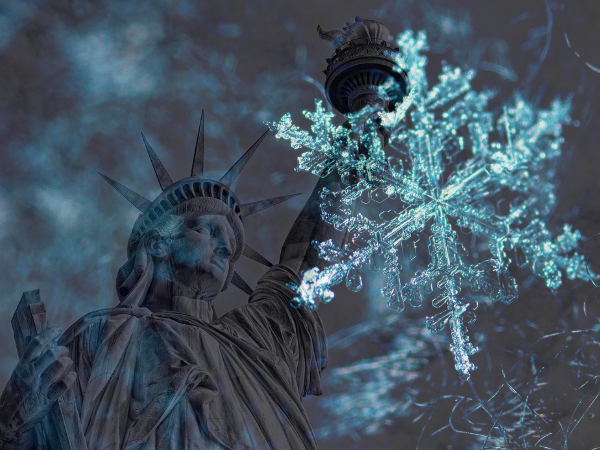
To a nation of snowflakes, Christmas has become yet another trigger word.

When I was a child in the 1950s, the magic of Christmas was promoted in the schools. We sang Christmas carols in the classroom. There were cutouts of the Nativity scene on the bulletin board, along with the smiling, chubby face of Santa and Rudolph. We were all acutely aware that Christmas was magic.

Fast forward to the present day, and Christmas has become fodder for the politically correct culture wars.

Over the years, Christmas casualties in the campaign to create one large national safe space have ranged from the beloved animated classic Rudolph the Red-Nosed Reindeer (denounced for promoting bullying and homophobia) to the Oscar-winning tune “Baby, It’s Cold Outside” (accused of being a date rape anthem) crooned by everyone from Dean Martin to Will Ferrell and Zooey Deschanel in the movie Elf.

Also on the endangered species Christmas list are such songs as “Deck the Halls,” “Santa Baby,” and “White Christmas.”

One publishing company even re-issued their own redacted version of Clement Clarke Moore’s famous poem “Twas the night before Christmas” in order to be more health conscious: the company edited out Moore’s mention of Santa smoking a pipe (“The stump of a pipe he held tight in his teeth, / And the smoke, it encircled his head like a wreath.”)

In the politically correct quest to avoid causing offense, Christmas keeps getting axed.

Examples abound.

Schools across the country now avoid anything that alludes to the true meaning of Christmas such as angels, the baby Jesus, stables and shepherds.

In many of the nation’s schools, Christmas carols, Christmas trees, wreaths and candy canes have also been banned as part of the effort to avoid any reference to Christmas, Christ or God. One school even outlawed the colors red and green, saying they were Christmas colors and, thus, illegal. 
Students asked to send seasonal cards to military troops have been told to make them “holiday cards” and instructed not to use the words “Merry Christmas” on their cards.

Many schools have redubbed their Christmas concerts as “winter holiday programs” and refer to Christmas as a “winter festival.” Some schools have cancelled holiday celebrations altogether to avoid offending those who do not celebrate the various holidays.

In Minnesota, a charter school banned the display of a poster prepared to promote the school’s yearbook as a holiday gift because the poster included Jack Skellington from Tim Burton’s The Nightmare Before Christmas and other secular Christmas icons, not to mention the word “Christmas.”

In New Jersey, one school district banned traditional Christmas songs such as “Joy to the World” and “Silent Night” from its holiday concerts.  A New Jersey middle school cancelled a field trip to attend a performance of a play based on Charles Dickens’s “A Christmas Carol” because some might have found it “offensive.”

In Texas, a teacher in Texas who decorated her door with a scene from “A Charlie Brown Christmas,” including a scrawny tree and Linus, was forced to take it down lest students be offended or feel uncomfortable.

In Connecticut, teachers were instructed to change the wording of the classic poem “Twas the Night Before Christmas” to “Twas the Night Before a Holiday.”

In Virginia, a high school principal debated about whether he could mention Santa or distribute candy canes given that they were symbols of Christmas.

In Massachusetts, a fourth-grade class was asked to list 25 things that reminded them of Christmas. When one young student asked if she could include “Jesus,” her teacher replied that she could get fired if Christmas’ namesake appeared on the list.

Things have not been much better outside the schools, muddled by those who subscribe to the misguided notion that the Constitution requires that anything religious in nature be banned from public places.

In one West Virginia town, although the manger scene (one of 350 light exhibits in the town’s annual Festival of Lights) included shepherds, camels and a guiding star, the main attractions—Jesus, Mary and Joseph—were nowhere to be found due to concerns about the separation of church and state.

In Chicago, organizers of a German Christkindlmarket were informed that the public Christmas festival was no place for the Christmas story. Officials were concerned that clips of the film “The Nativity Story,” which were to be played at the festival, might cause offense.

In Delaware, a Girl Scout troop was prohibited from carrying signs reading “Merry Christmas” in their town’s annual holiday parade.

Clearly, Christmas has become one of many casualties in the misguided dispute over the so-called “separation of church and state,” a controversy that has given rise to a disconcerting and unconstitutional attempt to sanitize public places of any reference to God or religion.

Yet there’s a really simple solution to this annual angst of whether students and teachers can display Christmas-related posters, wear Christmas colors of red and green or sing Christmas songs, and that is for government officials to stop being such Humbugs and create a vibrant, open environment where all expression can flourish.

While the First Amendment prohibits the government from forcing religion on people or endorsing one particular religion over another, there is no legitimate legal reason why people should not be able to celebrate the season freely or wish each other a Merry Christmas or even mention the word Christmas.

After all, the First Amendment affirms the right to freedom for religion, not freedom from religion.

Hoping to clear up the legal misunderstanding over the do’s and don’ts of celebrating Christmas, The Rutherford Institute’s Constitutional Q&A on “Twelve Rules of Christmas” provides basic guidelines for lawfully celebrating Christmas in schools, workplaces and elsewhere.

Yet while Christmas may be the “trigger” for purging Christmas from public places, government forums and speech—except when it profits Corporate America—it is part and parcel of the greater trend in recent years to whittle away at free speech and trample the First Amendment underfoot.

Anything that might raise the specter of controversy is avoided at all costs.

We are witnessing the emergence of an unstated yet court-sanctioned right, one that makes no appearance in the Constitution and yet seems to trump the First Amendment at every turn: the right to not be offended.

In this way, emboldened by phrases such as “hate crimes,” “bullying,” “extremism” and “microaggressions,” free speech has been confined to carefully constructed “free speech zones,” criminalized when it skates too close to challenging the status quo, shamed when it butts up against politically correct ideals, and muzzled when it appears dangerous.

At the slightest hint of trouble, government officials (and corporations) are inclined to chuck anything that might be objectionable.

Yet when all is said and done, what the police state really wants is a nation of snowflakes, snitches and book burners: a legalistic, intolerant, elitist, squealing bystander nation willing to turn on each other and turn each other in for the slightest offense, while being incapable of presenting a united front against the threats posed by the government and its cabal of Constitution-destroying agencies and corporate partners.

You want to know why this country is in the state it’s in?

The answer is the same no matter what the problem might be, whether it’s the economy, government corruption, police brutality, endless wars, censorship, falling literacy rates, etc.: every one of these problems can be sourced back to the fact that “we the people” have stopped thinking for ourselves and relinquished responsibility for our lives and well-being to a government entity that sees us only as useful idiots.

The Greek philosopher Socrates believed in teaching people to think for themselves and in the free exchange of ideas. For his efforts, he was accused of corrupting the youth and was put to death. However, his legacy lived on in the Socratic method of teaching: posing questions that help young and old discover the answers by learning to think for themselves.

Now even the ability to think for oneself is in danger of extinction.

As Rod Serling, creator of the classic sci-fi series Twilight Zone and one of the most insightful commentators on human nature, once observed, “We’re developing a new citizenry. One that will be very selective about cereals and automobiles, but won’t be able to think.”

We face an immense threat in our society from this drive to obliterate our history and traditions in order to erect a saccharine view of reality. In the process, we are creating a schizophrenic world for our children to grow up in, and it is neither healthy nor will it produce the kind of people who will be able to face the challenges of a future ruled by a totalitarian regime.

As I make clear in my book Battlefield America: The War on the American People and in its fictional counterpart The Erik Blair Diaries, you can’t sanitize reality. You can’t scrub out of existence every unpleasant thought or idea. You can’t legislate tolerance. You can’t create enough safe spaces to avoid the ugliness that lurks in the hearts of men and women. You can’t fight ignorance with the weapons of a police state.

What you can do, however, is step up your game.

Opt for kindness over curtness, and civility over censorship. Choose peace over politics, and freedom over fascism. Find common ground with those whose politics or opinions or lifestyles may not jive with your own. 

Do your part to make the world a little brighter and a little lighter, and maybe, just maybe, we’ll have a chance of digging our way out of this hole.

Source: https://tinyurl.com/5cjkt5hn

ABOUT JOHN W. WHITEHEAD

Constitutional attorney and author John W. Whitehead is founder and president of The Rutherford Institute. His most recent books are the best-selling Battlefield America: The War on the American People, the award-winning A Government of Wolves: The Emerging American Police State, and a debut dystopian fiction novel, The Erik Blair Diaries. Whitehead can be contacted at staff@rutherford.org. Nisha Whitehead is the Executive Director of The Rutherford Institute. Information about The Rutherford Institute is available at www.rutherford.org.

Publication Guidelines / Reprint Permission

John W. Whitehead’s weekly commentaries are available for publication to newspapers and web publications at no charge. Please contact staff@rutherford.org to obtain reprint permission.
“Once a government is committed to the principle of silencing the voice of opposition, it has only one way to go, and that is down the path of increasingly repressive measures, until it becomes a source of terror to all its citizens and creates a country where everyone lives in fear.” — President Harry S. Truman

Ever since Martin Luther King Jr. delivered his groundbreaking “I Have a Dream” speech during the March on Washington for Jobs and Freedom on Aug. 28, 1963, the Deep State has been hard at work turning King’s dream into a living nightmare.

The end result of the government’s efforts over the past 60 years is a country where nothing ever really changes, and everyone lives in fear.

Race wars are still being stoked by both the Right and the Left; the military-industrial complex is still waging profit-driven wars at taxpayer expense; the oligarchy is still calling the shots in the seats of government power; and the government is still weaponizing surveillance in order to muzzle anti-government sentiment, harass activists, and terrorize Americans into compliance.

This last point is particularly disturbing.

Starting in the 1950s, the government relied on COINTELPRO, its domestic intelligence program, to neutralize domestic political dissidents. Those targeted by the FBI under COINTELPRO for its intimidation, surveillance and smear campaigns included: Martin Luther King Jr., Malcom X, the Black Panther Party, John Lennon, Billie Holiday, Emma Goldman, Aretha Franklin, Charlie Chaplin, Ernest Hemingway, Felix Frankfurter, and hundreds more.

In more recent decades, the powers-that-be have expanded their reach to target anyone who opposes the police state, regardless of their political leanings.

Advances in technology have enabled the government to deploy a veritable arsenal of surveillance weapons in order to “expose, disrupt, misdirect, discredit, or otherwise neutralize” perceived threats to the government’s power.

Surveillance cameras mounted on utility poles, traffic lights, businesses, and homes. License plate readers. Ring doorbells. GPS devices. Dash cameras. Drones. Store security cameras. Geofencing and geotracking. FitBits. Alexa. Internet-connected devices. Geofencing dragnets. Fusion centers. Smart devices. Behavioral threat assessments. Terror watch lists. Facial recognition. Snitch tip lines. Biometric scanners. Pre-crime. DNA databases. Data mining. Precognitive technology. Contact tracing apps.

What these add up to is a world in which, on any given day, the average person is now monitored, surveilled, spied on and tracked in more than 20 different ways by both government and corporate eyes and ears.

Consider just a small sampling of the ways in which the government is weaponizing its 360 degree surveillance technologies to flag you as a threat to national security, whether or not you’ve done anything wrong.

Flagging you as a danger based on your feelings. Customs and Border Protection is reportedly using an artificial intelligence surveillance program that can detect “sentiment and emotion” in social media posts in order to identify travelers who may be “a threat to public safety, national security, or lawful trade and travel.”

Flagging you as a danger based on your phone and movements. Cell phones have become de facto snitches, offering up a steady stream of digital location data on users’ movements and travels. For instance, the FBI was able to use geofence data to identify more than 5,000 mobile devices (and their owners) in a 4-acre area around the Capitol on January 6. This latest surveillance tactic could land you in jail for being in the “wrong place and time.” Police are also using cell-site simulators to carry out mass surveillance of protests without the need for a warrant. Moreover, federal agents can now employ a number of hacking methods in order to gain access to your computer activities and “see” whatever you’re seeing on your monitor. Malicious hacking software can also be used to remotely activate cameras and microphones, offering another means of glimpsing into the personal business of a target.

Flagging you as a danger based on your DNA. DNA technology in the hands of government officials completes our transition to a Surveillance State. If you have the misfortune to leave your DNA traces anywhere a crime has been committed, you’ve already got a file somewhere in some state or federal database—albeit it may be a file without a name. By accessing your DNA, the government will soon know everything else about you that they don’t already know: your family chart, your ancestry, what you look like, your health history, your inclination to follow orders or chart your own course, etc. After all, a DNA print reveals everything about “who we are, where we come from, and who we will be.” It can also be used to predict the physical appearance of potential suspects. It’s only a matter of time before the police state’s pursuit of criminals expands into genetic profiling and a preemptive hunt for criminals of the future.

Flagging you as a danger based on your face. Facial recognition software aims to create a society in which every individual who steps out into public is tracked and recorded as they go about their daily business. Coupled with surveillance cameras that blanket the country, facial recognition technology allows the government and its corporate partners to identify and track someone’s movements in real-time. One particularly controversial software program created by Clearview AI has been used by police, the FBI and the Department of Homeland Security to collect photos on social media sites for inclusion in a massive facial recognition database. Similarly, biometric software, which relies on one’s unique identifiers (fingerprints, irises, voice prints), is becoming the standard for navigating security lines, as well as bypassing digital locks and gaining access to phones, computers, office buildings, etc. In fact, greater numbers of travelers are opting into programs that rely on their biometrics in order to avoid long waits at airport security. Scientists are also developing lasers that can identify and surveil individuals based on their heartbeats, scent and microbiome.

Flagging you as a danger based on your behavior. Rapid advances in behavioral surveillance are not only making it possible for individuals to be monitored and tracked based on their patterns of movement or behavior, including gait recognition (the way one walks), but have given rise to whole industries that revolve around predicting one’s behavior based on data and surveillance patterns and are also shaping the behaviors of whole populations. One smart “anti-riot” surveillance system purports to predict mass riots and unauthorized public events by using artificial intelligence to analyze social media, news sources, surveillance video feeds and public transportation data.

Flagging you as a danger based on your spending and consumer activities. With every smartphone we buy, every GPS device we install, every Twitter, Facebook, and Google account we open, every frequent buyer card we use for purchases—whether at the grocer’s, the yogurt shop, the airlines or the department store—and every credit and debit card we use to pay for our transactions, we’re helping Corporate America build a dossier for its government counterparts on who we know, what we think, how we spend our money, and how we spend our time. Consumer surveillance, by which your activities and data in the physical and online realms are tracked and shared with advertisers, has become a $300 billion industry that routinely harvests your data for profit. Corporations such as Target have not only been tracking and assessing the behavior of their customers, particularly their purchasing patterns, for years, but the retailer has also funded major surveillance in cities across the country and developed behavioral surveillance algorithms that can determine whether someone’s mannerisms might fit the profile of a thief.

Flagging you as a danger based on your public activities. Private corporations in conjunction with police agencies throughout the country have created a web of surveillance that encompasses all major cities in order to monitor large groups of people seamlessly, as in the case of protests and rallies. They are also engaging in extensive online surveillance, looking for any hints of “large public events, social unrest, gang communications, and criminally predicated individuals.” Defense contractors have been at the forefront of this lucrative market. Fusion centers, $330 million-a-year, information-sharing hubs for federal, state and law enforcement agencies, monitor and report such “suspicious” behavior as people buying pallets of bottled water, photographing government buildings, and applying for a pilot’s license as “suspicious activity.”

Flagging you as a danger based on your social media activities. Every move you make, especially on social media, is monitored, mined for data, crunched, and tabulated in order to form a picture of who you are, what makes you tick, and how best to control you when and if it becomes necessary to bring you in line. As The Intercept reported, the FBI, CIA, NSA and other government agencies are increasingly investing in and relying on corporate surveillance technologies that can mine constitutionally protected speech on social media platforms such as Facebook, Twitter and Instagram in order to identify potential extremists and predict who might engage in future acts of anti-government behavior. This obsession with social media as a form of surveillance will have some frightening consequences in coming years. As Helen A.S. Popkin, writing for NBC News, observed, “We may very well face a future where algorithms bust people en masse for referencing illegal ‘Game of Thrones’ downloads… the new software has the potential to roll, Terminator-style, targeting every social media user with a shameful confession or questionable sense of humor.”

Flagging you as a danger based on your social network. Not content to merely spy on individuals through their online activity, government agencies are now using surveillance technology to track one’s social network, the people you might connect with by phone, text message, email or through social message, in order to ferret out possible criminals. An FBI document obtained by Rolling Stone speaks to the ease with which agents are able to access address book data from Facebook’s WhatsApp and Apple’s iMessage services from the accounts of targeted individuals and individuals not under investigation who might have a targeted individual within their network. What this creates is a “guilt by association” society in which we are all as guilty as the most culpable person in our address book.

Flagging you as a danger based on your car. License plate readers are mass surveillance tools that can photograph over 1,800 license tag numbers per minute, take a picture of every passing license tag number and store the tag number and the date, time, and location of the picture in a searchable database, then share the data with law enforcement, fusion centers and private companies to track the movements of persons in their cars. With tens of thousands of these license plate readers now in operation throughout the country, affixed to overpasses, cop cars and throughout business sectors and residential neighborhoods, it allows police to track vehicles and run the plates through law enforcement databases for abducted children, stolen cars, missing people and wanted fugitives. Of course, the technology is not infallible: there have been numerous incidents in which police have mistakenly relied on license plate data to capture out suspects only to end up detaining innocent people at gunpoint.

Flagging you as a danger based on your political views. The Church Committee, the Senate task force charged with investigating COINTELPRO abuses in 1975, concluded that the government had carried out “secret surveillance of citizens on the basis of their political beliefs, even when those beliefs posed no threat of violence or illegal acts on behalf of a hostile foreign power.” The report continued: “Groups and individuals have been harassed and disrupted because of their political views and their lifestyles… Intelligence agencies have served the political and personal objectives of presidents and other high officials.” Nothing has changed since then.

Flagging you as a danger based on your correspondence. Just about every branch of the government—from the Postal Service to the Treasury Department and every agency in between—now has its own surveillance sector, authorized to spy on the American people. For instance, the U.S. Postal Service, which has been photographing the exterior of every piece of paper mail for the past 20 years, is also spying on Americans’ texts, emails and social media posts. Headed up by the Postal Service’s law enforcement division, the Internet Covert Operations Program (iCOP) is reportedly using facial recognition technology, combined with fake online identities, to ferret out potential troublemakers with “inflammatory” posts. The agency claims the online surveillance, which falls outside its conventional job scope of processing and delivering paper mail, is necessary to help postal workers avoid “potentially volatile situations.”

Now the government wants us to believe that we have nothing to fear from these mass spying programs as long as we’ve done nothing wrong.

Don’t believe it.

As Matthew Feeney warns in the New York Times, “In the past, Communists, civil rights leaders, feminists, Quakers, folk singers, war protesters and others have been on the receiving end of law enforcement surveillance. No one knows who the next target will be.

The government’s definition of a “bad” guy is extraordinarily broad, and it results in the warrantless surveillance of innocent, law-abiding Americans on a staggering scale.

Moreover, there is a repressive, suppressive effect to surveillance that not only acts as a potentially small deterrent on crime but serves to monitor and chill lawful First Amendment activity, and that is the whole point.

Weaponized surveillance is re-engineering a society structured around the aesthetic of fear.

As I make clear in my book Battlefield America: The War on the American People and in its fictional counterpart The Erik Blair Diaries, the police state wants us silent, servile and compliant.

They definitely do not want us to engage in First Amendment activities that challenge the government’s power, reveal the government’s corruption, expose the government’s lies, and encourage the citizenry to push back against the government’s many injustices.

And they certainly do not want us to remember that we have rights, let alone attempting to exercise those rights peaceably and lawfully, whether it’s protesting police brutality and racism, challenging COVID-19 mandates, questioning election outcomes, or listening to alternate viewpoints—even conspiratorial ones—in order to form our own opinions about the true nature of government. 

Source: https://tinyurl.com/5n8839tw

ABOUT JOHN W. WHITEHEAD

Constitutional attorney and author John W. Whitehead is founder and president of The Rutherford Institute. His most recent books are the best-selling Battlefield America: The War on the American People, the award-winning A Government of Wolves: The Emerging American Police State, and a debut dystopian fiction novel, The Erik Blair Diaries. Whitehead can be contacted at staff@rutherford.org. Nisha Whitehead is the Executive Director of The Rutherford Institute. Information about The Rutherford Institute is available at www.rutherford.org.

Publication Guidelines / Reprint Permission

John W. Whitehead’s weekly commentaries are available for publication to newspapers and web publications at no charge. Please contact staff@rutherford.org to obtain reprint permission.