WASHINGTON, DC —The U.S. Supreme Court has declined to protect homeowners from warrantless searches by police based merely on a suspicion that a person on probation or parole resides on the premises.
In refusing to hear an appeal in Bailey v. Arkansas, the Supreme Court let stand a lower court ruling that could, as Rutherford Institute attorneys warned in their amicus brief, establish a slippery slope that allows police to carry out warrantless searches when police merely suspect but do not know or have probable cause to believe that a probationer lives on the premises.
“This case is about a creeping erosion of our Fourth Amendment rights that threatens every homeowner in America,” said constitutional attorney John W. Whitehead, president of The Rutherford Institute and author of Battlefield America: The War on the American People. “We’re on a slippery slope towards a society where police can invade any home based on nothing more than a hunch. It’s an affront to the Constitution and a danger to us all.”
Under Arkansas Code § 16-93-106, persons who are placed on supervised probation or parole are required to agree to a waiver that allows any law enforcement officer to conduct a warrantless search of their person, residence, electronic device, or motor vehicle at any time, day or night, whenever requested by the law enforcement officer, and the search does not need to be based on an articulable suspicion that the person is committing or has committed a new criminal offense. If a person refuses to waive their Fourth Amendment rights, then they will not be eligible for supervised release. The Rutherford Institute’s amicus brief noted that nearly four million individuals across the country are subject to supervised probation or parole, and about 65% of jurisdictions require similar waivers while many other jurisdictions are in states, like Arkansas, which impose the waiver as a condition of supervised release. This raises a concern, potentially affecting millions of innocent third parties throughout the country, when police officers mistakenly suspect that a probationer who has waived his Fourth Amendment rights is living at another’s residence, and then use that waiver as justification to search the home without a warrant or any indication of criminal activity.
The Arkansas Supreme Court ruled that police officers merely need reasonable suspicion to believe that the home is the probationer’s residence in order to conduct a search. But because police will often have reason to suspect a probationer or parolee is residing with a parent, sibling, or friend, The Rutherford Institute’s amicus brief warned that those relatives and friends will then lose their right to security in their homes. The brief highlighted many cases where the rights of innocent third parties have been violated by police searching their homes based on a mistaken suspicion that a family member or friend who was on probation or the subject of an arrest warrant lived there—in one case the police shot and killed the owner’s dog, and in other cases police drew guns in front of children and traumatized a parolee’s mother who then went to the hospital and took several days to recover. The Institute’s brief argued that police officers must at least establish the higher standard of probable cause that a home is actually the probationer’s residence to avoid such reckless and damaging searches.
Derek C. Reinbold, Brenna L. Darling, and Sven E. (Trip) Henningson of Kellogg, Hansen, Todd, Figel & Frederick P.L.L.C. advanced the arguments in the Bailey v. Arkansasamicus brief.
The Rutherford Institute, a nonprofit civil liberties organization, defends individuals whose constitutional rights have been threatened or violated and educates the public on a wide spectrum of issues affecting their freedoms.
“There are always risks in challenging excessive police power, but the risks of not challenging it are more dangerous, even fatal.”—Hunter S. Thompson, Kingdom of Fear
The American police state has become America’s new crime boss.
Thirty years after then-President Bill Clinton signed the Violent Crime Control and Law Enforcement Act into law, its legacy of mass incarceration, police militarization, and over-criminalization continues to haunt us.
It has become the gift that America can’t seem to return.
We are now suffering the blowback from the triple threats of the Crime Bill: police militarization, a warrior mindset that has police viewing the rest of the citizenry as enemy combatants, and law enforcement training that teaches cops to shoot first and ask questions later.
The Crime Bill fueled the rise of the police state by pouring funding into law enforcement agencies, particularly for military-grade weaponry and the expansion of police forces. It also laid the groundwork for mass incarceration by incentivizing the construction of more prisons and enacting harsh “three strikes” laws that mandated lengthy sentences for repeat offenders.
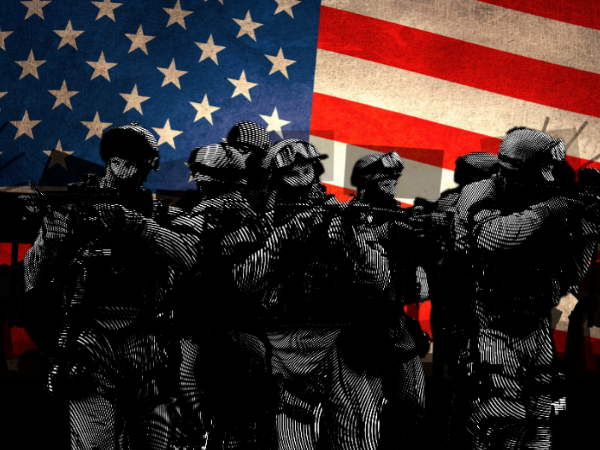
Most critically, the Crime Bill led to the explosive growth of SWAT teams across the country.
It’s estimated that more than 80,000 SWAT raids are carried out every year. That translates to over 200 every single day in the U.S.
Among the tens of thousands of raids that leave in their wake the wreckage of lives, homes and trust in the nation’s so-called peacekeepers, some are so egregious as to cut through the apathy and desensitization that has settled over the nation regarding police violence.
Breonna Taylor was killed when plainclothes police executed a no-knock warrant of her home late at night. Officers used a battering ram to enter the home. Taylor’s boyfriend, believing it was a home invasion, fired a warning shot. Officers responded with a barrage of gunfire, killing Taylor.
Such tragedies are not isolated incidents.
They are the direct result of a system built on policies like the 1994 Crime Bill.
The unfortunate reality we must come to terms with is that America is overrun with militarized cops—vigilantes with a badge—who have almost absolute discretion to decide who is a threat, what constitutes resistance, and how harshly they can deal with the citizens they were appointed to “serve and protect.”
It doesn’t matter where you live—big city or small town—it’s the same scenario being played out over and over again in which government agents, hyped up on their own authority and the power of their uniform, ride roughshod over the rights of the citizenry.
These warrior cops, who have been trained to act as judge, jury and executioner in their interactions with the public and believe the lives (and rights) of police should be valued more than citizens, are increasingly outnumbering the good cops, who take seriously their oath of office to serve and protect their fellow citizens, uphold the Constitution, and maintain the peace.
Indeed, if you ask police and their enablers what Americans should do to stay alive during encounters with law enforcement, they will tell you to comply, no matter what.
In other words, it doesn’t matter if you’re in the right, it doesn’t matter if a cop is in the wrong. If you want to emerge from a police encounter with your life and body intact, then you’d better do whatever a cop tells you to do.
In this way, the old police motto to “protect and serve” has become “comply or die.”
This is the unfortunate, misguided, perverse message that has been beaten, shot, tasered and slammed into our collective consciousness over the past few decades, and it has taken root.
This is how we have gone from a nation of laws—where the least among us had just as much right to be treated with dignity and respect as the next person (in principle, at least)—to a nation of law enforcers (revenue collectors with weapons) who treat “we the people” like suspects and criminals.
As a result, Americans as young as 4 years old are being leg shackled, handcuffed, tasered and held at gun point for not being quiet, not being orderly and just being childlike—i.e., not being compliant enough.
And Americans of every age and skin color are continuing to die at the hands of a government that sees itself as judge, jury and executioner over a populace that have been pre-judged and found guilty, stripped of their rights, and left to suffer at the hands of government agents trained to respond with the utmost degree of violence.
At a time when growing numbers of unarmed people have been shot and killed for just standing a certain way, or moving a certain way, or holding something—anything—that police could misinterpret to be a gun, or igniting some trigger-centric fear in a police officer’s mind that has nothing to do with an actual threat to their safety, even the most benign encounters with police can have fatal consequences.
If you’re black and disabled, you’re even more vulnerable.
Specifically, what we’re dealing with today is a skewed shoot-to-kill mindset in which police, trained to view themselves as warriors or soldiers in a war, whether against drugs, or terror, or crime, must “get” the bad guys—i.e., anyone who is a potential target—before the bad guys get them.
This nationwide epidemic of court-sanctioned police violence carried out with impunity against individuals posing little or no real threat has all but guaranteed that unarmed Americans will keep dying at the hands of militarized police.
Making matters worse, when these officers, who have long since ceased to be peace officers, violate their oaths by bullying, beating, tasering, shooting and killing their employers—the taxpayers to whom they owe their allegiance—they are rarely given more than a slap on the hands before resuming their patrols.
This lawlessness on the part of law enforcement, an unmistakable characteristic of a police state, is made possible in large part by police unions which routinely oppose civilian review boards and resist the placement of names and badge numbers on officer uniforms; police agencies that abide by the Blue Code of Silence, the quiet understanding among police that they should not implicate their colleagues for their crimes and misconduct; prosecutors who treat police offenses with greater leniency than civilian offenses; courts that sanction police wrongdoing in the name of security; and legislatures that enhance the power, reach and arsenal of the police, and a citizenry that fails to hold its government accountable to the rule of law.
Indeed, not only are cops protected from most charges of wrongdoing—whether it’s shooting unarmed citizens (including children and old people), raping and abusing young women, falsifying police reports, trafficking drugs, or soliciting sex with minors—but even on the rare occasions when they are fired for misconduct, it’s only a matter of time before they get re-hired again.
This is no longer a debate over good cops and bad cops.
It’s a power struggle between police officers who rank their personal safety above everyone else’s and police officers who understand that their jobs are to serve and protect; between police trained to shoot to kill and police trained to resolve situations peacefully; most of all, it’s between police who believe the law is on their side and police who know that they will be held to account for their actions under the same law as everyone else.
Unfortunately, more and more police are being trained to view themselves as distinct from the citizenry, to view their authority as superior to the citizenry, and to view their lives as more precious than those of their citizen counterparts.
Instead of being taught to see themselves as mediators and peacemakers whose lethal weapons are to be used as a last resort, they are being drilled into acting like gunmen with killer instincts who shoot to kill rather than merely incapacitate.
In Barnes v. Felix, a case before the U.S. Supreme Court, the justices have been asked to do away with the “moment-of-threat doctrine,” which encourages police to act recklessly with impunity, unnecessarily escalating the level of danger in situations involving relatively minor crimes and then responding to the perceived danger with deadly force.
Like the Ghost of Christmas Past, the 1994 Crime Bill haunts us with its legacy of injustice. Its Ghost of Christmas Present shows us the ongoing struggles with police brutality and mass incarceration. And its Ghost of Christmas Future warns us of a society where over-policing and surveillance become the norm.
So how do we counter the triple threats posed by the Crime Bill?
Despite the outcry from those on the left, the answer is not to de-fund the police, although it wouldn’t hurt to loosen the military industrial complex’s chokehold on America.
What we really need to do is de-fang the police: de-militarize (reduce the reliance on military-grade equipment and tactics), de-weaponize, and focus on de-escalation tactics (prioritizing communication and conflict resolution skills over the use of force), a shift in mindset (moving away from the “warrior” mentality towards a guardian or community policing model), and better accountability.
As with all things, change must start locally, in your hometown.
Remember, a police state does not come about overnight. It starts small, perhaps with a revenue-generating red light camera at an intersection. When that is implemented without opposition, perhaps next will be surveillance cameras on public streets. License plate readers on police cruisers. More police officers on the beat. Free military equipment from the federal government. Free speech zones and zero tolerance policies and curfews. SWAT team raids. Drones flying overhead.
John W. Whitehead’s weekly commentaries are available for publication to newspapers and web publications at no charge. Please contact staff@rutherford.org to obtain reprint permission.
“He sees you when you’re sleeping He knows when you’re awake He knows when you’ve been bad or good So be good for goodness’ sake!” —“Santa Claus Is Coming to Town”
You’d better watch out—you’d better not pout—you’d better not cry—‘cos I’m telling you why: this Christmas, it’s the Surveillance State that’s making a list and checking it twice, and it won’t matter whether you’ve been bad or good.
You’ll be on this list whether you like it or not.
Mass surveillance is the Deep State’s version of a “gift” that keeps on giving…back to the Deep State.
Geofencing dragnets. Fusion centers. Smart devices. Behavioral threat assessments. Terror watch lists. Facial recognition. Snitch tip lines. Biometric scanners. Pre-crime. DNA databases. Data mining. Precognitive technology. Drones. Contact tracing apps. License plate readers. Social media vetting. Surveillance towers.
Big Tech wedded to Big Government has become Big Brother.
Every second of every day, the American people are being spied on by a vast network of digital Peeping Toms, electronic eavesdroppers and robotic snoops.
This creepy new era of government/corporate spying—in which we’re being listened to, watched, tracked, followed, mapped, bought, sold and targeted—has been made possible by a global army of techno-tyrants, fusion centers and Peeping Toms.
Consider just a small sampling of the tools being used to track our movements, monitor our spending, and sniff out all the ways in which our thoughts, actions and social circles might land us on the government’s naughty list, whether or not you’ve done anything wrong.
Tracking you based on your phone and movements: Cell phones have become de facto snitches, offering up a steady stream of digital location data on users’ movements and travels. For instance, the FBI was able to use geofence data to identify more than 5,000 mobile devices (and their owners) in a 4-acre area around the Capitol on January 6. This latest surveillance tactic could land you in jail for being in the “wrong place and time.” Police are also using cell-site simulators to carry out mass surveillance of protests without the need for a warrant. Moreover, federal agents can now employ a number of hacking methods in order to gain access to your computer activities and “see” whatever you’re seeing on your monitor. Malicious hacking software can also be used to remotely activate cameras and microphones, offering another means of glimpsing into the personal business of a target.
Tracking you based on your behavior: Rapid advances in behavioral surveillance are not only making it possible for individuals to be monitored and tracked based on their patterns of movement or behavior, including gait recognition (the way one walks), but have given rise to whole industries that revolve around predicting one’s behavior based on data and surveillance patterns and are also shaping the behaviors of whole populations. One smart “anti-riot” surveillance system purports to predict mass riots and unauthorized public events by using artificial intelligence to analyze social media, news sources, surveillance video feeds and public transportation data.
Tracking you based on your spending and consumer activities: With every smartphone we buy, every GPS device we install, every X/Twitter, Facebook, and Google account we open, every frequent buyer card we use for purchases—whether at the grocer’s, the yogurt shop, the airlines or the department store—and every credit and debit card we use to pay for our transactions, we’re helping Corporate America build a dossier for its government counterparts on who we know, what we think, how we spend our money, and how we spend our time. Consumer surveillance, by which your activities and data in the physical and online realms are tracked and shared with advertisers, has become big business, a $300 billion industry that routinely harvests your data for profit. Corporations such as Target have not only been tracking and assessing the behavior of their customers, particularly their purchasing patterns, for years, but the retailer has also funded major surveillance in cities across the country and developed behavioral surveillance algorithms that can determine whether someone’s mannerisms might fit the profile of a thief.
Tracking you based on your social media activities: Every move you make, especially on social media, is monitored, mined for data, crunched, and tabulated in order to form a picture of who you are, what makes you tick, and how best to control you when and if it becomes necessary to bring you in line. As The Interceptreported, the FBI, CIA, NSA and other government agencies are increasingly investing in and relying on corporate surveillance technologies that can mine constitutionally protected speech on social media platforms such as Facebook, Twitter and Instagram in order to identify potential extremists and predict who might engage in future acts of anti-government behavior. This obsession with social media as a form of surveillance will have some frightening consequences in coming years. As Helen A.S. Popkin, writing for NBC News, observed, “We may very well face a future where algorithms bust people en masse for referencing illegal ‘Game of Thrones’ downloads… the new software has the potential to roll, Terminator-style, targeting every social media user with a shameful confession or questionable sense of humor.”
Tracking you based on your social network: Not content to merely spy on individuals through their online activity, government agencies are now using surveillance technology to track one’s social network, the people you might connect with by phone, text message, email or through social message, in order to ferret out possible criminals. An FBI document obtained by Rolling Stone speaks to the ease with which agents are able to access address book data from Facebook’s WhatsApp and Apple’s iMessage services from the accounts of targeted individuals and individuals not under investigation who might have a targeted individual within their network. What this creates is a “guilt by association” society in which we are all as guilty as the most culpable person in our address book.
Tracking you based on your car: License plate readers are mass surveillance tools that can photograph over 1,800 license tag numbers per minute, take a picture of every passing license tag number and store the tag number and the date, time, and location of the picture in a searchable database, then share the data with law enforcement, fusion centers and private companies to track the movements of persons in their cars. With tens of thousands of these license plate readers now in operation throughout the country, affixed to overpasses, cop cars and throughout business sectors and residential neighborhoods, it allows police to track vehicles and run the plates through law enforcement databases for abducted children, stolen cars, missing people and wanted fugitives. Of course, the technology is not infallible: there have been numerous incidents in which police have mistakenly relied on license plate data to capture out suspects only to end up detaining innocent people at gunpoint.
Now the government wants us to believe that we have nothing to fear from these mass spying programs as long as we’ve done nothing wrong.
Don’t believe it.
The government’s definition of a “bad” guy is extraordinarily broad, and it results in the warrantless surveillance of innocent, law-abiding Americans on a staggering scale.
As I make clear in my book Battlefield America: The War on the American People and in its fictional counterpart The Erik Blair Diaries, surveillance, digital stalking and the data mining of the American people—weapons of compliance and control in the government’s hands—haven’t made America any safer. And they certainly aren’t helping to preserve our freedoms.
Indeed, America will never be safe as long as the U.S. government is allowed to shred the Constitution.
John W. Whitehead’s weekly commentaries are available for publication to newspapers and web publications at no charge. Please contact staff@rutherford.org to obtain reprint permission.
“The privacy and dignity of our citizens is being whittled away by sometimes imperceptible steps. Taken individually, each step may be of little consequence. But when viewed as a whole, there begins to emerge a society quite unlike any we have seen—a society in which government may intrude into the secret regions of man’s life at will.”—Justice William O. Douglas
The spirit of the Constitution, drafted by men who chafed against the heavy-handed tyranny of an imperial ruler, would suggest that one’s home is a fortress, safe from almost every kind of intrusion.
Unfortunately, a collective assault by the government’s cabal of legislators, litigators, judges and militarized police has all but succeeded in reducing that fortress—and the Fourth Amendment alongside it—to a crumbling pile of rubble.
We are no longer safe in our homes, not from the menace of a government and its army of Peeping Toms who are waging war on the last stronghold of privacy left to us as a free people.
The weapons of this particular war on the privacy and sanctity of our homes are being wielded by the government and its army of bureaucratized, corporatized, militarized mercenaries.
Government agents—with or without a warrant, with or without probable cause that criminal activity is afoot, and with or without the consent of the homeowner—are now justified in mounting virtual home invasions using surveillance technology—with or without the blessing of the courts—to invade one’s home with wiretaps, thermal imaging, surveillance cameras, aerial drones, and other monitoring devices.
While the courts have given police significant leeway at times when it comes to physical intrusions into the privacy of one’s home (the toehold entry, the battering ram, the SWAT raid, the knock-and-talk conversation, etc.), the menace of such virtual intrusions on our Fourth Amendment rights has barely begun to be litigated, legislated and debated.
A byproduct of this surveillance age in which we live, whether you’re walking through a store, driving your car, checking email, or talking to friends and family on the phone, you can be sure that some government agency is listening in and tracking your behavior.
This doesn’t even begin to touch on the corporate trackers that monitor your purchases, web browsing, Facebook posts and other activities taking place in the cyber sphere.
Stingray devices mounted on police cars to warrantlessly track cell phones, Doppler radar devices that can detect human breathing and movement within in a home, license plate readers that can record up to 1800 license plates per minute, sidewalk and “public space” cameras coupled with facial recognition and behavior-sensing technology that lay the groundwork for police “pre-crime” programs, police body cameras that turn police officers into roving surveillance cameras, the internet of things: all of these technologies (and more) add up to a society in which there’s little room for indiscretions, imperfections, or acts of independence—especially not when the government can listen in on your phone calls, read your emails, monitor your driving habits, track your movements, scrutinize your purchases and peer through the walls of your home.
Without our realizing it, the American Police State passed the baton off to a fully-fledged Surveillance State that gives the illusion of freedom while functioning all the while like an electronic prison: controlled, watchful, inflexible, punitive, deadly and inescapable.
Nowhere to run and nowhere to hide: this is the mantra of the architects of the Surveillance State and their corporate collaborators.
Government eyes see your every move: what you read, how much you spend, where you go, with whom you interact, when you wake up in the morning, what you’re watching on television and reading on the internet.
Every move you make is being monitored, mined for data, crunched, and tabulated in order to amass a profile of who you are, what makes you tick, and how best to control you when and if it becomes necessary to bring you in line.
Cue the dawning of the Age of the Internet of Things (IoT), in which internet-connected “things” monitor your home, your health and your habits in order to keep your pantry stocked, your utilities regulated and your life under control and relatively worry-free.
By the end of 2018, “there were an estimated 22 billion internet of things connected devices in use around the world… Forecasts suggest that by 2030 around 50 billion of these IoT devices will be in use around the world, creating a massive web of interconnected devices spanning everything from smartphones to kitchen appliances.”
As the technologies powering these devices have become increasingly sophisticated, they have also become increasingly widespread, encompassing everything from toothbrushes and lightbulbs to cars, smart meters and medical equipment.
These Internet-connected techno gadgets include smart light bulbs that discourage burglars by making your house look occupied, smart thermostats that regulate the temperature of your home based on your activities, and smart doorbells that let you see who is at your front door without leaving the comfort of your couch.
Nest, Google’s suite of smart home products, has been at the forefront of the “connected” industry, with such technologically savvy conveniences as a smart lock that tells your thermostat who is home, what temperatures they like, and when your home is unoccupied; a home phone service system that interacts with your connected devices to “learn when you come and go” and alert you if your kids don’t come home; and a sleep system that will monitor when you fall asleep, when you wake up, and keep the house noises and temperature in a sleep-conducive state.
The aim of these internet-connected devices, as Nest proclaims, is to make “your house a more thoughtful and conscious home.” For example, your car can signal ahead that you’re on your way home, while Hue lights can flash on and off to get your attention if Nest Protect senses something’s wrong. Your coffeemaker, relying on data from fitness and sleep sensors, will brew a stronger pot of coffee for you if you’ve had a restless night.
Yet given the speed and trajectory at which these technologies are developing, it won’t be long before these devices become government informants, reporting independently on anything you might do that runs afoul of the Nanny State.
Moreover, it’s not just our homes and personal devices that are being reordered and reimagined in this connected age: it’s our workplaces, our health systems, our government, our bodies and our innermost thoughts that are being plugged into a matrix over which we have no real control.
It is expected that by 2030, we will all experience The Internet of Senses (IoS), enabled by Artificial Intelligence (AI), Virtual Reality (VR), Augmented Reality (AR), 5G, and automation. The Internet of Senses relies on connected technology interacting with our senses of sight, sound, taste, smell, and touch by way of the brain as the user interface. As journalist Susan Fourtane explains:
Many predict that by 2030, the lines between thinking and doing will blur. Fifty-nine percent of consumers believe that we will be able to see map routes on VR glasses by simply thinking of a destination… By 2030, technology is set to respond to our thoughts, and even share them with others… Using the brain as an interface could mean the end of keyboards, mice, game controllers, and ultimately user interfaces for any digital device. The user needs to only think about the commands, and they will just happen. Smartphones could even function without touch screens.
Once technology is able to access and act on your thoughts, not even your innermost thoughts will be safe from the Thought Police.
Thus far, the public response to concerns about government surveillance has amounted to a collective shrug. Yet when the government sees all and knows all and has an abundance of laws to render even the most seemingly upstanding citizen a criminal and lawbreaker, then the old adage that you’ve got nothing to worry about if you’ve got nothing to hide no longer applies.
To our detriment, we are fast approaching a world without the Fourth Amendment, where the lines between private and public property are so blurred that private property is reduced to little more than something the government can use to control, manipulate and harass you to suit its own purposes, and you the homeowner and citizen have been reduced to little more than a tenant or serf in bondage to an inflexible landlord.
When people talk about privacy, they mistakenly assume it protects only that which is hidden behind a wall or under one’s clothing. The courts have fostered this misunderstanding with their constantly shifting delineation of what constitutes an “expectation of privacy.” And technology has furthered muddied the waters.
However, privacy is so much more than what you do or say behind locked doors. It is a way of living one’s life firm in the belief that you are the master of your life, and barring any immediate danger to another person (which is far different from the carefully crafted threats to national security the government uses to justify its actions), it’s no one’s business what you read, what you say, where you go, whom you spend your time with, and how you spend your money.
As Glenn Greenwald notes:
“The way things are supposed to work is that we’re supposed to know virtually everything about what [government officials] do: that’s why they’re called public servants. They’re supposed to know virtually nothing about what we do: that’s why we’re called private individuals. This dynamic—the hallmark of a healthy and free society—has been radically reversed. Now, they know everything about what we do, and are constantly building systems to know more. Meanwhile, we know less and less about what they do, as they build walls of secrecy behind which they function. That’s the imbalance that needs to come to an end. No democracy can be healthy and functional if the most consequential acts of those who wield political power are completely unknown to those to whom they are supposed to be accountable.”
As I make clear in my book Battlefield America: The War on the American People and in its fictional counterpart The Erik Blair Diaries, none of this will change, no matter which party controls Congress or the White House, because despite all of the work being done to help us buy into the fantasy that things will change if we just elect the right candidate, we’ll still be prisoners of the electronic concentration camp.
“Whether he wrote DOWN WITH BIG BROTHER, or whether he refrained from writing it, made no difference … The Thought Police would get him just the same … the arrests invariably happened at night … In the vast majority of cases there was no trial, no report of the arrest. People simply disappeared, always during the night. Your name was removed from the registers, every record of everything you had ever done was wiped out, your one-time existence was denied and then forgotten. You were abolished, annihilated: vaporized was the usual word.”—George Orwell, 1984
The government long ago sold us out to the highest bidder.
The highest bidder, by the way, has always been the Deep State.
Just as the USA Patriot was perverted from its stated intent to fight terrorism abroad and was instead used to covertly crack down on the American people (allowing government agencies to secretly track Americans’ financial activities, monitor their communications, and carry out wide-ranging surveillance on them), Section 702 has been used as an end-run around the Constitution to allow the government to collect the actual content of your conversations (phone calls, text messages, video chats, emails and other electronic communication) without a warrant.
Now intelligence officials are pushing to dramatically expand the government’s spying powers, effectively giving the government unbridled authority to force millions of Americans to spy on its behalf.
Basically, the Deep State wants to turn the American people into extensions of Big Brother.
After all, every office building in America has data cables running through it. The people are not just the engineers who install, maintain, and repair our communications infrastructure; there are countless others who could be forced to help the government spy, including those who clean offices and guard buildings. If this provision is enacted, the government can deputize any of these people against their will, and force them in effect to become what amounts to an agent for Big Brother—for example, by forcing an employee to insert a USB thumb drive into a server at an office they clean or guard at night.
This could all happen without any oversight whatsoever: The FISA Court won’t know about it, Congress won’t know about it. Americans who are handed these directives will be forbidden from talking about it. Unless they can afford high-priced lawyers with security clearances who know their way around the FISA Court, they will have no recourse at all.”
After all, the Police State doesn’t relinquish power easily, the Surveillance State doesn’t look favorably on anything that might weaken its control, and Big Brother doesn’t like to be restricted.
What most Americans don’t get is that even without Section 702 in play, the government will still target the populace for warrantless, suspicionless mass surveillance, because that’s how the police state maintains its stranglehold on power.
These maneuvers are just the tip of the iceberg.
For all intents and purposes, we now have a fourth branch of government.
This fourth branch came into being without any electoral mandate or constitutional referendum, and yet it possesses superpowers, above and beyond those of any other government agency save the military.
It is all-knowing, all-seeing and all-powerful.
It operates beyond the reach of the president, Congress and the courts, and it marches in lockstep with the corporate elite who really call the shots in Washington, DC.
The government’s “technotyranny” surveillance apparatus has become so entrenched and entangled with its police state apparatus that it’s hard to know anymore where law enforcement ends and surveillance begins. They have become one and the same entity.
The police state has passed the baton to the surveillance state.
Every second of every day, the American people are being spied on by the U.S. government’s vast network of digital Peeping Toms, electronic eavesdroppers and robotic snoops.
Beware of what you say, what you read, what you write, where you go, and with whom you communicate, because it will all be recorded, stored and used against you eventually, at a time and place of the government’s choosing.
Privacy, as we have known it, is dead.
Whether you’re walking through a store, driving your car, checking email, or talking to friends and family on the phone, you can be sure that some government agency is listening in and tracking you. This doesn’t even begin to touch on the complicity of the corporate sector, which buys and sells us from cradle to grave, until we have no more data left to mine. These corporate trackers monitor your purchases, web browsing, Facebook posts and other activities taking place in the cyber sphere and share the data with the government.
Just about every branch of the government—from the Postal Service to the Treasury Department and every agency in between—now has its own surveillance sector, authorized to collect data and spy on the American people. Then there are the fusion and counterterrorism centers that gather all of the data from the smaller government spies—the police, public health officials, transportation, etc.—and make it accessible for all those in power.
These government snoops are constantly combing through and harvesting vast quantities of our communications, then storing it in massive databases for years. Once this information—collected illegally and without any probable cause—is ingested into NSA servers, other government agencies can often search through the databases to make criminal cases against Americans that have nothing to do with terrorism or anything national security-related.
Empowered by advances in surveillance technology and emboldened by rapidly expanding public-private partnerships between law enforcement, the Intelligence Community, and the private sector, police have become particularly adept at sidestepping the Fourth Amendment.
Talk about a system rife for abuse.
Now, the government wants us to believe that we have nothing to fear from its mass spying program because they’re only looking to get the “bad” guys who are overseas.
Don’t believe it.
The government’s definition of a “bad” guy is extraordinarily broad, and it results in the warrantless surveillance of innocent, law-abiding Americans on a staggering scale.
Indeed, the government has become the biggest lawbreaker of all.
It’s telling that even after it was revealed that the FBI, one of the most power-hungry and corrupt agencies within the police state’s vast complex of power-hungry and corrupt agencies, misused a massive government surveillance database more than 300,000 times in order to target American citizens, we’re still debating whether they should be allowed to continue to sidestep the Fourth Amendment.
This is how the government operates, after all: our objections are routinely overruled and our rights trampled underfoot.
According to the Foreign Intelligence Surveillance Court, the FBI repeatedly misused Section 702 in order to spy on the communications of two vastly disparate groups of Americans: those involved in the George Floyd protests and those who may have taken part in the Jan. 6, 2021, protests at the Capitol.
This abuse of its so-called national security powers is par for the course for the government.
The government has claimed that its spying on Americans is simply “incidental,” as though it were an accident, but it fully intends to collect this information.
Ask the government why it’s carrying out this far-reaching surveillance on American citizens, and you’ll get the same Orwellian answer the government has been trotting in response to every so-called crisis to justify its assaults on our civil liberties: to keep America safe.
What this is really all about, however, is control.
What we are dealing with is a government so power-hungry, paranoid and afraid of losing its stranglehold on power that it is conspiring to wage war on anyone who dares to challenge its authority.
When the FBI is asking banks and other financial institutions to carry out dragnet searches of customer transactions—warrantlessly and without probable cause—for “extremism” indicators broadly based on where you shop, what you read, and how you travel, we’re all in trouble.
You don’t have to do anything illegal.
For that matter, you don’t even have to challenge the government’s authority.
Frankly, you don’t even have to care about politics or know anything about your rights.
All you really need to do in order to be tagged as a suspicious character, flagged for surveillance, and eventually placed on a government watch list is live in the United States.
As long as the government is allowed to weaponize its 360 degree surveillance technologies to flag you as a threat to national security, whether or not you’ve done anything wrong, it’s just a matter of time before you find yourself wrongly accused, investigated and confronted by police based on a data-driven algorithm or risk assessment culled together by a computer program run by artificial intelligence.
Sometimes you don’t get a warning before all hell breaks loose.
Imagine it, if you will: It’s the middle of the night. Your neighborhood is in darkness. Your household is asleep. Suddenly, you’re awakened by a loud noise.
Barely ten seconds later, someone or an army of someones has crashed through your front door.
The intruders are in your home.
Your heart begins racing. Your stomach is tied in knots. The adrenaline is pumping through you.
You’re not just afraid. You’re terrified.
Desperate to protect yourself and your loved ones from whatever threat has invaded your home, you scramble to lay hold of something—anything—that you might use in self-defense. It might be a flashlight, a baseball bat, or that licensed and registered gun you thought you’d never need.
You brace for the confrontation.
Shadowy figures appear at the doorway, screaming orders, threatening violence, launching flash bang grenades.
Chaos reigns.
You stand frozen, your hands gripping whatever means of self-defense you could find.
Just that simple act—of standing frozen in fear and self-defense—is enough to spell your doom.
The assailants open fire, sending a hail of bullets in your direction.
In your final moments, you get a good look at your assassins: it’s the police.
Brace yourself, because this hair-raising, heart-pounding, jarring account of a SWAT team raid is what passes for court-sanctioned policing in America today, and it could happen to any one of us or our loved ones.
Nationwide, SWAT teams routinely invade homes, break down doors, kill family pets (they always shoot the dogs first), damage furnishings, terrorize families, and wound or kill those unlucky enough to be present during a raid.
No longer reserved exclusively for deadly situations, SWAT teams are now increasingly being deployed for relatively routine police matters such as serving a search warrant, with some SWAT teams being sent out as much as five times a day.
Police have also raided homes on the basis of mistaking the presence or scent of legal substances for drugs. Incredibly, these substances have included tomatoes, sunflowers, fish, elderberry bushes, kenaf plants, hibiscus, and ragweed. In some instances, SWAT teams are even employed, in full armament, to perform routine patrols.
These raids, which might be more aptly referred to as “knock-and-shoot” policing, have become a thinly veiled, court-sanctioned means of giving heavily armed police the green light to crash through doors in the middle of the night.
No-knock raids, a subset of the violent, terror-inducing raids carried out by police SWAT teams on unsuspecting households, differ in one significant respect: they are carried out without police even having to announce themselves.
Warning or not, to the unsuspecting homeowner woken from sleep by the sounds of a violent entry, there is no way of distinguishing between a home invasion by criminals as opposed to a police mob. In many instances, there is little real difference.
While the Fourth Amendment requires that police obtain a warrant based on probable cause before they can enter one’s home, search and seize one’s property, or violate one’s privacy, SWAT teams are granted “no-knock” warrants at high rates such that the warrants themselves are rendered practically meaningless.
In addition to the terror brought on by these raids, general incompetence, collateral damage (fatalities, property damage, etc.) and botched raids are also characteristic of these SWAT team raids.
In some cases, officers misread the address on the warrant. In others, they simply barge into the wrong house or even the wrong building. In another subset of cases, SWAT teams have conducted multiple, sequential raids on wrong addresses; executed search warrants despite the fact that the suspect is already in police custody; or conducted a search of a building where the suspect no longer resides.
That appeared to be the case in Ohio, when a botched SWAT team raid in pursuit of stolen guns at a home where the suspects no longer resided resulted in a 17-month-old baby with a heart defect and a breathing disorder ending up in the ICU with burns around the eyes, chest and neck. In that Jan. 10, 2024, incident, police waited all of six seconds after knocking on the door before using a battering ram to break in and simultaneously launch two flash-bang grenades into the home. The baby’s mother, having lived in the house for a week, barely had time to approach the door before she was grabbed at gunpoint, handcuffed and hustled outside. Only later did police allow her to enter the home to check on the baby, who had been hooked up to a ventilator near the window that police shattered before deploying the flash grenades.
Aiyana Jones is dead because of a SWAT raid gone awry. The 7-year-old was killed after a Detroit SWAT team—searching for a suspect—launched a flash-bang grenade into her family’s apartment, broke through the door and opened fire, hitting the little girl who was asleep on the living room couch. The cops weren’t even in the right apartment.
Exhibiting a similar lack of basic concern for public safety, a Georgia SWAT team launched a flash-bang grenade into the house in which Baby Bou Bou, his three sisters and his parents were staying. The grenade landed in the 2-year-old’s crib, burning a hole in his chest and leaving him with scarring that a lifetime of surgeries will not be able to easily undo.
The horror stories have become legion in which homeowners are injured or killed simply because they mistook a SWAT team raid by police for a home invasion by criminals.
That’s exactly what happened to a 16-year-old Alabama boy. Mistaking a pre-dawn SWAT team raid for a home invasion, the boy grabbed a gun to protect his family only to be gunned down by police attempting to execute a search warrant for drugs. The boy’s brother, not home at the time of the raid, was later arrested with 8 grams of marijuana.
Then there was Jose Guerena, the young ex-Marine who was killed after a SWAT team kicked open the door of his Arizona home during a drug raid and opened fire. According to news reports, Guerena, 26 years old and the father of two young children, grabbed a gun in response to the forced invasion but never fired. In fact, the safety was still on his gun when he was killed. Police officers were not as restrained. The young Iraqi war veteran was allegedly fired upon 71 times. Guerena had no prior criminal record, and the police found nothing illegal in his home.
All too often, botched SWAT team raids have resulted in one tragedy after another for those targeted with little consequences for law enforcement.
SWAT teams, designed to defuse dangerous situations such as those involving hostages, were never meant to be used for routine police work targeting nonviolent suspects, yet they have become intrinsic parts of federal and local law enforcement operations.
An Atlanta SWAT team raided a music studio, allegedly out of a concern that it might have been involved in illegal music piracy.
And then there are the SWAT team raids arising from red flag gun laws, which gives police the authority to preemptively raid homes of people “suspected” of being threats who might be in possession of a gun, legal or otherwise.
With more states adding red flag gun laws to their books, what happened to Duncan Lemp—who was gunned down in his bedroom during an early morning, no-knock SWAT team raid on his family’s home—could very well happen to more people.
At 4:30 a.m. on March 12, 2020, in the midst of a COVID-19 pandemic that had most of the country under a partial lockdown and sheltering at home, a masked SWAT team—deployed to execute a “high risk” search warrant for unauthorized firearms—stormed the suburban house where 21-year-old Duncan lived with his parents and 19-year-old brother. The entire household, including Lemp and his girlfriend, was reportedly asleep when the SWAT team directed flash bang grenades and gunfire through Lemp’s bedroom window. Lemp was killed and his girlfriend injured.
No one in the house that morning, including Lemp, had a criminal record.
No one in the house that morning, including Lemp, was considered an “imminent threat” to law enforcement or the public, at least not according to the search warrant.
So, what was so urgent that militarized police felt compelled to employ battlefield tactics in the pre-dawn hours of a day when most people are asleep in bed, not to mention stuck at home as part of a nationwide lockdown?
According to police, they were tipped off that Lemp was in possession of “firearms.”
Thus, rather than approaching the house by the front door at a reasonable hour in order to investigate this complaint—which is what the Fourth Amendment requires—police instead strapped on their guns, loaded up their flash bang grenades and acted like battle-crazed warriors.
This is what happens when you use SWAT teams to carry out routine search warrants.
These incidents underscore a dangerous mindset in which the citizenry (often unarmed and defenseless) not only have less rights than militarized police, but also one in which the safety of the citizenry is treated as a lower priority than the safety of their police counterparts (who are armed to the hilt with an array of lethal and nonlethal weapons).
Yet it wasn’t always this way.
There was a time in America when a person’s home was a sanctuary, safe and secure from the threat of invasion by government agents, who were held at bay by the dictates of the Fourth Amendment, which protects American citizens from unreasonable searches and seizures.
The Fourth Amendment, in turn, was added to the U.S. Constitution by colonists still smarting from the abuses they had been forced to endure while under British rule, among these home invasions by the military under the guise of “writs of assistance.” These writs gave British soldiers blanket authority to raid homes, damage property and wreak havoc for any reason whatsoever, without any expectation of probable cause.
We have come full circle to a time before the American Revolution when government agents—with the blessing of the courts—could force their way into a citizen’s home, with seemingly little concern for lives lost and property damaged in the process.
If these aggressive, excessive police tactics have also become troublingly commonplace, it is in large part due to judges who largely rubberstamp the warrant requests based only on the word of police; police who have been known to lie or fabricate the facts in order to justify their claims of “reasonable suspicion” (as opposed to the higher standard of probable cause, which is required by the Constitution before any government official can search an individual or his property); and software that allows judges to remotely approve requests using computers, cellphones or tablets.
This sorry state of affairs is made even worse by the U.S. Supreme Court, which tends to shield police under the guise of qualified immunity. As Reuters concluded, “the Supreme Court has built qualified immunity into an often insurmountable police defense.”
Rubber-stamped, court-issued warrants for no-knock SWAT team raids have become the modern-day equivalent of colonial-era writs of assistance.
Previously, the Bureau sought to ask about each person’s sexual orientation and gender identity. Institute attorneys submitted formal public comments in opposition to the Bureau mandating that people answer the ACS and these additional questions, arguing that the Bureau’s threats and intimidation tactics to force people to respond to the ACS seeks to compel speech in violation of the First Amendment and violates the right to privacy from government intrusion under the Fourth Amendment.
For individuals alarmed by the U.S. Census Bureau’s efforts to collect and track private information about the citizenry, their home life and personal habits, The Rutherford Institute has made its updated “Constitutional Q&A: American Community Survey” guidelines available. The Institute has also provided a form letter of complaint for lodging objections to the ACS with the Census Bureau.
“In an age when the government has significant technological resources at its disposal to not only carry out warrantless surveillance on American citizens but also to harvest and mine that data for its own dubious purposes, whether it be crime-mapping or profiling based on race or religion, the potential for abuse is grave,” said constitutional attorney John W. Whitehead, president of The Rutherford Institute and author of Battlefield America: The War on the American People. “Any attempt by the government to encroach upon the citizenry’s privacy rights or establish a system by which the populace can be targeted, tracked, and singled out must be met with extreme caution. The American Community Survey qualifies as a government program whose purpose, while seemingly benign, raises significant constitutional concerns.”
The American Community Survey (ACS) is a highly invasive, ongoing monthly survey issued by the U.S. Census Bureau to collect detailed housing and socioeconomic data from about 3.5 million households each year. The ACS requires recipients to provide the government with extensive and sensitive information about each and every person in their household, including their work schedules, their physical disabilities and limitations, the number of automobiles kept at the residence, and their access to phone-service and the internet. The information collected by the ACS is not anonymous: the survey is to contain the name, age, sex, race, and home address of each person at the residence, along with their relationship to the person who fills out the form and that person’s phone number. There are so many questions on the ACS that it is estimated the average household will have to take 40 minutes to answer the questions.
When people do not respond online or by mail, the Census Bureau repeatedly sends field representatives to their homes at unannounced times to harass and interview them until they answer the survey. People have reported that field representatives remained outside their houses for hours while waiting for them to arrive home or come out, have walked around their homes, and have talked to minor children when parents were away. The questions on the ACS are so invasive that many initially think the survey is a phishing scam to steal their personal information. Institute attorneys warn that the data collected and amassed by the Census Bureau through the ACS would be a goldmine for criminals.
The Rutherford Institute, a nonprofit civil liberties organization, defends individuals whose constitutional rights have been threatened or violated and educates the public on a wide spectrum of issues affecting their freedoms.
In filing a joint amicus brief with Cato Institute in Long Lake Township v. Maxon, Institute attorneys are calling on the Michigan Supreme Court to hold government officials accountable for violating the Fourth Amendment by not obtaining a search warrant before using a drone to take aerial photographs of private property, which was not observable from the ground, in order to gather evidence of a civil zoning violation.
“Americans are being swept up into a massive digital data dragnet that does not distinguish between those who are innocent of wrongdoing, suspects, or criminals. Aerial drone surveillance has become a de facto snitch for the police state,” said constitutional attorney John W. Whitehead, president of The Rutherford Institute and author of Battlefield America: The War on the American People. “By subjecting Americans to surveillance without their knowledge or compliance, the government has erected the ultimate suspect society. In such an environment, there is no such thing as ‘innocent until proven guilty.’”
In 2008, Long Lake Township brought a zoning action against Todd Maxon, alleging that he was using his five-acre property where he lives as an illegal salvage or junkyard due to having automobiles which he worked on fixing up as a hobby. The case settled that year in Maxon’s favor with a dismissal and the Township agreeing to reimburse a portion of his attorneys’ fees. However, the government did not stop in its pursuit to penalize Maxon and his wife. In 2010, 2016, 2017, and 2018—without obtaining any search warrant—Township officials used a drone to take aerial photographs of the Maxons’ property, which was not visible from the ground because it is blocked by buildings and trees. The Township then filed another zoning action in 2018, alleging that the Maxons had increased the scope of the junk cars and material on their property. The Maxons argued that the aerial surveillance and photographs by the drones of their property was an unlawful search in violation of the Fourth Amendment and should therefore be excluded from evidence because people do not reasonably expect drones with high powered cameras to surveil their private property at relatively low altitudes. The trial court denied the Maxons’ motion to suppress the images.
Noting the maneuverability, speed, and stealth of drones which could fly directly up to an open bathroom window, the Michigan Court of Appeals ruled that persons do have a reasonable expectation of privacy in their property against drone surveillance and that government officials must therefore obtain a warrant for such surveillance. However, although the Court of Appeals held that government officials had violated the Fourth Amendment, the court further held that the exclusionary rule does not apply in civil cases to suppress unconstitutionally obtained evidence. The Maxons appealed to the Michigan Supreme Court. In weighing in before the Court on behalf of the Maxons’ right to be free from warrantless aerial drone surveillance, The Rutherford Institute and Cato Institute warned that failure to apply the exclusionary rule will create a roadmap for the government to circumvent Fourth Amendment protections by simply classifying its fines as “civil” to punish people for violating its laws and ordinances.
Clark M. Neily, III and Laura A. Bondank of the Cato Institute helped advance the arguments in the Long Lake Township v. Maxon amicus brief.
The Rutherford Institute, a nonprofit civil liberties organization, provides legal assistance at no charge to individuals whose constitutional rights have been threatened or violated and educates the public on a wide spectrum of issues affecting their freedoms.
“There is now the capacity to make tyranny total in America.”― James Bamford, journalist
We’re all being targeted now.
We’re all guilty until proven innocent now.
And thanks to the 24/7 surveillance being carried out by the government’s spy network of fusion centers, we are all now sitting ducks, just waiting to be tagged, flagged, targeted, monitored, manipulated, investigated, interrogated, heckled and generally harassed by agents of the American police state.
Although these precrime programs are popping up all across the country, in small towns and big cities, they are not making us any safer but they are endangering individual freedoms.
Nationwide, there are upwards of 123 real-time crime centers (a.k.a. fusion centers), which allow local police agencies to upload and share massive amounts of surveillance data and intelligence with state and federal agencies culled from surveillance cameras, facial recognition technology, gunshot sensors, social media monitoring, drones and body cameras, and artificial intelligence-driven predictive policing algorithms.
While these latest expansions of the surveillance state are part of the Biden Administration’s efforts to combat domestic extremism through the creation of a “precrime” crime prevention agency, they have long been a pivotal part of the government’s plans for total control and dominion.
Yet this crime prevention campaign is not so much about making America safer as it is about ensuring that the government has the wherewithal to muzzle anti-government discontent, penalize anyone expressing anti-government sentiments, and preemptively nip in the bud any attempts by the populace to challenge the government’s authority or question its propaganda.
As J.D. Tuccille writes for Reason, “[A]t a time when government officials rage against ‘misinformation’ and ‘disinformation’ that is often just disagreement with whatever opinions are currently popular among the political class, fusion centers frequently scrutinize peaceful dissenting speech.”
Indeed, while the Biden Administration was recently dealt a legal blow over its attempts to urge social media companies to do more to combat so-called dis- and mis-information, these fusion centers are the unacknowledged powerhouses behind the government’s campaign to censors and retaliate against those who vocalize their disagreement and discontent with government policies.
Already, the powers-that-be are mobilizing to ensure that fusion centers have the ability to monitor and lockdown sectors of a community at a moment’s notice.
It’s like a scene straight out of Steven Spielberg’s dystopian film Minority Report, set in 2054, where police agencies harvest intelligence from widespread surveillance, behavior prediction technologies, data mining, precognitive technology, and neighborhood and family snitch programs in order to capture would-be criminals before they can do any damage.
Incredibly, as the various nascent technologies employed and shared by the government and corporations alike—facial recognition, iris scanners, massive databases, behavior prediction software, and so on—are incorporated into a complex, interwoven cyber network aimed at tracking our movements, predicting our thoughts and controlling our behavior, the dystopian visions of past writers is fast becoming our reality.
Our world is now characterized by widespread surveillance, behavior prediction technologies, data mining, fusion centers, driverless cars, voice-controlled homes, facial recognition systems, cybugs and drones, and predictive policing (pre-crime) aimed at capturing would-be criminals before they can do any damage.
What once seemed futuristic no longer occupies the realm of science fiction.
The American police state’s take on the dystopian terrors foreshadowed by George Orwell, Aldous Huxley and Phillip K. Dick have all been rolled up into one oppressive pre-crime and pre-thought crime package.
In this way, the novel 1984 has become an operation manual for an omnipresent, modern-day surveillance state in which ordinary Americans find themselves labeled domestic extremists for engaging in lawful behavior that triggers the government’s precrime sensors.
The technocrats who run the surveillance state don’t even have to break a sweat while monitoring what you say, what you read, what you write, where you go, how much you spend, whom you support, and with whom you communicate and then classifying you as a danger.
Computers now do the tedious work of trolling social media, the internet, text messages and phone calls for potentially anti-government remarks, all of which is carefully recorded, documented, and stored to be used against you someday at a time and place of the government’s choosing.
In this way, with the help of automated eyes and ears, a growing arsenal of high-tech software, hardware and techniques, government propaganda urging Americans to turn into spies and snitches, as well as social media and behavior sensing software, government agents are spinning a sticky spider-web of threat assessments, behavioral sensing warnings, flagged “words,” and “suspicious” activity reports aimed at snaring potential enemies of the state.
One fusion center in Maine was found to have been “illegally collecting and sharing information about Maine residents who weren’t suspected of criminal activity. They included gun purchasers, people protesting the construction of a new power transmission line, the employees of a peacebuilding summer camp for teenagers, and even people who travelled to New York City frequently.”
In one Florida county, police have been using their precrime program to generate “lists of people it considers likely to break the law, based on arrest histories, unspecified intelligence and arbitrary decisions by police analysts.” Then, according to the Tampa Bay Times, deputies are deployed “to find and interrogate anyone whose name appears, often without probable cause, a search warrant or evidence of a specific crime. They swarm homes in the middle of the night, waking families and embarrassing people in front of their neighbors. They write tickets for missing mailbox numbers and overgrown grass, saddling residents with court dates and fines. They come again and again, making arrests for any reason they can.”
This is how the government is turning a nation of citizens into suspects and would-be criminals.
This transformation is being driven by the Department of Homeland Security (DHS), the agency notorious for militarizing the police and SWAT teams; spying on activists, dissidents and veterans; stockpiling ammunition; distributing license plate readers; contracting to build detention camps; tracking cell-phones with Stingray devices; carrying out military drills and lockdowns in American cities; using the TSA as an advance guard; conducting virtual strip searches with full-body scanners; carrying out soft target checkpoints; directing government workers to spy on Americans; conducting widespread spying networks using fusion centers; carrying out Constitution-free border control searches; funding city-wide surveillance cameras; and utilizing drones and other spybots.
Twenty years after being formed in the wake of 9/11, the DHS is a massive, costly, power-hungry bureaucracy working hard to ensure that the government is all-seeing, all-knowing and all-powerful.
Yet here’s the thing: you don’t have to do anything illegal or challenge the government’s authority in order to be flagged as a suspicious character, labeled an enemy of the state and locked up like a dangerous criminal.
In fact, all you need to do is use certain trigger words, surf the internet, communicate using a cell phone, drive a car, stay at a hotel, purchase materials at a hardware store, take flying or boating lessons, appear suspicious to a neighbor, question government authority, or generally live in the United States.
The following activities are guaranteed to get you censored, surveilled, eventually placed on a government watch list, possibly detained and potentially killed.
Use harmless trigger words like cloud, pork and pirates. Use a cell phone. Drive a car. Attend a political rally. Express yourself on social media. Serve in the military. Disagree with a law enforcement official. Call in sick to work. Limp or stutter. Appear confused or nervous, fidget, whistle or smell bad. Allow yourself to be seen in public waving a toy gun or anything remotely resembling a gun, such as a water nozzle or a remote control or a walking cane, for instance. Stare at a police officer. Appear to be pro-gun, pro-freedom or anti-government. Attend a public school. Speak truth to power.
It’s just a matter of time before you find yourself wrongly accused, investigated and confronted by police based on a data-driven algorithm or risk assessment culled together by a computer program run by artificial intelligence.
Before long, every household in America will be flagged as a threat and assigned a threat score.
Without having ever knowingly committed a crime or been convicted of one, you and your fellow citizens have likely been assessed for behaviors the government might consider devious, dangerous or concerning; assigned a threat score based on your associations, activities and viewpoints; and catalogued in a government database according to how you should be approached by police and other government agencies based on your particular threat level.
Combine predictive policing with surveillance, overcriminalization and precrime programs, then add in militarized police trained to shoot first and ask questions later, and as I make clear in my book Battlefield America: The War on the American People and in its fictional counterpart The Erik Blair Diaries, you’ll be lucky to escape with your life.
John W. Whitehead’s weekly commentaries are available for publication to newspapers and web publications at no charge. Please contact staff@rutherford.org to obtain reprint permission.
According to the Foreign Intelligence Surveillance Court, the FBI repeatedly misused Section 702 of the Foreign Intelligence Surveillance Act in order to spy on the communications of two vastly disparate groups of Americans: those involved in the George Floyd protests and those who may have taken part in the Jan. 6, 2021, protests at the Capitol.
Indeed, the FBI has a long history of persecuting, prosecuting and generally harassing activists, politicians, and cultural figures.
Back in the 1950s and ‘60s, the FBI’s targets were civil rights activists, those suspected of having Communist ties, and anti-war activists. In more recent decades, the FBI has expanded its reach to target so-called domestic extremists, environmental activists, and those who oppose the police state.
In 2019, President Trump promised to give the FBI “whatever they need” to investigate and disrupt hate crimes and domestic terrorism, without any apparent thought for the Constitution’s prohibitions on such overreach.
That misguided pledge sheds a curious light on the FBI’s ongoing spree of SWAT team raids, surveillance, disinformation campaigns, fear-mongering, paranoia, and strong-arm tactics meted out to dissidents on both the right and the left.
Yet while these overreaching, heavy-handed lessons in how to rule by force have become standard operating procedure for a government that communicates with its citizenry primarily through the language of brutality, intimidation and fear, none of this is new.
Indeed, the FBI’s love affair with totalitarianism can be traced back to the Nazi police state.
As historian Robert Gellately recounts, the Nazi police state was so admired for its efficiency and order by the world powers of the day that in the decades after World War II, the FBI, along with other government agencies, aggressively recruited at least a thousand Nazis, including some of Hitler’s highest henchmen.
Since then, U.S. government agencies—the FBI, CIA and the military—have fully embraced many of the Nazi’s well-honed policing tactics, and used them repeatedly against American citizens.
With every passing day, the United States government borrows yet another leaf from Nazi Germany’s playbook: Secret police. Secret courts. Secret government agencies. Surveillance. Censorship. Intimidation. Harassment. Torture. Brutality. Widespread corruption. Entrapment. Indoctrination. Indefinite detention.
These are not tactics used by constitutional republics, where the rule of law and the rights of the citizenry reign supreme. Rather, they are the hallmarks of authoritarian regimes, where secret police control the populace through intimidation, fear and official lawlessness on the part of government agents.
Consider the extent to which the FBI’s far-reaching powers to surveil, detain, interrogate, investigate, prosecute, punish, police and generally act as a law unto themselves resemble those of their Nazi cousins, the Gestapo.
Much like the Gestapo’s sophisticated surveillance programs, the FBI’s spying capabilities can delve into Americans’ most intimate details (and allow local police to do so, as well).
Much like the Gestapo’s ability to profile based on race and religion, and its assumption of guilt by association, the FBI’s approach to pre-crime allows it to profile Americans based on a broad range of characteristics including race and religion.
Much like the Gestapo’s power to render anyone an enemy of the state, the FBI has the power to label anyone a domestic terrorist.
Much like the Gestapo infiltrated communities in order to spy on the German citizenry, the FBI routinely infiltrates political and religious groups, as well as businesses.
Just as the Gestapo united and militarized Germany’s police forces into a national police force, America’s police forces have largely been federalized and turned into a national police force.
Just as the Gestapo carried out entrapment operations, the FBI has become a master in the art of entrapment.
Just as the Gestapo’s secret files on political leaders were used to intimidate and coerce, the FBI’s attempts to target and spy on anyone suspected of “anti-government” sentiment have been similarly abused.
The Gestapo became the terror of the Third Reich by creating a sophisticated surveillance and law enforcement system that relied for its success on the cooperation of the military, the police, the intelligence community, neighborhood watchdogs, government workers for the post office and railroads, ordinary civil servants, and a nation of snitches inclined to report “rumors, deviant behavior, or even just loose talk.”
In fact, borrowing heavily from the Gestapo, between 1956 and 1971, the FBI conducted an intensive domestic intelligence program, termed COINTELPRO, intended to neutralize domestic political dissidents. As Congressman Steve Cohen explains, “COINTELPRO was set up to surveil and disrupt groups and movements that the FBI found threatening… many groups, including anti-war, student, and environmental activists, and the New Left were harassed, infiltrated, falsely accused of criminal activity .”
Sound familiar? The more things change, the more they stay the same.
Those targeted by the FBI under COINTELPRO for its intimidation, surveillance and smear campaigns included: Martin Luther King Jr., Malcom X, the Black Panther Party, Billie Holiday, Emma Goldman, Aretha Franklin, Charlie Chaplin, Ernest Hemingway, Felix Frankfurter, John Lennon, and hundreds more.
The Church Committee, the Senate task force charged with investigating COINTELPRO abuses in 1975, denounced the government’s abuses:
“Too many people have been spied upon by too many Government agencies and too much information has been collected. The Government has often undertaken the secret surveillance of citizens on the basis of their political beliefs, even when those beliefs posed no threat of violence or illegal acts on behalf of a hostile foreign power.”
The report continued:
“Groups and individuals have been harassed and disrupted because of their political views and their lifestyles. Investigations have been based upon vague standards whose breadth made excessive collection inevitable. Unsavory and vicious tactics have been employed—including anonymous attempts to break up marriages, disrupt meetings, ostracize persons from their professions, and provoke target groups into rivalries that might result in deaths. Intelligence agencies have served the political and personal objectives of presidents and other high officials.”
Whether 50 years ago or in the present day, the treatment being doled out by the government’s lethal enforcers has remained consistent, no matter the threat.
The FBI’s laundry list of crimes against the American people includes surveillance, disinformation, blackmail, entrapment, intimidation tactics, harassment and indoctrination, governmental overreach, abuse, misconduct, trespassing, enabling criminal activity, and damaging private property, and that’s just based on what we know.
Whether the FBI is planting undercover agents in churches, synagogues and mosques; issuing fake emergency letters to gain access to Americans’ phone records; using intimidation tactics to silence Americans who are critical of the government; recruiting high school students to spy on and report fellow students who show signs of being future terrorists; or persuading impressionable individuals to plot acts of terror and then entrapping them, the overall impression of the nation’s secret police force is that of a well-dressed thug, flexing its muscles and doing the boss’ dirty work of ensuring compliance, keeping tabs on potential dissidents, and punishing those who dare to challenge the status quo.
John W. Whitehead’s weekly commentaries are available for publication to newspapers and web publications at no charge. Please contact staff@rutherford.org to obtain reprint permission.






 John W. Whitehead, Constitutional Attorney