Posts Tagged ‘dictator’

“We are fast approaching the stage of the ultimate inversion: the stage where the government is free to do anything it pleases, while the citizens may act only by permission; which is the stage of the darkest periods of human history, the stage of rule by brute force.” — Ayn Rand

130 executive orders in under 100 days.

Sweeping powers claimed in the name of “security” and “efficiency.”

One president acting as lawmaker, enforcer, and judge.

No debate. No oversight. No limits.

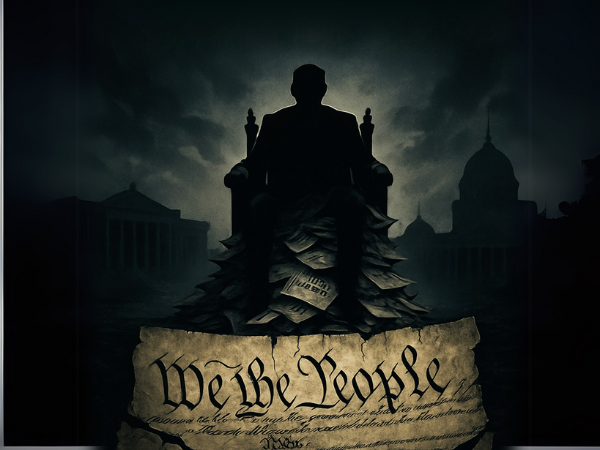
This is how the Constitution dies—not with a coup, but with a pen.

The Unitary Executive Theory is no longer a theory—it’s the architecture of a dictatorship in motion.

Where past presidents have used executive orders, decrees, memorandums, proclamations, national security directives and legislative signing statements to circumvent Congress or sidestep the rule of law, President Trump is using executive orders to advance his “unitary executive theory” of governance, which is a thinly disguised excuse for a government by fiat.

In other words, these executive orders are the mechanism by which we finally arrive at a full-blown dictatorship.

America’s founders established a system of checks and balances to prevent the concentration of power in any single branch. To this end, the Constitution establishes three separate but equal branches of government: the legislative branch, which makes the law; the executive branch, which enforces the law; and the judicial branch, which interprets the law.

And yet, despite this carefully balanced structure, we now find ourselves in a place the founders warned against.

Despite Trump’s attempts to rule by fiat, the president has no unilateral authority to operate outside the Constitution’s system of checks and balances—no matter how urgent the crisis or how well-meaning the intentions.

This is what government by fiat looks like.

Where Congress was once the nation’s lawmaking body, its role is now being eclipsed by a deluge of executive directives—each one issued without public debate, legislative compromise, or judicial review.

These executive orders aren’t mere administrative housekeeping. They represent a radical shift in how power is exercised in America, bypassing democratic institutions in favor of unilateral command. From trade and immigration to surveillance, speech regulation, and policing, the president is claiming broad powers that traditionally reside with the legislative and judicial branches.

Some orders invoke national security to disrupt global markets. Others attempt to override congressional control over tariffsfast-track weapons exports, or alter long-standing public protections through regulatory rollbacks. A few go even further—flirting with ideological loyalty tests for citizenshipchilling dissent through financial coercion, and expanding surveillance in ways that undermine due process and privacy.

Yet here’s where these actions run into constitutional peril: they redefine executive authority in ways that bypass the checks and balances enshrined in the Constitution. They centralize decision-making in the White House, sideline the legislative process, and reduce the judiciary to an afterthought—if not an outright obstacle.

Each of these directives, taken individually, might seem technocratic or temporary. But taken together, they reveal the architecture of a parallel legal order—one in which the president acts as lawmaker, enforcer, and judge. That is not how a constitutional republic operates. That is how a dictatorship begins.

Each of these orders marks another breach in the constitutional levee, eroding the rule of law and centralizing unchecked authority in the executive.

This is not merely policy by another name—it is the construction of a parallel legal order, where the president acts as lawmaker, enforcer, and judge—the very state of tyranny our founders sought to prevent.

This legal theory—the so-called Unitary Executive—is not new. But under this administration, it has metastasized into something far more dangerous: a doctrine of presidential infallibility.

What began as a constitutional interpretation that the president controls the executive branch has morphed into an ideological justification for unchecked power.

Under this theory, all executive agencies, decisions, and even enforcement priorities bend entirely to the will of the president—obliterating the idea of an independent bureaucracy or impartial governance.

The result? An imperial presidency cloaked in legalism.

Historically, every creeping dictatorship has followed this pattern: first, undermine the legislative process; then, centralize enforcement powers; finally, subjugate the judiciary or render it irrelevant. America is following that roadmap, one executive order at a time.

Even Supreme Court justices and legal scholars who once defended broad executive authority are beginning to voice concern.

Yet the real danger of the Unitary Executive Theory is not simply that it concentrates power in the hands of the president—it’s that it does so by ignoring the rest of the Constitution.

Respect for the Constitution means obeying it even when it’s inconvenient to do so.

We’re watching the collapse of constitutional constraints not through tanks in the streets, but through policy memos drafted in the West Wing.

No matter how well-meaning the politicians make these encroachments on our rights appear, in the right (or wrong) hands, benevolent plans can easily be put to malevolent purposes. Even the most principled policies can be twisted to serve illegitimate ends once power and profit enter the equation.

The war on terror, the war on drugs, the war on illegal immigration, asset forfeiture schemes, road safety schemes, school safety schemes, eminent domain: all of these programs started out as legitimate responses to pressing concerns and have since become weapons of compliance and control in the police state’s hands.

We are approaching critical mass.

The groundwork has been laid for a new kind of government where it doesn’t matter if you’re innocent or guilty, whether you’re a threat to the nation, or even if you’re a citizen.

What will matter is what the government—or whoever happens to be calling the shots at the time—thinks. And if the powers-that-be think you’re a threat to the nation and should be locked up, then you’ll be locked up with no access to the protections our Constitution provides.

In effect, you will disappear.

Our freedoms are already being made to disappear.

This is how tyranny arrives: not with a constitutional amendment, but with a series of executive orders; not with a military coup, but with a legal memo; not with martial law, but with bureaucratic obedience and public indifference.

A government that rules by fiat, outside of constitutional checks and balances, is not a republic. It is a dictatorship in everything but name.

If freedom is to survive this constitutional crisis, We the People must reclaim our role as the ultimate check on government power.

That means holding every branch of government accountable to the rule of law. It means demanding that Congress do its job—not merely as a rubber stamp or partisan enabler, but as a coequal branch with the courage to rein in executive abuses.

It means insisting that the courts serve justice, not politics.

And it means refusing to normalize rule by decree, no matter who sits in the Oval Office.

There is no freedom without limits on power.

There is no Constitution if it can be ignored by those who swear to uphold it.

The presidency was never meant to be a throne. The Constitution was never meant to be optional. And the people were never meant to be silent.

As I make clear in my book Battlefield America: The War on the American People and in its fictional counterpart The Erik Blair Diaries, the time to speak out is now.

As our revolutionary forefathers learned the hard way, once freedom is lost, it is rarely regained without a fight.

Source: https://tinyurl.com/mr2hvf3h

ABOUT JOHN W. WHITEHEAD

Constitutional attorney and author John W. Whitehead is founder and president of The Rutherford Institute. His most recent books are the best-selling Battlefield America: The War on the American People, the award-winning A Government of Wolves: The Emerging American Police State, and a debut dystopian fiction novel, The Erik Blair Diaries. Whitehead can be contacted at staff@rutherford.org. Nisha Whitehead is the Executive Director of The Rutherford Institute. Information about The Rutherford Institute is available at www.rutherford.org.

Publication Guidelines / Reprint Permission

John W. Whitehead’s weekly commentaries are available for publication to newspapers and web publications at no charge. 

“The relationship between the President and the people he serves has shifted irrevocably. In every use of official power, the President is now a king above the law.”—Justice Sonia Sotomayor dissenting in Trump v. United States

The U.S. Supreme Court has made it official: the president of the United States can now literally get away with murder.

In a devastating 6-3 ruling in Trump v. United States that is equal parts politically short-sighted, self-servingly partisan, and utterly devoid of any pretense that the president is anything other than a dictator, the Supreme Court has validated what Richard Nixon once claimed: “When the president does it, that means that it is not illegal.”

As Justice Sotomayor concluded in her powerful dissent:

“The President of the United States is the most powerful person in the country, and possibly the world. When he uses his official powers in any way, under the majority’s reasoning, he now will be insulated from criminal prosecution. Orders the Navy’s Seal Team 6 to assassinate a political rival? Immune. Organizes a military coup to hold onto power? Immune. Takes a bribe in exchange for a pardon? Immune. Immune, immune, immune. Let the President violate the law, let him exploit the trappings of his office for personal gain, let him use his official power for evil ends. Because if he knew that he may one day face liability for breaking the law, he might not be as bold and fearless as we would like him to be. That is the majority’s message today. Even if these nightmare scenarios never play out, and I pray they never do, the damage has been done.”

The damage has indeed been done. Indubitably. Irrevocably. Unarguably.

Every American should be outraged, offended and afraid of what this ruling means for the future of our nation.

There can be no more pretending that we live in a constitutional republic. It’s all out in the open now. This is a dictatorship: Hitler has finally stepped out of the shadows.

The rule of law may have been on life support for a long time, but this ruling pulls the plug.

The facts of the case itself, which asks whether former president Donald Trump is immune from prosecution on charges that he attempted to overturn the 2020 presidential election, are less important than the ramifications of this ruling, which go so far as to dramatically expand the power of the presidency, rendering whoever occupies the Oval Office lawless and unaccountable.

This is exactly how tyranny rises and freedom falls.

In a textbook example of doublespeak, Chief Justice John Roberts, writing for the Supreme Court’s six-person conservative majority, essentially declared that presidents are not above the law and then turned right around and ensured that president can do whatever they want in their official capacity without being held accountable or criminally liable.

As Roberts noted, “We conclude that under our constitutional structure of separated powers, the nature of presidential power requires that a former president have some immunity from criminal prosecution for official acts during his tenure in office. At least with respect to the President’s exercise of his core constitutional powers, this immunity must be absolute.”

Here’s the thing, however: this isn’t anything new. Not really.

Although the Constitution invests the President with very specific, limited powers, in recent years, American presidents have claimed the power to completely and almost unilaterally alter the landscape of this country for good or for ill. The powers amassed by each successive president through the negligence of Congress and the courts—powers which add up to a toolbox of terror for an imperial ruler—empower whoever occupies the Oval Office to act as a dictator, above the law and beyond any real accountability.

As law professor William P. Marshall explains, “every extraordinary use of power by one President expands the availability of executive branch power for use by future Presidents.”

Moreover, it doesn’t even matter whether other presidents have chosen not to take advantage of any particular power, because “it is a President’s action in using power, rather than forsaking its use, that has the precedential significance.”

In other words, each successive president continues to add to his office’s list of extraordinary orders and directives, expanding the reach and power of the presidency and granting him- or herself near dictatorial powers.

All of the imperial powers amassed by past presidents—to kill American citizens without due process, to detain suspects indefinitely, to strip Americans of their citizenship rights, to carry out mass surveillance on Americans without probable cause, to suspend laws during wartime, to disregard laws with which he might disagree, to conduct secret wars and convene secret courts, to sanction torture, to sidestep the legislatures and courts with executive orders and signing statements, to direct the military to operate beyond the reach of the law, to operate a shadow government, and to act as a dictator and a tyrant, above the law and beyond any real accountability—were passed from Clinton to Bush to Obama to Trump to Biden and will be passed along to the next president.

These presidential powers—acquired through the use of executive orders, decrees, memorandums, proclamations, national security directives and legislative signing statements and which can be activated by any sitting president—enable past, president and future presidents to operate above the law and beyond the reach of the Constitution.

These are the powers that continue to be passed along to each successive heir to the Oval Office, the Constitution be damned.

So you see, the Supreme Court didn’t make the president a dictator. It merely confirmed what we’ve been warning about all along: the president is already an imperial, unaccountable and unconstitutional dictator with permanent powers.

Absolute power absolutely corrupted the presidency.

As for Trump, his concept of power, immunity and the presidency has always been troubling, self-serving and corrupt.

For instance, in 2016, Trump bragged, “I could stand in the middle of Fifth Avenue and shoot somebody and wouldn’t lose any voters, okay?”

In 2019, Trump declared, “I have to the right to do whatever I want as president.

And in 2023, Trump promised if he were reelected to only be a dictator on “day one.”

Any presidential candidate who promises to be a dictator on day one will be a dictator-in-chief for life. The government does not voluntarily relinquish those powers once it acquires, uses and inevitably abuses them.

As political science professor Gene Sharp warned, “Dictators are not in the business of allowing elections that could remove them from their thrones.”

Which brings me back to the Supreme Court’s ruling on July 1, 2024, which was handed down mere days before the nation celebrates the anniversary of its declaration of independence from the heavy-handed tyranny of King George.

A document seething with outrage over a government which had betrayed its citizens, the Declaration of Independence was signed on July 4, 1776, by 56 men who laid everything on the line, pledged it all—“our Lives, our Fortunes, and our sacred Honor”—because they sought to free the American people from the reign of a dictatorial British emperor and believed in a radical idea: that all people are created to be free.

Labeled traitors, these men were charged with treason, a crime punishable by death. For some, their acts of rebellion would cost them their homes and their fortunes. For others, it would be the ultimate price—their lives.

Yet even knowing the heavy price they might have to pay, these men dared to speak up when silence could not be tolerated. Even after they had won their independence from Great Britain, these new Americans worked to ensure that the rights they had risked their lives to secure would remain secure for future generations.

The result: our Bill of Rights, the first ten amendments to the Constitution.

Imagine the shock and outrage these 56 men would feel were they to discover that 248 years later, the government they had risked their lives to create has been transformed into a militaristic police state in which exercising one’s freedoms—at a minimum, merely questioning a government agent—is often viewed as a flagrant act of defiance.

In fact, had the Declaration of Independence been written today, it would have rendered its signers extremists or terrorists, resulting in them being placed on a government watch list, targeted for surveillance of their activities and correspondence, and potentially arrested, held indefinitely, stripped of their rights and labeled enemy combatants.

Read the Declaration of Independence again, and ask yourself if the list of complaints tallied by Jefferson don’t bear a startling resemblance to the abuses “we the people” are suffering at the hands of the American police state.

In the 248 years since early Americans first declared and eventually won their independence from Great Britain, “we the people” have managed to work ourselves right back under the tyrant’s thumb.

Only this time, the tyrant is one of our own making. The abuses meted out by an imperial government and endured by the American people have not ended. They have merely evolved.

Given the fact that America is a relatively young nation, it hasn’t taken very long for an authoritarian regime to creep into power.

Unfortunately, the bipartisan coup that laid siege to our nation did not happen overnight.

It snuck in under our radar, hiding behind the guise of national security, the war on drugs, the war on terror, the war on immigration, political correctness, hate crimes and a host of other official-sounding programs aimed at expanding the government’s power at the expense of individual freedoms.

The building blocks for the bleak future we’re just now getting a foretaste of—police shootings of unarmed citizens, profit-driven prisons, weapons of compliance, a wall-to-wall surveillance state, pre-crime programs, a suspect society, school-to-prison pipelines, militarized police, overcriminalization, SWAT team raids, endless wars, etc.—were put in place by government officials we trusted to look out for our best interests.

Yet as I make clear in my book Battlefield America: The War on the American People and in its fictional counterpart The Erik Blair Diaries, that does not mean we should give up or give in or tune out.

Folks, if ever there were a time to declare our independence from tyranny, it’s now.

Source: https://tinyurl.com/fk7jb787

ABOUT JOHN W. WHITEHEAD

Constitutional attorney and author John W. Whitehead is founder and president of The Rutherford Institute. His most recent books are the best-selling Battlefield America: The War on the American People, the award-winning A Government of Wolves: The Emerging American Police State, and a debut dystopian fiction novel, The Erik Blair Diaries. Whitehead can be contacted at staff@rutherford.org. Nisha Whitehead is the Executive Director of The Rutherford Institute. Information about The Rutherford Institute is available at www.rutherford.org.

Publication Guidelines / Reprint Permission

John W. Whitehead’s weekly commentaries are available for publication to newspapers and web publications at no charge.
“Life, liberty, and the pursuit of happiness have given way to permanent crisis management: to policing the planet and fighting preventative wars of ideological containment, usually on terrain chosen by, and favorable to, our enemies. Limited government and constitutional accountability have been shouldered aside by the kind of imperial presidency our constitutional system was explicitly designed to prevent.”— David C. Unger, The Emergency State: America’s Pursuit of Absolute Security at All Costs

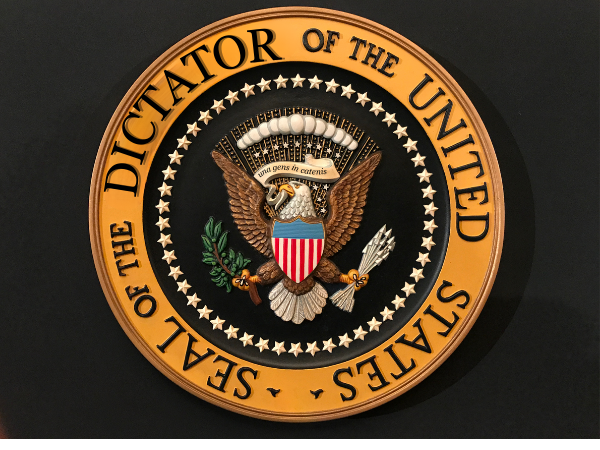
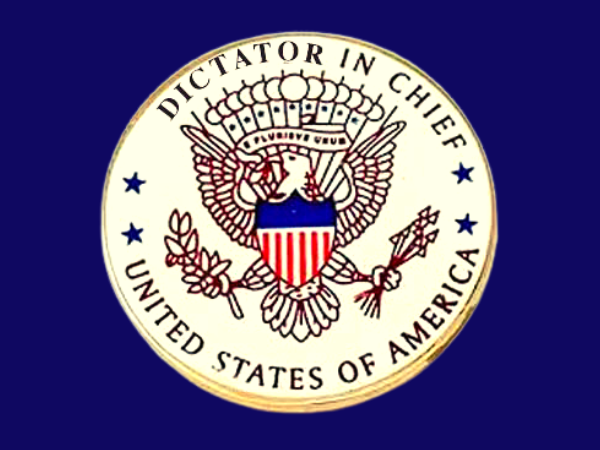
America, meet your new dictator-in-chief.

As the New York Times reports, “Newly disclosed documents have shed a crack of light on secret executive branch plans for apocalyptic scenarios—like the aftermath of a nuclear attack—when the president may activate wartime powers for national security emergencies.”

The problem, of course, is that we have become a nation in a permanent state of emergency.

Power-hungry and lawless, the government has weaponized one national crisis after another in order to expand its powers and justify all manner of government tyranny in the so-called name of national security.

The seeds of this present madness were sown almost two decades ago when George W. Bush stealthily issued two presidential directives that granted the president the power to unilaterally declare a national emergency, which is loosely defined as “any incident, regardless of location, that results in extraordinary levels of mass casualties, damage, or disruption severely affecting the U.S. population, infrastructure, environment, economy, or government functions.

Comprising the country’s Continuity of Government (COG) plan, these directives (National Security Presidential Directive 51 and Homeland Security Presidential Directive 20) provide a skeletal outline of the actions the president will take in the event of a “national emergency.”

Just what sort of actions the president will take once he declares a national emergency can barely be discerned from the barebones directives. However, one thing is clear: in the event of a national emergency, the COG directives give unchecked executive, legislative and judicial power to the president.

The country would then be subjected to martial law by default, and the Constitution and the Bill of Rights would be suspended.

Essentially, the president would become a dictator for life.

It has happened already.

As we have witnessed in recent years, that national emergency can take any form, can be manipulated for any purpose and can be used to justify any end goal—all on the say so of the president.

The emergency powers that we know about which presidents might claim during such states of emergency are vast, ranging from imposing martial law and suspending habeas corpus to shutting down all forms of communications, including implementing an internet kill switch, and restricting travel.

Yet according to documents recently obtained by the Brennan Center, there may be many more secret powers that presidents may institute in times of so-called crisis without oversight from Congress, the courts, or the public.

It doesn’t even matter what the nature of the crisis might be—civil unrest, the national emergencies, “unforeseen economic collapse, loss of functioning political and legal order, purposeful domestic resistance or insurgency, pervasive public health emergencies, and catastrophic natural and human disasters”—as long as it allows the government to justify all manner of government tyranny in the name of so-called national security.

The war on COVID-19, the war on terror, the war on drugs, the war on illegal immigration: all of these programs started out as responses to pressing national concerns and have since become weapons of compliance and control in the police state’s hands.

Deploying the same strategy it used with 9/11 to acquire greater powers under the USA Patriot Act, the police state—a.k.a. the shadow government, a.k.a. the Deep State—has been planning and preparing for such crises for years now, quietly assembling a wish list of presidential lockdown powers that could be trotted out and approved at a moment’s notice.

Indeed, the Trump Administration even asked Congress to allow it to suspend parts of the Constitution whenever it deems it necessary during the COVID-19 crisis and “other” emergencies. The Department of Justice (DOJ) went so far as to quietly trot out and test a long laundry list of terrifying powers that override the Constitution.

We’re talking about lockdown powers (at both the federal and state level): the ability to suspend the Constitution, indefinitely detain American citizens, bypass the courts, quarantine whole communities or segments of the population, override the First Amendment by outlawing religious gatherings and assemblies of more than a few people, shut down entire industries and manipulate the economy, muzzle dissidents, “stop and seize any plane, train or automobile to stymie the spread of contagious disease,” reshape financial markets, create a digital currency (and thus further restrict the use of cash), determine who should live or die.

These are powers the police state would desperately like to make permanent.

In such a climate, the American president becomes dictator with permanent powers: imperial, unaccountable and unconstitutional.

Bear in mind that the powers the government officially asked Congress to recognize and authorize barely scratch the surface of the far-reaching powers the government has already unilaterally claimed for itself.

Unofficially, the police state with the president at its helm has been riding roughshod over the rule of law for years now without any pretense of being reined in or restricted in its power grabs by Congress, the courts or the citizenry.

Although the Constitution invests the President with very specific, limited powers, in recent years, American presidents have claimed the power to completely and almost unilaterally alter the landscape of this country for good or for ill.

The powers amassed by each successive president through the negligence of Congress and the courts—powers which add up to a toolbox of terror for an imperial ruler—empower whoever occupies the Oval Office to act as a dictator, above the law and beyond any real accountability.

As law professor William P. Marshall explains, “every extraordinary use of power by one President expands the availability of executive branch power for use by future Presidents.”

Moreover, it doesn’t even matter whether other presidents have chosen not to take advantage of any particular power, because “it is a President’s action in using power, rather than forsaking its use, that has the precedential significance.”

In other words, each successive president continues to add to his office’s list of extraordinary orders and directives, expanding the reach and power of the presidency and granting him- or herself near dictatorial powers.

All of the imperial powers amassed by Barack Obama and George W. Bush—to kill American citizens without due process, to detain suspects indefinitely, to strip Americans of their citizenship rights, to carry out mass surveillance on Americans without probable cause, to suspend laws during wartime, to disregard laws with which he might disagree, to conduct secret wars and convene secret courts, to sanction torture, to sidestep the legislatures and courts with executive orders and signing statements, to direct the military to operate beyond the reach of the law, to operate a shadow government, and to act as a dictator and a tyrant, above the law and beyond any real accountability—were inherited by Donald Trump and passed along to Joe Biden.

These presidential powers—acquired through the use of executive orders, decrees, memorandums, proclamations, national security directives and legislative signing statements and which can be activated by any sitting president—enable past, president and future presidents to operate above the law and beyond the reach of the Constitution.

These are the powers that continue to be passed along to each successive heir to the Oval Office, the Constitution be damned.

This is what you might call a stealthy, creeping, silent, slow-motion coup d’état.

From Clinton to Bush, Obama to Trump, and now Biden, it’s as if we’ve been caught in a time loop, forced to re-live the same abuses over and over again: the same assaults on our freedoms, the same disregard for the rule of law, the same subservience to the Deep State, and the same corrupt, self-serving government that exists only to amass power, enrich its shareholders and ensure its continued domination.

We’ve been losing our freedoms so incrementally for so long—sold to us in the name of national security and global peace, maintained by way of martial law disguised as law and order, and enforced by a standing army of militarized police and a political elite determined to maintain their powers at all costs—that it’s hard to pinpoint exactly when it all started going downhill, but “we the people” are paying the price for it now.

We are paying the price every day that we allow the government to continue to wage its war on the American People, a war that is being fought on many fronts: with bullets and tasers, with surveillance cameras and license readers, with intimidation and propaganda, with court rulings and legislation, with the collusion of every bureaucrat who dances to the tune of corporate handouts while on the government’s payroll, and most effectively of all, with the complicity of the American people, who continue to allow themselves to be easily manipulated by their politics, distracted by their pastimes, and acclimated to a world in which government corruption is the norm.

Unless something changes in the way we deal with these ongoing, egregious abuses of power, the predators of the police state will continue to wreak havoc on our freedoms, our communities, and our lives.

If we continue down this road, there can be no surprise about what awaits us at the end.

After all, it is a tale that has been told time and again throughout history about how easy it is for freedom to fall and tyranny to rise, and it often begins with one small, seemingly inconsequential willingness on the part of the people to compromise their principles and undermine the rule of law in exchange for a dubious assurance of safety, prosperity and a life without care.

Unfortunately, the process of unseating a dictator and limiting the powers of the presidency is far from simple but at a minimum, it must start with “we the people.”

For starters, as I make clear in my book Battlefield America: The War on the American People and in its fictional counterpart The Erik Blair Diaries, we must recalibrate the balance of power.

Start locally—in your own communities, in your schools, at your city council meetings, in newspaper editorials, at protests—by pushing back against laws that are unjust, police departments that overreach, politicians that don’t listen to their constituents, and a system of government that grows more tyrannical by the day.

What we desperately need is a concerted, collective commitment to the Constitution’s principles of limited government, a system of checks and balances, and a recognition that they—the president, Congress, the courts, the military, the police, the technocrats and plutocrats and bureaucrats—answer to and are accountable to “we the people.”

This will mean that Americans will have to stop letting their personal politics and party allegiances blind them to government misconduct and power grabs.

It will mean holding all three branches of government accountable to the Constitution (i.e., vote them out of office if they abuse their powers).

And it will mean calling on Congress to put an end to the use of presidential executive orders, decrees, memorandums, proclamations, national security directives and legislative signing statements as a means of getting around Congress and the courts.

In other words, we’ve got to start making both the president and the police state play by the rules of the Constitution.

Source: https://bit.ly/38FKkzs

ABOUT JOHN W. WHITEHEAD

Constitutional attorney and author John W. Whitehead is founder and president of The Rutherford Institute. His most recent books are the best-selling Battlefield America: The War on the American People, the award-winning A Government of Wolves: The Emerging American Police State, and a debut dystopian fiction novel, The Erik Blair Diaries. Whitehead can be contacted at staff@rutherford.org. Nisha Whitehead is the Executive Director of The Rutherford Institute. Information about The Rutherford Institute is available at www.rutherford.org.

Publication Guidelines / Reprint Permission

John W. Whitehead’s weekly commentaries are available for publication to newspapers and web publications at no charge. Please contact staff@rutherford.org to obtain reprint permission.