Posts Tagged ‘civil liberties’

“Take alarm at the first experiment on our liberties.” — James Madison

James Madison, often referred to as the “Father of the Constitution,” once predicted that the Bill of Rights would become mere “parchment barrier,” words on paper ignored by successive generations of Americans.

How right he was.

Although Madison initially felt that the inclusion of a bill of rights in the originally ratified Constitution was unnecessary to its success, Thomas Jefferson persuaded him that “a bill of rights is what the people are entitled to against every government on earth, general or particular, & what no just government should refuse, or rest on inferences.”

The Bill of Rights drafted by Madison—the first ten amendments to the Constitution—was a document so revolutionary at the time that it would come to be viewed as the epitome of American liberty. The rights of the people reflected in those ten amendments encapsulated much of Madison’s views about government, the corrupting influence of power, and the need for safeguards against tyranny.

Madison’s writings speak volumes to the present constitutional crisis in the country.

Read them and weep.  

“The accumulation of all powers, Legislative, Executive, and Judiciary, in the same hands, whether of one, a few, or many, and whether hereditary, self-appointed, or elective, may justly be pronounced the very definition of tyranny.” — James Madison

“The people are the only legitimate fountain of power, and it is from them that the constitutional charter, under which the several branches of government hold their power, is derived.” — James Madison

“If men were angels, no government would be necessary. If angels were to govern men, neither external nor internal controls on government would be necessary. In framing a government which is to be administered by men over men, the great difficulty lies in this: you must first enable the government to control the governed; and in the next place oblige it to control itself.” — James Madison

“A standing military force, with an overgrown Executive will not long be safe companions to liberty. The means of defence against foreign danger have been always the instruments of tyranny at home.” — James Madison

“Wherever the real power in a Government lies, there is the danger of oppression.” — James Madison

“Knowledge will forever govern ignorance: And a people who mean to be their own Governors, must arm themselves with the power which knowledge gives.” — James Madison

I believe there are more instances of the abridgement of the freedom of the people by gradual and silent encroachments of those in power than by violent and sudden usurpations.”— James Madison

In the years since the founders laid their lives on the line to pursue the dream of individual freedom and self-government, big government has grown bigger and the rights of the citizenry have grown smaller.

However, there are certain principles—principles that every American should know—which undergird the American system of government and form the basis of our freedoms.

The following seven principles are a good starting point for understanding what free government is really all about.

First, the maxim that power corrupts is an absolute truth. Realizing this, those who drafted the Constitution and the Bill of Rights held one principle sacrosanct: a distrust of all who hold governmental power. As James Madison proclaimed, “All men having power ought to be distrusted to a certain degree.” Moreover, in questions of power, Thomas Jefferson warned, “Let no more be heard of confidence in man, but bind him down from mischief by the chains of the Constitution.” As such, those who drafted our founding documents would see today’s government as an out-of-control, unmanageable beast.

The second principle is that governments primarily exist to secure rights, an idea that is central to constitutionalism. In appointing the government as the guardian of the people’s rights, the people give it only certain, enumerated powers, which are laid out in a written constitution. The idea of a written constitution actualizes the two great themes of the Declaration of Independence: consent and protection of equal rights. Thus, the purpose of constitutionalism is to limit governmental power and ensure that the government performs its basic function: to preserve and protect our rights, especially our unalienable rights to life, liberty and the pursuit of happiness, and our civil liberties. Unfortunately, the government today has discarded this principle and now sees itself as our master, not our servant. The obvious next step, unless we act soon, is tyranny.

The third principle revolves around the belief that no one is above the law, not even those who make the law. This is termed rule of law. Richard Nixon’s statement, “When the President does it, that means it is not illegal,” would have been an anathema to the Framers of the Constitution. If all people possess equal rights, the people who live under the laws must be allowed to participate in making those laws. By that same token, those who make the laws must live under the laws they make.

Fourth, separation of powers ensures that no single authority is entrusted with all the powers of government. People are not perfect, whether they are in government or out of it. As history makes clear, those in power tend to abuse it. The government is thus divided into three co-equal branches: legislative, executive and judicial. Placing all three powers in the same branch of government was considered the very definition of tyranny. The fact that the president today has dictatorial powers would have been considered an offense to every principle for which the Framers took their revolutionary stand.

Fifth, a system of checks and balances, essential if a constitutional government is to succeed, strengthens the separation of powers and prevents legislative despotism. Such checks and balances include dividing Congress into two houses, with different constituencies, term lengths, sizes and functions; granting the president a limited veto power over congressional legislation; and appointing an independent judiciary capable of reviewing ordinary legislation in light of the written Constitution, which is referred to as “judicial review.” The Framers feared that Congress could abuse its powers and potentially emerge as the tyrannous branch because it had the power to tax. But they did not anticipate the emergence of presidential powers as they have come to dominate modern government or the inordinate influence of corporate powers on governmental decision-making. Indeed, as recent academic studies now indicate, we are now ruled by a monied oligarchy that serves itself and not “we the people.”

Sixth, representation allows the people to have a voice in government by sending elected representatives to do their bidding while avoiding the need of each and every citizen to vote on every issue considered by government. In a country as large as the United States, it is not feasible to have direct participation in governmental affairs. Hence, we have a representative government. If the people don’t agree with how their representatives are conducting themselves, they can and should vote them out. However, as the citizenry has grown lazy and been distracted by the entertainment spectacles of modern society, government bureaucrats churn out numerous laws each year resulting in average citizens being rendered lawbreakers and jailed for what used to be considered normal behavior.

Finally, federalism is yet another constitutional device to limit the power of government by dividing power and, thus, preventing tyranny. In America, the levels of government generally break down into federal, state and local branches (which further divide into counties and towns or cities). Because local and particular interests differ from place to place, such interests are better handled at a more intimate level by local governments, not a bureaucratic national government. Remarking on the benefits of the American tradition of local self-government in the 1830s, the French historian Alexis de Tocqueville observed: “Local institutions are to liberty what primary schools are to science; they put it within the people’s reach; they teach people to appreciate its peaceful enjoyment and accustom them to make use of it. Without local institutions a nation may give itself a free government, but it has not got the spirit of liberty.”

These seven vital principles have been largely forgotten in recent years, obscured by the haze of a centralized government, a citizenry that no longer thinks analytically, and schools that don’t adequately teach our young people about their history and their rights.

Yet here’s the rub: while Americans wander about in their brainwashed states, their “government of the people, by the people and for the people” has largely been taken away from them.

The answer: get un-brainwashed.

Learn your rights.

Stand up for the founding principles.

Make your voice and your vote count for more than just political posturing.

Never cease to vociferously protest the erosion of your freedoms at the local and national level.

Most of all, do these things today.

If we wait until the votes have all been counted or hang our hopes on our particular candidate to win and fix what’s wrong with the country, “we the people” will continue to lose.

Whether we ever realize it not, the enemy is not across party lines, as they would have us believe. It has us surrounded on all sides.

Even so, we’re not yet defeated.

We could still overcome our oppressors if we cared enough to join forces and launch a militant nonviolent revolution—a people’s revolution that starts locally and trickles upwards—but that will take some doing.

It will mean turning our backs on the political jousting contests taking place at all levels of government and rejecting their appointed jesters as false prophets. It will mean not allowing ourselves to be corralled like cattle and branded with political labels that have no meaning anymore. It will mean recognizing that all the evils that surround us today—endless wars, drone strikes, invasive surveillance, militarized police, poverty, asset forfeiture schemes, overcriminalization, etc.—are not of our making but came about as a way to control and profit from us.

It will mean “voting with our feet” through sustained, mass civil disobedience.

Ultimately, as I make clear in my book Battlefield America: The War on the American People and in its fictional counterpart The Erik Blair Diaries, it will mean refusing to be divided, one against each other, by politics and instead uniting behind the only distinction that has ever mattered: “we the people” against tyranny.

Source: https://tinyurl.com/mpfzatb8

ABOUT JOHN W. WHITEHEAD

Constitutional attorney and author John W. Whitehead is founder and president of The Rutherford Institute. His most recent books are the best-selling Battlefield America: The War on the American People, the award-winning A Government of Wolves: The Emerging American Police State, and a debut dystopian fiction novel, The Erik Blair Diaries. Whitehead can be contacted at staff@rutherford.org. Nisha Whitehead is the Executive Director of The Rutherford Institute. Information about The Rutherford Institute is available at www.rutherford.org.

Publication Guidelines / Reprint Permission

John W. Whitehead’s weekly commentaries are available for publication to newspapers and web publications at no charge. 

If a nation expects to be ignorant and free in a state of civilization, it expects what never was and never will be.”—Thomas Jefferson

If America’s schools are to impart principles of freedom and democracy to future generations, they must start by respecting the constitutional rights of their students

Take the case of Lucas Hudson.

With all the negative press being written about today’s young people, it’s refreshing to meet a young person who not only knows his rights but is prepared to stand up for them. 

Lucas is a smart kid, a valedictorian of his graduating class at the Collegiate Academy at Armwood High School in Hillsborough County, Fla.

So, when school officials gave Lucas an ultimatum: either remove most of his speech’s religious references from his graduation speech—in which he thanked the people who helped shape his character, reflected on how quickly time goes by, and urged people to use whatever time they have to love others and serve the God who loves us—or he would not be speaking at all, Lucas refused to forfeit his rights.

That’s when Lucas’s father turned to The Rutherford Institute for help.

In coming to Lucas’ defense, attorneys for The Rutherford Institute warned school officials that their attempts to browbeat Lucas into watering down his graduation speech could expose the school to a First Amendment lawsuit.

Thankfully for Lucas, the school backed down, and he was able to deliver his speech as written.

It doesn’t always work out so well, unfortunately.

Over the course of The Rutherford Institute’s 42-year history, we have defended countless young people who found themselves censored, silenced and denied their basic First Amendment rights, especially when they chose to exercise their rights to free speech and religious freedom.

In case after case, we encounter an appalling level of ignorance on the part of public school officials who mistakenly believe that the law requires anything religious be banned from public schools.

Here’s where government officials get it wrong: while the government may not establish or compel a particular religion, it also may not silence and suppress religious speech merely because others might take offense.

People are free to ignore, disagree with, or counter the religious speech of others, but the government cannot censor private religious speech.

Unfortunately, you can only defend your rights when you know them, and the American people—and those who represent them—are utterly ignorant about their freedoms, history, and how the government is supposed to operate.

As Morris Berman points out in his book Dark Ages America, “70 percent of American adults cannot name their senators or congressmen; more than half don’t know the actual number of senators, and nearly a quarter cannot name a single right guaranteed by the First Amendment. Sixty-three percent cannot name the three branches of government. Other studies reveal that uninformed or undecided voters often vote for the candidate whose name and packaging (e.g., logo) are the most powerful; color is apparently a major factor in their decision.”

More than government corruption and ineptitude, police brutality, terrorism, gun violence, drugs, illegal immigration or any other so-called “danger” that threatens our nation, civic illiteracy may be what finally pushes us over the edge.

As Thomas Jefferson warned, no nation can be both ignorant and free.

Unfortunately, the American people have existed in a technology-laden, entertainment-fueled, perpetual state of cluelessness for so long that civic illiteracy has become the new normal for the citizenry.

In fact, most immigrants who aspire to become citizens know more about national civics than native-born Americans. Surveys indicate that half of native-born Americans couldn’t correctly answer 70% of the civics questions on the U.S. Citizenship test.

Not even the government bureaucrats who are supposed to represent us know much about civics, American history and geography, or the Constitution although they take an oath to uphold, support and defend the Constitution against “enemies foreign and domestic.”

For instance, a couple attempting to get a marriage license was recently forced to prove to a government official that New Mexico is, in fact, one of the 50 states and not a foreign country.

You can’t make this stuff up.

Those who gave us the Constitution and the Bill of Rights believed that the government exists at the behest of its citizens. The government’s purpose is to protect, defend and even enhance our freedoms, not violate them.

It was no idle happenstance that the Constitution opens with these three powerful words: “We the people.”

Those who founded this country knew quite well that every citizen must remain vigilant or freedom would be lost. As Thomas Paine recognized, “It is the responsibility of the patriot to protect his country from its government.”

You have no rights unless you exercise them.

Still, you can’t exercise your rights unless you know what those rights are.

“If Americans do not understand the Constitution and the institutions and processes through which we are governed, we cannot rationally evaluate important legislation and the efforts of our elected officials, nor can we preserve the national unity necessary to meaningfully confront the multiple problems we face today,” warns the Brennan Center in its Civic Literacy Report Card. “Rather, every act of government will be measured only by its individual value or cost, without concern for its larger impact. More and more we will ‘want what we want, and [will be] convinced that the system that is stopping us is wrong, flawed, broken or outmoded.’”

Education precedes action.

As the Brennan Center concludes “America, unlike most of the world’s nations, is not a country defined by blood or belief. America is an idea, or a set of ideas, about freedom and opportunity. It is these ideas that bind us together as Americans and have kept us free, strong, and prosperous. But these ideas do not perpetuate themselves. They must be taught and learned anew with each generation.”

There is a movement underway to require that all public-school students pass the civics portion of the U.S. naturalization test100 basic facts about U.S. history and civics—before receiving their high-school diploma, and that’s a start.

Lucas Hudson would have passed such a test with flying colors.

On graduation day, Lucas stepped up to the podium and delivered his uncensored valedictorian speech as written, without any interference by school censors.

As Lucas’s father relayed to The Rutherford Institute:

“In the end, Lucas got to give his entire speech the way he wanted to give it, and everybody was paying attention.  Nobody got hurt.  Nothing bad happened.  It was just a young man using the First Amendment rights to speak his mind regarding his personal beliefs. [Lucas] never thought a few sentences in a speech would create such a controversy in his world, but this speech turned into a defining moment for him.  He will never be the same after this experience, but this permanent change is a good thing.  When it mattered, Lucas stood up for himself, and when those he stood up against tried to push him down, [The Rutherford Institute] came to his aide and backed him up to make it a fair fight. I am comforted to know you are defending the rights of the people.  These fights matter.  Every time you defend the rights of one person, you defend the rights of every person.  You helped my son fight for his rights against the school, and, in doing so, Hillsborough County Public Schools will think twice before infringing on the rights of future students. Your defense of Lucas became an inspiration for the students in his school and sparked a healthy and meaningful debate among the teachers, students, and parents about the value of the First Amendment and the need for limits on government control over our personal beliefs.  You are fighting for good and doing important work.  Don’t ever stop. Thank you, Rutherford Institute, for being there for my son when he needed you most.”

America needs more freedom fighters like Lucas Hudson and The Rutherford Institute.

It’s up to us.

We have the power to make and break the government.

We the American people—the citizenry—are the arbiters and ultimate guardians of America’s welfare, defense, liberty, laws and prosperity.

We must act—and act responsibly.

A healthy, representative government is hard work. It takes a citizenry that is informed about the issues, educated about how the government operates, and willing to make the sacrifices necessary to stay involved.

As I make clear in my book Battlefield America: The War on the American People and in its fictional counterpart The Erik Blair Diaries, it’s our job to keep freedom alive using every nonviolent means available to us.

As Martin Luther King Jr. recognized in a speech delivered on December 5, 1955, just four days after Rosa Parks was arrested for refusing to relinquish her seat on a Montgomery city bus: “Democracy transformed from thin paper to thick action is the greatest form of government on earth.”

Know your rights. Exercise your rights. Defend your rights. If not, you will lose them.

Source: https://tinyurl.com/3b2uaxs7

ABOUT JOHN W. WHITEHEAD

Constitutional attorney and author John W. Whitehead is founder and president of The Rutherford Institute. His most recent books are the best-selling Battlefield America: The War on the American People, the award-winning A Government of Wolves: The Emerging American Police State, and a debut dystopian fiction novel, The Erik Blair Diaries. Whitehead can be contacted at staff@rutherford.org. Nisha Whitehead is the Executive Director of The Rutherford Institute. Information about The Rutherford Institute is available at www.rutherford.org.

Publication Guidelines / Reprint Permission

John W. Whitehead’s weekly commentaries are available for publication to newspapers and web publications at no charge. 

“Politicians of both parties want to use the power of government to silence their foes. Some in the university community seek to drive it from their campuses. And an entire generation of Americans is being taught that free speech should be curtailed as soon as it makes someone else feel uncomfortable.”—William Ruger, “Free Speech Is Central to Our Dignity as Humans

The police state does not want citizens who know their rights.

Nor does the police state want citizens prepared to exercise those rights.

This year’s graduates are a prime example of this master class in compliance. Their time in college has been set against a backdrop of crackdowns, lockdowns and permacrises ranging from the government’s authoritarian COVID-19 tactics to its more recent militant response to campus protests.

Born in the wake of the 9/11 attacks, these young people have been raised without any expectation of privacy in a technologically-driven, mass surveillance state; educated in schools that teach conformity and compliance; saddled with a debt-ridden economy on the brink of implosion; made vulnerable by the blowback from a military empire constantly waging war against shadowy enemies; policed by government agents armed to the teeth ready and able to lock down the country at a moment’s notice; and forced to march in lockstep with a government that no longer exists to serve the people but which demands they be obedient slaves or suffer the consequences.

And now, when they should be empowered to take their rightful place in society as citizens who fully understand and exercise their right to speak truth to power, they are being censored, silenced and shut down.

Consider what happened recently in Charlottesville, Va., when riot police were called in to shut down campus protests at the University of Virginia staged by students and members of the community to express their opposition to the ongoing humanitarian crisis in Palestine.

As the local newspaper reported, “State police sporting tactical gear and riot shields moved in on the demonstrators, using pepper spray and sheer force to disperse the group and arrest the roughly 15 or so at the camp, where for days students, faculty and community members had sang songs, read poetry and painted signs in protest of Israel’s ongoing war in the Palestinian territory of Gaza.”

What a sad turn-about for an institution which was founded as an experiment in cultivating an informed citizenry by Thomas Jefferson, the author of the Declaration of Independence, champion of the Bill of Rights, and the nation’s third president.

Unfortunately, the University of Virginia is not unique in its heavy-handed response to what have been largely peaceful anti-war protests. According to the Washington Postmore than 2300 people have been arrested for taking part in similar campus protests across the country.

These lessons in compliance, while expected, are what comes of challenging the police state.

What was unexpected were the campus protests themselves.

For those of us who came of age in the 1960s, college campuses were once the bastion of free speech, awash with student protests, sit-ins, marches, pamphleteering, and other expressive acts showing our displeasure with war, the Establishment and the status quo.

Contrast that with college campuses today, which have become breeding grounds for compliant citizens and bastions of censorship, trigger warningsmicroaggressions, and “red light” speech policies targeting anything that might cause someone to feel uncomfortable, unsafe or offended.

Free speech can certainly not be considered “free” when expressive activities across the nation are being increasingly limited, restricted to so-called free speech zones, or altogether blocked.

Remember, the First Amendment gives every American the right to “petition his government for a redress of grievances.”

There was a time in this country, back when the British were running things, that if you spoke your mind and it ticked off the wrong people, you’d soon find yourself in jail for offending the king.

Reacting to this injustice, when it was time to write the Constitution, America’s founders argued for a Bill of Rights, of which the First Amendment protects the right to free speech. James Madison, the father of the Constitution, was very clear about the fact that he wrote the First Amendment to protect the minority against the majority.

What Madison meant by minority is “offensive speech.”

Unfortunately, we don’t honor that principle as much as we should today. In fact, we seem to be witnessing a politically correct philosophy at play, one shared by both the extreme left and the extreme right, which aims to stifle all expression that doesn’t fit within their parameters of what they consider to be “acceptable” speech.

There are all kinds of labels put on such speech—it’s been called politically incorrect speech, hate speech, offensive speech, and so on—but really, the message being conveyed is that you don’t have a right to express yourself if certain people or groups don’t like or agree with what you are saying.

Hence, we have seen the caging of free speech in recent years, through the use of so-called “free speech zones” on college campuses and at political events, the requirement of speech permits in parks and community gatherings, and the policing of online forums.

Clearly, this elitist, monolithic mindset is at odds with everything America is supposed to stand for.

Indeed, we should be encouraging people to debate issues and air their views. Instead, by muzzling free speech, we are contributing to a growing underclass of Americans—many of whom have been labeled racists, rednecks and religious bigots—who are being told that they can’t take part in American public life unless they “fit in.”

Remember, the First Amendment acts as a steam valve. It allows people to speak their minds, air their grievances and contribute to a larger dialogue that hopefully results in a more just world. When there is no steam valve to release the pressure, frustration builds, anger grows and people become more volatile and desperate to force a conversation.

The attempt to stifle certain forms of speech is where we go wrong.

In fact, the U.S. Supreme Court has held that it is “a bedrock principle underlying the First Amendment…that the government may not prohibit the expression of an idea simply because society finds the idea offensive or disagreeable.” For example, it is not a question of whether the Confederate flag represents racism but whether banning it leads to even greater problems, namely, the loss of freedom in general.

Along with the constitutional right to peacefully (and that means non-violently) assemble, the right to free speech allows us to challenge the government through protests and demonstrations and to attempt to change the world around us—for the better or the worse—through protests and counterprotests.

If citizens cannot stand out in the open and voice their disapproval of their government, its representatives and its policies without fearing prosecution, then the First Amendment with all its robust protections for free speech, assembly and the right to petition one’s government for a redress of grievances is little more than window-dressing on a store window—pretty to look at but serving little real purpose.

After all, living in a representative republic means that each person has the right to take a stand for what they think is right, whether that means marching outside the halls of government, wearing clothing with provocative statements, or simply holding up a sign.

That’s what the First Amendment is supposed to be about: it assures the citizenry of the right to express their concerns about their government to their government, in a time, place and manner best suited to ensuring that those concerns are heard.

Unfortunately, through a series of carefully crafted legislative steps and politically expedient court rulings, government officials have managed to disembowel this fundamental freedom, rendering it with little more meaning than the right to file a lawsuit against government officials.

In more and more cases, the government is declaring war on what should be protected political speech whenever it challenges the government’s power, reveals the government’s corruption, exposes the government’s lies, and encourages the citizenry to push back against the government’s many injustices.

Indeed, there is a long and growing list of the kinds of speech that the government considers dangerous enough to red flag and subject to censorship, surveillance, investigation and prosecution: hate speech, conspiratorial speech, treasonous speech, threatening speech, inflammatory speech, radical speech, anti-government speech, extremist speech, etc.

Clearly, the government has no interest in hearing what “we the people” have to say.

Yet if Americans are not able to peacefully assemble for expressive activity outside of the halls of government or on public roads on which government officials must pass, or on college campuses, the First Amendment has lost all meaning.

If we cannot stand peacefully outside of the Supreme Court or the Capitol or the White House, our ability to hold the government accountable for its actions is threatened, and so are the rights and liberties that we cherish as Americans.

And if we cannot proclaim our feelings about the government, no matter how controversial, on our clothing, or to passersby, or to the users of the world wide web, then the First Amendment really has become an exercise in futility.

The source of the protest shouldn’t matter. The politics of the protesters are immaterial.

To play politics with the First Amendment encourages a double standard that will see us all muzzled in the end.

You don’t have to agree with someone to defend their freedoms.

Responsible citizenship means being outraged at the loss of others’ freedoms, even when our own are not directly threatened. It means remembering that the prime function of any free government is to protect the weak against the strong. And it means speaking up for those with whom you might disagree.

The Framers of the Constitution knew very well that whenever and wherever democratic governments had failed, it was because the people had abdicated their responsibility as guardians of freedom. They also knew that whenever in history the people rejected this responsibility, an authoritarian regime arose which eventually denied the people the right to govern themselves.

The demons of our age—some of whom disguise themselves as politicians—delight in fomenting violence, sowing distrust and prejudice, and persuading the public to support tyranny disguised as patriotism.

Overcoming the evils of our age will require us to stop marching in lockstep with the police state and start thinking—and speaking—for ourselves.

It doesn’t matter how old you are or what your political ideology is: it’s our civic duty to make the government hear us—and heed us—using every nonviolent means available to us: picket, protest, march, boycott, speak up, sound off and reclaim control over the narrative about what is really going on in this country.

The power elite has made their intentions clear: they will pursue and prosecute any and all words, thoughts and expressions that challenge their authority.

As I make clear in my book Battlefield America: The War on the American People and in its fictional counterpart The Erik Blair Diaries, this is the final link in the police state chain.

If ever there were a time for us to stand up for the right to speak freely, even if it’s freedom for speech we hate, the time is now.

Source: https://tinyurl.com/bddvzsnf

ABOUT JOHN W. WHITEHEAD

Constitutional attorney and author John W. Whitehead is founder and president of The Rutherford Institute. His most recent books are the best-selling Battlefield America: The War on the American People, the award-winning A Government of Wolves: The Emerging American Police State, and a debut dystopian fiction novel, The Erik Blair Diaries. Whitehead can be contacted at staff@rutherford.org. Nisha Whitehead is the Executive Director of The Rutherford Institute. Information about The Rutherford Institute is available at www.rutherford.org.

Publication Guidelines / Reprint Permission

John W. Whitehead’s weekly commentaries are available for publication to newspapers and web publications at no charge. 

“Whether the mask is labeled fascism, democracy, or dictatorship of the proletariat, our great adversary remains the apparatus—the bureaucracy, the police, the military.”—Simone Weil, French philosopher

We are caught in a vicious cycle of too many laws, too many cops, and too little freedom.

It’s hard to say whether we’re dealing with a kleptocracy (a government ruled by thieves), a kakistocracy (a government run by unprincipled career politicians, corporations and thieves that panders to the worst vices in our nature and has little regard for the rights of American citizens), or a Nanny State Idiocracy

Whatever the label, this overbearing despotism is what happens when government representatives (those elected and appointed to work for us) adopt the authoritarian notion that the government knows best and therefore must control, regulate and dictate almost everything about the citizenry’s public, private and professional lives.

The government’s bureaucratic attempts at muscle-flexing by way of overregulation and overcriminalization have reached such outrageous limits that federal and state governments now require on penalty of a fine that individuals apply for permission before they can grow exotic orchids, host elaborate dinner parties, gather friends in one’s home for Bible studies, give coffee to the homeless, let their kids manage a lemonade stand, keep chickens as pets, or braid someone’s hair, as ludicrous as that may seem.

As the Regulatory Transparency Project explains, “There are over 70 federal regulatory agencies, employing hundreds of thousands of people to write and implement regulations. Every year, they issue about 3,500 new rules, and the regulatory code now is over 168,000 pages long.”

In his CrimeADay Twitter feed, Mike Chase highlights some of the more arcane and inane laws that render us all guilty of violating some law or other.

As Chase notes, it’s against the law to try to make an unreasonable noise while a horse is passing by in a national park; to leave Michigan with a turkey that was hunted with a drone; to refill a liquor bottle with different liquor than it had in it when it was originally filled; to offer to buy swan feathers so you can make a woman’s hat with them; to enter a design in the Federal Duck Stamp contest if waterfowl are not the dominant feature of the design; to transport a cougar without a cougar license; to sell spray deodorant without telling people to avoid spraying it in their eyes; and to transport “meat loaf” unless it’s in loaf form.

In such a society, we are all petty criminals.

In fact, Boston lawyer Harvey Silvergate estimates that the average American now unknowingly commits three felonies a day, thanks to an overabundance of vague laws that render otherwise innocent activity illegal and an inclination on the part of prosecutors to reject the idea that there can’t be a crime without criminal intent. 

The bigger the government grows, the worse the red tape becomes.

Almost every aspect of American life today, including the job sector, is now subject to this kind of heightened scrutiny and ham-fisted control.

Whereas 70 years ago, one out of every 20 U.S. jobs required a state license, today, almost 1 in 4 American occupations requires a license.

According to business analyst Kaylyn McKenna, more than 41 states require that makeup artists be licensed. Twenty-eight states require a license before you can work as a residential painter. Funeral attendants, whose duties include placing caskets in visitation rooms, arranging flowers and directing mourners, have to be licensed to do so in Kansas, Maine and Massachusetts.

The problem of overregulation has become so bad that, as one analyst notes, “getting a license to style hair in Washington takes more instructional time than becoming an emergency medical technician or a firefighter.”

This is what happens when bureaucrats run the show, and the rule of law becomes little more than a cattle prod for forcing the citizenry to march in lockstep with the government.

Overregulation is just the other side of the coin to overcriminalization, that phenomenon in which everything is rendered illegal, and everyone becomes a lawbreaker.

As policy analyst Michael Van Beek warns, the problem with overcriminalization is that there are so many laws at the federal, state and local levels—that we can’t possibly know them all.

“It’s also impossible to enforce all these laws. Instead, law enforcement officials must choose which ones are important and which are not. The result is that they pick the laws Americans really must follow, because they’re the ones deciding which laws really matter,” concludes Van Beek. “Federal, state and local regulations — rules created by unelected government bureaucrats — carry the same force of law and can turn you into a criminal if you violate any one of them… if we violate these rules, we could be prosecuted as criminals. No matter how antiquated or ridiculous, they still carry the full force of the law. By letting so many of these sit around, just waiting to be used against us, we increase the power of law enforcement, which has lots of options to charge people with legal and regulatory violations.”

Case in point: in New Jersey, in what journalist Billy Binion describes as “yet another example of the effects of overcriminalization, which increases interactions between civilians and police with little benefit to actual public safety,” police went so far as to arrest a teenager and seize other teen’s bicycles for so-called traffic violations and a failure to register their bikes with the state.

This is the police state’s superpower: it has been vested with the authority to make our lives a bureaucratic hell.

That explains how a fisherman can be saddled with 20 years’ jail time for throwing fish that were too small back into the water. Or why police arrested a 90-year-old man for violating an ordinance that prohibits feeding the homeless in public unless portable toilets are also made available. Or how states across the country, in a misguided attempt to disperse homeless populations, have criminalized sitting, sleeping, or resting in public spaces; sharing food with people; and camping in public.

The laws can get downright silly.

For instance, in Florida, it’s against the law to eat a frog that was used in a frog-jumping contest. You could also find yourself passing time in a Florida slammer for such inane activities as singing in a public place while wearing a swimsuit, breaking more than three dishes per day, farting in a public place after 6 pm on a Thursday, and skateboarding without a license.

“Such laws,” notes journalist George Will, “which enable government zealots to accuse almost anyone of committing three felonies in a day, do not just enable government misconduct, they incite prosecutors to intimidate decent people who never had culpable intentions. And to inflict punishments without crimes.”

Unfortunately, the consequences are all too serious for those whose lives become grist for the police state’s mill.

In this way, America has gone from being a beacon of freedom to a locked down nation.

We labor today under the weight of countless tyrannies, large and small, carried out in the so-called name of the national good by an elite class of governmental and corporate officials who are largely insulated from the ill effects of their actions.

We increasingly find ourselves badgered, bullied and browbeaten into bearing the brunt of their arrogance, paying the price for their greed, suffering the backlash for their militarism, agonizing as a result of their inaction, feigning ignorance about their backroom dealings, overlooking their incompetence, turning a blind eye to their misdeeds, cowering from their heavy-handed tactics, and blindly hoping for change that never comes. 

The overt signs of the despotism exercised by the increasingly authoritarian regime that passes itself off as the United States government (and its corporate partners in crime) are all around us: censorship, criminalizing, shadow banning and de-platforming of individuals who express ideas that are politically incorrect or unpopular; warrantless surveillance of Americans’ movements and communications; SWAT team raids of Americans’ homes; shootings of unarmed citizens by police; harsh punishments meted out to schoolchildren in the name of zero tolerance; community-wide lockdowns and health mandates that strip Americans of their freedom of movement and bodily integrity; armed drones taking to the skies domestically; endless wars; out-of-control spending; militarized police; roadside strip searches; privatized prisons with a profit incentive for jailing Americans; fusion centers that spy on, collect and disseminate data on Americans’ private transactions; and militarized agencies with stockpiles of ammunition, to name some of the most appalling.

Yet as egregious as these incursions on our rights may be, it’s the endless, petty tyrannies—the heavy-handed, punitive-laden dictates inflicted by a self-righteous, Big-Brother-Knows-Best bureaucracy on an overtaxed, overregulated, and underrepresented populace—that illustrate so clearly the degree to which “we the people” are viewed as incapable of common sense, moral judgment, fairness, and intelligence, not to mention lacking a basic understanding of how to stay alive, raise a family, or be part of a functioning community.

In exchange for the promise of an end to global pandemics, lower taxes, lower crime rates, safe streets, safe schools, blight-free neighborhoods, and readily accessible technology, health care, water, food and power, we’ve opened the door to lockdowns, militarized police, government surveillance, asset forfeiture, school zero tolerance policies, license plate readers, red light cameras, SWAT team raids, health care mandates, overcriminalization, overregulation and government corruption.

We relied on the government to help us safely navigate national emergencies (terrorism, natural disasters, global pandemics, etc.) only to find ourselves forced to relinquish our freedoms on the altar of national security, yet we’re no safer (or healthier) than before.

We asked our lawmakers to be tough on crime, and we’ve been saddled with an abundance of laws that criminalize almost every aspect of our lives.

We wanted criminals taken off the streets, and we didn’t want to have to pay for their incarceration. What we’ve gotten is a nation that boasts the highest incarceration rate in the world, with many doing time for relatively minor, nonviolent crimes, and a private prison industry fueling the drive for more inmates.

We wanted law enforcement agencies to have the necessary resources to fight the nation’s wars on terror, crime and drugs. What we got instead were militarized police decked out with M-16 rifles, grenade launchers, silencers, battle tanks and hollow point bullets—gear designed for the battlefield, more than 80,000 SWAT team raids carried out every year (many for routine police tasks, resulting in losses of life and property), and profit-driven schemes that add to the government’s largesse such as asset forfeiture, where police seize property from “suspected criminals.”

We fell for the government’s promise of safer roads, only to find ourselves caught in a tangle of profit-driven red light cameras, which ticket unsuspecting drivers in the so-called name of road safety while ostensibly fattening the coffers of local and state governments.

This is what happens when the American people get duped, deceived, double-crossed, cheated, lied to, swindled and conned into believing that the government and its army of bureaucrats—the people we appointed to safeguard our freedoms—actually have our best interests at heart.

As I make clear in my book Battlefield America: The War on the American People and in its fictional counterpart The Erik Blair Diaries, the problem with these devil’s bargains is that there is always a catch, always a price to pay for whatever it is we valued so highly as to barter away our most precious possessions.

In the end, such bargains always turn sour.

Source: https://tinyurl.com/4nxxuxxj

ABOUT JOHN W. WHITEHEAD

Constitutional attorney and author John W. Whitehead is founder and president of The Rutherford Institute. His most recent books are the best-selling Battlefield America: The War on the American People, the award-winning A Government of Wolves: The Emerging American Police State, and a debut dystopian fiction novel, The Erik Blair Diaries. Whitehead can be contacted at staff@rutherford.org. Nisha Whitehead is the Executive Director of The Rutherford Institute. Information about The Rutherford Institute is available at www.rutherford.org.

Publication Guidelines / Reprint Permission

John W. Whitehead’s weekly commentaries are available for publication to newspapers and web publications at no charge. 

“The privacy and dignity of our citizens is being whittled away by sometimes imperceptible steps. Taken individually, each step may be of little consequence. But when viewed as a whole, there begins to emerge a society quite unlike any we have seen—a society in which government may intrude into the secret regions of man’s life at will.”—Justice William O. Douglas

The spirit of the Constitution, drafted by men who chafed against the heavy-handed tyranny of an imperial ruler, would suggest that one’s home is a fortress, safe from almost every kind of intrusion.

Unfortunately, a collective assault by the government’s cabal of legislators, litigators, judges and militarized police has all but succeeded in reducing that fortress—and the Fourth Amendment alongside it—to a crumbling pile of rubble.

We are no longer safe in our homes, not from the menace of a government and its army of Peeping Toms who are waging war on the last stronghold of privacy left to us as a free people.

The weapons of this particular war on the privacy and sanctity of our homes are being wielded by the government and its army of bureaucratized, corporatized, militarized mercenaries.

Government agents—with or without a warrant, with or without probable cause that criminal activity is afoot, and with or without the consent of the homeowner—are now justified in mounting virtual home invasions using surveillance technology—with or without the blessing of the courts—to invade one’s home with wiretaps, thermal imaging, surveillance cameras, aerial drones, and other monitoring devices.

Just recently, in fact, the Michigan Supreme Court gave the government the green light to use warrantless aerial drone surveillance to snoop on citizens at home and spy on their private property.

While the courts have given police significant leeway at times when it comes to physical intrusions into the privacy of one’s home (the toehold entry, the battering ram, the SWAT raid, the knock-and-talk conversation, etc.), the menace of such virtual intrusions on our Fourth Amendment rights has barely begun to be litigated, legislated and debated.

Consequently, we now find ourselves in the unenviable position of being monitored, managed, corralled and controlled by technologies that answer to government and corporate rulers.

Indeed, almost anything goes when it comes to all the ways in which the government can now invade your home and lay siege to your property.

Consider that on any given day, the average American going about his daily business will be monitored, surveilled, spied on and tracked in more than 20 different ways, by both government and corporate eyes and ears.

A byproduct of this surveillance age in which we live, whether you’re walking through a store, driving your car, checking email, or talking to friends and family on the phone, you can be sure that some government agency is listening in and tracking your behavior.

This doesn’t even begin to touch on the corporate trackers that monitor your purchases, web browsing, Facebook posts and other activities taking place in the cyber sphere.

Stingray devices mounted on police cars to warrantlessly track cell phones, Doppler radar devices that can detect human breathing and movement within in a home, license plate readers that can record up to 1800 license plates per minutesidewalk and “public space” cameras coupled with facial recognition and behavior-sensing technology that lay the groundwork for police “pre-crime” programspolice body cameras that turn police officers into roving surveillance cameras, the internet of things: all of these technologies (and more) add up to a society in which there’s little room for indiscretions, imperfections, or acts of independence—especially not when the government can listen in on your phone calls, read your emails, monitor your driving habits, track your movements, scrutinize your purchases and peer through the walls of your home.

Without our realizing it, the American Police State passed the baton off to a fully-fledged Surveillance State that gives the illusion of freedom while functioning all the while like an electronic prison: controlled, watchful, inflexible, punitive, deadly and inescapable.

Nowhere to run and nowhere to hide: this is the mantra of the architects of the Surveillance State and their corporate collaborators.

Government eyes see your every move: what you read, how much you spend, where you go, with whom you interact, when you wake up in the morning, what you’re watching on television and reading on the internet.

Every move you make is being monitored, mined for data, crunched, and tabulated in order to amass a profile of who you are, what makes you tick, and how best to control you when and if it becomes necessary to bring you in line.

Cue the dawning of the Age of the Internet of Things (IoT), in which internet-connected “things” monitor your home, your health and your habits in order to keep your pantry stocked, your utilities regulated and your life under control and relatively worry-free.

The key word here, however, is control.

In the not-too-distant future, “just about every device you have—and even products like chairs, that you don’t normally expect to see technology in—will be connected and talking to each other.”

By the end of 2018, “there were an estimated 22 billion internet of things connected devices in use around the world… Forecasts suggest that by 2030 around 50 billion of these IoT devices will be in use around the world, creating a massive web of interconnected devices spanning everything from smartphones to kitchen appliances.”

As the technologies powering these devices have become increasingly sophisticated, they have also become increasingly widespread, encompassing everything from toothbrushes and lightbulbs to cars, smart meters and medical equipment.

It is estimated that 127 new IoT devices are connected to the web every second.

These Internet-connected techno gadgets include smart light bulbs that discourage burglars by making your house look occupied, smart thermostats that regulate the temperature of your home based on your activities, and smart doorbells that let you see who is at your front door without leaving the comfort of your couch.

Nest, Google’s suite of smart home products, has been at the forefront of the “connected” industry, with such technologically savvy conveniences as a smart lock that tells your thermostat who is home, what temperatures they like, and when your home is unoccupied; a home phone service system that interacts with your connected devices to “learn when you come and go” and alert you if your kids don’t come home; and a sleep system that will monitor when you fall asleep, when you wake up, and keep the house noises and temperature in a sleep-conducive state.

The aim of these internet-connected devices, as Nest proclaims, is to make “your house a more thoughtful and conscious home.” For example, your car can signal ahead that you’re on your way home, while Hue lights can flash on and off to get your attention if Nest Protect senses something’s wrong. Your coffeemaker, relying on data from fitness and sleep sensors, will brew a stronger pot of coffee for you if you’ve had a restless night.

Yet given the speed and trajectory at which these technologies are developing, it won’t be long before these devices become government informants, reporting independently on anything you might do that runs afoul of the Nanny State.

Moreover, it’s not just our homes and personal devices that are being reordered and reimagined in this connected age: it’s our workplaces, our health systems, our government, our bodies and our innermost thoughts that are being plugged into a matrix over which we have no real control.

It is expected that by 2030, we will all experience The Internet of Senses (IoS), enabled by Artificial Intelligence (AI), Virtual Reality (VR), Augmented Reality (AR), 5G, and automation. The Internet of Senses relies on connected technology interacting with our senses of sight, sound, taste, smell, and touch by way of the brain as the user interface. As journalist Susan Fourtane explains:

Many predict that by 2030, the lines between thinking and doing will blur. Fifty-nine percent of consumers believe that we will be able to see map routes on VR glasses by simply thinking of a destination… By 2030, technology is set to respond to our thoughts, and even share them with others… Using the brain as an interface could mean the end of keyboards, mice, game controllers, and ultimately user interfaces for any digital device. The user needs to only think about the commands, and they will just happen. Smartphones could even function without touch screens.

Once technology is able to access and act on your thoughts, not even your innermost thoughts will be safe from the Thought Police.

Thus far, the public response to concerns about government surveillance has amounted to a collective shrug. Yet when the government sees all and knows all and has an abundance of laws to render even the most seemingly upstanding citizen a criminal and lawbreaker, then the old adage that you’ve got nothing to worry about if you’ve got nothing to hide no longer applies.

To our detriment, we are fast approaching a world without the Fourth Amendment, where the lines between private and public property are so blurred that private property is reduced to little more than something the government can use to control, manipulate and harass you to suit its own purposes, and you the homeowner and citizen have been reduced to little more than a tenant or serf in bondage to an inflexible landlord.

When people talk about privacy, they mistakenly assume it protects only that which is hidden behind a wall or under one’s clothing. The courts have fostered this misunderstanding with their constantly shifting delineation of what constitutes an “expectation of privacy.” And technology has furthered muddied the waters.

However, privacy is so much more than what you do or say behind locked doors. It is a way of living one’s life firm in the belief that you are the master of your life, and barring any immediate danger to another person (which is far different from the carefully crafted threats to national security the government uses to justify its actions), it’s no one’s business what you read, what you say, where you go, whom you spend your time with, and how you spend your money.

As Glenn Greenwald notes:

“The way things are supposed to work is that we’re supposed to know virtually everything about what [government officials] do: that’s why they’re called public servants. They’re supposed to know virtually nothing about what we do: that’s why we’re called private individuals. This dynamic—the hallmark of a healthy and free society—has been radically reversed. Now, they know everything about what we do, and are constantly building systems to know more. Meanwhile, we know less and less about what they do, as they build walls of secrecy behind which they function. That’s the imbalance that needs to come to an end. No democracy can be healthy and functional if the most consequential acts of those who wield political power are completely unknown to those to whom they are supposed to be accountable.”

As I make clear in my book Battlefield America: The War on the American People and in its fictional counterpart The Erik Blair Diaries, none of this will change, no matter which party controls Congress or the White House, because despite all of the work being done to help us buy into the fantasy that things will change if we just elect the right candidate, we’ll still be prisoners of the electronic concentration camp.

Source: https://tinyurl.com/uezfx4t9

ABOUT JOHN W. WHITEHEAD

Constitutional attorney and author John W. Whitehead is founder and president of The Rutherford Institute. His most recent books are the best-selling Battlefield America: The War on the American People, the award-winning A Government of Wolves: The Emerging American Police State, and a debut dystopian fiction novel, The Erik Blair Diaries. Whitehead can be contacted at staff@rutherford.org. Nisha Whitehead is the Executive Director of The Rutherford Institute. Information about The Rutherford Institute is available at www.rutherford.org.

Publication Guidelines / Reprint Permission

John W. Whitehead’s weekly commentaries are available for publication to newspapers and web publications at no charge.

“As I look at America today, I am not afraid to say that I am afraid.”—Former presidential advisor Bertram Gross

The American governmental scheme is sliding ever closer towards a pervasive authoritarianism.

The American people, the permanent underclass in America, have allowed themselves to be so distracted and divided that they have failed to notice the building blocks of tyranny being laid down right under their noses by the architects of the Deep State.

This steady slide towards tyranny, meted out by militarized local and federal police and legalistic bureaucrats, has been carried forward by each successive president over the past fifty years regardless of their political affiliation.

Biden, Trump, Obama, Bush, Clinton: they have all been complicit in carrying out the Deep State’s agenda.

Frankly, it really doesn’t matter who occupies the White House, because it is a profit-driven, unelected bureaucracy—call it whatever you will: the Deep State, the Controllers, the masterminds, the shadow government, the corporate elite, the police state, the surveillance state, the military industrial complex—that is actually calling the shots.

In the interest of liberty and truth, here’s an A-to-Z primer that spells out the grim realities of life in the American Police State that no one seems to be talking about anymore.

A is for the AMERICAN POLICE STATE. A police state “is characterized by bureaucracy, secrecy, perpetual wars, a nation of suspects, militarization, surveillance, widespread police presence, and a citizenry with little recourse against police actions.”

B is for our battered BILL OF RIGHTS. In the militarized police culture that is America today, where you can be kicked, punched, tasered, shot, intimidated, harassed, stripped, searched, brutalized, terrorized, wrongfully arrested, and even killed by a police officer, and that officer is rarely held accountable for violating your rights, the Bill of Rights doesn’t amount to much.

C is for CIVIL ASSET FORFEITURE. This governmental scheme to deprive Americans of their liberties—namely, the right to property—is being carried out under the guise of civil asset forfeiture, a government practice wherein government agents (usually the police and now TSA agents) seize private property they “suspect” may be connected to criminal activity. Then, whether or not any crime is actually proven to have taken place, the government keeps the citizen’s property and it’s virtually impossible to get it back.

D is for DRONES. Nearly 1500 police departments across the U.S. include drones as part of their technological arsenal, and that number is growing. Although drones may be used for benevolent purposes, they have increasingly become extensions of the surveillance state, carrying out warrantless and constant mass aerial surveillance in violation of the Fourth Amendment. New autonomous police drones can “read a license plate from 800 feet away and follow a vehicle from a distance of 3 miles.”

E is for EMERGENCY STATE. From 9/11 to COVID-19 and beyond, we have been the subjected to an “emergency state” that justifies all manner of government tyranny and power grabs in the so-called name of national security. The government’s ongoing attempts to declare so-called national emergencies in order to circumvent the Constitution’s system of checks and balances constitutes yet another expansion of presidential power that exposes the nation to further constitutional peril.

F is for FASCISM. A study conducted by Princeton and Northwestern University concluded that the U.S. government does not represent the majority of American citizens. Instead, the study found that the government is ruled by the rich and powerful, or the so-called “economic elite.” Moreover, the researchers concluded that policies enacted by this governmental elite nearly always favor special interests and lobbying groups. In other words, we are being ruled by an oligarchy disguised as a democracy, and arguably on our way towards fascism—a form of government where private corporate interests rule, money calls the shots, and the people are seen as mere economic units or databits.

G is for GLOBAL POLICE. The federal government has distributed more than $18 billion worth of battlefield-appropriate military weapons, vehicles and equipment such as drones, tanks, and grenade launchers to domestic police departments across the country. As a result, most small-town police forces now have enough firepower to render any citizen resistance futile. By the time you take those small-town police forces, train them to look and act like the military, and then enlist them to be part of the United Nations’ Strong Cities Network program, you not only have a standing army that operates beyond the reach of the Constitution but one that is part of a global police force.

H is for HOLLOW-POINT BULLETS. The government’s efforts to militarize and weaponize its agencies and employees is reaching epic proportions, with federal agencies as varied as the Department of Homeland Security and the Social Security Administration stockpiling millions of lethal hollow-point bullets, which violate international law. Ironically, while the government continues to push for stricter gun laws for the general populace, the U.S. military’s arsenal of weapons makes the average American’s handgun look like a Tinker Toy.

I is for the INTERNET OF THINGS, in which internet-connected “things” monitor your home, your health and your habits in order to keep your pantry stocked, your utilities regulated and your life under control and relatively worry-free. The key word here, however, is control. This “connected” industry propels us closer to a future where police agencies apprehend virtually anyone if the government “thinks” they may commit a crime, driverless cars populate the highways, and a person’s biometrics are constantly scanned and used to track their movements, target them for advertising, and keep them under perpetual surveillance.

J is for JAILING FOR PROFIT. Having outsourced their inmate population to private prisons run by private corporations, this profit-driven form of mass punishment has given rise to a $70 billion private prison industry that relies on the complicity of state governments to keep their privately run prisons full by jailing large numbers of Americans for petty crimes.

K is for KENTUCKY V. KING. In an 8-1 ruling, the Supreme Court ruled that police officers can break into homes, without a warrant, even if it’s the wrong home as long as they think they may have a reason to do so. Despite the fact that the police in question ended up pursuing the wrong suspect, invaded the wrong apartment and violated just about every tenet that stands between the citizenry and a police state, the Court sanctioned the warrantless raid, leaving Americans with little real protection in the face of all manner of abuses by law enforcement officials.

L is for LICENSE PLATE READERS, which enable law enforcement and private agencies to track the whereabouts of vehicles, and their occupants, all across the country. This data collected on tens of thousands of innocent people is also being shared between police agencies, as well as with government fusion centers and private companies. This puts Big Brother in the driver’s seat.

M is for MAIN CORE. Since the 1980s, the U.S. government has acquired and maintained, without warrant or court order, a database of names and information on Americans considered to be threats to the nation. As Salon reports, this database, reportedly dubbed “Main Core,” is to be used by the Army and FEMA in times of national emergency or under martial law to locate and round up Americans seen as threats to national security. There are at least 8 million Americans in the Main Core database.

N is for NO-KNOCK RAIDS. Owing to the militarization of the nation’s police forces, SWAT teams are now increasingly being deployed for routine police matters. In fact, more than 80,000 of these paramilitary raids are carried out every year. That translates to more than 200 SWAT team raids every day in which police crash through doors, damage private property, terrorize adults and children alike, kill family pets, assault or shoot anyone that is perceived as threatening—and all in the pursuit of someone merely suspected of a crime, usually possession of some small amount of drugs.

O is for OVERCRIMINALIZATION and OVERREGULATION. Thanks to an overabundance of 4500-plus federal crimes and 400,000 plus rules and regulations, it’s estimated that the average American actually commits three felonies a day without knowing it. As a result of this overcriminalization, we’re seeing an uptick in Americans being arrested and jailed for such absurd “violations” as letting their kids play at a park unsupervised, collecting rainwater and snow runoff on their own property, growing vegetables in their yard, and holding Bible studies in their living room.

P is for PATHOCRACY and PRECRIME. When our own government treats us as things to be manipulated, maneuvered, mined for data, manhandled by police and other government agents, mistreated, and then jailed in profit-driven private prisons if we dare step out of line, we are no longer operating under a constitutional republic. Instead, what we are experiencing is a pathocracy: tyranny at the hands of a psychopathic government, which “operates against the interests of its own people except for favoring certain groups.” Couple that with the government’s burgeoning precrime programs, which will use fusion centers, data collection agencies, behavioral scientists, corporations, social media, and community organizers and by relying on cutting-edge technology for surveillance, facial recognition, predictive policing, biometrics, and behavioral epigenetics in order to identify and deter so-called potential “extremists,” dissidents or rabble-rousers. Bear in mind that anyone seen as opposing the government—whether they’re Left, Right or somewhere in between—is now viewed as an extremist.

Q is for QUALIFIED IMMUNITY. Qualified immunity allows police officers to walk away without paying a dime for their wrongdoing. Conveniently, those deciding whether a cop should be immune from having to personally pay for misbehavior on the job all belong to the same system, all cronies with a vested interest in protecting the police and their infamous code of silence: city and county attorneys, police commissioners, city councils and judges.

R is for ROADSIDE STRIP SEARCHES and BLOOD DRAWS. The courts have increasingly erred on the side of giving government officials—especially the police—vast discretion in carrying out strip searches, blood draws and even anal and vaginal probes for a broad range of violations, no matter how minor the offense. In the past, strip searches were resorted to only in exceptional circumstances where police were confident that a serious crime was in progress. In recent years, however, strip searches have become routine operating procedures in which everyone is rendered a suspect and, as such, is subjected to treatment once reserved for only the most serious of criminals.

S is for the SURVEILLANCE STATE. On any given day, the average American going about his daily business will be monitored, surveilled, spied on and tracked in more than 20 different ways, by both government and corporate eyes and ears. A byproduct of the electronic concentration camp in which we live, whether you’re walking through a store, driving your car, checking email, or talking to friends and family on the phone, you can be sure that some government agency, whether the NSA or some other entity, is listening in and tracking your behavior. This doesn’t even begin to touch on the corporate trackers that monitor your purchases, web browsing, Facebook posts and other activities taking place in the cyber sphere.

T is for TASERS. Nonlethal weapons such as tasers, stun guns, rubber pellets and the like have been used by police as weapons of compliance more often and with less restraint—even against women and children—and in some instances, even causing death. These “nonlethal” weapons also enable police to aggress with the push of a button, making the potential for overblown confrontations over minor incidents that much more likely. A Taser Shockwave, for instance, can electrocute a crowd of people at the touch of a button.

U is for UNARMED CITIZENS SHOT BY POLICE. No longer is it unusual to hear about incidents in which police shoot unarmed individuals first and ask questions later, often attributed to a fear for their safety. Yet the fatality rate of on-duty patrol officers is reportedly far lower than many other professions, including construction, logging, fishing, truck driving, and even trash collection.

V is for OPERATION VIGILANT EAGLE. One of several government initiatives dating back to 2009 that call for heightened scrutiny of those who challenge the government’s authority, this particular program calls for surveillance of military veterans, characterizing them as extremists and potential domestic terrorist threats because they may be “disgruntled, disillusioned or suffering from the psychological effects of war.” Coupled with a report that defines extremists as individuals and groups “that are mainly antigovernment, rejecting federal authority in favor of state or local authority, or rejecting government authority entirely,” these tactics bode ill for anyone seen as opposing the government.

W is for WHOLE-BODY SCANNERS. Using either x-ray radiation or radio waves, scanning devices and government mobile units are being used not only to “see” through your clothes but to spy on you within the privacy of your home. While these mobile scanners are being sold to the American public as necessary security and safety measures, we can ill afford to forget that such systems are rife with the potential for abuse, not only by government bureaucrats but by the technicians employed to operate them.

X is for X-KEYSCORE, one of the many spying programs carried out by the National Security Agency that targets every person in the United States who uses a computer or phone. This top-secret program “allows analysts to search with no prior authorization through vast databases containing emails, online chats and the browsing histories of millions of individuals.”

Y is for YOU-NESS. Using your face, mannerisms, social media and “you-ness” against you, you are now be tracked based on what you buy, where you go, what you do in public, and how you do what you do. Facial recognition software promises to create a society in which every individual who steps out into public is tracked and recorded as they go about their daily business. The goal is for government agents to be able to scan a crowd of people and instantaneously identify all of the individuals present. Facial recognition programs are being rolled out in states all across the country.

Z is for ZERO TOLERANCE. We have moved into a new paradigm in which young people are increasingly viewed as suspects and treated as criminals by school officials and law enforcement alike, often for engaging in little more than childish behavior or for saying the “wrong” word. In some jurisdictions, students have also been penalized under school zero tolerance policies for such inane “crimes” as carrying cough drops, wearing black lipstick, bringing nail clippers to school, using Listerine or Scope, and carrying fold-out combs that resemble switchblades. The lesson being taught to our youngest—and most impressionable—citizens is this: in the American police state, you’re either a prisoner (shackled, controlled, monitored, ordered about, limited in what you can do and say, your life not your own) or a prison bureaucrat (politician, police officer, judge, jailer, spy, profiteer, etc.).

None of these dangers have dissipated in any way, and yet suddenly, no one seems to be talking about any of the egregious governmental abuses that are still wreaking havoc on our freedoms: police shootings of unarmed individuals, invasive surveillance, roadside blood draws, roadside strip searches, SWAT team raids gone awry, the military industrial complex’s costly wars, pork barrel spending, pre-crime laws, civil asset forfeiture, fusion centers, militarization, armed drones, smart policing carried out by AI robots, courts that march in lockstep with the police state, schools that function as indoctrination centers, bureaucrats that keep the Deep State in power.

As I make clear in my book Battlefield America: The War on the American People and in its fictional counterpart The Erik Blair Diaries, this is how freedom dies.

If there is any means left to us for thwarting the government in its relentless march towards outright dictatorship, it may rest with the Tenth Amendment, which affirms that “we the people” (in the form of juries and local governments) have the power to invalidate governmental laws, tactics and policies that are illegitimate, egregious or blatantly unconstitutional.

Nullify everything.

Nullify the court cases. Nullify the laws. Nullify everything the government does that flies in the face of the Constitution.

It’s time to rein in our runaway government, reclaim our freedoms, and restore justice in America.

Source: https://tinyurl.com/mr2u4t5b

ABOUT JOHN W. WHITEHEAD

Constitutional attorney and author John W. Whitehead is founder and president of The Rutherford Institute. His most recent books are the best-selling Battlefield America: The War on the American People, the award-winning A Government of Wolves: The Emerging American Police State, and a debut dystopian fiction novel, The Erik Blair Diaries. Whitehead can be contacted at staff@rutherford.org. Nisha Whitehead is the Executive Director of The Rutherford Institute. Information about The Rutherford Institute is available at www.rutherford.org.

Publication Guidelines / Reprint Permission

John W. Whitehead’s weekly commentaries are available for publication to newspapers and web publications at no charge.
“It is the function of mass agitation to exploit all the grievances, hopes, aspirations, prejudices, fears, and ideals of all the special groups that make up our society, social, religious, economic, racial, political. Stir them up. Set one against the other. Divide and conquer. That’s the way to soften up a democracy.”― J. Edgar Hoover, Masters of Deceit

Nothing is real,” observed John Lennon, and that’s especially true of politics.

Much like the fabricated universe in Peter Weir’s 1998 film The Truman Show, in which a man’s life is the basis for an elaborately staged television show aimed at selling products and procuring ratings, the political scene in the United States has devolved over the years into a carefully calibrated exercise in how to manipulate, polarize, propagandize and control a population.

Take the media circus that is the Donald Trump hush money trial, which panders to the public’s voracious appetite for titillating, soap opera drama, keeping the citizenry distracted, diverted and divided.

This is the magic of the reality TV programming that passes for politics today.

Everything becomes entertainment fodder.

As long as we are distracted, entertained, occasionally outraged, always polarized but largely uninvolved and content to remain in the viewer’s seat, we’ll never manage to present a unified front against tyranny (or government corruption and ineptitude) in any form.

Studies suggest that the more reality TV people watch—and I would posit that it’s all reality TV, entertainment news included—the more difficult it becomes to distinguish between what is real and what is carefully crafted farce.

“We the people” are watching a lot of TV.

On average, Americans spend five hours a day watching television. By the time we reach age 65, we’re watching more than 50 hours of television a week, and that number increases as we get older. And reality TV programming consistently captures the largest percentage of TV watchers every season by an almost 2-1 ratio.

This doesn’t bode well for a citizenry able to sift through masterfully-produced propaganda in order to think critically about the issues of the day.

Yet look behind the spectacles, the reality TV theatrics, the sleight-of-hand distractions and diversions, and the stomach-churning, nail-biting drama that is politics today, and you will find there is a method to the madness.

We have become guinea pigs in a ruthlessly calculated, carefully orchestrated, chillingly cold-blooded experiment in how to control a population and advance a political agenda without much opposition from the citizenry.

This is how you persuade a populace to voluntarily march in lockstep with a police state and police themselves (and each other): by ratcheting up the fear-factor, meted out one carefully calibrated crisis at a time, and teaching them to distrust any who diverge from the norm through elaborate propaganda campaigns.

Unsurprisingly, one of the biggest propagandists today is the U.S. government.

Add the government’s inclination to monitor online activity and police so-called “disinformation,” and you have the makings of a restructuring of reality straight out of Orwell’s 1984, where the Ministry of Truth polices speech and ensures that facts conform to whatever version of reality the government propagandists embrace.

This “policing of the mind” is exactly the danger author Jim Keith warned about when he predicted that “information and communication sources are gradually being linked together into a single computerized network, providing an opportunity for unheralded control of what will be broadcast, what will be said, and ultimately what will be thought.”

You may not hear much about the government’s role in producing, planting and peddling propaganda-driven fake news—often with the help of the corporate news media—because the powers-that-be don’t want us skeptical of the government’s message or its corporate accomplices in the mainstream media.

However, when you have social media giants colluding with the government in order to censor so-called disinformation, all the while the mainstream news media, which is supposed to act as a bulwark against government propaganda, has instead become the mouthpiece of the world’s largest corporation (the U.S. government), the Deep State has grown dangerously out-of-control.

This has been in the works for a long time.

Veteran journalist Carl Bernstein, in his expansive 1977 Rolling Stone piece “The CIA and the Media,” reported on Operation Mockingbird, a CIA campaign started in the 1950s to plant intelligence reports among reporters at more than 25 major newspapers and wire agencies, who would then regurgitate them for a public oblivious to the fact that they were being fed government propaganda.

In some instances, as Bernstein showed, members of the media also served as extensions of the surveillance state, with reporters actually carrying out assignments for the CIA. Executives with CBS, the New York Times and Time magazine also worked closely with the CIA to vet the news.

If it was happening then, you can bet it’s still happening today, only this collusion has been reclassified, renamed and hidden behind layers of government secrecy, obfuscation and spin.

In its article, “How the American government is trying to control what you think,” the Washington Post points out “Government agencies historically have made a habit of crossing the blurry line between informing the public and propagandizing.”

This is mind-control in its most sinister form.

The end goal of these mind-control campaigns—packaged in the guise of the greater good—is to see how far the American people will allow the government to go in re-shaping the country in the image of a totalitarian police state.

The government’s fear-mongering is a key element in its mind-control programming.

It’s a simple enough formula. National crises, global pandemics, reported terrorist attacks, and sporadic shootings leave us in a constant state of fear. The emotional panic that accompanies fear actually shuts down the prefrontal cortex or the rational thinking part of our brains. In other words, when we are consumed by fear, we stop thinking.

A populace that stops thinking for themselves is a populace that is easily led, easily manipulated and easily controlled whether through propaganda, brainwashing, mind control, or just plain fear-mongering.

Fear not only increases the power of government, but it also divides the people into factions, persuades them to see each other as the enemy and keeps them screaming at each other so that they drown out all other sounds. In this way, they will never reach consensus about anything and will be too distracted to notice the police state closing in on them until the final crushing curtain falls.

This Machiavellian scheme has so ensnared the nation that few Americans even realize they are being brainwashed—manipulated—into adopting an “us” against “them” mindset. All the while, those in power—bought and paid for by lobbyists and corporations—move their costly agendas forward.

This unseen mechanism of society that manipulates us through fear into compliance is what American theorist Edward L. Bernays referred to as “an invisible government which is the true ruling power of our country.”

It was almost 100 years ago when Bernays wrote his seminal work Propaganda:

“We are governed, our minds are molded, our tastes formed, our ideas suggested, largely by men we have never heard of… In almost every act of our daily lives, whether in the sphere of politics or business, in our social conduct or our ethical thinking, we are dominated by the relatively small number of persons…who understand the mental processes and social patterns of the masses. It is they who pull the wires which control the public mind.”

To this invisible government of rulers who operate behind the scenes—the architects of the Deep State—we are mere puppets on a string, to be brainwashed, manipulated and controlled.

All of the distracting, disheartening, disorienting news you are bombarded with daily is being driven by propaganda churned out by one corporate machine (the corporate-controlled government) and fed to the American people by way of yet another corporate machine (the corporate-controlled media).

“For the first time in human history, there is a concerted strategy to manipulate global perception. And the mass media are operating as its compliant assistants, failing both to resist it and to expose it,” writes investigative journalist Nick Davies.

So where does that leave us?

Americans should beware of letting others—whether they be television news hosts, political commentators or media corporations—do their thinking for them.

A populace that cannot think for themselves is a populace with its backs to the walls: mute in the face of elected officials who refuse to represent us, helpless in the face of police brutality, powerless in the face of militarized tactics and technology that treat us like enemy combatants on a battlefield, and naked in the face of government surveillance that sees and hears all.

As I make clear in my book Battlefield America: The War on the American People and in its fictional counterpart The Erik Blair Diaries, it’s time to change the channel, tune out the reality TV show, and push back against the real menace of the police state.

If not, if we continue to sit back and lose ourselves in political programming, we will remain a captive audience to a farce that grows more absurd by the minute.

Source: https://tinyurl.com/2d72r9ap

ABOUT JOHN W. WHITEHEAD

Constitutional attorney and author John W. Whitehead is founder and president of The Rutherford Institute. His most recent books are the best-selling Battlefield America: The War on the American People, the award-winning A Government of Wolves: The Emerging American Police State, and a debut dystopian fiction novel, The Erik Blair Diaries. Whitehead can be contacted at staff@rutherford.org. Nisha Whitehead is the Executive Director of The Rutherford Institute. Information about The Rutherford Institute is available at www.rutherford.org.

Publication Guidelines / Reprint Permission

John W. Whitehead’s weekly commentaries are available for publication to newspapers and web publications at no charge. 
“Whether he wrote DOWN WITH BIG BROTHER, or whether he refrained from writing it, made no difference … The Thought Police would get him just the same … the arrests invariably happened at night … In the vast majority of cases there was no trial, no report of the arrest. People simply disappeared, always during the night. Your name was removed from the registers, every record of everything you had ever done was wiped out, your one-time existence was denied and then forgotten. You were abolished, annihilated: vaporized was the usual word.”—George Orwell, 1984

The government long ago sold us out to the highest bidder.

The highest bidder, by the way, has always been the Deep State.

What’s playing out now with the highly politicized tug-of-war over whether Section 702 of the Foreign Intelligence Surveillance Act gets reauthorized by Congress doesn’t just sell us out, it makes us slaves of the Deep State.

Read the fine print: it’s a doozy.

Just as the USA Patriot was perverted from its stated intent to fight terrorism abroad and was instead used to covertly crack down on the American people (allowing government agencies to secretly track Americans’ financial activities, monitor their communications, and carry out wide-ranging surveillance on them), Section 702 has been used as an end-run around the Constitution to allow the government to collect the actual content of your conversations (phone calls, text messages, video chats, emails and other electronic communication) without a warrant.

Now intelligence officials are pushing to dramatically expand the government’s spying powers, effectively giving the government unbridled authority to force millions of Americans to spy on its behalf.

Basically, the Deep State wants to turn the American people into extensions of Big Brother.

As Sen. Ron Wyden (D-Ore.) explains:

If you have access to any communications, the government can force you to help it spy. That means anyone with access to a server, a wire, a cable box, a Wi-Fi router, a phone, or a computer. So think for a moment about the millions of Americans who work in buildings and offices in which communications are stored or pass through.

After all, every office building in America has data cables running through it. The people are not just the engineers who install, maintain, and repair our communications infrastructure; there are countless others who could be forced to help the government spy, including those who clean offices and guard buildings. If this provision is enacted, the government can deputize any of these people against their will, and force them in effect to become what amounts to an agent for Big Brother—for example, by forcing an employee to insert a USB thumb drive into a server at an office they clean or guard at night.

This could all happen without any oversight whatsoever: The FISA Court won’t know about it, Congress won’t know about it. Americans who are handed these directives will be forbidden from talking about it. Unless they can afford high-priced lawyers with security clearances who know their way around the FISA Court, they will have no recourse at all.”

This is how an effort to reform Section 702 has quickly steamrollered into an expansion of the government’s surveillance powers.

We should have seen this coming.

After all, the Police State doesn’t relinquish power easily, the Surveillance State doesn’t look favorably on anything that might weaken its control, and Big Brother doesn’t like to be restricted.

What most Americans don’t get is that even without Section 702 in play, the government will still target the populace for warrantless, suspicionless mass surveillance, because that’s how the police state maintains its stranglehold on power.

These maneuvers are just the tip of the iceberg.

For all intents and purposes, we now have a fourth branch of government.

This fourth branch came into being without any electoral mandate or constitutional referendum, and yet it possesses superpowers, above and beyond those of any other government agency save the military.

It is all-knowing, all-seeing and all-powerful.

It operates beyond the reach of the president, Congress and the courts, and it marches in lockstep with the corporate elite who really call the shots in Washington, DC.

The government’s “technotyranny” surveillance apparatus has become so entrenched and entangled with its police state apparatus that it’s hard to know anymore where law enforcement ends and surveillance begins. They have become one and the same entity.

The police state has passed the baton to the surveillance state.

On any given day, the average American is now monitored, surveilled, spied on and tracked in more than 20 different ways by both government and corporate eyes and ears.

Every second of every day, the American people are being spied on by the U.S. government’s vast network of digital Peeping Toms, electronic eavesdroppers and robotic snoops.

Beware of what you say, what you read, what you write, where you go, and with whom you communicate, because it will all be recorded, stored and used against you eventually, at a time and place of the government’s choosing.

Privacy, as we have known it, is dead.

Whether you’re walking through a store, driving your car, checking email, or talking to friends and family on the phone, you can be sure that some government agency is listening in and tracking you. This doesn’t even begin to touch on the complicity of the corporate sector, which buys and sells us from cradle to grave, until we have no more data left to mine. These corporate trackers monitor your purchases, web browsing, Facebook posts and other activities taking place in the cyber sphere and share the data with the government.

Just about every branch of the government—from the Postal Service to the Treasury Department and every agency in between—now has its own surveillance sector, authorized to collect data and spy on the American people. Then there are the fusion and counterterrorism centers that gather all of the data from the smaller government spies—the police, public health officials, transportation, etc.—and make it accessible for all those in power.

These government snoops are constantly combing through and harvesting vast quantities of our communications, then storing it in massive databases for years. Once this information—collected illegally and without any probable cause—is ingested into NSA servers, other government agencies can often search through the databases to make criminal cases against Americans that have nothing to do with terrorism or anything national security-related.

Empowered by advances in surveillance technology and emboldened by rapidly expanding public-private partnerships between law enforcement, the Intelligence Community, and the private sector, police have become particularly adept at sidestepping the Fourth Amendment.

Talk about a system rife for abuse.

Now, the government wants us to believe that we have nothing to fear from its mass spying program because they’re only looking to get the “bad” guys who are overseas.

Don’t believe it.

The government’s definition of a “bad” guy is extraordinarily broad, and it results in the warrantless surveillance of innocent, law-abiding Americans on a staggering scale.

Indeed, the government has become the biggest lawbreaker of all.

It’s telling that even after it was revealed that the FBI, one of the most power-hungry and corrupt agencies within the police state’s vast complex of power-hungry and corrupt agencies, misused a massive government surveillance database more than 300,000 times in order to target American citizens, we’re still debating whether they should be allowed to continue to sidestep the Fourth Amendment.

This is how the government operates, after all: our objections are routinely overruled and our rights trampled underfoot.

It works the same every time.

First, the government seeks out extraordinary powers acquired in the wake of some national crisis—in this case, warrantless surveillance powers intended to help the government spy on foreign targets suspected of engaging in terrorism—and then they use those powers against the American people.

According to the Foreign Intelligence Surveillance Court, the FBI repeatedly misused Section 702 in order to spy on the communications of two vastly disparate groups of Americans: those involved in the George Floyd protests and those who may have taken part in the Jan. 6, 2021, protests at the Capitol.

This abuse of its so-called national security powers is par for the course for the government.

According to the Brennan Center for Justice, intelligence agencies conduct roughly 200,000 of these warrantless “backdoor” searches for Americans’ private communications each year.

No one is spared.

Many of the targets of these searches have done nothing wrong.

Government agents have spied on the communications of protesters, members of Congress, crime victims, journalists, and political donors, among many others.

The government has claimed that its spying on Americans is simply “incidental,” as though it were an accident, but it fully intends to collect this information.

As journalist Jake Johnson warns, under an expanded Section 702, U.S. intelligence agencies “could, without a warrant, compel gyms, grocery stores, barber shops, and other businesses to hand over communications data.”

According to the Wall Street Journal, “The Securities and Exchange Commission is deploying a massive government database—the Consolidated Audit Trail, or CAT—that monitors in real time the identity, transactions and investment portfolio of everyone who invests in the stock market.”

Journalist Leo Hohmann reports that the government is also handing out $20 million in grants to police, mental health networks, universities, churches and school districts to enlist their help in identifying Americans who might be political dissidents or potential “extremists.”

Ask the government why it’s carrying out this far-reaching surveillance on American citizens, and you’ll get the same Orwellian answer the government has been trotting in response to every so-called crisis to justify its assaults on our civil liberties: to keep America safe.

What this is really all about, however, is control.

What we are dealing with is a government so power-hungry, paranoid and afraid of losing its stranglehold on power that it is conspiring to wage war on anyone who dares to challenge its authority.

When the FBI is asking banks and other financial institutions to carry out dragnet searches of customer transactions—warrantlessly and without probable cause—for “extremism” indicators broadly based on where you shop, what you read, and how you travel, we’re all in trouble.

You don’t have to do anything illegal.

For that matter, you don’t even have to challenge the government’s authority.

Frankly, you don’t even have to care about politics or know anything about your rights.

All you really need to do in order to be tagged as a suspicious character, flagged for surveillance, and eventually placed on a government watch list is live in the United States.

As long as the government is allowed to weaponize its 360 degree surveillance technologies to flag you as a threat to national security, whether or not you’ve done anything wrong, it’s just a matter of time before you find yourself wrongly accused, investigated and confronted by police based on a data-driven algorithm or risk assessment culled together by a computer program run by artificial intelligence.

As I make clear in my book Battlefield America: The War on the American People and in its fictional counterpart The Erik Blair Diaries, it won’t be long before Big Brother’s Thought Police are locking us up to “protect us” from ourselves.

At that point, we will disappear.

Source: https://tinyurl.com/yeym94s3

ABOUT JOHN W. WHITEHEAD

Constitutional attorney and author John W. Whitehead is founder and president of The Rutherford Institute. His most recent books are the best-selling Battlefield America: The War on the American People, the award-winning A Government of Wolves: The Emerging American Police State, and a debut dystopian fiction novel, The Erik Blair Diaries. Whitehead can be contacted at staff@rutherford.org. Nisha Whitehead is the Executive Director of The Rutherford Institute. Information about The Rutherford Institute is available at www.rutherford.org.

Publication Guidelines / Reprint Permission

John W. Whitehead’s weekly commentaries are available for publication to newspapers and web publications at no charge.

The government wants your money.

It will beg, steal or borrow if necessary, but it wants your money any way it can get it.

This is what comes of those $1.2 trillion spending bills: someone’s got to foot the bill for the government’s fiscal insanity, and that “someone” is the U.S. taxpayer.

The government’s schemes to swindle, cheat, scam, and generally defraud taxpayers of their hard-earned dollars have run the gamut from wasteful pork barrel legislation, cronyism and graft to asset forfeiture, costly stimulus packages, and a national security complex that continues to undermine our freedoms while failing to making us any safer.

Americans have also been made to pay through the nose for the government’s endless wars, subsidization of foreign nations, military empire, welfare state, roads to nowhere, bloated workforce, secret agencies, fusion centers, private prisons, biometric databases, invasive technologies, arsenal of weapons, and every other budgetary line item that is contributing to the fast-growing wealth of the corporate elite at the expense of those who are barely making ends meet—that is, we the taxpayers.

According to the number crunchers with the Committee for a Responsible Federal Budget, in order to spend money it doesn’t have on programs it can’t afford, the government is borrowing roughly $6 billion a day.

Basically, the U.S. government is funding its existence with a credit card.

Let’s talk numbers, shall we?

The national debt (the amount the federal government has borrowed over the years and must pay back) is more than $34 trillion and will grow another $19 trillion by 2033.

The bulk of that debt has been amassed over the past two decades, thanks in large part to the fiscal shenanigans of four presidents, 10 sessions of Congress and two wars.

It’s estimated that the amount this country owes is now 130% greater than its gross domestic product (all the products and services produced in one year by labor and property supplied by the citizens).

In other words, the government is spending more than it brings in.

The U.S. ranks as the 12th most indebted nation in the world, with much of that debt owed to the Federal Reserve, large investment funds and foreign governments, namely, Japan and China.

Interest payments on the national debt are more than $395 billion, which is significantly more than the government spends on veterans’ benefits and services, and according to Pew Research Center, more than it will spend on elementary and secondary education, disaster relief, agriculture, science and space programs, foreign aid, and natural resources and environmental protection combined.

According to the Committee for a Reasonable Federal Budget, the interest we’ve paid on this borrowed money is “nearly twice what the federal government will spend on transportation infrastructure, over four times as much as it will spend on K-12 education, almost four times what it will spend on housing, and over eight times what it will spend on science, space, and technology.”

In ten years, those interest payments will exceed our entire military budget.

This is financial tyranny.

We’ve been sold a bill of goods by politicians promising to pay down the national debt, jumpstart the economy, rebuild our infrastructure, secure our borders, ensure our security, and make us all healthy, wealthy and happy.

None of that has come to pass, and yet we’re still being loaded down with debt not of our own making while the government remains unrepentant, unfazed and undeterred in its wanton spending.

Indeed, the national deficit (the difference between what the government spends and the revenue it takes in) remains at more than $1.5 trillion.

If Americans managed their personal finances the way the government mismanages the nation’s finances, we’d all be in debtors’ prison by now.

Despite the government propaganda being peddled by the politicians and news media, however, the government isn’t spending our tax dollars to make our lives better.

We’re being robbed blind so the governmental elite can get richer.

In the eyes of the government, “we the people, the voters, the consumers, and the taxpayers” are little more than pocketbooks waiting to be picked.

“We the people” have become the new, permanent underclass in America.

Consider: The government can seize your home and your car (which you’ve bought and paid for) over nonpayment of taxes. Government agents can freeze and seize your bank accounts and other valuables if they merely “suspect” wrongdoing. And the IRS insists on getting the first cut of your salary to pay for government programs over which you have no say.

We have no real say in how the government runs, or how our taxpayer funds are used, but we’re being forced to pay through the nose, anyhow.

We have no real say, but that doesn’t prevent the government from fleecing us at every turn and forcing us to pay for endless wars that do more to fund the military industrial complex than protect us, pork barrel projects that produce little to nothing, and a police state that serves only to imprison us within its walls.

If you have no choice, no voice, and no real options when it comes to the government’s claims on your property and your money, you’re not free.

It wasn’t always this way, of course.

Early Americans went to war over the inalienable rights described by philosopher John Locke as the natural rights of life, liberty and property.

It didn’t take long, however—a hundred years, in fact—before the American government was laying claim to the citizenry’s property by levying taxes to pay for the Civil War. As the New York Times reports, “Widespread resistance led to its repeal in 1872.”

Determined to claim some of the citizenry’s wealth for its own uses, the government reinstituted the income tax in 1894. Charles Pollock challenged the tax as unconstitutional, and the U.S. Supreme Court ruled in his favor. Pollock’s victory was relatively short-lived. Members of Congress—united in their determination to tax the American people’s income—worked together to adopt a constitutional amendment to overrule the Pollock decision.

On the eve of World War I, in 1913, Congress instituted a permanent income tax by way of the 16th Amendment to the Constitution and the Revenue Act of 1913. Under the Revenue Act, individuals with income exceeding $3,000 could be taxed starting at 1% up to 7% for incomes exceeding $500,000.

It’s all gone downhill from there.

Unsurprisingly, the government has used its tax powers to advance its own imperialistic agendas and the courts have repeatedly upheld the government’s power to penalize or jail those who refused to pay their taxes.

While we’re struggling to get by, and making tough decisions about how to spend what little money actually makes it into our pockets after the federal, state and local governments take their share (this doesn’t include the stealth taxes imposed through tolls, fines and other fiscal penalties), the government continues to do whatever it likes—levy taxes, rack up debt, spend outrageously and irresponsibly—with little thought for the plight of its citizens.

To top it all off, all of those wars the U.S. is so eager to fight abroad are being waged with borrowed funds. As The Atlantic reports, “U.S. leaders are essentially bankrolling the wars with debt, in the form of purchases of U.S. Treasury bonds by U.S.-based entities like pension funds and state and local governments, and by countries like China and Japan.”

Of course, we’re the ones who have to repay that borrowed debt.

For instance, American taxpayers have been forced to shell out more than $5.6 trillion since 9/11 for the military industrial complex’s costly, endless so-called “war on terrorism.” That translates to roughly $23,000 per taxpayer to wage wars abroad, occupy foreign countries, provide financial aid to foreign allies, and fill the pockets of defense contractors and grease the hands of corrupt foreign dignitaries.

Mind you, that’s only a portion of what the Pentagon spends on America’s military empire.

The United States also spends more on foreign aid than any other nation, with nearly $300 billion disbursed over a five-year period. More than 150 countries around the world receive U.S. taxpayer-funded assistance, with most of the funds going to the Middle East, Africa and Asia. That price tag keeps growing, too.

As Forbes reports, “U.S. foreign aid dwarfs the federal funds spent by 48 out of 50 state governments annually. Only the state governments of California and New York spent more federal funds than what the U.S. sent abroad each year to foreign countries.”

Most recently, the U.S. has allocated nearly $115 billion in emergency military and humanitarian aid for Ukraine since the start of the Russia invasion.

As Dwight D. Eisenhower warned in a 1953 speech, this is how the military industrial complex continues to get richer, while the American taxpayer is forced to pay for programs that do little to enhance our lives, ensure our happiness and well-being, or secure our freedoms.

This is no way of life.

Yet it’s not just the government’s endless wars that are bleeding us dry.

We’re also being forced to shell out money for surveillance systems to track our movements, money to further militarize our already militarized police, money to allow the government to raid our homes and bank accounts, money to fund schools where our kids learn nothing about freedom and everything about how to comply, and on and on.

There was a time in our history when our forebears said “enough is enough” and stopped paying their taxes to what they considered an illegitimate government. They stood their ground and refused to support a system that was slowly choking out any attempts at self-governance, and which refused to be held accountable for its crimes against the people. Their resistance sowed the seeds for the revolution that would follow.

Unfortunately, in the 200-plus years since we established our own government, we’ve let bankers, corporate turncoats and number-crunching bureaucrats muddy the waters and pilfer the accounts to such an extent that we’re back where we started.

Once again, we’ve got a despotic regime with an imperial ruler doing as they please.

Once again, we’ve got a judicial system insisting we have no rights under a government which demands that the people march in lockstep with its dictates.

And once again, we’ve got to decide whether we’ll keep marching or break stride and make a turn toward freedom.

But what if we didn’t just pull out our pocketbooks and pony up to the federal government’s outrageous demands for more money?

What if we didn’t just dutifully line up to drop our hard-earned dollars into the collection bucket, no questions asked about how it will be spent?

What if, instead of quietly sending in our tax checks, hoping vainly for some meager return, we did a little calculating of our own and started deducting from our taxes those programs that we refuse to support?

As I make clear in my book Battlefield America: The War on the American People and in its fictional counterpart The Erik Blair Diaries, we’re no longer living the American dream.

We’re living a financial nightmare.

Source: https://tinyurl.com/ycye5kjt

ABOUT JOHN W. WHITEHEAD

Constitutional attorney and author John W. Whitehead is founder and president of The Rutherford Institute. His most recent books are the best-selling Battlefield America: The War on the American People, the award-winning A Government of Wolves: The Emerging American Police State, and a debut dystopian fiction novel, The Erik Blair Diaries. Whitehead can be contacted at staff@rutherford.org. Nisha Whitehead is the Executive Director of The Rutherford Institute. Information about The Rutherford Institute is available at www.rutherford.org.

Publication Guidelines / Reprint Permission

John W. Whitehead’s weekly commentaries are available for publication to newspapers and web publications at no charge.
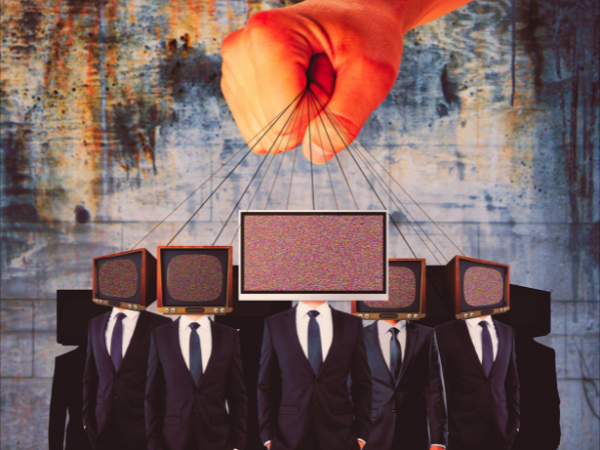
The government wants to play god.

It wants the power to decide who lives or dies and whose rights are worthy of protection.

Abortion may still be front and center in the power struggle between the Left and the Right over who has the right to decide—the government or the individual—when it comes to bodily autonomy, the right to privacy, sexual freedom, the rights of the unborn, and property interests in one’s body, but there’s so much more at play.

In the 50-plus years since the U.S. Supreme Court issued its landmark ruling in Roe v. Wade, the government has come to believe that it not only has the power to determine who is deserving of constitutional rights in the eyes of the law but it also has the authority to deny those rights to an American citizen.

This is how the abortion debate has played into the police state’s hands: by laying the groundwork for discussions about who else may or may not be deserving of rights.

Despite the Supreme Court having overturned its earlier rulings recognizing abortion as a constitutional right under the Fourteenth Amendment, the government continues to play fast and loose with the lives of the citizenry all along the spectrum of life.

Take a good, hard look at the many ways in which Americans are being denied their rights under the Constitution.

American families who have their dogs shot, their homes trashed and their children terrorized or, worse, killed by errant SWAT team raids in the middle of the night are being denied their rights under the Constitution.

Disabled individuals who are being strip searched, handcuffed, arrested and “diagnosed” by police as dangerous or mentally unstable merely because they stutter and walk unevenly are being denied their rights under the Constitution.

School-aged children as young as 4-years-old who are leg shackled, handcuffed and strip searched for violating school zero tolerance policies by chewing a Pop Tart into the shape of a gun and playing an imaginary game of cops and robbers, or engaging in childish behavior such as crying or jumping are being denied their rights under the Constitution.

Unarmed citizens who are tasered or shot by police for daring to hesitate, stutter, move a muscle, flee or disagree in any way with a police order are being denied their rights under the Constitution.

Likewise, Americans—young and old alike—who are shot by police because they pointed a garden hose at a police officer, reached for their registration in their glove box, relied upon a cane to steady themselves, or were seen playing with air rifles or BB guns are being denied their rights under the Constitution.

Female motorists who are unlucky enough to be pulled over for a questionable traffic infraction only to be subjected by police to cavity searches by the side of the road are being denied their rights under the Constitution.

Male pedestrians and motorists alike who are being subjected to roadside strip searches and rectal probes by police based largely on the color of their skin are being denied their rights under the Constitution.

American citizens subjected to government surveillance whereby their phone calls are being listened in on, their mail and text messages read, their movements tracked and their transactions monitored are being denied their rights under the Constitution.

Homeowners who are being fined and arrested for raising chickens in their backyard, allowing the grass in their front yards to grow too long, and holding Bible studies in their homes are being denied their rights under the Constitution.

Decorated military veterans who are being arrested for criticizing the government on social media such as Facebook are being denied their rights under the Constitution.

Homeless individuals who are being harassed, arrested and run out of towns by laws that criminalize homelessness are being denied their rights under the Constitution.

Individuals whose DNA has been forcibly collected and entered into federal and state law enforcement databases whether or not they have been convicted of any crime are being denied their rights under the Constitution.

Drivers whose license plates are being scanned, uploaded to a police database and used to map their movements, whether or not they are suspected of any crime, are being denied their rights under the Constitution. The same goes for drivers who are being ticketed for running afoul of red light cameras without any real opportunity to defend themselves against such a charge are being denied their rights under the Constitution.

Protesters and activists who are being labeled domestic terrorists and extremists and accused of hate crimes for speaking freely are being denied their rights under the Constitution. Likewise, American citizens who being targeted for assassination by drone strikes abroad without having been charged, tried and convicted of treason are being denied their rights under the Constitution.

Hard-working Americans whose bank accounts, homes, cars electronics and cash are seized by police (operating according to asset forfeiture schemes that provide profit incentives for highway robbery) are being denied their rights under the Constitution.

So, what is the common denominator here?

These are all American citizens—endowed by their Creator with certain unalienable rights, rights that no person or government can take away from them, among these the right to life, liberty and the pursuit of happiness—and they are all being oppressed in one way or another by a government that has grown drunk on power, money and its own authority.

If the government—be it the President, Congress, the courts or any federal, state or local agent or agency—can decide that any person has no rights, then that person becomes less than a citizen, less than human, less than deserving of respect, dignity, civility and bodily integrity. He or she becomes an “it,” a faceless number that can be tallied and tracked, a quantifiable mass of cells that can be discarded without conscience, an expendable cost that can be written off without a second thought, or an animal that can be bought, sold, branded, chained, caged, bred, neutered and euthanized at will.

It’s a slippery slope that justifies all manner of violations in the name of national security, the interest of the state and the so-called greater good.

Yet those who founded this country believed that what we conceive of as our rights were given to us by God—we are created equal, according to the nation’s founding document, the Declaration of Independence—and that government cannot create, nor can it extinguish our God-given rights. To do so would be to anoint the government with god-like powers and elevate it above the citizenry.

Unfortunately, we have been dancing with this particular devil for quite some time now.

If we continue to wait for the government to restore our freedoms, respect our rights, rein in its abuses and restrain its agents from riding roughshod over our lives, our liberty and our happiness, then we will be waiting forever.

The highly politicized tug-of-war over abortion will not resolve the problem of a culture that values life based on a sliding scale.  Nor will it help us navigate the moral, ethical and scientific minefields that await us as technology and humanity move ever closer to a point of singularity.

Humanity is being propelled at warp speed into a whole new frontier when it comes to privacy, bodily autonomy, and what it means to be a human being. As such, we haven’t even begun to wrap our heads around how present-day legal debates over bodily autonomy, privacy, vaccine mandates, the death penalty, and abortion play into future discussions about singularity, artificial intelligence, cloning, and the privacy rights of the individual in the face of increasingly invasive, intrusive and unavoidable government technologies.

Yet here is what I know.

Life is an inalienable right.

By allowing the government to decide who or what is deserving of rights, it shifts the entire discussion from one in which we are “endowed by our Creator with certain inalienable rights” (that of life, liberty property and the pursuit of happiness) to one in which only those favored by the government get to enjoy such rights.

If all people are created equal, then all lives should be equally worthy of protection.

Likewise, as I make clear in my book Battlefield America: The War on the American People and in its fictional counterpart The Erik Blair Diaries, all freedoms hang together.

We must never stop working to protect life, preserve our freedoms and maintain some semblance of our humanity.

Freedom cannot be a piece-meal venture.

Source: https://tinyurl.com/3zrj5n8k

ABOUT JOHN W. WHITEHEAD

Constitutional attorney and author John W. Whitehead is founder and president of The Rutherford Institute. His most recent books are the best-selling Battlefield America: The War on the American People, the award-winning A Government of Wolves: The Emerging American Police State, and a debut dystopian fiction novel, The Erik Blair Diaries. Whitehead can be contacted at staff@rutherford.org. Nisha Whitehead is the Executive Director of The Rutherford Institute. Information about The Rutherford Institute is available at www.rutherford.org.

Publication Guidelines / Reprint Permission

John W. Whitehead’s weekly commentaries are available for publication to newspapers and web publications at no charge.