Posts Tagged ‘Border Patrol’

“There are more instances of the abridgment of the freedom of the people by gradual and silent encroachments of those in power than by violent and sudden usurpations.”—James Madison

How far would you really go to secure the nation’s borders in the so-called name of national security?

Would you give the government limitless amounts of money? Surround the entire country with concrete walls and barbed wire? Erect a high-tech, virtual wall of AI-powered surveillance cameras and drones that does a better job of imprisoning those within its boundaries than keeping intruders out? Empower border police to trample on the rights of anyone who crosses their path, including legal citizens?

Relinquish some of your freedoms in exchange for the elusive promise of non-porous borders? Submit to a national ID card that allows the government to target individuals and groups as it chooses in order to identify those who do not “belong”? Turn a blind eye to private prisons and detainment camps that profit off the forced labor of its detainees?

Would you turn your backs on every constitutional principle for which our founders fought and died in exchange for empty campaign promises of elusive safety by fast-talking politicians?

This is the devil’s bargain that the U.S. government demands of its people.

These devilish deals have been foisted upon “we the people” before.

Every decade or so, the government makes the case for expanding its wartime powers and curtailing the citizenry’s freedom—in the war on terrorism, war on drugs, war on communism, war on foreigners, war on extremism, war on dissidents, war on peace activists, war on anti-government speech, etc.—all for the sake of national security, of course, and as expected, the American people fall in line.

Increasingly, the government wants us to buy into the fiction that its war on illegal immigrants is so necessary for national security that we should be grateful when roving bands of border patrol agents, flexing their muscles far beyond the nation’s borders, exercise their right to disregard the Constitution at every turn.

Except these border patrol cops aren’t just disregarding the Constitution.

They’re trampling all over the Constitution, especially the Fourth Amendment, which prohibits the government from carrying out egregious warrantless searches and seizures without probable cause.

As part of the government’s so-called crackdown on illegal immigration, drugs and trafficking, border patrol cops are expanding their reach, roaming further afield and subjecting greater numbers of Americans to warrantless searches, ID checkpoints, transportation checks, and even surveillance on private property far beyond the boundaries of the borderlands.

That so-called border, once a thin borderline, is now an ever-thickening band spreading deeper and deeper inside the country.

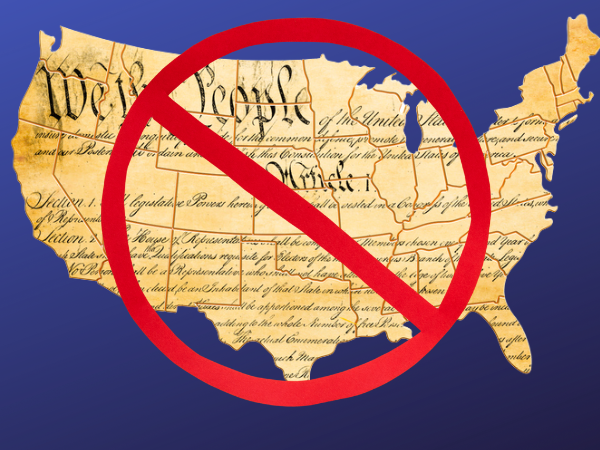
Consequently, nearly 66% of Americans (2/3 of the U.S. population, or 197.4 million people) now live within a 100-mile-deep, Constitution-free zone.

As journalist Todd Miller explains, that expanding border region now extends “100 miles inland around the United States—along the 2,000-mile southern border, the 4,000-mile northern border and both coasts… This ‘border’ region now covers places where two-thirds of the US population (197.4 million people) live… The ‘border’ has by now devoured the full states of Maine and Florida and much of Michigan.”

So much for walking that golden ribbon of highway.

In this authoritarian reshaping of America, you’d better watch where you roam and ramble, because you could find yourself wandering into the government’s ever-expanding, Constitution-free zone where freedom is off-limits and government agents have all the power and “we the people” have none.

Miller continues:

“In these vast domains, Homeland Security authorities can institute roving patrols with broad, extra-constitutional powers backed by national security, immigration enforcement and drug interdiction mandates. There, the Border Patrol can set up traffic checkpoints and fly surveillance drones overhead with high-powered cameras and radar that can track your movements. Within twenty-five miles of the international boundary, CBP [Customs and Border Protection] agents can enter a person’s private property without a warrant.”

These are definitely not Mayberry cops.

The CBP, with its more than 60,000 Customs and Border Protection employees, supplemented by the National Guard and the U.S. military, is an arm of the Department of Homeland Security (DHS), a national police force imbued with all the brutality, ineptitude and corruption such a role implies.

Just about every nefarious deed, tactic or thuggish policy advanced by the government today can be traced back to the DHS, its police state mindset, and the billions of dollars it distributes to local police agencies in the form of grants to transform them into extensions of the military.

As Miller points out, the government has turned the nation’s expanding border regions into “a ripe place to experiment with tearing apart the Constitution, a place where not just undocumented border-crossers, but millions of borderland residents have become the targets of continual surveillance.”

In much the same way that police across the country have been schooled in the art of sidestepping the Constitution, border cops have also been drilled in the art of “anything goes” in the name of national security.

In fact, according to FOIA documents shared with The Interceptborder cops even have a checklist of “possible behaviors” that warrant overriding the Constitution and subjecting individuals—including American citizens—to stops, searches, seizures, interrogations and even arrests.

For instance, if you’re driving a vehicle that to a border cop looks unusual in some way, you can be stopped.

If your passengers look dirty or unusual, you can be stopped.

If you or your passengers avoid looking at a cop, you can be stopped.

If you or your passengers look too long at a cop, you can be stopped.

If you’re anywhere near a border (near being within 100 miles of a border, or in a city, or on a bus, or at an airport), you can be stopped and asked to prove you’re legally allowed to be in the country.

If you’re traveling on a public road that smugglers and other criminals may have traveled, you can be stopped.

If you’re not driving in the same direction as other cars, you can be stopped.

If you appear to be avoiding a police checkpoint, you can be stopped.

If your car appears to be weighed down, you can be stopped.

If your vehicle is from out of town, wherever that might be, you can be stopped.

If you’re driving a make of car that criminal-types have also driven, you can be stopped.

If your car appears to have been altered or modified, you can be stopped.

If the cargo area in your vehicle is covered, you can be stopped.

If you’re driving during a time of day or night that border cops find suspicious, you can be stopped.

If you’re driving when border cops are changing shifts, you can be stopped.

If you’re driving in a motorcade or with another vehicle, you can be stopped.

If your car appears dusty, you can be stopped.

If people with you are trying to avoid being seen, or exhibiting “unusual” behavior, you can be stopped.

If you slow down after seeing a cop, you can be stopped.

Are you starting to get the picture yet?

This isn’t about illegal immigrants and border crossings at all.

It’s a test to see how hard “we the people” will fight to hold onto what remains of our freedoms.

If this is a test, we’re failing abysmally.

Then again, we’ve been failing this particular test for a long time now.

Indeed, as journalist Hayes Brown concludes, the United States has a long, dubious history of putting national security before people’s freedoms.

Certainly, it took no time at all for us to forget Benjamin Franklin’s warning that “Those who would give up essential Liberty, to purchase a little temporary Safety, deserve neither Liberty nor Safety.”

It was 1798 when Americans, their fears stoked by rumblings of a Quasi-War with France, chose safety over liberty when they failed to protest the Alien and Sedition Acts, which criminalized anti-government speech, empowered the government to deport “dangerous” non-citizens and made it harder for immigrants to vote.

During the Civil War, Americans went along when Abraham Lincoln suspended the writ of habeas corpus (the right to a speedy trial) and authorized government officials to spy on Americans’ mail.

During World War I, Americans took it in stride when  President Woodrow Wilson and Congress adopted the Espionage and Sedition Acts, which made it a crime to interfere with the war effort and criminalized any speech critical of war.

By World War II, Americans were marching in lockstep with the government’s expanding war powers to imprison Japanese-American citizens in detainment camps, censor mail, and lay the groundwork for the future surveillance state.

Fast-forward to the Cold War’s Red Scares, the McCarthy era’s hearings on un-American activities, and the government’s surveillance of Civil Rights activists such as Martin Luther King Jr.—all done in the name of national security.

By the time 9/11 rolled around, all George W. Bush had to do was claim the country was being invaded by terrorists, and the government was given greater powers to spy, search, detain and arrest American citizens in order to keep America safe.

The terrorist invasion never really happened, but the government kept its newly acquired police powers made possible by the nefarious USA Patriot Act.

Barack Obama continued Bush’s trend of undermining the Constitution, going so far as to give the military the power to strip Americans of their constitutional rights, label them extremists, and detain them indefinitely without trialall in the name of keeping America safe.

Despite the fact that the breadth of the military’s power to detain American citizens violates not only U.S. law and the Constitution but also international laws, the government has refused to relinquish its detention powers made possible by the National Defense Authorization Act (NDAA).

Then Donald Trump claimed the only way to keep America safe from dangerous immigrants was to build an expensive border wall, expand the reach of border patrol, and empower the military to “assist” with border control.

Now you have Joe Biden sending thousands of active-duty troops to the southern border in order to deal with what they anticipate could be more than 10,000 illegal crossings per day.

It’s a state of affairs perfectly timed to stir up, divide and distract the populace, while expanding the reach of the police state under our noses.

Once the government acquires—and uses—additional powers (to spy on its citizens, to carry out surveillance, to transform its police forces into extensions of the police, to seize taxpayer funds, to wage endless wars, to censor and silence dissidents, to identify potential troublemakers, to detain citizens without due process), it does not voluntarily relinquish them.

It’s time “we the people” put our house in order.

Just look at the mess we’re in right now: political theatrics that keep the populace distracted while the police state clamps down, an economy that is disintegrating before our eyes, a surveillance state that is gearing up for total control, an aging national infrastructure that is falling apart, an appalling lack of leaders with moral backbones and civic knowledge, and a government that grows more authoritarian with every passing day.

The looming problem is not so much that the U.S. is being invaded by hostile forces at the border, but rather that the U.S. Constitution is under assault from within by a power-hungry cabal at the highest levels of power.

As I make clear in my book Battlefield America: The War on the American People and in its fictional counterpart The Erik Blair Diaries, the government is now the greatest threat to our safety, and there’s no border wall big enough to protect us from these ruffians in our midst.

Source: https://bit.ly/3Mfx45k

ABOUT JOHN W. WHITEHEAD

Constitutional attorney and author John W. Whitehead is founder and president of The Rutherford Institute. His most recent books are the best-selling Battlefield America: The War on the American People, the award-winning A Government of Wolves: The Emerging American Police State, and a debut dystopian fiction novel, The Erik Blair Diaries. Whitehead can be contacted at staff@rutherford.org. Nisha Whitehead is the Executive Director of The Rutherford Institute. Information about The Rutherford Institute is available at www.rutherford.org.

Publication Guidelines / Reprint Permission

John W. Whitehead’s weekly commentaries are available for publication to newspapers and web publications at no charge. Please contact staff@rutherford.org to obtain reprint permission.

“The triumph of the S.S. demands that the tortured victim allow himself to be led to the noose without protesting, that he renounce and abandon himself to the point of ceasing to affirm his identity. And it is not for nothing. It is not gratuitously, out of sheer sadism, that the S.S. men desire his defeat. They know that the system which succeeds in destroying its victim before he mounts the scaffold . . . is incomparably the best for keeping a whole people in slavery.”—Hannah Arendt reporting on the trial of Adolf Eichmann

You can’t have it both ways.

You can’t live in a constitutional republic if you allow the government to act like a police state.

You can’t claim to value freedom if you allow the government to operate like a dictatorship.

You can’t expect to have your rights respected if you allow the government to treat whomever it pleases with disrespect and an utter disregard for the rule of law.

If you’re inclined to advance this double standard because you believe you have done nothing wrong and have nothing to hide, beware: there’s always a boomerang effect.

Whatever dangerous practices you allow the government to carry out now—whether it’s in the name of national security or protecting America’s borders or making America great again—rest assured, these same practices can and will be used against you when the government decides to set its sights on you.

Nothing is ever as simple as the government claims it is.

The war on drugs turned out to be a war on the American people, waged with SWAT teams and militarized police.

The war on terror turned out to be a war on the American people, waged with warrantless surveillance and indefinite detention.

The war on immigration will be yet another war on the American people, waged with roving government agents demanding “papers, please.”

So you see, when you talk about empowering government agents to demand identification from anyone they suspect might be an illegal immigrant—the current scheme being entertained by the Trump administration to ferret out and cleanse the country of illegal immigrants—what you’re really talking about is creating a society in which you are required to identify yourself to any government worker who demands it.

Just recently, in fact, passengers arriving in New York’s JFK Airport on a domestic flight from San Francisco were ordered to show their “documents” to border patrol agents in order to get off the plane.

This is how you pave the way for a national identification system.

Americans have always resisted adopting a national ID card for good reason: it gives the government and its agents the ultimate power to target, track and terrorize the populace according to the government’s own nefarious purposes.

National ID card systems have been used before, by other oppressive governments, in the name of national security, invariably with horrifying results.

For instance, in Germany, the Nazis required all Jews to carry special stamped ID cards for travel within the country. A prelude to the yellow Star of David badges, these stamped cards were instrumental in identifying Jews for deportation to death camps in Poland.

Author Raul Hilberg summarizes the impact that such a system had on the Jews:

The whole identification system, with its personal documents, specially assigned names, and conspicuous tagging in public, was a powerful weapon in the hands of the police. First, the system was an auxiliary device that facilitated the enforcement of residence and movement restrictions. Second, it was an independent control measure in that it enabled the police to pick up any Jew, anywhere, anytime. Third, and perhaps most important, identification had a paralyzing effect on its victims.

In South Africa during apartheid, pass books were used to regulate the movement of black citizens and segregate the population. The Pass Laws Act of 1952 stipulated where, when and for how long a black African could remain in certain areas. Any government employee could strike out entries, which cancelled the permission to remain in an area. A pass book that did not have a valid entry resulted in the arrest and imprisonment of the bearer.

Identity cards played a crucial role in the genocide of the Tutsis in the central African country of Rwanda. The assault, carried out by extremist Hutu militia groups, lasted around 100 days and resulted in close to a million deaths. While the ID cards were not a precondition to the genocide, they were a facilitating factor. Once the genocide began, the production of an identity card with the designation “Tutsi” spelled a death sentence at any roadblock.

Identity cards have also helped oppressive regimes carry out eliminationist policies such as mass expulsion, forced relocation and group denationalization. Through the use of identity cards, Ethiopian authorities were able to identify people with Eritrean affiliation during the mass expulsion of 1998. The Vietnamese government was able to locate ethnic Chinese more easily during their 1978-79 expulsion. The USSR used identity cards to force the relocation of ethnic Koreans (1937), Volga Germans (1941), Kamyks and Karachai (1943), Crimean Tartars, Meshkhetian Turks, Chechens, Ingush and Balkars (1944) and ethnic Greeks (1949). And ethnic Vietnamese were identified for group denationalization through identity cards in Cambodia in 1993, as were the Kurds in Syria in 1962.

And in the United States, post-9/11, more than 750 Muslim men were rounded up on the basis of their religion and ethnicity and detained for up to eight months. Their experiences echo those of 120,000 Japanese-Americans who were similarly detained 75 years ago following the attack on Pearl Harbor.

Despite a belated apology and monetary issuance by the U.S. government, the U.S. Supreme Court has yet to declare such a practice illegal. Moreover, laws such as the National Defense Authorization Act (NDAA) empower the government to arrest and detain indefinitely anyone they “suspect” of being an enemy of the state.

Fast forward to the Trump administration’s war on illegal immigration, and you have the perfect storm necessary for the adoption of a national ID card, the ultimate human tracking device, which would make the police state’s task of monitoring, tracking and singling out individual suspects—citizen and noncitizen alike—far simpler.

Granted, in the absence of a national ID card, “we the people” are already tracked in a myriad of ways: through our state driver’s licenses, Social Security numbers, bank accounts, purchases and electronic transactions; by way of our correspondence and communication devices—email, phone calls and mobile phones; through chips implanted in our vehicles, identification documents, even our clothing.

Add to this the fact that businesses, schools and other facilities are relying more and more on fingerprints and facial recognition to identify us. All the while, data companies such as Acxiom are capturing vast caches of personal information to help airports, retailers, police and other government authorities instantly determine whether someone is the person he or she claims to be.

This informational glut—used to great advantage by both the government and corporate sectors—is converging into a mandate for “an internal passport,” a.k.a., a national ID card that would store information as basic as a person’s name, birth date and place of birth, as well as private information, including a Social Security number, fingerprint, retina scan and personal, criminal and financial records.

The Real ID Act, which imposes federal standards on identity documents such as state drivers’ licenses, is the prelude to this national identification system. Individuals from states that fail to comply with the Real ID Act (there are nine states still not in compliance) will be unable to use their drivers’ licenses as forms of identification in airports starting in January 2018).

A federalized, computerized, cross-referenced, databased system of identification policed by government agents would be the final nail in the coffin for privacy (not to mention a logistical security nightmare that would leave Americans even more vulnerable to every hacker in the cybersphere).

So what is privacy?

In its purest sense, privacy means the right to walk down a street without fear of being accosted by a government agent demanding to know who you are, where you’re going and what you’re doing in that particular place at that particular moment in time.

Privacy means you have the right to tell any government agent who pokes his nose too far into your business to butt out.

Privacy means the right to remain anonymous, if you so choose.

Unfortunately, in an age of constant surveillance, in which we are constantly watched and our movements monitored and tracked—by our technology, by the government, by the corporations, and through our own obsession with social media and smart devices—the case for privacy is no longer quite so clear-cut.

Likewise, the penalty for telling the government to stick it (or mind its own business) is growing more severe with every passing day.

Noncompliance with a direct government order—whether that order is to show your papers, step out of a car, exit your house with your hands up, or bend over and submit to being searched, fondled or frisked—can now result in missed flights, broken bones and dead bodies.

Remember, the police state does not discriminate.

At some point, it will not matter whether your skin is black or yellow or brown or white. It will not matter whether you’re an immigrant or a citizen. It will not matter whether you’re rich or poor. It won’t even matter whether you’re driving, flying or walking.

After all, government-issued bullets will kill you just as easily whether you’re a law-abiding citizen or a hardened criminal. Government jails will hold you just as easily whether you’ve obeyed every law or broken a dozen. And whether or not you’ve done anything wrong, government agents will treat you like a suspect simply because they have been trained to view and treat everyone like potential criminals.

Eventually, when the police state has turned that final screw and slammed that final door, all that will matter is whether some government agent—poorly trained, utterly ignorant of the Constitution, way too hyped up on the power of their badges, and authorized to detain, search, interrogate, threaten and generally harass anyone they see fit—chooses to single you out for special treatment.

You see, it’s a short hop, skip and a jump from allowing government agents to stop and demand identification from someone suspected of being an illegal immigrant to empowering government agents to subject anyone—citizen and noncitizen alike—to increasingly intrusive demands that they prove not only that they are legally in the country, but that they are also lawful, in compliance with every statute and regulation on the books, and not suspected of having committed some crime or other.

It’s no longer a matter of if, but when.

You may be innocent of wrongdoing now, but when the standard for innocence is set by the government, no one is safe. Everyone is a suspect. And anyone can be a criminal when it’s the government determining what is a crime.

We’ve been having this same debate about the perils of government overreach for the past 50-plus years, and still we don’t seem to learn, or if we learn, we learn too late.

All of the excessive, abusive tactics employed by the government today—warrantless surveillance, stop and frisk searches, SWAT team raids, roadside strip searches, asset forfeiture schemes, private prisons, torture, indefinite detention, militarized police, etc.—started out as a seemingly well-meaning plan to address some problem in society that needed a little extra help.

Be careful what you wish for: you will get more than you bargained for, especially when the government’s involved.

In the case of a national identification system, it might start off as a means of curtailing illegal immigration, but it will end up as a means of controlling the American people.

Taking a prophetic cue from George Orwell’s 1984, a 2013 video game Papers, Please “puts players in control of an unnamed border agent in the fictional Eastern Bloc totalitarian state of Arstotzka in 1982.”
As journalist Jason Concepcion explains, “The rules are simple: Decide who can enter the country. This is accomplished by checking each traveler’s documents — passports, visas, work permits — for authenticity and cross-referencing with various guidelines handed down by the state. The state’s instructions are initially simple. Those holding Arstotzkan passports — assuming the information contained therein matches the person at the window — are considered citizens and may cross the border. Take out your green ACCEPTED stamp, mark the appropriate box on the entry visa, hand the owner back his or her documents, and call the next person in line.”

Where things start to get dicey is when the stakes get higher, when there’s money to be made, when there are lives on the line.

Concepcion continues:

As the game progresses, the restrictions on immigration become more complex. A trade war with a neighboring country causes the Ministry of Admission to ban travelers from the nation. Rumors of insurgent groups with forged documents mean every seal and stamp in an entry visa must be double-checked against those in your handbook. If a traveler is heavier than the weight indicated in their passport, then they must be questioned and X-rayed for contraband. Faces are checked against the state’s most-wanted list. Perhaps a prospective immigrant doesn’t resemble the photograph in their documents, in which case fingerprints must be taken and processed. With each passing day, there are more details to check. Some travelers don’t have the correct work visa, or have papers that would have been valid yesterday. These must be scrutinized closely.

Around day two or three on the job, one of the soldiers who guards the checkpoint steps to your window. He tells you he gets a bonus for each person processed for detention. He offers to cut you in. Criminals — sometimes even terrorists — attempt to pass through the Grestin checkpoint. But this is rare. Immigrants who haven’t kept abreast of the constant changes in state policy are much more common. Every now and again, a traveler comes to your booth with a heartrending story — a dying loved one, children they’ve never seen — but the wrong documentation. You could, easily and legally, hand a few of these people over to the guards and make a few bucks on the side.

This is what the banality of evil looks like, as described by historian Hannah Arendt.

Arendt explains: “The essence of totalitarian government, and perhaps the nature of every bureaucracy, is to make functionaries and mere cogs in the administrative machinery out of men, and thus to dehumanize them.”

How do you persuade people to just follow orders and carry out the dictates of a police state?

You turn them into mindless robots. You teach them to obey unquestioningly. You brainwash them into believing that compliance and patriotism go hand in hand.

As Concepcion concludes, “Papers, Please gives players a window into how fascism manifests itself in bureaucracy. The brilliance of the game’s paperwork gameplay is that it makes the player complicit in the projection of state power… ‘What I found making this game,’ [designer Lucas Pope explained], ‘is that this communist setting or this dystopian, fascist setting works nicely for game mechanics because you can tell the player, ‘you have to do this.’ There’s not a whole lot of questioning of, ‘why?’ ‘You have to do it because that’s how we … run things here, we tell you how to do it and you do it.’ That works perfectly well with the setting of some kind of communist government or some kind of bureaucracy where the rules just come down from the top and boom, that’s your job.’”

Boom. That’s your job.

That about sums things up, doesn’t it?

Battlefield_Cover_300Yet as I make clear in my book Battlefield America: The War on the American People, it’s not just the border patrol agents or the police or the prison guards who are marching in lockstep with the regime. It’s also the populace that obeys every order, that fails to question or resist or push back against government dictates that are unjust or unconstitutional or immoral.

We have been down this road before.

Reporting on the trial of Nazi bureaucrat Adolf Eichmann for the New Yorker in 1963, Hannah Arendt describes the “submissive meekness with which Jews went to their death”:

arriving on time at the transportation points, walking under their own power to the places of execution, digging their own graves, undressing and making neat piles of their clothing, and lying down side by side to be shot—seemed a telling point, and the prosecutor, asking witness after witness, “Why did you not protest?,” “Why did you board the train?,” “Fifteen thousand people were standing there and hundreds of guards facing you—why didn’t you revolt and charge and attack these guards?,” harped on it for all it was worth. But the sad truth of the matter is that the point was ill taken, for no non-Jewish group or non-Jewish people had behaved differently.

The lessons of history are clear: chained, shackled and imprisoned in a detention camp, there is little chance of resistance. The time to act is now, before it’s too late. Indeed, there is power in numbers, but if those numbers will not unite and rise up against their oppressors, there can be no resistance.

As Arendt concludes, “under conditions of terror most people will comply but some people will not, just as the lesson of the countries to which the Final Solution was proposed is that ‘it could happen’ in most places but it did not happen everywhere.”

It does not have to happen here.

We do not have to condemn ourselves to life under an oppressive, authoritarian regime.

We do not have to become our own jailers.

We do not have to dig our own graves.

We do not have to submit.

WC: 2982

ABOUT JOHN W. WHITEHEAD

Constitutional attorney and author John W. Whitehead is founder and president of The Rutherford Institute. His new book Battlefield America: The War on the American People (SelectBooks, 2015) is available online at http://www.amazon.com. Whitehead can be contacted at johnw@rutherford.org.

PUBLICATION GUIDELINES / REPRINT PERMISSION

John W. Whitehead’s weekly commentaries are available for publication to newspapers and web publications at no charge. Please contact staff@rutherford.org to obtain reprint permission.