RICHMOND, Va. — Attorneys for The Rutherford Institute have filed a brief with the Fourth Circuit Court of Appeals, asking the court to reject the claims of a Chesterfield County mental health screener that he was not responsible or liable for the seizure and week-long detention in a psychiatric ward of a decorated Marine by a swarm of Secret Service and FBI agents and local police because of controversial song lyrics and political views posted on his Facebook page. In asking the Court of Appeals to reinstate the lawsuit, which was dismissed in February 2014 by a federal judge who termed its concerns over government censorship as “far-fetched,” Institute attorneys argue that Brandon Raub’s seizure and detention were the result of a mental health screener’s dislike of Raub’s “unpatriotic” views on federal government misconduct, thereby violating the ex-Marine’s First Amendment right to freedom of speech.

“As various free speech cases working their way through the courts right now make clear, the government, a master in the art of intrusion, surveillance and criminalizing harmless activities, is continuing to clamp down on First Amendment activity on the web and in social media under the various guises of fighting terrorism, discouraging cyberbullying, and combatting violence,” said John W. Whitehead, president of The Rutherford Institute and author of A Government of Wolves: The Emerging American Police State. “For the 1.31 billion individuals who use Facebook and the 255 million who tweet their personal and political views on Twitter, these cases will determine where the government can draw the line when it comes to expressive speech that is protected and permissible versus speech that could be interpreted as connoting a criminal intent.”

On Aug.16, 2012, Chesterfield police, Secret Service and FBI agents arrived at Brandon Raub’s home, asking to speak with him about his Facebook posts. Like many Facebook users, Raub, a Marine who has served tours in Iraq and Afghanistan, uses his Facebook page to post song lyrics and air his political opinions. Without providing any explanation, levying any charges against Raub or reading him his rights, law enforcement officials handcuffed Raub and transported him to police headquarters, then to John Randolph Medical Center, where he was held against his will. In a hearing on Aug. 20, government officials pointed to Raub’s Facebook posts as the reason for his incarceration. A Special Justice subsequently ordered that Raub be held up to 30 more days for psychological evaluation and treatment.

In coming to Raub’s aid, Rutherford Institute attorneys challenged the government’s actions as a violation of Raub’s First and Fourth Amendment rights. On Aug. 23, Circuit Court Judge Allan Sharrett ordered Raub’s immediate release, stating that the government’s case was “so devoid of any factual allegations that it could not be reasonably expected to give rise to a case or controversy.” Rutherford Institute attorneys filed a lawsuit in May 2013 on behalf of Raub in the U.S. District Court for the Eastern District of Virginia challenging the government’s actions as procedurally improper, legally unjustified, and in violation of Raub’s First Amendment rights. In February 2014, a U.S. District Court judge dismissed the lawsuit, rejecting concerns over government suppression of dissident speech as “far-fetched.”

Attorneys Anthony Troy and Charles A. Zdebski of Eckert Seamens Cherin & Mellott, LLC, and William H. Hurd and Stephen C. Piepgrass of Troutman Sanders, LLP in Richmond are assisting The Rutherford Institute by representing Brandon Raub.

“Let your motto be resistance! resistance! Resistance! No oppressed people have ever secured their liberty without resistance.”—Abolitionist Henry Highland Garnet

The perils of resisting the police state grow more costly with each passing day, especially if you hope to escape with your life and property intact. The thing you must remember is that we’ve entered an age of militarized police in which we’re no longer viewed as civilians but as enemy combatants.

Take, for example, Mary Elizabeth VandenBerg who was charged with disturbing the peace, a crime punishable by up to 93 days in jail and a $500 fine, for daring to vocalize her frustrations over a traffic ticket by reading a prepared statement to the court clerk and paying her $145 traffic ticket with 145 one-dollar bills. VandenBerg was also handcuffed, tasered and pepper sprayed for “passively” resisting police by repeatedly stopping and talking to them and stiffening her arms. The incident, filmed by VandenBerg’s brother, is now the subject of a lawsuit.

Zachary Noel was tasered by police and charged with resisting arrest after he questioned why he was being ordered out of his truck during a traffic stop. “Because I’m telling you to,” the officer replied before repeating his order for Noel to get out of the vehicle and then, without warning, shooting him with a taser through the open window. The encounter, recorded with a cell phone by Noel’s friend in the passenger seat, offers a particularly chilling affirmation of how little recourse Americans really have when it comes to obeying an order from a government official or police officer, even if it’s just to ask a question or assert one’s rights.

Eighteen-year-old Keivon Young was shot seven times by police from behind while urinating outdoors. Young was just zipping up his pants when he heard a commotion behind him and then found himself struck by a hail of bullets from two undercover cops. Despite the fact that the officers mistook Young—5’4,” 135 lbs., and guilty of nothing more than taking a leak outdoors—for a 6’ tall, 200 lb. murder suspect whom they later apprehended, the young man was charged with felony resisting arrest and two counts of assaulting a peace officer.

What these incidents make clear is that anything short of compliance will now get you charged with any of the growing number of contempt charges (ranging from resisting arrest and interference to disorderly conduct, obstruction, and failure to obey a police order) that get trotted out anytime a citizen voices discontent with the government or challenges or even questions the authority of the powers that be—and that’s the best case scenario. The worst case scenario involves getting probed, poked, pinched, tasered, tackled, searched, seized, stripped, manhandled, arrested, shot, or killed.

So what can you really do when you find yourself at the mercy of law enforcement officers who have almost absolute discretion to decide who is a threat, what constitutes resistance, and how harshly they can deal with the citizens they were appointed to “serve and protect”? In other words, what are the rules of engagement when it comes to interacting with the police?

If you want to play it safe, comply and do whatever a police officer tells you to do. Don’t talk back. Don’t threaten. And don’t walk away. In other words, don’t do anything that even hints at resistance.

Keep in mind, however, that this is not a fail-safe plan, especially not in an age where police officers tend to shoot first and ask questions later, oftentimes based only on their highly subjective “feeling” of being threatened, and are reprimanded with little more than a slap on the wrist. Indeed, the news is riddled with reports of individuals who didn’t resist when confronted by police and still got tasered, tackled or shot simply because they looked at police in a threatening manner or moved in a way that made an officer fear for his safety.

For example, Levar Edward Jones was shot by a South Carolina police officer during a routine traffic stop over a seatbelt violation as he was in the process of reaching for his license and registration. The trooper justified his shooting of the unarmed man by insisting that Jones reached for his license “aggressively.”

If compliance isn’t quite your cup of tea—and we’d be far better off as a nation if we were far less compliant—then you’ve got a few more options ranging from legal-but-sure-to-annoy-an-officer to legal-but-it-could-get-you-arrested to legal-but-it-could-get-you-shot.

If this is war—and a good case could be made for the fact that the government is indeed waging a war on the American citizenry—then the tactics I’m about to outline could be considered nonviolent guerilla warfare, using whatever strategic, legal, creative and nonviolent means are available in order to outmaneuver an opponent—in our case, the American police force—whose language is the language of force.

To begin with, and most importantly, Americans need to know their rights when it comes to interactions with the police, bearing in mind that many law enforcement officials are largely ignorant of the law themselves. In a nutshell, here are your basic rights when it comes to interactions with the police as outlined in the first ten amendments to the U.S. Constitution:

You have the right under the First Amendment to ask questions and express yourself. You have the right under the Fourth Amendment to not have your person or your property searched by police or any government agent unless they have a search warrant authorizing them to do so.  You have the right under the Fifth Amendment to remain silent and not incriminate yourself.

You have the right under the Sixth Amendment to request an attorney. Depending on which state you live in and whether your encounter with police is consensual as opposed to your being temporarily detained or arrested, you may have the right to refuse to identify yourself. Presently, 26 states do not require citizens to show their ID to an officer (drivers in all states must do so, however).

Knowing your rights is only part of the battle, unfortunately. The hard part comes in when you have to exercise those rights in order to hold government officials accountable to respecting those rights.

As a rule of thumb, you should always be sure to clarify in any police encounter whether or not you are being detained, i.e., whether you have the right to walk away. That holds true whether it’s a casual “show your ID” request on a boardwalk, a stop-and-frisk search on a city street, or a traffic stop for speeding or just to check your insurance.

As I point out in my book A Government of Wolves: The Emerging American Police State, if you feel like you can’t walk away from a police encounter of your own volition—and more often than not you can’t, especially when you’re being confronted by someone armed to the hilt with all manner of militarized weaponry and gear—then for all intents and purposes, you’re essentially under arrest from the moment a cop stops you.

Still, it doesn’t hurt to clarify that distinction, as Kahler Nygard learned. Nygard was threatened with arrest for failing to comply with an order by TSA agents to undergo additional screening after flying with no incident from Minneapolis to his final destination in Denver. It turns out that Nygard, at one time a vocal critic of the government, had been placed on a special list requiring him to undergo extra airport screening. When airport officials realized that they had failed to carry out the additional screening prior to Nygard’s departure, they attempted to cover their mistake by screening him once he landed. To the annoyance of the government agent, Nygard—who filmed the entire encounter—repeatedly asked the agent whether he was being detained or not. Once he deduced that the TSA had no legal rationale for detaining him, Nygard walked away without incident. The encounter might have ended far differently had a police officer been standing nearby, however.

Another important takeaway from Nygard’s experience is to record your encounter with police. While technology is always going to be a double-edged sword, with the gadgets that are the most useful to us in our daily lives—GPS devices, cell phones, the internet—being the very tools used by the government to track us, monitor our activities, and generally spy on us, cell phones are particularly useful for recording encounters with the police and have proven to be increasingly powerful reminders to police that they are not all powerful.

No matter what individual police officers might say to the contrary, members of the public have a First Amendment right to record police interactions, as the Justice Department recognized in a 2012 memorandum acknowledging that “recording governmental officers engaged in public duties is a form of speech through which private individuals may gather and disseminate information of public concern, including the conduct of law enforcement officers.”

That said, there may still be consequences for filming the police, as Fred Marlow learned the hard way. Marlow was charged with interfering and resisting arrest, and fined $5,000 for daring to film a SWAT team raid that took place across the street from his apartment. Marlow was asleep when he heard what sounded like “multiple bombs blasting and glass breaking.” Rushing outside to investigate, Marlow filmed police officers dressed in army green camouflage standing beside an armored vehicle, in the process of carrying out a SWAT team raid to serve a search warrant (more than 80,000 such raids take place every year in the U.S. for such routine police procedures as serving search warrants). Ordered to return inside or face arrest for interference, Marlow explained that he was on his own property and could be outside. He was subsequently arrested.

One popular alternative to citizens filming police encounters is having the police wear body cameras, which have been proven to decrease the number of use-of-force incidents and citizen complaints when used properly. Unfortunately, given that they can be turned off as easily as they are turned on, these devices are also ripe for abuse, not to mention the fact that they are privacy-threatening, roving extensions of the surveillance state whose cameras are conveniently pointed at us, not them.

Clearly, the language of freedom is no longer the common tongue spoken by the citizenry and their government. With the government having shifted into a language of force, “we the people” have been reduced to suspects in a surveillance state, criminals in a police state, and enemy combatants in a military empire.

In such an environment, as every resistor from Martin Luther King Jr. and on down the line has learned, there is always a price to be paid for challenging the status quo. Then again, the price for not challenging the status quo is even worse: outright tyranny, the loss of our freedoms, and a totalitarian regime the likes of which the world has never seen before.

WASHINGTON, D.C. — Challenging efforts by the Obama administration to target whistleblowers acting in the interest of public safety, The Rutherford Institute has asked the U.S. Supreme Court to reject the federal government’s attempts to eviscerate protections for employee speech under the Whistleblower Protection Act. The case involves a federal air marshal Robert J. MacLean who claims he was improperly fired by the Transportation Security Administration after he leaked to the media a plan by the TSA to remove air marshals from long distance flights as a cost-savings measure. MacLean’s disclosure came on the heels of a briefing by his supervisors about a potential terrorist attack. As a result of the ensuing public outcry, the Department of Homeland Security canceled the order to withdraw air marshals from long distance flights within 24 hours. MacLean was eventually fired for acting as a whistleblower. In filing an amicus curiae brief in Department of Homeland Security v. MacLean, Rutherford Institute attorneys argue that government agencies should not have the power to unilaterally determine what kind of information federal employees are forbidden from disclosing, asserting that this would further tip the balance toward agencies, allowing them to exploit their rulemaking powers to target legitimate whistleblowers acting in the interest of public safety.

The Rutherford Institute’s amicus brief in DHS v. MacLean is available at www.rutherford.org.

“Ironically, while the Department of Homeland Security continues to push its ‘See Something, Say Something’ campaign urging Americans to report suspicious behavior to the police, call it in to a government hotline, or report it using a convenient app on their smart phone, the government doesn’t take kindly to having its dirty deeds publicized and, God forbid, being made to account for them,” said John W. Whitehead, president of The Rutherford Institute and author of A Government of Wolves: The Emerging American Police State. “Unfortunately, this is par for the course for the Obama administration, whose actions, ranging from its reliance on secret courts, secret laws and secret surveillance in order to sidestep the rule of law to its relentless pursuit of whistleblowers, fly in the face of its claims of transparency.”

Having formerly served in the U.S. Air Force and as a border patrol agent, Robert J. MacLean volunteered to serve as an air marshal in the wake of the September 11 attacks. Air marshals are federal law enforcement agents who travel undercover aboard commercial airliners. In July 2003, MacLean and other air marshals were briefed about a specific and imminent terrorist threat to long-distance flights. Despite the warning, less than three days later, MacLean and other air marshals received a text message from their superiors cancelling all overnight missions, thereby removing air marshals from long-distance flights. Believing the text message to be a mistake, MacLean contacted his superiors who confirmed the message and told MacLean this was being done to save money on overnight hotels, overtime and other travel allowances. After failed attempts to raise his concerns with independent investigators, MacLean alerted an MSNBC reporter to the government’s plan to remove air marshals from many flights. The news report aired without identifying MacLean. The story produced outrage in Congress, and the DHS soon rescinded its order. MacLean’s role as a whistleblower was revealed three years later, at which time, the TSA fired him for disclosing “sensitive security information” (SSI). Although the text message removing air marshals from long distance flights was not classified as SSI when it was sent, the DHS issued an order classifying it as SSI retroactively. The U.S. Court of Appeals for the Federal Circuit sided with MacLean, ruling that he was entitled to argue that he was protected by whistleblower laws after he was fired by the TSA in 2006. However, lawyers for the Obama administration are disputing that ruling, claiming that it “effectively permits individual federal employees to override the TSA’s judgments about the dangers of public disclosure.”

“For every 10 women rescued, there are 50 to 100 more women are brought in by the traffickers. Unfortunately, they’re not 18- or 20-year-olds anymore. They’re minors as young as 13 who are being trafficked. They’re little girls.”—25-year-old victim of trafficking

“Children are being targeted and sold for sex in America every day.”—John Ryan, National Center for Missing & Exploited Children

The mysterious disappearance of 18-year-old Hannah Graham on September 13, 2014, has become easy fodder for the media at a time when the news cycle is lagging. After all, how does a young woman just vanish without a trace, in the middle of the night, in a town that is routinely lauded for being the happiest place in America, not to mention one of the most beautiful?

Yet Graham is not the first girl to vanish in America without a trace—my hometown of Charlottesville, Va., has had five women go missing over the span of five years—and it is doubtful she will be the last. I say doubtful because America is in the grip of a highly profitable, highly organized and highly sophisticated sex trafficking business that operates in towns large and small, raking in upwards of $9.5 billion a year in the U.S. alone by abducting and selling young girls for sex.

It is estimated that there are 100,000 to 150,000 under-aged sex workers in the U.S. The average age of girls who enter into street prostitution is between 12 and 14 years old, with some as young as 9 years old. This doesn’t include those who entered the “trade” as minors and have since come of age. Rarely do these girls enter into prostitution voluntarily. As one rescue organization estimated, an underaged prostitute might be raped by 6,000 men during a five-year period of servitude.

This is America’s dirty little secret.

You don’t hear much about domestic sex trafficking from the media or government officials, and yet it infects suburbs, cities and towns across the nation. According to the FBI, sex trafficking is the fastest growing business in organized crime, the second most-lucrative commodity traded illegally after drugs and guns. It’s an industry that revolves around cheap sex on the fly, with young girls and women who are sold to 50 men each day for $25 apiece, while their handlers make $150,000 to $200,000 per child each year.

In order to avoid detection by police and cater to male buyers’ demand for sex with different women, pimps and the gangs and crime syndicates they work for have turned sex trafficking into a highly mobile enterprise, with trafficked girls, boys and women constantly being moved from city to city, state to state, and country to country. The Baltimore-Washington area, referred to as The Circuit, with its I-95 corridor dotted with rest stops, bus stations and truck stops, is a hub for the sex trade.
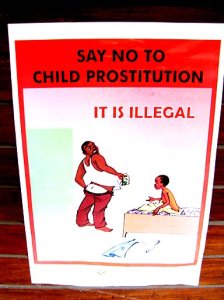
"SAY NO TO CHILD PROSTITUTION: IT IS ILLEGAL" Awareness Poster

Photo via Felix Krohn/Flickr

With a growing demand for sexual slavery and an endless supply of girls and women who can be targeted for abduction, this is not a problem that’s going away anytime soon. Young girls are particularly vulnerable, with 13 being the average age of those being trafficked. Yet as the head of a group that combats trafficking pointed out, “Let’s think about what average means. That means there are children younger than 13. That means 8-, 9-, 10-year-olds.”

Consider this: every two minutes, a child is exploited in the sex industry. In Georgia alone, it is estimated that 7,200 men (half of them in their 30s) seek to purchase sex with adolescent girls each month, averaging roughly 300 a day. It is estimated that at least 100,000 children—girls and boys—are bought and sold for sex in the U.S. every year, with as many as 300,000 children in danger of being trafficked each year. Some of these children are forcefully abducted, others are runaways, and still others are sold into the system by relatives and acquaintances.

As one news center reported, “Finding girls is easy for pimps. They look on MySpace, Facebook, and other social networks. They and their assistants cruise malls, high schools and middle schools. They pick them up at bus stops. On the trolley. Girl-to-girl recruitment sometimes happens.” Foster homes and youth shelters have also become prime targets for traffickers.

With such numbers, why don’t we hear more about this? Especially if, as Ernie Allen of the National Center for Missing and Exploited Children insists, “this is not a problem that only happens in New York and Los Angeles and San Francisco. This happens in smaller communities. The only way not to find this in any American city is simply not to look for it.”

Unfortunately, Americans have become good at turning away from things that make us uncomfortable or stray too far from our picture-perfect images of ourselves. In this regard, we’re all complicit in contributing to this growing evil which, for all intents and purposes, is out in the open: advertising on the internet, commuting on the interstate, operating in swanky hotels, taking advantage of a system in which the police, the courts and the legislatures are more interested with fattening their coffers by targeting Americans for petty violations than actually breaking up crime syndicates.

Writing for the Herald-Tribune, reporter J. David McSwane has put together one of the most chilling and insightful investigative reports into sex trafficking in America. “The Stolen Ones” should be mandatory reading for every American, especially those who still believe it can’t happen in their communities or to their children because it’s mainly a concern for lower income communities or immigrants.

As McSwane makes clear, no community is safe from this danger, and yet very little is being done to combat it. Indeed, although police agencies across the country receive billions of dollars’ worth of military equipment, weapons and training that keeps them busy fighting a losing battle against marijuana, among other less pressing concerns, very little time and money is being invested in the fight against sex trafficking except for the FBI’s annual sex trafficking sting, which inevitably makes national headlines for the numbers of missing girls recovered.

For those trafficked, it’s a nightmare from beginning to end. Those being sold for sex have an average life expectancy of seven years, and those years are a living nightmare of endless rape, forced drugging, humiliation, degradation, threats, disease, pregnancies, abortions, miscarriages, torture, pain, and always the constant fear of being killed or, worse, having those you love hurt or killed. A common thread woven through most survivors’ experiences is being forced to go without sleep or food until they have met their sex quota of at least 40 men. One woman recounts how her trafficker made her lie face down on the floor when she was pregnant and then literally jumped on her back, forcing her to miscarry.

Holly Austin Smith was abducted when she was 14 years old, raped, and then forced to prostitute herself. Her pimp, when brought to trial, was only made to serve a year in prison. Barbara Amaya was repeatedly sold between traffickers, abused, shot, stabbed, raped, kidnapped, trafficked, beaten, and jailed all before she was 18 years old. “I had a quota that I was supposed to fill every night. And if I didn’t have that amount of money, I would get beat, thrown down the stairs. He beat me once with wire coat hangers, the kind you hang up clothes, he straightened it out and my whole back was bleeding.”

As McSwane recounts: “In Oakland Park, an industrial Fort Lauderdale suburb, federal agents in 2011 encountered a brothel operated by a married couple. Inside ‘The Boom Boom Room,’ as it was known,  customers paid a fee and were given a condom and a timer and left alone with one of the brothel’s eight teenagers, children as young as 13. A 16-year-old foster child testified that he acted as security, while a 17-year-old girl told a federal judge she was forced to have sex with as many as 20 men a night.”

One particular sex trafficking ring that was busted earlier in 2014 caters specifically to migrant workers employed seasonally on farms throughout the southeastern states, especially the Carolinas and Georgia, although it’s a flourishing business in every state in the country. Traffickers transport the women from farm to farm, where migrant workers would line up outside shacks, as many as 30 at a time, to have sex with them before they were transported to yet another farm where the process would begin all over again.

What can you do?

Call on your city councils, elected officials and police departments to make the battle against sex trafficking a top priority, more so even than the so-called war on terror and drugs and the militarization of law enforcement.

Insist that law enforcement agencies in the country at all levels, local, state and federal, funnel their resources into fighting the crime of sex trafficking. Stop prosecuting adults for victimless “crimes” such as growing lettuce in their front yard and focus on putting away the pimps and buyers who victimize these young women.

Educate yourselves and your children about this growing menace in our communities. The future of America is at stake. As YouthSpark, a group that advocates for young people points out, sex trafficking is part of a larger continuum in America that runs the gamut from homelessness, poverty, and self-esteem issues to sexualized television, the glorification of a pimp/ho culture—what is often referred to as the pornification of America—and a billion dollar sex industry built on the back of pornography, music, entertainment, etc.

Stop feeding the monster. This epidemic is largely one of our own making, especially in a corporate age where the value placed on human life takes a backseat to profit. The U.S. is a huge consumer of trafficked “goods,” with national sporting events such as the Super Bowl serving as backdrops for the sex industry’s most lucrative seasons. Each year, for instance, the Super Bowl serves as a “windfall” for sex traffickers selling minors as young as 13 years old. As one sex trafficking survivor explained, “They’re coming to the Super Bowl not even to watch football. They’re coming to the Super Bowl to have sex with women and/or men or children.”

Finally, as the Abell Foundation’s report on trafficking advises: the police need to do a better job of training on, identifying and responding to these issues; communities and social services need to do a better job of protecting runaways, who are the primary targets of traffickers; legislators need to pass legislation aimed at prosecuting traffickers and “johns,” the buyers who drive the demand for sex slaves; hotels need to stop enabling these traffickers, by providing them with rooms and cover for their dirty deeds; and “we the people” need to stop hiding our heads in the sand and acting as if there are other matters more pressing. A Government of Wolves book cover

Those concerned about the police state in America, which I document in my book A Government of Wolves: The Emerging American Police State, should be equally concerned about the sex trafficking trade in America. It is only made possible by the police state’s complicity in turning average Americans into suspects for minor violations while letting the real criminals wreak havoc on our communities. No doubt about it, these are two sides of the same coin.

During his tenure, Attorney General Eric Holder has carried on the sorry tradition of his predecessors by aiding and abetting the Executive Branch in skirting and, more often than not, flouting the law altogether, justifying all manner of civil liberties and human rights violations and trampling the Constitution in the process, particularly the Fourth Amendment.

Despite getting a “pass” from those who would normally have been crying foul, during his time as attorney general, Holder has “made the Constitution scream”—that according to one of his detractors. The colorful description is apt. Some of the Justice Department’s (DOJ) “greatest hits” under Holder begin and end with his stalwart defense of the Obama administration’s growing powers, coming as they do at the expense of the Constitution.

The following are just some of the highlights of the dangerous philosophies embraced and advanced by Holder and his Justice Department:

  • The military can detain anyone, including American citizens, it deems a threat to the country.
  • Presidential kill lists and drone killings are fine as long as the president thinks someone might have terrorist connections.
  • The federal government has the right to seize the private property—cash, real estate, cars and other assets—of those suspected of being “connected” to criminal activity, whether or not the suspect is actually guilty.
  • Warrantless electronic surveillance of Americans’ telephone, email and Facebook accounts is not only permissible but legal.
  • Judicial review is far from necessary. Moreover, while it is legal for the government to use National Security Letters (NSL) to get detailed information on Americans’ finances and communications without oversight from a judge, it is illegal to challenge the authority of the Justice Department.
  • Due process and judicial process are not the same.
  • Government transparency is important unless government officials are busy, can stonewall, redact, obfuscate or lie about the details, are able to make the case that they are exempt from disclosure or that it interferes with national security.
  • When it comes to Wall Street, justice is not blind.
  • Not all suspects should have the right to remain silent.

Clearly, it’s not the Constitution that Eric Holder has been safeguarding but the power of the presidency. Without a doubt, Holder has taken as his mantra Nixon’s mantra that “When the President does it, that means it is not illegal.”

It may be that the time has come to create a “non-political” and “independent” Attorney General, one who would serve the interests of the public by upholding the rule of law rather than justifying the whims of the President.

Whoever succeeds Holder, you can rest assured that The Rutherford Institute will continue to shine a light into the darkness that is the American police state.

WASHINGTON, DC — Attorneys for The Rutherford Institute appeared before the U.S. Court of Appeals for the District of Columbia to argue against a 60-year old federal ban which broadly makes it unlawful to display any flag, banner or device designed to bring into public notice a party, organization, or movement while on the grounds of the U.S. Supreme Court. In challenging the ban on expressive activity as facially unconstitutional, Institute attorneys pointed to the lower court ruling in Hodge v. Talkin, et al., in which District Court Judge Beryl L. Howell struck down the law, declaring it to be “repugnant” to the Constitution and “unreasonable, substantially overbroad, and irreconcilable with the First Amendment.” Rutherford Institute attorneys filed the lawsuit on behalf of Harold Hodge, who was arrested while standing silently in front of the U.S. Supreme Court on a snowy day wearing a sign voicing his concerns about the government’s disparate treatment of African-Americans and Hispanics. Within days of Judge Howell’s ruling, the marshal for the Supreme Court—with the approval of Chief Justice John Roberts—issued even more strident regulations outlawing expressive activity on the grounds of the high court, including the plaza. Rutherford Institute attorneys have since filed a related lawsuit challenging the Supreme Court’s more strident regulations.

“There are a good many things that are repugnant to the Constitution right now—mass surveillance of Americans, roadside strip searches, forcible DNA extractions, SWAT team raids, civil commitments for criticizing the government, etc.—but for the U.S. Supreme Court to overtly prohibit expressive activity on its grounds in defiance of a federal court ruling declaring it a free speech zone shows exactly how perverse our so-called system of justice has become,” said constitutional attorney John W. Whitehead, president of The Rutherford Institute and author of A Government of Wolves: The Emerging American Police State.

On January 28, 2011, Harold Hodge quietly and peacefully stood in the plaza area near the steps leading to the United States Supreme Court Building, wearing a 3’ X 2’ sign around his neck that proclaimed: “The U.S. Gov. Allows Police To Illegally Murder And Brutalize African Americans And Hispanic People.” The plaza is a place where the public is allowed to gather and converse and is in all relevant respects like a public square or park where citizens have traditionally met to express their views on matters of public interest. However, Hodge was approached by a police officer who informed him that he was violating the law and issued him three warnings to leave the plaza. Hodge refused, was handcuffed, placed under arrest for violating 40 U.S.C. § 6135, moved to a holding cell, and then was transported to U.S. Capitol Police Headquarters where he was booked and given a citation. The charge was dismissed in September 2011 after Hodge complied with an agreement to stay away from the Supreme Court building and grounds for six months.

Affiliate attorney Jeffrey Light is assisting The Rutherford Institute by representing Hodge in the appeal.

“There were relatively few secret police, and most were just processing the information coming in. I had found a shocking fact. It wasn’t the secret police who were doing this wide-scale surveillance and hiding on every street corner. It was the ordinary German people who were informing on their neighbors.”—Professor Robert Gellately

If you see something suspicious, says the Department of Homeland Security, say something about it to the police, call it in to a government hotline, or report it using a convenient app on your smart phone.

(If you’re a whistleblower wanting to snitch on government wrongdoing, however, forget about it—the government doesn’t take kindly to having its dirty deeds publicized and, God forbid, being made to account for them.)

For more than a decade now, the DHS has plastered its “See Something, Say Something” campaign on the walls of metro stations, on billboards, on coffee cup sleeves, at the Super Bowl, even on television monitors in the Statue of Liberty. Now colleges, universities and even football teams and sporting arenas are lining up for grants to participate in the program.

Photo credit: Tony Fischer/flickr

Photo credit: Tony Fischer/flickr

This DHS slogan is nothing more than the government’s way of indoctrinating “we the people” into the mindset that we’re an extension of the government and, as such, have a patriotic duty to be suspicious of, spy on, and turn in our fellow citizens.

This is what is commonly referred to as community policing. Yet while community policing and federal programs such as “See Something, Say Something” are sold to the public as patriotic attempts to be on guard against those who would harm us, they are little more than totalitarian tactics dressed up and repackaged for a more modern audience as well-intentioned appeals to law and order and security.

The police state could not ask for a better citizenry than one that carries out its own policing.

After all, the police can’t be everywhere. So how do you police a nation when your population outnumbers your army of soldiers? How do you carry out surveillance on a nation when there aren’t enough cameras, let alone viewers, to monitor every square inch of the country 24/7? How do you not only track but analyze the transactions, interactions and movements of every person within the United States?

The answer is simpler than it seems: You persuade the citizenry to be your eyes and ears. You hype them up on color-coded “Terror alerts,” keep them in the dark about the distinctions between actual threats and staged “training” drills so that all crises seem real, desensitize them to the sight of militarized police walking their streets, acclimatize them to being surveilled “for their own good,” and then indoctrinate them into thinking that they are the only ones who can save the nation from another 9/11.

As historian Robert Gellately points out, a Nazi order requires at least some willing collaborators to succeed. In other words, this is how you turn a people into extensions of the omniscient, omnipotent, omnipresent police state, and in the process turn a citizenry against each other.

It’s a brilliant ploy, with the added bonus that while the citizenry remains focused on and distrustful of each other and shadowy forces from outside the country, they’re incapable of focusing on more definable threats that fall closer to home—namely, the government and its cabal of Constitution-destroying agencies and corporate partners.

Community policing did not come about as a feel-good, empowering response to individuals trying to “take back” their communities from crime syndicates and drug lords. Rather, “Community-Oriented Policing” or COPs (short for Community Partnerships, Organizational Transformation, and Problem Solving) is a Department of Justice program designed to foster partnerships between police agencies and members of the community. (Remember, this is the same Justice Department which, in conjunction with the DHS, has been providing funding and equipping local police agencies across the country with surveillance devices and military gear. These same local police have been carrying out upwards of 80,000 SWAT team raids a year on individuals, some of whom are guilty of nothing more than growing tomatoes, and breeding orchids without the proper paperwork.)

Mind you, this is a far cry from community engagement, which is what I grew up with as a kid. Then as now, there were always neighbors watching what you bought, what you said, what you did, who you did it with, etc. My own mother proudly peered out our living room window with a pair of military-issue binoculars to keep an eye on the goings on in the neighborhood. The difference was that if there was a problem, it was dealt with as a community. When my neighbor spied me running through his flower garden, he didn’t call the cops—he called my mother. When I sassed the manager of the general store, he didn’t turn me in to the cops—he reported it to my mother. Likewise, when my next-door neighbor (who happened to be the police chief) caught me in the act of egging cars one Halloween, he didn’t haul me down to the precinct—“I’m taking you to a far worse place,” he said, “your Dad.”

So, if there’s nothing wrong with community engagement, if the police can’t be everywhere at once, if surveillance cameras do little to actually prevent crime, and if we need to “take back our communities” from the crime syndicates and drug lords, then what’s wrong with community policing and “See Something, Say Something”?

What’s wrong is that these programs are not, in fact, making America any safer. Instead, they’re turning us into a legalistic, intolerant, squealing, bystander nation content to report a so-called violation to the cops and then turn a blind eye to the ensuing tragedies.

Apart from the sheer idiocy of arresting people for such harmless “crimes” as raising pet chickens, letting their kids walk to the park alone, peeling the bark off a tree, holding prayer meetings in their backyard and living off the grid, there’s also the unfortunate fact that once the police are called in, with their ramped up protocols, battlefield mindset, militarized weapons, uniforms and equipment, and war zone tactics, it’s a process that is near impossible to turn back and one that too often ends in tragedy for all those involved.

For instance, when a neighbor repeatedly called the police to report that 5-year-old Phoenix Turnbull was keeping a pet red hen (nickname: Carson Petey) in violation of an Atwater, Minnesota, city ordinance against backyard chickens, the police chief got involved. In an effort to appease the complaining neighbor and “protect a nearby elementary school from a chicken on the loose,” the police chief walked onto the Turnbull’s property, decapitated the hen with a shovel, deposited the severed head on the family’s front stoop, and left a neighborhood child to report the news that “the cops killed your chicken!”

Now things could have been worse. The police chief could have opted to do a SWAT-team style raid on the Turnbulls’ chicken coop, as other police departments have taken to raiding goat cheese farmers, etc. The Turnbulls could also have been made to serve jail time or pay a hefty fine for violating an established ordinance. In fact, this happens routinely to individuals who grow vegetable gardens and install solar panels in violation of city ordinances.

At a minimum, the Atwater city council needs to revisit its ban on backyard chickens, especially at a time when increasing numbers of Americans are attempting, for economic or health reasons, to grow or raise their own organic food, and the police chief needs to scale back on his aggression towards our feathered friends. But what about the complaining neighbor?

It’s fine to be shocked by the convergence of militarized police in Ferguson, Mo., it’s appropriate to be outraged by the SWAT team raid that left a Georgia toddler in the ICU, and it’s fitting to take umbrage with the inane laws that result in parents being arrested for leaving their 10-year-old kids in air conditioned cars while they run into a store, but where’s the indignation over the police state’s partners-in crime—the neighbors, the clerks, the utility workers—who turn in their fellow citizens for little more than having unsightly lawns and voicing controversial ideas?

In much the same way the old African proverb “it takes a village to raise a child” was used to make the case for an all-encompassing government program of social welfare, the DHS and the DOJ are attempting to make the case that it takes a nation to catch a terrorist.

To this end, the Justice Department identifies five distinct “partners” in the community policing scheme: law enforcement and other government agencies, community members and groups, nonprofits, churches and service providers, private businesses and the media.

Together, these groups are supposed to “identify” community concerns, “engage” the community in achieving specific goals, serve as “powerful” partners with the government, and add their “considerable resources” to the government’s already massive arsenal of technology and intelligence. The mainstream media’s role, long recognized as being a mouthpiece for the government, is formally recognized as “publicizing” services from government or community agencies or new laws or codes that will be enforced, as well as shaping public perceptions of the police, crime problems, and fear of crime.A Government of Wolves book cover

Amazingly, the Justice Department guidelines sound as if they were taken from a Nazi guide on how to rule a nation. “Germans not only watched out for ‘crimes’ and other deviations” of fellow German citizens, Gellately writes, “but they watched each other.”

Should you find yourself suddenly unnerved at the prospect of being spied on by your neighbors, your actions scrutinized, your statements dissected, and your motives second-guessed, not to worry: as I point out in my book A Government of Wolves, this is par for the course in the American police state.

OCALA, Fla. — In a resounding victory for the First Amendment, the City of Ocala, Fla., has affirmed that it will no longer object to a “Dont Tread On Me” flag displayed in front of a local sporting goods store. Ocala officials reversed their stance after being informed by attorneys for The Rutherford Institute that their flag ordinance policy and notice of violation to small business owners Keith and Hannah Greenberg constituted a content-based restriction on speech that patently violates the First Amendment. Ocala officials have also announced their intention to amend the ordinance, which bans most flags except those of the United States and State of Florida, in order to bring it in line with constitutional standards. The Greenbergs plan to resume flying the “Dont Tread On Me” flag in front of The Gear Barrel.

A Government of Wolves book cover“Living in a constitutional republic means that each person has the right to take a stand for what they think is right, whether that means marching outside the halls of government, wearing clothing with provocative statements, simply holding up a sign or flying a flag in front of their home or business,” said John W. Whitehead, president of The Rutherford Institute and author of A Government of Wolves: The Emerging American Police State. “These kinds of cases speak to the citizenry’s right to express their concerns about their government to their government, in a time, place and manner best suited to ensuring that those concerns are heard. That’s what the First Amendment is all about, and I’m glad to see that the City of Ocala recognizes the value of this vital freedom.”

Keith and Hannah Greenberg lease property on Northeast 3rd Street in Ocala, Fla., and operate The Gear Barrel, a sporting goods store. In July 2014, the Greenbergs hung on a pole outside their store the “Gadsden Flag,” which depicts a yellow field bearing the image of a coiled snake and the words “Dont Tread on Me.” The Gadsden Flag was designed and used during the Revolutionary War and has been adopted recently as a popular symbol of discontent with the government. In September 2014, the Greenbergs received a letter from the City informing them that their property was in violation of the City’s sign ordinances and demanding that they cure the violation. Believing the notice related to another display at the property, the Greenbergs removed that display and Keith Greenberg called the City’s Code Enforcement Officer to advise him that the display had been removed. At that time, the Code Enforcement Officer told Keith that the outside display of the Gadsden Flag was also prohibited and that flag must also be removed. Keith was also told that flying a United States flag was not prohibited. Keith told the officer his liberty entitled him to fly the Gadsden Flag and he would not remove the flag. Thereafter, the City sent a Notice of Violation to the Greenbergs and their landlord demanding removal of the flag and informing them that they could be fined up to $500 per day for repeat violations. After consulting with their landlord, the Greenbergs removed the flag from outside the store in order to avoid the steep penalties threatened by the City.

In coming to the defense of the Greenbergs, attorneys for The Rutherford Institute demanded that the City’s threat to prosecute the couple be withdrawn. Institute attorneys also pointed out that the provisions of the City’s ordinances allowing only governmental and religious flags is patently in violation of the First Amendment because speech is permitted on the basis of the content of the speech. Affiliate attorney Robert A. McGlynn, Jr., P.A. assisted The Rutherford Institute in its defense of the Greenbergs’ First Amendment rights.

SAN FRANCISCO, Calif. — A federal appeals court has refused to reconsider its ruling that it is unsafe to display an American flag in an American public school, for fear of causing offense and disruption. The denial of a petition for rehearing by the U.S. Court of Appeals for the Ninth Circuit came in response to a case being handled by Rutherford Institute attorneys in which school officials ordered several students to cover up their patriotic apparel emblazoned with American flags or be sent home on the Mexican holiday Cinco de Mayo, allegedly out of a concern that it might offend Hispanic students. Three of the nine judges on the Ninth Circuit agreed with The Institute that school officials violated long-standing Supreme Court precedent forbidding suppression of protected expression on the basis of a “heckler’s veto,” which occurs when the government restricts an individual’s right to free speech in order to maintain order.

A Government of Wolves book cover“There are all kinds of labels being put on so-called ‘unacceptable’ speech today, from calling it politically incorrect and hate speech to offensive and dangerous speech, but the real message being conveyed is that Americans don’t have a right to express themselves if what they are saying is unpopular or in any way controversial,” said John W. Whitehead, president of The Rutherford Institute and author of A Government of Wolves: The Emerging American Police State. “Whether it’s through the use of so-called ‘free speech zones,’ the requirement of speech permits, or the policing of online forums, what we’re seeing is the caging of free speech and the asphyxiation of the First Amendment.”

On May 5, 2010, three Live Oak High School students wore patriotic t-shirts, shorts and shoes to school bearing various images of the U.S. flag. During a mid-morning “brunch break,” the students were approached by Assistant Principal Miguel Rodriguez, who told the students they could not wear their pro-U.S.A. shirts and gave them the option of either removing their shirts or turning them inside out. When the students refused because the options would be disrespectful to the flag, Rodriguez ordered them to his office. After two of the students’ parents arrived at the school, Rodriguez is alleged to have lectured the group about Cinco de Mayo, indicating that he had received complaints from some Hispanic students about the stars and stripes apparel, and again ordered that the clothing be covered up to prevent offending the Hispanic students on “their” day. Principal Nick Boden also met with the parents and students and affirmed Rodriguez’s order, allegedly because he did not want to offend students who were celebrating Cinco de Mayo.

Arguing that the decision by school officials constituted viewpoint discrimination against pro-U.S.A. expression, Rutherford Institute attorneys filed suit on behalf of the students and their parents seeking a declaration that the action violated the First Amendment and injunctive relief against a vague school district policy allowing prior restraints on speech to be imposed upon students. The lawsuit asserted that school officials violated the students’ rights to Free Speech under the First Amendment, and their Due Process and Equal Protection rights under the Fourteenth Amendment. In November 2011, the district court ruled in favor of school officials, citing a concern for school safety. That ruling was affirmed by the Ninth Circuit Court of Appeals in February 2014. Although the appeals court acknowledged that other students were permitted to wear Mexican flag colors and symbols, it ruled that school officials could forbid the American flag apparel out of concerns that it would cause disruption, even though no disruption had occurred. Affiliate attorney William J. Becker, Jr. is assisting The Rutherford Institute in its defense of the students.

PORT ST. LUCIE, Fla. —Florida officials have agreed not to pursue the prosecution of a Florida mother who was arrested and charged with child neglect for allowing her 7-year-old son to visit a neighborhood playground located a half mile from their house. In doing so, the state has effectively put an end to the criminal case against Nicole Gainey. Attorneys for The Rutherford Institute, along with Miami-based criminal defense lawyer Brian H. Bieber, a partner at GrayRobinson, P.A., worked with state prosecutors to achieve a mutually agreeable resolution of the matter that resulted in the charges against Gainey being dropped. In addition to being charged with a third-degree criminal felony charge that carries with it a fine of up to $5,000 and 5 years in jail, Gainey was interrogated, arrested and handcuffed in front of her son, and transported to the local jail where she was physically searched, fingerprinted, photographed and held for seven hours.

“What this incident shows is that keeping young people safe and a parent’s ability to know what’s appropriate for their children are not mutually exclusive goals,” said John W. Whitehead, president of The Rutherford Institute and author of A Government of Wolves: The Emerging American Police State. “All is not lost as long as there are government officials willing to work through issues in a reasonable manner, exhibiting compassion and common sense and recognizing that there are better ways to deal with concerns about child safety than criminalizing parents. When all is said and done, however, what we really need is for the government to stop acting as if it can do a better job of managing our lives than we can, and that holds true whether you’re talking about child rearing, health care or the surveillance state.”A Government of Wolves book cover

Nicole Gainey, a resident of Port St. Lucie, Fla., was arrested on Saturday, July 26, 2014, after allowing her 7-year-old son Dominic to walk by himself from their house to a popular neighborhood playground located a half mile away. According to Gainey, Dominic normally rides his bike (which was out of commission that day due to a flat tire) to Sportsmans’ Park, which is located along the same stretch of road as a fire station, community pool, library, church and a daycare. Dominic also rides his bike along that same route when going to school, which is two miles away, without anyone raising any concerns. As usual, Dominic carried a cell phone with him in order to check in with his mom. According to the 7-year-old, someone asked him where his mom was when he was walking past the pool. Police officers were called, went to the park, questioned Dominic, and then drove him home in their car, without alerting his mother that there was a concern or that they had picked up her son. Upon arriving at Gainey’s home, officers questioned the single mother about her son’s whereabouts, without informing her that they had picked him up. The police then arrested Gainey, charged her with neglect, and took her to the local jail, where she was physically searched, fingerprinted, photographed and held for seven hours and then forced to pay almost $4000 in bond in order to return to her family. Gainey’s son was allowed to stay with her boyfriend in lieu of going to foster care.

In coming to Gainey’s defense, Rutherford Institute attorneys argued that parents have every right to make their own determinations about when their children are mature enough and responsible enough to be permitted to safely play outside by themselves, wait in the car by themselves or walk to a neighborhood park unsupervised. Affiliate attorneys Brian H. Bieber of GrayRobinson, P.A., and Robert A. McGlynn, Jr., P.A. assisted The Rutherford Institute in its defense of Gainey.