March on Albany

March on Albany, NYPL Digital Collection, Image ID 1602566

“If liberty means anything at all, it means the right to tell people what they do not want to hear.”― George Orwell

Free speech is not for the faint of heart.

Nor is it for those who are easily offended, readily intimidated or who need everything wrapped in a neat and tidy bow. Free speech is often messy, foul-mouthed, obscene, intolerant, undignified, insensitive, cantankerous, bawdy and volatile.

While free speech can also be tender, tolerant, soft-spoken, sensitive and sweet, it is free speech’s hot-blooded alter ego—the wretched, brutal, beastly Mr. Hyde to its restrained, dignified and civil Dr. Jekyll—that tests the limits of our so-called egalitarian commitment to its broad-minded principles.

Unfortunately, our appreciation for a robust freedom of speech has worn thin over the years.

Many Americans have become fearfully polite, careful to avoid offense, and largely unwilling to be labeled intolerant, hateful, closed-minded or any of the other toxic labels that carry a badge of shame today. We’ve come to prize civility over freedom. Most of all, too many Americans, held hostage by their screen devices and the talking heads on television, have lost the ability to think critically.

Societies that cherish free speech relish open debates and controversy and, in turn, produce a robust citizenry who will stand against authoritarian government. Indeed, oppressive regimes of the past have understood the value of closed-mouthed, closed-minded citizens and the power inherent in controlling speech and, thus, controlling how a people view their society and government.

We in the United States have a government with a ravenous appetite for power and a seeming desire to turn the two-way dialogue that is our constitutional republic into a one-way dictatorship. Emboldened by phrases such as “hate crimes,” “bullying,” “extremism” and “microaggressions,” the government is whittling away at free speech, confining it to carefully constructed “free speech zones,” criminalizing it when it skates too close to challenging the status quo, shaming it when it butts up against politically correct ideals, and muzzling it when it appears dangerous.

Free speech is no longer free.

Nor is free speech still considered an inalienable right or an essential liberty, even by those government entities entrusted with protecting it.

We’ve entered into an egotistical, insulated, narcissistic era in which free speech has become regulated speech: to be celebrated when it reflects the values of the majority and tolerated otherwise, unless it moves so far beyond our political, religious and socio-economic comfort zones as to be rendered dangerous and unacceptable.

Consider some of the kinds of speech being targeted for censorship or outright elimination.

Offensive, politically incorrect and “unsafe” speech: Disguised as tolerance, civility and love, political correctness has resulted in the chilling of free speech and the demonizing of viewpoints that run counter to the cultural elite. Consequently, college campuses have become hotbeds of student-led censorship, trigger warnings, microaggressions, and “red light” speech policies targeting anything that might cause someone to feel uncomfortable, unsafe or offended.

Bullying, intimidating speech: Warning that “school bullies become tomorrow’s hate crimes defendants,” the Justice Department has led the way in urging schools to curtail bullying, going so far as to classify “teasing” as a form of “bullying,” and “rude” or “hurtful” “text messages” as “cyberbullying.”

Hateful speech: Hate speech—speech that attacks a person or group on the basis of attributes such as gender, ethnic origin, religion, race, disability, or sexual orientation—is the primary candidate for online censorship. Corporate internet giants Google, Twitter and Facebook are in the process of determining what kinds of speech will be permitted online and what will be deleted.

Dangerous, anti-government speech: As part of its newly unveiled war on “extremism,” the Obama administration is partnering with the tech industry to establish a task force to counter online “propaganda” by terrorists hoping to recruit support or plan attacks. In this way, anyone who criticizes the government online is considered an extremist and will have their content reported to government agencies for further investigation or deleted.

The upshot of all of this editing, parsing, banning and silencing is the emergence of a new language, what George Orwell referred to as Newspeak, which places the power to control language in the hands of the totalitarian state. Under such a system, language becomes a weapon to change the way people think by changing the words they use. The end result is control.

In totalitarian regimes—a.k.a. police states—where conformity and compliance are enforced at the end of a loaded gun, the government dictates what words can and cannot be used. In countries where the police state hides behind a benevolent mask and disguises itself as tolerance, the citizens censor themselves, policing their words and thoughts to conform to the dictates of the mass mind lest they find themselves ostracized or placed under surveillance.

Even when the motives behind this rigidly calibrated reorientation of societal language appear well-intentioned—discouraging racism, condemning violence, denouncing discrimination and hatred—inevitably, the end result is the same: intolerance, indoctrination and infantilism.

Thus, while on paper, we are technically still free to speak, in reality, we are only as free to speak as a government official or corporate censor may allow.

Battlefield_Cover_300The U.S. Supreme Court has long been the referee in the tug-of-war over the nation’s tolerance for free speech and other expressive activities protected by the First Amendment. Yet as I point out in my book Battlefield America: The War on the American People, the Supreme Court’s role as arbiter of justice in these disputes is undergoing a sea change. Except in cases where it has no vested interest, the Court has begun to advocate for the government’s outsized interests, ruling in favor of the government in matters of war, national security, commerce and speech. When asked to choose between the rule of law and government supremacy, this Court tends to side with the government.

In the 225 years since the First Amendment to the U.S. Constitution was adopted, the rights detailed in that amendment—which assures the American people of the right to speak freely, worship freely, peaceably assemble, petition the government for a redress of grievances, and have a free press—have certainly taken a beating, but none more so than the right to free speech.

Nowhere in the First Amendment does it permit the government to limit speech in order to avoid causing offense, hurting someone’s feelings, safeguarding government secrets, protecting government officials, insulating judges from undue influence, discouraging bullying, penalizing hateful ideas and actions, eliminating terrorism, combatting prejudice and intolerance, and the like.

Unfortunately, in the war being waged between free speech purists who believe that free speech is an inalienable right and those who believe that free speech should be regulated, the censors are winning. Free speech zones, bubble zones, trespass zones, anti-bullying legislation, zero tolerance policies, hate crime laws and a host of other legalistic maladies dreamed up by politicians and prosecutors have conspired to corrode our core freedoms.

If we no longer have the right to tell a Census Worker to get off our property, if we no longer have the right to tell a police officer to get a search warrant before they dare to walk through our door, if we no longer have the right to stand in front of the Supreme Court wearing a protest sign or approach an elected representative to share our views, if we no longer have the right to voice our opinions in public—no matter how misogynistic, hateful, prejudiced, intolerant, misguided or politically incorrect they might be—then we do not have free speech.

What we have instead is regulated, controlled speech, and that’s a whole other ballgame.

Just as surveillance has been shown to “stifle and smother dissent, keeping a populace cowed by fear,” government censorship gives rise to self-censorship, breeds compliance, makes independent thought all but impossible, and ultimately foments a seething discontent that has no outlet but violence.

The First Amendment is a steam valve. It allows people to speak their minds, air their grievances and contribute to a larger dialogue that hopefully results in a more just world. When there is no steam valve—when there is no one to hear what the people have to say—frustration builds, anger grows and people become more volatile and desperate to force a conversation.

The problem as I see it is that we’ve lost faith in the average citizen to do the right thing. We’ve allowed ourselves to be persuaded that we need someone else to think and speak for us. The result is a society in which we’ve stopped debating among ourselves, stopped thinking for ourselves, and stopped believing that we can fix our own problems and resolve our own differences.

In short, we have reduced ourselves to a largely silent, passive populace, content to watch and not do. In this way, we have become our worst enemy. As U.S. Supreme Court Justice Louis Brandeis once warned, a silent, inert citizenry is the greatest menace to freedom.

Brandeis provided a well-reasoned argument against government censorship in his concurring opinion in Whitney v. California (1927). It’s not a lengthy read, but here it is boiled down to ten basic truths:

1. The purpose of government is to make men free to develop their faculties, i.e., THINK. 2. The freedom to think as you will and to speak as you think are essential to the discovery and spread of political truth. 3. Without free speech and assembly, discussion would be futile. 4. The greatest menace to freedom is a silent people. 5. Public discussion is a political duty, and should be a fundamental principle of the American government. 6. Order cannot be secured through censorship. 7. Fear breeds repression; repression breeds hate; and hate menaces stable government. 8. The power of reason as applied through public discussion is always superior to silence coerced by law. 9. Free speech and assembly were guaranteed in order to guard against the occasional tyrannies of governing majorities. 10. To justify suppression of free speech, there must be reasonable ground (a clear and present danger) to believe that the danger apprehended is imminent, and that the evil to be prevented is a serious one.

Perhaps the most important point that Brandeis made is that freedom requires courage. “Those who won our independence by revolution were not cowards,” he wrote. “They did not fear political change. They did not exalt order at the cost of liberty.” Rather, they were “courageous, self-reliant men, with confidence in the power of free and fearless reasoning applied through the processes of popular government.”

In other words, the founders did not fear the power of speech. Rather, they embraced it, knowing all too well that a nation without a hearty tolerance for free speech, no matter how provocative, insensitive or dangerous, will be easy prey for a police state where only government speech is allowed.

What the police state wants is a nation of sheep that will docilely march in lockstep with its dictates. What early Americans envisioned was a nation of individualists who knew exactly when to tell the government to go to hell.
What happens to a dream deferred?
Does it dry up
like a raisin in the sun?
Or fester like a sore—
And then run?
Does it stink like rotten meat?
Or crust and sugar over—
like a syrupy sweet?
Maybe it just sags
like a heavy load.
Or does it explode?—Langston Hughes, “Harlem”

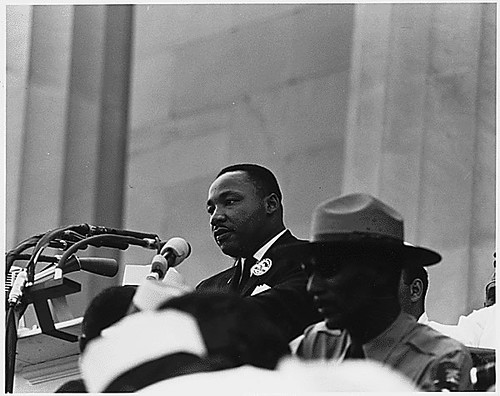
Martin Luther King Jr. could tell you what happens to dreams deferred. They explode.

As I point out in my book Battlefield America: The War on the American People, more than 50 years after King was assassinated, his dream of a world without racism, militarism and materialism remains a distant dream.

Indeed, the reality we must contend with is far different from King’s dream for the future: America has become a ticking time bomb of racial unrest and injustice, police militarization, surveillance, government corruption and ineptitude, the blowblack from a battlefield mindset and endless wars abroad, and a growing economic inequality between the haves and have nots.

King’s own legacy has suffered in the process.

The image of the hard-talking, charismatic leader, voice of authority, and militant, nonviolent activist minister/peace warrior who staged sit-ins, boycotts and marches and lived through police attack dogs, water cannons and jail cells has been so watered down that younger generations recognize his face but know very little about his message.

Rubbing salt in the wound, while those claiming to honor King’s legacy pay lip service to his life and the causes for which he died, they have done little to combat the evils about which King spoke and opposed so passionately: injustice, war, racism and economic inequality.

For instance, President Obama speaks frequently of King, but what has he done to bring about peace or combat the racial injustices that continue to be meted out to young black Americans by the police state?

Republican presidential candidate Donald Trump plans to “honor” Martin Luther King Jr.’s legacy by speaking at a convocation at Liberty University, but what has he done to combat economic injustice?

Democratic presidential contender Hillary Clinton will pay tribute to King’s legacy by taking part in Columbia, South Carolina’s King Day at the Dome event, but has she done anything to dispel her track record’s impression that “machines and computers, profit motives and property rights are still considered more important than people”?

Unlike the politicians of our present day, King was a clear moral voice that cut through the fog of distortion. He spoke like a prophet and commanded that you listen. King dared to speak truth to the establishment and called for an end to oppression and racism. He raised his voice against the Vietnam War and challenged the military-industrial complex. And King didn’t just threaten boycotts and sit-ins for the sake of photo ops and media headlines. Rather, he carefully planned and staged them to great effect.

The following key principles formed the backbone of Rev. King’s life and work. King spoke of them incessantly, in every sermon he preached, every speech he delivered and every article he wrote. They are the lessons we failed to learn and, in failing to do so, we have set ourselves up for a future in which a militarized surveillance state is poised to eradicate freedom.

Practice militant non-violence, resist militarism and put an end to war.

“I could never again raise my voice against the violence of the oppressed in the ghettos without having first spoken clearly to the greatest purveyor of violence in the world today—my own government.”—Martin Luther King Jr., Sermon at New York’s Riverside Church (April 4, 1967)

On April 4, 1967, exactly one year before his murder, King used the power of his pulpit to condemn the U.S. for “using massive doses of violence to solve its problems, to bring about the changes it wanted.” King called on the U.S. to end all bombing in Vietnam, declare a unilateral cease-fire, curtail its military buildup, and set a date for troop withdrawals. In that same sermon, King warned that “a nation that continues year after year to spend more money on military defense than on programs of social uplift is approaching spiritual death.”

Fifty-some years later, America’s military empire has been expanded at great cost to the nation, with the White House leading the charge. Indeed, in his recent State of the Union address, President Obama bragged that the U.S. spends more on its military than the next eight nations combined. Mind you, the money spent on wars abroad, weapons and military personnel is money that is not being spent on education, poverty and disease.

Stand against injustice.

“Injustice anywhere is a threat to justice everywhere… there are two types of laws: just and unjust. I would be the first to advocate obeying just laws. One has not only a legal but a moral responsibility to obey just laws. Conversely, one has a moral responsibility to disobey unjust laws.”― Martin Luther King Jr., “Letter from a Birmingham Jail” (April 16, 1963)

Arrested and jailed for taking part in a nonviolent protest against racial segregation in Birmingham, Ala., King used his time behind bars to respond to Alabama clergymen who criticized his methods of civil disobedience and suggested that the courts were the only legitimate means for enacting change. His “Letter from a Birmingham Jail,” makes the case for disobeying unjust laws when they are “out of harmony with the moral law.”

Fifty-some years later, we are being bombarded with unjust laws at both the national and state levels, from laws authorizing the military to indefinitely detain American citizens and allowing the NSA to spy on American citizens to laws making it illegal to protest near an elected official or in front of the U.S. Supreme Court. As King warned, “Never forget that everything Hitler did in Germany was legal.”

Work to end poverty. Prioritize people over corporations.

“When machines and computers, profit motives and property rights, are considered more important than people, the giant triplets of racism, extreme materialism, and militarism are incapable of being conquered.” —Martin Luther King Jr., Sermon at New York’s Riverside Church (April 4, 1967)

Especially in the latter part of his life, King was unflinching in his determination to hold Americans accountable to alleviating the suffering of the poor, going so far as to call for a march on Washington, DC, to pressure Congress to pass an Economic Bill of Rights.

Fifty-some years later, a monied, oligarchic elite calls the shots in Washington, while militarized police and the surveillance sector keep the masses under control. With roughly 23 lobbyists per Congressman, corporate greed largely dictates what happens in the nation’s capital, enabling our so-called elected representatives to grow richer and the people poorer. One can only imagine what King would have said about a nation whose political processes, everything from elections to legislation, are driven by war chests and corporate benefactors rather than the needs and desires of the citizenry.

Stand up for what is right, rather than what is politically expedient.

“On some positions, cowardice asks the question, is it expedient? And then expedience comes along and asks the question, is it politic? Vanity asks the question, is it popular? Conscience asks the question, is it right? There comes a time when one must take the position that is neither safe nor politic nor popular, but he must do it because conscience tells him it is right.”—Martin Luther King Jr., Sermon at National Cathedral (March 31, 1968)

Five days before his assassination, King delivered a sermon at National Cathedral in Washington, DC, in which he noted that “one of the great liabilities of life is that all too many people find themselves living amid a great period of social change, and yet they fail to develop the new attitudes, the new mental responses, that the new situation demands. They end up sleeping through a revolution.”

Freedom, human dignity, brotherhood, spirituality, peace, justice, equality, putting an end to war and poverty: these are just a few of the big themes that shaped King’s life and his activism. As King recognized, there is much to be done if we are to make this world a better place, and we cannot afford to play politics when so much hangs in the balance.

It’s time to wake up, America.

To quote my hero: “[O]ur very survival depends on our ability to stay awake, to adjust to new ideas, to remain vigilant and to face the challenge of change. The large house in which we live demands that we transform this world-wide neighborhood into a world-wide brotherhood. Together we must learn to live as brothers or together we will be forced to perish as fools.”

Original post can be found at http://rutherford.org/publications_resources/john_whiteheads_commentary/what_happens_to_a_dream_deferred_ask_martin_luther_king_jr


“There will be, in the next generation or so, a pharmacological method of making people love their servitude, and producing dictatorship without tears, so to speak, producing a kind of painless concentration camp for entire societies, so that people will in fact have their liberties taken away from them, but will rather enjoy it, because they will be distracted from any desire to rebel by propaganda or brainwashing, or brainwashing enhanced by pharmacological methods. And this seems to be the final revolution.”—Aldous Huxley

There’s a man who contacts me several times a week to disagree with my assessments of the American police state. According to this self-avowed Pollyanna who is tired of hearing “bad news,” the country is doing just fine, the government’s intentions are honorable, anyone in authority should be blindly obeyed, those individuals who are being arrested, shot and imprisoned must have done something to deserve such treatment, and if you have nothing to hide, you shouldn’t care whether the government is spying on you.

In other words, this man trusts the government with his life, his loved ones and his property, and anyone who doesn’t feel the same should move elsewhere.

It’s tempting to write this man off as dangerously deluded, treacherously naïve, and clueless to the point of civic incompetence. However, he is not alone in his goose-stepping, comfort-loving, TV-watching, insulated-from-reality devotion to the alternate universe constructed for us by the Corporate State with its government propaganda, pseudo-patriotism and contrived political divisions.

While only 1 in 5 Americans claim to trust the government to do what is right, the majority of the people are not quite ready to ditch the American experiment in liberty. Or at least they’re not quite ready to ditch the government with which they have been saddled.

As The Washington Post concludes, “Americans hate government, but they like what it does.” Indeed, kvetching aside, Americans want the government to keep providing institutionalized comforts such as Social Security, public schools, and unemployment benefits, fighting alleged terrorists and illegal immigrants, defending the nation from domestic and foreign threats, and maintaining the national infrastructure. And it doesn’t matter that the government has shown itself to be corrupt, abusive, hostile to citizens who disagree, wasteful and unconcerned about the plight of the average American.

For the moment, Americans are continuing to play by the government’s rules. Indeed, Americans may not approve the jobs being done by their elected leaders, and they may have little to no access to those same representatives, but they remain committed to the political process, so much so that they are working themselves into a frenzy over the upcoming presidential election, with contributions to the various candidates nearing $500 million.

Yet as Barack Obama’s tenure in the White House shows, no matter how much hope and change were promised, what we’ve ended up with is not only more of the same, but something worse: an invasive, authoritarian surveillance state armed and ready to eliminate any opposition.

The state of our nation under Obama has become more bureaucratic, more debt-ridden, more violent, more militarized, more fascist, more lawless, more invasive, more corrupt, more untrustworthy, more mired in war, and more unresponsive to the wishes and needs of the electorate. Most of all, the government, already diabolical and manipulative to the nth degree, has mastered the art of “do what I say and not what I do” hypocrisy.

For example, the government’s arsenal is growing. While the Obama administration is working to limit the public’s access to guns by pushing for greater gun control, it’s doing little to scale back on the federal government’s growing arsenal of firepower and militarized equipment.

In fact, it’s not just the Department of Defense that’s in the business of waging war. Government agencies focused largely on domestic matters continue to spend tens of millions of taxpayer dollars to purchase SWAT and military-style equipment such as body armor, riot helmets and shields, cannon launchers and police firearms and ammunition. The Department of Veterans Affairs spent nearly $2 million on riot helmets, defender shields, body armor, a “milo return fire cannon system,” armored mobile shields, Kevlar blankets, tactical gear and equipment for crowd control. The Food and Drug Administration purchased “ballistic vests and carriers.” The Environmental Protection Agency shelled out $200,000 for body armor. And the Smithsonian Institution procured $28,000 worth of body armor for its “zoo police and security officers.”

The national debt is growing. In fact, it’s almost doubled during Obama’s time in office to nearly $20 trillion. Much of this debt is owed to foreign countries such as China, which have come to exert an undue degree of influence on various aspects of the American economy.

Meanwhile, almost half of Americans are struggling to save for emergencies and retirement, 43% can’t afford to go more than one month without a paycheck, and 24% have less than $250 in their bank accounts preceding payday.

On any given night, over half a million people in the U.S. are homeless, and half of them are elderly. In fact, studies indicate that the homeless are aging faster than the general population in the U.S.

While the U.S. spends more on education than almost any other country, American schools rank 28th in the world, below much poorer countries such as the Czech Republic and Vietnam.

The American police state’s payroll is expanding. Despite the fact that violent crime is at a 40-year-low, there are more than 1.1 million persons employed on a full-time basis by state and local law enforcement in this country. That doesn’t include the more than 120,000 full-time officers on the federal payroll.

While crime is falling, the number of laws creating new crimes is growing at an alarming rate. Congress creates, on average, more than 50 new criminal laws each year. This adds up to more than 4,500 federal criminal laws and an even greater number of state laws.

The prison population is growing at an alarming rate. Owing largely to overcriminalization, the nation’s prison population has quadrupled since 1980 to 2.4 million, which breaks down to more than one out of every 100 American adults behind bars. According to The Washington Post, it costs $21,000 a year to keep someone in a minimum-security federal prison and $33,000 a year for a maximum-security federal prison. Those costs are expected to increase 30 percent by 2020. Translation: while the American taxpayer will be forced to shell out more money for its growing prison population, the private prison industry will be making a hefty profit.

The nation’s infrastructure—railroads, water pipelines, ports, dams, bridges, airports and roads—is rapidly deteriorating. An estimated $1.7 trillion will be needed by 2020 to improve surface transportation, but with vital funds being siphoned off by the military industrial complex, there’s little relief in sight.

The expense of those endless wars in Afghanistan and Iraq will cost taxpayers $4 trillion to $6 trillion. That does not include the cost of military occupations and exercises elsewhere around the globe. Unfortunately, that’s money that is not being invested in America, nor is it being used to improve the lives of Americans.

Government incompetence, corruption and lack of accountability continue to result in the loss of vast amounts of money and weapons. A Reuters investigation revealed $8.5 trillion in “taxpayer money doled out by Congress to the Pentagon since 1996 that has never been accounted for.” Then there was the $500 million in Pentagon weapons, aircraft and equipment (small arms, ammunition, night-vision goggles, patrol boats, vehicles and other supplies) that the U.S. military somehow lost track of.

Rounding out the bad news, many Americans know little to nothing about their rights and the government. Only 31% can name all three branches of the U.S. government, while one in three says that the Bill of Rights guarantees the right to own your own home, while one in four thinks that it guarantees “equal pay for equal work.” One in 10 Americans (12%) says the Bill of Rights includes the right to own a pet.

If this brief catalogue of our national woes proves anything at all, it is that the American experiment in liberty has failed, and as political economist Lawrence Hunter warns, it is only a matter of time before people realize it. Writing for Forbes, Hunter notes:

The greatest fear of America’s Founding Fathers has been realized: The U.S. Constitution has been unable to thwart the corrosive dynamics of majority-rule democracy, which in turn has mangled the Constitution beyond recognition. The real conclusion of the American Experiment is that democracy ultimately undermines liberty and leads to tyranny and oppression by elected leaders and judges, their cronies and unelected bureaucrats.  All of this is done in the name of “the people” and the “general welfare,” of course.  But in fact, democracy oppresses the very demos in whose name it operates, benefiting string-pullers within the Establishment and rewarding the political constituencies they manage by paying off special interests with everyone else’s money forcibly extracted through taxation. The Founding Fathers (especially Washington, Jefferson, Franklin, Adams, Madison, and James Monroe), as well as outside observers of the American Experiment such as Alexis de Tocqueville all feared democracy and dreaded this outcome.  But, they let hope and faith in their ingenious constitutional engineering overcome their fear of the democratic state, only to discover they had replaced one tyranny with another.

So are there any real, workable solutions to the emerging American police state?

A second American Revolution will not work. In the first revolution, the colonists were able to dispatch the military occupation and take over the running of the country. However, the Orwellian state is here and it is so pervasive that government agents are watching, curtailing and putting down any resistance before it can get started.

A violent overthrow of the government will not work. Government agents are armed to the teeth and will easily blow away any insurgency when and if necessary.

Politics will not help things along. As history has made clear, the new boss is invariably the same as or worse than the old boss—all controlled by a monied, oligarchic elite.

Battlefield_Cover_300As I make clear in my book Battlefield America: The War on the American People, there is only one feasible solution left to us short of fleeing the country for parts unknown: grassroots activism that strives to reform the government locally and trickles up.

Unfortunately, such a solution requires activism, engagement, vigilance, sacrifice, individualism, community-building, nullification and a communal willingness to reject the federal government’s handouts and, when needed, respond with what Martin Luther King Jr. referred to as “militant nonviolent resistance.”

That means forgoing Monday night football in order to actively voice your concerns at city council meetings, turning off the television and spending an hour reading your local newspaper (if you still have one that reports local news) from front to back, showing your displeasure by picketing in front of government offices, risking your reputation by speaking up and disagreeing with the majority when necessary, refusing to meekly accept whatever the government dictates, reminding government officials—including law enforcement—that they work for you, and working together with your neighbors to present a united front against an overreaching government.

Unfortunately, we now live in a ubiquitous Orwellian society with all the trappings of Huxley’s A Brave New World. We have become a society of watchers rather than activists who are distracted by even the clumsiest government attempts at sleight-of-hand.

There are too many Americans who are reasonably content with the status quo and too few Americans willing to tolerate the discomfort of a smaller, more manageable government and a way of life that is less convenient, less entertaining, and less comfortable.

It well may be that Huxley was right, and that the final revolution is behind us. Certainly, most Americans seem to have learned to love their prison walls and take comfort in a dictatorship without tears.

WASHINGTON, DC – Attorneys for The Rutherford Institute have asked the U.S. Supreme Court to declare its own ban on expressive First Amendment activity on the Supreme Court plaza unconstitutional. In asking the Court to hear the case of Hodge v. Talkin, Rutherford Institute attorneys argue that the U.S. Court of Appeals for the District of Columbia’s decision to uphold a 60-year-old federal statute criminalizing expressive First Amendment activity on the Supreme Court plaza conflicts with the high court’s own rulings regarding expressive activity in public elsewhere. For example, in 1972, the Supreme Court struck down limits on similar protests on the Capitol grounds, located across the street from the Court’s plaza. The Court of Appeals ruling was issued in response to a lawsuit filed by Rutherford Institute attorneys on behalf of activist Harold Hodge, who was arrested while standing silently in front of the U.S. Supreme Court on a snowy day wearing a sign voicing his concerns about the government’s disparate treatment of African-Americans and Hispanics.

Affiliate attorney Jeffrey Light is assisting The Rutherford Institute in defending Hodge.

“This is definitely a first: asking the justices of the U.S. Supreme Court to declare unconstitutional their own statute limiting expressive activity,” said constitutional attorney John W. Whitehead, president of The Rutherford Institute and author of Battlefield America: The War on the American People. “It’s our hope that the Supreme Court will reconcile the inconsistencies inherent in this First Amendment ban on what is essentially their front porch and reinforce their historic commitment to free speech activities in public places.”

On January 28, 2011, Harold Hodge quietly and peacefully stood in the plaza area near the steps leading to the United States Supreme Court Building, wearing a 3’ X 2’ sign around his neck that proclaimed: “The U.S. Gov. Allows Police To Illegally Murder And Brutalize African Americans And Hispanic People.” The plaza is a place where the public is allowed to gather and converse, and is in all relevant respects like a public square or park where citizens have traditionally met to express their views on matters of public interest. However, Hodge was handcuffed, placed under arrest, and then transported to U.S. Capitol Police Headquarters for violating 40 U.S.C. § 6135, which broadly makes it unlawful to display any flag, banner, or device designed to bring into public notice a party, organization, or movement while on the grounds of the U.S. Supreme Court, thereby banning expressive activity on the Supreme Court plaza. Rutherford Institute attorneys subsequently filed a lawsuit challenging § 6135, and in June 2013 a district court judge struck down the law finding the ban to be “repugnant” to the Constitution, “unreasonable, substantially overbroad, and irreconcilable with the First Amendment,” not to mention “plainly unconstitutional on its face.” In response, the government not only appealed that ruling, but the marshal for the Supreme Court—with the approval of Chief Justice John Roberts—issued even more strident regulations outlawing expressive activity on the grounds of the high court, including the plaza. Rutherford Institute attorneys have since filed a related lawsuit challenging the Supreme Court’s more strident regulations.


“When it gets down to having to use violence, then you are playing the system’s game. The establishment will irritate you – pull your beard, flick your face – to make you fight. Because once they’ve got you violent, then they know how to handle you. The only thing they don’t know how to handle is non-violence and humor.”—John Lennon

Yes, the government is corrupt.

Yes, the system is broken. By broken, I mean it’s “dysfunctional, gridlocked, and, in general, incapable of doing what needs to be done.”

Yes, the government is out of control and overreaching on almost every front.

Yes, the government’s excesses—pork barrel spending, endless wars, etc.—are pushing the nation to a breaking point.

Yes, many Americans are afraid. Who wouldn’t be afraid of an increasingly violent and oppressive federal government?

Yes, the citizenry has little protection against standing armies (domestic and military), invasive surveillance, marauding SWAT teams, an overwhelming government arsenal of assault vehicles and firepower, and a barrage of laws that criminalize everything from vegetable gardens to lemonade stands.

Yes, in the eyes of the American surveillance state, “we the people” are little more than suspects and criminals to be monitored, policed, prosecuted and imprisoned. As former law professor John Baker, who has studied the growing problem of overcriminalization, noted, “There is no one in the United States over the age of 18 who cannot be indicted for some federal crime.”

Yes, the United States of America is not the democracy that is purports to be, but rather an oligarchy ruled by a wealthy corporate elite.

Yes, politics is a sham. Average Americans have largely lost all of the conventional markers of influencing government, whether through elections, petition, or protest, have no way to impact their government, no way to be heard, and no assurance that their concerns are truly being represented.

Yes, the Obama administration’s efforts to identify, target and punish “domestic extremists” through the use of surveillance, corporate spies, global police and the Strong Cities network sends a troubling message to all Americans that any opposition to the government—no matter how benign—will be viewed with suspicion and will likely be treated with hostility.

Yes, we have reached a tipping point. The freedoms we once enjoyed are increasingly being eroded: speech, assembly, association, privacy, etc.

Yes, something needs to be done about the government’s long train of abuses, power grabs, erosion of private property, and overt acts of tyranny.

Yes, many Americans, increasingly dissatisfied with the government and its heavy-handed tactics, are tired of being used and abused and are ready to say “enough is enough.”

No, violence is not the answer.

A handful of armed protesters are not going to fix what’s broken in the government by forcing a showdown with government agents. In fact, this kind of scenario plays right into the government’s hands by provoking a violent confrontation that allows government officials to sanctimoniously justify their use of surveillance, military weaponry and tactics, and laws criminalizing guns and hate speech in order to target anyone who even vaguely resembles an “anti-government extremist.”

Take the latest spectacle in Oregon, for example.

Armed activists led by brothers Ryan and Ammon Bundy have occupied a federal wildlife refuge. The Bundys (infamous for their 2014 standoff with the Bureau of Land Management over grazing rights on federal land in Nevada) are protesting the government’s prosecution of two ranchers, Dwight and Steven Hammond, who have been sentenced to five years in prison for allegedly setting back fires on government-owned land in Oregon. (Mind you, the government owns more than half the land in Oregon.)

Few conflicts are ever black and white, and this situation involving the Bundys, the Hammonds and the BLM is no exception. Yet the issue is not whether the Hammonds are arsonists as the government claims, or whether the Bundys are anti-government extremists as the government claims, or even whether ranchers should have their access to government-owned lands regulated as the BLM claims.

Battlefield_Cover_300No, as I point out in my book Battlefield America: The War on the American People, the larger question at play here is who owns—or controls—the government: is it “we the people” or private corporations?

Are American citizens shareholders of the government’s vast repositories, or are we merely serfs and tenant farmers in bondage to corporate overlords? Do we have a say in how the government is run, or are we merely on the receiving end of the government’s dictates? What recourse do we have if we don’t approve of the government’s actions?

Almost every struggle between the citizenry and the government is, at its core, about whether we are masters or slaves in this constantly evolving relationship with the government.

  • Do parents have a right to allow their children to play outside alone, or must they abide by the government’s dictates about how to raise their families?
  • Do activists have a right to freely associate with one another, assemble in public, and voice their opinions publicly or privately, or must they be constrained by what the government and its corporate partners deem to be appropriate?
  • Do residents of a community have to obey whatever a police officer says, lawful or not, or do Americans have a right to resist an unlawful order without getting shot or arrested?

It doesn’t matter what the issue is—whether it’s a rancher standing his ground over grazing rights, a minister jailed for holding a Bible study in his own home, or a community outraged over police shootings of unarmed citizens—these are the building blocks of a political powder keg.

Much like the heated protests that arose after the police shootings in Ferguson and Baltimore, there’s a subtext to the Oregon incident that must not be ignored, and it is simply this: America is a pressure cooker with no steam valve, and things are about to blow.

This is what happens when a parasitical government muzzles the citizenry, fences them in, herds them, brands them, whips them into submission, forces them to ante up the sweat of their brows while giving them little in return, and then provides them with little to no outlet for voicing their discontent.

As psychologist Erich Fromm recognized in his insightful book, On Civil Disobedience: “If a man can only obey and not disobey, he is a slave; if he can only disobey and not obey, he is a rebel (not a revolutionary). He acts out of anger, disappointment, resentment, yet not in the name of a conviction or a principle.”

Let me say it again: an armed occupation of a government property only plays right into the government’s hands and increases its power over the citizenry. Yet it speaks to a growing tension over how to bring about meaningful change when dealing with a government that refuses to listen to its citizens.

This is what happens when people get desperate, when citizens lose hope, and when lawful, nonviolent alternatives appear pointless.

Whether the parties involved are blameless or not, whether they’re using the wrong tactics or not, whether their agendas are selfless or not, this is the face of a nation undergoing a nervous breakdown on all fronts.

Now all that remains is a spark, and it need not be a very big one, to set the whole powder keg aflame.

The government has been anticipating and preparing for such an explosion for years. For example, in 2008, a U.S. Army War College report warned that the military must be prepared for a “violent, strategic dislocation inside the United States,” which could be provoked by “unforeseen economic collapse,” “purposeful domestic resistance,” “pervasive public health emergencies” or “loss of functioning political and legal order”—all related to dissent and protests over America’s economic and political disarray. Consequently, predicted the report, the “widespread civil violence would force the defense establishment to reorient priorities in extremis to defend basic domestic order and human security.”

In 2009, the Department of Homeland Security (DHS) released two reports, one on “Rightwing Extremism,” which broadly defines rightwing extremists as individuals and groups “that are mainly antigovernment, rejecting federal authority in favor of state or local authority, or rejecting government authority entirely,” and one on “Leftwing Extremism,” which labeled environmental and animal rights activist groups as extremists.
Incredibly, both reports use the words terrorist and extremist interchangeably.

That same year, the DHS launched Operation Vigilant Eagle, which calls for surveillance of military veterans returning from Iraq and Afghanistan, characterizing them as extremists and potential domestic terrorist threats because they may be “disgruntled, disillusioned or suffering from the psychological effects of war.” These reports indicate that for the government, anyone seen as opposing the government—whether they’re Left, Right or somewhere in between—can be labeled an extremist. Under such a definition, John Lennon, Martin Luther King Jr., Patrick Henry, Thomas Jefferson and Samuel Adams—all of whom protested and passionately spoke out against government practices with which they disagreed—would be prime targets.

Fast forward a few years, and you have the National Defense Authorization Act (NDAA), which President Obama has continually re-upped, that allows the military to take you out of your home, lock you up with no access to friends, family or the courts if you’re seen as an extremist. Now connect the dots, from the 2009 Extremism reports to the NDAA and the UN’s Strong Cities Network with its globalized police forces, the National Security Agency’s far-reaching surveillance networks, and fusion centers that collect and share surveillance data between local, state and federal police agencies.

Add in tens of thousands of armed, surveillance drones that will soon blanket American skies, facial recognition technology that will identify and track you wherever you go and whatever you do. And then to complete the circle, toss in the real-time crime centers being deployed in cities across the country, which will be attempting to “predict” crimes and identify criminals before they happen based on widespread surveillance, complex mathematical algorithms and prognostication programs.

Hopefully you’re getting the picture, which is how easy it is for the government to identify, label and target individuals as “extremist.”

All that we have been subjected to in recent years—living under the shadow of NSA spying; motorists strip searched and anally probed on the side of the road; innocent Americans spied upon while going about their daily business in schools and stores; homeowners having their doors kicked in by militarized SWAT teams serving routine warrants—illustrates how the government deals with people it views as potential “extremists”: with heavy-handed tactics designed to intimidate the populace into submission and discourage anyone from stepping out of line or challenging the status quo.

What we’re grappling with is a double standard in what the government metes out to the citizenry, and how the citizenry is supposed to treat the government.

SWAT teams can crash through our doors without impunity, but if we dare to defend ourselves against unknown government assailants, we’ll be shot or jailed.

Government agents can confiscate our homes, impound our cars and seize our bank accounts on the slightest suspicion of wrongdoing, but we’ll face jail time and fines for refusing to pay taxes in support of government programs with which we might disagree.

Government spies can listen in on our phone calls, read our emails and text messages, track our movements, photograph our license plates, and even enter our biometric information into DNA databases, but those who dare to film potential police misconduct will likely get roughed up by the police, arrested, and charged with violating various and sundry crimes.

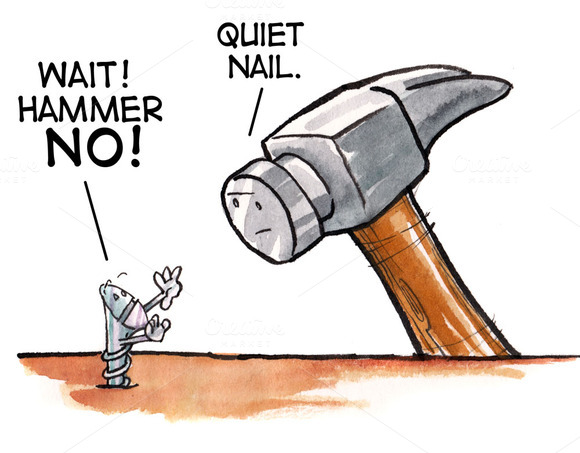
This phenomenon is what philosopher Abraham Kaplan referred to as the law of the instrument, which essentially says that to a hammer, everything looks like a nail. In the scenario that has been playing out in recent years, we the citizenry have become the nails to be hammered by the government’s battalion of laws and law enforcers: its police officers, technicians, bureaucrats, spies, snitches, inspectors, accountants, etc.

This is exactly what those who drafted the U.S. Constitution feared: that laws and law enforcers would be used as tools by a despotic government to wage war against the citizenry.

That is exactly what we are witnessing today: a war against the American citizenry.

Is it any wonder then that Americans are starting to resist?

*This article can also be found at The Rutherford Institute.

“Those who cannot remember the past are condemned to repeat it.”—George Santayana, The Life of Reason, Vol. 1

In Harold Ramis’ classic 1993 comedy Groundhog Day, TV weatherman Phil Connors (played by Bill Murray) is forced to live the same day over and over again until he not only gains some insight into his life but changes his priorities.

Battlefield_Cover_300Similarly, as I illustrate in my book Battlefield America: The War on the American People, we in the emerging American police state find ourselves reliving the same set of circumstances over and over again—egregious surveillance, strip searches, police shootings of unarmed citizens, government spying, the criminalization of lawful activities, war-mongering, etc.—although with far fewer moments of comic hilarity.

What remains to be seen is whether 2016 will bring more of the same or whether “we the people” will wake up from our somnambulant states. Indeed, when it comes to civil liberties and freedom, 2015 was far from a banner year.

The following is just a sampling of what we can look forward to repeating if we don’t find some way to push back against the menace of an overreaching, aggressive, invasive, militarized surveillance state.

More surveillance. The surveillance state is alive and well and kicking privacy to shreds in America. Whether you’re walking through a store, driving your car, checking email, or talking to friends and family on the phone, you can be sure that some government agency, whether the NSA or some other entity, will still be listening in and tracking your behavior. This doesn’t even begin to touch on the corporate trackers that monitor your purchases, web browsing, Facebook posts and other activities taking place in the cyber sphere. We are now in a state of transition with the police state shifting into high-gear under the auspices of the surveillance state. In such an environment, we are all suspects to be spied on, searched, scanned, frisked, monitored, tracked and treated as if we’re potentially guilty of some wrongdoing or other. Even our homes provide little protection against government intrusions. Police agencies, already empowered to crash through your door if they suspect you’re up to no good, now have radars that allow them to “see” through the walls of your home.

More militarized police. Americans will continue to be rendered powerless in the face of militarized police. In early America, government agents were not permitted to enter one’s home without permission or in a deceitful manner. And citizens could resist arrest when a police officer tried to restrain them without proper justification or a warrant. Daring to dispute a warrant with a police official today who is armed with high-tech military weapons would be nothing short of suicidal. Moreover, as police forces across the country continue to be transformed into extensions of the military, Americans are finding their once-peaceful communities transformed into military outposts, complete with tanks, weaponry, and other equipment designed for the battlefield. Having already transformed local police into extensions of the military, now the Department of Homeland Security, the Justice Department and the FBI are preparing to turn the nation’s police officers into techno-warriors, complete with iris scanners, body scanners, thermal imaging Doppler radar devices, facial recognition programs, license plate readers, cell phone Stingray devices and so much more.

More police shootings of unarmed citizens. Owing in large part to the militarization of local law enforcement agencies, not a week goes by without more reports of hair-raising incidents by police imbued with a take-no-prisoners attitude and a battlefield approach to the communities in which they serve.

More so-called “terrorist” attacks. Despite the government’s endless propaganda about the threat of terrorism and even in the wake of the shootings in San Bernardino and Paris, statistics show that you are 17,600 times more likely to die from heart disease than from a terrorist attack. You are 11,000 times more likely to die from an airplane accident than from a terrorist plot involving an airplane. You are 1,048 times more likely to die from a car accident than a terrorist attack. You are 404 times more likely to die in a fall than from a terrorist attack. And you are 8 times more likely to be killed by a police officer than by a terrorist.

More costly wars. The military industrial complex that has advocated that the U.S. remain at war, year after year, is the very entity that will continue to profit the most from America’s expanding military empire. The U.S. Department of Defense is the world’s largest employer, with more than 3.2 million employees. Thus far, the U.S. taxpayer has been made to shell out more than $1.6 trillion to wage wars in Afghanistan and Iraq. When you add in our military efforts in Pakistan, as well as the lifetime price of health care for disabled veterans and interest on the national debt, that cost rises to $4.4 trillion.

More attempts by the government to identify, target and punish so-called domestic “extremists.” In much the same way that the USA Patriot Act was used as a front to advance the surveillance state, the government’s anti-extremism program will, in many cases, be utilized to render otherwise lawful, nonviolent activities as potentially extremist. To this end, police will identify, monitor and deter individuals who exhibit, express or engage in anything that could be construed as extremist before they can become actual threats. This is pre-crime on an ideological scale and it’s been a long time coming. Moreover, under the guise of fighting violent extremism “in all of its forms and manifestations” in cities and communities across the world, the Obama administration has agreed to partner with the United Nations to take part in its Strong Cities Network program and hire a domestic extremism czar.

More SWAT team raids. More than 80% of American communities have their own SWAT teams, with more than 80,000 of these paramilitary raids are carried out every year. That translates to more than 200 SWAT team raids every day in which police crash through doors, damage private property, kill citizens, terrorize adults and children alike, kill family pets, assault or shoot anyone that is perceived as threatening—and all in the pursuit of someone merely suspected of a crime, usually some small amount of drugs.

More erosions of private property. Private property means little at a time when SWAT teams and other government agents can invade your home, break down your doors, kill your dog, wound or kill you, damage your furnishings and terrorize your family. Likewise, if government officials can fine and arrest you for growing vegetables in your front yard, praying with friends in your living room, installing solar panels on your roof, and raising chickens in your backyard, you’re no longer the owner of your property.

More debt. Currently, the national debt is somewhere in the vicinity of a whopping $18.1 trillion and rising that our government owes to foreign countries, private corporations and its retirement programs. Not only is the U.S. the largest debtor nation in the world, but according to Forbes, “the amount of interest on the national debt is estimated to be accumulating at a rate of over one million dollars per minute.”

More government contractors. Despite all the talk about big and small government, what we have been saddled with is a government that is outsourcing much of its work to high-paid contractors at great expense to the taxpayer and with no competition, little transparency and dubious savings. According to the Washington Post, “By some estimates, there aretwice as many people doing government work under contract than there are government workers.” These open-ended contracts, worth hundreds of millions of dollars, “now account for anywhere between one quarter and one half of all federal service contracting.”

More overcriminalization. The government’s tendency towards militarization and overcriminalization, in which routine, everyday behaviors become targets of regulation and prohibition, have resulted in Americans getting arrested for making and selling unpasteurized goat cheese, cultivating certain types of orchids, feeding a whale, holding Bible studies in their homes, and picking their kids up from school.

More strip searches and the denigration of bodily integrity. The Fourth Amendment to the U.S. Constitution was intended to protect the citizenry from being subjected to “unreasonable searches and seizures” by government agents. While the literal purpose of the amendment is to protect our property and our bodies from unwarranted government intrusion, the moral intention behind it is to protect our human dignity. Unfortunately, court rulings undermining the Fourth Amendment and justifying invasive strip searches have left us powerless against police empowered to forcefully draw our blood, forcibly take our DNA, strip search us, and probe us intimately. Accounts are on the rise of individuals—men and women alike—being subjected to what is essentially government-sanctioned rape by police in the course of “routine” traffic stops.

More injustice. Americans can no longer rely on the courts to mete out justice. The courts were established to intervene and protect the people against the government and its agents when they overstep their bounds. Yet the courts increasingly march in lockstep with the police state, while concerned themselves primarily with advancing the government’s agenda, no matter how unjust or illegal. As a result, Americans have no protection against police abuse. It is no longer unusual to hear about incidents in which police shoot unarmed individuals first and ask questions later. What is increasingly common, however, is the news that the officers involved in these incidents get off with little more than a slap on the hands.

More political spectacles. Americans continue to naively buy into the idea that politics matter, as if there really were a difference between the Republicans and Democrats (there’s not). As if Barack Obama proved to be any different from George W. Bush (he has not). As if Hillary Clinton’s values are any different from Donald Trump’s (with both of them, money talks). As if when we elect a president, we’re getting someone who truly represents “we the people” rather than the corporate state (in fact, in the oligarchy that is the American police state, an elite group of wealthy donors is calling the shots). Politics in America is a game, a joke, a hustle, a con, a distraction, a spectacle, a sport, and for many devout Americans, a religion. In other words, it’s a sophisticated ruse aimed at keeping us divided and fighting over two parties whose priorities are exactly the same.

More drones. As corporations and government agencies alike prepare for their part in the coming drone invasion—it is expected that at least 30,000 drones will occupy U.S. airspace by 2020, ushering in a $30 billion per year industry—it won’t be long before American citizens who will be the target of these devices discover first-hand that drones—unmanned aerial vehicles—come in all shapes and sizes, from nano-sized drones as small as a grain of sand that can do everything from conducting surveillance to detonating explosive charges, to middle-sized copter drones that can deliver pizzas to massive “hunter/killer” Predator warships that unleash firepower from on high.

More dumbed down, locked down public schools. Our schools have become training grounds for compliant citizens. Despite the fact that we spend more than most of the world on education ($115,000 per student), we rank 36th in the world when it comes to math, reading and science, far below most of our Asian counterparts. Even so, we continue to insist on standardized programs such as Common Core, which teach students to be test-takers rather than thinkers. Making matters worse is the heavy police presence in schools, which have become little more than quasi-prisons in which classrooms are locked down and kids as young as age 4 are being handcuffed for “acting up,” subjected to body searches, and suspended for childish behavior.

More ignorance about our rights. Americans know little to nothing about their rights or how the government is supposed to operate. This includes educators and politicians. For example, 27 percent of elected officials cannot name even one right or freedom guaranteed by the First Amendment, while 54 percent do not know the Constitution gives Congress the power to declare war.

More prisons. Our prisons, housing the largest number of inmates in the world and still growing, have become money-making enterprises for private corporations that manage the prisons in exchange for the states agreeing to maintain a 90% occupancy rate for at least 20 years. And how do you keep the prisons full? By passing laws aimed at increasing the prison population, including the imposition of life sentences on people who commit minor or nonviolent crimes such as siphoning gasoline. Little surprise, then, that the United States has 5% of the world’s population, but 25% of the world’s prisoners.

More corruption. If there is any absolute maxim by which the federal government seems to operate, it is that the American taxpayer always gets ripped off. This is true, whether you’re talking about taxpayers being forced to fund high-priced weaponry that will be used against us, endless wars that do little for our safety or our freedoms, or bloated government agencies such as the National Security Agency with its secret budgets, covert agendas and clandestine activities. Rubbing salt in the wound, even monetary awards in lawsuits against government officials who are found guilty of wrongdoing are paid by the taxpayer.

More censorship. First Amendment activities are being pummeled, punched, kicked, choked, chained and generally gagged all across the country. The reasons for such censorship vary widely from political correctness, safety concerns and bullying to national security and hate crimes but the end result remains the same: the complete eradication of what Benjamin Franklin referred to as the “principal pillar of a free government.” Free speech zones, bubble zones, trespass zones, anti-bullying legislation, zero tolerance policies, hate crime laws and a host of other legalistic maladies dreamed up by politicians and prosecutors have conspired to corrode our core freedoms. As a result, we are no longer a nation of constitutional purists for whom the Bill of Rights serves as the ultimate authority. We have litigated and legislated our way into a new governmental framework where the dictates of petty bureaucrats carry greater weight than the inalienable rights of the citizenry.

More fascism. As a Princeton University survey indicates, our elected officials, especially those in the nation’s capital, represent the interests of the rich and powerful rather than the average citizen. We are no longer a representative republic. With Big Business and Big Government having fused into a corporate state, the president and his state counterparts—the governors, have become little more than CEOs of the Corporate State, which day by day is assuming more government control over our lives. Never before have average Americans had so little say in the workings of their government and even less access to their so-called representatives.

More fear. We’re being fed a constant diet of fear, which has resulted in Americans adopting an “us” against “them” mindset that keeps us divided into factions, unable to reach consensus about anything and too distracted to notice the police state closing in on us.

James Madison, the father of the Constitution, put it best: “Take alarm,” he warned, “at the first experiment with liberties.” Anyone with even a casual knowledge about current events knows that the first experiment on our freedoms happened long ago. Worse, we have not heeded the warnings of Madison and those like him who understood that if you give the government an inch, they will take a mile. Unfortunately, the government has not only taken a mile, they have taken mile after mile after mile after mile with seemingly no end in sight for their power grabs.

If you’re in the business of making New Year’s resolutions, why not resolve that 2016 will be the year we break the cycle of tyranny and get back on the road to freedom? No matter what the politicians say about the dire state of our nation, you can rest assured that none of the problems that continue to plague our lives and undermine our freedoms will be resolved by our so-called elected representatives in any credible, helpful way in the new year.

“We the people”—the citizenry, not the politicians—are the only ones who have ever been able to enact effective change, and there is a lot that needs to change.

All of the signs point to something nasty up ahead.

“Two thousand years later … the memory of the revolutionary zealot who walked across Galilee gathering an army of disciples with the goal of establishing the Kingdom of God on earth, the magnetic preacher who defied the authority of the Temple priesthood in Jerusalem, the radical Jewish nationalist who challenged the Roman occupation and lost, has been almost completely lost to history.” ― Reza Aslan, religious scholar

The Christmas narrative of a baby born in a manger is a familiar one.

The Roman Empire, a police state in its own right, had ordered that a census be conducted. Joseph and his pregnant wife Mary traveled to the little town of Bethlehem so that they could be counted. There being no room for the couple at any of the inns, they stayed in a stable, where Mary gave birth to a baby boy. That boy, Jesus, would grow up to undermine the political and religious establishment of his day and was eventually crucified as a warning to others not to challenge the powers-that-be.

But what if Jesus, the revered preacher, teacher, radical and prophet, had been born 2,000 years later? How would Jesus’ life have been different had he be born and raised in the American police state?

Consider the following if you will.

Had Jesus been born in the year 2015…

Rather than traveling to Bethlehem for a census, Jesus’ parents would have been mailed a 28-page American Community Survey, a mandatory government questionnaire documenting their habits, household inhabitants, work schedule, and even how many toilets were in their home, etc. The penalty for not responding to this invasive survey would have resulted in a fine of $5,000.

Instead of being born in a manger, Jesus might have been born at home. Rather than wise men and shepherds bringing gifts, however, the baby’s parents might have been forced to ward off visits from state social workers intent on prosecuting them for the home birth. One couple in Washington had all three of their children removed after social services objected to the two youngest being birthed in an unassisted home delivery.

Had Jesus been born in a hospital, his blood and DNA would have been taken and entered into a government biobank without his parents’ knowledge or consent. While most states require newborn screening, a growing number are indefinitely holding onto that genetic material long-term for research, analysis and purposes yet to be disclosed.

Then again, had his parents been undocumented immigrants, they and the newborn baby might have been shuffled to aprofit-driven, private detention center for illegals. There’s quite a lot of money to be made from imprisoning immigrants, especially when taxpayers are footing the bill.

Once in school, Jesus would have been drilled in lessons of compliance and obedience to government authorities, all the while learning little about his own rights. And if he dared to challenge school officials, he might have found himself suspended under a school zero tolerance policy that punishes minor infractions (such as doodling or talking in class) as harshly as more serious offenses (such as bringing a weapon to class).

According to scripture, Jesus, at the age of twelve, wandered the temple courts in Jerusalem alone and unsupervised. Today, had Jesus disappeared for a few hours let alone days, his parents would have been handcuffed, arrested and jailed for parental negligence. Parents across the country have been arrested for far less “offenses” such as allowing their children to walk to the park unaccompanied and play in their front yard alone.

Rather than disappearing from the history books from his early teenaged years to adulthood, Jesus’ movements and personal data—including his biometrics—would have been documented, tracked, monitored and filed by governmental agencies and corporations such as Google and Microsoft. Incredibly, 95 percent of school districts share their student records with outside companies contracted to manage the data.

If Jesus were to ever make contact with the likes of John the Baptist, he would have been flagged for surveillance because of his association with a prominent activist, peaceful or otherwise. Since 9/11, the FBI has actively carried out surveillance and intelligence-gathering operations on a broad range of activist groups, from animal rights groups to poverty relief and anti-war organizations.

Rather than being permitted to live as an itinerant preacher, Jesus might have found himself threatened with arrest for daring to live off the grid or sleeping outside. In fact, the number of cities that have resorted to criminalizing homelessness by enacting bans on camping, sleeping in vehicles, loitering and begging in public has doubled in recent years.

Had his travels taken him from community to community, Jesus might have been reported to government officials as “suspicious” under the Department of Homeland Security’s “See Something, Say Something” programs. Many states, including New York, are providing individuals with phone apps that allow them to take photos of suspicious activity and report them to their state Intelligence Center, where they are reviewed and forwarded to law-enforcement agencies.

Perceived as a dissident and a potential threat to the government’s power, Jesus might have had government spies planted among his followers in order to monitor his activities, report on his movements, and entrap him into breaking the law.

Jesus’ anti-government views would certainly have resulted in him being labeled a domestic extremist. Law enforcement agencies are being trained to recognize signs of anti-government extremism during interactions with potential extremists who share a “belief in the approaching collapse of government and the economy.”

Assuming Jesus used the internet to spread his radical message of peace and love, he might have found his blog posts infiltrated by government spies attempting to undermine his integrity, discredit him or plant incriminating information online about him. At the very least, he would have had his website hacked and his email monitored.

Had Jesus attempted to feed large crowds of people, he would have been threatened with arrest for violating various ordinances prohibiting the distribution of food without a permit. Florida officials arrested a 90-year-old man for feeding the homeless on a public beach.
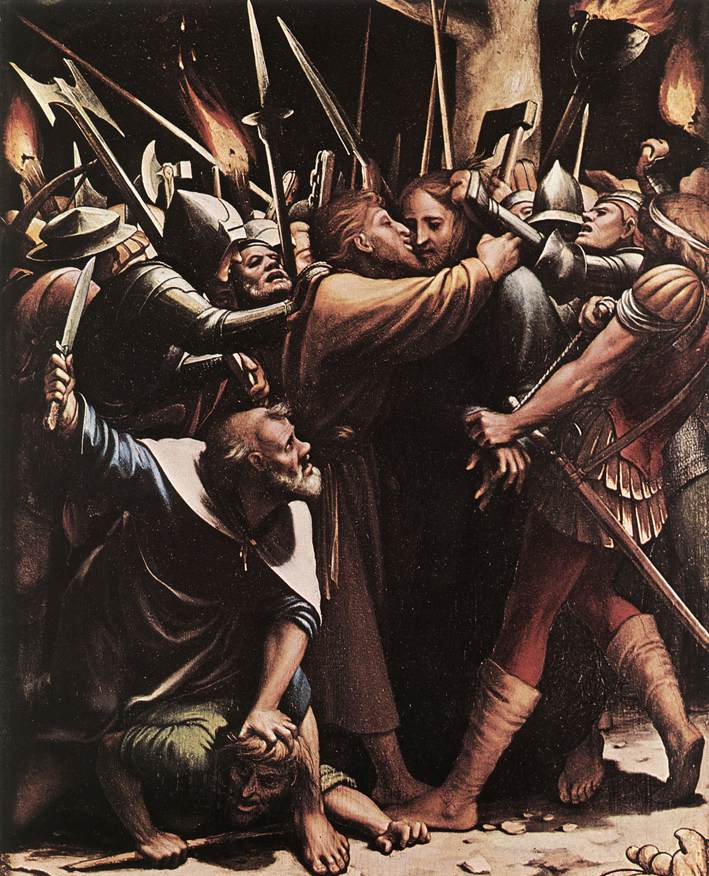
Had Jesus spoken publicly about his 40 days in the desert and his conversations with the devil, he might have been labeled mentally ill and detained in a psych ward against his will for a mandatory involuntary psychiatric hold with no access to family or friends. One Virginia man was arrested, strip searched, handcuffed to a table, diagnosed as having “mental health issues,” and locked up for five days in a mental health facility against his will apparently because of his slurred speech and unsteady gait.

Without a doubt, had Jesus attempted to overturn tables in a Jewish temple and raged against the materialism of religious institutions, he would have been charged with a hate crime. Currently, 45 states and the federal government have hate crime laws on the books.

Rather than having armed guards capture Jesus in a public place, government officials would have ordered that a SWAT team carry out a raid on Jesus and his followers, complete with flash-bang grenades and military equipment. There are upwards of 80,000 such SWAT team raids carried out every year, many on unsuspecting Americans who have no defense against such government invaders, even when such raids are done in error.

Instead of being detained by Roman guards, Jesus might have been made to “disappear” into a secret government detention center where he would have been interrogated, tortured and subjected to all manner of abuses. Chicago police “disappeared” more than 7,000 people into a secret, off-the-books interrogation warehouse at Homan Square.

Charged with treason and labeled a domestic terrorist, Jesus might have been sentenced to a life-term in a private prison where he would have been forced to provide slave labor for corporations or put to death by way of the electric chair or a lethal mixture of drugs.

Either way, as I make clear in my book Battlefield America: The War on the American People, whether Jesus had been born in our modern age or his own, he still would have died at the hands of a police state.

What a turbulent year it’s been.

For those of us who have managed to survive 2015 with our lives intact and our freedoms hanging by a thread, it has been a year of crackdowns, clampdowns, shutdowns, showdowns, shootdowns, standdowns, knockdowns, putdowns, breakdowns, lockdowns, takedowns, slowdowns, meltdowns, and never-ending letdowns.

As I point out in my book Battlefield America: The War on the American People, we’ve been held up, stripped down, faked out, photographed, frisked, fracked, hacked, tracked, cracked, intercepted, accessed, spied on, zapped, mapped, searched, shot at, tasered, tortured, tackled, trussed up, tricked, lied to, labeled, libeled, leered at, shoved aside, saddled with debt not of our own making, sold a bill of goods about national security, tuned out by those representing us, tossed aside, and taken to the cleaners.

After endless months of being mired in gloom and doom, we now find ourselves just a few weeks away from Christmas, struggling to latch onto that spirit of joy, excitement, innocence, magic and hope we had as children. Even so, it takes a monumental effort to get past the Grinches and Scrooges who can you make you feel like yours is anything but a wonderful life.

And then there’s Christmas itself, which has become embattled in recent years, co-opted by rampant commercialism, straight-jacketed by political correctness, and denuded of so much of its loveliness, holiness and mystery.

Despite all of this humbuggery, however, there are still a few steps you can take to enjoy the season and hopefully make this world a better place in the face of weaponized drones, far-reaching surveillance and a government that with every passing day is coming to resemble authoritarian regimes of old. While it’s not possible to solve all of the world’s problems right away, here are some practical steps each of us can take to recapture the true spirit of Christmas.

Move beyond the “us” vs. “them” mentality. Tune into what’s happening in your family, in your community and your world, and get active. Show compassion to those in need, be kind to those around you, forgive those who have wronged you, and teach your children to do the same. Stop acting entitled and start being empowered. Learn tolerance in the true sense of the word. Value your family. Feed the hungry, shelter the homeless and comfort the lonely and broken-hearted. Give peace a chance.

And finally, turn off the news, settle down with your loved ones, and turn on a Christmas movie that reinforces your faith in humanity. Unfortunately, Christmas movies made in the last few years seem to express a cynicism and weariness that have become hallmarks of our materialistic culture. The season for giving has turned into the season for getting. However, there is still magic to be found in some of the classic Christmas movies, along with a few newer ones that are quickly joining their ranks. The following are ten of my favorites to help get you through the season with maximum joy.

It’s A Wonderful Life (1946). An American classic about a despondent man, George Bailey (James Stewart), who is saved from suicide by an angel working to get his wings. Stewart and Donna Reed are sublime. Henry Travers, Lionel Barrymore and Thomas Mitchell are fine in support. This film is a testament to director Frank Capra’s faith in people. Fine performances by James Stewart and Donna Reed.

The Bishop’s Wife (1947). An angel (Cary Grant) comes to earth in answer to a bishop’s (David Niven) prayer for help. The two male leads and Loretta Young help energize this tale of lost visions and longings of the heart. Monty Woolley and Elsa Lanchester are superb in supporting roles. Look for Karolyn Grimes, who plays the bishop’s daughter. She was also Zuzu (of Zuzu’s petals) in It’s A Wonderful Life.

Miracle on 34th Street (1947). By happenchance, Kris Kringle (Edmund Gwenn) is hired as Santa Claus by Macy’s Department Store in New York City for the Thanksgiving Day Parade. Before long, Kringle, who believes himself to be the one and only Santa Claus, has impacted virtually everyone around him. Funny, witty and heartwarming, this film is stocked with some fine performances from Maureen O’Hara, John Payne and young Natalie Wood. Gwenn won the Academy Award for best supporting actor for his role as Saint Nick.

A Christmas Carol (1951). Also known as Scrooge, this is the best film version of the penny-pinching Scrooge’s journey to spiritual enlightenment by way of visits from supernatural visitors. Alastair Sim as Scrooge gives one of the finest film performances never to win an Oscar. Bill Murray’s Scrooged (1988) is a good modern film adaptation of this Charles Dickens tale.

A Christmas Story (1983). Ralphie (Peter Billingsley) is a young boy obsessed with one thing and only one thing: how to get a Red Ryder BB-gun for Christmas. Ralphie’s parents are wary, and his mother continually warns him that “you’ll shoot your eye out.” Based on Jean Shepherd’s autobiographical book In God We Trust, All Others Pay Cash, this comedy has some classic scenes—such as a department store Santa who is more demonic than saintly. However, Bob Clark’s adept direction never loses the focus of the story—the yearnings of a child for the magic of Christmas morning. A great cast, which includes Darren McGavin, Melinda Dillon and a voice-over narrative by Shepherd himself.

One Magic Christmas (1985). If you grew up in a family where times were tough, this film is for you. A guardian angel (Harry Dean Stanton) comes to earth to help a disillusioned woman (Mary Steenburgen), who hates Christmas. This, of course, poses serious problems for her husband and two children who groove on the yuletide. This tale of redemption and second chances is a delight to watch. And Harry Dean Stanton, even though he plays against type, is excellent as a weird, offbeat angel.

Prancer (1989). This story of an eight-year-old girl (Rebecca Harrell) who believes that an injured reindeer in her barn is actually one of Santa’s reindeer is one of the most down-to-earth Christmas films ever made. It shows how the love of an individual, even if it’s a little girl, can change not only other hearts but the course of historical events. Sam Elliott and Cloris Leachman are fine in supporting roles, but Rebecca Harrell is excellent. Filmed on location in freezing, snowy weather, this film is a treat for those who love Christmas.

Home Alone (1990). Eight-year-old Kevin (Macaulay Culkin) is accidentally left alone at home in a Chicago suburb when his parents, siblings and assorted relatives fly to Paris for Christmas.  Good riddance—or so Kevin thinks until he runs into all kinds of problems, including two burglars played by Joe Pesci and Daniel Stern. Written by John Hughes, the story centers on the importance of family relationships.

Elf (2003). Will Ferrell is marvelous as Buddy. As a baby, Buddy snuck into Santa’s bag and wound up at the North Pole, where he was raised as an oversized elf. From there, he begins a journey back to the “real” world to find and establish a relationship with his father. This film has it all—Santa, elves, family problems, humor, emotion and above all else, a large dose of the Christmas spirit. One of the best Christmas movies ever made.

Get Santa (2014). This British film is a rare gem among the paltry holiday films to come out in recent years. Santa, played by Jim Broadbent, has crashed while test-driving a new sleigh and turns to fresh-out-of-prison ex-con Steve and his 9-year-old son Tom to save Christmas. The film has enough heart and Christmas magic to touch the most determined Unbeliever, and then for laughs, tosses in some farting reindeer, a jailbreak, a car chase, and a trip to the North Pole.

As these films illustrate, it is possible to move beyond the self-centered, materialistic, cynical world that imprisons us—a materialistic world that has our young people growing jaded and skeptical—and reclaim the loving, giving, magical spirit of Christmas.

More than a century ago, the editor of The New York Sun addressed this growing cynicism in his response to a letter from 8-year-old Virginia O’Hanlon, whose friends had told her there is no Santa Claus. This was his answer.

VIRGINIA, your little friends are wrong. They have been affected by the skepticism of a skeptical age. They do not believe except [what] they see. They think that nothing can be which is not comprehensible by their little minds. All minds, Virginia, whether they be men’s or children’s, are little. In this great universe of ours man is a mere insect, an ant, in his intellect, as compared with the boundless world about him, as measured by the intelligence capable of grasping the whole of truth and knowledge.

Yes, VIRGINIA, there is a Santa Claus. He exists as certainly as love and generosity and devotion exist, and you know that they abound and give to your life its highest beauty and joy. Alas! how dreary would be the world if there were no Santa Claus… There would be no childlike faith then, no poetry, no romance to make tolerable this existence. We should have no enjoyment, except in sense and sight. The eternal light with which childhood fills the world would be extinguished.

Not believe in Santa Claus! You might as well not believe in fairies. You might get your papa to hire men to watch in all the chimneys on Christmas Eve to catch Santa Claus, but even if you did not see Santa Claus coming down, what would that prove? Nobody sees Santa Claus, but that is no sign that there is no Santa Claus. The most real things in the world are those that neither children nor men can see. Did you ever see fairies dancing on the lawn? Of course not, but that’s no proof that they are not there. Nobody can conceive or imagine all the wonders there are unseen and unseeable in the world.

You tear apart the baby’s rattle and see what makes the noise inside, but there is a veil covering the unseen world which not the strongest man, nor even the united strength of all the strongest men that ever lived, could tear apart. Only faith, fancy, poetry, love, romance, can push aside that curtain and view and picture the supernal beauty and glory beyond. Is it all real? Ah, Virginia, in all this world there is nothing else real and abiding.

No Santa Claus! Thank God! He lives, and lives forever. A thousand years from now, Virginia, nay, ten times ten thousand years from now, he will continue to make glad the heart of childhood.

No one can terrorize a whole nation, unless we are all his accomplices.”—Edward R. Murrow, broadcast journalist

America is in the midst of an epidemic of historic proportions.

The contagion being spread like wildfire is turning communities into battlegrounds and setting Americans one against the other.

Normally mild-mannered individuals caught up in the throes of this disease have been transformed into belligerent zealots, while others inclined to pacifism have taken to stockpiling weapons and practicing defensive drills.

This plague on our nation—one that has been spreading like wildfire—is a potent mix of fear coupled with unhealthy doses of paranoia and intolerance, tragic hallmarks of the post-9/11 America in which we live.

Everywhere you turn, those on both the left- and right-wing are fomenting distrust and division. You can’t escape it.

We’re being fed a constant diet of fear: fear of terrorists, fear of illegal immigrants, fear of people who are too religious, fear of people who are not religious enough, fear of Muslims, fear of extremists, fear of the government, fear of those who fear the government. The list goes on and on.

The strategy is simple yet effective: the best way to control a populace is through fear and discord.

Fear makes people stupid.

Confound them, distract them with mindless news chatter and entertainment, pit them against one another by turning minor disagreements into major skirmishes, and tie them up in knots over matters lacking in national significance.

Most importantly, divide the people into factions, persuade them to see each other as the enemy and keep them screaming at each other so that they drown out all other sounds. In this way, they will never reach consensus about anything and will be too distracted to notice the police state closing in on them until the final crushing curtain falls.

This is how free people enslave themselves and allow tyrants to prevail.

This Machiavellian scheme has so ensnared the nation that few Americans even realize they are being manipulated into adopting an “us” against “them” mindset. Instead, fueled with fear and loathing for phantom opponents, they agree to pour millions of dollars and resources into political elections, militarized police, spy technology and endless wars, hoping for a guarantee of safety that never comes.

All the while, those in power—bought and paid for by lobbyists and corporations—move their costly agendas forward, and “we the suckers” get saddled with the tax bills and subjected to pat downs, police raids and round-the-clock surveillance.

Turn on the TV or flip open the newspaper on any given day, and you will find yourself accosted by reports of government corruption, corporate malfeasance, militarized police and marauding SWAT teams.

America has already entered a new phase, one in which children are arrested in schools, military veterans are forcibly detained by government agents because of the content of their Facebook posts, and law-abiding Americans are having their movements tracked, their financial transactions documented and their communications monitored

These threats are not to be underestimated.

Yet even more dangerous than these violations of our basic rights is the language in which they are couched: the language of fear. It is a language spoken effectively by politicians on both sides of the aisle, shouted by media pundits from their cable TV pulpits, marketed by corporations, and codified into bureaucratic laws that do little to make our lives safer or more secure.

Fear, as history shows, is the method most often used by politicians to increase the power of government. Even while President Obama insists that “freedom is more powerful than fear,” the tactics of his administration continue to rely on fear of another terrorist attack in order to further advance the agenda of the military/security industrial complex.

An atmosphere of fear permeates modern America. However, with crime at a 40-year low, is such fear of terrorism rational?

Even in the wake of the shootings in San Bernardino and Paris, statistics show that you are 17,600 times more likely to die from heart disease than from a terrorist attack. You are 11,000 times more likely to die from an airplane accident than from a terrorist plot involving an airplane. You are 1,048 times more likely to die from a car accident than a terrorist attack. You are 404 times more likely to die in a fall than from a terrorist attack. You are 12 times more likely to die from accidental suffocating in bed than from a terrorist attack. And you are 9 more times likely to choke to death in your own vomit than die in a terrorist attack.

Indeed, those living in the American police state are 8 times more likely to be killed by a police officer than by a terrorist. Thus, the government’s endless jabbering about terrorism amounts to little more than propaganda—the propaganda of fear—a tactic used to terrorize, cower and control the population.

So far, these tactics are working.

The 9/11 attacks, the Paris attacks, and now the San Bernardino shooting have succeeded in reducing the American people to what commentator Dan Sanchez refers to as “herd-minded hundreds of millions [who] will stampede to the State for security, bleating to please, please be shorn of their remaining liberties.”

Sanchez continues:

I am not terrified of the terrorists; i.e., I am not, myself, terrorized. Rather, I am terrified of the terrorized; terrified of the bovine masses who are so easily manipulated by terrorists, governments, and the terror-amplifying media into allowing our country to slip toward totalitarianism and total war…

I do not irrationally and disproportionately fear Muslim bomb-wielding jihadists or white, gun-toting nutcases. But I rationally and proportionately fear those who do, and the regimes such terror empowers. History demonstrates that governments are capable of mass murder and enslavement far beyond what rogue militants can muster. Industrial-scale terrorists are the ones who wear ties, chevrons, and badges. But such terrorists are a powerless few without the supine acquiescence of the terrorized many. There is nothing to fear but the fearful themselves…

Stop swallowing the overblown scaremongering of the government and its corporate media cronies. Stop letting them use hysteria over small menaces to drive you into the arms of tyranny, which is the greatest menace of all.

As history makes clear, fear leads to fascistic, totalitarian regimes.

It’s a simple enough formula. National crises, reported terrorist attacks, and sporadic shootings leave us in a constant state of fear. Fear prevents us from thinking. The emotional panic that accompanies fear actually shuts down the prefrontal cortex or the rational thinking part of our brains. In other words, when we are consumed by fear, we stop thinking.

A populace that stops thinking for themselves is a populace that is easily led, easily manipulated and easily controlled.

Battlefield_Cover_300As I document in my book Battlefield America: The War on the American People, the following are a few of the necessary ingredients for a fascist state:

  • The government is managed by a powerful leader (even if he or she assumes office by way of the electoral process). This is the fascistic leadership principle (or father figure).
  • The government assumes it is not restrained in its power. This is authoritarianism, which eventually evolves into totalitarianism.
  • The government ostensibly operates under a capitalist system while being undergirded by an immense bureaucracy.
  • The government through its politicians emits powerful and continuing expressions of nationalism.
  • The government has an obsession with national security while constantly invoking terrifying internal and external enemies.
  • The government establishes a domestic and invasive surveillance system and develops a paramilitary force that is not answerable to the citizenry.
  • The government and its various agencies (federal, state, and local) develop an obsession with crime and punishment. This is overcriminalization.
  • The government becomes increasingly centralized while aligning closely with corporate powers to control all aspects of the country’s social, economic, military, and governmental structures.
  • The government uses militarism as a center point of its economic and taxing structure.
  • The government is increasingly imperialistic in order to maintain the military-industrial corporate forces.

The parallels to modern America are impossible to ignore.

“Every industry is regulated. Every profession is classified and organized,” writes Jeffrey Tucker. “Every good or service is taxed. Endless debt accumulation is preserved. Immense doesn’t begin to describe the bureaucracy. Military preparedness never stops, and war with some evil foreign foe, remains a daily prospect.”

For the final hammer of fascism to fall, it will require the most crucial ingredient: the majority of the people will have to agree that it’s not only expedient but necessary. In times of “crisis,” expediency is upheld as the central principle—that is, in order to keep us safe and secure, the government must militarize the police, strip us of basic constitutional rights and criminalize virtually every form of behavior.

Not only does fear grease the wheels of the transition to fascism by cultivating fearful, controlled, pacified, cowed citizens, but it also embeds itself in our very DNA so that we pass on our fear and compliance to our offspring.

It’s called epigenetic inheritance, the transmission through DNA of traumatic experiences.

For example, neuroscientists observed how quickly fear can travel through generations of mice DNA. As The Washington Post reports:

In the experiment, researchers taught male mice to fear the smell of cherry blossoms by associating the scent with mild foot shocks. Two weeks later, they bred with females. The resulting pups were raised to adulthood having never been exposed to the smell. Yet when the critters caught a whiff of it for the first time, they suddenly became anxious and fearful. They were even born with more cherry-blossom-detecting neurons in their noses and more brain space devoted to cherry-blossom-smelling.

The conclusion? “A newborn mouse pup, seemingly innocent to the workings of the world, may actually harbor generations’ worth of information passed down by its ancestors.”

Now consider the ramifications of inherited generations of fears and experiences on human beings. As the Post reports, “Studies on humans suggest that children and grandchildren may have felt the epigenetic impact of such traumatic events such as famine, the Holocaust and the Sept. 11, 2001, terrorist attacks.”

In other words, fear, trauma and compliance can be passed down through the generations.

Fear has been a critical tool in past fascistic regimes, and it now operates in our contemporary world—all of which raises fundamental questions about us as human beings and what we will give up in order to perpetuate the illusions of safety and security.

In the words of psychologist Erich Fromm:

[C]an human nature be changed in such a way that man will forget his longing for freedom, for dignity, for integrity, for love—that is to say, can man forget he is human? Or does human nature have a dynamism which will react to the violation of these basic human needs by attempting to change an inhuman society into a human one?

We are at a critical crossroads in American history, and we have a choice: freedom or fascism.

Let’s hope the American people make the right choice while we still have the freedom to choose.