“I could never again raise my voice against the violence of the oppressed in the ghettos without having first spoken clearly to the greatest purveyor of violence in the world today: my own government. For the sake of those boys, for the sake of this government, for the sake of the hundreds of thousands trembling under our violence, I cannot be silent.”—Martin Luther King Jr.

The latest shootings—in Texas, Minnesota, Louisiana, Illinois, New York, Missouri and every other state in the nation—are symptomatic of a psychotic outbreak by a nation that has been waging a war against its own citizens for too long.

We have long since passed the stage at which a government of wolves would give rise to a nation of sheep. As I point out in my book Battlefield America: The War on the American People, what we now have is a government of psychopaths that is actively breeding a nation of psychopathic killers.

We’re getting distracted, people.

Battlefield_Cover_300Instead of focusing our ire on the architects of the American police state, who are responsible for turning the streets into mini-war zones, we’re getting distracted by the many voices eager to play the blame game by pointing their fingers at someone else.

Police groups are blaming President Obama and the Justice Department for failing to prosecute “cop killers.” Texas Republicans are blaming the Black Lives Matter movement for fomenting a “war on cops” mindset. Gun control advocates are blaming “gun lovers and their mouthpieces at the National Rifle Association” for America’s gun violence, reasoning that if all Americans were unarmed, police would not have to treat them as potential threats.

News outlets such as Rolling Stone and Mother Jones have concluded that racial bias is to blame for the “disproportionately high number of African-Americans among police shooting victims.” The Drug Enforcement Administration has suggested that illegal steroid use could be responsible for “police officers who exhibit rage, aggression and/or poor judgment (all symptoms of possible steroid abuse) in confrontations with citizens.”

Human Rights Watch blames police misconduct and excessive use of force on a systemic lack of accountability within law enforcement agencies and the criminal justice system. And civil rights advocates are blaming police militarization and the abundance of laws (overcriminalization) pushed by lawmakers for the nation’s over-policing, over-jailing and over-killing.

Yet in the midst of all this finger pointing, no one is stepping forward to take responsibility for the violence that is tearing the nation apart, deepening racial tensions, heightening police tensions, justifying all manner of civil liberties abuses, and pushing us ever closer to a state of lockdown.

Shame on President Obama for not taking personal responsibility for the blowback resulting from America’s endless wars abroad, the militarization of local police, and the ramifications of allowing police to use battlefield equipment such as drones, assault weapons, tanks, etc. How telling that the first domestic killing of an American citizen by a drone (in this case, a bomb-equipped police robot) should be carried out during the final term of a president whose targeted drone killings abroad have resulted in the deaths of thousands of innocent civilians.

Shame on Congress and the countless federal and state policy-making bodies for not taking responsibility for the overabundance of laws that have turned law-abiding citizens into criminals and police into the inflexible enforcers of a legal code that benefits the corporate elite at the expense of the working classes.

Shame on Corporate America, particularly the military industrial complex, for not taking responsibility for having militarized America’s police forces and subjected its citizenry to the tyranny of a heavily armed police state.

Shame on the various government agencies, from the FDA and Social Security Administration to the Department of Education, for not taking responsibility for ratcheting up tensions by using military firepower to advance their bureaucratic agendas.

Shame on Republicans and Democrats for not taking responsibility for having sidelined legitimate matters of concern such as police misconduct in favor of party politics and campaign contributions from special interest groups and unions.

Shame on the courts for not taking responsibility for allowing government agents to hide behind the shield of qualified immunity, rather than being held accountable for their actions.

Shame on law enforcement agencies for advancing the notion that the lives—and rights—of police should be valued more than citizens. Shame on them for not taking responsibility for allowing blind allegiance to the so-called “thin, blue line” to trump the constitutional rights afforded to every American equally.
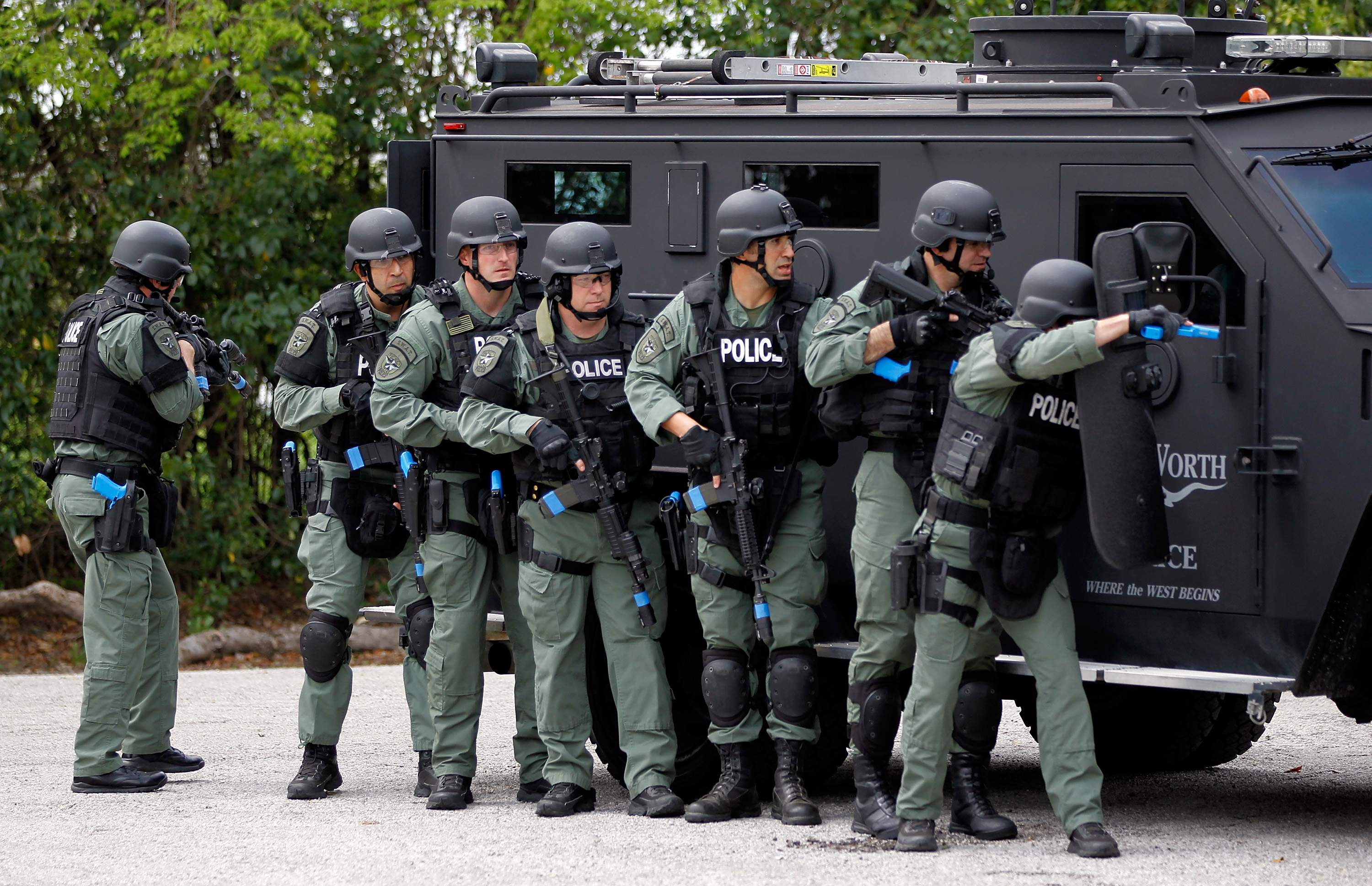
Shame on communities for not taking responsibility for using SWAT teams that are armed to the teeth and ready for action to deliver mere search warrants, terrorizing and killing American citizens.

Shame on those who embrace violence as an answer to what ails America for not taking responsibility for their part in contributing to an environment that is growing increasingly tense with every new shooting. It’s a vicious cycle in which the police are becoming more hypersensitive, twitchy and quick to shoot at the slightest provocation, and the populace is growing more fearful, outraged and unconvinced that if they “just obey,” all will be fine.

Shame on the religious community for not taking responsibility for its deafening silence in the face of what can only be termed evil, despite its historic lineage of dissenters such as Jesus, Gandhi, Martin Luther King Jr. who dared to speak truth to power.

Shame on white Americans, black Americans, brown Americans and every other skin tone in between for not taking responsibility for their part in allowing racism, prejudice and bigotry to dictate justice in America.

And shame on so-called “patriotic” Americans who equate good citizenship with blind obedience to government authority and adulation of the military for not taking responsibility for holding their government officials accountable to the nation’s founding principles. Remember, “we the people” were entrusted with the power to make and unmake the government whenever it ran afoul of its primary purpose, which is to protect our lives, freedoms and property.

Clearly, there’s more than enough blame to go around, but the real question is what can “we the people” do about it? What can average Americans do to stay alive and counter the violence being inflicted on our communities? What can you do to push back against the power of the police state?

For starters, let’s all agree that violence can never be the answer. Violence will only give rise to more violence.

Stop buying into the “us vs. them” rhetoric being pushed by politicians, police unions and those who use the race card as a justification for bloodshed. No matter what color your skin is, what politics you subscribe to, how much money you’ve got, whom you love, where you live, whom you worship, what school you attend, where you work, or any other superficial label that is used to divide us: we all bleed red.

Put your prejudices behind you and stop dealing in stereotypes. Not all police are bloodthirsty. Not all young black men are thugs. Not all people who challenge government authority want anarchy.

In a police state, you’re either the one with your hand on the trigger or you’re staring down the barrel of a loaded down. In other words, we’re all in this together. The oppression and injustice—be it in the form of shootings, surveillance, fines, asset forfeiture, prison terms, roadside searches, etc.—will come to all of us eventually.

Stop allowing yourself the luxury of distraction and the sin of neutrality. These things happen—the madness and the mayhem—because good people stood by and did nothing.

The only real power we have to push back against the police state is as a unified body.

So what can you do on a practical level?

For starters, find common ground on the issue of gun control, especially as it pertains to government agents. Demilitarize the police. It’s worked in other countries.

Demand that police be held financially responsible for official misconduct.

Put your taxpayer dollars to work for you instead of against you for a change. Tell your elected representatives to stop investing in militarization, wars and weaponry that will only be used against you eventually. Instead, apply the same funds being wasted on endless wars abroad on badly needed infrastructure here at home. By putting more Americans to work rebuilding our communities and our economy, we’ll also strike at the heart of the poverty that drives crime.

Get informed about the workings of government. Get outraged about the corruption that has rotted our republic from the core. Get vocal about the need for transparency, accountability and reform. There are so many issues in need of attention. Pick just one to start with and raise hell about it. For instance, why has the government been spending three times more on jails and prisons than schools for the past 30 years?

Finally, take it upon yourself to interfere. Pay attention to what’s going on around you. Use those cell phones that are never far from your side and record police interactions in order to hold them accountable to playing by our rules, the rules of the Constitution. Most important of all, take a stand for freedom and humanity.

“Neutrality,” as Holocaust survivor Elie Wiesel reminded us, “helps the oppressor, never the victim. Silence encourages the tormentor, never the tormented. Sometimes we must interfere. When human lives are endangered, when human dignity is in jeopardy, national borders and sensitivities become irrelevant. Wherever men and women are persecuted because of their race, religion, or political views, that place must – at that moment – become the center of the universe.”

“Our carceral state banishes American citizens to a gray wasteland far beyond the promises and protections the government grants its other citizens… When the doors finally close and one finds oneself facing banishment to the carceral state—the years, the walls, the rules, the guards, the inmates—reactions vary. Some experience an intense sickening feeling. Others, a strong desire to sleep. Visions of suicide. A deep shame. A rage directed toward guards and other inmates. Utter disbelief. The incarcerated attempt to hold on to family and old social ties through phone calls and visitations. At first, friends and family do their best to keep up. But phone calls to prison are expensive, and many prisons are located far from one’s hometown… As the visits and phone calls diminish, the incarcerated begins to adjust to the fact that he or she is, indeed, a prisoner. New social ties are cultivated. New rules must be understood.”—Ta-Nehisi Coates, TheAtlantic

In a carceral state—a.k.a. a prison state or a police state—there is no Fourth Amendment to protect you from the overreaches, abuses, searches and probing eyes of government overlords.

In a carceral state, there is no difference between the treatment meted out to a law-abiding citizen and a convicted felon: both are equally suspect and treated as criminals, without any of the special rights and privileges reserved for the governing elite.

In a carceral state, there are only two kinds of people: the prisoners and the prison guards.

With every new law enacted by federal and state legislatures, every new ruling handed down by government courts, and every new military weapon, invasive tactic and egregious protocol employed by government agents, “we the people”—the prisoners of the American police state—are being pushed that much further into a corner, our backs against the prison wall.

This concept of a carceral state in which we possess no rights except for that which the government grants on an as-needed basis is the only way I can begin to comprehend, let alone articulate, the irrational, surreal, topsy-turvy, through-the-looking-glass state of affairs that is being imposed upon us in America today.

Battlefield_Cover_300As I point out in my book Battlefield America: The War on the American People, we who pretend we are free are no different from those who spend their lives behind bars.

Indeed, we are experiencing much the same phenomenon that journalist Ta-Nehisi Coates ascribes to those who are banished to a “gray wasteland far beyond the promises and protections the government grants its other citizens” : a sickening feeling, a desire to sleep, hopelessness, shame, rage, disbelief, clinginess to the past and that which is familiar, and then eventually resignation and acceptance of our new “normal.”

All that we are experiencing—the sense of dread at what is coming down the pike, the desperation, the apathy about government corruption, the deeply divided partisanship, the carnivalesque political spectacles, the public displays of violence, the nostalgia for the past—are part of the dying refrain of an America that is fading fast.

No longer must the government obey the law.

Likewise, “we the people” are no longer shielded by the rule of law.

While the First Amendment—which gives us a voice—is being muzzled, the Fourth Amendment—which protects us from being bullied, badgered, beaten, broken and spied on by government agents—is being disemboweled.

For instance, in a recent 5-3 ruling in Utah v. Strieff, the U.S. Supreme Court opened the door for police to stop, arrest and search citizens without reasonable suspicion or probable cause, effectively giving police a green light to embark on a fishing expedition of one’s person and property, rendering Americans completely vulnerable to the whims of any cop on the beat.

Support the work of The Rutherford Institute with a tax-deductible donation today.

Support the work of The Rutherford Institute with a tax-deductible donation today.

In a blistering dissent, Justice Sonia Sotomayor blasted the court for holding “that the discovery of a warrant for an unpaid parking ticket will forgive a police officer’s violation of your Fourth Amendment rights.” Sotomayor continued:

This Court has allowed an officer to stop you for whatever reason he wants—so long as he can point to a pretextual justification after the fact. That justification must provide specific reasons why the officer suspected you were breaking the law, but it may factor in your ethnicity, where you live, what you were wearing, and how you behaved. The officer does not even need to know which law you might have brokenso long as he can later point to any possible infraction—even one that is minor, unrelated, or ambiguous.

The indignity of the stop is not limited to an officer telling you that you look like a criminal. The officer may next ask for your “consent” to inspect your bag or purse without telling you that you can decline. Regardless of your answer, he may order you to stand “helpless, perhaps facing a wall with [your] hands raised.” If the officer thinks you might be dangerous, he may then “frisk” you for weapons. This involves more than just a pat down. As onlookers pass by, the officer may “‘feel with sensitive fingers every portion of [your] body. A thorough search [may] be made of [your] arms and armpits, waistline and back, the groin and area about the testicles, and entire surface of the legs down to the feet.’”

If you still can’t read the writing on the wall, Sotomayor breaks it down further: “This case allows the police to stop you on the street, demand your identification, and check it for outstanding traffic warrants—even if you are doing nothing wrong… So long as the target is one of the many millions of people in this country with an outstanding arrest warrant, anything the officer finds in a search is fair game for use in a criminal prosecution. The officer’s incentive to violate the Constitution thus increases…”

Just consider some of the many other ways in which the Fourth Amendment—which ensures that the government can’t harass you, let alone even investigate you, without probable cause—has been weakened and undermined by the courts, the legislatures and various government agencies and operatives.

Breath tests, blood draws: Americans have no protection against mandatory breathalyzer tests at a police checkpoint, although mandatory blood draws violate the Fourth Amendment (Birchfield v. North Dakota).

Ignorance of the law is defensible if you work for the government: Police officers who violate the law can be granted qualified immunity if they claim ignorance of the law (Heien v. North Carolina). That rationale was also applied to police who clearly used excessive force when they repeatedly tasered a pregnant woman during a routine traffic stop and were granted immunity from prosecution (Brooks v. City of Seattle).

Highspeed car chases: Police officers can use lethal force in car chases without fear of lawsuits (Plumhoff v. Rickard).

Noknock raids: Police can perform a “no-knock” as long as they have a reasonable suspicion that knocking and announcing their presence, under the particular circumstances, would be dangerous or futile or give occupants a chance to destroy evidence of a crime (Richards v. Wisconsin). Legal ownership of a firearm is also enough to justify a no-knock raid by police (Quinn v. Texas).

Warrantless searches by police: Police can carry out warrantless searches on our homes based on a “reasonable” concern by police that a suspect (or occupant) might be attempting to destroy evidence, fleeing or hurt, even if it’s the wrong house (Kentucky v. King). Police can also, without a warrant, search anyone who has been lawfully arrested (United States v. Robinson) as well as their property post-arrest (Colorado v. Bertine) and their vehicle (New York v.Belton), search a car they suspect might contain evidence of a crime (Chambers v. Maroney), and search a home when the arrest is made on its premises (Maryland v. Buie).

Forced DNA extractions: Police can forcibly take your DNA, whether or not you’ve been convicted of a crime. Innocent or not, your DNA will then be stored in the national FBI database (Maryland v. King).

Strip searches: Police can subject Americans to virtual strip searches, no matter the “offense” (Florence v. Board ofChosen Freeholders of the County of Burlington). This “license to probe” is now being extended to roadside stops, as police officers throughout the country have begun performing roadside strip searches—some involving anal and vaginal probes—without any evidence of wrongdoing and without a warrant.

Seizures: For all intents and purposes, you’re “seized” within the meaning of the Fourth Amendment from the moment an officer stops you (Brendlin v. California).

Search warrants on a leash: Police have free reign to use drug-sniffing dogs as “search warrants on leashes,” justifying any and all police searches of vehicles stopped on the roadside (Florida v. Harris), but the use of a K-9 unit after a reasonable amount of time has passed during a stop does violate the Fourth Amendment (Rodriguez v. United States).

Police and DUI Checkpoints: Police can conduct sobriety and “information-seeking” checkpoints (Illinois v. Lidster andMich. Dept of State Police v. Sitz).

Interrogating public transit passengers: Police officers are free to board a bus, question passengers, and ask for consent to search without notifying them of their right to refuse (U.S v. Drayton).

Warrantless arrests for minor criminal offenses: Police can arrest you for minor criminal offenses, such as a misdemeanor seatbelt violation, punishable only by a fine (Atwater v. City of Lago Vista).

Stop and identify: Refusing to answer when a policeman asks “What’s your name?” can rightfully be considered a crime. No longer do Americans, even those not charged with any crime, have the right to remain altogether silent when stopped and questioned by a police officer (Hiibel v. Sixth Judicial District Court of the State of Nevada).

Traffic stops: As long as police have reasonable cause to believe that a traffic violation occurred, they may stop any vehicle (Whren v. U.S.). If probable cause justifies a vehicle search, then every part of the vehicle can be searched (U.S. v. Ross). A vehicle can be stopped even if the driver has not committed a traffic offense (U.S. v. Cortez).

Anonymous tips, careful driving, rigid posture and acne: Police officers can stop cars based only on “anonymous” tips (Navarette v. California). Police can also pull you over if you are driving too carefully, with a rigid posture, taking a scenic route, and have acne (U.S. v. Westhoven).

What many Americans fail to understand is the devastating amount of damage that can be done to one’s freedoms long before a case ever makes its way to court by government agents who are violating the Fourth Amendment at every turn. This is how freedoms, long undermined, can give way to tyranny through constant erosion and become part of the fabric of the police state through constant use.

Phone and email surveillance, databases for dissidents, threat assessments, terror watch lists, militarized police, SWAT team raids, security checkpoints, lockdowns, roadside strip searches: there was a time when any one of these encroachments on our Fourth Amendment rights would have roused the public to outrage. Today, such violations are shrugged off matter-of-factly by Americans who have been assiduously groomed to accept the intrusions of the police state into their private lives.

So when you hear about the FBI hacking into Americans’ computers without a warrant with the blessing of the courts, or states assembling and making public terror watch lists containing the names of those who are merely deemed suspicious, or the police knocking on the doors of activists in advance of political gatherings to ascertain their plans for future protests, or administrative government agencies (such as the FDA, Small Business Administration, Smithsonian, Social Security, National Oceanic and Atmospheric Administration, U.S. Mint, and Department of Education) spending millions on guns and ammunition, don’t just matter-of-factly file it away in that part of your brain reserved for things you may not like but over which you have no control.

It’s true that there may be little the average person can do to push back against the police state on a national level, but there remains some hope at the local level as long as we retain a speck of our independence and individuality—as long as we can resist the defeatist sense of double-consciousness (a phrase coined by W. E. B. Du Bois in which we view ourselves as inferior through the prism of our oppressors)—as long as we continue to cry out for justice for ourselves and those around us—as long as we refuse to be shackled and made prisoners—and as long as we continue to recognize that the only way the police state can truly acquire and retain power is if we relinquish it through our negligence, complacence and ignorance.

Unfortunately, we have been utterly brainwashed into believing the government’s propaganda and lies. Americans actually celebrate with perfect sincerity the anniversary of our independence from Great Britain without ever owning up to the fact that we are as oppressed now—more so, perhaps, thanks to advances in technology—than we ever were when Redcoats stormed through doorways and subjected colonists to the vagaries of a police state.

You see, by gradually whittling away at our freedoms—free speech, assembly, due process, privacy, etc.—the government has, in effect, liberated itself from its contractual agreement to respect our constitutional rights while resetting the calendar back to a time when we had no Bill of Rights to protect us from the long arm of the government.

Aided and abetted by the legislatures, the courts and Corporate America, the government has been busily rewriting the contract (a.k.a. the Constitution) that establishes the citizenry as the masters and agents of the government as the servants. We are now only as good as we are useful, and our usefulness is calculated on an economic scale by how much we are worth—in terms of profit and resale value—to our “owners.”

Under the new terms of this one-sided agreement, the government and its many operatives have all the privileges and rights and “we the prisoners” have none.

As Sotomayor concluded in her ringing dissent in Utah v. Strieff:

By legitimizing the conduct that produces this double consciousness, this case tells everyone, white and black, guilty and innocent, that an officer can verify your legal status at any time. It says that your body is subject to invasion while courts excuse the violation of your rights. It implies that you are not a citizen of a democracy but the subject of a carceral state, just waiting to be cataloged. We must not pretend that the countless people who are routinely targeted by police are “isolated.” They are the canaries in the coal mine whose deaths, civil and literal, warn us that no one can breathe in this atmosphere. They are the ones who recognize that unlawful police stops corrode all our civil liberties and threaten all our lives. Until their voices matter too, our justice system will continue to be anything but.


The original post can be found here.

11589153-dark-prison-cell-at-night-stock-photo-jail

“Those who corrupt the public mind are just as evil as those who steal from the public purse.”—Adlai Stevenson, 23rd Vice President of the United States

If you’ve been caught up in the circus that is the presidential election, you’ve likely missed the latest news about all the ways in which the government continues to erode our freedoms, undermine our sovereignty, abuse our trust, invade our homes, invade our privacy, destroy our property, hijack our bank accounts, and generally render itself above the law.

Then again, this is all par for the course from a militaristic government that is armed to the teeth, wages war against its own people, imprisons its citizens for profit, marches in lockstep with the corporate elite, and treats human beings as little more than cattle to be branded, bought, sold and butchered.

The following incidents constitute a typical week in the life of the American police state.

Not content with merely spying on our emails and phone calls, the NSA wants to spy on thermostats, refrigerators, and pacemakers.

Reinforcing fears about how easily surveillance technology can be abused by government officials, local police in California are using money acquired through asset forfeiture to buy surveillance equipment that was then used to blackmail city council members.

Small-town police departments continue to militarize their forces, acquiring military equipment such as BearCat armored vehicles and SWAT teams at an alarming rate.

According to the Government Accountability Office, the majority of people in the government’s criminal face-recognition database have never committed a crime.

The private prison business is booming, signaling a profitable windfall for investors and a death knell for any American unfortunate enough to run afoul of the many laws criminalizing otherwise legitimate behavior such as growing a garden on one’s front lawn or hosting a Bible study in one’s backyard.

In fact, one Florida couple recently sued their town council after being threatened with fines under a law banning front-yard gardens.

The Second Circuit Court of Appeals recently ruled that as long as the government shows “good faith,” it can search your digital files as much as it wants.

The FBI and other government agencies have been hiding cameras in city utility poles in order to carry out warrantless, covert surveillance on Americans.

The USDA and EPA have been using SWAT teams to conduct raids on raw milk producers, beekeepers and lemon growers, among others.

donatenow-sam

Support the work of The Rutherford Institute with a tax-deductible donation today.

The Eighth Circuit Court of Appeals has ruled that Americans have no expectation of privacy when it comes to credit card magnetic strips. Translation: swiping a credit card to determine its legitimacy is not a search under the Fourth Amendment.

Sex scandals involving police officers—the latest involving police and sex workers in California—are revealing yet another sordid side of the abuses being perpetrated by government officials as they carry out their “official” duties.

The University of Oklahoma is preparing to launch a 24/7 hotline for students to report incidents of microaggressions and bias.

The government’s active shooter, crisis actor terror drills continue to blur the line between what is real and staged. In Fenway Park, a multi-agency counterterrorism exercise managed to fool even local media with its simulated explosions and gunfire, reports of active shooters and bombs, bomb-sniffing dogs, and fake victims, blood smeared on their faces, running from the park with hands in the air.

The Drug Enforcement Administration is fighting for warrantless access to Americans’ private medical files, including what prescriptions you might be on, as part of its so-called war on drugs.

Two police training academies have been suspended for what appears to be teaching the use of excessive force.

Belying its claims of neutrality, among the 426 organizations the IRS has been accused of targeting for increased scrutiny, a large subsection of the groups have the word “tea” in their name, 33 have “patriot,” 26 refer to “liberty,” and several others have “occupy” in their name.

The FBI is pushing Congress for access to Internet browser history without a warrant. The agency also wants to keep its biometric database secret and exempt from privacy laws.

Using video analytics technology that can detect “suspicious” behavior, the government is looking to tap into surveillance cameras in order to identify “people and objects who could present a threat, or individuals and items that might have been involved in a past crime.”

According to recent figures, people with severe untreated mental illness are 16 times more likely to be killed in a police encounter.

Michigan is creating a pilot program to allow police to carry out roadside drug testing, opening the door to further forced searches in violation of a driver’s right to bodily integrity.

If a new tech start-up gets its way, landlords and employers will eventually be able to strip-mine intimate data from your Facebook page, including entire conversation threads and private messages.

Facebook may also be listening in on your phone conversations all of the time.

According to EPA data, drinking water sources in communities across America may be contaminated beyond what is being reported.

Despite government efforts to appear transparent and receptive to input on its drone programs, secret documents reveal that the government’s secret drone task force ignored public concerns about drone surveillance.

Taking the risk of government surveillance to all-new levels and moving us that much closer to realizing the fictional world of Minority Report, “biohackers” are putting microchips and magnets in their bodies to enable them to communicate electronically with their surroundings.

Further legitimizing corrupt asset forfeiture schemes, the Texas Supreme Court has ruled that law enforcement can seize private property that was used in the commission of a crime, even if evidence of wrongdoing was illegally obtained by police.

Despite a mounting body of evidence—and dead bodies—proving that tasers can kill, police officers continue to use the so-called nonlethal weapons recklessly, leaving those victims who survive the shock permanently disabled.

As a testament to the transformation of the nation’s public schools into quasi-prisons, more than 1.6 million high school students now attend schools with police on campus but not a single guidance counselor.

In Oklahoma, highway patrols are rolling out a new asset forfeiture program that allows them to access and transfer any funds on prepaid credit cards directly to police bank accounts.

Finally, in a recent interview, former congressman Ron Paul voiced what so many of us have  been warning for years now: we no longer really have democracy in America.

Battlefield_Cover_300Rather, as I point out in my book Battlefield America: The War on the American People, what we have is a political distraction that keeps us oblivious to the steady advance of the police state, deaf to the cries of its victims, blind to the damage its wreaking on our communities and silent in the face of tyranny.

As always, I am asked: what can Americans do about the incessant assault on their freedoms?

For starters, wake up. Stop allowing yourselves to be easily distracted by pointless political spectacles and pay attention to what’s really going on in the country.

The real battle in 2016 for control of this nation is not being waged between Republicans and Democrats in the ballot box. The real battle for control of this nation is taking place on roadsides, in police cars, on witness stands, over phone lines, in government offices, in corporate offices, in public school hallways and classrooms, in parks and city council meetings.

Wake up, America. The real battle between freedom and tyranny is taking place right in front of our eyes, if we would only open them.

“The evil was not in bread and circuses, per se, but in the willingness of the people to sell their rights as free men for full bellies and the excitement of the games which would serve to distract them from the other human hungers which bread and circuses can never appease.” — Admiral Ben Moreell (1892 – 1978), chief of the U.S. Navy’s Bureau of Yards and Docks and of the Civil Engineer Corps

As the grandfather of three young ones, ages 5 to 9, I get to see my fair share of kid movies: plenty of hijinks, lots of bathroom humor, and an endless stream of slapstick gags. Yet even among the worst of the lot, there’s something to be learned, some message being conveyed, or some aspect of our reality being reflected in celluloid.

So it was that I found myself sitting through The Angry Birds Movie on a recent Sunday afternoon, doling out popcorn, candy and drinks and trying to make sense of a 90-minute movie based on a cell phone video game that has beendownloaded more than 3 billion times.

The storyline is simple enough: an island nation of well-meaning, feel-good, flightless birds gets seduced by a charismatic green pig and his cohort who comes bearing food, wine and entertainment spectacles (the Roman equivalent of bread circuses). Ignoring the warnings of one solitary, suspicious “angry” bird that the pigs are up to no good, the clueless birds eventually discover that the pigs have stolen their most precious possessions: their eggs, the future of their entire society. It takes the “angry bird” to motivate the normally unflappable Bird Nation to get outraged enough to do something about the violation of their trust by the pigs and the theft of their personal property.

While one would be hard-pressed to call The Angry Birds Movie overly insightful, it is, as The Atlantic concludes, a “feather-light metaphor for our times… The film functions, effectively, as a fairy tale: It uses its status as fantasy to impart lessons about reality.”

It turns out that we’re no different from the wine-guzzling, food-noshing, party-loving Bird Nation. We too are easily fooled by charismatic politicians bearing gifts. And we too are easily distracted as those same politicians and their cohorts rob us blind.

Case in point: while Barack Obama winds down his presidency with a flurry of celebrity-studded events that is causing the media to hail him as the “coolest” president, and the presidential candidates continue to distract us with spectacular feats of chest-thumping, browbeating and demagoguery, the police state continues its steady march onward.

All of the revelations of government wrongdoing, spying and corruption disclosed by NSA whistleblower Edward Snowdenseem to have fallen on deaf ears.

Nothing has improved or changed for the better.

There has been no real reform, no significant attempts at greater transparency, no accountability, no scaling back of the government’s warrantless, illegal domestic surveillance programs, and no recognition by Congress or the courts that the Fourth Amendment provides citizens with any protection against unreasonable searches and seizures by government agents.

In fact, as I point out in my book Battlefield America: The War on the American People, we’ve been subject to even more obfuscation, even more lies, even more sleight-of-hand maneuvers by government agencies determined to keep doing what they’re doing without any restrictions on their nefarious activities, and even more attempts by government agencies to listen in our phone calls, read our emails and text messages, monitor our movements, and generally imprison us within an electronic concentration camp.

Writing for the New Yorker, investigative reporter Maria Bustillos concludes, “the machinery of our government seems to have taken on an irrational life of its own. We live in a surreal world in which a ‘transparent’ government insists on the need for secret courts; our President prosecutes whistle-blowers and maintains a secret ‘kill list’; and private information is collected in secret and stored indefinitely by intelligence agencies.”

It’s no coincidence that almost exactly three years after Snowden began his steady campaign to leak documents about the government’s illegal surveillance program, Congress is preparing to adopt legislation containing a secret provision that would expand the FBI’s powers to secretly read Americans’ emails without a court order.

Yes, you read that correctly.

The government is planning to push through secret legislation that would magnify its ability to secretly spy on us without a warrant.

After three years of lying to us about the real nature of the government’s spying program, feigning ignorance, dissembling, and playing at enacting real reforms, it turns out that what the government really wants is more power, more control and more surveillance.

A secret provision tacked onto the 2017 Intelligence Authorization Act will actually make it easier for the government to spy on Americans’ emails as well as their phone calls.

If enacted, this law would build upon the Patriot Act’s authorization of National Security Letters (NSL) which allows the FBI to secretly demand—without prior approval from a judge and under a gag order that carries the penalty of a prison sentence—that banks, phone companies, and other businesses provide them with customer information and not disclose the demands to the person being investigated or even indicate that they have been subjected to an NSL.

As Reuters reports, federal agencies do not need a warrant to access emails or other digital communications more than 180 days old due to a provision in a 1986 law that considers them abandoned by the owner. However, legislative efforts to require government authorities to obtain a search warrant before accessing old emails have been turned on their head by the insertion of this secret provision giving the FBI carte blanche access to Americans’ emails.

As if the FBI didn’t have enough corrupt tools in its bag of tricks already.

NSLs—in existence since the 1970s—empower FBI operatives to delve into Americans’ most personal affairs based only on the say-so of an agency that has come to be known as America’s Gestapo, or secret police. Incredibly, all the FBI needs to assert in order to justify such a search is that the information sought is relevant to a national-security investigation.

Nicholas Merrill can tell you all about NSLs. The head of a web-hosting company, he challenged the FBI’s unwarranted request for information on one of his customers and its companion gag order. Only after the FBI withdrew its request and a subsequent court-ordered lifting of the gag order was Merrill able to share his experiences. As Merrill recounts:

It was not a warrant. It was not stamped or signed by a court or a judge. It was this letter demanding this information from me. And it also told me that I could never tell anyone that I had gotten the letter. It said that I could tell ‘no person.’ The amount of information that the government can get with one of these letters can paint an incredibly vivid picture of all aspects of a person’s life — from the professional, to the personal, to the political, to their religious beliefs, to invading the privacy of their marriage, to being able to figure out what their sexual preference is. The amount of information that comes out of a national security letter is just so invasive. The fact that the government has been treating it so casually, and essentially going out on mass fishing expeditions and gathering the data of potentially millions of Americans without any suspicion of wrongdoing is very upsetting to me as someone who was raised on ideas about American exceptionalism and the belief that our system of government — with its built-in checks and balances and safeguards against abuse — were what made our country different from other countries.

Clandestine requests. Broad powers. Minimal insight. Intimidation tactics.

That’s how the FBI’s use of NSLs are described, but it can easily be applied to the government-at-large and its voracious quest for ever-greater powers without any real accountability to the citizenry or any adherence to the rule of law.

It’s estimated that the FBI issues approximately 40,000 to 60,000 such NSLs per year and that number is growing.

In 2008, the Justice Department’s inspector general revealed that the FBI had been abusing its NSL authority by making improper requests, collecting more data than they were allowed to, not having proper authorization to proceed with a case, and attempting to sidestep the Foreign Intelligence Surveillance Court, the secret court charged with overseeing the government’s secret surveillance program. In one case, after having its search request denied by the FISA Court on the basis that “the ‘facts’ were too thin” and the “request implicated the target’s First Amendment rights,” the FBI used its NSL power to carry out its surveillance.

Even after being called on the carpet for abusing its information-gathering powers, the FBI continued to flout the very laws put in place to keep government abuses in check.

Incredibly, Barack Obama criticized President Bush for his administration’s mass government surveillance programsonly to fully embrace them once he himself had attained the White House. Indeed, the Obama administration has been lobbying for years to expand the FBI’s use of NSLs to include emails.

Now, here we are, eight years later, and we’re still being treated like the gullible birds in The Angry Birds Movie, easily pacified with bread, easily distracted by circuses, and easily robbed of our most precious possessions—our freedoms, our privacy and our right to have a government that abides by the rule of law and answers to us.

There are many ways of reacting to this latest news about the government’s treachery.

You can subscribe to the simplistic, head-in-the-sand routine and do as one of my so-called Facebook “friends” suggests and just obey the law, hoping that it will keep you out of the government’s clutches, but that’s no guarantee of safe passage. Of course, that will mean knowing the law—federal, state and local—in all of its convoluted, massive, growing permutations, understanding that overcriminalization has resulted in the average person unknowingly committing three crimes a day. As author Harvey Silvergate points out, even the most honest and informed citizen “cannot predict with any reasonable assurance whether a wide range of seemingly ordinary activities might be regarded by federal prosecutors as felonies.” For instance, you could be charged criminally for receiving an odd package, taking a fake sick day, reporting on government wrongdoing based on an anonymous source, or creating a website for a religious charity.

You can insist that such concessions to security are making us safer, even though facts suggest otherwise.Barring a few notable exceptions, the politicians are singing the same tune: security at any cost. The NSL provision sailed past the 15-member Senate Intelligence Committee with only Sen. Ron Wyden (D-Ore.) dissenting. In a joint statement that underscores the ease with which the Republicans and Democrats work together in order to sell us out, Chairman Richard Burr (R-NC) and Vice Chairman Dianne Feinstein (D-Calif.) declared the expanded powers necessary to “keep America safe” and “vital” in order to “provide intelligence agencies with all the resources they need to prevent attacks both at home and abroad.”

This whole line of reasoning, as Nicholas Merrill explains, is hogwash. As he points out, the terrorist attacks in Paris were carried out by individuals “communicating without the use of any type of security or encryption. They were speaking in Facebook groups and using regular text messaging on their phones, without taking any steps to cover their tracks or make it harder to listen in on what they were doing. To me this proves that the whole dragnet surveillance system that we’ve built is actually useless, because it didn’t help us at all to prevent that type of attack.”

In other words, government spying isn’t making us safer, but it is making us less free. “In the end we’ve lost part of our freedom that maybe we’ll never get back. We’ve lost some part of what makes our system great, but in the end we’ve not really gained the security we thought we would get in the tradeoff for the freedom that we’ve given up.”

You can cast your ballot for one of the many slogan-spouting politicians who are long on lies and short on loyalty to their constituents. At the end of the day, these people work for the government and their primary purpose is to remain in office, living the kind of rarefied, pampered, privileged life that the average American only gets to dream about. Every one of the members of the Senate Intelligence Committee who voted for this legislation is a traitor to their oath of office and should be booted off that committee. What’s more, any member of Congress who votes for this legislation should be sent packing back to where they came from. As Brewster Kahle, another recipient of an NSL who successfully challenged the government’s gag order, reminds us, “The government is not one monolithic thing. It’s a bunch of people, thinking they’re doing their jobs.” It’s our job to make them toe the line when their thinking goes awry.

Or you can stop drinking the happy juice, stop believing the politicians’ lies, stop being so gallingly gullible and out to lunch, and start getting angry. In our politically correct, feel-good, play nice culture, anger has gotten a bad rap, but there’s something to be said for righteous anger acted upon in a nonviolent, effective fashion. It’s what Martin Luther King Jr. referred to as “military nonviolent resistance.” It means caring enough to get off your caboose, get on your feet and get actively involved in holding government officials accountable to the simple fact that they work for “we the people.”

It’s not an easy undertaking.

The government has been playing fast and loose with the rules for too long now, and its greed for power and riches is boundless.

Still we are not powerless, although the government’s powers grow daily. We have not yet been altogether muzzled, although the acts of censorship increase daily. And we have not yet lost all hope for restoring our republic, although the outlook appears bleaker by the day.

For the moment, we still have some small allotment of freedoms by which we can express our displeasure, push back against injustice and corruption, and resist tyranny. One Texas man, outraged at being fined $212 for driving 39 in a 30 mph zone, chose to pay his fine with 22,000 pennies. It was a small act of disdain in the face of a government machine that tolerates little resistance, but it was acts such as these that sowed the early seeds of resistance that birthed this nation.

As revolutionary patriot Samuel Adams observed, “It does not take a majority to prevail… but rather an irate, tireless minority, keen on setting brushfires of freedom in the minds of men.”


Support the work of The Rutherford Institute with a tax-deductible donation today.

Support the work of The Rutherford Institute with a tax-deductible donation today.

“What are the defenders of free speech to do? The sad fact is that this fundamental freedom is on its heels across America. Politicians of both parties want to use the power of government to silence their foes. Some in the university community seek to drive it from their campuses. And an entire generation of Americans is being taught that free speech should be curtailed as soon as it makes someone else feel uncomfortable. On the current trajectory, our nation’s dynamic marketplace of ideas will soon be replaced by either disengaged intellectual silos or even a stagnant ideological conformity. Few things would be so disastrous for our nation and the well-being of our citizenry.”—William Ruger, “Free Speech Is Central to Our Dignity as Humans

As a nation, we have a tendency to sentimentalize cultural icons in death in a way that renders them non-threatening, antiseptic and easily digested by a society with an acute intolerance for anything controversial, politically incorrect or marred by imperfection.

This revisionist history—a silent censorship of sorts—has proven to be a far more effective means of neutralizing radicals such as Martin Luther King Jr. than anything the NSA, CIA or FBI could dream up.

In life, King called for Americans to rise up against a government that was not only treating blacks unfairly but was also killing innocent civilians, impoverishing millions, and prioritizing the profits of war over human rights and dignity. This was a man who went to jail over racial segregation laws, encouraged young children to face down police dogs and water hoses, and who urged people to turn their anger loose on the government through civil disobedience. King actually insisted that people have a moral responsibility to disobey unjust laws.

In death, however, King has been reduced to a face on a national monument and a national holiday, neither of which even hint at the true nature of the man: fiery, passionate, single-minded in his pursuit of justice, unwilling to remain silent in the face of wrongdoing, and unafraid of offending those who might disagree with him.

A contemporary of King’s, heavy-weight championship boxer Muhammad Ali followed a different path as a social activist and “breaker of boundaries.” Like King, Ali didn’t pull any punches when it came to saying what he believed and acting on it. Yet already, in the wake of Ali’s passing, we’re being treated to a sentimentalized version of the heavy-weight boxer.

In life, Ali was fast-talking, fast-moving and as politically incorrect as they come. He became an early convert to the Nation of Islam, a black separatist religious movement whose membership at one time included Malcolm X and Louis Farrakhan. He denounced his “slave name” (Cassius Marcellus Clay) and refused to be the “white man’s Negro.”

He was stripped of his boxing title, arrested and threatened with five years in prison and a fine of $10,000 after refusing to be drafted into the Army as a conscientious objector to the Vietnam War. “My conscience won’t let me go shoot my brother, or some darker people, or some poor hungry people in the mud for big powerful America,” declared Ali. “And shoot them for what? They never called me nigger, they never lynched me, they didn’t put no dogs on me, they didn’t rob me of my nationality, rape and kill my mother and father. … Shoot them for what? How can I shoot them poor people? Just take me to jail.”

As First Amendment scholar David L. Hudson Jr. notes, “Ali’s remarkable career and life placed him at the vortex of these First Amendment freedoms… Ali freely exercised his religious faith. He regularly spoke provocatively on a variety of topics. The press was abuzz with coverage and criticism. Thousands assembled in support of him, and the champion himself took part in rallies, parades and marches. Some petitioned the government to redress the injustice of his conviction for refusing military service, which resulted in his being exiled from the boxing ring for his beliefs.”

It took a legal battle all the way to the U.S. Supreme Court for Ali’s religious objections to serving in the Army to be given credence and his First Amendment arguments to prevail. The case was Clay v. United States.

That was in 1971.

Forty-five years later, Ali is dead, fear is alive, and free speech is being dealt one knock-out punch after another.

Indeed, talk-show celebrity Piers Morgan has been soundly trounced and roundly censured for daring to suggest that Ali—a champion of the First Amendment who liberally peppered his speech with words (nigger and Uncle Tom) and opinions (“the white man is the Devil“ and “I’m sure no intelligent white person watching this show … want black boys and black girls marrying their white sons and daughters“) that would horrify most of his politically correct fans—made more “inflammatory/racist” comments than Donald Trump.

Speaking of Trump, in Fresno, California, a third-grader was ordered to remove his pro-Trump “Make America Great Again” hat because school officials feared for his safety. The 9-year-old boy refused, citing the First Amendment.

That was the same argument—a concern for safety—officials used in 2010 when they ordered several high school students to remove their t-shirts emblazoned with the American flag. The concern: wearing the flag on Cinco de Mayo, a Mexican day of celebration, might offend Hispanic students attending the school. The U.S. Supreme Court agreed with the school’s logic. Coincidentally, that same week, the high court also ruled against Confederate flag license plates on the grounds that they constituted government speech and might be offensive to African-Americans.

For those of us who came of age in the 1960s, college campuses were once the bastion of free speech, awash with student protests, sit-ins, marches, pamphleteering, and other expressive acts showing our displeasure with war, the Establishment and the status quo.

Today, on college campuses across the nation, merely chalking the word “Trump” on the sidewalk is enough to have student groups crying foul and labeling it as hate speech in need of censorship. Under the misleading guise of tolerance, civility, love and political correctness, college campuses have become hotbeds of student-led censorship, trigger warningsmicroaggressions, and “red light” speech policies targeting anything that might cause someone to feel uncomfortable, unsafe or offended.

As I point out in my book Battlefield America: The War on the American People, this doesn’t even begin to touch on the criminalization and surveillance of various forms of speech that the government deems to be hateful, anti-government, extremist, bullying, dangerous or inflammatory.

One could say that we have allowed our fears—fear for our safety, fear of each other, fear of being labeled racist or hateful or prejudiced, etc.—to trump our freedom of speech and muzzle us far more effectively than any government edict could.

Ultimately the war on free speech—and that’s exactly what it is: a war being waged by Americans against other Americans—is a war that is driven by fear.

America is in the midst of an epidemic of historic proportions. The contagion being spread like wildfire is turning communities into battlegrounds and setting Americans one against the other. Normally mild-mannered individuals caught up in the throes of this disease have been transformed into belligerent zealots, while others inclined to pacifism have taken to stockpiling weapons and practicing defensive drills.

This plague on our nation—one that has been carefully cultivated and spread by the powers-that-be—is a potent mix of fear coupled with unhealthy doses of paranoia and intolerance, tragic hallmarks of the post-9/11 America in which we live.

Everywhere you turn, those on both the left- and right-wing are fomenting distrust and division. You can’t escape it. We’re being fed a constant diet of fear: fear of terrorists, fear of illegal immigrants, fear of people who are too religious, fear of people who are not religious enough, fear of the government, fear of those who fear the government. The list goes on and on.

The strategy is simple yet brilliant: the best way to control a populace is through fear and discord. Confound them, distract them with mindless news chatter and entertainment, pit them against one another by turning minor disagreements into major skirmishes, and tie them up in knots over matters lacking in national significance. Most importantly, keep the people divided so that they see each other as the enemy and screaming at each other so that they drown out all other sounds. In this way, they will never reach consensus about anything or hear the corporate state as it closes in on them.

This is how a freedom-loving people enslave themselves and allow tyrants to prevail.

This Machiavellian scheme has so ensnared the nation that few Americans even realize they are being manipulated into adopting an “us” against “them” mindset. Instead, fueled with fear and loathing for phantom opponents, they pour millions of dollars and resources into political elections, hoping for change that never comes. All the while, those in power—bought and paid for by lobbyists and corporations—move their costly agendas forward, and “we the suckers” get saddled with the tax bills.

We have been down this road before.

A classic example is the fear and paranoia that gripped the country during the 1950s. Many huddled inside their homes and fallout shelters, awaiting a nuclear war. It was also the time of the Red Scare. The enemy this time was Communist infiltration of American society.

Joseph McCarthy, a young Republican senator, grasped the opportunity to capitalize on the popular paranoia for personal national attention. In a speech in February 1950, McCarthy alleged having a list of over 200 members of the Communist Party “working and shaping the policy of the U.S. State Department.” The speech was picked up by the Associated Press, without substantiating the facts, and within a few days the hysteria began.

McCarthy specialized in sensational and unsubstantiated accusations about Communist infiltration of the American government, particularly the State Department. He also targeted well-known Hollywood actors and directors, trade unionists and teachers. Many others were brought before the inquisitional House Committee on Un-American Activities for questioning. Regarded as bad risks, the accused struggled to secure employment. The witch hunt ruined careers, resulting in suicides, and tightened immigration to exclude alleged subversives.

“McCarthyism” eventually smeared all the accused with the same broad brush, whether the evidence was good, bad or nonexistent. McCarthy, like many do today, appealed to the low instincts of envy, paranoia and dislike for the intellectual establishment.

“The real scoundrel in all this,” writes historian David Halberstam, “was the behavior of the members of the Washington press corps, who, more often than not, knew better. They were delighted to be a part of his traveling road show, chronicling each charge and then moving on to the next town, instead of bothering to stay behind and follow up. They had little interest in reporting how careless McCarthy was or how little it all meant to him.”

However, on March 9, 1954, Edward R. Murrow, the most-respected newsman on television at the time, broke the ice. He attacked McCarthy on his weekly show, See It Now. Murrow interspersed his own comments and clarifications into a damaging series of film clips from McCarthy’s speeches. Murrow ended the broadcast with one of the greatest news commentaries of all time, also a warning.

We will not walk in fear, one of another. We will not be driven by fear into an age of unreason, if we dig deep in our history and our doctrine; and remember that we are not descended from fearful men. Not from men who feared to write, to speak, to associate, and to defend causes that were for the moment unpopular.

This is no time for men who oppose Senator McCarthy’s methods to keep silent, or for those who approve. We can deny our heritage and our history, but we cannot escape responsibility for the result. There is no way for a citizen of a republic to abdicate his responsibilities. As a nation we have come into our full inheritance at a tender age. We proclaim ourselves, as indeed we are, the defenders of freedom, wherever it continues to exist in the world, but we cannot defend freedom abroad by deserting it at home. The actions of the junior Senator from Wisconsin have caused alarm and dismay amongst our allies abroad, and given considerable comfort to our enemies. And whose fault is that? Not really his. He didn’t create this situation of fear; he merely exploited it—and rather successfully. Cassius was right. ”The fault, dear Brutus, is not in our stars, but in ourselves.” 

Support the work of The Rutherford Institute with a tax-deductible donation today.

Support the work of The Rutherford Institute with a tax-deductible donation today.

Whether you’re talking about free speech, surveillance, police misconduct or some other symptom of a government that has grown drunk on its own power, the answer is always the same: “we the people.”

We need to reject fear as our guiding principle, and restore freedom to its rightful place at the center of our republic.

As William Ruger writes in a powerful editorial for Time:

We must vigorously re-make the case for free speech. We must recur to its great defenders from ages past and reintroduce their ideas to our fellow Americans. The wisdom of John Milton, John Locke and John Stuart Mill—not to mention that of Americans like George Mason and Justice Louis Brandeis—is as true today as it was in their times. We just have to remember it… we must transmit an understanding of the value of free speech to today’s Americans in order to ensure that it is protected for future generations. And perhaps even more importantly, we need to demonstrate a vigorous commitment to free speech. America’s success depends on whether we continue to embrace this fundamental freedom.

“The horror… the horror…”—Apocalypse Now (1979)

“You can’t show war as it really is on the screen, with all the blood and gore. Perhaps it would be better if you could fire real shots over the audience’s head every night, you know, and have actual casualties in the theater.”—Sam Fuller, film director and author

Nearly 71 years ago, the United States unleashed atomic bombs on the Japanese cities of Hiroshima and Nagasaki,killing more than 200,000 individuals, many of whom were civilians.

Fast forward to the present day, and President Obama—the antiwar candidate and Nobel Peace Prize winner who haswaged war longer than any American president and whose legacy includes targeted-drone killings and at least 1.3 million lives lost to the U.S.-led war on terror—is paying lip service to the victims of America’s nuclear carnage, all the while continuing to feed the war machine.

America has long had a penchant for endless wars that empty our national coffers while fattening those of the military industrial complex. Since 9/11, we’ve spent more than $1.6 trillion to wage wars in Afghanistan and Iraq. Adding in our military efforts in Pakistan, as well as the lifetime price of health care for disabled veterans and interest on the national debt, that cost rises to $4.4 trillion. Even now, the war drums are sounding as Obama prepares to deploy U.S. troops on a long-term mission to Libya and continues to police the rest of the world with more than 1.3 million U.S. troops being stationed at roughly 1000 military bases in over 150 countries.

Battlefield_Cover_300To this end, as I point out in my book Battlefield America: The War on the American People, Americans are fed a steady diet of pro-war propaganda that keeps them content to wave flags with patriotic fervor and less inclined to look too closely at the mounting body counts, the ruined lives, the ravaged countries, the blowback arising from ill-advised targeted-drone killings and bombing campaigns in foreign lands, and the transformation of our own homeland into a warzone.

Nowhere is this double-edged irony more apparent than during military holidays such as Memorial Day, when we get treated to a generous serving of praise and grandstanding by politicians, corporations and others with similarly self-serving motives eager to go on record as being pro-military.

Yet war is a grisly business, a horror of epic proportions. In terms of human carnage alone, war’s devastation is staggering. For example, it is estimated that approximately 231 million people died worldwide during the wars of the 20th century. This figure does not take into account the walking wounded—both physically and psychologically—who “survive” war.

War drives the American police state. The military-industrial complex is the world’s largest employer. War sustains our way of life while killing us at the same time. As Pulitzer Prize-winning war correspondent and author Chris Hedges observes:

War is like a poison. And just as a cancer patient must at times ingest a poison to fight off a disease, so there are times in a society when we must ingest the poison of war to survive. But what we must understand is that just as the disease can kill us, so can the poison. If we don’t understand what war is, how it perverts us, how it corrupts us, how it dehumanizes us, how it ultimately invites us to our own self-annihilation, then we can become the victim of war itself.

War also entertains us with its carnage, its killing fields, its thrills and chills and bloodied battles set to music and memorialized in books, on television, in video games, and in superhero films and blockbuster Hollywood movies financed in part by the military.

War has become a centerpiece of American entertainment culture, most prevalent in war movies.

War movies deal in the extremes of human behavior. The best films address not only destruction on a vast scale but also plumb the depths of humanity’s response to the grotesque horror of war. They present human conflict in its most bizarre conditions—where men and women caught in the perilous straits of death perform feats of noble sacrifice or dig into the dark battalions of cowardice.

War films also provide viewers with a way to vicariously experience combat, but the great ones are not merely vehicles for escapism. Instead, they provide a source of inspiration, while touching upon the fundamental issues at work in wartime scenarios.

While there are many films to choose from, the following 10 war films touch on modern warfare (from the First World War onward) and run the gamut of conflicts and human emotions and center on the core issues often at work in the nasty business of war.

The Third Man (1949). Carol Reed’s The Third Man, which deals primarily with the after-effects of the ravages of war, is a great film by anyone’s standards. Set in postwar Europe, this bleak film (written by Graham Greene) sets forth the proposition that the corruption inherent in humanity means that the ranks of war are never closed. There are many fine performances in this film, including Orson Welles, Joseph Cotten and Alida Valli.

Paths of Glory (1957). This Stanley Kubrick film is an antiwar masterpiece. The setting is 1916, when two years of trench warfare have arrived at a stalemate. And while nothing of importance is occurring in the war, thousands of lives are being lost. But the masters of war pull the puppet strings, and the blood continues to flow. This film is packed with good performances, especially from Kirk Douglas and George Macready.

The Manchurian Candidate (1962). John Frankenheimer’s classic focuses on the psychological effects of war and its transmutation into mind control and political assassination. All the lines of intrigue converge to form a prophetic vision of what occurred the year after the film’s release with the assassination of John F. Kennedy. This chilling film is well written (co-written by Frankenheimer and George Axelrod) and acted. Frank Sinatra, Laurence Harvey and Angela Lansbury head a fine cast.

Dr. Strangelove, Or: How I Learned To Stop Worrying And Love The Bomb (1964). One of the great films of all time, Stanley Kubrick’s Dr. Strangelove burst onto the cinematic landscape and cast a cynical eye on the entire business of war. Strange and surreal, this film is packed full of amazing images and great performances. Peter Sellers should have walked off with the Oscar for best actor (but he didn’t). Sterling Hayden and George C. Scott are excellent in support.

The Deer Hunter (1978). Michael Cimino’s Academy Award-winning film is one of the most emotion-invoking films ever made. This story of a group of Pennsylvania steel mill workers who endure excruciating ordeals in the Vietnam War is one film that makes its point clear—war is the horror of all horrors. Robert DeNiro is fine, and Christopher Walken, who won a best supporting actor Oscar, is superb.

Apocalypse Now (1979). I consider this Francis Ford Coppola’s best film. Based on Joseph Conrad’s novella, The Heart of Darkness, Captain Willard (Martin Sheen) treks to the Cambodian jungle to assassinate renegade, manic Colonel Kurtz (Marlon Brando). This antiwar epic is a great visual experience with fine performances from its ensemble cast.

Platoon (1986). This is not Oliver Stone’s best film, but it is one helluva war movie. Set before and during the Tet Offensive of January 1968, this is a gritty view of the Vietnam War by one who served there. Indeed, when Stone is not filling the screen with explosions, he makes the jungle seem all too real—a wet place for bugs, leeches and snakes, but not for people. Fine performances by Willem Dafoe and Tom Berenger.

Full Metal Jacket (1987). Stanley Kubrick’s take on Vietnam is one of the most powerful and psychological dramas ever made. Focusing on the schizophrenic nature of the human psyche—the duality of man—Kubrick takes us through a hell-like Parris Island boot camp and into the bowels of a surreal Vietnam through the eyes of Joker (Matthew Modine). Every facet of this film, as in all of Kubrick’s work, is top notch.

Jacob’s Ladder (1990). Adrian Lyne’s thriller hits the psyche like a thunderbolt. A man (Tim Robbins) struggles with what he saw while serving in Vietnam. Back home, he gradually becomes unable to separate “reality” from the surreal, psychotic world that intermittently intervenes in his existence. This bizarre film touches on the sordid nature of war and the corruption of those who manipulate and experiment on us while we fight on their behalf. Good cast (especially Elizabeth Peña), an excellent screenplay (Bruce Joel Rubin) and adept directing make this film one nice trip.

Jarhead (2005). Sam Mendes’ film follows a Marine recruit (Jake Gyllenhaal) through Marine boot camp to service in Operation Desert Storm, winding up at the Highway of Death. But what Mendes serves up is war as a phallic obsession in the oil-drenched sands of Kuwait and Iraq. Here soldiers fight not for causes but to survive in the nihilistic pursuit of destruction. Fine performance by Jamie Foxx as Sergeant Sykes.

As these films illustrate, war is indeed hell.

What we must decide is whether we’re stuck with war as a necessity of the world in which we live, as President Obama suggested in his Nobel Peace Prize speech, or whether we’re prepared to do as Martin Luther King suggested 45 years earlier in his Nobel Peace Prize lecture and find an alternative to war.

Speaking in Oslo in 1964, King declared:

Man’s proneness to engage in war is still a fact. But wisdom born of experience should tell us that war is obsolete. There may have been a time when war served as a negative good by preventing the spread and growth of an evil force, but the destructive power of modern weapons eliminated even the possibility that war may serve as a negative good. If we assume that life is worth living and that man has a right to survive, then we must find an alternative to war.

“The qualifications for president seem to be that one is willing to commit mass murder one minute and hand presidential medals of freedom to other war criminals in the next. One need only apply if one has very loose, flexible, or non-existent morality.”—Author and activist Cindy Sheehan

Long gone are the days when the path to the White House was open to anyone who met the Constitution’s bare minimum requirements of being a natural born citizen, a resident of the United States for 14 years, and 35 years of age or older.

Today’s presidential hopefuls must jump through a series of hoops aimed at selecting the candidates best suited to serve the interests of the American police state. Candidates who are anti-war, anti-militarization, anti-Big Money, pro-Constitution, pro-individual freedom and unabashed advocates for the citizenry need not apply.

The carefully crafted spectacle of the presidential election with its nail-biting primaries, mud-slinging debates, caucuses, super-delegates, popular votes and electoral colleges has become a fool-proof exercise in how to persuade a gullible citizenry into believing that their votes matter.

Yet no matter how many Americans go to the polls on November 8, “we the people” will not be selecting the nation’s next president.

While voters might care about where a candidate stands on healthcare, Social Security, abortion and immigration—hot-button issues that are guaranteed to stir up the masses, secure campaign contributions and turn any election into a circus free-for-all—those aren’t the issues that will decide the outcome of this presidential election.

What decides elections are money and power.

We’ve been hoodwinked into believing that our votes count, that we live in a democracy, that elections make a difference, that it matters whether we vote Republican or Democrat, and that our elected officials are looking out for our best interests. Truth be told, we live in an oligarchy, and politicians represent only the profit motives of the corporate state, whose leaders know all too well that there is no discernible difference between red and blue politics, because there is only one color that matters in politics—green.

As much as the Republicans and Democrats like to act as if there’s a huge difference between them and their policies, they are part of the same big, brawling, noisy, semi-incestuous clan. Watch them interact at social events—hugging and kissing and nudging and joking and hobnobbing with each other—and it quickly becomes clear that they are not sworn enemies but partners in crime, united in a common goal, which is to maintain the status quo.

The powers-that-be will not allow anyone to be elected to the White House who does not answer to them.

Who are the powers-that-be, you might ask?

As I point out in my book Battlefield America: The War on the American People, the powers-that-be are the individuals and corporations who profit from America’s endless wars abroad and make their fortunes many times over by turning America’s homeland into a war zone. They are the agents and employees of the military-industrial complex, the security-industrial complex, and the surveillance-industrial complex. They are the fat cats on Wall Street who view the American citizenry as economic units to be bought, sold and traded on a moment’s notice. They are the monied elite from the defense and technology sectors, Hollywood, and Corporate America who believe their money makes them better suited to decide the nation’s future. They are the foreign nationals to whom America is trillions of dollars in debt.

One thing is for certain: the powers-that-be are not you and me.

In this way, the presidential race is just an exaggerated farce of political theater intended to dazzle, distract and divide us, all the while the police state marches steadily forward.

It’s a straight-forward equation: the candidate who wins the White House will be the one who can do the best job of ensuring that the powers-that-be keep raking in the money and acquiring ever greater powers. In other words, for any viable presidential candidate to get elected today that person must be willing to kill, lie, cheat, steal, be bought and sold and made to dance to the tune of his or her corporate overlords.

The following are just some of the necessary qualifications for anyone hoping to be appointed president of the American police state. Candidates must:

Help grow the militaryindustrial complex: Fifty-five years after President Dwight D. Eisenhower warned about the growth of the “military-industrial complex” in his farewell address, the partnership between the government, the military and private corporations has resulted in the permanent militarization of America. From militarized police and the explosive growth of SWAT teams to endless wars abroad, the expansion of private sector contractors, and never-ending blowback from our foreign occupations, we have become a nation permanently at war. As the New York Times pointed out, “themilitary is the true ‘third rail’ of American politics.” The military-industrial complex understands the value of buying the presidency, and has profited from the incessant warmongering of Obama and his predecessors. If money is any indicator of who the defense industry expects to win this November, thus far, Hillary Clinton is winning the money race, having collected more campaign contributions from employees with the 50 largest military contractors.

Police the rest of the world using U.S. troops: The U.S. military empire’s determination to police the rest of the world has resulted in more than 1.3 million U.S. troops being stationed at roughly 1000 military bases in over 150 countriesaround the world, including 48,000 in Japan, 37,000 in Germany, 27,000 in South Korea and 9800 in Afghanistan. That doesn’t include the number of private contractors pulling in hefty salaries at taxpayer expense. In Afghanistan, for example, private contractors outnumber U.S. troops three to one. Now comes the news that the U.S. is preparing to sendtroops to Libya on a long-term mission to fight ISIS.

Sow seeds of discord and foment wars among other nations under the guise of democracy: It’s not enough for the commander-in-chief to lead the United States into endless wars abroad. Any successful presidential candidate also needs to be adept at stirring up strife within other nations under the guise of spreading democracy. The real motive, of course, is creating new markets for the nation’s #1 export: weapons. In this way, the U.S. is constantly arming so-called “allies” with deadly weapons, only to later wage war against these same nations for possessing weapons of mass destruction. It happened in Iraq when the U.S. sold Saddam Hussein weapons to build his war machine. It happened in Syria when the U.S. provided rebel fighters with military equipment and munitions, only to have them seized by ISIS and used against us. Now comes the news that President Obama has agreed to sell weapons to Vietnam, lifting a decades-long embargo against the nation whose civil war claimed the lives of more than 90,000 Americans.

Speak of peace while slaughtering innocent civilians: Barack Obama’s campaign and subsequent presidency illustrates this principle perfectly. The first black American to become president, Obama was awarded the Nobel Peace Prize long before he had done anything to truly deserve it. He has rewarded the Nobel committee’s faith in him by becoming one of the most hawkish war presidents to lead the nation, overseeing a targeted-killing drone campaign that has resulted in thousands of civilian casualties and deaths. Ironically, while Obama has made no significant effort to de-escalate government-inflicted violence or de-weaponize militarized police, he has gone to great lengths to denounce and derail private gun ownership by American citizens.

Prioritize surveillance in the name of security over privacy: Since 9/11, the Surveillance State has undergone a dramatic boom, thanks largely to the passage of the USA Patriot Act and so-called “secret” interpretations of the mammoth law allowing the NSA and other government agencies to spy on Americans’ electronic communications. What began as a government-driven program under George W. Bush has grown under Obama into a mass surveillance private sector that makes its money by spying on American citizens. As Fortune reports, “In response to security concerns after 9/11, Americans witnessed the growth of a massive domestic security apparatus, fueled by federal largesse.” That profit-incentive has opened up a multi-billion dollar video surveillance industry that is blanketing the country with surveillance cameras—both governmental and private—which can be accessed by law enforcement at a moment’s notice.

Promote the interests of Corporate America and Big Money over the rights of the citizenry: Almost every major government program hailed as benefiting Americans—affordable healthcare, the war on terror, airport security, police-worn body cameras—has proven to be a Trojan Horse aimed at enriching Corporate America while leaving Americans poorer, less secure and less free. For instance, the so-called “affordable” health care mandated by Congress has become yet another costly line item in already strained household budgets for millions of Americans.

Expand the powers of the imperial president while repeatedly undermining the rule of law: George W. Bush assumed near-absolute power soon after the September 11, 2001, attacks. Unfettered by Congress or the Constitution, Bush led the “war on terror” abroad and championed both the USA Patriot Act and Homeland Security Department domestically. This, of course, led to the Bush Administration’s demand that presidential wartime powers permit the President to assume complete control over any and all aspects of an international war on terrorism. Such control included establishing military tribunals and eliminating basic rights long recognized under American law.

When Barack Obama ascended to the presidency in 2008, there was a sense, at least among those who voted for him, that the country might change for the better. Those who watched in awe as President Bush chipped away at our civil liberties over the course of his two terms as president thought that perhaps the young, charismatic Senator from Illinois would reverse course and put an end to some of the Bush administration’s worst transgressions—the indefinite detention of suspected terrorists, the torture, the black site prisons, and the never-ending wars that have drained our resources, to name just a few. As we near the end of Obama’s two terms in office, that fantasy has proven to be just that: a fantasy. Indeed, President Obama has not only carried on the Bush legacy, but has taken it to its logical conclusion. Obama has gone beyond Guantanamo Bay, gone beyond spying on Americans’ emails and phone calls, and gone beyond bombing countries without Congressional authorization. As journalist Amy Goodman warned, “the recent excesses of U.S. presidential power are not transient aberrations, but the creation of a frightening new normal, where drone strikes, warrantless surveillance, assassination and indefinite detention are conducted with arrogance and impunity, shielded by secrecy and beyond the reach of law.”

Act as if the work of the presidency is a hardship while enjoying all the perks: The race for the White House is an expensive, grueling horse race: candidates must have at a minimum $200 or $300 million or more just to get to the starting line. The total cost for this year’s election is estimated to exceed $5 billion and could go as high as $10 billion. However, for the winner, life in the White House is an endless series of star-studded dinner parties, lavish vacations and perks the likes of which the average American will never enjoy. The grand prize winner will rake in a $400,000 annual salary (not including $100,000 a year for travel expenses, $19,000 for entertaining, $50,000 for “general” expenses and last but not least, $1,000,000 for “unanticipated” expenses), live rent-free in a deluxe, 6-storey, 55,000 square foot mansion that comes complete with its own movie theater and bowling alley, round-the-clock staff, florists, valets and butlers. Upon leaving the White House, presidents are gifted with hefty pensions, paid staff and office space, travel allowances and lifetime medical care. Ex-presidents can also expand upon their largesse by writing books and giving speeches (Bill Clinton was given a $15 million advance for his memoir and routinely makes upwards of $100,000 per speech).

Clearly, it doesn’t matter where a candidate claims to stand on an issue as long as he or she is prepared to obey the dictates of the architects, movers and shakers, and shareholders of the police state once in office.

So here we are once again, preparing to embark upon yet another delusional, reassurance ritual of voting in order to sustain the illusion that we have a democratic republic when, in fact, what we have is a dictatorship without tears. Once again, we are left feeling helpless in the face of a well-funded, heavily armed propaganda machine that is busily spinning political webs with which the candidates can lure voters. And once again we are being urged to vote for the lesser of two evils.

Railing against a political choice that offers no real choice, gonzo journalist Hunter S. Thompson snarled, “How many more of these stinking, double-downer sideshows will we have to go through before we can get ourselves straight enough to put together some kind of national election that will give me and the at least 20 million people I tend to agree with a chance to vote for something, instead of always being faced with that old familiar choice between the lesser of two evils?”

Remember, the lesser of two evils is still evil.

WASHINGTON, D.C. — The Rutherford Institute has denounced a stealth effort by the Department of Justice to give law enforcement and intelligence agencies the power to remotely hack into personal computers and mobile devices, implant malicious software on computers, and rummage through the personal contents of those computers in the absence of criminal activity by the devices’ owners. The DOJ’s proposed changes to the Federal Rule of Criminal Procedure 41 have been justified as a way to fight cybercrime and make it easier for law enforcement to track down cyber criminals who use tools such as Tor, botnets or malware to mask their true location.

With the U.S. Supreme Court already having rubberstamped its approval to the Rule 41 amendment allowing the government to expand its surveillance powers, Congress has until December 1 to either block or approve the change. In a letter to Sen. Ron Wyden (D-Or.) who has publicly announced his intent to introduce legislation to block the amendments, Rutherford Institute attorneys set forth their objections to the proposed Rule 41 changes, which they characterize as a significant expansion of the surveillance power the government may use to spy on its citizens.

Support the work of The Rutherford Institute with a tax-deductible donation today.

Support the work of The Rutherford Institute with a tax-deductible donation today.

“Once again, the government is insisting that it needs greater powers to combat cybercrime, even if it means cutting through the very foundations of freedom in order to fight these modern devils,” said constitutional attorney John W. Whitehead, president of The Rutherford Institute and author of Battlefield America: The War on the American People. “Of course, it’s a devil’s bargain—much like the Patriot Act was—that attempts to sell us on the idea that safety, security and material comforts are preferable to freedom. The problem with these devil’s bargains, however, is that there is always a catch, always a price to pay for whatever it is we valued so highly as to barter away our most precious possessions. In the end, as we saw with the Patriot Act, such bargains always turn sour.”

Insisting that the government needs greater powers to fight cybercrime, the Department of Justice and federal law enforcement agencies proposed amendments to the Federal Rule of Criminal Procedure 41 which would allow a judge in any district affected by criminal activity to issue a warrant to search electronic storage media and seize and copy stored information if the location of the electronic storage media has been concealed through technological means. Additionally, for an investigation of computer crimes such as the distribution of computer viruses or malware involving more than five computers, the proposed amendments allow a single magistrate to issue a warrant to search numerous computers, including computers that have been infected by the virus or malware regardless of whether the computer’s owner is suspected of involvement in any criminal activity.

These amendments would greatly expand federal investigators’ ability to engage in remote surveillance, which involves the secret installation of data extraction software on a computer. Once installed, the software allows government agents to remotely search a computer’s hard drive and other data storage, transmit data back to the agents, and to even remotely activate and control attached cameras and microphones. In raising its objections to the proposed changes to Rule 41, The Rutherford Institute points out that the proposed rule changes impose no time limit on how long the data extraction software may remain on computers, allowing for ongoing surveillance, and do not require that persons be notified that their electronic storage is being searched by the government.

CASE HISTORY

05-05-2016: Rutherford Institute Denounces Stealth DOJ Move to Expand Police Powers & Remotely Hack Into Phones, Computers in Absence of Criminal Activity

RICHMOND, Va. — Rejecting as patently false the Obama administration’s contention that its mass surveillance program has inflicted no harm on American citizens, attorneys for The Rutherford Institute, ACLU, Wikipedia, Amnesty International, Human Rights Watch, and the National Association of Criminal Defense Lawyers have asked a federal appeals court to reinstate a First and Fourth Amendment lawsuit against the National Security Agency (NSA), the U.S. Department of Justice and their directors.

In advancing their arguments before the Fourth Circuit Court of Appeals, the broad coalition of educational, legal, human rights and media organizations point out that the NSA’s surveillance program—which is unprecedented in its scope and intrudes on the privacy of Americans’ internet communications and impairs their expressive and associational rights—has chilled lawful First Amendment expression and given rise to self-censorship. The coalition’s arguments are reinforced by a recent study published by the Journalism and Mass Communication Quarterly showing that knowledge of government surveillance causes people to self-censor their dissenting opinions online. A Maryland federal court had dismissed the lawsuit, ruling that the coalition of national and international groups does not have standing to bring the lawsuit against the government.

“On any given day, the average American going about his daily business will be monitored, surveilled, spied on and tracked in more than 20 different ways, by both government and corporate eyes and ears,” said constitutional attorney John W. Whitehead, president of The Rutherford Institute and author of Battlefield America: The War on the American People. “Revelations about the NSA’s spying programs only scrape the surface in revealing the lengths to which government agencies and their corporate allies will go to conduct mass surveillance on Americans’ communications and transactions. Senator Ron Wyden was right when he warned, ‘If we do not seize this unique moment in our constitutional history to reform our surveillance laws and practices, we are all going to live to regret it.’”

Support the work of The Rutherford Institute with a tax-deductible donation today.

Support the work of The Rutherford Institute with a tax-deductible donation today.

The lawsuit brought by The Rutherford Institute, the ACLU, Wikipedia, Amnesty International, Human Rights Watch, the National Association of Criminal Defense Lawyers and other educational, legal, human rights and media organizations arises from efforts by the U.S. government since the 9/11 terrorist attacks to increase the surveillance and monitoring of U.S. citizens and foreign nationals. Although Congress had previously authorized the issuance of orders for electronic surveillance of foreign agents for intelligence purposes under the Foreign Intelligence Surveillance Act (FISA) in October 2001, President George W. Bush secretly authorized warrantless interception of emails and telephone calls involving persons within the United States if NSA personnel had a “reasonable basis” to believe one party was connected with al Qaeda. When a judge refused to authorize the continuation of this program, the Bush administration obtained amendments to FISA in 2008 authorizing the acquisition without individualized suspicion of the international communications of U.S. citizens that are with or are about foreigners who the NSA chooses to target.

In carrying out this broad authority under the 2008 law, the NSA has engaged in so-called “Upstream surveillance,” which according to the complaint “involves the NSA’s seizing and searching the internet communications of U.S. citizens and residents en mass as those communications travel across the internet ‘backbone’ in the United States—the network of high-capacity cables, switches and routers that facilitates both domestic and international communications via the internet.” Upstream surveillance encompasses the copying of virtually all international text-based communications, review of the content of those communications by the NSA, and the retention of the copied communications for future use and analysis.

CASE HISTORY

May 9, 2016 • The Rutherford Institute, Wikipedia, ACLU Et Al. Rebut the Obama Administration’s Claim That No Harm Is Caused by the NSA’s Unprecedented Mass Surveillance

February 18, 2016 • The Rutherford Institute, Wikipedia, ACLU Et Al. Ask Fourth Circuit Court of Appeals to Reinstate Lawsuit Over the NSA’s Mass Surveillance Program

December 17, 2015 • The Rutherford Institute, Wikipedia, ACLU Et Al. Appeal to 4th Circuit Seeking Reinstatement of Lawsuit Over the NSA’s Mass Surveillance Program

October 27, 2015 • Upholding System of Secret Surveillance, Federal Court Dismisses Lawsuit Filed by The Rutherford Institute, Wikipedia, ACLU Et Al. Over the NSA’s Spying Program

September 04, 2015 • The Rutherford Institute, Wikipedia, ACLU Et Al. Ask Federal Court to Reject Government Motion to Dismiss Lawsuit Over the NSA’s Mass Surveillance Program

March 10, 2015 • Rutherford Institute Joins with ACLU, Wikipedia, Human Rights Watch, Amnesty International and Others to Sue NSA Over Its Mass Surveillance of Email

RICHMOND, Va. — A federal appeals court has given attorneys for The Rutherford Institute the green light to move forward with a lawsuit against Virginia police officers on behalf of a 37-year-old disabled man who went to a police station to report the theft of his cable services and ended up being strip searched, handcuffed to a table, diagnosed as having “mental health issues,” and involuntarily detained for six days for a mental-health evaluation with no access to family and friends, allegedly because of his slurred speech and unsteady gait.

In reversing a lower court decision and reinstating the Fourth Amendment lawsuit against two police officers, the U.S. Court of Appeals for the Fourth Circuit ruled that Waynesboro resident Gordon Goines’ lawsuit “tells the story of police who assumed from Goines’ physical difficulties that he was mentally ill and never actually listened to what Goines was telling them.” Goines suffers from a neurological condition similar to multiple sclerosis.

Click here to read the Fourth Circuit’s opinion in Goines v. Valley Community.

“By giving government officials the power to declare individuals mentally ill and detain them against their will without first ensuring that they are actually trained to identify such illness, the government has opened the door to a system in which involuntary detentions can be used to make people disappear,” said John W. Whitehead, president of The Rutherford Institute and author of Battlefield America: The War on the American People. “Indeed, government officials in the Cold War-era Soviet Union often used psychiatric hospitals as prisons in order to isolate political prisoners from the rest of society, discredit their ideas, and break them physically and mentally.”

Support the work of The Rutherford Institute with a tax-deductible donation today.

Support the work of The Rutherford Institute with a tax-deductible donation today.

Gordon Goines resides in Waynesboro and suffers from cerebellar ataxia, a neurological condition similar to multiple or amyotrophic lateral sclerosis, or Lou Gehrig’s disease. As a result, Goines has difficulty at times with his balance, causing him to walk unsteadily, speaks slowly and with a slur and has problems with fine motor skills. Goines has no cognitive impairment, is of above-average intelligence, and is acutely aware of what is happening around him.

The complaint alleges that on May 15, 2014, Goines was having problems with his cable television reception, including disconnections and extremely loud line noise and signals, and called the cable company for assistance. A technician determined that a neighbor had spliced into Goines’ cable and recommended that Goines contact police about the theft. Goines walked across the street to the Waynesboro Police Dept. and reported the theft to one officer, who called on two other officers to follow Goines home and investigate his complaint. However, the first officer reported that Goines was having “mental health issues.” The officers then proceeded to question Goines about his “mental health issues.” Goines told them he did not have any mental health problems. The officers then asked Goines if he wanted to go talk to someone. Believing they meant about the cable theft, Goines told them he did. The officers then handcuffed him and transported Goines, who pleaded to be taken home, to Augusta County Medical Center. After he arrived, he was examined by an employee of Virginia Community Services Board (VCSB) who concluded that Goines suffered from a psychotic condition, and a petition for Goines’ involuntary detention was filed as a result.

In May 2015, a federal district court dismissed Goines’ lawsuit against the police officers and VCSB concluding that the defendants were entitled to immunity from suit because they had not violated clearly established law in seizing and detaining Goines. Affiliate attorneys Jesse Baker, IV, and Timothy Coffield assisted The Rutherford Institute by representing Goines on appeal.