“The people are unaware. They’re not educated to realize that they have power. The system is so geared that everyone believes the government will fix everything. We are the government.”—John Lennon

No doubt about it: 2020—a terrible, horrible, no good, very bad year for freedom—was the culmination of a terrible, horrible, no good, very bad decade for freedom.

Government corruption, tyranny, and abuse coupled with a Big Brother-knows-best mindset and the COVID-19 pandemic propelled us at warp speed towards a full-blown police state in which nationwide lockdowns, egregious surveillance, roadside strip searches, police shootings of unarmed citizens, censorship, retaliatory arrests, the criminalization of lawful activities, warmongering, indefinite detentions, SWAT team raids, asset forfeiture, police brutality, profit-driven prisons, and pay-to-play politicians were accepted as the norm.

Here’s just a small sampling of the laundry list of abuses—cruel, brutal, immoral, unconstitutional and unacceptable—that have been heaped upon us by the government over the past two decades and in the past year, in particular.

The government failed to protect our lives, liberty and happiness. The predators of the police state wreaked havoc on our freedoms, our communities, and our lives. The government didn’t listen to the citizenry, refused to abide by the Constitution, and treated the citizenry as a source of funding and little else. Police officers shot unarmed citizens and their household pets. Government agents—including local police—were armed to the teeth and encouraged to act like soldiers on a battlefield. Bloated government agencies were allowed to fleece taxpayers. Government technicians spied on our emails and phone calls. And government contractors made a killing by waging endless wars abroad.

The American President became more imperial. Although the Constitution invests the President with very specific, limited powers, in recent years, American presidents (Trump, Obama, Bush, Clinton, etc.) claimed the power to completely and almost unilaterally alter the landscape of this country for good or for ill. The powers that have been amassed by each successive president through the negligence of Congress and the courts—powers which add up to a toolbox of terror for an imperial ruler—empower whoever occupies the Oval Office to act as a dictator, above the law and beyond any real accountability. The presidency itself has become an imperial one with permanent powers.

Militarized police became a power unto themselves, 911 calls turned deadly, and traffic stops took a turn for the worse. Lacking in transparency and accountability, protected by the courts and legislators, and rife with misconduct, America’s police forces continued to be a menace to the citizenry and the rule of law. Despite concerns about the government’s steady transformation of local police into a standing military army, local police agencies acquired even more weaponry, training and equipment suited for the battlefield. Police officers were also given free range to pull anyone over for a variety of reasons and subject them to forced cavity searches, forced colonoscopies, forced blood draws, forced breath-alcohol tests, forced DNA extractions, forced eye scans, forced inclusion in biometric databases.

The courts failed to uphold justice. With every ruling handed down, it becomes more apparent that we live in an age of hollow justice, with government courts more concerned with protecting government agents than upholding the rights of “we the people.” This is true at all levels of the judiciary, but especially so in the highest court of the land, the U.S. Supreme Court, which is seemingly more concerned with establishing order and protecting government agents than with upholding the rights enshrined in the Constitution. A review of critical court rulings over the past two decades, including some ominous ones by the U.S. Supreme Court, reveals a startling and steady trend towards pro-police state rulings by an institution concerned more with establishing order and protecting the ruling class and government agents than with upholding the rights enshrined in the Constitution.

COVID-19 allowed the Emergency State to expand its powers. What started out as an apparent effort to prevent a novel coronavirus from sickening the nation (and the world) became yet another means by which world governments (including our own) could expand their powers, abuse their authority, and further oppress their constituents. While COVID-19 took a significant toll on the nation emotionally, physically, and economically, it also allowed the government to trample our rights in the so-called name of national security, with talk of mass testing for COVID-19 antibodies, screening checkpoints, contact tracing, immunity passports, forced vaccinations, snitch tip lines and onerous lockdowns.

The Surveillance State rendered Americans vulnerable to threats from government spies, police, hackers and power failures. Thanks to the government’s ongoing efforts to build massive databases using emerging surveillance, DNA and biometrics technologies, Americans have become sitting ducks for hackers and government spies alike. Billions of people have been affected by data breaches and cyberattacks. On a daily basis, Americans have been made to relinquish the most intimate details of who we are—our biological makeup, our genetic blueprints, and our biometrics (facial characteristics and structure, fingerprints, iris scans, etc.)—in order to navigate an increasingly technologically-enabled world.

America became a red flag nation. Red flag laws, specifically, and pre-crime laws generally push us that much closer towards a suspect society where everyone is potentially guilty of some crime or another and must be preemptively rendered harmless. Where many Americans go wrong is in naively assuming that you have to be doing something illegal or harmful in order to be flagged and targeted for some form of intervention or detention. In fact, all you need to do these days to end up on a government watch list or be subjected to heightened scrutiny is use certain trigger words (like cloud, pork and pirates), surf the internet, communicate using a cell phone, limp or stutterdrive a car, stay at a hotel, attend a political rally, express yourself on social mediaappear mentally ill, serve in the militarydisagree with a law enforcement officialcall in sick to work, purchase materials at a hardware store, take flying or boating lessons, appear suspicious, appear confused or nervous, fidget or whistle or smell bad, be seen in public waving a toy gun or anything remotely resembling a gun (such as a water nozzle or a remote control or a walking cane), stare at a police officer, question government authority, appear to be pro-gun or pro-freedom, or generally live in the United States. Be warned: once you get on such a government watch list—whether it’s a terrorist watch list, a mental health watch list, a dissident watch list, or a red flag gun watch list—there’s no clear-cut way to get off, whether or not you should actually be on there.

The cost of policing the globe drove the nation deeper into debt. America’s war spending has already bankrupted the nation to the tune of more than $20 trillion dollars. Policing the globe and waging endless wars abroad hasn’t made America—or the rest of the world—any safer, but it has made the military industrial complex rich at taxpayer expense. The U.S. military reportedly has more than 1.3 million men and women on active duty, with more than 200,000 of them stationed overseas in nearly every country in the world. Yet America’s military forces aren’t being deployed abroad to protect our freedoms here at home. Rather, they’re being used to guard oil fields, build foreign infrastructure and protect the financial interests of the corporate elite. In fact, the United States military spends about $81 billion a year just to protect oil supplies around the world. This is how a military empire occupies the globe. Meanwhile, America’s infrastructure is falling apart.

Free speech was dealt one knock-out punch after another. Protest laws, free speech zones, bubble zones, trespass zones, anti-bullying legislation, zero tolerance policies, hate crime laws, shadow banning on the Internet, and a host of other legalistic maladies dreamed up by politicians and prosecutors (and championed by those who want to suppress speech with which they might disagree) conspired to corrode our core freedoms, purportedly for our own good. On paper—at least according to the U.S. Constitution—we are technically free to speak. In reality, however, we are only as free to speak as a government official—or corporate entities such as Facebook, Google or YouTube—may allow. The reasons for such censorship varied widely from political correctness, so-called safety concerns and bullying to national security and hate crimes but the end result remained the same: the complete eradication of free speech.

The Deep State took over. The American system of representative government has been overthrown by the Deep State—a.k.a. the police state a.k.a. the military/corporate industrial complex—a profit-driven, militaristic corporate state bent on total control and global domination through the imposition of martial law here at home and by fomenting wars abroad. The “government of the people, by the people, for the people” has perished. In its place is a shadow government, a corporatized, militarized, entrenched bureaucracy that is fully operational and staffed by unelected officials who are, in essence, running the country and calling the shots in Washington DC, no matter who sits in the White House. Mind you, by “government,” I’m not referring to the highly partisan, two-party bureaucracy of the Republicans and Democrats. Rather, I’m referring to “government” with a capital “G,” the entrenched Deep State that is unaffected by elections, unaltered by populist movements, and has set itself beyond the reach of the law. This is the hidden face of a government that has no respect for the freedom of its citizenry. This shadow government, which “operates according to its own compass heading regardless of who is formally in power,” makes a mockery of elections and the entire concept of a representative government.

The takeaway: Everything the founders of this country feared has come to dominate in modern America. “We the people” have been saddled with a government that is no longer friendly to freedom and is working overtime to trample the Constitution underfoot and render the citizenry powerless in the face of the government’s power grabs, corruption and abusive tactics.

So how do you balance the scales of justice at a time when Americans are being tasered, tear-gassed, pepper-sprayed, hit with batons, shot with rubber bullets and real bullets, blasted with sound cannons, detained in cages and kennels, sicced by police dogs, arrested and jailed for challenging the government’s excesses, abuses and power-grabs, and then locked down and stripped of any semblance of personal freedom?

No matter who sits in the White House, politics won’t fix a system that is broken beyond repair.

For that matter, protests and populist movements also haven’t done much to push back against an authoritarian regime that is deaf to our cries, dumb to our troubles, blind to our needs, and accountable to no one.

So how do you not only push back against the government’s bureaucracy, corruption and cruelty but also launch a counterrevolution aimed at reclaiming control over the government using nonviolent means?

You start by changing the rules and engaging in some (nonviolent) guerilla tactics.

Take your cue from the Tenth Amendment and nullify everything the government does that flies in the face of the principles on which this nation was founded. If there is any means left to us for thwarting the government in its relentless march towards outright dictatorship, it may rest with the power of juries and local governments to invalidate governmental laws, tactics and policies that are illegitimate, egregious or blatantly unconstitutional.

In an age in which government officials accused of wrongdoing—police officers, elected officials, etc.—are treated with general leniency, while the average citizen is prosecuted to the full extent of the law, nullification is a powerful reminder that, as the Constitution tells us, “we the people” are the government.

For too long we’ve allowed our so-called “representatives” to call the shots. Now it’s time to restore the citizenry to their rightful place in the republic: as the masters, not the servants.

Nullification is one way of doing so.

America was meant to be primarily a system of local governments, which is a far cry from the colossal federal bureaucracy we have today. Yet if our freedoms are to be restored, understanding what is transpiring practically in your own backyard—in one’s home, neighborhood, school district, town council—and taking action at that local level must be the starting point.

Responding to unmet local needs and reacting to injustices is what grassroots activism is all about. Attend local city council meetings, speak up at town hall meetings, organize protests and letter-writing campaigns, employ “militant nonviolent resistance” and civil disobedience, which Martin Luther King Jr. used to great effect through the use of sit-ins, boycotts and marches.

The power to change things for the better rests with us, not the politicians.

As long as we continue to allow callousness, cruelty, meanness, immorality, ignorance, hatred, intolerance, racism, militarism, materialism, meanness and injustice—magnified by an echo chamber of nasty tweets and government-sanctioned brutality—to trump justice, fairness and equality, there can be no hope of prevailing against the police state.

We could transform this nation if only Americans would work together to harness the power of their discontent and push back against the government’s overreach, excesses and abuse.

As I make clear in my book Battlefield America: The War on the American People, the police state is marching forward, more powerful than ever.

If there is to be any hope for freedom in 2021, it rests with “we the people.”

Source: https://bit.ly/34Qxr08

ABOUT JOHN W. WHITEHEAD

Constitutional attorney and author John W. Whitehead is founder and president of The Rutherford Institute. His new book Battlefield America: The War on the American People  is available at www.amazon.com. Whitehead can be contacted at johnw@rutherford.org.

Publication Guidelines / Reprint Permission

John W. Whitehead’s weekly commentaries are available for publication to newspapers and web publications at no charge. Please contact staff@rutherford.org to obtain reprint permission.

“When the song of the angels is stilled, when the star in the sky is gone, when the kings and princes are home, when the shepherds are back with their flocks, the work of Christmas begins: to find the lost, to heal the broken, to feed the hungry, to release the prisoner, to rebuild the nations, to bring peace among the people, to make music in the heart.” ― Howard Thurman

The Christmas story of a baby born in a manger is a familiar one.

The Roman Empire, a police state in its own right, had ordered that a census be conducted. Joseph and his pregnant wife Mary traveled to the little town of Bethlehem so that they could be counted. There being no room for the couple at any of the inns, they stayed in a stable (a barn), where Mary gave birth to a baby boy, Jesus. Warned that the government planned to kill the baby, Jesus’ family fled with him to Egypt until it was safe to return to their native land.

Yet what if Jesus had been born 2,000 years later?

What if, instead of being born into the Roman police state, Jesus had been born at this moment in time? What kind of reception would Jesus and his family be given? Would we recognize the Christ child’s humanity, let alone his divinity? Would we treat him any differently than he was treated by the Roman Empire? If his family were forced to flee violence in their native country and sought refuge and asylum within our borders, what sanctuary would we offer them?

A singular number of churches across the country have asked those very questions in recent years, and their conclusions were depicted with unnerving accuracy by nativity scenes in which Jesus and his family are separated, segregated and caged in individual chain-link pens, topped by barbed wire fencing.

Those nativity scenes were a pointed attempt to remind the modern world that the narrative about the birth of Jesus is one that speaks on multiple fronts to a world that has allowed the life, teachings and crucifixion of Jesus to be drowned out by partisan politics, secularism, materialism and war, all driven by a manipulative shadow government called the Deep State.

The modern-day church has largely shied away from applying Jesus’ teachings to modern problems such as war, poverty, immigration, etc., but thankfully there have been individuals throughout history who ask themselves and the world: what would Jesus do?

What would Jesus—the baby born in Bethlehem who grew into an itinerant preacher and revolutionary activist, who not only died challenging the police state of his day (namely, the Roman Empire) but spent his adult life speaking truth to power, challenging the status quo of his day, and pushing back against the abuses of the Roman Empire—do about the injustices of our  modern age?

Dietrich Bonhoeffer asked himself what Jesus would have done about the horrors perpetrated by Hitler and his assassins. The answer: Bonhoeffer was executed by Hitler for attempting to undermine the tyranny at the heart of Nazi Germany.

Aleksandr Solzhenitsyn asked himself what Jesus would have done about the soul-destroying gulags and labor camps of the Soviet Union. The answer: Solzhenitsyn found his voice and used it to speak out about government oppression and brutality.

Martin Luther King Jr. asked himself what Jesus would have done about America’s warmongering. The answer: declaring “my conscience leaves me no other choice,” King risked widespread condemnation when he publicly opposed the Vietnam War on moral and economic grounds.

Even now, despite the popularity of the phrase “What Would Jesus Do?” (WWJD) in Christian circles, there remains a disconnect in the modern church between the teachings of Christ and the suffering of what Jesus in Matthew 25 refers to as the “least of these.”

Yet this is not a theological gray area: Jesus was unequivocal about his views on many things, not the least of which was charity, compassion, war, tyranny and love.

After all, Jesus—the revered preacher, teacher, radical and prophet—was born into a police state not unlike the growing menace of the American police state. When he grew up, he had powerful, profound things to say, things that would change how we view people, alter government policies and change the world. “Blessed are the merciful,” “Blessed are the peacemakers,” and “Love your enemies” are just a few examples of his most profound and revolutionary teachings.

When confronted by those in authority, Jesus did not shy away from speaking truth to power. Indeed, his teachings undermined the political and religious establishment of his day. It cost him his life. He was eventually crucified as a warning to others not to challenge the powers-that-be.

Can you imagine what Jesus’ life would have been like if, instead of being born into the Roman police state, he had been born and raised in the American police state?

Consider the following if you will.

Had Jesus been born in the era of the America police state, rather than traveling to Bethlehem for a census, Jesus’ parents would have been mailed a 28-page American Community Survey, a mandatory government questionnaire documenting their habits, household inhabitants, work schedule, how many toilets are in your home, etc. The penalty for not responding to this invasive survey can go as high as $5,000.

Instead of being born in a manger, Jesus might have been born at home. Rather than wise men and shepherds bringing gifts, however, the baby’s parents might have been forced to ward off visits from state social workers intent on prosecuting them for the home birth. One couple in Washington had all three of their children removed after social services objected to the two youngest being birthed in an unassisted home delivery.

Had Jesus been born in a hospital, his blood and DNA would have been taken without his parents’ knowledge or consent and entered into a government biobank. While most states require newborn screening, a growing number are holding onto that genetic material long-term for research, analysis and purposes yet to be disclosed.

Then again, had Jesus’ parents been undocumented immigrants, they and the newborn baby might have been shuffled to a profit-driven, private prison for illegals where they first would have been separated from each other, the children detained in make-shift cages, and the parents eventually turned into cheap, forced laborers for corporations such as Starbucks, Microsoft, Walmart, and Victoria’s Secret. There’s quite a lot of money to be made from imprisoning immigrants, especially when taxpayers are footing the bill.

From the time he was old enough to attend school, Jesus would have been drilled in lessons of compliance and obedience to government authorities, while learning little about his own rights. Had he been daring enough to speak out against injustice while still in school, he might have found himself tasered or beaten by a school resource officer, or at the very least suspended under a school zero tolerance policy that punishes minor infractions as harshly as more serious offenses.

Had Jesus disappeared for a few hours let alone days as a 12-year-old, his parents would have been handcuffed, arrested and jailed for parental negligence. Parents across the country have been arrested for far less “offenses” such as allowing their children to walk to the park unaccompanied and play in their front yard alone.

Rather than disappearing from the history books from his early teenaged years to adulthood, Jesus’ movements and personal data—including his biometrics—would have been documented, tracked, monitored and filed by governmental agencies and corporations such as Google and Microsoft. Incredibly, 95 percent of school districts share their student records with outside companies that are contracted to manage data, which they then use to market products to us.

From the moment Jesus made contact with an “extremist” such as John the Baptist, he would have been flagged for surveillance because of his association with a prominent activist, peaceful or otherwise. Since 9/11, the FBI has actively carried out surveillance and intelligence-gathering operations on a broad range of activist groups, from animal rights groups to poverty relief, anti-war groups and other such “extremist” organizations.

Jesus’ anti-government views would certainly have resulted in him being labeled a domestic extremist. Law enforcement agencies are being trained to recognize signs of anti-government extremism during interactions with potential extremists who share a “belief in the approaching collapse of government and the economy.”

While traveling from community to community, Jesus might have been reported to government officials as “suspicious” under the Department of Homeland Security’s “See Something, Say Something” programs. Many states, including New York, are providing individuals with phone apps that allow them to take photos of suspicious activity and report them to their state Intelligence Center, where they are reviewed and forwarded to law-enforcement agencies.

Rather than being permitted to live as an itinerant preacher, Jesus might have found himself threatened with arrest for daring to live off the grid or sleeping outside. In fact, the number of cities that have resorted to criminalizing homelessness by enacting bans on camping, sleeping in vehicles, loitering and begging in public has doubled.

Viewed by the government as a dissident and a potential threat to its power, Jesus might have had government spies planted among his followers to monitor his activities, report on his movements, and entrap him into breaking the law. Such Judases today—called informants—often receive hefty paychecks from the government for their treachery.

Had Jesus used the internet to spread his radical message of peace and love, he might have found his blog posts infiltrated by government spies attempting to undermine his integrity, discredit him or plant incriminating information online about him. At the very least, he would have had his website hacked and his email monitored.

Had Jesus attempted to feed large crowds of people, he would have been threatened with arrest for violating various ordinances prohibiting the distribution of food without a permit. Florida officials arrested a 90-year-old man for feeding the homeless on a public beach.

Had Jesus spoken publicly about his 40 days in the desert and his conversations with the devil, he might have been labeled mentally ill and detained in a psych ward against his will for a mandatory involuntary psychiatric hold with no access to family or friends. One Virginia man was arrested, strip searched, handcuffed to a table, diagnosed as having “mental health issues,” and locked up for five days in a mental health facility against his will apparently because of his slurred speech and unsteady gait.

Without a doubt, had Jesus attempted to overturn tables in a Jewish temple and rage against the materialism of religious institutions, he would have been charged with a hate crime. Currently, 45 states and the federal government have hate crime laws on the books.

Had anyone reported Jesus to the police as being potentially dangerous, he might have found himself confronted—and killed—by police officers for whom any perceived act of non-compliance (a twitch, a question, a frown) can result in them shooting first and asking questions later.

Rather than having armed guards capture Jesus in a public place, government officials would have ordered that a SWAT team carry out a raid on Jesus and his followers, complete with flash-bang grenades and military equipment. There are upwards of 80,000 such SWAT team raids carried out every year, many on unsuspecting Americans who have no defense against such government invaders, even when such raids are done in error.

Instead of being detained by Roman guards, Jesus might have been made to “disappear” into a secret government detention center where he would have been interrogated, tortured and subjected to all manner of abuses. Chicago police have “disappeared” more than 7,000 people into a secret, off-the-books interrogation warehouse at Homan Square.

Charged with treason and labeled a domestic terrorist, Jesus might have been sentenced to a life-term in a private prison where he would have been forced to provide slave labor for corporations or put to death by way of the electric chair or a lethal mixture of drugs.

Indeed, as I show in my book Battlefield America: The War on the American People, given the nature of government then and now, it is painfully evident that whether Jesus had been born in our modern age or his own, he still would have died at the hands of a police state.

Thus, as we draw near to Christmas with its celebrations and gift-giving, we would do well to remember that what happened on that starry night in Bethlehem is only part of the story. That baby in the manger grew up to be a man who did not turn away from evil but instead spoke out against it, and we must do no less.

Source: https://bit.ly/2KITcb5

ABOUT JOHN W. WHITEHEAD

Constitutional attorney and author John W. Whitehead is founder and president of The Rutherford Institute. His new book Battlefield America: The War on the American People  is available at www.amazon.com. Whitehead can be contacted at johnw@rutherford.org.

Publication Guidelines / Reprint Permission

John W. Whitehead’s weekly commentaries are available for publication to newspapers and web publications at no charge. Please contact staff@rutherford.org to obtain reprint permission.

Face recognition, surveillance concepts. Hand holding smartphone with watching eye on screen. Mobile phone with eye icon. Modern flat design, vector illustration. Phone is watching you art concept.

“You had to live—did live, from habit that became instinct—in the assumption that every sound you made was overheard, and, except in darkness, every movement scrutinized.”—George Orwell, 1984

It had the potential for disaster.

Early in the morning of Monday, December 15, 2020, Google suffered a major worldwide outage in which all of its internet-connected services crashed, including Nest, Google Calendar, Gmail, Docs, Hangouts, Maps, Meet and YouTube.

The outage only lasted an hour, but it was a chilling reminder of how reliant the world has become on internet-connected technologies to do everything from unlocking doors and turning up the heat to accessing work files, sending emails and making phone calls.

A year earlier, a Google outage resulted in Nest users being unable to access their Nest thermostats, Nest smart locks, and Nest cameras. As Fast Company reports, “This essentially meant that because of a cloud storage outage, people were prevented from getting inside their homes, using their AC, and monitoring their babies.”

Welcome to the Matrix.

Twenty-some years after the Wachowskis’ iconic film, The Matrix, introduced us to a futuristic world in which humans exist in a computer-simulated non-reality powered by authoritarian machines—a world where the choice between existing in a denial-ridden virtual dream-state or facing up to the harsh, difficult realities of life comes down to a blue pill or a red pill—we stand at the precipice of a technologically-dominated matrix of our own making.

We are living the prequel to The Matrix with each passing day, falling further under the spell of technologically-driven virtual communities, virtual realities and virtual conveniences managed by artificially intelligent machines that are on a fast track to replacing human beings and eventually dominating every aspect of our lives.

Science fiction has become fact.

In The Matrixcomputer programmer Thomas Anderson a.k.a. hacker Neo is wakened from a virtual slumber by Morpheus, a freedom fighter seeking to liberate humanity from a lifelong hibernation state imposed by hyper-advanced artificial intelligence machines that rely on humans as an organic power source. With their minds plugged into a perfectly crafted virtual reality, few humans ever realize they are living in an artificial dream world.

Neo is given a choice: to take the red pill, wake up and join the resistance, or take the blue pill, remain asleep and serve as fodder for the powers-that-be.

Most people opt for the blue pill.

In our case, the blue pill—a one-way ticket to a life sentence in an electronic concentration camp—has been honey-coated to hide the bitter aftertaste, sold to us in the name of expediency and delivered by way of blazingly fast Internet, cell phone signals that never drop a call, thermostats that keep us at the perfect temperature without our having to raise a finger, and entertainment that can be simultaneously streamed to our TVs, tablets and cell phones.

Yet we are not merely in thrall with these technologies that were intended to make our lives easier. We have become enslaved by them.

Look around you. Everywhere you turn, people are so addicted to their internet-connected screen devices—smart phones, tablets, computers, televisions—that they can go for hours at a time submerged in a virtual world where human interaction is filtered through the medium of technology.

This is not freedom.

This is not even progress.

This is technological tyranny and iron-fisted control delivered by way of the surveillance state, corporate giants such as Google and Facebook, and government spy agencies such as the National Security Agency.

So consumed are we with availing ourselves of all the latest technologies that we have spared barely a thought for the ramifications of our heedless, headlong stumble towards a world in which our abject reliance on internet-connected gadgets and gizmos is grooming us for a future in which freedom is an illusion.

Yet it’s not just freedom that hangs in the balance. Humanity itself is on the line.

If ever Americans find themselves in bondage to technological tyrants, we will have only ourselves to blame for having forged the chains through our own lassitude, laziness and abject reliance on internet-connected gadgets and gizmos that render us wholly irrelevant.

Indeed, we’re fast approaching Philip K. Dick’s vision of the future as depicted in the film Minority Report. There, police agencies apprehend criminals before they can commit a crime, driverless cars populate the highways, and a person’s biometrics are constantly scanned and used to track their movements, target them for advertising, and keep them under perpetual surveillance.

Cue the dawning of the Age of the Internet of Things (IoT), in which internet-connected “things” monitor your home, your health and your habits in order to keep your pantry stocked, your utilities regulated and your life under control and relatively worry-free.

The key word here, however, is control.

In the not-too-distant future, “just about every device you have — and even products like chairs, that you don’t normally expect to see technology in — will be connected and talking to each other.”

By the end of 2018, “there were an estimated 22 billion internet of things connected devices in use around the world… Forecasts suggest that by 2030 around 50 billion of these IoT devices will be in use around the world, creating a massive web of interconnected devices spanning everything from smartphones to kitchen appliances.”

As the technologies powering these devices have become increasingly sophisticated, they have also become increasingly widespread, encompassing everything from toothbrushes and lightbulbs to cars, smart meters and medical equipment.

It is estimated that 127 new IoT devices are connected to the web every second.

This “connected” industry has become the next big societal transformation, right up there with the Industrial Revolution, a watershed moment in technology and culture.

Between driverless cars that completely lacking a steering wheel, accelerator, or brake pedal, and smart pills embedded with computer chips, sensors, cameras and robots, we are poised to outpace the imaginations of science fiction writers such as Philip K. Dick and Isaac Asimov. (By the way, there is no such thing as a driverless car. Someone or something will be driving, but it won’t be you.)

These Internet-connected techno gadgets include smart light bulbs that discourage burglars by making your house look occupied, smart thermostats that regulate the temperature of your home based on your activities, and smart doorbells that let you see who is at your front door without leaving the comfort of your couch.

Nest, Google’s suite of smart home products, has been at the forefront of the “connected” industry, with such technologically savvy conveniences as a smart lock that tells your thermostat who is home, what temperatures they like, and when your home is unoccupied; a home phone service system that interacts with your connected devices to “learn when you come and go” and alert you if your kids don’t come home; and a sleep system that will monitor when you fall asleep, when you wake up, and keep the house noises and temperature in a sleep-conducive state.

The aim of these internet-connected devices, as Nest proclaims, is to make “your house a more thoughtful and conscious home.” For example, your car can signal ahead that you’re on your way home, while Hue lights can flash on and off to get your attention if Nest Protect senses something’s wrong. Your coffeemaker, relying on data from fitness and sleep sensors, will brew a stronger pot of coffee for you if you’ve had a restless night.

Yet given the speed and trajectory at which these technologies are developing, it won’t be long before these devices are operating entirely independent of their human creators, which poses a whole new set of worries. As technology expert Nicholas Carr notes, “As soon as you allow robots, or software programs, to act freely in the world, they’re going to run up against ethically fraught situations and face hard choices that can’t be resolved through statistical models. That will be true of self-driving cars, self-flying drones, and battlefield robots, just as it’s already true, on a lesser scale, with automated vacuum cleaners and lawnmowers.”

For instance, just as the robotic vacuum, Roomba, “makes no distinction between a dust bunny and an insect,” weaponized drones—poised to take to the skies en masse this year—will be incapable of distinguishing between a fleeing criminal and someone merely jogging down a street. For that matter, how do you defend yourself against a robotic cop—such as the Atlas android being developed by the Pentagon—that has been programmed to respond to any perceived threat with violence?

Moreover, it’s not just our homes and personal devices that are being reordered and reimagined in this connected age: it’s our workplaces, our health systems, our government, our bodies and our innermost thoughts that are being plugged into a matrix over which we have no real control.

Indeed, it is expected that by 2030, we will all experience The Internet of Senses (IoS), enabled by Artificial Intelligence (AI), Virtual Reality (VR), Augmented Reality (AR), 5G, and automation. The Internet of Senses relies on connected technology interacting with our senses of sight, sound, taste, smell, and touch by way of the brain as the user interface. As journalist Susan Fourtane explains:

Many predict that by 2030, the lines between thinking and doing will blur. Fifty-nine percent of consumers believe that we will be able to see map routes on VR glasses by simply thinking of a destination… By 2030, technology is set to respond to our thoughts, and even share them with others… Using the brain as an interface could mean the end of keyboards, mice, game controllers, and ultimately user interfaces for any digital device. The user needs to only think about the commands, and they will just happen. Smartphones could even function without touch screens.

In other words, the IoS will rely on technology being able to access and act on your thoughts.

Fourtane outlines several trends related to the IoS that are expected to become a reality by 2030:

1: Thoughts become action: using the brain as the interface, for example, users will be able to see map routes on VR glasses by simply thinking of a destination.

2: Sounds will become an extension of the devised virtual reality: users could mimic anyone’s voice realistically enough to fool even family members.

3: Real food will become secondary to imagined tastes. A sensory device for your mouth could digitally enhance anything you eat, so that any food can taste like your favorite treat.

4: Smells will become a projection of this virtual reality so that virtual visits, to forests or the countryside for instance, would include experiencing all the natural smells of those places.

5: Total touch: Smartphones with screens will convey the shape and texture of the digital icons and buttons they are pressing.

6: Merged reality: VR game worlds will become indistinguishable from physical reality by 2030.

Unfortunately, in our race to the future, we have failed to consider what such dependence on technology might mean for our humanity, not to mention our freedoms.

Ingestible or implantable chips are a good example of how unprepared we are, morally and otherwise, to navigate this uncharted terrain. Hailed as revolutionary for their ability to access, analyze and manipulate your body from the inside, these smart pills can remind you to take your medication, search for cancer, and even send an alert to your doctor warning of an impending heart attack.

Sure, the technology could save lives, but is that all we need to know?

Have we done our due diligence in asking all the questions that need to be asked before unleashing such awesome technology on an unsuspecting populace?

For example, asks Washington Post reporter Ariana Eunjung Cha:

What kind of warnings should users receive about the risks of implanting chip technology inside a body, for instance? How will patients be assured that the technology won’t be used to compel them to take medications they don’t really want to take? Could law enforcement obtain data that would reveal which individuals abuse drugs or sell them on the black market? Could what started as a voluntary experiment be turned into a compulsory government identification program that could erode civil liberties?

Let me put it another way.

If you were shocked by Edward Snowden’s revelations about how NSA agents have used surveillance to spy on Americans’ phone calls, emails and text messages, can you imagine what unscrupulous government agents could do with access to your internet-connected car, home and medications? Imagine what a SWAT team could do with the ability to access, monitor and control your internet-connected home—locking you in, turning off the lights, activating alarms, etc.

While President Trump signed the Internet of Things Cybersecurity Improvement Act into law on Dec. 4, 2020, in order to establish a baseline for security protection for the billions of IoT devices flooding homes and businesses, the law does little to protect the American people against corporate and governmental surveillance.

In fact, the public response to concerns about government surveillance has amounted to a collective shrug.

After all, who cares if the government can track your whereabouts on your GPS-enabled device so long as it helps you find the fastest route from Point A to Point B? Who cares if the NSA is listening in on your phone calls and downloading your emails so long as you can get your phone calls and emails on the go and get lightning fast Internet on the fly? Who cares if the government can monitor your activities in your home by tapping into your internet-connected devices—thermostat, water, lights—so long as you can control those things with the flick of a finger, whether you’re across the house or across the country?

Control is the key here.

As I make clear in my book Battlefield America: The War on the American People, total control over every aspect of our lives, right down to our inner thoughts, is the objective of any totalitarian regime.

George Orwell understood this.

Orwell’s masterpiece, 1984, portrays a global society of total control in which people are not allowed to have thoughts that in any way disagree with the corporate state. There is no personal freedom, and advanced technology has become the driving force behind a surveillance-driven society. Snitches and cameras are everywhere. And people are subject to the Thought Police, who deal with anyone guilty of thought crimes. The government, or “Party,” is headed by Big Brother, who appears on posters everywhere with the words: “Big Brother is watching you.”

Make no mistake: the Internet of Things and its twin, the Internet of Senses, is just Big Brother in disguise.

Source: https://bit.ly/3abewR9

ABOUT JOHN W. WHITEHEAD

Constitutional attorney and author John W. Whitehead is founder and president of The Rutherford Institute. His new book Battlefield America: The War on the American People  is available at www.amazon.com. Whitehead can be contacted at johnw@rutherford.org.

Publication Guidelines / Reprint Permission

John W. Whitehead’s weekly commentaries are available for publication to newspapers and web publications at no charge. Please contact staff@rutherford.org to obtain reprint permission.
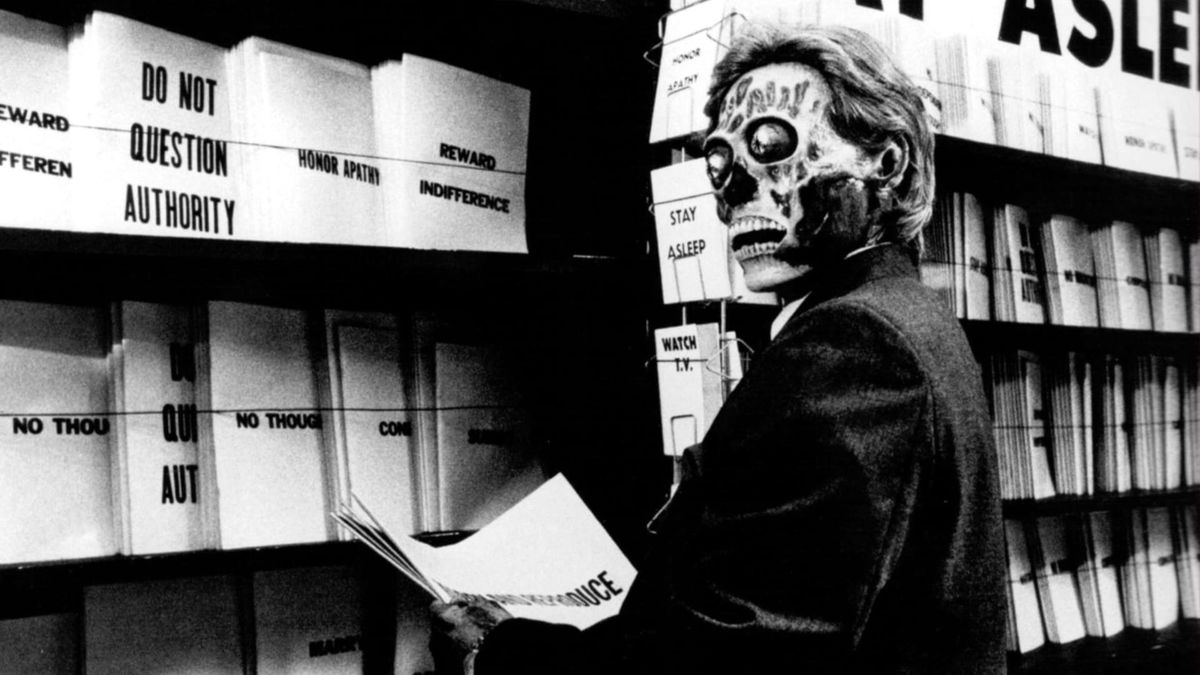
“Look! You fools! You’re in danger! Can’t you see? They’re after you! They’re after all of us! Our wives…our children…they’re here already! You’re next!”—Dr. Miles Bennell, Invasion of the Body Snatchers (1956)

It’s like Invasion of the Body Snatchers all over again.

The nation is being overtaken by an alien threat that invades bodies, alters minds, and transforms freedom-loving people into a mindless, compliant, conforming mob intolerant of anyone who dares to be different, let alone think for themselves.

However, while Body Snatchersthe chilling 1956 film directed by Don Siegel—blames its woes on seed pods from outerspace, the seismic societal shift taking place in America owes less to biological warfare reliant on the COVID-19 virus than it does to psychological warfare disguised as a pandemic threat.

As science writer David Robson explains:

Fears of contagion lead us to become more conformist and tribalistic, and less accepting of eccentricity. Our moral judgements become harsher and our social attitudes more conservative when considering issues such as immigration or sexual freedom and equality. Daily reminders of disease may even sway our political affiliations… Various experiments have shown that we become more conformist and respectful of convention when we feel the threat of a disease… the evocative images of a pandemic led [participants in an experiment] to value conformity and obedience over eccentricity or rebellion.

This is how you persuade a populace to voluntarily march in lockstep with a police state and police themselves (and each other): by ratcheting up the fear-factor, meted out one carefully calibrated crisis at a time, and teaching them to distrust any who diverge from the norm.

This is not a new experiment in mind control.

The powers-that-be have been pushing our buttons and herding us along like so much cattle since World War II, at least, starting with the Japanese attacks on Pearl Harbor, which not only propelled the U.S. into World War II but also unified the American people in their opposition to a common enemy.

That fear of attack by foreign threats, conveniently torqued by the growing military industrial complex, in turn gave rise to the Cold War era’s “Red Scare.” Promulgated through government propaganda, paranoia and manipulation, anti-Communist sentiments boiled over into a mass hysteria that viewed anyone and everyone as suspect: your friends, the next-door neighbor, even your family members could be a Communist subversive.

This hysteria, which culminated in hearings before the House Un-American Activities Committee, where hundreds of Americans were called before Congress to testify about their so-called Communist affiliations and intimidated into making false confessions, also paved the way for the rise of an all-knowing, all-seeing governmental surveillance state.

The 9/11 attacks followed a similar script: a foreign invasion mounts an attack on an unsuspecting nation, the people unite in solidarity against a common foe, and the government gains greater war-time powers (read: surveillance powers) that, conveniently enough, become permanent once the threat has passed.

The government’s scripted response to the COVID-19 pandemic has been predictably consistent: once again, in order to fight this so-called “foreign” foe, the government insists it needs even greater surveillance powers.

As we’ve seen since 9/11 and more recently with the COVID lockdowns, those in power have always had a penchant for enacting extreme measures to combat perceived threats. However, unlike the modern America police state, the American government circa the 1950s did not have at its disposal the arsenal of invasive technologies that are such an intrinsic part of our modern surveillance state.

Today, we are watched and tracked 24/7; data is collected on us at an alarming rate by governmental and corporate entities; and with the help of powerful computer programs, American domestic intelligence agencies sweep our websites, listen in on our telephone calls and read our text messages at will.

Now with the COVID pandemic and its offshoots such as contact tracing and immunity passports, the governmental landscape is even more invasive.

Yet no matter the threat, the underlying principle remains the same: can we hold onto our basic freedoms and avoid succumbing to the soul-sucking dredge of conformity that threatens our very humanity?

This conundrum is at the heart of the 1956 classic Invasion of the Body Snatchers, which was based on a 1954 science fiction novel by Jack Finney (and later remade into an equally chilling 1978 film by Philip Kaufman).

Body Snatchers not only captured the ideology and politics of its post-war era but remains timely and relevant as it relates to the worries that plague us today. Filmed with only seven days of rehearsal and 23 days of actual shooting, Body Snatchers is considered one of the great science fiction classics.

Body Snatchers is set in a small California town which has been infiltrated by mysterious pods from outer space that replicate and take the place of humans who then become conforming non-individuals. Miles Bennell, the main character, is a local doctor who resists the invaders and their attempts to erase humanity from the face of the earth.

At the very least, the film conveys a double meaning, serving as both a mirror of a particular moment in history and a compass pointing to a growing societal illness. Following World War II with the emerging military empire, the atomic bomb and the Korean War, Americans were confused and neurotically preoccupied with domestic threats, the polio pandemic and international political events, not much different from today’s populace preoccupied with domestic and international political drama, terrorism and the COVID-19 pandemic.

Yet Siegel’s film delves beneath the surface to confront an even more sinister threat: the dehumanization of individuals and the horrifying possibility that humanity could become infused as part of the societal machine.

Central to the film is one key speech delivered by Bennell while hiding from the aliens:

In my practice, I see how people have allowed their humanity to drain away…only it happens slowly instead of all at once. They didn’t seem to mind…. All of us, a little bit. We harden our hearts…grow callous…only when we have to fight to stay human do we realize how precious it is.

As Siegel makes clear, it is not Communists or terrorists or even viral pandemics that threaten our well-being. The real enemy is invasive governmental measures—something we now see happening across the country—and, thus, totalitarian conformity. And resistance must be against all government measures that threaten our civil liberties and against all kinds of conformity, no matter the shape, size or color of the package it comes in.

When all is said and done, however, the real threat to freedom (in the fictional world of Body Snatchers and in our present-day America) is posed by an establishment—be it governmental, corporate or societal—that is hostile to individuality and those who dare to challenge the status quo.

The mob hysteria, sense of paranoia, fascist police and the witch hunt atmosphere of the film mirror the ills of a 1950s America that is frighteningly applicable to present American society.

Acknowledging that Body Snatchers portrayed the conflict between individuals and varied forms of mindless authority, Siegel stated, “I think the world is populated by pods and I wanted to show them.” He explained:

People are pods. Many of my associates are certainly pods. They have no feelings. They exist, breathe, sleep. To be a pod means that you have no passion, no anger, the spark has left you…of course, there’s a very strong case for being a pod. These pods, who get rid of pain, ill-health and mental disturbances are, in a sense, doing good. It happens to leave you in a very dull world but that, by the way, is the world that most of us live in. It’s the same as people who welcome going into the army or prison. There’s regimentation, a lack of having to make up your mind, face decisions…. People are becoming vegetables. I don’t know what the answer is except an awareness of it.

All of the threats to freedom documented in my book Battlefield America: The War on the American People came about because “we the people” stopped thinking for ourselves and relinquished control over our lives and our country to government operatives who care only for money and power.

While the specific game plan for turning things around is complicated by a police state that wants to keep us at a disadvantage, the solution is relatively simple: Don’t be a pod person. Pay attention. Question everything. Dare to be different. Don’t follow the mob. Don’t let yourself become numb to the world around you. Be compassionate. Be humane. Most of all, think for yourself.

Source: https://bit.ly/36T4bYf

ABOUT JOHN W. WHITEHEAD

Constitutional attorney and author John W. Whitehead is founder and president of The Rutherford Institute. His new book Battlefield America: The War on the American People  is available at www.amazon.com. Whitehead can be contacted at johnw@rutherford.org.

Publication Guidelines / Reprint Permission

John W. Whitehead’s weekly commentaries are available for publication to newspapers and web publications at no charge. Please contact staff@rutherford.org to obtain reprint permission.

Man’s conquest of Nature, if the dreams of some scientific planners are realized, means the rule of a few hundreds of men over billions upon billions of men.” —C. S. Lewis, The Abolition of Man

Like it or not, the COVID-19 pandemic with its veiled threat of forced vaccinations, contact tracing, and genetically encoded vaccines is propelling humanity at warp speed into a whole new frontier—a surveillance matrix—the likes of which we’ve only previously encountered in science fiction.

Those who eye these developments with lingering mistrust have good reason to be leery: the government has long had a tendency to unleash untold horrors upon the world in the name of global conquest, the acquisition of greater wealth, scientific experimentation, and technological advances, all packaged in the guise of the greater good.

Indeed, “we the people” have been treated like lab rats by government agencies for decades now: caged, branded, experimented upon without our knowledge or consent, and then conveniently discarded and left to suffer from the after-effects.

You don’t have to dig very deep or go very back in the nation’s history to uncover numerous cases in which the government deliberately conducted secret experiments on an unsuspecting populacemaking healthy people sick by spraying them with chemicals, injecting them with infectious diseases and exposing them to airborne toxins.

Now this same government—which has taken every bit of technology sold to us as being in our best interests (GPS devices, surveillance, nonlethal weapons, etc.) and used it against us, to track, control and trap us—wants us to fall in line as it prepares to roll out COVID-19 vaccines that owe a great debt to the Pentagon’s Defense Advanced Research Projects Agency for its past work on how to weaponize and defend against infectious diseases.

The Trump Administration by way of the National Institute of Health awarded $22.8 million to seven corporations to develop artificial intelligence (AI), machine learning, etc., with smart phone apps, wearable devices and software “that can identify and trace contacts of infected individuals, keep track of verified COVID-19 test results, and monitor the health status of infected and potentially infected individuals.”

This is all part of Operation Warp Speed, which President Trump has likened to the Manhattan Project, a covert government effort spearheaded by the military to engineer and build the world’s first atomic bomb.

There is every reason to tread cautiously.

There is a sinister world beyond that which we perceive, one in which power players jockey for control over the one commodity that is a necessary ingredient for total domination: you.

By you, I mean you the individual in all your singular humanness.

Remaining singularly human and retaining your individuality and dominion over yourself—mind, body and soul—in the face of corporate and government technologies that aim to invade, intrude, monitor, manipulate and control us may be one of the greatest challenges before us.

These COVID-19 vaccines, which rely on messenger RNA technology that influences everything from viruses to memory, are merely the tipping point.

The groundwork being laid with these vaccines is a prologue to what will become the police state’s conquest of a new, relatively uncharted, frontier: inner space, specifically, the inner workings (genetic, biological, biometric, mental, emotional) of the human race.

If you were unnerved by the rapid deterioration of privacy under the Surveillance State, prepare to be terrified by the surveillance matrix that will be ushered in on the heels of the government’s rollout of this COVID-19 vaccine.

The term “matrix” was introduced into our cultural lexicon by the 1999 film The Matrix in which Neo, a computer programmer/hacker, awakens to the reality that humans have been enslaved by artificial intelligence and are being harvested for their bio-electrical energy.

Hardwired to a neuro-interactive simulation of reality called the “Matrix,” humans are kept inactive and docile while robotic androids gather the electricity their bodies generate. In order for the machines who run the Matrix to maintain control, they impose what appears to be a perfect world for humans to keep them distracted, content, and submissive.

Here’s the thing: Neo’s Matrix is not so far removed from our own technologically-hardwired worlds in which we’re increasingly beholden to corporate giants such as Google for powering so much of our lives. As journalist Ben Thompson explains:

Google+ is about unifying all of Google’s services under a single log-in which can be tracked across the Internet on every site that serves Google ads, uses Google sign-in, or utilizes Google analytics. Every feature of Google+—or of YouTube, or Maps, or Gmail, or any other service—is a flytrap meant to ensure you are logged in and being logged by Google at all times.

Everything we do is increasingly dependent on and, ultimately, controlled by our internet-connected, electronic devices. For example, in 2007, there were an estimated 10 million sensor devices connecting human utilized electronic devices (cell phones, laptops, etc.) to the Internet. By 2013, it had increased to 3.5 billion. By 2030, it is estimated to reach 100 trillion.

Much, if not all, of our electronic devices will be connected to Google, a neural network that approximates a massive global brain.

Google’s resources, beyond anything the world has ever seen, includes the huge data sets that result from one billion people using Google every single day and the Google knowledge graph “which consists of 800 million concepts and billions of relationships between them.”

The end goal? The creation of a new “human” species, so to speak, and the NSA, the Pentagon and the “Matrix” of surveillance agencies are part of the plan. As William Binney, one of the highest-level whistleblowers to ever emerge from the NSA, said, “The ultimate goal of the NSA is total population control.”

Mind you, this isn’t population control in the classic sense. It’s more about controlling the population through singularity, a marriage of sorts between machine and human beings in which artificial intelligence and the human brain will merge to form a superhuman mind.

“Google will know the answer to your question before you have asked it,” predicts transhumanist scientist Ray Kurzweil. “It will have read every email you’ve ever written, every document, every idle thought you’ve ever tapped into a search-engine box. It will know you better than your intimate partner does. Better, perhaps, than even yourself.”

The term “singularity”—that is, computers simulating human life itself—was coined years ago by mathematical geniuses Stanislaw Ulam and John von Neumann. “The ever accelerating progress of technology,” warned von Neumann, “gives the appearance of approaching some essential singularity in the history of the race beyond which human affairs, as we know them, could not continue.”

The plan is to develop a computer network that will exhibit intelligent behavior equivalent to or indistinguishable from that of human beings by 2029. And this goal is to have computers that will be “a billion times more powerful than all of the human brains on earth.”

Neuralink, a brain-computer chip interface (BCI), paves the way for AI control of the human brain, at which point the disconnect between humans and AI-controlled computers will become blurred and human minds and computers will essentially become one and the same. “In the most severe scenario, hacking a Neuralink-like device could turn ‘hosts’ into programmable drone armies capable of doing anything their ‘master’ wanted,” writes Jason Lau for Forbes.

Advances in neuroscience indicate that future behavior can be predicted based upon activity in certain portions of the brain, potentially creating a nightmare scenario in which government officials select certain segments of the population for more invasive surveillance or quarantine based solely upon their brain chemistry.

Case in point: researchers at the Mind Research Center scanned the brains of thousands of prison inmates in order to track their brain chemistry and their behavior after release. In one experiment, researchers determined that inmates with lower levels of activity in the area of the brain associated with error processing allegedly had a higher likelihood of committing a crime within four years of being released from prison. While researchers have cautioned against using the results of their research as a method of predicting future crime, it will undoubtedly become a focus of study for government officials.

There’s no limit to what can be accomplished—for good or ill—using brain-computer interfaces.

Researchers at Duke University Medical Center have created a brain-to-brain interface between lab rats, which allows them to transfer information directly between brains. In one particular experiment, researchers trained a rat to perform a task where it would hit a lever when lit. The trained rat then had its brain connected to an untrained rat’s brain via electrodes. The untrained rat was then able to learn the trained rat’s behavior via electrical stimulation. This even worked over great distances using the Internet, with a lab rat in North Carolina guiding the actions of a lab rat in Brazil.

Clearly, we are rapidly moving into the “posthuman era,” one in which humans will become a new type of being. “Technological devices,” writes journalist Marcelo Gleiser, “will be implanted in our heads and bodies, or used peripherally, like Google Glass, extending our senses and cognitive abilities.”

Transhumanism—the fusing of machines and people—is here to stay and will continue to grow.

In fact, as science and technology continue to advance, the ability to control humans will only increase. In 2014, for example, it was revealed that scientists have discovered how to deactivate that part of our brains that controls whether we are conscious or not. When researchers at George Washington University sent high frequency electrical signals to the claustrum—that thin sheet of neurons running between the left and right sides of the brain—their patients lost consciousness. Indeed, one patient started speaking more slowly until she became silent and still. When she regained consciousness, she had no memory of the event.

Add to this the fact that increasingly humans will be implanted with microchips for such benign purposes as tracking children or as medical devices to assist with our health. Such devices “point to an uber-surveillance society that is Big Brother on the inside looking out,” warns Dr. Katina Michael. “Governments or large corporations would have the ability to track people’s actions and movements, categorize them into different socio-economic, political, racial, or consumer groups and ultimately even control them.”

As I make clear in my book Battlefield America: The War on the American People, control is the issue.

In fact, Facebook and the Department of Defense are working to manipulate our behavior. In a 2012 study, Facebook tracked the emotional states of over 600,000 of its users. The goal of the study was to see if the emotions of users could be manipulated based upon whether they were fed positive or negative information in their news feeds. The conclusion of the study was that “emotional states can be transferred to others via emotional contagion, leading people to experience the same emotions without their awareness.”

All of this indicates a new path forward for large corporations and government entities that want to achieve absolute social control. Instead of relying solely on marauding SWAT teams and full-fledged surveillance apparatuses, they will work to manipulate our emotions to keep us in lock step with the American police state.

Now add this warp speed-deployed vaccine to that mix, with all of the associated unknown and fearsome possibilities for altering or controlling human epigenetics, and you start to see the perils inherent in blindly adopting emerging technologies without any restrictions in place to guard against technological tyranny and abuse.

It’s one thing for the starship Enterprise to boldly go where no man has gone before, but even Mr. Spock recognized the dangers of a world dominated by AI. “Computers make excellent and efficient servants,” he observed in “The Ultimate Computer” episode of Star Trek, “but I have no wish to serve under them.”

Source: https://bit.ly/3qglAl7

ABOUT JOHN W. WHITEHEAD

Constitutional attorney and author John W. Whitehead is founder and president of The Rutherford Institute. His new book Battlefield America: The War on the American People  is available at www.amazon.com. Whitehead can be contacted at johnw@rutherford.org.

Publication Guidelines / Reprint Permission

John W. Whitehead’s weekly commentaries are available for publication to newspapers and web publications at no charge. Please contact staff@rutherford.org to obtain reprint permission.

“War is over. If you want it.”—John Lennon

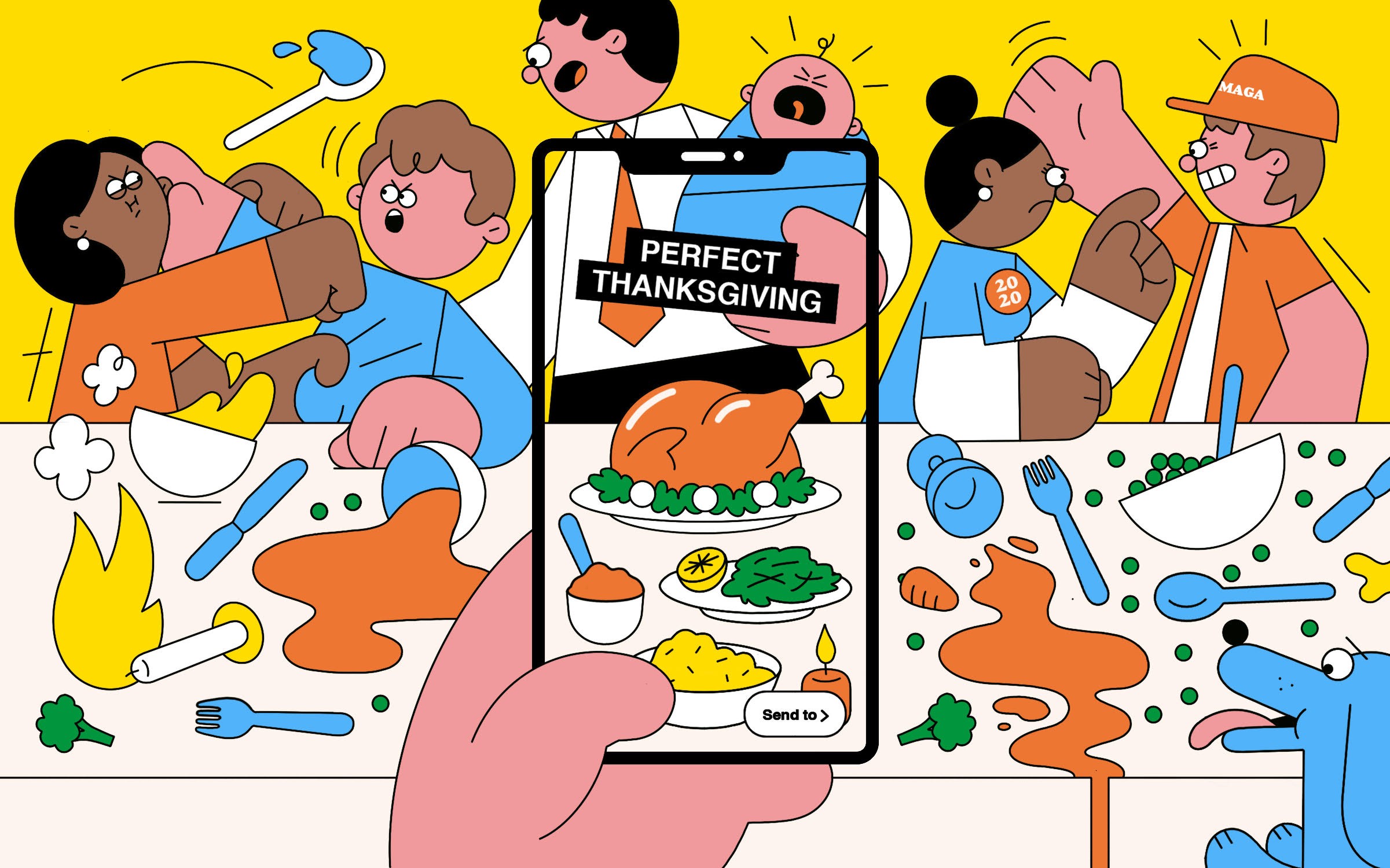
If ever there were a year filled with an abundance of bad news and a shortage of good news, 2020 would take the prize. Between the toxic political theater, pandemic scares, nationwide lockdowns that smack of martial law, a rollercoaster economy, and the ever-present menace of the police state, it’s been a hard, heart-wrenching, stomach-churning kind of year overrun with too much hate and too little tolerance.

It’s been a year in which tyranny took a few more steps forward, freedom got knocked down a few more notches, and politics and profit margins took precedence over decency, compassion and human-kindness.

Now we find ourselves at this present moment, overwhelmed by all that is wrong in the world and missing the fellowship of family and friends kept apart by COVID-19 restrictions and concerns.

No wonder this Thanksgiving finds so many struggling to reflect and give thanks for what is good. After all, how do you give thanks for freedoms that are constantly being eroded? How do you express gratitude for one’s safety when the perils posed by the American police state grow more treacherous by the day? How do you come together as a nation in thanksgiving when the powers-that-be continue to polarize and divide us into warring factions?

Here’s what I’ve learned from living in a small community (population 1500) for the past year: you don’t have to agree on politics, or subscribe to the same religious beliefs, or have the same demographic makeup in order to live peaceably with one another.

These small-town people don’t have a preponderance of fancy cars or advanced degrees or six-figure salaries or committees aimed at discussing problems to death, and yet they have mastered the art of getting along. They make no secret about their views on politics and religion and anything else on their minds, and yet they remain friendly—neighborly—respectful of those with opposing views, even when they wholeheartedly disagree.

Yes, America, there is life beyond politics and it can be wonderful if you just give it a chance.

Here’s what I suggest: this Thanksgiving, do yourselves a favor and turn off the talking heads, tune out the politicians, and take a deep breath. Then try this exercise in gratitude: find something to be thankful for about the things and people in your community for which you might have the least tolerance or appreciation. Instead of just rattling off a list of things you’re thankful for that sound good, dig a little deeper and acknowledge the good in those you may have underappreciated or feared.

When it comes time to giving thanks for your good fortune, put your gratitude into action: pay your blessings forward with deeds that spread a little kindness, lighten someone’s burden, and brighten some dark corner.

Engage in acts of kindness. Smile more. Fight less. Build bridges. Refuse to let toxic politics define your relationships. Focus on the things that unite instead of that which divides.

Do your part to push back against the meanness of our culture with conscious compassion and humanity. Moods are contagious, the good and the bad. They can be passed from person to person. So can the actions associated with those moods, the good and the bad.

Even with COVID-19 restrictions in place throughout the country, there is still so much good that can be done to help those in need.

Be a hero, whether or not anyone ever notices.

Acts of benevolence, no matter how inconsequential they might seem, can spark a movement.

Each of us has an inner hero we can draw upon in an emergency,” concludes psychologist Philip Zimbardo. “If you think there is even a possibility that someone needs help, act on it. You may save a life. You are the modern version of the Good Samaritan that makes the world a better place for all of us.”

All it takes is one person breaking away from the fold to change the dynamics of a situation. “Once any one helps, then in seconds others will join in because a new social norm emerges,” notes Zimbardo.

This is what Zimbardo refers to as “the power of one.”

“If you find yourself in an ambiguous situation, resist the urge to look to others and go with your gut instinct,” advises Melissa Burkley in Psychology Today. “If you think there is even a possibility that someone is in need, act on it. At worst, you will embarrass yourself for a few minutes, but at best, you will save a life.”

In other words, don’t turn away from suffering. Even smiling at a stranger in these fearful times can be a revolutionary act.

All it takes is one person to start a chain reaction.

For instance, a few years ago in Florida, a family of six—four adults and two young boys—were swept out to sea by a powerful rip current in Panama City Beach. There was no lifeguard on duty. The police were standing by, waiting for a rescue boat. And the few people who had tried to help ended up stranded, as well.

Those on shore grouped together and formed a human chain. What started with five volunteers grew to 15, then 80 people, some of whom couldn’t swim.

One by one, they linked hands and stretched as far as their chain would go. The strongest of the volunteers swam out beyond the chain and began passing the stranded victims of the rip current down the chain.

One by one, they rescued those in trouble and pulled each other in.

There’s a moral here for what needs to happen in this country if we only can band together and prevail against the riptides that threaten to overwhelm us.

As I make clear in my book Battlefield America: The War on the American People, there may not be much we can do to avoid the dismal reality of the police state in the long term—not so long as the powers-that-be continue to call the shots and allow profit margins to take precedence over the needs of people—but in the short term, there are things we can all do right now to make this world (or at least our small corners of it) a little bit kinder, a lot less hostile and more just.

It’s never too late to start making things right in the world.

Source: https://bit.ly/39b3ATc

ABOUT JOHN W. WHITEHEAD

Constitutional attorney and author John W. Whitehead is founder and president of The Rutherford Institute. His new book Battlefield America: The War on the American People  is available at www.amazon.com. Whitehead can be contacted at johnw@rutherford.org.

Publication Guidelines / Reprint Permission

John W. Whitehead’s weekly commentaries are available for publication to newspapers and web publications at no charge. Please contact staff@rutherford.org to obtain reprint permission.
“Anyone who cares for someone with a developmental disability, as well as for disabled people themselves [lives] every day in fear that their behavior will be misconstrued as suspicious, intoxicated or hostile by law enforcement.”—Steve Silberman, The New York Times

They shot at him fourteen times.

Walter Wallace Jr.—a troubled 27-year-old black man with a criminal history and mental health issues—was no saint. Still, he didn’t deserve to die in a hail of bullets fired by two police officers who clearly had not been adequately trained in how to de-escalate encounters with special needs individuals.

Wallace wasn’t unarmed—he was reportedly holding a knife when police confronted him—yet neither cop attempted to use non-lethal weapons on Wallace, who appeared to be in the midst of a mental health crisis. In fact, neither cop even possessed a taser. Wallace, fired upon repeatedly by both officers, was hit in the shoulder and chest and pronounced dead at the hospital.

Wallace’s death is yet one more grim statistic to add to that growing list of Americans—unarmed, impaired or experiencing a mental health crisis—who have been killed by police trained to shoot first and ask questions later.

It’s also a powerful reminder to think twice before you call the cops to carry out a welfare check on a loved one. Especially if that person is autistic, hearing impaired, mentally ill, elderly, suffering from dementia, disabled or might have a condition that hinders their ability to understand, communicate or immediately comply with an order.

Particularly if you value that person’s life.

There are some things that don’t change. Even as the nation grapples with the twin distractions of political theater and a viral pandemic, there are still deadlier forces at play.

This is one of them.

At a time when growing numbers of unarmed people have been shot and killed for just standing a certain way, or moving a certain way, or holding something—anything—that police could misinterpret to be a gun, or igniting some trigger-centric fear in a police officer’s mind that has nothing to do with an actual threat to their safety, even the most benign encounters with police can have fatal consequences.

Unfortunately, police—trained in the worst case scenario and thus ready to shoot first and ask questions later—increasingly pose a risk to anyone undergoing a mental health crisis or with special needs whose disabilities may not be immediately apparent or require more finesse than the typical freeze-or-I’ll-shoot tactics employed by America’s police forces.

Just last year, in fact, Gay Plack, a 57-year-old Virginia woman with bipolar disorder, was killed after two police officers—sent to do a welfare check on her—entered her home uninvited, wandered through the house shouting her name, kicked open her locked bedroom door, discovered the terrified woman hiding in a dark bathroom and wielding a small axe, and four seconds later, shot her in the stomach.

Four seconds.

That’s all the time it took for the two police officers assigned to check on Plack to decide to use lethal force against her (both cops opened fire on the woman), rather than using non-lethal options (one cop had a Taser, which he made no attempt to use) or attempting to de-escalate the situation.

The police chief defended his officers’ actions, claiming they had “no other option” but to shoot the 5 foot 4 inch “woman with carpal tunnel syndrome who had to quit her job at a framing shop because her hand was too weak to use the machine that cut the mats.”

This is what happens when you empower the police to act as judge, jury and executioner.

This is what happens when you indoctrinate the police into believing that their lives and their safety are paramount to anyone else’s.

Suddenly, everyone and everything else is a threat that must be neutralized or eliminated.

In light of the government’s ongoing efforts to predict who might pose a threat to public safety based on mental health sensor data (tracked by wearable data such as FitBits and Apple Watches and monitored by government agencies such as HARPA, the “Health Advanced Research Projects Agency”), encounters with the police could get even more deadly, especially if those involved have a mental illness or disability.

Indeed, disabled individuals make up a third to half of all people killed by law enforcement officers. (People of color are three times more likely to be killed by police than their white counterparts.) If you’re black and disabled, you’re even more vulnerable.

A study by the Ruderman Family Foundation reports that “disabled individuals make up the majority of those killed in use-of-force cases that attract widespread attention. This is true both for cases deemed illegal or against policy and for those in which officers are ultimately fully exonerated… Many more disabled civilians experience non-lethal violence and abuse at the hands of law enforcement officers.”

For instance, Nancy Schrock called 911 for help after her husband, Tom, who suffered with mental health issues, started stalking around the backyard, upending chairs and screaming about demons. Several times before, police had transported Tom to the hospital, where he was medicated and sent home after 72 hours. This time, Tom was tasered twice. He collapsed, lost consciousness and died.

In South Carolina, police tasered an 86-year-old grandfather reportedly in the early stages of dementia, while he was jogging backwards away from them. Now this happened after Albert Chatfield led police on a car chase, running red lights and turning randomly. However, at the point that police chose to shock the old man with electric charges, he was out of the car, on his feet, and outnumbered by police officers much younger than him.

In Georgia, campus police shot and killed a 21-year-old student who was suffering a mental health crisis. Scout Schultz was shot through the heart by campus police when he approached four of them late one night while holding a pocketknife, shouting “Shoot me!” Although police may have feared for their lives, the blade was still in its closed position.

In Oklahoma, police shot and killed a 35-year-old deaf man seen holding a two-foot metal pipe on his front porch (he used the pipe to fend off stray dogs while walking). Despite the fact that witnesses warned police that Magdiel Sanchez couldn’t hear—and thus comply—with their shouted orders to drop the pipe and get on the ground, police shot the man when he was about 15 feet away from them.

In Maryland, police (moonlighting as security guards) used extreme force to eject a 26-year-old man with Downs Syndrome and a low IQ from a movie theater after the man insisted on sitting through a second screening of a film. Autopsy results indicate that Ethan Saylor died of complications arising from asphyxiation, likely caused by a chokehold.

In Florida, police armed with assault rifles fired three shots at a 27-year-old nonverbal, autistic man who was sitting on the ground, playing with a toy truck. Police missed the autistic man and instead shot his behavioral therapist, Charles Kinsey, who had been trying to get him back to his group home. The therapist, bleeding from a gunshot wound, was then handcuffed and left lying face down on the ground for 20 minutes.

In Texas, police handcuffed, tasered and then used a baton to subdue a 7-year-old student who has severe ADHD and a mood disorder. With school counselors otherwise occupied, school officials called police and the child’s mother to assist after Yosio Lopez started banging his head on a wall. The police arrived first.

In New Mexico, police tasered, then opened fire on a 38-year-old homeless man who suffered from schizophrenia, all in an attempt to get James Boyd to leave a makeshift campsite. Boyd’s death provoked a wave of protests over heavy-handed law enforcement tactics.

In Ohio, police forcefully subdued a 37-year-old bipolar woman wearing only a nightgown in near-freezing temperatures who was neither armed, violent, intoxicated, nor suspected of criminal activity. After being slammed onto the sidewalk, handcuffed and left unconscious on the street, Tanisha Anderson died as a result of being restrained in a prone position.

And in North Carolina, a state trooper shot and killed a 29-year-old deaf motorist after he failed to pull over during a traffic stop. Daniel K. Harris was shot after exiting his car, allegedly because the trooper feared he might be reaching for a weapon.

These cases, and the hundreds—if not thousands—more that go undocumented every year speak to a crisis in policing when it comes to law enforcement’s failure to adequately assess, de-escalate and manage encounters with special needs or disabled individuals.

While the research is relatively scant, what has been happening is telling.

Over the course of six months, police shot and killed someone who was in mental crisis every 36 hours.

Among 124 police killings analyzed by The Washington Post in which mental illness appeared to be a factor, “They were overwhelmingly men, more than half of them white. Nine in 10 were armed with some kind of weapon, and most died close to home.”

But there were also important distinctions, reports the Post.

This group was more likely to wield a weapon less lethal than a firearm. Six had toy guns; 3 in 10 carried a blade, such as a knife or a machete — weapons that rarely prove deadly to police officers. According to data maintained by the FBI and other organizations, only three officers have been killed with an edged weapon in the past decade. Nearly a dozen of the mentally distraught people killed were military veterans, many of them suffering from post-traumatic stress disorder as a result of their service, according to police or family members. Another was a former California Highway Patrol officer who had been forced into retirement after enduring a severe beating during a traffic stop that left him suffering from depression and PTSD. And in 45 cases, police were called to help someone get medical treatment, or after the person had tried and failed to get treatment on his own.

The U.S. Supreme Court, as might be expected, has thus far continued to immunize police against charges of wrongdoing when it comes to use of force against those with a mental illness.

In a 2015 ruling, the Court declared that police could not be sued for forcing their way into a mentally ill woman’s room at a group home and shooting her five times when she advanced on them with a knife. The justices did not address whether police must take special precautions when arresting mentally ill individuals. (The Americans with Disabilities Act requires “reasonable accommodations” for people with mental illnesses, which in this case might have been less confrontational tactics.)

Where does this leave us?

For starters, we need better police training across the board, but especially when it comes to de-escalation tactics and crisis intervention.

A study by the National Institute of Mental Health found that CIT (Crisis Intervention Team)-trained officers made fewer arrests, used less force, and connected more people with mental-health services than their non-trained peers.

As The Washington Post points out:

“Although new recruits typically spend nearly 60 hours learning to handle a gun, according to a recent survey by the Police Executive Research Forum, they receive only eight hours of training to de-escalate tense situations and eight hours learning strategies for handling the mentally ill. Otherwise, police are taught to employ tactics that tend to be counterproductive in such encounters, experts said. For example, most officers are trained to seize control when dealing with an armed suspect, often through stern, shouted commands. But yelling and pointing guns is ‘like pouring gasoline on a fire when you do that with the mentally ill,’ said Ron Honberg, policy director with the National Alliance on Mental Illness.”

Second, police need to learn how to slow confrontations down, instead of ramping up the tension (and the noise).

In Maryland, police recruits are now required to take a four-hour course in which they learn “de-escalation tactics” for dealing with disabled individuals: speak calmly, give space, be patient.

One officer in charge of the Los Angeles Police Department’s “mental response teams” suggests that instead of rushing to take someone into custody, police should try to slow things down and persuade the person to come with them.

Third, with all the questionable funds flowing to police departments these days, why not use some of those funds to establish what one disability-rights activist describes as “a 911-type number dedicated to handling mental-health emergencies, with community crisis-response teams at the ready rather than police officers.”

Increasingly, funds are being directed towards technologies that support predictive policing and behavioral and health surveillance. For instance, HARPA (a healthcare counterpart to the Pentagon’s research and development arm DARPA) would take the lead in identifying and targeting “signs” of mental illness or violent inclinations among the populace by using artificial intelligence to collect data from Apple Watches, Fitbits, Amazon Echo and Google Home. The Trump Administration has already awarded contracts worth $22.8 million to seven major corporations to develop artificial intelligence (AI) and machine learning connected to smartphone apps, wearable devices and software that can identify and trace contacts of “infected individuals,” keep track of “verified” COVID-19 test results, and monitor the health states of infected and “potentially” infected individuals.

It wouldn’t take much for these nascent predictive programs to give rise to healthcare versions of red flag gun laws, which allows the government to preemptively take action against individuals who may be perceived as potential threats. Where the problem arises is when you put the power to determine who is a potential danger in the hands of government agencies, the courts and the police.

In the end, while we need to make encounters with police officers safer for people with suffering from mental illness or with disabilities, what we really need—as I point out in my book Battlefield America: The War on the American People—is to make encounters with police safer for all individuals all across the board.

Source: https://bit.ly/3nthWCf

ABOUT JOHN W. WHITEHEAD

Constitutional attorney and author John W. Whitehead is founder and president of The Rutherford Institute. His new book Battlefield America: The War on the American People  is available at www.amazon.com. Whitehead can be contacted at johnw@rutherford.org.

Publication Guidelines / Reprint Permission

John W. Whitehead’s weekly commentaries are available for publication to newspapers and web publications at no charge. Please contact staff@rutherford.org to obtain reprint permission.

For soldiers … coming home is more lethal than being in combat.” ― Brené Brown, research professor at the University of Houston

The 2020 presidential election may be over, but nothing has really changed.

The U.S. government still poses the greatest threat to our freedoms.

More than terrorism, more than domestic extremism, more than gun violence and organized crime, even more than the perceived threat posed by any single politician, the U.S. government remains a greater menace to the life, liberty and property of its citizens than any of the so-called dangers from which the government claims to protect us.

This threat is especially pronounced for America’s military veterans, especially that portion of the population that exercises their First Amendment right to speak out against government wrongdoing.

Consider: we raise our young people on a steady diet of militarism and war, sell them on the idea that defending freedom abroad by serving in the military is their patriotic duty, then when they return home, bruised and battle-scarred and committed to defending their freedoms at home, we often treat them like criminals merely for exercising those rights they risked their lives to defend.

The government even has a name for its war on America’s veterans: Operation Vigilant Eagle.

As first reported by the Wall Street Journal, this Department of Homeland Security (DHS) program tracks military veterans returning from Iraq and Afghanistan and characterizes them as extremists and potential domestic terrorist threats because they may be “disgruntled, disillusioned or suffering from the psychological effects of war.”

Coupled with the DHS’ dual reports on Rightwing and Leftwing “Extremism,” which broadly define extremists as individuals, military veterans and groups “that are mainly antigovernment, rejecting federal authority in favor of state or local authority, or rejecting government authority entirely,” these tactics bode ill for anyone seen as opposing the government.

Yet the government is not merely targeting individuals who are voicing their discontent so much as it is taking aim at individuals trained in military warfare.

Don’t be fooled by the fact that the DHS has gone extremely quiet about Operation Vigilant Eagle.

Where there’s smoke, there’s bound to be fire.

And the government’s efforts to target military veterans whose views may be perceived as “anti-government” make clear that something is afoot.

In recent years, military servicemen and women have found themselves increasingly targeted for surveillance, censorship, threatened with incarceration or involuntary commitment, labeled as extremists and/or mentally ill, and stripped of their Second Amendment rights.

In light of the government’s efforts to lay the groundwork to weaponize the public’s biomedical data and predict who might pose a threat to public safety based on mental health sensor data (a convenient means by which to penalize certain “unacceptable” social behaviors), encounters with the police could get even more deadly, especially if those involved have a mental illness or disability coupled with a military background.

Incredibly, as part of a proposal being considered by the Trump Administration, a new government agency HARPA (a healthcare counterpart to the Pentagon’s research and development arm DARPA) will take the lead in identifying and targeting “signs” of mental illness or violent inclinations among the populace by using artificial intelligence to collect data from Apple Watches, Fitbits, Amazon Echo and Google Home.

These tactics are not really new.

Many times throughout history in totalitarian regimes, such governments have declared dissidents mentally ill and unfit for society as a means of rendering them disempowering them.

As Pulitzer Prize-winning author Anne Applebaum observes in Gulag: A History: “The exile of prisoners to a distant place, where they can ‘pay their debt to society,’ make themselves useful, and not contaminate others with their ideas or their criminal acts, is a practice as old as civilization itself. The rulers of ancient Rome and Greece sent their dissidents off to distant colonies. Socrates chose death over the torment of exile from Athens. The poet Ovid was exiled to a fetid port on the Black Sea.”

For example, government officials in the Cold War-era Soviet Union often used psychiatric hospitals as prisons in order to isolate political prisoners from the rest of society, discredit their ideas, and break them physically and mentally through the use of electric shocks, drugs and various medical procedures.

Insisting that “ideas about a struggle for truth and justice are formed by personalities with a paranoid structure,” the psychiatric community actually went so far as to provide the government with a diagnosis suitable for locking up such freedom-oriented activists.

In addition to declaring political dissidents mentally unsound, Russian officials also made use of an administrative process for dealing with individuals who were considered a bad influence on others or troublemakers.

Author George Kennan describes a process in which:

The obnoxious person may not be guilty of any crime . . . but if, in the opinion of the local authorities, his presence in a particular place is “prejudicial to public order” or “incompatible with public tranquility,” he may be arrested without warrant, may be held from two weeks to two years in prison, and may then be removed by force to any other place within the limits of the empire and there be put under police surveillance for a period of from one to ten years. Administrative exile–which required no trial and no sentencing procedure–was an ideal punishment not only for troublemakers as such, but also for political opponents of the regime.

Sound familiar?

This age-old practice by which despotic regimes eliminate their critics or potential adversaries by declaring them mentally ill and locking them up in psychiatric wards for extended periods of time is a common practice in present-day China.

What is particularly unnerving, however, is how this practice of eliminating or undermining potential critics, including military veterans, is happening with increasing frequency in the United States.

Remember, the National Defense Authorization Act (NDAA) opened the door for the government to detain as a threat to national security anyone viewed as a troublemaker. According to government guidelines for identifying domestic extremists—a word used interchangeably with terrorists—technically, anyone exercising their First Amendment rights in order to criticize the government qualifies.

It doesn’t take much anymore to be flagged as potentially anti-government in a government database somewhere—Main Core, for example—that identifies and tracks individuals who aren’t inclined to march in lockstep to the government’s dictates.

In fact, as the Washington Post reports, communities are being mapped and residents assigned a color-coded threat score—green, yellow or red—so police are forewarned about a person’s potential inclination to be a troublemaker depending on whether they’ve had a career in the military, posted a comment perceived as threatening on Facebook, suffer from a particular medical condition, or know someone who knows someone who might have committed a crime.

The case of Brandon Raub is a prime example of Operation Vigilant Eagle in action.

Raub, a 26-year-old decorated Marine, actually found himself interrogated by government agents about his views on government corruption, arrested with no warning, labeled mentally ill for subscribing to so-called “conspiratorial” views about the government, detained against his will in a psych ward for standing by his views, and isolated from his family, friends and attorneys.

On August 16, 2012, a swarm of local police, Secret Service and FBI agents arrived at Raub’s Virginia home, asking to speak with him about posts he had made on his Facebook page made up of song lyrics, political opinions and dialogue used in a political thriller virtual card game.

Among the posts cited as troublesome were lyrics to a song by a rap group and Raub’s views, shared increasingly by a number of Americans, that the 9/11 terrorist attacks were an inside job.

After a brief conversation and without providing any explanation, levying any charges against Raub or reading him his rights, Raub was then handcuffed and transported to police headquarters, then to a medical center, where he was held against his will due to alleged concerns that his Facebook posts were “terrorist in nature.”

Outraged onlookers filmed the arrest and posted the footage to YouTube, where it quickly went viral. Meanwhile, in a kangaroo court hearing that turned a deaf ear to Raub’s explanations about the fact that his Facebook posts were being read out of context, Raub was sentenced to up to 30 days’ further confinement in a psychiatric ward.

Thankfully, The Rutherford Institute came to Raub’s assistance, which combined with heightened media attention, brought about his release and may have helped prevent Raub from being successfully “disappeared” by the government.

Even so, within days of Raub being seized and forcibly held in a VA psych ward, news reports started surfacing of other veterans having similar experiences.

“Oppositional defiance disorder” (ODD) is another diagnosis being used against veterans who challenge the status quo. As journalist Anthony Martin explains, an ODD diagnosis

“denotes that the person exhibits ‘symptoms’ such as the questioning of authority, the refusal to follow directions, stubbornness, the unwillingness to go along with the crowd, and the practice of disobeying or ignoring orders. Persons may also receive such a label if they are considered free thinkers, nonconformists, or individuals who are suspicious of large, centralized government… At one time the accepted protocol among mental health professionals was to reserve the diagnosis of oppositional defiance disorder for children or adolescents who exhibited uncontrollable defiance toward their parents and teachers.”

Frankly, based on how well my personality and my military service in the U.S. Armed Forces fit with this description of “oppositional defiance disorder,” I’m sure there’s a file somewhere with my name on it.

That the government is using the charge of mental illness as the means by which to immobilize (and disarm) these veterans is diabolical. With one stroke of a magistrate’s pen, these veterans are being declared mentally ill, locked away against their will, and stripped of their constitutional rights.

If it were just being classified as “anti-government,” that would be one thing.

Unfortunately, anyone with a military background and training is also now being viewed as a heightened security threat by police who are trained to shoot first and ask questions later.

Feeding this perception of veterans as ticking time bombs in need of intervention, the Justice Department launched a pilot program in 2012 aimed at training SWAT teams to deal with confrontations involving highly trained and often heavily armed combat veterans.

The result?

Police encounters with military veterans often escalate very quickly into an explosive and deadly situation, especially when SWAT teams are involved.

For example, Jose Guerena, a Marine who served in two tours in Iraq, was killed after an Arizona SWAT team kicked open the door of his home during a mistaken drug raid and opened fire. Thinking his home was being invaded by criminals, Guerena told his wife and child to hide in a closet, grabbed a gun and waited in the hallway to confront the intruders. He never fired his weapon. In fact, the safety was still on his gun when he was killed. The SWAT officers, however, not as restrained, fired 70 rounds of ammunition at Guerena—23 of those bullets made contact. Apart from his military background, Guerena had had no prior criminal record, and the police found nothing illegal in his home.

John Edward Chesney, a 62-year-old Vietnam veteran, was killed by a SWAT team allegedly responding to a call that the Army veteran was standing in his San Diego apartment window waving what looked like a semi-automatic rifle. SWAT officers locked down Chesney’s street, took up positions around his home, and fired 12 rounds into Chesney’s apartment window. It turned out that the gun Chesney reportedly pointed at police from three stories up was a “realistic-looking mock assault rifle.”

Ramon Hooks’ encounter with a Houston SWAT team did not end as tragically, but it very easily could have. Hooks, a 25-year-old Iraq war veteran, was using an air rifle gun for target practice outside when a Homeland Security Agent, allegedly house shopping in the area, reported him as an active shooter. It wasn’t long before the quiet neighborhood was transformed into a war zone, with dozens of cop cars, an armored vehicle and heavily armed police. Hooks was arrested, his air rifle pellets and toy gun confiscated, and charges filed against him for “criminal mischief.”

Given the government’s increasing view of veterans as potential domestic terrorists, it makes one think twice about government programs encouraging veterans to include a veterans designation on their drivers’ licenses and ID cards.

Hailed by politicians as a way to “make it easier for military veterans to access discounts from retailers, restaurants, hotels and vendors across the state,” it will also make it that much easier for the government to identify and target veterans who dare to challenge the status quo.

Remember: no one is spared in a police state.

Eventually, as I make clear in my book Battlefield America: The War on the American People, we all suffer the same fate.

It stands to reason that if the government can’t be bothered to abide by its constitutional mandate to respect the citizenry’s rights—whether it’s the right to be free from government surveillance and censorship, the right to due process and fair hearings, the right to be free from roadside strip searches and militarized police, or the right to peacefully assemble and protest and exercise our right to free speech—then why should anyone expect the government to treat our nation’s veterans with respect and dignity?

It’s time to end the government’s war on the American people, and that includes military veterans.

Certainly, veterans have enough physical and psychological war wounds to overcome without adding the government to the mix. Although the U.S. boasts more than 20 million veterans who have served in World War II through the present day, large numbers of veterans are impoverished, unemployed, traumatized mentally and physically, struggling with depression, suicide, and marital stress, homeless, subjected to sub-par treatment at clinics and hospitals, and left to molder while their paperwork piles up within Veterans Administration offices.

At least 60,000 veterans died by suicide between 2008 and 2017.

On average, 6,000 veterans kill themselves every year, and the numbers are on the rise.

The plight of veterans today—and their treatment at the hands of the U.S. government—remains America’s badge of shame.

So here’s a suggestion: if you really want to do something to show your respect and appreciation for the nation’s veterans, why not skip the parades and the flag-waving and instead go exercise your rights—the freedoms that those veterans swore to protect—by pushing back against the government’s tyranny.

It’s time the rest of the nation did its part to safeguard the freedoms we too often take for granted.

Freedom is not free.

Source: https://bit.ly/35aTT4D

ABOUT JOHN W. WHITEHEAD

Constitutional attorney and author John W. Whitehead is founder and president of The Rutherford Institute. His new book Battlefield America: The War on the American People  is available at www.amazon.com. Whitehead can be contacted at johnw@rutherford.org.

Publication Guidelines / Reprint Permission

John W. Whitehead’s weekly commentaries are available for publication to newspapers and web publications at no charge. Please contact staff@rutherford.org to obtain reprint permission.
“If liberty means anything at all, it means the right to tell people what they do not want to hear.”—George Orwell

The American people remain eager to be persuaded that a new president in the White House can solve the problems that plague us.

Yet no matter who wins this presidential election, you can rest assured that the new boss will be the same as the old boss, and we—the permanent underclass in America—will continue to be forced to march in lockstep with the police state in all matters, public and private.

Indeed, it really doesn’t matter what you call them—the Deep State, the 1%, the elite, the controllers, the masterminds, the shadow government, the police state, the surveillance state, the military industrial complex—so long as you understand that no matter which party occupies the White House in 2021, the unelected bureaucracy that actually calls the shots will continue to do so.

In the interest of liberty and truth, here are a few hard truths about life in the American police state that will persist no matter who wins the 2020 presidential election. Indeed, these issues persisted—and in many cases flourished—under both Republican and Democratic administrations in recent years.

Police militarization will continue. Thanks to federal grant programs allowing the Pentagon to transfer surplus military supplies and weapons to local law enforcement agencies without charge, police forces will continue to be transformed from peace officers to heavily armed extensions of the military, complete with jackboots, helmets, shields, batons, pepper-spray, stun guns, assault rifles, body armor, miniature tanks and weaponized drones. “Today, 17,000 local police forces are equipped with such military equipment as Blackhawk helicopters, machine guns, grenade launchers, battering rams, explosives, chemical sprays, body armor, night vision, rappelling gear and armored vehicles,” stated Paul Craig Roberts, former Assistant Secretary of the Treasury. “Some have tanks.”

Overcriminalization will continue. In the face of a government bureaucracy consumed with churning out laws, statutes, codes and regulations that reinforce its powers and value systems and those of the police state and its corporate allies, we will all continue to be viewed as petty criminals, guilty of violating some minor law. Thanks to an overabundance of 4,500-plus federal crimes and 400,000-plus rules and regulations, it is estimated that the average American actually commits three felonies a day without knowing it. In fact, according to law professor John Baker, “There is no one in the United States over the age of 18 who cannot be indicted for some federal crime.” Consequently, we now find ourselves operating in a strange new world where small farmers who dare to make unpasteurized goat cheese and share it with members of their community are finding their farms raided, while home gardeners face jail time for daring to cultivate their own varieties of orchids without having completed sufficient paperwork. This frightening state of affairs—where a person can actually be arrested and incarcerated for the most innocent and inane activities, including feeding a whale and collecting rainwater on their own property—is due to what law scholars refer to as overcriminalization.

Jailing Americans for profit will continue. At one time, the American penal system operated under the idea that dangerous criminals needed to be put under lock and key in order to protect society. Today, as states attempt to save money by outsourcing prisons to private corporations, imprisoning Americans in private prisons run by mega-corporations has turned into a cash cow for big business. In exchange for corporations buying and managing public prisons across the country at a supposed savings to the states, the states have to agree to maintain a 90% occupancy rate in the privately run prisons for at least 20 years. Such a scheme simply encourages incarceration for the sake of profits, while causing millions of Americans, most of them minor, nonviolent criminals, to be handed over to corporations for lengthy prison sentences which do nothing to protect society or prevent recidivism. Thus, although the number of violent crimes in the country is down substantially, the number of Americans being jailed for nonviolent crimes such as driving with a suspended license is skyrocketing.

Poverty will continue. Despite the fact that we have 46 million Americans living at or below the poverty line16 million children living in households without adequate access to food, and at least 900,000 veterans relying on food stamps (mind you, these are pre-COVID numbers, which have only got worse during this pandemic), enormous sums continue to be doled out for presidential excursions (taxpayers have been forced to pay at least $100 million so that Donald Trump could visit his golf clubs and private properties more than 500 times during his four years in office).

Endless wars that enrich the military industrial complex will continue. Having been co-opted by greedy defense contractors, corrupt politicians and incompetent government officials, America’s expanding military empire is bleeding the country dry at a rate of more than $15 billion a month (or $20 million an hour)—and that’s just what the government spends on foreign wars. That does not include the cost of maintaining and staffing the 1000-plus U.S. military bases spread around the globe. Incredibly, although the U.S. constitutes only 5% of the world’s population, America boasts almost 50% of the world’s total military expenditure, spending more on the military than the next 19 biggest spending nations combined. In fact, the Pentagon spends more on war than all 50 states combined spend on health, education, welfare, and safety. Yet what most Americans fail to recognize is that these ongoing wars have little to do with keeping the country safe and everything to do with enriching the military industrial complex at taxpayer expense. Consider that since 2001, Americans have spent $10.5 million every hour for numerous foreign military occupations, including in Iraq and Afghanistan.

Police shootings of unarmed Americans will continue. No matter what our party politics, race, religion, or any other distinction used to divide us, we all suffer when violence becomes the government’s calling card. Remember, in a police state, you’re either the one with your hand on the trigger or you’re staring down the barrel of a loaded gun. At least 400 to 500 innocent people are killed by police officers every year. Indeed, Americans are now eight times more likely to die in a police confrontation than they are to be killed by a terrorist. Americans are 110 times more likely to die of foodborne illness than in a terrorist attack. Police officers are more likely to be struck by lightning than be made financially liable for their wrongdoing. As a result, Americans are largely powerless in the face of militarized police.

SWAT team raids will continue.  More than 80,000 SWAT team raids are carried out every year on unsuspecting Americans for relatively routine police matters. Nationwide, SWAT teams have been employed to address an astonishingly trivial array of criminal activity or mere community nuisances including angry dogs, domestic disputes, improper paperwork filed by an orchid farmer, and misdemeanor marijuana possession, to give a brief sampling. On an average day in America, over 100 Americans have their homes raided by SWAT teams. There has been a notable buildup in recent years of SWAT teams within non-security-related federal agencies such as the Department of Agriculture, the Railroad Retirement Board, the Tennessee Valley Authority, the Office of Personnel Management, the Consumer Product Safety Commission, the U.S. Fish and Wildlife Service, and the Education Department.

The government’s war on the American people will continue.  “We the people” are no longer shielded by the rule of law. While the First Amendment—which gives us a voice—is being muzzled, the Fourth Amendment—which protects us from being bullied, badgered, beaten, broken and spied on by government agents—is being disemboweled. Consequently, you no longer have to be poor, black or guilty to be treated like a criminal in America. All that is required is that you belong to the suspect class—that is, the citizenry—of the American police state. As a de facto member of this so-called criminal class, every U.S. citizen is now guilty until proven innocent. The oppression and injustice—be it in the form of shootings, surveillance, fines, asset forfeiture, prison terms, roadside searches, and so on—will come to all of us eventually unless we do something to stop it now.

Government corruption will continue.  The government is not our friend. Nor does it work for “we the people.” Americans instinctively understand this. When asked to name the greatest problem facing the nation, Americans of all political stripes ranked the government as the number one concern. In fact, almost eight out of ten Americans believe that government corruption is widespread. Our so-called government representatives do not actually represent us, the citizenry. We are now ruled by an oligarchic elite of governmental and corporate interests whose main interest is in perpetuating power and control. Congress is dominated by a majority of millionaires who are, on average, fourteen times wealthier than the average American.

The rise of the surveillance state will continue. Government eyes are watching you. They see your every move: what you read, how much you spend, where you go, with whom you interact, when you wake up in the morning, what you’re watching on television and reading on the internet. Every move you make is being monitored, mined for data, crunched, and tabulated in order to form a picture of who you are, what makes you tick, and how best to control you when and if it becomes necessary to bring you in line. Police have been outfitted with a litany of surveillance gear, from license plate readers and cell phone tracking devices to biometric data recorders. Technology now makes it possible for the police to scan passersby in order to detect the contents of their pockets, purses, briefcases, etc. Full-body scanners, which perform virtual strip-searches of Americans traveling by plane, have gone mobile, with roving police vans that peer into vehicles and buildings alike—including homes. Coupled with the nation’s growing network of real-time surveillance cameras and facial recognition software, soon there really will be nowhere to run and nowhere to hide.

The erection of a suspect society will continue. Due in large part to rapid advances in technology and a heightened surveillance culture, the burden of proof has been shifted so that the right to be considered innocent until proven guilty has been usurped by a new norm in which all citizens are suspects. This is exemplified by police practices of stopping and frisking people who are merely walking down the street and where there is no evidence of wrongdoing. Making matters worse are Terrorism Liaison Officers (firefighters, police officers, and even corporate employees) who have been trained to spy on their fellow citizens and report “suspicious activity,” which includes taking pictures with no apparent aesthetic value, making measurements and drawings, taking notes, conversing in code, espousing radical beliefs and buying items in bulk. TLOs report back to “fusion centers,” which are a driving force behind the government’s quest to collect, analyze, and disseminate information on American citizens.

Government tyranny under the reign of an Imperial President will continue. The Constitution invests the President with very specific, limited powers: to serve as Commander in Chief of the military, grant pardons, make treaties (with the approval of Congress), appoint ambassadors and federal judges (again with Congress’ blessing), and veto legislation. In recent years, however, American presidents have anointed themselves with the power to wage war, unilaterally kill Americans, torture prisoners, strip citizens of their rights, arrest and detain citizens indefinitely, carry out warrantless spying on Americans, and erect their own secretive, shadow government. The powers amassed by each past president and inherited by each successive president—powers which add up to a toolbox of terror for an imperial ruler—empower whomever occupies the Oval Office to act as a dictator, above the law and beyond any real accountability. The grim reality we must come to terms with is the fact that the government does whatever it wants, freedom be damned. More than terrorism, more than domestic extremism, more than gun violence and organized crime, the U.S. government has become a greater menace to the life, liberty and property of its citizens than any of the so-called dangers from which the government claims to protect us. This state of affairs has become the status quo, no matter which party is in power.

The government’s manipulation of national crises in order to expand its powers will continue. “We the people” have been the subjected to an “emergency state” that justifies all manner of government tyranny and power grabs in the so-called name of national security. Whatever the so-called threat to the nation—whether it’s civil unrest, school shootings, alleged acts of terrorism, or the threat of a global pandemic in the case of COVID-19—the government has a tendency to capitalize on the nation’s heightened emotions, confusion and fear as a means of extending the reach of the police state. Indeed, the government’s answer to every problem continues to be more government—at taxpayer expense—and less individual liberty.

The bottom line is this: nothing taking place on Election Day will alleviate the suffering of the American people. Unless we do something more than vote, the government as we have come to know it—corrupt, bloated and controlled by big-money corporations, lobbyists and special interest groups—will remain unchanged. And “we the people”—overtaxed, overpoliced, overburdened by big government, underrepresented by those who should speak for us and blissfully ignorant of the prison walls closing in on us—will continue to trudge along a path of misery.

As I point out in my book Battlefield America: The War on the American People, these problems will continue to plague our nation unless and until Americans wake up to the fact that we’re the only ones who can change things for the better and then do something about it. If there is to be any hope of restoring our freedoms and reclaiming control over our government, it will rest not with the politicians but with the people themselves.

After all, Indeed, the Constitution opens with those three vital words, “We the people.”

What the founders wanted us to understand is that we are the government.

There is no government without us—our sheer numbers, our muscle, our economy, our physical presence in this land. There can also be no police state—no tyranny—no routine violations of our rights without our complicity and collusion—without our turning a blind eye, shrugging our shoulders, allowing ourselves to be distracted and our civic awareness diluted.

No matter which candidate wins this election, the citizenry and those who represent us need to be held accountable to this powerful truth.

Source: https://bit.ly/3843EDH

ABOUT JOHN W. WHITEHEAD

Constitutional attorney and author John W. Whitehead is founder and president of The Rutherford Institute. His new book Battlefield America: The War on the American People  is available at www.amazon.com. Whitehead can be contacted at johnw@rutherford.org.

Publication Guidelines / Reprint Permission

John W. Whitehead’s weekly commentaries are available for publication to newspapers and web publications at no charge. Please contact staff@rutherford.org to obtain reprint permission.
“Every day I ask myself the same question: How can this be happening in America? How can people like these be in charge of our country? If I didn’t see it with my own eyes, I’d think I was having a hallucination.”—Philip Roth, novelist

Things are falling apart.

How much longer we can sustain the fiction that we live in a constitutional republic, I cannot say, but anarchy is being loosed upon the nation.

We are witnessing the unraveling of the American dream one injustice at a time.

Day after day, the government’s crimes against the citizenry grow more egregious, more treacherous and more tragic. And day after day, the American people wake up a little more to the grim realization that they have become captives in a prison of their own making.

No longer a free people, we are now pushed and prodded and watched over by twitchy, hyper-sensitive, easily-spooked armed guards who care little for the rights, humanity or well-being of those in their care.

The death toll is mounting.

The carnage is heartbreaking.

The public’s faith in the government to do its job—which is to protect our freedoms—is deteriorating.

It doesn’t take a weatherman to realize when a storm is brewing: clouds gather, the wind begins to blow, and an almost-palpable tension builds.

It’s the same way with freedom.

The warning signs are everywhere.

“Things fall apart,” wrote W.B. Yeats in his dark, forbidding poem “The Second Coming.” “The centre cannot hold; mere anarchy is loosed upon the world, the blood-dimmed tide is loosed, and everywhere the ceremony of innocence is drowned … Surely some revelation is at hand.”

The upcoming election and its aftermath will undoubtedly keep the citizenry divided and at each other’s throats, so busy fighting each other that they never manage to present a unified front against tyranny in any form. Yet the winner has already been decided. As American satirist H.L. Mencken predicted almost a century ago:

“All the odds are on the man who is, intrinsically, the most devious and mediocre — the man who can most adeptly disperse the notion that his mind is a virtual vacuum. The Presidency tends, year by year, to go to such men. As democracy is perfected, the office of president represents, more and more closely, the inner soul of the people. On some great and glorious day the plain folks of the land will reach their heart’s desire at last and the White House will be adorned by a downright moron.”

In other words, nothing will change.

You cannot have a republican form of government—nor a democratic one, for that matter—when the government views itself as superior to the citizenry, when it no longer operates for the benefit of the people, when the people are no longer able to peacefully reform their government, when government officials cease to act like public servants, when elected officials no longer represent the will of the people, when the government routinely violates the rights of the people and perpetrates more violence against the citizenry than the criminal class, when government spending is unaccountable and unaccounted for, when the judiciary act as courts of order rather than justice, and when the government is no longer bound by the laws of the Constitution.

For too long, the American people have obeyed the government’s dictates, no matter now unjust.

We have paid its taxes, penalties and fines, no matter how outrageous. We have tolerated its indignities, insults and abuses, no matter how egregious. We have turned a blind eye to its indiscretions and incompetence, no matter how imprudent. We have held our silence in the face of its lawlessness, licentiousness and corruption, no matter how illicit.

We have suffered. Oh how we have suffered.

How much longer we will continue to suffer at the hands of a tyrannical police state depends on how much we’re willing to give up for the sake of freedom.

It may well be that Professor Morris Berman is correct: perhaps we are entering into the dark ages that signify the final phase of the American Empire. “It seems to me,” writes Berman, “that the people do get the government they deserve, and even beyond that, the government who they are, so to speak. In that regard, we might consider, as an extreme version of this… that Hitler was as much an expression of the German people at that point in time as he was a departure from them.”

For the moment, the American people seem content to sit back and watch the reality TV programming that passes for politics today. It’s the modern-day equivalent of bread and circuses, a carefully calibrated exercise in how to manipulate, polarize, propagandize and control a population.

As French philosopher Etienne de La Boétie observed half a millennium ago:

“Plays, farces, spectacles, gladiators, strange beasts, medals, pictures, and other such opiates, these were for ancient peoples the bait toward slavery, the price of their liberty, the instruments of tyranny. By these practices and enticements the ancient dictators so successfully lulled their subjects under the yoke, that the stupefied peoples, fascinated by the pastimes and vain pleasures flashed before their eyes, learned subservience as naively, but not so creditably, as little children learn to read by looking at bright picture books.”

The bait towards slavery. The price of liberty. The instruments of tyranny.

Yes, that sounds about right.

“We the people” have learned only too well how to be slaves. Worse, we have come to enjoy our voluntary servitude, which masquerades as citizenship.

This presidential election is yet another pacifier to lull us into complacency and blind us to the monsters in our midst.

I refuse to be pacified, patronized or placated.

Here’s my plan: rather than staying glued to my TV set, watching politicians and talking heads regurgitate the same soundbites over and over, I’m going to keep doing the hard work that needs to be done to keep freedom alive in this country.

That’s why, almost 40 years ago, I founded The Rutherford Institute: as a nonpartisan, apolitical organization committed to the principles enshrined in the Constitution and Bill of Rights that would work tirelessly to reshape the government from the bottom up into one that respects freedom, recognizes our worth as human beings, resists corruption, and abides by the rule of law.

It’s a thankless, never-ending job, but someone’s got to do it. And I can promise you that when I do eventually turn on the TV, John Carpenter—not Donald Trump or Joe Biden—will be my pick for escapist entertainment.

Carpenter’s films, known primarily for their horror themes, are infused with strong anti-authoritarian, overarching themes that speak to the filmmaker’s concerns about the unraveling of our society, particularly our government. Even among a pantheon of dystopian films such as Minority ReportNineteen Eighty-FourThe MatrixV for Vendetta, and Land of the Blind, Carpenter’s work stands out for its clarity of vision.

Carpenter sees the government working against its own citizens.

Yet while Carpenter is a skeptic and critic, there’s also a strange optimism that runs through his films. “A close view of Carpenter’s work reveals a romantic streak beneath the skepticism,” John Muir writes in his insightful book The Films of John Carpenter, “a belief down deep—far below the anti-establishment hatred—that a single committed and idealistic person can make a difference, even if society does not recognize that person as valuable or good.”

In fact, Carpenter’s central characters are always out of step with their times. Underneath their machismo, they still believe in the ideals of liberty and equal opportunity. Their beliefs place them in constant opposition with the law and the establishment, but they are nonetheless freedom fighters. When, for example, John Nada destroys the alien hypno-transmitter in They Live, he restores hope by delivering America a wake-up call for freedom.

This is the theme that runs throughout Carpenter’s films—the belief in American ideals and in people. “He believes that man can do better,” writes Muir, “and his heroes consistently prove that worthy goals (such as saving the Earth from malevolent shape-shifters) can be accomplished, but only through individuality.”

Thus, John Carpenter is more than a filmmaker. He is a cultural analyst and a keen observer of the unraveling of the American psyche. “I’m disgusted by what we’ve become in America,” said Carpenter. “I truly believe there is brain death in this country. Everything we see is designed to sell us something. The only thing they want to do is take our money.”

The following are my favorite Carpenter films.

Assault on Precinct 13 (1976): This is essentially a remake of Howard Hawks’ 1959 classic western Rio Bravo—much beloved by Carpenter. A street gang and assorted criminals surround and assault a police station. Paranoia abounds as the police are attacked from all sides and can see no way out. Indeed, Carpenter repeatedly has his characters comment, in disbelief, that “This can’t happen, not today!” or “We’re in the middle of a city … in a police station … someone will drive by eventually!” Or will they?

Halloween (1978): This low-budget horror masterpiece launched Carpenter’s career. Acclaimed as the most successful independent motion picture of all time, the story centers on a deranged youth who returns to his hometown to conduct a murderous rampage after fifteen years in an asylum. This film, which assumes that there is a form of evil so dark that it can’t be killed, deconstructs our technological existence while reminding us that in the end, we all may have to experience Orwell’s stamping boot on our faces forever.

The Fog (1980): This is a disturbing ghost story made in the mode of Alfred Hitchcock’s The Birds (1963). Here the menace besieging a small town is not a pack of winged pests but rather a deadly fog bank that cloaks vengeful, faceless, evil spirits from which there may be no escape.

Escape from New York (1981): This is the ultimate urban nightmare. A ruined Manhattan of the future is an anarchic prison for America’s worst criminals. When the U.S. president is captured as a hostage, the government sends a disgraced, rebellious war hero into Manhattan in what seems to be an impossible rescue mission. In fact, this film sees fascism as the future of America.

The Thing (1982): Considered by many as one of Carpenter’s best films, this is a remake of the 1951 sci-fi classic of the same name. A team of scientists in a remote Antarctic outpost discover a buried spaceship with a ravenous, mutating alien that eventually creates a claustrophobic, paranoid environment within their compound. The social commentary is obvious as the horrible creature literally erupts and bursts out of human flesh. This film presupposes that increasingly we are all becoming dehumanized. Thus, in the end, we are all potential aliens.

Christine (1983): This film adaptation of Stephen King’s novel finds a young man with a classic automobile that is demonically possessed. The car, representing technology with a will and consciousness of its own, goes on a murderous rampage. Do we now face the same possibility with the predominance of artificial intelligence?

Starman (1984): An alien from an advanced civilization takes on the guise of a young widow’s recently deceased husband. The couple then takes off on a long drive to rendezvous with the alien spacecraft so he can return home. Surprisingly, as John Muir recognizes, this film is a Christ allegory with the alien visitor possessing extraordinary powers to heal the sick, resurrect the dead, and perform miracles. The question posed is whether the only hope for humanity is a visitor from another world.

They Live (1988): This film, which I explore in detail in my books, assumes the future has already arrived. John Nada is a homeless person who stumbles across a resistance movement and finds a pair of sunglasses that enables him to see the real world around him. What he discovers is a monochrome reality in a world controlled by ominous beings who bombard the citizens with subliminal messages such as “obey” and “conform.” Carpenter makes an effective political point about the underclass (everyone except those in power, that is): we, the prisoners of our devices, are too busy sucking up the entertainment trivia beamed into our brains and attacking each other to start an effective resistance movement. As the Bearded Man in They Live tells us:

The poor and the underclass are growing. Racial justice and human rights are non-existent. They have created a repressive society and we are their unwitting accomplices . . . They are dismantling the sleeping middle class. More and more people are becoming poor. We are their cattle. We are being bred for slavery.

In the Mouth of Madness (1995): A successful horror novelist’s fans become so engrossed in his stories that they slip into dementia and carry out the grisly acts depicted in his books. When this film was being conceived, politicians were criticizing horror movies for promoting violence. Carpenter parodied this argument while noting that evil grows when people lose “the ability to know the difference between reality and fantasy.” As we lose ourselves in ever-evolving technology, we are increasingly blurring that distinction. Does that mean evil will eventually overcome us all?

Madness. Delusion. Denial. Paranoia. Inhumanity. These are some of the monsters of our age.

In the cinematic world of John Carpenter, whenever freedom falls to tyranny, it is because the people allowed it to happen.

It works that way in the real world, too.

The lesson, as I make clear in my book Battlefield America: The War on the American People: they—the tyrants, the bogeymen, the strongmen, the enemies of freedom—live, because “we the people” sleep.

Time to wake up, America, and break free of your chains.

Something wicked this way comes.

Source: https://bit.ly/35ygY0g

ABOUT JOHN W. WHITEHEAD

Constitutional attorney and author John W. Whitehead is founder and president of The Rutherford Institute. His new book Battlefield America: The War on the American People  is available at www.amazon.com. Whitehead can be contacted at johnw@rutherford.org.

Publication Guidelines / Reprint Permission

John W. Whitehead’s weekly commentaries are available for publication to newspapers and web publications at no charge. Please contact staff@rutherford.org to obtain reprint permission.