“Whether the mask is labeled fascism, democracy, or dictatorship of the proletariat, our great adversary remains the apparatus—the bureaucracy, the police, the military.”—Simone Weil, French philosopher

It’s hard to say whether we’re dealing with a kleptocracy (a government ruled by thieves), a kakistocracy (a government run by unprincipled career politicians, corporations and thieves that panders to the worst vices in our nature and has little regard for the rights of American citizens), or if we’ve gone straight to an idiocracy

For instance, an animal welfare bill introduced in the Florida state legislature would ban the sale of rabbits in March and April, prohibit cat owners from declawing their pets, make it illegal for dogs to stick their heads out of car windows, force owners to place dogs in a harness or in a pet seatbelt when traveling in a car, and require police to create a public list of convicted animal abusers.

A Massachusetts law prohibits drivers from letting their cars idle for more than five minutes on penalty of a $100 fine ($500 for repeat offenders), even in the winter. You can also be fined $20 or a month in jail for scaring pigeons.

This overbearing Nanny State despotism is what happens when government representatives (those elected and appointed to work for us) adopt the authoritarian notion that the government knows best and therefore must control, regulate and dictate almost everything about the citizenry’s public, private and professional lives.

The government’s bureaucratic attempts at muscle-flexing by way of overregulation and overcriminalization have reached such outrageous limits that federal and state governments now require on penalty of a fine that individuals apply for permission before they can grow exotic orchids, host elaborate dinner parties, gather friends in one’s home for Bible studies, give coffee to the homeless, let their kids manage a lemonade stand, keep chickens as pets, or braid someone’s hair, as ludicrous as that may seem.

Consider, for example, that businesses in California were ordered to designate an area of the children’s toy aisle “gender-neutral” or face a fine, whether or not the toys sold are traditionally marketed to girls or boys such as Barbies and Hot Wheels. California schools are prohibited from allowing students to access websites, novels or religious works that reflect negatively on gays. And while Californians are free to have sex with whomever they choose (because that’s none of the government’s business), removing a condom during sex without consent could make you liable for general, special and punitive damages.

It’s getting worse.

Almost every aspect of American life today—especially if it is work-related—is subject to this kind of heightened scrutiny and ham-fisted control, whether you’re talking about aspiring “bakers, braiders, casket makers, florists, veterinary masseuses, tour guides, taxi drivers, eyebrow threaders, teeth whiteners, and more.”

For instance, whereas 70 years ago, one out of every 20 U.S. jobs required a state license, today, almost 1 in 3 American occupations requires a license.

The problem of overregulation has become so bad that, as one analyst notes, “getting a license to style hair in Washington takes more instructional time than becoming an emergency medical technician or a firefighter.”

This is what happens when bureaucrats run the show, and the rule of law becomes little more than a cattle prod for forcing the citizenry to march in lockstep with the government.

Overregulation is just the other side of the coin to overcriminalization, that phenomenon in which everything is rendered illegal and everyone becomes a lawbreaker.

As policy analyst Michael Van Beek warns, the problem with overcriminalization is that there are so many laws at the federal, state and local levels—that we can’t possibly know them all.

“It’s also impossible to enforce all these laws. Instead, law enforcement officials must choose which ones are important and which are not. The result is that they pick the laws Americans really must follow, because they’re the ones deciding which laws really matter,” concludes Van Beek. “Federal, state and local regulations — rules created by unelected government bureaucrats — carry the same force of law and can turn you into a criminal if you violate any one of them… if we violate these rules, we could be prosecuted as criminals. No matter how antiquated or ridiculous, they still carry the full force of the law. By letting so many of these sit around, just waiting to be used against us, we increase the power of law enforcement, which has lots of options to charge people with legal and regulatory violations.”

This is the police state’s superpower: it has been vested with the authority to make our lives a bureaucratic hell.

That explains how a fisherman can be saddled with 20 years’ jail time for throwing fish that were too small back into the water. Or why police arrested a 90-year-old man for violating an ordinance that prohibits feeding the homeless in public unless portable toilets are also made available.

The laws can get downright silly. For instance, you could also find yourself passing time in a Florida slammer for such inane activities as singing in a public place while wearing a swimsuit, breaking more than three dishes per day, farting in a public place after 6 pm on a Thursday, and skateboarding without a license.

However, the consequences are all too serious for those whose lives become grist for the police state’s mill. A few years back, police raided barber shops in minority communities, resulting in barbers being handcuffed in front of customers, and their shops searched without warrants. All of this was purportedly done in an effort to make sure that the barbers’ licensing paperwork was up to snuff.

In this way, America has gone from being a beacon of freedom to a locked down nation. And “we the people,” sold on the idea that safety, security and material comforts are preferable to freedom, have allowed the government to pave over the Constitution in order to erect a concentration camp.

We labor today under the weight of countless tyrannies, large and small, carried out in the so-called name of the national good by an elite class of governmental and corporate officials who are largely insulated from the ill effects of their actions.

We increasingly find ourselves badgered, bullied and browbeaten into bearing the brunt of their arrogance, paying the price for their greed, suffering the backlash for their militarism, agonizing as a result of their inaction, feigning ignorance about their backroom dealings, overlooking their incompetence, turning a blind eye to their misdeeds, cowering from their heavy-handed tactics, and blindly hoping for change that never comes. 

The overt signs of the despotism exercised by the increasingly authoritarian regime that passes itself off as the United States government (and its corporate partners in crime) are all around us: censorship, criminalizing, shadow banning and de-platforming of individuals who express ideas that are politically incorrect or unpopular; warrantless surveillance of Americans’ movements and communications; SWAT team raids of Americans’ homes; shootings of unarmed citizens by police; harsh punishments meted out to schoolchildren in the name of zero tolerance; community-wide lockdowns and health mandates that strip Americans of their freedom of movement and bodily integrity; armed drones taking to the skies domestically; endless wars; out-of-control spending; militarized police; roadside strip searches; privatized prisons with a profit incentive for jailing Americans; fusion centers that spy on, collect and disseminate data on Americans’ private transactions; and militarized agencies with stockpiles of ammunition, to name some of the most appalling.

Yet as egregious as these incursions on our rights may be, it’s the endless, petty tyrannies—the heavy-handed, punitive-laden dictates inflicted by a self-righteous, Big-Brother-Knows-Best bureaucracy on an overtaxed, overregulated, and underrepresented populace—that illustrate so clearly the degree to which “we the people” are viewed as incapable of common sense, moral judgment, fairness, and intelligence, not to mention lacking a basic understanding of how to stay alive, raise a family, or be part of a functioning community.

In exchange for the promise of an end to global pandemics, lower taxes, lower crime rates, safe streets, safe schools, blight-free neighborhoods, and readily accessible technology, health care, water, food and power, we’ve opened the door to lockdowns, militarized police, government surveillance, asset forfeiture, school zero tolerance policies, license plate readers, red light cameras, SWAT team raids, health care mandates, overcriminalization, overregulation and government corruption.

In the end, such bargains always turn sour.

We relied on the government to help us safely navigate national emergencies (terrorism, natural disasters, global pandemics, etc.) only to find ourselves forced to relinquish our freedoms on the altar of national security, yet we’re no safer (or healthier) than before.

We asked our lawmakers to be tough on crime, and we’ve been saddled with an abundance of laws that criminalize almost every aspect of our lives. So far, we’re up to 4500 criminal laws and 300,000 criminal regulations that result in average Americans unknowingly engaging in criminal acts at least three times a day. For instance, the family of an 11-year-old girl was issued a $535 fine for violating the Federal Migratory Bird Act after the young girl rescued a baby woodpecker from predatory cats.

We wanted criminals taken off the streets, and we didn’t want to have to pay for their incarceration. What we’ve gotten is a nation that boasts the highest incarceration rate in the world, with more than 2.3 million people locked up, many of them doing time for relatively minor, nonviolent crimes, and a private prison industry fueling the drive for more inmates, who are forced to provide corporations with cheap labor.

A special report by CNBC breaks down the national numbers:

One out of 100 American adults is behind bars — while a stunning one out of 32 is on probation, parole or in prison. This reliance on mass incarceration has created a thriving prison economy. The states and the federal government spend about $74 billion a year on corrections, and nearly 800,000 people work in the industry.

We wanted law enforcement agencies to have the necessary resources to fight the nation’s wars on terror, crime and drugs. What we got instead were militarized police decked out with M-16 rifles, grenade launchers, silencers, battle tanks and hollow point bullets—gear designed for the battlefield, more than 80,000 SWAT team raids carried out every year (many for routine police tasks, resulting in losses of life and property), and profit-driven schemes that add to the government’s largesse such as asset forfeiture, where police seize property from “suspected criminals.”

According to the Washington Post, these funds have been used to buy guns, armored cars, electronic surveillance gear, “luxury vehicles, travel and a clown named Sparkles.” Police seminars advise officers to use their “department wish list when deciding which assets to seize” and, in particular, go after flat screen TVs, cash and nice cars.

In Florida, where police are no strangers to asset forfeiture, Florida police have been carrying out “reverse” sting operations, where they pose as drug dealers to lure buyers with promises of cheap cocaine, then bust them, and seize their cash and cars. Over the course of a year, police in one small Florida town seized close to $6 million using these entrapment schemes.

We fell for the government’s promise of safer roads, only to find ourselves caught in a tangle of profit-driven red light cameras, which ticket unsuspecting drivers in the so-called name of road safety while ostensibly fattening the coffers of local and state governments. Despite widespread public opposition, corruption and systemic malfunctions, these cameras—used in 24 states and Washington, DC—are particularly popular with municipalities, which look to them as an easy means of extra cash.

One small Florida town, population 8,000, generates a million dollars a year in fines from these cameras. Building on the profit-incentive schemes, the cameras’ manufacturers are also pushing speed cameras and school bus cameras, both of which result in heft fines for violators who speed or try to go around school buses.

As I make clear in my book Battlefield America: The War on the American People and in its fictional counterpart The Erik Blair Diaries, this is what happens when the American people get duped, deceived, double-crossed, cheated, lied to, swindled and conned into believing that the government and its army of bureaucrats—the people we appointed to safeguard our freedoms—actually have our best interests at heart.

The problem with these devil’s bargains is that there is always a catch, always a price to pay for whatever it is we valued so highly as to barter away our most precious possessions.

We’ve bartered away our right to self-governance, self-defense, privacy, autonomy and that most important right of all: the right to tell the government to “leave me the hell alone.”

Source: https://bit.ly/3kuytdi

ABOUT JOHN W. WHITEHEAD

Constitutional attorney and author John W. Whitehead is founder and president of The Rutherford Institute. His most recent books are the best-selling Battlefield America: The War on the American People, the award-winning A Government of Wolves: The Emerging American Police State, and a debut dystopian fiction novel, The Erik Blair Diaries. Whitehead can be contacted at staff@rutherford.org. Nisha Whitehead is the Executive Director of The Rutherford Institute. Information about The Rutherford Institute is available at www.rutherford.org.

Publication Guidelines / Reprint Permission

John W. Whitehead’s weekly commentaries are available for publication to newspapers and web publications at no charge. Please contact staff@rutherford.org to obtain reprint permission.

“Autocrats only understand one word: no, no, no. No you will not take my country, no you will not take my freedom, no you will not take my future… A dictator bent on rebuilding an empire will never be able to ease the people’s love of liberty. Brutality will never grind down the will of the free.”—President Biden

Oh, the hypocrisy.

To hear President Biden talk about the Russia’s aggression against Ukraine, you might imagine that Putin is the only dictator bent on expanding his military empire through the use of occupation, aggression and oppression.

Yet the United States is no better, having spent much of the past half-century policing the globe, occupying other countries, and waging endless wars.

What most Americans fail to recognize is that these ongoing wars have little to do with keeping the country safe and everything to do with propping up a military industrial complex that has its sights set on world domination.

War has become a huge money-making venture, and the U.S. government, with its vast military empire, is one of its best buyers and sellers.

America’s part in the showdown between Russia and the Ukraine has already cost taxpayers more than $112 billion and shows no signs of abating.

Clearly, it’s time for the U.S. government to stop policing the globe.

The U.S. military reportedly has more than 1.3 million men and women on active duty, with more than 200,000 of them stationed overseas in nearly every country in the world.

American troops are stationed in Somalia, Iraq and Syria. In Germany, South Korea and Japan. In Saudi Arabia, Jordan and Oman. In Niger, Chad and Mali. In Turkey, the Philippines, and northern Australia.

Those numbers are likely significantly higher in keeping with the Pentagon’s policy of not fully disclosing where and how many troops are deployed for the sake of “operational security and denying the enemy any advantage.” As investigative journalist David Vine explains, “Although few Americans realize it, the United States likely has more bases in foreign lands than any other people, nation, or empire in history.”

Incredibly, America’s military forces aren’t being deployed abroad to protect our freedoms here at home. Rather, they’re being used to guard oil fields, build foreign infrastructure and protect the financial interests of the corporate elite. In fact, the United States military spends about $81 billion a year just to protect oil supplies around the world.

The reach of America’s military empire includes close to 800 bases in as many as 160 countries, operated at a cost of more than $156 billion annually. As Vine reports, “Even US military resorts and recreation areas in places like the Bavarian Alps and Seoul, South Korea, are bases of a kind. Worldwide, the military runs more than 170 golf courses.”

This is how a military empire occupies the globe.

After 20 years of propping up Afghanistan to the tune of trillions of dollars and thousands of lives lost, the U.S. military may have finally been forced out, but those troops represent just a fraction of our military presence worldwide.

In an ongoing effort to police the globe, American military servicepeople continue to be deployed to far-flung places in the Middle East and elsewhere.

This is how the military industrial complex, aided and abetted by the likes of Joe Biden, Donald Trump, Barack Obama, George W. Bush, Bill Clinton and others, continues to get rich at taxpayer expense.

Yet while the rationale may keep changing for why American military forces are policing the globe, these wars abroad aren’t making America—or the rest of the world—any safer, are certainly not making America great again, and are undeniably digging the U.S. deeper into debt.

War spending is bankrupting America.

Although the U.S. constitutes only 5% of the world’s population, America boasts almost 50% of the world’s total military expenditure, spending more on the military than the next 19 biggest spending nations combined.

In fact, the Pentagon spends more on war than all 50 states combined spend on health, education, welfare, and safety.

The American military-industrial complex has erected an empire unsurpassed in history in its breadth and scope, one dedicated to conducting perpetual warfare throughout the earth.

Since 2001, the U.S. government has spent more than $4.7 trillion waging its endless wars.

Having been co-opted by greedy defense contractors, corrupt politicians and incompetent government officials, America’s expanding military empire is bleeding the country dry at a rate of more than $32 million per hour.

In fact, the U.S. government has spent more money every five seconds in Iraq than the average American earns in a year.

Future wars and military exercises waged around the globe are expected to push the total bill upwards of $12 trillion by 2053.

Talk about fiscally irresponsible: the U.S. government is spending money it doesn’t have on a military empire it can’t afford.

Unfortunately, even if we were to put an end to all of the government’s military meddling and bring all of the troops home today, it would take decades to pay down the price of these wars and get the government’s creditors off our backs.

As investigative journalist Uri Friedman puts it, for more than 15 years now, the United States has been fighting terrorism with a credit card, “essentially bankrolling the wars with debt, in the form of purchases of U.S. Treasury bonds by U.S.-based entities like pension funds and state and local governments, and by countries like China and Japan.”

War is not cheap, but it becomes outrageously costly when you factor in government incompetence, fraud, and greedy contractors. Indeed, a leading accounting firm concluded that one of the Pentagon’s largest agencies “can’t account for hundreds of millions of dollars’ worth of spending.”

Unfortunately, the outlook isn’t much better for the spending that can be tracked.

A government audit found that defense contractor Boeing has been massively overcharging taxpayers for mundane parts, resulting in tens of millions of dollars in overspending. As the report noted, the American taxpayer paid:

$71 for a metal pin that should cost just 4 cents; $644.75 for a small gear smaller than a dime that sells for $12.51: more than a 5,100 percent increase in price. $1,678.61 for another tiny part, also smaller than a dime, that could have been bought within DoD for $7.71: a 21,000 percent increase. $71.01 for a straight, thin metal pin that DoD had on hand, unused by the tens of thousands, for 4 cents: an increase of over 177,000 percent.

That price gouging has become an accepted form of corruption within the American military empire is a sad statement on how little control “we the people” have over our runaway government.

Mind you, this isn’t just corrupt behavior. It’s deadly, downright immoral behavior.

Americans have thus far allowed themselves to be spoon-fed a steady diet of pro-war propaganda that keeps them content to wave flags with patriotic fervor and less inclined to look too closely at the mounting body counts, the ruined lives, the ravaged countries, the blowback arising from ill-advised targeted-drone killings and bombing campaigns in foreign lands, or the transformation of our own homeland into a warzone.

That needs to change.

The U.S. government is not making the world any safer. It’s making the world more dangerous. It is estimated that the U.S. military drops a bomb somewhere in the world every 12 minutes. Since 9/11, the United States government has directly contributed to the deaths of around 500,000 human beings. Every one of those deaths was paid for with taxpayer funds.

The U.S. government is not making America any safer. It’s exposing American citizens to alarming levels of blowback, a CIA term referring to the unintended consequences of the U.S. government’s international activities. Chalmers Johnson, a former CIA consultant, repeatedly warned that America’s use of its military to gain power over the global economy would result in devastating blowback.

The 9/11 attacks were blowback. The Boston Marathon Bombing was blowback. The attempted Times Square bomber was blowback. The Fort Hood shooter, a major in the U.S. Army, was blowback.

The U.S. military’s ongoing drone strikes will, I fear, spur yet more blowback against the American people.

The war hawks’ militarization of America—bringing home the spoils of war (the military tanks, grenade launchers, Kevlar helmets, assault rifles, gas masks, ammunition, battering rams, night vision binoculars, etc.) and handing them over to local police, thereby turning America into a battlefield—is also blowback.

James Madison was right: “No nation could preserve its freedom in the midst of continual warfare.” As Madison explained, “Of all the enemies to public liberty war is, perhaps, the most to be dreaded because it comprises and develops the germ of every other. War is the parent of armies; from these proceed debts and taxes… known instruments for bringing the many under the domination of the few.”

We are seeing this play out before our eyes.

The government is destabilizing the economy, destroying the national infrastructure through neglect and a lack of resources, and turning taxpayer dollars into blood money with its endless wars, drone strikes and mounting death tolls.

Clearly, our national priorities are in desperate need of an overhauling.

At the height of its power, even the mighty Roman Empire could not stare down a collapsing economy and a burgeoning military. Prolonged periods of war and false economic prosperity largely led to its demise. As historian Chalmers Johnson predicts:

The fate of previous democratic empires suggests that such a conflict is unsustainable and will be resolved in one of two ways. Rome attempted to keep its empire and lost its democracy. Britain chose to remain democratic and in the process let go its empire. Intentionally or not, the people of the United States already are well embarked upon the course of non-democratic empire.

This is the “unwarranted influence, whether sought or unsought, by the military-industrial complex” that President Dwight Eisenhower warned us more than 50 years ago not to let endanger our liberties or democratic processes.

Eisenhower, who served as Supreme Commander of the Allied forces in Europe during World War II, was alarmed by the rise of the profit-driven war machine that emerged following the war—one that, in order to perpetuate itself, would have to keep waging war.

We failed to heed his warning.

As I make clear in my book Battlefield America: The War on the American People and in its fictional counterpart The Erik Blair Diaries, war is the enemy of freedom.

As long as America’s politicians continue to involve us in wars that bankrupt the nation, jeopardize our servicemen and women, increase the chances of terrorism and blowback domestically, and push the nation that much closer to eventual collapse, “we the people” will find ourselves in a perpetual state of tyranny.

Source: https://bit.ly/3lXPLA5

ABOUT JOHN W. WHITEHEAD

Constitutional attorney and author John W. Whitehead is founder and president of The Rutherford Institute. His most recent books are the best-selling Battlefield America: The War on the American People, the award-winning A Government of Wolves: The Emerging American Police State, and a debut dystopian fiction novel, The Erik Blair Diaries. Whitehead can be contacted at staff@rutherford.org. Nisha Whitehead is the Executive Director of The Rutherford Institute. Information about The Rutherford Institute is available at www.rutherford.org.

Publication Guidelines / Reprint Permission

John W. Whitehead’s weekly commentaries are available for publication to newspapers and web publications at no charge. Please contact staff@rutherford.org to obtain reprint permission.
“If all that Americans want is security, they can go to prison. They’ll have enough to eat, a bed and a roof over their heads. But if an American wants to preserve his dignity and his equality as a human being, he must not bow his neck to any dictatorial government.”— President Dwight D. Eisenhower

The government wants us to bow down to its dictates.

It wants us to buy into the fantasy that we are living the dream, when in fact, we are trapped in an endless nightmare of servitude and oppression.

Indeed, with every passing day, life in the American Police State increasingly resembles life in the dystopian television series The Prisoner.

First broadcast 55 years ago in the U.S., The Prisonerdescribed as “James Bond meets George Orwell filtered through Franz Kafka”—confronted societal themes that are still relevant today: the rise of a police state, the loss of freedom, round-the-clock surveillance, the corruption of government, totalitarianism, weaponization, group think, mass marketing, and the tendency of human beings to meekly accept their lot in life as prisoners in a prison of their own making.

Perhaps the best visual debate ever on individuality and freedom, The Prisoner centers around a British secret agent who abruptly resigns only to find himself imprisoned in a virtual prison disguised as a seaside paradise with parks and green fields, recreational activities and even a butler.

While luxurious, the Village’s inhabitants have no true freedom, they cannot leave the Village, they are under constant surveillance, all of their movements tracked by militarized drones, and stripped of their individuality so that they are identified only by numbers.

“I am not a number. I am a free man,” is the mantra chanted in each episode of The Prisoner, which was largely written and directed by Patrick McGoohan, who also played the title role of Number Six, the imprisoned government agent.

Throughout the series, Number Six is subjected to interrogation tactics, torture, hallucinogenic drugs, identity theft, mind control, dream manipulation, and various forms of social indoctrination and physical coercion in order to “persuade” him to comply, give up, give in and subjugate himself to the will of the powers-that-be.

Number Six refuses to comply.

In every episode, Number Six resists the Village’s indoctrination methods, struggles to maintain his own identity, and attempts to escape his captors. “I will not make any deals with you,” he pointedly remarks to Number Two, the Village administrator a.k.a. prison warden. “I’ve resigned. I will not be pushed, filed, stamped, indexed, debriefed or numbered. My life is my own.”

Yet no matter how far Number Six manages to get in his efforts to escape, it’s never far enough.

Watched by surveillance cameras and other devices, Number Six’s attempts to escape are continuously thwarted by ominous white balloon-like spheres known as “rovers.”

Still, he refuses to give up.

“Unlike me,” he says to his fellow prisoners, “many of you have accepted the situation of your imprisonment, and will die here like rotten cabbages.”

Number Six’s escapes become a surreal exercise in futility, each episode an unfunny, unsettling Groundhog’s Day that builds to the same frustrating denouement: there is no escape.

As journalist Scott Thill concludes for Wired, “Rebellion always comes at a price. During the acclaimed run of The Prisoner, Number Six is tortured, battered and even body-snatched: In the episode ‘Do Not Forsake Me Oh My Darling,’ his mind is transplanted to another man’s body. Number Six repeatedly escapes The Village only to be returned to it in the end, trapped like an animal, overcome by a restless energy he cannot expend, and betrayed by nearly everyone around him.”

The series is a chilling lesson about how difficult it is to gain one’s freedom in a society in which prison walls are disguised within the seemingly benevolent trappings of technological and scientific progress, national security and the need to guard against terrorists, pandemics, civil unrest, etc.

As Thill noted, “The Prisoner was an allegory of the individual, aiming to find peace and freedom in a dystopia masquerading as a utopia.”

The Prisoner’s Village is also an apt allegory for the American Police State, which is rapidly transitioning into a full-fledged Surveillance State: it gives the illusion of freedom while functioning all the while like a prison: controlled, watchful, inflexible, punitive, deadly and inescapable.

The American Surveillance State, much like The Prisoner’s Village, is a metaphorical panopticon, a circular prison in which the inmates are monitored by a single watchman situated in a central tower. Because the inmates cannot see the watchman, they are unable to tell whether or not they are being watched at any given time and must proceed under the assumption that they are always being watched.

Eighteenth century social theorist Jeremy Bentham envisioned the panopticon prison to be a cheaper and more effective means of “obtaining power of mind over mind, in a quantity hitherto without example.”

Bentham’s panopticon, in which the prisoners are used as a source of cheap, menial labor, has become a model for the modern surveillance state in which the populace is constantly being watched, controlled and managed by the powers-that-be while funding its existence.

Nowhere to run and nowhere to hide: this is the mantra of the architects of the Surveillance State and their corporate collaborators.

Government eyes are watching you.

They see your every move: what you read, how much you spend, where you go, with whom you interact, when you wake up in the morning, what you’re watching on television and reading on the internet.

Every move you make is being monitored, mined for data, crunched, and tabulated in order to amass a profile of who you are, what makes you tick, and how best to control you when and if it becomes necessary to bring you in line.

When the government sees all and knows all and has an abundance of laws to render even the most seemingly upstanding citizen a criminal and lawbreaker, then the old adage that you’ve got nothing to worry about if you’ve got nothing to hide no longer applies.

Apart from the obvious dangers posed by a government that feels justified and empowered to spy on its people and use its ever-expanding arsenal of weapons and technology to monitor and control them, we’re approaching a time in which we will be forced to choose between bowing down in obedience to the dictates of the government—i.e., the law, or whatever a government official deems the law to be—and maintaining our individuality, integrity and independence.

When people talk about privacy, they mistakenly assume it protects only that which is hidden behind a wall or under one’s clothing. The courts have fostered this misunderstanding with their constantly shifting delineation of what constitutes an “expectation of privacy.” And technology has furthered muddied the waters.

However, privacy is so much more than what you do or say behind locked doors. It is a way of living one’s life firm in the belief that you are the master of your life, and barring any immediate danger to another person (which is far different from the carefully crafted threats to national security the government uses to justify its actions), it’s no one’s business what you read, what you say, where you go, whom you spend your time with, and how you spend your money.

Unfortunately, George Orwell’s 1984—where “you had to live—did live, from habit that became instinct—in the assumption that every sound you made was overheard, and, except in darkness, every movement scrutinized”—has now become our reality.

We now find ourselves in the unenviable position of being monitored, managed, corralled and controlled by technologies that answer to government and corporate rulers.

Consider that on any given day, the average American going about his daily business will be monitored, surveilled, spied on and tracked in more than 20 different ways, by both government and corporate eyes and ears.

A byproduct of this new age in which we live, whether you’re walking through a store, driving your car, checking email, or talking to friends and family on the phone, you can be sure that some government agency is listening in and tracking your behavior.

This doesn’t even begin to touch on the corporate trackers that monitor your purchases, web browsing, Facebook posts and other activities taking place in the cyber sphere.

Stingray devices mounted on police cars to warrantlessly track cell phones, Doppler radar devices that can detect human breathing and movement within in a home, license plate readers that can record up to 1800 license plates per minutesidewalk and “public space” cameras coupled with facial recognition and behavior-sensing technology that lay the groundwork for police “pre-crime” programspolice body cameras that turn police officers into roving surveillance cameras, the internet of things: all of these technologies (and more) add up to a society in which there’s little room for indiscretions, imperfections, or acts of independence—especially not when the government can listen in on your phone calls, read your emails, monitor your driving habits, track your movements, scrutinize your purchases and peer through the walls of your home.

As French philosopher Michel Foucault concluded in his 1975 book Discipline and Punish, “Visibility is a trap.”

This is the electronic concentration camp—the panopticon prison—the Village—in which we are now caged.

It is a prison from which there will be no escape. Certainly not if the government and its corporate allies have anything to say about it.

As Glenn Greenwald notes:

“The way things are supposed to work is that we’re supposed to know virtually everything about what [government officials] do: that’s why they’re called public servants. They’re supposed to know virtually nothing about what we do: that’s why we’re called private individuals. This dynamic – the hallmark of a healthy and free society – has been radically reversed. Now, they know everything about what we do, and are constantly building systems to know more. Meanwhile, we know less and less about what they do, as they build walls of secrecy behind which they function. That’s the imbalance that needs to come to an end. No democracy can be healthy and functional if the most consequential acts of those who wield political power are completely unknown to those to whom they are supposed to be accountable.”

None of this will change, no matter which party controls Congress or the White House, because despite all of the work being done to help us buy into the fantasy that things will change if we just elect the right candidate, we’ll still be prisoners of the Village.

So how do you escape? For starters, resist the urge to conform to a group mind and the tyranny of mob-think as controlled by the Deep State.

Think for yourself. Be an individual.

As McGoohan commented in 1968, “At this moment individuals are being drained of their personalities and being brainwashed into slaves… As long as people feel something, that’s the great thing. It’s when they are walking around not thinking and not feeling, that’s tough. When you get a mob like that, you can turn them into the sort of gang that Hitler had.”

You want to be free? Remove the blindfold that blinds you to the Deep State’s con game, stop doping yourself with government propaganda, and break free of the political chokehold that has got you marching in lockstep with tyrants and dictators.

As I make clear in my book Battlefield America: The War on the American People and in its fictional counterpart The Erik Blair Diaries, until you come to terms with the fact that the government is the problem (no matter which party dominates), you’ll never stop being prisoners.

Source: https://bit.ly/3XB5MZz

ABOUT JOHN W. WHITEHEAD

Constitutional attorney and author John W. Whitehead is founder and president of The Rutherford Institute. His most recent books are the best-selling Battlefield America: The War on the American People, the award-winning A Government of Wolves: The Emerging American Police State, and a debut dystopian fiction novel, The Erik Blair Diaries. Whitehead can be contacted at staff@rutherford.org. Nisha Whitehead is the Executive Director of The Rutherford Institute. Information about The Rutherford Institute is available at www.rutherford.org.

Publication Guidelines / Reprint Permission

John W. Whitehead’s weekly commentaries are available for publication to newspapers and web publications at no charge. Please contact staff@rutherford.org to obtain reprint permission.

Step away from the blinders that partisan politics uses to distract, divide and conquer, and you will find that we are drowning in a cesspool of problems that individually and collectively threaten our lives, liberties, prosperity and happiness.

These are not problems the politicians want to talk about, let alone address, yet we cannot afford to ignore them much longer.

Foreign interests are buying up our farmland and holding our national debt. As of 2021, foreign persons and entities owned 40.8 million acres of U.S. agricultural land, 47% of which was forestland, 29% in cropland, and 22% in pastureland. Foreign land holdings have increased by an average of 2.2 million acres per year since 2015. Foreign countries also own $7.4 trillion worth of U.S. national debt, with Japan and China ranked as our two largest foreign holders of our debt.

Corporate and governmental censorship have created digital dictators. While the “Twitter files” revealed the lengths to which the FBI has gone to monitor and censor social media content, the government has been colluding with the tech sector for some time now in order to silence its critics and target “dangerous” speech in the name of fighting so-called disinformation. The threat of being labelled “disinformation” is being used to undermine anyone who asks questions, challenges the status quo, and engages in critical thinking.

Middle- and lower-income Americans are barely keeping up. Rising costs of housing, food, gas and other necessities are presenting nearly insurmountable hurdles towards financial independence for the majority of households who are scrambling to make ends meet. Meanwhile, mounting layoffs in the tens of thousands are adding to the fiscal pain.

The government is attempting to weaponize mental health care. Increasingly, in communities across the nation, police are being empowered to forcibly detain individuals they believe might be mentally ill, even if they pose no danger to others. While these programs are ostensibly aimed at getting the homeless off the streets, when combined with the government’s ongoing efforts to predict who might pose a threat to public safety based on mental health sensor data (tracked by wearable data and monitored by government agencies such as HARPA), the specter of mental health round-ups begins to sound less far-fetched.

The military’s global occupation is spreading our resources thin and endangering us at home. America’s war spending and commitment to policing the rest of the world are bankrupting the nation and spreading our troops dangerously thin. In 2022 alone, the U.S. approved more than $50 billion in aid for Ukraine, half of which went towards military spending, with more on the way. The U.S. also maintains some 750 military bases in 80 countries around the world.

Deepfakes, AI and virtual reality are blurring the line between reality and a computer-generated illusion. Powered by AI software, deepfake audio and video move us into an age where it is almost impossible to discern what is real, especially as it relates to truth and disinformation. At the same time, the technology sector continues to use virtual reality to develop a digital universe—the metaverse—that is envisioned as being the next step in our evolutionary transformation from a human-driven society to a technological one.

Advances in technology are outstripping our ability to protect ourselves from its menacing side, both in times of rights, humanity and workforce. In the absence of constitutional protections in place to guard against encroachments on our rights in the electronic realm, we desperately need an Electronic Bill of Rights that protects “we the people” from predatory surveillance and data-mining business practices.

The courts have aligned themselves with the police state. In one ruling after another, the courts have used the doctrine of qualified immunity to shield police officers from accountability for misconduct, tacitly giving them a green light to act as judge, jury and executioner on the populace. All the while, police violence, the result of training that emphasizes brute force over constitutional restraints, continues to endanger the public.

The nation’s dependence on foreign imports has fueled a $1 trillion trade deficit. While analysts have pointed to the burgeoning trade deficit as a sign that the U.S. economy is growing, it underscores the extent to which very little is actually made in America anymore.

World governments, including the U.S., continue to use national crises such as COVID-19 to expand their emergency powers. None are willing to relinquish these powers when the crisis passes. According to the Brennan Center for Justice, the U.S. government still has 42 declared national emergencies in effect, allowing it to sidestep constitutional protocols that maintain a system of checks and balances. For instance, the emergency declared after the 9/11 has yet to be withdrawn.

The nation’s infrastructure is rapidly falling apart. Many of the country’s roads, bridges, airports, dams, levees and water systems are woefully outdated and in dire need of overhauling, and have fallen behind that of other developed countries in recent years. The American Society of Civil Engineers estimates that crumbling infrastructure costs every American household $3,300 in hidden costs a year due to lost time, increased fuel consumption while sitting in traffic jams, and extra car repairs due to poor road conditions.

The nation is about to hit a healthcare crisis. Despite the fact that the U.S. spends more on health care than any other high-income country, it has the worst health outcomes than its peer nations. Experts are also predicting a collapse in the U.S. health care system as the medical community deals with growing staff shortages and shuttered facilities.

These are just a small sampling of the many looming problems that threaten to overwhelm us in the near future.

Thus far, Americans seem inclined to just switch the channel, tune out what they don’t want to hear, and tune into their own personal echo chambers.

Yet as I make clear in my book Battlefield America: The War on the American People and in its fictional counterpart The Erik Blair Diaries, no amount of escapism can shield us from the harsh reality that the danger in our midst is posed by an entrenched government bureaucracy that has no regard for the Constitution, Congress, the courts or the citizenry.

Source: https://bit.ly/3JTk1pG

ABOUT JOHN W. WHITEHEAD

Constitutional attorney and author John W. Whitehead is founder and president of The Rutherford Institute. His most recent books are the best-selling Battlefield America: The War on the American People, the award-winning A Government of Wolves: The Emerging American Police State, and a debut dystopian fiction novel, The Erik Blair Diaries. Whitehead can be contacted at staff@rutherford.org. Nisha Whitehead is the Executive Director of The Rutherford Institute. Information about The Rutherford Institute is available at www.rutherford.org.

Publication Guidelines / Reprint Permission

John W. Whitehead’s weekly commentaries are available for publication to newspapers and web publications at no charge. Please contact staff@rutherford.org to obtain reprint permission.
This is warrior policing on steroids.”—Paul Butler, law professor

That the police officers charged with the beating death of 29-year-old Tyre Nichols are Black is a distraction.

Don’t be distracted.

This latest instance of police brutality is not about racism in policing or black-on-black violence.

The entire institution is corrupt.

The old guard—made up of fine, decent, lawful police officers who took seriously their oath of office to serve and protect their fellow citizens, uphold the Constitution, and maintain the peace—has given way to a new guard hyped up on their own authority and the power of the badge who have almost absolute discretion to decide who is a threat, what constitutes resistance, and how harshly they can deal with the citizens they were appointed to “serve and protect.”

Memphis’ now-disbanded Scorpion unit provides a glimpse into the looming crisis in policing that has gone beyond mere militarization.

Unfortunately, while much has been said about the dangers of police militarization, a warrior mindset that has police viewing the rest of the citizenry as enemy combatants, and law enforcement training that teaches cops to shoot first and ask questions later, little attention has been paid to the role that “roid rage,” triggered by anabolic steroid use and abuse by police, may contribute to the mounting numbers of cases involving police brutality.

Given how prevalent steroid use is within the U.S. military (it remains a barely concealed fixture of military life) and the rate of military veterans migrating into law enforcement (one out of every five police officers is a military veteran), this could shed some light on the physical evolution of domestic police physiques.

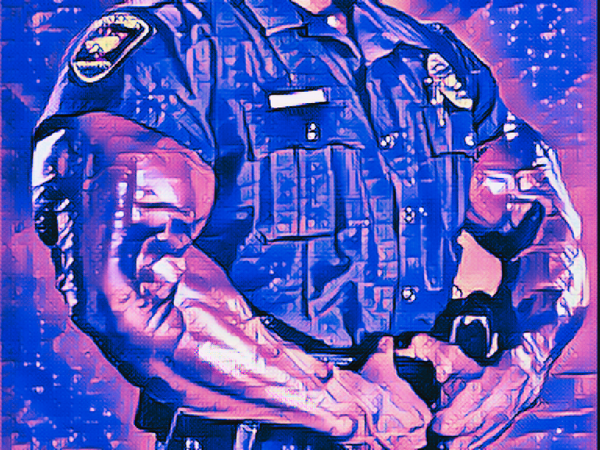
A far cry from Mayberry’s benevolent, khaki-clad neighborhood cops, police today are stormtroopers on steroids, both literally and figuratively: raging bulls in blue.

“Steroid use,” as researcher Philip J. Sweitzer warns, “is the not-so-quiet little secret of state and city police departments.”

John Hoberman, the author of Dopers in Uniform: The Hidden World of Police on Steroids, estimates that there may be tens of thousands of officers on steroids.

Illegal without a prescription and legitimized by a burgeoning industry of doctors known to law enforcement personnel who will prescribe steroids and other growth hormones based on bogus diagnoses, these testosterone-enhancing drugs have become hush-hush tools of the trade for police seeking to increase the size and strength of their muscles and their physical endurance, as well as gain an “edge” on criminals.

Having gained traction within the bodybuilding and sports communities, steroid use has fueled the dramatic transformation of police from Sheriff Andy Taylor’s lean form to the massive menace of the Hulk. As retired cop Phil Dees explains, “Anabolic steroid use among law enforcement officers is prevalent among the subset of cops who are heavily into weight training. They usually stand out from the crowd, and anyone who cares to look can pick out the most likely suspects.”

Broad-shouldered. Slim-waisted. Veiny. Tree-trunk necks. Rippling physiques. And as big as action heroes. That’s how Men’s Health describes these “juicers in blue”: cops using a cocktail of steroid drugs to transform themselves into “a flesh-and-blood Justice League.”

“Because juicing cops are a secretive subculture within a secretive subculture,” exact numbers are hard to come by, but if the anecdotal evidence is to be believed, it’s more widespread than ever, with 25% of police using these drugs to bulk up and supercharge their aggression.

Indeed, while steroids are physically transformative, building muscle mass, they are also psychologically affective, upping resistance to physical and emotional stress during periods of prolonged or heavy conflict, to the delight of the military, which was involved in their early development and experimentation.

Cue the rise of muscular authoritarianism.

As Philip Sweitzer documents, “Cops on steroids are simply the natural evolution of a conscious decision by the federal government to promote military authoritarianism in drug enforcement, and the implementation of military technologies.”

Roid rage is yet another example of blowback from a militaristic culture.

There are few police forces at every level of government that are not implicated in steroid use and, consequently, impacted by “roid rage,” which manifests itself as extreme mood swings, irritability, nervousness, delusions, aggressive outbursts, excessive use of force, a sense of invincibility, and poor judgment.

“For officers who work daily in high stress, high adrenaline environments and carry guns, the ‘rage’ can be even more extreme,” concludes journalist Bianca Cain Johnson, eliciting “a Hulk-esque response by those using steroids to normal situations.”

When that roid rage is combined with the trappings of a militarized cop armed to the teeth and empowered to shoot first and ask questions later, as well as to probe, poke, pinch, taser, search, seize, strip and generally manhandle anyone they see fit in almost any circumstance, all with the general blessing of the courts, the danger of any encounter with a cop grows exponentially more deadly.

Given the growing numbers of excessive force incidents by police, especially against unarmed individuals, we cannot afford to ignore the role that doping by police plays in this escalating violence.

For instance, in one of the largest busts nationwide involving law enforcement, 248 New Jersey police officers and firefighters were found to have been getting fraudulent prescriptions of anabolic steroids, human growth hormones and other muscle-building drugs from a doctor. A subsequent investigation of those officers found that many had previously been sued for excessive force or civil rights violations, or had been arrested, fired or suspended for off-duty.

As David Meinert reports, “Steroid use has been anecdotally associated with several brutality cases and racially motivated violence by police officers, including the 1997 sodomizing of an Haitian immigrant in  New York.”

Not surprisingly, police have consistently managed to sidestep a steady volley of lawsuits alleging a correlation between police doping and excessive force, insulated by a thin blue wall of silence, solidarity and coverups, powerful police unions, and the misapplied doctrine of qualified immunity.

Qualified immunity is how the police state stays in power.

Indeed, as Reuters reports, qualified immunity “has become a nearly failsafe tool to let police brutality go unpunished and deny victims their constitutional rights.”

At its most basic level, what this really translates to is an utter lack of accountability, whether over police brutality or doping.

Despite concerns about roid rage by police, few agencies carry out random tests for steroid use among officers, not even when an officer employs excessive force. Objections to such testing range from concerns about availability and cost to officer privacy.

As Hoberman points out, “The police establishment has reacted to the steroid culture by equivocating: announcing zero-tolerance policies while doing the absolute minimum to detect and control steroid use.”

Thus, any serious discussion about police reform needs to address the use of steroids by police, along with a national call for mandatory testing.

For starters, as journalist David Meinert suggests, police should be subjected to random drug tests for use of steroids, testosterone and HCG (an artificial form of testosterone), and testing should be mandatory and immediate any time an officer is involved in a shooting or accused of unnecessary force.

This is no longer a debate over good cops and bad cops.

It’s a power struggle between police officers who rank their personal safety above everyone else’s and police officers who understand that their jobs are to serve and protect; between police trained to shoot to kill and police trained to resolve situations peacefully; most of all, it’s between police who believe the law is on their side and police who know that they will be held to account for their actions under the same law as everyone else.

Unfortunately, more and more police are being trained to view themselves as distinct from the citizenry, to view their authority as superior to the citizenry, and to view their lives as more precious than those of their citizen counterparts. Instead of being taught to see themselves as mediators and peacemakers whose lethal weapons are to be used as a last resort, they are being drilled into acting like gunmen with killer instincts who shoot to kill rather than merely incapacitate.

We’ve allowed the government to create an alternate reality in which freedom is secondary to security, and the rights and lives of the citizenry are less important than the authority and might of the government.

As I make clear in my book Battlefield America: The War on the American People and in its fictional counterpart The Erik Blair Diaries, the longer we wait to burst the bubble on this false chimera, the greater the risks to both police officers and the rest of the citizenry.

Source: https://bit.ly/3DUcvqT

ABOUT JOHN W. WHITEHEAD

Constitutional attorney and author John W. Whitehead is founder and president of The Rutherford Institute. His most recent books are the best-selling Battlefield America: The War on the American People, the award-winning A Government of Wolves: The Emerging American Police State, and a debut dystopian fiction novel, The Erik Blair Diaries. Whitehead can be contacted at staff@rutherford.org. Nisha Whitehead is the Executive Director of The Rutherford Institute. Information about The Rutherford Institute is available at www.rutherford.org.

Publication Guidelines / Reprint Permission

John W. Whitehead’s weekly commentaries are available for publication to newspapers and web publications at no charge. Please contact staff@rutherford.org to obtain reprint permission.
Children are being targeted and sold for sex in America every day.”—John Ryan, National Center for Missing & Exploited Children

It takes a special kind of evil to prostitute and traffick a child for sex, and yet this evil walks among us every minute of every day.

Consider this: every two minutes, a child is bought and sold for sex.

Hundreds of young girls and boys—some as young as 9 years old—are being bought and sold for sex, as many as 20 times per day.

Adults purchase children for sex at least 2.5 million times a year in the United States alone.

In Georgia alone, it is estimated that 7,200 men (half of them in their 30s) seek to purchase sex with adolescent girls each month, averaging roughly 300 a day.

On average, a child might be raped by 6,000 men during a five-year period.

It is estimated that at least 100,000 to 500,000 children—girls and boys—are bought and sold for sex in the U.S. every year, with as many as 300,000 children in danger of being trafficked each year. Some of these children are forcefully abducted, others are runaways, and still others are sold into the system by relatives and acquaintances.

Child rape has become Big Business in America.

This is not a problem found only in big cities.

It’s happening everywhere, right under our noses, in suburbs, cities and towns across the nation.

As Ernie Allen of the National Center for Missing and Exploited Children points out, “The only way not to find this in any American city is simply not to look for it.”

Like so many of the evils in our midst, sex trafficking (and the sexualization of young people) is a cultural disease that is rooted in the American police state’s heart of darkness. It speaks to a sordid, far-reaching corruption that stretches from the highest seats of power (governmental and corporate) down to the most hidden corners and relies on our silence and our complicity to turn a blind eye to wrongdoing.

It is estimated that the number of children who are at risk of being trafficked or have already been sold into the sex trade would fill 1300 school buses.

The internet has become the primary means of sexual predators targeting and selling young children for sex. “One in five kids online are sexually propositioned through gaming platforms and other social media. And those, non-contact oriented forums of sexual exploitation are increasing,” said researcher Brian Ulicny.

It’s not just young girls who are vulnerable, either.

According to a USA Today investigative report, “boys make up about 36% of children caught up in the U.S. sex industry (about 60% are female and less than 5% are transgender males and females).”

Every year, the ages of the girls and boys being bought and sold get younger and younger.

The average age of those being trafficked is 13. Yet as the head of a group that combats trafficking pointed out, “Let’s think about what average means. That means there are children younger than 13. That means 8-, 9-, 10-year-olds.”

They’re minors as young as 13 who are being trafficked,” noted a 25-year-old victim of trafficking. “They’re little girls.”

This is America’s dirty little secret.

But what or who is driving this evil appetite for young flesh? Who buys a child for sex?

Otherwise ordinary men from all walks of life. “They could be your co-worker, doctor, pastor or spouse,” writes journalist Tim Swarens, who spent more than a year investigating the sex trade in America.

According to criminal investigator Marc Chadderdon, these “buyers”—the so-called “ordinary” men who drive the demand for sex with children—represent a cross-section of American society: every age, every race, every socio-economic background, cops, teachers, corrections workers, pastors, etc.

America’s police forces—riddled with corruption, brutality, sexual misconduct and drug abuse—represent another facet of the problem: police have become both predators and pimps. As the Philadelphia Inquirer reports, “Hundreds of police officers across the country have turned from protectors to predators, using the power of their badge to extort sex.”

Young girls are particularly vulnerable to these predators in blue.

Former police officer Phil Stinson estimates that half of the victims of police sex crimes are minors under the age of eighteen. According to The Washington Post, a national study found that 40 percent of reported cases of police sexual misconduct involved teens.

For example, in California, a police sergeant—a 16-year veteran of the police force—was arrested for raping a 16-year-old girl who was being held captive and sold for sex in a home in an upscale neighborhood.

A Pennsylvania police chief and his friend were arrested for allegedly raping a young girl hundreds of times—orally, vaginally, and anally several times a week—over the course of seven years, starting when she was 4 years old.

Two NYPD cops were accused of arresting a teenager, handcuffing her, and driving her in an unmarked van to a nearby parking lot, where they raped her and forced her to perform oral sex on them, then dropped her off on a nearby street corner.

The New York Times reports that “a sheriff’s deputy in San Antonio was charged with sexually assaulting the 4-year-old daughter of an undocumented Guatemalan woman and threatening to have her deported if she reported the abuse.”

And then you have national sporting events such as the Super Bowl, where sex traffickers have been caught selling minors, some as young as 9 years old. Whether or not the Super Bowl is a “windfall” for sex traffickers as some claim, it remains a lucrative source of income for the child sex trafficking industry and a draw for those who are willing to pay to rape young children.

Finally, as I documented in an earlier column, the culture is grooming these young people to be preyed upon by sexual predators.

Social media makes it all too easy. As one news center reported, “Finding girls is easy for pimps. They look on … social networks. They and their assistants cruise malls, high schools and middle schools. They pick them up at bus stops. On the trolley. Girl-to-girl recruitment sometimes happens.” Foster homes and youth shelters have also become prime targets for traffickers.

Rarely do these children enter into prostitution voluntarily. Many start out as runaways or throwaways, only to be snatched up by pimps or larger sex rings. Others, persuaded to meet up with a stranger after interacting online through one of the many social networking sites, find themselves quickly initiated into their new lives as sex slaves.

According to the National Center for Missing and Exploited Children, nearly 800,000 children go missing every year (roughly 2,185 children a day).

For those trafficked, it’s a nightmare from beginning to end.

Those being sold for sex have an average life expectancy of seven years, and those years are a living nightmare of endless rape, forced drugging, humiliation, degradation, threats, disease, pregnancies, abortions, miscarriages, torture, pain, and always the constant fear of being killed or, worse, having those you love hurt or killed.

A common thread woven through most survivors’ experiences is being forced to go without sleep or food until they have met their sex quota of at least 40 men.

As David McSwane recounts in a chilling piece for the Herald-Tribune: “In Oakland Park, an industrial Fort Lauderdale suburb, federal agents in 2011 encountered a brothel operated by a married couple. Inside ‘The Boom Boom Room,’ as it was known, customers paid a fee and were given a condom and a timer and left alone with one of the brothel’s eight teenagers, children as young as 13. A 16-year-old foster child testified that he acted as security, while a 17-year-old girl told a federal judge she was forced to have sex with as many as 20 men a night.”

One particular sex trafficking ring catered specifically to migrant workers employed seasonally on farms throughout the southeastern states, especially the Carolinas and Georgia, although it’s a flourishing business in every state in the country. Traffickers transport the women from farm to farm, where migrant workers would line up outside shacks, as many as 30 at a time, to have sex with them before they were transported to yet another farm where the process would begin all over again.

This growing evil is, for all intents and purposes, out in the open.

Unfortunately, as I document in my book Battlefield America: The War on the American People and in its fictional counterpart The Erik Blair Diaries, the government’s war on sex trafficking, much like the government’s war on terrorism, drugs and crime, has become a perfect excuse for inflicting more police state tactics (police check points, searches, surveillance, and heightened security) on a vulnerable public while doing little to actually protect our children from sex predators.

That so many children continue to be victimized, brutalized and treated like human cargo is due to three things: one, a consumer demand that is increasingly lucrative for everyone involved—except the victims; two, a level of corruption so invasive on both a local and international scale that there is little hope of working through established channels for change; and three, an eerie silence from individuals who fail to speak out against such atrocities.

Source: https://bit.ly/3XAkHUQ

ABOUT JOHN W. WHITEHEAD

Constitutional attorney and author John W. Whitehead is founder and president of The Rutherford Institute. His most recent books are the best-selling Battlefield America: The War on the American People, the award-winning A Government of Wolves: The Emerging American Police State, and a debut dystopian fiction novel, The Erik Blair Diaries. Whitehead can be contacted at staff@rutherford.org. Nisha Whitehead is the Executive Director of The Rutherford Institute. Information about The Rutherford Institute is available at www.rutherford.org.

Publication Guidelines / Reprint Permission

John W. Whitehead’s weekly commentaries are available for publication to newspapers and web publications at no charge. Please contact staff@rutherford.org to obtain reprint permission.

We live in a surveillance state founded on a partnership between government and the technology industry.”— Law Professor Avidan Y. Cover

In this age of ubiquitous surveillance, there are no private lives: everything is public.

Surveillance cameras mounted on utility poles, traffic lights, businesses, and homes. License plate readers. Ring doorbells. GPS devices. Dash cameras. Drones. Store security cameras. Geofencing and geotracking. FitBits. Alexa. Internet-connected devices.  

There are roughly one billion surveillance cameras worldwide and that number continues to grow, thanks to their wholehearted adoption by governments (especially law enforcement and military agencies), businesses, and individual consumers.

With every new surveillance device we welcome into our lives, the government gains yet another toehold into our private worlds.

Indeed, empowered by advances in surveillance technology and emboldened by rapidly expanding public-private partnerships between law enforcement, the Intelligence Community, and the private sector, police have become particularly adept at sidestepping the Fourth Amendment.

As law professor Avidan Y. Cover explains:

A key feature of the surveillance state is the cooperative relationship between the private sector and the government. The private sector’s role is vital to the surveillance both practically and legally. The private sector, of course, provides the infrastructure and tools for the surveillance… The private sector is also critical to the surveillance state’s legality. Under the third-party doctrine, the Fourth Amendment is not implicated when the government acquires information that people provide to corporations, because they voluntarily provide their information to another entity and assume the risk that the entity will disclose the information to the government. Therefore, people do not have a reasonable expectation of privacy in their calling data, or potentially even their emails. As a result, the government does not normally need a warrant to obtain information transmitted electronically. But the Fourth Amendment is not only a source of protection for individual privacy; it also limits government excess and abuse through challenges by the people. The third-party doctrine removes this vital and populist check on government overreach.

Critical to this end run around the Fourth Amendment’s prohibitions against unreasonable searches and seizures by government agents is a pass play that allows police to avoid public transparency requirements (open bids, public meetings, installation protocols) by having private companies and individuals do the upfront heavy lifting, leaving police to harvest the intel on the back end.

Stingray devices, facial recognition technology, body cameras, automated license plate readers, gunshot detection, predictive policing software, AI-enhanced video analytics, real-time crime centers, fusion centers: all of these technologies and surveillance programs rely on public-private partnerships that together create a sticky spiderweb from which there is no escape.

As the cost of these technologies becomes more affordable for the average consumer, an effort underwritten by the tech industry and encouraged by law enforcement agencies and local governing boards, which in turn benefit from access to surveillance they don’t need to include in their budgets, big cities, small towns, urban, suburban and rural communities alike are adding themselves to the surveillance state’s interconnected grid.

What this adds up to for government agencies (that is, FBI, NSA, DHS agents, etc., as well as local police) is a surveillance map that allows them to track someone’s movements over time and space, hopscotching from doorbell camera feeds and business security cameras to public cameras on utility poles, license plate readers, traffic cameras, drones, etc.

It has all but eliminated the notion of privacy and radically re-drawn the line of demarcation between our public and private selves.

Over the past 50 years, surveillance has brought about a series of revolutions in how governments govern and populations are policed to the detriment of us all. Cybersecurity expert Adam Scott Wandt has identified three such revolutions.

The first surveillance revolution came about as a result of government video cameras being installed in public areas. There were a reported 51 million surveillance cameras blanketing the United States in 2022. It’s estimated that Americans are caught on camera an average of 238 times every week (160 times per week while driving; 40 times per week at work; 24 times per week while out running errands and shopping; and 14 times per week through various other channels and activities). That doesn’t even touch on the coverage by surveillance drones, which remain a relatively covert part of police spying operations.

The second revolution occurred when law enforcement agencies started forging public-private partnerships with commercial establishments like banks and drug stores and parking lots in order to gain access to their live surveillance feeds. The use of automatic license plate readers (manufactured and distributed by the likes of Flock Safety), once deployed exclusively by police and now spreading to home owners associations and gated communities, extends the reach of the surveillance state that much further afield. It’s a win-win for police budgets and local legislatures when they can persuade businesses and residential communities to shoulder the costs of the equipment and share the footage, and they can conscript the citizenry to spy on each other through crowdsourced surveillance.

The third revolution was ushered in with the growing popularity of doorbell cameras such as Ring, Amazon’s video surveillance doorbell, and Google’s Nest Cam.

Amazon has been particularly aggressive in its pursuit of a relationship with police, enlisting them in its marketing efforts, and going so far as to hosting parties for police, providing free Ring doorbells and deep discounts, sharing “active camera” maps of Ring owners, allowing access to the Law Enforcement Neighborhood Portal, which enables police to directly contact owners for access to their footage, and coaching police on how to obtain footage without a warrant.

Ring currently partners with upwards of 2,161 law enforcement agencies and 455 fire departments, and that number grows exponentially every year. As Vice reports, “Ring has also heavily pursued city discount programs and private alliances with neighborhood watch groups. When cities provide free or discounted Ring cameras, they sometimes create camera registries, and police sometimes order people to aim Ring cameras at their neighbors, or only give cameras to people surveilled by neighborhood watches.”

In November 2022, San Francisco police gained access to the live footage of privately owned internet cameras as opposed to merely being able to access recorded footage. No longer do police even have to request permission of homeowners for such access: increasingly, corporations have given police access to footage as part of their so-called criminal investigations with or without court orders.

We would suggest a fourth revolutionary shift to be the use of facial recognition software and artificial intelligence-powered programs that can track people by their biometrics, clothing, behavior and car, thereby synthesizing the many strands of surveillance video footage into one cohesive narrative, which privacy advocates refer to as 360 degree surveillance.

Finally, Wandt sees autonomous cars equipped with cameras that record everything around them as yet another revolutionary expansion of surveillance to be tapped by police.

Yet in the present moment, it’s those public-private partnerships that signify a watershed moment in the transition from a police state to a surveillance state and sound a death knoll for our privacy rights. This fusion of government power and private power is also at the heart of the surveillance state’s growing stranglehold on the populace.

As always, these intrusions into our personal lives are justified in the name of national security and fighting crime. Yet while the price to be paid for having the government’s so-called protection is nothing less than our right to privacy, the guarantee of safety remains dubious, at best.

As a study on camera surveillance by researchers at City University of New York concluded, the presence of cameras were somewhat effective as a deterrent for crimes such as car burglaries and property theft, but they had no significant effect on violent crimes.

On the other hand, when you combine overcriminalization with wall-to-wall surveillance monitored by police in pursuit of crimes, the resulting suspect society inevitably gives way to a nation of criminals. In such a society, we are all guilty of some crime or other.

The predatory effect of these surveillance cameras has also yet to be fully addressed, but they are vulnerable to being hacked by third parties and abused by corporate and government employees.

After all, power corrupts. We’ve seen this abuse of power recur time and time again throughout history. For instance, as an in-depth investigative report by the Associated Press concludes, the very same mass surveillance technologies that were supposedly so necessary to fight the spread of COVID-19 are now being used to stifle dissent, persecute activists, harass marginalized communities, and link people’s health information to other surveillance and law enforcement tools. As the AP reports, federal officials have also been looking into how to add “‘identifiable patient data,’ such as mental health, substance use and behavioral health information from group homes, shelters, jails, detox facilities and schools,” to its surveillance toolkit.

These cameras—and the public-private eyes peering at us through them—are re-engineering a society structured around the aesthetic of fear and, in the process, empowering “people to not just watch their neighborhood, but to organize as watchers,” creating not just digital neighborhood watches but digital gated communities.

Finally, there is a repressive, suppressive effect to surveillance that not only acts as a potentially small deterrent on crime but serves to monitor and chill lawful First Amendment activity. As Matthew Feeney warns in the New York Times, “In the past, Communists, civil rights leaders, feminists, Quakers, folk singers, war protesters and others have been on the receiving end of law enforcement surveillance. No one knows who the next target will be.

No one knows, but it’s a pretty good bet that the surveillance state will be keeping a close watch on anyone seen as a threat to the government’s chokehold on power.

It’s George Orwell’s 1984 on a global scale.

As I make clear in my book Battlefield America: The War on the American People and in its fictional counterpart The Erik Blair Diaries, Orwell’s dystopian nightmare has become our looming reality.

Source: https://bit.ly/3HeSmgW

ABOUT JOHN W. WHITEHEAD

Constitutional attorney and author John W. Whitehead is founder and president of The Rutherford Institute. His most recent books are the best-selling Battlefield America: The War on the American People, the award-winning A Government of Wolves: The Emerging American Police State, and a debut dystopian fiction novel, The Erik Blair Diaries. Whitehead can be contacted at staff@rutherford.org. Nisha Whitehead is the Executive Director of The Rutherford Institute. Information about The Rutherford Institute is available at www.rutherford.org.

Publication Guidelines / Reprint Permission

John W. Whitehead’s weekly commentaries are available for publication to newspapers and web publications at no charge. Please contact staff@rutherford.org to obtain reprint permission.

How do you trust a government that continuously sidesteps the Constitution and undermines our rights? You can’t.

When you consider all the ways “we the people” are being bullied, beaten, bamboozled, targeted, tracked, repressed, robbed, impoverished, imprisoned and killed by the government, one can only conclude that you shouldn’t trust the government with your privacy, your property, your life, or your freedoms.

Consider for yourself.

Don’t trust the government with your privacy, digital or otherwise. In the two decades since 9/11, the military-security industrial complex has operated under a permanent state of emergency that, in turn, has given rise to a digital prison that grows more confining and inescapable by the day. Wall-to wall surveillance, monitored by AI software and fed to a growing network of fusion centers, render the twin concepts of privacy and anonymity almost void. By conspiring with corporations, the Department of Homeland Security “fueled a massive influx of money into surveillance and policing in our cities, under a banner of emergency response and counterterrorism.” For instance, all across the country, police are installing Flock Safety license plate readers as part of a public-private partnership program between police and the surveillance industry. These cameras, which upload data in real time to fusion crime centers, signal a turning point in the transition from a police state to a police-driven surveillance state.

Don’t trust the government with your property. In yet another effort to legitimize warrantless searches, police are employing “hit-and-hold” tactics in which police enter a home, carry out an initial sweep of the property, handcuff the occupants, then wait for official search warrants to be secured and applied retroactively. In the meantime, police have managed to bypass the Fourth Amendment. The rationale, to prevent possible destruction of evidence, is the same one used to deadly effect with no-knock raids. If government agents can invade your home, break down your doors, kill your dog, damage your furnishings and terrorize your family, your property is no longer private and secure—it belongs to the government. Hard-working Americans are having their bank accounts, homes, cars electronics and cash seized by police under the assumption that they have allegedly been associated with some criminal scheme.

Don’t trust the government with your finances. The U.S. government—and that includes the current administration—is spending money it doesn’t have on programs it can’t afford, and “we the taxpayers” are being forced to foot the bill for the government’s fiscal insanity. The national debt is $31.3 trillion and growing, and we’re paying more than $300 billion in interest every year on that public debt, yet there seems to be no end in sight when it comes to the government’s fiscal insanity. According to Forbes, Congress has raised, extended or revised the definition of the debt limit 78 times since 1960 in order to allow the government to essentially fund its existence with a credit card.

Don’t trust the government with your health. For all intents and purposes, “we the people” have become lab rats in the government’s secret experiments, which include MKULTRA and the U.S. military’s secret race-based testing of mustard gas on more than 60,000 enlisted men. Indeed, you don’t have to dig very deep or go very back in the nation’s history to uncover numerous cases in which the government deliberately conducted secret experiments on an unsuspecting populace—citizens and noncitizens alike—making healthy people sick by spraying them with chemicals, injecting them with infectious diseases and exposing them to airborne toxins. Unfortunately, the public has become so easily distracted by the political spectacle out of Washington, DC, that they are altogether oblivious to the grisly experiments, barbaric behavior and inhumane conditions that have become synonymous with the U.S. government, which has meted out untold horrors against humans and animals alike.

Don’t trust the government with your life: At a time when growing numbers of unarmed people have been shot and killed for just standing a certain way, or moving a certain way, or holding something—anything—that police could misinterpret to be a gun, or igniting some trigger-centric fear in a police officer’s mind that has nothing to do with an actual threat to their safety, even the most benign encounters with police can have fatal consequences. The number of Americans killed by police continues to grow, with the majority of those killed as a result of police encounters having been suspected of a non-violent offense or no crime at all, or during a traffic violation. According a report by Mapping Police Violence, police killed more people in 2022 than any other year within the past decade. In 98% of those killings, police were not charged with a crime.

Don’t trust the government with your freedoms. For years now, the government has been playing a cat-and-mouse game with the American people, letting us enjoy just enough freedom to think we are free but not enough to actually allow us to live as a free people. Freedom no longer means what it once did. This holds true whether you’re talking about the right to criticize the government in word or deed, the right to be free from government surveillance, the right to not have your person or your property subjected to warrantless searches by government agents, the right to due process, the right to be safe from militarized police invading your home, the right to be innocent until proven guilty and every other right that once reinforced the founders’ belief that this would be “a government of the people, by the people and for the people.” On paper, we may be technically free, but in reality, we are only as free as a government official may allow.

Whatever else it may be—a danger, a menace, a threat—the U.S. government is certainly not looking out for our best interests, nor is it in any way a friend to freedom.

Remember the purpose of a good government is to protect the lives and liberties of its people.

Unfortunately, what we have been saddled with is, in almost every regard, the exact opposite of an institution dedicated to protecting the lives and liberties of its people.

As I make clear in my book Battlefield America: The War on the American People and in its fictional counterpart The Erik Blair Diaries, “we the people” should have learned early on that a government that repeatedly lies, cheats, steals, spies, kills, maims, enslaves, breaks the laws, overreaches its authority, and abuses its power at almost every turn can’t be trusted.

Source: https://bit.ly/3W36IW2

ABOUT JOHN W. WHITEHEAD

Constitutional attorney and author John W. Whitehead is founder and president of The Rutherford Institute. His most recent books are the best-selling Battlefield America: The War on the American People, the award-winning A Government of Wolves: The Emerging American Police State, and a debut dystopian fiction novel, The Erik Blair Diaries. Whitehead can be contacted at staff@rutherford.org. Nisha Whitehead is the Executive Director of The Rutherford Institute. Information about The Rutherford Institute is available at www.rutherford.org.

Publication Guidelines / Reprint Permission

John W. Whitehead’s weekly commentaries are available for publication to newspapers and web publications at no charge. Please contact staff@rutherford.org to obtain reprint permission.
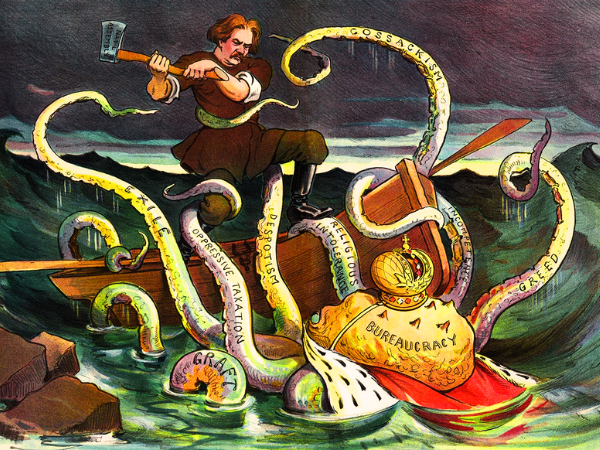
“There is no greater tyranny than that which is perpetrated under the shield of the law and in the name of justice.”—Montesquieu, Enlightenment philosopher

For those wondering what to expect from the government in 2023, it looks like we’re going to be in for more of the same in terms of the government’s brand of madness, mayhem, corruption and brutality.

Digital prisons. Unceasingly, the government and its corporate partners are pushing for a national digital ID system. Local police agencies have already been given access to facial recognition software and databases containing 20 billion images, the precursor to a digital ID. Eventually, a digital ID will be required to gain access to all aspects of life: government, work, travel, healthcare, financial services, shopping, etc. Before long, biometrics (iris scans, face print, voice, DNA, etc.), will become the de facto digital ID.

Precrime. Under the pretext of helping overwhelmed government agencies work more efficiently, AI predictive and surveillance technologies are being used to classify, segregate and flag the populace with little concern for privacy rights or due process. All of this sorting, sifting and calculating is being done swiftly, secretly and incessantly with the help of AI technology and a surveillance state that monitors your every move. AI predictive tools are being deployed in almost every area of life.

Mandatory quarantines. Building on precedents established during the COVID-19 pandemic, government agents may be empowered to indefinitely detain anyone they suspect of posing a medical risk to others without providing an explanation, subject them to medical tests without their consent, and carry out such detentions and quarantines without any kind of due process or judicial review.

Mental health assessments by non-medical personnel. As a result of a nationwide push to train a broad spectrum of so-called gatekeepers in mental health first-aid training, more Americans are going to run the risk of being reported by non-medical personnel and detained for having mental health issues.

Tracking chips for citizens. Momentum is building for corporations and the government alike to be able to track the populace, whether through the use of RFID chips embedded in a national ID card, microscopic chips embedded in one’s skin, or tags in retail products.

Military involvement domestically. The future, according to a Pentagon training video, will be militaristic, dystopian and far from friendly to freedom. Indeed, all signs point to the battlefield of the future being the American home front. Anticipating this, the government plans to have the military work in conjunction with local police to quell civil unrest domestically.

Government censorship of anything it classifies as disinformation. In the government’s ongoing assault on those who criticize the government—whether that criticism manifests itself in word, deed or thought—government and corporate censors claiming to protect us from dangerous, disinformation campaigns are, in fact, laying the groundwork now to preempt any “dangerous” ideas that might challenge the power elite’s stranglehold over our lives.

Threat assessments. The government has a growing list—shared with fusion centers and law enforcement agencies—of ideologies, behaviors, affiliations and other characteristics that could flag someone as suspicious and result in their being labeled potential enemies of the state. Before long, every household in America will be flagged as a threat and assigned a threat score. It’s just a matter of time before you find yourself wrongly accused, investigated and confronted by police based on a data-driven algorithm or risk assessment culled together by a computer program run by artificial intelligence.

War on cash. The government and its corporate partners are engaged in a concerted campaign to shift consumers towards a digital mode of commerce that can easily be monitored, tracked, tabulated, mined for data, hacked, hijacked and confiscated when convenient. This push for a digital currency dovetails with the government’s war on cash, which it has been subtly waging for some time now. In recent years, just the mere possession of significant amounts of cash could implicate you in suspicious activity and label you a criminal.

Expansive surveillance. AI surveillance harnesses the power of artificial intelligence and widespread surveillance technology to do what the police state lacks the manpower and resources to do efficiently or effectively: be everywhere, watch everyone and everything, monitor, identify, catalogue, cross-check, cross-reference, and collude. Everything that was once private is now up for grabs to the right buyer. With every new AI surveillance technology that is adopted and deployed without any regard for privacy, Fourth Amendment rights and due process, the rights of the citizenry are being marginalized, undermined and eviscerated.

Militarized police. Having transformed local law enforcement into extensions of the military, the Department of Homeland Security, the Justice Department and the FBI are moving into the next phase of the transformation, turning the nation’s police officers into techno-warriors, complete with iris scanners, body scanners, thermal imaging Doppler radar devices, facial recognition programs, license plate readers, cell phone extraction software, Stingray devices and so much more.

Police shootings of unarmed citizens. Owing in large part to the militarization of local law enforcement agencies, not a week goes by without more reports of hair-raising incidents by police imbued with a take-no-prisoners attitude and a battlefield approach to the communities in which they serve. Police brutality and the use of excessive force continues unabated.

False flags and terrorist attacks. Almost every tyranny being perpetrated by the U.S. government against the citizenry—purportedly to keep us safe and the nation secure—has come about as a result of some threat manufactured in one way or another by our own government. This has become the shadow government’s modus operandi regardless of which party is in power: the government creates a menace—knowing full well the ramifications such a danger might pose to the public—then without ever owning up to the part it played in unleashing that particular menace on an unsuspecting populace, it demands additional powers in order to protect “we the people” from the threat.

Endless wars to keep America’s military’s empire employed. The military and security industrial complexes that have advocated that the U.S. remain at war, year after year, are the very entities that will continue to profit the most from America’s expanding military empire abroad and here at home.

Erosions of private property. Private property means little at a time when SWAT teams and other government agents can invade your home, break down your doors, kill your dog, wound or kill you, damage your furnishings and terrorize your family. Likewise, if government officials can fine and arrest you for growing vegetables in your front yard, praying with friends in your living room, installing solar panels on your roof, and raising chickens in your backyard, you’re no longer the owner of your property.

Overcriminalization. The government has increasingly adopted the authoritarian notion that it knows best and therefore must control, regulate and dictate almost everything about the citizenry’s public, private and professional lives. Overregulation and overcriminalization have been pushed to such outrageous limits that federal and state governments now require on penalty of a fine that individuals apply for permission before they can grow exotic orchids, host elaborate dinner parties, gather friends in one’s home for Bible studies, give coffee to the homeless, let their kids manage a lemonade stand, keep chickens as pets, or braid someone’s hair.

Strip searches and the denigration of bodily integrity. Court rulings undermining the Fourth Amendment and justifying invasive strip searches have left us powerless against police empowered to forcefully draw our blood, forcibly take our DNA, strip search us, and probe us intimately. Individuals—men and women alike—continue to be subjected to what is essentially government-sanctioned rape by police in the course of “routine” traffic stops.

Censorship. First Amendment activities are being pummeled, punched, kicked, choked, chained and generally gagged all across the country. Free speech zones, bubble zones, trespass zones, anti-bullying legislation, zero tolerance policies, hate crime laws and a host of other legalistic maladies dreamed up by politicians and prosecutors have conspired to corrode our core freedoms. The reasons for such censorship vary widely from political correctness, safety concerns and bullying to national security and hate crimes but the end result remains the same: the complete eradication of what Benjamin Franklin referred to as the “principal pillar of a free government.”

Taxation Without Any Real Representation. As a Princeton University survey indicates, our elected officials, especially those in the nation’s capital, represent the interests of the rich and powerful rather than the average citizen. We are no longer a representative republic. With Big Business and Big Government having fused into a corporate state, the president and his state counterparts—the governors—have become little more than CEOs of the Corporate State, which day by day is assuming more government control over our lives. Never before have average Americans had so little say in the workings of their government and even less access to their so-called representatives.

Year after year, the government remains the greatest threat to our freedoms, and yet year after year, “we the people” allow ourselves to be suckered into believing that politics will fix what’s wrong with the country.

Indeed, as I make clear in my book Battlefield America: The War on the American People and in its fictional counterpart The Erik Blair Diaries, this is the very definition of insanity.

Source: https://bit.ly/3ItNINg

ABOUT JOHN W. WHITEHEAD

Constitutional attorney and author John W. Whitehead is founder and president of The Rutherford Institute. His most recent books are the best-selling Battlefield America: The War on the American People, the award-winning A Government of Wolves: The Emerging American Police State, and a debut dystopian fiction novel, The Erik Blair Diaries. Whitehead can be contacted at staff@rutherford.org. Nisha Whitehead is the Executive Director of The Rutherford Institute. Information about The Rutherford Institute is available at www.rutherford.org.

Publication Guidelines / Reprint Permission

John W. Whitehead’s weekly commentaries are available for publication to newspapers and web publications at no charge. Please contact staff@rutherford.org to obtain reprint permission.
The danger signs were everywhere in 2022.

With every new law enacted by federal and state legislatures, every new ruling handed down by government courts, and every new military weapon, invasive tactic and egregious protocol employed by government agents, we were reminded that in the eyes of the government and its corporate accomplices, “we the people” possess no rights except for that which the Deep State grants on an as-needed basis.

Totalitarian paranoia spiked. What we have been saddled with is a government so power-hungry, paranoid and afraid of losing its stranglehold on power that it has conspired to wage war on anyone who dares to challenge its authority. In a Machiavellian attempt to expand its powers, the government unleashed all manner of dangers on an unsuspecting populace in order to justify its demands for additional powers to protect “we the people” from emerging threats, whether legitimate, manufactured or overblown.

The state of our nation suffered. The nation remained politically polarized, controlled by forces beyond the purview of the average American, and rapidly moving the nation away from its freedom foundation. The combined blowback from a contentious presidential election and the COVID-19 pandemic resulted in Americans being subjected to egregious civil liberties violations, invasive surveillance, martial law, lockdowns, political correctness, erosions of free speech, strip searches, police shootings of unarmed citizens, government spying, and the criminalization of lawful activities.

Thought crimes became a target for punishment. For years now, the government has used all of the weapons in its vast arsenal—surveillance, threat assessments, fusion centers, pre-crime programs, hate crime laws, militarized police, lockdowns, martial law, etc.—to target potential enemies of the state based on their ideologies, behaviors, affiliations and other characteristics that might be deemed suspicious or dangerous. In other words, if you dare to subscribe to any views that are contrary to the government’s, you may well be suspected of being a domestic terrorist and treated accordingly. In 2022, those who criticized the government—whether that criticism manifested itself in word, deed or thought—were flagged as dangerous alongside consumers and spreaders of “mis- dis- and mal-information.”

Speech was muzzled. Those who want to monitor, muzzle, catalogue and censor speech continued to push for social media monitoring, censorship of flagged content that could be construed as dangerous or hateful, and limitations on free speech activities, particularly online. Of course, it’s a slippery slope from censoring so-called illegitimate ideas to silencing truth. Eventually, as George Orwell predicted, telling the truth will become a revolutionary act. If the government can control speech, it can control thought and, in turn, it can control the minds of the citizenry.

Kill switches aimed to turn off more than just your car. Vehicle “kill switches” were sold to the public as a safety measure aimed at keeping drunk drivers off the roads, but they were a perfect metaphor for the government’s efforts to not only take control of our cars but also our freedoms and our lives. For too long, we have been captive passengers in a driverless car controlled by the government, losing more and more of our privacy and autonomy the further down the road we go.

Currency went digital. No matter how much money the government pulls in, it’s never enough, so the government came up with a new plan to make it even easier for its agents to seize Americans’ bank account. In an Executive Order issued in March 2022, President Biden called for the federal government to consider establishing a form of digital money. Digital currency will provide the government and its corporate partners with a mode of commerce that can easily be monitored, tracked, tabulated, mined for data, hacked, hijacked and confiscated when convenient.

The government spoke in a language of violence. Police violence killed three people a day. Warrior cops—trained in the worst-case scenario and thus ready to shoot first and ask questions later—did not make us or themselves any safer. Despite this, President Biden’s pledged to expand law enforcement and so-called crime prevention through a $30 billion “Fund the Police” program.

Cancel culture became more intolerant. Cancel culture—political correctness amped up on steroids, the self-righteousness of a narcissistic age, and a mass-marketed pseudo-morality that is little more than fascism disguised as tolerance—shifted us into an Age of Intolerance, policed by techno-censors, social media bullies, and government watchdogs. Everything has now become fair game for censorship if it can be construed as hateful, hurtful, bigoted or offensive provided that it runs counter to the established viewpoint.

Homes were invaded. Government agents routinely violated the Fourth Amendment at will under the pretext of public health and safety. This doesn’t even begin to touch on the many ways the government and its corporate partners-in-crime used surveillance technology to invade homes: with wiretaps, thermal imaging, surveillance cameras, and other monitoring devices.

Political theater kept the public distracted. Having devolved into a carefully calibrated exercise in how to manipulate, polarize, propagandize and control a population, the political scene provided ample diversions with its televised Jan. 6 committee hearings, the Russia-Ukraine crisis, the Ketanji Brown Jackson confirmation hearings, and more.

Bodily integrity was undermined. Caught in the crosshairs of a showdown between the rights of the individual and the so-called “emergency” state, concerns about COVID-19 mandates and bodily integrity remained part of a much larger debate over the ongoing power struggle between the citizenry and the government over our property “interest” in our bodies. This debate over bodily integrity covered broad territory, ranging from abortion and forced vaccinations to biometric surveillance and basic healthcare. Although the Supreme Court overturned its earlier rulings recognizing abortion as a constitutional right under the Fourteenth Amendment, it did nothing to resolve the larger problem that plagues us today: namely, that all along the spectrum of life—from the unborn child to the aged—the government continues to play fast and loose with the lives of the citizenry.

The government’s fiscal insanity reached new heights. The national debt (the amount the federal government has borrowed over the years and must pay back) hit $30 trillion. That translates to roughly $242,000 per taxpayer. It’s estimated that the amount this country owes is now 130% greater than its gross domestic product (all the products and services produced in one year by labor and property supplied by the citizens). That debt is also growing exponentially: it is expected to be twice the size of the U.S. economy by 2051.

Surveillance got creepier. On any given day, the average American going about his daily business was monitored, surveilled, spied on and tracked in more than 20 different ways, by both government and corporate eyes and ears. In such a surveillance ecosystem, we’re all suspects and databits to be tracked, catalogued and targeted. With every new AI surveillance technology that was adopted and deployed without any regard for privacy, Fourth Amendment rights and due process, the rights of the citizenry were marginalized, undermined and eviscerated.

Precrime became more fact than fiction. Under the pretext of helping overwhelmed government agencies work more efficiently, AI predictive and surveillance technologies were used to classify, segregate and flag the populace with little concern for privacy rights or due process. All of this sorting, sifting and calculating was done swiftly, secretly and incessantly with the help of AI technology and a surveillance state that monitors your every move. Where this becomes particularly dangerous is when the government takes preemptive steps to combat crime or abuse, or whatever the government has chosen to outlaw at any given time.

The government waged psychological warfare on the nation. The government made clear in word and deed that “we the people” are domestic enemies to be targeted, tracked, manipulated, micromanaged, surveilled, viewed as suspects, and treated as if our fundamental rights are mere privileges that can be easily discarded. Aided and abetted by technological advances and scientific experimentation, the government weaponized violence; surveillance, pre-crime and pre-thought campaigns; digital currencies, social media scores and censorship; desensitization campaigns; fear; genetics; and entertainment.

Gun confiscation laws put a target on the back of every American. Red flag gun laws (which authorize government officials to seize guns from individuals viewed as a danger to themselves or others) gained traction as a legislative means by which to allow police to remove guns from people suspected of being threats. Red flag gun laws merely push us that much closer towards a suspect society where everyone is potentially guilty of some crime or another and must be preemptively rendered harmless.

The burden of proof was reversed. Although the Constitution requires the government to provide solid proof of criminal activity before it can deprive a citizen of life or liberty, the government turned that fundamental assurance of due process on its head. Each and every one of us is now seen as a potential suspect, terrorist and lawbreaker in the eyes of the government. The groundwork has been laid for a new kind of government where it won’t matter if you’re innocent or guilty, whether you’re a threat to the nation, or even if you’re a citizen. What will matter is what the government—or whoever happens to be calling the shots at the time—thinks. And if the powers-that-be think you’re a threat to the nation and should be locked up, then you’ll be locked up with no access to the protections our Constitution provides.

The Supreme Court turned America into a Constitution-free zone. Although the Court’s rulings on qualified immunity for police who engage in official misconduct were largely overshadowed by its politically polarizing rulings on abortion, gun ownership and religion, they were no less devastating. The bottom line: there will be no consequences for cops who brutalize the citizenry and no justice for the victims of police brutality.

The FBI went rogue. The FBI’s laundry list of crimes against the American people ran the gamut from surveillance, disinformation, blackmail, entrapment, and intimidation tactics to harassment and indoctrination, governmental overreach, abuse, misconduct, trespassing, enabling criminal activity, and damaging private property, and that’s just based on what we know.

The government waged war on political freedom. In more and more cases, the government declared war on what should be protected political speech whenever it challenges the government’s power, reveals the government’s corruption, exposes the government’s lies, and encourages the citizenry to push back against the government’s many injustices.

The military industrial complex waged more wars. America’s part in the showdown between Russia and the Ukraine conveniently followed on the heels of a long line of other crises which have occurred like clockwork in order to keep Americans distracted, deluded, amused, and insulated from the government’s steady encroachments on our freedoms.

The Deep State went global. We’ve been inching closer to a new world order for the past several decades, but COVID-19, which saw governmental and corporate interests become even more closely intertwined, shifted this transformation into high gear. This new world order—a global world order—made up of international government agencies and corporations owes its existence in large part to the U.S. government’s deep-seated and, in many cases, top-secret alliances with foreign nations and global corporations. This powerful international cabal, let’s call it the Global Deep State, is just as real as the corporatized, militarized, industrialized American Deep State, and it poses just as great a threat to our rights as individuals under the U.S. Constitution, if not greater.

Authoritarian madness escalated. You didn’t have to be a conspiracy theorist or even anti-government to recognize the slippery slope that starts with well-meaning intentions for the greater good and ends with tyrannical abuses no one should tolerate. When any government is empowered to adopt a comply-or-suffer-the-consequences mindset that is enforced through mandates, lockdowns, penalties, detention centers, martial law, and an utter disregard for the rights of the individual, there should be reason for concern.

The takeaway: the more things changed, the more they stayed the same.

As I make clear in my book Battlefield America: The War on the American People and in its fictional counterpart The Erik Blair Diaries, if there is any means left to us for thwarting the government in its relentless march towards outright dictatorship, it rests—as it always has—at the local level, with “we the people.”

Unless we work together to push back against the government’s overreach, excesses and abuse, 2023 will be yet another terrible, horrible, no good, very bad year for freedom.

Source: https://bit.ly/3jrcC5D

ABOUT JOHN W. WHITEHEAD

Constitutional attorney and author John W. Whitehead is founder and president of The Rutherford Institute. His most recent books are the best-selling Battlefield America: The War on the American People, the award-winning A Government of Wolves: The Emerging American Police State, and a debut dystopian fiction novel, The Erik Blair Diaries. Whitehead can be contacted at staff@rutherford.org. Nisha Whitehead is the Executive Director of The Rutherford Institute. Information about The Rutherford Institute is available at www.rutherford.org.

Publication Guidelines / Reprint Permission

John W. Whitehead’s weekly commentaries are available for publication to newspapers and web publications at no charge. Please contact staff@rutherford.org to obtain reprint permission.