Archive for the ‘Uncategorized’ Category

Despite the steady hue and cry by government agencies about the need for more police, more sophisticated weaponry, and the difficulties of preserving the peace and maintaining security in our modern age, the reality is far different. Indeed, violent crime in America has been on a steady decline, and if current trends continue, Americans will finish the year 2013 experiencing the lowest murder rate in over a century.

Despite this clear referendum on the fact that communities would be better served by smaller, demilitarized police forces, police agencies throughout the country are dramatically increasing in size and scope. Some of the nation’s larger cities boast police forces the size of small armies. (New York City Mayor Michael Bloomberg actually likes to brag that the NYPD is his personal army.) For example, the Los Angeles Police Department (LAPD) has reached a total of 10,000 officers. It takes its place alongside other cities boasting increasingly large police forces, including New York (36,000 officers) and Chicago (13,400 officers). When considered in terms of cops per square mile, Los Angeles assigns a whopping 469 officers per square mile, followed by New York with 303 officers per square mile, and Chicago with 227 cops per square mile.

Of course, such heavy police presence comes at a price. Los Angeles spends over $2 billion per year on the police force, a 36% increase within the last eight years. The LAPD currently consumes over 55% of Los Angeles’ discretionary budget, a 9% increase over the past nine years. Meanwhile, street repair and maintenance spending has declined by 36%, and in 2011, one-fifth of the city’s fire stations lost units, increasing response times for 911 medical emergencies.

For those who want to credit hefty police forces for declining crime rates, the data just doesn’t show a direct correlation. In fact, many cities across the country actually saw decreases in crime rates during the 1990s in the wake of increasing prison sentences and the waning crack-cocaine epidemic. Cities such as Seattle and Dallas actually cut their police forces during this time and still saw crime rates drop.

For more on these and other issues, read my new book, A Government of Wolves: The Emerging American Police State, available at Amazon and in a bookstore near you.

As I point out in my new book, A Government of Wolves: The Emerging American Police State, there was a time in our nation’s history when Americans would have revolted against the prospect of city police forces the size of small armies, or rampaging SWAT teams tearing through doors and terrorizing families. Today, the SWAT team is largely sold to the American public by way of the media, through reality TV shows such as Cops, Armed and Famous, and Police Women of Broward County, and by politicians well-versed in promising greater security in exchange for the government being given greater freedom to operate as it sees fit outside the framework of the Constitution.

Having watered down the Fourth Amendment’s strong prohibitions intended to keep police in check and functioning as peacekeepers, we now find ourselves in the unenviable position of having militarized standing armies enforcing the law. Likewise, whereas the police once operated as public servants (i.e., in service to the public), today that master-servant relationship has been turned on its head to such an extent that if we fail to obey anyone who wears a badge, we risk dire consequences.

Consider that in 1980, there were roughly 3,000 SWAT team-style raids in the US. By 2001, that number had grown to 45,000 and has since swelled to more than 80,000 SWAT team raids per year. On an average day in America, over 100 Americans have their homes raided by SWAT teams. In fact, there are few communities without a SWAT team on their police force today. In 1984, 25.6 percent of towns with populations between 25,000 and 50,000 people had a SWAT team. That number rose to 80 percent by 2005.

The problem, of course, is that as SWAT teams and SWAT-style tactics are used more frequently to carry out routine law enforcement activities, Americans find themselves in increasingly dangerous and absurd situations. For example, in late July 2013, a no-kill animal shelter in Kenosha, Wisconsin, was raided by nine Department of Natural Resources (DNR) agents and four deputy sheriffs. The raid was prompted by tips that the shelter was home to a baby deer that had been separated from its mother. The shelter officials had planned to send the deer to a wildlife rehabilitation facility in Illinois, but the agents, who stormed the property unannounced, demanded that the deer be handed over because citizens are not allowed to possess wildlife. When the 13 LEOs entered the property “armed to the teeth,” they corralled the employees around a picnic table while they searched for the deer. When they returned, one agent had the deer slung over his shoulder in a body bag, ready to be euthanized.

When asked why they didn’t simply ask shelter personnel to hand the deer over instead of conducting an unannounced raid, DNR Supervisor Jennifer Niemeyer compared their actions to drug raids, saying “If a sheriff’s department is going in to do a search warrant on a drug bust, they don’t call them and ask them to voluntarily surrender their marijuana or whatever drug that they have before they show up.”

If these raids are becoming increasingly common and widespread, you can chalk it up to the “make-work” philosophy, in which you assign at-times unnecessary jobs to individuals to keep them busy or employed. In this case, however, the make-work principle is being used to justify the use of sophisticated military equipment and, in the process, qualify for federal funding.

It all started back in the 1980s, when Congress launched the 1033 Program to allow the Department of Defense to transfer surplus military goods to state and local police agencies. The 1033 program has grown dramatically, with some 13,000 police agencies in all 50 states and four US territories currently participating. In 2012, the federal government transferred $546 million worth of property to state and local police agencies. This 1033 program allows small towns like Rising Star, Texas, with a population of 835 and only one full-time police officer, to acquire $3.2 million worth of goods and military gear from the federal government over the course of fourteen months.

Military equipment sent to small towns has included high-powered weapons, assault vehicles and tactical gear. However, after it was discovered that local police agencies were failing to keep inventories of their acquired firearms and in some cases, selling the equipment for a profit, the transfer of firearms was temporarily suspended until October 2013. In the meantime, police agencies can still receive a variety of other toys and gizmos, including “aircraft, boats, Humvees, body armor, weapon scopes, infrared imaging systems and night-vision goggles,” not to mention more general items such as “bookcases, hedge trimmers, telescopes, brassieres, golf carts, coffee makers and television sets.”

In addition to equipping police with militarized weapons and equipment, the government has also instituted an incentive program of sorts, the Byrne Formula Grant Program, which awards federal grants based upon “the number of overall arrests, the number of warrants served or the number of drug seizures.” A sizable chunk of taxpayer money has kept the program in full swing over the years. Through the Clinton administration, the program was funded with about $500 million. By 2008, the Bush administration had reduced the budget to about $170 million, less out of concern for the militarization of police forces and more to reduce federal influence on law enforcement matters. However, Barack Obama boosted the program again at the beginning of his term, using the 2009 American Recovery and Reinvestment Act to inject $2 billion into the program.

When it comes to SWAT-style tactics being used in routine policing, the federal government is one of the largest offenders, with multiple agencies touting their own SWAT teams, including the US Fish and Wildlife Service, Consumer Product Safety Commission, NASA, the Department of Education, the Department of Health and Human Services, the US National Park Service, and the FDA.

Clearly, the government has all but asphyxiated the Fourth Amendment, but what about the Third Amendment, which has been interpreted to not only prohibit the quartering of soldiers in one’s home and martial law but standing armies? While most Americans—and the courts—largely overlook this amendment, which at a minimum bars the government from stationing soldiers in civilian homes during times of peace, it is far from irrelevant to our age. Indeed, with some police units equivalent in size, weaponry and tactics to military forces, a case could well be made that the Third Amendment is routinely being violated every time a SWAT team crashes through a door.

A vivid example of this took place on July 10, 2011, in Henderson, Nevada, when local police informed homeowner Anthony Mitchell that they wanted to occupy his home in order to gain a “tactical advantage” in dealing with a domestic abuse case in an adjacent home. Mitchell refused the request, but this didn’t deter the police, who broke down Mitchell’s front door using a battering ram. Five officers pointed weapons at him, ordering him to the ground, where they shot him with pepper-ball projectiles.

The point is this: America today is not much different from the America of the early colonists, who had to contend with British soldiers who were allowed to “enter private homes, confiscate what they found, and often keep the bounty for themselves.” This practice is echoed today through SWAT team raids and the execution of so-called asset forfeiture laws, “which allow police to seize and keep for their departments cash, cars, luxury goods and even homes, often under only the thinnest allegation of criminality.”

It is this intersection of law enforcement and military capability which so worried the founding fathers and which should worry us today. What Americans must decide is what they’re going to do about this occupation of our cities and towns by standing armies operating under the guise of keeping the peace. — John W. Whitehead

For more on this and other issues, check out John Whitehead’s new book, A Government of Wolves: The Emerging American Police State.

Time and again, throughout America’s history, individuals with a passion for truth and a commitment to justice have opted to defy the unjust laws and practices of the American government in order to speak up against slavery, segregation, discrimination, war and government corruption. Even when their personal safety and freedom were on the line, these individuals spoke up, knowing they would be chastised, ridiculed, arrested, branded traitors and even killed.

Thanks to the U.S. government’s growing intolerance for dissidents, whistleblowers and journalists who insist on transparency and accountability, who oppose its endless wars, targeted killings, warrantless surveillance, corrupt practices, and who demand that government officials abide by the rule of law, that list of so-called “enemies of the state” who will find themselves targeted for censure and prosecution is growing.

Yet as veteran journalist Walter Lippmann once declared, “There can be no higher law in journalism than to tell the truth and to shame the devil.”

Frankly, we should all be doing our part to shame this particular devil.

“If, as it seems, we are in the process of becoming a totalitarian society in which the state apparatus is all-powerful, the ethics most important for the survival of the true, free, human individual would be: cheat, lie, evade, fake it, be elsewhere, forge documents, build improved electronic gadgets in your garage that’ll outwit the gadgets used by the authorities.” – Philip K. Dick, author of Minority Report[1]

On any given day, the average American going about his daily business will be monitored, surveilled, spied on and tracked in more than 20 different ways, by both government and corporate eyes and ears.[2]

A byproduct of this new age in which we live, whether you’re walking through a store, driving your car, checking email, or talking to friends and family on the phone, you can be sure that some government agency, whether the NSA or some other entity, is listening in and tracking your behavior. As I point out in my new book, A Government of Wolves: The Emerging American Police State, this doesn’t even begin to touch on the corporate trackers that monitor your purchases, web browsing, Facebook posts and other activities taking place in the cyber sphere.

The revelations by Edward Snowden only scrape the surface in revealing the lengths to which government agencies and their corporate allies will go to conduct mass surveillance on all communications and transactions within the United States.

Erected in secret, without any public input, these surveillance programs amount to an electronic concentration camp which houses every single person in the United States today. Indeed, government whistleblower Russ Tice, who exposed the NSA’s warrantless surveillance of American phone calls as far back as 2005, insists that despite Obama administration claims that the NSA is simply collecting metadata, the NSA is in fact retrieving “the contents of emails, text messages, Skype communications, and phone calls, as well as financial information, health records, legal documents, and travel documents.”[3]

These communications are being stored in the NSA’s Utah Data Center, a massive $2 billion facility that will be handling yottabytes of data (equivalent to one septillion bytes—imagine a one followed by 24 zeroes) on American communications.[4] This Utah facility is opening amidst a backlash against NSA surveillance. Most recently, the Obama administration and the NSA went into overdrive to quash an amendment sponsored by Justin Amash (R-Mich.) that would have cut off funds to the NSA if it collects surveillance data on American citizens who are not under criminal investigation.[5] It was a bold move, especially when one considers that the NSA operates off a budget of approximately $10 billion. After all, when the government no longer listens to the citizenry—when it no longer abides by the Constitution, which is our rule of law—and when it views the citizenry as a source of funding and little else, we have no choice but to speak to the government in a language it understands—money.

Unfortunately, lobbyists and the Washington elite succeeded in defeating the amendment 217-205.[6] Not surprisingly, many of those who voted down the bill were also recipients of campaign funds from the lucrative security/surveillance sector.

In the face of such powerful lobbyists working in tandem with our so-called representatives, any hope of holding onto even a shred of privacy is rapidly dwindling. Indeed, the life of the average American is an open book for government agents. As Senator Ron Wyden, a longtime critic of the American surveillance state, points out, government agencies operate based upon a secret interpretation of the Patriot Act which allows them to extract massive amounts of data from third party agencies, enabling them to collect information on “bulk medical, financial, credit card and gun-ownership records or lists of ‘readers of books and magazines deemed subversive.’”[7]

Cell phones are equally vulnerable, serving as a “combination phone bug, listening device, location tracker and hidden camera.”[8] Indeed, it’s incredibly easy to activate a cell phone’s GPS and microphone capabilities remotely. For example, the FBI uses the “roving bug” technique, which allows agents to remotely activate the microphone on a cellphone and use it as a listening device. A federal judge actually ruled in 2006 that this was a constitutional technique when it was used to listen to two alleged mobsters, despite the fact that no phone call was taking place at the time.[9]

With private corporations also taking advantage of this technology, the outlook is decidedly grim. In an attempt to mimic the tracking capabilities of online retailers, brick-and-mortar stores now utilize WIFI-enabled devices to track the movements of their customers by tracking their phones as they move throughout the store. The data gathered by these devices include “‘capture rate’ (how successful window displays are at pulling people into the store); number of customers inside the store; customer visit duration and frequency; customer location within the store; people who walk by the store without coming in; and the amount of foot traffic around the store.”[10]

Combined with facial recognition technology, our cell phones have become a tell-all about our personal lives. For example, one Russian marking company, Synqera, “uses facial recognition technology to tailor marketing messages to customers according to their gender, age, and mood.” As one company representative noted, “if you are an angry man of 30, and it is Friday evening, [the Synqera software] may offer you a bottle of whiskey.”[11]

Americans cannot even drive their cars without being enmeshed in this web of surveillance. As confirmed by an ACLU report entitled, “You Are Being Tracked: How License Plate Readers Are Being Used to Record Americans’ Movements,” the latest developments in license plate readers enable law enforcement and private agencies to track the whereabouts of vehicles, and their occupants, all across the country.

License plate readers work by recognizing a passing license plate, photographing it, and running the information against a pre-determined database that lets police know if they’ve got a “hit,” a person of interest, though not necessarily a suspected criminal. There are reportedly tens of thousands of these license plate readers now affixed to police cars and underpasses in operation throughout the country. The data collected from these devices is also being shared between police agencies, as well as with fusion centers and private companies.[12]

Indeed, while all drivers’ data is being collected, only a fraction of the data collected constitutes a “hit.” An even smaller fraction of those “hits” actually result in an arrest.[13] Overall, the hit rate for criminal activity gleaned from the license pictures is usually between .01% and .3%, meaning that over 99% of the people being unnecessarily surveilled are entirely innocent.[14]

The implications for privacy are dire. All of the data points collected by license plate readers can be traced and mapped so that a picture of a vehicle’s past movements can be re-constructed.[15] Furthermore, the photographs produced by license plate readers “sometimes include a substantial part of a vehicle, its occupants, and its immediate vicinity.”[16]

In addition to tracking tens of thousands of innocent people, the data collected by license plate readers is often kept far beyond any reasonable period of time. Data retention policies vary widely, from the Ohio State Highway Patrol, which deletes non-hits immediately, versus some localities which hold on to data for weeks, months, or years. Some localities hold on to the information indefinitely. [17]

To cap it off, private companies are also getting into the data collection game, as data collected on innocent drivers is being shared between both government agencies and corporations. One such business, Final Notice, offers the information they gather to police agencies and intends to start selling the information to other groups soon, including bail bondsmen, private investigators, and insurers.[18]

Another company, MVTrac, claims to have data on “a large majority” of vehicles in the US, and the Digital Recognition Network (DRN) claims to have a network of affiliates of more than 550. These affiliates feed over 50 million plate reads into a national database containing “over 700 million data points on where American drivers have been.”[19]

This is the United States of America today, where liberty and privacy are the currency for any and all essential services. Short of living in a cave, cut off from all communications and commerce, anyone living in the concentration camp that is America today must cede his privacy and liberty to a government agency, a corporation, or both, in order to access information via the internet, communicate with friends and family, shop for food and clothing, or travel to work.

We have just about reached the point of no return. “If we do not seize this unique moment in our constitutional history to reform our surveillance laws and practices, we are all going to live to regret it,” warned Senator Wyden. “The combination of increasingly advanced technology with a breakdown in the checks and balances that limit government action could lead us to a surveillance state that cannot be reversed.”[20] — John W. Whitehead


[1] Michael Walsh, ““Canada Gains A Noted Science Fiction Writer,” Vancouver Provence, (February 21, 1972), http://www.philipkdickfans.com/resources/articles/canada-gains-a-noted-science-fiction-writer/.

[2] Julia Angwin and Jennifer Valentino-Devries, “New Tracking Frontier: Your License Plates,” Wall Street Journal, (October 13, 2012), http://online.wsj.com/article/SB10000872396390443995604578004723603576296.html.

[3] Justice Sharrock, “The NSA’s Massive Data Center Is Coming Online Ahead Of Schedule — And It’s More Powerful Than You Thought,” BuzzFeed, (July 15, 2013), http://www.buzzfeed.com/justinesharrock/the-nsas-massive-data-center-is-coming-online-ahead-of-sched.

[4] Justice Sharrock, “The NSA’s Massive Data Center Is Coming Online Ahead Of Schedule — And It’s More Powerful Than You Thought,” BuzzFeed, (July 15, 2013), http://www.buzzfeed.com/justinesharrock/the-nsas-massive-data-center-is-coming-online-ahead-of-sched.

[5] James Risen and Charlie Savage, “N.S.A. Director Lobbies House on Eve of Critical Vote,” The New York Times, (July 23, 2013), http://www.nytimes.com/2013/07/24/us/politics/nsa-director-lobbies-house-on-eve-of-critical-vote.html?_r=0.

[6] Ed O’Keefe, “Plan to defund NSA phone collection program defeated,” The Washington Post, (July 24, 2013), http://www.washingtonpost.com/blogs/post-politics/wp/2013/07/24/plan-to-defund-nsa-phone-collection-program-has-broad-support-sponsor-says/.

[7] James Risen and Charlie Savage, “N.S.A. Director Lobbies House on Eve of Critical Vote,” The New York Times, (July 23, 2013), http://www.nytimes.com/2013/07/24/us/politics/nsa-director-lobbies-house-on-eve-of-critical-vote.html?_r=0.

[8] James Risen and Charlie Savage, “N.S.A. Director Lobbies House on Eve of Critical Vote,” The New York Times, (July 23, 2013), http://www.nytimes.com/2013/07/24/us/politics/nsa-director-lobbies-house-on-eve-of-critical-vote.html?_r=0.

[9] Adam Sneed, “The NSA’s Best Tool for Snooping: You Carry It in Your Pocket Every Day,” Slate, (June 7, 2013), http://www.slate.com/blogs/future_tense/2013/06/07/nsa_surveillance_iphones_make_snooping_easy_for_spies_and_law_enforcement.html.

[10] Jathan Sadowski, “In-Store Tracking Companies Try to Self-Regulate Privacy,” Slate, (July 23, 2013), http://www.slate.com/blogs/future_tense/2013/07/23/privacy_self_regulation_and_consumer_tracking_euclid_and_the_future_of_privacy.html.

[11] Megan Garber, “I Know What You Did Last Errand,” The Atlantic, (July 15, 2013), http://www.theatlantic.com/technology/archive/2013/07/i-know-what-you-did-last-errand/277785/.

[12] “You Are Being Tracked: How License Plate Readers Are Being Used to Record Americans’ Movements,” ACLU, (July 2013), http://www.aclu.org/technology-and-liberty/you-are-being-tracked-how-license-plate-readers-are-being-used-record.

[13] “You Are Being Tracked: How License Plate Readers Are Being Used to Record Americans’ Movements,” ACLU, (July 2013), http://www.aclu.org/technology-and-liberty/you-are-being-tracked-how-license-plate-readers-are-being-used-record.

[14] “You Are Being Tracked: How License Plate Readers Are Being Used to Record Americans’ Movements,” ACLU, (July 2013), http://www.aclu.org/technology-and-liberty/you-are-being-tracked-how-license-plate-readers-are-being-used-record.

[15] “You Are Being Tracked: How License Plate Readers Are Being Used to Record Americans’ Movements,” ACLU, (July 2013), http://www.aclu.org/technology-and-liberty/you-are-being-tracked-how-license-plate-readers-are-being-used-record.

[16] “You Are Being Tracked: How License Plate Readers Are Being Used to Record Americans’ Movements,” ACLU, (July 2013), http://www.aclu.org/technology-and-liberty/you-are-being-tracked-how-license-plate-readers-are-being-used-record.

[17] “You Are Being Tracked: How License Plate Readers Are Being Used to Record Americans’ Movements,” ACLU, (July 2013), http://www.aclu.org/technology-and-liberty/you-are-being-tracked-how-license-plate-readers-are-being-used-record.

[18] Julia Angwin and Jennifer Valentino-Devries, “New Tracking Frontier: Your License Plates,” Wall Street Journal, (October 13, 2012), http://online.wsj.com/article/SB10000872396390443995604578004723603576296.html.

[19] “You Are Being Tracked: How License Plate Readers Are Being Used to Record Americans’ Movements,” ACLU, (July 2013), http://www.aclu.org/technology-and-liberty/you-are-being-tracked-how-license-plate-readers-are-being-used-record.

[20] Jathan Sadowski, “Ron Wyden’s Warning: America May Be on Track to Become Surveillance State,” Slate, (July 23, 2013), http://www.slate.com/blogs/future_tense/2013/07/23/ron_wyden_dangers_of_nsa_surveillance_and_the_patriot_act.html.

Thomas Jefferson repeatedly warned Americans to prevent government officials from doing mischief by binding them down with the chains of the Constitution. However, when the government no longer listens to the citizenry—when it no longer abides by the Constitution, which is our rule of law—and when it views the citizenry as a source of funding and little else, we have no choice but to speak to the  government in a language it understands—money.

This is what the Amash Amendment is attempting to do by cutting off funds to the NSA if it collects surveillance data on American citizens who are not under criminal investigation. It’s a bold move, especially when one considers that the NSA operates off a budget of approximately $10 billion, and it may do more to hold this rogue agency accountable than any lawsuit, whistleblower or outrage on the part of the American people.

Little surprise, then, that the White House is doing everything in its power to quash this amendment.

—Constitutional attorney John W. Whitehead, author of A Government of Wolves: The Emerging American Police State

In a bizarre and ludicrous attempt at ‘transparency,’ the Obama administration has announced that it asked a secret court to approve a secret order to allow the government to keep spying on millions of Americans, and the secret court has granted its request. This is the bizarre logic which now defines American governance: it doesn’t matter if we spy on you without your consent, so long as you know that we’re doing it, and so long as we give the impression that there is a process by which a court reviews the order.


“Logic may indeed be unshakeable, but it cannot withstand a man who is determined to live. Where was the judge he had never seen? Where was the High Court he had never reached? He raised his hands and spread out all his fingers. But the hands of one of the men closed round his throat, just as the other drove the knife deep into his heart and turned it twice.” – Franz Kafka, The Trial


In a bizarre and ludicrous attempt at “transparency,” the Obama administration has announced that it asked a secret court to approve a secret order to allow the government to keep spying on millions of Americans, and the secret court has granted its request.

Late on Friday, July 19, 2013, the Foreign Intelligence Surveillance Court (FISC)—a secret court which operates out of an undisclosed federal building in Washington, DC—quietly renewed an order from the National Security Agency to have Verizon Communications hand over hundreds of millions of Americans’ telephone records to government officials. In so doing, the government has doubled down on the numerous spying programs currently aimed at the American people, some of which were exposed by whistleblower Edward Snowden, who temporarily pulled back the veil on the government’s gigantic spying apparatus.

As a sign of just how disconnected and out-of-touch with reality those in the Beltway are, National Intelligence Director James Clapper actually suggested that declassifying and publicly disclosing the government application was a show of good faith by the government. The order, submitted by the federal government and approved by the FISC, is set to expire every three months and is re-approved without fail. This is the bizarre logic which now defines American governance: it doesn’t matter if we spy on you without your consent, so long as you know that we’re doing it, and so long as we give the impression that there is a process by which a court reviews the order.

Ironically, the seeds for this brave new world were planted in an attempt to reform the ludicrous mantra of the Nixon administration that “if the president does it, it’s not illegal.” In the aftermath of the Watergate incident, the Senate held meetings under the Church Committee in order to determine exactly what sorts of illicit activities the American intelligence apparatus was engaged in under the direction of Nixon, and how future violations of the law could be stopped. The result was the passage of the Foreign Intelligence Surveillance Acts (FISA), and the creation of the FISC, which was supposed to oversee and correct how intelligence information is collated.

Fast forward to the present day, and what we see is that the alleged solution to the problem of government entities engaging in unjustified and illegal surveillance has instead become the main perpetrator of such activities.

When FISA was passed in 1978, it provided for a court of seven federal judges from seven different federal circuits who would serve for seven years. The judges on the FISC are appointed by the Chief Justice of the Supreme Court and may only serve once. The USA PATRIOT Act, however, increased the number of judges to 11, and altered the standards under which the government could engage in surveillance.

Thus, what was ostensibly designed as a mechanism to protect the American people from unwarranted government surveillance became instead a bureaucratic mechanism to rubber stamp government applications for surveillance. Indeed, the Court is structured such that applications for surveillance are rarely ever denied.

If a judge were to reject an application, for example, that judge would have to immediately write a report detailing every reason for the rejection, then transmit the report to a 3-person court of review. If that court finds that the application was properly denied, it must also write a report, which is then subject to a writ of certiorari by the Supreme Court. However, no reviews are necessary if an application is granted. This bias towards approving applications has played out predictably over the history of the court: out of 33,949 total applications, only 11 have been denied. Out of those 11, at least four were granted partial warrants later.

Deference to government requests for surveillance has only been exacerbated since 9/11. Before the PATRIOT Act was passed, collection of foreign intelligence information had to be the sole or primary purpose of the surveillance. However, after the PATRIOT Act, collecting foreign intelligence information merely had to be a “significant” part of the surveillance. The PATRIOT Act also allowed for a “roving wiretap,” which meant that government agents no longer had to designate a particular number or line to be bugged. This has led to the government forcing telephone and internet providers – some willingly and some not so willingly – to hand over vast troves of information on American communications.

Unnamed officials familiar with the inner workings of the FISC have noted that the Court’s mission has vastly expanded in the past few years, from simply granting warrants for surveillance to settling constitutional questions about surveillance in classified decisions, some almost one hundred pages long. For example, the FISC has gone so far as to determine that the Fourth Amendment requirement for a search warrant does not apply when it comes to the NSA collecting and analyzing data of Americans’ communications.

To make matters worse, the only party represented before the Court is the government, and the Court’s decisions are rarely made public. It’s unclear if the corporations which are readily sharing Americans’ communications data are even authorized to appear before the court. Appeals are rare, and none has ever made it to the US Supreme Court. Furthermore, customers of the big telecoms whose data is being collected by the federal government do not have standing to challenge FISC rulings.

In truth, the FISC has basically become a parallel Supreme Court, but one which operates in almost total secrecy. As the editorial board of the New York Times has pointed out, even if the Court is operating completely within the bounds of established law when approving hundreds of requests for surveillance each year, “the public will never know because no one was allowed to make a counterargument.”

The biases of the Court are exacerbated by the fact that since judges only serve seven-year terms, they are usually all chosen by the same Chief Justice of the U.S. Supreme Court. Currently, every single FISC judge has been appointed by Chief Justice Roberts. Furthermore, all but one are Republicans. Roberts also appointed all three members of the Court of Review, which hears appeals to FISC decisions. Thus, the Electronic Privacy Information Center’s (EPIC) emergency appeal to the U.S. Supreme Court to end the NSA surveillance program is likely to fall on deaf ears.

Justice James Robertson, who served on the FISC from 2002 to 2005, has strongly condemned the power of the Court, claiming that it has become an “administrative agency, which makes and approves rules for others to follow. That’s not the bailiwick of judges. Judges don’t make policy.” Yet in the bizarre bureaucratic nightmare we have created for ourselves, that is exactly what they do.

The runaround and circular logic of the courts, Congress, the intelligence agencies, and the White House calls to mind Franz Kafka’s various depictions of bureaucracy gone mad, which have colored our civilization’s understanding of the shortcomings of a government which is only accountable to itself. As Bertolt Brecht wrote, “Kafka described with wonderful imaginative power the future concentration camps, the future instability of the law, the future absolutism of the stateApparat.”

One of Kafka’s most famous novels, The Trial, tells the story of Josef K., an ordinary middle manager who one morning awakes to find himself accused of a terrible crime – a crime which is too awful for his accusers to speak of. While at times absurdly funny, The Trial is ultimately a frightening depiction of what it means to live under a regime which operates on a circular logic that prevents outsiders, including those subject to its rule, from understanding – let alone challenging – the rules of the game, and who is making them.

Legal scholar Daniel J. Solove has expounded upon this metaphor, pointing out that:

The problems captured by the Kafka metaphor… are problems of information processing–the storage, use, or analysis of data–rather than information collection. They affect the power relationships between people and the institutions of the modern state. They not only frustrate the individual by creating a sense of helplessness and powerlessness, but they also affect social structure by altering the kind of relationships people have with the institutions that make important decisions about their lives.

Josef K’s plight, one of bureaucratic lunacy and an inability to discover the identity of his accusers, is increasingly an American reality. We now live in a society in which a person can be accused of any number of crimes without knowing what exactly he has done. He might be apprehended in the middle of the night by a roving band of SWAT police. He might find himself on a no-fly list, unable to travel for reasons undisclosed. He might have his phones or internet tapped based upon a secret order handed down by a secret court, with no recourse to discover why he was targeted. Indeed, this is Kafka’s nightmare, and it is slowly becoming America’s reality. — John W. Whitehead

For more on this and other pressing issues relating to the emerging police state in America, read my new book A Government of Wolves: The Emerging American Police State, available now at Amazon.com.

The Oldest Con in the Books

Posted: July 21, 2013 in Uncategorized


As I point out in my new book, A Government of Wolves: The Emerging American Police State, what characterizes American government today is not so much dysfunctional politics as it is ruthlessly contrived governance carried out behind the entertaining, distracting and disingenuous curtain of political theater.

Played out on the national stage and eagerly broadcast to a captive audience by media sponsors, this farcical exercise in political theater can, at times, seem riveting, life-changing and suspenseful, even for those who know better. Week after week, the script changes, with each new script following on the heels of the last, never any let-up, never any relief from the constant melodrama. The players come and go, the protagonists and antagonists trade places, and the audience members are forgiving to a fault, quick to forget past mistakes and move on to the next spectacle. All the while, a different kind of drama is unfolding in the dark backstage, where those who really run the show are putting in place policies which erode our freedoms and undermine our attempts at contributing to the workings of our government.

A Government of Wolves: The Emerging American Police State by John W. Whitehead

It’s the oldest con game in the books, the magician’s sleight of hand that keeps you focused on the shell game in front of you while your wallet is being picked clean by ruffians in your midst. A perfect example of this: while the nation debated the Trayvon Martin ruling, the Obama administration quietly requested and was granted permission by the FISA court which oversees the NSA’s surveillance programs to keep spying on Americans’ phone calls and emails to the tune of hundreds of millions of records per day.

Tune in tomorrow for more on this latest wrinkle in the surveillance saga.

“Dissent is the greatest form of patriotism.”–Thomas Jefferson

Let me tell you  about 56 men who risked everything–their fortunes and their lives–to take a stand for truth.

These men laid everything on the line, pledged it all–“our Lives, our Fortunes, and our sacred Honor”–because they believed in a radical idea: that all people are created to be free. They believed that the rights we possess are, in their words, given to us by the Creator. At the heart of these rights is freedom. The freedom to speak, to think and to stand up for ideas–even when it’s not popular to do so, even when it’s dangerous to do so.

Labeled traitors, these men were charged with treason, a crime punishable by death. For some, their acts of rebellion would cost them their homes and their fortunes. For others, it would be the ultimate price–their lives. Yet even knowing the heavy price they might have to pay, these men dared to speak up when silence could not be tolerated.

Their signatures, famously scribbled on a piece of parchment, expressed their unfettered willingness to speak out against the most powerful empire in the world. These 56 men were the signers of the Declaration of Independence.

Some we remember for their later accomplishments–such as Thomas Jefferson and John Adams, both of whom went on to serve as American presidents. But there were others–such as Lewis Morris, Carter Braxton, Thomas Nelson and Richard Stockton–who do not often get mentioned, who sought not glory but rather a cause. They knew that sacrifice was necessary to secure freedom, and they were willing to make the sacrifice.

Lewis Morris lost his entire estate. The British ravaged and destroyed it, sending his family fleeing in desperation with nowhere to go.

Carter Braxton’s entire career and way of life were decimated. Losing his ships to the British Navy, his shipping company was forever lost and he was never able to revive it.

Thomas Nelson’s price for liberty was to the tune of $2 million–and that was in 1776. He ran up the $2 million credit debt for the “Patriots’ Cause.” In the end, repaying the debt cost him his entire estate. He died bankrupt and was buried in an unmarked grave.

Richard Stockton paid dearly also. Once a prominent judge, he gave up his cherished seat on the bench to fight for liberty. For his decision, he was dragged from his bed and tortured by British soldiers.

All in all, of those 56 signers, 9 died during the Revolution, 5 were captured by British soldiers, 18 had their homes looted and burned by the Red Coats, 2 were wounded in battle and 2 lost their sons during the war. Remarkably, these men–who were community leaders, business owners, judges, lawyers and inventors–sacrificed their lives, their fortunes and their sacred honor so that you and I could live freely in a nation where we have the right to stand up and speak out.

There are many more stories of heroic patriots throughout American history who have risked it all to preserve the freedoms we possess. Most of them have come from radically different walks of life–different upbringings, different educations, different ideas. But the one thing that unites them is their love of and commitment to freedom and their willingness to stand up and speak out, no matter the cost. Although many of them lost everything, they were willing to make the sacrifice to raise their voices in truth. They put freedom before their own interests. Because of their bravery in speaking truth to power and their commitment to unwavering principles, history has judged them to be extraordinary.

Thus, it is only right that we should still honor them today. Yet how do we do so? We go through the motions every Fourth of July, spouting patriotic sentiments and putting on displays of national pomp and circumstance that at the end of the day mean nothing. Sadly, as a nation, we have become jaded and apathetic, content to celebrate our independence with cookouts and fireworks but little else.

What we need is a fresh outlook and a renewed commitment to not let the American dream of freedom die. And we need to remember that “citizenship,” as actor Sam Waterston reminded a group of newly minted citizens a few years on the Fourth of July, “isn’t just a great privilege and opportunity, though it is all that, it’s also a job.”

Gathered at Monticello, the home of Thomas Jefferson, those new citizens, having migrated to the U.S. from all over the world, took an oath of allegiance to the United States, solemnly swearing to “support and defend the Constitution and laws of the United States of America against all enemies, foreign and domestic.”

I’ve always thought it a shame that Americans born in this country aren’t asked to make a similar pledge of allegiance to our Constitution. Still, pledge or not, we owe it to those who have put their lives on the line for our freedoms to make our citizenship count for something. We need to get educated about our rights. We need to take responsibility for what’s going on around us. And we need to stand up and support those who refuse to remain silent when they see an injustice and who, like those 56 brave men, dare to put it all on the line in order to speak truth to power.

As Waterston pointed out, “We all need to exercise our lungs in the discussion. This is not a job just for the talking heads on TV and the politicians. Nor for moneyed interests, nor for single-issue movements. As the WWI recruiting poster said, ‘Uncle Sam needs you’, needs us.”

Whatever the issue might be, whether it’s mass surveillance, no-knock raids, or the right to freely express one’s views about the government, we’ve moved into a new age in which the rights of the citizenry are being treated as a secondary concern by the White House, Congress, the courts, and their vast holding of employees, including law enforcement officials. The disconnect, of course, is that the Constitution establishes a far different scenario in which government officials, including the police, are accountable to ‘we the people.’ For it to be otherwise, for government concerns to trump individual freedoms, with government officials routinely sidestepping the Constitution and reinterpreting the law to their own purposes, makes a mockery of everything this nation is supposed to stand for—self-government, justice, and the rule of law.

For example,  in a case that tests the limits of Second and Fourth Amendment protections for law-abiding gun owners, The Rutherford Institute has asked a Texas appeals court to ensure that individuals are not subjected to unannounced “no-knock” entries by police based solely on their lawful possession of a firearm. In a petition filed with the Texas Court of Criminal Appeals in Quinn v. State of Texas, Rutherford Institute attorneys have asked the court to establish that an individual’s exercise of his Second Amendment right to possess a firearm in his residence does not deprive the individual of his Fourth Amendment protection against “no-knock” executions of search warrants by police.

The case involves a Texas resident, John Quinn, whose home was stormed by a SWAT team that failed to knock and announce its entry in keeping with police protocol for non-violent situations. Although the SWAT team had been granted a search warrant on the basis of leads provided by informants that Quinn’s son may have been involved in drug activity, the warrant did not authorize police to enter the residence without knocking and announcing their entry. Nevertheless, based solely on the suspicion that there were firearms in the Quinn household, the SWAT team forcibly broke into Quinn’s home after he had gone to bed and proceeded to carry out a search of the premises. The raid resulted in police finding less than one gram of cocaine, which Quinn was charged with possessing. Lower courts rejected Quinn’s objection to the “no-knock” entry on the grounds that because police had information that guns were present at the residence, they were justified in making a forced and unannounced invasion into Quinn’s home.

Although established Fourth Amendment jurisprudence dictates that police officers entering a dwelling must knock on the door and announce their identity and purpose before attempting a forcible entry, police may disregard the knock and announce rule under circumstances presenting a threat of physical violence or a danger that evidence will be destroyed. In their petition to the Court of Criminal Appeals, Rutherford Institute attorneys argue that in the absence of any evidence of actual danger to police, the legal possession of a firearm, as guaranteed by the Second Amendment, is not sufficient to justify allowing police to override the Fourth Amendment’s protection against unannounced “no-knock” home invasions when executing warrants.

Affiliate attorney James A. Pikl of Scheef & Stone, LLP, in Frisco, Texas, is assisting the Institute in defending the rights of Quinn.

“How far does a man have to go to be thought so dangerous that he needs to be locked away, physically separated from the rest of the world, behind stone walls and iron bars? Clearly, it is a last resort.”—Joe, Land of the Blind

In the Wachowskis’ iconic 1999 film, The Matrix, the protagonist Neo is wakened from a lifelong slumber by Morpheus, a freedom fighter seeking to liberate humans from virtual slavery—a lifelong hibernation state—imposed by hyper-advanced artificial intelligence machines. With their minds plugged into a perfectly crafted virtual reality, few humans ever realize they are living in a dream world to such an extent that most are willing to give their lives in order to preserve the system that enslaves them.

Sound familiar? It should, because as I make clear in my new book, A Government of Wolves: The Emerging American Police State (available on Amazon.com and in stores), we too are living in a fantasy world carefully crafted to resemble a representative democracy, while in reality we are little more than slaves in thrall to an authoritarian regime, with its constant surveillance, manufactured media spectacles, secret courts, inverted justice, and violent repression of dissent. And for the few who dare to challenge the status quo such as Edward Snowden, they are assured of being branded either as conspiratorialists, alarmists, lunatics or outright traitors.

A Government of Wolves: The Emerging American Police State by John W. Whitehead

Consider how quickly the government’s attack dogs went from defending the NSA’s warrantless mass surveillance of Americans’ phone calls to targeting and punishing any and all parties involved in the “leak” of sensitive information, including labeling Snowden a traitor, charging him with espionage and warning foreign governments against giving him refuge. Adding to the surreal drama, President Obama has begun preaching about the need for Americans to “trust” their government, insisting that the NSA’s surveillance is perfectly legal with no acknowledgment of the fact that the information leaked by Snowden shed much-needed light on government corruption, illicit programs and treachery on the part of our so-called representatives.

So well-oiled and interconnected are the cogs, wheels and gear shifts in our government machinery that it can be near to impossible to decipher where the fault lies when something goes awry. What some are slowly coming to realize, however, is that the mechanism itself has changed. Its purpose is no longer to keep our republic running smoothly. To the contrary, this particular contraption’s purpose is to keep the corporate police state in power. Thus, when hiccups, belches, whinges and jams arise, they are not being caused by the mechanism itself becoming faulty—its various parts are already a corrupt part of the whole. Rather, that’s the sound of someone jamming the mechanism and interrupting the smooth flow of the corporate state.

Just consider how insidious and incestuous the various “parts” of the mechanism have become.

Congress. Perhaps the most notorious offenders and most obvious culprits in the creation of the corporate-state, Congress has proven itself to be both inept and avaricious, oblivious champions of an authoritarian system that is systematically dismantling their constituents’ fundamental rights. Congress’ most grievous behavior, however, is its failure to bring the president to task, who for all intents and purposes now operates above the law. The precedent set during the Bush administration of Congressmen going along with senseless and illegal White House policies has turned the office of the president into an untouchable, unstoppable force.

The President. Despite having ridden into office on a wave of optimism and the promise of a new America free of civil liberties abuses, President Obama has proven to be a more effective manipulator of the American people than his predecessors. His presidency has been defined by “kill lists,” the murder of civilians in secret drone strikes, the assassination of American citizens, the continued operation of Guantanamo Bay, the championing of warrantless surveillance of American citizens, and most recently, the funneling of arms to al-Qaeda backed rebels in Syria.

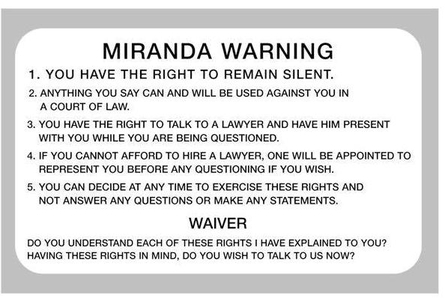
The Supreme Court. The U.S. Supreme Court—once the last refuge of justice, the one governmental body really capable of rolling back the slowly emerging tyranny enveloping America—has instead become the champion of the American police state, absolving government and corporate officials of their crimes while relentlessly punishing the average American for exercising his or her rights. Consider that in the past month alone, the justices have determined that criminal suspects, who are supposed to be treated as innocent until proven guilty, may have their DNA forcibly extracted from them by police. They have decided that staying silent while the police question you may be considered evidence of guilt, despite the Fifth Amendment’s protection against self-incrimination and the well-established “right to remain silent.” Finally, the Court has decided that it operates in a zone in which First Amendment protections cease to exist, as they have unilaterally barred protests outside the Supreme Court building, countering a federal court decision that determined that activities on the Supreme Court grounds are protected by the First Amendment. These are just three examples of a Court that, like the rest of the government, places profit, security, and convenience above our basic rights.

The Media. Of course, this triumvirate of total control would be completely ineffective without a propaganda machine provided by the world’s largest corporations. Besides shoving drivel down our throats at every possible moment, the so-called news agencies which are supposed to act as bulwarks against government propaganda have instead become the mouthpieces of the state. One need only look at the media’s behavior post-9/11 to understand what I mean. From championing the invasion of Iraq based upon absolute fabrications, to the fanatic support of all surveillance state policies and the demonization of whistle blowers like Edward Snowden and Bradley Manning, the pundits which pollute our airwaves are at best court jesters and at worst propagandists for the false reality created by the American government.

The American People. Of course, the most superior engine in the world still requires some form of energy to bring it to life and maintain it, and in this particular mechanism, “we the people” serve that vital function. We are the petrol that powers the motor, for good or bad. We now belong to a permanent underclass in America. It doesn’t matter what you call us—chattel, slaves, worker bees, drones, it’s all the same—what matters is that we are expected to march in lockstep with and submit to the will of the state in all matters, public and private.

Through our complicity in matters large and small, we have allowed an out-of-control corporate-state apparatus to take over every element of American society. Our failure to remain informed about what is taking place in our government, to know and exercise our rights, to vocally protest, to demand accountability on the part of our government representatives, and at a minimum to care about the plight of our fellow Americans has been our downfall. Having allowed ourselves to descend into darkness, refusing to see what is really happening, happily trading the truth for false promises of security and freedom, we have allowed the police state to emerge and to flourish.

Having started with The Matrix, allow me to conclude with a woefully overlooked film, Land of the Blind (2006), a dark political satire in which tyrannical rulers are overthrown by new leaders who prove to be just as bad, if not worse. In the film, citizens perceived as questioning the state are sent to “re-education camps” where the state’s concept of reality is drummed into their heads. Joe, a prison guard, is so impressed with a political prisoner Thorne that he eventually joins a coup to unseat the present dictator and replace him with Thorne. Before long, however, Joe becomes the target of the new government and comes to realize that the old boss is the same as the new boss.

In an age of governmental doublespeak, media obfuscation, and insidious subterfuge on all sides, it can at times be hard to know who is working for whom, and which side the “good guys,” if there are any, are really on. When in doubt, just remember what Orwell had to say about the matter in Animal Farm: “Four legs good, two legs bad.”

What the Supreme Court’s ruling in Salinas v. Texas says, essentially, is that citizens had better know what their rights are and understand when those rights are being violated, because the government is no longer going to be held responsible for informing you of those rights before violating them. Mind you, this is the same court that agreed that cops who tasered a pregnant woman couldn’t be held accountable because they were not aware that repeated electro-shocks qualified as constitutionally excessive and unreasonable force.

Dealing a blow to the fundamental right of citizens to remain silent, a 5-4 United States Supreme Court  has ruled that persons who are not under arrest must specifically invoke their Fifth Amendment privilege against self-incrimination in order to avoid having their refusal to answer police questions used against them in a subsequent criminal trial.

In handing down their decision in Salinas v. Texas, the Court upheld the conviction of Genovevo Salinas, who was found guilty of homicide after prosecutors argued that Salinas’ silence during a police interview prior to his arrest was a “very important piece of evidence” and that only a guilty person would have remained silent when questioned about his connection to a crime. Justice Samuel Alito wrote in the majority opinion that Salinas “was required to assert the privilege in order to benefit from it,” even though a person questioned while under arrest could not have his silence used against him.

The case began in 1992, Juan and Hector Garza were found murdered in their apartment. Genovevo Salinas, an acquaintance of the men, was suspected by police as being responsible for the murders. The police approached Salinas at his home and asked him to accompany them to the police station so they could question him and clear his name. Salinas was never handcuffed and was not given Miranda warnings.

At the police station, Salinas was taken to an interview room where, during the course of the interview, police questioning became more accusatory, and Salinas was asked whether his father’s shotgun “would match the shells recovered at the scene of the murder.” Salinas remained silent and did not answer the question. The interview proceeded. At the conclusion of the interview, police arrested Salinas for outstanding traffic fines.

The district attorney charged Salinas with the murders, but Salinas wasn’t arrested on the murder charge until 2007. During the trial, the prosecutor suggested that Salinas’ silence during the police interview prior to his arrest was a “very important piece of evidence” and that only a guilty person would have remained silent when questioned about his connection to a crime. The jury found Salinas guilty of murder and sentenced him to twenty years in prison.

On appeal, Salinas argued that the prosecution’s emphasis on his pre-arrest silence as evidence of his guilt was a violation of the Fifth Amendment’s guarantee against self-incrimination. Two Texas appeals courts ruled that Salinas was not under government compulsion during the time of the police interview, thus he had no Fifth Amendment right to remain silent.

In upholding the lower courts’ rulings, the Supreme Court majority asserted that a person claiming the benefit of the Fifth Amendment’s privilege “must claim it” and a person does not normally claim the privilege by remaining silent. In Justice Stephen Breyer’s dissenting opinion, he argued that the fact that Salinas was a suspect in a criminal investigation gave rise to a reasonable conclusion that his silence derived from an exercise of his Fifth Amendment privilege.

The Rutherford Institute filed an amicus curiae brief in the case, arguing that a person’s refusal to answer police questions, even before arrest and before Miranda warnings are given, does not indicate guilt in light of the well-known “right to remain silent,” and exclusion of evidence of silence is in keeping with the Fifth Amendment’s guarantee that “[n]o person… shall be compelled in any criminal case to be a witness against himself.”

For more on this and other pressing issues relating to the emerging police state in America, read my new book A Government of Wolves: The Emerging American Police State, available now at Amazon.com.