Archive for the ‘Uncategorized’ Category

Direct Action Against War

“A patriot must always be ready to defend his country against his government.”―Edward Abbey, American author

There’s a lot to love about America and its people: their pioneering spirit, their entrepreneurship, their ability to think outside the box, their passion for the arts, etc. Increasingly, however, as time goes by, I find the things I don’t like about living in a nation that has long since ceased to be a sanctuary for freedom are beginning to outnumber the things I love.

Here’s what I don’t like about living in the American police state: I don’t like being treated as if my only value to the government is as a source of labor and funds. I don’t like being viewed as a consumer and bits of data. I don’t like being spied on and treated as if I have no right to privacy, especially in my own home.

I don’t like government officials who lobby for my vote only to ignore me once elected. I don’t like having representatives incapable of and unwilling to represent me. I don’t like taxation without representation.

I don’t like being bullied by government bureaucrats, vigilantes masquerading as cops, or faceless technicians. I don’t like being railroaded into financing government programs whose only purpose is to increase the power and wealth of the corporate elite. I don’t like being forced to pay for wars abroad that serve no other purpose except to expand the reach of the military industrial complex.

I don’t like being subjected to scans, searches, pat downs and other indignities by the TSA. I don’t like VIPR raids on so-called “soft” targets like shopping malls and bus depots by black-clad, Darth Vader look-alikes. I don’t like fusion centers, which represent the combined surveillance efforts of federal, state and local law enforcement.

I don’t like being treated like an underling by government agents who are supposed to be working for me. I don’t like being threatened, intimidated, bribed, beaten and robbed by individuals entrusted with safeguarding my rights. I don’t like being silenced, censored and marginalized. I don’t like my movements being tracked, my conversations being recorded, and my transactions being catalogued.

I don’t like how the presidency has developed into a neo-monarchy replete with all the luxury and lasciviousness of the feudal lords of old.

I don’t like politicians who spend most of their time running for office, fundraising and enjoying being feted by lobbyists and corporations alike. I don’t like being kept at a distance from my elected representatives, including the president (a.k.a. the Emperor). I don’t like free speech zones, roving bubble zones and trespass laws that restrict Americans’ First Amendment rights.

I don’t like laws that criminalize Americans for otherwise lawful activities such as holding religious studies at home, growing vegetables in their yard, and collecting rainwater. I don’t like the NDAA, which allows the president and the military to arrest and detain American citizens indefinitely. I don’t like the Patriot Act, which opened the door to all manner of government abuses and intrusions on our privacy.

I don’t like the Department of Homeland Security (DHS), which has become America’s standing army in direct opposition to the dire warnings of those who founded our country. I don’t like military weapons such as armored vehicles, sound cannons and the like being used against the American citizens. I don’t like government agencies such as the DHS, Post Office, Social Security Administration and Wildlife stocking up on hollow-point bullets. And I definitely don’t like the implications of detention centers being built that could house American citizens.

I don’t like the fact that since President Obama took office, police departments across the country “have received tens of thousands of machine guns; nearly 200,000 ammunition magazines; thousands of pieces of camouflage and night-vision equipment; and hundreds of silencers, armored cars and aircraft.”

I don’t like America’s infatuation with locking people up for life for non-violent crimes. There are over 3,000 people in America serving life sentences for non-violent crimes, including theft of a jacket, siphoning gasoline from a truck, stealing tools, and attempting to cash a stolen check. I don’t like paying roughly $29,000 a year per inmate just to keep these nonviolent offenders in prison.

I don’t like having my hard-earned taxpayer dollars used against me.

I don’t like the partisan nature of politics today, which has so polarized Americans that they are incapable of standing in unity against the government’s abuses. I don’t like the entertainment drivel that passes for news coverage today.

I don’t like the fact that those within a 25-mile range of the border are getting a front row seat to the American police state, as Border Patrol agents are now allowed to search people’s homes, intimately probe their bodies, and rifle through their belongings, all without a warrant.

I don’t like public schools that treat students as if they were prison inmates. I don’t like zero tolerance laws that criminalize childish behavior. I don’t like a public educational system that emphasizes rote memorization and test-taking over learning, synthesizing and critical thinking.

I don’t like police precincts whose primary purpose—whether through the use of asset forfeiture laws, speed traps, or red light cameras—is making a profit at the expense of those they have sworn to protect. I don’t like militarized police and their onerous SWAT team raids.

I don’t like Department of Defense and DHS programs that transfer surplus military hardware to local and state police. I don’t like government programs that reward cops for raiding homes and terrorizing homeowners. I don’t like local police dressing and acting as if they were the military while viewing me as an enemy combatant.

I don’t like being treated as if I have no rights.

I don’t like cash-strapped states cutting deals with private corporations to run the prisons in exchange for maintaining 90% occupancy rates for at least 20 years. I don’t like the fact that American prisons have become the source of cheap labor for Corporate America.

I don’t like feeling as if we’ve come full circle back to a pre-Revolutionary era.

I don’t like answering to an imperial president, who operates above the law. I don’t like the injustice that passes for justice in the courts. I don’t like prosecutors so hell bent on winning that they allow innocent people to suffer for crimes they didn’t commit.

I don’t like the double standards that allow government officials to break laws with immunity, while average Americans get the book thrown at them. I don’t like cops who shoot first and ask questions later. I don’t like police dogs being treated with more respect and afforded more rights than American citizens.

I don’t like living in a suspect society. I don’t like Americans being assumed guilty until they prove their innocence. I don’t like the fact that 38 states require that a property owner prove his innocence when police have laid claim to it in a civil forfeiture proceeding, whether or not that individual has done anything wrong.

I don’t like technology being used as a double-edged sword against us. I don’t like agencies like DARPA developing weapons for the battlefield that get used against Americans back at home. I don’t like the fact that drones will be deployed domestically in 2015, yet the government has yet to establish any civil liberties protocols to prevent them from being used against the citizenry.

Most of all, I don’t like feeling as if there’s no hope for turning things around.

Now there are those who would suggest that if I don’t like things about this country, I should leave and go elsewhere. And there are certainly those among my fellow citizens who are leaving for friendlier shores. However, I happen to come from a long line of people who believe in the virtue of hard work and perseverance and in the principle that nothing worthwhile comes without effort.

So I’m not giving up, at least not anytime soon. But I’m also not waiting around for the government to clean up its act. I’m not making any deals with politicians who care nothing about me and mine. To quote Number Six, the character in the British television series The Prisoner: “I will not be pushed, filed, stamped, indexed, briefed, debriefed, or numbered! My life is my own!”

I plan to keep fighting, writing, speaking up, speaking out, shouting if necessary, filing lawsuits, challenging the status quo, writing letters to the editor, holding my representatives accountable, thinking nationally but acting locally, and generally raising a ruckus anytime the government attempts to undermine the Constitution and ride roughshod over the rights of the citizenry.

As I make clear in my book A Government of Wolves: The Emerging American Police State, we’re at a crisis point in American history. If we don’t get up off our duffs and get involved in the fight for freedom, then up ahead the graveyard beckons. As Martin Luther King Jr. warned, “The hottest places in hell are reserved for those who in a period of moral crisis maintain their neutrality.”

financial crisis

“The most dangerous man, to any government, is the man who is able to think things out for himself…Almost inevitably, he comes to the conclusion that the government he lives under is dishonest, insane, and intolerable.”—H.L. Mencken, American journalist

It’s vogue, trendy and appropriate to look to dystopian literature as a harbinger of what we’re experiencing at the hands of the government. Certainly, George Orwell’s 1984 and Animal Farm have much to say about government tyranny, corruption, and control, as does Aldous Huxley’s Brave New World and Philip K. Dick’s Minority Report. Yet there are also older, simpler, more timeless stories—folk tales and fairy tales—that speak just as powerfully to the follies and foibles in our nature as citizens and rulers alike that give rise to tyrants and dictatorships.

One such tale, Hans Christian Andersen’s fable of the Emperor’s New Clothes, is a perfect paradigm of life today in the fiefdom that is the American police state, only instead of an imperial president spending money wantonly on lavish vacations, entertainment, and questionable government programs aimed at amassing greater power, Andersen presents us with a vain and thoughtless emperor, concerned only with satisfying his own needs at the expense of his people, even when it means taxing them unmercifully, bankrupting his kingdom, and harshly punishing his people for daring to challenge his edicts.

For those unfamiliar with the tale, the Emperor, a vain peacock of a man, is conned into buying a prohibitively expensive suit of clothes that is supposedly visible only to those who are smart, competent and well-suited to their positions. Surrounded by yes men, professional flatterers and career politicians who fawn, simper and genuflect, the Emperor—arrogant, pompous and oblivious to his nudity—prances through the town in his new suit of clothes until a child dares to voice what everyone else has been thinking but too afraid to say lest they be thought stupid or incompetent: “He isn’t wearing anything at all!”

Much like the people of the Emperor’s kingdom, we, too, have been conned into believing that if we say what we fear, if we dare to suggest that something is indeed “rotten in the state of Denmark,” we will be branded idiots and fools by the bureaucrats, corporate heads, governmental elites and media hotshots who have a vested interest in maintaining the status quo—or who at least are determined to maintain the façade that is the status quo. Yet the truth is staring us in the face just as surely as the fact that the Emperor was wearing no clothes.

Truth #1: The U.S. is on the brink of bankruptcy, as many economists have been warning for some time now, with more than $16 trillion in debts owned by foreign nationals and corporations. As one financial news site reports: “Internationally, the world is fed up with The Fed and the U.S. government’s unabashed debt growth. China, Russia, Iran, India and a host of other countries are establishing trade relationships that are bypassing the U.S. dollar altogether, a move that will soon see the world’s reserve currency lose purchasing power and status. In anticipation of this imminent collapse gold is being hoarded by private and public entities from Berlin to Beijing in an effort to preserve wealth before the Tsunami hits.”

Truth #2: We no longer have a government that is “of the people, for the people and by the people.” What we have now is a feudal monarchy, run by wealthy overlords and financed with the blood, sweat and labor of the underclasses who are kept in check by the increasingly militarized police. This sorry state of affairs is reinforced by a study which found that average citizens have “little or no independent influence” on the policy-making process. A similar study published by the Political Research Quarterly revealed that members of the U.S. Senate represent their wealthiest constituents while ignoring those on the bottom rung of the economic ladder.

Truth #3: Far from being a benevolent entity concerned with the well-being of its citizens, whether in matters of health, safety or security, the government is concerned with three things only: power, control and money. As an often quoted adage says, “Government is not reason; it is not eloquent; it is force. Like fire, it is a dangerous servant and a fearful master.” Unfortunately, the master-servant relationship that once had the government answering to “we the people” has been reversed. Government agents now act as if they are the masters and we are the servants. Nowhere is this more evident than in the transformation of police officers from benevolent keepers of the peace to inflexible extensions of the military hyped up on the power of their badge.

Truth #4: Our primary use to the government is as consumers, worker bees and bits of data to be collected, catalogued, controlled, mined for information, and sold to the highest bidder. Working in cahoots with corporations, the government has given itself carte blanche access to our phone calls, emails, bank transactions, physical movements, even our travels on foot or in our cars. Cybersecurity expert Richard Clarke envisions a future where data about every aspect of our lives will be collected and analyzed. Thus, no matter what the U.S. Supreme Court might have said to the contrary, the government no longer needs a warrant to spy on your cell phone activity or anything else for that matter. As the Washington Post recently revealed, 9 out of 10 people caught up in the NSA’s surveillance net had done nothing wrong to justify such intrusions on their privacy. Clearly, the government now operates relatively autonomously, answering only to itself and unbridled by the courts, Congress, the will of the people or the Constitution.

Truth #5: Whatever problems we are grappling with in regards to illegal immigrants flooding over the borders has little to do with the fact that the borders are porous and everything to do with the government’s own questionable agenda. How is it that a government capable of locking down roads, open seas, and air routes is unable to prevent tens of thousands of women and children from crossing into the U.S. illegally? Conveniently, the Obama administration is asking Congress for $3.8 billion in emergency funding to send more immigration judges to the southern border, build additional detention facilities and add border patrol agents. The funds would be managed by the Departments of Justice, Homeland Security, State and Health and Human Services, the very same agencies responsible for bringing about a rapid shift into a police state.

Truth #6: The U.S. government is preparing for massive domestic unrest, arising most likely from an economic meltdown. The government has repeatedly made clear its intentions, through its U.S. Army War College report alerting the military to prepare for a “violent, strategic dislocation inside the United States,” through its ongoing military drills in cities across the country, through its profiling of potential homegrown “dissidents” or extremists, and through the proliferation of detention centers being built across the country.

Truth #7: As Gerald Ford warned, “A government big enough to give you everything you want is a government big enough to take from you everything you have.” Too often, Americans have fallen prey to the temptation to let the government take care of whatever ails them, whether it be financial concerns, health needs, childcare. As a result, we now find ourselves caught in a Catch-22 situation wherein the government’s so-called solutions to our problems have led to even graver problems. In this way, zero tolerance policies intended to outlaw drugs and weapons in schools result in young children being arrested and kicked out of school for childish behavior such as drawing pictures of soldiers and crying too much; truancy laws intended to keep students in school have resulted in parents being arrested and fined excessively; and zoning laws intended to protect homeowners have been used to prosecute residents who attempt to live off the grid.

Truth #8: The U.S. is following the Nazi blueprint to a “t,” whether through its storm trooper-like police in the form of heavily armed government agents, to its erection of an electronic concentration camp that not only threatens to engulf America but the rest of the world as well via NSA surveillance programs such as Five Eyes. Most damning of all is the Department of Homeland Security’s self-appointed role as a national police force, a.k.a. standing army, the fundamental and final building block for every totalitarian regime that has ever wreaked havoc on humanity. Indeed, just about every nefarious deed, tactic or thuggish policy advanced by the government today can be traced back to the DHS, its police state mindset, and the billions of dollars it distributes to police agencies in the form of grants.

Truth #9: Not only does the U.S. government perpetrate organized, systematic violence on its own citizens, especially those who challenge its authority nonviolently, in the form of SWAT team raids, militarized police, and roaming VIPR checkpoints, but it gets away with these clear violations of the Fourth Amendment because the courts grant them immunity from wrongdoing. Expanding its reach, the U.S. also exports its violence wholesale to other countries through armaments sales and the use of its military as a global police force. Yet no matter how well trained, well equipped and well financed, America cannot police the world. As history shows, military empires, once over extended, inevitably collapse into chaos.

Truth #10: As I make clear in my book A Government of Wolves: The Emerging American Police State, the United States of America has become the new battlefield. In fact, the only real war being fought by the U.S. government today is the war on the American people, and it is being waged with deadly weapons, militarized police, surveillance technology, laws that criminalize otherwise lawful behavior, private prisons that operate on quota systems, and government officials who are no longer accountable to the rule of law.

So there you have it: facts rather than fiction, so naked that a child could call it for what it is, and yet so politically inconvenient, incorrect and uncomfortable that few dare to speak of them.

Even so, despite the fact that no one wants to be labeled dimwitted, or conspiratorial, or a right wing nut job, most Americans, if they were truly paying attention to what’s been going on in this country over the past few decades and willing to be truthful, at least to themselves, would have to admit that the outlook is decidedly grim. Indeed, unless something changes drastically for the good in the near future, it looks like this fairytale will not have a happy ending.

declaration

“Is life so dear, or peace so sweet, as to be purchased at the price of chains and slavery? I know not what course others may take; but as for me, give me liberty or give me death!”–Patrick Henry

Imagine living in a country where armed soldiers crash through doors to arrest and imprison citizens merely for criticizing government officials. Imagine that in this very same country, you’re watched all the time, and if you look even a little bit suspicious, the police stop and frisk you or pull you over to search you on the off chance you’re doing something illegal. Keep in mind that if you have a firearm of any kind while in this country, it may get you arrested and, in some circumstances, shot by police.

If you’re thinking this sounds like America today, you wouldn’t be far wrong. However, the scenario described above took place more than 200 years ago, when American colonists suffered under Great Britain’s version of an early police state. It was only when the colonists finally got fed up with being silenced, censored, searched, frisked, threatened, and arrested that they finally revolted against the tyrant’s fetters.

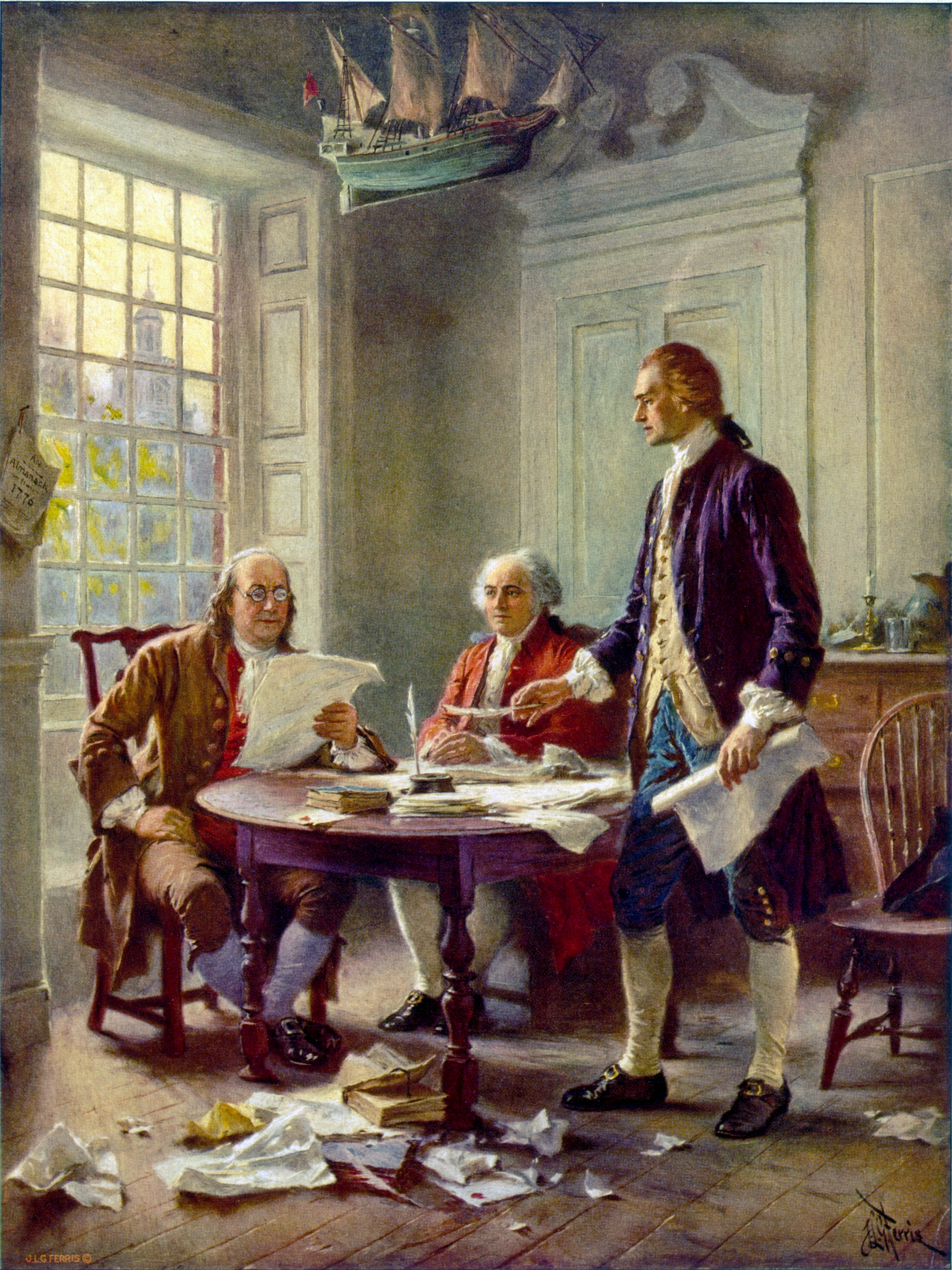
No document better states their grievances than the Declaration of Independence. A document seething with outrage over a government which had betrayed its citizens, the Declaration of Independence was signed on July 4, 1776, by 56 men who laid everything on the line, pledged it all–“our Lives, our Fortunes, and our sacred Honor”–because they believed in a radical idea: that all people are created to be free.

Labeled traitors, these men were charged with treason, a crime punishable by death. For some, their acts of rebellion would cost them their homes and their fortunes. For others, it would be the ultimate price–their lives. Yet even knowing the heavy price they might have to pay, these men dared to speak up when silence could not be tolerated. Even after they had won their independence from Great Britain, these new Americans worked to ensure that the rights they had risked their lives to secure would remain secure for future generations. The result: our Bill of Rights, the first ten amendments to the Constitution.

Imagine the shock and outrage these 56 men would feel were they to discover that 238 years later, the government they had risked their lives to create has been transformed into a militaristic police state in which exercising one’s freedoms is often viewed as a flagrant act of defiance. Indeed, had the Declaration of Independence been written today, it would have rendered its signers terrorists, resulting in them being placed on a government watch list, targeted for surveillance of their activities and correspondence, and potentially arrested, held indefinitely, stripped of their rights and labeled enemy combatants.

Indeed, as I document in my book A Government of Wolves: The Emerging American Police State, a cursory review of the true state of our freedoms as outlined in the Bill of Rights shows exactly how dismal things have become:

The First Amendment is supposed to protect the freedom to speak your mind and protest in peace without being bridled by the government. It also protects the freedom of the media, as well as the right to worship and pray without interference. In other words, Americans cannot be silenced by the government. Yet despite the clear protections found in the First Amendment, the freedoms described therein are under constant assault. Whether it’s a Marine detained for criticizing the government on Facebook, a reporter persecuted for refusing to reveal his sources, or a protester arrested for standing silently in front of the U.S. Supreme Court, these are dangerous times for those who choose to exercise their rights.

The Second Amendment was intended to guarantee “the right of the people to keep and bear arms.” Yet while gun ownership has been recognized as an individual citizen right, Americans continue to face an uphill battle in the courts when it comes to defending themselves against militarized, weaponized government agents armed to the hilt. In fact, court rulings in recent years have affirmed that citizens don’t have the right to resist police officers who enter their homes illegally, mistakenly or otherwise.

The Third Amendment reinforces the principle that civilian-elected officials are superior to the military by prohibiting the military from entering any citizen’s home without “the consent of the owner.” Unfortunately, the wall of separation between civilian and military policing has been torn down in recent years, as militarized SWAT teams are now allowed to burst into homes unannounced in order to investigate minor crimes such as marijuana possession and credit card fraud. With domestic police increasingly posing as military forces–complete with weapons, uniforms, assault vehicles, etc.–a good case could be made for the fact that SWAT team raids constitute the forced quartering of soldiers within the private home, which the Third Amendment was written to prevent.

The Fourth Amendment prohibits government agents from touching you or placing you under surveillance or entering your property without probable cause and even then, only with a court-sanctioned warrant. Unfortunately, the Fourth Amendment has been all but eviscerated in recent years by court rulings and government programs that sanction all manner of intrusions, including giving police carte blanche authority to break into homes or apartments without a warrant, conduct roadside strip searches, and generally manhandle any person in manner they see fit. Moreover, in the so-called name of national security, intelligence agencies like the National Security Agency now have the ability to conduct mass unwarranted electronic intrusions into the personal and private transactions of all Americans, including phone, mail, computer and medical records. All of this data is available to other government agencies, including local police.

The Fifth Amendment is supposed to ensure that you are innocent until proven guilty, and government authorities cannot deprive you of your life, your liberty or your property without following strict legal guidelines. Unfortunately, those protections have been largely extinguished in recent years, especially in the wake of Congress’ passage of the National Defense Authorization Act (NDAA), which allows the president and the military to arrest and detain Americans indefinitely without due process.

The Sixth Amendment was intended to not only ensure a “speedy and public trial,” but it was supposed to prevent the government from keeping someone in jail for unspecified offenses. That too has been a casualty of the so-called war on terror. Between the NDAA’s indefinite detention clause and the Authorization to Use Military Force (AUMF) legislation, which has been used as justification for using drones to kill American citizens in the absence of a court trial, the Sixth Amendment’s guarantees become meaningless.

The Seventh Amendment guarantees citizens the right to a jury trial. However, when the populace has no idea of what’s in the Constitution–civic education has virtually disappeared from most school curriculums–that inevitably translates to an ignorant jury incapable of distinguishing justice and the law from their own preconceived notions and fears.

The Eighth Amendment is similar to the Sixth in that it is supposed to protect the rights of the accused and forbid the use of cruel and unusual punishment. However, the Supreme Court’s determination that what constitutes “cruel and unusual” should be dependent on the “evolving standards of decency that mark the progress of a maturing society” leaves us with little protection in the face of a society lacking in morals altogether. America’s continued reliance on the death penalty, which has been shown to be flawed in its application and execution, is a perfect example of this.

The Ninth Amendment provides that other rights not enumerated in the Constitution are nonetheless retained by the people. Popular sovereignty–the belief that the power to govern flows upward from the people rather than downward from the rulers–is clearly evident in this amendment. However, it has since been turned on its head by a centralized federal government that sees itself as supreme and which continues to pass more and more laws that restrict our freedoms under the pretext that it has an “important government interest” in doing so. Thus, once the government began violating the non-enumerated rights granted in the Ninth Amendment, it was only a matter of time before it began to trample the enumerated rights of the people, as explicitly spelled out in the rest of the Bill of Rights.

As for the Tenth Amendment‘s reminder that the people and the states retain every authority that is not otherwise mentioned in the Constitution, that assurance of a system of government in which power is divided among local, state and national entities has long since been rendered moot by the centralized Washington, DC power elite–the president, Congress and the courts. Indeed, the federal governmental bureaucracy has grown so large that it has made local and state legislatures relatively irrelevant. Through its many agencies, the federal government has stripped states of the right to regulate countless issues that were originally governed at the local level.

Thus, even on those rare occasions when the courts provide us with a slight glimmer of hope that all may not be lost, those brief reprieves of judicial sensibility are quickly overwhelmed by a bureaucratic machine that continues to march relentlessly in lockstep with the police state.

This brings me back to those 56 men who risked everything–their fortunes and their lives–to speak truth to power in that sweltering Philadelphia heat 238 summers ago. Of those 56 signers, 9 died during the Revolution, 5 were captured by British soldiers, 18 had their homes looted and burned by the Red Coats, 2 were wounded in battle and 2 lost their sons during the war. Remarkably, these men–who were community leaders, business owners, judges, lawyers and inventors–sacrificed their lives, their fortunes and their sacred honor so that you and I could live freely in a nation where we have the right to stand up and speak out against tyrannical government. In the face of torture and even death, they did not waver.

The choice before us is clear. In the words of Patrick Henry, will we choose dangerous freedom or peaceful slavery?

scotus

“[I]f the individual is no longer to be sovereign, if the police can pick him up whenever they do not like the cut of his jib, if they can ‘seize’ and ‘search’ him in their discretion, we enter a new regime. The decision to enter it should be made only after a full debate by the people of this country.”—U.S. Supreme Court Justice William O. Douglas

The U.S. Supreme Court was intended to be an institution established to intervene and protect the people against the government and its agents when they overstep their bounds. Yet as I point out in my book A Government of Wolves: The Emerging American Police State, Americans can no longer rely on the courts to mete out justice. In the police state being erected around us, the police and other government agents can probe, poke, pinch, taser, search, seize, strip and generally manhandle anyone they see fit in almost any circumstance, all with the general blessing of the courts.

Whether it’s police officers breaking through people’s front doors and shooting them dead in their homes or strip searching innocent motorists on the side of the road, these instances of abuse are continually validated by a judicial system that kowtows to virtually every police demand, no matter how unjust, no matter how in opposition to the Constitution.

These are the hallmarks of the emerging American police state: where police officers, no longer mere servants of the people entrusted with keeping the peace, are part of an elite ruling class dependent on keeping the masses corralled, under control, and treated like suspects and enemies rather than citizens.

A review of the Supreme Court’s rulings over the past 10 years, including some critical ones this term, reveals a startling and steady trend towards pro-police state rulings by an institution concerned more with establishing order and protecting government agents than with upholding the rights enshrined in the Constitution.

Police officers can use lethal force in car chases without fear of lawsuits. In Plumhoff v. Rickard (2014), the Court declared that police officers who used deadly force to terminate a car chase were immune from a lawsuit. The officers were accused of needlessly resorting to deadly force by shooting multiple times at a man and his passenger in a stopped car, killing both individuals.

Police officers can stop cars based only on “anonymous” tips. In a 5-4 ruling in Navarette v. California (2014), the Court declared that police officers can, under the guise of “reasonable suspicion,” stop cars and question drivers based solely on anonymous tips, no matter how dubious, and whether or not they themselves witnessed any troubling behavior. This ruling came on the heels of a ruling by the Tenth Circuit Court of Appeals in U.S. v. Westhoven that driving too carefully, with a rigid posture, taking a scenic route, and having acne are sufficient reasons for a police officer to suspect you of doing something illegal, detain you, search your car, and arrest you—even if you’ve done nothing illegal to warrant the stop in the first place.

Secret Service agents are not accountable for their actions, as long as they’re done in the name of security. In Wood v. Moss (2014), the Court granted “qualified immunity” to Secret Service officials who relocated anti-Bush protesters, despite concerns raised that the protesters’ First Amendment right to freely speak, assemble, and petition their government leaders had been violated. These decisions, part of a recent trend toward granting government officials “qualified immunity”—they are not accountable for their actions—in lawsuits over alleged constitutional violations, merely incentivize government officials to violate constitutional rights without fear of repercussion.

Citizens only have a right to remain silent if they assert it. The Supreme Court ruled in Salinas v. Texas (2013) that persons who are not under arrest must specifically invoke their Fifth Amendment privilege against self-incrimination in order to avoid having their refusal to answer police questions used against them in a subsequent criminal trial. What this ruling says, essentially, is that citizens had better know what their rights are and understand when those rights are being violated, because the government is no longer going to be held responsible for informing you of those rights before violating them.

Police have free reign to use drug-sniffing dogs as “search warrants on leashes,” justifying any and all police searches of vehicles stopped on the roadside. In Florida v. Harris (2013), a unanimous Court determined that police officers may use highly unreliable drug-sniffing dogs to conduct warrantless searches of cars during routine traffic stops. In doing so, the justices sided with police by claiming that all that the police need to do to prove probable cause for a search is simply assert that a drug detection dog has received proper training. The ruling turns man’s best friend into an extension of the police state.

Police can forcibly take your DNA, whether or not you’ve been convicted of a crime. In Maryland v. King (2013), a divided Court determined that a person arrested for a crime who is supposed to be presumed innocent until proven guilty must submit to forcible extraction of their DNA. Once again the Court sided with the guardians of the police state over the defenders of individual liberty in determining that DNA samples may be extracted from people arrested for “serious offenses.” While the Court claims to have made its decision based upon concerns of properly identifying criminal suspects upon arrest, what they actually did is open the door for a nationwide dragnet of suspects targeted via DNA sampling.

Police can stop, search, question and profile citizens and non-citizens alike. The Supreme Court declared in Arizona v. United States (2012) that Arizona police officers have broad authority to stop, search and question individuals—citizen and non-citizen alike. While the law prohibits officers from considering race, color, or national origin, it amounts to little more than a perfunctory nod to discrimination laws on the books, while paving the way for outright racial profiling and destroying the Fourth Amendment.

Police can subject Americans to virtual strip searches, no matter the “offense.” A divided Supreme Court actually prioritized making life easier for overworked jail officials over the basic right of Americans to be free from debasing strip searches. In its 5-4 ruling in Florence v. Burlington (2012), the Court declared that any person who is arrested and processed at a jail house, regardless of the severity of his or her offense (i.e., they can be guilty of nothing more than a minor traffic offense), can be subjected to a virtual strip search by police or jail officials, which involves exposing the genitals and the buttocks. This “license to probe” is now being extended to roadside stops, as police officers throughout the country have begun performing roadside strip searches—some involving anal and vaginal probes—without any evidence of wrongdoing and without a warrant.

Immunity protections for Secret Service agents trump the free speech rights of Americans. The court issued a unanimous decision in Reichle v. Howards (2012), siding with two Secret Service agents who arrested a Colorado man simply for daring to voice critical remarks to Vice President Cheney. However, contrast the Court’s affirmation of the “free speech” rights of corporations and wealthy donors in McCutcheon v. FEC (2014), which does away with established limits on the number of candidates an entity can support with campaign contributions, and Citizens United v. FEC (2010) with its tendency to deny those same rights to average Americans when government interests abound, and you’ll find a noticeable disparity.

Police can break into homes without a warrant, even if it’s the wrong home. In an 8-1 ruling in Kentucky v. King (2011), the Supreme Court placed their trust in the discretion of police officers, rather than in the dictates of the Constitution, when they gave police greater leeway to break into homes or apartments without a warrant. Despite the fact that the police in question ended up pursuing the wrong suspect, invaded the wrong apartment and violated just about every tenet that stands between us and a police state, the Court sanctioned the warrantless raid, leaving Americans with little real protection in the face of all manner of abuses by police.

Police can interrogate minors without their parents present. In a devastating ruling that could very well do away with what little Fourth Amendment protections remain to public school students and their families—the Court threw out a lower court ruling in Camreta v. Greene (2011), which required government authorities to secure a warrant, a court order or parental consent before interrogating students at school. The ramifications are far-reaching, rendering public school students as wards of the state. Once again, the courts sided with law enforcement against the rights of the people.

It’s a crime to not identify yourself when a policeman asks your name. In Hiibel v. Sixth Judicial District Court of the State of Nevada (2004), a majority of the high court agreed that refusing to answer when a policeman asks “What’s your name?” can rightfully be considered a crime under Nevada’s “stop and identify” statute. No longer will Americans, even those not suspected of or charged with any crime, have the right to remain silent when stopped and questioned by a police officer.

The cases the Supreme Court refuses to hear, allowing lower court judgments to stand, are almost as critical as the ones they rule on. Some of these cases, turned away in recent years alone, have delivered devastating blows to the rights enshrined in the Constitution.

Legally owning a firearm is enough to justify a no-knock raid by police. Justices refused to hear Quinn v. Texas (2014) the case of a Texas man who was shot by police through his closed bedroom door and whose home was subject to a no-knock, SWAT-team style forceful entry and raid based solely on the suspicion that there were legally-owned firearms in his household.

The military can arrest and detain American citizens. In refusing to hear Hedges v. Obama (2014), a legal challenge to the indefinite detention provision of the National Defense Authorization Act of 2012 (NDAA), the Supreme Court affirmed that the President and the U.S. military can arrest and indefinitely detain individuals, including American citizens. In so doing, the high court also passed up an opportunity to overturn its 1944 Korematsu v. United States ruling allowing for the internment of Japanese-Americans in concentration camps.

Students can be subjected to random lockdowns and mass searches at school. The Court refused to hear Burlison v. Springfield Public Schools (2013), a case involving students at a Missouri public school who were subjected to random lockdowns, mass searches and drug-sniffing dogs by police. In so doing, the Court let stand an appeals court ruling that the searches and lockdowns were reasonable in order to maintain the safety and security of students at the school.

Police officers who don’t know their actions violate the law aren’t guilty of breaking the law. The Supreme Court let stand a Ninth Circuit Court of Appeals decision in Brooks v. City of Seattle (2012) in which police officers who clearly used excessive force when they repeatedly tasered a pregnant woman during a routine traffic stop were granted immunity from prosecution. The Ninth Circuit actually rationalized its ruling by claiming that the officers couldn’t have known beyond a reasonable doubt that their actions—tasering a pregnant woman who was not a threat in any way until she was unconscious—violated the Fourth Amendment.

When all is said and done, what these assorted court rulings add up to is a disconcerting government mindset that interprets the Constitution one way for the elite—government entities, the police, corporations and the wealthy—and uses a second measure altogether for the underclasses—that is, you and me.

Keep in mind that in former regimes such as Nazi Germany and the Soviet Union, the complicity of the courts was the final piece to fall into place before the totalitarian beast stepped out of the shadows and into the light. If history is a guide, then the future that awaits us is truly frightening.

Time, as they say, grows short.

Insisting that “ignorance of the law is no excuse” when it comes to police officers being permitted to violate American citizens’ constitutional rights, The Rutherford Institute has asked the U.S. Supreme Court to hold law enforcement officials accountable to knowing and abiding by the rule of law. Specifically, in filing an amicus curiae brief  in Heien v. State of North Carolina, Rutherford Institute attorneys argue that courts must suppress evidence seized as a result of an improper stop of a motorist even though the police officer reasonably, but mistakenly, believed he was authorized by law to stop the vehicle.

“It’s a toss up which is worse—law enforcement officials who know nothing about the laws they have sworn to uphold, support and defend, or a constitutionally illiterate citizenry so clueless about their rights that they don’t even know when those rights are being violated,” said John W. Whitehead, president of The Rutherford Institute and author of the award-winning book A Government of Wolves: The Emerging American Police State. “Thomas Jefferson recognized that an educated citizenry is the only real assurance that freedom will survive. At the very least, anyone taking public office or working for the government in any capacity—whether it’s a police officer, a school teacher, or a member of Congress—should be required to have a working knowledge of the Constitution, particularly the Bill of Rights, and should be held accountable for upholding their precepts. At heart, that’s what this Heien case is really all about: ensuring that ignorance of the law, especially the Fourth Amendment, does not become a ready excuse for government officials to routinely violate the law.”

In April 2009, a Surry County (N.C.) law enforcement officer stopped a car traveling on Interstate 77, allegedly because of a brake light which at first failed to illuminate and then flickered on. The officer mistakenly believed that state law prohibited driving a car with one broken brake light. In fact, the state traffic law requires only one working brake light. Nevertheless, operating under a mistaken understanding of the law, during the course of the stop, the officer asked for permission to search the car. Nicholas Heien, the owner of the vehicle, granted his consent to a search. Upon the officer finding cocaine in the vehicle, he arrested and charged Heien with trafficking.

Prior to his trial, Heien moved to suppress the evidence seized in light of the fact that the officer’s pretext for the stop was erroneous and therefore unlawful. Although the trial court denied the motion to suppress evidence, the state court of appeals determined that since the police officer had based his initial stop of the car on a mistaken understanding of the law, there was no valid reason for the stop in the first place.

On appeal, the North Carolina Supreme Court ruled that even though the officer was wrong in concluding that the inoperable brake light was an offense, because the officer’s mistake was a “reasonable” one, the stop of the car did not violate the Fourth Amendment and the evidence resulting from the stop did not need to be suppressed. In weighing in on the case before the U.S. Supreme Court, Rutherford Institute attorneys warn against allowing government agents to “benefit” from their mistakes of law, deliberate or otherwise, lest it become an incentive for abuse.  Affiliate attorney Christopher F. Moriarty assisted The Rutherford Institute in advancing the arguments in the amicus brief before the U.S. Supreme Court.

Click here to read The Rutherford Institute’s amicus brief in Heien v. State of North Carolina

VIPR

“A standing military force, with an overgrown Executive will not long be safe companions to liberty.”–James Madison

“Here [in New Mexico], we are moving more toward a national police force. Homeland Security is involved with a lot of little things around town. Somebody in Washington needs to call a timeout.”–Dan Klein, retired Albuquerque Police Department sergeant

If the United States is a police state, then the Department of Homeland Security (DHS) is its national police force, with all the brutality, ineptitude and corruption such a role implies. In fact, although the DHS’ governmental bureaucracy may at times appear to be inept and bungling, it is ruthlessly efficient when it comes to building what the Founders feared most–a standing army on American soil.

The third largest federal agency behind the Departments of Veterans Affairs and Defense, the DHS–with its 240,000 full-time workers, $61 billion budget and sub-agencies that include the Coast Guard, Customs and Border Protection, Secret Service, Transportation Security Administration (TSA) and the Federal Emergency Management Agency (FEMA)–has been aptly dubbed a “runaway train.”

In the 12 years since it was established to “prevent terrorist attacks within the United States,” the DHS has grown from a post-9/11 knee-jerk reaction to a leviathan with tentacles in every aspect of American life. With good reason, a bipartisan bill to provide greater oversight and accountability into the DHS’ purchasing process has been making its way through Congress.

A better plan would be to abolish the DHS altogether. In making the case for shutting down the de facto national police agency, analyst Charles Kenny offers the following six reasons: one, the agency lacks leadership; two, terrorism is far less of a threat than it is made out to be; three, the FBI has actually stopped more alleged terrorist attacks than DHS; four, the agency wastes exorbitant amounts of money with little to show for it; five, “An overweight DHS gets a free pass to infringe civil liberties without a shred of economic justification”; and six, the agency is just plain bloated.

To Kenny’s list, I will add the following: The menace of a national police force, a.k.a. a standing army, vested with so much power cannot be overstated, nor can its danger be ignored. Indeed, as the following list shows, just about every nefarious deed, tactic or thuggish policy advanced by the government today can be traced back to the DHS, its police state mindset, and the billions of dollars it distributes to police agencies in the form of grants.

Militarizing police and SWAT teams. The DHS routinely hands out six-figure grants to enable local municipalities to purchase military-style vehicles, as well as a veritable war chest of weaponry, ranging from tactical vests, bomb-disarming robots, assault weapons and combat uniforms. This rise in military equipment purchases funded by the DHS has, according to analysts Andrew Becker and G.W. Schulz, “paralleled an apparent increase in local SWAT teams.” The end result? An explosive growth in the use of SWAT teams for otherwise routine police matters, an increased tendency on the part of police to shoot first and ask questions later, and an overall mindset within police forces that they are at war–and the citizenry are the enemy combatants.

Spying on activists, dissidents and veterans. In 2009, DHS released three infamous reports on Rightwing and Leftwing “Extremism,” and another entitled Operation Vigilant Eagle, outlining a surveillance program targeting veterans. The reports collectively and broadly define extremists as individuals and groups “that are mainly antigovernment, rejecting federal authority in favor of state or local authority, or rejecting government authority entirely.” In 2013, it was revealed that DHS, the FBI, state and local law enforcement agencies, and the private sector were working together to conduct nationwide surveillance on protesters’ First Amendment activities.

Stockpiling ammunition. DHS, along with other government agencies, has been stockpiling an alarming amount of ammunition in recent years, which only adds to the discomfort of those already leery of the government. As of 2013, DHS had 260 million rounds of ammo in stock, which averages out to between 1,300 to 1,600 rounds per officer. The US Army, in contrast, has roughly 350 rounds per soldier. DHS has since requisitioned more than 1.6 billion rounds of ammo, “enough,” concludes Forbes magazine, “to sustain a hot war for 20+ years.”

Distributing license plate readers. DHS has already distributed more than $50 million in grants to enable local police agencies to acquire license plate readers, which rely on mobile cameras to photograph and identify cars, match them against a national database, and track their movements. Relying on private contractors to maintain a license plate database allows the DHS and its affiliates to access millions of records without much in the way of oversight.

Contracting to build detention camps. In 2006, DHS awarded a $385 million contract to a Halliburton subsidiary to build detention centers on American soil. Although the government and Halliburton were not forthcoming about where or when these domestic detention centers would be built, they rationalized the need for them in case of “an emergency influx of immigrants, or to support the rapid development of new programs” in the event of other emergencies such as “natural disasters.” Viewed in conjunction with the NDAA provision allowing the military to arrest and indefinitely detain anyone, including American citizens, it would seem the building blocks are already in place for such an eventuality.

Tracking cell-phones with Stingray devices. Distributed to local police agencies as a result of grants from the DHS, these Stingray devices enable police to track individuals’ cell phones–and their owners–without a court warrant or court order. The amount of information conveyed by these devices about one’s activities, whereabouts and interactions is considerable. As one attorney explained: “Because we carry our cellphones with us virtually everywhere we go, stingrays can paint a precise picture of where we are and who we spend time with, including our location in a lover’s house, in a psychologist’s office or at a political protest.”

Carrying out military drills and lockdowns in American cities. Each year, DHS funds military-style training drills in cities across the country. These Urban Shield exercises, elaborately staged with their own set of professionally trained Crisis Actors playing the parts of shooters, bystanders and victims, fool law enforcement officials, students, teachers, bystanders and the media into thinking it’s a real crisis.

Using the TSA as an advance guard. The TSA now searches a variety of government and private databases, including things like car registrations and employment information, in order to track travelers’ before they ever get near an airport. Other information collected includes “tax identification number, past travel itineraries, property records, physical characteristics, and law enforcement or intelligence information.”

Conducting virtual strip searches with full-body scanners. Under the direction of the TSA, American travelers have been subjected to all manner of searches ranging from whole-body scanners and enhanced patdowns at airports to bag searches in train stations. In response to public outrage over what amounted to a virtual strip search, the TSA has begun replacing the scanners with equally costly yet less detailed models. The old scanners will be used by prisons for now.

Carrying out soft target checkpoints. VIPR task forces, comprised of federal air marshals, surface transportation security inspectors, transportation security officers, behavior detection officers and explosive detection canine teams have laid the groundwork for the government’s effort to secure so-called “soft” targets such as malls, stadiums, bridges, etc. Some security experts predict that checkpoints and screening stations will eventually be established at all soft targets, such as department stores, restaurants, and schools. DHS’ Operation Shield, a program which seeks to check up on security protocols around the country with unannounced visits, conducted a surprise security exercise at the Social Security Administration building in Leesburg, Fla., when they subjected people who went to pick up their checks to random ID checks by federal agents armed with semi-automatic weapons.

Directing government workers to spy on Americans. Terrorism Liaison Officers are firefighters, police officers, and even corporate employees who have received training to spy on and report back to government entities on the day-to-day activities of their fellow citizens. These individuals are authorized to report “suspicious activity” which can include such innocuous activities as taking pictures with no apparent aesthetic value, making measurements and drawings, taking notes, conversing in code, espousing radical beliefs, and buying items in bulk.

Conducting widespread spying networks using fusion centers. Data collecting agencies spread throughout the country, aided by the National Security Agency, fusions centers–of which there are at least 78 scattered around the U.S.— constantly monitor our communications, collecting and cataloguing everything from our internet activity and web searches to text messages, phone calls and emails. This data is then fed to government agencies, which are now interconnected: the CIA to the FBI, the FBI to local police. Despite a budget estimated to be somewhere between $289 million and $1.4 billion, these fusion centers have proven to be exercises in incompetence, often producing irrelevant, useless or inappropriate intelligence, while spending millions of dollars on “flat-screen televisions, sport utility vehicles, hidden cameras and other gadgets.”

Carrying out Constitution-free border control searches. On orders from the DHS, the government’s efforts along the border have become little more than an exercise in police state power, ranging from aggressive checkpoints to the widespread use of drone technology, often used against American citizens traveling within the country. Border patrol operations occur within 100 miles of an international crossing, putting some 200 million Americans within the bounds of aggressive border patrol searches and seizures, as well as increasingly expansive drone surveillance. With 71 checkpoints found along the southwest border of the United States alone, suspicionless search and seizures on the border are rampant. Border patrol agents also search the personal electronic devices of people crossing the border without a warrant.

Funding city-wide surveillance cameras. As Charlie Savage reports for the Boston Globe, the DHS has funneled “millions of dollars to local governments nationwide for purchasing high-tech video camera networks, accelerating the rise of a ‘surveillance society’ in which the sense of freedom that stems from being anonymous in public will be lost.” These camera systems, installed on city streets, in parks and transit systems, operating in conjunction with sophisticated computer systems that boast intelligent video analytics, digital biometric identification, military-pedigree software for analyzing and predicting crime and facial recognition software, create a vast surveillance network that can target millions of innocent individuals.

Utilizing drones and other spybots. The DHS has been at the forefront of funding and deploying surveillance robots and drones for land, sea and air, including robots that resemble fish and tunnel-bots that can travel underground. Despite repeated concerns over the danger surveillance drones used domestically pose to Americans’ privacy rights, the DHS has continued to expand its fleet of Predator drones, which come equipped with video cameras, infrared cameras, heat sensors, and radar. DHS also loans its drones out to local, state, and federal law enforcement agencies for a variety of tasks, although the agency refuses to divulge any details as to how, why and in what capacity these drones are being used by police. Incredibly, the DHS has also been handing out millions of dollars in grants to local police agencies to “accelerate the adoption” of drones in their localities.

It’s not difficult to see why the DHS has been described as a “wasteful, growing, fear-mongering beast.” If it is a beast, however, it is a beast that is accelerating our nation’s transformation into a police state through its establishment of a standing army, a.k.a. national police force.

This, too, is nothing new. Historically, as I show in my book A Government of Wolves: The Emerging American Police State, the establishment of a national police force has served as a fundamental and final building block for every totalitarian regime that has ever wreaked havoc on humanity, from Hitler’s all-too-real Nazi Germany to George Orwell’s fictional Oceania. Whether fictional or historical, however, the calling cards of these national police agencies remain the same: brutality, inhumanity, corruption, intolerance, rigidity, and bureaucracy–in other words, evil.

We have returned to a time before the American Revolution when government agents—with the blessing of the courts—could force their way into a citizen’s home, with seemingly little concern for lives lost and property damaged in the process. At all levels, federal, local and state, the government and the police have merged. And in the process, they have become a standing army–which is exactly what the Founders feared. The question we must ask ourselves is how much more innocent blood will be shed before we take back control over our government, our communities and our lives?

Click the following link to watch my latest video: https://www.youtube.com/watch?v=ipPRWyai79U

police-militarization

 “Why should anyone trust a government that has condoned torture, spied on at least 35 world leaders, supports indefinite detention, places bugs in thousands of computers all over the world, kills innocent people with drone attacks, promotes the post office to log mail for law enforcement agencies and arbitrarily authorizes targeted assassinations? Or, for that matter, a president that instituted the Insider Threat Program, which was designed to get government employees to spy on each other and ‘turn themselves and others in for failing to report breaches,’ which includes ‘any unauthorized disclosure of anything, not just classified materials.’” — Professor Henry Giroux

Why should anyone trust a government that kills, maims, tortures, lies, spies, cheats, and treats its own citizens like criminals? For that matter, why should anyone trust a government utterly lacking in transparency, whose actions give rise to more troubling questions than satisfactory answers, and whose domestic policies are dictated more by paranoia than need?

Unfortunately, “we the people” have become so trusting, so gullible, so easily distracted, so out-of-touch, so compliant and so indoctrinated on the idea that our government will always do the right thing by us that we have ignored the warning signs all around us, or at least failed to recognize them as potential red flags.

As I point out in my book A Government of Wolves: The Emerging American Police State, the consequences of this failure on both our parts—the citizenry’s and the government’s—to do our due diligence in asking the right questions, demanding satisfactory answers, and holding our government officials accountable to respecting our rights and abiding by the rule of law has pushed us to the brink of a nearly intolerable state of affairs. Intolerable, at least, to those who remember what it was like to live in a place where freedom, due process and representative government actually meant something. (Remember that the people of Stalin’s Soviet Union and Hitler’s Germany also failed to ask questions, demand answers, and hold their government officials accountable until it was too late, and we know how that turned out.)

There’s certainly no shortage of issues about which we should be asking questions of our government representatives, demanding truthful answers, and subsequently insisting on changes within our government. Keep in mind, however, that the government has mastered the art of evasion. Thus, it’s not enough to ask the questions. We need to demand answers, and when those answers aren’t forthcoming—either because a government official claims to not “know” or because it’s outside his or her jurisdiction—we need to demand that they find out.

To get the ball rolling, here are just a few dozen of the questions that require honest answers by those individuals and agencies that are supposed to be answering to us. For my part, I’m going to send this exact list of questions to my government representatives and see how responsive they are. I’d suggest you do the same.

To start with, what’s the rationale behind turning government agencies into military outposts? There has been a notable buildup in recent years of SWAT teams within non-security-related federal agencies such as Department of Agriculture, the Railroad Retirement Board, the Tennessee Valley Authority, the Office of Personnel Management, the Consumer Product Safety Commission, the U.S. Fish and Wildlife Service and the Education Department. As of 2008, “73 federal law enforcement agencies… [employ] approximately 120,000 armed full-time on-duty officers with arrest authority.” Four-fifths of those officers are under the command of either the Department of Homeland Security (DHS) or the Department of Justice.

What’s with all of the government agencies stockpiling hollow point bullets? For example, why does the Department of Agriculture need .40 caliber semiautomatic submachine guns and 320,000 rounds of hollow point bullets? For that matter, why do its agents need ballistic vests and body armor?

Why does the Postal Service need “assorted small arms ammunition”? Why did the DHS purchase “1.6 billion rounds of hollow-point ammunition, along with 7,000 fully-automatic 5.56x45mm NATO ‘personal defense weapons’ plus a huge stash of 30-round high-capacity magazines”? That’s in addition to the FBI’s request for 100 million hollow-point rounds. The Department of Education, IRS, the Social Security Administration, and the National Oceanic and Atmospheric Administration, which oversees the National Weather Service, are also among the federal agencies which have taken to purchasing ammunition and weaponry in bulk.

Why is the federal government distributing obscene amounts of military equipment, weapons and ammunition to police departments around the country? And why is DHS acquiring more than 2,500 Mine-Resistant Armored Protection (MRAP) vehicles, only to pass them around to local police departments across the country? According to the New York Times:

[A]s President Obama ushers in the end of what he called America’s “long season of war,” the former tools of combat — M-16 rifles, grenade launchers, silencers and more — are ending up in local police departments, often with little public notice. During the Obama administration, according to Pentagon data, police departments have received tens of thousands of machine guns; nearly 200,000 ammunition magazines; thousands of pieces of camouflage and night-vision equipment; and hundreds of silencers, armored cars and aircraft. The equipment has been added to the armories of police departments that already look and act like military units.

Why is the military partnering with local police to conduct training drills around the country? And what exactly are they training for? In Richland South Carolina, for instance, U.S. army special forces are participating in joint and secretive exercises and training with local deputies. The public has been disallowed from obtaining any information about the purpose of the drills, other than that they might be loud and to not be alarmed. The Army and DHS also carried out similar drills and maneuvers involving Black Hawk helicopters in Texas, Florida, and other locations throughout the U.S., ostensibly in order to provide officers with realistic urban training.

What is being done to protect the American populace from the threat of military arms and forces, including unarmed drones, being used against them? Policy analysts point to Directive No. 3025.18, “Defense Support of Civil Authorities” (issued on Dec. 29, 2010), as justification for the government’s use of military force to put down civil unrest within the United States.

Why is FEMA stockpiling massive quantities of emergency supplies? On January 10, 2014, FEMA made a statement enlisting the service of contractors who could “supply medical biohazard disposal capabilities and 40 yard dumpsters to 1,000 tent hospitals across the United States; all required on 24-48 hour notice.” This coincides with other medical requests seeking massive amounts of supplies, such as “31,000,000 flu vaccinations,” “100,000 each of winter shirts and pants and the same for summer” and other goods and services requests as well like tarps, manufactured housing units, and beverages. And why does the TSA need $21,000 worth of potassium chlorate, a chemical compound often used in explosives?

Why is the Pentagon continuing to purchase mass amounts of ammunition while at the same time preparing to destroy more than $1 billion worth of bullets and missiles that are still viable?

Moreover, what is really being done to hold the Pentagon accountable for its doctored ledgers, fraud, waste and mismanagement, which has cost the taxpayer trillions of dollars? According to Reuters, “The Pentagon is the only federal agency that has not complied with a law that requires annual audits of all government departments. That means that the $8.5 trillion in taxpayer money doled out by Congress to the Pentagon since 1996, the first year it was supposed to be audited, has never been accounted for. That sum exceeds the value of China’s economic output last year.”

Given the similarities between the government’s Live Active Shooter Drill training exercises, carried out at schools, in shopping malls, and on public transit, which can and do fool law enforcement officials, students, teachers and bystanders into thinking it’s a real crisis, how much of what is being passed off as real is, in fact, being staged by DHS for the “benefit” of training law enforcement, leaving us none the wiser? These training exercises come complete with their own set of professionally trained Crisis Actors playing the parts of shooters, bystanders and victims in order to help “schools and first responders create realistic drills, full-scale exercises, high-fidelity simulations, and interactive 3D films.”

Given that Americans are 110 times more likely to die of foodborne illness than in a terrorist attack, why is the government spending trillions of dollars on “national security”? How exactly is the $75 billion given to 15 intelligence agencies annually to keep us “safe” being spent? And why is the DHS giving away millions of dollars’ worth of federal security grants to states that federal intelligence agencies ruled have “no specific foreign or domestic terrorism threat”?

Why is the government amassing names and information on Americans considered to be threats to the nation, and what criteria is the government using for this database? Keep in mind that this personal information is being acquired and kept without warrant or court order. It’s been suggested that in the event of nuclear war, the destruction of the US Government, and the declaration of martial law, this Main Core database, which as of 2008 contained some 8 million names of Americans, would be used by military officials to locate and round up Americans seen as threats to national security, a program to be carried about by the Army and FEMA.

Taken individually, these questions are alarming enough. However, when viewed collectively, they leave one wondering what exactly the U.S. government is preparing for and whether American citizens shouldn’t be preparing, as well, for that eventuality when our so-called “government of the people, by the people, for the people” is no longer answerable to “we the people.”

SWAT-team

“A government which will turn its tanks upon its people, for any reason, is a government with a taste of blood and a thirst for power and must either be smartly rebuked, or blindly obeyed in deadly fear.”–John Salter

How many children, old people, and law-abiding citizens have to be injured, terrorized or killed before we call a halt to the growing rash of police violence that is wracking the country? How many family pets have to be gunned down in cold blood by marauding SWAT teams before we declare such tactics off limits? And how many communities have to be transformed into military outposts, complete with heavily armed police, military tanks, and “safety” checkpoints before we draw that line in the sand that says “not in our town”?

The latest incident comes out of Atlanta, Georgia, where a SWAT team, attempting to execute a no-knock drug warrant in the middle of the night, launched a flash bang grenade into the targeted home, only to have it land in a crib where a 19-month-old baby lay sleeping. The grenade exploded in the baby’s face, burning his face, lacerating his chest, and leaving him paralyzed. He is currently in the hospital in a medically induced coma.

If this were the first instance of police overkill, if it were even the fifth, there might be hope of reforming our system of law enforcement. But what happened to this baby, whose life will never be the same, has become par for the course in a society that glorifies violence, turns a blind eye to government wrongdoing, and sanctions any act by law enforcement, no matter how misguided or wrong. Indeed, as I detail in my book A Government of Wolves: The Emerging American Police State, this state-sponsored violence is a necessary ingredient in any totalitarian regime to ensure a compliant, cowed and fearful populace.

Thus, each time we as a rational, reasoning, free-minded people fail to be outraged by government wrongdoing–whether it’s the SWAT team raids that go awry, the senseless shootings of unarmed citizens, the stockpiling of military weapons and ammunition by government agencies (including small-town police), the unapologetic misuse of our taxpayer dollars for graft and pork, the incarceration of our fellow citizens in forced labor prisons, etc.–we become accomplices in bringing about our own downfall.

There’s certainly no shortage of things to be outraged about, starting with this dangerous mindset that has come to dominate law enforcement and the courts that protecting the lives and safety of police officers (of all stripes) is more important than the lives and safety of the citizenry. This is true even if it means that greater numbers of innocent civilians will get hurt or killed (police kill roughly five times more often than they are killed), police might become laws unto themselves, and the Constitution will be sidestepped, or worse disregarded, at every turn.

For example, where was the outrage when a Minnesota SWAT team raided the wrong house in the middle of the night, handcuffed the three young children, held the mother on the floor at gunpoint, shot the family dog, and then “forced the handcuffed children to sit next to the carcass of their dead pet and bloody pet for more than an hour” while they searched the home?

Or what about the SWAT team that drove an armored Lenco Bearcat into Roger Serrato’s yard, surrounded his home with paramilitary troops wearing face masks, threw a fire-starting flashbang grenade into the house in order, then when Serrato appeared at a window, unarmed and wearing only his shorts, held him at bay with rifles? Serrato died of asphyxiation from being trapped in the flame-filled house, and the county was ordered to pay $2.6 million to Serrato’s family. It turns out the father of four had done nothing wrong; the SWAT team had misidentified him as someone involved in a shooting. Even so, the police admitted no wrongdoing.

And then there was the police officer who tripped and “accidentally” shot and killed Eurie Stamps, who had been forced to the floor of his home at gunpoint while a SWAT team attempted to execute a search warrant against his stepson. Equally outrageous was the recent four-hour SWAT team raid on a California high school, where students were locked down in classrooms, forced to urinate in overturned desks and generally terrorized by heavily armed, masked gunmen searching for possible weapons that were never found.

The problem with all of these incidents, as one reporter rightly concluded, is “not that life has gotten that much more dangerous, it’s that authorities have chosen to respond to even innocent situations as if they were in a warzone.”

This battlefield mindset has so corrupted our law enforcement agencies that the most routine tasks, such as serving a search warrant–intended to uncover evidence of a suspected crime–becomes a death warrant for the alleged “suspect,” his family members and his pets once a SWAT team, trained to kill, is involved.

Unfortunately, SWAT teams are no longer reserved exclusively for deadly situations. Owing to the militarization of the nation’s police forces, SWAT teams are now increasingly being deployed for relatively routine police matters, with some SWAT teams being sent out as much as five times a day. For example, police in both Baltimore and Dallas have used SWAT teams to bust up poker games. A Connecticut SWAT team was sent into a bar that was believed to be serving alcohol to underage individuals. In Arizona, a SWAT team was used to break up an alleged cockfighting ring. An Atlanta SWAT team raided a music studio, allegedly out of a concern that it might have been involved in illegal music piracy.

Yet the tension inherent in most civilian-police encounter these days can’t be blamed exclusively on law enforcement’s growing reliance on SWAT teams. It goes far deeper, to a transformation in the way police view themselves and their line of duty. Specifically, what we’re dealing with today is a skewed shoot-to-kill mindset in which police, trained to view themselves as warriors or soldiers in a war, whether against drugs, or terror, or crime, must “get” the bad guys–i.e., anyone who is a potential target–before the bad guys get them. The result is a spike in the number of incidents in which police shoot first, and ask questions later.

Who could forget what happened to 13-year-old Andy Lopez? The teenager was shot seven times and killed after two sheriff’s deputies, a mere 20 feet away, saw him carrying a toy BB gun in public.

Then there was the time two Cleveland police officers mistook the sounds of a backfiring car for gunfire and immediately began pursuing the car and its two occupants. Within 20 minutes, more than 60 police cars, some unmarked, and 115 officers had joined the pursuit, which ended in a middle school parking lot with more than 140 bullets fired by police in less than 30 seconds. The “suspects”–dead from countless bullet wounds–were unarmed.

Miriam Carey’s family still can’t get past the shock of her death. Police in Washington, DC, shot and killed the 34-year-old woman after she collided with a barrier leading to the White House, then fled when pursued by a phalanx of gun-wielding police and cop cars. Carey’s 1-year-old daughter was in the backseat. Seventeen gun shots later, Carey was dead and her toddler motherless.

Just as troubling as this “shoot first, ask questions later” mindset is what investigative journalist Katie Rucke uncovered about how police are being trained to use force without hesitation and report their shootings in such a way as to legally justify a shot. Rucke reports the findings of one concerned citizen, “Jack,” who went undercover in order to attend 24 hours of law enforcement training classes organized by the private, for-profit law enforcement training organization Calibre Press.

“Jack says it was troubling to witness hundreds of SWAT team officers and supervisors who seemed unfazed by being instructed to not hesitate when it comes to using excessive, and even deadly, force,” writes Rucke. “‘From my personal experience, these trainers consistently promote more aggression and criticize hesitation to use force,’ Jack said. ‘They argue that the risk of making a mistake is worth it to absolutely minimize risk to the officer. And they teach officers how to use the law to minimize legal repercussions in almost any scenario. All this is, of course, done behind the scenes, with no oversight from police administrators, much less the public.'”

Rucke continues:

According to the learning materials, ” there isn’t time for logic and analysis, encouraging officers to fire multiple rounds at subjects because “two shots rarely stops ’em,” and outlines seven reasons why “excessive use of force” is a myth. Other lessons Jack learned from the “Anatomy of Force Incidents” training in January include a need to over-analyze one’s environment for deadly threats by using one’s imagination to create “targets of the day” who could be “reasonably” shot, to view racial profiling as a legitimate policing technique, even if the person is a child, pregnant woman or elderly person, and to use the law to one’s advantage to avoid culpability.

What we’re dealing with is what author Kristian Williams describes as the dual myths of heroism and danger: “The overblown image of police heroism, and the ‘obsession’ with officer safety, do not only serve to justify police violence after the fact; by providing such justification, they legitimize violence, and thus make it more likely.”

If ever there were a time to de-militarize and de-weaponize police forces, it’s now, starting at the local level, with local governments and citizens reining in local police. The same goes for scaling back on the mindset adopted by cops that they are the law and should be revered, feared and obeyed.

Police have been insulated from accusations of wrongdoing for too long and allowed to operate in an environment in which whatever a cop says, goes. The current practice is to let the police deal with these transgressions internally by suspending the officer involved with administrative pay, dragging out the investigation until the public forgets about the incident, and then eventually declaring the shooting incident justified based on the officer’s fear for his safety, and allowing him to go back to work as usual. And if, on the off chance, a shooting incident goes before the courts, the judiciary defers to police authority in almost all instances. Just recently, for example, the U.S. Supreme Court declared that police officers who used deadly force to terminate a car chase were immune from a lawsuit. The officers were accused of needlessly resorting to deadly force by shooting multiple times at a man and his passenger in a stopped car, killing both individuals.

Meanwhile, the epidemic of police violence continues to escalate while fear of the police increases and the police state, with all its surveillance gear and military weaponry, expands around us.

WASHINGTON, DC — Ruling in two separate cases in Plumhoff v. Rickard and Wood v. Moss, the U.S. Supreme Court has once again refused to hold law enforcement officials accountable for allegedly violating citizens’ constitutional rights. In the first case, the Court dismissed complaints against police officers who were involved in a fatal shooting, despite Fourth Amendment concerns that the officers needlessly resorted to a deadly use of force, and in the second, the Court granted “qualified immunity” to Secret Service officials who relocated anti-Bush protesters, despite concerns raised that the protesters’ First Amendment right to freely speak, assemble, and petition their government leaders had been violated. Noting that these decisions are part of a recent trend toward granting government officials “qualified immunity” in lawsuits over alleged constitutional violations, John W. Whitehead, president of The Rutherford Institute, warned that such rulings incentivize government officials to violate constitutional rights without fear of repercussion.

“Not a day goes by without reports of police officers overstepping the bounds of the Constitution and brutalizing, terrorizing and killing the citizenry. Indeed, the list of incidents in which unaccountable police abuse their power, betray their oath of office and leave taxpayers bruised, broken and/or killed grows longer and more tragic by the day to such an extent that Americans are now eight times more likely to die in a police confrontation than they are to be killed by a terrorist,” said constitutional attorney John W. Whitehead, author of A Government of Wolves: The Emerging American Police State. “This lawlessness on the part of government officials, an unmistakable characteristic of a police state, is made possible in large part by the courts, which increasingly defer to law enforcement and prioritize security over civil liberties. In so doing, the government gives itself free rein to abuse the law, immune from reproach, and we are all the worse off for it.”

In Wood v. Moss, the Ninth Circuit Court of Appeals found that Secret Service agents who removed only anti-Bush protesters (while allowing pro-Bush supporters standing on an adjacent street to remain) were not immune from lawsuit on First Amendment grounds, and had to make a showing that their actions were not unlawfully motivated by the viewpoint of the protesters. In reversing the Ninth Circuit, the U.S. Supreme Court held that the protesters’ rights to “equal access to the President” were not clearly established under the law, and that the agents’ actions were not motivated by the viewpoint of the protesters.

In Plumhoff v. Rickard, the Sixth Circuit Court of Appeals ruled that police officers who used lethal force against a man fleeing police in a high speed car chase were not immune from a wrongful death suit, and that the case should continue to trial. In Plumhoff, the deceased plaintiff led police officers on a high-speed car chase, which came to a halt after his car was spun out in a parking lot.  Officers proceeded to fire three shots at the stopped vehicle, then fired an additional 12 shots as the vehicle backed away, eventually killing both the driver and passenger of the vehicle.  The Sixth Circuit held that it could not conclude that the officers’ conduct was reasonable as a matter of law, and instead should proceed to a fact finder. In reversing the Sixth Circuit’s decision, the Supreme Court held that the officers’ use of deadly force to terminate the car chase did not violate the Fourth Amendment and the officers were immune from suit.