Archive for the ‘Uncategorized’ Category

(Photo: Alexandra Wimley, AP)

“As nightfall does not come at once, neither does oppression. In both instances, there is a twilight when everything remains seemingly unchanged. And it is in such twilight that we all must be most aware of change in the air – however slight – lest we become unwitting victims of the darkness.” ― Supreme Court Justice William O. Douglas

Yet another shooting.

Yet another smear of ugliness, hatred and violence.

Yet another ratcheting up of the calls for the government to clamp down on the citizenry by imposing more costly security measures without any real benefit, more militarized police, more surveillance, more widespread mental health screening of the general population, more threat assessments and behavioral sensing warnings, more gun control measures, more surveillance cameras with facial recognition capabilities, more “See Something, Say Something” programs aimed at turning Americans into snitches and spies, more metal detectors and whole-body imaging devices at so-called soft targets, more roaming squads of militarized police empowered to do more stop-and-frisk searches, more fusion centers to centralize and disseminate information to law enforcement agencies, and more government monitoring of what Americans say and do, where they go, what they buy and how they spend their time.

All of these measures play into the government’s hands.

All of these measures add up to more government power, less real security and far less freedom.

As we have learned the hard way, the phantom promise of safety in exchange for restricted or regulated liberty is a false, misguided doctrine that has no basis in the truth.

Things are falling apart.

When things start to fall apart or implode, ask yourself: who stands to benefit?

In most cases, it’s the government that stands to benefit by amassing greater powers at the citizenry’s expense.

Unfortunately, the government’s answer to civil unrest and societal violence, as always, will lead us further down the road we’ve travelled since 9/11 towards totalitarianism and away from freedom.

With alarming regularity, the nation is being subjected to a spate of violence that not only terrorizes the public but also destabilizes the country’s fragile ecosystem, and gives the government greater justifications to crack down, lock down, and institute even more authoritarian policies for the so-called sake of national security without many objections from the citizenry.

Clearly, America is being pushed to the brink of a national nervous breakdown.

This breakdown—triggered by polarizing circus politics, media-fed mass hysteria, racism, classism, xenophobia, militarization and militainment (the selling of war and violence as entertainment), a sense of hopelessness and powerlessness in the face of growing government corruption and brutality, and a growing economic divide that has much of the population struggling to get by—is manifesting itself in madness, mayhem and an utter disregard for the very principles and liberties that have kept us out of the clutches of totalitarianism for so long.

Yet there is a method to this madness.

Remember, authoritarian regimes begin with incremental steps. Overcriminalization, surveillance of innocent citizens, imprisonment for nonviolent—victimless—crimes, etc. Bit by bit, the citizenry finds its freedoms being curtailed and undermined for the sake of national security. And slowly the populace begins to submit.

No one speaks up for those being targeted.

No one resists these minor acts of oppression.

No one recognizes the indoctrination into tyranny for what it is.

Historically this failure to speak truth to power has resulted in whole populations being conditioned to tolerate unspoken cruelty toward their fellow human beings, a bystander syndrome in which people remain silent and disengaged—mere onlookers—in the face of abject horrors and injustice.

Time has insulated us from the violence perpetrated by past regimes in their pursuit of power: the crucifixion and slaughter of innocents by the Romans, the torture of the Inquisition, the atrocities of the Nazis, the butchery of the Fascists, the bloodshed by the Communists, and the cold-blooded war machines run by the military industrial complex.

We can disassociate from such violence.

We can convince ourselves that we are somehow different from the victims of government abuse.

We can continue to spout empty campaign rhetoric about how great America is, despite the evidence to the contrary.

We can avoid responsibility for holding the government accountable.

We can zip our lips and bind our hands and shut our eyes.

In other words, we can continue to exist in a state of denial.

Whatever we do or don’t do, it won’t change the facts: the nation is imploding, and our republic is being pushed ever closer to martial law.

As Vann R. Newkirk II writes for the Atlantic:

Trumpism demands that violence be solved by local militarization: increased security at schools, the arming of teachers, and now, the adoption of guns in places intended quite literally to be sanctuaries from the scourges of the world. Taken altogether, what Trumpism seems to intend is the creation—or perhaps the expansion—of the machinery of a police state

In facing what appears to be a rising tide of violence—a tide that Trump himself elevates and encourages—the prescription of arms merely capitulates to the demands of that bloodshed. The purpose of political violence and terrorism is not necessarily to eliminate or even always to create body counts, but to disempower people, to spread the contagion of fear, to splinter communities into self-preserving bunkers, and to invalidate the very idea that a common destiny is even possible. Mandates to arm people accelerate this process. They inherently promote the idea that society cannot reduce the global level of harm, and promote the authoritarian impulses of people seeking order.

Where Newkirk misses the point is by placing the blame squarely on the Trump Administration.

This shift towards totalitarianism and martial law started long before Trump, set in motion by powers-that-be that see the government as a means to an end: power and profit.

As Paul Craig Roberts, former Assistant Secretary of the Treasury, recognized years ago, “Adolf Hitler is alive and well in the United States, and he is fast rising to power.”

Roberts was not comparing Trump to Hitler, as so many today are wont to do.

Rather, he was comparing the American Police State to the Nazi Third Reich, which is a far more apt comparison.

After all, U.S. government agencies—the FBI, CIA and the military—have fully embraced many of the Nazi’s well-honed policing tactics and have used them repeatedly against American citizens for years now.

Indeed, with every passing day, the United States government borrows yet another leaf from Nazi Germany’s playbook: Secret police. Secret courts. Secret government agencies. Surveillance. Censorship. Intimidation. Harassment. Torture. Brutality. Widespread corruption. Entrapment. Indoctrination. Indefinite detention.

These are not tactics used by constitutional republics, where the rule of law and the rights of the citizenry reign supreme. Rather, they are the hallmarks of authoritarian regimes, where the only law that counts comes in the form of heavy-handed, unilateral dictates from a supreme ruler who uses a secret police to control the populace.

The empowerment of the Gestapo, Germany’s secret police, tracked with the rise of the Nazi regime in much the same way that the rise of the American police state corresponds to the decline of freedom in America.

How did the Gestapo become the terror of the Third Reich?

It did so by creating a sophisticated surveillance and law enforcement system that relied for its success on the cooperation of the military, the police, the intelligence community, neighborhood watchdogs, government workers for the post office and railroads, ordinary civil servants, and a nation of snitches inclined to report “rumors, deviant behavior, or even just loose talk.”

In other words, ordinary citizens working with government agents helped create the monster that became Nazi Germany. Writing for the New York Times, Barry Ewen paints a particularly chilling portrait of how an entire nation becomes complicit in its own downfall by looking the other way:

In what may be his most provocative statement, [author Eric A.] Johnson says that ‘‘most Germans may not even have realized until very late in the war, if ever, that they were living in a vile dictatorship.’’ This is not to say that they were unaware of the Holocaust; Johnson demonstrates that millions of Germans must have known at least some of the truth. But, he concludes, ‘‘a tacit Faustian bargain was struck between the regime and the citizenry.’’ The government looked the other way when petty crimes were being committed. Ordinary Germans looked the other way when Jews were being rounded up and murdered; they abetted one of the greatest crimes of the 20th century not through active collaboration but through passivity, denial and indifference.

Much like the German people, “we the people” have become passive, polarized, gullible, easily manipulated, and lacking in critical thinking skills.  Distracted by entertainment spectacles, politics and screen devices, we too are complicit, silent partners in creating a police state similar to the terror practiced by former regimes.

Can the Fourth Reich happen here?

It’s already happening right under our noses. Much like the German people, “we the people” are all too inclined to “look the other way.”

In our state of passivity, denial and indifference, here are some of the looming problems we’re ignoring:

Our government is massively in debt. Currently, the national debt is somewhere in the vicinity of $21 trillion. Approximately half of our debt is owned by foreign countries, namely China, Japan and Saudi Arabia.

Our education system is abysmal. Despite the fact that we spend more than most of the world on education, we rank 36th in the world when it comes to math, reading and science, far below most of our Asian counterparts. Even so, we continue to insist on standardized programs such as Common Core, which teach students to be test-takers rather than thinkers.

Our homes provide little protection against government intrusions. Police agencies, already empowered to crash through your door if they suspect you’re up to no good, now have radar devices that allow them to “see” through the walls of our homes.

Our prisons, housing the largest number of inmates in the world and still growing, have become money-making enterprises for private corporations that rely on the inmates for cheap labor.

We are no longer a representative republic. The U.S. has become a corporate oligarchy. As a recent academic survey indicates, our elected officials, especially those in the nation’s capital, represent the interests of the rich and powerful rather than the average citizen.

We’ve got the most expensive, least effective health care system in the world compared to other western, industrialized nations.

The air pollution levels are dangerously high for almost half of the U.S. population, putting Americans at greater risk of premature death, aggravated asthma, difficulty breathing and future cardiovascular problems.

Despite outlandish amounts of money being spent on the nation’s “infrastructure,” there are more than 63,000 bridges—one out of every 10 bridges in the country—in urgent need of repair. Some of these bridges are used 250 million times a day by trucks, school buses, passenger cars and other vehicles.

Americans know little to nothing about their rights or how the government is supposed to operate. This includes educators and politicians. For example, 27 percent of elected officials cannot name even one right or freedom guaranteed by the First Amendment, while 54 percent do not know the Constitution gives Congress the power to declare war.

Nearly one out of every three American children live in poverty, ranking us among the worst in the developed world.

Patrolled by police, our schools have become little more than quasi-prisons in which kids as young as age 4 are being handcuffed for “acting up,” subjected to body searches and lockdowns, and suspended for childish behavior.

We’re no longer innocent until proven guilty.  In our present surveillance state, that burden of proof has now been shifted so that we are all suspects to be spied on, searched, scanned, frisked, monitored, tracked and treated as if we’re potentially guilty of some wrongdoing.

Parents, no longer viewed as having an inherent right to raise their children as they see fit, are increasingly being arrested for letting their kids walk to the playground alone, or play outside alone. Similarly, parents who challenge a doctor’s finding or request a second opinion regarding their children’s health care needs are being charged with medical child abuse and, in a growing number of cases, losing custody of their children to the government.

Private property means little at a time when SWAT teams and other government agents can invade your home, break down your doors, kill your dog, wound or kill you, damage your furnishings and terrorize your family. Likewise, if government officials can fine and arrest you for growing vegetables in your front yard, praying with friends in your living room, installing solar panels on your roof, and raising chickens in your backyard, you’re no longer the owner of your property.

Court rulings undermining the Fourth Amendment and justifying invasive strip searches have left us powerless against police empowered to forcefully draw our blood, forcibly take our DNA, strip search us, and probe us intimately. Accounts are on the rise of individuals—men and women alike—being subjected to what is essentially government-sanctioned rape by police in the course of “routine” traffic stops.

Americans can no longer rely on the courts to mete out justice. The courts were established to intervene and protect the people against the government and its agents when they overstep their bounds. Yet the courts increasingly march in lockstep with the police state, while concerning themselves primarily with advancing the government’s agenda, no matter how unjust or unconstitutional.

Americans have no protection against police abuse. It is no longer unusual to hear about incidents in which police shoot unarmed individuals first and ask questions later. What is increasingly common, however, is the news that the officers involved in these incidents get off with little more than a slap on the hands.

If there is any absolute maxim by which the federal government seems to operate, it is that the American taxpayer always gets ripped off. This is true, whether you’re talking about taxpayers being forced to fund high-priced weaponry that will be used against us, endless wars that do little for our safety or our freedoms, or bloated government agencies such as the National Security Agency with its secret budgets, covert agendas and clandestine activities. Rubbing salt in the wound, even monetary awards in lawsuits against government officials who are found guilty of wrongdoing are paid with taxpayer funds.

Americans are powerless in the face of militarized police. In early America, government agents were not permitted to enter one’s home without permission or in a deceitful manner. And citizens could resist arrest when a police officer tried to restrain them without proper justification or a warrant. Daring to dispute a warrant with a police official today who is armed with high-tech military weapons would be nothing short of suicidal. Moreover, as police forces across the country continue to be transformed into extensions of the military, Americans are finding their once-peaceful communities transformed into military outposts, complete with tanks, weaponry, and other equipment designed for the battlefield.

Now these are not problems that you can just throw money at, as most politicians are inclined to do.

These are problems that will continue to plague our nation—and be conveniently ignored by politicians—unless and until Americans wake up to the fact that we’re the only ones who can change things.

We’re caught in a vicious cycle right now between terror and fear and distraction and hate and partisan politics and an inescapable longing for a time when life was simpler and people were kinder and the government was less of a monster.

Our prolonged exposure to the American police state is not helping.

As always, the solution to most problems must start locally, in our homes, in our neighborhoods, and in our communities.

We’ve got to refrain from the toxic us vs. them rhetoric that is consuming the nation.

We’ve got to work harder to build bridges, instead of burning them to the ground.

We’ve got to learn to stop bottling up dissent and disagreeable ideas and learn how to work through our disagreements without violence.

We’ve got to de-militarize our police and lower the levels of violence here and abroad, whether it’s violence we export to other countries, violence we glorify in entertainment, or violence we revel in when it’s leveled at our so-called enemies, politically or otherwise.

For starters, we’ll need to actually pay attention to what’s going on around us, and I don’t mean by turning on the TV news. That will get you nowhere. It’s a mere distraction from what is really going on. In other words, if you’re watching, that means you’re not doing. It’s time to get active.

Pay attention to what your local city councils are enacting.

Pay attention to what your school officials are teaching and not teaching.

Pay attention to whom your elected officials are giving access and currying favor.

Most of all, stop acting like it really matters whether you vote for a Republican or Democrat, because in the grand scheme of things, it really doesn’t.

While you’re at it, start acting like citizens who expect the government to work for them, rather than the other way around. While that bloated beast called the federal government may not listen to you without a great deal of activism and effort brought to bear, you can have a great—and more immediate—impact on your local governing bodies.

This will mean gathering together with your friends and neighbors and, for example, forcing your local city council to start opposing state and federal programs that are ripping you off. And if need be, your local city council can refuse to abide by the dictates that continue to flow from Washington, DC. In other words, nullify everything the government does that is illegitimate, egregious or blatantly unconstitutional.

Finally, remember that when you strip away all of the things that serve to divide us, we’re no different underneath: we all bleed red, and we all suffer when violence becomes the government’s calling card.

As I make clear in my book Battlefield America: The War on the American People, the oppression and injustice—be it in the form of shootings, surveillance, fines, asset forfeiture, prison terms, roadside searches, and so on—will come to all of us eventually unless we do something to stop it now.

Unless we can learn to live together as brothers and sisters and fellow citizens, we will perish as tools and prisoners of the American police state. — John W. Whitehead

WC: 3106

ABOUT JOHN W. WHITEHEAD

Constitutional attorney and author John W. Whitehead is founder and president of The Rutherford Institute. His new book Battlefield America: The War on the American People  (SelectBooks, 2015) is available online at http://www.amazon.com. Whitehead can be contacted at johnw@rutherford.org.

This commentary originally appeared at:
https://rutherford.org/publications_resources/john_whiteheads_commentary/can_the_fourth_reich_happen_here_america_is_on_the_brink_of_a_nervous_breakdown
Publication Guidelines / Reprint Permission

John W. Whitehead’s weekly commentaries are available for publication to newspapers and web publications at no charge. Please contact staff@rutherford.org to obtain reprint permission.

 

“The warlords of history are still kicking our heads in, and no one, not our fathers, not our Gods, is coming to save us.”— Journalist Ta-Nehisi Coates

The U.S. Supreme Court has ruled: it will not hear the case of Young v. Borders.

Despite the fact that a 26-year-old man was gunned down by police who banged on the wrong door at 1:30 am, failed to identify themselves as police, and then repeatedly shot and killed the innocent homeowner who answered the door while holding a gun in self-defense, the justices of the high court refused to intervene to address police misconduct.

Although 26-year-old Andrew Scott committed no crime and never fired a single bullet or lifted his firearm against police, only to be gunned down by police who were investigating a speeding incident by engaging in a middle-of-the-night “knock and talk” in Scott’s apartment complex, the Supreme Court refused to balance the scales between justice and injustice.

Despite the fact that police shot and killed nearly 1,000 people nationwide for the third year in a row (many of whom were unarmed, mentally ill, minors or were shot merely because militarized police who were armed to the hilt “feared” for their safety), the Supreme Court will not act to right the wrongs being meted out by the American police state.

Although “knock-and-talk” policing has become a thinly veiled, warrantless—lethal—exercise by which citizens are coerced and intimidated into “talking” with heavily armed police who “knock” on their doors in the middle of the night, the Supreme Court will not make the government play by the rules of the Constitution.

The lesson to be learned: the U.S. Supreme Court will not save us.

No one is coming to save us: not the courts, not the legislatures, and not the president.

According to journalist Michael Harriot:

More people died from police violence in 2017 than the total number of U.S. soldiers killed in action around the globe (21). More people died at the hands of police in 2017 than the number of black people who were lynched in the worst year of Jim Crow (161 in 1892). Cops killed more Americans in 2017 than terrorists did (four). They killed more citizens than airplanes (13 deaths worldwide), mass shooters (428 deaths) and Chicago’s “top gang thugs” (675 Chicago homicides).

Americans are dying at the hands of the police, and the U.S. government doesn’t care.

In Kansas, a prank caller placed a fake 911 call (the tactic is referred to as “swatting”) that prompted a SWAT team to open fire on a 28-year-old unarmed man who had been spending a quiet evening at home with his family. The man was shot dead within moments of appearing outside his home, clearly confused to find his home surrounded by police on all sides, guns pointed in his direction, and orders being shouted at him. Thus far, all the blame has rested with the prank caller and little with the cops who shot first and asked questions later.

In New York, a 68-year-old former Marine was shot and killed by police who did a welfare check on him after he accidentally set off his emergency medical alert device. Although Kenneth Chamberlain insisted he was fine, police refused to leave, eventually kicked open the door, zapping Chamberlain with a stun gun, shooting him with beanbag ammunition and then killing him with a pistol shot. The cops were not charged.

In Arizona, a police officer was acquitted after he shot an unarmed man outside his hotel room while the man cried, begged and pleaded for his life. As the Associated Press reports:

“The shooting occurred in the Phoenix suburb of Mesa after officers ordered Shaver to exit his hotel room, lie face-down in a hallway and refrain from making sudden movements — or risk being shot. Shaver, 26, sobbed as he begged police not to shoot and was ordered to crawl toward officers. As he inched forward, he reached toward the waistband of his shorts. Brailsford said he fired his rifle because he believed Shaver was grabbing a handgun in his waistband. While no gun was found on Shaver’s body…the detective investigating the shooting had agreed Shaver’s movement was similar to reaching for a pistol, but has said it also looked as though Shaver was pulling up his loose-fitting basketball shorts that had fallen down as he was ordered to crawl toward officers.”

It gets worse.

You see, it’s not just that the U.S. government appears unconcerned about the fact that Americans are dying at the hands of the police.

Right now, the U.S. government is actively doing everything in its power to ensure that the killing spree continues.

Take Jeff Sessions, for example.

While the president’s conveniently-timed tweets distract the public and dominate the headlines, his attorney general continues to bulldoze over the Constitution, knocking down what scant protections remain between the citizenry and the hydra-headed police state.

Within his first year as attorney general, Jeff Sessions has made a concerted effort to expand the police state’s power to search, strip, seize, raid, steal from, arrest and jail Americans for any infraction, no matter how insignificant.

What this means is more militarized police, more asset forfeiture, more private prisons, more SWAT team raids, more police shootings of unarmed citizens, and more wars waged by the government against the American people.

And while the crime rate may be falling, the death toll—casualties of the government’s war on the American people—is growing.

The body count will continue to mount as long as the courts continue to march in lockstep with the police state, as long as police unions continue to strong-arm politicians into letting police agencies get away with murder, as long as legislators continue to care more about getting re-elected than about protecting the rights of the citizenry, as long as police continue to treat their fellow citizens as enemy combatants on a battlefield, as long as the media continues to focus the spotlight on circus politics, and as long as the citizenry fail to be alarmed and outraged every time the police state shoots another hole in the Constitution.

Even so, it’s not just the police shootings that are cause for concern.

We are inching ever closer to a constitutional crisis the likes of which we have never seen before, and “we the people” are woefully unprepared and ill-equipped to deal with a government that is corrupt, topsy turvy, unjust, immoral, illegal, brutal, violent, war-hungry, greedy, biased, imbalanced, unaccountable, non-transparent, fascist and as illegitimate as they come.

Where do we go from here?

We’ve been through troubled times before.

In fact, it was 50 years ago this year, in 1968, when the country was buffeted by assassinations, riots and protests: “The assassinations of the Rev. Martin Luther King Jr. and Robert F. Kennedy. The riots that shook Washington, Chicago, Baltimore and other U.S. cities. Campus protests. Civil rights protests. Vietnam War protests. The Tet Offensive. The My Lai massacre. The rise of Richard Nixon and the retreat of Lyndon Johnson.”

Fifty years later, we’re no better off.

The nation is still being buffeted by economic instability, racial inequality, injustice, police brutality, government misconduct and a rising discontent on the part of the populace.

I can’t help but wonder what Martin Luther King Jr. would have to say to about his dream today.

Certainly, the reality we must contend with is far different from King’s dream of a world without racism, militarism and materialism: America has become a ticking time bomb of racial unrest and injustice, police militarization, surveillance, government corruption and ineptitude, the blowback from a battlefield mindset and endless wars abroad, and a growing economic inequality between the haves and have nots.

King himself—in life, a hard-talking, charismatic leader, voice of authority, and militant, nonviolent activist minister/peace warrior who staged sit-ins, boycotts and marches and lived through police attack dogs, water cannons and jail cells—has been so watered down in death that younger generations recognize his face but know very little about his message.

Yet King had a lot to say that remains relevant to our day and age.

“Freedom is never voluntarily given by the oppressor; it must be demanded by the oppressed.”

“Nonviolence is the answer to the crucial political and moral questions of our time — the need for mankind to overcome oppression and violence without resorting to violence and oppression.”

“The arc of the moral universe is long but it bends toward justice.”

“We can no longer afford to worship the god of hate or bow before the altar of retaliation.”

“We are now faced with the fact that tomorrow is today. We are confronted with the fierce urgency of now. In this unfolding conundrum of life and history there is such a thing as being too late. Procrastination is still the thief of time. Life often leaves us standing bare, naked, and dejected with a lost opportunity. The tide in the affairs of men does not remain at flood — it ebbs. We may cry out desperately for time to pause in her passage, but time is adamant to every plea and rushes on. Over the bleached bones and jumbled residues of numerous civilizations are written the pathetic words, ‘Too late.’”

We cannot afford to wait until it is “too late.”

This is no time to stand silently on the sidelines. It’s a time for anger and reform. Most importantly, it’s a time for making ourselves heard. And there is no better time to act than the present.

As Robert F. Kennedy reminded his listeners in a speech delivered at the University of Cape Town in 1966, “Hand in hand with freedom of speech goes the power to be heard, to share in the decisions of government which shape men’s lives. Everything that makes man’s life worthwhile—family, work, education, a place to rear one’s children and a place to rest one’s head—all this depends on decisions of government; all can be swept away by a government which does not heed the demands of its people.”

What can ordinary citizens do?

As I make clear in my book Battlefield America: The War on the American People, instead of sitting around and waiting for someone else to change things, take charge. Never discount the part that everyday citizens play in our nation’s future. You can change things, but there can be no action without education. Get educated about your rights and exercise them. Start by reading the Bill of Rights. You can do so online at http://www.rutherford.org. Or, if you want a copy to keep with you, email me at staff@rutherford.org and I’ll send you a free one.

Most important of all, just get out there and do your part to make sure that your government officials hear you. The best way to ensure that happens is by never giving up, never backing down, and never remaining silent. To quote Dr. King, “If you can’t fly, run; if you can’t run, walk; if you can’t walk, crawl, but by all means keep moving.”

It doesn’t matter whether you’re protesting the economy, the war, the environment or something else altogether. What matters is that you do your part. As that great revolutionary firebrand Samuel Adams pointed out, “It does not require a majority to prevail, but rather an irate, tireless minority keen to set brushfires in people’s minds.”

Take some time right now and start your own brushfire for freedom. Learn about the issues and then take a stand: attend local government meetings, contact your representatives, raise awareness within your community, and generally make your voice heard.

It’s midnight in America right now. But the real question is, will there be a dawn?

That’s up to you and me. The future is in our hands.

WC: 1958

ABOUT JOHN W. WHITEHEAD

Constitutional attorney and author John W. Whitehead is founder and president of The Rutherford Institute. His new book Battlefield America: The War on the American People (SelectBooks, 2015) is available online at http://www.amazon.com. Whitehead can be contacted at johnw@rutherford.org.

PUBLICATION GUIDELINES / REPRINT PERMISSION

John W. Whitehead’s weekly commentaries are available for publication to newspapers and web publications at no charge. Please contact staff@rutherford.org to obtain reprint permission. This commentary originally appeared at https://www.rutherford.org/publications_resources/john_whiteheads_commentary/justice_denied_the_government_is_not_going_to_save_us


“Jesus! Where will it end? How low do you have to stoop in this country to be President? … We’ve come to a point where every four years this national fever rises up — this hunger for the Saviour, the White Knight, the Man on Horseback — and whoever wins becomes so immensely powerful … that when you vote for President today you’re talking about giving a man dictatorial power for four years… The whole framework of the presidency is getting out of hand. It’s come to the point where you almost can’t run unless you can cause people to salivate and whip each other with big sticks. You almost have to be a rock star to get the kind of fever you need to survive in American politics.” —Hunter S. Thompson, gonzo journalist

Here’s the question I pose to you: has Donald Trump been a blessing or a curse to the architects of the American police state?

One thing is for sure: a year into his presidency, Trump hasn’t done much to improve the lot of the American people.

The predators of the police state are still wreaking havoc on our freedoms, our communities, and our lives. The government still doesn’t listen to the citizenry, it still refuses to abide by the Constitution, which is our rule of law, and it still treats the citizenry as a source of funding and little else. Police officers are still shooting unarmed citizens and their household pets. Government agents—including local police—are still being armed to the teeth and encouraged to act like soldiers on a battlefield. Bloated government agencies are still fleecing taxpayers. Government technicians are still spying on our emails and phone calls. Government contractors are still making a killing by waging endless wars abroad.

In other words, the American police state is still alive and well and flourishing.

Nothing has changed.

Rather than draining the corrupt swamps of Washington, as he repeatedly promised, Trump and his brand of reality TV politics have merely redirected our attention.

Trust me, the swamps are still stagnant with corruption.

Indeed, we are still the unwitting victims of a system so corrupt that those who stand up for the rule of law and aspire to transparency in government are in the minority. This corruption is so vast it spans all branches of government—from the power-hungry agencies under the executive branch and the corporate puppets within the legislative branch to a judiciary that is, more often than not, elitist and biased towards government entities and corporations.

We are still ruled by an elite class of individuals who are completely out of touch with the travails of the average American.

We are still viewed as relatively expendable in the eyes of government: faceless numbers of individuals who serve one purpose, which is to keep the government machine running through our labor and our tax dollars. Those in power aren’t losing any sleep over the indignities we are being made to suffer or the possible risks to our health. All they seem to care about are power and control.

We are still being made to suffer countless abuses at the government’s hands.

We still have little protection against standing armies (domestic and military), invasive surveillance, marauding SWAT teams, an overwhelming government arsenal of assault vehicles and firepower, and a barrage of laws that criminalize everything from vegetable gardens to lemonade stands.

In the name of national security, we’re still being subjected to government agencies such as the NSA, FBI and others listening in on our phone calls, reading our mail, monitoring our emails, and carrying out warrantless “black bag” searches of our homes. Adding to the abuse, we still have to deal with surveillance cameras mounted on street corners and in traffic lights, weather satellites co-opted for use as spy cameras from space, and thermal sensory imaging devices that can detect heat and movement through the walls of our homes. That doesn’t even begin to touch on the many ways in which our Fourth Amendment rights are still being trampled upon by militarized police and SWAT teams empowered to act as laws unto themselves.

In other words, despite Trump (or because of him), freedom—or what’s left of it—is still being threatened from every direction.

Trump has done nothing to wrest control of the government from the Deep State, that shadowy elite group of powerbrokers and corporations who call the shots in Washington.

Trump has done nothing to prevent the government from continuing to plunder and steal from the American taxpayer. In fact, his administration has paved the way for even more theft in the form of civil asset forfeiture.

Trump has failed to end the government’s endless wars. To the contrary, he has fallen in line with the military industrial complex.

Most of all, Trump has proven to be as deaf, dumb and blind as every president before him when it comes to the plight of the citizenry.

The new boss really is just the same as the old boss.

We’re still on the losing end of a tug-of-war over control of our country and our lives.

The Deep State is winning.

Get ready.

We’re just a few short years away from the dystopian future depicted in the film V for Vendetta, which is no future at all.

Written and produced by the Wachowskis, V for Vendetta (2005) provides a powerful visual commentary on how totalitarian governments such as our own exploit fear and use mass surveillance, censorship, terrorism, and militarized tactics to control, oppress and enslave.

The year is 2027 and the country is ruled by a totalitarian corporate state where concentration camps (jails, private prisons and detention facilities) have been established to house political prisoners and others deemed to be enemies of the state. Executions of undesirables (extremists, troublemakers and the like) are common, while other enemies of the state are made to “disappear.” The television networks are controlled by the government with the purpose of perpetuating the regime. And most of the population is hooked into an entertainment mode and are clueless.

Enter V, a vigilante in a Guy Fawkes mask, who rails against the people’s loss of freedom at the hands of a fascist government. Says V:

Where once you had the freedom to object, to think and speak as you saw fit, you now have censors and systems of surveillance coercing your conformity and soliciting your submission. How did this happen? Who’s to blame? Well certainly there are those more responsible than others, and they will be held accountable, but again truth be told, if you’re looking for the guilty, you need only look into a mirror. I know why you did it. I know you were afraid. Who wouldn’t be? War, terror, disease. There were a myriad of problems which conspired to corrupt your reason and rob you of your common sense. Fear got the best of you, and in your panic, you turned to the now high chancellor… He promised you order, he promised you peace, and all he demanded in return was your silent, obedient consent.

Sounds painfully familiar, doesn’t it?

We, too, have relinquished control over the most intimate aspects of our lives to government officials who, while they may occupy seats of authority, are neither wiser, smarter, more in tune with our needs, more knowledgeable about our problems, nor more aware of what is really in our best interests.

Yet having bought into the false notion that the government knows best and can ensure not only our safety but our happiness and will take care of us from cradle to grave, we have allowed ourselves to be bridled and turned into slaves at the bidding of a government that cares little for our freedoms or our happiness.

The lesson is this: once a free people allows the government to make inroads into their freedoms or uses those same freedoms as bargaining chips for security, it quickly becomes a slippery slope to outright tyranny.

As V remarks, “Since mankind’s dawn, a handful of oppressors have accepted the responsibility over our lives that we should have accepted for ourselves. By doing so, they took our power. By doing nothing, we gave it away. We’ve seen where their way leads, through camps and wars, towards the slaughterhouse.”

In other words, it makes no difference whether it’s a Democrat or a Republican at the helm, because the bureaucratic mindset on both sides of the aisle now embodies the same philosophy of authoritarian government, whose priority is to remain in power.

When our own government no longer sees us as human beings with dignity and worth but as things to be manipulated, maneuvered, mined for data, manhandled by police, conned into believing it has our best interests at heart, mistreated, and then jails us if we dare step out of line, punishes us unjustly without remorse, and refuses to own up to its failings, we are no longer operating under a constitutional republic.

Instead, what we are experiencing is a pathocracy: tyranny at the hands of a psychopathic government.

So where does that leave us?

In V for Vendetta, it takes a desperate act of terrorism (V blows up the seat of government on the fifth of November) for the people to finally mobilize and stand up to the government’s tyranny.

This is what happens when a parasitical government muzzles the citizenry, fences them in, herds them, brands them, whips them into submission, forces them to ante up the sweat of their brows while giving them little in return, and then provides them with little to no outlet for voicing their discontent: people get desperate, citizens lose hope, and lawful, nonviolent resistance gives way to unlawful, violent resistance.

As John F. Kennedy warned, “Those who make peaceful revolution impossible will make violent revolution inevitable.”

Do not wait to act until there is no alternative but violence.

As director James McTeighe observed about the tyrannical regime in V for Vendetta, “It really showed what can happen when society is ruled by government, rather than the government being run as a voice of the people. I don’t think it’s such a big leap to say things like that can happen when leaders stop listening to the people.”

What will it take for the government to start listening to the people again?

We’ve got to make them hear us using every nonviolent means available to us: picket, protest, march, boycott, speak up, sound off and reclaim control over the narrative about what is really going on in this country.

Mind you, the government doesn’t want to hear us. It doesn’t even want us to speak. In fact, it’s done a diabolically good job of establishing roadblocks to prevent us from exercising our First Amendment right to speech and assembly and protest.

Still we must persist.

As author Erich Fromm warned in his book On Disobedience and Other Essays, “At this point in history, the capacity to doubt, to criticize and to disobey may be all that stands between a future for mankind and the end of civilization.”

In other words, stop worshipping false idols. Stop waiting for Trump to drain the swamps, or some whistleblower to topple the tyrants, or some other political savior to swoop in and fix all that’s wrong with this country. Stop allowing yourselves to be drawn into divisive party politics. Stop thinking of yourselves as members of a particular political party, as opposed to citizens of the United States. Most of all, stop looking away from the injustices and cruelties and endless acts of tyranny that have become hallmarks of American police state.

As war journalist Chris Hedges concluded, “Not having to make moral choice frees you from a great deal of anxiety. It frees you from responsibility. And it assures that you will always be wrapped in the embrace of the powerful as long as, of course, you will do or dance to the tune the powers play… when you do what is right, you often have to understand that you are not going to be lauded and praised for it. Making a moral decision always entails risks, certainly to one’s career and to one’s standing in the community.”

Remember, remember the fifth of November.

Why should we remember the fifth of November?

Because it commemorates a day in history when a desperate vigilante tried to bring about a violent revolution.

Trust me, no one wants a violent revolution.

Americans speak reverently of how our founders mounted a revolution to secure our freedoms, but our platitudes gloss over the terrible toll it demanded of them: families torn apart, lives lost and years of misery and hardship.

As I make clear in my book Battlefield America: The War on the American People, the moral choice before us is clear: it is the choice between tyranny and freedom, dictatorship and autonomy, peaceful slavery and dangerous freedom, and manufactured pipedreams of what America used to be versus the gritty reality of what she is today.

WC: 2163

ABOUT JOHN W. WHITEHEAD

Constitutional attorney and author John W. Whitehead is founder and president of The Rutherford Institute. His new book Battlefield America: The War on the American People (SelectBooks, 2015) is available online at http://www.amazon.com. Whitehead can be contacted at johnw@rutherford.org.

PUBLICATION GUIDELINES / REPRINT PERMISSION

John W. Whitehead’s weekly commentaries are available for publication to newspapers and web publications at no charge. Please contact staff@rutherford.org to obtain reprint permission.


“Mass shootings have become routine in the United States and speak to a society that relies on violence to feed the coffers of the merchants of death. Given the profits made by arms manufacturers, the defense industry, gun dealers and the lobbyists who represent them in Congress, it comes as no surprise that the culture of violence cannot be abstracted from either the culture of business or the corruption of politics. Violence runs through US society like an electric current offering instant pleasure from all cultural sources, whether it be the nightly news or a television series that glorifies serial killers.”—Professor Henry A. Giroux

This latest mass shooting in Las Vegas that left more than 50 people dead and more than 500 injured is as obscure as they come: a 64-year-old retiree with no apparent criminal history, no military training, and no obvious axe to grind opens fire on a country music concert crowd from a hotel room 32 floors up using a semi-automatic gun that may have been rigged to fire up to 700 rounds a minute, then kills himself.

We’re left with more questions than answers, none of them a flattering reflection of the nation’s values, political priorities, or the manner in which the military-industrial complex continues to dominate, dictate and shape almost every aspect of our lives.

For starters, why do these mass shootings keep happening? Mass shootings have taken place at churches, in nightclubs, on college campuses, on military bases, in elementary schools, in government offices, and at concerts. This shooting is the deadliest to date.

What is it about America that makes violence our nation’s calling card?

Is it because America is a gun culture (what professor Henry Giroux describes as “a culture soaked in blood – a culture that threatens everyone and extends from accidental deaths, suicides and domestic violence to mass shootings“)?

Is it because guns are so readily available? After all, the U.S. is home to more firearms than adults. As The Atlantic reports, gun fetishism has become mainstream in recent decades due in large part to “gun porn in music, movies, and TV, [and] the combination of weapons marketing and violent videogames.” (Curiously enough, the majority of gun-related deaths in the U.S. are suicides, not homicides.)

Is it because entertainment violence is the hottest selling ticket at the box office? As Giroux points out, “Popular culture not only trades in violence as entertainment, but also it delivers violence to a society addicted to a pleasure principle steeped in graphic and extreme images of human suffering, mayhem and torture.”

Is it because the government continues to whet the nation’s appetite for violence and war through paid propaganda programs (seeded throughout sports entertainment, Hollywood blockbusters and video games)—what professor Roger Stahl refers to as “militainment“—that glorify the military and serve as recruiting tools for America’s expanding military empire?

Is it because Americans from a very young age are being groomed to enlist as foot soldiers—even virtual ones—in America’s Army (coincidentally, that’s also the name of a first person shooter video game produced by the military)? Explorer scouts are one of the most popular recruiting tools for the military and its civilian counterparts (law enforcement, Border Patrol, and the FBI).

Writing for The Atlantic, a former Explorer scout described the highlight of the program: monthly weekend maneuvers with the National Guard where scouts “got to fire live rounds from M16s, M60 machine guns, and M203 grenade launchers… we would have urban firefights (shooting blanks, of course) in Combat Town, a warren of concrete buildings designed for just that purpose. The exercise always devolved into a free-for-all, with all of us weekend warriors emptying clip after clip of blanks until we couldn’t see past the end of our rifles for all the smoke in the air.”

Is it because the United States is the number one consumer, exporter and perpetrator of violence and violent weapons in the world? Seriously, America spends more money on war than the combined military budgets of China, Russia, the United Kingdom, Japan, France, Saudi Arabia, India, Germany, Italy and Brazil. America polices the globe, with 800 military bases and troops stationed in 160 countries. Moreover, the war hawks have turned the American homeland into a quasi-battlefield with military gear, weapons and tactics. In turn, domestic police forces have become roving extensions of the military—a standing army.

Or is the Second Amendment to blame, as many continue to suggest? Would there be fewer mass shootings if tighter gun control laws were enacted? Or would the violence simply take a different form: homemade bombs, cars driven into crowds, and knives (remember the knife assailant in Japan who stabbed 19 people to death at a care home for the disabled)?

Then again, could it be, as some have speculated, that these shootings are all part of an elaborate plan to incite fear and chaos, heighten national tensions and shift us that much closer to a complete lockdown? After all, the military and our militarized police forces have been predicting and preparing for exactly this kind of scenario for years now.

So who’s to blame for the violence?

This time, in Las Vegas, it was a seemingly nondescript American citizen pulling the trigger.

At other times, it’s organized crime syndicates or petty criminals or so-called terrorists/extremists.

Still other times, it’s the police with their shoot first, ask questions later mindset (more than 900,000 law enforcement officers are armed).

In certain parts of the Middle East, it’s the U.S. government and the military carrying out drone strikes and bombing campaigns that leave innocent civilians dead and their communities torn apart.

Are you starting to get the picture yet?

We’re caught in a vicious cycle with no end in sight.

Perhaps there’s no single one factor to blame for this gun violence. However, there is a common denominator, and that is a war-drenched, violence-imbued, profit-driven military industrial complex that has invaded almost every aspect of our lives.

Ask yourself: Who are these shooters modelling themselves after? Where are they finding the inspiration for their weaponry and tactics? Whose stance and techniques are they mirroring?

In almost every instance, you can connect the dots back to the military.

We are a military culture.

We have been a nation at war for most of our existence.

We are a nation that makes a living from killing through defense contracts, weapons manufacturing and endless wars.

In order to sustain the nation’s appetite for war over the long haul in spite of the costs of war in lives lost and dollars spent—and little else to show for it—the military has had to work overtime to churn out pro-war, pro-military propaganda. It’s exactly what President Eisenhower warned against (“the acquisition of unwarranted influence, whether sought or unsought, by the military-industrial complex”) in his 1961 farewell address.

We didn’t listen then and we’re still not listening now.

All the while, the government’s war propaganda machine has grown more sophisticated and entrenched in American culture.

Back when I was a boy growing up in the 1950s, almost every classic sci fi movie ended with the heroic American military saving the day, whether it was battle tanks in Invaders from Mars (1953) or military roadblocks in Invasion of the Body Snatchers (1956). What I didn’t know then as a schoolboy was the extent to which the Pentagon was paying to be cast as America’s savior.

By the time my own kids were growing up, it was Jerry Bruckheimer’s blockbuster film Top Guncreated with Pentagon assistance and equipment—that boosted civic pride in the military.

Now it’s my grandkids’ turn to be awed and overwhelmed by child-focused military propaganda in the X-Men movies. Same goes for The Avengers and Superman and the Transformers. (Don’t even get me started on the war propaganda churned out by the toymakers.)

All of the military equipment featured in blockbuster movies is provided—at taxpayer expense—in exchange for carefully placed promotional spots aimed at indoctrinating the American populace into believing that patriotism means throwing their support behind the military wholeheartedly and unquestioningly.

Even reality TV shows have gotten in on the gig, with the Pentagon’s entertainment office influencing “American Idol,” “The X-Factor,” “Masterchef,” “Cupcake Wars,” numerous Oprah Winfrey shows, “Ice Road Truckers,” “Battlefield Priests,” “America’s Got Talent,” “Hawaii Five-O,” lots of BBC, History Channel and National Geographic documentaries, “War Dogs,” and “Big Kitchens.” And that’s just a sampling.

It’s estimated that U.S. military intelligence agencies (including the NSA) have influenced over 1,800 movies and TV shows.

And then there are the growing number of video games, a number of which are engineered by or created for the military, which have accustomed players to interactive war play through military simulations and first-person shooter scenarios.

This is how you acclimate a population to war.

This is how you cultivate loyalty to a war machine.

This is how, to borrow from the subtitle to the 1964 film Dr. Strangelove, you teach a nation to “stop worrying and love the bomb.”

As journalist David Sirota writes for Salon, “[C]ollusion between the military and Hollywood – including allowing Pentagon officials to line edit scripts – is once again on the rise, with new television programs and movies slated to celebrate the Navy SEALs….major Hollywood directors remain more than happy to ideologically slant their films in precisely the pro-war, pro-militarist direction that the Pentagon demands in exchange for taxpayer-subsidized access to military hardware.”

Why is the Pentagon (and the CIA and the government at large) so focused on using Hollywood as a propaganda machine?

To those who profit from war, it is—as Sirota recognizes—”a ‘product’ to be sold via pop culture products that sanitize war and, in the process, boost recruitment numbers….At a time when more and more Americans are questioning the fundamental tenets of militarism (i.e., budget-busting defense expenditures, never-ending wars/occupations, etc.), military officials are desperate to turn the public opinion tide back in a pro-militarist direction — and they know pop culture is the most effective tool to achieve that goal.”

The media, eager to score higher ratings, has been equally complicit in making (real) war more palatable to the public by packaging it as TV friendly.

This is what Dr. Stahl refers to as the representation of a “clean war“: a war “without victims, without bodies, and without suffering”:

‘Dehumanize destruction’ by extracting all human imagery from target areas … The language used to describe the clean war is as antiseptic as the pictures. Bombings are ‘air strikes.’ A future bombsite is a ‘target of opportunity.’ Unarmed areas are ‘soft targets.’ Civilians are ‘collateral damage.’ Destruction is always ‘surgical.’ By and large, the clean war wiped the humanity of civilians from the screen … Create conditions by which war appears short, abstract, sanitized and even aesthetically beautiful. Minimize any sense of death: of soldiers or civilians.”

This is how you sell war to a populace that may have grown weary of endless wars: sanitize the war coverage of anything graphic or discomfiting (present a clean war), gloss over the actual numbers of soldiers and civilians killed (human cost), cast the business of killing humans in a more abstract, palatable fashion (such as a hunt), demonize one’s opponents, and make the weapons of war a source of wonder and delight.

“This obsession with weapons of war has a name: technofetishism,” explains Stahl. “Weapons appear to take on a magical aura. They become centerpieces in a cult of worship.”

“Apart from gazing at the majesty of these bombs, we were also invited to step inside these high-tech machines and take them for a spin,” said Stahl. “Or if we have the means, we can purchase one of the military vehicles on the consumer market. Not only are we invited to fantasize about being in the driver’s seat, we are routinely invited to peer through the crosshairs too. These repeated modes of imaging war cultivate new modes of perception, new relationships to the tools of state violence. In other words, we become accustomed to ‘seeing’ through the machines of war.”

In order to sell war, you have to feed the public’s appetite for entertainment.

Not satisfied with peddling its war propaganda through Hollywood, reality TV shows and embedded journalists whose reports came across as glorified promotional ads for the military, the Pentagon turned to sports to further advance its agenda, “tying the symbols of sports with the symbols of war.”

The military has been firmly entrenched in the nation’s sports spectacles ever since, having co-opted football, basketball, even NASCAR.

Remember, just before this Vegas shooting gave the media, the politicians and the easily distracted public something new to obsess over, the headlines were dominated by President Trump’s feud with the NFL over players kneeling during the national anthem.

That, too, was yet another example of how much the military entertainment complex—which paid $53 million of taxpayer money between 2012 and 2015 to pro sports teams for military tributes (on-field events recognizing military service members, including ceremonial first pitches, honor guards and Jumbotron tributes)—has infiltrated American culture.

This Trump-NFL feud is also a classic example of how to squash dissent—whether it’s dissent over police brutality or America’s killing fields abroad. As Stahl explains, “Supporting the troops is made synonymous with supporting the war. Those who disagree with the decision to send soldiers to war are thus identified with the enemy. This is done through a variety of associations… Dissent becomes synonymous with criminal activity.”

When you talk about the Las Vegas mass shooting, you’re not dealing with a single shooter scenario. Rather, you’re dealing with a sophisticated, far-reaching war machine that has woven itself into the very fabric of this nation.

As Stahl concludes, “War has come to look very much like a video game. As viewers of the TV war, we are treated to endless flyovers. We are immersed in a general spirit of play. We are shown countless computer animations that contribute a sense of virtuality. We play alongside news anchors who watch on their monitors. We sit in front of the crosshairs directing missiles with a sense of interactivity. The destruction, if shown at all, seems unreal, distant. These repeated images foster habitual fantasies of crossing over.”

You want to stop the gun violence?

Stop the worship of violence that permeates our culture.

Stop glorifying the military industrial complex with flyovers and salutes during sports spectacles.

Stop acting as if there is anything patriotic about military exercises and occupations that bomb hospitals and schools.

Stop treating guns and war as entertainment fodder in movies, music, video games, toys, amusement parks, reality TV and more.

Stop distribution weapons of war to the local police and turning them into extensions of the military—weapons that have no business being anywhere but on a battlefield.

Most of all, as I point out in my book Battlefield America: The War on the American People, stop falling for the military industrial complex’s psychological war games.

WC: 2513

ABOUT JOHN W. WHITEHEAD

Constitutional attorney and author John W. Whitehead is founder and president of The Rutherford Institute. His new book Battlefield America: The War on the American People (SelectBooks, 2015) is available online at http://www.amazon.com. Whitehead can be contacted at johnw@rutherford.org.

PUBLICATION GUIDELINES / REPRINT PERMISSION

John W. Whitehead’s weekly commentaries are available for publication to newspapers and web publications at no charge. Please contact staff@rutherford.org to obtain reprint permission.

Original article appeared at https://rutherford.org/publications_resources/john_whiteheads_commentary/mass_shootings_the_military_entertainment_complexs_culture_of_violence.


If we’re training cops as soldiers, giving them equipment like soldiers, dressing them up as soldiers, when are they going to pick up the mentality of soldiers? If you look at the police department, their creed is to protect and to serve. A soldier’s mission is to engage his enemy in close combat and kill him. Do we want police officers to have that mentality? Of course not.”— Arthur Rizer, former police officer and member of the military

America, you’ve been fooled again.

While the nation has been distracted by a media maelstrom dominated by news of white supremacists, Powerball jackpots, Hurricane Harvey, and a Mayweather v. McGregor fight, the American Police State has been carving its own path of devastation and destruction through what’s left of the Constitution.

We got sucker punched.

First, Congress overwhelmingly passed—and President Trump approved—a law allowing warrantless searches of private property for the purpose of “making inspections, investigations, examinations, and testing.”

For now, the scope of the law is geographically limited to property near the Washington DC Metro system, but mark my words, this is just a way of testing the waters. Under the pretext of ensuring public safety by “inspecting” property in the vicinity of anything that could be remotely classified as impacting public safety, the government could gain access to almost any private property in the country.

Then President Trump, aided and abetted by his trusty Department of Justice henchman Jeff Sessions and to the delight of the nation’s powerful police unions, rolled back restrictions on the government’s military recycling program.

What this means is that police agencies, only minimally deterred by the Obama administration’s cosmetic ban on certain types of military gear, can now go hog-wild.

We’re talking Blackhawk helicopters, machine guns, grenade launchers, battering rams, explosives, chemical sprays, body armor, night vision, rappelling gear, armored vehicles, and tanks.

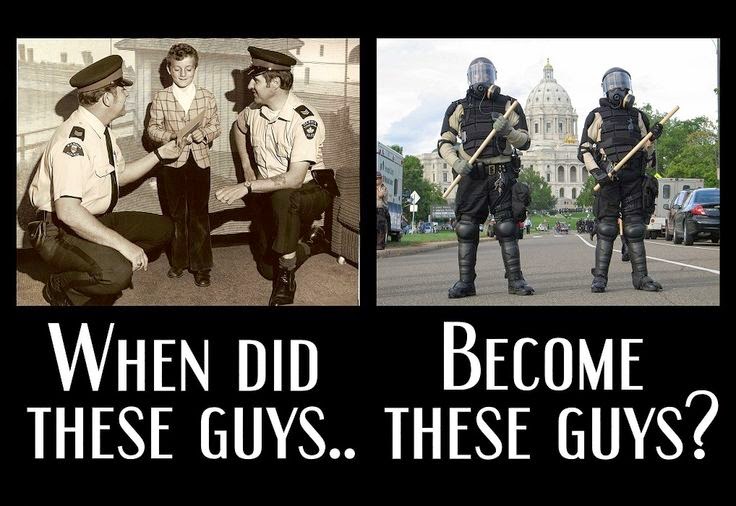
Clearly, we’re not in Mayberry anymore.

Or if this is Mayberry, it’s Mayberry in The Twilight Zone.

As journalist Benjamin Carlson stresses, “In today’s Mayberry, Andy Griffith and Barney Fife could be using grenade launchers and a tank to keep the peace.”

You remember The Andy Griffith Show, don’t you?

Set in the fictional town of Mayberry, N.C., The Andy Griffith Show portrays the two stars of the show—Sheriff Andy Taylor and his bumbling deputy Barney Fife—as peace officers in the truest sense of the word as opposed to law enforcers.

Both Sheriff Taylor and Deputy Fife dress in khaki uniforms, a far cry from the black, militarized Stormtrooper getups worn by police today. Andy refuses to wear a gun and only allows Barney to wear his gun on the proviso that he keep his single bullet out of the chamber and in his shirt pocket. Most of all, the two lawmen relate to those under their protection as equals, rather than as enemy combatants or inferiors.

Contrast the idyllic Mayberry with the American police state of today, where local police—clad in jackboots, helmets and shields and wielding batons, pepper-spray, stun guns, and assault rifles—have increasingly come to resemble occupying forces in communities across the country.

As Alyssa Rosenberg writes for The Washington Post, “[The Andy Griffith Show] expressed an ideal that has leached out of American pop culture and public policy, to dangerous effect: that the police were part of the communities that they served and shared their fellow citizens’ interests. They were of their towns and cities, not at war with them.”

That’s really what this is about: a war on the American citizenry waged by local law enforcement armed to the teeth with weapons previously only seen on the battlefield

If you thought the militarized police response to Ferguson and Baltimore was bad, brace yourselves.

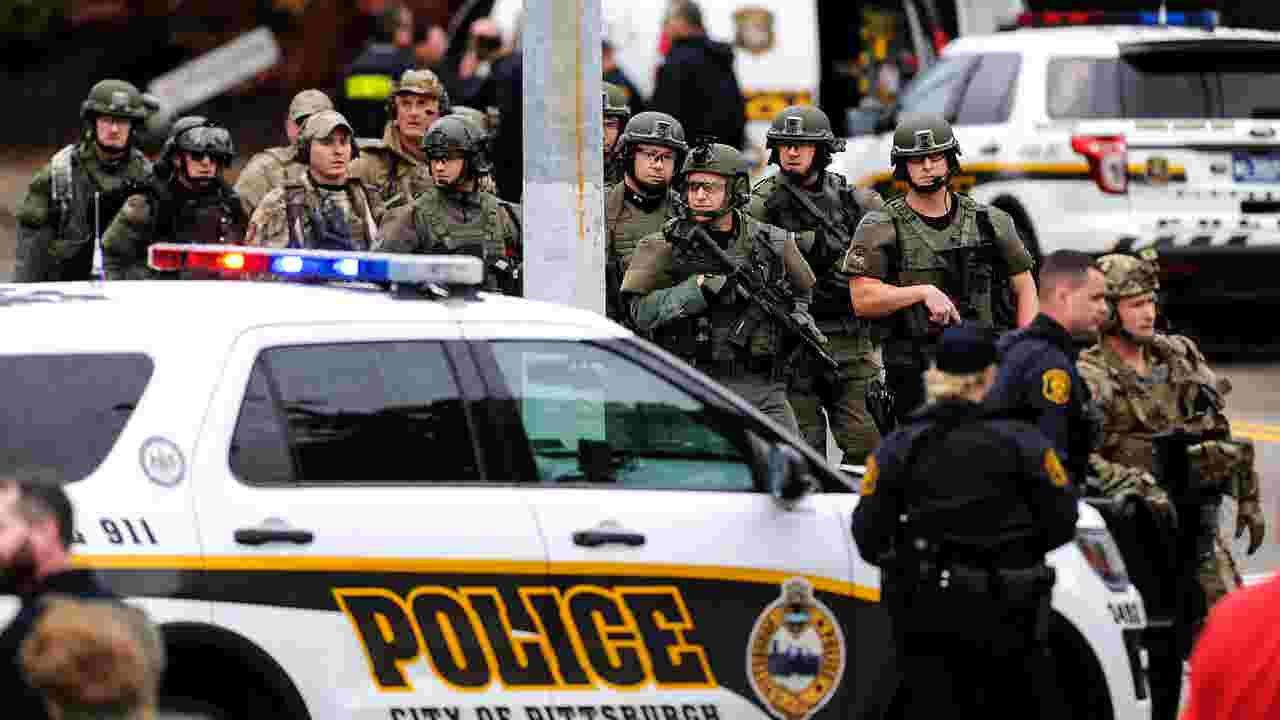
As investigative journalists Andrew Becker and G.W. Schulz reveal, “Many police, including beat cops, now routinely carry assault rifles. Combined with body armor and other apparel, many officers look more and more like combat troops serving in Iraq and Afghanistan.”

Thanks to Trump, this transformation of America into a battlefield is only going to get worse.

To be fair, Trump did not create this totalitarian nightmare. However, he has legitimized it and, in so doing, has also accelerated the pace at which we fall deeper into the clutches of outright tyranny.

Everything America’s founders warned against—a standing army that would view and treat American citizens as combatants—is fast becoming the norm. Certainly, this lopsided, top-heavy, authoritarian state of affairs is not the balance of power the founders intended for “we the people.”

Yet in the hands of government agents, whether they are members of the military, law enforcement or some other government agency, these weapons of war have become accepted instruments of tyranny, routine parts of America’s day-to-day life, a byproduct of the rapid militarization of law enforcement over the past several decades.

As Becker and Schulz document in their insightful piece, “Local Cops Ready for War With Homeland Security-Funded Military Weapons”:

In Montgomery County, Texas, the sheriff’s department owns a $300,000 pilotless surveillance drone, like those used to hunt down al Qaeda terrorists in the remote tribal regions of Pakistan and Afghanistan. In Augusta, Maine, with fewer than 20,000 people and where an officer hasn’t died from gunfire in the line of duty in more than 125 years, police bought eight $1,500 tactical vests. Police in Des Moines, Iowa, bought two $180,000 bomb-disarming robots, while an Arizona sheriff is now the proud owner of a surplus Army tank.

Under this recycling program, small counties and cities throughout the country have been “gifted” with 20-ton Mine Resistant Ambush Protected (MRAP) vehicles.

MRAPs are built to withstand roadside bombs, a function which seems unnecessary for any form of domestic policing, yet police in Jefferson County, New York, Boise and Nampa, Idaho, as well as High Springs, Florida, have all acquired MRAPs. Police in West Lafayette, Indiana also have an MRAP, valued at half a million dollars.

Universities are getting in on the program as well.

The Ohio State University Department of Public Safety acquired an MRAP, which a university spokesperson said will be used for “officer rescue, hostage scenarios, bomb evaluation,” situations which are not common on OSU’s campus. In fact, it will be used for crowd control at football games.
Almost 13,000 agencies in all 50 states and four U.S. territories participate in the military “recycling” program, and the share of equipment and weaponry gifted each year continues to expand.

In 2011, $500 million worth of military equipment was distributed to law enforcement agencies throughout the country. That number jumped to $546 million in 2012.

Since 1990, $4.2 billion worth of equipment has been transferred from the Defense Department to domestic police agencies through the 1033 program, in addition to various other programs supposedly aimed at fighting the so-called War on Drugs and War on Terror. For example, the Department of Homeland Security has delivered roughly $34 billion to police departments throughout the country since 9/11, ostensibly to purchase more gear for their steady growing arsenals of military weapons and equipment.

Police departments are also receiving grants to create microcosms of the extensive surveillance systems put in place by the federal government in the years since 9/11.

For example, using a $2.6 million grant from the DHS, police in Seattle purchased and setup a “mesh network”throughout the city capable of tracking every Wi-Fi enabled device within range. Police claim it won’t be used for surveillance, but the devices are capable of determining “the IP address, device type, downloaded applications, current location, and historical location of any device that searches for a Wi-Fi signal.”

Now ask yourself: why does a police department which hasn’t had an officer killed in the line of duty in over 125 years in a town of less than 20,000 people need tactical military vests like those used by soldiers in Afghanistan?

Why does a police department in a city of 35,000 people need a military-grade helicopter?

For that matter, what possible use could police at Ohio State University have for acquiring a heavily-armored vehicle intended to withstand IED blasts?

It’s a modern-day Trojan Horse.

Although these federal programs that allow the military to “gift” battlefield-appropriate weapons, vehicles and equipment to domestic police departments at taxpayer expense are being sold to communities as a benefit, the real purpose is to keep the defense industry churning out profits, bring police departments in line with the military, and establish a standing army.

It’s a militarized approach to make-work programs, except in this case, instead of unnecessary busy work to keep people employed, communities across America are finding themselves “gifted” with unnecessary drones, tanks, grenade launchers and other military equipment better suited to the battlefield in order to fatten the bank accounts of the military industrial complex.

Not surprisingly, this trend towards the militarization of domestic police forces has also opened up a new market for military contractors.

You know who gets stuck with the bill for all of this unnecessary military gear, don’t you?

“We the taxpayers,” of course.

First, taxpayers are forced to pay millions of dollars for equipment which the Defense Department purchases from megacorporations only to abandon after a few years. Then taxpayers get saddled with the bill to maintain the costly equipment once it has been acquired by the local police.

It’s like the old adage: “never look a gift horse in the mouth.” The catch is that this gift horse is an expensive and deadly boondoggle.

For instance, although the Tupelo, Miss., police department was “gifted” with a free military helicopter, residents quickly learned that it required “$100,000 worth of upgrades and $20,000 each year in maintenance.”

In addition to being an astounding waste of taxpayer money, this equipping of police with military-grade equipment and weapons also gives rise to a dangerous mindset in which police adopt a warrior-like, more aggressive approach to policing.

The results are deadly.

As a study by researchers at Stanford University makes clear, “When law enforcement receives more military materials — weapons, vehicles and tools — it becomes … more likely to jump into high-risk situations. Militarization makes every problem — even a car of teenagers driving away from a party — look like a nail that should be hit with an AR-15 hammer.”

The danger of giving police high-power toys and weapons is that they will feel compelled to use it in all kinds of situations that would never normally warrant battlefield gear, weapons or tactics.

This “if we have it, we might as well use it” mindset, by the way, is also used to justify assigning SWAT teams to carry out routine law enforcement work such as delivering a warrant. That’s how you end up with SWAT tactics being employed when police are tasked with searching for a stolen koi fish and enforcing barber licensing laws.

Suffice it to say, we’re long past the days of Mayberry when cops were peace officers and recognized their role as public servants, a marked contrast to the climate of entitlement that has cops today acting like overlords and authoritarians.

Change will not come easily.

As I make clear in my book Battlefield America: The War on the American People, the police unions are a powerful force and they will not relinquish their power easily. Connect the dots and you’ll find that most, if not all, attempts to cover up police misconduct or sidestep accountability can be traced back to police unions and the police lobby.

Just look at Trump: he’s been on the police unions’ payroll from the moment they endorsed him for president, and he’s paid them back generously by ensuring that police can kill, shoot, taser, abuse and steal from American citizens with impunity.

Still, the responsibility rests with “we the people.”

As author Ta-Nehisi Coates reminds us:

The truth is that the police reflect America in all of its will and fear, and whatever we might make of this country’s criminal justice policy, it cannot be said that it was imposed by a repressive minority. The abuses that have followed from these policies—the sprawling carceral state, the random detention of black people, the torture of suspects—are the product of democratic will. And so to challenge the police is to challenge the American people who send them into the ghettos armed with the same self-generated fears that compelled the people who think they are white to flee the cities and into the Dream. The problem with the police is not that they are fascist pigs but that our country is ruled by majoritarian pigs.

WC: 2090

ABOUT JOHN W. WHITEHEAD

Constitutional attorney and author John W. Whitehead is founder and president of The Rutherford Institute. His book Battlefield America: The War on the American People (SelectBooks, 2015) is available online at http://www.amazon.com. Whitehead can be contacted at johnw@rutherford.org.

PUBLICATION GUIDELINES / REPRINT PERMISSION

John W. Whitehead’s weekly commentaries are available for publication to newspapers and web publications at no charge. Please contact staff@rutherford.org to obtain reprint permission. This commentary originally appeared at: http://rutherford.org/publications_resources/john_whiteheads_commentary/battlefield_america_is_the_new_normal_were_not_in_mayberry_anymore.


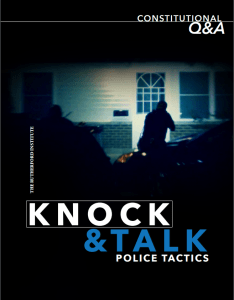
WASHINGTON, D.C. — Warning of the danger to the public from the increasing use of “knock and talk” tactics by police, The Rutherford Institute has asked the United States Supreme Court to rein in aggressive “knock and talk” practices, which have become thinly veiled, warrantless attempts by which citizens are coerced and intimidated into “talking” with heavily armed police who “knock” on their doors in the middle of the night.

In asking the Court to review the case of Young v. Borders,Rutherford Institute attorneys denounced a lower court ruling that failed to hold police accountable for banging on the wrong door at 1:30 am, failing to identify themselves as police, and then repeatedly shooting and killing the innocent homeowner who answered the door while holding a gun in self-defense. Although 26-year-old Andrew Scott had committed no crime and never fired a single bullet or lifted his firearm against police, he was gunned down by police who were investigating a speeding incident by engaging in a middle-of-the-night “knock and talk” in Scott’s apartment complex.

In an amicus brief filed with the Supreme Court, Institute attorneys argue that the police violated the Fourth Amendment in conducting the “knock and talk” because the late-night raid at Scott’s home was an abuse of society’s norms and a trespass on Scott’s property. The Institute has also issued constitutional guidelines to educate the public about what they can do to preserve their constitutional rights against the coercive use of “knock and talks” by police as a means of sidestepping the Fourth Amendment’s prohibition against warrantless, unreasonable searches.

The Rutherford Institute’s amicus curiae brief in Young v. Borders is available at www.rutherford.org.

“Government officials insist that there is nothing unlawful, unreasonable or threatening about the prospect of armed police dressed in SWAT gear knocking on doors in the middle of night and ‘asking’ homeowners to engage in warrantless ‘knock-and-talk’ sessions,” said constitutional attorney John W. Whitehead, president of The Rutherford Institute and author of Battlefield America: The War on the American People. “However, as Andrew Scott learned, there’s always a price to pay for saying no to such heavy-handed requests by police. If the courts continue to sanction such aggressive, excessive, coercive tactics, it will give police further incentive to terrorize and kill American citizens without fear of repercussion.”

On July 15, 2012, Deputy Richard Sylvester pursued a speeding motorcyclist, which he later had cause to believe might be armed and had been spotted at a nearby apartment complex. Around 1:30 a.m., Sylvester and three other deputies began knocking on doors in the apartment complex in the vicinity of the parked motorcycle, starting with Apt. 114, which was occupied by Andrew Scott and Amy Young, who were playing video games and had no connection to the motorcycle or any illegal activity. The deputies assumed tactical positions, guns drawn and ready to shoot. Sylvester, without announcing he was a police officer, then banged loudly and repeatedly on the door. Unnerved by the banging at such a late hour, Andrew Scott retrieved his handgun before opening the door. When Scott saw a shadowy figure holding a gun outside his door, he retreated into his apartment only to have Sylvester immediately open fire. Sylvester fired six shots, three of which hit and killed Scott. A trial court subsequently ruled in favor of the police, ruling that Scott was to blame for choosing to retrieve a handgun before opening the door. On appeal, the Eleventh Circuit ruled that Sylvester was protected by “qualified immunity,” reasoning that the use of excessive force did not violate “clearly established law.”

DOCUMENTS

The Rutherford Institute’s amicus curiae brief in Young v. Borders

The Rutherford Institute’s “Constitutional Q&A: Knock-and-Talk Police Tactics”

“We’re run by the Pentagon, we’re run by Madison Avenue, we’re run by television, and as long as we accept those things and don’t revolt we’ll have to go along with the stream to the eventual avalanche…. As long as we go out and buy stuff, we’re at their mercy… We all live in a little Village. Your Village may be different from other people’s Villages, but we are all prisoners.”— Patrick McGoohan

First broadcast in Great Britain 50 years ago, The Prisoner—a dystopian television series described as “James Bond meets George Orwell filtered through Franz Kafka”—confronted societal themes that are still relevant today: the rise of a police state, the freedom of the individual, round-the-clock surveillance, the corruption of government, totalitarianism, weaponization, group think, mass marketing, and the tendency of humankind to meekly accept their lot in life as a prisoner in a prison of their own making.

Perhaps the best visual debate ever on individuality and freedom, The Prisoner (17 episodes in all) centers around a British secret agent who abruptly resigns only to find himself imprisoned, monitored by militarized drones, and interrogated in a mysterious, self-contained, cosmopolitan, seemingly tranquil retirement community known only as the Village. The Village is an idyllic setting with parks and green fields, recreational activities and even a butler.

While luxurious and resort-like, the Village is a virtual prison disguised as a seaside paradise: its inhabitants have no true freedom, they cannot leave the Village, they are under constant surveillance, their movements are tracked by surveillance drones, and they are stripped of their individuality and identified only by numbers.

The series’ protagonist, played by Patrick McGoohan, is Number Six.

Number Two, the Village administrator, acts as an agent for the unseen and all-powerful Number One, whose identity is not revealed until the final episode.

“I am not a number. I am a free man,” was the mantra chanted on each episode of The Prisoner, which was largely written and directed by McGoohan.

In the opening episode (“The Arrival”), Number Six meets Number Two, who explains to him that he is in The Village because information stored “inside” his head has made him too valuable to be allowed to roam free “outside.”

Throughout the series, Number Six is subjected to interrogation tactics, torture, hallucinogenic drugs, identity theft, mind control, dream manipulation, and various forms of social indoctrination and physical coercion in order to “persuade” him to comply, give up, give in and subjugate himself to the will of the powers-that-be.

Number Six refuses to comply.

In every episode, Number Six resists the Village’s indoctrination methods, struggles to maintain his own identity, and attempts to escape his captors. “I will not make any deals with you,” he pointedly remarks to Number Two. “I’ve resigned. I will not be pushed, filed, stamped, indexed, debriefed or numbered. My life is my own.”

Yet no matter how far Number Six manages to get in his efforts to escape, it’s never far enough.

Watched by surveillance cameras and other devices, Number Six’s getaways are continuously thwarted by ominous white balloon-like spheres known as “rovers.” Still, he refuses to give up. “Unlike me,” he says to his fellow prisoners, “many of you have accepted the situation of your imprisonment, and will die here like rotten cabbages.”

Number Six’s escapes become a surreal exercise in futility, each episode an unfunny, unsettling Groundhog’s Day that builds to the same frustrating denouement: there is no escape.

As journalist Scott Thill concludes for Wired, “Rebellion always comes at a price. During the acclaimed run of The Prisoner, Number Six is tortured, battered and even body-snatched: In the episode ‘Do Not Forsake Me Oh My Darling,’ his mind is transplanted to another man’s body. Number Six repeatedly escapes The Village only to be returned to it in the end, trapped like an animal, overcome by a restless energy he cannot expend, and betrayed by nearly everyone around him.”

The series is a chilling lesson about how difficult it is to gain one’s freedom in a society in which prison walls are disguised within the trappings of technological and scientific progress, national security and so-called democracy.

As Thill noted when McGoohan died in 2009, “The Prisoner was an allegory of the individual, aiming to find peace and freedom in a dystopia masquerading as a utopia.”

The Prisoner’s Village is also an apt allegory for the American Police State: it gives the illusion of freedom while functioning all the while like a prison: controlled, watchful, inflexible, punitive, deadly and inescapable.

The American Police State, much like The Prisoner’s Village, is a metaphorical panopticon, a circular prison in which the inmates are monitored by a single watchman situated in a central tower. Because the inmates cannot see the watchman, they are unable to tell whether or not they are being watched at any given time and must proceed under the assumption that they are always being watched.

Eighteenth century social theorist Jeremy Bentham envisioned the panopticon prison to be a cheaper and more effective means of “obtaining power of mind over mind, in a quantity hitherto without example.”

Bentham’s panopticon, in which the prisoners are used as a source of cheap, menial labor, has become a model for the modern surveillance state in which the populace is constantly being watched, controlled and managed by the powers-that-be and funding its existence.

Nowhere to run and nowhere to hide: this is the new mantra of the architects of the police state and their corporate collaborators (Facebook, Amazon, Netflix, Google, Instagram, etc.).

Government eyes are watching you.

They see your every move: what you read, how much you spend, where you go, with whom you interact, when you wake up in the morning, what you’re watching on television and reading on the internet.

Every move you make is being monitored, mined for data, crunched, and tabulated in order to form a picture of who you are, what makes you tick, and how best to control you when and if it becomes necessary to bring you in line.

When the government sees all and knows all and has an abundance of laws to render even the most seemingly upstanding citizen a criminal and lawbreaker, then the old adage that you’ve got nothing to worry about if you’ve got nothing to hide no longer applies.

Apart from the obvious dangers posed by a government that feels justified and empowered to spy on its people and use its ever-expanding arsenal of weapons and technology to monitor and control them, we’re approaching a time in which we will be forced to choose between obeying the dictates of the government—i.e., the law, or whatever a government official deems the law to be—and maintaining our individuality, integrity and independence.

When people talk about privacy, they mistakenly assume it protects only that which is hidden behind a wall or under one’s clothing. The courts have fostered this misunderstanding with their constantly shifting delineation of what constitutes an “expectation of privacy.” And technology has furthered muddied the waters.

However, privacy is so much more than what you do or say behind locked doors. It is a way of living one’s life firm in the belief that you are the master of your life, and barring any immediate danger to another person (which is far different from the carefully crafted threats to national security the government uses to justify its actions), it’s no one’s business what you read, what you say, where you go, whom you spend your time with, and how you spend your money.

Unfortunately, George Orwell’s 1984—where “you had to live—did live, from habit that became instinct—in the assumption that every sound you made was overheard, and, except in darkness, every movement scrutinized”—has now become our reality.

We now find ourselves in the unenviable position of being monitored, managed and controlled by our technology, which answers not to us but to our government and corporate rulers.

Consider that on any given day, the average American going about his daily business will be monitored, surveilled, spied on and tracked in more than 20 different ways, by both government and corporate eyes and ears.
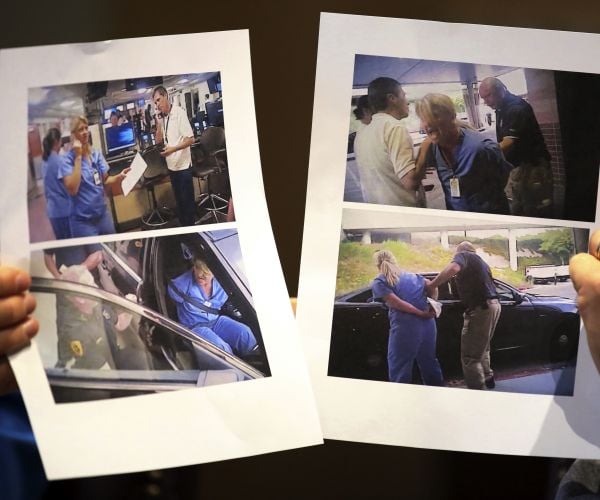
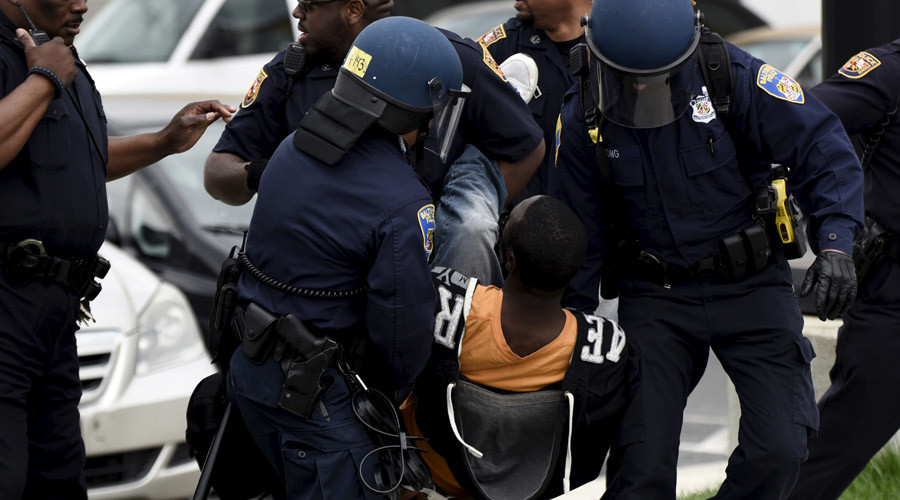
A byproduct of this new age in which we live, whether you’re walking through a store, driving your car, checking email, or talking to friends and family on the phone, you can be sure that some government agency, whether the NSA or some other entity, is listening in and tracking your behavior.

This doesn’t even begin to touch on the corporate trackers that monitor your purchases, web browsing, Facebook posts and other activities taking place in the cyber sphere.

Stingray devices mounted on police cars to warrantlessly track cell phones, Doppler radar devices that can detect human breathing and movement within in a home, license plate readers that can record up to 1800 license plates per minutesidewalk and “public space” cameras coupled with facial recognition and behavior-sensing technology that lay the groundwork for police “pre-crime” programspolice body cameras that turn police officers into roving surveillance cameras, the internet of things: all of these technologies add up to a society in which there’s little room for indiscretions, imperfections, or acts of independence—especially not when the government can listen in on your phone calls, monitor your driving habits, track your movements, scrutinize your purchases and peer through the walls of your home.

As French philosopher Michel Foucault concluded in his 1975 book Discipline and Punish, “Visibility is a trap.”

This is the electronic concentration camp—the panopticon prison—the Village—in which we are now caged.

It is a prison from which there will be no escape if the government gets it way.

As Glenn Greenwald notes:

“The way things are supposed to work is that we’re supposed to know virtually everything about what [government officials] do: that’s why they’re called public servants. They’re supposed to know virtually nothing about what we do: that’s why we’re called private individuals. This dynamic – the hallmark of a healthy and free society – has been radically reversed. Now, they know everything about what we do, and are constantly building systems to know more. Meanwhile, we know less and less about what they do, as they build walls of secrecy behind which they function. That’s the imbalance that needs to come to an end. No democracy can be healthy and functional if the most consequential acts of those who wield political power are completely unknown to those to whom they are supposed to be accountable.”

Even now, the Trump Administration is working to make some of the National Security Agency’s vast spying powers permanent.

In fact, Attorney General Jeff Sessions is pushing for Congress to permanently renew Section 702 of the Foreign Intelligence Surveillance Act, which allows government snoops to warrantlessly comb through and harvest vast quantities of our communications.

And just like that, we’re back in the Village, our escape plans foiled, our future bleak.

Except this is no surprise ending: for those who haven’t been taking the escapist blue pill, who haven’t fallen for the Deep State’s phony rhetoric, who haven’t been lured in by the promise of a political savior, we never stopped being prisoners.

So how do we break out?

For starters, wake up. Resist the urge to comply.

The struggle to remain “oneself in a society increasingly obsessed with conformity to mass consumerism,” writes Steven Paul Davies, means that superficiality and image trump truth and the individual. The result is the group mind and the tyranny of mob-think.

Think for yourself. Be an individual. As McGoohan commented in 1968, “At this moment individuals are being drained of their personalities and being brainwashed into slaves… As long as people feel something, that’s the great thing. It’s when they are walking around not thinking and not feeling, that’s tough. When you get a mob like that, you can turn them into the sort of gang that Hitler had.”

In a media-dominated age in which the lines between entertainment, politics and news reporting are blurred, it is extremely difficult to distinguish fact from fiction. We are so bombarded with images, dictates, rules and punishments and stamped with numbers from the day we are born that it is a wonder we ever ponder a concept such as freedom. As McGoohan declared, “Freedom is a myth.”

In the end, as I make clear in my book Battlefield America: The War on the American People, we are all prisoners of our own mind.

In fact, it is in the mind that prisons are created for us. And in the lockdown of political correctness, it becomes extremely difficult to speak or act individually without being ostracized. Thus, so often we are forced to retreat inwardly into our minds, a prison without bars from which we cannot escape, and into the world of video games and television and the Internet.

We have come full circle from Bentham’s Panopticon to McGoohan’s Village to Huxley’s Brave New World.

As cultural theorist Neil Postman observed:

What Orwell feared were those who would ban books. What Huxley feared was that there would be no reason to ban a book, for there would be no one who wanted to read one. Orwell feared those who would deprive us of information. Huxley feared those who would give us so much that we would be reduced to passivity and egoism. Orwell feared we would become a captive audience. Huxley feared the truth would be drowned in a sea of irrelevance. Orwell feared that we would become a captive culture. Huxley feared we would become a trivial culture, preoccupied with some equivalent of the feelies, the orgy porgy, and the centrifugal bumblepuppy. As Huxley remarked in Brave New World Revisited, the civil libertarians and rationalists who are ever on the alert to oppose tyranny “failed to take into account man’s almost infinite appetite for distractions.” In Brave New World, they are controlled by inflicting pleasure. In short, Orwell feared that what we hate would ruin us. Huxley feared that what we love will ruin us.

You want to be free? Break out of the circle.

WC: 2356

ABOUT JOHN W. WHITEHEAD

Constitutional attorney and author John W. Whitehead is founder and president of The Rutherford Institute. His new book Battlefield America: The War on the American People (SelectBooks, 2015) is available online at http://www.amazon.com. Whitehead can be contacted at johnw@rutherford.org.

PUBLICATION GUIDELINES / REPRINT PERMISSION

John W. Whitehead’s weekly commentaries are available for publication to newspapers and web publications at no charge. Please contact staff@rutherford.org to obtain reprint permission. The original article appeared at www.rutherford.org.


“The Fourth Amendment was designed to stand between us and arbitrary governmental authority. For all practical purposes, that shield has been shattered, leaving our liberty and personal integrity subject to the whim of every cop on the beat, trooper on the highway and jail official.”—Herman Schwartz, The Nation

Our freedoms—especially the Fourth Amendment—are being choked out by a prevailing view among government bureaucrats that they have the right to search, seize, strip, scan, shoot, spy on, probe, pat down, taser, and arrest any individual at any time and for the slightest provocation.

Forced cavity searches, forced colonoscopies, forced blood draws, forced breath-alcohol tests, forced DNA extractions, forced eye scans, forced inclusion in biometric databases: these are just a few ways in which Americans are being forced to accept that we have no control over our bodies, our lives and our property, especially when it comes to interactions with the government.

Worse, on a daily basis, Americans are being made to relinquish the most intimate details of who we are—our biological makeup, our genetic blueprints, and our biometrics (facial characteristics and structure, fingerprints, iris scans, etc.)—in order to clear the nearly insurmountable hurdle that increasingly defines life in the United States: we are now guilty until proven innocent.

Such is life in America today that individuals are being threatened with arrest and carted off to jail for the least hint of noncompliance, homes are being raided by police under the slightest pretext, property is being seized on the slightest hint of suspicious activity, and roadside police stops have devolved into government-sanctioned exercises in humiliation and degradation with a complete disregard for privacy and human dignity.

Consider, for example, what happened to Utah nurse Alex Wubbels after a police detective demanded to take blood from a badly injured, unconscious patient without a warrant.

Wubbels refused, citing hospital policy that requires police to either have a warrant or permission from the patient in order to draw blood. The detective had neither. Irate, the detective threatened to have Wubbels arrested if she didn’t comply. Backed up by her supervisors, Wubbels respectfully stood her ground only to be roughly grabbed, shoved out of the hospital, handcuffed and forced into an unmarked car while hospital police looked on and failed to intervene (take a look at the police body camera footage, which has gone viral, and see for yourself).

Michael Chorosky didn’t have an advocate like Wubbels to stand guard over his Fourth Amendment rights. Chorosky was surrounded by police, strapped to a gurney and then had his blood forcibly drawn after refusing to submit to a breathalyzer test. “What country is this? What country is this?” cried Chorosky during the forced blood draw.

What country is this indeed?

Unfortunately, forced blood draws are just the tip of the iceberg when it comes to the indignities and abuses being heaped on Americans in the so-called name of “national security.”

Forced cavity searches, forced colonoscopies and forced roadside strip searches are also becoming par for the course in an age in which police are taught to have no respect for the citizenry’s bodily integrity whether or not a person has done anything wrong.

For example, 21-year-old Charnesia Corley was allegedly being pulled over by Texas police in 2015 for “rolling” through a stop sign. Claiming they smelled marijuana, police handcuffed Corley, placed her in the back of the police cruiser, and then searched her car for almost an hour. No drugs were found in the car.

As the Houston Chronicle reported:

Returning to his car where Corley was held, the deputy again said he smelled marijuana and called in a female deputy to conduct a cavity search. When the female deputy arrived, she told Corley to pull her pants down, but Corley protested because she was cuffed and had no underwear on. The deputy ordered Corley to bend over, pulled down her pants and began to search her. Then…Corley stood up and protested, so the deputy threw her to the ground and restrained her while another female was called in to assist. When backup arrived, each deputy held one of Corley’s legs apart to conduct the probe.

The cavity search lasted 11 minutes. This practice is referred to as “rape by cop.”

Although Corley was charged with resisting arrest and with possession of 0.2 grams of marijuana, those charges were subsequently dropped.

David Eckert was forced to undergo an anal cavity search, three enemas, and a colonoscopy after allegedly failing to yield to a stop sign at a Wal-Mart parking lot. Cops justified the searches on the grounds that they suspected Eckert was carrying drugs because his “posture [was] erect” and “he kept his legs together.” No drugs were found.

During a routine traffic stop, Leila Tarantino was subjected to two roadside strip searches in plain view of passing traffic, while her two children—ages 1 and 4—waited inside her car. During the second strip search, presumably in an effort to ferret out drugs, a female officer “forcibly removed” a tampon from Tarantino. No contraband or anything illegal was found.

Thirty-eight-year-old Angel Dobbs and her 24-year-old niece, Ashley, were pulled over by a Texas state trooper on July 13, 2012, allegedly for flicking cigarette butts out of the car window. Insisting that he smelled marijuana, the trooper proceeded to interrogate them and search the car. Despite the fact that both women denied smoking or possessing any marijuana, the police officer then called in a female trooper, who carried out a roadside cavity search, sticking her fingers into the older woman’s anus and vagina, then performing the same procedure on the younger woman, wearing the same pair of gloves. No marijuana was found.

Sixty-nine-year-old Gerald Dickson was handcuffed and taken into custody (although not arrested or charged with any crime) after giving a ride to a neighbor’s son, whom police suspected of being a drug dealer. Despite Dickson’s insistence that the bulge under his shirt was the result of a botched hernia surgery, police ordered Dickson to “strip off his clothes, bend over and expose all of his private parts. No drugs or contraband were found.”

Meanwhile, four Milwaukee police officers were charged with carrying out rectal searches of suspects on the street and in police district stations over the course of several years. One of the officers was accused of conducting searches of men’s anal and scrotal areas, often inserting his fingers into their rectums and leaving some of his victims with bleeding rectums.

It’s gotten so bad that you don’t even have to be suspected of possessing drugs to be subjected to a strip search.

A North Carolina public school allegedly strip-searched a 10-year-old boy in search of a $20 bill lost by another student, despite the fact that the boy, J.C., twice told school officials he did not have the missing money. The assistant principal reportedly ordered the fifth grader to disrobe down to his underwear and subjected him to an aggressive strip-search that included rimming the edge of his underwear. The missing money was later found in the school cafeteria.

Suspecting that Georgia Tech alum Mary Clayton might have been attempting to smuggle a Chick-Fil-A sandwich into the football stadium, a Georgia Tech police officer allegedly subjected the season ticket-holder to a strip search that included a close examination of her underwear and bra. No contraband chicken was found.

What these incidents show is that while forced searches may span a broad spectrum of methods and scenarios, the common denominator remains the same: a complete disregard for the rights of the citizenry.

In fact, in the wake of the U.S. Supreme Court’s ruling in Florence v. Burlison, any person who is arrested and processed at a jail house, regardless of the severity of his or her offense (i.e., they can be guilty of nothing more than a minor traffic offense), can be subjected to a strip search by police or jail officials without reasonable suspicion that the arrestee is carrying a weapon or contraband.

Examples of minor infractions which have resulted in strip searches include: individuals arrested for driving with a noisy muffler, driving with an inoperable headlight, failing to use a turn signal, riding a bicycle without an audible bell, making an improper left turn, and engaging in an antiwar demonstration (the individual searched was a nun, a Sister of Divine Providence for 50 years).

Police have also carried out strip searches for passing a bad check, dog leash violations, filing a false police report, failing to produce a driver’s license after making an illegal left turn, having outstanding parking tickets, and public intoxication. A failure to pay child support can also result in a strip search.

As technology advances, these searches are becoming more invasive on a cellular level, as well.

For instance, close to 600 motorists leaving Penn State University one Friday night were stopped by police and, without their knowledge or consent, subjected to a breathalyzer test using flashlights that can detect the presence of alcohol on a person’s breath. These passive alcohol sensors are being hailed as a new weapon in the fight against DUIs. (Those who refuse to knowingly submit to a breathalyzer test are being subjected to forced blood draws. Thirty states presently allow police to do forced blood draws on drivers as part of a nationwide “No Refusal” initiative funded by the federal government. Not even court rulings declaring such practices to be unconstitutional in the absence of a warrant have slowed down the process. Now police simply keep a magistrate on call to rubber stamp the procedure over the phone.)

The National Highway Safety Administration, the same government agency that funds the “No Refusal” DUI checkpoints and forcible blood draws, is also funding nationwide roadblocks aimed at getting drivers to “voluntarily” provide police with DNA derived from saliva and blood samples, reportedly to study inebriation patterns. In at least 28 states, there’s nothing voluntary about having one’s DNA collected by police in instances where you’ve been arrested, whether or not you’re actually convicted of a crime. All of this DNA data is being fed to the federal government.

Airline passengers, already subjected to virtual strip searches, are now being scrutinized even more closely, with the Customs and Border Protection agency tasking airport officials with monitoring the bowel movements of passengers suspected of ingesting drugs. They even have a special hi-tech toilet designed to filter through a person’s fecal waste.

Iris scans, an essential part of the U.S. military’s boots-on-the-ground approach to keeping track of civilians in Iraq and Afghanistan, are becoming a de facto method of building the government’s already mammoth biometrics database. Funded by the Dept. of Justice, along with other federal agencies, the iris scan technology is being incorporated into police precincts, jails, immigration checkpoints, airports and even schools. School officials—from elementary to college—have begun using iris scans in place of traditional ID cards. In some parts of the country, parents wanting to pick their kids up from school have to first submit to an iris scan.

As for those endless pictures everyone so cheerfully uploads to Facebook (which has the largest facial recognition database in the world) or anywhere else on the internet, they’re all being accessed by the police, filtered with facial recognition software, uploaded into the government’s mammoth biometrics database and cross-checked against its criminal files. With good reason, civil libertarians fear these databases could “someday be used for monitoring political rallies, sporting events or even busy downtown areas.”
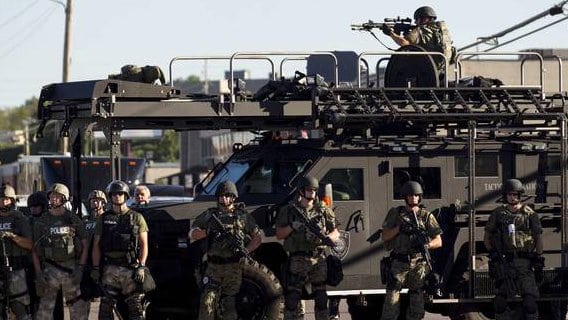
While the Fourth Amendment was created to prevent government officials from searching an individual’s person or property without a warrant and probable cause—evidence that some kind of criminal activity was afoot—the founders could scarcely have imagined a world in which we needed protection against widespread government breaches of our privacy, including on a cellular level.

Yet that’s exactly what we are lacking and what we so desperately need.

Unfortunately, the indignities being heaped upon us by the architects and agents of the American police state—whether or not we’ve done anything wrong—are just a foretaste of what is to come.

As I make clear in my book Battlefield America: The War on the American People, the government doesn’t need to tie you to a gurney and forcibly take your blood or strip you naked by the side of the road in order to render you helpless. It has other methods—less subtle perhaps but equally humiliating, devastating and mind-altering—of stripping you of your independence, robbing you of your dignity, and undermining your rights.

With every court ruling that allows the government to operate above the rule of law, every piece of legislation that limits our freedoms, and every act of government wrongdoing that goes unpunished, we’re slowly being conditioned to a society in which we have little real control over our bodies or our lives.

WC: 2146

ABOUT JOHN W. WHITEHEAD

Constitutional attorney and author John W. Whitehead is founder and president of The Rutherford Institute. His new book Battlefield America: The War on the American People (SelectBooks, 2015) is available online at http://www.amazon.com. Whitehead can be contacted at johnw@rutherford.org.

PUBLICATION GUIDELINES / REPRINT PERMISSION

John W. Whitehead’s weekly commentaries are available for publication to newspapers and web publications at no charge. Please contact staff@rutherford.org to obtain reprint permission. This commentary originally appeared at http://rutherford.org/publications_resources/john_whiteheads_commentary/what_country_is_this_forced_blood_draws_cavity_searches_and_colonoscopies.


“I tell you, freedom and human rights in America are doomed. The U.S. government will lead the American people in — and the West in general — into an unbearable hell and a choking life.”—Osama bin Laden (October 2001)

Ironically, during the same week that we mark the 16th anniversary of the 9/11 attacks, we find ourselves commemorating the 230th anniversary of the U.S. Constitution.

While there has been much to mourn about the loss of our freedoms in the years since 9/11, there has been very little to celebrate. Indeed, we have gone from being a nation that took great pride in serving as a model of a representative democracy to being a model of how to persuade a freedom-loving people to march in lockstep with a police state.

What began with the passage of the USA Patriot Act in the wake of the 9/11 attacks has snowballed into the eradication of every vital safeguard against government overreach, corruption and abuse.

Since then, we have been terrorized, traumatized, and tricked into a semi-permanent state of compliance. The bogeyman’s names and faces change over time, but the end result remains the same: our unquestioning acquiescence to anything the government wants to do in exchange for the phantom promise of safety and security.

All the while, the Constitution has been steadily chipped away at, undermined, eroded, whittled down, and generally discarded to such an extent that what we are left with today is but a shadow of the robust document adopted more than two centuries ago. Most of the damage, however, has been inflicted upon the Bill of Rights—the first ten amendments to the Constitution—which historically served as the bulwark from government abuse.

Set against a backdrop of government surveillance, militarized police, SWAT team raids, asset forfeiture, eminent domain, overcriminalization, armed surveillance drones, whole body scanners, stop and frisk searches, roving VIPR raids and the like—all sanctioned by Congress, the White House, the courts and the like—a recitation of the Bill of Rights would understandably sound more like a eulogy to freedoms lost than an affirmation of rights we truly possess.

We can pretend that the Constitution, which was written to hold the government accountable, is still our governing document. However, the reality we must come to terms with is that in the America we live in today, the government does whatever it wants, freedom be damned.

Here is what it means to live under the Constitution today.

The First Amendment is supposed to protect the freedom to speak your mind, assemble and protest nonviolently without being bridled by the government. It also protects the freedom of the media, as well as the right to worship and pray without interference. In other words, Americans should not be silenced by the government. To the founders, all of America was a free speech zone.

Despite the clear protections found in the First Amendment, the freedoms described therein are under constant assault. Increasingly, Americans are being arrested and charged with bogus “contempt of cop” charges such as “disrupting the peace” or “resisting arrest” for daring to film police officers engaged in harassment or abusive practices. Journalists are being prosecuted for reporting on whistleblowers. States are passing legislation to muzzle reporting on cruel and abusive corporate practices. Religious ministries are being fined for attempting to feed and house the homeless. Protesters are being tear-gassed, beaten, arrested and forced into “free speech zones.” And under the guise of “government speech,” the courts have reasoned that the government can discriminate freely against any First Amendment activity that takes place within a government forum.

The Second Amendment was intended to guarantee “the right of the people to keep and bear arms.” Essentially, this amendment was intended to give the citizenry the means to resist tyrannical government. Yet while gun ownership has been recognized by the U.S. Supreme Court as an individual citizen right, Americans remain powerless to defend themselves against SWAT team raids and government agents armed to the teeth with military weapons better suited for the battlefield. As such, this amendment has been rendered null and void.

The Third Amendment reinforces the principle that civilian-elected officials are superior to the military by prohibiting the military from entering any citizen’s home without “the consent of the owner.” With the police increasingly training like the military, acting like the military, and posing as military forces—complete with military weapons, assault vehicles, etc.—it is clear that we now have what the founders feared most—a standing army on American soil.

The Fourth Amendment prohibits the government from conducting surveillance on you or touching you or invading you, unless they have some evidence that you’re up to something criminal. In other words, the Fourth Amendment ensures privacy and bodily integrity. Unfortunately, the Fourth Amendment has suffered the greatest damage in recent years and has been all but eviscerated by an unwarranted expansion of police powers that include strip searches and even anal and vaginal searches of citizens, surveillance and intrusions justified in the name of fighting terrorism, as well as the outsourcing of otherwise illegal activities to private contractors.

The Fifth Amendment and the Sixth Amendment work in tandem. These amendments supposedly ensure that you are innocent until proven guilty, and government authorities cannot deprive you of your life, your liberty or your property without the right to an attorney and a fair trial before a civilian judge. However, in the new suspect society in which we live, where surveillance is the norm, these fundamental principles have been upended. Certainly, if the government can arbitrarily freeze, seize or lay claim to your property (money, land or possessions) under government asset forfeiture schemes, you have no true rights.

The Seventh Amendment guarantees citizens the right to a jury trial. Yet when the populace has no idea of what’s in the Constitution—civic education has virtually disappeared from most school curriculums—that inevitably translates to an ignorant jury incapable of distinguishing justice and the law from their own preconceived notions and fears. However, as a growing number of citizens are coming to realize, the power of the jury to nullify the government’s actions—and thereby help balance the scales of justice—is not to be underestimated. Jury nullification reminds the government that “we the people” retain the power to ultimately determine what laws are just.

The Eighth Amendment is similar to the Sixth in that it is supposed to protect the rights of the accused and forbid the use of cruel and unusual punishment. However, the Supreme Court’s determination that what constitutes “cruel and unusual” should be dependent on the “evolving standards of decency that mark the progress of a maturing society” leaves us with little protection in the face of a society lacking in morals altogether.

The Ninth Amendment provides that other rights not enumerated in the Constitution are nonetheless retained by the people. Popular sovereignty—the belief that the power to govern flows upward from the people rather than downward from the rulers—is clearly evident in this amendment. However, it has since been turned on its head by a centralized federal government that sees itself as supreme and which continues to pass more and more laws that restrict our freedoms under the pretext that it has an “important government interest” in doing so.

As for the Tenth Amendment’s reminder that the people and the states retain every authority that is not otherwise mentioned in the Constitution, that assurance of a system of government in which power is divided among local, state and national entities has long since been rendered moot by the centralized Washington, DC, power elite—the president, Congress and the courts. Indeed, the federal governmental bureaucracy has grown so large that it has made local and state legislatures relatively irrelevant. Through its many agencies and regulations, the federal government has stripped states of the right to regulate countless issues that were originally governed at the local level.

If there is any sense to be made from this recitation of freedoms lost, it is simply this: our individual freedoms have been eviscerated so that the government’s powers could be expanded.

Yet those who gave us the Constitution and the Bill of Rights believed that the government exists at the behest of its citizens. It is there to protect, defend and even enhance our freedoms, not violate them.

It was no idle happenstance that the Constitution opens with these three powerful words: “We the people.” As the Preamble proclaims:

We, the people of the United States, in order to form a more perfect Union, establish justice, insure domestic tranquility, provide for the common defense, promote the general welfare, and secure the blessings of liberty to ourselves and our posterity, do ordain and establish this CONSTITUTION for the United States of America.

In other words, we have the power to make and break the government. We are the masters and they are the servants. We the American people—the citizenry—are the arbiters and ultimate guardians of America’s welfare, defense, liberty, laws and prosperity.

Still, it’s hard to be a good citizen if you don’t know anything about your rights or how the government is supposed to operate.

As the National Review rightly asks, “How can Americans possibly make intelligent and informed political choices if they don’t understand the fundamental structure of their government? American citizens have the right to self-government, but it seems that we increasingly lack the capacity for it.”

Americans are constitutionally illiterate.

Most citizens have little, if any, knowledge about their basic rights. And our educational system does a poor job of teaching the basic freedoms guaranteed in the Constitution and the Bill of Rights. For instance, when Newsweek asked 1,000 adult U.S. citizens to take America’s official citizenship test44% were unable to define the Bill of Rights.

A survey by the Annenberg Public Policy Center found that a little more than one-third of respondents (36 percent) could name all three branches of the U.S. government, while another one-third (35 percent) could not name a single one. Only a quarter of Americans (27 percent) know it takes a two-thirds vote of the House and Senate to override a presidential veto. One in five Americans (21 percent) incorrectly thinks that a 5-4 Supreme Court decision is sent back to Congress for reconsideration. And more than half of Americans do not know which party controls the House and Senate.

A 2006 survey by the McCormick Tribune Freedom Museum found that only one out of a thousand adults could identify the five rights protected by the First Amendment. On the other hand, more than half (52%) of the respondents could name at least two of the characters in the animated Simpsons television family, and 20% could name all five. And although half could name none of the freedoms in the First Amendment, a majority (54%) could name at least one of the three judges on the TV program American Idol, 41% could name two and one-fourth could name all three.

It gets worse.

Many who responded to the survey had a strange conception of what was in the First Amendment. For example, 21% said the “right to own a pet” was listed someplace between “Congress shall make no law” and “redress of grievances.” Some 17% said that the First Amendment contained the “right to drive a car,” and 38% believed that “taking the Fifth” was part of the First Amendment.

Teachers and school administrators do not fare much better. A study conducted by the Center for Survey Research and Analysis found that one educator in five was unable to name any of the freedoms in the First Amendment.

In fact, while some educators want students to learn about freedom, they do not necessarily want them to exercise their freedoms in school. As the researchers conclude, “Most educators think that students already have enough freedom, and that restrictions on freedom in the school are necessary. Many support filtering the Internet, censoring T-shirts, disallowing student distribution of political or religious material, and conducting prior review of school newspapers.”

Government leaders and politicians are also ill-informed. Although they take an oath to uphold, support and defend the Constitution against “enemies foreign and domestic,” their lack of education about our fundamental rights often causes them to be enemies of the Bill of Rights.

So what’s the solution?

Thomas Jefferson recognized that a citizenry educated on “their rights, interests, and duties”  is the only real assurance that freedom will survive.

As Jefferson wrote in 1820: “I know no safe depository of the ultimate powers of our society but the people themselves; and if we think them not enlightened enough to exercise their control with a wholesome discretion, the remedy is not to take it from them, but to inform their discretion by education. This is the true corrective of abuses of constitutional power.”

From the President on down, anyone taking public office should have a working knowledge of the Constitution and the Bill of Rights and should be held accountable for upholding their precepts. One way to ensure this would be to require government leaders to take a course on the Constitution and pass a thorough examination thereof before being allowed to take office.

Some critics are advocating that students pass the United States citizenship exam in order to graduate from high school. Others recommend that it must be a prerequisite for attending college. I’d go so far as to argue that students should have to pass the citizenship exam before graduating from grade school.

Here’s an idea to get educated and take a stand for freedom: anyone who signs up to become a member of The Rutherford Institute gets a wallet-sized Bill of Rights card and a Know Your Rights card.

If this constitutional illiteracy is not remedied and soon, freedom in America will be doomed.

As I make clear in my book Battlefield America: The War on the American People, we have managed to keep the wolf at bay so far. Barely.

Our national priorities need to be re-prioritized. For instance, Donald Trump wants to make America great again. I, for one, would prefer to make America free again.

As actor-turned-activist Richard Dreyfuss warned:

Unless we teach the ideas that make America a miracle of government, it will go away in your kids’ lifetimes, and we will be a fable. You have to find the time and creativity to teach it in schools, and if you don’t, you will lose it. You will lose it to the darkness, and what this country represents is a tiny twinkle of light in a history of oppression and darkness and cruelty. If it lasts for more than our lifetime, for more than our kids’ lifetime, it is only because we put some effort into teaching what it is, the ideas of America: the idea of opportunity, mobility, freedom of thought, freedom of assembly.”

WC:  2481

ABOUT JOHN W. WHITEHEAD

Constitutional attorney and author John W. Whitehead is founder and president of The Rutherford Institute. His new book Battlefield America: The War on the American People (SelectBooks, 2015) is available online at http://www.amazon.com. Whitehead can be contacted at johnw@rutherford.org.

PUBLICATION GUIDELINES / REPRINT PERMISSION

John W. Whitehead’s weekly commentaries are available for publication to newspapers and web publications at no charge. Please contact staff@rutherford.org to obtain reprint permission.


“If there is any principle of the Constitution that more imperatively calls for attachment than any other, it is the principle of free thought — not free thought for those who agree with us but freedom for the thought that we hate.”— Supreme Court Justice Oliver Wendell Holmes

There was a time in this country, back when the British were running things, that if you spoke your mind and it ticked off the wrong people, you’d soon find yourself in jail for offending the king.

Reacting to this injustice, when it was time to write the Constitution, America’s founders argued for a Bill of Rights, of which the First Amendment protects the right to free speech. James Madison, the father of the Constitution, was very clear about the fact that he wrote the First Amendment to protect the minority against the majority.

What Madison meant by minority is “offensive speech.”

Unfortunately, we don’t honor that principle as much as we should today. In fact, we seem to be witnessing a politically correct philosophy at play, one shared by both the extreme left and the extreme right, which aims to stifle all expression that doesn’t fit within their parameters of what they consider to be “acceptable” speech.

There are all kinds of labels put on such speech—it’s been called politically incorrect speech, hate speech, offensive speech, and so on—but really, the message being conveyed is that you don’t have a right to express yourself if certain people or groups don’t like or agree with what you are saying.

Hence, we have seen the caging of free speech in recent years, through the use of so-called “free speech zones” on college campuses and at political events, the requirement of speech permits in parks and community gatherings, and the policing of online forums.

Clearly, this elitist, monolithic mindset is at odds with everything America is supposed to stand for.

Indeed, we should be encouraging people to debate issues and air their views. Instead, by muzzling free speech, we are contributing to a growing underclass of Americans—many of whom have been labeled racists, rednecks and religious bigots—who are being told that they can’t take part in American public life unless they “fit in.”

Remember, the First Amendment acts as a steam valve. It allows people to speak their minds, air their grievances and contribute to a larger dialogue that hopefully results in a more just world. When there is no steam valve to release the pressure, frustration builds, anger grows and people become more volatile and desperate to force a conversation.

The attempt to stifle certain forms of speech is where we go wrong.

In fact, the U.S. Supreme Court has held that it is “a bedrock principle underlying the First Amendment…that the government may not prohibit the expression of an idea simply because society finds the idea offensive or disagreeable.” For example, it is not a question of whether the Confederate flag represents racism but whether banning it leads to even greater problems, namely, the loss of freedom in general.

Along with the constitutional right to peacefully (and that means non-violently) assemble, the right to free speech allows us to challenge the government through protests and demonstrations and to attempt to change the world around us—for the better or the worse—through protests and counterprotests.

As always, knowledge is key.

The following Constitutional Q&A, available in more detail at The Rutherford Institute (www.rutherford.org), is a good starting point.

Q:        WHAT LAWS GIVE ME THE RIGHT TO PROTEST?

A:         The First Amendment prohibits the government from “abridging the freedom of speech, or of the press; or the right of the people peaceably to assemble, and to petition the government for a redress of grievances.” Protesting is an exercise of these constitutional rights because it involves speaking out, by individual people or those assembled in groups, about matters of public interest and concern.

Q:        WHERE CAN I ENGAGE IN PROTEST ACTIVITY?

A:         The right to protest generally extends to places that are owned and controlled by the government, although not all government-owned property is available for exercising speech and assembly rights. However, beyond public or government property, a person cannot claim a First Amendment right to protest and demonstrate on property that is privately owned by someone else. This also applies to private property that is generally open to the public, such as a shopping mall or shopping center, although these areas sometimes allow demonstrations and other free speech activity with permission from the owner. You are also entitled to engage in protest activities on land you own.  The Supreme Court has ruled that the government may not forbid homeowners from posting signs on their property speaking out on a political or social issue.

Q:        WHAT ARE MY RIGHTS TO PROTEST IN A TRADITIONAL PUBLIC FORUM?

A:         Places historically associated with the free exercise of expressive activities, such as streets, sidewalks and parks, are traditional public forums and the government’s power to limit speech and assembly in those places is very limited. The government may not impose an absolute ban on expression and assembly in traditional public forums except in circumstances where it is essential to serve a compelling government interest.  However, expression and assembly in traditional public forums may be limited by reasonable time, place and manner regulations. Examples of reasonable regulations include restrictions on the volume of sound produced by the activity or a prohibition on impeding vehicle and pedestrian traffic.  To be a valid time, place and manner regulation, the restriction must not have the effect of restricting speech based on its content and it must not be broader than needed to serve the interest of the government.

Q:        CAN I PICKET AND/OR DISTRIBUTE LEAFLETS AND OTHER TYPES OF LITERATURE ON PUBLIC SIDEWALKS?

A:         Yes, a sidewalk is considered a traditional public forum where you can engage in expressive activities, such a passing out literature or speaking out on a matter of public concern. In exercising that right, you must not block pedestrians or the entrances to buildings. You may not physically or maliciously detain someone in order to give them a leaflet, but you may approach them and offer it to them.

Q:        CAN MY FREE SPEECH BE RESTRICTED BECAUSE OF WHAT I SAY, EVEN IF IT IS CONTROVERSIAL?

A:         No, the First Amendment protects speech even if most people would find it offensive, hurtful or hateful. Speech generally cannot be banned based upon its content or viewpoint because it is not up to the government to determine what can and cannot be said. A bedrock principle of the First Amendment is that the government may not prohibit expression of an idea because society finds it offensive or disagreeable. Also, protest speech also cannot be banned because of a fear that others may react violently to the speech.  Demonstrators cannot be punished or forbidden from speaking because they might offend a hostile mob. The Supreme Court has held that a “heckler’s veto” has no place in First Amendment law.

Q:        HOW DO THESE RIGHTS APPLY TO PUBLIC PLACES I TYPICALLY VISIT?

A:         Your rights to speak out and protest in particular public places will depend on the use and purpose of the place involved.  For example, the lobbies and offices of public buildings that are used by the government are generally not open for expressive activities because the purpose of these buildings is to carry out public business. Protesting would interfere with that purpose.  Ironically, the meetings of a governmental body, such as a city council or town board, are not considered public forums open for protest activities because the purpose of the meeting is generally to address public business that is on the agenda.  However, some government councils and boards set aside a time at the meeting when the public can voice their complaints.

The grounds of public colleges and universities are generally considered available for assembly and protest by students and other members of the institution’s community.  However, those who are not students, faculty or staff of the institution may be denied access to the campus for speech and protest activities under rules issued by the school.

Public elementary and secondary school grounds also are not considered places where persons can engage in assembly and protest.  However, students at these schools do not lose their right to free speech when they enter the school. The First Amendment protects the right of students to engage in expressive acts of protest, such as wearing armbands to demonstrate opposition to a war, that are not disruptive to the school environment.

Q:        DO I NEED A PERMIT IN ORDER TO CONDUCT A PROTEST?

A:         As a general rule, no. A person is not required to obtain the consent or permission of the government before engaging in activities that are protected by the First Amendment.  One of the main reasons for that constitutional provision was to forbid any requirement that citizens obtain a license in order to speak out.  The government cannot require that individuals or small groups obtain a permit in order to speak or protest in a public forum.

However, if persons or organizations want to hold larger rallies and demonstrations, they may be required by local laws to obtain a permit.  The Supreme Court has recognized that the government, in order to regulate competing uses of public forums, may impose a permit requirement on those wishing to hold a parade or rally.  Government officials cannot simply prohibit a public assembly according to their discretion, but the government can impose restrictions on the time, place, and manner of peaceful assembly, provided that constitutional safeguards are met. Such time, place and manner restrictions can take the form of requirements to obtain a permit for an assembly.

Whether an assembly or demonstration requires a permit depends on the laws of the locality.  A permit certainly is required for any parade because it would involve the use of the streets and interfere with vehicle traffic. A permit to hold an event in other public places typically is required if the gathering involves more than 50 persons or the use of amplification.

Q:        DO COUNTER-DEMONSTRATORS HAVE FREE SPEECH RIGHTS?

A:         Yes, they do. Just because counter-demonstrators oppose you and the viewpoint of your demonstration does not mean they have any less right to speak out and demonstrate. However, the same rules apply to counter-demonstrators as apply to the original assembly. The group cannot be violent and must assemble and protest in an appropriate place and manner.

Q:        WHAT CAN’T I DO IN EXERCISING MY RIGHTS TO PROTEST?

A:         The Supreme Court of the United States has held that the First Amendment protects the right to conduct a peaceful public assembly. The First Amendment does not provide the right to conduct a gathering at which there is a clear and present danger of riot, disorder, interference with traffic on public streets or other immediate threat to public safety. Laws that prohibit people from assembling and using force or violence to accomplish unlawful purposes are permissible under the First Amendment.

Q:       AM I ALLOWED TO CARRY A WEAPON OR FIREARM AT A DEMONSTRATION OR PROTEST?

A:         Your right to have a weapon with you when you protest largely depends on what is allowed by state law and is unlikely to be protected by the First Amendment’s guarantee to freedom of speech. Not all conduct can be considered “speech” protected by the First Amendment even if the person engaging in the conduct intends to express an idea. Most courts have held that the act of openly carrying a weapon or firearm is not expression protected by the First Amendment.

The right to possess a firearm is protected by the Second Amendment, and all states allow carrying a concealed weapon in public, although most require a permit to do so. Some states allow persons to openly carry firearms in public. However, it is not yet settled whether the Second Amendment guarantees the right to possess a firearm in public. Thus, the right to carry a firearm at a demonstration or protest is a matter that depends on what is allowed under state law. Carrying other weapons, such as stun guns, which are not firearms also is subject to restrictions imposed by state lawPossession of weapons also may be prohibited in certain places where demonstrations might take place, such as a national park.

Even if possession of weapons is allowed, their presence at demonstrations and rallies can be intimidating and provocative and does not help in achieving a civil and peaceful discourse on issues of public interest and concern. Demonstrations often relate to issues raising strong feelings among competing groups, and the presence of counter-demonstrators makes conflict likely.  In these situations, where the purpose of the gathering is to engage in speech activities, firearms and other weapons are threatening, result in the suppression of speech and are contrary to the purpose of the First Amendment to allow all voices to be heard on matters of public importance.

Q:        WHAT CAN’T THE POLICE DO IN RESPONDING TO PROTESTERS?

A:         In recent history, challenges to the right to protest have come in many forms. In some cases, police have cracked down on demonstrations by declaring them “unlawful assemblies” or through mass arrests, illegal use of force or curfews. Elsewhere, expression is limited by corralling protesters into so-called “free-speech zones.” New surveillance technologies are increasingly turned on innocent people, collecting information on their activities by virtue of their association with or proximity to a given protest. Even without active obstruction of the right to protest, police-inspired intimidation and fear can chill expressive activity and result in self-censorship. All of these things violate the First Amendment and are things the police cannot do to censor free speech. Unless the assembly is violent or violence is clearly imminent, the police have limited authority under the law to shut down protesters.

Clearly, as evidenced by the recent tensions in Charlottesville, Va., we’re at a crossroads concerning the constitutional right to free speech.

As Benjamin Franklin warned, “Whoever would overthrow the liberty of a nation must begin by subduing the freeness of speech.”

It must be emphasized that it was for the sake of preserving individuality and independence that James Madison, the author of the Bill of Rights, fought for a First Amendment that protected the “minority” against the majority, ensuring that even in the face of overwhelming pressure, a minority of one—even one who espouses distasteful viewpoints—would still have the right to speak freely, pray freely, assemble freely, challenge the government freely, and broadcast his views in the press freely.

This freedom for those in the unpopular minority constitutes the ultimate tolerance in a free society. Conversely, as I make clear in my book Battlefield America: The War on the American Peoplewhen we fail to abide by Madison’s dictates about greater tolerance for all viewpoints, no matter how distasteful, the end result is always the same: an indoctrinated, infantilized citizenry that marches in lockstep with the governmental regime.

Some of this past century’s greatest dystopian literature shows what happens when the populace is transformed into mindless automatons. For instance, in George Orwell’s 1984, Big Brother does away with all undesirable and unnecessary words and meanings, even going so far as to routinely rewrite history and punish “thoughtcrimes.”

Where we stand now is at the juncture of OldSpeak (where words have meanings, and ideas can be dangerous) and Newspeak (where only that which is “safe” and “accepted” by the majority is permitted). The power elite has made their intentions clear: they will pursue and prosecute any and all words, thoughts and expressions that challenge their authority.

This is the final link in the police state chain.

If ever there were a time for us to stand up for the right to speak freely, even if it’s freedom for speech we hate, the time is now.

WC: 2655

ABOUT JOHN W. WHITEHEAD

Constitutional attorney and author John W. Whitehead is founder and president of The Rutherford Institute. His book Battlefield America: The War on the American People (SelectBooks, 2015) is available online at http://www.amazon.com. Whitehead can be contacted at johnw@rutherford.org.

PUBLICATION GUIDELINES / REPRINT PERMISSION

John W. Whitehead’s weekly commentaries are available for publication to newspapers and web publications at no charge. Please contact staff@rutherford.org to obtain reprint permission.

This commentary is available at: http://rutherford.org/publications_resources/john_whiteheads_commentary/freedom_for_the_speech_we_hate_the_legal_ins_and_outs_of_the_right_to_