Archive for the ‘Uncategorized’ Category

“There will come a time when it isn’t ‘They’re spying on me through my phone’ anymore. Eventually, it will be ‘My phone is spying on me.’” ― Philip K. Dick

Red pill or blue pill? You decide.

Twenty years after the Wachowskis’ iconic 1999 film, The Matrix, introduced us to a futuristic world in which humans exist in a computer-simulated non-reality powered by authoritarian machines—a world where the choice between existing in a denial-ridden virtual dream-state or facing up to the harsh, difficult realities of life comes down to a red pill or a blue pill—we stand at the precipice of a technologically-dominated matrix of our own making.

We are living the prequel to The Matrix with each passing day, falling further under the spell of technologically-driven virtual communities, virtual realities and virtual conveniences managed by artificially intelligent machines that are on a fast track to replacing us and eventually dominating every aspect of our lives.

Science fiction has become fact.

In The Matrixcomputer programmer Thomas Anderson a.k.a. hacker Neo is wakened from a virtual slumber by Morpheus, a freedom fighter seeking to liberate humanity from a lifelong hibernation state imposed by hyper-advanced artificial intelligence machines that rely on humans as an organic power source. With their minds plugged into a perfectly crafted virtual reality, few humans ever realize they are living in a dream world.

Neo is given a choice: to wake up and join the resistance, or remain asleep and serve as fodder for the powers-that-be. “You take the blue pill and the story ends. You wake in your bed and believe whatever you want to believe,” Morpheus says to Neo in The Matrix. “You take the red pill and you stay in Wonderland, and I show you how deep the rabbit hole goes.

Most people opt for the red pill.

In our case, the red pill—a one-way ticket to a life sentence in an electronic concentration camp—has been honey-coated to hide the bitter aftertaste, sold to us in the name of expediency and delivered by way of blazingly fast Internet, cell phone signals that never drop a call, thermostats that keep us at the perfect temperature without our having to raise a finger, and entertainment that can be simultaneously streamed to our TVs, tablets and cell phones.

Yet we are not merely in thrall with these technologies that were intended to make our lives easier. We have become enslaved by them.

Look around you. Everywhere you turn, people are so addicted to their internet-connected screen devices—smart phones, tablets, computers, televisions—that they can go for hours at a time submerged in a virtual world where human interaction is filtered through the medium of technology.

This is not freedom.

This is not even progress.

This is technological tyranny and iron-fisted control delivered by way of the surveillance state, corporate giants such as Google and Facebook, and government spy agencies such as the National Security Agency.

We are living in a virtual world carefully crafted to resemble a representative government, while in reality we are little more than slaves in thrall to an authoritarian regime, with its constant surveillance, manufactured media spectacles, secret courts, inverted justice, and violent repression of dissent.

So consumed are we with availing ourselves of all the latest technologies that we have spared barely a thought for the ramifications of our heedless, headlong stumble towards a world in which our abject reliance on internet-connected gadgets and gizmos is grooming us for a future in which freedom is an illusion.

It’s not just freedom that hangs in the balance. Humanity itself is on the line.

Indeed, while most people are busily taking selfies, Google has been busily partnering with the NSA, the Pentagon, and other governmental agencies to develop a new “human” species.

Essentially, Google—a neural network that approximates a global brain—is fusing with the human mind in a phenomenon that is called “singularity.” Google will know the answer to your question before you have asked it, said transhumanist scientist Ray Kurzweil. “It will have read every email you will ever have written, every document, every idle thought you’ve ever tapped into a search-engine box. It will know you better than your intimate partner does. Better, perhaps, than even yourself.”

But here’s the catch: the NSA and all other government agencies will also know you better than yourself. As William Binney, one of the highest-level whistleblowers to ever emerge from the NSA said, “The ultimate goal of the NSA is total population control.”

Cue the dawning of the Age of the Internet of Things, in which internet-connected “things” will monitor your home, your health and your habits in order to keep your pantry stocked, your utilities regulated and your life under control and relatively worry-free.

The key word here is control.

In the not-too-distant future, “just about every device you have — and even products like chairs, that you don’t normally expect to see technology in — will be connected and talking to each other.”

By 2020, there will be 152 million cars connected to the Internet and 100 million Internet-connected bulbs and lamps. By 2021, it is estimated there will be 240 million wearable devices such as smartwatches, keeping users connected it real time to their phones, emails, text messages and the Internet. By 2022, there will be 1.1 billion smart meters installed in homes, reporting real-time usage to utility companies and other interested parties.

This “connected” industry—estimated to add more than $14 trillion to the economy by 2020—is about to be the next big thing in terms of societal transformations, right up there with the Industrial Revolution, a watershed moment in technology and culture.

Between driverless cars that completely lacking a steering wheel, accelerator, or brake pedal and smart pills embedded with computer chips, sensors, cameras and robots, we are poised to outpace the imaginations of science fiction writers such as Philip K. Dick and Isaac Asimov. (By the way, there is no such thing as a driverless car. Someone or something will be driving, but it won’t be you.)

The aim of these internet-connected devices, as Nest proclaims, is to make “your house a more thoughtful and conscious home.” For example, your car can signal ahead that you’re on your way home, while Hue lights can flash on and off to get your attention if Nest Protect senses something’s wrong. Your coffeemaker, relying on data from fitness and sleep sensors, will brew a stronger pot of coffee for you if you’ve had a restless night.

Internet-connected techno gadgets as smart light bulbs can discourage burglars by making your house look occupied, smart thermostats will regulate the temperature of your home based on your activities, and smart doorbells will let you see who is at your front door without leaving the comfort of your couch.

Nest, Google’s $3 billion acquisition, has been at the forefront of the “connected” industry, with such technologically savvy conveniences as a smart lock that tells your thermostat who is home, what temperatures they like, and when your home is unoccupied; a home phone service system that interacts with your connected devices to “learn when you come and go” and alert you if your kids don’t come home; and a sleep system that will monitor when you fall asleep, when you wake up, and keep the house noises and temperature in a sleep-conducive state.

It’s not just our homes that are being reordered and reimagined in this connected age: it’s our workplaces, our health systems, our government and our very bodies that are being plugged into a matrix over which we have no real control.

Moreover, given the speed and trajectory at which these technologies are developing, it won’t be long before these devices are operating entirely independent of their human creators, which poses a whole new set of worries.

As technology expert Nicholas Carr notes, “As soon as you allow robots, or software programs, to act freely in the world, they’re going to run up against ethically fraught situations and face hard choices that can’t be resolved through statistical models. That will be true of self-driving cars, self-flying drones, and battlefield robots, just as it’s already true, on a lesser scale, with automated vacuum cleaners and lawnmowers.”

For instance, just as the robotic vacuum, Roomba, “makes no distinction between a dust bunny and an insect,” weaponized drones will be incapable of distinguishing between a fleeing criminal and someone merely jogging down a street.

For that matter, how do you defend yourself against a robotic cop—such as the Atlas android being developed by the Pentagon—that has been programmed to respond to any perceived threat with violence?

Unfortunately, in our race to the future, we have failed to consider what such dependence on technology might mean for our humanity, not to mention our freedoms.

Ingestible or implantable chips are a good example of how unprepared we are, morally and otherwise, to navigate this uncharted terrain. Hailed as revolutionary for their ability to access, analyze and manipulate your body from the inside, these smart pills can remind you to take your medication, search for cancer, and even send an alert to your doctor warning of an impending heart attack.

Sure, the technology could save lives, but is that all we need to know? Have we done our due diligence in dealing with the ramifications of giving the government and its cronies access to such intrusive programs? For example, asks reporter Ariana Eunjung Cha, “How will patients be assured that the technology won’t be used to compel them to take medications they don’t really want to take? Could what started as a voluntary experiment be turned into a compulsory government identification program that could erode civil liberties?

Let me put it another way.

If you were shocked by Edward Snowden’s revelations about how NSA agents have used surveillance to spy on Americans’ phone calls, emails and text messages, can you imagine what unscrupulous government agents could do with access to your internet-connected car, home and medications?

All of those internet-connected gadgets we just have to have (Forbes refers to them as “(data) pipelines to our intimate bodily processes”)—the smart watches that can monitor our blood pressure and the smart phones that let us pay for purchases with our fingerprints and iris scans—are setting us up for a brave new world where there is nowhere to run and nowhere to hide.

Imagine what a SWAT team could do with the ability to access, monitor and control your internet-connected home: locking you in, turning off the lights, activating alarms, etc.

Thus far, the public response to concerns about government surveillance has amounted to a collective shrug.

After all, who cares if the government can track your whereabouts on your GPS-enabled device so long as it helps you find the fastest route from Point A to Point B? Who cares if the NSA is listening in on your phone calls and downloading your emails so long as you can get your phone calls and emails on the go and get lightning fast Internet on the fly? Who cares if the government can monitor your activities in your home by tapping into your internet-connected devices—thermostat, water, lights—so long as you can control those things with the flick of a finger, whether you’re across the house or across the country?

It’s hard to truly appreciate the intangible menace of technology-enabled government surveillance in the face of the all-too-tangible menace of police shootings of unarmed citizens, SWAT team raids, and government violence and corruption.

However, both dangers are just as lethal to our freedoms if left unchecked.

Consider that on any given day, the average American going about his daily business is monitored, surveilled, spied on and tracked in virtually every way by both government and corporate eyes and ears.

Whether you’re walking through a store, driving your car, checking email, or talking to friends and family on the phone, you can be sure that some government agency, whether the NSA or some other entity, will be listening in and tracking your behavior.

This doesn’t even begin to touch on the corporate trackers that monitor your purchases, web browsing, Facebook posts and other activities taking place in the cyber sphere.

In other words, there is no form of digital communication that the government cannot and does not monitor: phone calls, emails, text messages, tweets, Facebook posts, internet video chats, etc., are all accessible, trackable and downloadable by federal agents.

The government and its corporate partners-in-crime have been bypassing the Fourth Amendment’s prohibitions for so long that this constitutional bulwark against warrantless searches and seizures has largely been rendered antiquated and irrelevant.

We are now in the final stage of the transition from a police state to a surveillance state.

Having already transformed local police into extensions of the military, the Department of Homeland Security, the Justice Department and the FBI are in the process of turning the nation’s police officers into techno-warriors, complete with iris scanners, body scanners, thermal imaging Doppler radar devices, facial recognition programs, license plate readers, cell phone Stingray devices and so much more.

Add in the fusion centers and real-time crime centers, city-wide surveillance networks, data clouds conveniently hosted overseas by Amazon and Microsoft, drones equipped with thermal imaging cameras, and biometric databases, and you’ve got the makings of a world in which “privacy” is reserved exclusively for government agencies.

In other words, the surveillance state that came into being with the 9/11 attacks is alive and well and kicking privacy to shreds in America. Having been persuaded to trade freedom for a phantom promise of security, Americans now find themselves imprisoned in a virtual cage of cameras, wiretaps, sensors and watchful government eyes.

Just about every branch of the government—from the Postal Service to the Treasury Department and every agency in between—now has its own surveillance sector, authorized to spy on the American people.

And of course that doesn’t even begin to touch on the complicity of the corporate sector, which buys and sells us from cradle to grave, until we have no more data left to mine. Indeed, Facebook, Amazon and Google are among the government’s closest competitors when it comes to carrying out surveillance on Americans, monitoring the content of your emails, tracking your purchases and exploiting your social media posts.

“Few consumers understand what data are being shared, with whom, or how the information is being used,” reports the Los Angeles Times. “Most Americans emit a stream of personal digital exhaust — what they search for, what they buy, who they communicate with, where they are — that is captured and exploited in a largely unregulated fashion.”

It’s not just what we say, where we go and what we buy that is being tracked.

We’re being surveilled right down to our genes, thanks to a potent combination of hardware, software and data collection that scans our biometrics—our faces, irises, voices, genetics, even our gait—runs them through computer programs that can break the data down into unique “identifiers,” and then offers them up to the government and its corporate allies for their respective uses.

For instance, imagine what the NSA could do (and is likely already doing) with voiceprint technology, which has been likened to a fingerprint. Described as “the next frontline in the battle against overweening public surveillance,” the collection of voiceprints is a booming industry for governments and businesses alike. As The Guardian reports, “voice biometrics could be used to pinpoint the location of individuals. There is already discussion about placing voice sensors in public spaces, and … multiple sensors could be triangulated to identify individuals and specify their location within very small areas.”

The NSA is merely one small part of a shadowy permanent government comprised of unelected bureaucrats who march in lockstep with profit-driven corporations that actually runs Washington, DC, and works to keep us under surveillance and, thus, under control. For example, Google openly works with the NSA, Amazon has built a massive $600 million intelligence database for CIA, and the telecommunications industry is making a fat profit by spying on us for the government.

In other words, Corporate America is making a hefty profit by aiding and abetting the government in its domestic surveillance efforts.

Control is the key here.

Total control over every aspect of our lives, right down to our inner thoughts, is the objective of any totalitarian regime.

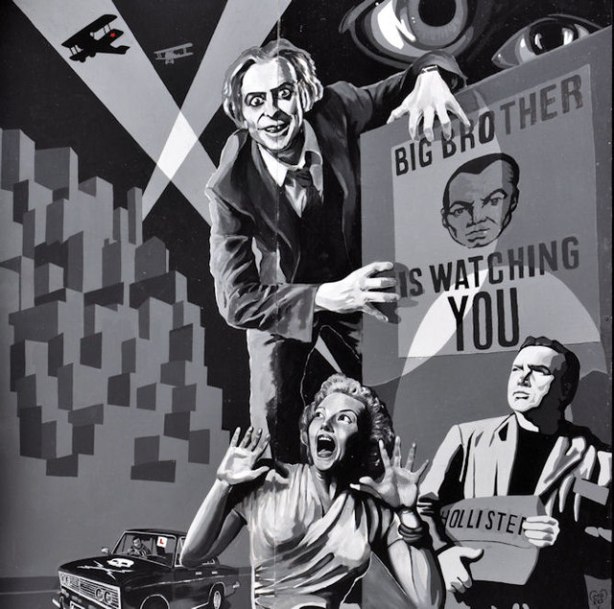
George Orwell understood this. His masterpiece, 1984, portrays a global society of total control in which people are not allowed to have thoughts that in any way disagree with the corporate state. There is no personal freedom, and advanced technology has become the driving force behind a surveillance-driven society. Snitches and cameras are everywhere. And people are subject to the Thought Police, who deal with anyone guilty of thought crimes. The government, or “Party,” is headed by Big Brother, who appears on posters everywhere with the words: “Big Brother is watching you.”

Make no mistake: the Internet of Things is just Big Brother in a more appealing disguise.

Now there are still those who insist that they have nothing to hide from the surveillance state and nothing to fear from the police state because they have done nothing wrong. To those sanctimonious few, secure in their delusions, let this be a warning: the danger posed by the American police state applies equally to all of us, lawbreaker and law-abider alike.

In an age of too many laws, too many prisons, too many government spies, and too many corporations eager to make a fast buck at the expense of the American taxpayer, there is no safe place and no watertight alibi.

We are all guilty of some transgression or other.

Eventually, as I make clear in my book Battlefield America: The War on the American People, we will all be made to suffer the same consequences in the electronic concentration camp that surrounds us.

Source: https://bit.ly/2Me36St

ABOUT JOHN W. WHITEHEAD

Constitutional attorney and author John W. Whitehead is founder and president of The Rutherford Institute. His new book Battlefield America: The War on the American People  is available at www.amazon.com. Whitehead can be contacted at johnw@rutherford.org.

Publication Guidelines / Reprint Permission

John W. Whitehead’s weekly commentaries are available for publication to newspapers and web publications at no charge. Please contact staff@rutherford.org to obtain reprint permission.

 

“No matter who you are, no matter how strong you are, sooner or later, you’ll face circumstances beyond your control.” — Cersei Lannister, Game of Thrones

Those coming of age today will face some of the greatest obstacles ever encountered by young people.

They will find themselves overtaxed, burdened with excessive college debt, and struggling to find worthwhile employment in a debt-ridden economy on the brink of implosion. Their privacy will be eviscerated by the surveillance state. They will be the subjects of a military empire constantly waging war against shadowy enemies and government agents armed to the teeth ready and able to lock down the country at a moment’s notice.

As such, they will find themselves forced to march in lockstep with a government that no longer exists to serve the people but which demands they be obedient slaves or suffer the consequences.

It’s a dismal prospect, isn’t it?

Unfortunately, we who should have known better failed to guard against such a future.

Worse, we neglected to maintain our freedoms or provide our young people with the tools necessary to survive, let alone succeed, in the impersonal jungle that is modern America.

We brought them into homes fractured by divorce, distracted by mindless entertainment, and obsessed with the pursuit of materialism. We institutionalized them in daycares and afterschool programs, substituting time with teachers and childcare workers for parental involvement. We turned them into test-takers instead of thinkers and automatons instead of activists.

We allowed them to languish in schools which not only look like prisons but function like prisons, as well—where conformity is the rule and freedom is the exception. We made them easy prey for our corporate overlords, while instilling in them the values of a celebrity-obsessed, technology-driven culture devoid of any true spirituality. And we taught them to believe that the pursuit of their own personal happiness trumped all other virtues, including any empathy whatsoever for their fellow human beings.

No, we haven’t done this generation any favors.

Based on the current political climate, things could very well get much worse before they ever take a turn for the better. Here are a few pieces of advice that will hopefully help those coming of age today survive the perils of the journey that awaits:

Be an individual. For all of its claims to champion the individual, American culture advocates a stark conformity which, as John F. Kennedy warned, is “the jailer of freedom, and the enemy of growth.” Worry less about fitting in with the rest of the world and instead, as Henry David Thoreau urged, become “a Columbus to whole new continents and worlds within you, opening new channels, not of trade, but of thought.”

Learn your rights. We’re losing our freedoms for one simple reason: most of us don’t know anything about our freedoms. At a minimum, anyone who has graduated from high school, let alone college, should know the Bill of Rights backwards and forwards. However, the average young person, let alone citizen, has very little knowledge of their rights for the simple reason that the schools no longer teach them. So grab a copy of the Constitution and the Bill of Rights, and study them at home. And when the time comes, stand up for your rights before it’s too late.

Speak truth to power. Don’t be naive about those in positions of authority. As James Madison, who wrote our Bill of Rights, observed, “All men having power ought to be distrusted.” We must learn the lessons of history. People in power, more often than not, abuse that power. To maintain our freedoms, this will mean challenging government officials whenever they exceed the bounds of their office.

Resist all things that numb you. Don’t measure your worth by what you own or earn. Likewise, don’t become mindless consumers unaware of the world around you. Resist all things that numb you, put you to sleep or help you “cope” with so-called reality. Those who establish the rules and laws that govern society’s actions desire compliant subjects. However, as George Orwell warned, “Until they become conscious, they will never rebel, and until after they rebelled, they cannot become conscious.” It is these conscious individuals who change the world for the better.

Don’t let technology turn you into zombies. Technology anesthetizes us to the all-too-real tragedies that surround us. Techno-gadgets are merely distractions from what’s really going on in America and around the world. As a result, we’ve begun mimicking the inhuman technology that surrounds us and have lost our humanity. We’ve become sleepwalkers. If you’re going to make a difference in the world, you’re going to have to pull the earbuds out, turn off the cell phones and spend much less time viewing screens.

Help others. We all have a calling in life. And I believe it boils down to one thing: You are here on this planet to help other people. In fact, none of us can exist very long without help from others. If we’re going to see any positive change for freedom, then we must change our view of what it means to be human and regain a sense of what it means to love and help one another. That will mean gaining the courage to stand up for the oppressed.

Give voice to moral outrage. As Martin Luther King Jr. said, “Our lives begin to end the day we become silent about the things that matter.” There is no shortage of issues on which to take a stand. For instance, on any given night, over half a million people in the U.S. are homeless, and half of them are elderly. There are 46 million Americans living at or below the poverty line, and 16 million children living in households without adequate access to food. Congress creates, on average, more than 50 new criminal laws each year. With more than 2 million Americans in prison, and close to 7 million adults in correctional care, the United States has the largest prison population in the world. At least 2.7 million children in the United States have at least one parent in prison. At least 400 to 500 innocent people are killed by police officers every year. Americans are now eight times more likely to die in a police confrontation than they are to be killed by a terrorist. On an average day in America, over 100 Americans have their homes raided by SWAT teams. It costs the American taxpayer $52.6 billion every year to be spied on by the government intelligence agencies tasked with surveillance, data collection, counterintelligence and covert activities. All the while, since 9/11, the U.S. has spent more than $1.6 trillion to wage wars in Afghanistan and Iraq and police the rest of the world. This is an egregious affront to anyone who believes in freedom.

Cultivate spirituality, reject materialism and put people first. When the things that matter most have been subordinated to materialism, we have lost our moral compass. We must change our values to reflect something more meaningful than technology, materialism and politics. Standing at the pulpit of the Riverside Church in New York City in April 1967, Martin Luther King Jr. urged his listeners:

[W]e as a nation must undergo a radical revolution of values. We must rapidly begin the shift from a “thing-oriented” society to a “person-oriented” society. When machines and computers, profit motive and property rights are considered more important than people, the giant triplets of racism, materialism, and militarism are incapable of being conquered.

Pitch in and do your part to make the world a better place. Don’t rely on someone else to do the heavy lifting for you. Don’t wait around for someone else to fix what ails you, your community or nation. As Gandhi urged: “Be the change you wish to see in the world.”

Say no to war. Addressing the graduates at Binghampton Central High School in 1968, at a time when the country was waging war “on different fields, on different levels, and with different weapons,” Twilight Zonecreator Rod Serling declared:

Too many wars are fought almost as if by rote. Too many wars are fought out of sloganry, out of battle hymns, out of aged, musty appeals to patriotism that went out with knighthood and moats. Love your country because it is eminently worthy of your affection. Respect it because it deserves your respect. Be loyal to it because it cannot survive without your loyalty. But do not accept the shedding of blood as a natural function or a prescribed way of history—even if history points this up by its repetition. That men die for causes does not necessarily sanctify that cause. And that men are maimed and torn to pieces every fifteen and twenty years does not immortalize or deify the act of war… find another means that does not come with the killing of your fellow-man.

Finally, prepare yourselves for what lies ahead. The demons of our age—some of whom disguise themselves as politicians—delight in fomenting violence, sowing distrust and prejudice, and persuading the public to support tyranny disguised as patriotism. Overcoming the evils of our age will require more than intellect and activism. It will require decency, morality, goodness, truth and toughness. As Serling concluded in his remarks to the graduating class of 1968:

Toughness is the singular quality most required of you… we have left you a world far more botched than the one that was left to us… Part of your challenge is to seek out truth, to come up with a point of view not dictated to you by anyone, be he a congressman, even a minister… Are you tough enough to take the divisiveness of this land of ours, the fact that everything is polarized, black and white, this or that, absolutely right or absolutely wrong. This is one of the challenges. Be prepared to seek out the middle ground … that wondrous and very difficult-to-find Valhalla where man can look to both sides and see the errant truths that exist on both sides. If you must swing left or you must swing right—respect the other side. Honor the motives that come from the other side. Argue, debate, rebut—but don’t close those wondrous minds of yours to opposition. In their eyes, you’re the opposition. And ultimately … ultimately—you end divisiveness by compromise. And so long as men walk and breathe—there must be compromise…

Are you tough enough to face one of the uglier stains upon the fabric of our democracy—prejudice? It’s the basic root of most evil. It’s a part of the sickness of man. And it’s a part of man’s admission, his constant sick admission, that to exist he must find a scapegoat. To explain away his own deficiencies—he must try to find someone who he believes more deficient… Make your judgment of your fellow-man on what he says and what he believes and the way he acts. Be tough enough, please, to live with prejudice and give battle to it. It warps, it poisons, it distorts and it is self-destructive. It has fallout worse than a bomb … and worst of all it cheapens and demeans anyone who permits himself the luxury of hating.”

As I make clear in my book Battlefield America: The War on the American People, the only way we’ll ever achieve change in this country is for the American people to finally say “enough is enough” and fight for the things that truly matter.

It doesn’t matter how old you are or what your political ideology is. If you have something to say, speak up. Get active, and if need be, pick up a picket sign and get in the streets. And when civil liberties are violated, don’t remain silent about it.

Wake up, stand up, and make your activism count for something more than politics.

Source: https://bit.ly/2HFm92B

ABOUT JOHN W. WHITEHEAD

Constitutional attorney and author John W. Whitehead is founder and president of The Rutherford Institute. His new book Battlefield America: The War on the American People  is available at www.amazon.com. Whitehead can be contacted at johnw@rutherford.org.

Publication Guidelines / Reprint Permission

John W. Whitehead’s weekly commentaries are available for publication to newspapers and web publications at no charge. Please contact staff@rutherford.org to obtain reprint permission.

“The Fourth Amendment was designed to stand between us and arbitrary governmental authority. For all practical purposes, that shield has been shattered, leaving our liberty and personal integrity subject to the whim of every cop on the beat, trooper on the highway and jail official. The framers would be appalled.”—Herman Schwartz, The Nation

We’ve all been there before.

You’re driving along and you see a pair of flashing blue lights in your rearview mirror. Whether or not you’ve done anything wrong, you get a sinking feeling in your stomach.

You’ve read enough news stories, seen enough headlines, and lived in the American police state long enough to be anxious about any encounter with a cop that takes place on the side of the road.

For better or worse, from the moment you’re pulled over, you’re at the mercy of law enforcement officers who have almost absolute discretion to decide who is a threat, what constitutes resistance, and how harshly they can deal with the citizens they were appointed to “serve and protect.”

This is what I call “blank check policing,” in which the police get to call all of the shots.

So if you’re nervous about traffic stops, you have every reason to be.

Trying to predict the outcome of any encounter with the police is a bit like playing Russian roulette: most of the time you will emerge relatively unscathed, although decidedly poorer and less secure about your rights, but there’s always the chance that an encounter will turn deadly.

Try to assert your right to merely ask a question during a traffic stop and see how far it gets you.

Zachary Noel was tasered by police and charged with resisting arrest after he questioned why he was being ordered out of his truck during a traffic stop. “Because I’m telling you to,” the officer replied before repeating his order for Noel to get out of the vehicle and then, without warning, shooting him with a taser through the open window.

Unfortunately, as Gregory Tucker learned the hard way, there are no longer any fail-safe rules of engagement for interacting with the police.

It was in the early morning hours of Dec. 1, 2016, when Tucker, a young African-American man, was pulled over by Louisiana police for a broken taillight. Because he did not feel safe stopping immediately, Tucker drove calmly and slowly to a safe, well-lit area a few minutes away before stopping in front of his cousin’s house.

That’s when what should have been a routine traffic stop became yet another example of police brutality in America and another reason why Americans are justified in their fear of cops.

According to the lawsuit that was filed in federal court by The Rutherford Institute, police ordered Tucker out of his vehicle, and after he had stepped out, immediately placed him under arrest for “resisting” (in this case, not immediately stopping) and searched his person and his vehicle. Tucker was then ordered to move to the front of the police vehicle and place his hands on its hood.

Two more police officers arrived on the scene, walked up behind Tucker, and grabbed his arms to restrain and handcuffed him.

Then the fourth police officer arrived on the scene. According to police dash cam footage, Tucker was thrown to the ground and punched numerous times in the head and body. The police also yelled repeatedly at Tucker to “quit resisting.” Tucker, bleeding with injuries to his face, head and arm, was then placed into the back of a police vehicle and EMTs were called to treat him. He was eventually taken to the hospital for severe injuries to his face and arm.

Mind you, this young man complied with police. He just didn’t do it fast enough to suit their purposes.

This young man submitted to police. He didn’t challenge police authority when they frisked him, searched his car, handcuffed him, and beat him to a pulp.

If this young man is “guilty” of anything, he’s guilty of ticking off the cops by being cautious, concerned for his safety, and all too aware of the dangers faced by young black men during encounters with the police.

Frankly, you don’t even have to be young or black or a man to fear for your life during an encounter with the police.

Just consider the growing numbers of unarmed people are who being shot and killed just for standing a certain way, or moving a certain way, or holding something—anything—that police could misinterpret to be a gun, or igniting some trigger-centric fear in a police officer’s mind that has nothing to do with an actual threat to their safety.

At a time when police can do no wrong—at least in the eyes of the courts, police unions and politicians dependent on their votes—and a “fear” for officer safety is used to justify all manner of police misconduct, “we the people” are at a severe disadvantage.

Add a traffic stop to the mix, and that disadvantage increases dramatically.

According to the Justice Department, the most common reason for a citizen to come into contact with the police is being a driver in a traffic stop.

On average, one in 10 Americans gets pulled over by police.

Black drivers are 31 percent more likely to be pulled over than white drivers, or about 23 percent more likely than Hispanic drivers. As the Washington Post concludes, “‘Driving while black’ is, indeed, a measurable phenomenon.”

Indeed, police officers have been given free range to pull anyone over for a variety of reasons.

This free-handed approach to traffic stops has resulted in drivers being stopped for windows that are too heavily tinted, for driving too fast, driving too slow, failing to maintain speed, following too closely, improper lane changes, distracted driving, screeching a car’s tires, and leaving a parked car door open for too long.

Motorists can also be stopped by police for driving near a bar or on a road that has large amounts of drunk driving, driving a certain make of car (Mercedes, Grand Prix and Hummers are among the most ticketed vehicles), having anything dangling from the rearview mirror (air fresheners, handicap parking permits, troll transponders or rosaries), and displaying pro-police bumper stickers.

Incredibly, a federal appeals court actually ruled unanimously in 2014 that acne scars and driving with a stiff upright posture are reasonable grounds for being pulled over. The Fifth Circuit Court of Appeals ruled that driving a vehicle that has a couple air fresheners, rosaries and pro-police bumper stickers at 2 MPH over the speed limit is suspicious, meriting a traffic stop.

Equally appalling, in Heien v. North Carolina, the U.S. Supreme Court—which has largely paved the way for the police and other government agents to probe, poke, pinch, taser, search, seize, strip and generally manhandle anyone they see fit in almost any circumstance—allowed police officers to stop drivers who appear nervous, provided they provide a palatable pretext for doing so.

Justice Sonia Sotomayor was the lone objector in the case. Dissenting in Heien, Sotomayor warned, “Giving officers license to effect seizures so long as they can attach to their reasonable view of the facts some reasonable legal interpretation (or misinterpretation) that suggests a law has been violated significantly expands this authority… One wonders how a citizen seeking to be law-abiding and to structure his or her behavior to avoid these invasive, frightening, and humiliating encounters could do so.”

In other words, drivers beware.

Traffic stops aren’t just dangerous. They can be downright deadly.

Remember Walter L. Scott? Reportedly pulled over for a broken taillight, Scott—unarmed—ran away from the police officer, who pursued and shot him from behind, first with a Taser, then with a gun. Scott was struck five times, “three times in the back, once in the upper buttocks and once in the ear — with at least one bullet entering his heart.”

Samuel Dubose, also unarmed, was pulled over for a missing front license plate. He was reportedly shot in the head after a brief struggle in which his car began rolling forward.

Levar Jones was stopped for a seatbelt offense, just as he was getting out of his car to enter a convenience store. Directed to show his license, Jones leaned into his car to get his wallet, only to be shot four times by the “fearful” officer. Jones was also unarmed.

Bobby Canipe was pulled over for having an expired registration. When the 70-year-old reached into the back of his truck for his walking cane, the officer fired several shots at him, hitting him once in the abdomen.

Dontrell Stevens was stopped “for not bicycling properly.” The officer pursuing him “thought the way Stephens rode his bike was suspicious. He thought the way Stephens got off his bike was suspicious.” Four seconds later, sheriff’s deputy Adams Lin shot Stephens four times as he pulled out a black object from his waistband. The object was his cell phone. Stephens was unarmed.

Sandra Bland, pulled over for allegedly failing to use her turn signal, was arrested after refusing to comply with the police officer’s order to extinguish her cigarette and exit her vehicle. The encounter escalated, with the officer threatening to “light” Bland up with his taser. Three days later, Bland was found dead in her jail cell. “You’re doing all of this for a failure to signal?” Bland asked as she got out of her car, after having been yelled at and threatened repeatedly.

Keep in mind, from the moment those lights start flashing and that siren goes off, we’re all in the same boat. However, it’s what happens after you’ve been pulled over that’s critical.

Survival is key.

Technically, you have the right to remain silent (beyond the basic requirement to identify yourself and show your registration). You have the right to refuse to have your vehicle searched. You have the right to film your interaction with police. You have the right to ask to leave. You also have the right to resist an unlawful order such as a police officer directing you to extinguish your cigarette, put away your phone or stop recording them.

However, there is a price for asserting one’s rights. That price grows more costly with every passing day.

If you ask cops and their enablers what Americans should do to stay alive during encounters with police, they will tell you to comply, cooperate, obey, not resist, not argue, not make threatening gestures or statements, avoid sudden movements, and submit to a search of their person and belongings.

The problem, of course, is what to do when compliance is not enough.

After all, every day we hear about situations in which unarmed Americans complied and still died during an encounter with police simply because they appeared to be standing in a “shooting stance” or held a cell phone or a garden hose or carried around a baseball bat or answered the front door or held a spoon in a threatening manner or ran in an aggressive manner holding a tree branch or wandered around naked or hunched over in a defensive posture or made the mistake of wearing the same clothes as a carjacking suspect (dark pants and a basketball jersey) or dared to leave an area at the same time that a police officer showed up or had a car break down by the side of the road or were deaf or homeless or old.

Now you can make all kinds of excuses to justify these shootings, and in fact that’s exactly what you’ll hear from politicians, police unions, law enforcement officials and individuals who are more than happy to march in lockstep with the police.

However, to suggest that a good citizen is a compliant citizen and that obedience will save us from the police state is not only recklessly irresponsible, but it is also deluded and out of touch with reality.

To begin with, and most importantly, Americans need to know their rights when it comes to interactions with the police, bearing in mind that many law enforcement officials are largely ignorant of the law themselves.

In a nutshell, the following are your basic rights when it comes to interactions with the police as outlined in the Bill of Rights:

You have the right under the First Amendment to ask questions and express yourself. You have the right under the Fourth Amendment to not have your person or your property searched by police or any government agent unless they have a search warrant authorizing them to do so.  You have the right under the Fifth Amendment to remain silent, to not incriminate yourself and to request an attorney. Depending on which state you live in and whether your encounter with police is consensual as opposed to your being temporarily detained or arrested, you may have the right to refuse to identify yourself. Presently, 26 states do not require citizens to show their ID to an officer (drivers in all states must do so, however).

Knowing your rights is only part of the battle, unfortunately.

As I make clear in my book Battlefield America: The War on the American People, the hard part comes in when you have to exercise those rights in order to hold government officials accountable to respecting those rights.

As a rule of thumb, you should always be sure to clarify in any police encounter whether or not you are being detained, i.e., whether you have the right to walk away. That holds true whether it’s a casual “show your ID” request on a boardwalk, a stop-and-frisk search on a city street, or a traffic stop for speeding or just to check your insurance. If you feel like you can’t walk away from a police encounter of your own volition—and more often than not you can’t, especially when you’re being confronted by someone armed to the hilt with all manner of militarized weaponry and gear—then for all intents and purposes, you’re essentially under arrest from the moment a cop stops you. Still, it doesn’t hurt to clarify that distinction.

While technology is always going to be a double-edged sword, with the gadgets that are the most useful to us in our daily lives—GPS devices, cell phones, the internet—being the very tools used by the government to track us, monitor our activities, and generally spy on us, cell phones are particularly useful for recording encounters with the police and have proven to be increasingly powerful reminders to police that they are not all powerful.

A good resource is The Rutherford Institute’s “Constitutional Q&A: Rules of Engagement for Interacting with Police.”

Clearly, in the American police state, compliance is no guarantee that you will survive an encounter with the police with your life and liberties intact.

So if you’re starting to feel somewhat overwhelmed, intimidated and fearful for your life and the lives of your loved ones, you should be.

Source: https://www.rutherford.org/publications_resources/john_whiteheads_commentary/drivers_beware_the_deadly_perils_of_traffic_stops_in_the_american_police_state

ABOUT JOHN W. WHITEHEAD

Constitutional attorney and author John W. Whitehead is founder and president of The Rutherford Institute. His new book Battlefield America: The War on the American People  is available at www.amazon.com. Whitehead can be contacted at johnw@rutherford.org.

Publication Guidelines / Reprint Permission

John W. Whitehead’s weekly commentaries are available for publication to newspapers and web publications at no charge. Please contact staff@rutherford.org to obtain reprint permission.


“When a population becomes distracted by trivia, when cultural life is redefined as a perpetual round of entertainments, when serious public conversation becomes a form of baby-talk, when, in short, a people become an audience and their public business a vaudeville act, then a nation finds itself at risk; a culture-death is a clear possibility.” — Professor Neil Postman, Amusing Ourselves to Death: Discourse in the Age of Show Business

What characterizes American government today is not so much dysfunctional politics as it is ruthlessly contrived governance carried out behind the entertaining, distracting and disingenuous curtain of political theater. And what political theater it is, diabolically Shakespearean at times, full of sound and fury, yet in the end, signifying nothing.

Played out on the national stage and eagerly broadcast to a captive audience by media sponsors, this farcical exercise in political theater can, at times, seem riveting, life-changing and suspenseful, even for those who know better.

Week after week, the script changes (Donald Trump’s Tweets, Congress’ hearings on Robert Mueller’s Russia probe, the military’s endless war drums, the ever-widening field of candidates for the 2020 presidential race, etc.) with each new script following on the heels of the last, never any let-up, never any relief from the constant melodrama.

The players come and go, the protagonists and antagonists trade places, and the audience members are quick to forget past mistakes and move on to the next spectacle.

All the while, a different kind of drama is unfolding in the dark backstage, hidden from view by the heavy curtain, the elaborate stage sets, colored lights and parading actors.

Such that it is, the realm of political theater with all of its drama, vitriol and scripted theatrics is what passes for “transparent” government today, with elected officials, entrusted to act in the best interests of their constituents, routinely performing for their audiences and playing up to the cameras, while doing very little to move the country forward.

Yet behind the footlights, those who really run the show are putting into place policies which erode our freedoms and undermine our attempts at contributing to the workings of our government, leaving us none the wiser and bereft of any opportunity to voice our discontent or engage in any kind of discourse until it’s too late.

It’s the oldest con game in the books, the magician’s sleight of hand that keeps you focused on the shell game in front of you while your wallet is being picked clean by ruffians in your midst.

Indeed, while mainstream America has been fixated on the drama-filled reality show being televised from the White House, the American Police State has moved steadily forward.

Set against a backdrop of government surveillance, militarized police, SWAT team raids, asset forfeiture, eminent domain, overcriminalization, armed surveillance drones, whole body scanners, stop and frisk searches, roving VIPR raids and the like—all of which have been sanctioned by Congress, the White House and the courts—our constitutional freedoms have been steadily chipped away at, undermined, eroded, whittled down, and generally discarded.

Our losses are mounting with every passing day.

Free speech, the right to protest, the right to challenge government wrongdoing, due process, a presumption of innocence, the right to self-defense, accountability and transparency in government, privacy, press, sovereignty, assembly, bodily integrity, representative government: all of these and more have become casualties in the government’s war on the American people.

The American people have been treated like enemy combatants, to be spied on, tracked, scanned, frisked, searched, subjected to all manner of intrusions, intimidated, invaded, raided, manhandled, censored, silenced, shot at, locked up, and denied due process.

None of these dangers have dissipated.

They have merely disappeared from our televised news streams.

The new boss has proven to be the same as the old boss, and the American people, the permanent underclass in America, has allowed itself to be so distracted and divided that they have failed to notice the building blocks of tyranny being laid down right under their noses by the architects of the Deep State.

Frankly, it really doesn’t matter what you call the old/new boss—the Deep State, the Controllers, the masterminds, the shadow government, the police state, the surveillance state, the military industrial complex—so long as you understand that no matter who occupies the White House, it is a profit-driven, an unelected bureaucracy that is actually calling the shots.

In the interest of liberty and truth, here’s an A-to-Z primer to spell out the grim realities of life in the American Police State that no one is talking about anymore.

A is for the AMERICAN POLICE STATE. A police state “is characterized by bureaucracy, secrecy, perpetual wars, a nation of suspects, militarization, surveillance, widespread police presence, and a citizenry with little recourse against police actions.”

B is for our battered BILL OF RIGHTS. In the cop culture that is America today, where you can be kicked, punched, tasered, shot, intimidated, harassed, stripped, searched, brutalized, terrorized, wrongfully arrested, and even killed by a police officer, and that officer is rarely held accountable for violating your rights, the Bill of Rights doesn’t amount to much.

C is for CIVIL ASSET FORFEITURE. This governmental scheme to deprive Americans of their liberties—namely, the right to property—is being carried out under the guise of civil asset forfeiture, a government practice wherein government agents (usually the police) seize private property they “suspect” may be connected to criminal activity. Then, whether or not any crime is actually proven to have taken place, the government keeps the citizen’s property.

D is for DRONES. It is estimated that at least 30,000 drones will be airborne in American airspace by 2020, part of an $80 billion industry. Although some drones will be used for benevolent purposes, many will also be equipped with lasers, tasers and scanning devices, among other weapons—all aimed at “we the people.”

E is for ELECTRONIC CONCENTRATION CAMP. In the electronic concentration camp, as I have dubbed the surveillance state, all aspects of a person’s life are policed by government agents and all citizens are suspects, their activities monitored and regulated, their movements tracked, their communications spied upon, and their lives, liberties and pursuit of happiness dependent on the government’s say-so.

F is for FASCISM. A study conducted by Princeton and Northwestern University concluded that the U.S. government does not represent the majority of American citizens. Instead, the study found that the government is ruled by the rich and powerful, or the so-called “economic elite.” Moreover, the researchers concluded that policies enacted by this governmental elite nearly always favor special interests and lobbying groups. In other words, we are being ruled by an oligarchy disguised as a democracy, and arguably on our way towards fascism—a form of government where private corporate interests rule, money calls the shots, and the people are seen as mere economic units.

G is for GRENADE LAUNCHERS and GLOBAL POLICE. The federal government has distributed more than $18 billion worth of battlefield-appropriate military weapons, vehicles and equipment such as drones, tanks, and grenade launchers to domestic police departments across the country. As a result, most small-town police forces now have enough firepower to render any citizen resistance futile. Now take those small-town police forces, train them to look and act like the military, and then enlist them to be part of the United Nations’ Strong Cities Network program, and you not only have a standing army that operates beyond the reach of the Constitution but one that is part of a global police force.

H is for HOLLOW-POINT BULLETS. The government’s efforts to militarize and weaponize its agencies and employees is reaching epic proportions, with federal agencies as varied as the Department of Homeland Security and the Social Security Administration stockpiling millions of lethal hollow-point bullets, which violate international law. Ironically, while the government continues to push for stricter gun laws for the general populace, the U.S. military’s arsenal of weapons makes the average American’s handgun look like a Tinker Toy.

I is for the INTERNET OF THINGS, in which internet-connected “things” will monitor your home, your health and your habits in order to keep your pantry stocked, your utilities regulated and your life under control and relatively worry-free. The key word here, however, is control. This “connected” industry propels us closer to a future where police agencies apprehend virtually anyone if the government “thinks” they may commit a crime, driverless cars populate the highways, and a person’s biometrics are constantly scanned and used to track their movements, target them for advertising, and keep them under perpetual surveillance.

J is for JAILING FOR PROFIT. Having outsourced their inmate population to private prisons run by private corporations, this profit-driven form of mass punishment has given rise to a $70 billion private prison industry that relies on the complicity of state governments to keep their privately run prisons full by jailing large numbers of Americans for inane crimes.

K is for KENTUCKY V. KING. In an 8-1 ruling, the Supreme Court ruled that police officers can break into homes, without a warrant, even if it’s the wrong home as long as they think they have a reason to do so. Despite the fact that the police in question ended up pursuing the wrong suspect, invaded the wrong apartment and violated just about every tenet that stands between us and a police state, the Court sanctioned the warrantless raid, leaving Americans with little real protection in the face of all manner of abuses by law enforcement officials.

L is for LICENSE PLATE READERS, which enable law enforcement and private agencies to track the whereabouts of vehicles, and their occupants, all across the country. This data collected on tens of thousands of innocent people is also being shared between police agencies, as well as with fusion centers and private companies. This puts Big Brother in the driver’s seat.

M is for MAIN CORE. Since the 1980s, the U.S. government has acquired and maintained, without warrant or court order, a database of names and information on Americans considered to be threats to the nation. As Salon reports, this database, reportedly dubbed “Main Core,” is to be used by the Army and FEMA in times of national emergency or under martial law to locate and round up Americans seen as threats to national security. As of 2008, there were some 8 million Americans in the Main Core database.

N is for NO-KNOCK RAIDS. Owing to the militarization of the nation’s police forces, SWAT teams are now increasingly being deployed for routine police matters. In fact, more than 80,000 of these paramilitary raids are carried out every year. That translates to more than 200 SWAT team raids every day in which police crash through doors, damage private property, terrorize adults and children alike, kill family pets, assault or shoot anyone that is perceived as threatening—and all in the pursuit of someone merely suspected of a crime, usually possession of some small amount of drugs.

O is for OVERCRIMINALIZATION and OVERREGULATION. Thanks to an overabundance of 4500-plus federal crimes and 400,000 plus rules and regulations, it’s estimated that the average American actually commits three felonies a day without knowing it. As a result of this overcriminalization, we’re seeing an uptick in Americans being arrested and jailed for such absurd “violations” as letting their kids play at a park unsupervised, collecting rainwater and snow runoff on their own property, growing vegetables in their yard, and holding Bible studies in their living room.

P is for PATHOCRACY and PRECRIME. When our own government treats us as things to be manipulated, maneuvered, mined for data, manhandled by police, mistreated, and then jailed in profit-driven private prisons if we dare step out of line, we are no longer operating under a constitutional republic. Instead, what we are experiencing is a pathocracy: tyranny at the hands of a psychopathic government, which “operates against the interests of its own people except for favoring certain groups.” Couple that with the government’s burgeoning precrime programs, which will use fusion centers, data collection agencies, behavioral scientists, corporations, social media, and community organizers and by relying on cutting-edge technology for surveillance, facial recognition, predictive policing, biometrics, and behavioral epigenetics in order to identify and deter so-called potential “extremists,” dissidents or rabble-rousers. Bear in mind that anyone seen as opposing the government—whether they’re Left, Right or somewhere in between—is now viewed as an extremist.

Q is for QUALIFIED IMMUNITY. Qualified immunity allows officers to walk away without paying a dime for their wrongdoing. Conveniently, those deciding whether a police officer should be immune from having to personally pay for misbehavior on the job all belong to the same system, all cronies with a vested interest in protecting the police and their infamous code of silence: city and county attorneys, police commissioners, city councils and judges.

R is for ROADSIDE STRIP SEARCHES and BLOOD DRAWS. The courts have increasingly erred on the side of giving government officials—especially the police—vast discretion in carrying out strip searches, blood draws and even anal probes for a broad range of violations, no matter how minor the offense. In the past, strip searches were resorted to only in exceptional circumstances where police were confident that a serious crime was in progress. In recent years, however, strip searches have become routine operating procedures in which everyone is rendered a suspect and, as such, is subjected to treatment once reserved for only the most serious of criminals.

S is for the SURVEILLANCE STATE. On any given day, the average American going about his daily business will be monitored, surveilled, spied on and tracked in more than 20 different ways, by both government and corporate eyes and ears. A byproduct of this new age in which we live, whether you’re walking through a store, driving your car, checking email, or talking to friends and family on the phone, you can be sure that some government agency, whether the NSA or some other entity, is listening in and tracking your behavior. This doesn’t even begin to touch on the corporate trackers that monitor your purchases, web browsing, Facebook posts and other activities taking place in the cyber sphere.

T is for TASERS. Nonlethal weapons such as tasers, stun guns, rubber pellets and the like have been used by police as weapons of compliance more often and with less restraint—even against women and children—and in some instances, even causing death. These “nonlethal” weapons also enable police to aggress with the push of a button, making the potential for overblown confrontations over minor incidents that much more likely. A Taser Shockwave, for instance, can electrocute a crowd of people at the touch of a button.

U is for UNARMED CITIZENS SHOT BY POLICE. No longer is it unusual to hear about incidents in which police shoot unarmed individuals first and ask questions later, often attributed to a fear for their safety. Yet the fatality rate of on-duty patrol officers is reportedly far lower than many other professions, including construction, logging, fishing, truck driving, and even trash collection.

V is for VIPR SQUADS. So-called “soft target” security inspections, carried out by roving VIPR task forces, comprised of federal air marshals, surface transportation security inspectors, transportation security officers, behavior detection officers and explosive detection canine teams, are taking place whenever and wherever the government deems appropriate, at random times and places, and without needing the justification of a particular threat.

W is for WHOLE-BODY SCANNERS. Using either x-ray radiation or radio waves, scanning devices and government mobile units are being used not only to “see” through your clothes but to spy on you within the privacy of your home. While these mobile scanners are being sold to the American public as necessary security and safety measures, we can ill afford to forget that such systems are rife with the potential for abuse, not only by government bureaucrats but by the technicians employed to operate them.

X is for X-KEYSCORE, one of the many spying programs carried out by the National Security Agency that targets every person in the United States who uses a computer or phone. This top-secret program “allows analysts to search with no prior authorization through vast databases containing emails, online chats and the browsing histories of millions of individuals.”

Y is for YOU-NESS. Using your face, mannerisms, social media and “you-ness” against you, you can now be tracked based on what you buy, where you go, what you do in public, and how you do what you do. Facial recognition software promises to create a society in which every individual who steps out into public is tracked and recorded as they go about their daily business. The goal is for government agents to be able to scan a crowd of people and instantaneously identify all of the individuals present. Facial recognition programs are being rolled out in states all across the country.

Z is for ZERO TOLERANCE. We have moved into a new paradigm in which young people are increasingly viewed as suspects and treated as criminals by school officials and law enforcement alike, often for engaging in little more than childish behavior. In some jurisdictions, students have also been penalized under school zero tolerance policies for such inane “crimes” as carrying cough drops, wearing black lipstick, bringing nail clippers to school, using Listerine or Scope, and carrying fold-out combs that resemble switchblades. The lesson being taught to our youngest—and most impressionable—citizens is this: in the American police state, you’re either a prisoner (shackled, controlled, monitored, ordered about, limited in what you can do and say, your life not your own) or a prison bureaucrat (politician, police officer, judge, jailer, spy, profiteer, etc.).

As I make clear in my book Battlefield America: The War on the American People, the reality we must come to terms with is that in the post-9/11 America we live in today, the government does whatever it wants, freedom be damned.

We have moved beyond the era of representative government and entered a new age.

You can call it the age of authoritarianism. Or fascism. Or oligarchy. Or the American police state.

Whatever label you want to put on it, the end result is the same: tyranny.

WC: 3042

Original: https://www.rutherford.org/publications_resources/john_whiteheads_commentary/d_is_for_dictatorship_while_america_feuds_the_police_state_shifts_into_high_gear
ABOUT JOHN W. WHITEHEAD

Constitutional attorney and author John W. Whitehead is founder and president of The Rutherford Institute. His new book Battlefield America: The War on the American People  is available at www.amazon.com. Whitehead can be contacted at johnw@rutherford.org.

Publication Guidelines / Reprint Permission

John W. Whitehead’s weekly commentaries are available for publication to newspapers and web publications at no charge. Please contact staff@rutherford.org to obtain reprint permission.


“In a time of universal deceit, telling the truth is a revolutionary act.” — George Orwell

When exposing a crime is treated as committing a crime, you are being ruled by criminals.

In the current governmental climate, where laws that run counter to the dictates of the Constitution are made in secret, passed without debate, and upheld by secret courts that operate behind closed doors, obeying one’s conscience and speaking truth to the power of the police state can render you an “enemy of the state.”

That list of so-called “enemies of the state” is growing.

Wikileaks founder Julian Assange is merely the latest victim of the police state’s assault on dissidents and whistleblowers.

On April 11, 2019, police arrested Assange for daring to access and disclose military documents that portray the U.S. government and its endless wars abroad as reckless, irresponsible, immoral and responsible for thousands of civilian deaths.

Included among the leaked materials was gunsight video footage from two U.S. AH-64 Apache helicopters engaged in a series of air-to-ground attacks while American air crew laughed at some of the casualties. Among the casualties were two Reuters correspondents who were gunned down after their cameras were mistaken for weapons and a driver who stopped to help one of the journalists. The driver’s two children, who happened to be in the van at the time it was fired upon by U.S. forces, suffered serious injuries.

There is nothing defensible about crimes such as these perpetrated by the government.

When any government becomes almost indistinguishable from the evil it claims to be fighting—whether that evil takes the form of war, terrorism, torture, drug trafficking, sex trafficking, murder, violence, theft, pornography, scientific experimentations or some other diabolical means of inflicting pain, suffering and servitude on humanity—that government has lost its claim to legitimacy.

These are hard words, but hard times require straight-talking.

It is easy to remain silent in the face of evil.

What is harder—what we lack today and so desperately need—are those with moral courage who will risk their freedoms and lives in order to speak out against evil in its many forms.

Throughout history, individuals or groups of individuals have risen up to challenge the injustices of their age. Nazi Germany had its Dietrich Bonhoeffer. The gulags of the Soviet Union were challenged by Aleksandr Solzhenitsyn. America had its color-coded system of racial segregation and warmongering called out for what it was, blatant discrimination and profiteering, by Martin Luther King Jr.

And then there was Jesus Christ, an itinerant preacher and revolutionary activist, who not only died challenging the police state of his day—namely, the Roman Empire—but provided a blueprint for civil disobedience that would be followed by those, religious and otherwise, who came after him.

Indeed, it is fitting that we remember that Jesus Christ—the religious figure worshipped by Christians for his death on the cross and subsequent resurrection—paid the ultimate price for speaking out against the police state of his day.

A radical nonconformist who challenged authority at every turn, Jesus was a far cry from the watered-down, corporatized, simplified, gentrified, sissified vision of a meek creature holding a lamb that most modern churches peddle. In fact, he spent his adult life speaking truth to power, challenging the status quo of his day, and pushing back against the abuses of the Roman Empire.

Much like the American Empire today, the Roman Empire of Jesus’ day had all of the characteristics of a police state: secrecy, surveillance, a widespread police presence, a citizenry treated like suspects with little recourse against the police state, perpetual wars, a military empire, martial law, and political retribution against those who dared to challenge the power of the state.

For all the accolades poured out upon Jesus, little is said about the harsh realities of the police state in which he lived and its similarities to modern-day America, and yet they are striking.

Secrecy, surveillance and rule by the elite. As the chasm between the wealthy and poor grew wider in the Roman Empire, the ruling class and the wealthy class became synonymous, while the lower classes, increasingly deprived of their political freedoms, grew disinterested in the government and easily distracted by “bread and circuses.” Much like America today, with its lack of government transparency, overt domestic surveillance, and rule by the rich, the inner workings of the Roman Empire were shrouded in secrecy, while its leaders were constantly on the watch for any potential threats to its power. The resulting state-wide surveillance was primarily carried out by the military, which acted as investigators, enforcers, torturers, policemen, executioners and jailers. Today that role is fulfilled by the NSA, the FBI, the Department of Homeland Security and the increasingly militarized police forces across the country.

Widespread police presence. The Roman Empire used its military forces to maintain the “peace,” thereby establishing a police state that reached into all aspects of a citizen’s life. In this way, these military officers, used to address a broad range of routine problems and conflicts, enforced the will of the state. Today SWAT teams, comprised of local police and federal agents, are employed to carry out routine search warrants for minor crimes such as marijuana possession and credit card fraud.

Citizenry with little recourse against the police state. As the Roman Empire expanded, personal freedom and independence nearly vanished, as did any real sense of local governance and national consciousness. Similarly, in America today, citizens largely feel powerless, voiceless and unrepresented in the face of a power-hungry federal government. As states and localities are brought under direct control by federal agencies and regulations, a sense of learned helplessness grips the nation.

Perpetual wars and a military empire. Much like America today with its practice of policing the world, war and an over-arching militarist ethos provided the framework for the Roman Empire, which extended from the Italian peninsula to all over Southern, Western, and Eastern Europe, extending into North Africa and Western Asia as well. In addition to significant foreign threats, wars were waged against inchoate, unstructured and socially inferior foes.

Martial law. Eventually, Rome established a permanent military dictatorship that left the citizens at the mercy of an unreachable and oppressive totalitarian regime. In the absence of resources to establish civic police forces, the Romans relied increasingly on the military to intervene in all matters of conflict or upheaval in provinces, from small-scale scuffles to large-scale revolts. Not unlike police forces today, with their martial law training drills on American soil, militarized weapons and “shoot first, ask questions later” mindset, the Roman soldier had “the exercise of lethal force at his fingertips” with the potential of wreaking havoc on normal citizens’ lives.

A nation of suspects. Just as the American Empire looks upon its citizens as suspects to be tracked, surveilled and controlled, the Roman Empire looked upon all potential insubordinates, from the common thief to a full-fledged insurrectionist, as threats to its power. The insurrectionist was seen as directly challenging the Emperor.  A “bandit,” or revolutionist, was seen as capable of overturning the empire, was always considered guilty and deserving of the most savage penalties, including capital punishment. Bandits were usually punished publicly and cruelly as a means of deterring others from challenging the power of the state.  Jesus’ execution was one such public punishment.

Acts of civil disobedience by insurrectionists. Much like the Roman Empire, the American Empire has exhibited zero tolerance for dissidents such as Julian Assange, Edward Snowden and Chelsea Manningwho exposed the police state’s seedy underbelly. Jesus branded himself a political revolutionary starting with his act of civil disobedience at the Jewish temple, the site of the administrative headquarters of the Sanhedrin, the supreme Jewish council. When Jesus “with the help of his disciples, blocks the entrance to the courtyard” and forbids “anyone carrying goods for sale or trade from entering the Temple,” he committed a blatantly criminal and seditious act, an act “that undoubtedly precipitated his arrest and execution.” Because the commercial events were sponsored by the religious hierarchy, which in turn was operated by consent of the Roman government, Jesus’ attack on the money chargers and traders can be seen as an attack on Rome itself, an unmistakable declaration of political and social independence from the Roman oppression.

Military-style arrests in the dead of night. Jesus’ arrest account testifies to the fact that the Romans perceived Him as a revolutionary. Eerily similar to today’s SWAT team raids, Jesus was arrested in the middle of the night, in secret, by a large, heavily armed fleet of soldiers.  Rather than merely asking for Jesus when they came to arrest him, his pursuers collaborated beforehand with Judas. Acting as a government informant, Judas concocted a kiss as a secret identification marker, hinting that a level of deception and trickery must be used to obtain this seemingly “dangerous revolutionist’s” cooperation.

Torture and capital punishment. In Jesus’ day, religious preachers, self-proclaimed prophets and nonviolent protesters were not summarily arrested and executed. Indeed, the high priests and Roman governors normally allowed a protest, particularly a small-scale one, to run its course. However, government authorities were quick to dispose of leaders and movements that appeared to threaten the Roman Empire. The charges leveled against Jesus—that he was a threat to the stability of the nation, opposed paying Roman taxes and claimed to be the rightful King—were purely political, not religious. To the Romans, any one of these charges was enough to merit death by crucifixion, which was usually reserved for slaves, non-Romans, radicals, revolutionaries and the worst criminals.
Jesus was presented to Pontius Pilate “as a disturber of the political peace,” a leader of a rebellion, a political threat, and most gravely—a claimant to kingship, a “king of the revolutionary type.” After Jesus is formally condemned by Pilate, he is sentenced to death by crucifixion, “the Roman means of executing criminals convicted of high treason.”  The purpose of crucifixion was not so much to kill the criminal, as it was an immensely public statement intended to visually warn all those who would challenge the power of the Roman Empire. Hence, it was reserved solely for the most extreme political crimes: treason, rebellion, sedition, and banditry. After being ruthlessly whipped and mocked, Jesus was nailed to a cross.

As Professor Mark Lewis Taylor observed:

The cross within Roman politics and culture was a marker of shame, of being a criminal. If you were put to the cross, you were marked as shameful, as criminal, but especially as subversive. And there were thousands of people put to the cross. The cross was actually positioned at many crossroads, and, as New Testament scholar Paula Fredricksen has reminded us, it served as kind of a public service announcement that said, “Act like this person did, and this is how you will end up.”

Jesus—the revolutionary, the political dissident, and the nonviolent activist—lived and died in a police state. Any reflection on Jesus’ life and death within a police state must take into account several factors: Jesus spoke out strongly against such things as empires, controlling people, state violence and power politics. Jesus challenged the political and religious belief systems of his day. And worldly powers feared Jesus, not because he challenged them for control of thrones or government but because he undercut their claims of supremacy, and he dared to speak truth to power in a time when doing so could—and often did—cost a person his life.

Unfortunately, the radical Jesus, the political dissident who took aim at injustice and oppression, has been largely forgotten today, replaced by a congenial, smiling Jesus trotted out for religious holidays but otherwise rendered mute when it comes to matters of war, power and politics.

Yet for those who truly study the life and teachings of Jesus, the resounding theme is one of outright resistance to war, materialism and empire.

What a marked contrast to the advice being given to Americans by church leaders to “submit to your leaders and those in authority,” which in the American police state translates to complying, conforming, submitting, obeying orders, deferring to authority and generally doing whatever a government official tells you to do.

Telling Americans to march in lockstep and blindly obey the government—or put their faith in politics and vote for a political savior—flies in the face of everything for which Jesus lived and died.

Ultimately, this is the contradiction that must be resolved if the radical Jesus—the one who stood up to the Roman Empire and was crucified as a warning to others not to challenge the powers-that-be—is to be an example for our modern age.

As I make clear in my book Battlefield America: The War on the American People, we must decide whether we will follow the path of least resistance—willing to turn a blind eye to what Martin Luther King Jr. referred to as the “evils of segregation and the crippling effects of discrimination, to the moral degeneracy of religious bigotry and the corroding effects of narrow sectarianism, to economic conditions that deprive men of work and food, and to the insanities of militarism and the self-defeating effects of physical violence”—or whether we will be transformed nonconformists “dedicated to justice, peace, and brotherhood.”

As King explained in a powerful sermon delivered in 1954, “This command not to conform comes … [from] Jesus Christ, the world’s most dedicated nonconformist, whose ethical nonconformity still challenges the conscience of mankind.”

We need to recapture the gospel glow of the early Christians, who were nonconformists in the truest sense of the word and refused to shape their witness according to the mundane patterns of the world.  Willingly they sacrificed fame, fortune, and life itself in behalf of a cause they knew to be right.  Quantitatively small, they were qualitatively giants.  Their powerful gospel put an end to such barbaric evils as infanticide and bloody gladiatorial contests.  Finally, they captured the Roman Empire for Jesus Christ… The hope of a secure and livable world lies with disciplined nonconformists, who are dedicated to justice, peace, and brotherhood.  The trailblazers in human, academic, scientific, and religious freedom have always been nonconformists.  In any cause that concerns the progress of mankind, put your faith in the nonconformist!

…Honesty impels me to admit that transformed nonconformity, which is always costly and never altogether comfortable, may mean walking through the valley of the shadow of suffering, losing a job, or having a six-year-old daughter ask, “Daddy, why do you have to go to jail so much?”  But we are gravely mistaken to think that Christianity protects us from the pain and agony of mortal existence.  Christianity has always insisted that the cross we bear precedes the crown we wear.  To be a Christian, one must take up his cross, with all of its difficulties and agonizing and tragedy-packed content, and carry it until that very cross leaves its marks upon us and redeems us to that more excellent way that comes only through suffering.

In these days of worldwide confusion, there is a dire need for men and women who will courageously do battle for truth.  We must make a choice. Will we continue to march to the drumbeat of conformity and respectability, or will we, listening to the beat of a more distant drum, move to its echoing sounds?  Will we march only to the music of time, or will we, risking criticism and abuse, march to the soul saving music of eternity?

WC: 2590

Source: https://bit.ly/2IlLdOR
ABOUT JOHN W. WHITEHEAD

Constitutional attorney and author John W. Whitehead is founder and president of The Rutherford Institute. His new book Battlefield America: The War on the American People  (SelectBooks, 2015) is available online at http://www.amazon.com. Whitehead can be contacted at johnw@rutherford.org.

Publication Guidelines / Reprint Permission

John W. Whitehead’s weekly commentaries are available for publication to newspapers and web publications at no charge. Please contact staff@rutherford.org to obtain reprint permission.


If you drive a car, I’ll tax the street,
If you try to sit, I’ll tax your seat.
If you get too cold I’ll tax the heat,
If you take a walk, I’ll tax your feet.

Don’t ask me what I want it for
If you don’t want to pay some more
‘Cause I’m the taxman, yeah, I’m the taxman…
And you’re working for no one but me.
— George Harrison, “Taxman”

We’re not living the American Dream. We’re in the grip of a financial nightmare.

“We the people” have become the new, permanent underclass in America.

We get taxed on how much we earn, taxed on what we eat, taxed on what we buy, taxed on where we go, taxed on what we drive, and taxed on how much is left of our assets when we die, and yet we have no real say in how the government runs, or how our taxpayer funds are used.

Case in point: Lawmakers across the country have been acting as fronts for corporations, sponsoring more than 10,000 model laws written by corporations, industry groups and think tanks such as the American Legislative Exchange Council.

Make no mistake: this is fascism disguised as legislative expediency.

As a recent investigative report by USA TODAY, The Arizona Republic and the Center for Public Integrity points out, these copycat bills have been used to “override the will of local voters” and advance the agendas of the corporate state. “Disguised as the work of lawmakers, these so-called ‘model’ bills get copied in one state Capitol after another, quietly advancing the agenda of the people who write them.”

In this way, laws that promise to protect the public “actually bolster the corporate bottom line.”

For example, “The Asbestos Transparency Act didn’t help people exposed to asbestos. It was written by corporations who wanted to make it harder for victims to recoup money. The ‘HOPE Act,’ introduced in nine states, was written by a conservative advocacy group to make it more difficult for people to get food stamps.”

Talk about Orwellian.

So we have no real say in how the government runs, or how our taxpayer funds are used, but that doesn’t prevent the government from fleecing us at every turn.

This is true whether you’re talking about taxpayers being forced to fund high-priced weaponry that will be used against us, endless wars that do little for our safety or our freedoms, or bloated government agencies such as the National Security Agency with its secret budgets, covert agendas and clandestine activities. Even monetary awards in lawsuits against government officials who are found guilty of wrongdoing are paid by the taxpayer.

We’re being forced to pay for endless wars that do more to fund the military industrial complex than protect us, for misguided pork barrel projects that do little to enhance our lives, and for the trappings of a police state that serves only to imprison us within its walls.

All the while the government continues to do whatever it likes—levy taxes, rack up debt, spend outrageously and irresponsibly—with little thought for the plight of its citizens.

We’re being played as easy marks by hustlers bearing the imprimatur of the government.

Truly, if there is an absolute maxim by which the federal government seems to operate, it is that the taxpayers—who fuel the nation’s economy and fund the government’s programs—always get ripped off.

Examples abound of wasteful government spending.

$28 million for a camouflage pattern for the Afghan National Army’s uniforms that had to be discarded because it clashes with the desert; $80 million to corral wild horses that would fare better unpenned; $5 million for a study to conclude that fraternity and sorority members drink more than their peers; and more than $1 billion worth of small arms, mortars, Humvees, and other equipment that has gone “missing” in Iraq.

If Americans managed their personal finances the way the government mismanages the nation’s finances, we’d all be in debtors’ prison by now.

Still, the government remains unrepentant, unfazed and undeterred in its money grabs.

Because the government’s voracious appetite for money, power and control has grown out of control, its agents have devised other means of funding its excesses and adding to its largesse through taxes disguised as fines, taxes disguised as fees, and taxes disguised as tolls, tickets and penalties.

With every new tax, fine, fee and law adopted by our so-called representatives, the yoke around the neck of the average American seems to tighten just a little bit more.

Everywhere you go, everything you do, and every which way you look, we’re getting swindled, cheated, conned, robbed, raided, pickpocketed, mugged, deceived, defrauded, double-crossed and fleeced by governmental and corporate shareholders of the American police state out to make a profit at taxpayer expense.

The overt and costly signs of the despotism exercised by the increasingly authoritarian regime that passes itself off as the United States government are all around us: warrantless surveillance of Americans’ private phone and email conversations by the NSA; SWAT team raids of Americans’ homes; shootings of unarmed citizens by police; harsh punishments meted out to schoolchildren in the name of zero tolerance; armed drones taking to the skies domestically; endless wars; out-of-control spending; militarized police; roadside strip searches; roving TSA sweeps; privatized prisons with a profit incentive for jailing Americans; fusion centers that collect and disseminate data on Americans’ private transactions; and militarized agencies such as the IRS, Dept. of Education, the Smithsonian and others with stockpiles of ammunition, to name some of the most appalling.

Meanwhile, the three branches of government (Executive, Legislative and Judicial) and the agencies under their command—Defense, Commerce, Education, Homeland Security, Justice, Treasury, etc.—have switched their allegiance to the Corporate State with its unassailable pursuit of profit at all costs and by any means possible.

We are now ruled by a government consumed with squeezing every last penny out of the population and seemingly unconcerned if essential freedoms are trampled in the process.

While we’re struggling to get by, and making tough decisions about how to spend what little money actually makes it into our pockets after the federal, state and local governments take their share (this doesn’t include the stealth taxes imposed through tolls, fines and other fiscal penalties), the police state is spending our hard-earned tax dollars to further entrench its powers and entrap its citizens.

If you want to know the real motives behind the government’s agenda, follow the money trail.

When you dig down far enough, you quickly find that those who profit from Americans being surveilled, fined, scanned, searched, probed, tasered, arrested and imprisoned are none other than the police who arrest them, the courts which try them, the prisons which incarcerate them, and the corporations, which manufacture the weapons, equipment and prisons used by the American police state.

It gets worse.

Americans have also been made to pay through the nose for the government’s endless wars, subsidization of foreign nations, military empire, welfare state, roads to nowhere, bloated workforce, secret agencies, fusion centers, private prisons, biometric databases, invasive technologies, arsenal of weapons, and every other budgetary line item that is contributing to the fast-growing wealth of the corporate elite at the expense of those who are barely making ends meet—that is, we the taxpayers.

Those football stadiums that charge exorbitant sums for nosebleed seats? Our taxpayer dollars subsidize them.

Those blockbuster war films? Yep, we were the silent investors on those, too.

This isn’t freedom.

You’re not free if the government can seize your home and your car (which you’ve bought and paid for) over nonpayment of taxes.

You’re not free if government agents can freeze and seize your bank accounts and other valuables if they merely “suspect” wrongdoing.

And you’re certainly not free if the IRS gets the first cut of your salary to pay for government programs over which you have no say.

If you have no choice, no voice, and no real options when it comes to the government’s claims on your property and your money, you’re not free.

As former Congressman Ron Paul observed, “The Founding Fathers never intended a nation where citizens would pay nearly half of everything they earn to the government.”

Unfortunately, somewhere over the course of the past 240-plus years, democracy has given way to kleptocracy (a government ruled by thieves), and representative government has been rejected in favor of a kakistocracy (a government run by the most unprincipled citizens that panders to the worst vices in our nature: greed, violence, hatred, prejudice and war) ruled by career politicians, corporations and thieves—individuals and entities with little regard for the rights of American citizens.

The American kleptocracy continues to suck the American people down a rabbit hole into a parallel universe in which the Constitution is meaningless, the government is all-powerful, and the citizenry is powerless to defend itself against government agents who steal, spy, lie, plunder, kill, abuse and generally inflict mayhem and sow madness on everyone and everything in their sphere.

This dissolution of that sacred covenant between the citizenry and the government—establishing “we the people” as the masters and the government as the servant—didn’t happen overnight.

It didn’t happen because of one particular incident or one particular president.

It has been a process, one that began long ago and continues in the present day, aided and abetted by politicians who have mastered the polarizing art of how to “divide and conquer.”

By playing on our prejudices about those who differ from us, capitalizing on our fears for our safety, and deepening our distrust of those fellow citizens whose opinions run counter to our own, the powers-that-be have effectively divided us into polarized, warring camps incapable of finding consensus on the one true menace that is an immediate threat to all of our freedoms: the U.S. government.

We are now the subjects of a militarized, corporate empire in which the vast majority of the citizenry work their hands to the bone for the benefit of a privileged few.

Adding injury to the ongoing insult of having our tax dollars misused and our so-called representatives bought and paid for by the moneyed elite, the government then turns around and uses the money we earn with our blood, sweat and tears to target, imprison and entrap us.

All of those nefarious government deeds that you read about in the paper every day: those are your tax dollars at work.

So what are you going to do about it?

There was a time in our history when our forebears said “enough is enough” and stopped paying their taxes to what they considered an illegitimate government. They stood their ground and refused to support a system that was slowly choking out any attempts at self-governance, and which refused to be held accountable for its crimes against the people. Their resistance sowed the seeds for the revolution that would follow.

Unfortunately, in the 200-plus years since we established our own government, we’ve let bankers, turncoats and number-crunching bureaucrats muddy the waters and pilfer the accounts to such an extent that we’re back where we started.

Once again, we’ve got a despotic regime with an imperial ruler doing as they please.

Once again, we’ve got a judicial system insisting we have no rights under a government which demands that the people march in lockstep with its dictates.

And once again, we’ve got to decide whether we’ll keep marching or break stride and make a turn toward freedom.

But what if we didn’t just pull out our pocketbooks and pony up to the federal government’s outrageous demands for more money?

What if we didn’t just dutifully line up to drop our hard-earned dollars into the collection bucket, no questions asked about how it will be spent?

What if, instead of quietly sending in our tax checks, hoping vainly for some meager return, we did a little calculating of our own and started deducting from our taxes those programs that we refuse to support?

As I make clear in my book Battlefield America: The War on the American People, if we don’t have the right to decide what happens to our hard-earned cash, then we don’t have any rights at all.

After all, the government isn’t taking our money to make our lives better.

We’re being robbed blind so the governmental elite can get richer.

This is nothing less than financial tyranny.

WC: 2069

Source: https://rutherford.org/publications_resources/john_whiteheads_commentary/financial_tyranny_america_has_become_a_pay_to_play_exercise_in_fascism
ABOUT JOHN W. WHITEHEAD

Constitutional attorney and author John W. Whitehead is founder and president of The Rutherford Institute. His book Battlefield America: The War on the American People is available online at http://www.amazon.com. Whitehead can be contacted at johnw@rutherford.org.

Publication Guidelines / Reprint Permission

John W. Whitehead’s weekly commentaries are available for publication to newspapers and web publications at no charge. Please contact staff@rutherford.org to obtain reprint permission.


“But these weren’t the kind of monsters that had tentacles and rotting skin, the kind a seven-year-old might be able to wrap his mind around—they were monsters with human faces, in crisp uniforms, marching in lockstep, so banal you don’t recognize them for what they are until it’s too late.” — Ransom Riggs, Miss Peregrine’s Home for Peculiar Children

The U.S. government, in its pursuit of so-called monsters, has itself become a monster.

This is not a new development, nor is it a revelation.

This is a government that has in recent decades unleashed untold horrors upon the world—including its own citizenry—in the name of global conquest, the acquisition of greater wealth, scientific experimentation, and technological advances, all packaged in the guise of the greater good.

Mind you, there is no greater good when the government is involved. There is only greater greed for money and power.

Unfortunately, the public has become so easily distracted by the political spectacle coming out of Washington, DC, that they are altogether oblivious to the grisly experiments, barbaric behavior and inhumane conditions that have become synonymous with the U.S. government.

These horrors are being meted out against humans and animals alike.

It’s heartbreaking enough when you hear about police shooting family dogs that pose no threat—beloved pets that are “guilty” of little more than barking, or wagging a tag, or racing towards them in greeting—at an alarming rate somewhere in the vicinity of 500 dogs a day.

What I’m about to share goes beyond heartbreaking to horrifying.

For instance, did you know that the U.S. government has been buying hundreds of dogs and cats from “Asian meat markets” as part of a gruesome experiment into food-borne illnesses? The cannibalistic experiments involve killing cats and dogs purchased from Colombia, Brazil, Vietnam, China and Ethiopia, and then feeding the dead remains to laboratory kittens, bred in government laboratories for the express purpose of being infected with a disease and then killed.

It gets more gruesome.

The Department of Veterans Affairs has been removing parts of dogs’ brains to see how it affects their breathing; applying electrodes to dogs’ spinal cords (before and after severing them) to see how it impacts their cough reflexes; and implanting pacemakers in dogs’ hearts and then inducing them to have heart attacks (before draining their blood). All of the laboratory dogs are killed during the course of these experiments.

It’s not just animals that are being treated like lab rats by government agencies.

“We the people” have also become the police state’s guinea pigs: to be caged, branded, experimented upon without our knowledge or consent, and then conveniently discarded and left to suffer from the after-effects.

Back in 2017, FEMA “inadvertently” exposed nearly 10,000 firefighters, paramedics and other responders to a deadly form of ricin during simulated bioterrorism response sessions. In 2015, it was discovered that an Army lab had been “mistakenly” shipping deadly anthrax to labs and defense contractors for a decade.

While these particular incidents have been dismissed as “accidents,” you don’t have to dig very deep or go very back in the nation’s history to uncover numerous cases in which the government deliberately conducted secret experiments on an unsuspecting populace—citizens and noncitizens alike—making healthy people sick by spraying them with chemicals, injecting them with infectious diseases and exposing them to airborne toxins.

At the time, the government reasoned that it was legitimate to experiment on people who did not have full rights in society such as prisoners, mental patients, and poor blacks.

In Alabama, for example, 600 black men with syphilis were allowed to suffer without proper medical treatment in order to study the natural progression of untreated syphilis. In California, older prisoners had testicles from livestock and from recently executed convicts implanted in them to test their virility. In Connecticut, mental patients were injected with hepatitis.

In Maryland, sleeping prisoners had a pandemic flu virus sprayed up their noses. In Georgia, two dozen “volunteering” prison inmates had gonorrhea bacteria pumped directly into their urinary tracts through the penis. In Michigan, male patients at an insane asylum were exposed to the flu after first being injected with an experimental flu vaccine. In Minnesota, 11 public service employee “volunteers” were injected with malaria, then starved for five days.

In New York, dying patients had cancer cells introduced into their systems. In Ohio, over 100 inmates were injected with live cancer cells. Also in New York, prisoners at a reformatory prison were also split into two groups to determine how a deadly stomach virus was spread: the first group was made to swallow an unfiltered stool suspension, while the second group merely breathed in germs sprayed into the air. And in Staten Island, children with mental retardation were given hepatitis orally and by injection to see if they could then be cured.

As the Associated Press reports, “The late 1940s and 1950s saw huge growth in the U.S. pharmaceutical and health care industries, accompanied by a boom in prisoner experiments funded by both the government and corporations. By the 1960s, at least half the states allowed prisoners to be used as medical guinea pigs … because they were cheaper than chimpanzees.”

Moreover, “Some of these studies, mostly from the 1940s to the ’60s, apparently were never covered by news media. Others were reported at the time, but the focus was on the promise of enduring new cures, while glossing over how test subjects were treated.”

Media blackouts, propaganda, spin. Sound familiar?

How many government incursions into our freedoms have been blacked out, buried under “entertainment” news headlines, or spun in such a way as to suggest that anyone voicing a word of caution is paranoid or conspiratorial?

Unfortunately, these incidents are just the tip of the iceberg when it comes to the atrocities the government has inflicted on an unsuspecting populace in the name of secret experimentation.

For instance, there was the U.S. military’s secret race-based testing of mustard gas on more than 60,000 enlisted men. As NPR reports, “All of the World War II experiments with mustard gas were done in secret and weren’t recorded on the subjects’ official military records. Most do not have proof of what they went through. They received no follow-up health care or monitoring of any kind. And they were sworn to secrecy about the tests under threat of dishonorable discharge and military prison time, leaving some unable to receive adequate medical treatment for their injuries, because they couldn’t tell doctors what happened to them.”

And then there was the CIA’s MKULTRA program in which hundreds of unsuspecting American civilians and military personnel were dosed with LSD, some having the hallucinogenic drug slipped into their drinks at the beach, in city bars, at restaurants. As Time reports, “before the documentation and other facts of the program were made public, those who talked of it were frequently dismissed as being psychotic.”

Now one might argue that this is all ancient history and that the government today is different from the government of yesteryear, but has the U.S. government really changed?

Has the government become any more humane, any more respectful of the rights of the citizenry?

Has it become any more transparent or willing to abide by the rule of law? Has it become any more truthful about its activities? Has it become any more cognizant of its appointed role as a guardian of our rights?

Or has the government simply hunkered down and hidden its nefarious acts and dastardly experiments under layers of secrecy, legalism and obfuscations? Has it not become wilier, more slippery, more difficult to pin down?

Having mastered the Orwellian art of Doublespeak and followed the Huxleyan blueprint for distraction and diversion, are we not dealing with a government that is simply craftier and more conniving that it used to be?

Consider this: after revelations about the government’s experiments spanning the 20th century spawned outrage, the government began looking for human guinea pigs in other countries, where “clinical trials could be done more cheaply and with fewer rules.”

In Guatemala, prisoners and patients at a mental hospital were infected with syphilis, “apparently to test whether penicillin could prevent some sexually transmitted disease.” In Uganda, U.S.-funded doctors “failed to give the AIDS drug AZT to all the HIV-infected pregnant women in a study… even though it would have protected their newborns.” Meanwhile, in Nigeria, children with meningitis were used to test an antibiotic named Trovan. Eleven children died and many others were left disabled.

The more things change, the more they stay the same.

Case in point: back in 2016, it was announced that scientists working for the Department of Homeland Security would begin releasing various gases and particles on crowded subway platforms as part of an experiment aimed at testing bioterror airflow in New York subways.

The government insisted that the gases released into the subways by the DHS were nontoxic and did not pose a health risk. It’s in our best interests, they said, to understand how quickly a chemical or biological terrorist attack might spread. And look how cool the technology is—said the government cheerleaders—that scientists can use something called DNATrax to track the movement of microscopic substances in air and food. (Imagine the kinds of surveillance that could be carried out by the government using trackable airborne microscopic substances you breathe in or ingest.)

Mind you, this is the same government that in 1949 sprayed bacteria into the Pentagon’s air handling system, then the world’s largest office building. In 1950, special ops forces sprayed bacteria from Navy ships off the coast of Norfolk and San Francisco, in the latter case exposing all of the city’s 800,000 residents.

In 1953, government operatives staged “mock” anthrax attacks on St. Louis, Minneapolis, and Winnipegusing generators placed on top of cars. Local governments were reportedly told that “‘invisible smokescreen[s]’ were being deployed to mask the city on enemy radar.” Later experiments covered territory as wide-ranging as Ohio to Texas and Michigan to Kansas.

In 1965, the government’s experiments in bioterror took aim at Washington’s National Airport, followed by a 1966 experiment in which army scientists exposed a million subway NYC passengers to airborne bacteria that causes food poisoning.

And this is the same government that has taken every bit of technology sold to us as being in our best interests—GPS devices, surveillance, nonlethal weapons, etc.—and used it against us, to track, control and trap us.

So, no, I don’t think the government’s ethics have changed much over the years. It’s just taken its nefarious programs undercover.

The question remains: why is the government doing this? The answer is always the same: money, power and total domination.

It’s the same answer no matter which totalitarian regime is in power.

The mindset driving these programs has, appropriately, been likened to that of Nazi doctors experimenting on Jews. As the Holocaust Museum recounts, Nazi physicians “conducted painful and often deadly experiments on thousands of concentration camp prisoners without their consent.”

The Nazi’s unethical experiments ran the gamut from freezing experiments using prisoners to find an effective treatment for hypothermia, tests to determine the maximum altitude for parachuting out of a plane, injecting prisoners with malaria, typhus, tuberculosis, typhoid fever, yellow fever, and infectious hepatitis, exposing prisoners to phosgene and mustard gas, and mass sterilization experiments.

The horrors being meted out against the American people can be traced back, in a direct line, to the horrors meted out in Nazi laboratories. In fact, following the second World War, the U.S. government recruited many of Hitler’s employees, adopted his protocols, embraced his mindset about law and order and experimentation, and implemented his tactics in incremental steps.

Sounds far-fetched, you say? Read on. It’s all documented.

As historian Robert Gellately recounts, the Nazi police state was initially so admired for its efficiency and order by the world powers of the day that J. Edgar Hoover, then-head of the FBI, actually sent one of his right-hand men, Edmund Patrick Coffey, to Berlin in January 1938 at the invitation of Germany’s secret police, the Gestapo.

The FBI was so impressed with the Nazi regime that, according to the New York Times, in the decades after World War II, the FBI, along with other government agencies, aggressively recruited at least a thousand Nazis, including some of Hitler’s highest henchmen.

All told, thousands of Nazi collaborators—including the head of a Nazi concentration camp, among others—were given secret visas and brought to America by way of Project Paperclip. Subsequently, they were hired on as spies, informants and scientific advisers, and then camouflaged to ensure that their true identities and ties to Hitler’s holocaust machine would remain unknown. All the while, thousands of Jewish refugees were refused entry visas to the U.S. on the grounds that it could threaten national security.

Adding further insult to injury, American taxpayers have been paying to keep these ex-Nazis on the U.S. government’s payroll ever since. And in true Gestapo fashion, anyone who has dared to blow the whistle on the FBI’s illicit Nazi ties has found himself spied upon, intimidated, harassed and labeled a threat to national security.

As if the government’s covert, taxpayer-funded employment of Nazis after World War II wasn’t bad enough, U.S. government agencies—the FBI, CIA and the military—have since fully embraced many of the Nazi’s well-honed policing tactics, and have used them repeatedly against American citizens.

It’s certainly easy to denounce the full-frontal horrors carried out by the scientific and medical community within a despotic regime such as Nazi Germany, but what do you do when it’s your own government that claims to be a champion of human rights all the while allowing its agents to engage in the foulest, bases and most despicable acts of torture, abuse and experimentation?

When all is said and done, this is not a government that has our best interests at heart.

This is not a government that values us.

Perhaps the answer lies in The Third Man, Carol Reed’s influential 1949 film starring Joseph Cotten and Orson Welles. In the film, set in a post-WW II Vienna, rogue war profiteer Harry Lime has come to view human carnage with a callous indifference, unconcerned that the diluted penicillin he’s been trafficking underground has resulted in the tortured deaths of young children.

Challenged by his old friend Holly Martins to consider the consequences of his actions, Lime responds, “In these days, old man, nobody thinks in terms of human beings. Governments don’t, so why should we?

“Have you ever seen any of your victims?” asks Martins.

“Victims?” responds Limes, as he looks down from the top of a Ferris wheel onto a populace reduced to mere dots on the ground. “Look down there. Tell me. Would you really feel any pity if one of those dots stopped moving forever? If I offered you twenty thousand pounds for every dot that stopped, would you really, old man, tell me to keep my money, or would you calculate how many dots you could afford to spare? Free of income tax, old man. Free of income tax — the only way you can save money nowadays.”

As I make clear in my book Battlefield America: The War on the American People, this is how the U.S. government sees us, too, when it looks down upon us from its lofty perch.

To the powers-that-be, the rest of us are insignificant specks, faceless dots on the ground.

To the architects of the American police state, we are not worthy or vested with inherent rights. This is how the government can justify treating us like economic units to be bought and sold and traded, or caged rats to be experimented upon and discarded when we’ve outgrown our usefulness.

To those who call the shots in the halls of government, “we the people” are merely the means to an end.

“We the people”—who think, who reason, who take a stand, who resist, who demand to be treated with dignity and care, who believe in freedom and justice for all—have become obsolete, undervalued citizens of a totalitarian state that, in the words of Rod Serling, “has patterned itself after every dictator who has ever planted the ripping imprint of a boot on the pages of history since the beginning of time. It has refinements, technological advances, and a more sophisticated approach to the destruction of human freedom.”

In this sense, we are all Romney Wordsworth, the condemned man in Serling’s Twilight Zone episode “The Obsolete Man.”

The Obsolete Man” speaks to the dangers of a government that views people as expendable once they have outgrown their usefulness to the State. Yet—and here’s the kicker—this is where the government through its monstrous inhumanity also becomes obsolete. As Serling noted in his original script for “The Obsolete Man,” “Any state, any entity, any ideology which fails to recognize the worth, the dignity, the rights of Man…that state is obsolete.

How do you defeat a monster? You start by recognizing the monster for what it is.

WC: 2845

Source: https://rutherford.org/publications_resources/john_whiteheads_commentary/the_making_of_a_monster_were_all_lab_rats_in_the_governments_secret_experiments
ABOUT JOHN W. WHITEHEAD

Constitutional attorney and author John W. Whitehead is founder and president of The Rutherford Institute. His new book Battlefield America: The War on the American People is available online at http://www.amazon.com. Whitehead can be contacted at johnw@rutherford.org.

Publication Guidelines / Reprint Permission

John W. Whitehead’s weekly commentaries are available for publication to newspapers and web publications at no charge. Please contact staff@rutherford.org to obtain reprint permission.


The freedom of individuals verbally to oppose or challenge police action without thereby risking arrest is one of the principal characteristics by which we distinguish a free nation from a police state.”— Justice William J. Brennan, City of Houston v. Hill

What the architects of the police state want are submissive, compliant, cooperative, obedient, meek citizens who don’t talk back, don’t challenge government authority, don’t speak out against government misconduct, and don’t step out of line.

What the First Amendment protects—and a healthy constitutional republic requires—are citizens who routinely exercise their right to speak truth to power.

It’s not an easy undertaking.

Weaponized by police, prosecutors, courts and legislatures, “disorderly conduct” charges have become a convenient means by which to punish those individuals who refuse to be muzzled.

Cases like these have become all too common, typical of the bipolar nature of life in the American police state today: you may have distinct, protected rights on paper, but dare to exercise those rights and you put yourself at risk for fines, arrests, injuries and even death.

This is the unfortunate price of freedom.

Yet these are not new developments.

We have been circling this particular drain hole for some time now.

Almost 50 years ago, in fact, Lewis Colten was arrested outside Lexington, Kentucky, for questioning police and offering advice to his friend during a traffic stop.

Colten was one of 20 or so college students who had driven to the Blue Grass Airport to demonstrate against then-First Lady Pat Nixon. Upon leaving the airport, police stopped one of the cars in Colten’s motorcade because it bore an expired, out-of-state license plate. Colten and the other drivers also pulled over to the side of the road.

Fearing violence on the part of the police, Colten exited his vehicle and stood nearby while police issued his friend, Mendez, a ticket and arranged to tow his car. Police repeatedly asked Colten to leave. At one point, a state trooper declared, “This is none of your affair . . . get back in your car and please move on and clear the road.”

Insisting that he wanted to make a transportation arrangement for his friend Mendez and the occupants of the Mendez car, Colten failed to move away and was arrested for violating Kentucky’s disorderly conduct statute.

Colten subsequently challenged his arrest as a violation of his First Amendment right to free speech and took the case all the way to the U.S. Supreme Court, which sided with the police.

Although the Court acknowledged that Colten was not trespassing or disobeying any traffic regulation himself, the majority affirmed that Colten “had no constitutional right to observe the issuance of a traffic ticket or to engage the issuing officer in conversation at that time.”

The Supreme Court’s bottom line: protecting police from inconvenience, annoyance or alarm is more important than protecting speech that, in the government’s estimation, has “no social value.”

While the ruling itself was unsurprising for a judiciary that tends to march in lockstep with the police, the dissent by Justice William O. Douglas is a powerful reminder that the government exists to serve the people and not the other way around.

Stressing that Colten’s speech was quiet, not boisterous, devoid of “fighting words,” and involved no overt acts, fisticuffs, or disorderly conduct in the normal meaning of the words, Douglas took issue with the idea that merely by speaking to a government representative, in this case the police—a right enshrined in the First Amendment, by the way—Colten was perceived as inconveniencing and annoying the police.

In a passionate defense of free speech, Douglas declared:

Since when have we Americans been expected to bow submissively to authority and speak with awe and reverence to those who represent us? The constitutional theory is that we the people are the sovereigns, the state and federal officials only our agents. We who have the final word can speak softly or angrily. We can seek to challenge and annoy, as we need not stay docile and quiet. The situation might have indicated that Colten’s techniques were ill-suited to the mission he was on, that diplomacy would have been more effective. But at the constitutional level speech need not be a sedative; it can be disruptive.

It’s a power-packed paragraph full of important truths that the powers-that-be would prefer we quickly forget: We the people are the sovereigns. We have the final word. We can speak softly or angrily. We can seek to challenge and annoy. We need not stay docile and quiet. Our speech can be disruptive. It can invite dispute. It can be provocative and challenging. We do not have to bow submissively to authority or speak with reverence to government officials.

Now in theory, “we the people” have a constitutional right to talk back to the government.

In fact, the U.S. Supreme Court concluded as much in City of Houston v. Hill when it struck down a city ordinance prohibiting verbal abuse of police officers as unconstitutionally overbroad and a criminalization of protected speech.

In practice, however, talking back—especially when the police are involved—can get you killed.

The danger is real.

We live in an age in which “we the people” are at the mercy of militarized, weaponized, immunized cops who have almost absolute discretion to decide who is a threat, what constitutes resistance, and how harshly they can deal with the citizens they were appointed to “serve and protect.”

While violent crime in America remains at an all-time low, the death toll as a result of police-sponsored violence continues to rise. In fact, more than 1,000 people are killed every year by police in America, more than any other country in the world.

What we are dealing with is a nationwide epidemic of court-sanctioned police violence carried out against individuals posing little or no real threat.

I’m not talking about the number of individuals—especially young people—who are being shot and killed by police for having a look-alike gun in their possession, such as a BB gun. I’m not even talking about people who have been shot for brandishing weapons at police, such as scissors.

I’m talking about the growing numbers of unarmed people are who being shot and killed for just standing a certain way, or looking a certain way, or moving a certain way, or not moving fast enough, or asking a question, or not answering a question, or holding something—anything—that police could misinterpret to be a gun, or igniting some trigger-centric fear in a police officer’s mind that has nothing to do with an actual threat to their safety.

This is not what life should be like in a so-called “free” country.

Police encounters have deteriorated so far that anything short of compliance—including behavior the police perceive as disrespectful or “insufficiently deferential to their authority,” “threatening” or resistant—could get you arrested, jailed or killed.

The problem, of course, is that compliance is rarely enough to guarantee one’s safety.

Case in point: Miami-Dade police slammed a 14-year-old boy to the ground, putting him in a chokehold and handcuffing him after he allegedly gave them “dehumanizing stares” and walked away from them, which the officers found unacceptable.

According to Miami-Dade Police Detective Alvaro Zabaleta, “His body language was that he was stiffening up and pulling away… When you have somebody resistant to them and pulling away and somebody clenching their fists and flailing their arms, that’s a threat. Of course we have to neutralize the threat.

This mindset that any challenge to police authority is a threat that needs to be “neutralized” is a dangerous one that is part of a greater nationwide trend that sets the police beyond the reach of the First and Fourth Amendments.

When police officers are allowed to operate under the assumption that their word is law and that there is no room for any form of disagreement or even question, that serves to destroy the First Amendment’s assurances of free speech, free assembly and the right to petition the government for a redress of grievances.

Then again, this is what happens when you take a police recruit, hype him (or her) up on the power of the gun in his holster and the superiority of his uniform, render him woefully ignorant of how to handle a situation without resorting to violence, drill him in military tactics but keep him in the dark about the Constitution, and never stress to him that he is to be a peacemaker and a peacekeeper, respectful of and subservient to the taxpayers, who are in fact his masters and employers.

The problem, as one reporter rightly concluded, is “not that life has gotten that much more dangerous, it’s that authorities have chosen to respond to even innocent situations as if they were in a warzone.”

What we’re dealing with today is a skewed shoot-to-kill mindset in which police, trained to view themselves as warriors or soldiers in a war, whether against drugs, or terror, or crime, must “get” the bad guys—i.e., anyone who is a potential target—before the bad guys get them.

Never mind that the fatality rate of on-duty police officers is reportedly far lower than many other professions, including construction, logging, fishing, truck driving, and even trash collection.

The result of this battlefield approach to domestic peacekeeping is a society in which police shoot first and ask questions later.

The message being drummed into our heads with every police shooting of an unarmed citizen is this: if you don’t want to get probed, poked, pinched, tasered, tackled, searched, seized, stripped, manhandled, arrested, shot, or killed, don’t say, do or even suggest anything that even hints of noncompliance.

This is the “thin blue line” over which you must not cross in interactions with police if you want to walk away with your life and freedoms intact.

If ever there were a time to scale back on the mindset adopted by cops that they are the law and should be revered, feared and obeyed, it’s now.

It doesn’t matter where you live—big city or small town—it’s the same scenario being played out over and over again in which government agents, hyped up on their own authority and the power of their uniform, ride roughshod over the rights of the citizenry.

Americans as young as 4 years old are being leg shackledhandcuffedtasered and held at gun point for not being quiet, not being orderly and just being childlike—i.e., not being compliant enough.

Americans as old as 95 are being beaten, shot and killed for questioning an order, hesitating in the face of a directive, and mistaking a policeman crashing through their door for a criminal breaking into their home—i.e., not being submissive enough.

And Americans of every age and skin color are being taught the painful lesson that the only truly compliant, submissive and obedient citizen in a police state is a dead one.

As a result, Americans are being brainwashed into believing that anyone who wears a government uniform—soldier, police officer, prison guard—must be obeyed without question.

Of course, the Constitution takes a far different position, but does anyone in the government even read, let alone abide by, the Constitution anymore?

If we just cower before government agents and meekly obey, we may find ourselves following in the footsteps of those nations that eventually fell to tyranny.

The alternative involves standing up and speaking truth to power. Jesus Christ walked that road. So did Mahatma Gandhi, Martin Luther King Jr., and countless other freedom fighters whose actions changed the course of history.

As I make clear in my book Battlefield America: The War on the American People, the American dream was built on the idea that no one is above the law, that our rights are inalienable and cannot be taken away, and that our government and its appointed agents exist to serve us.

It may be that things are too far gone to save, but still we must try.

WC: 2215

ABOUT JOHN W. WHITEHEAD

Constitutional attorney and author John W. Whitehead is founder and president of The Rutherford Institute. His book Battlefield America: The War on the American People  is available online at http://www.amazon.com. Whitehead can be contacted at johnw@rutherford.org.

Publication Guidelines / Reprint Permission

John W. Whitehead’s weekly commentaries are available for publication to newspapers and web publications at no charge. Please contact staff@rutherford.org to obtain reprint permission.


“As we express our gratitude, we must never forget that the highest appreciation is not to utter words, but to live by them.”—John F. Kennedy

Listen: I know it’s been a hard, heart-wrenching, stomach-churning kind of year.

It’s been a year of hotheads and blowhards and killing sprees and bloodshed and takedowns.

It’s been a year in which tyranny took a few more steps forward and freedom got knocked down a few more notches.

It’s been a year with an abundance of bad news and a shortage of good news.

It’s been a year of too much hate and too little kindness.

It’s been a year in which politics and profit margins took precedence over decency, compassion and human-kindness.

We’ve been operating in this soul-sucking, topsy-turvy, inside-out, upside-down state for so long that it’s hard not to be overwhelmed by all that is wrong in the world in order to reflect and give thanks for what is good.

And now we find ourselves at this present moment, more than 200 years after George Washington issued the first Thanksgiving proclamation as a time to give thanks for a government whose purpose was to ensure the safety and happiness of its people and for a Constitution designed to safeguard civil and religious liberty.

But how do you give thanks for freedoms that are constantly being eroded?

How do you express gratitude for one’s safety when the perils posed by the American police state grow more treacherous by the day?

How do you come together as a nation in thanksgiving when the powers-that-be continue to polarize and divide us into warring factions?

Washington didn’t intend Thanksgiving to be a day for offering up glib platitudes that require no thought, no effort and no sacrifice. He wanted it to be a day of contemplation, in which we frankly assessed our shortcomings, acknowledged our wrongdoings, and resolved to be a better, more peaceable nation in the year to come.

Here’s what I know: this Thanksgiving finds us saddled with a government that is a far cry from Washington’s vision of a government that is:

  • governed by wise, just and constitutional laws
  • faithfully executed and obeyed by its agents
  • assisting foreign nations with good government, peace, and concord
  • promoting true religion, virtue and science
  • and enabling temporal prosperity.

Rather, with every passing day, the U.S. government more closely resembles an evil empire, governed by laws that are rash, unjust and unconstitutional; policed by government agents who are corrupt, hypocritical and abusive; a menace to its own people; and the antithesis of everything Washington hoped the government would be—a blessing to all the people.

Here’s a prime example of how out of whack things have become: just recently, government officials in Kansas City confiscated large quantities of food being served to homeless people and soaked them in bleach, rendering them inedible.

Why would the government poison food intended for the homeless?

According to city health officials, the soup kitchen providing the free food didn’t have sufficient permits to prepare and serve food, even if that food was being handed out for free.

The government’s rationale: it’s better to allow the homeless to starve than risk them getting sick from a food-borne illness since many have no health insurance.

There are people in this country who are homeless, hungry and in need of any small act of kindness, so why is the government placing bureaucratic roadblocks in the path of those who want to help?

I’m sorry, but this isn’t just misguided government officials run amok.

This is evil disguised as bureaucracy.

This is what Hannah Arendt referred to as the banality of evil.

Evil has a broad spectrum, and poisoning food for the homeless is by no means as monstrous as killing innocent people, but still… evil is evil.

This is what happens when the government is run by bureaucrats who unquestioningly carry out orders that are immoral, inhumane and evil; obey immoral instructions unthinkingly; march in lockstep with tyrants; mindlessly perpetuate acts of terror and inhumanity; and justify it all as just “doing one’s job.”

To that list, let me add one more: a populace that remains silent in the face of wrongdoing.

This is how evil prevails: when good men and women do nothing.

By doing nothing, by remaining silent, by being bystanders to injustice, hate and wrongdoing, good people become as guilty as the perpetrator.

There’s a term for this phenomenon where people stand by, watch and do nothing—even when there is no risk to their safety—while some horrific act takes place (someone is mugged or raped or bullied or left to die): it’s called the bystander effect.

It works the same whether you’re talking about kids watching bullies torment a fellow student on a playground, bystanders watching someone dying on a sidewalk, or citizens remaining silent in the face of government atrocities.

The stories are legion.

For example, there was the 15-year-old girl who was gang raped in a schoolyard during a homecoming dance. As many as 20 people witnessed the assault over the course of two and a half hours. No one intervened to stop it.

A 28-year-old woman was stabbed, raped and murdered outside her apartment early in the morning. Thirty-eight bystanders witnessed the attack and failed to intervene. The woman died from her wounds at the locked doorway to her apartment building.

A 58-year-old man waded into chest-deep water in the San Francisco Bay in an apparent suicide attempt. For an hour, Raymond Zack stood in the shallow water while 75 onlookers watched. Police and firefighters were called in but failed to intervene, citing budget cuts, a lack of training in water rescue, fear for their safety and a lack of proper equipment. The man eventually passed out and later died of hypothermia. Eventually, an onlooker volunteered to bring the body back to the beach.

A homeless man intervened to save a woman from a knife-wielding attacker. He saved the woman but was stabbed repeatedly in the process. As The Guardian reports, “For more than an hour he lay dying in a pool of his own blood as dozens walked by. Some paused to stare, others leaned in close. One even shook his body and then left, while someone else recorded a video of the entire proceeding.”

We need to stop being silent bystanders.

So what can you do about this bystander effect?

Be a hero, suggests psychologist Philip Zimbardo.

Each of us has an inner hero we can draw upon in an emergency,” Zimbardo concluded. “If you think there is even a possibility that someone needs help, act on it. You may save a life. You are the modern version of the Good Samaritan that makes the world a better place for all of us.”

Zimbardo is the psychologist who carried out the Stanford Prison Experiment which studied the impact of perceived power and authority on middleclass students who were assigned to act as prisoners and prison guards. The experiment revealed that power does indeed corrupt (the appointed guards became increasingly abusive), and those who were relegated to being prisoners acted increasingly “submissive and depersonalized, taking the abuse and saying little in protest.”

What is the antidote to group think and the bystander effect?

Be an individual. Listen to your inner voice. Take responsibility.

“If you find yourself in an ambiguous situation, resist the urge to look to others and go with your gut instinct,” advises Melissa Burkley in Psychology Today. “If you think there is even a possibility that someone is in need, act on it. At worst, you will embarrass yourself for a few minutes, but at best, you will save a life.”

“Even if people recognize that they are witnessing a crime, they may still fail to intervene if they do not take personal responsibility for helping the victim,” writes Burkley. “The problem is that the more bystanders there are, the less responsible each individual feels.”

In other words, recognize injustice.

Don’t turn away from suffering.

Refuse to remain silent. Take a stand. Speak up. Speak out.

This is what Zimbardo refers to as “the power of one.”

All it takes is one person breaking away from the fold to change the dynamics of a situation. “Once any one helps, then in seconds others will join in because a new social norm emerges: Do Something Helpful.”

The Good Samaritans of this world don’t always get recognized, but they’re doing their part to push back against the darkness.

For instance, a few years ago in Florida, a family of six—four adults and two young boys—were swept out to sea by a powerful rip current in Panama City Beach. There was no lifeguard on duty. The police were standing by, waiting for a rescue boat. And the few people who had tried to help ended up stranded, as well.

Those on shore grouped together and formed a human chain. What started with five volunteers grew to 15, then 80 people, some of whom couldn’t swim.

One by one, they linked hands and stretched as far as their chain would go. The strongest of the volunteers swam out beyond the chain and began passing the stranded victims of the rip current down the chain.

One by one, they rescued those in trouble and pulled each other in.

There’s a moral here for what needs to happen in this country if we only can band together and prevail against the riptides that threaten to overwhelm us.

So here’s what I suggest.

Instead of just giving thanks this holiday season with words that are too soon forgotten, why not put your gratitude into action with deeds that spread a little kindness, lighten someone’s burden, and brighten some dark corner?

Pay your blessings forward in whatever way makes sense to you.

This is something that everyone can do no matter how tight our budgets or how crowded our schedules.

Engage in acts of kindness. Smile more. Fight less. Build bridges. Refuse to toxic politics define your relationships. Focus on the things that unite instead of that which divides. Be a hero, whether or not anyone ever notices.

Do your part to push back against the meanness of our culture with conscious compassion and humanity. Moods are contagious, the good and the bad. They can be passed from person to person. So can the actions associated with those moods, the good and the bad.

Even holding the door for someone or giving up your seat on a crowded train are acts of benevolence that, magnified by other such acts, can spark a movement.

Volunteer at a soup kitchen or donate to a charity that does good work. Take part in local food drives. Take a meal to a needy family. “Adopt” an elderly person at a nursing home. Support the creation of local homeless shelters in your community. Urge your churches, synagogues and mosques to act as rotating thermal shelters for the homeless during the cold winter months.

In other words, help those in need.

I know that fixing what’s wrong with this country is not going to happen overnight.

As I make clear in my book Battlefield America: The War on the American People, there may not be much we can do to avoid the dismal reality of the police state in the long term—not so long as the powers-that-be continue to call the shots and allow profit margins to take precedence over the needs of people—but in the short term, there are things we can all do right now to make this world (or at least our small corners of it) a little bit kinder, a lot less hostile and more just.

On a larger scale, we need to stop being silent bystanders to our nation’s downfall.

Historically, this bystander syndrome in which people remain silent and disengaged—mere onlookers—in the face of abject horrors and injustice has resulted in whole populations being conditioned to tolerate unspoken cruelty toward their fellow human beings: the crucifixion and slaughter of innocents by the Romans, the torture of the Inquisition, the atrocities of the Nazis, the butchery of the Fascists, the bloodshed by the Communists, and the cold-blooded war machines run by the military industrial complex.

“I swore never to be silent whenever and wherever human beings endure suffering and humiliation,” stated Holocaust Elie Wiesel in his Nobel Peace Prize acceptance speech in 1986. “We must always take sides. Neutrality helps the oppressor, never the victim. Silence encourages the tormentor, never the tormented. Sometimes we must interfere. When human lives are endangered, when human dignity is in jeopardy, national borders and sensitivities become irrelevant. Wherever men or women are persecuted because of their race, religion, or political views, that place must – at that moment – become the center of the universe.”

It’s never too late to start making things right in the world.

So this year, don’t just give thanks at Thanksgiving.

Pay your blessings forward.

WC: 2160

ABOUT JOHN W. WHITEHEAD

Constitutional attorney and author John W. Whitehead is founder and president of The Rutherford Institute. His new book Battlefield America: The War on the American People  (SelectBooks, 2015) is available online at http://www.amazon.com. Whitehead can be contacted at johnw@rutherford.org.

Publication Guidelines / Reprint Permission

John W. Whitehead’s weekly commentaries are available for publication to newspapers and web publications at no charge. Please contact staff@rutherford.org to obtain reprint permission.


veteran-1807121_1280

For soldiers serving in Afghanistan and Iraq, coming home is more lethal than being in combat.” ― Brené Brown, research professor at the University of Houston

Not all heroes wear the uniform of war.

In the United States, however, we take particular pride in recognizing as heroes those who have served in the military.

Yet while we honor our veterans with holidays, parades, discounts at retail stores and restaurants, and endless political rhetoric about their sacrifice and bravery, we do a pitiful job of respecting their freedoms and caring for their needs once out of uniform.

Despite the fact that the U.S. boasts more than 20 million veterans who have served in World War II through the present day, the plight of veterans today is America’s badge of shame, with large numbers of veterans impoverished, unemployed, traumatized mentally and physically, struggling with depression, suicide, and marital stress, homeless, subjected to sub-par treatment at clinics and hospitals, and left to molder while their paperwork piles up within Veterans Administration offices.

Still, the government’s efforts to wage war on veterans, especially those who speak out against government wrongdoing, is downright appalling.

Consider: we raise our young people on a steady diet of militarism and war, sell them on the idea that defending freedom abroad by serving in the military is their patriotic duty, then when they return home, bruised and battle-scarred and committed to defending their freedoms at home, we often treat them like criminals merely for having served in the military.

The government even has a name for its war on America’s veterans: Operation Vigilant Eagle.

As first reported by the Wall Street Journal, this Department of Homeland Security (DHS) program tracks military veterans returning from Iraq and Afghanistan and characterizes them as extremists and potential domestic terrorist threats because they may be “disgruntled, disillusioned or suffering from the psychological effects of war.”

Coupled with the DHS’ dual reports on Rightwing and Leftwing “Extremism,” which broadly define extremists as individuals, military veterans and groups “that are mainly antigovernment, rejecting federal authority in favor of state or local authority, or rejecting government authority entirely,” these tactics bode ill for anyone seen as opposing the government.

Yet the government is not merely targeting individuals who are voicing their discontent so much as it is taking aim at individuals trained in military warfare.

Don’t be fooled by the fact that the DHS has gone extremely quiet about Operation Vigilant Eagle.

Where there’s smoke, there’s bound to be fire.

And the government’s efforts to target military veterans whose views may be perceived as “anti-government” make clear that something is afoot.

In recent years, military servicemen and women have found themselves increasingly targeted for surveillance, censorship, threatened with incarceration or involuntary commitment, labeled as extremists and/or mentally ill, and stripped of their Second Amendment rights.

An important point to consider, however, is that under the guise of mental health treatment and with the complicity of government psychiatrists and law enforcement officials, these veterans are increasingly being portrayed as threats to national security.

This is not the first time that psychiatry has been used to exile political prisoners.

Many times throughout history in totalitarian regimes, such governments have declared dissidents mentally ill and unfit for society as a means of rendering them disempowering them.

As Pulitzer Prize-winning author Anne Applebaum observes in Gulag: A History: “The exile of prisoners to a distant place, where they can ‘pay their debt to society,’ make themselves useful, and not contaminate others with their ideas or their criminal acts, is a practice as old as civilization itself. The rulers of ancient Rome and Greece sent their dissidents off to distant colonies. Socrates chose death over the torment of exile from Athens. The poet Ovid was exiled to a fetid port on the Black Sea.”

For example, government officials in the Cold War-era Soviet Union often used psychiatric hospitals as prisons in order to isolate political prisoners from the rest of society, discredit their ideas, and break them physically and mentally through the use of electric shocks, drugs and various medical procedures.

Insisting that “ideas about a struggle for truth and justice are formed by personalities with a paranoid structure,” the psychiatric community actually went so far as to provide the government with a diagnosis suitable for locking up such freedom-oriented activists.

In addition to declaring political dissidents mentally unsound, Russian officials also made use of an administrative process for dealing with individuals who were considered a bad influence on others or troublemakers.

Author George Kennan describes a process in which:

The obnoxious person may not be guilty of any crime . . . but if, in the opinion of the local authorities, his presence in a particular place is “prejudicial to public order” or “incompatible with public tranquility,” he may be arrested without warrant, may be held from two weeks to two years in prison, and may then be removed by force to any other place within the limits of the empire and there be put under police surveillance for a period of from one to ten years. Administrative exile–which required no trial and no sentencing procedure–was an ideal punishment not only for troublemakers as such, but also for political opponents of the regime.

Sound familiar?

This age-old practice by which despotic regimes eliminate their critics or potential adversaries by declaring them mentally ill and locking them up in psychiatric wards for extended periods of time is a common practice in present-day China.

What is particularly unnerving, however, is how this practice of eliminating or undermining potential critics, including military veterans, is happening with increasing frequency in the United States.

Remember, the National Defense Authorization Act (NDAA) opened the door for the government to detain as a threat to national security anyone viewed as a troublemaker. According to government guidelines for identifying domestic extremists—a word used interchangeably with terrorists—technically, anyone exercising their First Amendment rights in order to criticize the government qualifies.

It doesn’t take much anymore to be flagged as potentially anti-government in a government database somewhere—Main Core, for example—that identifies and tracks individuals who aren’t inclined to march in lockstep to the government’s dictates.

In fact, as the Washington Post reports, communities are being mapped and residents assigned a color-coded threat score—green, yellow or red—so police are forewarned about a person’s potential inclination to be a troublemaker depending on whether they’ve had a career in the military, posted a comment perceived as threatening on Facebook, suffer from a particular medical condition, or know someone who knows someone who might have committed a crime.

The case of Brandon Raub is a prime example of Operation Vigilant Eagle in action.

Raub, a 26-year-old decorated Marine, actually found himself interrogated by government agents about his views on government corruption, arrested with no warning, labeled mentally ill for subscribing to so-called “conspiratorial” views about the government, detained against his will in a psych ward for standing by his views, and isolated from his family, friends and attorneys.

On August 16, 2012, a swarm of local police, Secret Service and FBI agents arrived at Raub’s Virginia home, asking to speak with him about posts he had made on his Facebook page made up of song lyrics, political opinions and dialogue used in a political thriller virtual card game.

Among the posts cited as troublesome were lyrics to a song by a rap group and Raub’s views, shared increasingly by a number of Americans, that the 9/11 terrorist attacks were an inside job.

After a brief conversation and without providing any explanation, levying any charges against Raub or reading him his rights, Raub was then handcuffed and transported to police headquarters, then to a medical center, where he was held against his will due to alleged concerns that his Facebook posts were “terrorist in nature.”

Outraged onlookers filmed the arrest and posted the footage to YouTube, where it quickly went viral. Meanwhile, in a kangaroo court hearing that turned a deaf ear to Raub’s explanations about the fact that his Facebook posts were being read out of context, Raub was sentenced to up to 30 days’ further confinement in a psychiatric ward.

Thankfully, The Rutherford Institute came to Raub’s assistance, which combined with heightened media attention, brought about his release and may have helped prevent Raub from being successfully “disappeared” by the government.

Even so, within days of Raub being seized and forcibly held in a VA psych ward, news reports started surfacing of other veterans having similar experiences.

“Oppositional defiance disorder” (ODD) is another diagnosis being used against veterans who challenge the status quo. As journalist Anthony Martin explains, an ODD diagnosis

“denotes that the person exhibits ‘symptoms’ such as the questioning of authority, the refusal to follow directions, stubbornness, the unwillingness to go along with the crowd, and the practice of disobeying or ignoring orders. Persons may also receive such a label if they are considered free thinkers, nonconformists, or individuals who are suspicious of large, centralized government… At one time the accepted protocol among mental health professionals was to reserve the diagnosis of oppositional defiance disorder for children or adolescents who exhibited uncontrollable defiance toward their parents and teachers.”

Frankly, based on how well my personality and my military service in the U.S. Armed Forces fit with this description of “oppositional defiance disorder,” I’m sure there’s a file somewhere with my name on it.

That the government is using the charge of mental illness as the means by which to immobilize (and disarm) these veterans is diabolical. With one stroke of a magistrate’s pen, these veterans are being declared mentally ill, locked away against their will, and stripped of their constitutional rights.

If it were just being classified as “anti-government,” that would be one thing.

Unfortunately, anyone with a military background and training is also now being viewed as a heightened security threat by police who are trained to shoot first and ask questions later.

Feeding this perception of veterans as ticking time bombs in need of intervention, the Justice Department launched a pilot program in 2012 aimed at training SWAT teams to deal with confrontations involving highly trained and often heavily armed combat veterans.

The result?

Police encounters with military veterans often escalate very quickly into an explosive and deadly situation, especially when SWAT teams are involved.

For example, Jose Guerena, a Marine who served in two tours in Iraq, was killed after an Arizona SWAT team kicked open the door of his home during a mistaken drug raid and opened fire. Thinking his home was being invaded by criminals, Guerena told his wife and child to hide in a closet, grabbed a gun and waited in the hallway to confront the intruders. He never fired his weapon. In fact, the safety was still on his gun when he was killed. The SWAT officers, however, not as restrained, fired 70 rounds of ammunition at Guerena—23 of those bullets made contact. Apart from his military background, Guerena had had no prior criminal record, and the police found nothing illegal in his home.

John Edward Chesney, a 62-year-old Vietnam veteran, was killed by a SWAT team allegedly responding to a call that the Army veteran was standing in his San Diego apartment window waving what looked like a semi-automatic rifle. SWAT officers locked down Chesney’s street, took up positions around his home, and fired 12 rounds into Chesney’s apartment window. It turned out that the gun Chesney reportedly pointed at police from three stories up was a “realistic-looking mock assault rifle.”

Ramon Hooks’ encounter with a Houston SWAT team did not end as tragically, but it very easily could have. Hooks, a 25-year-old Iraq war veteran, was using an air rifle gun for target practice outside when a Homeland Security Agent, allegedly house shopping in the area, reported him as an active shooter. It wasn’t long before the quiet neighborhood was transformed into a war zone, with dozens of cop cars, an armored vehicle and heavily armed police. Hooks was arrested, his air rifle pellets and toy gun confiscated, and charges filed against him for “criminal mischief.”

Given the government’s increasing view of veterans as potential domestic terrorists, it makes one think twice about government programs encouraging veterans to include a veterans designation on their drivers’ licenses and ID cards.

Hailed by politicians as a way to “make it easier for military veterans to access discounts from retailers, restaurants, hotels and vendors across the state,” it will also make it that much easier for the government to identify and target veterans who dare to challenge the status quo.

Remember: no one is spared in a police state.

Eventually, as I make clear in my book Battlefield America: The War on the American People, we all suffer the same fate.

It stands to reason that if the government can’t be bothered to abide by its constitutional mandate to respect the citizenry’s rights—whether it’s the right to be free from government surveillance and censorship, the right to due process and fair hearings, the right to be free from roadside strip searches and militarized police, or the right to peacefully assemble and protest and exercise our right to free speech—then why should anyone expect the government to treat our nation’s veterans with respect and dignity?

So if you really want to do something to show your respect and appreciation for the nation’s veterans, here’s a suggestion: skip the parades and the retail sales and the flag-waving and instead go exercise your rights—the freedoms that those veterans risked their lives to protect—by pushing back against the government’s tyranny.

Freedom is not free.

It’s time the rest of the nation started to pay the price for the freedoms we too often take for granted.

WC: 2299

ABOUT JOHN W. WHITEHEAD

Constitutional attorney and author John W. Whitehead is founder and president of The Rutherford Institute. His new book Battlefield America: The War on the American People  (SelectBooks, 2015) is available online at http://www.amazon.com. Whitehead can be contacted at johnw@rutherford.org.

Publication Guidelines / Reprint Permission

John W. Whitehead’s weekly commentaries are available for publication to newspapers and web publications at no charge. Please contact staff@rutherford.org to obtain reprint permission. This article originally appeared at https://rutherford.org/publications_resources/john_whiteheads_commentary/a_badge_of_shame_the_governments_war_on_americas_military_veterans.