
Archive for September, 2024

“The greatest tyrannies are always perpetrated in the name of the noblest causes.”—Thomas Paine

The government wants your money.

It will beg, steal or borrow if necessary, but it wants your money any way it can get it.

The government’s schemes to swindle, cheat, scam, and generally defraud taxpayers of their hard-earned dollars have run the gamut from wasteful pork barrel legislation, cronyism and graft to asset forfeiture, costly stimulus packages, and a national security complex that continues to undermine our freedoms while failing to making us any safer.

Americans have also been made to pay through the nose for the government’s endless wars, subsidization of foreign nations, military empire, welfare state, roads to nowhere, bloated workforce, secret agencies, fusion centers, private prisons, biometric databases, invasive technologies, arsenal of weapons, and every other budgetary line item that is contributing to the fast-growing wealth of the corporate elite at the expense of those who are barely making ends meet—that is, we the taxpayers.

This is what comes of those $1.2 trillion spending bills: someone’s got to foot the bill.

Because the government’s voracious appetite for money, power and control has grown out of control, its agents have devised other means of funding its excesses and adding to its largesse through taxes disguised as fines, taxes disguised as fees, and taxes disguised as tolls, tickets and penalties.

No matter how much money the government pulls in, it’s never enough (case in point: the endless stopgap funding deals and constant ratcheting up of the debt ceiling), so the government has to keep introducing new plans to empower its agents to seize Americans’ bank accounts.

Make way for the digital dollar.

Whether it’s the central bank digital currency favored by President Biden, or the cryptocurrency being hawked by former President Trump, the end result will still be a form of digital money that makes it easier to track, control and punish the citizenry.

For instance, weeks before the Biden Administration made headlines with its support for a government-issued digital currency, the FBI and the Justice Department quietly moved ahead with plans for a cryptocurrency enforcement team (translation: digital money cops), a virtual asset exploitation unit tasked with investigating crypto crimes and seizing virtual assets, and a crypto czar to oversee it all.

No surprises here, of course.

This is how the government operates: by giving us tools to make our lives “easier” while, in the process, making it easier for the government to crack down.

Indeed, this shift to a digital currency is a global trend.

More than 100 other countries are considering introducing their own digital currencies.

China has already adopted a government-issued digital currency, which not only allows it to surveil and seize people’s financial transactions, but can also work in tandem with its social credit score system to punish individuals for moral lapses and social transgressions (and reward them for adhering to government-sanctioned behavior). As China expert Akram Keram wrote for The Washington Post, “With digital yuan, the CCP [Chinese Communist Party] will have direct control over and access to the financial lives of individuals, without the need to strong-arm intermediary financial entities. In a digital-yuan-consumed society, the government easily could suspend the digital wallets of dissidents and human rights activists.”

Where China goes, the United States eventually follows.

Inevitably, a digital currency will become part of our economy and a central part of the government’s surveillance efforts.

Combine that with ESG (Environmental, Social and Governance) initiatives that are tantamount to social media credit scores for corporations, and you will find that we’re traveling the same road as China towards digital authoritarianism. As journalist Jon Brookin warns: “Digital currency issued by a central bank can be used as a tool for government surveillance of citizens and control over their financial transactions.”

As such, digital currency provides the government and its corporate partners with a mode of commerce that can easily be monitored, tracked, tabulated, mined for data, hacked, hijacked and confiscated when convenient.

This push for a digital currency dovetails with the government’s war on cash, which it has been subtly waging for some time now. Much like the war on drugs and the war on terror, this so-called “war on cash” has been sold to the public as a means of fighting terrorists, drug dealers, tax evaders and even COVID-19 germs.

In recent years, just the mere possession of significant amounts of cash could implicate you in suspicious activity and label you a criminal. The rationale (by police) is that cash is the currency for illegal transactions given that it’s harder to track, can be used to pay illegal immigrants, and denies the government its share of the “take,” so doing away with paper money will help law enforcement fight crime and help the government realize more revenue.

According to economist Steve Forbes, “The real reason for this war on cash—start with the big bills and then work your way down—is an ugly power grab by Big Government. People will have less privacy: Electronic commerce makes it easier for Big Brother to see what we’re doing, thereby making it simpler to bar activities it doesn’t like, such as purchasing salt, sugar, big bottles of soda and Big Macs.”

This is how a cashless society—easily monitored, controlled, manipulated, weaponized and locked down—plays right into the hands of the government (and its corporate partners).

Despite what we know about the government and its history of corruption, bumbling, fumbling and data breaches, not to mention how easily technology can be used against us, the shift to a cashless society is really not a hard sell for a society increasingly dependent on technology for the most mundane aspects of life.

In much the same way that Americans have opted into government surveillance through the convenience of GPS devices and cell phones, digital cash—the means of paying with one’s debit card, credit card or cell phone—is becoming the de facto commerce of the American police state.

At one time, it was estimated that smart phones would replace cash and credit cards altogether by 2020. Since then, growing numbers of businesses have adopted no-cash policies, including certain airlines, hotels, rental car companies, restaurants and retail stores. In Sweden, even the homeless and churches accept digital cash.

Making the case for a digital wallet, journalist Lisa Rabasca Roepe argues that there’s no longer a need for cash. “More and more retailers and grocery stores are embracing Apple Pay, Google Wallet, Samsung Pay, and Android Pay,” notes Roepe. “PayPal’s app is now accepted at many chain stores including Barnes & Noble, Foot Locker, Home Depot, and Office Depot. Walmart and CVS have both developed their own payment apps while their competitors Target and RiteAid are working on their own apps.”

So what’s really going on here?

Despite all of the advantages that go along with living in a digital age—namely, convenience—it’s hard to imagine how a cashless world navigated by way of a digital wallet doesn’t signal the beginning of the end for what little privacy we have left and leave us vulnerable to the likes of government thieves, data hackers and an all-knowing, all-seeing Orwellian corpo-governmental state.

First, when I say privacy, I’m not just referring to the things that you don’t want people to know about, those little things you do behind closed doors that are neither illegal nor harmful but embarrassing or intimate. I am also referring to the things that are deeply personal and which no one need know about, certainly not the government and its constabulary of busybodies, nannies, Peeping Toms, jail wardens and petty bureaucrats.

Second, we’re already witnessing how easy it will be for government agents to manipulate digital wallets for their own gain in order to track your movements, monitor your activities and communications, and ultimately shut you down. For example, civil asset forfeiture schemes are becoming even more profitable for police agencies thanks to ERAD (Electronic Recovery and Access to Data) devices supplied by the Department of Homeland Security that allow police to not only determine the balance of any magnetic-stripe card (i.e., debit, credit and gift cards) but also freeze and seize any funds on pre-paid money cards. In fact, the Eighth Circuit Court of Appeals ruled that it does not violate the Fourth Amendment for police to scan or swipe your credit card. Expect those numbers to skyrocket once digital money cops show up in full force.

Third, a government-issued digital currency will give the government the ultimate control of the economy and complete access to the citizenry’s pocketbook. While the government might tout the ease with which it can deposit stimulus funds into the citizenry’s accounts, such a system could also introduce what economists refer to as “negative interest rates.” Instead of being limited by a zero bound threshold on interest rates, the government could impose negative rates on digital accounts in order to control economic growth. “If the cash is electronic, the government can just erase 2 percent of your money every year,” said David Yermack, a finance professor at New York University.

Fourth, a digital currency will open Americans—and their bank accounts—up to even greater financial vulnerabilities from hackers and government agents alike.

Fifth, digital authoritarianism will redefine what it means to be free in almost every aspect of our lives. Again, we must look to China to understand what awaits us. As Human Rights Watch analyst Maya Wang explains: “Chinese authorities use technology to control the population all over the country in subtler but still powerful ways. The central bank is adopting digital currency, which will allow Beijing to surveil—and control—people’s financial transactions. China is building so-called safe cities, which integrate data from intrusive surveillance systems to predict and prevent everything from fires to natural disasters and political dissent. The government believes that these intrusions, together with administrative actions, such as denying blacklisted people access to services, will nudge people toward ‘positive behaviors,’ including greater compliance with government policies and healthy habits such as exercising.”

Short of returning to a pre-technological, Luddite age, there’s really no way to pull this horse back now that it’s left the gate. To our detriment, we have virtually no control over who accesses our private information, how it is stored, or how it is used. And in terms of our bargaining power over digital privacy rights, we have been reduced to a pitiful, unenviable position in which we can only hope and trust that those in power will treat our information with respect.

At a minimum, before any kind of digital currency is adopted, we need stricter laws on data privacy and an Electronic Bill of Rights that protects “we the people” from predatory surveillance and data-mining business practices by the government and its corporate partners.

As I make clear in my book Battlefield America: The War on the American People and in its fictional counterpart The Erik Blair Diaries, the ramifications of any government having this much unregulated, unaccountable power to target, track, round up and detain its citizens is beyond chilling.

Source: https://tinyurl.com/yes3pjbb

ABOUT JOHN W. WHITEHEAD

Constitutional attorney and author John W. Whitehead is founder and president of The Rutherford Institute. His most recent books are the best-selling Battlefield America: The War on the American People, the award-winning A Government of Wolves: The Emerging American Police State, and a debut dystopian fiction novel, The Erik Blair Diaries. Whitehead can be contacted at staff@rutherford.org. Nisha Whitehead is the Executive Director of The Rutherford Institute. Information about The Rutherford Institute is available at www.rutherford.org.

Publication Guidelines / Reprint Permission

John W. Whitehead’s weekly commentaries are available for publication to newspapers and web publications at no charge.

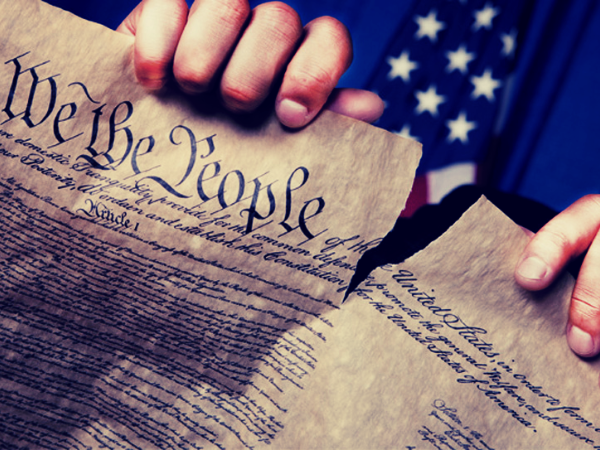
“In questions of power then, let no more be heard of confidence in man, but bind him down from mischief by the chains of the Constitution.”—Thomas Jefferson

Public trust in the government to “do what is right” understandably remains at an all-time low.

After all, how do you trust a government that continuously sidesteps the Constitution and undermines our rights? You can’t.

When you consider all the ways “we the people” are being bullied, beaten, bamboozled, targeted, tracked, repressed, robbed, impoverished, imprisoned and killed by the government, one can only conclude that you shouldn’t trust the government with your privacy, your property, your life, or your freedoms.

Consider for yourself.

Don’t trust the government with your privacy, digital or otherwise. In the more than two decades since 9/11, the military-security industrial complex has operated under a permanent state of emergency that, in turn, has given rise to a digital prison that grows more confining and inescapable by the day. Wall-to wall surveillance, monitored by AI software and fed to a growing network of fusion centers, render the twin concepts of privacy and anonymity almost void. By conspiring with corporations, the Department of Homeland Security “fueled a massive influx of money into surveillance and policing in our cities, under a banner of emergency response and counterterrorism.”

Don’t trust the government with your property. If government agents can invade your home, break down your doors, kill your dog, damage your furnishings and terrorize your family, your property is no longer private and secure—it belongs to the government. Hard-working Americans are having their bank accounts, homes, cars electronics and cash seized by police under the assumption that they have allegedly been associated with some criminal scheme.

Don’t trust the government with your finances. The U.S. government—and that includes the current administration—is spending money it doesn’t have on programs it can’t afford, and “we the taxpayers” are being forced to foot the bill for the government’s fiscal insanity. The national debt is $35 trillion and growing, yet there seems to be no end in sight when it comes to the government’s fiscal insanity. According to Forbes, Congress has raised, extended or revised the definition of the debt limit 78 times since 1960 in order to allow the government to essentially fund its existence with a credit card.

Don’t trust the government with your health. For all intents and purposes, “we the people” have become lab rats in the government’s secret experiments, which include MKULTRA and the U.S. military’s secret race-based testing of mustard gas on more than 60,000 enlisted men. Indeed, you don’t have to dig very deep or go very back in the nation’s history to uncover numerous cases in which the government deliberately conducted secret experiments on an unsuspecting populace—citizens and noncitizens alike—making healthy people sick by spraying them with chemicals, injecting them with infectious diseases and exposing them to airborne toxins. Unfortunately, the public has become so easily distracted by the political spectacle out of Washington, DC, that they are altogether oblivious to the grisly experiments, barbaric behavior and inhumane conditions that have become synonymous with the U.S. government, which has meted out untold horrors against humans and animals alike.

Don’t trust the government with your life: At a time when growing numbers of unarmed people have been shot and killed for just standing a certain way, or moving a certain way, or holding something—anything—that police could misinterpret to be a gun, or igniting some trigger-centric fear in a police officer’s mind that has nothing to do with an actual threat to their safety, even the most benign encounters with police can have fatal consequences. The number of Americans killed by police continues to grow, with the majority of those killed as a result of police encounters having been suspected of a non-violent offense or no crime at all, or during a traffic violation. According a report by Mapping Police Violence, police killed more people in 2022 than any other year within the past decade. In 98% of those killings, police were not charged with a crime.

Don’t trust the government with your freedoms. For years now, the government has been playing a cat-and-mouse game with the American people, letting us enjoy just enough freedom to think we are free but not enough to actually allow us to live as a free people. Freedom no longer means what it once did. This holds true whether you’re talking about the right to criticize the government in word or deed, the right to be free from government surveillance, the right to not have your person or your property subjected to warrantless searches by government agents, the right to due process, the right to be safe from militarized police invading your home, the right to be innocent until proven guilty and every other right that once reinforced the founders’ belief that this would be “a government of the people, by the people and for the people.” On paper, we may be technically free, but in reality, we are only as free as a government official may allow.

Whatever else it may be—a danger, a menace, a threat—the U.S. government is certainly not looking out for our best interests, nor is it in any way a friend to freedom.

Remember the purpose of a good government is to protect the lives and liberties of its people.

Unfortunately, what we have been saddled with is, in almost every regard, the exact opposite of an institution dedicated to protecting the lives and liberties of its people.

“We the people” should have learned early on that a government that repeatedly lies, cheats, steals, spies, kills, maims, enslaves, breaks the laws, overreaches its authority, and abuses its power at almost every turn can’t be trusted.

So what’s the answer?

For starters, get back to basics. Get to know your neighbors, your community, and your local officials. This is the first line of defense when it comes to securing your base: fortifying your immediate lines.

Second, understand your rights. Know how your local government is structured. Who serves on your city council and school boards? Who runs your local jail: has it been coopted by private contractors? What recourse does the community have to voice concerns about local problems or disagree with decisions by government officials?

Third, know the people you’re entrusting with your local government. Are your police chiefs being promoted from within your community? Are your locally elected officials accessible and, equally important, are they open to what you have to say? Who runs your local media? Does your newspaper report on local events? Who are your judges? Are their judgments fair and impartial? How are prisoners being treated in your local jails?

Finally, don’t get so trusting and comfortable that you stop doing the hard work of holding your government accountable. We’ve drifted a long way from the local government structures that provided the basis for freedom described by Alexis de Tocqueville in Democracy in America, but we are not so far gone that we can’t reclaim some of its vital components.

As an article in The Federalist points out:

Local government is fundamental not so much because it’s a “laboratory” of democracy but because it’s a school of democracy. Through such accountable and democratic government, Americans learn to be democratic citizens. They learn to be involved in the common good. They learn to take charge of their own affairs, as a community. Tocqueville writes that it’s because of local democracy that Americans can make state and Federal democracy work—by learning, in their bones, to expect and demand accountability from public officials and to be involved in public issues.

To put it another way, think nationally but act locally.

As I make clear in my book Battlefield America: The War on the American People and in its fictional counterpart The Erik Blair Diaries, there is still a lot Americans can do to topple the police state tyrants, but any revolution that has any hope of succeeding needs to be prepared to reform the system from the bottom up. And that will mean re-learning step by painful step what it actually means to be a government of the people, by the people and for the people.

Source: https://tinyurl.com/y9bxudud

ABOUT JOHN W. WHITEHEAD

Constitutional attorney and author John W. Whitehead is founder and president of The Rutherford Institute. His most recent books are the best-selling Battlefield America: The War on the American People, the award-winning A Government of Wolves: The Emerging American Police State, and a debut dystopian fiction novel, The Erik Blair Diaries. Whitehead can be contacted at staff@rutherford.org. Nisha Whitehead is the Executive Director of The Rutherford Institute. Information about The Rutherford Institute is available at www.rutherford.org.

Publication Guidelines / Reprint Permission

John W. Whitehead’s weekly commentaries are available for publication to newspapers and web publications at no charge. 
“We the people are the rightful masters of both Congress and the courts, not to overthrow the Constitution but to overthrow the men who pervert the Constitution.” — Abraham Lincoln

It is both apt and ironic that the anniversary of 9/11, which paved the way for the government to overthrow the Constitution, occurs the week before the anniversary of the day the U.S. Constitution was adopted on September 17, 1787.

All sides are still waging war on our constitutional freedoms, and “we the people” remain the biggest losers.

This year’s presidential election is no exception.

As Bruce Fein, the former associate deputy attorney general under President Ronald Reagan, warns in a recent article in the Baltimore Sun, “In November, the American people will have a choice between Harris-Walz and Trump-Vance. But they will not have a choice between an Empire and a Republic.

In other words, the candidates on this year’s ballot do not represent a substantive choice between freedom and tyranny so much as they constitute a cosmetic choice: the packaging may vary widely, but the contents remain the same.

No matter who wins, the bureaucratic minions of the Security/Military Industrial Complex and its Police State/Deep State partners will retain their stranglehold on power.

Neither Donald Trump nor Kamala Harris have the greatest of track records when it comes to actually respecting the rights enshrined in the Constitution, despite the rhetoric being trotted out by both sides lately regarding their so-called devotion to the rule of law.

Indeed, Trump has repeatedly called for parts of the Constitution to be terminated, while both Harris and Trump seem to view the First Amendment’s assurance of the right to free speech, political expression and protest as dangerous when used to challenge the government’s power.

This flies in the face of everything America’s founders fought to safeguard.

Those who gave us the Constitution and the Bill of Rights believed that the government exists at the behest of its citizens. It is there to protect, defend and even enhance our freedoms, not violate them.

Unfortunately, although the Bill of Rights was adopted as a means of protecting the people against government tyranny, in America today, the government does whatever it wants, freedom be damned.

In the 23 years since the USA Patriot Act—a massive 342-page wish list of expanded powers for the FBI and CIA—was rammed through Congress in the wake of the so-called 9/11 terror attacks, it has snowballed into the eradication of every vital safeguard against government overreach, corruption and abuse.

The Patriot Act drove a stake through the heart of the Bill of Rights, violating at least six of the ten original amendments—the First, Fourth, Fifth, Sixth, Seventh and Eighth Amendments—and possibly the Thirteenth and Fourteenth Amendments, as well.

The Patriot Act also redefined terrorism so broadly that many non-terrorist political activities such as protest marches, demonstrations and civil disobedience are now considered potential terrorist acts, thereby rendering anyone desiring to engage in protected First Amendment expressive activities as suspects of the surveillance state.

The Patriot Act justified broader domestic surveillance, the logic being that if government agents knew more about each American, they could distinguish the terrorists from law-abiding citizens—no doubt a reflexive impulse shared by small-town police and federal agents alike.

This, according to Washington Post reporter Robert O’Harrow, Jr., was a fantasy that “had been brewing in the law enforcement world for a long time.” And 9/11 provided the government with the perfect excuse for conducting far-reaching surveillance and collecting mountains of information on even the most law-abiding citizen.

Federal agents and police officers are now authorized to conduct covert black bag “sneak-and-peak” searches of homes and offices while you are away and confiscate your personal property without first notifying you of their intent or their presence.

The law also granted the FBI the right to come to your place of employment, demand your personal records and question your supervisors and fellow employees, all without notifying you; allowed the government access to your medical records, school records and practically every personal record about you; and allowed the government to secretly demand to see records of books or magazines you’ve checked out in any public library and Internet sites you’ve visited (at least 545 libraries received such demands in the first year following passage of the Patriot Act).

In the name of fighting terrorism, government officials are now permitted to monitor religious and political institutions with no suspicion of criminal wrongdoing; prosecute librarians or keepers of any other records if they tell anyone that the government has subpoenaed information related to a terror investigation; monitor conversations between attorneys and clients; search and seize Americans’ papers and effects without showing probable cause; and jail Americans indefinitely without a trial, among other things.

The federal government has also made liberal use of its post-9/11 powers, especially through the use (and abuse) of the nefarious national security letters, which allow the FBI to demand personal customer records from Internet Service Providers, financial institutions and credit companies at the mere say-so of the government agent in charge of a local FBI office and without prior court approval.

In fact, since 9/11, we’ve been spied on by surveillance cameras, eavesdropped on by government agents, had our belongings searched, our phones tapped, our mail opened, our email monitored, our opinions questioned, our purchases scrutinized (under the USA Patriot Act, banks are required to analyze your transactions for any patterns that raise suspicion and to see if you are connected to any objectionable people), and our activities watched.

We’re also being subjected to invasive patdowns and whole-body scans of our persons and seizures of our electronic devices in the nation’s airports. We can’t even purchase certain cold medicines at the pharmacy anymore without it being reported to the government and our names being placed on a watch list.

In this way, “we the people” continue to be terrorized, traumatized, and tricked into a semi-permanent state of compliance by a government that cares nothing for our lives or our liberties.

The bogeyman’s names and faces have changed over time (terrorism, the war on drugs, illegal immigration, a viral pandemic, and more to come), but the end result remains the same: in the so-called name of national security, the Constitution has been steadily chipped away at, undermined, eroded, whittled down, and generally discarded with the support of Congress, the White House, and the courts.

A recitation of the Bill of Rights—set against a backdrop of government surveillance, militarized police, SWAT team raids, asset forfeiture, eminent domain, overcriminalization, armed surveillance drones, whole body scanners, stop and frisk searches, vaccine mandates, lockdowns, and the like (all sanctioned by Congress, the White House, and the courts)—would understandably sound more like a eulogy to freedoms lost than an affirmation of rights we truly possess.

What we are left with today is but a shadow of the robust document adopted more than two centuries ago. Sadly, most of the damage has been inflicted upon the Bill of Rights.

Here is what it means to live in a permanent state of crisis with our freedoms locked down:

The First Amendment is supposed to protect the freedom to speak your mind, assemble and protest nonviolently without being bridled by the government. It also protects the freedom of the media, as well as the right to worship and pray without interference. In other words, Americans should not be silenced by the government. To the founders, all of America was a free speech zone.

Despite the clear protections found in the First Amendment, the freedoms described therein are under constant assault. Increasingly, Americans are being persecuted for exercising their First Amendment rights and speaking out against government corruption. Activists are being arrested and charged for daring to film police officers engaged in harassment or abusive practices. Journalists are being prosecuted for reporting on whistleblowers. States are passing legislation to muzzle reporting on cruel and abusive corporate practices. Religious ministries are being fined for attempting to feed and house the homeless. Protesters are being tear-gassed, beaten, arrested and forced into “free speech zones.” And under the guise of “government speech,” the courts have reasoned that the government can discriminate freely against any First Amendment activity that takes place within a so-called government forum.

The Second Amendment was intended to guarantee “the right of the people to keep and bear arms.” Essentially, this amendment was intended to give the citizenry the means to resist tyrannical government. Yet while gun ownership has been recognized by the U.S. Supreme Court as an individual citizen right, Americans remain powerless to defend themselves against red flag gun laws, militarized police, SWAT team raids, and government agencies armed to the teeth with military weapons better suited to the battlefield.

The Third Amendment reinforces the principle that civilian-elected officials are superior to the military by prohibiting the military from entering any citizen’s home without “the consent of the owner.” With the police increasingly training like the military, acting like the military, and posing as military forces—complete with heavily armed SWAT teams, military weapons, assault vehicles, etc.—it is clear that we now have what the founders feared most—a standing army on American soil.

The Fourth Amendment prohibits government agents from conducting surveillance on you or touching you or encroaching on your private property unless they have evidence that you’re up to something criminal. In other words, the Fourth Amendment ensures privacy and bodily integrity. Unfortunately, the Fourth Amendment has suffered the greatest damage in recent years and has been all but eviscerated by an unwarranted expansion of governmental police powers that include strip searches and even anal and vaginal searches of citizens, surveillance (corporate and otherwise), and intrusions justified in the name of fighting terrorism, as well as the outsourcing of otherwise illegal activities to private contractors.

The Fifth Amendment and the Sixth Amendment work in tandem. These amendments supposedly ensure that you are innocent until proven guilty, and government authorities cannot deprive you of your life, your liberty or your property without the right to an attorney and a fair trial before a civilian judge. However, in the new suspect society in which we live, where surveillance is the norm, these fundamental principles have been upended. Certainly, if the government can arbitrarily freeze, seize or lay claim to your property (money, land or possessions) under government asset forfeiture schemes, you have no true rights.

The Seventh Amendment guarantees citizens the right to a jury trial. Yet when the populace has no idea of what’s in the Constitution—civic education has virtually disappeared from most school curriculums—that inevitably translates to an ignorant jury incapable of distinguishing justice and the law from their own preconceived notions and fears. However, as a growing number of citizens are coming to realize, the power of the jury to nullify the government’s actions—and thereby help balance the scales of justice—is not to be underestimated. Jury nullification reminds the government that “we the people” retain the power to ultimately determine what laws are just.

The Eighth Amendment is similar to the Sixth in that it is supposed to protect the rights of the accused and forbid the use of cruel and unusual punishment. However, the Supreme Court’s determination that what constitutes “cruel and unusual” should be dependent on the “evolving standards of decency that mark the progress of a maturing society” leaves us with little protection in the face of a society lacking in morals altogether.

The Ninth Amendment provides that other rights not enumerated in the Constitution are nonetheless retained by the people. Popular sovereignty—the belief that the power to govern flows upward from the people rather than downward from the rulers—is clearly evident in this amendment. However, it has since been turned on its head by a centralized federal government that sees itself as supreme and which continues to pass more and more laws that restrict our freedoms under the pretext that it has an “important government interest” in doing so.

As for the Tenth Amendment’s reminder that the people and the states retain every authority that is not otherwise mentioned in the Constitution, that assurance of a system of government in which power is divided among local, state and national entities has long since been rendered moot by the centralized Washington, DC, power elite—the president, Congress and the courts.

Thus, if there is any sense to be made from this recitation of freedoms lost, it is simply this: our individual freedoms have been eviscerated so that the government’s powers could be expanded.

It was no idle happenstance that the Constitution opens with these three powerful words: “We the people.” As the Preamble proclaims:

We, the people of the United States, in order to form a more perfect Union, establish justice, insure domestic tranquility, provide for the common defense, promote the general welfare, and secure the blessings of liberty to ourselves and our posterity, do ordain and establish this CONSTITUTION for the United States of America.

In other words, it’s our job to make the government play by the rules of the Constitution.

We are supposed to be the masters and they—the government and its agents—are the servants.

We the American people—the citizenry—are supposed to be the arbiters and ultimate guardians of America’s welfare, defense, liberty, laws and prosperity.

Still, it’s hard to be a good citizen if you don’t know anything about your rights or how the government is supposed to operate.

As the National Review rightly asks, “How can Americans possibly make intelligent and informed political choices if they don’t understand the fundamental structure of their government? American citizens have the right to self-government, but it seems that we increasingly lack the capacity for it.”

Americans are constitutionally illiterate.

Most citizens have little, if any, knowledge about their basic rights. And our educational system does a poor job of teaching the basic freedoms guaranteed in the Constitution and the Bill of Rights.

Teachers and school administrators do not fare much better. A study conducted by the Center for Survey Research and Analysis found that one educator in five was unable to name any of the freedoms in the First Amendment.

Government leaders and politicians are also ill-informed. Although they take an oath to uphold, support and defend the Constitution against “enemies foreign and domestic,” their lack of education about our fundamental rights often causes them to be enemies of the Bill of Rights.

So what’s the solution?

Thomas Jefferson recognized that a citizenry educated on “their rights, interests, and duties”  is the only real assurance that freedom will survive.

From the President on down, anyone taking public office should have a working knowledge of the Constitution and the Bill of Rights and should be held accountable for upholding their precepts. One way to ensure this would be to require government leaders to take a course on the Constitution and pass a thorough examination thereof before being allowed to take office.

Some critics are advocating that students pass the United States citizenship exam in order to graduate from high school. Others recommend that it must be a prerequisite for attending college. I’d go so far as to argue that students should have to pass the citizenship exam before graduating from grade school.

Here’s an idea to get educated and take a stand for freedom: anyone who signs up to become a member of The Rutherford Institute gets a wallet-sized Bill of Rights card and a Know Your Rights card. Use this card to teach your children the freedoms found in the Bill of Rights.

A healthy, representative government is hard work. It takes a citizenry that is informed about the issues, educated about how the government operates, and willing to do more than grouse and complain.

As I point out in my book Battlefield America: The War on the American People and in its fictional counterpart The Erik Blair Diaries, “we the people” have the power to make and break the government.

The powers-that-be want us to remain divided over politics, hostile to those with whom we disagree politically, and intolerant of anyone or anything whose solutions to what ails this country differ from our own. They also want us to believe that our job as citizens begins and ends on Election Day.

Yet there are 330 million of us in this country. Imagine what we could accomplish if we actually worked together, presented a united front, and spoke with one voice.

Tyranny wouldn’t stand a chance.

Source: https://tinyurl.com/37ut7ne9

ABOUT JOHN W. WHITEHEAD

Constitutional attorney and author John W. Whitehead is founder and president of The Rutherford Institute. His most recent books are the best-selling Battlefield America: The War on the American People, the award-winning A Government of Wolves: The Emerging American Police State, and a debut dystopian fiction novel, The Erik Blair Diaries. Whitehead can be contacted at staff@rutherford.org. Nisha Whitehead is the Executive Director of The Rutherford Institute. Information about The Rutherford Institute is available at www.rutherford.org.

Publication Guidelines / Reprint Permission

John W. Whitehead’s weekly commentaries are available for publication to newspapers and web publications at no charge.

“Every day in communities across the United States, children and adolescents spend the majority of their waking hours in schools that have increasingly come to resemble places of detention more than places of learning.”—Investigative journalist Annette Fuentes

It’s not easy being a child in the American police state.

Danger lurks around every corner and comes at you from every direction, especially when Big Brother is involved.

Out on the streets, you’ve got the menace posed by police officers who shoot first and ask questions later. In your neighborhoods, you’ve got to worry about the Nanny State and its network of busybodies turning parents in for allowing their children to walk to school alone, walk to the park alone, play at the beach alone, or even play in their own yard alone.

The tentacles of the police state even intrude on the sanctity of one’s home, with the government believing it knows better than you—the parent—what is best for your child. This criminalization of parenthood has run the gamut in recent years from parents being arrested for attempting to walk their kids home from school to parents being fined and threatened with jail time for their kids’ bad behavior or tardiness at school.

This doesn’t even touch on what happens to your kids when they’re at school—especially the public schools—where parents have little to no control over what their kids are taught, how they are taught, how and why they are disciplined, and the extent to which they are being indoctrinated into marching in lockstep with the government’s authoritarian playbook.

The message is chillingly clear: your children are not your own but are, in fact, wards of the state who have been temporarily entrusted to your care. Should you fail to carry out your duties to the government’s satisfaction, the children in your care will be re-assigned elsewhere.

This is what it means to go back-to-school in America today: where parents have to worry about school resource officers who taser teenagers and handcuff kindergartners, school officials who have criminalized childhood behavior, school lockdowns and terror drills that teach your children to fear and comply, and a police state mindset that has transformed the schools into quasi-prisons.

Instead of being taught the three R’s of education (reading, writing and arithmetic), young people are being drilled in the three I’s of life in the American police state: indoctrination, intimidation and intolerance.

Indeed, while young people today are learning first-hand what it means to be at the epicenter of politically charged culture wars, test scores indicate that students are not learning how to succeed in social studies, math and reading. Rather, government officials are churning out compliant drones who know little to nothing about their history or their freedoms.

In turn, these young people are being brainwashed into adopting a worldview in which rights are negotiable rather than inalienable; free speech is dangerous; the virtual world is preferable to the real world; and history can be extinguished when inconvenient or offensive.

What does it mean for the future of freedom at large when these young people, trained to be mindless automatons, are someday running the government?

Under the direction of government officials focused on making the schools more authoritarian (sold to parents as a bid to make the schools safer), young people in America are now first in line to be searched, surveilled, spied on, threatened, tied up, locked down, treated like criminals for non-criminal behavior, tasered and in some cases shot.

From the moment a child enters one of the nation’s 98,000 public schools to the moment he or she graduates, they will be exposed to a steady diet of:

  • draconian zero tolerance policies that criminalize childish behavior,
  • overreaching anti-bullying statutes that criminalize speech,
  • school resource officers (police) tasked with disciplining and/or arresting so-called “disorderly” students,
  • standardized testing that emphasizes rote answers over critical thinking,
  • politically correct mindsets that teach young people to censor themselves and those around them,
  • and extensive biometric and surveillance systems that, coupled with the rest, acclimate young people to a world in which they have no freedom of thought, speech or movement.

This is how you groom young people to march in lockstep with a police state.

As Deborah Cadbury writes for The Washington Post, “Authoritarian rulers have long tried to assert control over the classroom as part of their totalitarian governments.”

In Nazi Germany, the schools became indoctrination centers, breeding grounds for intolerance and compliance.

In the American police state, the schools have become increasingly hostile to those who dare to question or challenge the status quo.

America’s young people have become casualties of a post-9/11 mindset that has transformed the country into a locked-down, militarized, crisis-fueled mockery of a representative government.

Roped into the government’s profit-driven campaign to keep the nation “safe” from drugs, disease, and weapons, America’s schools have transformed themselves into quasi-prisons, complete with surveillance cameras, metal detectors, police patrols, zero tolerance policies, lock downs, drug sniffing dogs, strip searches and active shooter drills.

Students are not only punished for minor transgressions such as playing cops and robbers on the playground, bringing LEGOs to school, or having a food fight, but the punishments have become far more severe, shifting from detention and visits to the principal’s office into misdemeanor tickets, juvenile court, handcuffs, tasers and even prison terms.

Students have been suspended under school zero tolerance policies for bringing to school “look alike substances” such as oreganobreath mints, birth control pills and powdered sugar.

Look-alike weapons (toy guns—even Lego-sized ones, hand-drawn pictures of guns, pencils twirled in a “threatening” manner, imaginary bows and arrows, fingers positioned like guns) can also land a student in hot water, in some cases getting them expelled from school or charged with a crime.

Not even good deeds go unpunished.

One 13-year-old was given detention for exposing the school to “liability” by sharing his lunch with a hungry friend. A third grader was suspended for shaving her head in sympathy for a friend who had lost her hair to chemotherapy. And then there was the high school senior who was suspended for saying “bless you” after a fellow classmate sneezed.

Having police in the schools only adds to the danger.

Thanks to a combination of media hype, political pandering and financial incentives, the use of armed police officers (a.k.a. school resource officers) to patrol school hallways has risen dramatically in the years since the Columbine school shooting.

Indeed, the growing presence of police in the nation’s schools is resulting in greater police “involvement in routine discipline matters that principals and parents used to address without involvement from law enforcement officers.”

Funded by the U.S. Department of Justice, these school resource officers have become de facto wardens in elementary, middle and high schools, doling out their own brand of justice to the so-called “criminals” in their midst with the help of tasers, pepper spray, batons and brute force.

In the absence of school-appropriate guidelines, police are more and more “stepping in to deal with minor rulebreaking: sagging pants, disrespectful comments, brief physical skirmishes. What previously might have resulted in a detention or a visit to the principal’s office was replaced with excruciating pain and temporary blindness, often followed by a trip to the courthouse.”

Not even the younger, elementary school-aged kids are being spared these “hardening” tactics.

On any given day when school is in session, kids who “act up” in class are pinned facedown on the floor, locked in dark closets, tied up with straps, bungee cords and duct tape, handcuffed, leg shackled, tasered or otherwise restrained, immobilized or placed in solitary confinement in order to bring them under “control.”

In almost every case, these undeniably harsh methods are used to punish kids—some as young as 4 and 5 years old—for simply failing to follow directions or throwing tantrums.

Very rarely do the kids pose any credible danger to themselves or others.

Unbelievably, these tactics are all legal, at least when employed by school officials or school resource officers in the nation’s public schools.

This is what happens when you introduce police and police tactics into the schools.

Paradoxically, by the time you add in the lockdowns and active shooter drills, instead of making the schools safer, school officials have succeeded in creating an environment in which children are so traumatized that they suffer from post-traumatic stress disorder, nightmares, anxiety, mistrust of adults in authority, as well as feelings of anger, depression, humiliation, despair and delusion.

For example, a middle school in Washington State went on lockdown after a student brought a toy gun to class. A Boston high school went into lockdown for four hours after a bullet was discovered in a classroom. A North Carolina elementary school locked down and called in police after a fifth grader reported seeing an unfamiliar man in the school (it turned out to be a parent).

Police officers at a Florida middle school carried out an active shooter drill in an effort to educate students about how to respond in the event of an actual shooting crisis. Two armed officers, guns loaded and drawn, burst into classrooms, terrorizing the students and placing the school into lockdown mode.

These police state tactics have not made the schools any safer.

The fallout has been what you’d expect, with the nation’s young people treated like hardened criminals: handcuffed, arrested, tasered, tackled and taught the painful lesson that the Constitution (especially the Fourth Amendment) doesn’t mean much in the American police state.

Likewise, the harm caused by attitudes and policies that treat America’s young people as government property is not merely a short-term deprivation of individual rights. It is also a long-term effort to brainwash our young people into believing that civil liberties are luxuries that can and will be discarded at the whim and caprice of government officials if they deem doing so is for the so-called “greater good” (in other words, that which perpetuates the aims and goals of the police state).

What we’re dealing with is a draconian mindset that sees young people as wards of the state—and the source of potential income—to do with as they will in defiance of the children’s constitutional rights and those of their parents. However, this is in keeping with the government’s approach towards individual freedoms in general.

Surveillance cameras, government agents listening in on your phone calls, reading your emails and text messages and monitoring your spending, mandatory health care, sugary soda bans, anti-bullying laws, zero tolerance policies, political correctness: these are all outward signs of a government—i.e., a monied elite—that believes it knows what is best for you and can do a better job of managing your life than you can.

This is tyranny disguised as “the better good.”

Indeed, this is the tyranny of the Nanny State: marketed as benevolence, enforced with armed police, and inflicted on all those who do not belong to the elite ruling class that gets to call the shots.

This is what the world looks like when bureaucrats not only think they know better than the average citizen but are empowered to inflict their viewpoints on the rest of the populace on penalty of fines, arrest or death.

So, what’s the answer, not only for the here-and-now but for the future of this country, when these same young people are someday in charge?

How do you convince someone who has been routinely handcuffed, shackled, tied down, locked up, and immobilized by government officials—all before he reaches the age of adulthood—that he has any rights at all, let alone the right to challenge wrongdoing, resist oppression and defend himself against injustice?

Most of all, how do you persuade a fellow American that the government works for him when, for most of his young life, he has been incarcerated in an institution that teaches young people to be obedient and compliant citizens who don’t talk back, don’t question and don’t challenge authority?

As I make clear in my book Battlefield America: The War on the American People and in its fictional counterpart The Erik Blair Diaries, if we want to raise up a generation of freedom fighters who will actually operate with justice, fairness, accountability and equality towards each other and their government, we must start by running the schools like freedom forums.

Source: https://tinyurl.com/yc3ermr7

ABOUT JOHN W. WHITEHEAD

Constitutional attorney and author John W. Whitehead is founder and president of The Rutherford Institute. His most recent books are the best-selling Battlefield America: The War on the American People, the award-winning A Government of Wolves: The Emerging American Police State, and a debut dystopian fiction novel, The Erik Blair Diaries. Whitehead can be contacted at staff@rutherford.org. Nisha Whitehead is the Executive Director of The Rutherford Institute. Information about The Rutherford Institute is available at www.rutherford.org.

Publication Guidelines / Reprint Permission

John W. Whitehead’s weekly commentaries are available for publication to newspapers and web publications at no charge.