Archive for May, 2024

If a nation expects to be ignorant and free in a state of civilization, it expects what never was and never will be.”—Thomas Jefferson

If America’s schools are to impart principles of freedom and democracy to future generations, they must start by respecting the constitutional rights of their students

Take the case of Lucas Hudson.

With all the negative press being written about today’s young people, it’s refreshing to meet a young person who not only knows his rights but is prepared to stand up for them. 

Lucas is a smart kid, a valedictorian of his graduating class at the Collegiate Academy at Armwood High School in Hillsborough County, Fla.

So, when school officials gave Lucas an ultimatum: either remove most of his speech’s religious references from his graduation speech—in which he thanked the people who helped shape his character, reflected on how quickly time goes by, and urged people to use whatever time they have to love others and serve the God who loves us—or he would not be speaking at all, Lucas refused to forfeit his rights.

That’s when Lucas’s father turned to The Rutherford Institute for help.

In coming to Lucas’ defense, attorneys for The Rutherford Institute warned school officials that their attempts to browbeat Lucas into watering down his graduation speech could expose the school to a First Amendment lawsuit.

Thankfully for Lucas, the school backed down, and he was able to deliver his speech as written.

It doesn’t always work out so well, unfortunately.

Over the course of The Rutherford Institute’s 42-year history, we have defended countless young people who found themselves censored, silenced and denied their basic First Amendment rights, especially when they chose to exercise their rights to free speech and religious freedom.

In case after case, we encounter an appalling level of ignorance on the part of public school officials who mistakenly believe that the law requires anything religious be banned from public schools.

Here’s where government officials get it wrong: while the government may not establish or compel a particular religion, it also may not silence and suppress religious speech merely because others might take offense.

People are free to ignore, disagree with, or counter the religious speech of others, but the government cannot censor private religious speech.

Unfortunately, you can only defend your rights when you know them, and the American people—and those who represent them—are utterly ignorant about their freedoms, history, and how the government is supposed to operate.

As Morris Berman points out in his book Dark Ages America, “70 percent of American adults cannot name their senators or congressmen; more than half don’t know the actual number of senators, and nearly a quarter cannot name a single right guaranteed by the First Amendment. Sixty-three percent cannot name the three branches of government. Other studies reveal that uninformed or undecided voters often vote for the candidate whose name and packaging (e.g., logo) are the most powerful; color is apparently a major factor in their decision.”

More than government corruption and ineptitude, police brutality, terrorism, gun violence, drugs, illegal immigration or any other so-called “danger” that threatens our nation, civic illiteracy may be what finally pushes us over the edge.

As Thomas Jefferson warned, no nation can be both ignorant and free.

Unfortunately, the American people have existed in a technology-laden, entertainment-fueled, perpetual state of cluelessness for so long that civic illiteracy has become the new normal for the citizenry.

In fact, most immigrants who aspire to become citizens know more about national civics than native-born Americans. Surveys indicate that half of native-born Americans couldn’t correctly answer 70% of the civics questions on the U.S. Citizenship test.

Not even the government bureaucrats who are supposed to represent us know much about civics, American history and geography, or the Constitution although they take an oath to uphold, support and defend the Constitution against “enemies foreign and domestic.”

For instance, a couple attempting to get a marriage license was recently forced to prove to a government official that New Mexico is, in fact, one of the 50 states and not a foreign country.

You can’t make this stuff up.

Those who gave us the Constitution and the Bill of Rights believed that the government exists at the behest of its citizens. The government’s purpose is to protect, defend and even enhance our freedoms, not violate them.

It was no idle happenstance that the Constitution opens with these three powerful words: “We the people.”

Those who founded this country knew quite well that every citizen must remain vigilant or freedom would be lost. As Thomas Paine recognized, “It is the responsibility of the patriot to protect his country from its government.”

You have no rights unless you exercise them.

Still, you can’t exercise your rights unless you know what those rights are.

“If Americans do not understand the Constitution and the institutions and processes through which we are governed, we cannot rationally evaluate important legislation and the efforts of our elected officials, nor can we preserve the national unity necessary to meaningfully confront the multiple problems we face today,” warns the Brennan Center in its Civic Literacy Report Card. “Rather, every act of government will be measured only by its individual value or cost, without concern for its larger impact. More and more we will ‘want what we want, and [will be] convinced that the system that is stopping us is wrong, flawed, broken or outmoded.’”

Education precedes action.

As the Brennan Center concludes “America, unlike most of the world’s nations, is not a country defined by blood or belief. America is an idea, or a set of ideas, about freedom and opportunity. It is these ideas that bind us together as Americans and have kept us free, strong, and prosperous. But these ideas do not perpetuate themselves. They must be taught and learned anew with each generation.”

There is a movement underway to require that all public-school students pass the civics portion of the U.S. naturalization test100 basic facts about U.S. history and civics—before receiving their high-school diploma, and that’s a start.

Lucas Hudson would have passed such a test with flying colors.

On graduation day, Lucas stepped up to the podium and delivered his uncensored valedictorian speech as written, without any interference by school censors.

As Lucas’s father relayed to The Rutherford Institute:

“In the end, Lucas got to give his entire speech the way he wanted to give it, and everybody was paying attention.  Nobody got hurt.  Nothing bad happened.  It was just a young man using the First Amendment rights to speak his mind regarding his personal beliefs. [Lucas] never thought a few sentences in a speech would create such a controversy in his world, but this speech turned into a defining moment for him.  He will never be the same after this experience, but this permanent change is a good thing.  When it mattered, Lucas stood up for himself, and when those he stood up against tried to push him down, [The Rutherford Institute] came to his aide and backed him up to make it a fair fight. I am comforted to know you are defending the rights of the people.  These fights matter.  Every time you defend the rights of one person, you defend the rights of every person.  You helped my son fight for his rights against the school, and, in doing so, Hillsborough County Public Schools will think twice before infringing on the rights of future students. Your defense of Lucas became an inspiration for the students in his school and sparked a healthy and meaningful debate among the teachers, students, and parents about the value of the First Amendment and the need for limits on government control over our personal beliefs.  You are fighting for good and doing important work.  Don’t ever stop. Thank you, Rutherford Institute, for being there for my son when he needed you most.”

America needs more freedom fighters like Lucas Hudson and The Rutherford Institute.

It’s up to us.

We have the power to make and break the government.

We the American people—the citizenry—are the arbiters and ultimate guardians of America’s welfare, defense, liberty, laws and prosperity.

We must act—and act responsibly.

A healthy, representative government is hard work. It takes a citizenry that is informed about the issues, educated about how the government operates, and willing to make the sacrifices necessary to stay involved.

As I make clear in my book Battlefield America: The War on the American People and in its fictional counterpart The Erik Blair Diaries, it’s our job to keep freedom alive using every nonviolent means available to us.

As Martin Luther King Jr. recognized in a speech delivered on December 5, 1955, just four days after Rosa Parks was arrested for refusing to relinquish her seat on a Montgomery city bus: “Democracy transformed from thin paper to thick action is the greatest form of government on earth.”

Know your rights. Exercise your rights. Defend your rights. If not, you will lose them.

Source: https://tinyurl.com/3b2uaxs7

ABOUT JOHN W. WHITEHEAD

Constitutional attorney and author John W. Whitehead is founder and president of The Rutherford Institute. His most recent books are the best-selling Battlefield America: The War on the American People, the award-winning A Government of Wolves: The Emerging American Police State, and a debut dystopian fiction novel, The Erik Blair Diaries. Whitehead can be contacted at staff@rutherford.org. Nisha Whitehead is the Executive Director of The Rutherford Institute. Information about The Rutherford Institute is available at www.rutherford.org.

Publication Guidelines / Reprint Permission

John W. Whitehead’s weekly commentaries are available for publication to newspapers and web publications at no charge. 
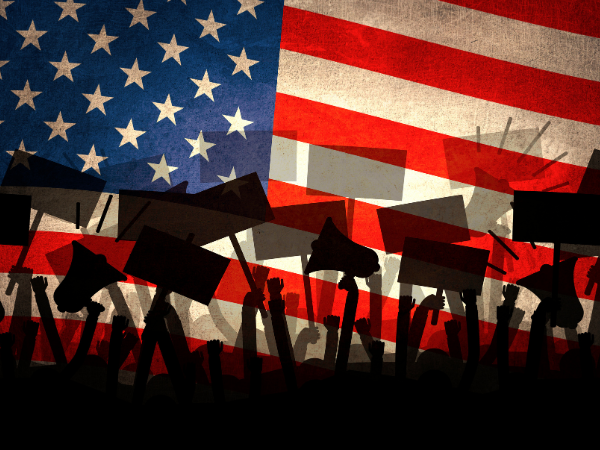
“Politicians of both parties want to use the power of government to silence their foes. Some in the university community seek to drive it from their campuses. And an entire generation of Americans is being taught that free speech should be curtailed as soon as it makes someone else feel uncomfortable.”—William Ruger, “Free Speech Is Central to Our Dignity as Humans

The police state does not want citizens who know their rights.

Nor does the police state want citizens prepared to exercise those rights.

This year’s graduates are a prime example of this master class in compliance. Their time in college has been set against a backdrop of crackdowns, lockdowns and permacrises ranging from the government’s authoritarian COVID-19 tactics to its more recent militant response to campus protests.

Born in the wake of the 9/11 attacks, these young people have been raised without any expectation of privacy in a technologically-driven, mass surveillance state; educated in schools that teach conformity and compliance; saddled with a debt-ridden economy on the brink of implosion; made vulnerable by the blowback from a military empire constantly waging war against shadowy enemies; policed by government agents armed to the teeth ready and able to lock down the country at a moment’s notice; and forced to march in lockstep with a government that no longer exists to serve the people but which demands they be obedient slaves or suffer the consequences.

And now, when they should be empowered to take their rightful place in society as citizens who fully understand and exercise their right to speak truth to power, they are being censored, silenced and shut down.

Consider what happened recently in Charlottesville, Va., when riot police were called in to shut down campus protests at the University of Virginia staged by students and members of the community to express their opposition to the ongoing humanitarian crisis in Palestine.

As the local newspaper reported, “State police sporting tactical gear and riot shields moved in on the demonstrators, using pepper spray and sheer force to disperse the group and arrest the roughly 15 or so at the camp, where for days students, faculty and community members had sang songs, read poetry and painted signs in protest of Israel’s ongoing war in the Palestinian territory of Gaza.”

What a sad turn-about for an institution which was founded as an experiment in cultivating an informed citizenry by Thomas Jefferson, the author of the Declaration of Independence, champion of the Bill of Rights, and the nation’s third president.

Unfortunately, the University of Virginia is not unique in its heavy-handed response to what have been largely peaceful anti-war protests. According to the Washington Postmore than 2300 people have been arrested for taking part in similar campus protests across the country.

These lessons in compliance, while expected, are what comes of challenging the police state.

What was unexpected were the campus protests themselves.

For those of us who came of age in the 1960s, college campuses were once the bastion of free speech, awash with student protests, sit-ins, marches, pamphleteering, and other expressive acts showing our displeasure with war, the Establishment and the status quo.

Contrast that with college campuses today, which have become breeding grounds for compliant citizens and bastions of censorship, trigger warningsmicroaggressions, and “red light” speech policies targeting anything that might cause someone to feel uncomfortable, unsafe or offended.

Free speech can certainly not be considered “free” when expressive activities across the nation are being increasingly limited, restricted to so-called free speech zones, or altogether blocked.

Remember, the First Amendment gives every American the right to “petition his government for a redress of grievances.”

There was a time in this country, back when the British were running things, that if you spoke your mind and it ticked off the wrong people, you’d soon find yourself in jail for offending the king.

Reacting to this injustice, when it was time to write the Constitution, America’s founders argued for a Bill of Rights, of which the First Amendment protects the right to free speech. James Madison, the father of the Constitution, was very clear about the fact that he wrote the First Amendment to protect the minority against the majority.

What Madison meant by minority is “offensive speech.”

Unfortunately, we don’t honor that principle as much as we should today. In fact, we seem to be witnessing a politically correct philosophy at play, one shared by both the extreme left and the extreme right, which aims to stifle all expression that doesn’t fit within their parameters of what they consider to be “acceptable” speech.

There are all kinds of labels put on such speech—it’s been called politically incorrect speech, hate speech, offensive speech, and so on—but really, the message being conveyed is that you don’t have a right to express yourself if certain people or groups don’t like or agree with what you are saying.

Hence, we have seen the caging of free speech in recent years, through the use of so-called “free speech zones” on college campuses and at political events, the requirement of speech permits in parks and community gatherings, and the policing of online forums.

Clearly, this elitist, monolithic mindset is at odds with everything America is supposed to stand for.

Indeed, we should be encouraging people to debate issues and air their views. Instead, by muzzling free speech, we are contributing to a growing underclass of Americans—many of whom have been labeled racists, rednecks and religious bigots—who are being told that they can’t take part in American public life unless they “fit in.”

Remember, the First Amendment acts as a steam valve. It allows people to speak their minds, air their grievances and contribute to a larger dialogue that hopefully results in a more just world. When there is no steam valve to release the pressure, frustration builds, anger grows and people become more volatile and desperate to force a conversation.

The attempt to stifle certain forms of speech is where we go wrong.

In fact, the U.S. Supreme Court has held that it is “a bedrock principle underlying the First Amendment…that the government may not prohibit the expression of an idea simply because society finds the idea offensive or disagreeable.” For example, it is not a question of whether the Confederate flag represents racism but whether banning it leads to even greater problems, namely, the loss of freedom in general.

Along with the constitutional right to peacefully (and that means non-violently) assemble, the right to free speech allows us to challenge the government through protests and demonstrations and to attempt to change the world around us—for the better or the worse—through protests and counterprotests.

If citizens cannot stand out in the open and voice their disapproval of their government, its representatives and its policies without fearing prosecution, then the First Amendment with all its robust protections for free speech, assembly and the right to petition one’s government for a redress of grievances is little more than window-dressing on a store window—pretty to look at but serving little real purpose.

After all, living in a representative republic means that each person has the right to take a stand for what they think is right, whether that means marching outside the halls of government, wearing clothing with provocative statements, or simply holding up a sign.

That’s what the First Amendment is supposed to be about: it assures the citizenry of the right to express their concerns about their government to their government, in a time, place and manner best suited to ensuring that those concerns are heard.

Unfortunately, through a series of carefully crafted legislative steps and politically expedient court rulings, government officials have managed to disembowel this fundamental freedom, rendering it with little more meaning than the right to file a lawsuit against government officials.

In more and more cases, the government is declaring war on what should be protected political speech whenever it challenges the government’s power, reveals the government’s corruption, exposes the government’s lies, and encourages the citizenry to push back against the government’s many injustices.

Indeed, there is a long and growing list of the kinds of speech that the government considers dangerous enough to red flag and subject to censorship, surveillance, investigation and prosecution: hate speech, conspiratorial speech, treasonous speech, threatening speech, inflammatory speech, radical speech, anti-government speech, extremist speech, etc.

Clearly, the government has no interest in hearing what “we the people” have to say.

Yet if Americans are not able to peacefully assemble for expressive activity outside of the halls of government or on public roads on which government officials must pass, or on college campuses, the First Amendment has lost all meaning.

If we cannot stand peacefully outside of the Supreme Court or the Capitol or the White House, our ability to hold the government accountable for its actions is threatened, and so are the rights and liberties that we cherish as Americans.

And if we cannot proclaim our feelings about the government, no matter how controversial, on our clothing, or to passersby, or to the users of the world wide web, then the First Amendment really has become an exercise in futility.

The source of the protest shouldn’t matter. The politics of the protesters are immaterial.

To play politics with the First Amendment encourages a double standard that will see us all muzzled in the end.

You don’t have to agree with someone to defend their freedoms.

Responsible citizenship means being outraged at the loss of others’ freedoms, even when our own are not directly threatened. It means remembering that the prime function of any free government is to protect the weak against the strong. And it means speaking up for those with whom you might disagree.

The Framers of the Constitution knew very well that whenever and wherever democratic governments had failed, it was because the people had abdicated their responsibility as guardians of freedom. They also knew that whenever in history the people rejected this responsibility, an authoritarian regime arose which eventually denied the people the right to govern themselves.

The demons of our age—some of whom disguise themselves as politicians—delight in fomenting violence, sowing distrust and prejudice, and persuading the public to support tyranny disguised as patriotism.

Overcoming the evils of our age will require us to stop marching in lockstep with the police state and start thinking—and speaking—for ourselves.

It doesn’t matter how old you are or what your political ideology is: it’s our civic duty to make the government hear us—and heed us—using every nonviolent means available to us: picket, protest, march, boycott, speak up, sound off and reclaim control over the narrative about what is really going on in this country.

The power elite has made their intentions clear: they will pursue and prosecute any and all words, thoughts and expressions that challenge their authority.

As I make clear in my book Battlefield America: The War on the American People and in its fictional counterpart The Erik Blair Diaries, this is the final link in the police state chain.

If ever there were a time for us to stand up for the right to speak freely, even if it’s freedom for speech we hate, the time is now.

Source: https://tinyurl.com/bddvzsnf

ABOUT JOHN W. WHITEHEAD

Constitutional attorney and author John W. Whitehead is founder and president of The Rutherford Institute. His most recent books are the best-selling Battlefield America: The War on the American People, the award-winning A Government of Wolves: The Emerging American Police State, and a debut dystopian fiction novel, The Erik Blair Diaries. Whitehead can be contacted at staff@rutherford.org. Nisha Whitehead is the Executive Director of The Rutherford Institute. Information about The Rutherford Institute is available at www.rutherford.org.

Publication Guidelines / Reprint Permission

John W. Whitehead’s weekly commentaries are available for publication to newspapers and web publications at no charge. 
“Whether the mask is labeled fascism, democracy, or dictatorship of the proletariat, our great adversary remains the apparatus—the bureaucracy, the police, the military.”—Simone Weil, French philosopher

We are caught in a vicious cycle of too many laws, too many cops, and too little freedom.

It’s hard to say whether we’re dealing with a kleptocracy (a government ruled by thieves), a kakistocracy (a government run by unprincipled career politicians, corporations and thieves that panders to the worst vices in our nature and has little regard for the rights of American citizens), or a Nanny State Idiocracy

Whatever the label, this overbearing despotism is what happens when government representatives (those elected and appointed to work for us) adopt the authoritarian notion that the government knows best and therefore must control, regulate and dictate almost everything about the citizenry’s public, private and professional lives.

The government’s bureaucratic attempts at muscle-flexing by way of overregulation and overcriminalization have reached such outrageous limits that federal and state governments now require on penalty of a fine that individuals apply for permission before they can grow exotic orchids, host elaborate dinner parties, gather friends in one’s home for Bible studies, give coffee to the homeless, let their kids manage a lemonade stand, keep chickens as pets, or braid someone’s hair, as ludicrous as that may seem.

As the Regulatory Transparency Project explains, “There are over 70 federal regulatory agencies, employing hundreds of thousands of people to write and implement regulations. Every year, they issue about 3,500 new rules, and the regulatory code now is over 168,000 pages long.”

In his CrimeADay Twitter feed, Mike Chase highlights some of the more arcane and inane laws that render us all guilty of violating some law or other.

As Chase notes, it’s against the law to try to make an unreasonable noise while a horse is passing by in a national park; to leave Michigan with a turkey that was hunted with a drone; to refill a liquor bottle with different liquor than it had in it when it was originally filled; to offer to buy swan feathers so you can make a woman’s hat with them; to enter a design in the Federal Duck Stamp contest if waterfowl are not the dominant feature of the design; to transport a cougar without a cougar license; to sell spray deodorant without telling people to avoid spraying it in their eyes; and to transport “meat loaf” unless it’s in loaf form.

In such a society, we are all petty criminals.

In fact, Boston lawyer Harvey Silvergate estimates that the average American now unknowingly commits three felonies a day, thanks to an overabundance of vague laws that render otherwise innocent activity illegal and an inclination on the part of prosecutors to reject the idea that there can’t be a crime without criminal intent. 

The bigger the government grows, the worse the red tape becomes.

Almost every aspect of American life today, including the job sector, is now subject to this kind of heightened scrutiny and ham-fisted control.

Whereas 70 years ago, one out of every 20 U.S. jobs required a state license, today, almost 1 in 4 American occupations requires a license.

According to business analyst Kaylyn McKenna, more than 41 states require that makeup artists be licensed. Twenty-eight states require a license before you can work as a residential painter. Funeral attendants, whose duties include placing caskets in visitation rooms, arranging flowers and directing mourners, have to be licensed to do so in Kansas, Maine and Massachusetts.

The problem of overregulation has become so bad that, as one analyst notes, “getting a license to style hair in Washington takes more instructional time than becoming an emergency medical technician or a firefighter.”

This is what happens when bureaucrats run the show, and the rule of law becomes little more than a cattle prod for forcing the citizenry to march in lockstep with the government.

Overregulation is just the other side of the coin to overcriminalization, that phenomenon in which everything is rendered illegal, and everyone becomes a lawbreaker.

As policy analyst Michael Van Beek warns, the problem with overcriminalization is that there are so many laws at the federal, state and local levels—that we can’t possibly know them all.

“It’s also impossible to enforce all these laws. Instead, law enforcement officials must choose which ones are important and which are not. The result is that they pick the laws Americans really must follow, because they’re the ones deciding which laws really matter,” concludes Van Beek. “Federal, state and local regulations — rules created by unelected government bureaucrats — carry the same force of law and can turn you into a criminal if you violate any one of them… if we violate these rules, we could be prosecuted as criminals. No matter how antiquated or ridiculous, they still carry the full force of the law. By letting so many of these sit around, just waiting to be used against us, we increase the power of law enforcement, which has lots of options to charge people with legal and regulatory violations.”

Case in point: in New Jersey, in what journalist Billy Binion describes as “yet another example of the effects of overcriminalization, which increases interactions between civilians and police with little benefit to actual public safety,” police went so far as to arrest a teenager and seize other teen’s bicycles for so-called traffic violations and a failure to register their bikes with the state.

This is the police state’s superpower: it has been vested with the authority to make our lives a bureaucratic hell.

That explains how a fisherman can be saddled with 20 years’ jail time for throwing fish that were too small back into the water. Or why police arrested a 90-year-old man for violating an ordinance that prohibits feeding the homeless in public unless portable toilets are also made available. Or how states across the country, in a misguided attempt to disperse homeless populations, have criminalized sitting, sleeping, or resting in public spaces; sharing food with people; and camping in public.

The laws can get downright silly.

For instance, in Florida, it’s against the law to eat a frog that was used in a frog-jumping contest. You could also find yourself passing time in a Florida slammer for such inane activities as singing in a public place while wearing a swimsuit, breaking more than three dishes per day, farting in a public place after 6 pm on a Thursday, and skateboarding without a license.

“Such laws,” notes journalist George Will, “which enable government zealots to accuse almost anyone of committing three felonies in a day, do not just enable government misconduct, they incite prosecutors to intimidate decent people who never had culpable intentions. And to inflict punishments without crimes.”

Unfortunately, the consequences are all too serious for those whose lives become grist for the police state’s mill.

In this way, America has gone from being a beacon of freedom to a locked down nation.

We labor today under the weight of countless tyrannies, large and small, carried out in the so-called name of the national good by an elite class of governmental and corporate officials who are largely insulated from the ill effects of their actions.

We increasingly find ourselves badgered, bullied and browbeaten into bearing the brunt of their arrogance, paying the price for their greed, suffering the backlash for their militarism, agonizing as a result of their inaction, feigning ignorance about their backroom dealings, overlooking their incompetence, turning a blind eye to their misdeeds, cowering from their heavy-handed tactics, and blindly hoping for change that never comes. 

The overt signs of the despotism exercised by the increasingly authoritarian regime that passes itself off as the United States government (and its corporate partners in crime) are all around us: censorship, criminalizing, shadow banning and de-platforming of individuals who express ideas that are politically incorrect or unpopular; warrantless surveillance of Americans’ movements and communications; SWAT team raids of Americans’ homes; shootings of unarmed citizens by police; harsh punishments meted out to schoolchildren in the name of zero tolerance; community-wide lockdowns and health mandates that strip Americans of their freedom of movement and bodily integrity; armed drones taking to the skies domestically; endless wars; out-of-control spending; militarized police; roadside strip searches; privatized prisons with a profit incentive for jailing Americans; fusion centers that spy on, collect and disseminate data on Americans’ private transactions; and militarized agencies with stockpiles of ammunition, to name some of the most appalling.

Yet as egregious as these incursions on our rights may be, it’s the endless, petty tyrannies—the heavy-handed, punitive-laden dictates inflicted by a self-righteous, Big-Brother-Knows-Best bureaucracy on an overtaxed, overregulated, and underrepresented populace—that illustrate so clearly the degree to which “we the people” are viewed as incapable of common sense, moral judgment, fairness, and intelligence, not to mention lacking a basic understanding of how to stay alive, raise a family, or be part of a functioning community.

In exchange for the promise of an end to global pandemics, lower taxes, lower crime rates, safe streets, safe schools, blight-free neighborhoods, and readily accessible technology, health care, water, food and power, we’ve opened the door to lockdowns, militarized police, government surveillance, asset forfeiture, school zero tolerance policies, license plate readers, red light cameras, SWAT team raids, health care mandates, overcriminalization, overregulation and government corruption.

We relied on the government to help us safely navigate national emergencies (terrorism, natural disasters, global pandemics, etc.) only to find ourselves forced to relinquish our freedoms on the altar of national security, yet we’re no safer (or healthier) than before.

We asked our lawmakers to be tough on crime, and we’ve been saddled with an abundance of laws that criminalize almost every aspect of our lives.

We wanted criminals taken off the streets, and we didn’t want to have to pay for their incarceration. What we’ve gotten is a nation that boasts the highest incarceration rate in the world, with many doing time for relatively minor, nonviolent crimes, and a private prison industry fueling the drive for more inmates.

We wanted law enforcement agencies to have the necessary resources to fight the nation’s wars on terror, crime and drugs. What we got instead were militarized police decked out with M-16 rifles, grenade launchers, silencers, battle tanks and hollow point bullets—gear designed for the battlefield, more than 80,000 SWAT team raids carried out every year (many for routine police tasks, resulting in losses of life and property), and profit-driven schemes that add to the government’s largesse such as asset forfeiture, where police seize property from “suspected criminals.”

We fell for the government’s promise of safer roads, only to find ourselves caught in a tangle of profit-driven red light cameras, which ticket unsuspecting drivers in the so-called name of road safety while ostensibly fattening the coffers of local and state governments.

This is what happens when the American people get duped, deceived, double-crossed, cheated, lied to, swindled and conned into believing that the government and its army of bureaucrats—the people we appointed to safeguard our freedoms—actually have our best interests at heart.

As I make clear in my book Battlefield America: The War on the American People and in its fictional counterpart The Erik Blair Diaries, the problem with these devil’s bargains is that there is always a catch, always a price to pay for whatever it is we valued so highly as to barter away our most precious possessions.

In the end, such bargains always turn sour.

Source: https://tinyurl.com/4nxxuxxj

ABOUT JOHN W. WHITEHEAD

Constitutional attorney and author John W. Whitehead is founder and president of The Rutherford Institute. His most recent books are the best-selling Battlefield America: The War on the American People, the award-winning A Government of Wolves: The Emerging American Police State, and a debut dystopian fiction novel, The Erik Blair Diaries. Whitehead can be contacted at staff@rutherford.org. Nisha Whitehead is the Executive Director of The Rutherford Institute. Information about The Rutherford Institute is available at www.rutherford.org.

Publication Guidelines / Reprint Permission

John W. Whitehead’s weekly commentaries are available for publication to newspapers and web publications at no charge. 
“The privacy and dignity of our citizens is being whittled away by sometimes imperceptible steps. Taken individually, each step may be of little consequence. But when viewed as a whole, there begins to emerge a society quite unlike any we have seen—a society in which government may intrude into the secret regions of man’s life at will.”—Justice William O. Douglas

The spirit of the Constitution, drafted by men who chafed against the heavy-handed tyranny of an imperial ruler, would suggest that one’s home is a fortress, safe from almost every kind of intrusion.

Unfortunately, a collective assault by the government’s cabal of legislators, litigators, judges and militarized police has all but succeeded in reducing that fortress—and the Fourth Amendment alongside it—to a crumbling pile of rubble.

We are no longer safe in our homes, not from the menace of a government and its army of Peeping Toms who are waging war on the last stronghold of privacy left to us as a free people.

The weapons of this particular war on the privacy and sanctity of our homes are being wielded by the government and its army of bureaucratized, corporatized, militarized mercenaries.

Government agents—with or without a warrant, with or without probable cause that criminal activity is afoot, and with or without the consent of the homeowner—are now justified in mounting virtual home invasions using surveillance technology—with or without the blessing of the courts—to invade one’s home with wiretaps, thermal imaging, surveillance cameras, aerial drones, and other monitoring devices.

Just recently, in fact, the Michigan Supreme Court gave the government the green light to use warrantless aerial drone surveillance to snoop on citizens at home and spy on their private property.

While the courts have given police significant leeway at times when it comes to physical intrusions into the privacy of one’s home (the toehold entry, the battering ram, the SWAT raid, the knock-and-talk conversation, etc.), the menace of such virtual intrusions on our Fourth Amendment rights has barely begun to be litigated, legislated and debated.

Consequently, we now find ourselves in the unenviable position of being monitored, managed, corralled and controlled by technologies that answer to government and corporate rulers.

Indeed, almost anything goes when it comes to all the ways in which the government can now invade your home and lay siege to your property.

Consider that on any given day, the average American going about his daily business will be monitored, surveilled, spied on and tracked in more than 20 different ways, by both government and corporate eyes and ears.

A byproduct of this surveillance age in which we live, whether you’re walking through a store, driving your car, checking email, or talking to friends and family on the phone, you can be sure that some government agency is listening in and tracking your behavior.

This doesn’t even begin to touch on the corporate trackers that monitor your purchases, web browsing, Facebook posts and other activities taking place in the cyber sphere.

Stingray devices mounted on police cars to warrantlessly track cell phones, Doppler radar devices that can detect human breathing and movement within in a home, license plate readers that can record up to 1800 license plates per minutesidewalk and “public space” cameras coupled with facial recognition and behavior-sensing technology that lay the groundwork for police “pre-crime” programspolice body cameras that turn police officers into roving surveillance cameras, the internet of things: all of these technologies (and more) add up to a society in which there’s little room for indiscretions, imperfections, or acts of independence—especially not when the government can listen in on your phone calls, read your emails, monitor your driving habits, track your movements, scrutinize your purchases and peer through the walls of your home.

Without our realizing it, the American Police State passed the baton off to a fully-fledged Surveillance State that gives the illusion of freedom while functioning all the while like an electronic prison: controlled, watchful, inflexible, punitive, deadly and inescapable.

Nowhere to run and nowhere to hide: this is the mantra of the architects of the Surveillance State and their corporate collaborators.

Government eyes see your every move: what you read, how much you spend, where you go, with whom you interact, when you wake up in the morning, what you’re watching on television and reading on the internet.

Every move you make is being monitored, mined for data, crunched, and tabulated in order to amass a profile of who you are, what makes you tick, and how best to control you when and if it becomes necessary to bring you in line.

Cue the dawning of the Age of the Internet of Things (IoT), in which internet-connected “things” monitor your home, your health and your habits in order to keep your pantry stocked, your utilities regulated and your life under control and relatively worry-free.

The key word here, however, is control.

In the not-too-distant future, “just about every device you have—and even products like chairs, that you don’t normally expect to see technology in—will be connected and talking to each other.”

By the end of 2018, “there were an estimated 22 billion internet of things connected devices in use around the world… Forecasts suggest that by 2030 around 50 billion of these IoT devices will be in use around the world, creating a massive web of interconnected devices spanning everything from smartphones to kitchen appliances.”

As the technologies powering these devices have become increasingly sophisticated, they have also become increasingly widespread, encompassing everything from toothbrushes and lightbulbs to cars, smart meters and medical equipment.

It is estimated that 127 new IoT devices are connected to the web every second.

These Internet-connected techno gadgets include smart light bulbs that discourage burglars by making your house look occupied, smart thermostats that regulate the temperature of your home based on your activities, and smart doorbells that let you see who is at your front door without leaving the comfort of your couch.

Nest, Google’s suite of smart home products, has been at the forefront of the “connected” industry, with such technologically savvy conveniences as a smart lock that tells your thermostat who is home, what temperatures they like, and when your home is unoccupied; a home phone service system that interacts with your connected devices to “learn when you come and go” and alert you if your kids don’t come home; and a sleep system that will monitor when you fall asleep, when you wake up, and keep the house noises and temperature in a sleep-conducive state.

The aim of these internet-connected devices, as Nest proclaims, is to make “your house a more thoughtful and conscious home.” For example, your car can signal ahead that you’re on your way home, while Hue lights can flash on and off to get your attention if Nest Protect senses something’s wrong. Your coffeemaker, relying on data from fitness and sleep sensors, will brew a stronger pot of coffee for you if you’ve had a restless night.

Yet given the speed and trajectory at which these technologies are developing, it won’t be long before these devices become government informants, reporting independently on anything you might do that runs afoul of the Nanny State.

Moreover, it’s not just our homes and personal devices that are being reordered and reimagined in this connected age: it’s our workplaces, our health systems, our government, our bodies and our innermost thoughts that are being plugged into a matrix over which we have no real control.

It is expected that by 2030, we will all experience The Internet of Senses (IoS), enabled by Artificial Intelligence (AI), Virtual Reality (VR), Augmented Reality (AR), 5G, and automation. The Internet of Senses relies on connected technology interacting with our senses of sight, sound, taste, smell, and touch by way of the brain as the user interface. As journalist Susan Fourtane explains:

Many predict that by 2030, the lines between thinking and doing will blur. Fifty-nine percent of consumers believe that we will be able to see map routes on VR glasses by simply thinking of a destination… By 2030, technology is set to respond to our thoughts, and even share them with others… Using the brain as an interface could mean the end of keyboards, mice, game controllers, and ultimately user interfaces for any digital device. The user needs to only think about the commands, and they will just happen. Smartphones could even function without touch screens.

Once technology is able to access and act on your thoughts, not even your innermost thoughts will be safe from the Thought Police.

Thus far, the public response to concerns about government surveillance has amounted to a collective shrug. Yet when the government sees all and knows all and has an abundance of laws to render even the most seemingly upstanding citizen a criminal and lawbreaker, then the old adage that you’ve got nothing to worry about if you’ve got nothing to hide no longer applies.

To our detriment, we are fast approaching a world without the Fourth Amendment, where the lines between private and public property are so blurred that private property is reduced to little more than something the government can use to control, manipulate and harass you to suit its own purposes, and you the homeowner and citizen have been reduced to little more than a tenant or serf in bondage to an inflexible landlord.

When people talk about privacy, they mistakenly assume it protects only that which is hidden behind a wall or under one’s clothing. The courts have fostered this misunderstanding with their constantly shifting delineation of what constitutes an “expectation of privacy.” And technology has furthered muddied the waters.

However, privacy is so much more than what you do or say behind locked doors. It is a way of living one’s life firm in the belief that you are the master of your life, and barring any immediate danger to another person (which is far different from the carefully crafted threats to national security the government uses to justify its actions), it’s no one’s business what you read, what you say, where you go, whom you spend your time with, and how you spend your money.

As Glenn Greenwald notes:

“The way things are supposed to work is that we’re supposed to know virtually everything about what [government officials] do: that’s why they’re called public servants. They’re supposed to know virtually nothing about what we do: that’s why we’re called private individuals. This dynamic—the hallmark of a healthy and free society—has been radically reversed. Now, they know everything about what we do, and are constantly building systems to know more. Meanwhile, we know less and less about what they do, as they build walls of secrecy behind which they function. That’s the imbalance that needs to come to an end. No democracy can be healthy and functional if the most consequential acts of those who wield political power are completely unknown to those to whom they are supposed to be accountable.”

As I make clear in my book Battlefield America: The War on the American People and in its fictional counterpart The Erik Blair Diaries, none of this will change, no matter which party controls Congress or the White House, because despite all of the work being done to help us buy into the fantasy that things will change if we just elect the right candidate, we’ll still be prisoners of the electronic concentration camp.

Source: https://tinyurl.com/uezfx4t9

ABOUT JOHN W. WHITEHEAD

Constitutional attorney and author John W. Whitehead is founder and president of The Rutherford Institute. His most recent books are the best-selling Battlefield America: The War on the American People, the award-winning A Government of Wolves: The Emerging American Police State, and a debut dystopian fiction novel, The Erik Blair Diaries. Whitehead can be contacted at staff@rutherford.org. Nisha Whitehead is the Executive Director of The Rutherford Institute. Information about The Rutherford Institute is available at www.rutherford.org.

Publication Guidelines / Reprint Permission

John W. Whitehead’s weekly commentaries are available for publication to newspapers and web publications at no charge.