Archive for January, 2024

We’re all potential victims.”—Peter Christ, retired police officer

Sometimes ten seconds is all the warning you get.

Sometimes you don’t get a warning before all hell breaks loose.

Imagine it, if you will: It’s the middle of the night. Your neighborhood is in darkness. Your household is asleep. Suddenly, you’re awakened by a loud noise.

Barely ten seconds later, someone or an army of someones has crashed through your front door.

The intruders are in your home.

Your heart begins racing. Your stomach is tied in knots. The adrenaline is pumping through you.

You’re not just afraid. You’re terrified.

Desperate to protect yourself and your loved ones from whatever threat has invaded your home, you scramble to lay hold of something—anything—that you might use in self-defense. It might be a flashlight, a baseball bat, or that licensed and registered gun you thought you’d never need.

You brace for the confrontation.

Shadowy figures appear at the doorway, screaming orders, threatening violence, launching flash bang grenades.

Chaos reigns.

You stand frozen, your hands gripping whatever means of self-defense you could find.

Just that simple act—of standing frozen in fear and self-defense—is enough to spell your doom.

The assailants open fire, sending a hail of bullets in your direction.

In your final moments, you get a good look at your assassins: it’s the police.

Brace yourself, because this hair-raising, heart-pounding, jarring account of a SWAT team raid is what passes for court-sanctioned policing in America today, and it could happen to any one of us or our loved ones.

Nationwide, SWAT teams routinely invade homes, break down doors, kill family pets (they always shoot the dogs first), damage furnishings, terrorize families, and wound or kill those unlucky enough to be present during a raid.

No longer reserved exclusively for deadly situations, SWAT teams are now increasingly being deployed for relatively routine police matters such as serving a search warrant, with some SWAT teams being sent out as much as five times a day.

SWAT teams have been employed to address an astonishingly trivial array of so-called criminal activity or mere community nuisances: angry dogs, domestic disputesimproper paperwork filed by an orchid farmer, and misdemeanor marijuana possession, to give a brief sampling.

Police have also raided homes on the basis of mistaking the presence or scent of legal substances for drugs. Incredibly, these substances have included tomatoes, sunflowers, fish, elderberry bushes, kenaf plants, hibiscus, and ragweed. In some instances, SWAT teams are even employed, in full armament, to perform routine patrols.

These raids, which might be more aptly referred to as “knock-and-shoot” policing, have become a thinly veiled, court-sanctioned means of giving heavily armed police the green light to crash through doors in the middle of the night.

No-knock raids, a subset of the violent, terror-inducing raids carried out by police SWAT teams on unsuspecting households, differ in one significant respect: they are carried out without police even having to announce themselves.

Warning or not, to the unsuspecting homeowner woken from sleep by the sounds of a violent entry, there is no way of distinguishing between a home invasion by criminals as opposed to a police mob. In many instances, there is little real difference.

According to an in-depth investigative report by The Washington Post, “police carry out tens of thousands of no-knock raids every year nationwide.”

While the Fourth Amendment requires that police obtain a warrant based on probable cause before they can enter one’s home, search and seize one’s property, or violate one’s privacy, SWAT teams are granted “no-knock” warrants at high rates such that the warrants themselves are rendered practically meaningless.

In addition to the terror brought on by these raids, general incompetence, collateral damage (fatalities, property damage, etc.) and botched raids are also characteristic of these SWAT team raids.

In some cases, officers misread the address on the warrant. In others, they simply barge into the wrong house or even the wrong building. In another subset of cases, SWAT teams have conducted multiple, sequential raids on wrong addresses; executed search warrants despite the fact that the suspect is already in police custody; or conducted a search of a building where the suspect no longer resides.

That appeared to be the case in Ohio, when a botched SWAT team raid in pursuit of stolen guns at a home where the suspects no longer resided resulted in a 17-month-old baby with a heart defect and a breathing disorder ending up in the ICU with burns around the eyes, chest and neck. In that Jan. 10, 2024, incident, police waited all of six seconds after knocking on the door before using a battering ram to break in and simultaneously launch two flash-bang grenades into the home. The baby’s mother, having lived in the house for a week, barely had time to approach the door before she was grabbed at gunpoint, handcuffed and hustled outside. Only later did police allow her to enter the home to check on the baby, who had been hooked up to a ventilator near the window that police shattered before deploying the flash grenades. 

Aiyana Jones is dead because of a SWAT raid gone awry. The 7-year-old was killed after a Detroit SWAT team—searching for a suspect—launched a flash-bang grenade into her family’s apartment, broke through the door and opened fire, hitting the little girl who was asleep on the living room couch. The cops weren’t even in the right apartment.

Exhibiting a similar lack of basic concern for public safety, a Georgia SWAT team launched a flash-bang grenade into the house in which Baby Bou Bou, his three sisters and his parents were staying. The grenade landed in the 2-year-old’s crib, burning a hole in his chest and leaving him with scarring that a lifetime of surgeries will not be able to easily undo.

The horror stories have become legion in which homeowners are injured or killed simply because they mistook a SWAT team raid by police for a home invasion by criminals.

That’s exactly what happened to a 16-year-old Alabama boy. Mistaking a pre-dawn SWAT team raid for a home invasion, the boy grabbed a gun to protect his family only to be gunned down by police attempting to execute a search warrant for drugs. The boy’s brother, not home at the time of the raid, was later arrested with 8 grams of marijuana.

Then there was Jose Guerena, the young ex-Marine who was killed after a SWAT team kicked open the door of his Arizona home during a drug raid and opened fire. According to news reports, Guerena, 26 years old and the father of two young children, grabbed a gun in response to the forced invasion but never fired. In fact, the safety was still on his gun when he was killed. Police officers were not as restrained. The young Iraqi war veteran was allegedly fired upon 71 times. Guerena had no prior criminal record, and the police found nothing illegal in his home.

All too often, botched SWAT team raids have resulted in one tragedy after another for those targeted with little consequences for law enforcement.

The problem, as one reporter rightly concluded, is “not that life has gotten that much more dangerous, it’s that authorities have chosen to respond to even innocent situations as if they were in a warzone.”

A study by a political scientist at Princeton University concludes that militarizing police and SWAT teams “provide no detectable benefits in terms of officer safety or violent crime reduction.” The study, the first systematic analysis on the use and consequences of militarized force, reveals that “police militarization neither reduces rates of violent crime nor changes the number of officers assaulted or killed.”

SWAT teams, designed to defuse dangerous situations such as those involving hostages, were never meant to be used for routine police work targeting nonviolent suspects, yet they have become intrinsic parts of federal and local law enforcement operations.

There are few communities without a SWAT team today.

In 1980, there were roughly 3,000 SWAT team-style raids in the US.

Incredibly, that number has since grown to more than 80,000 SWAT team raids per year, often for routine law enforcement tasks.

In the state of Maryland alone, 92 percent of 8200 SWAT missions were used to execute search or arrest warrants.

Police in both Baltimore and Dallas have used SWAT teams to bust up poker games.

A Connecticut SWAT team swarmed a bar suspected of serving alcohol to underage individuals.

In Arizona, a SWAT team was used to break up an alleged cockfighting ring.

An Atlanta SWAT team raided a music studio, allegedly out of a concern that it might have been involved in illegal music piracy.

And then there are the SWAT team raids arising from red flag gun laws, which gives police the authority to preemptively raid homes of people “suspected” of being threats who might be in possession of a gun, legal or otherwise.

With more states adding red flag gun laws to their books, what happened to Duncan Lemp—who was gunned down in his bedroom during an early morning, no-knock SWAT team raid on his family’s home—could very well happen to more people.

At 4:30 a.m. on March 12, 2020, in the midst of a COVID-19 pandemic that had most of the country under a partial lockdown and sheltering at home, a masked SWAT team—deployed to execute a “high risk” search warrant for unauthorized firearms—stormed the suburban house where 21-year-old Duncan lived with his parents and 19-year-old brother. The entire household, including Lemp and his girlfriend, was reportedly asleep when the SWAT team directed flash bang grenades and gunfire through Lemp’s bedroom window. Lemp was killed and his girlfriend injured.

No one in the house that morning, including Lemp, had a criminal record.

No one in the house that morning, including Lemp, was considered an “imminent threat” to law enforcement or the public, at least not according to the search warrant.

So, what was so urgent that militarized police felt compelled to employ battlefield tactics in the pre-dawn hours of a day when most people are asleep in bed, not to mention stuck at home as part of a nationwide lockdown?

According to police, they were tipped off that Lemp was in possession of “firearms.”

Thus, rather than approaching the house by the front door at a reasonable hour in order to investigate this complaint—which is what the Fourth Amendment requires—police instead strapped on their guns, loaded up their flash bang grenades and acted like battle-crazed warriors.

This is what happens when you use SWAT teams to carry out routine search warrants.

These incidents underscore a dangerous mindset in which the citizenry (often unarmed and defenseless) not only have less rights than militarized police, but also one in which the safety of the citizenry is treated as a lower priority than the safety of their police counterparts (who are armed to the hilt with an array of lethal and nonlethal weapons).

Yet it wasn’t always this way.

There was a time in America when a person’s home was a sanctuary, safe and secure from the threat of invasion by government agents, who were held at bay by the dictates of the Fourth Amendment, which protects American citizens from unreasonable searches and seizures.

The Fourth Amendment, in turn, was added to the U.S. Constitution by colonists still smarting from the abuses they had been forced to endure while under British rule, among these home invasions by the military under the guise of “writs of assistance.” These writs gave British soldiers blanket authority to raid homes, damage property and wreak havoc for any reason whatsoever, without any expectation of probable cause.

We have come full circle to a time before the American Revolution when government agents—with the blessing of the courts—could force their way into a citizen’s home, with seemingly little concern for lives lost and property damaged in the process.

If these aggressive, excessive police tactics have also become troublingly commonplace, it is in large part due to judges who largely rubberstamp the warrant requests based only on the word of police; police who have been known to lie or fabricate the facts in order to justify their claims of “reasonable suspicion” (as opposed to the higher standard of probable cause, which is required by the Constitution before any government official can search an individual or his property); and software that allows judges to remotely approve requests using computers, cellphones or tablets.

This sorry state of affairs is made even worse by the U.S. Supreme Court, which tends to shield police under the guise of qualified immunity. As Reuters concluded, “the Supreme Court has built qualified immunity into an often insurmountable police defense.”

Rubber-stamped, court-issued warrants for no-knock SWAT team raids have become the modern-day equivalent of colonial-era writs of assistance.

Given President Biden’s determination to expand law enforcement and so-called crime prevention at taxpayer expense, our privacy, property and security may be in even greater danger from government intrusion.

Be warned: as I make clear in my book Battlefield America: The War on the American People and in its fictional counterpart The Erik Blair Diaries, the American police state has become a powder keg waiting for a lit match.

Source: http://tinyurl.com/yurfnxub

ABOUT JOHN W. WHITEHEAD

Constitutional attorney and author John W. Whitehead is founder and president of The Rutherford Institute. His most recent books are the best-selling Battlefield America: The War on the American People, the award-winning A Government of Wolves: The Emerging American Police State, and a debut dystopian fiction novel, The Erik Blair Diaries. Whitehead can be contacted at staff@rutherford.org. Nisha Whitehead is the Executive Director of The Rutherford Institute. Information about The Rutherford Institute is available at www.rutherford.org.

Publication Guidelines / Reprint Permission

John W. Whitehead’s weekly commentaries are available for publication to newspapers and web publications at no charge.
WASHINGTON, D.C. — The Rutherford Institute is calling on the U.S. Supreme Court to protect free speech forums on social media from attempts by big tech companies to block, ban, remove, deplatform, demonetize, de-boost, restrict, deny equal access or visibility to, or otherwise discriminate against viewpoints of which they might disapprove.

In an amicus brief filed in NetChoice v. Paxton and Moody v. NetChoice, Rutherford Institute attorneys argue that laws should be allowed to treat social media platforms as free speech forums and secure them from viewpoint-based censorship by big tech companies to promote freedom of speech for all Americans. The joint cases arose in response to laws in Texas and Florida that forbid censorship by Big Tech companies such as Facebook, Google, TikTok and YouTube.

“Technofascism is the modern-day equivalent of book burning, which does away with controversial ideas and the people who espouse them,” said constitutional attorney John W. Whitehead, president of The Rutherford Institute and author of Battlefield America: The War on the American People. “Once you allow government agencies and corporations to determine what viewpoints are ‘legitimate,’ you’re already moving fast down a slippery slope that ends with the censorship of all viewpoints altogether other than that of the government and its corporate allies.”

In response to increasing complaints about viewpoint-based censorship by social media companies, Texas and Florida each passed laws to prohibit such content moderation. The Texas law forbids censorship by social media platforms with more than 50 million active monthly users, such as Facebook and YouTube. The law defines “censor” as meaning “to block, ban, remove, deplatform, demonetize, de-boost, restrict, deny equal access or visibility to, or otherwise discriminate against expression.” But the law does not prohibit censorship of unlawful expression, such as involving the sexual exploitation of children and threats of violence. Under the law, platforms must disclose how they moderate and promote content, publish an “acceptable use policy,” and maintain a complaint and appeal system for users whose posts are removed. The Florida law likewise applies to larger social media platforms, but it only prohibits censorship relating to candidates for office and larger “journalistic enterprises.” Both laws treat the platforms as common carriers similar to public utilities.

NetChoice and the Computer & Communications Industry Association—trade associations which represent social media companies like Facebook, Google (which owns YouTube), and TikTok—filed separate lawsuits challenging the two state laws. The Eleventh Circuit Court of Appeals found Florida’s law to be unconstitutional, reasoning that the content-moderation decisions of social media companies is a protected exercise of editorial discretion. However, the Fifth Circuit found the Texas law to be constitutional, rejecting “the idea that corporations have a freewheeling First Amendment right to censor what people say.” The Fifth Circuit also warned that providing corporations with an “unenumerated right to muzzle speech” could pave the way for “email providers, mobile phone companies, and banks [to] cancel the accounts of anyone who…support[s]…a disfavored political party.” In its amicus brief, The Rutherford Institute called on the U.S. Supreme Court to protect Americans’ freedom of speech in the modern public forum of social media.

Attorney Jared Harpt assisted with advancing the arguments in the amicus brief in NetChoice v. Paxton and Moody v. NetChoice.

The Rutherford Institute, a nonprofit civil liberties organization, provides legal assistance at no charge to individuals whose constitutional rights have been threatened or violated and educates the public on a wide spectrum of issues affecting their freedoms.

Source: http://tinyurl.com/yc3uxt5t

“In a closed society where everybody’s guilty, the only crime is getting caught.”—Hunter S. Thompson

According to the FBI, you may be an anti-government extremist if you’ve:

a) purchased a Bible or other religious materials,

b) used terms like “MAGA” and “Trump,”

c) shopped at Dick’s Sporting Goods, Cabela’s, or Bass Pro Shops,

d) purchased tickets to travel by bus, cars, or plane,

e) all of the above.

In fact, if you selected any of those options in recent years, you’re probably already on a government watchlist.

That’s how broadly the government’s net is being cast in its pursuit of domestic extremists.

We’re all fair game now, easy targets for inclusion on some FBI watch list or another.

When the FBI is asking banks and other financial institutions to carry out dragnet searches of customer transactions—warrantlessly and without probable cause—for “extremism” indicators broadly based on where you shop, what you read, and how you travel, we’re all in trouble.

Clearly, you don’t have to do anything illegal.

You don’t even have to challenge the government’s authority.

Frankly, you don’t even have to care about politics or know anything about your rights.

All you really need to do in order to be tagged as a suspicious character, flagged for surveillance, and eventually placed on a government watch list is live in the United States.

This is how easy it is to run afoul of the government’s many red flags.

In fact, all you need to do these days to end up on a government watch list or be subjected to heightened scrutiny is use certain trigger words (like cloud, pork and pirates), surf the internet, communicate using a cell phone, limp or stutter, drive a car, stay at a hotel, attend a political rally, express yourself on social media, appear mentally ill, serve in the military, disagree with a law enforcement official, call in sick to work, purchase materials at a hardware store, take flying or boating lessons, appear suspicious, appear confused or nervous, fidget or whistle or smell bad, be seen in public waving a toy gun or anything remotely resembling a gun (such as a water nozzle or a remote control or a walking cane), stare at a police officer, question government authority, or appear to be pro-gun or pro-freedom.

We’re all presumed guilty until proven innocent now.

It’s just a matter of time before you find yourself wrongly accused, investigated and confronted by police based on a data-driven algorithm or risk assessment culled together by a computer program run by artificial intelligence.

For instance, a so-called typo in a geofence search warrant, which allows police to capture location data for a particular geographic area, resulted in government officials being given access to information about who went where and with whom within a two-mile long stretch of San Francisco that included churches, businesses, private homes, hotels, and restaurants.

Thanks to the 24/7 surveillance being carried out by the government’s sprawling spy network of fusion centers, we are all just sitting ducks, waiting to be tagged, flagged, targeted, monitored, manipulated, investigated, interrogated, heckled and generally harassed by agents of the American police state.

Without having ever knowingly committed a crime or been convicted of one, you and your fellow citizens have likely been assessed for behaviors the government might consider devious, dangerous or concerning; assigned a threat score based on your associations, activities and viewpoints; and catalogued in a government database according to how you should be approached by police and other government agencies based on your particular threat level.

Before long, every household in America will be flagged as a threat and assigned a threat score.

Nationwide, there are upwards of 123 real-time crime centers (a.k.a. fusion centers), which allow local police agencies to upload and share massive amounts of surveillance data and intelligence with state and federal agencies culled from surveillance cameras, facial recognition technology, gunshot sensors, social media monitoring, drones and body cameras, and artificial intelligence-driven predictive policing algorithms.

These data fusion centers, which effectively create an electronic prison—a digital police state—from which there is no escape.

Yet this crime prevention campaign is not so much about making America safer as it is about ensuring that the government has the wherewithal to muzzle anti-government discontent, penalize anyone expressing anti-government sentiments, and preemptively nip in the bud any attempts by the populace to challenge the government’s authority or question its propaganda.

As J.D. Tuccille writes for Reason, “[A]t a time when government officials rage against ‘misinformation’ and ‘disinformation’ that is often just disagreement with whatever opinions are currently popular among the political class, fusion centers frequently scrutinize peaceful dissenting speech.”

These fusion centers are the unacknowledged powerhouses behind the government’s campaign to censors and retaliate against those who vocalize their disagreement and discontent with government policies.

It’s a setup ripe for abuse.

For instance, an investigative report by the Brennan Center found that “Over the last two decades, leaked materials have shown fusion centers tracking protestors and casting peaceful activities as potential threats. Their targets have included racial justice and environmental advocates, right-wing activists, and third-party political candidates.”

One fusion center in Maine was found to have been “illegally collecting and sharing information about Maine residents who weren’t suspected of criminal activity. They included gun purchasers, people protesting the construction of a new power transmission line, the employees of a peacebuilding summer camp for teenagers, and even people who travelled to New York City frequently.”

This is how the burden of proof has been reversed.

Although the Constitution requires the government to provide solid proof of criminal activity before it can deprive a citizen of life or liberty, the government has turned that fundamental assurance of due process on its head.

Each and every one of us is now seen as a potential suspect, terrorist and lawbreaker in the eyes of the government.

Consider some of the many ways in which “we the people” are now treated as criminals, found guilty of violating the police state’s abundance of laws, and preemptively stripped of basic due process rights.

Red flag gun confiscation laws: Gun control legislation, especially in the form of red flag gun laws, allow the police to remove guns from people “suspected” of being threats. These laws, growing in popularity as a legislative means by which to seize guns from individuals viewed as a danger to themselves or others, will put a target on the back of every American whether or not they own a weapon.

Disinformation eradication campaigns. In recent years, the government has used the phrase “domestic terrorist” interchangeably with “anti-government,” “extremist” and “terrorist” to describe anyone who might fall somewhere on a very broad spectrum of viewpoints that could be considered “dangerous.” The ramifications are so far-reaching as to render almost every American an extremist in word, deed, thought or by association.

Government watch lists. The FBI, CIA, NSA and other government agencies have increasingly invested in corporate surveillance technologies that can mine constitutionally protected speech on social media platforms such as Facebook, Twitter and Instagram in order to identify potential extremists and predict who might engage in future acts of anti-government behavior. Where many Americans go wrong is in naively assuming that you have to be doing something illegal or harmful in order to be flagged and targeted for some form of intervention or detention.

Thought crimes programs. For years now, the government has used all of the weapons in its vast arsenal—surveillance, threat assessments, fusion centers, pre-crime programs, hate crime laws, militarized police, lockdowns, martial law, etc.—to target potential enemies of the state based on their ideologies, behaviors, affiliations and other characteristics that might be deemed suspicious or dangerous. It’s not just what you say or do that is being monitored, but how you think that is being tracked and targeted. There’s a whole spectrum of behaviors ranging from thought crimes and hate speech to whistleblowing that qualifies for persecution (and prosecution) by the Deep State. It’s a slippery slope from censoring so-called illegitimate ideas to silencing truth.

Security checkpoints. By treating an entire populace as suspect, the government has justified wide-ranging security checkpoints that subject travelers to scans, searches, pat downs and other indignities by the TSA and VIPR raids on so-called “soft” targets like shopping malls and bus depots.

Surveillance and precrime programs. Facial recognition software aims to create a society in which every individual who steps out into public is tracked and recorded as they go about their daily business. Coupled with surveillance cameras that blanket the country, facial recognition technology allows the government and its corporate partners to warrantlessly identify and track someone’s movements in real-time, whether or not they have committed a crime.

Mail surveillance. Just about every branch of the government—from the Postal Service to the Treasury Department and every agency in between—now has its own surveillance sector, authorized to spy on the American people. For instance, the U.S. Postal Service, which has been photographing the exterior of every piece of paper mail for the past 20 years, is also spying on Americans’ texts, emails and social media posts.

Constitution-free zones. Merely living within 100 miles inland of the border around the United States is now enough to make you a suspect, paving the way for Border Patrol agents to search people’s homes, intimately probe their bodies, and rifle through their belongings, all without a warrant. Nearly 66% of Americans (2/3 of the U.S. population, 197.4 million people) now live within that 100-mile-deep, Constitution-free zone.

Vehicle kill switches. Sold to the public as a safety measure aimed at keeping drunk drivers off the roads, “vehicle kill switches” could quickly become a convenient tool in the hands of government agents to put the government in the driver’s seat while rendering null and void the Constitution’s requirements of privacy and its prohibitions against unreasonable searches and seizures. As such, it presumes every driver potentially guilty of breaking some law that would require the government to intervene and take over operation of the vehicle or shut it off altogether.

Biometric databases. “Guilt by association” has taken on new connotations in the technological age. The government’s presumptions about our so-called guilt or innocence have extended down to our very cellular level with a diabolical campaign to create a nation of suspects predicated on a massive national DNA database.

Limitations on our right to move about freely. At every turn, we’re tracked in by surveillance cameras that monitor our movements. For instance, license plate readers are mass surveillance tools that can photograph over 1,800 license tag numbers per minute, take a picture of every passing license tag number and store the tag number and the date, time, and location of the picture in a searchable database, then share the data with law enforcement, fusion centers and private companies to track the movements of persons in their cars. With tens of thousands of these license plate readers now in operation throughout the country, police can track vehicles in real time.

The war on cash. Digital currency provides the government and its corporate partners with a mode of commerce that can easily be monitored, tracked, tabulated, mined for data, hacked, hijacked and confiscated when convenient. This push for a digital currency dovetails with the government’s war on cash, which it has been subtly waging for some time now. In recent years, just the mere possession of significant amounts of cash could implicate you in suspicious activity and label you a criminal. Americans are having their bank accounts, homes, cars electronics and cash seized by police under the assumption that they have been associated with some criminal scheme.

These programs push us that much closer towards a suspect society where everyone is potentially guilty of some crime or another and must be preemptively rendered harmless.

In this way, the groundwork is being laid for a new kind of government where it won’t matter if you’re innocent or guilty, whether you’re a threat to the nation, or even if you’re a citizen.

What will matter is what the government—or whoever happens to be calling the shots at the time—thinks. And if the powers-that-be think you’re a threat to the nation and should be locked up, then you’ll be locked up with no access to the protections our Constitution provides.

In effect, you will disappear.

As I make clear in my book Battlefield America: The War on the American People and in its fictional counterpart The Erik Blair Diaries, our freedoms are already being made to disappear.

Source: http://tinyurl.com/yckcwa35

ABOUT JOHN W. WHITEHEAD

Constitutional attorney and author John W. Whitehead is founder and president of The Rutherford Institute. His most recent books are the best-selling Battlefield America: The War on the American People, the award-winning A Government of Wolves: The Emerging American Police State, and a debut dystopian fiction novel, The Erik Blair Diaries. Whitehead can be contacted at staff@rutherford.org. Nisha Whitehead is the Executive Director of The Rutherford Institute. Information about The Rutherford Institute is available at www.rutherford.org.

Publication Guidelines / Reprint Permission

John W. Whitehead’s weekly commentaries are available for publication to newspapers and web publications at no charge.
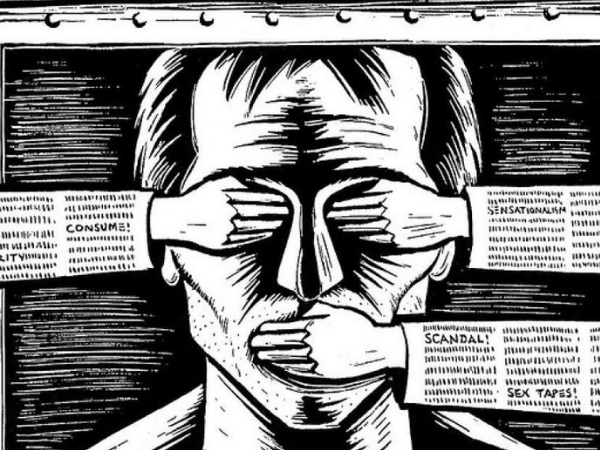
WASHINGTON, D.C. — The Rutherford Institute is warning against a growing cancel culture mindset within government agencies across the political spectrum that seeks to censor, ostracize and shun those with opposing, disfavored, or politically unpopular viewpoints.

Weighing in before the U.S. Supreme Court with an amicus brief in NRA of Am. v. Vullo, The Rutherford Institute, FIRE, the National Coalition Against Censorship, and the First Amendment Lawyers Association are challenging efforts by a New York state regulator to circumvent the First Amendment and indirectly penalize the National Rifle Association by pressuring regulated insurance companies to disassociate from and stop offering certain services to the pro-gun advocacy group.

“Knowing what we know about the government’s tendency to attach its own labels to behavior and speech that challenges its authority, these efforts to ostracize those with politically unpopular viewpoints should be cause for alarm across the entire political spectrum,” said constitutional attorney John W. Whitehead, president of The Rutherford Institute and author of Battlefield America: The War on the American People. “Whatever government-driven censorship we tolerate now are destined to serve as the building blocks for greater acts of tyranny.”

In October 2017, the New York State Department of Financial Services (DFS) opened an investigation into an NRA-endorsed insurance program called “Carry Guard,” which provided coverage for losses caused by licensed firearm use, including criminal defense costs resulting from the intentional use of a firearm in wrongdoing, which was a violation of New York law. DFS Superintendent Maria Vullo met with one of the insurance companies under investigation, which was facing millions in fines, and explained how the company could come into compliance, including by no longer providing insurance to gun groups like the NRA. Vullo also sought the company’s aid in DFS’s campaign against gun groups following the February 2018 school shooting in Parkland, Florida. Later, Vullo called upon banks and insurance companies doing business in New York to consider the risks, including reputational risks, which might arise from doing business with the NRA, urging them to join others that had discontinued their associations with the NRA. Multiple entities publicly severed their ties or determined not to do business with the NRA.

In response, the NRA filed a First Amendment lawsuit against Vullo. While the district court would have allowed that claim to proceed to trial, the Second Circuit Court of Appeals ordered the case to be dismissed. Noting that government officials can address issues of public concern as long as they do not use their regulatory powers to coerce entities into refraining from protected speech, the Second Circuit concluded that Vullo did not appear to have crossed the line between proper attempts to convince and improper attempts to coerce. But pointing to Vullo’s words, the perception of a threat for companies continuing to do business with the NRA, and the power of DFS’ regulatory authority as factors showing improper coercion to indirectly censor the NRA, the amici are urging the Supreme Court to make clear that government officials cannot sidestep the First Amendment by framing censorship demands as informal requests.

Robert Corn-Revere, Ronald G. London, Will Creeley, and Joshua A. House with FIRE advanced the arguments in the amicus brief in NRA v. Vullo.

The Rutherford Institute, a nonprofit civil liberties organization, provides legal assistance at no charge to individuals whose constitutional rights have been threatened or violated and educates the public on a wide spectrum of issues affecting their freedoms.

Source: http://tinyurl.com/yv2vjaby

“No president from either party should have the sole power to shut down or take control of the internet or any other of our communication channels during an emergency.”—Senator Rand Paul

What’s to stop the U.S. government from throwing the kill switch and shutting down phone and internet communications in a time of so-called crisis?

After all, it’s happening all over the world.

Communications kill switches have become tyrannical tools of domination and oppression to stifle political dissent, shut down resistance, forestall election losses, reinforce military coups, and keep the populace isolated, disconnected and in the dark, literally and figuratively.

As the Guardian reports, “From Ukraine to Myanmar, government-run internet outages are picking up pace around the world. In 2021, there were 182 shutdowns in 34 countries… Countries across Africa and Asia have turned to shutdowns in a bid to control behaviour, while India, largely in the conflict-ridden region of Jammu and Kashmir, plunged into digital darkness more times than any other last year… Civil unrest in Ethiopia and Kazakhstan has triggered internet shutdowns as governments try to prevent political mobilisation and stop news about military suppression from emerging.”

In an internet-connected age, killing the internet is tantamount to bringing everything—communications, commerce, travel, the power grid—to a standstill.

Tyrants and would-be tyrants rely on this “cloak of darkness” to advance their agendas.

In Myanmar, for example, the internet shutdown came on the day a newly elected government was to have been sworn in. That’s when the military staged a digital coup and seized power. Under cover of a communications blackout that cut off the populace from the outside world and each other, the junta “carried out nightly raids, smashing down doors to drag out high-profile politicians, activists and celebrities.”

These government-imposed communications shutdowns serve to not only isolate, terrorize and control the populace, but also underscore the citizenry’s lack of freedom in the face of the government’s limitless power.

Yet as University of California Irvine law professor David Kaye explains, these kill switches are no longer exclusive to despotic regimes. They have “migrated into a toolbox for governments that actually do have the rule of law.”

This is what digital authoritarianism looks like in a technological age.

Digital authoritarianism, as the Center for Strategic and International Studies cautions, involves the use of information technology to surveil, repress, and manipulate the populace, endangering human rights and civil liberties, and co-opting and corrupting the foundational principles of democratic and open societies, “including freedom of movement, the right to speak freely and express political dissent, and the right to personal privacy, online and off.”

For those who insist that it can’t happen here, it can and it has.

In 2005, cell service was disabled in four major New York tunnels, reportedly to avert potential bomb detonations via cell phone.

In 2009, those attending President Obama’s inauguration had their cell signals blocked—again, same rationale.

And in 2011, San Francisco commuters had their cell phone signals shut down, this time, to thwart any possible protests over a police shooting of a homeless man.

With shutdowns becoming harder to detect, who’s to say it’s not still happening?

Although an internet kill switch is broadly understood to be a complete internet shutdown, it can also include a broad range of restrictions such as content blocking, throttling, filtering, complete shutdowns, and cable cutting.

As Global Risk Intel explains:

“Content blocking is a relatively moderate method that blocks access to a list of selected websites or applications. When users access these sites and apps, they receive notifications that the server could not be found or that access was denied by the network administrator. A more subtle method is throttling. Authorities decrease the bandwidth to slow down the speed at which specific websites can be accessed. A slow internet connection discourages users to connect to certain websites and does not arouse immediate suspicion. Users may assume that connection service is slow but may not conclude that this circumstance was authorized by the government. Filtering is another tool to censor targeted content and erases specific messages and terms that the government does not approve of.”

How often do most people, experiencing server errors and slow internet speeds, chalk it up to poor service? Who would suspect the government of being behind server errors and slow internet speeds?

Then again, this is the same government that has subjected us to all manner of encroachments on our freedoms (lockdowns, mandates, restrictions, contact tracing programs, heightened surveillance, censorship, overcriminalization, shadow banning, etc.) in order to fight the COVID-19 pandemic, preserve the integrity of elections, and combat disinformation.

These tactics have become the tools of domination and oppression in an internet-dependent age.

It really doesn’t matter what the justifications are for such lockdowns. No matter the rationale, the end result is the same: an expansion of government power in direct proportion to the government’s oppression of the citizenry.

According to Global Risk Intel, there are many motives behind such restrictions:

“For instance, the kill switch serves to censor content and constrain the spread of news. This particularly concerns news reports that cover police brutality, human rights abuses, or educational information. Governments may also utilize the kill switch to prevent government-critical protestors from communicating through message applications like WhatsApp, Facebook, or Twitter and organizing mass demonstrations. Therefore, internet restrictions can provide a way of regulating the flow of information and hindering dissent. Governments reason that internet limitations help stop the spread of fake news and strengthen national security and public safety in times of unrest.”

In this age of manufactured crises, emergency powers and technofascism, the government already has the know-how, the technology and the authority.

Now all it needs is the “right” crisis to flip the kill switch.

This particular kill switch can be traced back to the Communications Act of 1934. Signed into law by President Franklin D. Roosevelt, the Act empowers the president to suspend wireless radio and phone services “if he deems it necessary in the interest of national security or defense” during a time of “war or a threat of war, or a state of public peril or disaster or other national emergency, or in order to preserve the neutrality of the United States.”

In the event of a national crisis, the president has a veritable arsenal of emergency powers that override the Constitution and can be activated at a moment’s notice. These range from imposing martial law and suspending habeas corpus to shutting down all forms of communications, restricting travel and implementing a communications kill switch.

That national emergency can take any form, can be manipulated for any purpose and can be used to justify any end goal—all on the say so of the president.

The seeds of this ongoing madness were sown several decades ago when George W. Bush stealthily issued two presidential directives that granted the president the power to unilaterally declare a national emergency, which is loosely defined as “any incident, regardless of location, that results in extraordinary levels of mass casualties, damage, or disruption severely affecting the U.S. population, infrastructure, environment, economy, or government functions.

Comprising the country’s Continuity of Government (COG) plan, these directives (National Security Presidential Directive 51 and Homeland Security Presidential Directive 20), which do not need congressional approval, provide a skeletal outline of the actions the president will take in the event of a “national emergency.”

Just what sort of actions the president will take once he declares a national emergency can barely be discerned from the barebones directives. However, one thing is clear: in the event of a perceived national emergency, the COG directives give unchecked executive, legislative and judicial power to the president.

The country would then be subjected to martial law by default, and the Constitution and the Bill of Rights would be suspended.

The internet kill switch is just one piece of the government’s blueprint for locking down the nation and instituting martial law.

There may be many more secret powers that presidents may institute in times of so-called crisis without oversight from Congress, the courts, or the public. These powers do not expire at the end of a president’s term. They remain on the books, just waiting to be used or abused by the next political demagogue.

Given the government’s penchant for weaponizing one national crisis after another in order to expand its powers and justify all manner of government tyranny in the so-called name of national security, it’s only a matter of time before this particular emergency power to shut down the internet is activated.

Then again, an all-out communications blackout is just a more extreme version of the technocensorship that we’ve already been experiencing at the hands of the government and its corporate allies.

Packaged as an effort to control the spread of speculative or false information in the name of national security, restricting access to social media has become a popular means of internet censorship.

In fact, these tactics are at the heart of several critical cases before the U.S. Supreme Court over who gets to control, regulate or remove what content is shared on the internet: the individual, corporate censors or the police state.

Nothing good can come from techno-censorship.

As Glenn Greenwald writes for The Intercept:

“The glaring fallacy that always lies at the heart of pro-censorship sentiments is the gullible, delusional belief that censorship powers will be deployed only to suppress views one dislikes, but never one’s own views… Facebook is not some benevolent, kind, compassionate parent or a subversive, radical actor who is going to police our discourse in order to protect the weak and marginalized or serve as a noble check on mischief by the powerful. They are almost always going to do exactly the opposite: protect the powerful from those who seek to undermine elite institutions and reject their orthodoxies. Tech giants, like all corporations, are required by law to have one overriding objective: maximizing shareholder value. They are always going to use their power to appease those they perceive wield the greatest political and economic power.

As I make clear in my book Battlefield America: The War on the American People and in its fictional counterpart The Erik Blair Diaries, these censors are laying the groundwork to preempt any “dangerous” ideas that might challenge the power elite’s stranglehold over our lives.

Whatever powers you allow the government and its corporate operatives to claim now, whatever the reason might be, will at some point in the future be abused and used against you by tyrants of your own making.

By the time you add AI technologies, social credit systems, and wall-to-wall surveillance into the mix, you don’t even have to be a critic of the government to get snared in the web of digital censorship.

Eventually, as George Orwell predicted, telling the truth will become a revolutionary act.

Source: http://tinyurl.com/3xteeb7c

ABOUT JOHN W. WHITEHEAD

Constitutional attorney and author John W. Whitehead is founder and president of The Rutherford Institute. His most recent books are the best-selling Battlefield America: The War on the American People, the award-winning A Government of Wolves: The Emerging American Police State, and a debut dystopian fiction novel, The Erik Blair Diaries. Whitehead can be contacted at staff@rutherford.org. Nisha Whitehead is the Executive Director of The Rutherford Institute. Information about The Rutherford Institute is available at www.rutherford.org.

Publication Guidelines / Reprint Permission

John W. Whitehead’s weekly commentaries are available for publication to newspapers and web publications at no charge. Please contact staff@rutherford.org to obtain reprint permission.

WASHINGTON, DC —The Rutherford Institute is once again pushing back against the U.S. Census Bureau’s efforts to amass sensitive private information about individual citizens and their property through its mandatory American Community Survey (ACS).

In addition to the already extensive and invasive list of personal questions included on the ACS, the Census Bureau issued a notice of proposed information collection seeking to add questions about each household member’s level of certain disabilities, including mental disabilities, and whether they have psychosocial, cognitive, or speech disabilities. The Bureau also seeks to ask about possession of electric vehicles, use of solar panels, type of sewage disposal, and other matters.

Previously, the Bureau sought to ask about each person’s sexual orientation and gender identity. Institute attorneys submitted formal public comments in opposition to the Bureau mandating that people answer the ACS and these additional questions, arguing that the Bureau’s threats and intimidation tactics to force people to respond to the ACS seeks to compel speech in violation of the First Amendment and violates the right to privacy from government intrusion under the Fourth Amendment.

For individuals alarmed by the U.S. Census Bureau’s efforts to collect and track private information about the citizenry, their home life and personal habits, The Rutherford Institute has made its updated “Constitutional Q&A: American Community Survey” guidelines available. The Institute has also provided a form letter of complaint for lodging objections to the ACS with the Census Bureau.

“In an age when the government has significant technological resources at its disposal to not only carry out warrantless surveillance on American citizens but also to harvest and mine that data for its own dubious purposes, whether it be crime-mapping or profiling based on race or religion, the potential for abuse is grave,” said constitutional attorney John W. Whitehead, president of The Rutherford Institute and author of Battlefield America: The War on the American People. “Any attempt by the government to encroach upon the citizenry’s privacy rights or establish a system by which the populace can be targeted, tracked, and singled out must be met with extreme caution. The American Community Survey qualifies as a government program whose purpose, while seemingly benign, raises significant constitutional concerns.”

The American Community Survey (ACS) is a highly invasive, ongoing monthly survey issued by the U.S. Census Bureau to collect detailed housing and socioeconomic data from about 3.5 million households each year. The ACS requires recipients to provide the government with extensive and sensitive information about each and every person in their household, including their work schedules, their physical disabilities and limitations, the number of automobiles kept at the residence, and their access to phone-service and the internet. The information collected by the ACS is not anonymous: the survey is to contain the name, age, sex, race, and home address of each person at the residence, along with their relationship to the person who fills out the form and that person’s phone number. There are so many questions on the ACS that it is estimated the average household will have to take 40 minutes to answer the questions.

When people do not respond online or by mail, the Census Bureau repeatedly sends field representatives to their homes at unannounced times to harass and interview them until they answer the survey. People have reported that field representatives remained outside their houses for hours while waiting for them to arrive home or come out, have walked around their homes, and have talked to minor children when parents were away. The questions on the ACS are so invasive that many initially think the survey is a phishing scam to steal their personal information. Institute attorneys warn that the data collected and amassed by the Census Bureau through the ACS would be a goldmine for criminals.

The Rutherford Institute, a nonprofit civil liberties organization, defends individuals whose constitutional rights have been threatened or violated and educates the public on a wide spectrum of issues affecting their freedoms.

Source: http://tinyurl.com/5t4wtfex

“When the President does it, that means that it is not illegal.”—Richard Nixon

Many years ago, a newspaper headline asked the question: “What’s the difference between a politician and a psychopath?

The answer, then and now, remains the same: None.

There is no difference between psychopaths and politicians.

Nor is there much of a difference between the havoc wreaked on innocent lives by uncaring, unfeeling, selfish, irresponsible, parasitic criminals and elected officials who lie to their constituents, trade political favors for campaign contributions, turn a blind eye to the wishes of the electorate, cheat taxpayers out of hard-earned dollars, favor the corporate elite, entrench the military industrial complex, and spare little thought for the impact their thoughtless actions and hastily passed legislation might have on defenseless citizens.

Psychopaths and politicians both have a tendency to be selfish, callous, remorseless users of others, irresponsible, pathological liars, glib, con artists, lacking in remorse and shallow.

Charismatic politicians, like criminal psychopaths, exhibit a failure to accept responsibility for their actions, have a high sense of self-worth, are chronically unstable, have socially deviant lifestyles, need constant stimulation, have parasitic lifestyles and possess unrealistic goals.

It doesn’t matter whether you’re talking about Democrats or Republicans.

Political psychopaths are all largely cut from the same pathological cloth, brimming with seemingly easy charm and boasting calculating minds. Such leaders eventually create pathocracies: totalitarian societies bent on power, control, and destruction of both freedom in general and those who exercise their freedoms.

Once psychopaths gain power, the result is usually some form of totalitarian government or a pathocracy. “At that point, the government operates against the interests of its own people except for favoring certain groups,” author James G. Long notes. “We are currently witnessing deliberate polarizations of American citizens, illegal actions, and massive and needless acquisition of debt. This is typical of psychopathic systems, and very similar things happened in the Soviet Union as it overextended and collapsed.”

In other words, electing a psychopath to public office is tantamount to national hara-kiri, the ritualized act of self-annihilation, self-destruction and suicide. It signals the demise of democratic government and lays the groundwork for a totalitarian regime that is legalistic, militaristic, inflexible, intolerant and inhuman.

Incredibly, despite clear evidence of the damage that has already been inflicted on our nation and its citizens by a psychopathic government, voters continue to elect psychopaths to positions of power and influence.

Indeed, a study from Southern Methodist University found that Washington, DC—our nation’s capital and the seat of power for our so-called representatives—ranks highest on the list of regions that are populated by psychopaths.

According to investigative journalist Zack Beauchamp, “In 2012, a group of psychologists evaluated every President from Washington to Bush II using ‘psychopathy trait estimates derived from personality data completed by historical experts on each president.’ They found that presidents tended to have the psychopath’s characteristic fearlessness and low anxiety levels — traits that appear to help Presidents, but also might cause them to make reckless decisions that hurt other people’s lives.”

The willingness to prioritize power above all else, including the welfare of their fellow human beings, ruthlessness, callousness and an utter lack of conscience are among the defining traits of the sociopath.

When our own government no longer sees us as human beings with dignity and worth but as things to be manipulated, maneuvered, mined for data, manhandled by police, conned into believing it has our best interests at heart, mistreated, jailed if we dare step out of line, and then punished unjustly without remorse—all the while refusing to own up to its failings—we are no longer operating under a constitutional republic.

Instead, what we are experiencing is a pathocracy: tyranny at the hands of a psychopathic government, which “operates against the interests of its own people except for favoring certain groups.”

Worse, psychopathology is not confined to those in high positions of government. It can spread like a virus among the populace. As an academic study into pathocracy concluded, “[T]yranny does not flourish because perpetuators are helpless and ignorant of their actions. It flourishes because they actively identify with those who promote vicious acts as virtuous.”

People don’t simply line up and salute. It is through one’s own personal identification with a given leader, party or social order that they become agents of good or evil.

Much depends on how leaders “cultivate a sense of identification with their followers,” says Professor Alex Haslam. “I mean one pretty obvious thing is that leaders talk about ‘we’ rather than ‘I,’ and actually what leadership is about is cultivating this sense of shared identity about ‘we-ness’ and then getting people to want to act in terms of that ‘we-ness,’ to promote our collective interests. . . . [We] is the single word that has increased in the inaugural addresses over the last century . . . and the other one is ‘America.’”

The goal of the modern corporate state is obvious: to promote, cultivate, and embed a sense of shared identification among its citizens. To this end, “we the people” have become “we the police state.”

We are fast becoming slaves in thrall to a faceless, nameless, bureaucratic totalitarian government machine that relentlessly erodes our freedoms through countless laws, statutes, and prohibitions.

Any resistance to such regimes depends on the strength of opinions in the minds of those who choose to fight back. What this means is that we the citizenry must be very careful that we are not manipulated into marching in lockstep with an oppressive regime.

Writing for ThinkProgress, Beauchamp suggests that “one of the best cures to bad leaders may very well be political democracy.”

But what does this really mean in practical terms?

It means holding politicians accountable for their actions and the actions of their staff using every available means at our disposal: through investigative journalism (what used to be referred to as the Fourth Estate) that enlightens and informs, through whistleblower complaints that expose corruption, through lawsuits that challenge misconduct, and through protests and mass political action that remind the powers-that-be that “we the people” are the ones that call the shots.

Remember, education precedes action. Citizens need to the do the hard work of educating themselves about what the government is doing and how to hold it accountable. Don’t allow yourselves to exist exclusively in an echo chamber that is restricted to views with which you agree. Expose yourself to multiple media sources, independent and mainstream, and think for yourself.

For that matter, no matter what your political leanings might be, don’t allow your partisan bias to trump the principles that serve as the basis for our constitutional republic. As Beauchamp notes, “A system that actually holds people accountable to the broader conscience of society may be one of the best ways to keep conscienceless people in check.”

That said, if we allow the ballot box to become our only means of pushing back against the police state, the battle is already lost.

Resistance will require a citizenry willing to be active at the local level.

Yet if you wait to act until the SWAT team is crashing through your door, until your name is placed on a terror watch list, until you are reported for such outlawed activities as collecting rainwater or letting your children play outside unsupervised, then it will be too late.

This much I know: we are not faceless numbers.

We are not cogs in the machine.

As I make clear in my book Battlefield America: The War on the American People and in its fictional counterpart The Erik Blair Diaries, we are not slaves.

We are human beings, and for the moment, we have the opportunity to remain free—that is, if we tirelessly advocate for our rights and resist at every turn attempts by the government to place us in chains.

The Founders understood that our freedoms do not flow from the government. They were not given to us only to be taken away by the will of the State. They are inherently ours. In the same way, the government’s appointed purpose is not to threaten or undermine our freedoms, but to safeguard them.

Until we can get back to this way of thinking, until we can remind our fellow Americans what it really means to be free, and until we can stand firm in the face of threats to our freedoms, we will continue to be treated like slaves in thrall to a bureaucratic police state run by political psychopaths.

Source: http://tinyurl.com/3r4n5evz

ABOUT JOHN W. WHITEHEAD

Constitutional attorney and author John W. Whitehead is founder and president of The Rutherford Institute. His most recent books are the best-selling Battlefield America: The War on the American People, the award-winning A Government of Wolves: The Emerging American Police State, and a debut dystopian fiction novel, The Erik Blair Diaries. Whitehead can be contacted at staff@rutherford.org. Nisha Whitehead is the Executive Director of The Rutherford Institute. Information about The Rutherford Institute is available at www.rutherford.org.

Publication Guidelines / Reprint Permission

John W. Whitehead’s weekly commentaries are available for publication to newspapers and web publications at no charge. Please contact staff@rutherford.org to obtain reprint permission.

Figure One: Just stop a few of their machines and radios and telephones and lawn mowers…throw them into darkness for a few hours and then you just sit back and watch the pattern. 

Figure Two: And this pattern is always the same? 

Figure One: With few variations. They pick the most dangerous enemy they can find…and it’s themselves. And all we need do is sit back…and watch…and let them destroy themselves. — “The Monsters Are Due on Maple Street,” Twilight Zone

Will 2024 be the year the Deep State’s exercise in controlled chaos finally gives way to an apocalyptic dismantling of our constitutional republic, or what’s left of it?

All the signs seem to point in this direction.

For years now, the government has been pushing us to the brink of a national nervous breakdown.

This breakdown—triggered by polarizing circus politics, media-fed mass hysteria, militarization and militainment (the selling of war and violence as entertainment), a sense of hopelessness and powerlessness in the face of growing corruption, the government’s alienation from its populace, and an economy that has much of the population struggling to get by—has manifested itself in the polarized, manipulated mayhem, madness and tyranny that is life in the American police state today.

Why is the Deep State engineering this societal madness? What’s in it for the government?

What is playing out before us is a chilling lesson in social engineering that keeps the populace fixated on circus politics and conveniently timed spectacles, distracted from focusing too closely on the government’s power grabs, and incapable of standing united in defense of our freedoms.

It’s not conspiratorial.

It’s a power play.

Rod Serling, the creator of the Twilight Zone, understood the dynamics behind this power play.

In the Twilight Zone episode, “The Monsters Are Due on Maple Street,” Serling imagined a world in which the powers-that-be carry out a social experiment to see how long it would take before the members of a small American neighborhood, frightened by a sudden loss of electric power and caught up in fears of the unknown, will transform into an irrational mob and turn on each other.

It doesn’t take long at all.

Likewise, in Netflix’s apocalyptic thriller Leave the World Behind (produced by Barack and Michelle Obama’s studio), unexplained crises lead to a technological blackout that leaves the populace disconnected, disoriented, isolated, suspicious, and under attack from mysterious ailments and each other.

As one of Leave the World’s characters speculates, the culprit behind the escalating catastrophes, which range from WiFi outages and mysterious health ailments to cities under siege from rogue forces, may be the result of a military campaign intended to destabilize a nation by forcing people to turn against each other.

It’s really not so far-flung a scenario when you consider some of the many ways the government already has the ability to manufacture crises in order to sow fear, fuel hysteria, destabilize the nation and institute martial law.

The government has the tools and the know-how to manufacture health crises. Long before COVID-19 locked down the nation, the U.S. government was creating lethal viruses and unleashing them on an unsuspecting public.

The government has the tools and the know-how to manufacture civil unrest and political upheaval. Since the days of J. Edgar Hoover, the FBI has been using agent provocateurs to infiltrate activist groups in order to “expose, disrupt, misdirect, discredit and otherwise neutralize” them.

The government has the tools and the know-how to manufacture economic instability. As the national debt continues to rise upwards of $34 trillion, with little attempt by federal agencies to curtail spending, it stands as the single-most pressing threat to the economy.

The government has the tools and the know-how to manufacture environmental disasters. Deployed in 1947, Project Cirrus, an early precursor to HAARP, the government’s weather-altering agency, attempted to disable a hurricane as it was moving out to sea. Instead of weakening the storm, however, the government steered it straight into Georgia, resulting in millions of dollars in damaged properties.

The government has the tools and the know-how to manufacture communications blackouts. Internet and cell phone kill switches enable the government to shut down communications at a moment’s notice. It’s a practice that has been used before in the U.S. In 2005, cell service was disabled in four major New York tunnels (reportedly to avert potential bomb detonations via cell phone). In 2009, those attending President Obama’s inauguration had their cell signals blocked (again, same rationale). And in 2011, San Francisco commuters had their cell phone signals shut down (this time, to thwart any possible protests over a police shooting of a homeless man).

The government has the tools and the know-how to manufacture terrorist attacks. Indeed, the FBI has a pattern and practice of entrapment that involves targeting vulnerable individuals, feeding them with the propaganda, know-how and weapons intended to turn them into terrorists, and then arresting them as part of an elaborately orchestrated counterterrorism sting.

The government has the tools and the know-how to manufacture propaganda aimed at mind control and psychological warfare. Not long ago, the Pentagon was compelled to order a sweeping review of clandestine U.S. psychological warfare operations (psy ops) conducted through social media platforms. The investigation came in response to reports suggesting that the U.S. military had been creating bogus personas with AI-generated profile pictures and fictitious media sites on Facebook, Twitter and Instagram in order to manipulate social media users. Of the many weapons in the government’s vast arsenal, psychological warfare (or psy ops) can take many forms: mind control experiments, behavioral nudging, propaganda. In fact, the CIA spent nearly $20 million on its MKULTRA program, reportedly as a means of programming people to carry out assassinations and, to a lesser degree, inducing anxieties and erasing memories, before it was supposedly shut down.

We must never forget that the government no longer exists to serve its people, protect their liberties and ensure their happiness.

Rather, “we the people” are the unfortunate victims of the diabolical machinations of a make-works program carried out on an epic scale whose only purpose is to keep the powers-that-be permanently (and profitably) employed.

This is how tyranny rises and freedom falls.

Almost every tyranny being perpetrated by the U.S. government against the citizenry—purportedly to keep us safe and the nation secure—has come about as a result of some threat manufactured in one way or another by our own government.

Think about it: Cyberwarfare. Terrorism. Bio-chemical attacks. The nuclear arms race. Surveillance. The drug wars. Domestic extremism. The COVID-19 pandemic.

In almost every instance, the U.S. government has in its typical Machiavellian fashion sown the seeds of terror domestically and internationally in order to expand its own totalitarian powers.

Consider that this very same government has taken every bit of technology sold to us as being in our best interests—GPS devices, surveillance, nonlethal weapons, etc.—and used it against us, to track, trap and control us.

Are you getting the picture yet?

The U.S. government isn’t protecting us from threats to our freedoms.The U.S. government is creating the threats to our freedoms.

It’s telling that in Leave the World Behind, before disaster strikes, the main characters—on their way to a family vacation—are utterly oblivious, connected to their electronic devices and insulated from each other and the world around them. Adding to the disconnect, the family’s teen daughter, Rose, is fixated on binge-watching episodes of Friends, even as the world falls apart around them. As TV critic Jen Chaney explains, the sitcom’s presence in the story “underlines how human beings crave escapism at the expense of embracing the actual present, a different way of ‘leaving the world behind.’

We’re in a similar escapist bubble, suffering from a “crisis of the now,” which keeps us distracted, deluded, amused, and insulated from reality.

Professor Jacques Ellul studied this phenomenon of overwhelming news, short memories and the use of propaganda to advance hidden agendas. “One thought drives away another; old facts are chased by new ones,” wrote Ellul.

“Under these conditions there can be no thought. And, in fact, modern man does not think about current problems; he feels them. He reacts, but he does not understand them any more than he takes responsibility for them. He is even less capable of spotting any inconsistency between successive facts; man’s capacity to forget is unlimited. This is one of the most important and useful points for the propagandists, who can always be sure that a particular propaganda theme, statement, or event will be forgotten within a few weeks.”

Yet in addition to being distracted by our electronic devices and diverted by bread-and-circus entertainment spectacles, we are also being polarized by political theater, which aims to keep us divided and at war with each other.

This is the underlying cautionary tale of Leave the World Behind and “The Monsters Are Due on Maple Street”: we are being manipulated by forces beyond our control.

A popular meme circulating a while back described it this way:

“If you catch 100 red fire ants as well as 100 large black ants, and put them in a jar, at first, nothing will happen. However, if you violently shake the jar and dump them back on the ground the ants will fight until they eventually kill each other. The thing is, the red ants think the black ants are the enemy and vice versa, when in reality, the real enemy is the person who shook the jar. This is exactly what’s happening in society today. Liberal vs. Conservative. Black vs. White. Pro Mask vs. Anti Mask. The real question we need to be asking ourselves is who’s shaking the jar … and why?”

As I make clear in my book Battlefield America: The War on the American People and in its fictional counterpart The Erik Blair Diaries, the government has never stopped shaking the jar.

Source: http://tinyurl.com/9x2brszb

ABOUT JOHN W. WHITEHEAD

Constitutional attorney and author John W. Whitehead is founder and president of The Rutherford Institute. His most recent books are the best-selling Battlefield America: The War on the American People, the award-winning A Government of Wolves: The Emerging American Police State, and a debut dystopian fiction novel, The Erik Blair Diaries. Whitehead can be contacted at staff@rutherford.org. Nisha Whitehead is the Executive Director of The Rutherford Institute. Information about The Rutherford Institute is available at www.rutherford.org.

Publication Guidelines / Reprint Permission

John W. Whitehead’s weekly commentaries are available for publication to newspapers and web publications at no charge. Please contact staff@rutherford.org to obtain reprint permission.