Archive for September, 2023

“Man is born free but everywhere is in chains.”—Jean-Jacques Rousseau

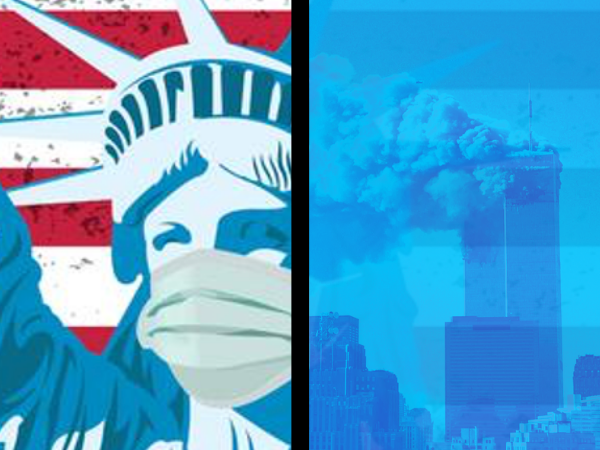
Authoritarian control freaks out to micromanage our lives have become the new normal or, to be more accurate, the new abnormal when it comes to how the government relates to the citizenry.

This overbearing despotism, which pre-dates the COVID-19 hysteria, is the very definition of a Nanny State, where government representatives (those elected and appointed to work for us) adopt the authoritarian notion that the government knows best and therefore must control, regulate and dictate almost everything about the citizenry’s public, private and professional lives.

Indeed, it’s a dangerous time for anyone who still clings to the idea that freedom means the right to think for yourself and act responsibly according to your best judgment.

This tug-of-war for control and sovereignty over our selves impacts almost every aspect of our lives, whether you’re talking about decisions relating to our health, our homes, how we raise our children, what we consume, what we drive, what we wear, how we spend our money, how we protect ourselves and our loved ones, and even who we associate with and what we think.

As Liz Wolfe writes for Reason, “Little things that make people’s lives better, tastier, and less tedious are being cracked down on by big government types in federal and state governments.”

You can’t even buy a stove, a dishwasher, a showerhead, a leaf blower, or a lightbulb anymore without running afoul of the Nanny State.

In this way, under the guise of pseudo-benevolence, the government has meted out this bureaucratic tyranny in such a way as to nullify the inalienable rights of the individual and limit our choices to those few that the government deems safe enough.

Yet limited choice is no choice at all. Likewise, regulated freedom is no freedom at all.

Indeed, as a study by the Cato Institute concludes, for the average American, freedom has declined generally over the past 20 years. As researchers William Ruger and Jason Sorens explain, “We ground our conception of freedom on an individual rights framework. In our view, individuals should be allowed to dispose of their lives, liberties, and property as they see fit, so long as they do not infringe on the rights of others.”

The overt signs of the despotism exercised by the increasingly authoritarian regime that passes itself off as the United States government (and its corporate partners in crime) are all around us: censorship, criminalizing, shadow banning and de-platforming of individuals who express ideas that are politically incorrect or unpopular; warrantless surveillance of Americans’ movements and communications; SWAT team raids of Americans’ homes; shootings of unarmed citizens by police; harsh punishments meted out to schoolchildren in the name of zero tolerance; community-wide lockdowns and health mandates that strip Americans of their freedom of movement and bodily integrity; armed drones taking to the skies domestically; endless wars; out-of-control spending; militarized police; roadside strip searches; privatized prisons with a profit incentive for jailing Americans; fusion centers that spy on, collect and disseminate data on Americans’ private transactions; and militarized agencies with stockpiles of ammunition, to name some of the most appalling.

Yet as egregious as these incursions on our rights may be, it’s the endless, petty tyrannies—the heavy-handed, punitive-laden dictates inflicted by a self-righteous, Big-Brother-Knows-Best bureaucracy on an overtaxed, overregulated, and underrepresented populace—that illustrate so clearly the degree to which “we the people” are viewed as incapable of common sense, moral judgment, fairness, and intelligence, not to mention lacking a basic understanding of how to stay alive, raise a family, or be part of a functioning community.

When the dictates of petty bureaucrats carry greater weight than the individual rights of the citizenry, we’re in trouble, folks.

Federal and state governments have used the law as a bludgeon to litigate, legislate and micromanage our lives through overregulation and overcriminalization.

This is what happens when bureaucrats run the show, and the rule of law becomes little more than a cattle prod for forcing the citizenry to march in lockstep with the government.

Overregulation is just the other side of the coin to overcriminalization, that phenomenon in which everything is rendered illegal, and everyone becomes a lawbreaker.

You don’t have to look far to find abundant examples of Nanny State laws that infantilize individuals and strip them of their ability to decide things for themselves. Back in 2012, then-New York Mayor Michael Bloomberg infamously proposed a ban on the sale of sodas and large sugary drinks in order to guard against obesity. Other localities enacted bans on texting while jaywalking, wearing saggy pants, having too much mud on your car, smoking outdoors, storing trash in your car, improperly sorting your trash, cursing within earshot of others, or screeching your tires.

Yet while there are endless ways for the Nanny State to micromanage our lives, things become truly ominous when the government adopts mechanisms enabling it to monitor us for violations in order to enforce its many laws.

Nanny State, meet the all-seeing, all-knowing Surveillance State and its sidekick, the muscle-flexing Police State.

You see, in an age of overcriminalization—when the law is wielded like a hammer to force compliance to the government’s dictates whatever they might be—you don’t have to do anything “wrong” to be fined, arrested or subjected to raids and seizures and surveillance.

You just have to refuse to march in lockstep with the government.

As policy analyst Michael Van Beek warns, the problem with overcriminalization is that there are so many laws at the federal, state and local levels—that we can’t possibly know them all.

“It’s also impossible to enforce all these laws. Instead, law enforcement officials must choose which ones are important and which are not. The result is that they pick the laws Americans really must follow, because they’re the ones deciding which laws really matter,” concludes Van Beek. “Federal, state and local regulations — rules created by unelected government bureaucrats — carry the same force of law and can turn you into a criminal if you violate any one of them… if we violate these rules, we could be prosecuted as criminals. No matter how antiquated or ridiculous, they still carry the full force of the law. By letting so many of these sit around, just waiting to be used against us, we increase the power of law enforcement, which has lots of options to charge people with legal and regulatory violations.”

This is the police state’s superpower: empowered by the Nanny State, it has been vested with the authority to make our lives a bureaucratic hell.

Indeed, if you were unnerved by the rapid deterioration of privacy under the Surveillance State, prepare to be terrified by the surveillance matrix that will be ushered in by the Nanny State working in tandem with the Police State.

The government’s response to COVID-19 saddled us with a Nanny State inclined to use its draconian pandemic powers to protect us from ourselves.

The groundwork laid with COVID-19 is a prologue to what will become the police state’s conquest of a new, relatively uncharted, frontier: inner space, specifically, the inner workings (genetic, biological, biometric, mental, emotional) of the human race.

Consider how many more ways the government could “protect us” from ourselves under the guise of public health and safety.

For instance, under the guise of public health and safety, the government could use mental health care as a pretext for targeting and locking up dissidents, activists and anyone unfortunate enough to be placed on a government watch list.

When combined with advances in mass surveillance technologies, artificial intelligence-powered programs that can track people by their biometrics and behavior, mental health sensor data (tracked by wearable data and monitored by government agencies such as HARPA), threat assessments, behavioral sensing warnings, precrime initiatives, red flag gun laws, and mental health first-aid programs aimed at training gatekeepers to identify who might pose a threat to public safety, these preemptive mental health programs could well signal a tipping point in the government’s efforts to penalize those engaging in so-called “thought crimes.”

This is how it begins.

On a daily basis, Americans are already relinquishing (in many cases, voluntarily) the most intimate details of who we are—their biological makeup, our genetic blueprints, and our biometrics (facial characteristics and structure, fingerprints, iris scans, etc.)—in order to navigate an increasingly technologically-enabled world.

Having conditioned the population to the idea that being part of society is a privilege and not a right, such access could easily be predicated on social credit scores, the worthiness of one’s political views, or the extent to which one is willing to comply with the government’s dictates, no matter what they might be.

COVID-19 with its talk of mass testing, screening checkpoints, contact tracing, immunity passports, and snitch tip lines for reporting “rule breakers” to the authorities was a preview of what’s to come.

We should all be leery and afraid.

At a time when the government has a growing list—shared with fusion centers and law enforcement agencies—of ideologies, behaviors, affiliations and other characteristics that could flag someone as suspicious and result in their being labeled potential enemies of the state, it won’t take much for any of us to be considered outlaws or terrorists.

After all, the government likes to use the words “anti-government,” “extremist” and “terrorist” interchangeably. The Department of Homeland Security broadly defines extremists as individuals “that are mainly antigovernment, rejecting federal authority in favor of state or local authority, or rejecting government authority entirely.”

At some point, being an individualist will be considered as dangerous as being a terrorist.

When anything goes when it’s done in the name of national security, crime fighting and terrorism, “we the people” have little to no protection against SWAT team raids, domestic surveillance, police shootings of unarmed citizens, indefinite detentions, and the like, whether or  not you’ve done anything wrong.

In an age of overcriminalization, you’re already a criminal.

All the government needs is proof of your law-breaking. They’ll get it, too.

Whether it’s through the use of surveillance software such as ShadowDragon that allows police to watch people’s social media activity, or technology that uses a home’s WiFi router and smart appliances to allow those on the outside to “see” throughout your home, it’s just a matter of time.

As I make clear in my book Battlefield America: The War on the American People and in its fictional counterpart The Erik Blair Diaries, it’s no longer a question of whether the government will lock up Americans for defying one of its numerous mandates but when.

Source: https://tinyurl.com/2jcu7y7v

ABOUT JOHN W. WHITEHEAD

Constitutional attorney and author John W. Whitehead is founder and president of The Rutherford Institute. His most recent books are the best-selling Battlefield America: The War on the American People, the award-winning A Government of Wolves: The Emerging American Police State, and a debut dystopian fiction novel, The Erik Blair Diaries. Whitehead can be contacted at staff@rutherford.org. Nisha Whitehead is the Executive Director of The Rutherford Institute. Information about The Rutherford Institute is available at www.rutherford.org.

Publication Guidelines / Reprint Permission

John W. Whitehead’s weekly commentaries are available for publication to newspapers and web publications at no charge. Please contact staff@rutherford.org to obtain reprint permission.
“There were relatively few secret police, and most were just processing the information coming in. I had found a shocking fact. It wasn’t the secret police who were doing this wide-scale surveillance and hiding on every street corner. It was the ordinary German people who were informing on their neighbors.”—Professor Robert Gellately, author of Backing Hitler

Are you among the 41% of Americans who regularly attend church or some other religious service?

Do you believe the economy is about to collapse and the government will soon declare martial law?

Do you display an unusual number of political and/or ideological bumper stickers on your car?

Are you among the 44% of Americans who live in a household with a gun? If so, are you concerned that the government may be plotting to confiscate your firearms?

If you answered yes to any of the above questions, you may be an anti-government extremist (a.k.a. domestic terrorist) in the eyes of the government and flagged for heightened surveillance and preemptive intervention.

Let that sink in a moment.

If you believe in and exercise your rights under the Constitution (namely, your right to speak freely, worship freely, associate with like-minded individuals who share your political views, criticize the government, own a weapon, demand a warrant before being questioned or searched, or any other activity viewed as potentially anti-government, racist, bigoted, anarchic or sovereign), you have just been promoted to the top of the government’s terrorism watch list.

I assure you I’m not making this stuff up.

So what is the government doing about these so-called American “extremists”?

The government is grooming the American people to spy on each other as part of its Center for Prevention Programs and Partnerships, or CP3 program.

According to journalist Leo Hohmann, the government is handing out $20 million in grants to police, mental health networks, universities, churches and school districts to enlist their help in identifying Americans who might be political dissidents or potential “extremists.”

As Hohmann explains, “Whether it’s COVID and vaccines, the war in Ukraine, immigration, the Second Amendment, LGBTQ ideology and child-gender confusion, the integrity of our elections, or the issue of protecting life in the womb, you are no longer allowed to hold dissenting opinions and voice them publicly in America. If you do, your own government will take note and consider you a potential ‘violent extremist’ and terrorist.”

Cue the dawning of the Snitch State.

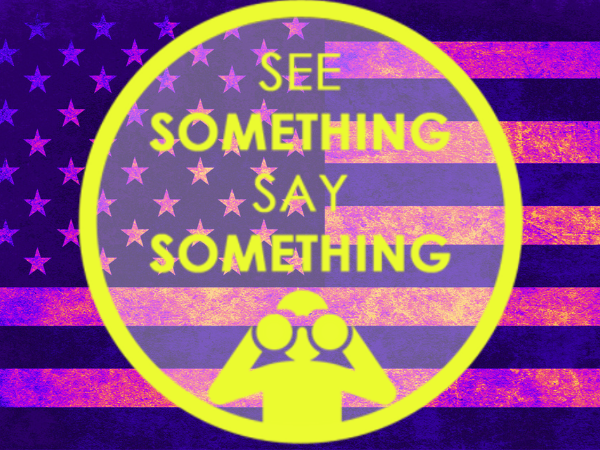
This new era of snitch surveillance is the lovechild of the government’s post-9/11 “See Something, Say Something” programs combined with the self-righteousness of a politically correct, hyper-vigilant, technologically-wired age.

For more than two decades, the Department of Homeland Security has plastered its “See Something, Say Something” campaign on the walls of metro stations, on billboards, on coffee cup sleeves, at the Super Bowl, even on television monitors in the Statue of Liberty. Colleges, universities and even football teams and sporting arenas have lined up for grants to participate in the program.

The government has even designated September 25 as National “If You See Something, Say Something” Awareness Day.

If you see something suspicious, says the DHS, say something about it to the police, call it in to a government hotline, or report it using a convenient app on your smart phone.

This DHS slogan is nothing more than the government’s way of indoctrinating “we the people” into the mindset that we’re an extension of the government and, as such, have a patriotic duty to be suspicious of, spy on, and turn in our fellow citizens.

This is what is commonly referred to as community policing.

Yet while community policing and federal programs such as “See Something, Say Something” are sold to the public as patriotic attempts to be on guard against those who would harm us, they are little more than totalitarian tactics dressed up and repackaged for a more modern audience as well-intentioned appeals to law and order and security.

The police state could not ask for a better citizenry than one that carries out its own policing.

After all, the police can’t be everywhere. So how do you police a nation when your population outnumbers your army of soldiers? How do you carry out surveillance on a nation when there aren’t enough cameras, let alone viewers, to monitor every square inch of the country 24/7? How do you not only track but analyze the transactions, interactions and movements of every person within the United States?

The answer is simpler than it seems: You persuade the citizenry to be your eyes and ears. You hype them up on color-coded “Terror alerts,” keep them in the dark about the distinctions between actual threats and staged “training” drills so that all crises seem real, desensitize them to the sight of militarized police walking their streets, acclimatize them to being surveilled “for their own good,” and then indoctrinate them into thinking that they are the only ones who can save the nation from another 9/11.

Consequently, we now live in a society in which a person can be accused of any number of crimes without knowing what exactly he has done. He might be apprehended in the middle of the night by a roving band of SWAT police. He might find himself on a no-fly list, unable to travel for reasons undisclosed. He might have his phones or internet tapped based upon a secret order handed down by a secret court, with no recourse to discover why he was targeted.

This Kafkaesque nightmare has become America’s reality.

This is how you turn a people into extensions of the omniscient, omnipotent, omnipresent police state, and in the process turn a citizenry against each other.

It’s a brilliant ploy, with the added bonus that while the citizenry remains focused on and distrustful of each other and shadowy forces from outside the country, they’re incapable of focusing on more definable threats that fall closer to home—namely, the government and its cabal of Constitution-destroying agencies and corporate partners.

Community policing did not come about as a feel-good, empowering response to individuals trying to “take back” their communities from crime syndicates and drug lords.

Rather, “Community-Oriented Policing” or COPS (short for Community Partnerships, Organizational Transformation, and Problem Solving) is a Department of Justice program designed to foster partnerships between police agencies and members of the community.

To this end, the Justice Department identifies five distinct “partners” in the community policing scheme: law enforcement and other government agencies, community members and groups, nonprofits, churches and service providers, private businesses and the media.

Together, these groups are supposed to “identify” community concerns, “engage” the community in achieving specific goals, serve as “powerful” partners with the government, and add their “considerable resources” to the government’s already massive arsenal of technology and intelligence. The mainstream media’s role, long recognized as being a mouthpiece for the government, is formally recognized as “publicizing” services from government or community agencies or new laws or codes that will be enforced, as well as shaping public perceptions of the police, crime problems, and fear of crime.

Inevitably, this begs the question: if there’s nothing wrong with community engagement, if the police can’t be everywhere at once, if surveillance cameras do little to actually prevent crime, and if we need to “take back our communities” from the crime syndicates and drug lords, then what’s wrong with community policing and “See Something, Say Something”?

What’s wrong is that these programs are not, in fact, making America any safer while turning us into a legalistic, intolerant, squealing, bystander nation.

We are now the unwitting victims of an interconnected, tightly woven, technologically evolving web of real-time, warrantless, wall-to-wall, widening mass surveillance dragnet comprised of fusion centers, red flag laws, behavioral threat assessments, terror watch lists, facial recognition, snitch tip lines, biometric scanners, pre-crime programs, DNA databases, data mining, precognitive technology and contact tracing apps, to name just a few.

This is how the government keeps us under control and in its crosshairs.

By the time you combine the DHS’ “See Something, Say Something” with CP3 and community policing, which has gone global in the guise of the Strong Cities Network program, you’ve got a formula for enabling the government to not only flag distinct “anti-government” segments of the population but locking down the entire nation.

Under the guise of fighting violent extremism “in all of its forms and manifestations” in cities and communities across the world, the Strong Cities Network program works with the UN and the federal government to train local police agencies across America in how to identify, fight and prevent extremism, as well as address intolerance within their communities, using all of the resources at their disposal.

What this program is really all about, however, is community policing on a global scale with the objective being to prevent violent extremism by targeting its source: racism, bigotry, hatred, intolerance, etc. In other words, police will identify, monitor and deter individuals who could be construed as potential extremist “threats,” violent or otherwise, before they can become actual threats.

The government’s war on extremists has been sold to Americans in much the same way that the USA Patriot Act was sold to Americans: as a means of combatting terrorists who seek to destroy America.

However, as we now know, the USA Patriot Act was used as a front to advance the surveillance state, allowing the government to establish a far-reaching domestic spying program that has turned every American citizen into a criminal suspect.

Similarly, the concern with the government’s ongoing anti-extremism program is that it will, in many cases, be utilized to render otherwise lawful, nonviolent activities as potentially extremist.

Keep in mind that the government agencies involved in ferreting out American “extremists” will carry out their objectives—to identify and deter potential extremists—in concert with fusion centers, data collection agencies, behavioral scientists, corporations, social media, and community organizers and by relying on cutting-edge technology for surveillance, facial recognition, predictive policing, biometrics, and behavioral epigenetics (in which life experiences alter one’s genetic makeup).

This is pre-crime on an ideological scale and it’s been a long time coming.

For example, in 2009, the Department of Homeland Security (DHS) released two reports, one on “Rightwing Extremism,” which broadly defines rightwing extremists as individuals and groups “that are mainly antigovernment, rejecting federal authority in favor of state or local authority, or rejecting government authority entirely,” and one on “Leftwing Extremism,” which labeled environmental and animal rights activist groups as extremists.

These reports, which use the words terrorist and extremist interchangeably, indicate that for the government, anyone seen as opposing the government—whether they’re Left, Right or somewhere in between—can be labeled an extremist.

Fast forward a few years, and you have the National Defense Authorization Act (NDAA), which each successive presidential administration has continually re-upped, that allows the military to take you out of your home, lock you up with no access to friends, family or the courts if you’re seen as an extremist.

Now connect the dots, from the 2009 Extremism reports to the NDAA and the far-reaching data crime fusion centers that collect and share surveillance data between local, state and federal police agencies.

Add in tens of thousands of armed, surveillance drones that will soon blanket American skies, facial recognition technology that identifies and tracks you wherever you go and whatever you do. And then to complete the circle, toss in the real-time crime centers which are attempting to “predict” crimes and identify criminals before they happen based on widespread surveillance, complex mathematical algorithms and prognostication programs.

If you can’t read the writing on the wall, you need to pay better attention.

As I point out in my book Battlefield America: The War on the American People and in its fictional counterpart The Erik Blair Diaries, unless we can put the brakes on this dramatic expansion and globalization of the government’s powers, we’re not going to recognize this country five, ten—even twenty—years from now.

As long as “we the people” continue to allow the government to trample our rights in the so-called name of national security, things will get worse, not better.

It’s already worse.

Source: https://tinyurl.com/4af3m2tt

ABOUT JOHN W. WHITEHEAD

Constitutional attorney and author John W. Whitehead is founder and president of The Rutherford Institute. His most recent books are the best-selling Battlefield America: The War on the American People, the award-winning A Government of Wolves: The Emerging American Police State, and a debut dystopian fiction novel, The Erik Blair Diaries. Whitehead can be contacted at staff@rutherford.org. Nisha Whitehead is the Executive Director of The Rutherford Institute. Information about The Rutherford Institute is available at www.rutherford.org.

Publication Guidelines / Reprint Permission

John W. Whitehead’s weekly commentaries are available for publication to newspapers and web publications at no charge. Please contact staff@rutherford.org to obtain reprint permission.
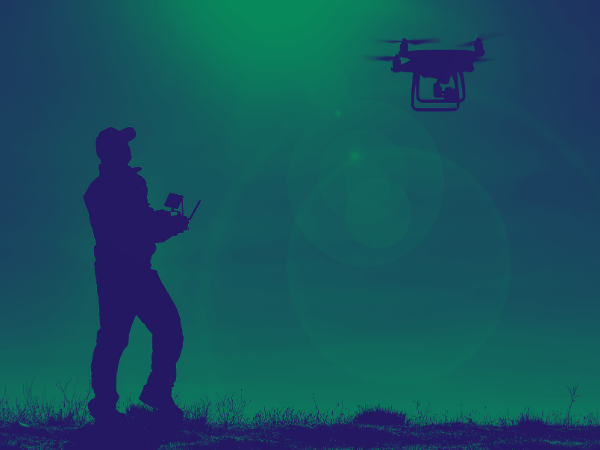
LANSING, Mich. — The Rutherford Institute is pushing back against efforts by government officials to use warrantless aerial drone surveillance to snoop on citizens at home and spy on their private property.

In filing a joint amicus brief with Cato Institute in Long Lake Township v. Maxon, Institute attorneys are calling on the Michigan Supreme Court to hold government officials accountable for violating the Fourth Amendment by not obtaining a search warrant before using a drone to take aerial photographs of private property, which was not observable from the ground, in order to gather evidence of a civil zoning violation.

“Americans are being swept up into a massive digital data dragnet that does not distinguish between those who are innocent of wrongdoing, suspects, or criminals. Aerial drone surveillance has become a de facto snitch for the police state,” said constitutional attorney John W. Whitehead, president of The Rutherford Institute and author of Battlefield America: The War on the American People. “By subjecting Americans to surveillance without their knowledge or compliance, the government has erected the ultimate suspect society. In such an environment, there is no such thing as ‘innocent until proven guilty.’”

In 2008, Long Lake Township brought a zoning action against Todd Maxon, alleging that he was using his five-acre property where he lives as an illegal salvage or junkyard due to having automobiles which he worked on fixing up as a hobby. The case settled that year in Maxon’s favor with a dismissal and the Township agreeing to reimburse a portion of his attorneys’ fees. However, the government did not stop in its pursuit to penalize Maxon and his wife. In 2010, 2016, 2017, and 2018—without obtaining any search warrant—Township officials used a drone to take aerial photographs of the Maxons’ property, which was not visible from the ground because it is blocked by buildings and trees. The Township then filed another zoning action in 2018, alleging that the Maxons had increased the scope of the junk cars and material on their property. The Maxons argued that the aerial surveillance and photographs by the drones of their property was an unlawful search in violation of the Fourth Amendment and should therefore be excluded from evidence because people do not reasonably expect drones with high powered cameras to surveil their private property at relatively low altitudes. The trial court denied the Maxons’ motion to suppress the images.

Noting the maneuverability, speed, and stealth of drones which could fly directly up to an open bathroom window, the Michigan Court of Appeals ruled that persons do have a reasonable expectation of privacy in their property against drone surveillance and that government officials must therefore obtain a warrant for such surveillance. However, although the Court of Appeals held that government officials had violated the Fourth Amendment, the court further held that the exclusionary rule does not apply in civil cases to suppress unconstitutionally obtained evidence. The Maxons appealed to the Michigan Supreme Court. In weighing in before the Court on behalf of the Maxons’ right to be free from warrantless aerial drone surveillance, The Rutherford Institute and Cato Institute warned that failure to apply the exclusionary rule will create a roadmap for the government to circumvent Fourth Amendment protections by simply classifying its fines as “civil” to punish people for violating its laws and ordinances.

Clark M. Neily, III and Laura A. Bondank of the Cato Institute helped advance the arguments in the Long Lake Township v. Maxon amicus brief.

The Rutherford Institute, a nonprofit civil liberties organization, provides legal assistance at no charge to individuals whose constitutional rights have been threatened or violated and educates the public on a wide spectrum of issues affecting their freedoms.

“We the people are the rightful masters of both Congress and the courts, not to overthrow the Constitution but to overthrow the men who pervert the Constitution.” — Abraham Lincoln

Those who gave us the Constitution and the Bill of Rights believed that the government exists at the behest of its citizens. It is there to protect, defend and even enhance our freedoms, not violate them.

Unfortunately, although the Bill of Rights was adopted as a means of protecting the people against government tyranny, in America today, the government does whatever it wants, freedom be damned.

In the 22 years since the USA Patriot Act—a massive 342-page wish list of expanded powers for the FBI and CIA—was rammed through Congress in the wake of the so-called 9/11 terror attacks, it has snowballed into the eradication of every vital safeguard against government overreach, corruption and abuse.

The Patriot Act drove a stake through the heart of the Bill of Rights, violating at least six of the ten original amendments—the First, Fourth, Fifth, Sixth, Seventh and Eighth Amendments—and possibly the Thirteenth and Fourteenth Amendments, as well.

The Patriot Act also redefined terrorism so broadly that many non-terrorist political activities such as protest marches, demonstrations and civil disobedience are now considered potential terrorist acts, thereby rendering anyone desiring to engage in protected First Amendment expressive activities as suspects of the surveillance state.

The Patriot Act justified broader domestic surveillance, the logic being that if government agents knew more about each American, they could distinguish the terrorists from law-abiding citizens—no doubt a reflexive impulse shared by small-town police and federal agents alike.

This, according to Washington Post reporter Robert O’Harrow, Jr., was a fantasy that “had been brewing in the law enforcement world for a long time.” And 9/11 provided the government with the perfect excuse for conducting far-reaching surveillance and collecting mountains of information on even the most law-abiding citizen.

Federal agents and police officers are now authorized to conduct covert black bag “sneak-and-peak” searches of homes and offices while you are away and confiscate your personal property without first notifying you of their intent or their presence.

The law also granted the FBI the right to come to your place of employment, demand your personal records and question your supervisors and fellow employees, all without notifying you; allowed the government access to your medical records, school records and practically every personal record about you; and allowed the government to secretly demand to see records of books or magazines you’ve checked out in any public library and Internet sites you’ve visited (at least 545 libraries received such demands in the first year following passage of the Patriot Act).

In the name of fighting terrorism, government officials are now permitted to monitor religious and political institutions with no suspicion of criminal wrongdoing; prosecute librarians or keepers of any other records if they tell anyone that the government has subpoenaed information related to a terror investigation; monitor conversations between attorneys and clients; search and seize Americans’ papers and effects without showing probable cause; and jail Americans indefinitely without a trial, among other things.

The federal government also made liberal use of its new powers, especially through the use (and abuse) of the nefarious national security letters, which allow the FBI to demand personal customer records from Internet Service Providers, financial institutions and credit companies at the mere say-so of the government agent in charge of a local FBI office and without prior court approval.

In fact, since 9/11, we’ve been spied on by surveillance cameras, eavesdropped on by government agents, had our belongings searched, our phones tapped, our mail opened, our email monitored, our opinions questioned, our purchases scrutinized (under the USA Patriot Act, banks are required to analyze your transactions for any patterns that raise suspicion and to see if you are connected to any objectionable people), and our activities watched.

We’re also being subjected to invasive patdowns and whole-body scans of our persons and seizures of our electronic devices in the nation’s airports. We can’t even purchase certain cold medicines at the pharmacy anymore without it being reported to the government and our names being placed on a watch list.

In this way, “we the people” continue to be terrorized, traumatized, and tricked into a semi-permanent state of compliance by a government that cares nothing for our lives or our liberties.

The bogeyman’s names and faces have changed over time (terrorism, the war on drugs, illegal immigration, a viral pandemic, and more to come), but the end result remains the same: in the so-called name of national security, the Constitution has been steadily chipped away at, undermined, eroded, whittled down, and generally discarded with the support of Congress, the White House, and the courts.

A recitation of the Bill of Rights—set against a backdrop of government surveillance, militarized police, SWAT team raids, asset forfeiture, eminent domain, overcriminalization, armed surveillance drones, whole body scanners, stop and frisk searches, vaccine mandates, lockdowns, and the like (all sanctioned by Congress, the White House, and the courts)—would understandably sound more like a eulogy to freedoms lost than an affirmation of rights we truly possess.

What we are left with today is but a shadow of the robust document adopted more than two centuries ago. Sadly, most of the damage has been inflicted upon the Bill of Rights.

Here is what it means to live under the Constitution, with the nation still suffering blowback from the permanent state of emergency brought about by 9/11 and COVID-19.

The First Amendment is supposed to protect the freedom to speak your mind, assemble and protest nonviolently without being bridled by the government. It also protects the freedom of the media, as well as the right to worship and pray without interference. In other words, Americans should not be silenced by the government. To the founders, all of America was a free speech zone.

Despite the clear protections found in the First Amendment, the freedoms described therein are under constant assault. Increasingly, Americans are being persecuted for exercising their First Amendment rights and speaking out against government corruption. Activists are being arrested and charged for daring to film police officers engaged in harassment or abusive practices. Journalists are being prosecuted for reporting on whistleblowers. States are passing legislation to muzzle reporting on cruel and abusive corporate practices. Religious ministries are being fined for attempting to feed and house the homeless. Protesters are being tear-gassed, beaten, arrested and forced into “free speech zones.” And under the guise of “government speech,” the courts have reasoned that the government can discriminate freely against any First Amendment activity that takes place within a so-called government forum.

The Second Amendment was intended to guarantee “the right of the people to keep and bear arms.” Essentially, this amendment was intended to give the citizenry the means to resist tyrannical government. Yet while gun ownership has been recognized by the U.S. Supreme Court as an individual citizen right, Americans remain powerless to defend themselves against red flag gun laws, militarized police, SWAT team raids, and government agencies armed to the teeth with military weapons better suited to the battlefield.

The Third Amendment reinforces the principle that civilian-elected officials are superior to the military by prohibiting the military from entering any citizen’s home without “the consent of the owner.” With the police increasingly training like the military, acting like the military, and posing as military forces—complete with heavily armed SWAT teams, military weapons, assault vehicles, etc.—it is clear that we now have what the founders feared most—a standing army on American soil.

The Fourth Amendment prohibits government agents from conducting surveillance on you or touching you or encroaching on your private property unless they have evidence that you’re up to something criminal. In other words, the Fourth Amendment ensures privacy and bodily integrity. Unfortunately, the Fourth Amendment has suffered the greatest damage in recent years and has been all but eviscerated by an unwarranted expansion of governmental police powers that include strip searches and even anal and vaginal searches of citizens, surveillance (corporate and otherwise), and intrusions justified in the name of fighting terrorism, as well as the outsourcing of otherwise illegal activities to private contractors.

The Fifth Amendment and the Sixth Amendment work in tandem. These amendments supposedly ensure that you are innocent until proven guilty, and government authorities cannot deprive you of your life, your liberty or your property without the right to an attorney and a fair trial before a civilian judge. However, in the new suspect society in which we live, where surveillance is the norm, these fundamental principles have been upended. Certainly, if the government can arbitrarily freeze, seize or lay claim to your property (money, land or possessions) under government asset forfeiture schemes, you have no true rights.

The Seventh Amendment guarantees citizens the right to a jury trial. Yet when the populace has no idea of what’s in the Constitution—civic education has virtually disappeared from most school curriculums—that inevitably translates to an ignorant jury incapable of distinguishing justice and the law from their own preconceived notions and fears. However, as a growing number of citizens are coming to realize, the power of the jury to nullify the government’s actions—and thereby help balance the scales of justice—is not to be underestimated. Jury nullification reminds the government that “we the people” retain the power to ultimately determine what laws are just.

The Eighth Amendment is similar to the Sixth in that it is supposed to protect the rights of the accused and forbid the use of cruel and unusual punishment. However, the Supreme Court’s determination that what constitutes “cruel and unusual” should be dependent on the “evolving standards of decency that mark the progress of a maturing society” leaves us with little protection in the face of a society lacking in morals altogether.

The Ninth Amendment provides that other rights not enumerated in the Constitution are nonetheless retained by the people. Popular sovereignty—the belief that the power to govern flows upward from the people rather than downward from the rulers—is clearly evident in this amendment. However, it has since been turned on its head by a centralized federal government that sees itself as supreme and which continues to pass more and more laws that restrict our freedoms under the pretext that it has an “important government interest” in doing so.

As for the Tenth Amendment’s reminder that the people and the states retain every authority that is not otherwise mentioned in the Constitution, that assurance of a system of government in which power is divided among local, state and national entities has long since been rendered moot by the centralized Washington, DC, power elite—the president, Congress and the courts.

Thus, if there is any sense to be made from this recitation of freedoms lost, it is simply this: our individual freedoms have been eviscerated so that the government’s powers could be expanded.

It was no idle happenstance that the Constitution, which was adopted 236 years ago on Sept. 17, 1787, opens with these three powerful words: “We the people.” As the Preamble proclaims:

We, the people of the United States, in order to form a more perfect Union, establish justice, insure domestic tranquility, provide for the common defense, promote the general welfare, and secure the blessings of liberty to ourselves and our posterity, do ordain and establish this CONSTITUTION for the United States of America.

In other words, it’s our job to make the government play by the rules of the Constitution.

We are supposed to be the masters and they—the government and its agents—are the servants.

We the American people—the citizenry—are supposed to be the arbiters and ultimate guardians of America’s welfare, defense, liberty, laws and prosperity.

Still, it’s hard to be a good citizen if you don’t know anything about your rights or how the government is supposed to operate.

As the National Review rightly asks, “How can Americans possibly make intelligent and informed political choices if they don’t understand the fundamental structure of their government? American citizens have the right to self-government, but it seems that we increasingly lack the capacity for it.”

Americans are constitutionally illiterate.

Most citizens have little, if any, knowledge about their basic rights. And our educational system does a poor job of teaching the basic freedoms guaranteed in the Constitution and the Bill of Rights.

Teachers and school administrators do not fare much better. A study conducted by the Center for Survey Research and Analysis found that one educator in five was unable to name any of the freedoms in the First Amendment.

Government leaders and politicians are also ill-informed. Although they take an oath to uphold, support and defend the Constitution against “enemies foreign and domestic,” their lack of education about our fundamental rights often causes them to be enemies of the Bill of Rights.

So what’s the solution?

Thomas Jefferson recognized that a citizenry educated on “their rights, interests, and duties”  is the only real assurance that freedom will survive.

From the President on down, anyone taking public office should have a working knowledge of the Constitution and the Bill of Rights and should be held accountable for upholding their precepts. One way to ensure this would be to require government leaders to take a course on the Constitution and pass a thorough examination thereof before being allowed to take office.

Some critics are advocating that students pass the United States citizenship exam in order to graduate from high school. Others recommend that it must be a prerequisite for attending college. I’d go so far as to argue that students should have to pass the citizenship exam before graduating from grade school.

Here’s an idea to get educated and take a stand for freedom: anyone who signs up to become a member of The Rutherford Institute gets a wallet-sized Bill of Rights card and a Know Your Rights card. Use this card to teach your children the freedoms found in the Bill of Rights.

A healthy, representative government is hard work. It takes a citizenry that is informed about the issues, educated about how the government operates, and willing to do more than grouse and complain.

As I point out in my book Battlefield America: The War on the American People and in its fictional counterpart The Erik Blair Diaries, “we the people” have the power to make and break the government.

The powers-that-be want us to remain divided over politics, hostile to those with whom we disagree politically, and intolerant of anyone or anything whose solutions to what ails this country differ from our own. They also want us to believe that our job as citizens begins and ends on Election Day.

Yet there are 330 million of us in this country. Imagine what we could accomplish if we actually worked together, presented a united front, and spoke with one voice.

Tyranny wouldn’t stand a chance.

Source: https://tinyurl.com/4sbcn4jd

ABOUT JOHN W. WHITEHEAD

Constitutional attorney and author John W. Whitehead is founder and president of The Rutherford Institute. His most recent books are the best-selling Battlefield America: The War on the American People, the award-winning A Government of Wolves: The Emerging American Police State, and a debut dystopian fiction novel, The Erik Blair Diaries. Whitehead can be contacted at staff@rutherford.org. Nisha Whitehead is the Executive Director of The Rutherford Institute. Information about The Rutherford Institute is available at www.rutherford.org.

Publication Guidelines / Reprint Permission

John W. Whitehead’s weekly commentaries are available for publication to newspapers and web publications at no charge. Please contact staff@rutherford.org to obtain reprint permission.
“The whole aim of practical politics is to keep the populace alarmed (and hence clamorous to be led to safety) by an endless series of hobgoblins, most of them imaginary.”—H.L. Mencken

First came 9/11, which the government used to transform itself into a police state.

Then the COVID-19 pandemic hit, which the police state used to test out its lockdown powers.

In light of the government’s tendency to exploit crises (legitimate or manufactured) and capitalize on the nation’s heightened emotions, confusion and fear as a means of extending the reach of the police state, one has to wonder what so-called crisis it will declare next.

It’s a simple enough formula: first, you create fear, then you capitalize on it by seizing power.

Frankly, it doesn’t even matter what the nature of the next national emergency might be (terrorism, civil unrest, economic collapse, a health scare, or the environment) as long as it allows the government to lockdown the nation and justify all manner of tyranny in the so-called name of national security.

Cue the Emergency State.

Terrorist attacks, mass shootings, “unforeseen economic collapse, loss of functioning political and legal order, purposeful domestic resistance or insurgency, pervasive public health emergencies, and catastrophic natural and human disasters”: the government has been anticipating and preparing for such crises for years now.

As David C. Unger writes for the New York Times: “Life, liberty, and the pursuit of happiness have given way to permanent crisis management: to policing the planet and fighting preventative wars of ideological containment, usually on terrain chosen by, and favorable to, our enemies. Limited government and constitutional accountability have been shouldered aside by the kind of imperial presidency our constitutional system was explicitly designed to prevent.”

Here’s what we know: given the rate at which the government keeps devising new ways to establish itself as the “solution” to all of our worldly problems at taxpayer expense, each subsequent crisis ushers in ever larger expansions of government power and less individual liberty.

This is the slippery slope to outright tyranny.

You see, once the government acquires (and uses) authoritarian powers—to spy on its citizens, to carry out surveillance, to transform its police forces into extensions of the military, to seize taxpayer funds, to wage endless wars, to censor and silence dissidents, to identify potential troublemakers, to detain citizens without due process—it does not voluntarily relinquish them.

The lesson for the ages is this: once any government is allowed to overreach and expand its powers, it’s almost impossible to put the genie back in the bottle. As Harvard constitutional law professor Laurence Tribe recognizes, “The dictatorial hunger for power is insatiable.

Indeed, the history of the United States is a testament to the old adage that liberty decreases as government (and government bureaucracy) grows. To put it another way, as government expands, liberty contracts.

In this way, every crisis since the nation’s early beginnings has become a make-work opportunity for the government.

Each crisis has also been a test to see how far “we the people” would allow the government to sidestep the Constitution in the so-called name of national security; a test to see how well we have assimilated the government’s lessons in compliance, fear and police state tactics; a test to see how quickly we’ll march in lockstep with the government’s dictates, no questions asked; and a test to see how little resistance we offer up to the government’s power grabs when made in the name of national security.

Most critically of all, it has been a test to see whether the Constitution—and our commitment to the principles enshrined in the Bill of Rights—could survive a national crisis and true state of emergency.

Unfortunately, we’ve been failing this particular test for a long time now.

Indeed, the powers-that-be have been pushing our buttons and herding us along like so much cattle since World War II, at least, starting with the Japanese attacks on Pearl Harbor, which not only propelled the U.S. into World War II but also unified the American people in their opposition to a common enemy.

That fear of attack by foreign threats, conveniently torqued by the growing military industrial complex, in turn gave rise to the Cold War era’s “Red Scare.” Promulgated through government propaganda, paranoia and manipulation, anti-Communist sentiments boiled over into a mass hysteria that viewed anyone and everyone as suspect: your friends, the next-door neighbor, even your family members could be a Communist subversive.

This hysteria, which culminated in hearings before the House Un-American Activities Committee, where hundreds of Americans were called before Congress to testify about their so-called Communist affiliations and intimidated into making false confessions, also paved the way for the rise of an all-knowing, all-seeing governmental surveillance state.

By the time 9/11 rolled around, all George W. Bush had to do was claim the country was being invaded by terrorists, and the government used the USA Patriot Act to claim greater powers to spy, search, detain and arrest American citizens in order to keep America safe.

By way of the National Defense Authorization Act, Barack Obama continued Bush’s trend of undermining the Constitution, going so far as to give the military the power to strip Americans of their constitutional rights, label them extremists, and detain them indefinitely without trialall in the name of keeping America safe.

Despite the fact that the breadth of the military’s power to detain American citizens violates not only U.S. law and the Constitution but also international laws, the government has refused to relinquish its detention powers made possible by the NDAA.

Then Donald Trump took office, claiming the country was being invaded by dangerous immigrants and insisting that the only way to keep America safe was to expand the reach of the border police, empower the military to “assist” with border control, and essentially turn the country into a Constitution-free zone.

That so-called immigration crisis then morphed into multiple crises (domestic extremism, the COVID-19 pandemic, race wars, civil unrest, etc.) that the government has been eager to use in order to expand its powers.

Joe Biden, in turn, has made every effort to expand the reach of the militarized police state, pledging to hire 87,000 more IRS agents and 100,000 police officers, and allowing the FBI to operate as standing army.

What the next crisis will be is anyone’s guess, but you can be sure that there will be a next crisis.

So, what should you expect if the government decides to declare another state of emergency and institutes a nationwide lockdown?

You should expect more of the same, only worse.

More compliance, less resistance.

More fear-mongering, mind-control tactics and less tolerance for those who question the government’s propaganda-driven narratives.

Most of all, you should expect more tyranny and less freedom.

Given the government’s past track record and its long-anticipated plans for using armed forces to solve domestic political and social problems in response to a future crisis, there’s every reason to worry about what comes next.

Mark my words: as I make clear in my book Battlefield America: The War on the American People and in its fictional counterpart The Erik Blair Diaries, if and when another crisis arises—if and when a nationwide lockdown finally hits—if and when martial law is enacted with little real outcry or resistance from the public— then we will truly understand the extent to which the powers-that-be have fully succeeded in acclimating us to a state of affairs in which the government has all the power and “we the people” have none. 

In the meantime, if all we do to reclaim our freedoms and regain control over our runaway government is vote for yet another puppet of the Deep State, by the time the next crisis arises, it may well be too late.

Source: http://tinyurl.com/3sn4waec

ABOUT JOHN W. WHITEHEAD

Constitutional attorney and author John W. Whitehead is founder and president of The Rutherford Institute. His most recent books are the best-selling Battlefield America: The War on the American People, the award-winning A Government of Wolves: The Emerging American Police State, and a debut dystopian fiction novel, The Erik Blair Diaries. Whitehead can be contacted at staff@rutherford.org. Nisha Whitehead is the Executive Director of The Rutherford Institute. Information about The Rutherford Institute is available at www.rutherford.org.

Publication Guidelines / Reprint Permission

John W. Whitehead’s weekly commentaries are available for publication to newspapers and web publications at no charge. Please contact staff@rutherford.org to obtain reprint permission.